Article

Isolation and Identification of Pseudoalteromonas agarivorans LJ53, a Pathogenic Bacterium Causing Bleaching Disease in Saccharina japonica

1
State Key Laboratory of Advanced Environmental Technology, Fujian Key Laboratory of Watershed Ecology, Institute of Urban Environment, Chinese Academy of Sciences, Xiamen 361021, China
2
College of Life Sciences, Hebei University, Baoding 071002, China
3
University of Chinese Academy of Sciences, Beijing 100049, China
4
College of Resources and Environment, Fujian Agriculture and Forestry University, Fuzhou 350002, China
5
Fujian Fisheries Research Institute, Xiamen 361000, China
6
Fujian Provincial Key Laboratory of Ecology-Toxicological Effects & Control for Emerging Contaminants, Key Laboratory of Ecological Environment and Information Altas, School of Architecture and Construction, Putian University, Putian 351100, China
*
Authors to whom correspondence should be addressed.
Water 2026, 18(1), 66; https://doi.org/10.3390/w18010066 (registering DOI)
Submission received: 24 November 2025 / Revised: 23 December 2025 / Accepted: 23 December 2025 / Published: 25 December 2025
(This article belongs to the Special Issue Aquaculture Productivity and Environmental Sustainability)

Abstract

As a major export crop in China, Saccharina japonica cultivation suffers from significant economic losses due to disease outbreaks, with pathogen identification remaining a critical bottleneck for mariculture. In this study, a dominant bacterial strain, LJ53, was isolated from the diseased farmed S. japonica. Artificial challenge assay confirmed that this strain is the direct causative agent of bleaching symptoms on sporophytes. Based on morphological characteristics and 16S rRNA gene-based phylogeny, it was identified as Pseudoalteromonas agarivorans LJ53. Ultrastructural observation revealed that this strain destroyed host cells and caused typical pathological changes such as chloroplast disintegration. Interestingly, metagenomic analysis showed no significant difference in the relative abundance of this pathogen between healthy and diseased S. japonica tissues. However, the co-occurrence network of the disease community exhibited increased connectivity, altered modularity, and features characteristic of microbial dysbiosis. This dysbiosis disrupts the water ecological balance by destabilizing microbial symbiosis and nutrient cycling, which are essential for overall ecosystem resilience. As a result, these imbalances can exacerbate disease transmission and weaken the self-regulating capacity of marine environment, highlighting the need for integrated management strategies to restore equilibrium. These findings provide a theoretical basis for elucidating the mechanisms of bacterial diseases in S. japonica and developing future control strategies.

1. Introduction

Saccharina japonica (S. japonica) is an economically important seaweed that can be used as food and a feedstock in aquaculture [1]. China contributes approximately 60% of the annual yield of S. japonica around the world [1,2], which plays an important role in carbon sinks [3]. However, with the continuous expansion of farming scale, various diseases have become increasingly prevalent. Epiphytic microorganisms are closely related to macroalgae [4,5] and play roles in promoting host growth and development [6], enhancing metabolism [7], and improving defense mechanisms [8,9]. The outbreak of S. japonica disease is often due to dysbiosis caused by environmental or human disturbances such as changes in light, temperature, and nutrients [10], resulting in pathogenic bacteria proliferation. Therefore, it is necessary to isolate and identify pathogenic bacteria to explore their pathogenic mechanism and biological control methods.
In recent years, the bleaching disease [11] has become increasingly serious in the late nursery stage of S. japonica cultivation. The typical symptom is that whitish rot appears at the top of sporophyte filaments and gradually develops into severe blade rot and detachment until death. This emerging pathogen poses a great threat to S. japonica farming and its etiology and control measures have become research priorities. Zhang et al. [11] first identified Pseudoalteromonas piscicida X-8 as the causative agent of juvenile sporophyte bleaching. Ma et al. [12] isolated Vibrio alginolyticus X-2 with antagonistic probiotic effects against X-8, which provided new insights for biological control. Although these studies have made important progress in identifying pathogenic bacteria and preliminary prevention and treatment, the mechanism by which pathogenicity persists throughout different breeding periods remains unclear.
In recent years, the escalating frequency and etiological diversity of disease outbreaks have complicated the identification of primary causative agents in S. japonica farming areas. Consequently, this study sought to isolate and identify pathogenic bacteria using cultivation-based methods and challenge assays. The anticipated outcomes include the establishment of a robust experimental model for examining S. japonica–microbe interactions in commercial aquaculture, as well as providing a theoretical foundation for the development of targeted disease management strategies.

2. Materials and Methods

2.1. Sample Collection

Diseased mature sporophytes of Saccharina japonica exhibiting Hole-Rotten symptoms (Figure 1) were collected from Huangqi Bay, Lianjiang County, Fujian Province, China (26°17′16″ N, 119°49′34″ E) on 29 March 2024. All samples were stored in an ice box with ice packs and were transported to the laboratory within 4 h.

2.2. Bacterial Isolation

The diseased S. japonica was rinsed with sterile seawater to remove loosely attached epiphytes. Then, 1 g of the S. japonica sample was then weighed and homogenized into a uniform slurry, which was subsequently subjected to serial dilution. A 100 μL of each dilution was spread in triplicate on Sodium Alginate (SA) [13] and Zobell 2216E marine agar [14], followed by incubation at 25 °C for 3–5 days. Distinct colonies were selected and purified through re-streaking on the plates at least three times. The purified strains were finally preserved in 25% (v/v) glycerol at −80 °C for long-term storage.

2.3. Re-Infection Assay

The isolated strains were cultured in 100 mL of fresh Zobell 2216E liquid medium at 25 °C for 24 h on a shaker. After cultivation, the bacterial cultures were centrifuged and washed three times. The pellets were resuspended in sterile seawater and diluted to an optical density at 600 nm (OD600) of approximately 0.5 (1.0 × 10⁸ colony-forming units (CFU)/mL). Then, 2.3 mL of this bacterial suspension was dispensed into individual wells of a 24-well plate as the treatment group. For the control group, an equal volume of sterile seawater was added to the wells. Before re-infection, epiphytic microorganisms on S. japonica sporelings were removed by rinsing with sterile seawater three times. A total of 200 healthy sporelings were selected under aseptic conditions and distributed among the plates, with five individuals placed in each well. The plates were then incubated at 10 °C under an irradiance of 1500 lux (light–dark = 14:10 h) for 84 h. The inoculated sporelings were collected at 10 h, 36 h, and 84 h and observed under a light microscope (Baiao-Gu Tech, Beijing, China) to record the symptomatic manifestations of infection.

2.4. Observations of Ultrastructural Changes in the Infected Sporelings Using Transmission Electron Microscope (TEM)

Control and infected S. japonica samples, collected at 36 and 84 h post-infection (hpi), were fixed in 2.5% glutaraldehyde at 4 °C for 10 h and subsequently washed twice with 0.1 M phosphate-buffered saline (PBS). The samples were then post-fixed in 1% osmium tetroxide (OsO4) for 1 h and rinsed again with PBS. Dehydration was performed using a graded series of ethanol-acetone (30%, 50%, 70%, 90%, and 100%) [11]. The dehydrated samples were embedded in Spurr’s epoxy resin and sectioned into ultrathin slices using a Leica UC7 ultramicrotome (Leica, Wetzlar, Germany). The sections were stained with uranyl acetate and lead citrate for 10 min each. Finally, the ultrathin sections were examined using a Hitachi H-7650 TEM (Hitachi, Tokyo, Japan).

2.5. Morphological Observation of the Pathogenic Bacterial Strain

The pathogenic bacteria were cultured on Zobell 2216E agar plates at 26 °C for 24 h. Morphological characteristics (size, colour, and morphology) were documented. A single colony was subsequently transferred to 0.1 M PBS to prepare a bacterial suspension. A droplet of this suspension was applied onto a carbon-coated copper grid (w/v) for 5 min. The sample was negatively stained with 2% phosphotungstic acid for 60 s and air-dried. Ultrastructural morphology of the stained cells was subsequently examined using a Hitachi H-7650 transmission electron microscope (Hitachi, Japan).

2.6. Molecular Identification

Individual colonies were selected from the plate using sterile toothpicks and transferred into 25 μL PCR reaction mixtures, with two replicates prepared for each sample. PCR amplification was performed under the following conditions: initial denaturation at 94 °C for 10 min, followed by 30 cycles of denaturation at 94 °C for 30 s, annealing at 55 °C for 45 s, extension at 72 °C for 60 s and a final extension at 72 °C for 7 min. The PCR products were electrophoresed on 1% agarose gels, and positive amplicons were subsequently subjected to Sanger sequencing [15]. The resulting 16S rRNA gene sequences of the pathogenic bacterial strains were deposited in the NCBI database. The assembled sequences were taxonomically annotated using the EzBioCloud online platform (https://eztaxon-e.ezbiocloud.net/, accessed on 12 November 2025) [16] and aligned by using MEGA 11.0.13 software [17]. A phylogenetic tree was reconstructed based on the neighbor-joining (NJ) method [18] by using MEGA11 software.

2.7. Microbial Community Profiling Analysis

Metagenomic sequencing was performed on the epiphytic bacterial communities of mature sporophyte samples collected in situ. Surface-associated debris was first removed by rinsing the S. japonica with sterile seawater, and then surface swabs were taken from the thallus using sterile cotton. The swabs were transferred to centrifuge tubes and stored at −20 °C until further analysis. A total of 37 samples were analyzed, including 14 replicates of diseased S. japonica, 14 replicates of healthy S. japonica, and 9 replicates of seawater.
Microbial DNA was extracted from both S. japonica and seawater samples using the FastDNA SPIN Kit for Soil (MP Biomedicals, Santa Ana, CA, USA). The qualified DNA was fragmented by the fragmentation reagent in the library construction kit, and then the adapters were ligated to the fragmented DNA using ligation reagents in the kit. The ligation products were purified using magnetic beads and subjected to two rounds of size selection to enrich the fragments with the expected sizes. The size-selected libraries were amplified by PCR using the amplification reagents in the kit and finally purified with DNA magnetic beads. The concentration and fragment size distribution of the final libraries were quality-controlled by Qubit reagents and a bioanalyzer, respectively. The qualified libraries were sequenced on an Illumina NovaSeq 6000 platform (Illumina, San Diego, CA, USA) with paired-end reads (2 × 150 bp) to generate raw shotgun metagenomic reads. The total number of raw reads obtained per sample and the number of reads retained after quality filtering are summarized in Table S1. The data is available under the BioProject accession number PRJNA1390388.
The raw sequencing reads were first quality-controlled and filtered to remove low-quality sequences and host contamination using kneadData (v0.6.1) (https://bitbucket.org/biobakery/kneaddata/wiki/Home, accessed on 9 November 2024). The cleaned reads were then assembled into contigs with a minimum length of 500 bp using MEGAHIT (v1.2.9) [19]. The pre-assembled cleaned reads were used as input for taxonomic classification and quantification. Taxonomic classification was performed using Kraken 2 (v2.0.7) [20]. Subsequently, the relative abundance of each classified taxon was estimated and refined through Bayesian re-estimation using Bracken (v2.0) [21] to obtain accurate quantitative results. To analyze the abundance of the target pathogen Pseudoalteromonas agarivorans, all sequences annotated as this species were extracted from the feature table. Their relative abundance was calculated and compared among the diseased, healthy, and seawater groups using the Wilcoxon rank-sum test. Microbial co-occurrence networks were constructed separately for the diseased and healthy groups. This process involved an initial filtration of low-abundance features followed by the calculation of Spearman’s correlation coefficient between them (|ρ| > 0.6, FDR-adjusted *p* < 0.01). Networks were finally constructed using the igraph package, from which node degree and betweenness centrality were computed.

3. Results

3.1. Isolation of Pathogenic Bacteria and Re-Infection Assay

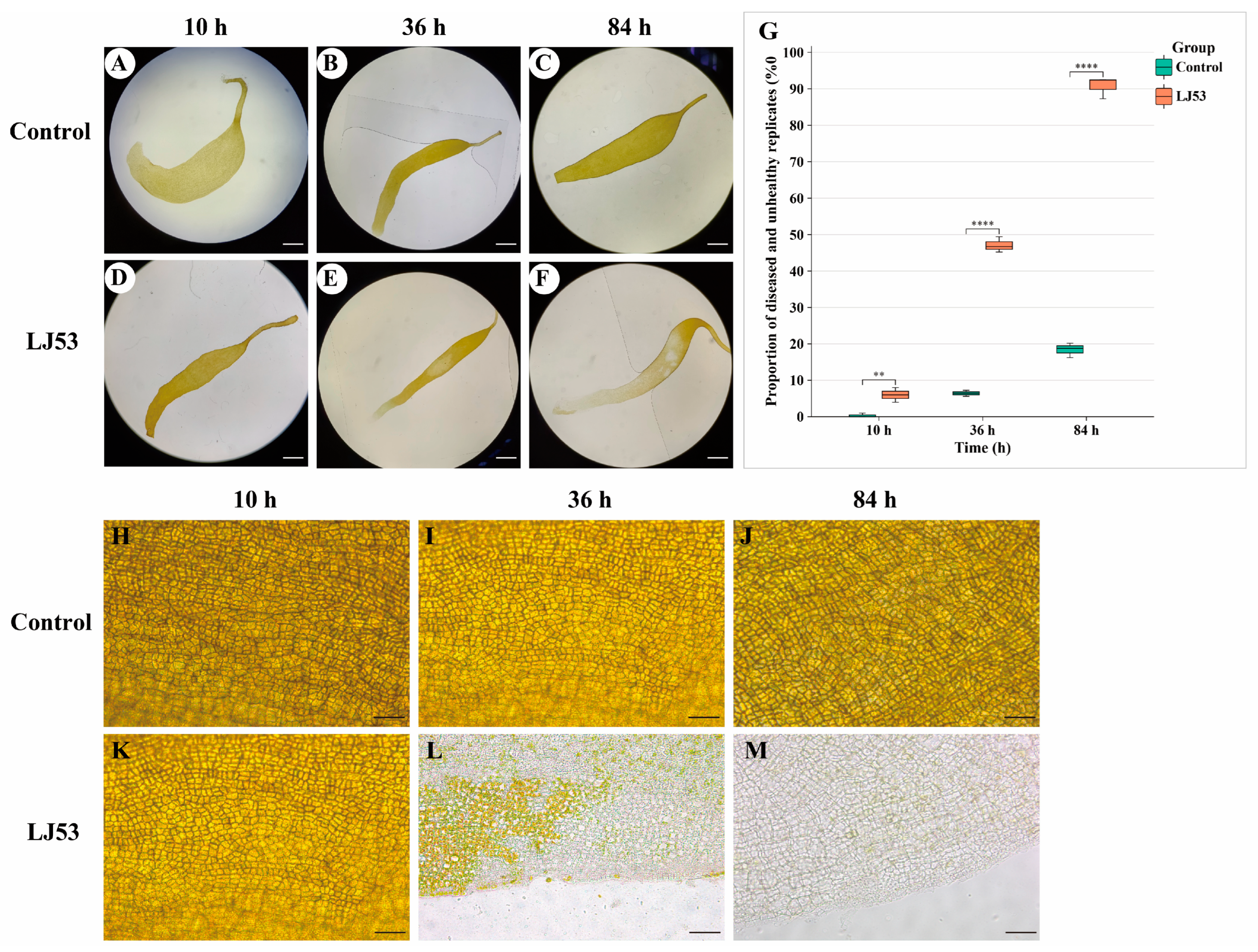
The diseased tissues in the sampled mature sporophytes were mainly distributed on the edges with different sizes of perforations (Figure 1B). Bacterial strains were isolated from the Hole-Rotten diseased mature sporophytes [22,23], and subsequent infection assays identified strain LJ53 as a strain that could cause bleaching symptoms in healthy sporophytes. Compared to the control group (Figure 2A–C,H–J), no disease symptoms were observed at 10 hpi in the LJ53-infected sporophytes (Figure 2D,K). At 36 hpi (Figure 2E,L), partial tissue bleaching was initiated in the infected sporophytes, accompanied by significantly reduced pigmentation verified by light microscopy. At 84 hpi (Figure 2F,M), the bleaching phenotype had developed throughout the thallus, and the pigments were almost completely lost. The incidence of disease increased over time in the infection group, reaching 90.7% ± 3.0% at 84 hpi, which was significantly different from the control (p < 0.0001) (Figure 2G). These results indicated that the bleaching symptoms observed in the treatment group were caused by infection with the bacterial strain LJ53.

3.2. Observations of TEM of Infected Tissue by Strain LJ53

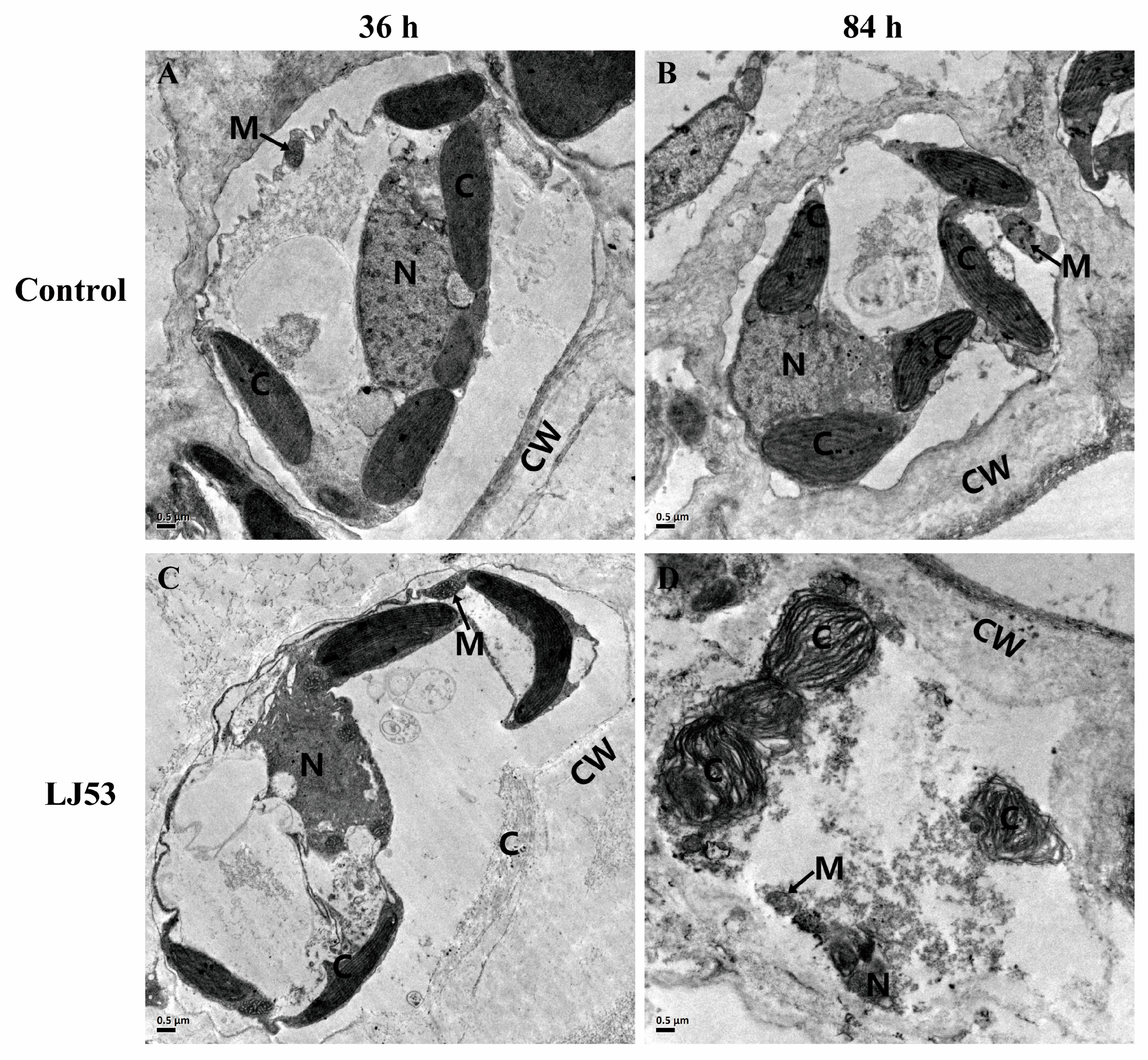
TEM observations of the infected cells revealed distinct ultrastructural changes following infection with strain LJ53. In the control groups at 36 and 84 hpi (Figure 3A,B), cells had an intact cellular architecture. Chloroplasts maintained their typical rod-like shape and other organelles, including the nucleus and mitochondria, showed well-defined structures with clear nuclear envelopes and normal cell wall morphology. By contrast, significant degradation was observed in the infected group at 36 hpi (Figure 3C). The initial pathological signs included initiation of cell wall and chloroplast disintegration, reduction in the number of chloroplasts and scattering of chloroplasts towards the periphery of the cell. At the same time, the nucleus appeared deformed. At 84 hpi (Figure 3D), severe progression of cellular deterioration was observed. Remaining chloroplasts had lost their structure and adopted a spherical and disordered form, and further decreased in number. Strong deformation of the cell was observed together with karyolysis and loss of boundaries between organelles.

3.3. Morphological Characteristics and Molecular Identification of Strain LJ53

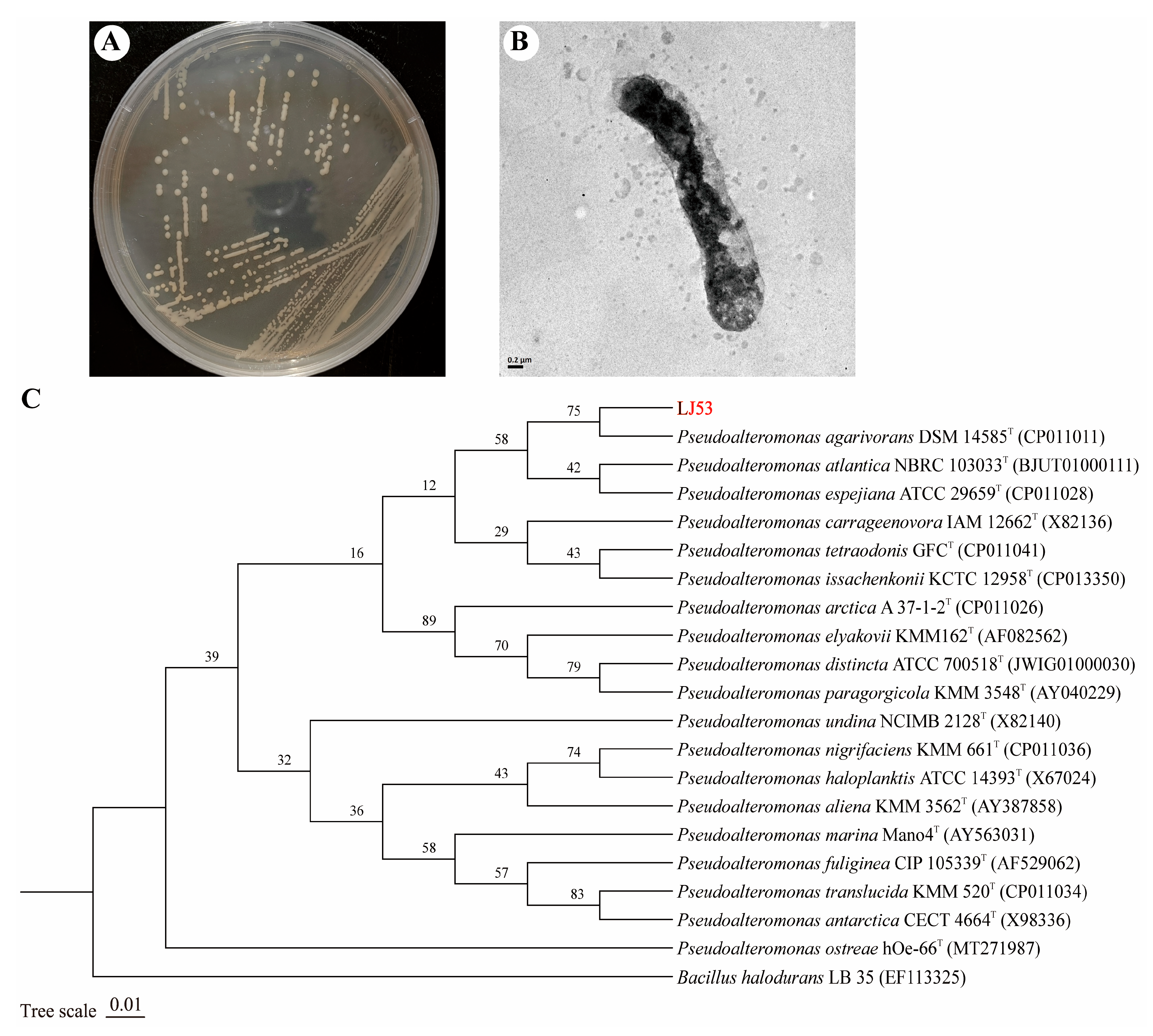
Strain LJ53 formed circular, beige colonies with a flat elevation, moist texture and entire margins on Zobell 2216E agar medium (Figure 4A). The colony was translucent. Negative-staining TEM revealed that the cells were rod-shaped, measuring 0.5–1.0 μm in width and 2–3 μm in length, and were monotrichous with a single polar flagellum (Figure 4B). A neighbor-joining phylogenetic tree was constructed based on 16S rRNA gene sequences, showing the phylogenetic positions of strain LJ53 and the related Pseudoalteromonas species. Strain LJ53 showed the highest similarity (99.86%) to Pseudoalteromonas agarivorans DSM 14585T (Figure 4C). Consequently, the isolate was identified as a member of the genus Pseudoalteromonas and designated as Pseudoalteromonas agarivorans LJ53. The 16S rRNA gene sequence has been deposited in the NCBI database under accession number PX463764.

3.4. Ecological Insights from Metagenomic Data

Analysis of the microbial community composition revealed that the phyla Pseudomonadota and Bacteroidota were the most abundant taxa in both diseased and healthy S. japonica samples (Figure S1). However, contrary to expectations that pathogenic bacteria would proliferate in diseased tissues, no significant difference was observed in the relative abundances of Pseudoalteromonas and P. agarivorans between healthy and diseased S. japonica samples (p > 0.05; Figure 5A,B). However, the abundance of both Pseudoalteromonas and P. agarivorans in the S. japonica samples differed significantly from those detected in the seawater microbiomes. To investigate the pathogenesis mechanism of P. agarivorans, co-occurrence networks were constructed separately for the diseased and healthy groups using taxonomic features with an average relative abundance ≥ 0.05% (Figure 5C,D). The analysis revealed fundamental differences in the overall topology between the two networks. Specifically, the diseased community network had higher modularity (DSJ: 0.563, HSJ: 0.503), along with a greater total number of edges, and a higher average degree (DSJ: 38.369, HSJ: 24.017) than to the healthy network.

4. Discussion

A pathogenic bacterium, designated as strain LJ53, was isolated from diseased S. japonica. Challenge assays confirmed that this strain induced bleaching symptoms in S. japonica sporophytes, a phenotype consistent with the previously reported bleaching disease by Zhang et al. [11]. Phylogenetic analysis based on the 16S rRNA gene sequence indicated that the strain belongs to the genus Pseudoalteromonas and shares 99.86% similarity with the type strain of P. agarivorans. It was therefore identified as Pseudoalteromonas agarivorans and designated as Pseudoalteromonas agarivorans LJ53.
The genus Pseudoalteromonas was originally classified under the genus Alteromonas and first described by Baumann et al. in 1972 [24]. Subsequent phylogenetic studies led to the reclassification of this group into two distinct genera, Alteromonas and Pseudoalteromonas [25,26]. Pseudoalteromonas is widely distributed in various marine environments and represents a significant component of marine bacterial communities [27]. Certain strains within this genus exhibit broad-spectrum algicidal activity and have been applied in algal bloom control [28,29,30]. Several species have also been reported as pathogens affecting both microalgae and animals in aquaculture systems. For instance, Zhang et al. [11] demonstrated that P. piscicida disrupts S. japonica cellular structures and causes bleaching disease. The same species has also been shown to be pathogenic to fish and fiddler crabs (e.g., Uca pugnas and U. pugilator) [31]. Furthermore, P. agarivorans NW4327 was identified as a major sponge pathogen that produced collagenase, which degraded the sponge skeletal fibers [32]. Sun et al. [33] isolated a strain of P. agarivorans A3 that directly degraded S. japonica by secreting alginate lyase. However, its pathogenicity against S. japonica did not need to be determined. This study further confirmed the pathogenic potential of P. agarivorans toward S. japonica and expanded the known host range of this species.
The pathogenicity mechanism of the pathogens infecting farmed S. japonica remains at an early stage. The ultrastructure observation in this study revealed that P. agarivorans LJ53 disrupts cellular structures in S. japonica, leading to the disintegration of chloroplasts and other organelles, thereby inducing disease. Notably, mitochondrial structures remained largely intact during infection. This distinct pattern strongly suggests that LJ53 may secrete specific effector proteins or toxins that selectively target chloroplasts and the nucleus, rather than employing broad-spectrum lytic enzymes. For instance, similar to the alginate lyase produced by P. agarivorans A3 [33], which specifically degrades the cell wall of S. japonica, LJ53 might possess conserved effector molecules—analogous to those in Pseudomonas syringae—that target the photosynthetic apparatus in chloroplasts, triggering a burst of reactive oxygen species and ultimately leading to programmed cell death [34]. In this context, mitochondria may be temporarily preserved due to their central role in energy production and apoptotic signaling [34,35]. Metagenomic analysis indicated that there was no significant difference in the relative abundance of this bacterium between diseased and healthy tissues, suggesting that its pathogenicity may not rely on population expansion but may be closely related to ecological function shift or microbial interaction. This phenomenon implies that pathogenicity may be triggered by specific gene expression or metabolic activity of the pathogen rather than mere numerical increase, aligning with the pathogenic pattern of some “opportunistic pathogens” [36,37]. Co-occurrence network analysis further revealed a significant increase in connectivity and a rise in modularity within the microbial community of diseased S. japonica. The epiphytic bacterial community of healthy S. japonica consists of multiple different functional modules with tight connections, reflecting niche differentiation and community stability. In contrast, the microbial community under diseased conditions transitions to a highly connected yet structurally disordered state, exhibiting characteristics typical of microbial dysbiosis. This restructuring of the microbial network may compromise the community’s resilience against pathogen colonization, facilitating infection by P. agarivorans LJ53.
Research on S. japonica bleaching disease is still in its infancy, and elucidating the specific molecular pathogenesis of the causative bacterium remains a significant challenge. To unravel the molecular mechanisms underlying LJ53 pathogenicity, future studies should focus on the following: (1) Employing comparative transcriptomics to systematically identify virulence genes that are specifically upregulated during infection by LJ53, such as those encoding alginate lyases, proteases, and effector proteins; (2) utilizing gene knockout techniques to construct mutant strains and validating their virulence in axenic S. japonica models; alternatively, purifying candidate effector proteins from strain LJ53 and observing the resulting disease phenotypes through complementation assays to establish a causal relationship between specific genes and pathogenicity; and (3) investigating the specific role of the host microbiota in resisting LJ53 colonization. This could involve isolating and identifying key beneficial bacterial strains within the healthy microbial community and evaluating their potential as probiotics for disease control. Furthermore, although a probiotic-based biocontrol strategy is mainly applicable at controllable stages such as seedling cultivation, its utility is significantly limited for mature S. japonica in open-sea farming systems that are subject to stochastic pathogen invasion. Thus, a highly promising alternative strategy involves the identification and characterization of novel antimicrobial agents, e.g., antimicrobial peptides (AMPs) [38,39], secreted by these beneficial bacterial strains, followed by the introduction of the complete biosynthetic gene cluster encoding such AMPs into the host S. japonica to enable endogenous and continuous disease resistance. To date, AMP biosynthetic gene clusters derived from marine actinomycetes (e.g., the gene cluster responsible for mathermycin synthesis) have been successfully identified [40]. These gene clusters can be designed and synthesized before being transferred into the host to direct post-translational modifications (e.g., hydroxylation and cyclization) of precursor peptides within the plants to achieve in situ production of mature AMPs with high efficacy. This genetic engineering-based strategy for endogenous AMP production may represent a highly specific, environmentally friendly, and application-independent biocontrol approach that not only directly neutralizing pathogens but also durably enhances microbial ecological resilience of the host, S. japonica.

5. Conclusions

S. japonica is a seaweed of global economic importance, yet the inappropriate expansion of cultivation areas has led to disease outbreaks, resulting in significant economic losses. Research into S. japonica pathogens remains nascent. Given that many kelp-associated bacteria in kelp are often opportunistic and non-pathogenic under normal conditions, pinpointing specific pathogens and elucidating their pathogenic mechanisms poses considerable challenges, complicating the identification of causative agents for particular diseases. Consequently, there is an imperative need to identify these pathogens and devise appropriate control measures. In this study, we successfully isolated and identified Pseudoalteromonas agarivorans LJ53 as the pathogenic bacterium responsible for kelp bleaching disease. Notably, its pathogenicity was found to be unrelated to its abundance. These findings not only enrich our understanding of the diverse pathogens causing S. japonica bleaching disease but also aid in establishing a robust experimental framework for examining S. japonica–pathogen interactions. Furthermore, they lay the foundation for molecular-level investigations into pathogenic mechanisms, paving the way for the development of precise biological control strategies.

Supplementary Materials

The following supporting information can be downloaded at https://www.mdpi.com/article/10.3390/w18010066/s1. Figure S1: Relative abundance of the dominant bacterial phyla in healthy and diseased S. japonica samples. DSJ: diseased group, HSJ: healthy group, SW: seawater group. Table S1: The total number of raw reads obtained from metagenomic sequencing and the number of reads retained after quality filtering.

Author Contributions

Y.O.: Investigation, Methodology, Visualization, Formal analysis, Writing—original draft, Data curation. R.T.: Methodology, Data curation, Formal analysis; J.L. (Jiapeng Li): Methodology, Data curation. X.Z.: Methodology, Data curation; C.Z.: Resources, Funding acquisition, Writing—review and editing; L.F.: Validation, Writing—review and editing, Funding acquisition; J.L. (Jiangwei Li): Conceptualization, Formal analysis, Validation, Writing—review and editing, Supervision, Resources, Funding acquisition. All authors have read and agreed to the published version of the manuscript.

Funding

This work was supported by the STS Project of Fujian-CAS (2023T3049) and the Natural Science Foundation of Xiamen City, China (3502Z202473084), open funds from Key Laboratory of Ecological Environment and Information Atlas (Putian University), Fujian Provincial University (ST24002), and the Technology Development and Application Project of the Science and Technology Bureau of Putian City (2023NJJ005).

Data Availability Statement

All raw sequence data generated in this study have been deposited in the NCBI’s Sequence Read Archive (SRA) database. The raw reads of kelp metagenomes and seawater metagenomes can be accessed under the BioProject PRJNA1390388.

Acknowledgments

We thank Anyi Hu for his help in reviewing this manuscript and Laiyi Li and Yuxin Qiu for their assistance with data analysis.

Conflicts of Interest

The authors declare that they have no known competing financial interests or personal relationships that could have appeared to have influenced the work reported in this paper.

References

  1. Wenning, R. The state of world fisheries and aquaculture (sofia) 2020 report. Integr. Environ. Asses. 2020, 16, 800–801. [Google Scholar]
  2. Wang, G.; Lu, B.; Shuai, L.; Li, D.; Zhang, R. Microbial diseases of nursery and field-cultivated Saccharina japonica (Phaeophyta) in China. Arch Hydrobiol. Suppl. Algol. Stud. 2014, 145, 39–51. [Google Scholar] [CrossRef]
  3. Coppin, R.; Rautenbach, C.; Smit, A.J. Individual-based numerical experiment to describe the distribution of floating kelp within the Southern Benguela Upwelling System. Bot. Mar. 2024, 67, 469–486. [Google Scholar] [CrossRef]
  4. Burke, C.; Thomas, T.; Lewis, M.; Steinberg, P.; Kjelleberg, S. Composition, uniqueness and variability of the epiphytic bacterial community of the green alga Ulva australis. ISME J. 2011, 5, 590–600. [Google Scholar] [CrossRef]
  5. Lemay, M.A.; Chen, M.L.Y.; Mazel, F.; Hind, K.R.; Starko, S.; Keeling, P.J.; Martone, P.T.; Parfrey, L.W. Morphological complexity affects the diversity of marine microbiomes. ISME J. 2021, 15, 1372–1386. [Google Scholar] [CrossRef]
  6. Marshall, K.; Joint, I.; Callow, M.E.; Callow, J.A. Effect of marine bacterial isolates on the growth and morphology of axenic plantlets of the green alga Ulva linza. Microb. Ecol. 2006, 52, 302–310. [Google Scholar] [CrossRef]
  7. Weigel, B.L.; Miranda, K.K.; Fogarty, E.C.; Watson, A.R.; Pfister, C.A. Functional Insights into the Kelp Microbiome from Metagenome-Assembled Genomes. mSystems 2022, 7, e01422-21. [Google Scholar] [CrossRef]
  8. Adouane, E.; Hubas, C.; Leblanc, C.; Lami, R.; Prado, S. Multi-omics analysis of the correlation between surface microbiome and metabolome in Saccharina latissima (Laminariales, Phaeophyceae). FEMS Microbiol. Ecol. 2025, 101, fiae160. [Google Scholar] [CrossRef] [PubMed]
  9. Phelps, C.M.; McMahon, K.; Bissett, A.; Bernasconi, R.; Steinberg, P.D.; Thomas, T.; Marzinelli, E.M.; Huggett, M.J. The surface bacterial community of an Australian kelp shows cross-continental variation and relative stability within regions. FEMS Microbiol. Ecol. 2021, 97, fiab089. [Google Scholar] [CrossRef] [PubMed]
  10. Zhang, Y.; Nair, S.; Zhang, Z.; Zhao, J.; Zhao, H.; Lu, L.; Chang, L.; Jiao, N. Adverse Environmental Perturbations May Threaten Kelp Farming Sustainability by Exacerbating Enterobacterales Diseases. Environ. Sci. Technol. 2024, 58, 5796–5810. [Google Scholar] [CrossRef] [PubMed]
  11. Zhang, X.Y.; Chen, Y.; Saha, M.; Zhuang, Y.R.; Chang, L.R.; Xiao, L.Y.; Wang, G.G. Pseudoalteromonas piscicida X-8 causes bleaching disease in farmed Saccharina japonica. Aquaculture 2022, 546, 737354. [Google Scholar] [CrossRef]
  12. Ma, M.Y.; Zhuang, Y.R.; Chang, L.R.; Xiao, L.Y.; Lin, Q.; Qiu, Q.Y.; Chen, D.F.; Egan, S.; Wang, G.G. Naturally occurring beneficial bacteria Vibrio alginolyticus X-2 protects seaweed from bleaching disease. mBio 2023, 14, e00065-23. [Google Scholar] [CrossRef]
  13. Cheng, W.W.; Yan, X.Y.; Xiao, J.L.; Chen, Y.Y.; Chen, M.H.; Jin, J.Y.; Bai, Y.; Wang, Q.; Liao, Z.Y.; Chen, Q. Isolation, identification, and whole genome sequence analysis of the alginate-degrading bacterium Cobetia sp. cqz5-12. Sci. Rep. 2020, 10, 10920. [Google Scholar] [CrossRef] [PubMed]
  14. Oppenheimer, C.H.; Zobell, C.E. The growth and viability of 63 species of marine bacteria as influenced by hydrostatic pressure. J. Mar. Res. 1952, 11, 10–18. [Google Scholar]
  15. Sanger, F.; Nicklen, S.; Coulson, A.R. DNA sequencing with chain-terminating inhibitors. Proc. Natl. Acad. Sci. USA 1977, 74, 5463–5467. [Google Scholar] [CrossRef]
  16. Khalifa, A.Y.Z.; Bekhet, G. First isolation and characterization of the pathogenic Aeromonas veronii bv. veronii associated with ulcerative syndrome in the indigenous Pelophylax ridibundus of Al-Ahsaa, Saudi Arabia. Microb. Pathogen. 2018, 117, 361–368. [Google Scholar] [CrossRef]
  17. Tamura, K.; Stecher, G.; Kumar, S. MEGA11 Molecular Evolutionary Genetics Analysis Version 11. Mol. Biol. Evol. 2021, 38, 3022–3027. [Google Scholar] [CrossRef]
  18. Saitou, N.; Nei, M. The neighbor-joining method—A new method for reconstructing phylogenetic trees. Mol. Biol. Evol. 1987, 4, 406–425. [Google Scholar] [PubMed]
  19. Li, D.; Liu, C.M.; Luo, R.; Sadakane, K.; Lam, T.W. MEGAHIT: An ultra-fast single-node solution for large and complex metagenomics assembly via succinct de Bruijn graph. Bioinformatics 2015, 31, 1674–1676. [Google Scholar] [CrossRef]
  20. Wood, D.E.; Lu, J.; Langmead, B. Improved metagenomic analysis with Kraken 2. Genome Biol. 2019, 20, 257. [Google Scholar] [CrossRef]
  21. Lu, J.; Breitwieser, F.P.; Thielen, P.; Salzberg, S.L. Bracken: Estimating species abundance in metagenomics data. PeerJ Comput. Sci. 2017, 3, e104. [Google Scholar] [CrossRef]
  22. Zhang, R.; Chang, L.; Xiao, L.; Zhang, X.; Han, Q.; Li, N.; Egan, S.; Wang, G. Diversity of the epiphytic bacterial communities associated with commercially cultivated healthy and diseased Saccharina japonica during the harvest season. J. Appl. Phycol. 2020, 32, 2071–2080. [Google Scholar] [CrossRef]
  23. Li, J.; Pang, S.; Shan, T.; Su, L. Changes of microbial community structures associated with seedlings of Saccharina japonica at early stage of outbreak of green rotten disease. J. Appl. Phycol. 2020, 32, 1323–1327. [Google Scholar] [CrossRef]
  24. Baumann, L.; Baumann, P.; Mandel, M.; Allen, R.D. Taxonomy of aerobic marine eubacteria. J. Bacteriol. 1972, 110, 402–429. [Google Scholar] [CrossRef]
  25. Romanenko, L.A.; Zhukova, N.V.; Rohde, M.; Lysenko, A.M.; Mikhailov, V.V.; Stackebrandt, E. Pseudoalteromonas agarivorans sp. nov., a novel marine agarolytic bacterium. Int. J. Syst. Evol. Micr. 2003, 53, 125–131. [Google Scholar] [CrossRef] [PubMed]
  26. Gauthier, G.; Gauthier, M.; Christen, R. Phylogenetic analysis of the genera alteromonas, Shewanella, and moritella using genes-coding for small-subunit ribosomal-rna sequences and division of the genus alteromonas into 2 genera, Alteromonas (emended) and Pseudoalteromonas gen-nov, and proposal of 12 new species combinations. Int. J. Syst. Evol. Microbiol. 1995, 45, 755–761. [Google Scholar]
  27. Xu, Y.; Lan, X.; Zhou, M.; Chen, X.; Jin, J.; Zhu, S.; Yang, J.; Chen, J. Genome sequencing and comparative genomic analysis of Pseudoalteromonas arabiensis N1230-9 isolated from the surface seawater of the Pacific Ocean. Weishengwu Xuebao 2024, 64, 1691–1703. [Google Scholar]
  28. Gong, L.; Li, Y.; Wang, X.; Liang, S.; Chu, C.; Han, X. The influence of biosurfactant on the growth of Prorocentrum donghaiense. China Environ. Sci. 2004, 24, 692–696. [Google Scholar]
  29. He, L.; Lin, Z.; Wang, Y.; He, X.; Zhou, J.; Guan, M.; Zhou, J. Facilitating harmful algae removal in fresh water via joint effects of multi-species algicidal bacteria. J. Hazard. Mater. 2021, 403, 123662. [Google Scholar] [CrossRef] [PubMed]
  30. Ji, R.P.; Lu, X.W.; Li, X.N.; Pu, Y.P. Biological degradation of algae and microcystins by microbial enrichment on artificial media. Eco. Eng. 2009, 35, 1584–1588. [Google Scholar] [CrossRef]
  31. Hansen, A.J.; Weeks, O.B.; Colwell, R.R. Taxonomy of pseudomonas piscicida (bein) buck meyers and leifson. J. Bacteriol. 1965, 89, 752–761. [Google Scholar] [CrossRef]
  32. Bhattacharya, S.; Choudhury, J.D.; Gachhui, R.; Mukherjee, J. A new collagenase enzyme of the marine sponge pathogen Pseudoalteromonas agarivorans NW4327 is uniquely linked with a TonB dependent receptor. Int. J. Biol. Macromol. 2018, 109, 1140–1146. [Google Scholar] [CrossRef]
  33. Sun, X.H.; Zhang, X.D.; Zhang, X.R.; Wang, X.F.; Zhang, X.Y.; Zhang, Y.Z.; Zhang, Y.Q.; Xu, F. Direct preparation of alginate oligosaccharides from brown algae by an algae-decomposing alginate lyase alyp18 from the marine bacterium Pseudoalteromonas agarivorans A3. Mar. Drugs 2024, 22, 483. [Google Scholar] [CrossRef]
  34. Roussin-Léveillée, C.; St-Amand, M.; Desbiens-Fortin, P.; Perreault, R.; Pelletier, A.; Gauthier, S.; Gaudreault-Lafleur, F.; Laforest-Lapointe, I.; Moffett, P. Co-occurrence of chloroplastic ROS production and salicylic acid induction in plant immunity. New Phytol. 2025, 248, 1989–2004. [Google Scholar] [CrossRef] [PubMed]
  35. Zhu, C.G.; Li, X.Y.; Zhang, M.; Wang, S.W.; Jing, B.Y.; Hu, C.Y.; Thomas, H.R.; Zhou, Y.H.; Yu, J.Q.; Hu, Z.J. ERF.D2 negatively controls drought tolerance through synergistic regulation of abscisic acid and jasmonic acid in tomato. Plant Biotechnol. J. 2025, 23, 3363–3381. [Google Scholar] [CrossRef]
  36. Li, Z.F.; Bai, X.L.; Jiao, S.; Li, Y.M.; Li, P.R.; Yang, Y.; Zhang, H.; Wei, G.H. A simplified synthetic community rescues Astragalus mongholicus from root rot disease by activating plant-induced systemic resistance. Microbiome 2021, 9, 217. [Google Scholar] [CrossRef]
  37. Zhou, Z.H.; Wang, W.H.; Zhang, S.K.; Chen, J.H.; Wu, J.S. Soil pH and potassium drive root rot in Torreya grandis via direct modulation and microbial taxa-mediated pathways. Ind. Crop Prod. 2025, 228, 120940. [Google Scholar] [CrossRef]
  38. Fan, S.; Qin, P.; Lu, J.; Wang, S.; Zhang, J.; Wang, Y.; Cheng, A.; Cao, Y.; Ding, W.; Zhang, W. Bioprospecting of culturable marine biofilm bacteria for novel antimicrobial peptides. Imeta 2024, 3, e244. [Google Scholar] [CrossRef] [PubMed]
  39. Chen, P.; Ye, T.; Li, C.; Praveen, P.; Hu, Z.; Li, W.; Shang, C. Embracing the era of antimicrobial peptides with marine organisms. Nat. Prod. Rep. 2024, 41, 331–346. [Google Scholar] [CrossRef]
  40. Chen, E.; Chen, Q.; Chen, S.; Xu, B.; Ju, J.; Wang, H. Mathermycin, a lantibiotic from the marine actinomycete Marinactinospora thermotolerans SCSIO 00652. Appl. Environ. Microbiol. 2017, 83, e00926-17. [Google Scholar] [CrossRef] [PubMed]
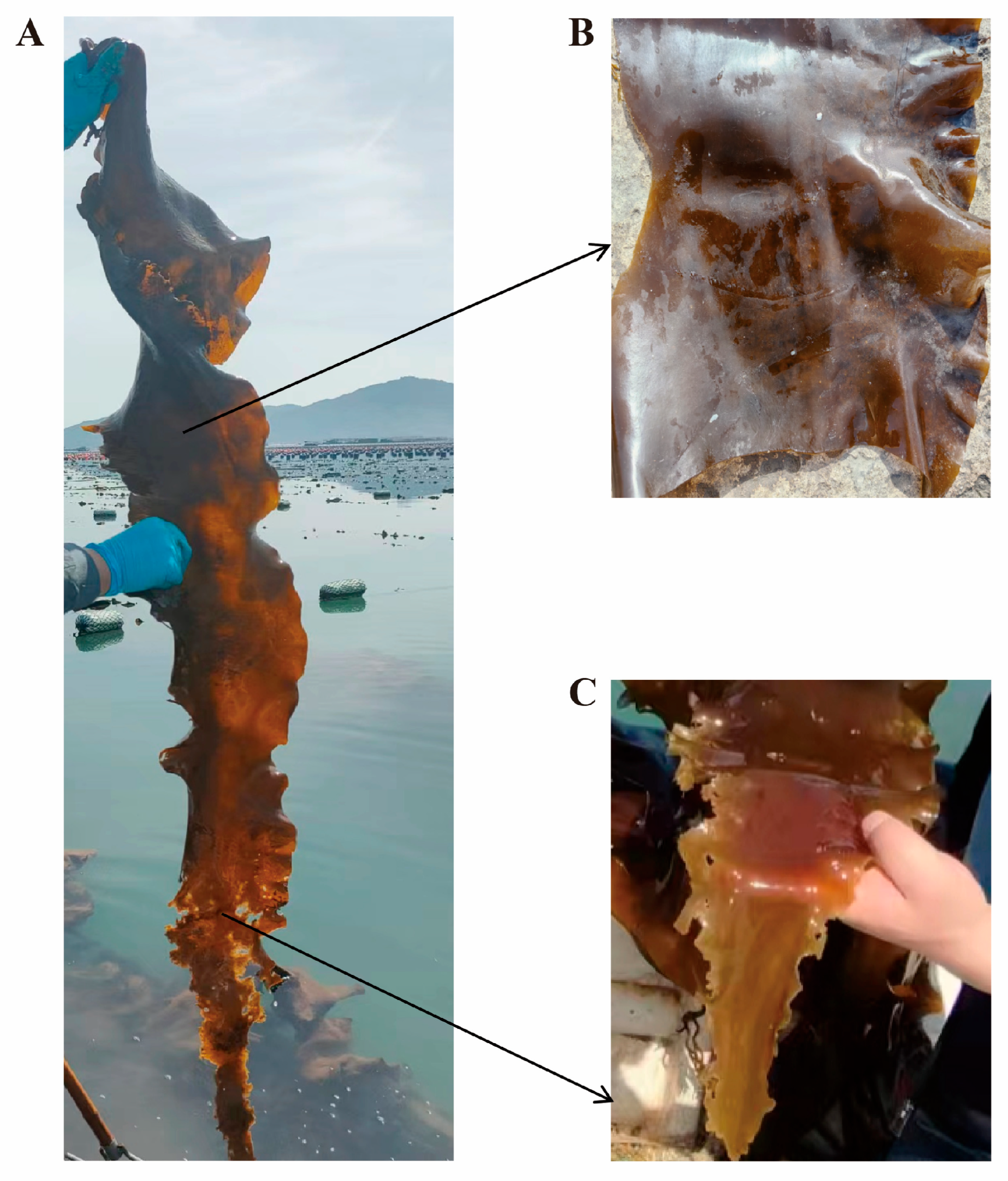
Figure 1. Hole-Rotten disease in mature sporophytes of cultivated S. japonica: (A) a Rotten diseased mature sporophytes; (B) the healthy tissue; (C) the diseased tissue.
Water 18 00066 g001
Figure 2. Pathogenicity of bacterial strain LJ53 towards sporophytes. (AC,HJ) morphology and corresponding microscopic images of healthy, uninfected control sporophytes; (D,K) sporophytes at 10 hpi with strain LJ53, showing no apparent symptoms; (E,L) initiation of partial tissue bleaching and a significant reduction in pigmentation observed at 36 hpi; (F,M) progression of the bleaching phenotype to the entire thallus and near-complete pigment depletion at 84 hpi; (G) Disease incidence rate over time in the LJ53-challenged group compared to the control (n = 3). Statistical significance was determined by the independent samples t-test (** represent 0.01 < p < 0.05, **** represent 0.001 < p < 0.0001). Bars: (AF) 0.3 cm; (HM) 100 μm.
Water 18 00066 g002
Figure 3. Ultrastructural observations of S. japonica infected by strain LJ53. (A,B) healthy S. japonica seedlings treated with sterile seawater at 36 and 84 hpi, respectively; (C,D) Infected S. japonica at 36 and 84 hpi, respectively, following inoculation with strain LJ53. CW, cell wall; C, chloroplast; M, mitochondrion; N, nucleus. Bar = 0.5 μm.
Water 18 00066 g003
Figure 4. Morphological and phylogenetic characteristics of strain LJ53. (A) colony morphology of strain LJ53 grown on Zobell 2216E agar medium; (B) cellular morphology of strain LJ53 observed by TEM following negative staining; (C) neighbor-joining phylogenetic tree based on 16S rRNA gene sequences. All strains included in the tree, except for the outgroup, belong to the genus Pseudoalteromonas. Bacillus halodurans LB 35 was used as the outgroup. Bootstrap values were shown for the nodes in percentage after 1000 re-samplings. The target strain is highlighted in red. Bars: (A) 1 cm; (B) 0.2 μm; (C) 0.01.
Water 18 00066 g004
Figure 5. Comparative microbial relative abundance and co-occurrence networks of Pseudoalteromonas in healthy and diseased S. japonica. (A,B) relative abundance of Pseudoalteromonas (A) and P. agarivorans (B) in the healthy group (HSJ), diseased group (DSJ) and seaweater group (SW). **: p < 0.01, ***: p < 0.001; (C,D) co-occurrence networks of the mature sporophytes surface microbiota. The left network represents the diseased group, and the right network represents the healthy group. Each node represents a taxon, coloured by its taxonomic assignment at the genus level. The node representing P. agarivorans is highlighted with a red box.
Water 18 00066 g005
Disclaimer/Publisher’s Note: The statements, opinions and data contained in all publications are solely those of the individual author(s) and contributor(s) and not of MDPI and/or the editor(s). MDPI and/or the editor(s) disclaim responsibility for any injury to people or property resulting from any ideas, methods, instructions or products referred to in the content.