1. Introduction
China is the world’s largest producer of chemical products, characterized by a diverse range and substantial products. The chemical manufacturing process generates significant volumes of wastewater with complex compositions and variable properties, making the effective treatment of such wastewater a persistent challenge in the environmental field. Acrylic, a significant synthetic fiber, is extensively utilized in clothing, home textiles, and plush toys owing to its high tensile strength, excellent elasticity, and superior dyeing properties [
1,
2]. Since DuPont in the United States pioneered the large-scale production of polyacrylonitrile fibers in the 1950s [
3], the global acrylic fiber industry has experienced rapid development. By 2022, China had emerged as the world’s largest producer and consumer of acrylic fibers, with an annual output reaching 566,000 tons, and the output has maintained a steady growth trend.
Acrylic fiber is typically synthesized using acrylonitrile as the primary monomer, which undergoes copolymerization with other comonomers and is subsequently processed via dry or wet spinning techniques. Dry spinning involves the application of external force and elevated temperatures to solidify the fibers [
4], generating wastewater characterized by complex composition, high toxicity, and poor biodegradability. In contrast, wet spinning—commonly employed in China—relies on a dual diffusion mechanism for fiber solidification and shaping, utilizing a base solvent with relatively low toxicity. Although the two processes yield effluents with differing pollutant concentrations [
5], both contain substantial amounts of recalcitrant dissolved organic matter (DOM) and high levels of ammonia nitrogen, resulting in complex pollutant profiles and limited biodegradability. Research indicated that the proportion of refractory DOM in wastewater from two-step wet-spun acrylic fiber production exceeded 40% [
6], exhibiting environmental persistence, carcinogenic, mutagenic, and teratogenic (three-causing) effects, as well as acute toxicity. Prolonged environmental accumulation of such pollutants can disrupt aquatic ecosystem stability and pose risks to human health through bioaccumulation. Therefore, systematically identifying DOM constituents in acrylic fiber wastewater across different process stages and elucidating their key degradation pathways hold significant practical importance for pollution control and sustainable industrial development.
Currently, the analysis and identification of organic pollutants in wastewater primarily rely on techniques such as spectroscopy, nuclear magnetic resonance, chromatography, and mass spectrometry. Each method has distinct characteristics and application scopes. For instance, infrared spectroscopy is well suited to identifying functional group structures; ultraviolet-visible absorption spectroscopy (UV-Vis) exhibits high sensitivity toward aromatic rings and conjugated systems. Three-dimensional fluorescence spectroscopy combined with parallel factor analysis (PARAFAC) enables the identification and quantification of dissolved organic matter (DOM) components, including humic substances and aromatic compounds. Proton nuclear magnetic resonance spectroscopy (
1H NMR) provides detailed information on the organic carbon framework. However, due to the high complexity and heterogeneity of DOM, the correlation between molecular descriptors and spectral indicators is often weak, which increases the difficulty of data interpretation [
7]. Particularly in complex matrices such as chemical wastewater, the standalone use of these methods is susceptible to limitations such as signal overlap, interference, and insufficient resolution. Therefore, in recent years, research efforts have increasingly adopted chromatography–mass spectrometry techniques to achieve more comprehensive and accurate pollutant characterization. These techniques integrate the high separation efficiency of chromatography with the high sensitivity and resolution of mass spectrometry, enabling effective separation and identification of organic compounds in complex environmental samples and providing robust technical support for environmental pollution analysis.
For samples containing complex and unknown constituents, chromatography–mass spectrometry plays a pivotal role in the qualitative and quantitative analysis of pollutants, owing to its high resolution and superior structural elucidation capabilities. This technique integrates mass spectrometric features—such as mass-to-charge ratio (
m/
z), isotope distribution, and fragment ion spectra—with chromatographic retention behavior to enable accurate structural inference of compounds. This approach, which does not rely on predefined target analytes and leverages multidimensional information for comprehensive screening, is known as non-targeted screening. Compared to conventional targeted methods, it offers higher efficiency and facilitates the rapid identification of unknown pollutants in complex environmental matrices [
8,
9]. The application of this strategy has been widely reported in the analysis of industrial wastewater [
10,
11,
12,
13]. For instance, Dsikowitzky et al. [
11] identified 39 organic compounds in wastewater from chemical plants using GC-MS, including a diverse range of halogenated substances with varying molecular structures. Similarly, Qi et al. [
12] detected a total of 2824 potential per- and polyfluoroalkyl substances across nine categories in environmental samples using high-performance liquid chromatography coupled to a Q Exactive™ hybrid quadrupole-orbitrap mass spectrometer (HPLC-Q Exactive Orbitrap MS). Chang et al. [
13] optimized the high-performance liquid chromatography method, achieving a significant improvement in the detection accuracy of characteristic pollutants such as N, N-dimethylacetamide, and acrylonitrile in acrylic fiber wastewater.
Furthermore, with technological advancements, comprehensive two-dimensional gas chromatography (GC×GC) has emerged as the method of choice for the analysis of complex matrices owing to its superior resolution, enhanced peak capacity, and structured elution patterns [
14]. When coupled with time-of-flight mass spectrometry (TOF-MS), GC×GC enables the acquisition of full-scan mass spectral data for each chromatographic peak, thereby significantly improving the accuracy of compound identification [
15]. He et al. [
16] successfully achieved the separation and quantitative analysis of 16 polycyclic aromatic hydrocarbons in coking wastewater by combining comprehensive two-dimensional gas chromatography–time-of-flight mass spectrometry (GC×GC-TOF MS) with a deconvolution algorithm. However, the application of related analytical technologies in the identification and detection of acrylic fiber wastewater is still very limited.
Building on the aforementioned background, this study aims to conduct non-targeted screening of wastewater samples collected from various process units at a petrochemical plant engaged in acrylic fiber production. The methodology integrates multiple advanced analytical techniques, including high-resolution mass spectrometry (HRMS), GC×GC, ultra-performance liquid chromatography (UPLC), nuclear magnetic resonance (NMR), Fourier-transform infrared spectroscopy (FTIR), and three-dimensional fluorescence spectroscopy (3D-EEM). By leveraging cross-validation of analytical results and the complementary nature of multi-technique data, this study systematically identifies the molecular structures and compound classes of characteristic organic pollutants present in acrylic fiber wastewater. The findings are intended to provide a robust theoretical foundation for pollution control strategies and risk management of refractory DOM in industrial effluents.
2. Materials and Methods
2.1. Sample Collection and Storage
This study focuses on four types of wastewater generated during the acrylic fiber production process at a petrochemical plant in Anhui province, China, including acrylonitrile mixed wastewater, polymerization wastewater, spinning wastewater, and integrated acrylic fiber mixed wastewater. Sampling bottles were pre-rinsed with the respective wastewater samples prior to collection to minimize contamination. Upon sampling, all samples were immediately placed in ice-cooled containers for low-temperature transport and subsequently stored at 4 °C to preserve sample integrity prior to analysis.
2.2. Analysis of Organic Pollutants
Due to the recalcitrant nature and high toxicity of certain organic pollutants, coupled with insufficient systematic screening research on DOM in acrylic fiber wastewater, this study employed multiple analytical techniques to conduct non-targeted screening of DOM in wastewater samples.
Samples were filtered through 0.22 μm membrane filters (Tianjin Jinteng Experimental Equipment Co., Ltd., Tianjin, China) to remove suspended solids. Conventional water quality parameters—including pH, electrical conductivity (EC), total organic carbon (TOC), and total nitrogen (TN)—were measured in accordance with the “Emission Standard of Pollutants for Petrochemical Industry” (GB 31571-2015) [
17] and the “Integrated Wastewater Discharge Standard”.
This study initially employed spectroscopic and nuclear magnetic resonance techniques for the qualitative analysis of organic matter in wastewater. A Fourier-transform infrared imaging system (Spotlight 400, PerkinElmer AG, Shanghai, China) and a UV-Vis spectrophotometer (Cary 100, Agilent Technologies Inc., Santa Clara, CA, USA) were used to identify functional group types, aromaticity, and conjugated systems. Fluorescence excitation-emission matrices (EEMs) were acquired using a temperature-controlled fluorescence spectrometer (Cary Eclipse, Agilent Technologies Inc., Santa Clara, CA, USA) to assess structural characteristics such as aromaticity and humification degree [
18]. Additionally, molecular environments of hydrogen atoms were analyzed using a 600 MHz fully digital superconducting NMR spectrometer (AVANCE NEO 600M, Bruker Scientific Instruments, Bilerica, MA, USA), allowing inference of potential organic compound classes. Due to the potential for missed detections and inherent limitations of the aforementioned characterization methods in the qualitative analysis of organic substances, the screening approach developed in this study incorporates high-resolution chromatography–mass spectrometry technology, thereby enabling methodological complementarity and facilitating a more comprehensive and systematic identification of organic compounds in wastewater.
Specific high-resolution chromatography–mass spectrometry techniques include comprehensive two-dimensional gas chromatography–tandem mass spectrometry (GC×GC-QTOF) and ultra-performance liquid chromatography–tandem mass spectrometry (UPLC-Q-Orbitrap), both operating at a resolution greater than 25,000, to separate and analyze various types of dissolved organic matter (DOM) in aqueous solutions. For organic compounds with different properties, the corresponding pretreatment methods are, respectively, applied.
For volatile organic compounds, purge and trap are used for enrichment. For semi-volatile organic compounds and volatile organic compounds with boiling points above 200 °C, solid-phase extraction is used (500 mg, 6 mL C18 extraction column, Welchrom®, Shanghai Yuexu Technology Co., Ltd., Shanghai, China). Or 500 mg, 6 mL HLB extraction column Waters Oasis®, Waters, Mumbai, India) or vacuum freeze-drying method (FD-1A-50, Beijing Boyikang Laboratory Instrument Co., Ltd., Beijing, China) for enrichment, and by GC×GC-QTOF (Agilent 8890-7250, Agilent Technologies Inc.) analyzes and simultaneously assesses the applicability of different pretreatment methods. For non-volatile organic compounds, the same solid-phase extraction and freeze-drying pretreatment were adopted, and they were detected by UPLC-Q-Orbitrap (Q Exactive Plus, Thermo Fisher Scientific Ltd., Waltham, MA, USA). In data processing, two-dimensional chromatographic data obtained from were subjected to peak detection using Canvas Browser software 2.2. A signal-to-noise ratio threshold of 20 was applied. Wide peaks were automatically identified, and overlapping chromatographic peaks were merged. Furthermore, this study excluded compounds with a matching coefficient lower than 700 and compared the results with blank samples to eliminate the potential interference of impurities.
The entire experimental procedure adhered to rigorous quality assurance and quality control (QA/QC) protocols to ensure sample recovery, method reproducibility, and instrument stability. Detailed pretreatment procedures and instrumental parameters are provided in the
Supplementary Materials.
3. Results and Discussion
3.1. Infrared Spectroscopy and UV254 Test Results
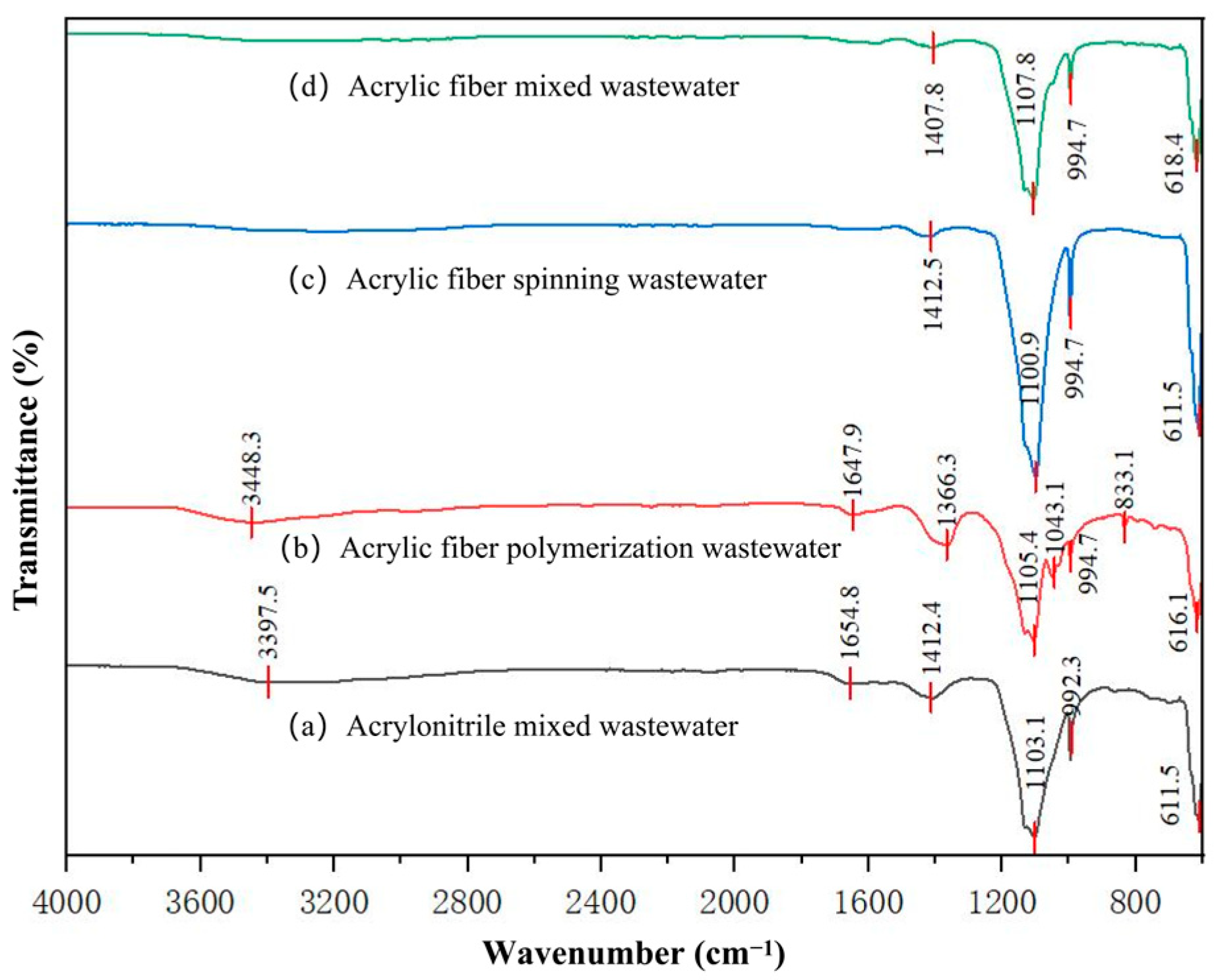
This study employed the manual peak-detection function in Origin software to analyze the infrared spectral characteristics of four types of wastewaters: acrylonitrile mixed wastewater, acrylic fiber polymerization wastewater, acrylic fiber spinning wastewater, and acrylic fiber mixed wastewater (
Figure 1). The results revealed strong absorption peaks at approximately 1100 cm
−1 and 990 cm
−1 across all four samples, which could be attributed to C-O stretching vibrations or S-O stretching vibrations in sulfonate/sulfonic acid groups [
19]. The peak at 1100 cm
−1 may additionally arise from C-N stretching vibrations in amine-containing compounds. Furthermore, absorption features at approximately 610 cm
−1 and 830 cm
−1 in the acrylic fiber polymerization wastewater fell within the aromatic ring fingerprint region, suggesting the presence of aromatic structures—likely common to all four wastewater types. Broad peaks near 3400 cm
−1 were observed in both acrylonitrile mixed wastewater and acrylic fiber polymerization wastewater, likely originating from O-H or N-H stretching vibrations, indicating the presence of alcohols, phenols, or amines. Signals around 1650 cm
−1 may correspond to C=C, C=N, or C=O stretching vibrations in amide functionalities, implying the potential presence of olefins or amide-containing organic compounds. As shown in
Table 1, the UV
254 value of acrylic fiber mixed wastewater was the highest among the samples, further supporting the inference that it contained a relatively high value of aromatic compounds or organic species with conjugated double-bond systems.
3.2. Three-Dimensional Fluorescence Spectroscopy Test Results
Aromatic rings, heterocycles, and other conjugated structures act as chromophores and are the primary contributors to fluorescence in DOM. For example, Peak Zone II is predominantly composed of tryptophan-like substances, with fluorescence arising from the absorption of specific-wavelength excitation light by the indole moiety within the molecule. Based on established classification criteria from references [
18,
19,
20], this study categorized the three-dimensional excitation-emission matrix (EEM) spectra of DOM (
Figure S2 and Table S3) and systematically analyzed the EEM profiles of the four wastewater types (
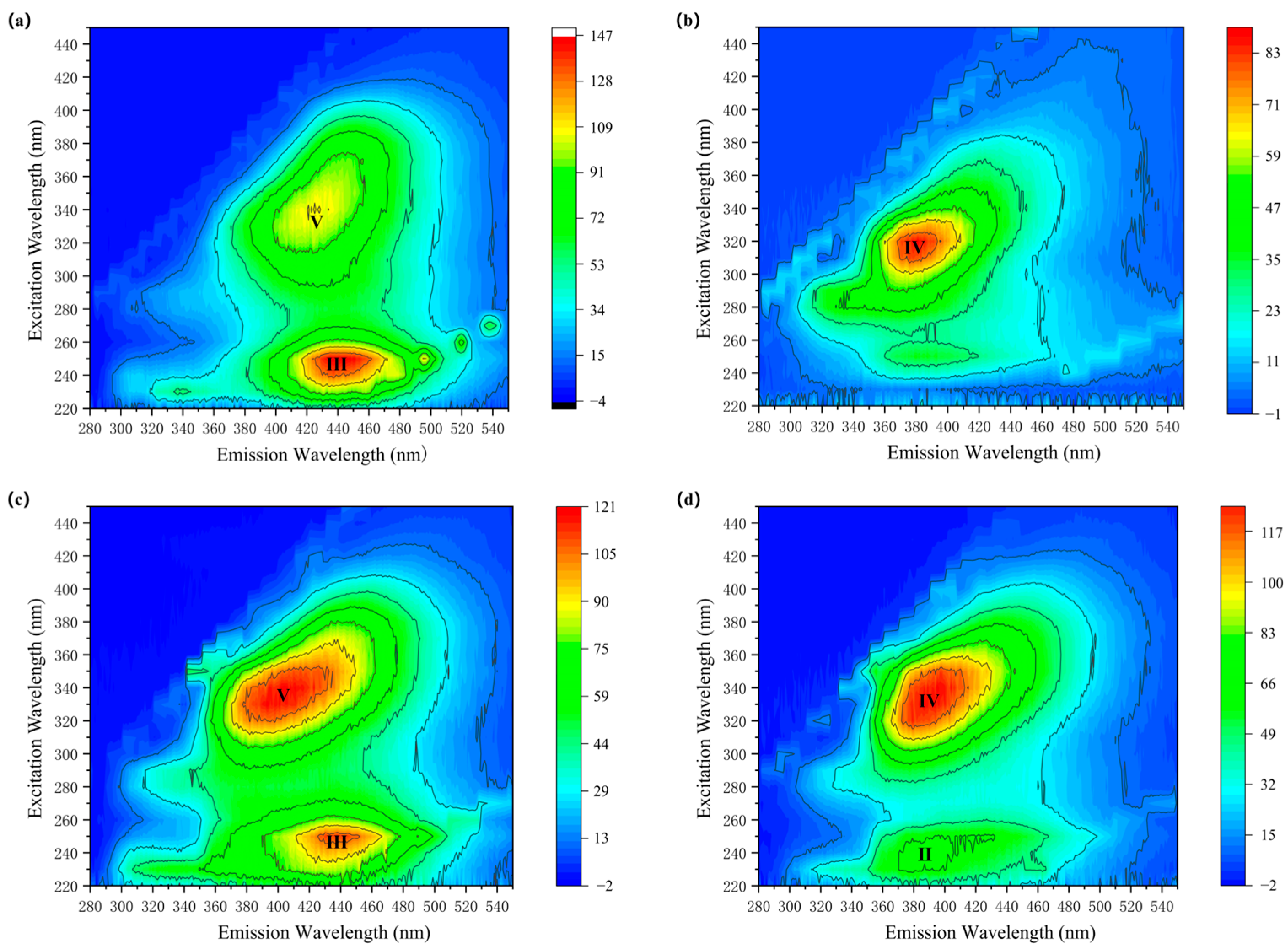
Figure 2). The results showed that acrylonitrile mixed wastewater exhibited two fluorescence peaks at 240/440 nm and 340/425 nm, with the stronger signal observed at 240/440 nm, assigned to fulvic acid-like substances, while the peak at 340/425 nm corresponded corresponding to humic acid-like substances. Acrylic fiber mixed wastewater displayed a prominent fluorescence peak at 340/395 nm, indicative of aromatic proteins and microbial metabolic by-products. The intense signal in the 230–250/400 nm region is likely associated with aromatic protein Class II (tryptophan-like compounds). Wastewater from acrylic fiber polymerization is primarily characterized by signals corresponding to aromatic protein analogs and microbial by-products. In contrast, the spinning-stage wastewater contains coexisting fulvic acid-like, humic acid-like, and aromatic protein-like components. Notably, the humic-like substances (Peaks III and V) are generally more recalcitrant to biodegradation, as reported in reference [
21].
3.3. Nuclear Magnetic Resonance Hydrogen Spectroscopy Test Results
To ensure that the organic matter content meets the sensitivity requirements for
1H NMR analysis, this study estimated the appropriate sampling volumes based on the TOC values of the four wastewater types (
Table S4). By referencing established chemical shift classifications from literature [
19,
22,
23] and the characteristic shifts in common organic compounds in deuterated water (D
2O), and applying the low-field shift principle, the
1H NMR signals of each wastewater type were systematically assigned (
Tables S5–S8) and summarized in
Table 2. The
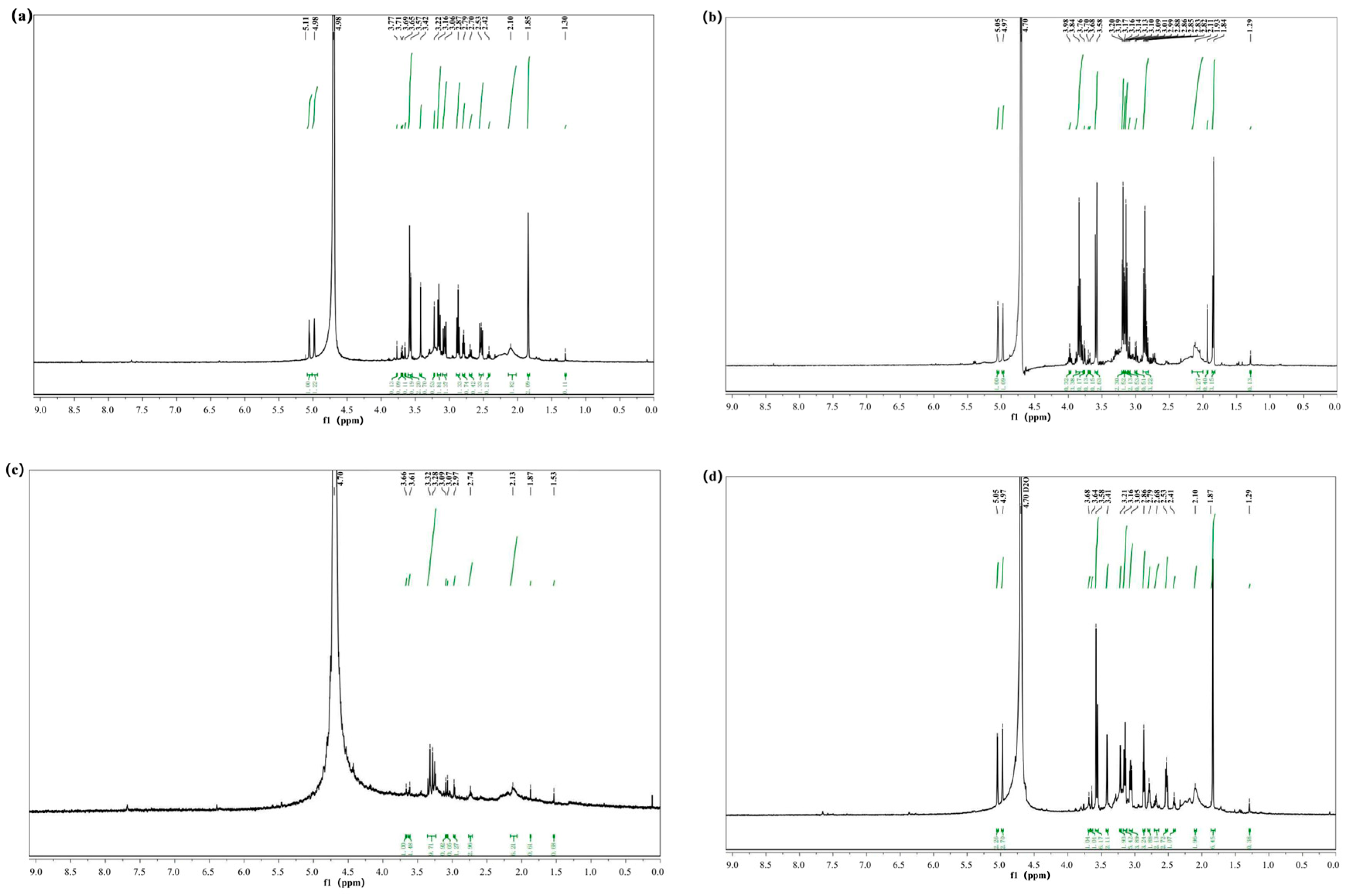
1H NMR results (
Figure 3) revealed a high degree of signal overlap across the four samples, indicating compositional similarities in their dissolved organic matter. For instance, a prominent CH-O signal was consistently observed in all four wastewater types, likely originating from alcohols, ethers, or esters. In contrast, the spectrum of acrylic fiber spinning wastewater exhibits relatively weak signal intensity (low signal-to-noise ratio), with only approximately 11 peaks detected above a signal-to-noise threshold of 3. Notably, no distinct C=CH characteristic peak was observed near 5 ppm, which may be attributed to the specific composition of organic constituents and potential interference from coexisting components such as salts.
Based on the above analysis, it can be established that the composition of wastewater from acrylic fiber production is rather complex. Although spectral and nuclear magnetic resonance hydrogen spectroscopy analysis are helpful for identifying functional groups and structural information, the signals of different compounds are prone to overlap, making it difficult to accurately analyze the molecular structure of organic substances. It is still necessary to combine chromatographic separation and mass spectrometry detection to accurately characterize the molecular structure information of organic substances.
3.4. Non-Target Screening Results of GC×GC-QTOF
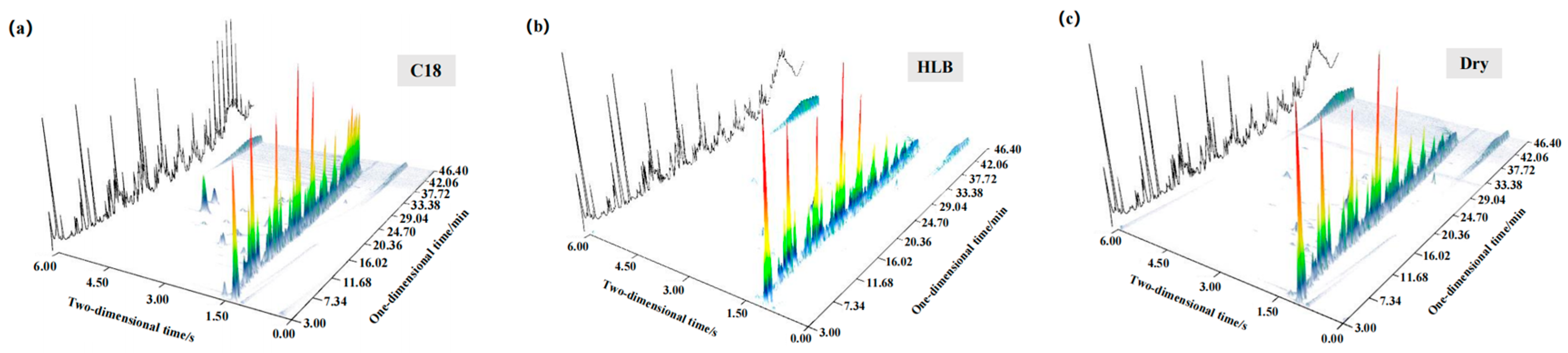
To enable comprehensive screening of DOM in wastewater samples, this study systematically optimized the sample pretreatment methodology. Using mixed acrylic fiber wastewater as the target matrix, three pretreatment methods—solid-phase extraction with C18 and HLB columns, and freeze-drying—were comparatively evaluated. The analysis was performed using GC×GC-QTOF, and the resulting two-dimensional and three-dimensional chromatograms are presented in
Figure 4 and
Figures S3–S7, respectively. In
Figure 4, the horizontal and vertical axes represent the one-dimensional retention time (in min) and the two-dimensional retention time (in s), respectively, reflecting the elution behavior of compounds on the chromatographic column. The analysis revealed that the C18 solid-phase extraction method yielded 55 effective peaks, exceeding those obtained by the HLB solid-phase extraction (36 peaks) and freeze-drying (41 peaks) methods. The C18 method demonstrates superior performance, which may be attributed to the higher abundance of weakly polar semi-volatile organic compounds in the wastewater, as such compounds are more readily enriched by C18 adsorbents. Consequently, the C18 solid-phase extraction and purge-and-trap methods were selected as the pretreatment approaches for subsequent non-targeted screening of DOM in the remaining water samples.
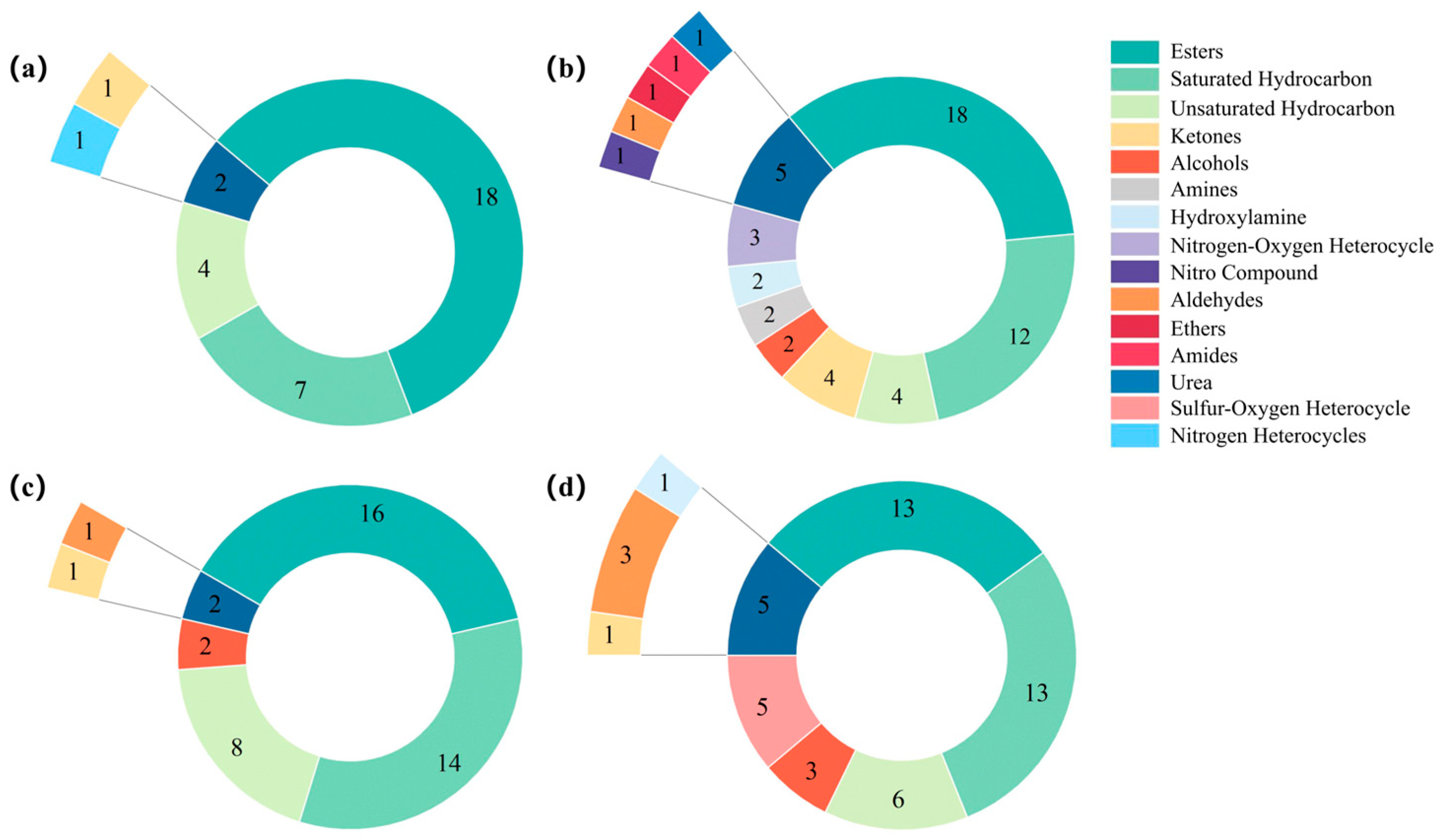
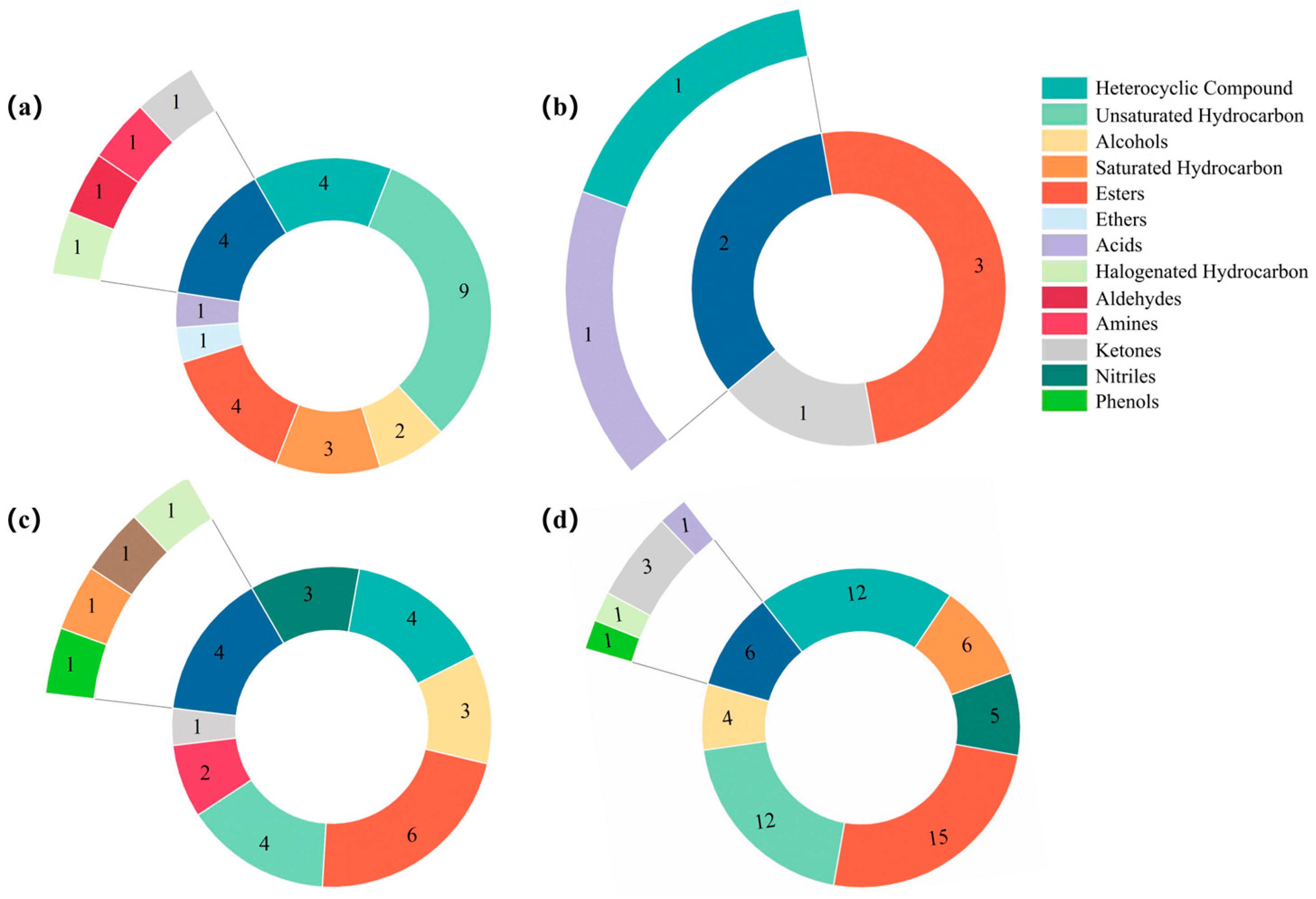
Following on-machine measurement and data analysis of the four wastewater types, it was found that each sample contained a diverse array of organic compounds, as illustrated in
Figure 5 and
Figure 6. Taking acrylonitrile mixed wastewater and acrylic fiber spinning wastewater as representative examples, a total of 31 semi-volatile organic compounds (SVOCs) and 28 volatile organic compounds (VOCs) were identified in the acrylonitrile mixed wastewater. Among the SVOCs, esters were predominant, accounting for 18 compounds in total, including 10 sulfonate esters. The presence of S-O bonds in these molecules was consistent with the infrared absorption signal at 1100 cm
−1. Saturated hydrocarbons were also detected, primarily branched-chain alkanes (7 compounds), whose signals aligned with the resonance at 1.30 ppm in the
1H NMR spectrum and the absorption peak near 1400 cm
−1 in the infrared spectrum. Additionally, aromatic compounds exhibited relatively high abundance, including both aromatic hydrocarbons and aromatic esters. This finding was corroborated by the UV
254 absorbance values, the FTIR signal at 610 cm
−1, and proton resonances with chemical shifts greater than 6.0 ppm in the
1H NMR spectrum. Among the VOCs, heterocyclic compounds were the most abundant, predominantly nitrogen-containing species such as pyridines, with a relative content reaching up to 26.1%. Unsaturated hydrocarbons (including aromatic hydrocarbons and olefins) and esters followed in abundance. Aromatic hydrocarbons constituted a significant proportion within the unsaturated fraction, with a total relative content exceeding 20%, further supporting the
1H NMR observations. The infrared absorption peak near 611 cm
−1 may be attributed to the out-of-plane bending vibration of Ar-H bonds.
A total of 42 semi-volatile organic compounds (SVOCs) and 27 volatile organic compounds (VOCs) were identified in the wastewater from acrylic fiber spinning. The semi-volatile fraction was predominantly composed of esters (16 compounds) and saturated hydrocarbons (14 branched-chain alkanes), with sulfonate esters representing the major subgroup. Compared to acrylonitrile mixed wastewater, this sample contained a greater number of unsaturated hydrocarbon species (8 types in total), a finding consistent with the UV
254 results. Other detected compounds included alcohols, aldehydes, and ketones. Among the volatile components, nitrile compounds—such as acrylonitrile and 3-hydroxypropionitrile—were present at relatively high levels, with acrylonitrile exhibiting particularly high relative abundance. This is likely attributable to the hydrolysis or incomplete polymerization of polyacrylonitrile monomers during the spinning process. In comparison with the other two wastewater types, the acrylic fiber mixed wastewater yielded the highest number of identified compounds, with 55 SVOCs and 60 VOCs detected—among the four wastewater streams analyzed. This may be associated with its origin as a multi-stage effluent mixture. In contrast, only six well-matched volatile organic compounds were detected in the acrylic polymerization wastewater (see
Tables S9–S16 for detailed results).
The aforementioned results indicated that aromatic compounds, alkanes, heterocyclic compounds, sulfonate esters, and other ester compounds were detected in all four types of acrylic fiber production wastewater. This finding directly reflects the complexity of raw materials and reaction pathways involved in the acrylic fiber manufacturing process. Specifically, aromatic compounds may originate from residual polymerization additives or solvents and their subsequent degradation; alkanes are primarily derived from unreacted raw materials or polymer chain scission; and heterocyclic compounds are likely formed under high-temperature and high-pressure polymerization conditions through side reactions. The presence of sulfonate esters clearly indicates the use of reagents such as sulfuric acid (H
2SO
4) and sodium methylallyl sulfonate in the production process. These substances are commonly employed in acrylonitrile copolymerization to enhance fiber performance, and their residues or hydrolysis products constitute the primary source of these pollutants in wastewater. These results suggest significant carryover of raw materials, occurrence of side reactions, and release of intermediates during acrylic fiber production. This not only confirms the inherent chemical characteristics of the process but also provides a critical foundation for subsequent pollution source analysis, process optimization, and the development of targeted wastewater treatment technologies. To validate the accuracy and reliability of the non-targeted screening results, this study selected representative compounds with readily available reference standards—such as pyridine, dichloromethane, and naphthalene—for confirmation (
Table S17). For compounds lacking commercially available standards, structural assignment was supported by complementary analytical data from infrared spectroscopy, three-dimensional fluorescence spectroscopy, and
1H NMR spectroscopy, enabling a more confident characterization of molecular structural features of organic substances in the wastewater.
3.5. Non-Targeted Screening Results of UPLC-Q-Orbitrap
To analyze refractory volatile organic compounds in wastewater, this study systematically compared three pretreatment methods: solid-phase extraction using C18 columns, HLB columns, and freeze-drying. Based on evaluation criteria such as recovery rate and reproducibility, the freeze-drying method was determined to be the most effective and was therefore selected for subsequent detection, coupled with UPLC-Q-Orbitrap mass spectrometry (
Figure S8). The total ion chromatograms (TICs) of the four wastewater types are presented in
Figure S9, providing a reliable foundation for compound identification.
Data analysis revealed that the diversity of non-volatile organic compounds in the four water sample types was substantially lower than that of volatile and semi-volatile organic compounds. In acrylonitrile mixed wastewater, a total of eight compounds were identified, including esters, amides, ketones, alcohols, and nitrogen-containing heterocycles (
Table 3). Of these, five contained benzene rings or conjugated double bonds, and exhibited relatively high molecular weights. The compound with the highest relative abundance (33.59%), C
33H
40N
2O
9, is a structurally complex aromatic ester, likely originating from polymerization reactions of organic precursors. Its cyclic structure and HC-O functional groups are corroborated by
1H NMR and infrared spectroscopy. In wastewater from acrylic fiber spinning, ten organic compounds were identified (
Table 4), comprising esters, amides, alcohols, ketones, and organic acids such as eugenic acid (C
20H
24N
2O
3). Structural analysis showed that eight of these compounds contain benzene rings or conjugated systems, with C
13H
13NO
4 exhibiting the highest relative content (34.44%). This compound is an amide featuring both a benzene ring and a six-membered oxygen-containing heterocyclic ring, and its fully cyclic architecture suggests high environmental persistence. Comparative analysis of the results (
Tables S18 and S19) indicated that six compounds were detected in acrylic fiber polymerization wastewater, primarily esters, nitrogen-containing heterocycles (e.g., pyridine derivatives), ethers, and ketones. In contrast, the mixed wastewater from acrylic fiber production exhibited greater compositional diversity, encompassing ketones, nitrogen-containing heterocycles, esters, amides, nitriles, and ethers. Among these, C
9H
13N (a pyridine-type compound) had the highest concentration. Its stable cyclic structure rendered it resistant to degradation by conventional biological treatment processes.
A systematic comparison of the non-volatile compound screening results across the four wastewater types revealed distinct common characteristics. On one hand, specific compounds such as C15H15N3O2S were detected in all three acrylic fiber-related wastewater samples, while C33H40N2O9 was present in two of them, indicating that these characteristic pollutants persisted across different production stages. On the other hand, structurally similar long-chain compounds were identified in wastewater from various stages of acrylic fiber production, suggesting the occurrence of continuous chemical transformations originating from key precursor substances—such as through oxidation-reduction or dehydration reactions—throughout the process. This finding provided critical insights into the migration and transformation mechanisms of pollutants during production. Furthermore, approximately 75% of the identified compounds in the four wastewater types contained benzene rings or conjugated double bonds. This prevalent structural feature offered a molecular-level explanation for the earlier spectroscopic observations: the three-dimensional fluorescence signals are primarily attributed to these conjugated systems. The infrared absorption peak at 1655 cm−1 was assignable to stretching vibrations of C=C, C=N, or amide C=O bonds. Additionally, the 1H NMR signals above 6.0 ppm and at 5 ppm were consistent with Ar-H and C=CH protons, respectively, establishing a clear mutual validation between the spectral data and the identified molecular structures.
In this study, the reliability and accuracy of the GC×GC-QTOF and UPLC-Q-Orbitrap non-targeted screening methods in analyzing complex wastewater systems were validated through the determination of selected compound standards and by integrating structural matching with complementary analytical data from infrared spectroscopy, three-dimensional fluorescence spectroscopy, and 1H NMR spectroscopy. Although a multi-technique analytical framework was systematically applied, only a limited number of volatile and semi-volatile compounds could be definitively identified and confirmed via comparison with authentic reference standards. The majority of the tentatively identified molecular structures are likely transformation products formed during the production process or microbial metabolites, exhibiting structural features that are not readily verifiable through commercially available standard substances, thus introducing a degree of analytical uncertainty. Nevertheless, this study consistently detected structurally stable and refractory organic compounds across all four types of acrylic fiber–related wastewater. The identification of these persistent constituents provides a critical theoretical foundation for the development of effective treatment strategies and pollution control measures in the acrylic fiber industry.
4. Conclusions
To comprehensively analyze the compositional characteristics of dissolved organic matter in wastewater generated during acrylic fiber production, this study integrated comprehensive two-dimensional gas chromatography–mass spectrometry, liquid chromatography–high-resolution mass spectrometry, multispectral analysis, and nuclear magnetic resonance spectroscopy to establish a multi-technique analytical approach. This study applied the method to wastewater samples collected from the four production stages of wet-spun acrylic fiber manufacturing. The results show that the organic compositions across all stages are highly similar, with sulfonate esters, various aliphatic and aromatic esters, alkanes, heterocyclic compounds, aromatic species, and conjugated structural moieties all detected, reflecting the presence of raw material residues, side reactions, and intermediate release throughout the production process. Notably, acrylonitrile concentration in spinning-stage wastewater increased significantly, suggesting its potential origin from polymer hydrolysis or residual unreacted monomers. Furthermore, the mixed wastewater, which integrates effluents from all stages, exhibits the highest diversity of volatile organic compounds, with a total of 60 distinct compounds identified. In conclusion, the analytical framework developed in this study provides a scientific basis for the structural characterization of organic pollutants in acrylic fiber wastewater and establishes a theoretical foundation for subsequent pollution source tracing, process optimization, and risk management.