Article

Research on Water Hammer Protection in Coastal Drainage Pumping Stations Based on the Combined Application of Flap Valve and Sluice Gate


1
College of Energy and Power Engineering, North China University of Water Resources and Electric Power, Zhengzhou 450045, China
2
Institute of Water Sciences, Zhejiang University of Water Resources and Electric Power, Hangzhou 310018, China
3
The Center of the Qiantang River Basin in Zhejiang Province, Hangzhou 310016, China
4
School of Geomatics, Zhejiang University of Water Resources and Electric Power, Hangzhou 310018, China
5
Bureau of Forestry and Water Resources of Fuyang District, Hangzhou 311400, China
6
School of Water Resources and Electric Power, Hebei University of Engineering, Handan 056038, China
*
Author to whom correspondence should be addressed.
Water 2026, 18(1), 25; https://doi.org/10.3390/w18010025 (registering DOI)
Submission received: 29 November 2025 / Revised: 16 December 2025 / Accepted: 19 December 2025 / Published: 21 December 2025

Abstract

The safe operation of drainage pumping stations, which are core flood-control facilities in eastern coastal areas of China, is paramount due to frequent typhoons and short-duration heavy rainfall. To enhance the operational safety against water hammer during pump trips caused by power failure, a water hammer protection method based on the combined application of flap valves and sluice gates is proposed. Only the scenario of all pumps tripping simultaneously was considered. A one-dimensional simulation model of the pumping station’s hydraulic transient process, which included pumps, pipelines, flap valves, and sluice gates, was established to analyze the system response under three scenarios: (i) only the flap valve closes normally, with the sluice gates remaining open, (ii) the flap valve fails, only the sluice gates operate, and (iii) the combined application of flap valve and sluice gates. In scenario (i), the maximum and minimum channel pressure heads were 13.53 m and −2.22 m, respectively, with no pump reversal occurred. However, continuous pressure fluctuations were observed downstream of the flap valve, posing a threat to the flow channel’s safety. In scenario (ii), the channel pressure heads all met the control requirements. Employing a 60 s single-stage linear closure rule for Gate #1 maintained the pump’s reverse speed within the safe range, peaking at −147.25% of the rated speed, with a reversal duration of 60 s. In scenario (iii), all channel pressure heads met basic control requirements, and no pump reversal occurred. The optimal strategy was found to be the adoption of a 60 s single-stage linear closure rule for both sluice gates. Compared to the scenario (i), the combined application reduced the amplitude of pressure fluctuations and damped these fluctuations rapidly, thus shortening the oscillation duration. The combined approach innovatively utilizes existing infrastructure for water hammer control, providing an economical and reliable solution for water hammer protection in urban drainage pumping stations.

1. Introduction

During the rapid urbanization of eastern coastal China, drainage pumping stations serve as core hydraulic infrastructure for resisting waterlogging disasters induced by typhoons and China’s plum rain season, and their operational stability directly influences the efficiency of regional waterlogging control. A power failure in the pumping system leads to the tripping of all pumps, and water backflow directly triggers hydraulic transients. This leads to a sudden pressure increase in the water transmission pipeline, potential rupture of the pipeline structure, and high-speed reverse rotation of the pump unit. Such consequences not only seriously threaten the overall operational safety of the pumping station system but also may result in significant economic losses [1,2]. To prevent such accidents, it is crucial to block backflow in a timely manner, and scientific and effective water hammer protection measures must be implemented. As a key backflow prevention device in the pump station outlet system, the flap valve primarily exhibits three typical failure modes: bearing failure [3], sealing failure [4,5] and failure to close. Among these measures, the flap valve is a commonly used, economical, and efficient backflow prevention device [6], which can achieve rapid flow cutoff by relying on water flow momentum and its own weight. If a single flap valve cannot be closed, it will lose its water hammer protection capability.
If the flap valve fails to close during a pump-trip event, it cannot block water backflow. This unimpeded backflow can then lead to destructive water hammer. Such an event not only drives the pump unit into overspeed reverse, which causes mechanical damage but also generates severe pressure fluctuations that threaten the safety of pipelines and channel structures. To enhance the operational reliability and hydraulic performance of flap valves, numerous scholars have conducted in-depth research on aspects such as structural forms and working mechanisms. Supri et al. [7] proposed three types of flap valves: a thickened type, a conical guide type, and a truncated cone guide. Through hydraulic performance analysis under the same opening angle, they found that the flap valve with a conical guide performs best in terms of flow field velocity distribution and pressure characteristics. Xie et al. [8] studied the hydraulic characteristics of hanging and side-hinged flap valves. They noted that side-hinged valves do not need to overcome gravity, unlike hanging ones. Such a design enables efficient flow interruption while ensuring minimal flow disturbance. Wang et al. [9] compared and analyzed the hydraulic characteristics of free-hanging, free-swing, and cover-plate flap valves. The free-swing flap valve, with its gentler closing process, can effectively avoid the severe pressure impact caused by instantaneous flow cutoff, and thus shows better performance in reducing pressure peaks in drainage culverts and improving flow patterns. Xi et al. [10] conducted research on the impact of hanging two-stage flap valves under different opening angles on water flow. Benefiting from the staged closing characteristic achieved by the hinge connection of the two-stage flap valve, this valve can stabilize the flow pattern in the water conveyance culvert at larger opening angles. Chen et al. [11] investigated side-hinged double-leaf flap valves, exploring the effect of increasing their opening angle to improve flow conditions. The research findings confirmed that this type of flap valve can effectively reduce operational resistance by opening to a larger angle, while also controlling pressure fluctuations within the channel. Lu [12] demonstrated that the mechanics of a flap valve following pump stoppage involve a transition from a forward flow phase, where it is subjected to a gradually decreasing downward force, to a backflow phase, where it closes rapidly under back pressure to prevent backflow and pump reversal. Through continuous optimization of the flap valve’s structure and hydraulic performance, the reliability of the flap valve’s flow cutoff has been significantly improved. However, in practical operation, flap valves may still experience failures such as refusal to close, delayed opening/closing, or structural damage. These unfavorable operational states compromise the flow-cutoff effectiveness [13,14], necessitating their combination with other measures to build a reliable water hammer protection system.
For high-head drainage pumping stations, the rapid closure of a flap valve can drastically alter the water momentum within the channel, inducing significant pressure fluctuations and potentially causing water hammer damage. This scenario requires a protection strategy that leverages the flap valve’s passive self-closing characteristic and coordinates it with an optimized, active closure of the terminal sluice gate to cushion system pressure variations. Therefore, the control strategy for sluice gates has also become an important aspect of water hammer protection research. Ouyang et al. [15] proposed a novel scheme in which a sluice gate was installed at the upstream end of an ultra-long pressurized diversion tunnel. By delaying gate opening for 40 min after water hammer effects occurred between the upstream and downstream sections during filling, and then adopting a slow and uniform opening, the extreme pressures and discharge variations along the tunnel were kept within safe limits. This approach mitigated unfavorable flow conditions such as air–water mixing, large air pocket formation, and water column separation, thereby improving flow efficiency and reducing water hammer pressure. This concept of a strategically timed and paced gate maneuver is directly applicable to the problem of controlling pump-trip induced transients. Xue et al. [16] conducted an analysis based on the Flowmaster technology, indicating that the gate can effectively suppress the pressure peak and significant fluctuations caused by water hammer by optimizing the closing strategy (adopting a fast-first-slow pattern, with the fast-closing stroke accounting for 2/3 of the total stroke, and the fast-closing opening controlled within the range of 0.6–0.3 (with the optimal value being 0.4)), ensuring the safety and stability of the pipeline system operation. Lescovich [17] investigated the influence of water conveyance pipeline length on the required gate closure time. The longer the pipeline, the more pronounced the impact of the pressure wave generated by water inertia during rapid gate closure. It is thus evident that the closure time of the gate should also be extended accordingly. Wang et al. [18] investigated various schemes, including single-side gate opening and combined gate openings on both sides, within a bidirectional flow channel pumping station. They found that the most uniform velocity distribution in the inlet section of the channel was achieved when the inlet-side gate remained fully open and the discharge was controlled solely by adjusting the opening of the outlet-side gate. Song [19], in a study on the flow characteristics of an integrated gate station under normal operating conditions, established an operational protocol based on “intelligently switching the gate status and pump operation according to the upstream and downstream water level difference.” While this study does not address pump-trip scenarios, it demonstrates the foundational principle of coordinated gate and pump control within a system, a concept that this research adapts and applies to fault conditions.
Notably, in addition to the structural form and integration method of the sluice gate, its control strategy is a key factor influencing water hammer protection effectiveness [20]. Appropriate control strategies can effectively mitigate water hammer pressure fluctuations, such as employing prolonged closure times [21,22] and two-stage closure [23]. However, relying solely on either sluice gates or flap valves may still present issues of inadequate protection or even heightened risks due to potential device failure. Adopting a combined application approach that utilizes the passive closure of the flap valve and integrates it with the active control of the sluice gate can further enhance the system’s reliability and protection effectiveness. Yu et al. [24] proposed adding a bypass flap valve to rapid-closure sluice gates, which can regulate flow changes during the pump start-up transition period, effectively smoothing the head fluctuations in the channel and reducing pressure peaks. Bettaieb et al. [25] proposed installing a sluice gate at the confluence of dual-pump discharge pipelines to address pump-trip water hammer. Their comparative study of check-valve-only regulation and combined gate–check valve regulation indicated that while the check valve alone could protect the pump, it induced severe pressure fluctuations. In contrast, the combined use the sluice gate and the check valve, implementing a two-stage strategy of “first rapidly closing to 10% opening, then slowly closing to fully closed,” effectively suppressed pressure fluctuations, thereby reducing the risk of pipeline fatigue caused by repeated pressure impacts. Zhang et al. [26] studied the combined protection of flap valves and rapid-closure sluice gates during the shutdown of a large axial-flow pump system. The results demonstrate that synchronizing shutdown of rapid-closure sluice gates with the pump stoppage leads to a more gradual flow decay, suppresses the maximum instantaneous hydraulic impact caused by flap valve action, and significantly reduces the water hammer pressure peak, thereby protecting the unit equipment. Optimizing the coordinated control logic among different devices has become key to further improving the water hammer protection effectiveness of pumping stations. This study innovatively proposes the combined application of flap gate and gate for water hammer protection of pumping station.
Both flap valves and sluice gates can provide a certain degree of protection against water hammer in drainage pumping stations. Typically, these stations operate with a low head, and the closure process of a flap valve does not induce severe pressure fluctuations. However, some drainage pumping stations can possess a head exceeding 10 m. In such systems, the combination of high flow velocity and the rapid closure of the flap valve can generate significant water hammer pressure sufficient to risk exceeding the pipelines’ pressure rating. This potentially damages the structure of the drainage channel, its connectors, the flow-breaking device itself, and the pump unit. Consequently, intervention from a sluice gate within the pipeline is often required. By systematically optimizing the combined closing strategy of the two sluice gates, the risk of water hammer damage can be reduced. Previous studies have insufficiently investigated the coordinated control strategy involving the simultaneous operation of the flap valve and sluice gate during the flap valve closure process in drainage pumping stations. Furthermore, few studies have systematically quantified the coordinated effects of flap valve and dual sluice gates on transient pressure attenuation and backflow control in such systems. This study focuses on urban drainage pumping stations. It conducts simulation calculations of the hydraulic transient process during pump trips caused by power failures under water pumping scenarios and analyzes the coordinated control effects on the peak water hammer pressure and pump rotational speed changes. This study aims to develop an optimal water hammer protection scheme based on the combined application of flap valve and sluice gate.

2. Methods

2.1. Coordinated Control Strategy and System Modeling

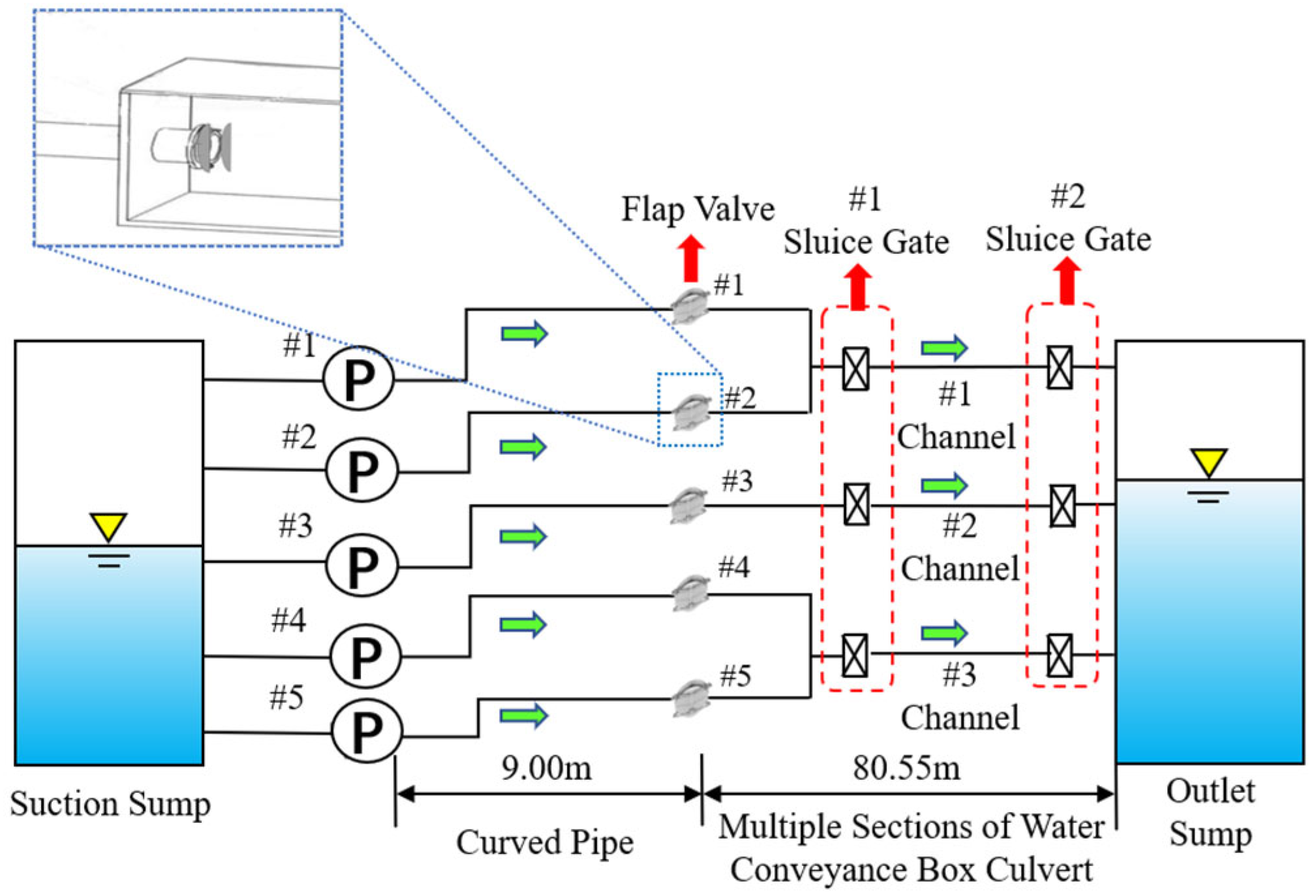
The core of the coordinated control strategy for functional flap valves and sluice gates lies in the synergistic use of flap valves rapid flow cutoff capability and sluice gates controllable closure strategy to collaboratively suppress water hammer pressure, control unit reversal, and manage backflow volume. This strategy is primarily implemented by regulating the closure sequence of sluice gates installed in the pumping station’s water conveyance channel. When two sluice gates are present within the channel, the system downstream of the flap valve is divided into three segments. The first section from the pump outlet to the flap valve, the second section between the flap valve and the #1 gate, and the last section between the #1 gate and the #2 gate. The dual sluice gates can be operated in various modes, such as “single-gate closure,” “front-gate fast, rear-gate slow,” or “simultaneous closure.” Different strategic combinations of these modes will yield distinct protective effects on the system’s hydraulic transient process.
This study developed a numerical model based on the Method of Characteristics (MOC) and implemented it in Fortran 90. Using a modular modeling approach, an integrated computational model for a drainage pumping station was constructed, incorporating key components such as pumps, pressure pipelines, flap valves, and sluice gates, as illustrated in Figure 1. This model couples and solves the governing equations of each component. By simulating transient processes under different sluice gate control strategies during both normal and failure conditions of the flap valve, the model enables systematic analysis of the coordinated control effectiveness on water hammer pressure and pump rotational speed.

2.2. Mathematical Model for Pressurized Pipeline Calculations

2.2.1. Mathematical Model for Steady Flow Conditions in Pressurized Pipelines

The water conveyance conduit of a drainage pumping station primarily consists of pipelines and box culverts. The water transmission is pressurized by pumps. Steady flow is analyzed using an energy equation based on the Bernoulli Principle, which is extended to include head loss, as follows:
h w   =   P 1 P 2 ρ g   +   v 1 2 v 2 2 2 g   +   ( Z 1 Z 2 )
where h w represents head loss, m; P 1 and P 2 represents the static pressure, Pa; ρ represents the density of water, kg/m3; g is the acceleration due to gravity, m/s2; v 1 and v 2 represents the flow velocity of water, m/s; Z 1 and Z 2 is the elevation of the evaluated point above a reference, m.
The head loss in the water conveyance conduit is predominantly attributed to frictional losses, with minor head losses accounting for a relatively small proportion of the total head loss. To ensure computational accuracy, the effects of local head losses resulting from changes in pipe diameter and bends are also considered in the calculation. These minor losses are incorporated into the frictional head loss by applying specific coefficients.
(1)
Calculation of Frictional Head Loss
In this study, both pipes and box culverts are classified as pressurized flow channels. When the flow in the pipeline is in a turbulent state, the frictional head loss is calculated using the Darcy–Weisbach equation, as follows:
h f   =   λ l d v 2 2 g
where h f is the frictional head loss, m; λ is the friction factor (loss coefficient along the route), λ = 0.015; l is the length of the pipe, m; d is the inner diameter of the pipe, m; v is the fluid velocity, m/s; g is the gravitational acceleration, m/s2 (in this study, g = 9.81).
(2)
Calculation of local head loss
h f = ζ v 2 2 g
where h f represents the local head loss, m; ζ represents the head loss coefficient; v is the fluid velocity, m/s; g is the gravitational acceleration, m/s2, in this study g = 9.81.

2.2.2. Mathematical Model for Water Hammer Calculation

The fundamental equations describing the flow state in any pipeline are as follows:
Q H x   +   π D 2 4 H t   +   a 2 g Q x   =   Q   sin α
  g π D 2 4 H x + Q Q x + π D 2 4 Q t = f Q Q 2 D
where H is the piezometric head, m; Q is the discharge, m3/s; D is the inner diameter of the pipe, m; t is the time variable, s; a is the water hammer wave speed, m/s; g is the gravitational acceleration, m/s2; x is the distance along the pipe axis, m; α is the angle between the pipe axis and the horizontal plane, °; and f is the friction factor.
Equations (4) and (5) can be simplified into standard hyperbolic partial differential equations. Consequently, they can be transformed into mathematically equivalent characteristic compatibility equations for pipeline water hammer computation via the Method of Characteristics [24].
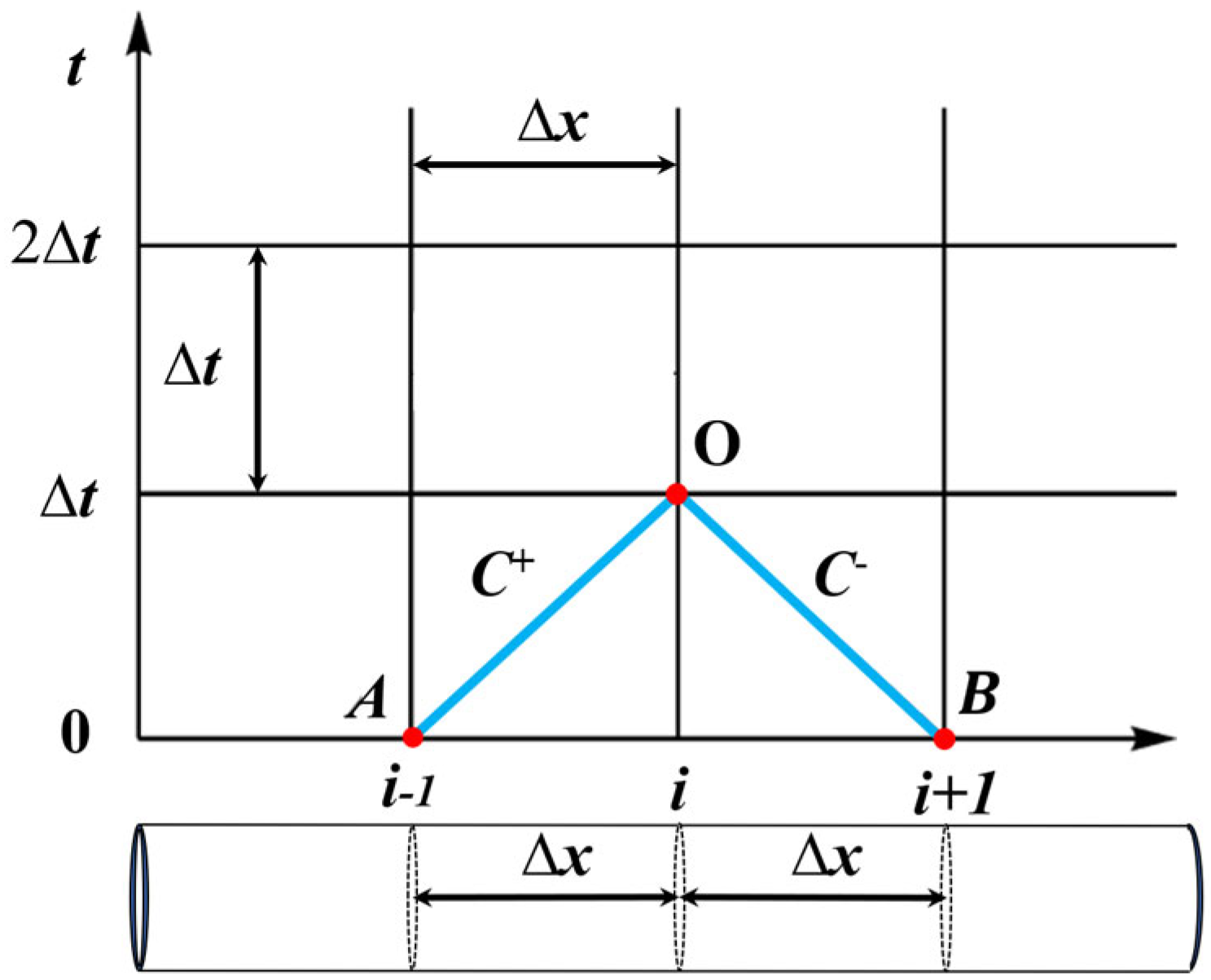
As illustrated in Figure 2, the pipeline is discretized using the method of characteristics (MOC). The schematic shows a characteristic mesh element with a length of 2 x , where x is the spatial step size. For a pipe A-B, the characteristic compatibility equations relating the transient hydraulic heads H A ( t ) , H B ( t ) and transient discharges Q A ( t ) , Q B ( t ) at both endpoints (A and B) at time t are established as follows:
C :   H A ( t )   =   C M   +   R M Q A ( t )
C + :   H B ( t ) = C O R O Q B ( t )
where the subscript “O” denotes parameters associated with the C + characteristic line; the subscript “M” denotes parameters associated with the C characteristic line; C M   =   H A ( t     k Δ t )     a g A Q A ( t     k Δ t ) ; R M   =   a g A   +   R Q A ( t     k Δ t ) ; C O   =   H B ( t     k Δ t )     a g A Q B ( t     k Δ t ) ; R O   =   a g A   +   R Q B t     k Δ t , with the following definitions: Δ t is the computational time step, s, ( Δ t   =   3.27   ×   10 5 ); Δ x is the characteristic grid segment length, satisfying the Δ x   =   a Δ t Courant condition, ( a   =   1200 m/s and Courant number is 1); k   is the number of characteristic grid segments, defined as k   =   L / Δ x ; R   is the head loss coefficient, given by R   =   Δ h Q 2 ; Δ h is frictional head loss or local head loss, m; L is the length of the pipe, m.
Hydraulic transient computation typically starts from an initial steady state, corresponding to t   =   0 . When the term ( t     k Δ t )   <   0 appears in the equations, it is set to ( t     k Δ t )   =   0 , thus adopting the initial condition values. Equations (6) and (7) each contain only two unknowns. By coupling them with the boundary conditions at nodes A and B, the transient hydraulic state variables at these nodes can be solved.

2.3. Characteristic Equations for Water Hammer Calculation Nodes

2.3.1. Governing Equations for the Pump Node

(1)
Runner Boundary Head Equilibrium Equation
Let nodes 1 and 2 denote the upstream and downstream boundaries of the runner. In accordance with Equations (6) and (7), the head equilibrium equation at the runner boundary is formulated as:
h   =   ( C 1     C 2 ) H r     q ( R 1   +   R 2 ) Q r H r
where H r is the rated runner head at the design condition, m, and Q r is the rated discharge at design condition, m3/s. All other symbols retain their previous definitions.
(2)
Treatment of Complete Characteristic Curves
The complete characteristic curves of pumps contain an “S-shaped region” in their characteristic curves characterized by severe numerical crossover. The Suter transformation method was employed to convert and process the complete characteristic curves of the pumps [28].
WH ( x ,   y ) = h y 2 a 2 + q 2
WB ( x ,   y ) = ( β h + k 1 M 1 r ) y
  x = arctan ( q + k 2 h a ) ,   a     0
  x = π + arctan ( q + k 2 h a ) ,   a   <   0
where h , m , a , q     are the dimensionless values of head, torque, rotational speed, and discharge, respectively; y     is the wicket gate opening, %; M 1 r denotes the specific torque under rated conditions, kN·m; and k 1 , k 2 are the empirical coefficients, with k 1   =   1.1   and   k 2   =   0.5 .
(3)
Unit Driving Torque Equilibrium Equation
α =   α 0 + [ ( β +   β 0 ) ( β g + β g 0 ) ] Δ t 2 T α
where T α is the moment of inertia time constant, s; given by T α   =   G D 2 n r 374.7 M r ; G D 2 is the flywheel moment of the rotating parts, kN·m2; n r , M r are the rated rotational speed, rpm and rated driving torque, kN·m, at the design condition; Δ t is the computational time step, s; β g is the dimensionless unit resistance torque; and α 0 , β 0 , β g 0 are the values of α , β , β g at the previous computational time step.
By simultaneously solving Equations (8)–(11) with the prescribed closure law y   =   y ( t ) , the transient state parameters at the pump-turbine node such as dimensionless head h , torque β , speed α , and flow q can be obtained for various operating conditions.

2.3.2. Flap Valve Node Governing Equations

In drainage pumping stations, pump discharge pipelines are typically designed with a hump-backed configuration, employing a flap valve for flow interruption. The flap valve, installed at pipeline outlets, functions similarly to a check valve in the pipeline system. Its hydraulic loss decreases as the opening angle increases.
The head loss across the flap valve is calculated as follows:
Q 0   =   C d A G 2 g Δ H 0
where H 0 is the head loss across the flap valve, m; Q 0 is the discharge through the flap valve, m3/s; g is the gravitational acceleration, typically 9.81 m/s2; C d is the discharge coefficient of the flap valve (dimensionless), C d   =   0.65 ; A G is the flow-passing area of the flap valve, m2.

2.3.3. Sluice Gate Control Node Equations

The governing equation for a sluice gate under submerged outflow conditions is applicable to both gates in the system, as shown in Figure 1, by utilizing the respective local head difference. The equation is as follows:
  Q Z   =   C z φ B 2 g   ( Z 2     Z 0 )   Z 2     Z 1
where Q Z is the discharge through the gate, m3/s; C z is the discharge coefficient for free flow (dimensionless),   C z = 0.85; φ is the relative gate opening height, m; B is the gate opening width, m; Z 1 is the upstream water level at the gate outlet, m; Z 2 is the downstream water level, m; and Z 0 is the invert elevation of the gate sill, m.

2.4. Numerical Model Validation

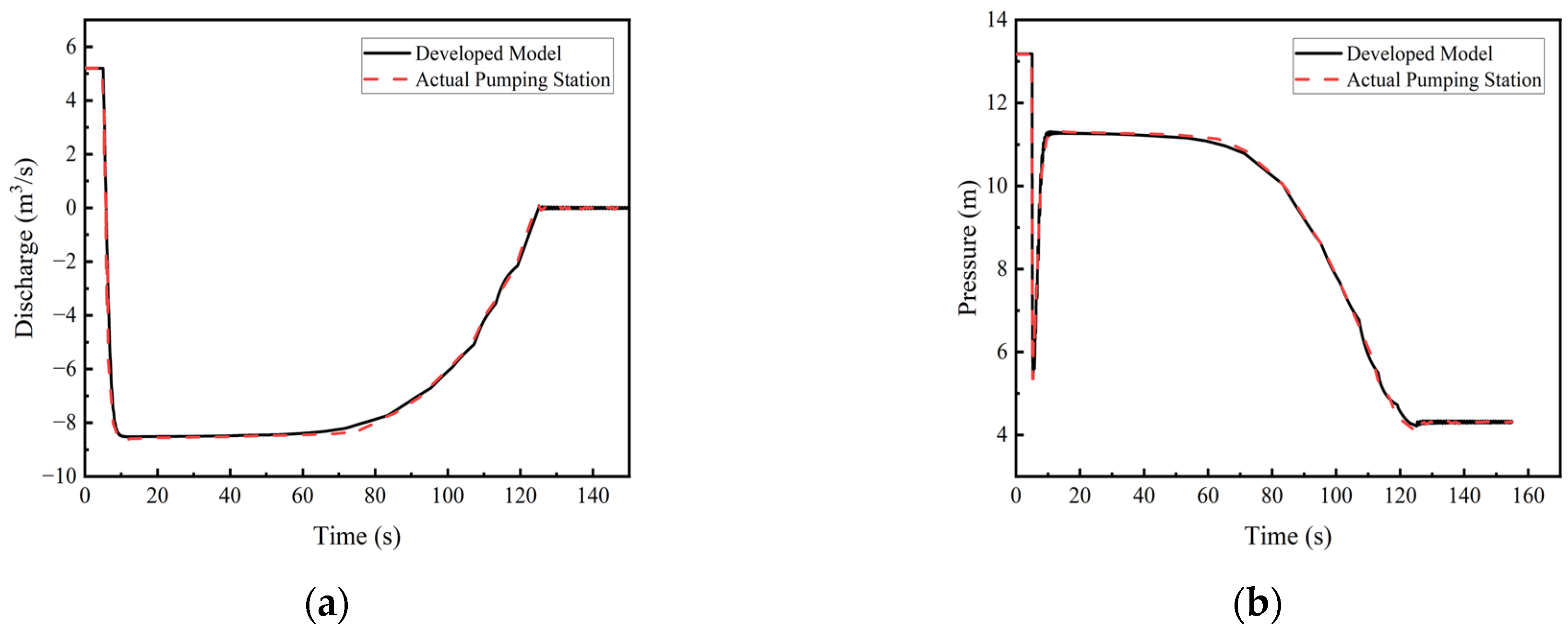
The model covers all relevant boundary conditions and takes into account factors such as frictional resistance in water pipelines and culverts. In order to verify the accuracy and reliability of the model, the results are compared with those obtained in practical engineering. All pumps trip at t = 5 s, and the downstream gate is linearly closed within 120 s. The comparison of the results is shown in Figure 3.
The simulation results exhibit strong agreement with the actual data in terms of overall temporal trends. Specifically, the pressure and flow curves demonstrate consistent dynamic behavior, with closely matching value ranges, fluctuation amplitudes, and peak and trough locations. Although minor local discrepancies are observed, the model successfully reproduces the key hydrodynamic characteristics reflected in the actual data.
These results indicate that the proposed model achieves a high level of accuracy in capturing real-world pressure and flow variations, thereby verifying the reliability and validity of the modeling framework established in this work.

3. Practical Case

3.1. Project Overview

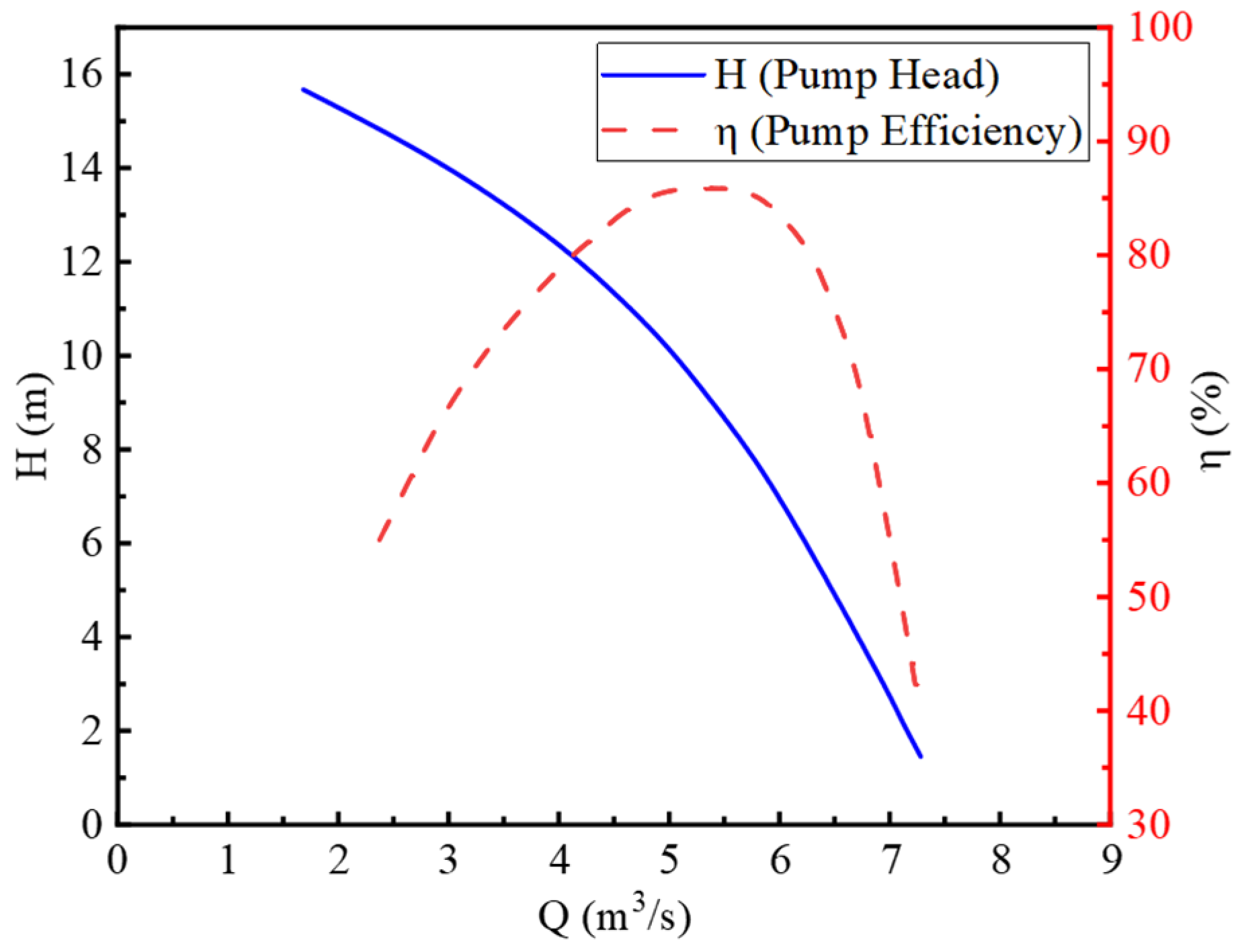
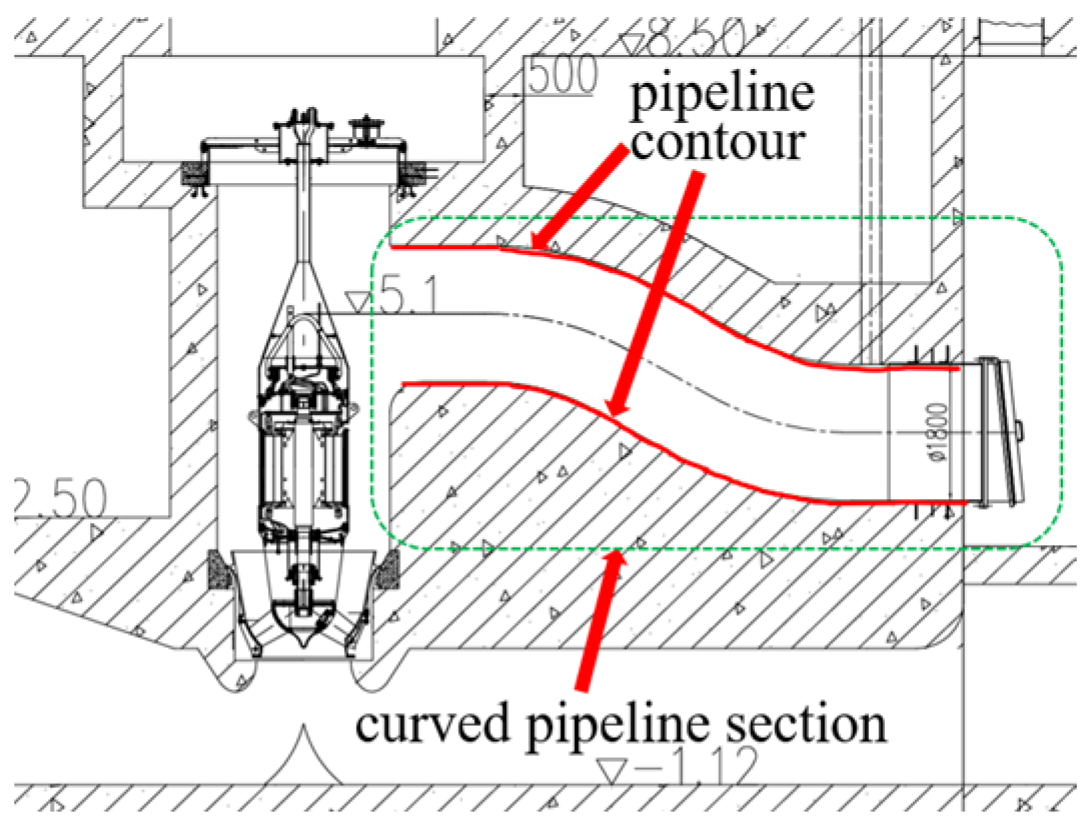
A drainage pumping station in a city in Anhui Province, China, was selected as a computational case study. It represents a typical configuration for coastal drainage systems in the region, characterized by a high static head that poses a significant water hammer risk during pump trips caused by power failure. This makes it a relevant and critical case for evaluating the proposed protection strategies. The system primarily comprises pump units, drainage pipelines, flap valves, drainage box culverts, and outlet sluice gates. The pumping station is equipped with five drainage pipelines, each fitted with a side-hinged double-leaf flap valve at their downstream ends. The water flows through curved pipe sections (Figure 4) and converges into three rectangular conveyance box culverts, ultimately discharging into the outlet sump. The general layout of the pumping station is illustrated in Figure 5. The pump unit configuration consists of five 1400HDB-60-type submersible mixed-flow pumps (Hengda Jianghai Pump Industry Co., Ltd. in Hefei, China), with a blade installation angle of θ = 0°. The performance curve for this pump model is shown in Figure 6. The discharge pipe for each pump has a diameter of DN1800 mm, a length of 9.00 m, and is constructed from reinforced concrete, with a pressure wave speed of 1200 m/s. To prevent pump reversal due to water backflow during shutdown, each drainage pipe is equipped with a side-hinged double-leaf flap valve (nominal diameter: DN1800 mm; nominal pressure: 0.25 MPa) at its termini. The flap valves are constructed from Q235B steel. The concrete rectangular box culverts, with a total length of 80.55 m, serve as the drainage channel. The culverts comprise multiple segments of varying dimensions in Table 1. For the purpose of the transient analysis, the rectangular cross-sections were modeled using an equivalent circular pipe approach to streamline the one-dimensional computational process. The flow area equivalence method ensures that the cross-sectional area of the box culvert equals that of the equivalent circular pipe, and that their flow capacity and along-the-way head loss characteristics are consistent. A maintenance sluice gate is installed 19.32 m from the inlets of the box culverts, and an emergency sluice gate is located at the outlets. Both gates are gravity-operated steel plate gates, utilizing their self-weight as the driving force for closing. The closing time and motion are controlled by gate hoist machinery, which manages the rate of descent. The pump parameters are listed in Table 2, and the characteristic water levels of the suction sump and outlet sump are provided in Table 3.

3.2. Control Settings

To ensure the safe operation of the pumping station and effectively prevent water hammer hazards, the following key conditions for pump trips and water hammer control require focused attention during water hammer protection studies:
(1)
Starting Conditions for Drainage Pumping Station: When the water level in the suction sump exceeds the design level of 5.03 m, the pump units must be started immediately and maintained in continuous operation.
(2)
Water Hammer Control Conditions: Based on the engineering design requirements, during a pump-trip accident, the maximum reverse speed of the pumps must not exceed −150.00% of the rated speed, and the duration of this overspeed condition must not be greater than 120 s. Furthermore, the maximum pressure in the flow channel downstream of the pump outlets must not exceed 1.5 times the pump outlet pressure, and the minimum pressure must not fall below −4 m (water column).
(3)
Control Requirement for gates operation: Owing to the substantial self-weight of steel plate gates, the closing speed must be appropriately limited. According to the specification [29], the gates must be fully closed within 120 s. Excessively rapid closure of emergency gate in pumping stations can induce severe water hammer effects, accompanied by mechanical shocks and system negative pressure. These transient phenomena may cause damage to pipelines, pump units, and the gates themselves, potentially leading to cascading safety incidents.

3.3. Computational Cases

Among the five drainage channels, the one with Pump #1 was selected as the representative case for this study. In accordance with the pumping station’s operational control requirements, the computational conditions were set as follows: the water level in the suction sump was set to 5.03 m, and the water level in the outlet sump was set to its maximum operating level of 13.74 m. This hydraulic head difference exceeds the design head, indicating a more severe water hammer effect is anticipated following a pump trip. All transient calculations are based on the scenario where all pumps trip simultaneously at t = 5 s, The scenario of simultaneous all-pump trip was selected as the critical research condition because it represents the most severe case for water hammer analysis in pumping station systems. Under this condition, the instantaneous and collective loss of pumping power induces the most drastic changes in flow velocity and pressure within the pipeline network. With the exception of the selected research channel, the flap valves in all other channels function normally. The closure of the sluice gates is initiated concurrently with the pump trip event.
The following typical computational scenarios are established.
(i)
Only the flap valve close normally, with the sluice gates remaining open.
(ii)
The flap valve fails, and only the sluice gates operate. All sluice gates adopt a single-stage linear closure rule, with the control strategy schemes detailed in Table 4.
(iii)
Combined application of flap valves and sluice gates. The scenarios are shown in Table 5.

4. Results and Discussion

4.1. Analysis of the Hydraulic Transient Process Under Normal Flap Valve Operation

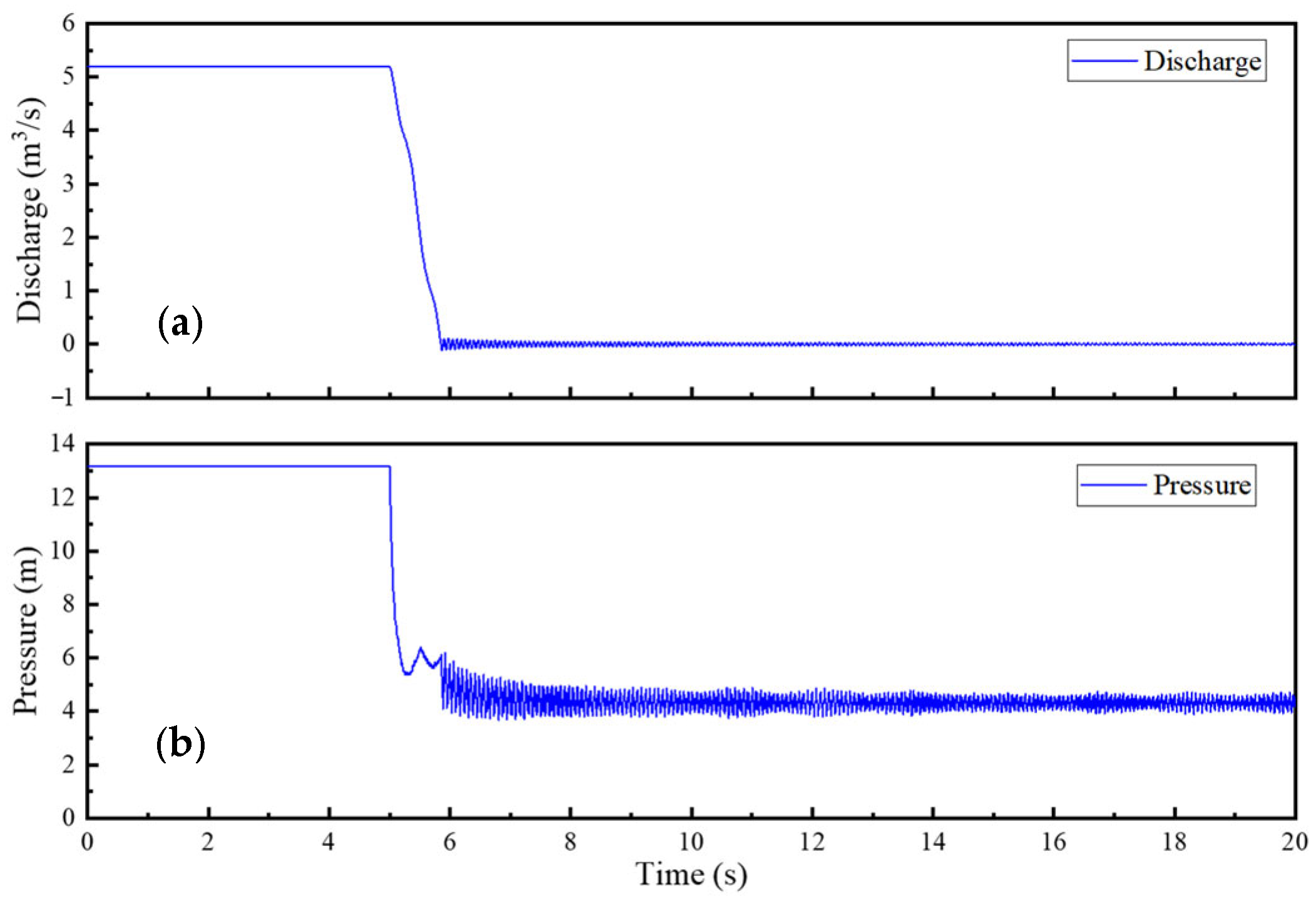
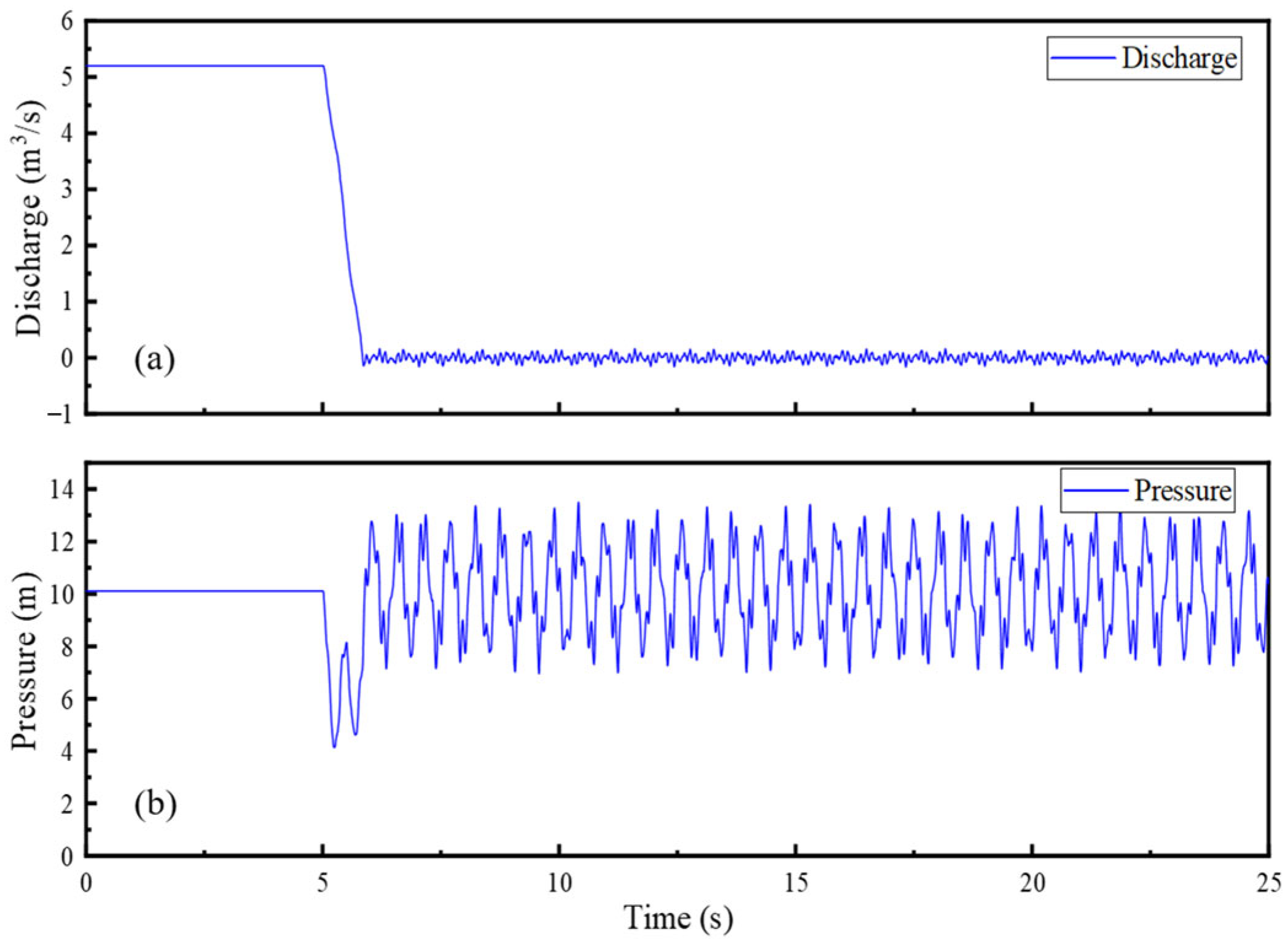
In scenario (i), where only the flap valve closes normally, with the sluice gates remaining open, the flap valve can promptly cut off the discharge. The discharge rate downstream of the pump rapidly stabilizes near zero and then remains steady. The pressure downstream of the pump decreases at a rate of 31.28 m/s in the first stage, dropping from 13.28 m to 5.36 m, and is followed by fluctuations. The rapid pressure transient poses a significant threat to the structural safety of the reinforced concrete conduits. Due to damping effects such as pipeline friction, the fluctuation amplitude gradually diminishes, as shown in Figure 7. The discharge rate downstream of the flap valve also rapidly returns to near zero after pump stoppage; however, due to the longer drainage channel in this section, the fluctuation amplitude is larger, as illustrated in Figure 8a. The pressure downstream of the flap valve decreases at a rate of 22.34 m/s in the first stage to 4.19 m, thereafter maintaining large-amplitude sustained fluctuations, as shown in Figure 8b. The shorter channels downstream of the pump results in a shorter propagation period and rapid attenuation of the water hammer wave. In contrast, the longer channels downstream of the flap valve leads to a longer water hammer wave period and slower attenuation.
When the pressure drops to its first trough, the overall pressure change induced by the long-period water hammer wave briefly creates a positive pressure differential across the flap valve, sufficient to overcome their self-weight and lead to a slight, transient opening. As backflow occurs, the flap valve closes again, triggering a secondary excitation that generates a new cycle of fluctuations. Subsequently, the energy gradually dissipates, the flap valve remains closed, and the pressure fluctuation amplitude downstream of the pump decreases; concurrently, the pressure downstream of the flap valve continues to exhibit sustained large-amplitude fluctuations.
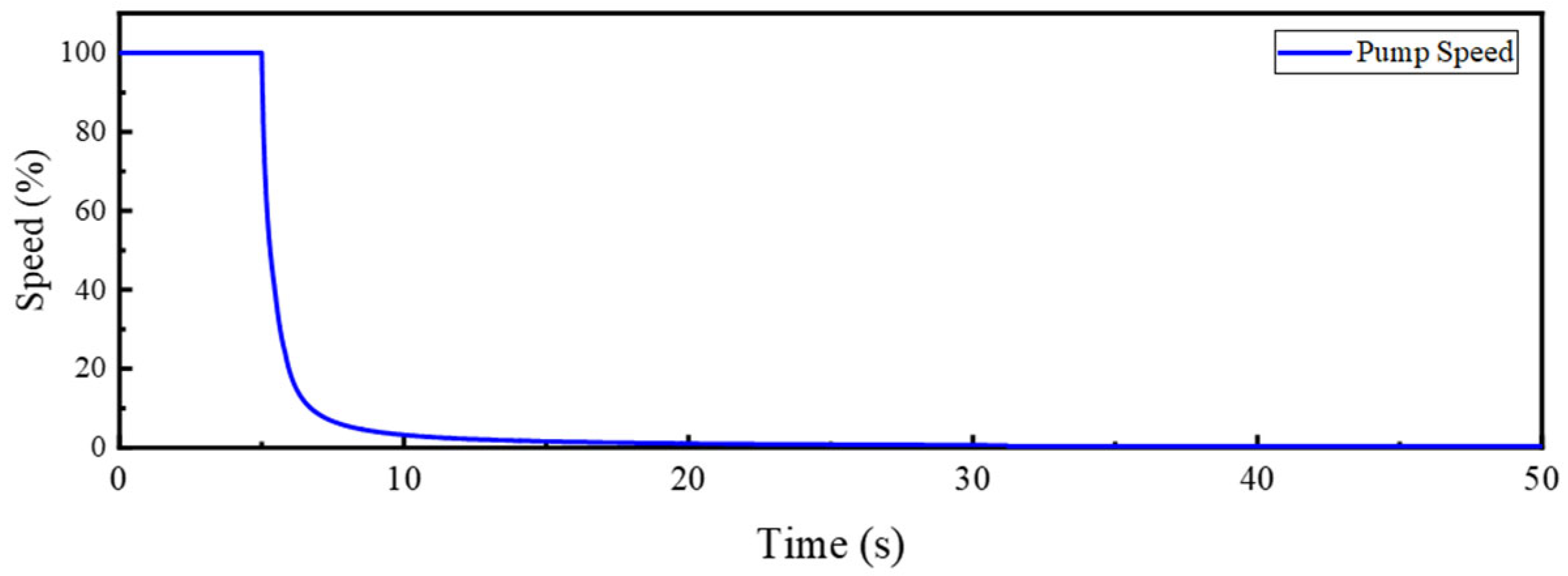
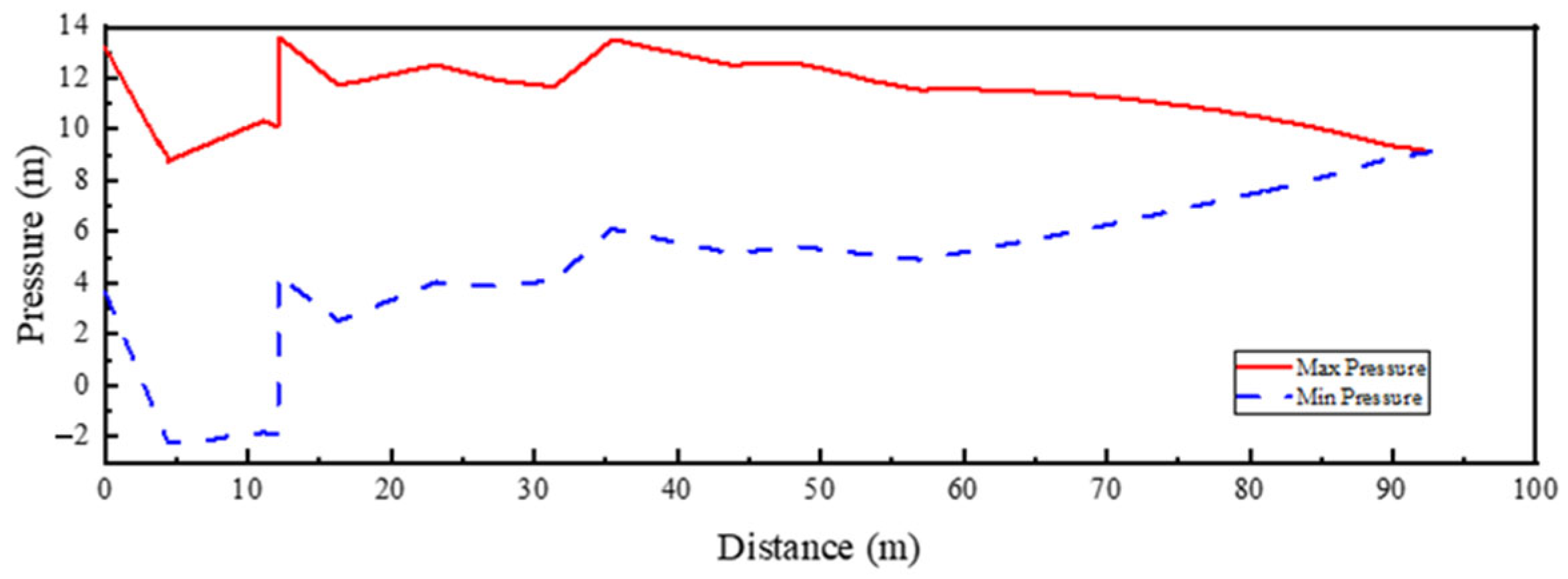
As shown in Figure 9, the minimum pressure heads along the flow channels are −2.22 m, occurring upstream of the flap valve, while the maximum pressure of 13.53 m appears downstream of the flap valve. Flap valve closure divides the flow channel into two separate hydraulic systems, leading to a significant pressure differential across the valve that ranges from −3.41 m to 6.02 m. The short channel sections upstream of the flap valve experiences intense water hammer pressure fluctuations with short periods, whereas the long channel sections downstream of the flap valve, characterized by greater water inertia, exhibits pressure fluctuations with longer periods and slower attenuation, leading to prolonged pressure variations in this region. The rapid flow interruption by the flap valve causes the pump speed to decrease promptly, effectively preventing pump reversal, as illustrated in Figure 10.

4.2. Analysis of the Hydraulic Transient Process When the Flap Valve Fails to Close

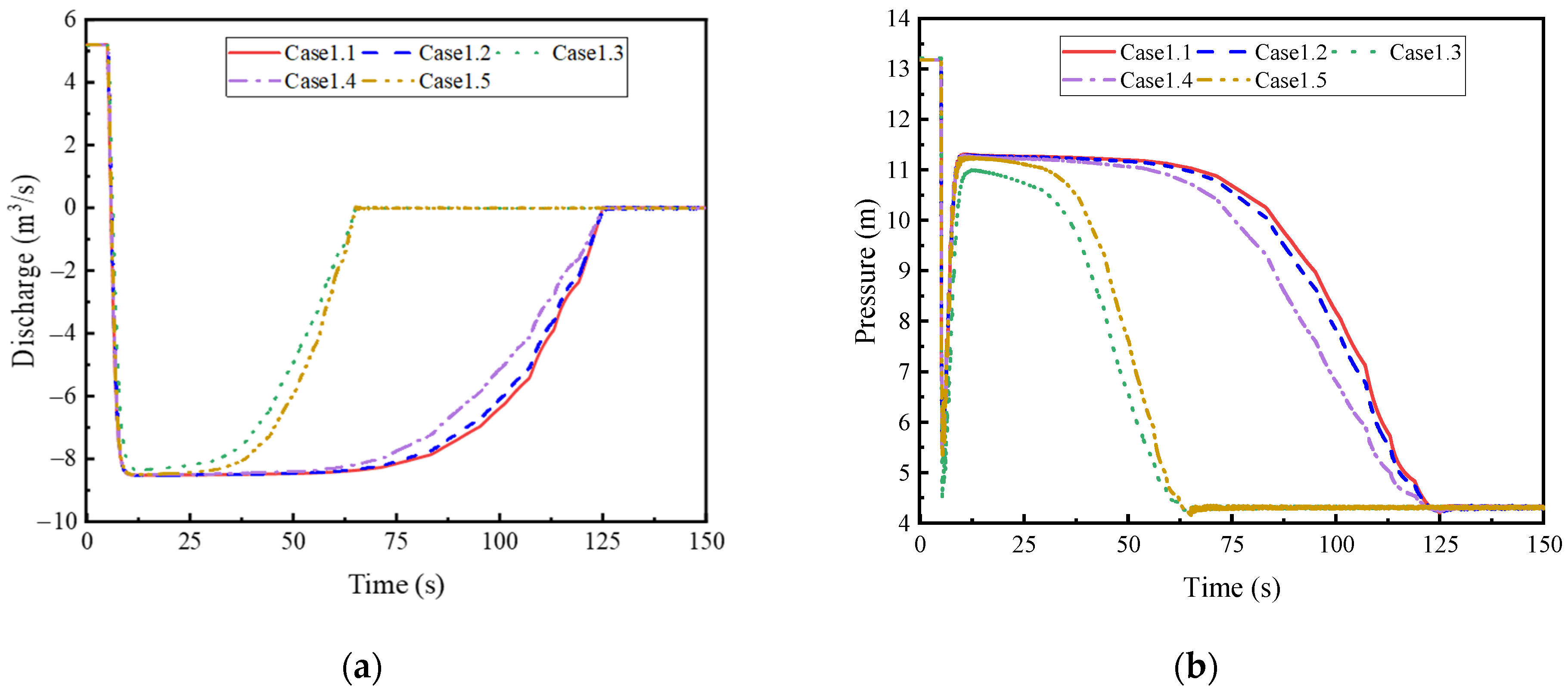
When the flap valve fails to close and the sluice gate alone is used for water hammer protection, the effectiveness of protection varies significantly depending on the control strategy adopted for sluice gates. Through computational analysis of the hydraulic transients during a pump-trip event with sluice gate protection, the extreme values of key control parameters were obtained, as shown in Table 6. Among the strategies relying solely on sluice gate control, all pressure heads along the flow conveyance channels meet the control standards. However, only Case 1.3 and Case 1.5 were able to effectively restrict the pump reversal speed within a safe range, thus qualifying as effective control strategies. In the Case 1.3 strategy, the maximum pump reversal speed was controlled at −147.25% of the rated speed, making it the optimal solution.
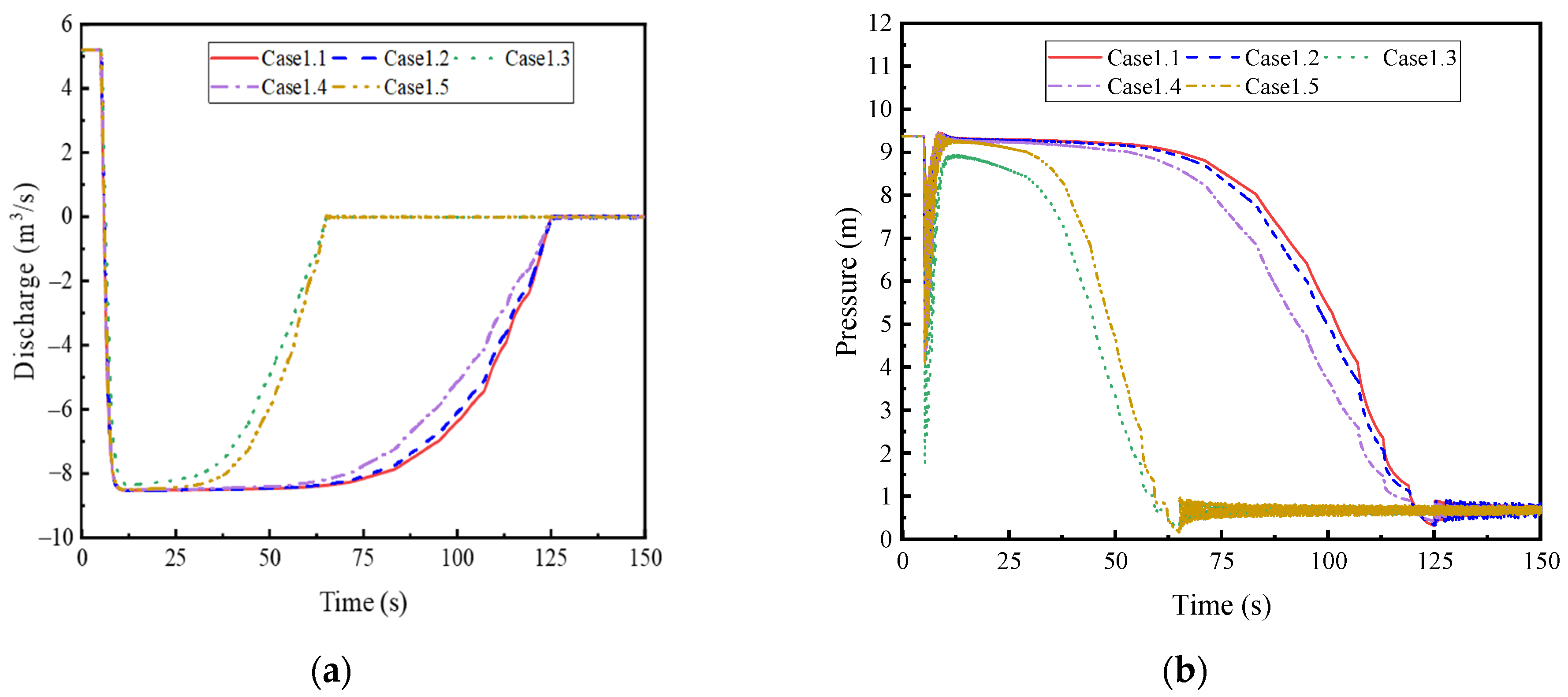
During a pump-trip event with flap valve failure, the section from the pump outlet to the upstream side of Gate #1 is part of the same flow channels and experiences identical water hammer effects. The variations in discharge and pressure downstream of the pump are shown in Figure 11 and Figure 12, respectively. The discharge in the drainage channels reverses rapidly after the power failure, reaching a peak backflow rate. Among the cases, Case 1.1 exhibits the highest reverse discharge of 8.52 m3/s and the longest backflow duration of 120 s. In contrast, Case 1.3 exhibits the smallest reverse discharge, and both Case 1.3 and Case 1.5 exhibit the shortest backflow duration of only 60 s. Shorter gate closure times resulted in more effective suppression and faster pressure recovery. After pump stoppage, the pressure drops sharply initially and then rises rapidly. Maximum extreme pressures of 11.29 m occur in Case 1.1 and Case 1.2, whereas the minimum extreme pressure of 10.99 m is observed in Case 1.3, which also demonstrates the fastest pressure recovery to a stable state. During the gate closure process, discharge and pressure remain relatively stable in the high-opening range. Significant changes begin to occur when the gate is closed to 50%, and substantial variations in discharge and pressure are observed when the closure reaches 80%, even with minor adjustments in the opening degree. The results indicate that the gate closure speed is a critical factor affecting the hydraulic transient response in the flow channels, and gate movements at small openings have a more pronounced impact on channel pressure and discharge.
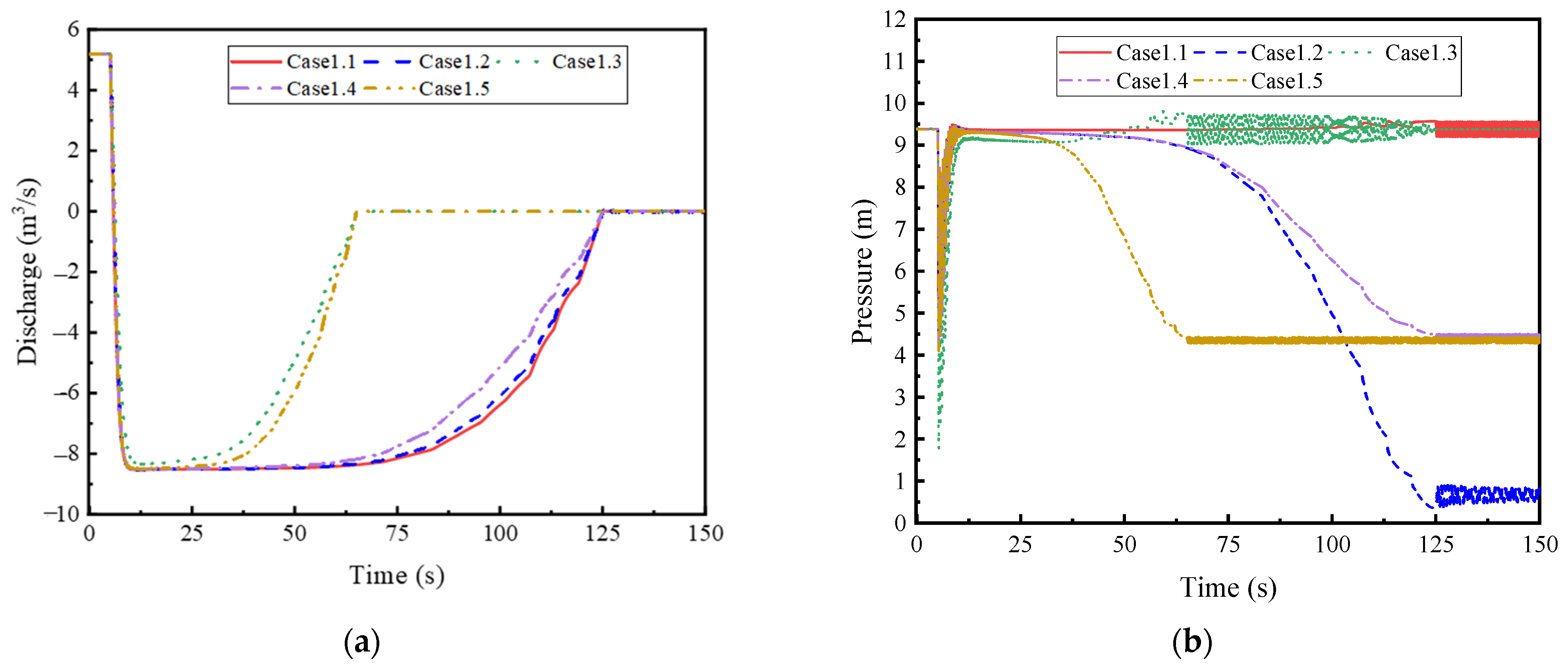
Under the condition of flap valve failure, the flow variation process upstream of Gate #2 is generally consistent with that upstream of Gate #1. However, significant differences in pressure response are observed among the different schemes. As shown in Figure 13b, the pressure in the channel upstream of Gate #2 drops to the lowest level in Case 1.2. In contrast, Case 1.1 and Case 1.3 result in relatively higher final pressures, whereas Case 1.4 and Case 1.5 lead to intermediate final pressure values. This difference arises because in Case 1.2, only Gate #2 is closed whereas Gate #1 remains fully open, providing an unobstructed path for the backflow. After the water’s inertia force is dissipated, the water level upstream of the gate can fully recede, resulting in the lowest stable pressure. The higher final pressures in Case 1.1 and Case 1.3 are attributed to the closure of Gate #1 in both strategies. This effectively blocks the backflow, trapping a significant volume of water in the pipeline section between the two gates. Consequently, the water level upstream of the gate is maintained at a higher elevation, leading to the observed higher final pressures.
In Case 1.4 and Case 1.5, where both sluice gates are closed either simultaneously or at different closure durations, the resulting final pressure state is intermediate between the two scenarios mentioned above. The water within the pipeline becomes completely enclosed, and its final pressure is determined by the trapped water volume and the corresponding water level at the moment of closure, thus exhibiting intermediate values.
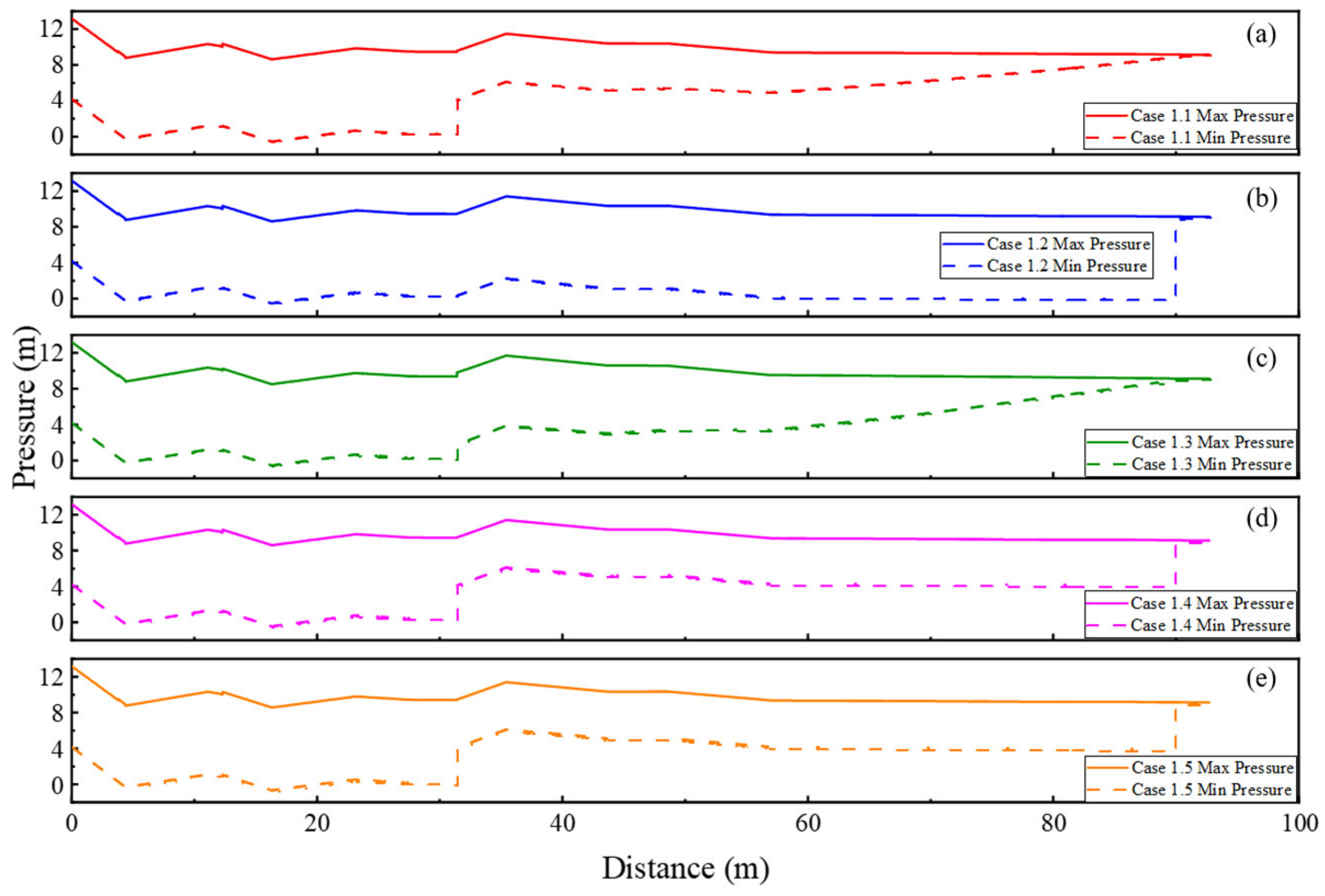
When the flap valve fails to close, the discharge variation process upstream of Gate #2 is essentially consistent with that observed upstream of Gate #1. However, the pressure responses under different control strategies exhibit significant differences, as shown in Figure 13. In Case 1.2, the pressure drops to its lowest level, fluctuating between 0.16 m and 0.73 m before gradually stabilizing. In Case 1.3, the pressure exhibits larger fluctuations from 60 s after the pump-trip. After Gate #2 fully closes at 120 s, the pressure stabilizes at 9.23 m. For Case 1.1, upon the complete closure of Gate #2 at 120 s, the pressure continues to oscillate within a range of 9.08 m to 9.38 m. Case 1.5 demonstrates the most rapid pressure stabilization due to the fast closure of Gate #2 within 60 s. Overall, the pressure stabilization time depends on the gate closure speed; faster closure leads to earlier stabilization but also to higher pressure increase. In all cases, the pressure extremes in each section of the flow channel did not exceed the safety standards, as shown in Figure 14.
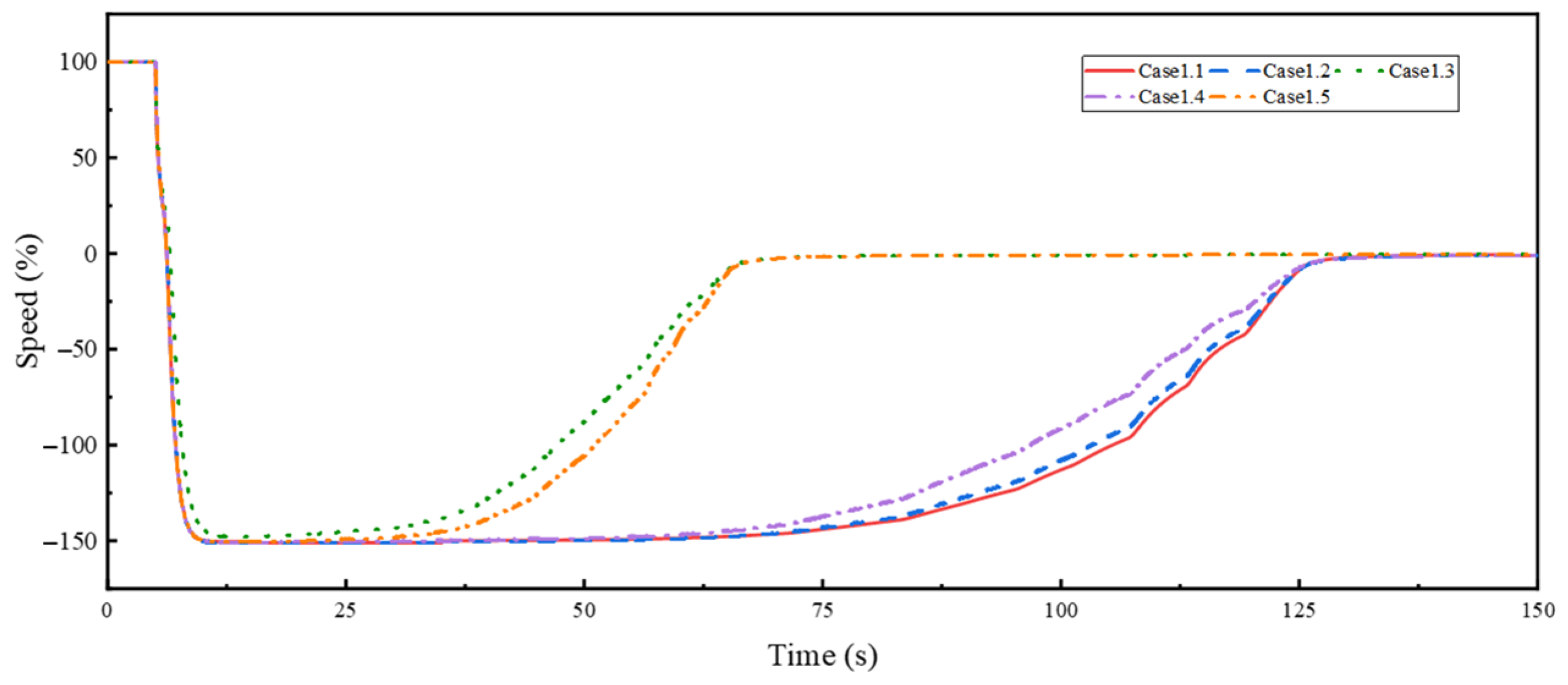
As shown in Figure 15, in Case 1.1, the maximum reverse speed of the pump reaches −150.44% of the rated speed, with a sustained reversal duration of 120 s. This result is due to the slow closure of a single gate, which fails to promptly block the backflow, resulting in continuous reverse impact on the impeller until the gate reaches a small opening degree, and the reversal gradually ceases. In Case 1.3, the maximum reverse speed of the pump is limited to −147.25% of the rated speed, and the sustained reversal duration is shortened to 60 s. This improvement is attributed to the rapid closure of the upstream gate, which significantly reduces both the duration and magnitude of the backflow, thereby effectively suppressing the rise in reverse speed and accelerating unit braking. Shorter gate closure times and placing the gate more upstream gate placement result in more pronounced backflow control, not only shortening the reversal duration but also reducing the extreme value of the reverse speed.
Under the extreme condition of flap valve failure, relying solely on sluice gate regulation can still mitigate water hammer hazards to some extent, but the effectiveness varies significantly depending on the closure strategy adopted. Protective effects are not significant when the sluice gate operates at large openings. When Gate #1 is closed within 60 s, both pressure and rotational speed can be effectively controlled within safety standards, achieving the optimal protective outcome. However, when the sluice gate acts alone, issues such as high reverse rotational speed and significant pressure fluctuations persist, indicating limitations in reliability and stability. The closure speed and sequence of the sluice gates are critical factors affecting water hammer protection effectiveness. Rapid closure of the mid-channel gate can significantly suppress backflow and reverse rotation, but it may also cause pressure surges, necessitating a balance between rotational speed control and pressure stability. Through comprehensive comparative analysis, Case 1.5, which employs simultaneous linear closure of both sluice gates within 60 s, is identified as the optimal control strategy under flap valve failure with normal sluice gate operation.

4.3. Analysis of the Hydraulic Transient Process Under Coordinated Application of the Flap Valve and Sluice Gates

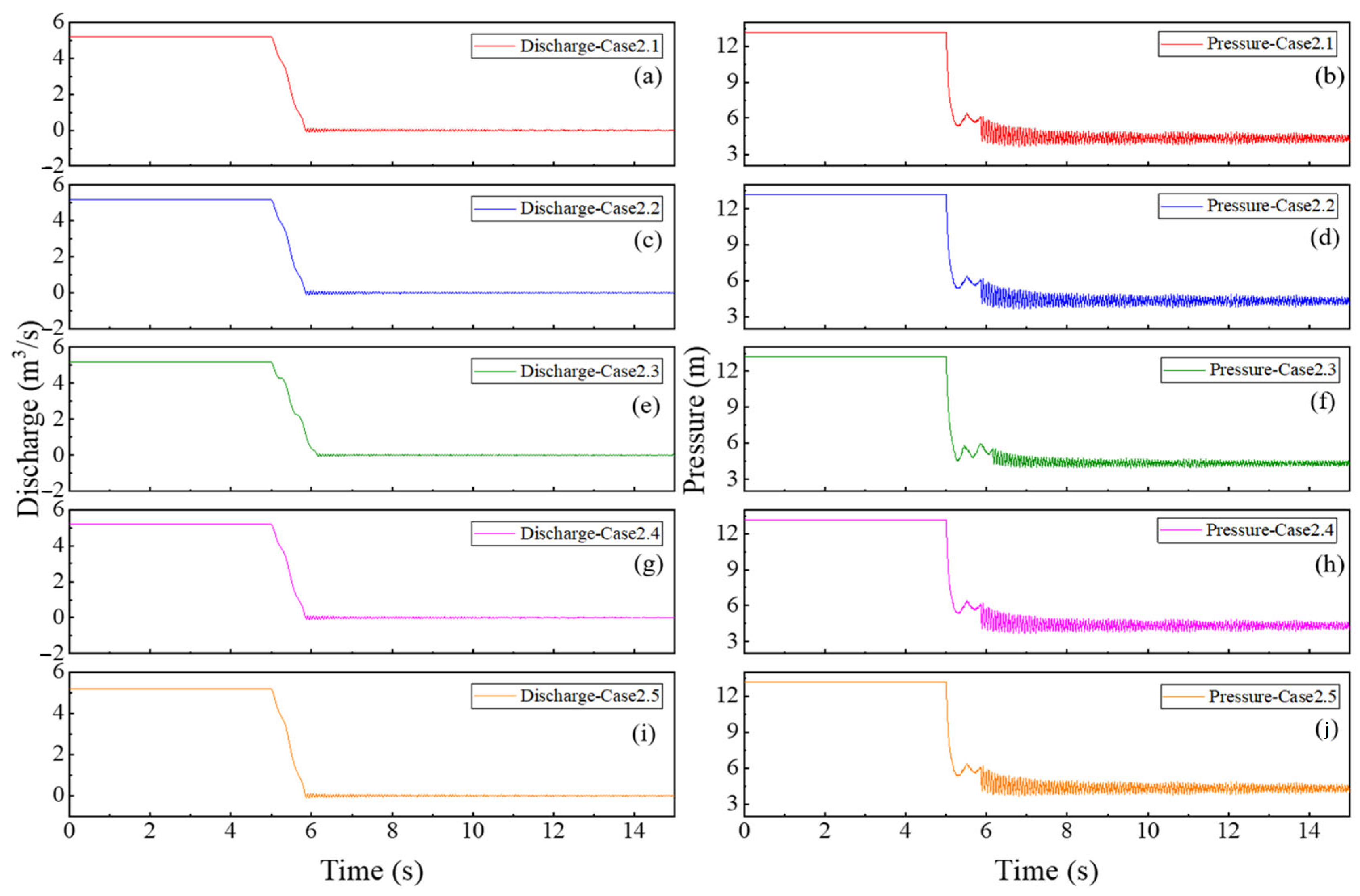
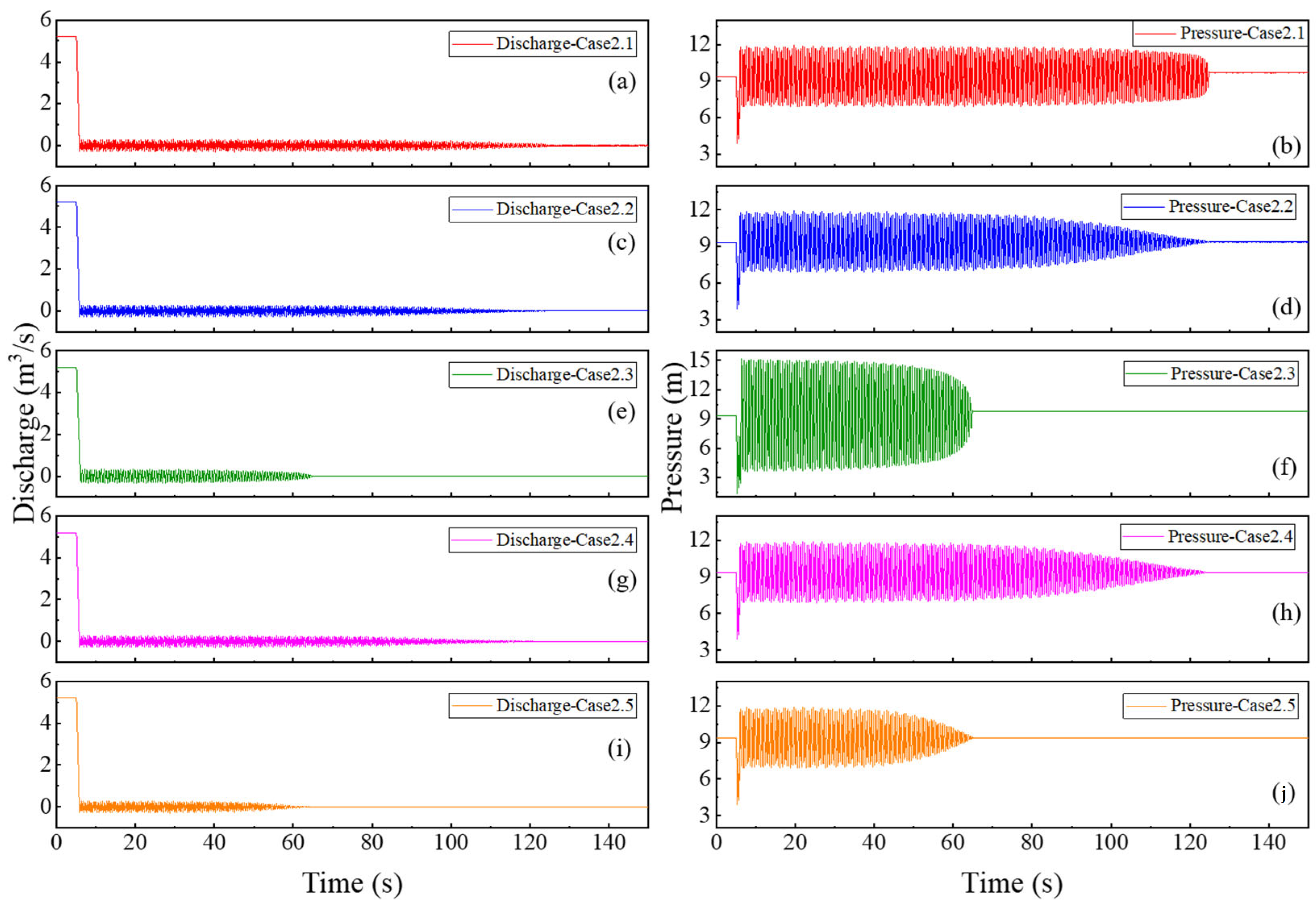
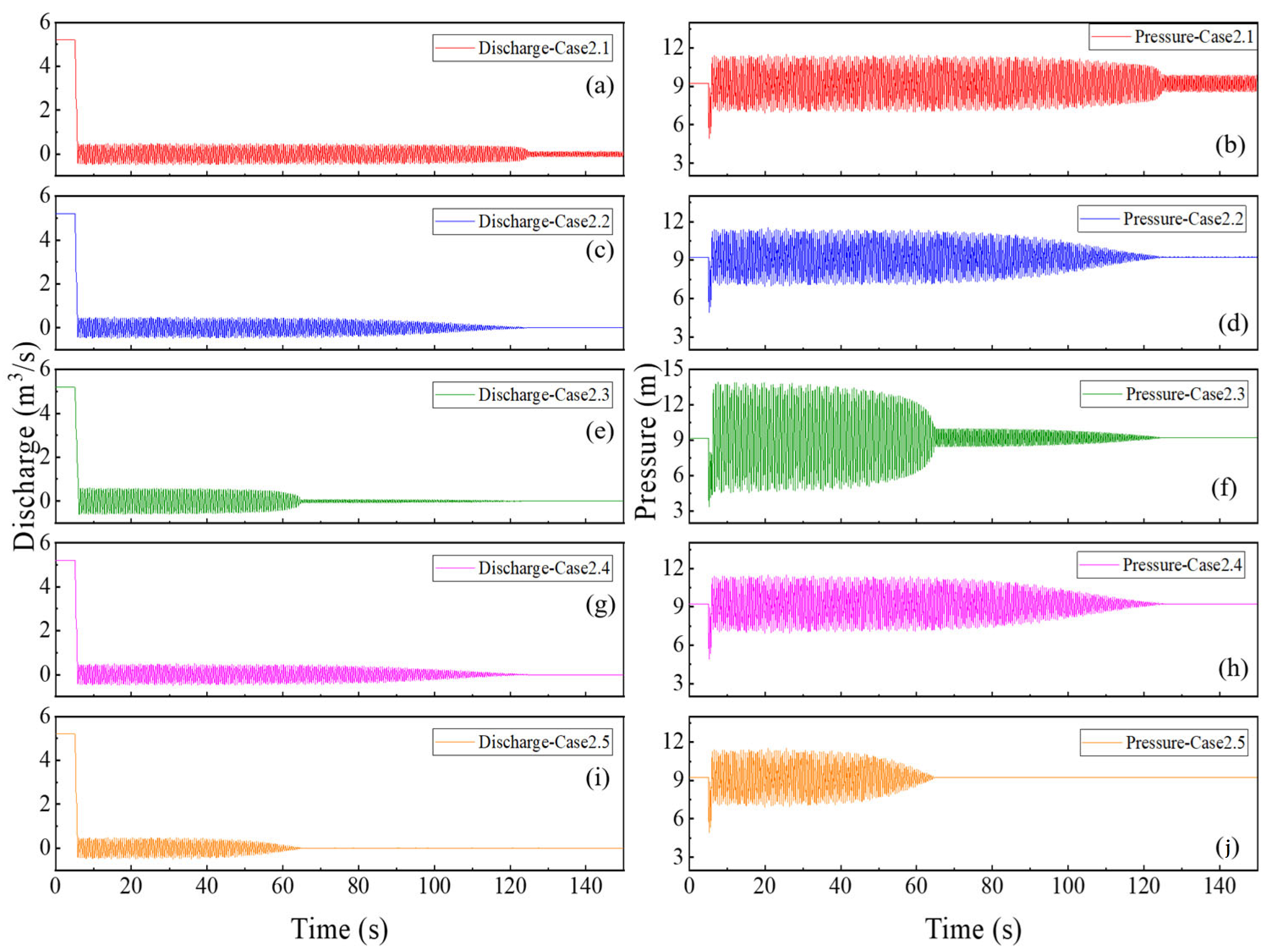
To mitigate persistent pressure fluctuations downstream of the flap valve, the sluice gates within the drainage flow channel are strategically utilized to form a combined protective strategy with the flap valve. Through computational analysis of hydraulic transients during pump-trip events under this combined application, key control parameters are obtained as shown in Table 7. The flap valve effectively prevents pump reversal through its immediate closure upon pump trip. Subsequently, the closure of the sluice gates helps to mitigate pressure fluctuations along the drainage flow channel, ensuring that both the pump status and system pressures comply with the control standards. Different sluice gate closure strategies result in variations in the extreme pressure values within the water conveyance channel. Case 2.3 increases the minimum pressure to -1.32 m while increasing the maximum pressure along the channel to 16.80 m, both of which remain within the pressure control standards. The extreme pressure values in other scenarios remain unaffected. In the combined application strategy, the maximum rate of flow reduction downstream of the pump occurs in Case 2.5, while the flow decay rates in other schemes are consistent with those observed under the scenario of normal flap valve operation alone. The pressure variation process downstream of the pump also remains identical, as illustrated in Figure 16.
In the combined application schemes, the closure time of Gate #1 significantly influences the system’s hydraulic response. Regarding the flow variation process upstream of Gate #1, Cases 2.3 and 2.5 achieve flow stabilization within 60 s after the incident, while other schemes require 120 s to stabilize. This finding indicates that shorter gate closure times reduce the time required for flow stabilization, as shown in Figure 17a,c,g. For pressure variations upstream of Gate #1, distinct differences are observed among the schemes: Case 2.3 exhibits the largest pressure fluctuations, ranging from 3.90 m to 14.90 m (Figure 17f); in comparison, Case 2.5 shows the smallest fluctuation range, between 7.12 m and 11.63 m (Figure 17j). Notably, the closure time of Gate #2 is 120 s in Case 2.3 compared to only 60 s in Case 2.5. This comparison reveals that the longer closure times of Gate #2 result in greater pressure fluctuation amplitudes upstream of Gate #1. In terms of pressure fluctuation duration, schemes with longer Gate #1 closure times (120 s)—specifically Cases 2.1, 2.2, and 2.4—exhibit prolonged pressure oscillations. In contrast, schemes with shorter Gate #1 closure times (60 s)—Cases 2.3 and 2.5—achieve pressure stabilization more rapidly. The analysis indicates that the stabilization time for both flow and pressure upstream of Gate #1 is positively correlated with closure time, and the pressure fluctuation amplitude is significantly influenced by the closure time of the downstream Gate #2.
In the combined application schemes, analysis of the flow variation process upstream of Gate #2 shows that Case 2.5 achieves flow stabilization to zero flow within 60 s after the incident, as shown in Figure 18a. Gate closure stabilizes the flow, with shorter closure times leading to faster stabilization. For pressure variations upstream of Gate #2, Case 2.3 exhibits the largest fluctuation range (4.58–13.89 m), while Case 2.5 shows the smallest range (7.20–11.36 m). The closure time of Gate #2 is 120 s in Case 2.3 compared to only 60 s in Case 2.5, indicating that the longer closure times of Gate #2 result in greater pressure fluctuation amplitudes. In Figure 18, comparing pressure fluctuation durations, Case 2.3 achieves pressure stabilization in the shortest time, demonstrating that the 60 s gate closure scheme enables faster pressure stabilization. Closing the sluice gate at the outlet of the drainage channel effectively controls the stabilization of both flow and pressure in the channel, with stabilization time positively correlated with the gate closure time. Among the dual-gate closure schemes, the simultaneous rapid closure scheme delivers better performance.
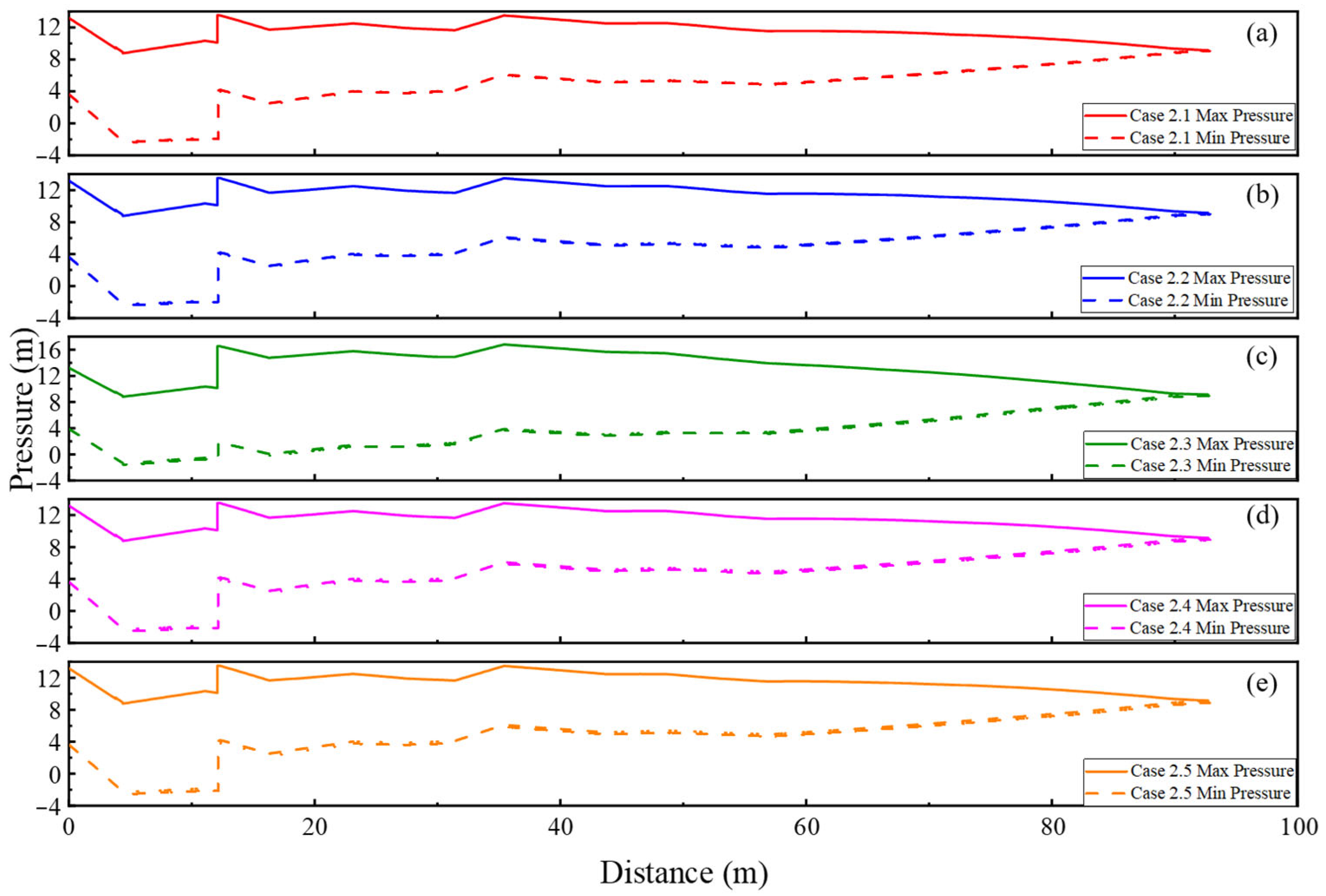
The implementation of the combined flap valve and sluice gate control measures leads to an expanded range of extreme pressure values within the channel in Case 2.3, as shown in Figure 19c. The maximum pressure in the channel for Case 2.3 is 16.80 m, and the minimum pressure is −2.22 m, both of which meet the engineering standard requirements. In this case, the inlet gate closed rapidly within 60 s, which could result in a sudden and nearly complete blockage of water flow near the box culvert entrance. Before the rear gate was fully closed, a more severe water hammer occurred. The pressure extremes in the other schemes remain consistent with those observed during normal flap valve operation. In the combined application, no pump reversal occurs, and the sluice gate control strategy has almost no influence on the pump speed.
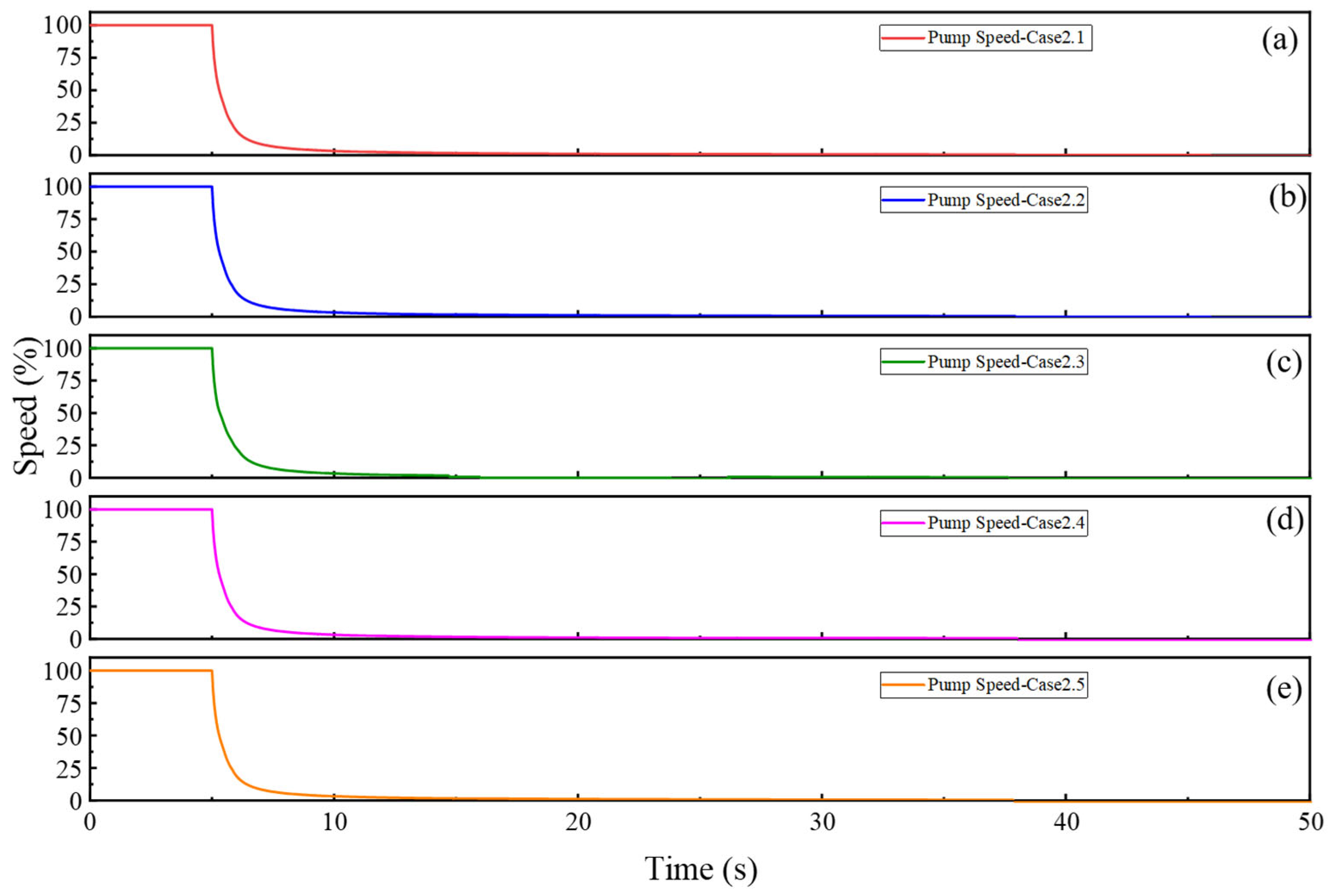
In the analysis of hydraulic transients under combined flap valve and sluice gate regulation, the study findings demonstrate that the rapid flow-cutting action of the flap valve effectively prevents pump reversal, ensuring unit safety (Figure 20). Different sluice gate closure strategies variably influence the stabilization of pipeline pressure fluctuations, with shorter closure times leading to faster stabilization of both flow and pressure. Among the combined control schemes, both Cases 2.4 and 2.5 reduce pressure amplitudes. However, Case 2.5, with simultaneous rapid gate closure, stands out by halving the oscillation duration compared to Case 2.4, thereby achieving the fastest system stabilization and demonstrating the most effective comprehensive protection.

5. Conclusions

To address the need for water hammer protection in urban drainage pumping stations under pump-trip conditions, this study proposes a strategy based on the combined application of flap valves and sluice gates. Through a comparative analysis of three typical operational scenarios using a validated one-dimensional hydraulic transient model, the following key conclusions are drawn.
  • While normal flap valve closure effectively prevents backflow and pump reversal—with channel pressures (maximum: 13.53 m; minimum: −2.22 m) complying with basic safety standards (Section 3.2)—it induces persistent, high-amplitude pressure fluctuations downstream. These oscillations, resulting from water inertia in the elongated drainage channel, pose a potential long-term fatigue risk to the channel structure. Therefore, designs relying solely on flap valves must account for these cyclic loads.
  • In the event of flap valve failure, slow single-gate closure strategies prove inadequate, allowing pump reversal speeds to approach −150% of the rated value. In contrast, rapid closure (60 s) of the upstream Gate #1 (Case 1.3) effectively limits the maximum reversal speed to −147.25%, halved the reversal duration to 60 s, and maintained all channel pressures within safe limits. Thus, a 60 s closure rule for the upstream sluice gate is recommended as the primary protection against flap valve failure.
  • The combined use of flap valves and sluice gates delivers optimal performance. The flap valve ensures immediate backflow blocking, eliminating pump reversal, while the strategic closure of the sluice gates mitigates subsequent pressure fluctuations. Case 2.5 (simultaneous 60 s linear closure of both gates) demonstrates the highest efficacy, significantly damping oscillations and reducing the system stabilization time from a persistent state to 60 s. This scheme is therefore the preferred design solution, offering superior pressure stability, backflow control, and response speed.
  • These conclusions are based on numerical simulations of a typical coastal drainage pumping station and require further validation through field tests or physical modeling. For practical applications, gate closure parameters should be optimized based on specific system characteristics. Future work should focus on: (1) developing real-time adaptive control strategies for sluice gates; (2) investigating the influence of key geometric parameters on transient performance; (3) exploring multi-stage closure rules to balance pressure surge and backflow control; and (4) experimentally verifying the synergistic mechanisms of combined protection.

Author Contributions

Conceptualization, R.Z. and J.H.; methodology, R.Z. and J.H.; software, R.Z. and J.H.; validation, R.Z., J.H. and Z.Z.; formal analysis, R.Z. and Z.Z.; investigation, R.Z. and Y.F.; resources, J.H. and L.W.; data curation, R.Z. and Z.Z.; writing—original draft preparation, R.Z.; writing—review and editing, R.Z. and J.H.; visualization, T.D. and M.S.; supervision, J.H. and H.G.; project administration, L.W. and J.M.; funding acquisition, J.H. All authors have read and agreed to the published version of the manuscript.

Funding

This work is supported by the joint funds of the Zhejiang Provincial Natural Science Foundation of China (LZJWZ22E090004) and Zhejiang Province Science and Technology Project, Research and Application of Urban Flood Risk Evolution and Response Technologies from the Perspective of Resilience (RC2408).

Data Availability Statement

The numerical simulation of the data and experimental data used to support the findings of this study are available from the corresponding author upon request.

Acknowledgments

The authors are grateful for the research collaboration.

Conflicts of Interest

The authors declare that the research has been conducted in the absence of any commercial or financial relationships that could be construed as a potential conflict of interest.

References

  1. Sun, Y.-M.; Yu, G.-P.; Liu, C. Research on closing control of the sluice gate for sudden power off of large pump. Adv. Sci. Lett. 2011, 4, 2316–2320. [Google Scholar] [CrossRef]
  2. Ghidaoui, M.S.; Zhao, M.; McInnis, D.A.; Axworthy, D.H. A review of water hammer theory and practice. Appl. Mech. Rev. 2005, 58, 49–76. [Google Scholar] [CrossRef]
  3. Ding, X.; Wang, L.; Cai, J.; Wang, Z.; Zhang, Z.; Fan, X. The sealing performance and failure analysis of marine valve packing seal structures based on dimensionless function definition. Ocean Eng. 2025, 316, 119939. [Google Scholar] [CrossRef]
  4. Indimath, S.S.; Das, S.; Mukhopadyay, G.; Bhattacharyya, S. Prevention of in-service failure of seal valve axles of blast furnace through non-destructive condition monitoring. J. Fail. Anal. Prev. 2015, 15, 430–435. [Google Scholar] [CrossRef]
  5. Raj, K.K.; Kumar, S.; Kumar, R.R. Systematic review of bearing component failure: Strategies for diagnosis and prognosis in rotating machinery. Arab. J. Sci. Eng. 2025, 50, 5353–5375. [Google Scholar] [CrossRef]
  6. Ge, X.; Zhang, J.; Zhang, J.; Liu, D.; Zheng, Y.; Chen, H. Review of research on the three-dimensional transition process of large-scale low-lift pump. Energies 2022, 15, 8338. [Google Scholar] [CrossRef]
  7. Supri, I.M.M.; Madon, R.H.; Salleh, Z.M.; Madon, H. Design and analysis of a new check valve on water hammer performance by using SolidWorks Flow Simulation. Prog. Eng. Appl. Technol. 2021, 2, 830–843. [Google Scholar]
  8. Xie, R.; Xiang, C.; Chen, Y.; Fang, H.; Wang, L. Analysis of flow capability of gate with small flap valve base on CFD. Hydropower Energy Sci. 2018, 36, 156–158. (In Chinese) [Google Scholar]
  9. Wang, Z.; Du, Y. Opening angle and impact force analysis of different types flap valve in pumping stations. IOP Conf. Ser. Earth Environ. Sci. 2019, 371, 022067. [Google Scholar] [CrossRef]
  10. Xi, W.; Lu, W.; Wang, C.; Fu, G. Numerical and experimental study on the opening angle of the double-stage flap valves in pumping stations. Front. Energy Res. 2022, 10, 866044. [Google Scholar] [CrossRef]
  11. Chen, J.; Lou, H.; Li, J.; Xu, Y.; Ye, F.; Zhang, Y. Structure and impact force calculating of the laisses-aller side-turn-over flap valve of large diameter. J. Irrig. Drain. 2008, 4, 44–47. (In Chinese) [Google Scholar]
  12. Lu, W. Studies on the Mechanical Characteristics of Flap Valve Cutoff Device in Pumping Stations. Ph.D. Thesis, Shanghai University, Shanghai, China, 2009. (In Chinese). [Google Scholar]
  13. Malmur, R. Methods of drainage and transfer of rainwater. E3S Web Conf. 2019, 116, 00049. [Google Scholar] [CrossRef]
  14. Yazdi, J.; Kim, J. Intelligent pump operation and river diversion systems for urban storm management. J. Hydrol. Eng. 2015, 20, 04015031. [Google Scholar] [CrossRef]
  15. Ouyang, C.; Zhao, Z.; Liu, C.; Zhao, Z.; Yin, X.; Yang, J. Does the upstream gate control scheme threaten the safety of extra-long pressurized water diversion tunnel: Gas–liquid evolution characteristics of the filling process. Phys. Fluids 2024, 36, 094130. [Google Scholar] [CrossRef]
  16. Xue, Y.; Wang, C.; Zhang, Y.; Du, S. Analysis on Water Hammer Resistant Characteristics of Pipeline Valves. Curr. Sci. 2025, 5, 5152–5164. [Google Scholar]
  17. Lescovich, J.E. The control of water hammer by automatic valves. J.-Am. Water Work. Assoc. 1967, 59, 632–644. [Google Scholar] [CrossRef]
  18. Wang, M.; Liu, Y. Research on two-way flow passage self-irrigation and self-draining of gate open control based on CFX. China Rural Water Hydropower 2017, 7, 140–143. [Google Scholar]
  19. Song, J. Application of Pump Gate in Inland River Water Treatment in Fuzhou. Fujian Archit. 2018, 7, 140–142. (In Chinese) [Google Scholar]
  20. Devlin, K. Pump Stations for Flood Harvesting or Irrigation Downstream of a Storage Dam; A Technical Report from the CSIRO Victoria and Southern Gulf Water Resource Assessments for the National Water Grid; CSIRO: Canberra, Australia, 2024. [Google Scholar]
  21. Zhang, X.; Guo, X.; Chen, Y.; Yang, C.; Liu, S.; Guo, L. Research on the characteristics and protection of water hammer in long-distance dual-pipe water supply systems. PLoS ONE 2024, 19, e0314998. [Google Scholar] [CrossRef]
  22. Lohrasbi, A.; Attarnejad, R. Water hammer analysis by characteristic method. Am. J. Eng. Appl. Sci. 2008, 1, 287–294. [Google Scholar] [CrossRef]
  23. Xin, Q.; Du, J.; Liu, M.; Liu, Y.; Huang, J.; Yu, W.; Yuan, F.; Wang, D.; Yang, X. Experimental study on the effects of two-stage valve closure on the maximum water hammer pressure in micro-hydroelectric system. J. Water Process Eng. 2024, 65, 105886. [Google Scholar] [CrossRef]
  24. Yu, Y.; Wei, C. Determination of the Area of Flap Valve in Rapid-Drop Gate of Large Vertical Axial Flow Pumping Station. S.–N. Water Transf. Water Sci. Technol. 2010, 8, 6–8. [Google Scholar]
  25. Bettaieb, N.; Taieb, E.H. Assessment of failure modes caused by water hammer and investigation of convenient control measures. J. Pipeline Syst. Eng. Pract. 2020, 11, 04020006. [Google Scholar] [CrossRef]
  26. Zhang, X.; Jiang, Y.; Song, X.; Tang, F.; Dai, J.; Yang, F.; Wang, H.; Shi, L. Investigation on the influence of flap valve area on transition process of large axial flow pump system. J. Mar. Sci. Eng. 2023, 11, 326. [Google Scholar] [CrossRef]
  27. Wylie, E.B.; Streeter, V.L. Fluid Transients; McGraw-Hill: New York, NY, USA, 1978. [Google Scholar]
  28. Liu, Z.; Zhang, D.; Liu, Y.; Zhang, X. New suter-transformation method of complete characteristic curves of pump-turbines based on the 3-D surface. China Rural Water Hydropower 2015, 1, 143–145. [Google Scholar]
  29. Ministry of Water Resources of the People’s Republic of China. Specification for Design of Steel Gate in Hydraulic and Hydroelectric Engineering: SL 74-2013; China Water & Power Press: Beijing, China, 2013. (In Chinese) [Google Scholar]
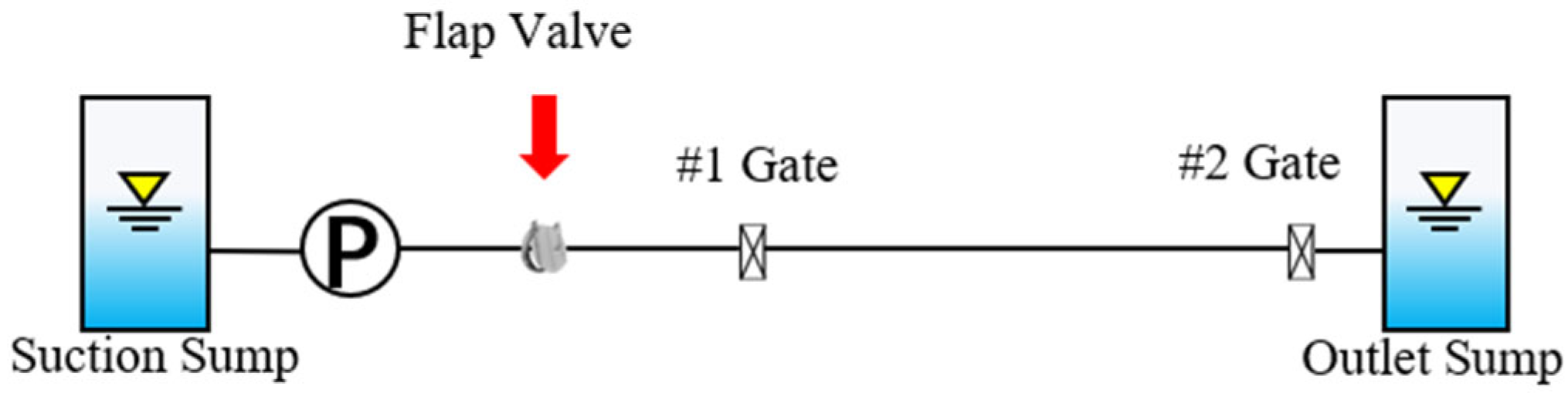
Figure 1. Schematic diagram of the coordinated control model of flap valve and sluice gate for water hammer protection.
Water 18 00025 g001
Figure 2. Schematic diagram of the characteristic compatibility equations [27].
Water 18 00025 g002
Figure 3. Comparison of transient pressure and discharge curves downstream of the pump. (a) Discharge; (b) Pressure.
Water 18 00025 g003
Figure 4. Diagram of curved pipeline.
Water 18 00025 g004
Figure 5. Schematic diagram of the pumping station layout.
Water 18 00025 g005
Figure 6. Performance curve of the 1400HDB-60 pump with a blade angle of θ = 0°.
Water 18 00025 g006
Figure 7. Transient pressure and discharge curves downstream of the pump under normal closure of the flap valve. (a) Discharge; (b) Pressure.
Water 18 00025 g007
Figure 8. Transient pressure and discharge curves downstream of the flap valves under normal closure conditions. (a) Discharge; (b) Pressure.
Water 18 00025 g008
Figure 9. Pressure envelope along the channels downstream of the pump under normal closure of the flap valve.
Water 18 00025 g009
Figure 10. Pump speed transient curve under normal closure of the flap valve.
Water 18 00025 g010
Figure 11. Transient curves of pressure and discharge downstream of the pump. (a) Discharge; (b) Pressure.
Water 18 00025 g011
Figure 12. Transient curves of pressure and discharge upstream of Gate #1. (a) Discharge; (b) Pressure.
Water 18 00025 g012
Figure 13. Transient curves of discharge and pressure upstream of Gate #1. (a) Discharge; (b) Pressure.
Water 18 00025 g013
Figure 14. Pressure envelopes along the drainage channel. (a) Case 1.1; (b) Case 1.2; (c) Case 1.3; (d) Case 1.4; (e) Case 1.5.
Water 18 00025 g014
Figure 15. Pump speed transient curves under flap valve failure with normal sluice gate closure.
Water 18 00025 g015
Figure 16. Transient curves downstream of the pump discharge and pressure under the combined application of the flap valve and sluice gate. (a) Case 2.1 Discharge; (b) Case 2.1 Pressure; (c) Case 2.2 Discharge; (d) Case 2.2 Pressure; (e) Case 2.3 Discharge; (f) Case 2.3 Pressure; (g) Case 2.4 Discharge; (h) Case 2.4 Pressure; (i) Case 2.5 Discharge; (j) Case 2.5 Pressure.
Water 18 00025 g016
Figure 17. Transient curves of discharge and pressure upstream of Gate #1 under the combined application of the flap valve and sluice gate. (a) Case 2.1 Discharge; (b) Case 2.1 Pressure; (c) Case 2.2 Discharge; (d) Case 2.2 Pressure; (e) Case 2.3 Discharge; (f) Case 2.3 Pressure; (g) Case 2.4 Discharge; (h) Case 2.4 Pressure; (i) Case 2.5 Discharge; (j) Case 2.5 Pressure.
Water 18 00025 g017
Figure 18. Transient curves of discharge and pressure upstream of Gate #2 under the combined application of the flap valve and sluice gate. (a) Case 2.1 Discharge; (b) Case 2.1 Pressure; (c) Case 2.2 Discharge; (d) Case 2.2 Pressure; (e) Case 2.3 Discharge; (f) Case 2.3 Pressure; (g) Case 2.4 Discharge; (h) Case 2.4 Pressure; (i) Case 2.5 Discharge; (j) Case 2.5 Pressure.
Water 18 00025 g018
Figure 19. Pressure envelope along the channel downstream of the pump under the combined application of the flap valve and sluice gate. (a) Case 1.1; (b) Case 1.2; (c) Case 1.3; (d) Case 1.4; (e) Case 1.5.
Water 18 00025 g019
Figure 20. Pump speed transient curve under the combined application of the flap valve and sluice gate. (a) Case 1.1; (b) Case 1.2; (c) Case 1.3; (d) Case 1.4; (e) Case 1.5.
Water 18 00025 g020
Table 1. Specifications of the water conveyance box culverts.
No.Length (m)Width (m)Height (m)Elevation of Pipe Centerline (m)
15.264.206.475.27
26.203.604.474.02
32.804.353.644.18
47.003.603.304.35
54.003.607.122.44
68.503.606.052.97
75.093.605.063.47
88.503.604.034.00
933.203.603.004.50
Note: the numbering of the water conveyance box culvert segments starts from the downstream of the flap valves (Segment 1 is closest to the flap valves, and Segment 9 connects to the outlet sluice gates).
Table 2. Pump parameters.
Design Head (m)Design Discharge (m3/s)Rated Speed (r/min)Rated Power (kW)Moment of Inertia (kg·m2)
8.515.5636571088.75
Note: the calculation formula for the moment of inertia of a water pump is I   =   G R 2 , where G is the mass of the water pump’s impeller, kg, and R represents the radius of the water pump impeller, m.
Table 3. Characteristic water levels of the suction and outlet sumps.
SumpMinimum Water Level (m)Design Water Level (m)Maximum Water Level (m)
Suction Sump3.685.037.35
Outlet Sump3.7312.1913.74
Table 4. Sluice gate closure schemes under flap valve failure conditions.
CaseMethodFlap Valve#1 Sluice Gate
Closure Time (s)
#2 Sluice Gate
Closure Time (s)
Case 1.1Single Gate Closure (#1)Failure120Remains fully open
Case 1.2Single Gate Closure (#2)FailureRemains fully open120
Case 1.3Asynchronous Dual-Gate Closure (Fast–Slow)Failure60120
Case 1.4Synchronized Dual-Gate Slow ClosureFailure120120
Case 1.5Synchronized Dual-Gate Fast ClosureFailure6060
Table 5. Combined application schemes for flap valves and sluice gates.
CaseMethodFlap Valve#1 Sluice Gate
Closure Time (s)
#2 Sluice Gate
Closure Time (s)
Case 2.1Single Gate Closure (#1)Normal closure120Remains fully open
Case 2.2Single Gate Closure (#2)Normal closureRemains fully open120
Case 2.3Asynchronous Dual-Gate Closure (Fast–Slow)Normal closure60120
Case 2.4Synchronized Dual-Gate Slow ClosureNormal closure120120
Case 2.5Synchronized Dual-Gate Fast ClosureNormal closure6060
Table 6. Maximum and minimum values of water hammer control parameters when the flap valve fail to close.
CaseMaximum Pump
Reverse Speed (%)
Maximum Pressure Along the Channel (m)Minimum Pressure Along the Channel (m)Does the Pump Speed Meet the Control StandardDoes the Pressure Meet the Control StandardMaximum Sustained Oscillation Duration (s)
Case 1.1−150.4411.48−0.56NoYesPersistent
Case 1.2−150.3911.42−0.53NoYesPersistent
Case 1.3−147.2511.70−0.56YesYes120
Case 1.4−150.1811.42−0.45NoYes120
Case 1.5−149.9211.40−0.67YesYes60
Table 7. Extreme values of water hammer control parameters under coordinated control of the flap valve and sluice gates.
CaseMaximum Pump
Reverse Speed (%)
Maximum Pressure Along the Channel (m)Minimum Pressure Along the Channel (m)Pump Speed Meets the Control StandardPressure Meets the Control StandardMaximum Sustained Oscillation Duration (s)
Case 2.10.0713.52−2.22YesYesPersistent
Case 2.20.0713.50−2.22YesYes120
Case 2.30.0816.80−1.32YesYes120
Case 2.40.0713.51−2.22YesYes120
Case 2.50.0713.51−2.22YesYes60
Disclaimer/Publisher’s Note: The statements, opinions and data contained in all publications are solely those of the individual author(s) and contributor(s) and not of MDPI and/or the editor(s). MDPI and/or the editor(s) disclaim responsibility for any injury to people or property resulting from any ideas, methods, instructions or products referred to in the content.