Machine Learning and SHAP-Based Prediction of Tip Velocity Around Spur Dikes Using a Small-Scale Experimental Dataset

 , ,
, ,  , ,
, , 
Abstract
1. Introduction
2. Methodology
2.1. Experimental Setup and Data Collection
2.2. Descriptive Statistics
2.3. Artificial Intelligence
2.3.1. Extreme Gradient Boosting (XGBoost) with PSO Model
2.3.2. Random Forest (RF) Model
2.3.3. Categorical Boosting (CatBoost) Model
2.3.4. Gaussian Process Regression (GPR) Model
2.4. Model Development
3. Result and Discussion
3.1. Correlation Heatmap
3.2. Scatter Pair Plots
3.3. Five-Fold Cross-Validation
3.4. Performance Metrics
3.5. Residual Analysis
3.6. Quantile Analysis
3.7. SHAP Analysis
4. Conclusions
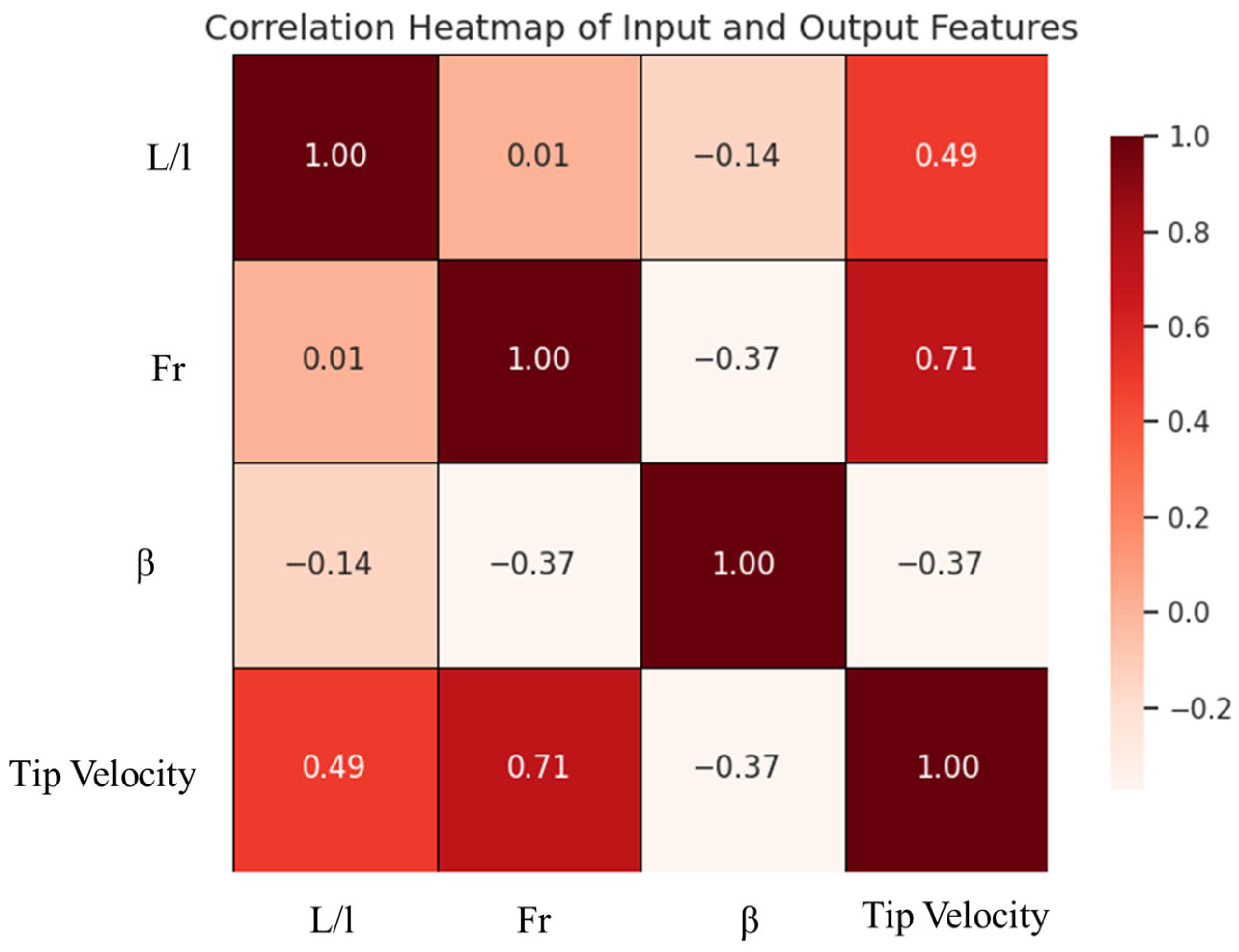
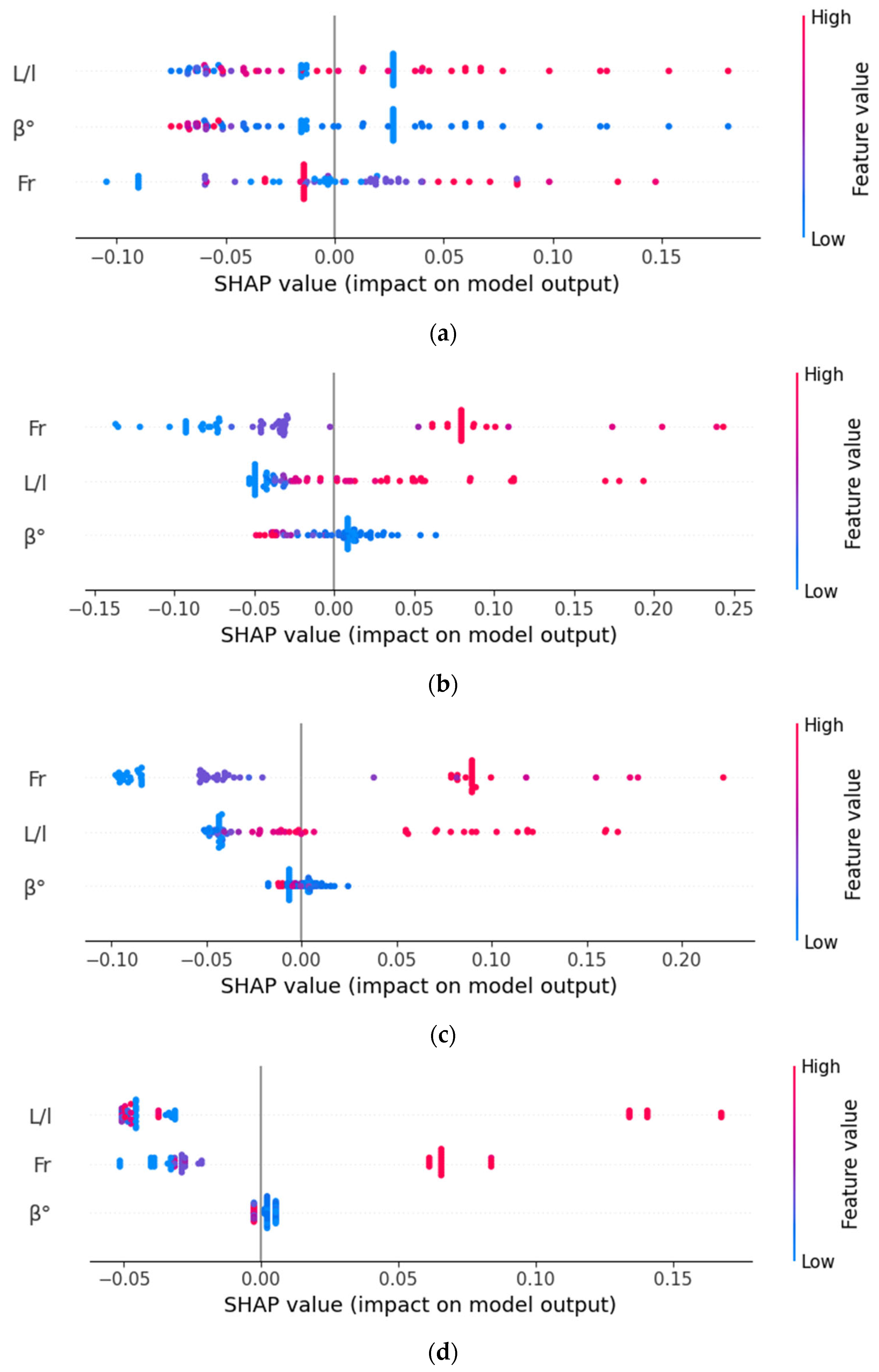
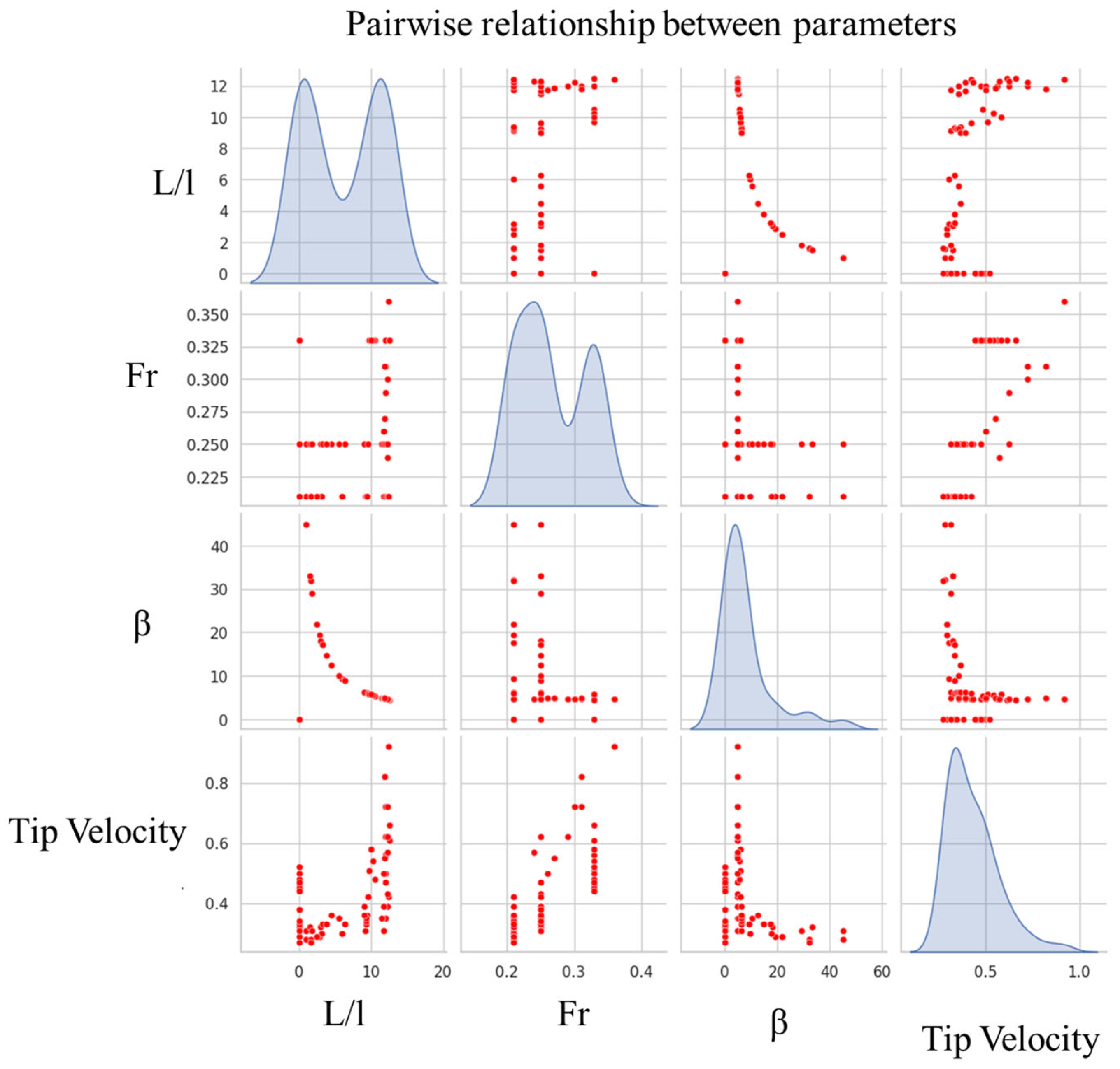
- The result of the correlation heatmap concluded that Fr demonstrated greater correlation with tip velocity, with a correlation coefficient (R) value of 0.71. This shows that under greater values of Fr, the flow significantly altered the flow acceleration near the tip of the dike, improving the risk of erosion and turbulence. In contrast, incidence angle (β) demonstrated a negative correlation with the R value of −0.37;
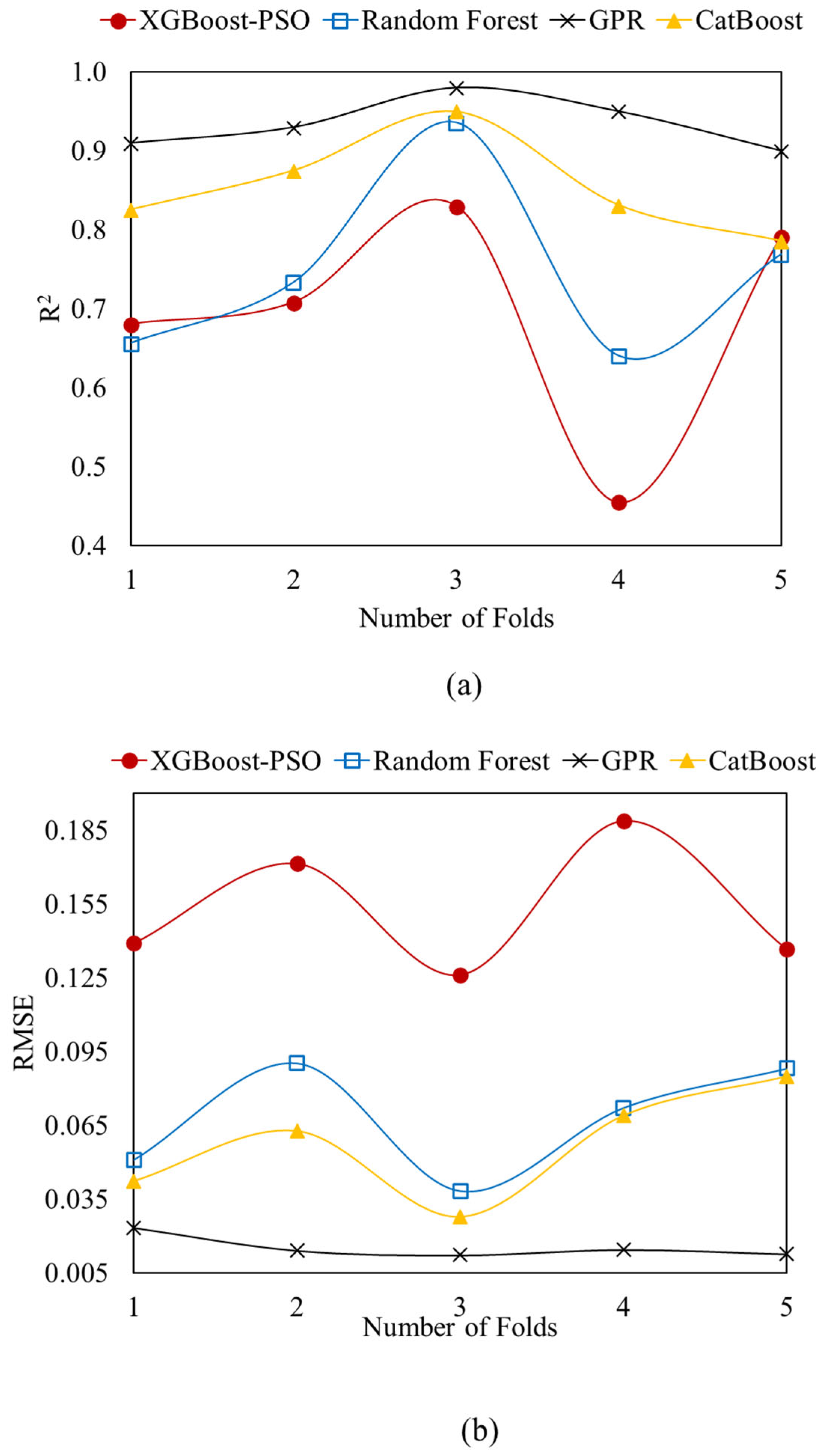
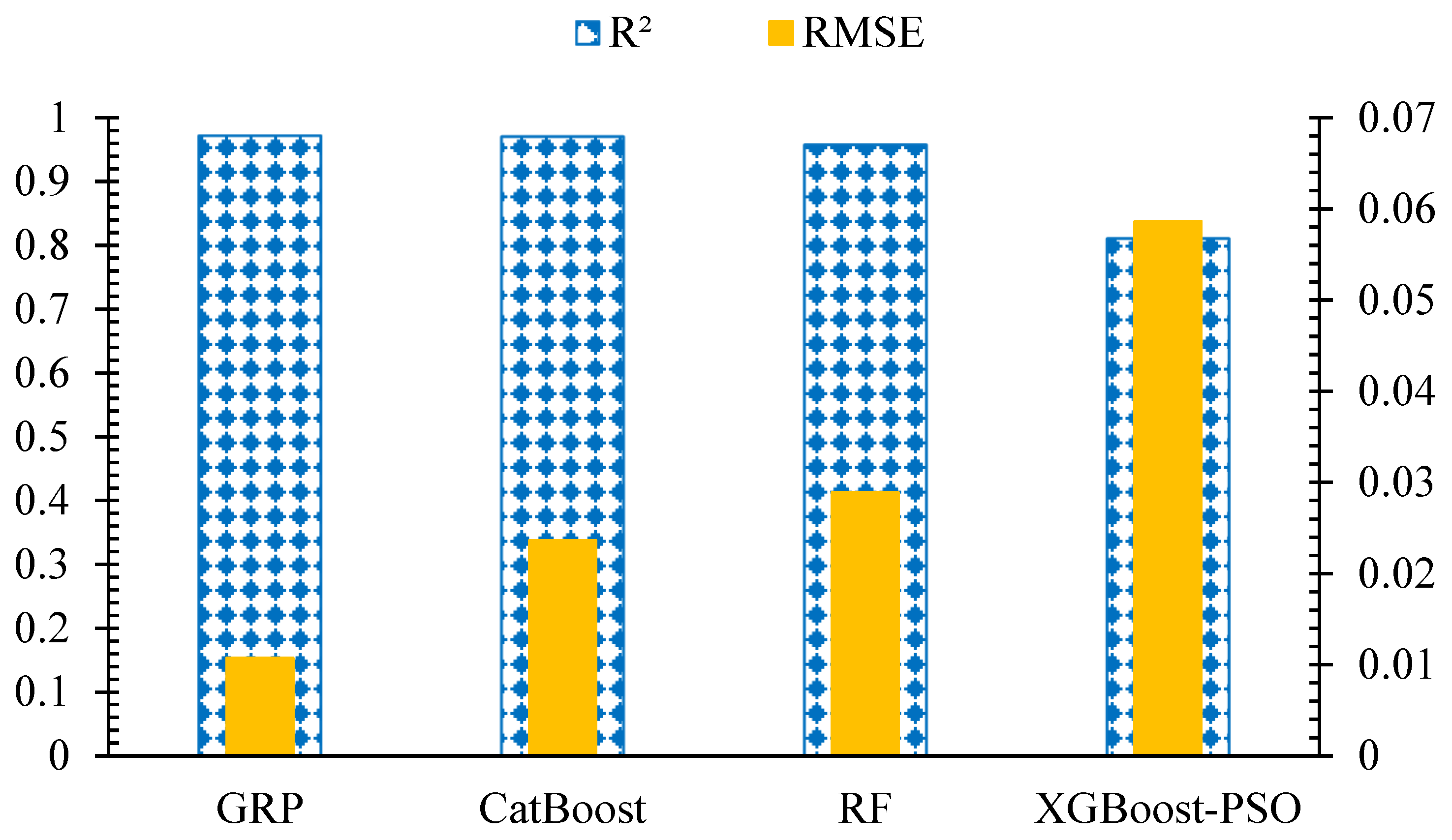
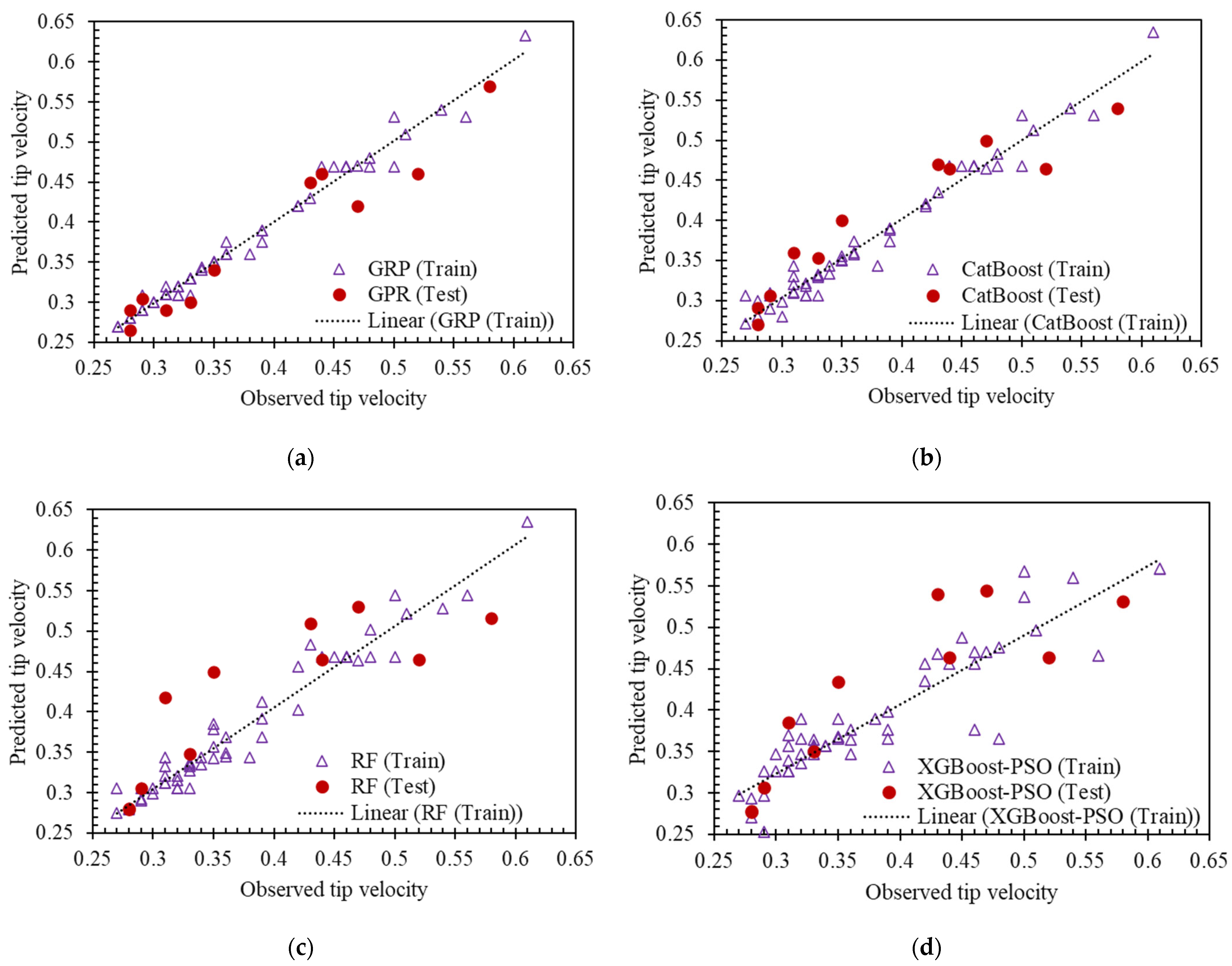
- The result of the AI model’s performance demonstrated superior performance of the GPR model compared to others, with an R2 value of 0.972 and an RMSE value of 0.0107. This demonstrated that the GPR model has superior performance because of its flexibility based on the kernel function and its small dataset handling capability. In contrast, the XGBoost–PSO model has a lower value of R2 = 0.810 and RMSE = 0.0586, demonstrating weaker performance;
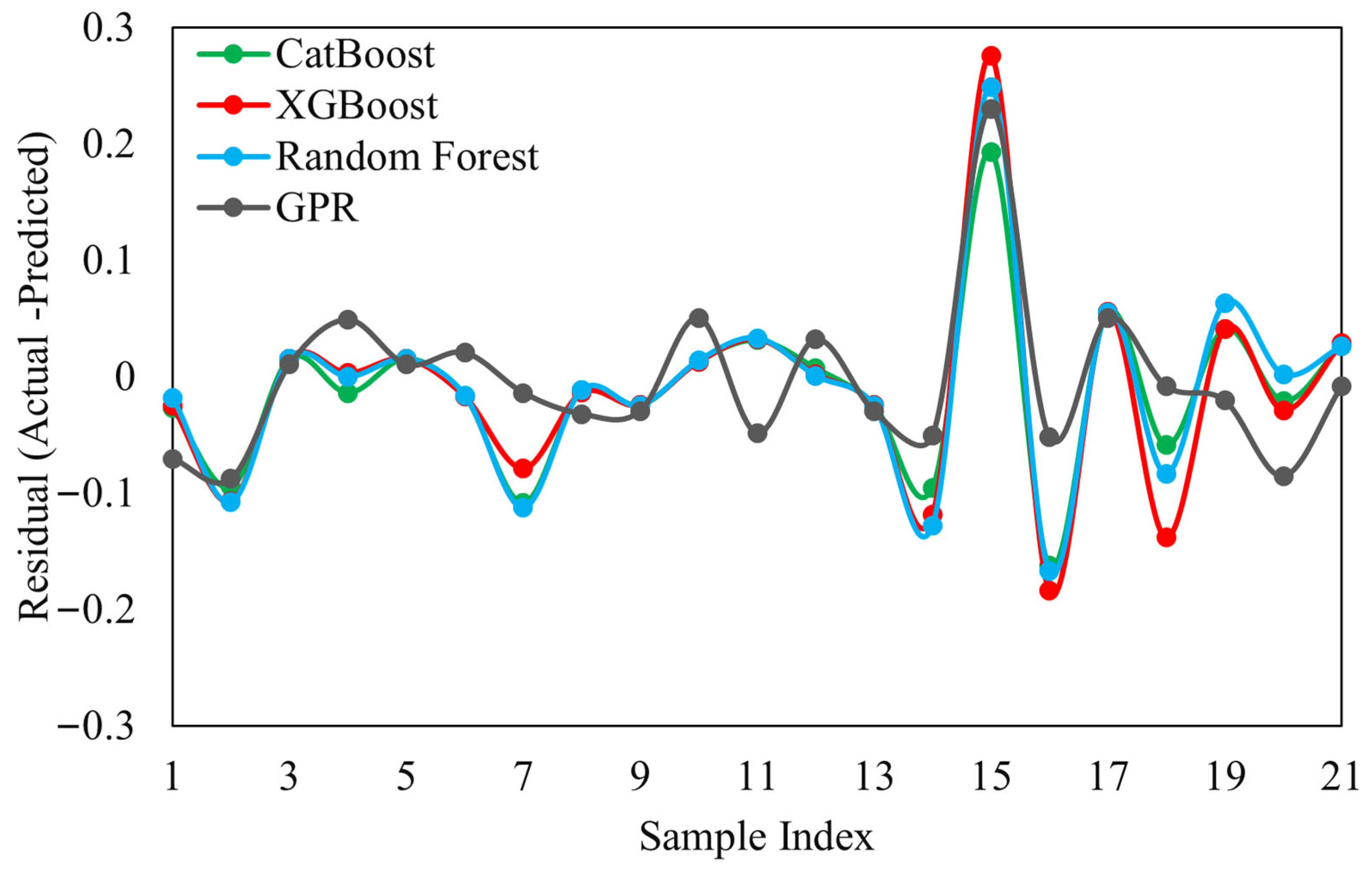
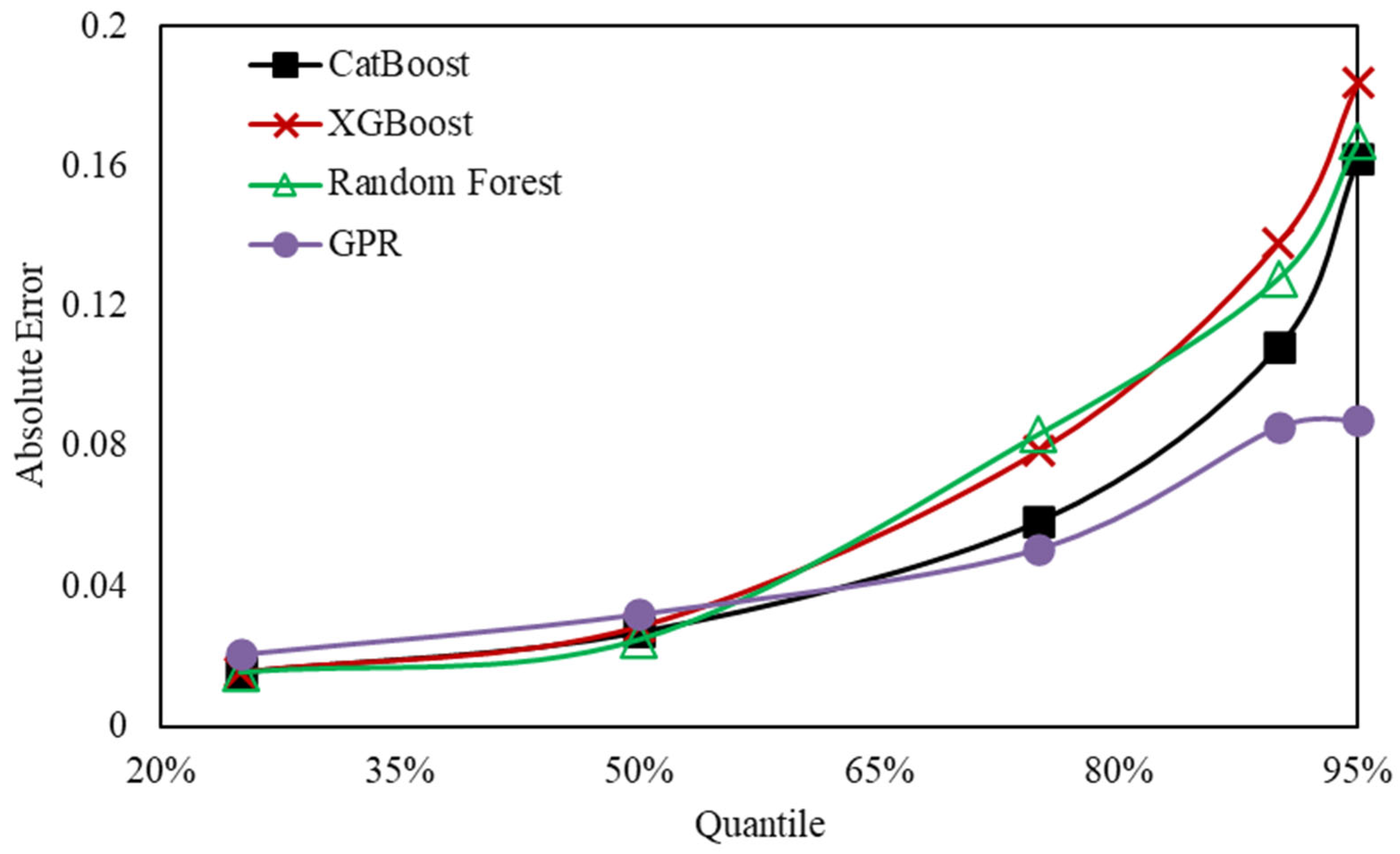
- Residual analysis showed that GPR and CatBoost yielded the most consistent predictions, with the residuals being concentrated on zero, which indicated a low under- or overprediction rate. RF was capable of moderately varying, though it was reliable, whereas XGBoost–PSO had made the highest residual deviations. Quantile-based analysis validated the fact that GPR and CatBoost had a steady performance in accuracy evaluation throughout the distribution of data, whereas RF had a steady but marginally greater errors at heavy quantiles, and XGBoost–PSO had instability when dealing with small data.
Author Contributions
Funding
Data Availability Statement
Acknowledgments
Conflicts of Interest
Appendix A
| L/l | Fr | β° | Tip Velocity |
| 11.75 | 0.21 | 4.86 | 0.31 |
| 9.15 | 0.21 | 6.24 | 0.31 |
| 6 | 0.21 | 9.46 | 0.3 |
| 2.85 | 0.21 | 19.33 | 0.29 |
| 1 | 0.21 | 45 | 0.28 |
| 12 | 0.21 | 4.76 | 0.35 |
| 9.33 | 0.21 | 6.12 | 0.33 |
| 0 | 0.21 | 0 | 0.32 |
| 3.15 | 0.21 | 17.61 | 0.3 |
| 1.59 | 0.21 | 32.17 | 0.28 |
| 12.25 | 0.21 | 4.67 | 0.39 |
| 9.25 | 0.21 | 6.17 | 0.34 |
| 0 | 0.21 | 0 | 0.32 |
| 2.5 | 0.21 | 21.8 | 0.29 |
| 1.6 | 0.21 | 32.01 | 0.27 |
| 12.4 | 0.21 | 4.61 | 0.42 |
| 9.4 | 0.21 | 6.07 | 0.36 |
| 0 | 0.21 | 0 | 0.33 |
| 0 | 0.21 | 0 | 0.29 |
| 0 | 0.21 | 0 | 0.27 |
| 11.47 | 0.25 | 4.98 | 0.35 |
| 9.25 | 0.25 | 6.17 | 0.35 |
| 6.3 | 0.25 | 9.02 | 0.33 |
| 3.05 | 0.25 | 18.15 | 0.32 |
| 1 | 0.25 | 45 | 0.31 |
| 11.7 | 0.25 | 4.89 | 0.39 |
| 9 | 0.25 | 6.34 | 0.36 |
| 5.58 | 0.25 | 10.16 | 0.35 |
| 3.23 | 0.25 | 17.2 | 0.33 |
| 1.53 | 0.25 | 33.17 | 0.32 |
| 12.25 | 0.25 | 4.67 | 0.43 |
| 9 | 0.25 | 6.34 | 0.39 |
| 4.48 | 0.25 | 12.58 | 0.36 |
| 3.81 | 0.25 | 14.71 | 0.33 |
| 1.8 | 0.25 | 29.05 | 0.31 |
| 12 | 0.25 | 4.76 | 0.47 |
| 9.6 | 0.25 | 5.95 | 0.42 |
| 0 | 0.25 | 0 | 0.38 |
| 0 | 0.25 | 0 | 0.34 |
| 0 | 0.25 | 0 | 0.31 |
| 12 | 0.33 | 4.76 | 0.5 |
| 10.5 | 0.33 | 5.44 | 0.48 |
| 0 | 0.33 | 0 | 0.46 |
| 0 | 0.33 | 0 | 0.46 |
| 0 | 0.33 | 0 | 0.44 |
| 12 | 0.33 | 4.76 | 0.56 |
| 9.67 | 0.33 | 5.9 | 0.51 |
| 0 | 0.33 | 0 | 0.48 |
| 0 | 0.33 | 0 | 0.46 |
| 0 | 0.33 | 0 | 0.45 |
| 12.5 | 0.33 | 4.57 | 0.61 |
| 10.25 | 0.33 | 5.57 | 0.54 |
| 0 | 0.33 | 0 | 0.5 |
| 0 | 0.33 | 0 | 0.48 |
| 0 | 0.33 | 0 | 0.45 |
| 12.5 | 0.33 | 4.57 | 0.66 |
| 10 | 0.33 | 5.71 | 0.58 |
| 0 | 0.33 | 0 | 0.52 |
| 0 | 0.33 | 0 | 0.47 |
| 0 | 0.33 | 0 | 0.44 |
| 12 | 0.31 | 4.76 | 0.72 |
| 11.88 | 0.27 | 4.81 | 0.55 |
| 12 | 0.29 | 4.76 | 0.62 |
| 11.75 | 0.26 | 4.86 | 0.5 |
| 12.4 | 0.36 | 4.61 | 0.92 |
| 12.3 | 0.24 | 4.65 | 0.57 |
| 12.3 | 0.25 | 4.65 | 0.62 |
| 12.24 | 0.3 | 4.67 | 0.72 |
| 11.8 | 0.31 | 4.84 | 0.82 |
References
- Nandhini, D.; Murali, K.; Harish, S.; Schüttrumpf, H.; Heins, K.; Gries, T. A state-of-the-art review of normal and extreme flow interaction with spur dikes and its failure mechanism. Phys. Fluids 2024, 36, 051301. [Google Scholar] [CrossRef] [Scilit]
- Mostafa, M.M.; Ahmed, H.S.; Ahmed, A.A.; Abdel-Raheem, G.A.; Ali, N.A. Experimental study of flow characteristics around floodplain single groyne. J. Hydro-Environ. Res. 2019, 22, 1–13. [Google Scholar] [CrossRef] [Scilit]
- Patel, H.K.; Arora, S.; Lade, A.D.; Kumar, B.; Azamathulla, H.M. Flow behaviour concerning bank stability in the presence of spur dike—A review. Water Supply 2023, 23, 237–258. [Google Scholar] [CrossRef] [Scilit]
- Liu, D.; Lv, S.; Li, C. Impact of Spur Dike Placement on Flow Dynamics in Curved River Channels: A CFD Study on Pick Angle and River-Width-Narrowing Rate. Water 2024, 16, 2236. [Google Scholar] [CrossRef] [Scilit]
- Chakravarty, S.; Patel, H.K.; Mohanty, B.; Kumar, B. Review on different shapes of spurs and their effects on channel morphology. Water Pract. Technol. 2024, 19, 241–262. [Google Scholar] [CrossRef] [Scilit]
- Iqbal, S.; Siddique, M.; Hamza, A.; Murtaza, N.; Pasha, G.A. Computational analysis of fluid dynamics in open channel with the vegetated spur dike. Innov. Infrastruct. Solut. 2024, 9, 345. [Google Scholar] [CrossRef] [Scilit]
- Giglou, A.N.; Mccorquodale, J.A.; Solari, L. Numerical study on the effect of the spur dikes on sedimentation pattern. Ain Shams Eng. J. 2018, 9, 2057–2066. [Google Scholar] [CrossRef] [Scilit]
- Pandey, M.; Lam, W.H.; Cui, Y.; Khan, M.A.; Singh, U.K.; Ahmad, Z. Scour around Spur Dike in Sand–Gravel Mixture Bed. Water 2019, 11, 1417. [Google Scholar] [CrossRef] [Scilit]
- Hussein, I.H.; Jamel, A.A.J.; Irzooki, R.H. Environmental and Hydraulic Considerations in Scour Reduction Around Spur Dikes: A Comprehensive Review. Sustain. Mar. Struct. 2025, 7, 117–135. [Google Scholar] [CrossRef] [Scilit]
- Iqbal, S.; Haider, R.; Pasha, G.A.; Zhao, L.; Abbas, F.M.; Anjum, N.; Murtaza, N.; Abbas, Z. Numerical Investigation of Flow Around Partially and Fully Vegetated Submerged Spur Dike. Water 2025, 17, 435. [Google Scholar] [CrossRef] [Scilit]
- Pradhan, T.K.; Malasani, G.C.; Reddy, S.K.; Chandra, V. Investigation on scouring and turbulence characteristics around T-head spur dike. J. Appl. Water Eng. Res. 2024, 12, 323–338. [Google Scholar] [CrossRef] [Scilit]
- Akbar, Z.; Murtaza, N.; Pasha, G.A.; Iqbal, S.; Ghumman, A.R.; Abbas, F.M. Predicting scour depth in a meandering channel with spur dike: A comparative analysis of machine learning techniques. Phys. Fluids 2025, 37, 045158. [Google Scholar] [CrossRef] [Scilit]
- Koken, M.; Gogus, M. Effect of spur dike length on the horseshoe vortex system and the bed shear stress distribution. J. Hydraul. Res. 2015, 53, 196–206. [Google Scholar] [CrossRef] [Scilit]
- Koken, M.; Constantinescu, G. Flow and turbulence structure around a spur dike in a channel with a large scour hole. Water Resour. Res. 2011, 47, W12511. [Google Scholar] [CrossRef] [Scilit]
- Akbar, Z.; Pasha, G.A.; Tanaka, N.; Ghani, U.; Hamidifar, H. Reducing bed scour in meandering channel bends using spur dikes. Int. J. Sediment Res. 2024, 39, 243–256. [Google Scholar] [CrossRef] [Scilit]
- Gu, Z.; Cao, X.; Gu, Q.; Lu, W.-Z. Exploring Proper Spacing Threshold of Non-Submerged Spur Dikes with Ipsilateral Layout. Water 2020, 12, 172. [Google Scholar] [CrossRef] [Scilit]
- Iqbal, S.; Pasha, G.A.; Ghani, U.; Ullah, M.K.; Ahmed, A. Flow Dynamics Around Permeable Spur Dike in a Rectangular Channel. Arab. J. Sci. Eng. 2021, 46, 4999–5011. [Google Scholar] [CrossRef] [Scilit]
- Özyaman, C.; Yerdelen, C.; Eris, E.; Daneshfaraz, R. Experimental investigation of scouring around a single spur under clear water conditions. Water Supply 2022, 22, 3484–3497. [Google Scholar] [CrossRef] [Scilit]
- Aydogdu, M. CFD technology in innovative spur dike design inspired by the Eğri (curved) Bridge. Sci. Rep. 2025, 15, 21308. [Google Scholar] [CrossRef] [Scilit] [PubMed]
- Vaghefi, M.; Mahmoodi, K.; Setayeshi, S.; Akbari, M. Application of artificial neural networks to predict flow velocity in a 180° sharp bend with and without a spur dike. Soft Comput. 2020, 24, 8805–8821. [Google Scholar] [CrossRef] [Scilit]
- Singh, B.; Minocha, V.K. Comparative Study of Machine Learning Techniques for Prediction of Scour Depth around Spur Dikes. In Proceedings of the World Environmental and Water Resources Congress 2024, Milwaukee, WI, USA, 19–22 May 2024; American Society of Civil Engineers: Reston, VA, USA, 2024; pp. 635–651. [Google Scholar] [CrossRef] [Scilit]
- Wei, X.; Lu, Y.; Wang, Z.; Liu, X.; Mo, S. A Machine Learning Approach to Evaluating the Damage Level of Tooth-Shape Spur Dikes. Water 2018, 10, 1680. [Google Scholar] [CrossRef] [Scilit]
- Tabassum, R.; Guguloth, S.; Gondu, V.R.; Zakwan, M. Machine learning-based prediction of scour depth evolution around spur dikes. J. Hydroinform. 2024, 26, 2815–2836. [Google Scholar] [CrossRef] [Scilit]
- Pandey, M.; Jamei, M.; Ahmadianfar, I.; Karbasi, M.; Lodhi, A.; Chu, X. Assessment of scouring around spur dike in cohesive sediment mixtures: A comparative study on three rigorous machine learning models. J. Hydrol. 2022, 606, 127330. [Google Scholar] [CrossRef] [Scilit]
- Saber, A.I.M.; Hassan, H.T.A. The Impact of Spur Dikes on the Dynamics of Erosion and Deposition Processes in the Nile River in Abnub Area: A Study in Engineering Geomorphology Using Artificial Intelligence. J. Fac. Arts Port Said Univ. 2024, 27, 172–223. [Google Scholar] [CrossRef] [Scilit]
- Singh, B.; Minocha, V.K. An optimized boosting-based machine learning model for predicting maximum scour depth around spur dikes. Mar. Georesour. Geotechnol. 2025, 1–21. [Google Scholar] [CrossRef] [Scilit]
- Singh, B.; Minocha, V.K. Approximation in scour depth around spur dikes using novel hybrid ensemble data-driven model. Water Sci. Technol. 2024, 89, 962–975. [Google Scholar] [CrossRef] [Scilit] [PubMed]
- Gupta, L.K.; Pandey, M.; Raj, P.A. Numerical modeling of scour and erosion processes around spur dike. CLEAN—Soil Air Water 2025, 53, 2300135. [Google Scholar] [CrossRef] [Scilit]
- Yeo, H.K.; Kang, J.G.; Kim, S.J. An experimental study on tip velocity and downstream recirculation zone of single groynes of permeability change. KSCE J. Civ. Eng. 2005, 9, 29–38. [Google Scholar] [CrossRef] [Scilit]
- Malekjani, N.; Kharaghani, A.; Tsotsas, E. A comparative study of dimensional and non-dimensional inputs in physics-informed and data-driven neural networks for single-droplet evaporation. Chem. Eng. Sci. 2025, 306, 121214. [Google Scholar] [CrossRef] [Scilit]
- Zhang, J.; Zhang, S.; Zhang, J.; Wang, Z. Machine Learning Model of Dimensionless Numbers to Predict Flow Patterns and Droplet Characteristics for Two-Phase Digital Flows. Appl. Sci. 2021, 11, 4251. [Google Scholar] [CrossRef] [Scilit]
- Rezzoug, A.; Khan, A.; Murtaza, N.; Rizvi, S.A.S. Predicting flood energy reduction in vegetated open channel: Comparative assessment of hybrid artificial intelligence techniques. Eng. Appl. Artif. Intell. 2025, 159, 111756. [Google Scholar] [CrossRef] [Scilit]
- Murtaza, N.; Khan, D.; Rezzoug, A.; Khan, Z.U.; Benzougagh, B.; Khedher, K.M. Scour depth prediction around bridge abutments: A comprehensive review of artificial intelligence and hybrid models. Phys. Fluids 2025, 37, 021306. [Google Scholar] [CrossRef] [Scilit]
- Eini, N.; Bateni, S.M.; Jun, C.; Heggy, E.; Band, S.S. Estimation and interpretation of equilibrium scour depth around circular bridge piers by using optimized XGBoost and SHAP. Eng. Appl. Comput. Fluid Mech. 2023, 17, 2244558. [Google Scholar] [CrossRef] [Scilit]
- Liu, C.; Duan, Z.; Zhang, B.; Zhao, Y.; Yuan, Z.; Zhang, Y.; Wu, Y.; Jiang, Y.; Tai, H. Local Gaussian process regression with small sample data for temperature and humidity compensation of polyaniline-cerium dioxide NH3 sensor. Sens. Actuators B Chem. 2023, 378, 133113. [Google Scholar] [CrossRef] [Scilit]
- Han, S.; Williamson, B.D.; Fong, Y. Improving random forest predictions in small datasets from two-phase sampling designs. BMC Med. Inform. Decis. Mak. 2021, 21, 322. [Google Scholar] [CrossRef] [Scilit]
- Breiman, L. Random forests. Mach. Learn. 2001, 45, 5–32. [Google Scholar] [CrossRef] [Scilit]
- Jafari, R.; Sui, J. Velocity Field and Turbulence Structure around Spur Dikes with Different Angles of Orientation under Ice Covered Flow Conditions. Water 2021, 13, 1844. [Google Scholar] [CrossRef] [Scilit]
- Duan, J.G.; He, L.; Fu, X.; Wang, Q. Mean flow and turbulence around experimental spur dike. Adv. Water Resour. 2009, 32, 1717–1725. [Google Scholar] [CrossRef] [Scilit]
- Vaghefi, M.; Shakerdargah, M.; Akbari, M. Numerical investigation of the effect of Froude number on flow pattern around a submerged T-shaped spur dike in a 90° bend. Turk. J. Eng. Environ. Sci. 2014, 38, 266–277. [Google Scholar] [CrossRef] [Scilit]
- Jeon, J.; Lee, J.Y.; Kang, S. Experimental Investigation of Three-Dimensional Flow Structure and Turbulent Flow Mechanisms Around a Nonsubmerged Spur Dike with a Low Length-to-Depth Ratio. Water Resour. Res. 2018, 54, 3530–3556. [Google Scholar] [CrossRef] [Scilit]
- Li, Y.-T.; Zhan, J.-M.; Wai, W.-H.O. A study of the effect of local scour on the flow field near the spur dike. Theor. Appl. Mech. Lett. 2024, 14, 100510. [Google Scholar] [CrossRef] [Scilit]
- Kang, J.G.; Yeo, H.-K.; Kim, S.-J. An Experimental Study on Tip Velocity and Downstream Recirculation Zone of Single Groyne Conditions. J. Korea Water Resour. Assoc. 2005, 38, 143–153. [Google Scholar] [CrossRef] [Scilit]
- Ho, J.; Yeo, H.K.; Coonrod, J.; Ahn, W.-S. Numerical Modeling Study for Flow Pattern Changes Induced by Single Groyne. In Proceedings of the Congress-International Association for Hydraulic Research 2007, Venice, Italy, 1–6 July 2007. [Google Scholar]
- Li, G.; Sui, J.; Sediqi, S. Turbulent flow structure around a single submerged angled spur dike under ice cover. J. Hydrol. Hydromech. 2024, 72, 522–537. [Google Scholar] [CrossRef] [Scilit]
- Rastgou, M.; Bayat, H.; Mansoorizadeh, M.; Gregory, A.S. Prediction of soil hydraulic properties by Gaussian process regression algorithm in arid and semiarid zones in Iran. Soil Tillage Res. 2021, 210, 104980. [Google Scholar] [CrossRef] [Scilit]
- Park, J.; Lechevalier, D.; Ak, R.; Ferguson, M.; Law, K.H.; Lee, Y.-T.T.; Rachuri, S. Gaussian Process Regression (GPR) Representation in Predictive Model Markup Language (PMML). Smart Sustain. Manuf. Syst. 2017, 1, 121–142. [Google Scholar] [CrossRef] [Scilit]
- Cai, Y.; Yuan, Y.; Zhou, A. Predictive slope stability early warning model based on CatBoost. Sci. Rep. 2024, 14, 25727. [Google Scholar] [CrossRef] [Scilit]
- Zivkovic, M.; Jovanovic, L.; Ivanovic, M.; Bacanin, N.; Strumberger, I.; Joseph, P.M. XGBoost Hyperparameters Tuning by Fitness-Dependent Optimizer for Network Intrusion Detection. In Communication and Intelligent Systems; Springer: Singapore, 2022; pp. 947–962. [Google Scholar] [CrossRef] [Scilit]
- Xiong, J.; Gong, Y.; Liu, X.; Li, Y.; Chen, L.; Liao, C.; Zhang, C. A PSO-XGBoost Model for Predicting the Compressive Strength of Cement–Soil Mixing Pile Considering Field Environment Simulation. Buildings 2025, 15, 2740. [Google Scholar] [CrossRef] [Scilit]





| Parameter | Mean | Mode | Standard Deviation | Variance | Range | 95% CI Lower | 95% CI Upper |
|---|---|---|---|---|---|---|---|
| L/l | 6.05 | 0.00 | 5.19 | 26.89 | 12.50 | 4.80 | 7.29 |
| Fr | 0.27 | 0.25 | 0.05 | 0.00 | 0.15 | 0.25 | 0.28 |
| β° | 7.80 | 0.00 | 10.29 | 105.85 | 45.00 | 5.32 | 10.27 |
| Tip Velocity | 0.43 | 0.31 | 0.14 | 0.02 | 0.65 | 0.40 | 0.46 |
| Configuration Item | XGBoost (XGBoost–PSO) | Random Forest (RF) | CatBoost | GPR |
|---|---|---|---|---|
| Algorithm family | Gradient boosting trees (XGBoost) | Ensemble of decision trees (bagging) | Gradient boosting trees (CatBoost) | Kernel-based probabilistic regression |
| Input features | `L/l`, `Fr`, `β°` | `L/l`, `Fr`, `β°` | `L/l`, `Fr`, `β°` (scaled) | `L/l`, `Fr`, `β°` (scaled) |
| Target | Tip Velocity | Tip Velocity | Tip Velocity | Tip Velocity |
| Data split | Train/Test/Valid split (70/15/15) | Train/Test/Valid split (70/15/15) | Train/Test/Valid split (70/15/15) | Train/Test/Valid split (70/15/15) |
| Feature scaling | No scaling in code | No scaling in code | `StandardScaler()` applied | `StandardScaler()` applied |
| Key hyperparameters | `max_depth`, `learning_rate`, `n_estimators`—optimized by PSO | `n_estimators = 200`, `max_depth = 10` | `iterations = 500`, `learning_rate = 0.1`, `depth = 6` | Kernel: C (1.0) RBF (length_scale = 1.0); n_restarts_optimizer = 10 |
| Hyperparameter optimization method | PSO optimizing MSE on test set; bounds: max_depth [2–10], learning_rate [0.01–0.3], n_estimators (50–300); swarmsize = 10, maxiter = 5 | No algorithmic tuning in code | No tuning (preset values used) | Hyperparameters optimized by log-marginal likelihood |
| Objective/loss used for tuning and training | Regression: reg:squarederror (minimize MSE) | Mean squared error minimization | Gradient boosting regression loss (MSE) | Maximizes log-marginal likelihood; predictions include uncertainty |
| Training procedure notes | PSO loop trains candidate models; final retrained with best params | Trained on X_train, predicts 53-sample test set | Model trained on scaled X, first 53 predictions used | Trained on scaled X; predictions made for all samples |
| Evaluation metrics reported | R2, Mean Squared Error (MSE) | R2, MSE (prints predictions count = 53) | R2 (first 53), MSE (first 53) | R2 and MSE |
| Random seed/reproducibility | train_test_split(random_state = 42); no explicit PSO seed | random_state = 42 for reproducibility | random_seed = 42` used for reproducibility | Deterministic, n_restarts_optimizer = 10 to avoid local optima |
| Practical remarks | PSO adds compute overhead but automates tuning | Balanced configuration with fixed test set for fair comparison | Strong fitting capacity: scaling helps stability | Provides predictive variance; best for smaller datasets |
| Model | Hyperparameter | Value |
|---|---|---|
| XGBoost–PSO | Booster | Gradient Boosted Trees |
| Objective Function | reg:squarederror | |
| max_depth | Optimized (2–10) | |
| learning_rate | Optimized (0.01–0.30) | |
| n_estimators | Optimized (50–300) | |
| Optimization Method | Particle Swarm Optimization (PSO) | |
| PSO Swarm Size | 10 | |
| PSO Iterations | 5 | |
| Fitness Function | Mean Squared Error (MSE) | |
| Random Forest | n_estimators | 200 |
| max_depth | 10 | |
| Split Criterion | Mean Squared Error | |
| Gaussian Process Regression | Kernel | C (1.0) × RBF (length_scale = 1.0) |
| Optimizer Restarts | 10 | |
| Input Scaling | StandardScaler | |
| Prediction Type | Probabilistic | |
| CatBoost Regressor | Iterations | 500 |
| Learning Rate | 0.10 | |
| Tree Depth | 6 | |
| Loss Function | RMSE | |
| Feature Scaling | StandardScaler |
Disclaimer/Publisher’s Note: The statements, opinions and data contained in all publications are solely those of the individual author(s) and contributor(s) and not of MDPI and/or the editor(s). MDPI and/or the editor(s) disclaim responsibility for any injury to people or property resulting from any ideas, methods, instructions or products referred to in the content. |
© 2025 by the authors. Licensee MDPI, Basel, Switzerland. This article is an open access article distributed under the terms and conditions of the Creative Commons Attribution (CC BY) license.
Share and Cite
Murtaza, N.; Akbar, Z.; Alrowais, R.; Iqbal, S.; Pasha, G.A.; Alquraish, M.; Bashir, M.T. Machine Learning and SHAP-Based Prediction of Tip Velocity Around Spur Dikes Using a Small-Scale Experimental Dataset. Water 2026, 18, 26. https://doi.org/10.3390/w18010026
Murtaza N, Akbar Z, Alrowais R, Iqbal S, Pasha GA, Alquraish M, Bashir MT. Machine Learning and SHAP-Based Prediction of Tip Velocity Around Spur Dikes Using a Small-Scale Experimental Dataset. Water. 2026; 18(1):26. https://doi.org/10.3390/w18010026
Chicago/Turabian StyleMurtaza, Nadir, Zeeshan Akbar, Raid Alrowais, Sohail Iqbal, Ghufran Ahmed Pasha, Mohammed Alquraish, and Muhammad Tariq Bashir. 2026. "Machine Learning and SHAP-Based Prediction of Tip Velocity Around Spur Dikes Using a Small-Scale Experimental Dataset" Water 18, no. 1: 26. https://doi.org/10.3390/w18010026
APA StyleMurtaza, N., Akbar, Z., Alrowais, R., Iqbal, S., Pasha, G. A., Alquraish, M., & Bashir, M. T. (2026). Machine Learning and SHAP-Based Prediction of Tip Velocity Around Spur Dikes Using a Small-Scale Experimental Dataset. Water, 18(1), 26. https://doi.org/10.3390/w18010026