


China’s Urban–Rural and Trade Inequality in Water Footprint



Abstract
1. Introduction
2. Methodology and Materials
2.1. The Calculation of Water Footprint
2.2. The Assessment of Water Inequality
2.3. Data Sources
3. Results
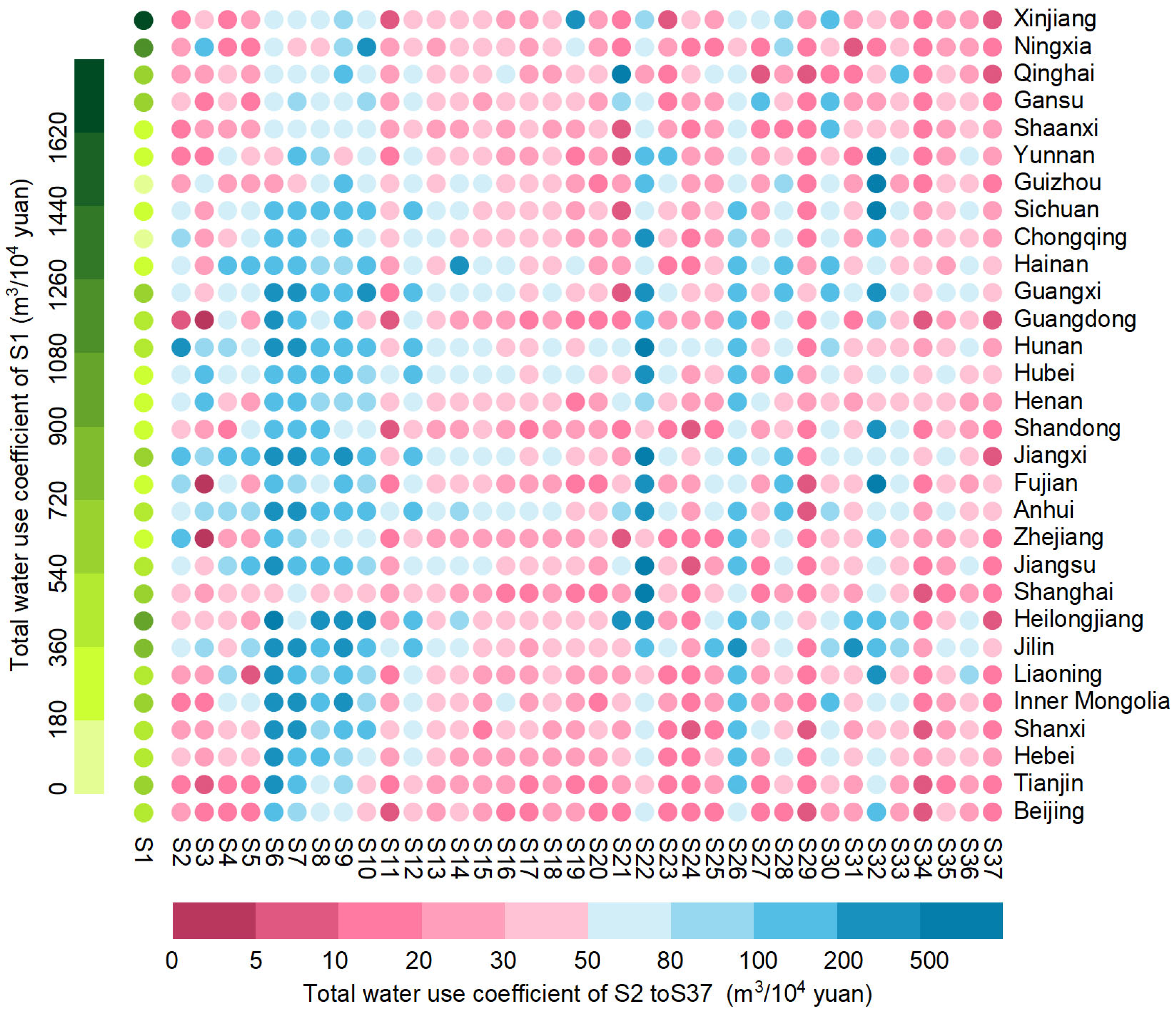
3.1. Water Use Intensity
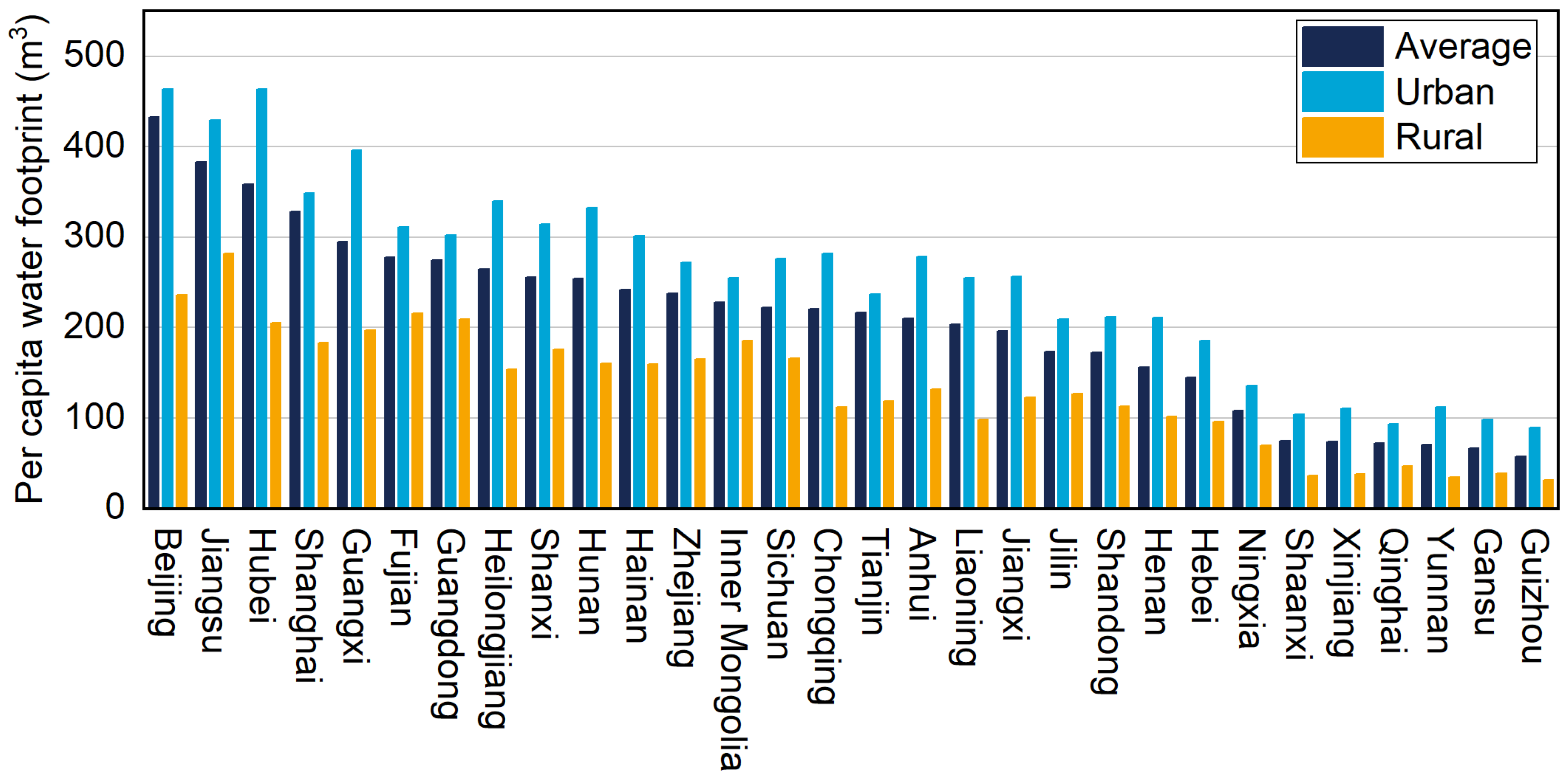
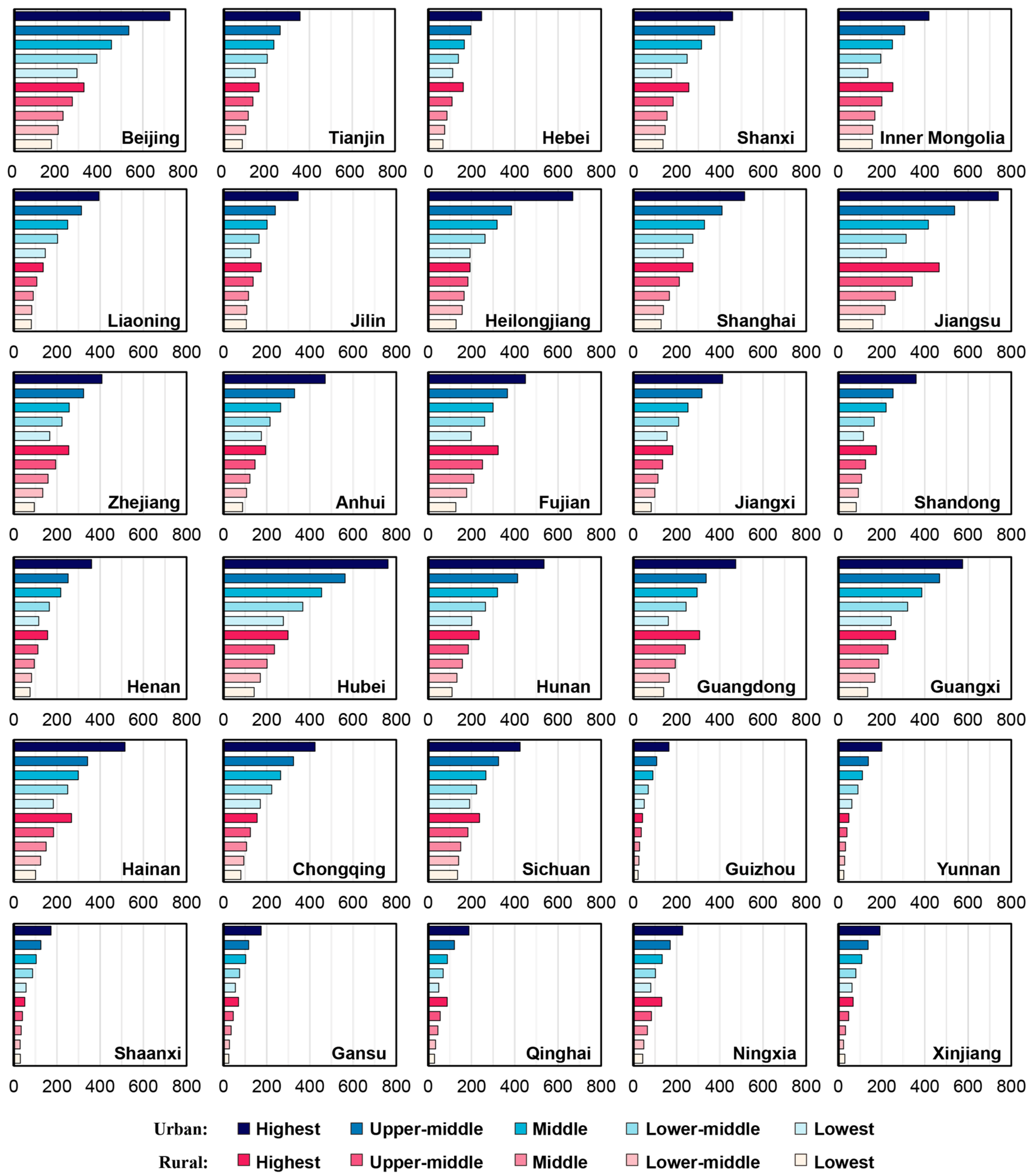
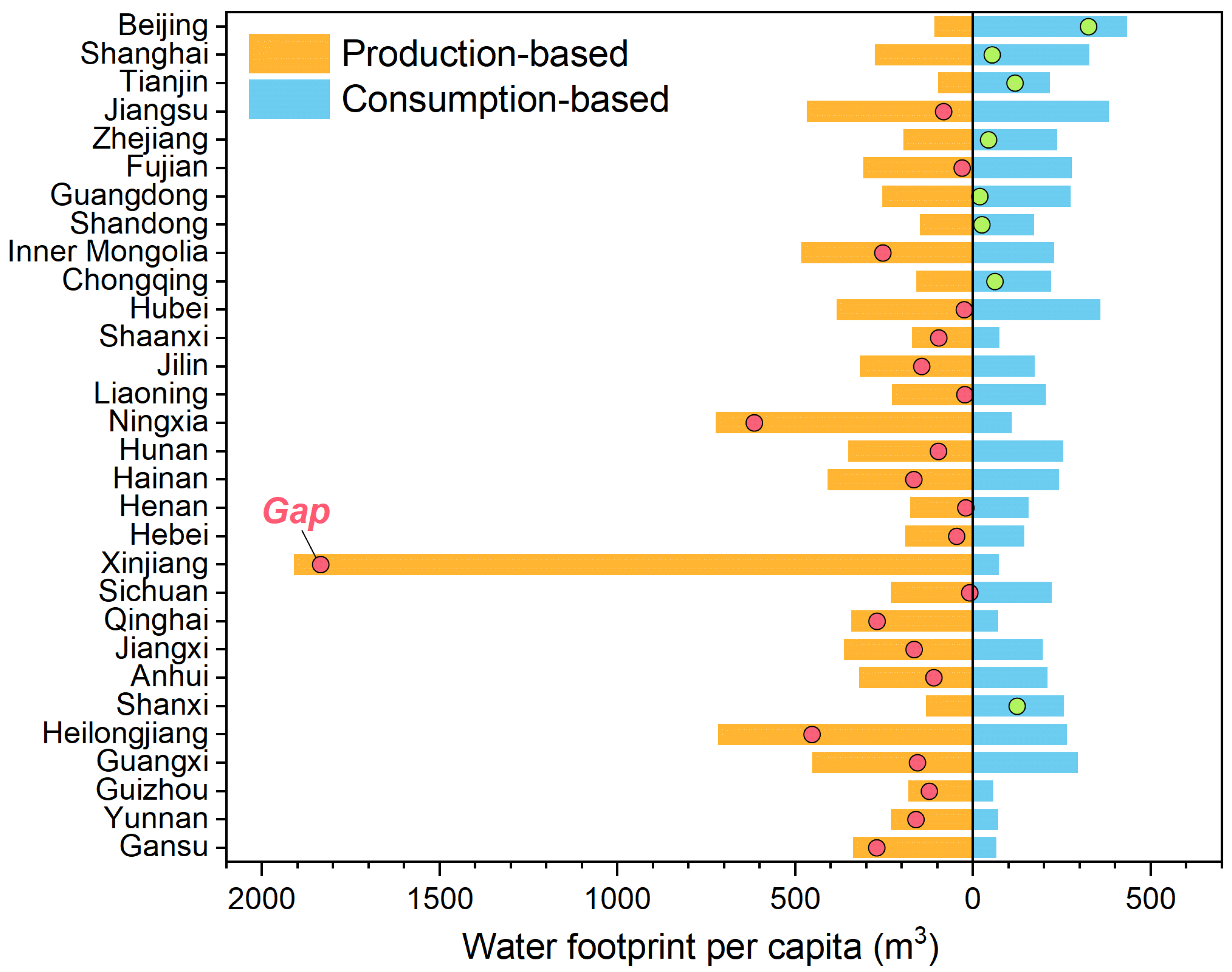
3.2. Provincial per Capita Consumption-Based Water Footprint
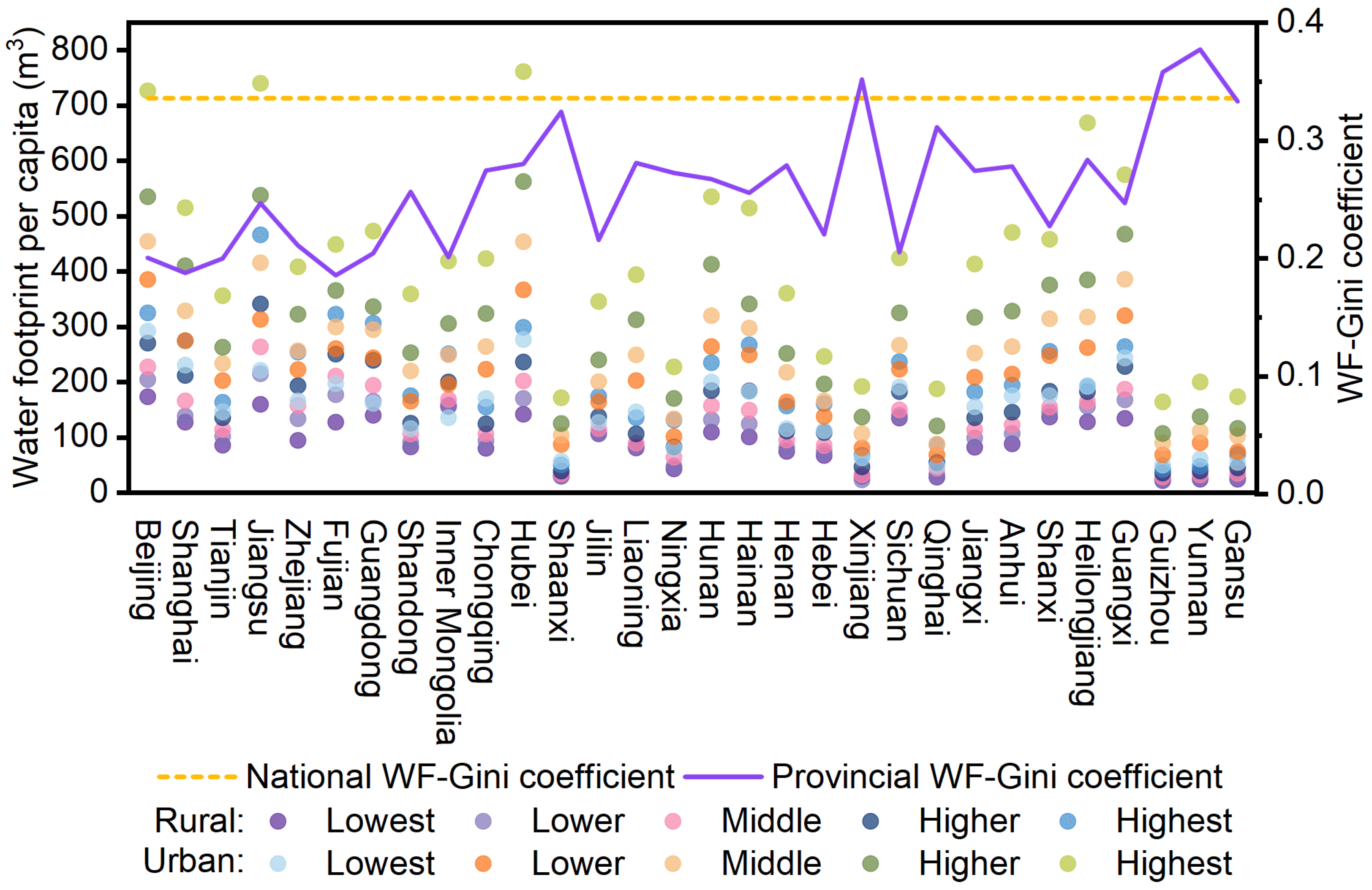
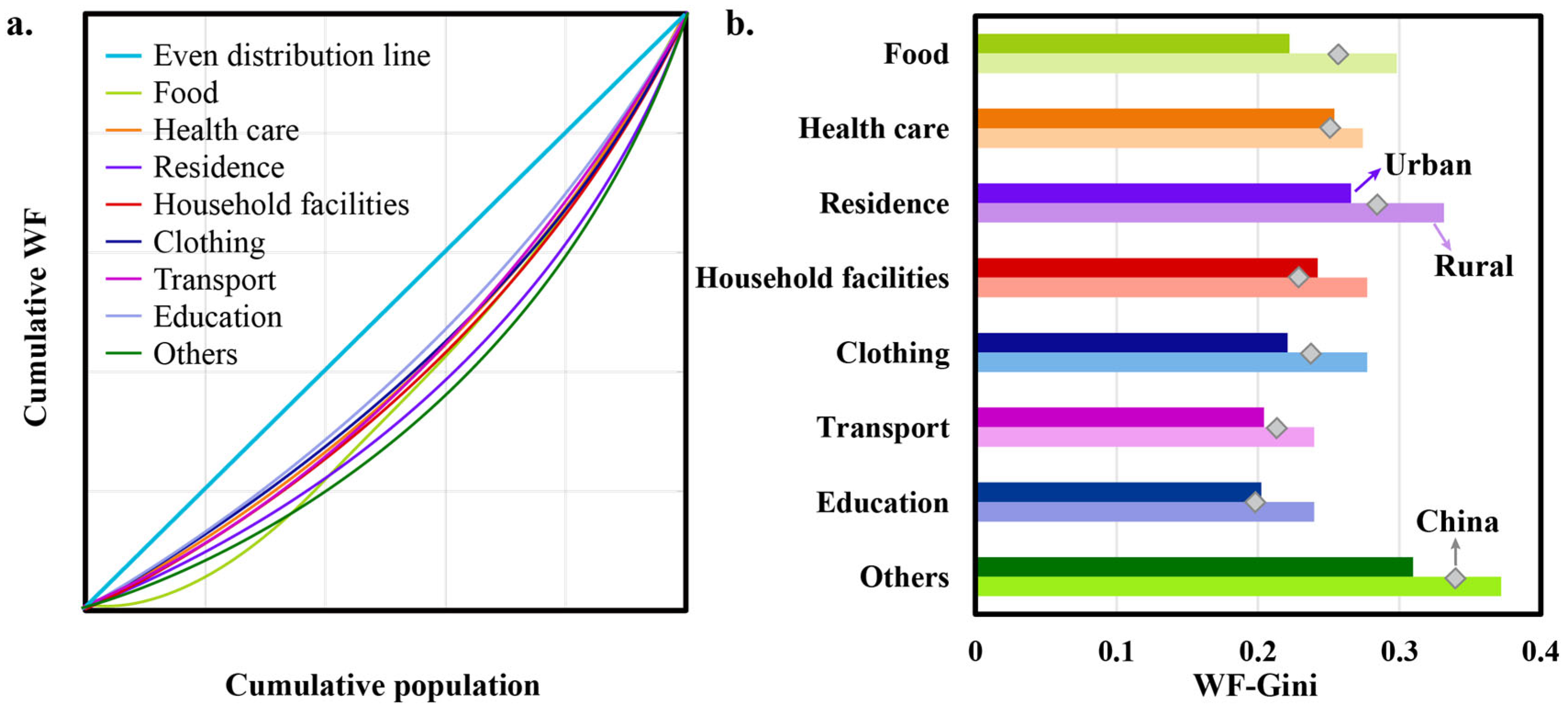
3.3. Water Footprint Inequality
4. Discussion
5. Conclusions and Policy Implications
Supplementary Materials
Author Contributions
Funding
Data Availability Statement
Conflicts of Interest
References
- Wang, Y.; Zhang, Y.; Sun, W.; Zhu, L. The Impact of New Urbanization and Industrial Structural Changes on Regional Water Stress Based on Water Footprints. Sustain. Cities Soc. 2022, 79, 103686. [Google Scholar] [CrossRef]
- Jones, E.R.; Bierkens, M.F.P.; van Vliet, M.T.H. Current and Future Global Water Scarcity Intensifies When Accounting for Surface Water Quality. Nat. Clim. Change 2024, 14, 629–635. [Google Scholar] [CrossRef]
- Yang, Y.; Zhang, R.; Deji, Y.; Li, Y. Hotspot Mapping and Risk Prediction of Fluoride in Natural Waters across the Tibetan Plateau. J. Hazard. Mater. 2024, 465, 133510. [Google Scholar] [CrossRef] [PubMed]
- Lu, N.; Zhu, J.; Tang, Z.; Zhang, J.; Chi, H. Decreasing Water Dependency for Economic Growth in Water-Scarce Regions by Focusing on Water Footprint and Physical Water: A Case Study of Xi’an, China. Sustain. Cities Soc. 2022, 85, 104092. [Google Scholar] [CrossRef]
- Umugwaneza, A.; Chen, X.; Liu, T.; Li, Z.; Uwamahoro, S.; Mind’je, R.; Dufatanye Umwali, E.; Ingabire, R.; Uwineza, A. Future Climate Change Impact on the Nyabugogo Catchment Water Balance in Rwanda. Water 2021, 13, 3636. [Google Scholar] [CrossRef]
- Higazy, N.; Merabet, S.; Khalifa, R.; Saleh, A.; Al-Sayegh, S.; Hosseini, H.; Wahib, S.; Alabsi, R.; Zarif, L.; Mohamed, M.S.; et al. Water Footprint Assessment and Virtual Water Trade in the Globally Most Water-Stressed Country, Qatar. Water 2024, 16, 1185. [Google Scholar] [CrossRef]
- Konar, M.; Marston, L. The Water Footprint of the United States. Water 2020, 12, 3286. [Google Scholar] [CrossRef]
- Sun, S.; Fang, C. Factors Governing Variations of Provincial Consumption-Based Water Footprints in China: An Analysis Based on Comparison with National Average. Sci. Total Environ. 2019, 654, 914–923. [Google Scholar] [CrossRef] [PubMed]
- Ali, Y. Carbon, Water and Land Use Accounting: Consumption vs Production Perspectives. Renew. Sustain. Energy Rev. 2017, 67, 921–934. [Google Scholar] [CrossRef]
- Seekell, D.A.; D’Odorico, P.; Pace, M.L. Virtual Water Transfers Unlikely to Redress Inequality in Global Water Use. Environ. Res. Lett. 2011, 6, 024017. [Google Scholar] [CrossRef]
- Wang, F.; Xu, B.; Si, Y.; Shang, Y.; Zhang, W.; Cai, B.; Jiang, M.; Xu, S.; Lu, S. Components and Drivers of Household Water Footprint Inequality in China. Sustain. Prod. Consum. 2023, 43, 1–14. [Google Scholar] [CrossRef]
- Feng, K.; Siu, Y.L.; Guan, D.; Hubacek, K. Assessing Regional Virtual Water Flows and Water Footprints in the Yellow River Basin, China: A Consumption Based Approach. Appl. Geogr. 2012, 32, 691–701. [Google Scholar] [CrossRef]
- Chen, W.; Wu, S.; Lei, Y.; Li, S. China’s Water Footprint by Province, and Inter-Provincial Transfer of Virtual Water. Ecol. Indic. 2017, 74, 321–333. [Google Scholar] [CrossRef]
- Gu, Y.; Chen, S.; Li, M. Uncovering the Dynamics of Consumption-Based Household Water Footprint in Response to Pandemic: The Hysteresis Effect of Disruption. Earths Future 2023, 11, e2022EF003088. [Google Scholar] [CrossRef]
- Jiang, Y.; Cai, W.; Du, P.; Pan, W.; Wang, C. Virtual Water in Interprovincial Trade with Implications for China’s Water Policy. J. Clean. Prod. 2015, 87, 655–665. [Google Scholar] [CrossRef]
- Cai, B.; Zhang, W.; Hubacek, K.; Feng, K.; Li, Z.; Liu, Y.; Liu, Y. Drivers of Virtual Water Flows on Regional Water Scarcity in China. J. Clean. Prod. 2019, 207, 1112–1122. [Google Scholar] [CrossRef]
- Gradín, C.; Wu, B. Income and Consumption Inequality in China: A Comparative Approach with India. China Econ. Rev. 2020, 62, 101463. [Google Scholar] [CrossRef]
- Wang, Q.; Wang, X. Does Economic Growth Help Reduce Inequality of Water Consumption? Insight from Evolution and Drivers of Inequality in Water Consumption in China. Environ. Sci. Pollut. Res. 2021, 28, 37338–37353. [Google Scholar] [CrossRef]
- Wang, H.; Yang, Y. Trends and Consumption Structures of China’s Blue and Grey Water Footprint. Water 2018, 10, 494. [Google Scholar] [CrossRef]
- Wang, J.; Qin, L.; He, H. Assessing Temporal and Spatial Inequality of Water Footprint Based on Socioeconomic and Environmental Factors in Jilin Province, China. Water 2019, 11, 521. [Google Scholar] [CrossRef]
- Babuna, P.; Yang, X.; Tulcan, R.X.S.; Dehui, B.; Takase, M.; Guba, B.Y.; Han, C.; Awudi, D.A.; Li, M. Modeling Water Inequality and Water Security: The Role of Water Governance. J. Environ. Manage. 2023, 326, 116815. [Google Scholar] [CrossRef] [PubMed]
- Zheng, H.; Zhang, Z.; Wei, W.; Song, M.; Dietzenbacher, E.; Wang, X.; Meng, J.; Shan, Y.; Ou, J.; Guan, D. Regional Determinants of China’s Consumption-Based Emissions in the Economic Transition. Environ. Res. Lett. 2020, 15, 074001. [Google Scholar] [CrossRef]
- Zhang, C.; Anadon, L.D. A Multi-Regional Input–Output Analysis of Domestic Virtual Water Trade and Provincial Water Footprint in China. Ecol. Econ. 2014, 100, 159–172. [Google Scholar] [CrossRef]
- Liu, G.; Zhang, F. Inequality of Household Water Footprint Consumption in China. J. Hydrol. 2022, 612, 128241. [Google Scholar] [CrossRef]
- Liu, G.; Zhang, F.; Deng, X. Economic Development Lowering Inequality in China’s Household Food Greenhouse Gas Footprints. Cell Rep. Sustain. 2024, 1, 100259. [Google Scholar] [CrossRef]
- Mi, Z.; Zheng, J.; Meng, J.; Ou, J.; Hubacek, K.; Liu, Z.; Coffman, D.; Stern, N.; Liang, S.; Wei, Y.-M. Economic Development and Converging Household Carbon Footprints in China. Nat. Sustain. 2020, 3, 529–537. [Google Scholar] [CrossRef]
- Liu, G.; Zhang, F.; Deng, X. Is Virtual Water Trade Beneficial for the Water-Deficient Regions? New Evidences from the Yellow River Basin, China. J. Hydrol. Reg. Stud. 2021, 38, 100964. [Google Scholar] [CrossRef]
- Liu, G.; Zhang, F. China’s Carbon Inequality of Households: Perspectives of the Aging Society and Urban-Rural Gaps. Resour. Conserv. Recycl. 2022, 185, 106449. [Google Scholar] [CrossRef]
- Fu, Z.; Sun, S.; Fang, C. Unequal Prefecture-Level Water Footprints in China: The Urban-Rural Divide. Sci. Total Environ. 2024, 912, 169089. [Google Scholar] [CrossRef]
- Sun, S.; Fang, C.; Lv, J. Spatial Inequality of Water Footprint in China: A Detailed Decomposition of Inequality from Water Use Types and Drivers. J. Hydrol. 2017, 553, 398–407. [Google Scholar] [CrossRef]
- Zhong, H.; Zhang, X.; Shao, X.; Xiao, J.; Tian, P. Dissecting Household Carbon and Energy Inequality: A Decade’s Insight into Regional Disparities and Urban-Rural Dynamics in China. Energy Policy 2024, 192, 114243. [Google Scholar] [CrossRef]
- Du, J.; Wang, S.; Chen, X.; Song, M. Enhancing Water Security: Statistical Measurement and Spatiotemporal Analysis. Environ. Res. 2024, 262, 119915. [Google Scholar] [CrossRef] [PubMed]
- Zhang, Z.; Cui, Y.; Zhang, Z. Unequal Age-Based Household Carbon Footprint in China. Clim. Policy 2023, 23, 577–592. [Google Scholar] [CrossRef]
- Zhang, C.; Zhou, B.; Wang, Q. Effect of China’s Western Development Strategy on Carbon Intensity. J. Clean. Prod. 2019, 215, 1170–1179. [Google Scholar] [CrossRef]
Disclaimer/Publisher’s Note: The statements, opinions and data contained in all publications are solely those of the individual author(s) and contributor(s) and not of MDPI and/or the editor(s). MDPI and/or the editor(s) disclaim responsibility for any injury to people or property resulting from any ideas, methods, instructions or products referred to in the content. |
© 2025 by the authors. Licensee MDPI, Basel, Switzerland. This article is an open access article distributed under the terms and conditions of the Creative Commons Attribution (CC BY) license (https://creativecommons.org/licenses/by/4.0/).
Share and Cite
Liu, G.; Li, Y. China’s Urban–Rural and Trade Inequality in Water Footprint. Water 2025, 17, 531. https://doi.org/10.3390/w17040531
Liu G, Li Y. China’s Urban–Rural and Trade Inequality in Water Footprint. Water. 2025; 17(4):531. https://doi.org/10.3390/w17040531
Chicago/Turabian StyleLiu, Gang, and Yonghua Li. 2025. "China’s Urban–Rural and Trade Inequality in Water Footprint" Water 17, no. 4: 531. https://doi.org/10.3390/w17040531
APA StyleLiu, G., & Li, Y. (2025). China’s Urban–Rural and Trade Inequality in Water Footprint. Water, 17(4), 531. https://doi.org/10.3390/w17040531

