Article

A Comparative Study of the Adsorption of Industrial Anionic Dyes with Bone Char and Activated Carbon Cloth


by
Samuel Aguirre-Contreras
1,
María Victoria López-Ramón
2,
Inmaculada Velo-Gala
3,*,
Miguel Ángel Álvarez-Merino
2,
Angélica Aguilar-Aguilar
1 and
Raúl Ocampo-Pérez
1,*
1
Centro de Investigación y Estudios de Posgrado, Facultad de Ciencias Químicas, Universidad Autónoma de San Luis Potosí, San Luis Potosí 78260, Mexico
2
Departamento de Química Inorgánica y Orgánica, Facultad de Ciencias Experimentales, Universidad de Jaén, 23071 Jaén, Spain
3
Departamento de Química Inorgánica, Facultad de Farmacia, Universidad de Granada, 18071 Granada, Spain
*
Authors to whom correspondence should be addressed.
Water 2025, 17(23), 3422; https://doi.org/10.3390/w17233422 (registering DOI)
Submission received: 1 October 2025 / Revised: 24 November 2025 / Accepted: 27 November 2025 / Published: 1 December 2025

Abstract

This study presents a comparative analysis of the adsorption behavior of three industrial ionic dyes—Indigo Carmine (IC), Congo Red (CR), and Evans Blue (EB)—using two adsorbent materials with distinct physicochemical and textural properties: bone char (BC) and activated carbon cloth (ACC). The main objective was to evaluate and compare the adsorption equilibrium and kinetics of these dyes on both materials. Equilibrium behavior was analyzed using the Prausnitz–Radke isotherm model, while adsorption kinetics were evaluated using PVSDM. The results showed that adsorption onto BC was primarily driven by electrostatic interactions, enhanced by the presence of hydroxyapatite. The maximum adsorbed amounts were determined to be 0.296, 0.107, and 0.0614 mmol g−1 for CR, IC, and EB, respectively. In contrast, adsorption on ACC was influenced by both electrostatic and hydrophobic forces due to its carbonaceous composition. IC exhibited significantly higher adsorption on ACC (1.087 mmol g−1), whereas CR and EB only 0.269 mmol g−1 and 0.028 mmol g−1, respectively. Kinetic studies revealed that intraparticle transport was the rate-limiting step across all systems. Specifically, pore volume diffusion controlled the adsorption rate on ACC, with mean diffusion coefficients of 9.72 × 10⁻⁸, 1.83 × 10⁻⁹, and 1.48 × 10⁻¹⁰ cm2 s−1 for IC, CR and EB, respectively. Conversely, for BC, adsorption surface diffusion played a dominant role in the adsorption of IC and CR, with mean diffusion coefficients of 1.62 × 10⁻⁹ and 7.28 × 10⁻¹⁰ for IC and CR, respectively. These findings underscore the importance of considering both equilibrium and kinetic parameters in the design of efficient wastewater treatment systems.

1. Introduction

The textile industry contributes significantly to industrial wastewater production, accounting for approximately 17–20% of the total industrial wastewater generated [1]. The manufacturing processes of textiles, such as dyeing, stamping, and finishing, require substantial quantities of water [2]. These processes subsequently generate significant volumes of industrial wastewater [2,3,4]. For instance, the production of a T-shirt typically consumes approximately 2500 L of water, while the production of a pair of jeans consumes around 1890 L [1,4].
Most textile industry does not have adequate wastewater treatment systems, and pollution causes serious related diseases as well as damage to aquatic organisms [2]. The discharged compounds are toxic, even at concentrations below 1 mg L−1, affecting the transparency of the water, the solubility of oxygen, and even the photosynthetic activity [2,4,5]. The textile industry is one of the most intensive industries in terms of chemical compounds used, such as dyes, starch, waxes, ammonia, surfactants, detergents, fats, oils, solvents, acids, metals, salts, softeners, among others [4,6]. While some of these pollutants can be addressed through common primary or secondary treatments, dyes pose a significant challenge due to their recalcitrant nature, requiring more advanced treatment methods [2]. Dyes have the potential to pose a threat to public health, as they have been identified as carcinogenic and may also act as carcinogenic substances under anaerobic conditions [7,8,9,10].
The dyes generally contain aromatic structures together with sulfonic acid groups, which gives them an overall anionic character. This means that they are direct dyes with high solubility [11,12]. These compounds have been observed to produce toxic, carcinogenic, and mutagenic metabolites, with low biodegradation [13,14,15]. Consequently, there is a need for adequate treatment of industrial wastewater.
Adsorption emerges as a technology with numerous benefits over alternative processes for the removal of industrial dyes from industrial wastewater [16,17,18]. Economic feasibility, low energetic consumption, high removal efficiency even at low concentrations, ease of operation, and flexibility in design are some of the advantages of this process [18,19]. However, the challenge lies in the utilization of cost-effective, sustainable, regenerative, and highly efficiency adsorbents [18,20].
The char of the animal bone has been identified as a potentially effective adsorbent for wastewater treatment [21,22,23,24]. The profitability of bone char is attributable to the abundance of the raw material [22,23,25]. In addition, bone char is a sustainable option due to its cost-effectiveness and ease of regeneration when compared to biomass-derived adsorbents [23]. Additionally, the inherent chemistry of bone char, characterized by its hydroxyapatite composition, renders it highly effective in the removal of fluoride, arsenic, metallic species, organic compounds, pharmaceuticals, and radioactive materials [22,23,25,26]. Consequently, bone char emerges as a highly effective solution for the treatment of wastewater contaminated with anionic dyes.
Conversely, activated carbon materials have been demonstrated to be highly effective in the removal of organic compounds, particularly activated carbon fibers [27,28,29,30,31]. Compared to bone char, activated carbon materials exhibit a superior capacity and adsorption rate due to the higher specific area and porous structure which enhances dispersive interactions and increases their capacity to adsorb aromatic compounds; however, they present the disadvantage of not having enough active sites of basic nature to remove anionic contaminants; here, the bone char exhibits a better behavior [28,32,33,34].
Mathematical models are an indispensable tool for scaling adsorption systems for batch and continuous operations. Despite the existence of numerous models to interpret adsorption processes [35,36,37], diffusional models are distinguished by their phenomenological approach, which facilitates the utilization of the properties of the adsorbent materials as well as those of contaminant molecules. These models are solved as a function of the physical parameters and operating conditions, allowing their application from laboratory scale to pilot or industrial systems. The effectiveness of these models in facilitating the utilization of information derived from batch experiments to predict and describe the dynamic operation of adsorption has been previously demonstrated [38].
Despite the existence of studies examining dye adsorption on carbon materials [39,40,41,42,43], there are few studies comparing adsorbent materials with different surface chemistry and textural properties. In addition, adsorption rate analyses using diffusional models are required to facilitate the scaling of the adsorption system to dynamic conditions. Accordingly, the aim of this work is to perform an in-depth study with different industrial anionic dyes and adsorbent materials to evaluate the equilibrium and adsorption rate. The proposed dyes are Indigo Carmine (C.I. Acid Blue 74), Congo Red (C.I. Direct Red 28), and Evans Blue (C.I. Direct Blue 53). Due to their ionic nature and the inclusion of chromophores such as azo and carbonyl groups, along with auxochromes such as amines and sulfonates, these dyes constitute the majority of those used in industry.

2. Materials and Methods

2.1. Reagents

The chemical reagents used in this study were high-purity analytical grade. The dyes used as target adsorbates were analytical grade. The dyes used as target adsorbates were IC (disodium [2(2′)E]-3,3′-dioxo-1,1′,3,3′-tetrahydro [2,2′-biindolylidene]-5,5′-disulfonate), CR (disodium 4-amino-3-[4-[4-(1-amino-4-sulfonato-naphthalen-2-yl)diazenylphenyl]phenyl]diazenyl-naphthalene-1-sulfonate), and EB (tetrasodium (6E,6′E)-6,6-[(3,3′-dimethylbiphenyl-4,4′-diyl)di(1E)hydrazin-2-yl-1-ylidene]bis(4-amino-5-oxo-5,6-dihydronaphthalene-1,3-disulfonate). Thermo Scientific supplied the latter two dyes with an indicator-grade purity. All solutions were prepared with ultrapure water obtained from Milli-Q equipment (Millipore). Quantification of the three dyes was determined by UV-vis spectrometry using the Thermo Scientific GENESYS 150 model. Calibration curves were prepared with concentrations from 1 mg L−1 to 20 mg L−1. The wavelengths were 610, 498, and 611 nm for IC, CR, and EB, respectively. The speciation diagrams and the properties of IC, CR and EB are shown in Table 1 and Figure S1 (Supplementary Material).

2.2. Adsorbents

The commercial bone char (BC) used was provided by BRIMAC®, containing between 70 and 76% of hydroxyapatite. Additionally, it contains between 8 and 11% carbon, which contributes between 40 and 60 m2 g−1 of the specific superficial area. The particles utilized in the study were of 0.22 mm in diameter, which were repeatedly washed with deionized water and dried at 110 °C for 24 h. Lastly, the material was stored in a closed container. The textural properties of BC were obtained by N2 physisorption at 77 K, using the ASAP 2020 model by Micromeritics. The specific surface area was calculated using the Brunauer–Emmett–Teller (BET) model, and the average pore size was evaluated using the following equation:
D p = 4 V p S B E T
where Vp is the pore volume obtained by a relative pressure P/P0 of 0.98. The distribution of the surface charge as well as the point of zero charge (pHPZC) was determined by the potentiometric titration method of Kuzin and Loskutov [44,45,46].
The commercial activated carbon cloth (ACC) used in this study was provided by Kynol Europe GmbH. The textural properties, the concentration of acid and basic sites, and the pHPZC were reported previously [33,47], highlighting a high BET area of 2128 m2 g−1, an average micropore width of 1.69 nm, and a surface area dominated by basic sites, giving a pHPZC of 8.0. The N2 isotherm and the pore distribution are presented in Figure S2 (Supplementary Material). The Raman spectra of both materials were obtained before and after the adsorption process using a XploRA spectrophotometer with a 532 nm laser.

2.3. Experimental System

The equilibrium and adsorption rate data were obtained in a system such as the one shown in Figure 1, known as a differential batch column [32]. This system is composed of a glass column (9 mm internal diameter, and 25 cm long), a peristaltic pump, a solution feed vessel, a stirring plate and magnetic stirrer, glass beads, and additional accessories such as flexible tubing and plastic connectors. The experiments were conducted in the following manner: the column was initially packed with a known amount of BC or ACC, placing glass beads of 2 mm diameter below and above the adsorbent material to evenly distribute the flow inside the column. In the case of the ACC, circles were cut with an equal size to the internal diameter of the column. After packing the column, deionized water was recirculated at a flow rate of 3.5 mL min−1 for a period of 24 h, with the objective of eliminating preferential pathways. Subsequently, the deionized water was substituted in the feed vessel for a dye solution that had been meticulously measured to ensure both concentration and pH were exact. The remaining water content remaining within the flexible tubing and the column was measured, thus enabling the recalculation of the initial concentration. Following the contact of the dye solution with the adsorbent material, the chronometer was started, and samples were obtained at various time intervals. In this way, decaying curves were formed, allowing the adsorbed amount to be estimated using the mass balance:
q ( t ) = V 0 ( C A 0 C A t ) m
where V0 is the initial volume, CA0 the initial concentration, CA (t) the time concentration at time “t” and m the adsorbent mass. Once the concentration remained constant, this value was taken as final equilibrium value and the quantity adsorbed was calculated with the next equation:
q e = V 0 ( C A 0 C A e ) m
The solution pH was kept constant by adding drops of 0.01 N NaOH or HCl as needed. The isotherms of each system, as well as the decay curves were obtained by varying the initial concentration or adsorbent mass. Conversely, experiments were conducted at different ionic strength and pH, with the addition of NaCl, or 0.1 N drops of NaOH or HCl to the respective solution preparation.

2.4. Mathematical Modeling of Equilibrium and Adsorption Rate

2.4.1. Equilibrium Adsorption

The adsorption equilibrium data was interpreted by Langmuir y Prausnitz–Radke models:
q e = q m K   C A e 1 + K C A e
q e = a C A e 1 + b C A e β
The parameters were obtained after non-linear fitting using the STATISTICA software. The objective function that was minimized was the percentage deviation, following the Rosenbrock and quasi-Newton methods:
% D e v = 1 N i N q e e x p q e c a l q e e x p ×   100 %

2.4.2. Adsorption Rate on BC

The decay curves from the BC experiments were interpreted using the PVSDM model [38,48,49,50,51]. This model has been applied to the adsorption of granular porous materials, including BC [52]. The model takes into account the different mass transport phenomena in adsorption, such as interfacial convective transport, intraparticle diffusion in the pore volume and surface, and adsorption on the active sites. The model equations are:
V d C A d t = m S k L ( C A C A r r = R P )
t = 0       C A = C A 0
ε p C A r t + ρ p q r t = 1 r 2 r r 2 D ep C A r r + D s ρ p q r r
C A r r r = 0 = 0
D ep C A r r r = R P + D s ρ p q r r = k L C A - C A r r = R P
C A r = 0       t = 0       0     r     R P
where V is the volume of the liquid solution, m is the mass of the adsorbent, S is the external surface area of the particles, CA is the concentration in the liquid phase, CAr is the pore concentration of the particles, CAr|r=Rp is the external surface concentration of the particles, and qr is the adsorbed amount at a given intraparticle radial distance. One of the considerations of the model is that equilibrium is instantaneous in the pores, which can be related qr = (CAr) to the experimentally obtained adsorption isotherm. Equation (7) represents the mass balance for the contaminant “a” in the liquid phase, while Equation (9) represents the mass balance on BC particles. Both equations are coupled by convective transport between the liquid phase and the solid phase (Equation (11)). The convective transport coefficient, kL, was estimated using the Furusawa method [53] while the diffusion coefficient in the pore volume was estimated using the following equation [38]:
D e p = D A B ε p τ
Molecular diffusion coefficients, DAB, were estimated using Wilke-Chang equation [54], yielding values of 4.64 × 10⁻¹⁰ m2 s−1, 3.75 × 10⁻¹⁰ m2 s−1 and 3.28 × 10⁻¹⁰ m2 s−1, for IC, CR, and EB, respectively. Tortuosity was estimated using the following equation [55,56,57]:
τ = 2 ε p 2 ε p
The values used for the void fraction (εp) and particle density (ρp) were taken from the literature for the commercial bone char [58], 0.46 and 1.53 g cm−3, respectively. Furthermore, the coefficient values Dep were 4.14 × 10⁻¹¹ m2 s−1, 3.35 × 10⁻¹¹ m2 s−1, and 2.93 × 10⁻¹¹ m2 s−1, for IC, CR, and EB, respectively. Finally, the surface diffusion coefficient (Ds) was obtained by minimizing the following objective function:
O F 1 = 1 N i N C A e x p ( t ) C A c a l ( t ) C A e x p ( t ) × 100 %

2.4.3. Adsorption Rate on ACC

The previous diffusion model can be applied for materials composed of fibers, such as ACC, due to their similar transport mechanisms. It was initially proposed by Leyva-Ramos (2007) [32] and its application has been reported in different adsorption systems on carbon fibers [33,59,60]. A necessary consideration for the application of the model is that the fibers are uniform cylindrical filaments of average diameter, and not spherical particles as in granular materials. Furthermore, the intraparticular transport is attributed only to the diffusion of the pore volume. Taking this into account, the equations are as follows:
V d C A d t = m S k L ( C A C A r r = R f )
t = 0       C A = C A 0
ε p C A r t + ρ p q r t = 1 r r r D ep C A r r
C A r r r = 0 = 0
D ep C A r r r = R f = k L C A - C A r r = R f
C A r = 0       t = 0       0     r     R f
Similarly, this model is based on the mass balance in the liquid phase (Equation (16)) and the adsorbent material (Equation (18)). The void fraction (εp), density (ρp), and fiber ratio (Rf) were obtained from previous work with ACC [33] and are 0.585, 0.643 g cm−3, and 4.5 µm, respectively. The diffusion volume pore coefficient was estimated using the following equation [61]:
D e p = D A B ε p K p K r τ
This equation includes the hindered factor by the steric exclusion, Kp, and by friction, Kr. These factors were estimates using Dechadilok and Deen (2006) equation [62]:
K p K r = 1 + 9 8 λ L n λ 1.56034 λ + 0.528155 λ 2 + 1.91521 λ 3 2.81903 λ 4 + 0.270788 λ 5 + 1.10115 λ 6 0.435933 λ 7
where λ is the ratio between the average diameter of the molecule (Table 1) and the average diameter of the pore (1.69 nm). The obtained values were 0.490, 0.751, and 0.869 for IC, CR, and EB, respectively, thereby yielding Kp Kr of 0.05178, 0.0021, and 0.00012 for IC, CR, and EB, respectively. The convective coefficient, kL, was estimated using the Furusawa method [53]. The tortuosity values (τ) was estimated to minimize the following objective function:
O F 2 = 1 N i N C A e x p ( t ) C A c a l ( t ) C A e x p ( t ) × 100   %

3. Results and Discussion

3.1. Physicochemical Characteristics of BC

The adsorption–desorption data obtained from the N2 at 77 K isotherm are presented in Figure S3a. The obtained isotherm is characteristic of type IV, with a H3 hysteresis loop [63,64]. This behavior is attributable to a mesoporous material formed by aggregated laminae that form slit-shaped pore volumes [65,66]. The specific area obtained with the BET method was 90 m2 g−1, a pore volume of 0.242 cm3 g−1, and a pore average diameter of 10.75 nm. These results are consistent with those reported in the literature on bone char [23,26]. Conversely, Figure S3b illustrates the charge distribution, with the surface predominantly identified as basic. The zero charge point (pHPZC) is approximately 10.1. Table 2 presents the properties summary of BC and ACC. Figure S4 (Supplementary Material) presents the RAMAN spectra of BC and ACC. BC is a material composed primarily of hydroxyapatite and carbon. The BC spectrum displays the distinctive modes of hydroxyapatite (phosphate vibration at 950 cm−1) and the bands of graphitic carbon (G-Band 1585 cm−1) and defective graphitic layers (D-Band 1335 cm−1) [67,68,69,70]. The ACC spectrum displays the G and D bands. The modes persisted following adsorption on BC and ACC.

3.2. Adsorption Equilibrium on BC

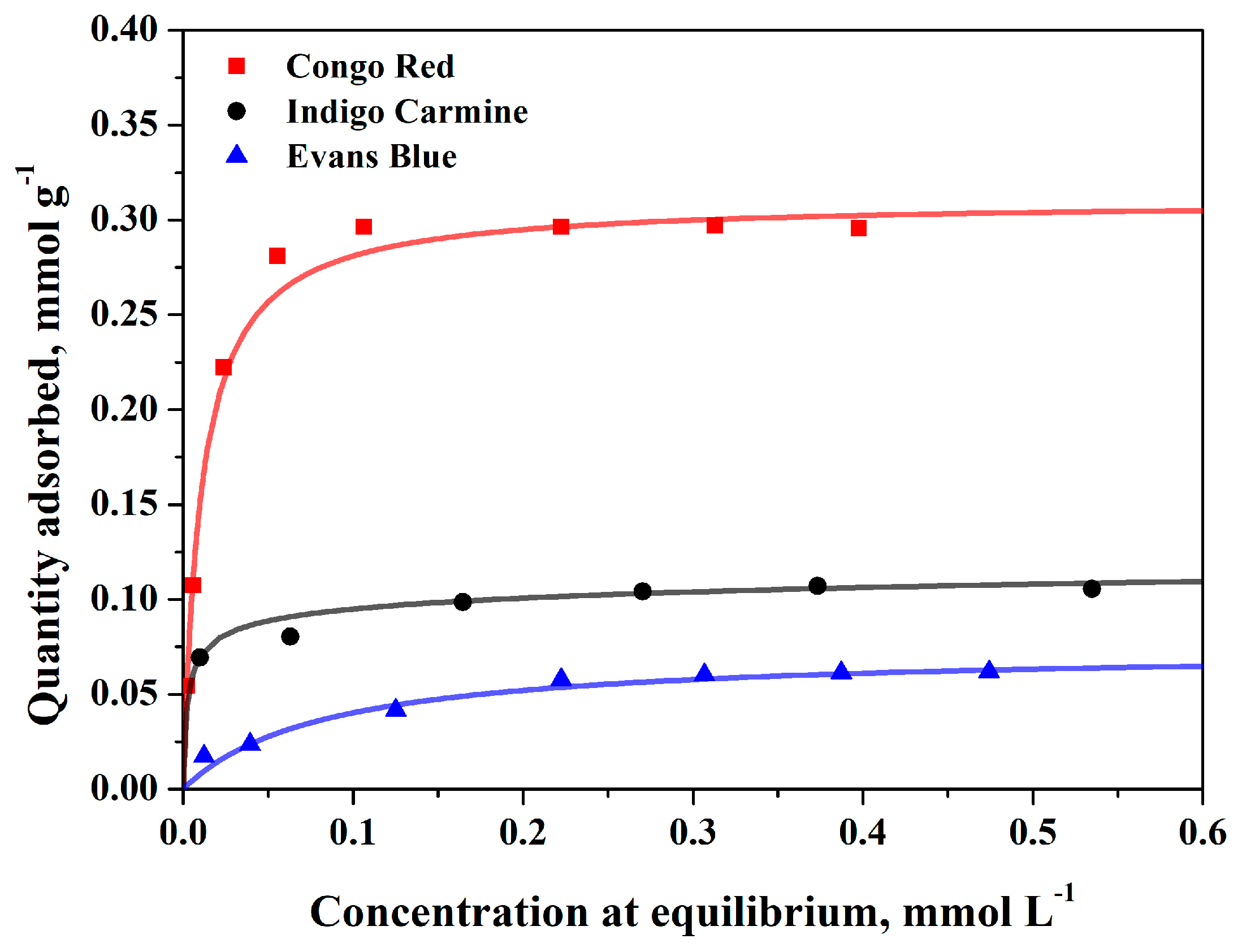
The equilibrium results of adsorption for the three dyes on BC are presented in Figure 2. The three systems present a favorable adsorption isotherm. The maximum adsorbed amounts were determined to be 0.296, 0.107, and 0.0614 mmol g−1 for CR, IC, and EB, respectively. The equilibrium curves of CR and IC present a high slope as the concentration approaches zero, and the adsorbed quantities in that region were determined to be 0.0545 and 0.0694 mmol g−1 for CR and IC, respectively. This indicates that both CR and IC have a high affinity for BC and are type “H” isotherms according to the Giles classification [65]. In the case of EB, the isotherm displays Langmuir-type behavior, whereby a constant adsorption capacity is achieved as the concentration increases [65]. In general, the three compounds reach a limited adsorption capacity by increasing the concentration, indicating that the BC has been saturated. The data interpretation by the Langmuir and Prausnitz–Radke models was adequate, with low deviation percentages in all cases. However, it was found that the Prausnitz–Radke equation yielded lower mean deviation percentages for the three dyes. Consequently, the Prausnitz–Radke equation is shown in Figure 2, and was used for kinetic analysis. The parameters obtained from the application of these models to the adsorption isotherms are presented in Table S1 of the Supplementary Material.
The adsorption mechanism could be elucidated by considering the properties of BC and the dye speciation. The BC has superficial chemistry based on hydroxyapatite, since it is the main component (70–76%). This mineral is characterized by the presence of basic active sites, which can accept protons in a specific manner, as follows [26,66]:
C a O H + H C a O H 2 +
This finding was further substantiated by the charge distribution analysis of the material, wherein it was revealed that at a pH below the pHPZC value of 10.1, positive charges prevail on the surface of the material. On the other hand, all three dyes are anionic throughout the pH range, as shown in the species distribution plots (Figure S1). Indigo Carmine (IC) is an anionic dye with a characteristic chromophore, termed indigoid, which is formed by carbonyl and amine groups [71]. The protonation of the amine group at a pKa of 9.76 results in the formation of two distinct species, as illustrated in Figure S1a of the Supplementary Material. In addition, the molecule possesses two sulfonate groups at its extremities, which contribute formal negative charges. Congo Red (CR) is constituted by aromatic rings, with two Azo chromophores in its structure, as well as two amines as auxochromes. It is also endowed with two sulfonate groups, which confer its anionic character. The azo group can accept a proton and has a pKa of 0.21, which means that, across almost the entire pH range, only one species bearing two negative charges is present (Figure S1b). Evans Blue (EB) exhibits a comparable structure to CR, with a distinction in the Azo groups present in a tautomeric form known as hydrazone [2]. The presence of methylene, carbonyl, hydroxyl, and two additional sulfonate groups contributes to the strong ionic nature of the compound [2]. The hydrazone group can accept a proton at a pKa of 3.42, while the hydroxyl group can donate a proton at a pKa of 8.9 (Figure S1c).
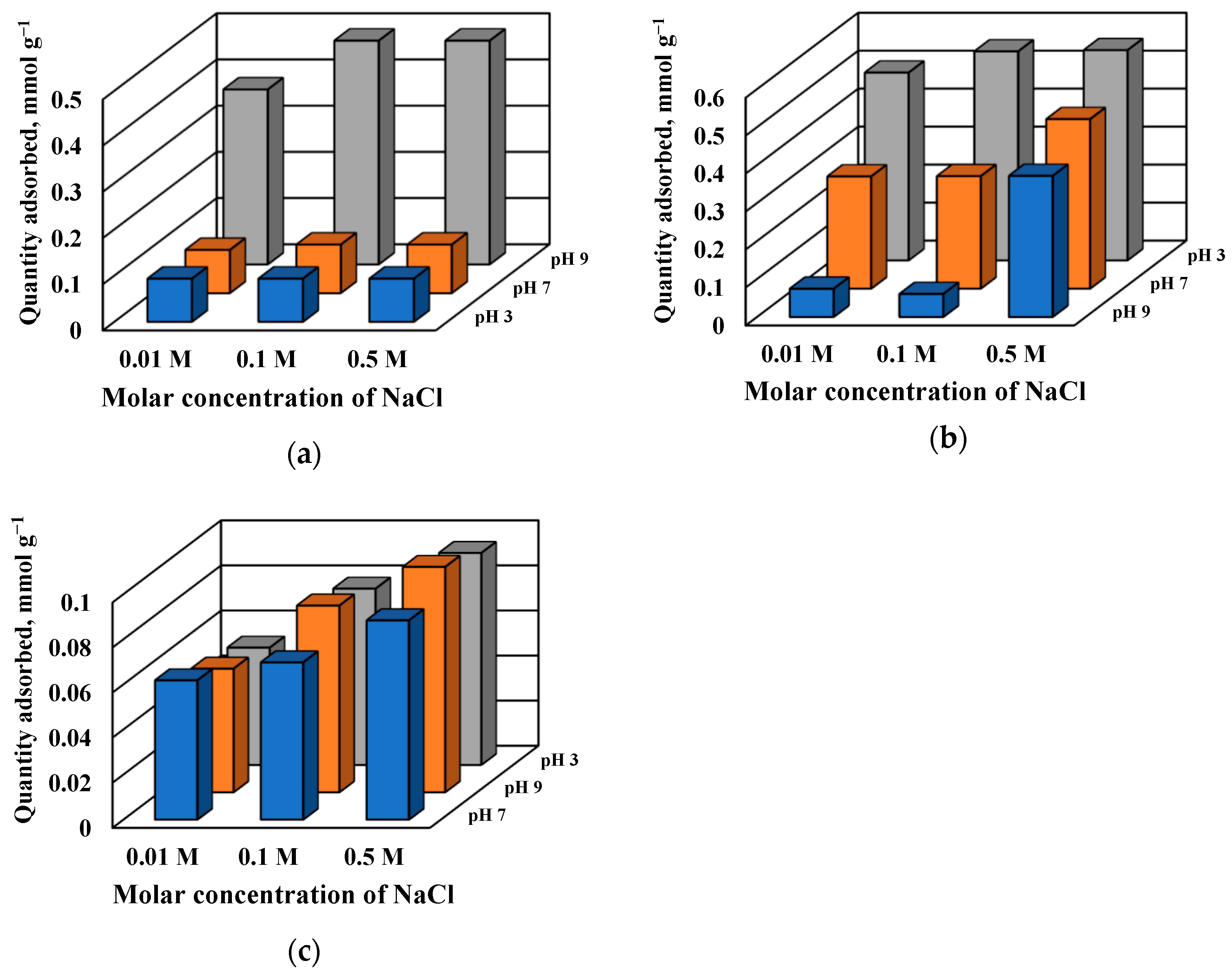
Consequently, it can be deduced that the predominant interactions between the ionic dyes and the pore surface of BC are electrostatic in nature [66,72,73]. To corroborate the interactions, additional experiments were conducted in acid and basic conditions, varying the ionic strength in the solution. It is well established that an elevated number of ions within the solution can induce effects in the adsorption of the dyes. The results for the three dyes are displayed in Figure 3. In the case of IC (see Figure 3a), a drastic change was obtained by increasing the pH of the dissolution from 7 to 9. This increase is approximately four-fold and can be explained by considering that, in basic conditions, the IC species that predominates in solutions has a higher electronegative force (Figure S1a), and the BC surface is positively charged in a way that attractive interactions are favored. Conversely, under acidic conditions, the pH fails to influence adsorption because the species present in IC is the same as at neutral pH, and the BC surface remains equally positive. On the other hand, increasing the ionic strength with concentrations from 0.1 to 0.5 M NaCl had a 28% effect on the adsorption at pH = 9, but had no significant effect in neutral or acidic conditions. This finding suggests that the solubility of IC may decrease with decreasing concentrations of NaCl, ranging from 0.1 M. In the context of the CR, the pH exhibited a pronounced influence on the adsorption of BC. By reducing the pH from 7 to 3, the adsorbed mass was observed to be on average 1.6 times higher. Given that the speciation of CR remains constant across the full pH range (see Figure S1b), this increase can be attributed to the presence of acidic conditions. The surface charge of BC is found to be eight times more positive than under neutral conditions (see Figure S3b), suggesting that electrostatic attractions play a significant role in these processes. In contrast, an increase in pH to 9 led to a 3.3-fold decrease in the adsorbed mass. This is because the material is located close to the pHPZC of BC (10.1), where the positive charges on the material’s surface have been significantly reduced. Consequently, electrostatic attractions are also reduced. However, this decline is counterbalanced by an increase in ionic strength, which is achieved by introducing a concentration of 0.5 M of NaCl. In a similar manner, at a pH of 7, adsorption was also favored by 50% when a concentration of 0.5 M of NaCl was reached.
Finally, in the case of EB, the pH exhibited no significant effect under acidic or basic conditions. This phenomenon may be attributed to the dye’s strong anionic character, derived from the presence of four sulfonate groups in its structure. The pH variation does not appear to have any significant impact on this dye. However, an effect was observed in relation to the increase in concentration of NaCl in the solution. On average, a 1.7-fold increase in adsorbed mass was observed when reaching concentrations of 0.5 M NaCl. In conclusion, pH exhibited a substantial impact on the adsorption of IC and CR, but not on EB, whereas ionic force exerted an influence on the three dyes. These findings provide substantial evidence to support the hypothesis that electrostatic interactions play a significant role in the adsorption of ionic dyes on BC.
Although electrostatic interactions are expected to be the dominant adsorption mechanism, the possibility of additional interaction between the dyes and bone char (BC) should not be disregarded. Considering that BC specific surface consists of up to 66% carbon, other mechanisms should be expected, such as hydrophobic interactions and π–π stacking. This phenomenon can be further accentuated in the context of CR, which exhibited the highest adsorbed amount in BC. Compared to IC, CR contains a greater number of aromatic rings in its structure, which increases its electron density and consequently enhances π–π interactions between the carbon surface [72]. In contrast, EB has the same number of aromatic rings as CR, but double the number of sulfonate groups, which provides a higher negative molecular charge in the structure. This is likely to result in repulsions between the EB molecules and the carbon surface, thereby hindering the potential for hydrophobic attractions on carbon. Conclusive evidence of this phenomenon has been reported in adsorption studies of organic compounds on BC [23,66,72,73,74]. The findings provide a rationale for the observed increase in adsorption quantity, with CR demonstrating 2.8- and 4.8-times higher adsorption capacity in comparison to IC and EB, respectively (Figure 2).

3.3. Adsorption Rate on BC

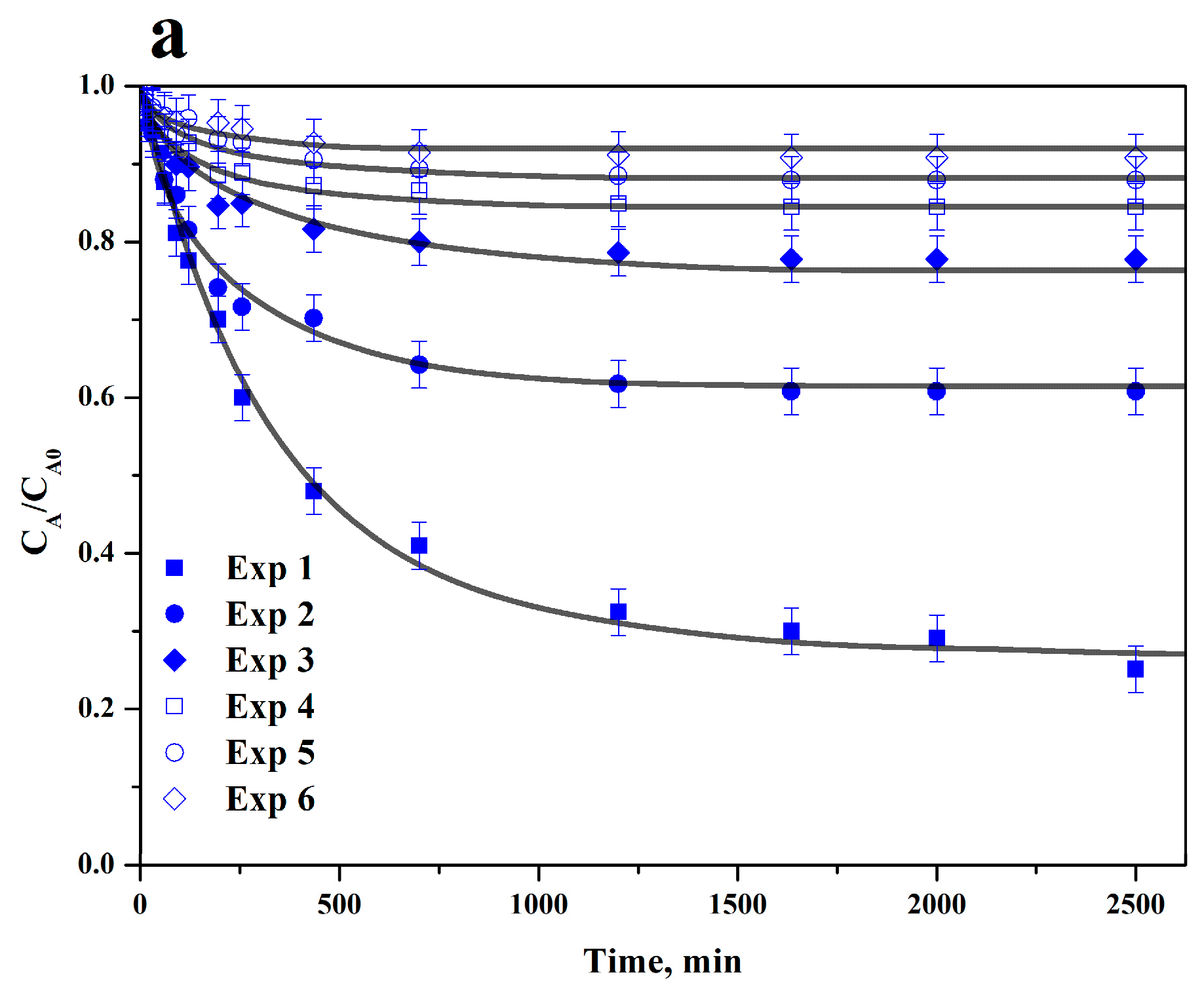
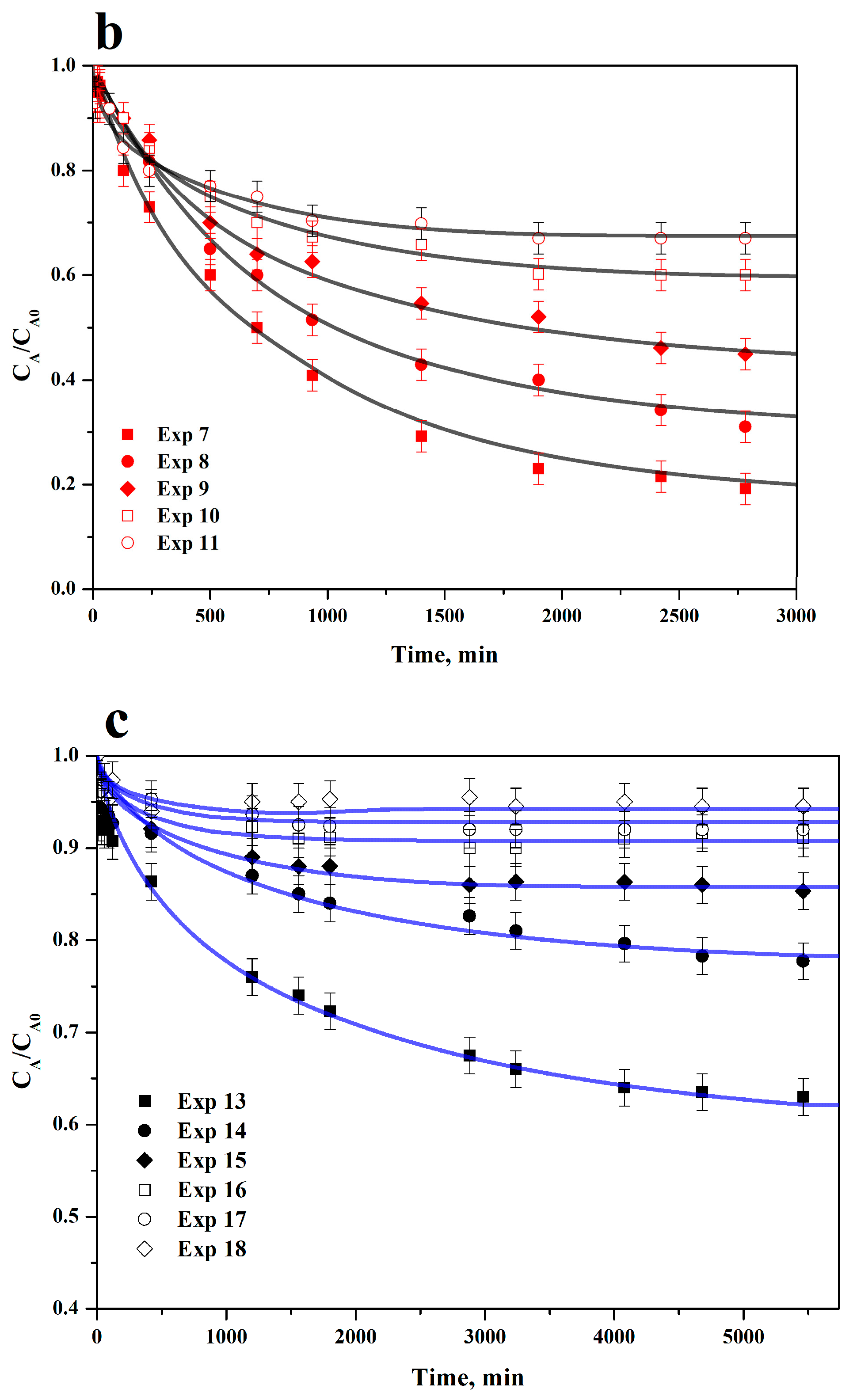
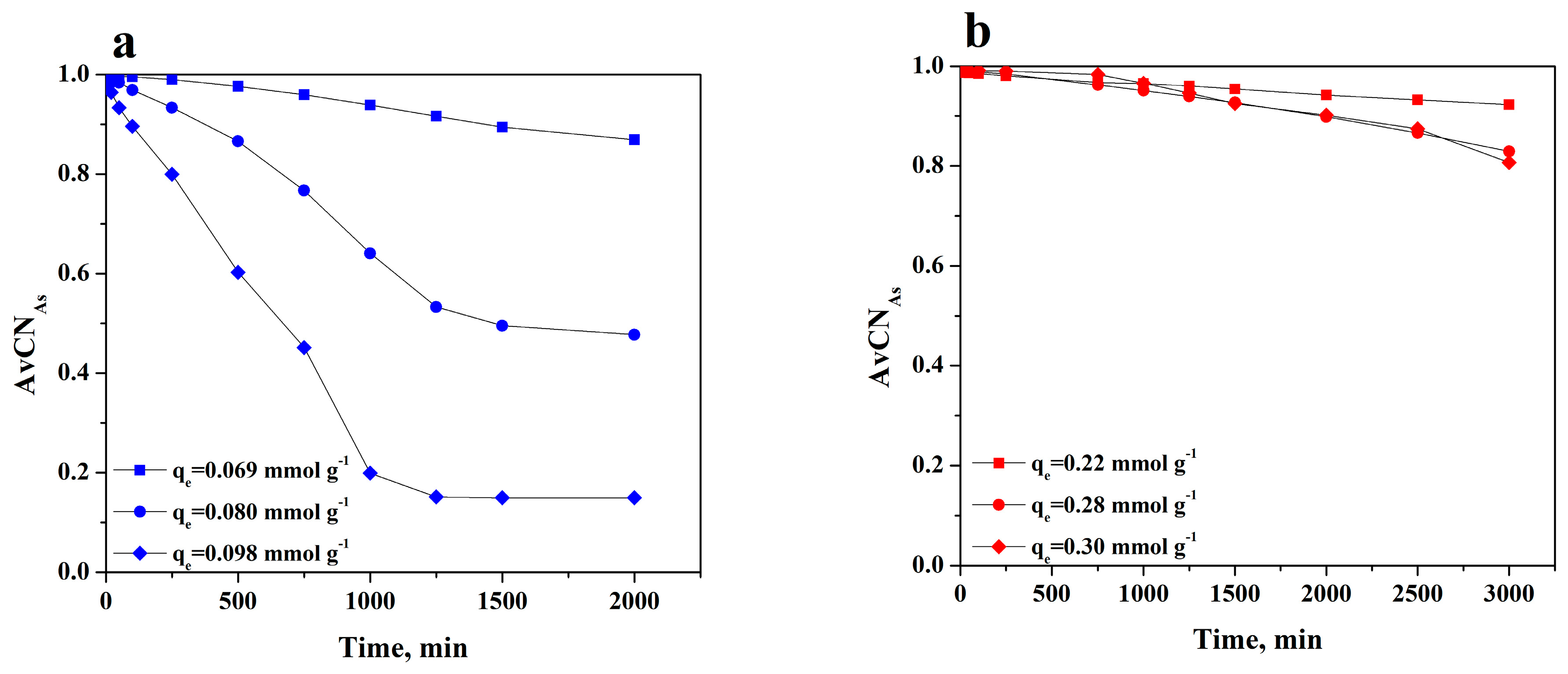
In order to ascertain the stage that controls the adsorption rate, six experiments were conducted for each dye, varying the initial concentration. The operational conditions and the results for the 18 experiments are presented in Table S2. The PVSDM model was able to interpret the correct shape of the decay curves for the three dyes, with deviation percentages of 5% as the highest. This finding suggests that the transport mechanisms involved in the adsorption process are consistent with the PVSDM model. The curves obtained for the three compounds are presented in the typical form of a controlled process for intraparticle transport (see Figure 4). The experiments concerning IC (Figure 4a) demonstrate that equilibrium is attained after approximately 1000 min.; nevertheless, a more pronounced decrease occurs within the initial 500 min. This finding suggests that transportation to a higher quantity of active sites is rapid. However, in higher concentration experiments (Exp 4–6), the curves tend to stabilize quickly. This observation suggests that increasing the gradient of concentration leads to accelerated intraparticle transport, as would be anticipated. On the other hand, Figure 5a shows the contribution to surface diffusion (obtained using Equation (26)) as a function of time and adsorbed amount for the IC.
AvCN As = 0 R P D s ρ p q r D s ρ p q r + D ep C Ar r d r 0 R P d r
During the initial stages, surface diffusion accounts for more than 80% of the total intraparticle transport. As time progresses, this contribution decreases, indicating an increasing relevance of pore volume diffusion. It is important to highlight that the highest adsorption rates occur in this initial phase, where surface diffusion plays a dominant role in intraparticle transport and, consequently, exerts a significant influence on the overall adsorption rate. Nevertheless, in order to achieve a lower error in modeling, the contribution of diffusion to the pore volume should not be disregarded. The diffusion coefficients obtained for IC remained practically constant, varying between 0.90 × 10⁻¹³ and 2.01 × 10⁻¹³ m2 s−1. Consequently, an average of 1.62 × 10⁻¹³ m2 s−1 can be considered for future applications.
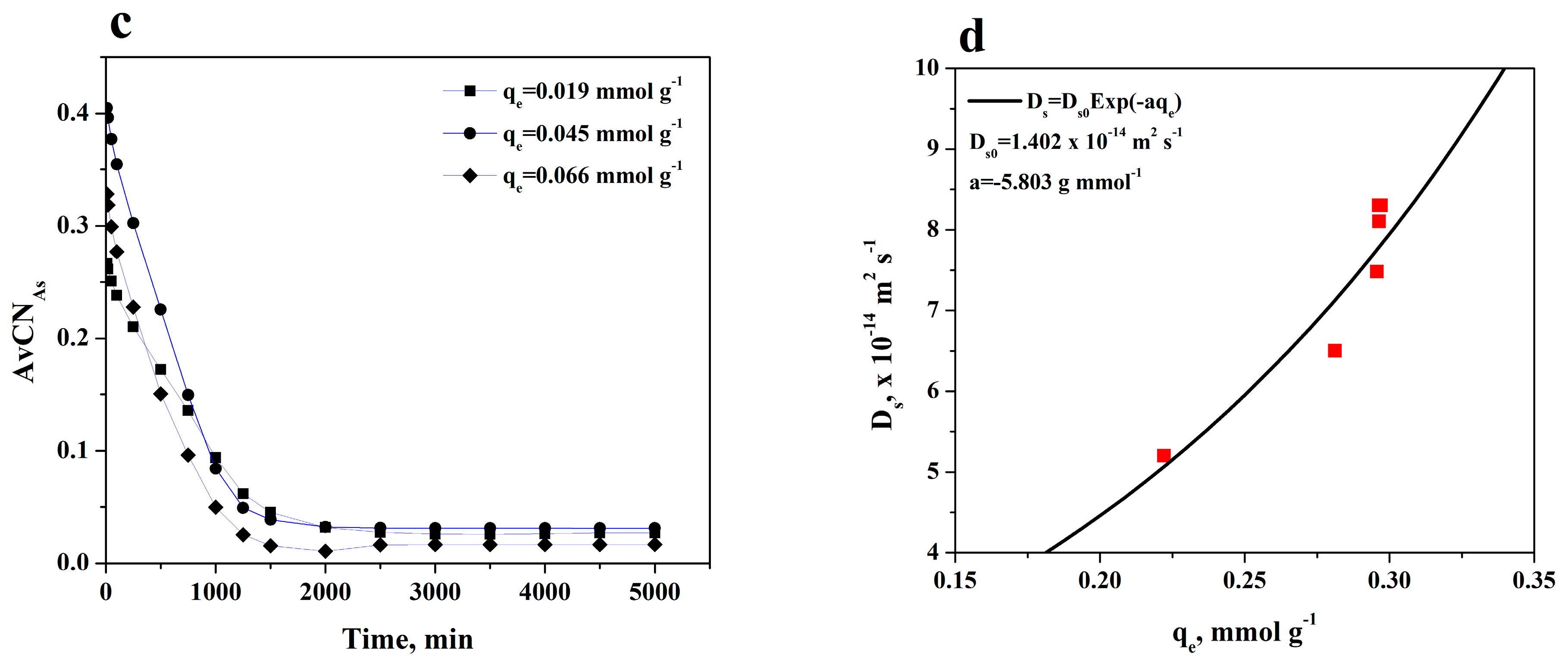
The adsorption rate of CR on BC was found to be different. Initially, the equilibrium was attained within approximately 2500 min. A comparison of the equilibrium time of IC reveals that it increased by 1.5 times. This can be attributed to the higher molecular weight of CR, which is 1.5 times higher than that of IC, and a substantially larger molecular size. Conversely, the intraparticle transport of the entire particle during this period was predominantly governed by surface diffusion (Figure 5b). Moreover, the obtained diffusion coefficients ranged from 5.20 × 10⁻¹⁴ to 8.30 × 10⁻¹⁴ m2 s−1, being on average 2.2 times smaller than those obtained for IC. This finding suggests that, in comparison to IC, CR molecules encounter greater difficulty to move while attached to the surface of BC. This phenomenon can be attributed to the structural characteristics of CR, which possess a greater number of functional groups, thereby generating slightly more attractive attractions in comparison to IC. Notwithstanding this observation, a positive and statistically significant correlation was identified between the coefficients and the adsorbed quantity (Figure 5d).
This relationship was subsequently described by the following equation [75]:
D s = D s 0 e a q e
Finally, the EB adsorption on BC was the slowest (see Figure 4c). This is attributable to the fact that it involves the molecule with the highest molecular weight and surface area. The time required to attain equilibrium was 4000 min. Additionally, the contribution of superficial diffusion was found to be less than 40% during the initial 500 min and subsequently exhibited a substantial decline (see Figure 5c). If superficial diffusion does not dominate intraparticle transport, then diffusion of the pore volume does. This suggests that EB molecules are more freely distributed in the pore volume.

3.4. Adsorption Equilibrium on ACC

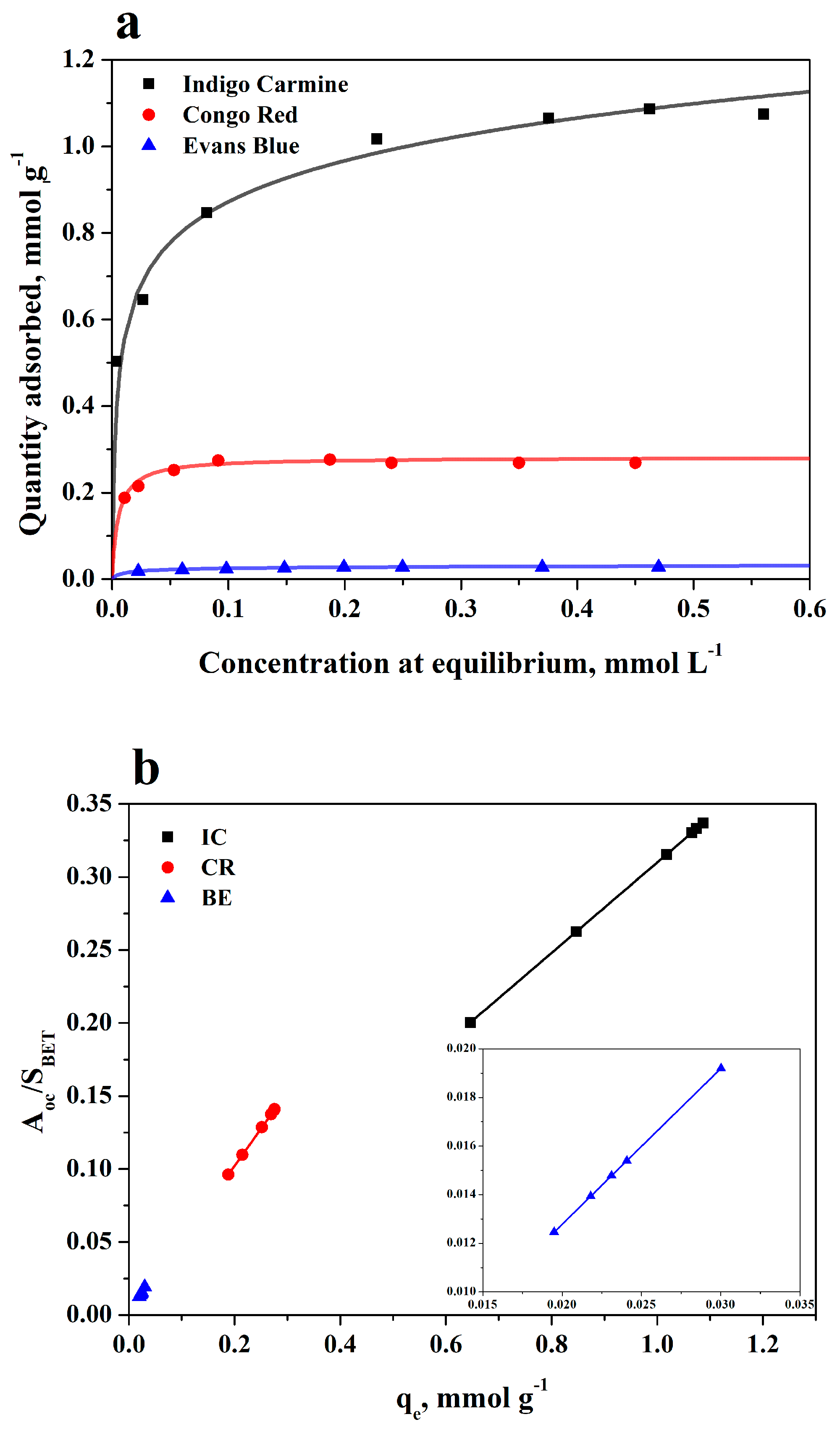
The adsorption equilibrium of the three dyes on ACC is presented in Figure 6, where Langmuir curves can be observed in all three cases. For IC, an L-type form was observed, with high adsorption from concentrations of 0.026 mmol L−1. This is indicative of a system with high affinity and, according to Giles’s classification, would be designated as type H [65]. The maximum quantities adsorbed were 1.087 mmol g−1, 0.269 mmol g−1, and 0.028 mmol g−1 for IC, CR, and EB, respectively. The Langmuir isotherms correctly interpreted the adsorption equilibrium data, with low deviation percentages (See Table S3).
The differences in the adsorbed amounts are clearly visible, highlighting the large adsorption capacity of IC on ACC. Given the recognized excellence of activated carbon materials as adsorbents for organic compounds, the high adsorption capacity of IC on ACC is not surprising. This expectation is further supported by the elevated specific surface area of ACC relative to other types of activated carbons. However, to elucidate why CR and EB do not present similar adsorption capacities, a fraction of the available area occupied by the adsorbed molecules was estimated for the three dyes with Equation (28) [38]. The results are presented in Figure 6b, where this fraction is plotted as a function of the amount adsorbed for all experiments. The linearity observed in the three dyes can be attributed to the direct proportionality between the area occupied by the molecules and the amount adsorbed (see Equation (28)). However, it is important to note that none of the dyes fully saturated the available area. The IC occupies 33% of the surface area, while the CR occupies 14%, and the EB occupies a mere 2%. This observation suggests the existence of a limit to the extent to which molecules can access the total available area. This restriction may be attributed to steric hindrance, considering the average pore size of 1.69 nm and the close proximity of the diameters of CR and EB molecules to these values (see Table 1). CR and EB molecules have a larger dimension than the pore diameter (2.57 × 0.65 × 0.48 nm for CR and 2.61 × 0.80 × 0.57 nm for EB, Table 1); therefore, they can only enter the pores in parallel form to the canal. Furthermore, by adsorbing onto the surface of the pores, these molecules prevent other molecules from accessing them. For these reasons, even though ACC possesses a high specific surface area, it cannot be used for the adsorption of CR and EB. In the case of IC, the average diameter is significantly lower than the pore average diameter, and thus, this compound is the one that best takes advantage of the available pore surface.
A o c = A p r o j q e N a v M W
In addition, since the three dyes are organic compounds, the adsorption mechanism is expected to occur through hydrophobic attractions and dispersive π–π interactions [76,77]. Furthermore, electrostatic attractions are favored because all three dyes are anionic. At pH 7, the ACC has a surface dominated by positive charges (pHPZC = 8).

3.5. Adsorption Rate on ACC

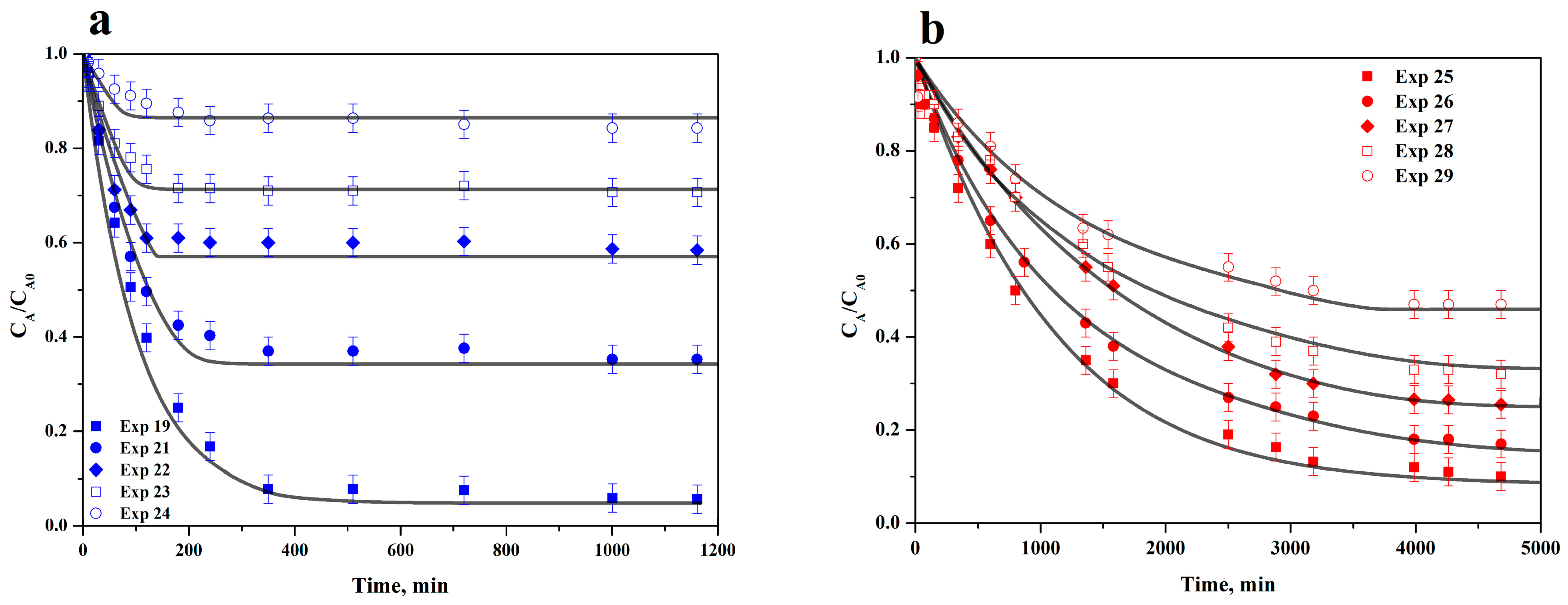
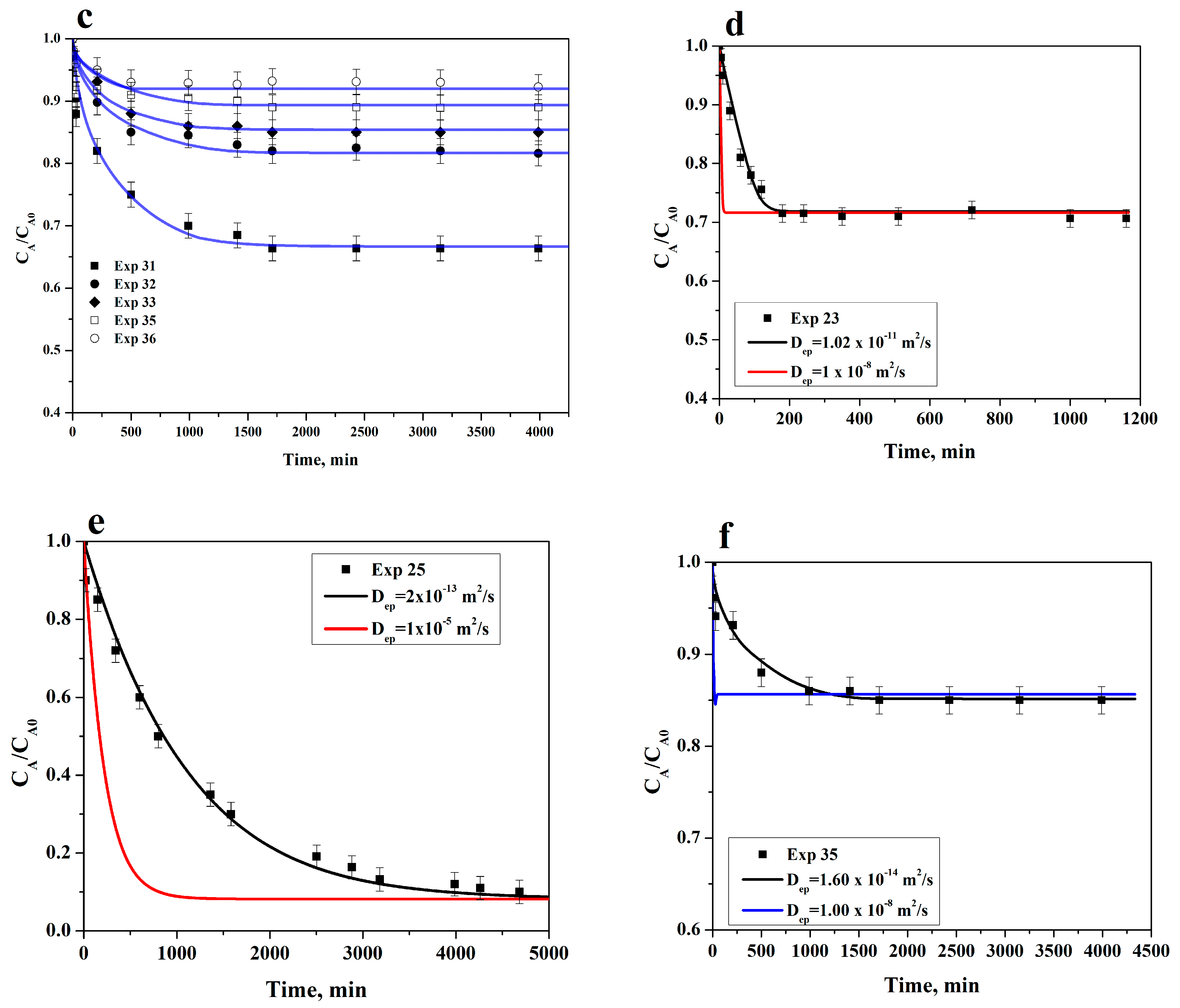
The decay curves for the adsorption of IC, CR, and EB on ACC are displayed in Figure 7, while the operation conditions and parameters obtained for the 18 experiments are presented in Table S4. The PVDM interpretation model is also shown in the graphs, where an adequate interpretation occurs. This is due to the experimental decay curves demonstrating the behavior of a process controlled by intraparticle diffusion. Figure 7 also shows a comparison between a process governed by intra-particle diffusion and a process governed by external transport. A process governed by external transport usually reaches equilibrium in a short time, as shown in Figure 7d–f. This is because in this type of process, intraparticular diffusion is faster than external transport, so to obtain these curves, the diffusion coefficients were arbitrarily increased to simulate this case. However, the experimental curves do not resemble this case, but are typical of a process controlled by intraparticular diffusion The average deviation percentages obtained with the PVDM were 4.95%, 6.79%, and 2.04% for IC, CR, and EB, respectively. To apply the model, an adjustment was made for the tortuosity factor. The mean values obtained from this parameter were 1.48, 2.55 and 1.56 for IC, CR, and EB, respectively. These values are similar to those reported in the literature [33]. For IC, the shortest duration for achieving equilibrium was 300 min. The IC molecule has been found to have the lower average diameter (0.83 nm), and considering the pore average diameter of the ACC (1.69 nm), it is the molecule that can access the micropore interior most easily. Consequently, it was the dye that reached the equilibrium the fastest. Conversely, the CR molecule required the longest time to reach equilibrium, a duration of 4000 min. This change is drastic and cannot be attributed to the difference in molecular dimensions in a simple way.
The CR structure is characterized by dimensions of 2.57 × 0.65 × 0.48 nm, where the length of 2.57 nm is considerably greater than the diameter of the pore (1.69 nm). Consequently, the micropore interior can only be accessed in a parallel form to the canal. This results in a reduction in the rate of transport, leading to diffusion coefficients for CR and EB that are lower than those for IC. Finally, the adsorption rate of EB exhibited a comparable trend to that of CR. EB molecules can only access the interior of the pores in parallel, which hinders access. Nevertheless, the time required to reach equilibrium was only 1500 min.

3.6. Adsorption Comparison on BC and ACC

The adsorption of the three ionic dyes was found to be feasible for both materials. However, it was observed that the adsorption capacities and rates varied significantly between the two materials. In the case of BC, electrostatic attractions were found to be the predominant factor in the adsorption process for all three dyes. This phenomenon can be attributed to the predominant composition of BC, which is constituted by hydroxyapatite, a material that possesses inherent positive basic groups at neutral pH. The carbon content of the material is only 10%, but for CR, hydrophobic interactions with BC were favored. Conversely, adsorption on ACC is equally favored by electrostatic attractions, but hydrophobic interactions are more prevalent due to the material’s composition of carbon alone. It is evident that disparities in textural and physicochemical properties exert a substantial influence on the adsorption capacity. While ACC possesses a high specific surface area and a large of active sites, its microporous nature hinders complete access to these active sites by dye molecules due to their size. Conversely, BC does not exhibit this limitation, so the adsorption capacity is limited by the number of active sites on the hydroxyapatite and the dyes’ capacity to interact with carbon.
However, the adsorption capacity of IC is clearly favored on ACC compared to BC, being 10 times higher on ACC than on BC because it has no problem accessing the micropores of ACC. Furthermore, the time required to reach equilibrium was found to be three times shorter for ACC. It is evident that, for organic compounds with average molecular size diameters such as IC, ACC will be the most effective adsorbent.
The adsorption capacity of CR on BC was found to be 10% higher than that observed with ACC. In this case, the diameter of the ACC pores hindered its capacity to capitalize on its high specific surface area. Furthermore, this factor also impacted on the adsorption rate, with the equilibrium time for ACC being 1.6 times higher than that of BC. Consequently, BC was determined to be a more effective medium for the adsorption of CR in comparison to ACC.
It was observed that EB adsorption on BC was favored compared to ACC. The underlying reason for this phenomenon is analogous to that observed for CR, where the microporosity restricts the access of molecules to the inner surface of the micropores, which is difficult for EB because the adsorption capacity on ACC was reduced by about half compared to BC. The restricted access of molecules to the interior of the pores leads to a more accelerated adsorption process, as the time to reach equilibrium on ACC was reduced by a factor of 2.7 compared to BC (Figure 4 and Figure 7). The material most suitable for dye removal, such as EB, is contingent on the requirements of the design. In scenarios where a high concentration of a particular substance is present in water, materials exhibiting superior removal capabilities, such as BC, are often the preferred choice. Conversely, when dealing with low concentrations, materials with a rapid adsorption rate are advantageous, as this facilitates the design of smaller columns and optimizes the utilization of the adsorbent. In such instances, the utilization of ACC is recommended.
As illustrated in Table 3, a comparative analysis is presented of adsorbent materials. The reported capacities are comparable to those obtained in this study. However, the medium in which the reported materials perform best differs. The efficacy of materials can vary significantly under different pH conditions, a factor that can present a challenge when assessing their practical applications. Adsorption is typically a tertiary treatment in water treatment systems, and therefore, it is advantageous for adsorption to operate within a neutral pH. In this regard, BC and ACC have been identified as materials that meet this requirement.
In the six adsorption systems studied, the intraparticle transport controlled the adsorption. For adsorption on ACC, the low deviation percentages obtained by the PVDM model indicate that pore volume diffusion controls the adsorption rate. In the case of adsorption on BC, pore volume diffusion contributed more than 60% to the intraparticle transport for EB, thereby demonstrating that this mechanism is the controlling step. Furthermore, for IC and CR, surface diffusion was found to contribute more than 80% to intraparticle transport, thereby controlling the adsorption rate.

4. Conclusions

In this study, the adsorption of three ionic dyes onto two adsorbent materials with different properties was investigated. The results demonstrated that even when dealing with the same type of compounds, such as industrial dyes, a material can exhibit significantly different adsorption capacities and kinetics. Therefore, the selection of an appropriate adsorbent for industrial dye removal requires a comprehensive analysis of both adsorption equilibrium and adsorption rate.
Adsorption on BC was primarily influenced by electrostatic interactions for the three anionic dyes due to the majority presence of hydroxyapatite, which provides positive basic sites at neutral pH. However, hydrophobic interactions were also observed between BC and CR, possibly due to the carbon content of BC. On ACC, adsorption was also favored by electrostatic attractions and hydrophobic interactions, given its predominantly carbonaceous composition. Despite the greater specific surface area and abundance of active sites in ACC, its microporous nature restricted dye access to these sites, significantly affecting the adsorption capacity compared to BC for certain dyes.
Adsorption of IC was considerably more favorable on ACC than on BC, showing a tenfold higher adsorption capacity and a threefold shorter equilibrium time on ACC. This was attributed to the smaller molecular size of IC, which facilitated its access to the ACC micropore structure. For CR, the adsorption capacity was slightly higher on BC compared to ACC, due to the limitations imposed by the microporosity of ACC. Furthermore, the adsorption rate of CR was higher on BC.
The adsorption capacity of EB was also higher in BC than in ACC, again due to restricted access to the ACC micropores. However, the adsorption rate of EB was faster in ACC. The choice between BC and ACC for EB would depend on whether a high removal capacity (BC) or rapid adsorption kinetics (ACC) is prioritized.
In all six adsorption systems studied, intraparticle transport was the step that controlled the adsorption rate. For ACC, diffusion in the pore volume was the rate-limiting factor, while in BC, surface diffusion controlled the rate for IC and CR, and diffusion in the pore volume for EB.

Supplementary Materials

The following supporting information can be downloaded at: https://www.mdpi.com/article/10.3390/w17233422/s1. Figure S1: Speciation diagram of IC (a), CR (b) and EB (c) as a function of solution pH.; Figure S2: (a) Adsorption–Desorption isotherm of N2 at 77 K of ACC (b) Pore distribution of ACC.; Figure S3: (a) Adsorption–Desorption isotherm of N2 at 77 K of BC (b) Surface charge distribution of BC.; Figure S4. (a) RAMAN spectrum of BC (b) RAMAN spectrum of ACC.; Table S1: Parameters obtained from the application of Langmuir and Prausnitz–Radke models in the adsorption of IC, CR and EB on Bone Char; Table S2: Operating conditions and parameters obtained for the kinetic experiments on Bone Char; Table S3: Parameters obtained from the application of Langmuir and Prausnitz–Radke models in the adsorption of IC, CR, and EB on Activated Carbon Cloth; Table S4: Operating conditions and parameters obtained for the kinetic experiments on Activated Carbon Cloth.

Author Contributions

Writing—original draft preparation, S.A.-C.; methodology, S.A.-C. and M.Á.Á.-M.; formal analysis, S.A.-C.; data curation, S.A.-C.; conceptualization, R.O.-P.; supervision, R.O.-P. and I.V.-G.; project administration, M.V.L.-R.; writing—review and editing, R.O.-P., M.V.L.-R., I.V.-G., M.Á.Á.-M., and A.A.-A.; funding acquisition, M.V.L.-R. All authors have read and agreed to the published version of the manuscript.

Funding

This research was funded by the Ministry of Science, Innovation and Universities of the Government of Spain MCIN/AEI/https://doi.org/10.13039/501100011033 [PID2022-142169OB-I00 project], EMERGIA20 EMC21_00396 awarded by the Secretariat of University, Research and Innovation of the Andalusian Government, and the Secretariat of Science, Humanities, Technology, and Innovation, SECIHTI, Mexico (scholarship 1034192).

Data Availability Statement

The original contributions presented in this study are included in the article. Further inquiries can be directed to the corresponding authors.

Acknowledgments

S.A.-C. thanks Asociación Universitaria Iberoamericana de Postgrado (Ibero-American Postgraduate University Association) AUIP, for the mobility scholarship between Andalusian and Ibero-American universities. I.V.-G. thanks the Secretariat of University, Research and Innovation of the Government of Andalusia (EMERGIA21_00396, 2021).

Conflicts of Interest

The authors declare no conflicts of interest.

References

  1. Christian, D.; Gaekwad, A.; Dani, H.; Shabiimam, M.A.; Kandya, A. Recent techniques of textile industrial wastewater treatment: A review. Mater. Today Proc. 2023, 77, 277–285. [Google Scholar] [CrossRef]
  2. Khan, S.; Malik, A. Environmental and health effects of textile industry wastewater. In Environmental Deterioration and Human Health; Malik, A., Crohmann, E., Akhtar, R., Eds.; Springer: Dordrecht, The Netherlands, 2014; pp. 55–71. [Google Scholar]
  3. Singh, R.L.; Gupta, R.; Singh, R.P. Microbial degradation of textile dyes for environmental safety. In Advances in Biodegradation and Bioremediation of Industrial Waste; Chen, H., Gao, B., Wang, S., Fang, J., Eds.; CRC Press: Boca Raton, FL, USA, 2015. [Google Scholar]
  4. Singh, R.P.; Singh, P.K.; Gupta, R.; Singh, R.L. Treatment and recycling of wastewater from textile industry. In Advances in Biological Treatment of Industrial Waste Water and Their Recycling for a Sustainable Future; Singh, R.L., Singh, R.P., Eds.; Springer: Singapore, 2019; pp. 225–266. [Google Scholar]
  5. Rana, S.; Sharma, R.; Chandra, S. Microbial degradation of synthetic textile dyes: A cost-effective and eco-friendly approach. Afr. J. Microbiol. Res. 2013, 7, 2983–2989. [Google Scholar] [CrossRef]
  6. Verma, A.K.; Dash, R.R.; Bhunia, P. A review on chemical coagulation/flocculation technologies for removal of colour from textile wastewaters. J. Environ. Manag. 2012, 93, 154–168. [Google Scholar] [CrossRef]
  7. Chung, K.-T.; Stevens, S.E.; Cerniglia, C.E. The reduction of azo dyes by the intestinal microflora. Crit. Rev. Microbiol. 1992, 18, 175–190. [Google Scholar] [CrossRef]
  8. Doble, M.; Kumar, A. Biotreatment of Industrial Effluents, 1st ed.; Elsevier/Butterworth-Heinemann: Burlington, MA, USA, 2005. [Google Scholar]
  9. Kim, T.-H.; Park, C.; Yang, J.; Kim, S. Comparison of disperse and reactive dye removals by chemical coagulation and Fenton oxidation. J. Hazard. Mater. 2004, 112, 95–103. [Google Scholar] [CrossRef]
  10. Üstün, G.E.; Solmaz, S.K.A.; Birgül, A. Regeneration of industrial district wastewater using a combination of Fenton process and ion exchange—A case study. Resour. Conserv. Recycl. 2007, 52, 425–440. [Google Scholar] [CrossRef]
  11. Pormazar, S.M.; Dalvand, A. Adsorption of Direct Red 23 dye from aqueous solution by means of modified montmorillonite nanoclay as a superadsorbent: Mechanism, kinetic and isotherm studies. Korean J. Chem. Eng. 2020, 37, 2192–2201. [Google Scholar] [CrossRef]
  12. Praipipat, P.; Ngamsurach, P.; Khamkhae, P. Iron(III) oxide-hydroxide modification on Pterocarpus macrocarpus sawdust beads for direct red 28 dye removal. Arab. J. Chem. 2024, 17, 105514. [Google Scholar] [CrossRef]
  13. Akhtar, M.F.; Ashraf, M.; Javeed, A.; Anjum, A.A.; Sharif, A.; Saleem, M.; Mustafa, G.; Ashraf, M.; Saleem, A.; Akhtar, B. Association of textile industry effluent with mutagenicity and its toxic health implications upon acute and sub-chronic exposure. Environ. Monit. Assess. 2018, 190, 179. [Google Scholar] [CrossRef] [PubMed]
  14. Espinola-Portilla, F.; Navarro-Mendoza, R.; Gutiérrez-Granados, S.; Morales-Muñoz, U.; Brillas-Coso, E.; Peralta-Hernández, J.M. A simple process for the deposition of TiO2 onto BDD by electrophoresis and its application to the photoelectrocatalysis of Acid Blue 80 dye. J. Electroanal. Chem. 2017, 802, 57–63. [Google Scholar] [CrossRef]
  15. Parida, S.; Mandal, A.K.; Behera, A.K.; Patra, S.; Nayak, R.; Behera, C.; Jena, M. A comprehensive review on phycoremediation of azo dye to combat industrial wastewater pollution. J. Water Process Eng. 2025, 70, 107088. [Google Scholar] [CrossRef]
  16. Holkar, C.R.; Jadhav, A.J.; Pinjari, D.V.; Mahamuni, N.M.; Pandit, A.B. A critical review on textile wastewater treatments: Possible approaches. J. Environ. Manag. 2016, 182, 351–366. [Google Scholar] [CrossRef]
  17. Jadhav, A.C.; Jadhav, N.C. Treatment of textile wastewater using adsorption and adsorbents. In Sustainable Technologies for Textile Wastewater Treatments; Muthu, S.S., Ed.; Woodhead Publishing: Sawston, UK, 2021; pp. 235–273. [Google Scholar]
  18. Rashid, R.; Shafiq, I.; Akhter, P.; Iqbal, M.J.; Hussain, M. A state-of-the-art review on wastewater treatment techniques: The effectiveness of adsorption method. Environ. Sci. Pollut. Res. 2021, 28, 9050–9066. [Google Scholar] [CrossRef] [PubMed]
  19. Nugraha, M.W.; Kim, S.; Roddick, F.; Xie, Z.; Fan, L. A review of the recent advancements in adsorption technology for removing antibiotics from hospital wastewater. J. Water Process Eng. 2025, 70, 106960. [Google Scholar] [CrossRef]
  20. Hussain, M.; Riaz, A.; Zeb, H.; Ali, A.; Mujahid, R.; Ahmad, F.; Zafar, M.S. Paving the path to water security: The role of advanced adsorbents in wastewater treatment. J. Water Process Eng. 2025, 71, 107333. [Google Scholar] [CrossRef]
  21. Alkurdi, S.S.A.; Al-Juboori, R.A.; Bundschuh, J.; Hamawand, I. Bone char as a green sorbent for removing health threatening fluoride from drinking water. Environ. Int. 2019, 127, 704–719. [Google Scholar] [CrossRef] [PubMed]
  22. Hart, A.; Porbeni, D.W.; Omonmhenle, S.; Peretomode, E. Waste bone char-derived adsorbents: Characteristics, adsorption mechanism and model approach. Environ. Technol. Rev. 2023, 12, 175–204. [Google Scholar] [CrossRef]
  23. Medellín-Castillo, N.A.; González-Fernández, L.A.; Thiodjio-Sendja, B.; Aguilera-Flores, M.M.; Leyva-Ramos, R.; Reyes-López, S.Y.; de León-Martínez, L.D.; Dias, J.M. Bone char for water treatment and environmental applications: A review. J. Anal. Appl. Pyrol. 2023, 175, 106161. [Google Scholar] [CrossRef]
  24. Piccirillo, C. Preparation, characterisation and applications of bone char, a food waste-derived sustainable material: A review. J. Environ. Manag. 2023, 339, 117896. [Google Scholar] [CrossRef]
  25. Li, Y.; Liu, J.; Wei, B.; Zhang, X.; Liu, X.; Han, L. A comprehensive review of bone char: Fabrication procedures, physicochemical properties, and environmental application. Sci. Total Environ. 2024, 954, 176375. [Google Scholar] [CrossRef]
  26. Medellin-Castillo, N.A.; Leyva-Ramos, R.; Ocampo-Perez, R.; Garcia de la Cruz, R.F.; Aragon-Piña, A.; Martinez-Rosales, J.M.; Guerrero-Coronado, R.M.; Fuentes-Rubio, L. Adsorption of Fluoride from Water Solution on Bone Char. Ind. Eng. Chem. Res. 2007, 46, 9205–9212. [Google Scholar] [CrossRef]
  27. Gopinath, A.; Kadirvelu, K. Strategies to design modified activated carbon fibers for the decontamination of water and air. Environ. Chem. Lett. 2018, 16, 1137–1168. [Google Scholar] [CrossRef]
  28. Hassan, M.F.; Sabri, M.A.; Fazal, H.; Hafeez, A.; Shezad, N.; Hussain, M. Recent trends in activated carbon fibers production from various precursors and applications—A comparative review. J. Anal. Appl. Pyrolysis 2020, 145, 104715. [Google Scholar] [CrossRef]
  29. Joo, J.-H.; Kim, S.-H.; Kim, J.H.; Kang, H.-J.; Lee, J.H.; Jeon, H.J.; Jang, Y.H.; Lee, J.-H.; Lee, S.-Y.; Park, S.-J.; et al. Recent advances in activated carbon fibers for pollutant removal. Carbon Lett. 2025, 35, 21–44. [Google Scholar] [CrossRef]
  30. Cano, F.J.; Sánchez− Albores, R.; Ashok, A.; Escorcia− García, J.; Cruz−Salomón, A.; Reyes− Vallejo, O.; Sebastian, P.J.; Velumani, S. Carica papaya seed− derived functionalized biochar: An environmentally friendly and efficient alternative for dye adsorption. J. Mater. Sci. Mater. Electron. 2025, 36, 663. [Google Scholar] [CrossRef]
  31. Cano, F.J.; Reyes-Vallejo, O.; Sánchez-Albores, R.M.; Sebastian, P.J.; Cruz-Salomón, A.; Hernández-Cruz, M.D.C.; Montejo-López, W.; González Reyes, M.; Serrano Ramirez, R.D.P.; Torres-Ventura, H.H. Activated Biochar from Pineapple Crown Biomass: A High-Efficiency Adsorbent for Organic Dye Removal. Sustainability 2024, 17, 99. [Google Scholar] [CrossRef]
  32. Leyva-Ramos, R.; Diaz-Flores, P.E.; Leyva-Ramos, J.; Femat-Flores, R.A. Kinetic modeling of pentachlorophenol adsorption from aqueous solution on activated carbon fibers. Carbon 2007, 45, 2280–2289. [Google Scholar] [CrossRef]
  33. López-Ramón, M.V.; Ocampo-Pérez, R.; Bautista-Toledo, M.I.; Rivera-Utrilla, J.; Moreno-Castilla, C.; Sánchez-Polo, M. Removal of bisphenols A and S by adsorption on activated carbon clothes enhanced by the presence of bacteria. Sci. Total Environ. 2019, 669, 767–776. [Google Scholar] [CrossRef]
  34. Suzuki, M. Activated carbon fiber: Fundamentals and applications. Carbon 1994, 32, 577–586. [Google Scholar] [CrossRef]
  35. Hu, Q.; Yang, X.; Huang, L.; Li, Y.; Hao, L.; Pei, Q.; Pei, X. A critical review of breakthrough models with analytical solutions in a fixed-bed column. J. Water Process Eng. 2024, 59, 105065. [Google Scholar] [CrossRef]
  36. Wang, J.; Guo, X. Adsorption kinetic models: Physical meanings, applications, and solving methods. J. Hazard. Mater. 2020, 390, 122156. [Google Scholar] [CrossRef]
  37. Xu, Z.; Cai, J.; Pan, B. Mathematically modeling fixed-bed adsorption in aqueous systems. J. Zhejiang Univ. Sci. A. 2013, 14, 155–176. [Google Scholar] [CrossRef]
  38. Aguirre-Contreras, S.; Leyva-Ramos, R.; Ocampo-Pérez, R.; Aguilar-Madera, C.G.; Flores-Cano, J.V.; Medellín-Castillo, N.A. Mathematical modeling of breakthrough curves for 8-hydroxyquinoline removal from fundamental equilibrium and adsorption rate studies. J. Water Process Eng. 2023, 54, 103967. [Google Scholar] [CrossRef]
  39. Boudechiche, N.; Fares, M.; Ouyahia, S.; Yazid, H.; Trari, M.; Sadaoui, Z. Comparative study on removal of two basic dyes in aqueous medium by adsorption using activated carbon from Ziziphus lotus stones. Microchem. J. 2019, 146, 1010–1018. [Google Scholar] [CrossRef]
  40. Doan, V.D.; Tran, T.K.N.; Nguyen, A.-T.; Tran, V.A.; Nguyen, T.D.; Le, V.T. Comparative study on adsorption of cationic and anionic dyes by nanomagnetite supported on biochar derived from Eichhornia crassipes and Phragmites australis stems. Environ. Nanotechnol. Monit. Manag. 2021, 16, 100569. [Google Scholar] [CrossRef]
  41. Huang, X.; Hadi, P.; Joshi, R.; Alhamzani, A.G.; Hsiao, B.S. A Comparative Study of Mechanism and Performance of Anionic and Cationic Dialdehyde Nanocelluloses for Dye Adsorption and Separation. ACS Omega 2023, 8, 8634–8649. [Google Scholar] [CrossRef] [PubMed]
  42. Thanarasu, A.; Periyasamy, K.; Manickam Periyaraman, P.; Devaraj, T.; Velayutham, K.; Subramanian, S. Comparative studies on adsorption of dye and heavy metal ions from effluents using eco-friendly adsorbent. Mater. Today Proc. 2021, 36, 775–781. [Google Scholar] [CrossRef]
  43. Xue, H.; Wang, X.; Xu, Q.; Dhaouadi, F.; Sellaoui, L.; Seliem, M.K.; Ben Lamine, A.; Belmabrouk, H.; Bajahzar, A.; Bonilla-Petriciolet, A.; et al. Adsorption of methylene blue from aqueous solution on activated carbons and composite prepared from an agricultural waste biomass: A comparative study by experimental and advanced modeling analysis. Chem. Eng. J. 2022, 430, 132801. [Google Scholar] [CrossRef]
  44. Fiol, N.; Villaescusa, I. Determination of sorbent point zero charge: Usefulness in sorption studies. Environ. Chem. Lett. 2009, 7, 79–84. [Google Scholar] [CrossRef]
  45. Rivera-Utrilla, J.; Sánchez-Polo, M. Ozonation of 1, 3, 6-naphthalenetrisulphonic acid catalysed by activated carbon in aqueous phase. Appl. Catal. B Environ. 2002, 39, 319–329. [Google Scholar] [CrossRef]
  46. Segovia-Sandoval, S.J.; Padilla-Ortega, E.; Carrasco-Marín, F.; Berber-Mendoza, M.S.; Ocampo-Pérez, R. Simultaneous removal of metronidazole and Pb (II) from aqueous solution onto bifunctional activated carbons. Environ. Sci. Pollut. Res. 2019, 26, 25916–25931. [Google Scholar] [CrossRef]
  47. Álvarez-Merino, M.A.; Fontecha-Cámara, M.A.; López-Ramón, M.V.; Moreno-Castilla, C. Temperature dependence of the point of zero charge of oxidized and non-oxidized activated carbons. Carbon 2008, 46, 778–787. [Google Scholar] [CrossRef]
  48. Díaz-Blancas, V.; Aguilar-Madera, C.G.; Flores-Cano, J.V.; Leyva-Ramos, R.; Padilla-Ortega, E.; Ocampo-Pérez, R. Evaluation of mass transfer mechanisms involved during the adsorption of metronidazole on granular activated carbon in fixed bed column. J. Water Process Eng. 2020, 36, 101303. [Google Scholar] [CrossRef]
  49. Leyva-Ramos, R.; Geankoplis, C.J. Model simulation and analysis of surface diffusion of liquids in porous solids. Chem. Eng. Sci. 1985, 40, 799–807. [Google Scholar] [CrossRef]
  50. Ocampo-Pérez, R.; Leyva-Ramos, R.; Sánchez-Polo, M.; Rivera-Utrilla, J. Role of pore volume and surface diffusion in the adsorption of aromatic compounds on activated carbon. Adsorption 2013, 19, 945–957. [Google Scholar] [CrossRef]
  51. Ocampo-Pérez, R.; Aguilar-Madera, C.G.; Díaz-Blancas, V. 3D modeling of overall adsorption rate of acetaminophen on activated carbon pellets. Chem. Eng. J. 2017, 321, 510–520. [Google Scholar] [CrossRef]
  52. Leyva-Ramos, R.; Rivera-Utrilla, J.; Medellin-Castillo, N.A.; Sánchez-Polo, M. Kinetic modeling of fluoride adsorption from aqueous solution onto bone char. Chem. Eng. J. 2010, 158, 458–467. [Google Scholar] [CrossRef]
  53. Furusawa, T.; Smith, J.M. Fluid-particle and intraparticle mass transport rates in slurries. Ind. Eng. Chem. Fund. 1973, 12, 197–203. [Google Scholar] [CrossRef]
  54. Wilke, C.; Chang, P. Correlation of diffusion coefficients in dilute solutions. AIChE J. 1955, 1, 264–270. [Google Scholar] [CrossRef]
  55. Mudhoo, A.; Otero, M.; Chu, K.H. Insights into adsorbent tortuosity across aqueous adsorption systems. Particuology 2024, 88, 71–88. [Google Scholar] [CrossRef]
  56. Pauletto, P.S.; Dotto, G.L.; Salau, N.P.G. Diffusion mechanisms and effect of adsorbent geometry on heavy metal adsorption. Chem. Eng. Res. Des. 2020, 157, 182–194. [Google Scholar] [CrossRef]
  57. Valderrama, C.; Gamisans, X.; de las Heras, X.; Farrán, A.; Cortina, J.L. Sorption kinetics of polycyclic aromatic hydrocarbons removal using granular activated carbon: Intraparticle diffusion coefficients. J. Hazard. Mater. 2008, 157, 386–396. [Google Scholar] [CrossRef]
  58. Medellín-Castillo, N.A. Remoción de Fluoruros En Solución Acuosa por Medio de Adsorción Sobre Varios Materiales. Ph.D. Thesis, Universidad Autónoma de San Luis Potosí, San Luis Potosi, Mexico, 2006. [Google Scholar]
  59. Leyva-Ramos, R.; Ocampo-Perez, R.; Mendoza-Barron, J. External mass transfer and hindered diffusion of organic compounds in the adsorption on activated carbon cloth. Chem. Eng. J. 2012, 183, 141–151. [Google Scholar] [CrossRef]
  60. Valdez-García, G.D.; Leyva-Ramos, R. Hindered diffusion of heavy metal cations in the adsorption rate on activated carbon fiber. Chem. Eng. Res. Des. 2023, 196, 556–567. [Google Scholar] [CrossRef]
  61. Satterfield, C.N.; Colton, C.K.; Pitcher, W.H. Restricted diffusion in liquids within fine pores. AIChE J. 1973, 19, 628–635. [Google Scholar] [CrossRef]
  62. Dechadilok, P.; Deen, W.M. Hindrance factors for diffusion and convection in pores. Ind. Eng. Chem. Res. 2006, 45, 6953–6959. [Google Scholar] [CrossRef]
  63. Rouquerol, J.; Rouquerol, F.; Sing, K. Adsorption by Powders and Porous Solids: Principles, Methodology and Applications; Academic Press: San Diego, CA, USA, 1999. [Google Scholar]
  64. Sing, K.S.W. Reporting physisorption data for gas/solid systems with special reference to the determination of surface area and porosity (Recommendations 1984). Pure Appl. Chem. 1985, 57, 603–619. [Google Scholar] [CrossRef]
  65. Giles, C.H.; Smith, D.; Huitson, A. A general treatment and classification of the solute adsorption isotherm. I. Theoretical. J. Colloid Interface Sci. 1974, 47, 755–765. [Google Scholar] [CrossRef]
  66. Ip, A.W.M.; Barford, J.P.; McKay, G. A comparative study on the kinetics and mechanisms of removal of Reactive Black 5 by adsorption onto activated carbons and bone char. Chem. Eng. J. 2010, 157, 434–442. [Google Scholar] [CrossRef]
  67. Li, J.; Ng, D.H.L.; Song, P.; Kong, C.; Song, Y.; Yang, P. Preparation and characterization of high-surface-area activated carbon fibers from silkworm cocoon waste for congo red adsorption. Biomass Bioenergy 2015, 75, 189–200. [Google Scholar] [CrossRef]
  68. Marsh, H.; Rodríguez-Reinoso, F. Activated Carbon; Elsevier: Amsterdam, The Netherlands, 2006; pp. 143–242. [Google Scholar]
  69. Gligorijević, B.R.; Vilotijević, M.; Šćepanović, M.; Vuković, N.S.; Radović, N.A. Substrate preheating and structural properties of power plasma sprayed hydroxyapatite coatings. Ceram. Int. 2016, 42, 411–420. [Google Scholar] [CrossRef]
  70. Piccirillo, C.; Moreira, I.S.; Novais, R.M.; Fernandes, A.J.S.; Pullar, R.C.; Castro, P.M.L. Biphasic apatite-carbon materials derived from pyrolysed fish bones for effective adsorption of persistent pollutants and heavy metals. J. Environ. Chem. Eng. 2017, 5, 4884–4894. [Google Scholar] [CrossRef]
  71. Ristea, M.-E.; Zarnescu, O. Indigo Carmine: Between Necessity and Concern. J. Xenobiotics 2023, 13, 509–528. [Google Scholar] [CrossRef]
  72. Coltre, D.S.C.; Cionek, C.A.; Meneguin, J.G.; Maeda, C.H.; Braga, M.U.C.; de Araújo, A.C.; Gauze, G.F.; de Barros, M.A.S.D.; Arroyo, P.A. Study of dye desorption mechanism of bone char utilizing different regenerating agents. SN Appl. Sci. 2020, 2, 2150. [Google Scholar] [CrossRef]
  73. Li, Y.; Wang, M.; Liu, J.; Han, L.; Qin, Q.; Liu, X. Adsorption/desorption behavior of ionic dyes on sintered bone char. Mater. Chem. Phys. 2023, 297, 127405. [Google Scholar] [CrossRef]
  74. Mesquita, P.D.L.; Cruz, M.A.P.; Souza, C.R.; Santos, N.T.G.; Nucci, E.R.; Rocha, S.D.F. Removal of refractory organics from saline concentrate produced by electrodialysis in petroleum industry using bone char. Adsorption 2017, 23, 983–997. [Google Scholar] [CrossRef]
  75. Miyabe, K.; Takeuchi, S. Analysis of surface diffusion phenomena in liquid phase adsorption. J. Phys. Chem. B 1997, 101, 7773–7779. [Google Scholar] [CrossRef]
  76. Diaz-Flores, P.E.; Leyva-Ramos, R.; Guerrero-Coronado, R.M.; Mendoza-Barron, J. Adsorption of pentachlorophenol from aqueous solution onto activated carbon fiber. J. Phys. Chem. B 2006, 101, 330–336. [Google Scholar] [CrossRef]
  77. Liu, Q.-S.; Zheng, T.; Wang, P.; Jiang, J.-P.; Li, N. Adsorption isotherm, kinetic and mechanism studies of some substituted phenols on activated carbon fiber. Chem. Eng. J. 2010, 157, 348–356. [Google Scholar] [CrossRef]
  78. Harrache, Z.; Abbas, M.; Aksil, T.; Trari, M. Thermodynamic and kinetics studies on adsorption of Indigo Carmine from aqueous solution by activated carbon. Microchem. J. 2019, 144, 180–189. [Google Scholar] [CrossRef]
  79. Prado, A.G.S.; Torres, J.D.; Faria, E.A.; Dias, S.C.L. Comparative adsorption studies of indigo carmine dye on chitin and chitosan. J. Colloid Interface Sci. 2004, 277, 43–47. [Google Scholar] [CrossRef] [PubMed]
  80. Jiwalak, N.; Rattanaphani, S.; Bremner, J.B.; Rattanaphani, V. Equilibrium and kinetic modeling of the adsorption of indigo carmine onto silk. Fibers Polym. 2010, 11, 572–579. [Google Scholar] [CrossRef]
  81. El-Kammah, M.; Elkhatib, E.; Gouveia, S.; Cameselle, C.; Aboukila, E. Cost-effective ecofriendly nanoparticles for rapid and efficient indigo carmine dye removal from wastewater: Adsorption equilibrium, kinetics and mechanism. Environ. Technol. Innov. 2022, 28, 102595. [Google Scholar] [CrossRef]
  82. El-Kammah, M.; Elkhatib, E.; Gouveia, S.; Cameselle, C.; Aboukila, E. Enhanced removal of Indigo Carmine dye from textile effluent using green cost-efficient nanomaterial: Adsorption, kinetics, thermodynamics and mechanisms. Sustain. Chem. Pharm. 2022, 29, 100753. [Google Scholar] [CrossRef]
  83. Ferreira, R.M.; de Oliveira, N.M.; Lima, L.L.S.; Campista, A.L.D.M.; Stapelfeldt, D.M.A. Adsorption of indigo carmine on Pistia stratiotes dry biomass chemically modified. Environ. Sci. Pollut. Res. 2019, 26, 28614–28621. [Google Scholar] [CrossRef]
  84. Ahmed, M.A.; Brick, A.A.; Mohamed, A.A. An efficient adsorption of indigo carmine dye from aqueous solution on mesoporous Mg/Fe layered double hydroxide nanoparticles prepared by controlled sol-gel route. Chemosphere 2017, 174, 280–288. [Google Scholar] [CrossRef]
  85. Li, M.; Wang, H.; Wu, S.; Li, F.; Zhi, P. Adsorption of hazardous dyes indigo carmine and acid red on nanofiber membranes. RSC Adv. 2012, 2, 900–907. [Google Scholar] [CrossRef]
  86. Dastgerdi, Z.H.; Meshkat, S.S.; Esrafili, M.D. Enhanced adsorptive removal of Indigo carmine dye performance by functionalized carbon nanotubes based adsorbents from aqueous solution: Equilibrium, kinetic, and DFT study. J. Nanostruct. Chem. 2019, 9, 323–334. [Google Scholar] [CrossRef]
  87. Khadhri, N.; Saad, M.E.K.; ben Mosbah, M.; Moussaoui, Y. Batch and continuous column adsorption of indigo carmine onto activated carbon derived from date palm petiole. J. Environ. Chem. Eng. 2019, 7, 102775. [Google Scholar] [CrossRef]
  88. Harja, M.; Buema, G.; Bucur, D. Recent advances in removal of Congo Red dye by adsorption using an industrial waste. Sci. Rep. 2022, 12, 6087. [Google Scholar] [CrossRef]
  89. Vimonses, V.; Lei, S.; Jin, B.; Chow, C.W.K.; Saint, C. Kinetic study and equilibrium isotherm analysis of Congo Red adsorption by clay materials. Chem. Eng. J. 2009, 148, 354–364. [Google Scholar] [CrossRef]
  90. Liu, J.; Wang, N.; Zhang, H.; Baeyens, J. Adsorption of Congo red dye on FexCo3-xO4 nanoparticles. J. Environ. Manag. 2019, 238, 473–483. [Google Scholar] [CrossRef] [PubMed]
  91. Ausavasukhi, A.; Kampoosaen, C.; Kengnok, O. Adsorption characteristics of Congo red on carbonized leonardite. J. Clean. Prod. 2016, 134, 506–514. [Google Scholar] [CrossRef]
  92. Zhang, Z.; Moghaddam, L.; O’Hara, I.M.; Doherty, W.O.S. Congo Red adsorption by ball-milled sugarcane bagasse. Chem. Eng. J. 2011, 178, 122–128. [Google Scholar] [CrossRef]
  93. Srilakshmi, C.; Saraf, R. Ag-doped hydroxyapatite as efficient adsorbent for removal of Congo red dye from aqueous solution: Synthesis, kinetic and equilibrium adsorption isotherm analysis. Microporous Mesoporous Mater. 2016, 219, 134–144. [Google Scholar] [CrossRef]
  94. Lorencgrabowska, E.; Gryglewicz, G. Adsorption characteristics of Congo Red on coal-based mesoporous activated carbon. Dye. Pigment. 2007, 74, 34–40. [Google Scholar] [CrossRef]
  95. Purkait, M.K.; Maiti, A.; DasGupta, S.; De, S. Removal of congo red using activated carbon and its regeneration. J. Hazard. Mater. 2007, 145, 287–295. [Google Scholar] [CrossRef]
  96. Magdy, A.; Mostafa, M.R.; Moustafa, S.A.; Mohamed, G.G.; Fouad, O.A. Kinetics and adsorption isotherms studies for the effective removal of Evans blue dye from an aqueous solution utilizing forsterite nanoparticles. Sci. Rep. 2024, 14, 24392. [Google Scholar] [CrossRef] [PubMed]
  97. Vergis, B.R.; Kottam, N.; Hari Krishna, R.; Nagabhushana, B.M. Removal of Evans Blue dye from aqueous solution using magnetic spinel ZnFe2O4 nanomaterial: Adsorption isotherms and kinetics. Nano-Struct. Nano-Objects 2019, 18, 100290. [Google Scholar] [CrossRef]
  98. Chandra, I.K.; Ju, Y.H.; Ayucitra, A.; Ismadji, S. Evans blue removal from wastewater by rarasaponin–bentonite. Int. J. Environ. Sci. Technol. 2013, 10, 359–370. [Google Scholar] [CrossRef]
  99. Saiah, F.B.D.; Su, B.; Bettahar, N. Removal of Evans Blue by using Nickel-Iron Layered Double Hydroxide (LDH) Nanoparticles: Effect of Hydrothermal Treatment Temperature on Textural Properties and Dye Adsorption. Macromol. Symp. 2008, 273, 125–134. [Google Scholar] [CrossRef]
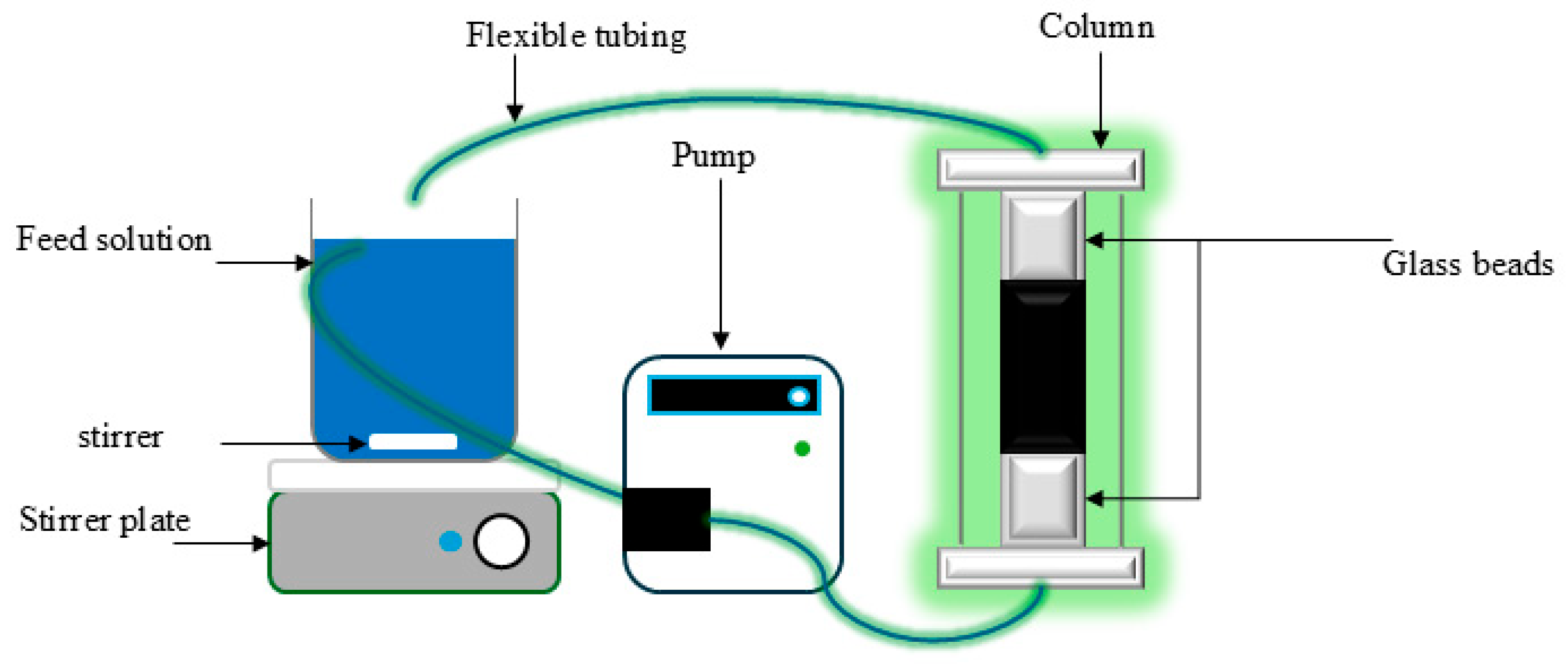
Figure 1. Experimental system employed.
Water 17 03422 g001
Figure 2. Adsorption isotherms of anionic dyes on Bone Char at pH = 7. The curves represent the Prausnitz–Radke model.
Water 17 03422 g002
Figure 3. Effect of ionic strength and pH on the adsorption of (a) Indigo Carmine, (b) Congo Red, and (c) Evans Blue on bone char.
Water 17 03422 g003
Figure 4. Concentration decay curves for adsorption of (a) Indigo Carmine, (b) Congo Red, and (c) Evans Blue on bone char.
Water 17 03422 g004aWater 17 03422 g004b
Figure 5. Contribution of surface diffusion to total intraparticle transport. (a) IC, (b) CR, and (c) EB. (d) Relationship between the amount adsorbed and the CR surface diffusion coefficient.
Water 17 03422 g005aWater 17 03422 g005b
Figure 6. Adsorption equilibrium of anionic dyes on activated carbon cloth. (a) Isotherms and (b) ratio between area occupied by adsorbed molecules and SBET.
Water 17 03422 g006
Figure 7. Concentration decay curves for adsorption of (a) Indigo Carmine, (b) Congo Red, and (c) Blue Evans on ACC. Comparison between a process governed by intra-particle diffusion and external transport: (d) Indigo Carmine, (e) Congo Red, and (f) Evans Blue.
Water 17 03422 g007aWater 17 03422 g007b
Table 1. Physicochemical properties of dyes.
Compound
Name
Molecular Structure1 Molecular
Size
Nm
M.W.
g mol−1
2 Projected
Area
Å2
3 Diameter
nm
4 Log KOWpKa5 Solubility
g L−1
Indigo
Carmine
Water 17 03422 i001X = 1.55
Y = 0.65
Z = 0.41
466.4100.510.831.019.761
Congo
Red
Water 17 03422 i002X = 2.57
Y = 0.65
Z = 0.48
696.7167.011.273.610.2133
Blue
Evans
Water 17 03422 i003X = 2.61
Y = 0.80
Z = 0.57
960.8208.801.47−4.153.42, 8.9280
Notes: 1 The distances represent the average distance between the atoms in the respective plane. Data from PyMol and Gaussian09 software. 2 Projected area. 3 Average molecular diameter. Data from Chemaxon software. 4 Octanol-Water partition coefficient. Data from Chemaxon software. 5 Data from https://pubchem.ncbi.nlm.nih.gov/. accessed on 18 February 2025.
Table 2. Properties summary of adsorbents.
Bone CharActivated Carbon Cloth
Carbon, %8–1195
Mineral (hydroxyapatite), %70–76-
pHPZC10.18.0
Area BET, m2 g−1902128
Mean pore width, nm10.751.69
Carbon area, %44–66100
Particle geometrygranularfiber
Particle size0.22 mm4.5 µm
Table 3. Comparison of reported adsorbents.
DyeAdsorbentExperimental ConditionsMass
Adsorbed,
mg g−1
Reference
ICCommercial ACpH = 2, 298 K55[78]
ICChitosan298 K70 [79]
ICSilkpH = 4, 303 K5[80]
ICNano water treatment residualspH = 5, 298 K173 [81]
ICNano Moringa oleifera seedspH = 4, 303 K60 [82]
ICActivated Pistia stratiotespH = 5, 298 K41 [83]
ICNano Mg/Fe DLHpH = 9.562[84]
ICNano Fiber pH = 2, 298 K267[85]
ICCarbon nanotubespH = 6136[86]
ICAC Palm PetiolepH = 854 [87]
ICBone CharpH = 7, 298 K50 This work
ICACCpH = 7, 298 K506This work
CRFly Ash298 K22 [88]
CRSodium bentonitepH = 7.5, 303 K20 [89]
CRFexCo3-xO4 nanoparticles-127 [90]
CRLeonardite CarbonpH = 7, 298 K60 [91]
CRSugarcane bagassepH = 538 [92]
CRAg-doped hydroxyapatiteNo pH control267 [93]
CRMesoporous ACpH = 8, 298 K189 [94]
CRAC FiberpH = 2512 [67]
CRCommercial ACpH = 7, 303 K300 [95]
CRBone CharpH = 7, 298 K206 This work
CRACCpH = 7, 298 K187 This work
EBFosterite NanoparticlespH = 3, 298 K42 [96]
EBZnFe2O4 NanoparticlespH = 7, 298 K40 [97]
EBBentonite-34 [98]
EBNiFeCO3 HDL297 K44 [99]
EBBone CharpH = 7, 298 K59 This work
EBACCpH = 7, 298 K27 This work
Disclaimer/Publisher’s Note: The statements, opinions and data contained in all publications are solely those of the individual author(s) and contributor(s) and not of MDPI and/or the editor(s). MDPI and/or the editor(s) disclaim responsibility for any injury to people or property resulting from any ideas, methods, instructions or products referred to in the content.