Article

Optimization Design of Liquid–Gas Jet Pump Based on RSM and CFD: A Comprehensive Analysis of the Optimization Mechanism

1
Research Centre of Fluid Machinery Engineering and Technology, Jiangsu University, Zhenjiang 212013, China
2
Technical Center, Shanghai Kaiquan Pump (Group) Co., Ltd., Shanghai 201800, China
*
Author to whom correspondence should be addressed.
Water 2025, 17(23), 3423; https://doi.org/10.3390/w17233423
Submission received: 22 October 2025 / Revised: 18 November 2025 / Accepted: 28 November 2025 / Published: 1 December 2025
(This article belongs to the Section Hydraulics and Hydrodynamics)

Abstract

The jet pump, a device that entrains and transports fluids using high-speed fluid, is characterized by its simple structure, lack of moving parts, and ease of maintenance. However, its low energy transfer efficiency hinders broader promotion and application. To enhance the entrainment efficiency of the gas–liquid jet pump, this study focuses on optimizing the performance of the liquid–gas jet pump using response surface methodology and numerical simulation. Four key performance parameters—throat length, Nozzle-throat Distance, area ratio, and diffuser angle—are selected for optimization. Computational fluid dynamics (CFD) is utilized for numerical simulation and single-factor optimization analysis is conducted to assess the impact of each parameter on the pump’s performance and to determine each approximate optimal range. Based on these findings, response surface methodology is applied for multi-factor joint optimization. A quadratic polynomial numerical model correlating the factors with the entrainment flow rate is developed through regression analysis, achieving a fitting accuracy of 99.43%. The optimized structural parameters of the gas–liquid jet pump, as predicted by this model, result in a 3.13% increase in peak velocity at the nozzle exit compared to the original design. Additionally, upon ejection, a constant high-speed region of 18 mm is generated at the throat inlet, which constitutes 12.13% of the total throat length. This feature is notably absent in the original design. This leads to a 190.66% increase in the entrainment flow rate, reaching 7.129 m3/h. The significant enhancement in the entrainment performance of the gas–liquid jet pump provides a theoretical foundation for its optimized design.

1. Introduction

The jet pump is composed of several precision components, with the core components including the nozzle, throat, and diffuser. The high-pressure working fluid is accelerated through the nozzle to form a high-speed jet, which creates a low-pressure region at the throat and draws the entrained medium into the jet pump. Driven by shear forces and fluid dynamic effects, this jet entrains the secondary fluid (the fluid to be transported) into the throat, where it mixes with the working fluid. Mixing and energy conversion are then achieved in the diffuser, effectively entraining and mixing the transported fluid and ultimately achieving efficient fluid transport. Owing to its simple structure, lack of moving parts, and convenient maintenance, it is widely used in fields [1] such as petroleum, chemical engineering, metallurgy, mining, and environmental protection.
The performance enhancement of jet pumps is closely related to the rational coordination of their internal structures. How to achieve a reasonable matching of the different components is a key factor in improving its performance. In recent years, numerous scholars worldwide have been engaged in investigating the underlying mechanisms of interaction among various components and their influence on the performance of jet pumps. Bai Yating et al. [2] conducted numerical simulations of the structure of a jet pump used in oil extraction based on the Realizable k-ε turbulence model, combined with the standard wall function method, and optimized structural parameters that significantly affect efficiency. It was found that within the range of Nozzle-throat Distances of 1.0 d to 2.0 d (d means the nozzle diameter), the jet pump has a higher efficiency and no cavitation occurs; Dong Jingming et al. [3] studied the impact of spiral flow on the performance of a ring jet pump, discovering that the pump has a larger flow rate when the ejection medium inlet working pressure is between 130 kPa and 170 kPa, and the fluid mixture is more uniform at the outlet pipe when the working pressure is 210 kPa; Liu Bing et al. [4], addressing the issue of low back-pressure fracturing liquid discharge efficiency of jet pumps used in coalbed methane wells, analyzed the impact of initial solid phase concentration on pump performance using a multiphase flow model, finding that the higher the solid phase concentration, the lower the pump efficiency and pressure ratio, providing theoretical guidance for sand removal and emission projects in oil wells; Dong Mengxue et al. [5] investigated the influence of the control ratio ring structure on the performance of a ring jet pump. Qi Yaoguang et al. [6] conducted numerical simulations to study the impact of central Nozzle-throat Distance on the performance of a compound jet pump, discovering that the pump’s energy transfer effect and efficiency are optimal when the central Nozzle-throat Distance is 0.2 to 0.8 times the ring Nozzle-throat Distance. Kwon et al. [7] performed a two-dimensional numerical simulation study on the impact of the mixing chamber’s shape on the performance of an annular jet pump, finding that the geometric parameters of the mixing chamber significantly affect the suction performance and efficiency of the jet pump, providing a theoretical foundation for subsequent structural optimization. Kotak et al. [8] focused on jet pumps in nuclear applications, experimentally verified the performance of a miniature jet pump, noting that the spacing between the nozzle and the inlet of the mixing chamber significantly affects performance, and also finding significant differences between theoretical solutions and experimental results during high flow amplification, which may be related to high-speed flows within the miniature pump. Weng et al. [9] combined experiments with numerical simulations to study the hydrodynamics and noise characteristics of pump-jet propulsion, with results showing a high degree of consistency between calculated and experimental values, providing theoretical support for performance prediction and optimized design of pump-jet propulsion. Wang et al. [10] used numerical methods to study the impact of the throat tube inlet function of a pulsed liquid jet pump on performance, discovering that pulsed jets can improve fluid mixing effects, thereby enhancing the overall performance of the jet pump. Xu et al. [11] conducted multi-objective optimization research on a ring jet pump based on the radial basis function (RBF) neural network and non-dominated sorting genetic algorithm (NSGA-II), with results indicating significant improvements in both head ratio and efficiency after optimization. Additionally, Zhang et al. [12] optimized the design of a high-thrust efficiency pump-jet propulsion based on the orthogonal method, significantly improving the thrust efficiency of the pump-jet propulsion through multiparameter orthogonal optimization, providing technical guidance for the structural optimization design of pump-jet propulsion. Wang et al. [13] analyzed the impact of duct geometric parameters on the dynamic performance of pump-jet propulsion using surface panel methods, indicating that suitable duct geometric shapes can significantly enhance the thrust efficiency of the propulsion system.
In the application of Response Surface Methodology (RSM), the precision of the response surface is significantly influenced by the distribution of sampling points within the experimental design space. Consequently, the selection of sampling points must adhere to specific criteria to achieve a high-precision response function with the minimal number of points. Historically, numerous researchers have employed various significant experimental design methodologies for designing experiments. The most prevalent experimental design methods primarily include Central Composite Design (CCD), Box–Behnken Design (BBD), D-optimal Design (DOD), Plackett-Burman Design (PBD), and full factorial or fractional factorial designs. Central Composite Design demonstrates superior adaptability when managing multiple design parameters and levels, and can more accurately model the response function. D-optimal Design is predicated on model assumptions and exhibits high computational complexity, being susceptible to outliers and model inaccuracies, leading to a potentially uneven distribution of experimental points. Plackett-Burman Design is exclusively suitable for screening experiments and is incapable of estimating interaction effects, offering low resolution and a fixed number of experiments. Full factorial design entails a substantial number of experiments and intricate data processing, whereas fractional factorial design may forfeit significant interaction information, introduce confounding effects, and complicate design selection. However, compared to Box–Behnken Design, Central Composite Design generally entails a larger scale of experiments, resulting in decreased optimization efficiency and increased costs. In contrast, Box–Behnken Design is more frequently utilized when dealing with a limited number of design parameters and levels. Particularly in optimization studies involving 3 to 4 variables, Box–Behnken Design offers a smaller trial scale relative to Central Composite Design, delivering superior optimization efficiency and reduced experimental costs, thus providing a more precise fit to the optimization objective.
Response Surface Methodology (RSM) is a widely utilized experimental design and optimization technique across diverse disciplines. Myers et al. [14] comprehensively discussed the theoretical underpinnings and application methodologies of RSM in their work, exemplifying its efficacy in enhancing industrial processes and product quality through numerous case studies, establishing it as a pivotal reference in this domain. In the realm of food engineering, Baş and Boyacı [15] examined the applications of RSM, underscoring its substantial benefits in optimizing food processing parameters—such as temperature, time, pH levels, etc.—to improve product quality and production efficiency, while also acknowledging the limitations, including the rationality of model assumptions. Xu et al. [16] conducted a multi-objective optimization design for jet pumps, using the NSGA-II multi-objective genetic algorithm to optimize the structure of the jet pump, aiming to reduce the damage rate of fish during transportation while maintaining the high efficiency of the pump. Arboretti R [17] systematically reviewed the use of RSM with observational data, proposing enhancements to boost the precision and reliability of models and discussing its combination with other statistical methods (e.g., machine learning algorithms). Furthermore, Lenth [18] introduced specific methodologies for implementing RSM in the R language using the “RSM” package, offering a practical tool for researchers in statistics and data analysis.
These studies not only uncover key factors influencing the performance of jet pumps but also furnish significant theoretical foundations and technical support for the optimized design and practical application of these pumps. However, there is a scarcity of research concerning multi-factor joint optimization and the underlying optimization mechanisms. In light of this, based on the actual production model and relevant references, this paper determines the four key performance parameters of the jet pump—throat length, Nozzle-throat Distance, throat diameter, and diffuser angle—and employs Response Surface Methodology (RSM) to optimize these parameters based on the outcomes of single-factor optimization. Furthermore, it elucidates the optimization mechanisms, aiming to offer guidance for the efficient design and clarification of the numerical optimization mechanisms of jet pumps.

2. Model Design

2.1. Jet Pump Theoretical Equations

2.1.1. Fluid Dynamics Equations

The continuity equation is instrumental in depicting the conservation of mass within a fluid during motion. The momentum equation, grounded in Newton’s second law, delineates the alteration in momentum of a fluid throughout its motion. These equations are important components in describing the flow conditions of the jet pump, and the specific content can be referred to in references [19,20,21,22].
(1)
Continuity Equation
The continuity equation is instrumental in depicting the conservation of mass within a fluid during motion. For an incompressible fluid, this equation is articulated as [19]:
u x + v y + w z = 0
where u , v , w are the velocity components of the fluid in the x , y and z directions, respectively, with the unit of meters per second (m/s). For compressible fluids, the continuity equation must account for variations in density and is expressed as:
ρ t + ( ρ u ) = 0
where ρ is the fluid density, with the unit of kilograms per cubic meter (kg/m3), u is the velocity vector with the unit of meters per second (m/s), and ∇ denotes the divergence operator. which is a dimensionless mathematical operator used to describe the spatial distribution of vector fields.
(2)
Momentum Equation
The momentum equation, grounded in Newton’s second law, delineates the alteration in momentum of a fluid throughout its motion. Its general formulation is presented as [20,21,22]:
ρ ( u t + u u ) = p + μ 2 u + f
where p is the static pressure of the fluid with the unit of Pascal (Pa), μ is the dynamic viscosity with the unit of Pascal-second (Pa·s), and f is the body force per unit volume (such as gravity). The unit is newton per cubic meter (N/m3), which is equivalent to kg/(m2·s2). For incompressible fluids, the density ρ is constant, and the equation can be simplified to:
u t + ( u ) u = 1 ρ p + ν 2 u + f
where ν is the kinematic viscosity, with the unit of meters per second (m/s).

2.1.2. Basic Performance Equations of Jet Pumps

The performance of jet pumps is influenced by factors such as pressure, flow rate, and geometric characteristics [23], mainly including dimensionless parameters such as flow ratio, pressure ratio, and efficiency.
Nozzle-to-throat area ratio ( m ), The following text is replaced by ‘Area Ratio’:
m = A 2 A 1
where A 2 is the cross-sectional area of the throat, and A 1 is the cross-sectional area at the nozzle outlet. The units of both parameters are square millimeters (mm2).
Flow ratio ( q ):
q = Q 0 Q S
where Q 0 is the flow rate of the entrained medium, and Q S is the flow rate of the working fluid. The units of both parameters are cubic meters per hour (m3/h).
Pressure recovery coefficient ( h ):
h = Δ P C Δ P 0 = P C P S P 0 P S
where P 0 is the pressure at the inlet of the working fluid, P S is the pressure at the inlet of the entrained medium, and P C is the pressure at the outlet of the mixed medium. The units of all three parameters are Pascal (Pa).
Efficiency ( η ):
η = q h 1 h
Based on the above parameters, the basic performance equation of the jet pump can be derived as [24]:
h = φ 1 2 [ 2 φ 2 m + ( 2 φ 2 n φ 4 2 ) n m 2 q 2 ( 2 φ 3 2 ) ( 1 + q ) 2 m 2 ]
where n = m m 1 , φ 1 , φ 2 , φ 3 , φ 4 are the velocity coefficients at the nozzle, suction pipe, suction chamber, and throat inlet, respectively. In a single-nozzle jet pump, based on experimental data [24], these values are 0.975, 0.975, 0.925, and 0.85, respectively.
The aforementioned continuity Equations (1) and (2) and momentum Equations (3) and (4) serve as the core theoretical basis for the numerical simulation in this paper. When establishing the mathematical model for the liquid–gas two-phase flow within the jet pump, the continuity equations are used to constrain the mass conservation relationship of the liquid and gas phases, ensuring no mass is created or destroyed out of nothing within the computational domain. The momentum equations are utilized to describe the momentum changes in the fluid during the processes of nozzle acceleration, throat mixing, and diffuser energy conversion. Combined with the SST k-ω turbulence model, they enable accurate simulation of high-Reynolds-number turbulent flows.

2.2. Geometric Model Establishment

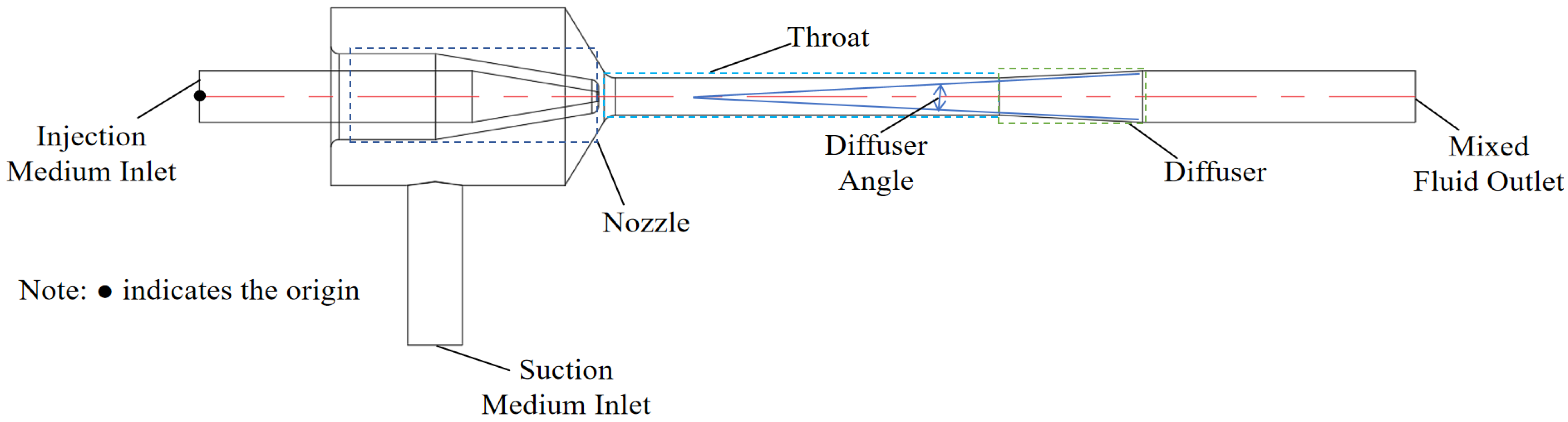
In light of practical production, the jet pump that already exists has been simplified, based on the actual jet-pump drawings, the core flow passage is retained, and non-essential ancillary components such as inlet/outlet flanges and transition joints are simplified into coaxial straight-section interfaces, resulting in the jet pump model established in this paper, as shown in Figure 1, the two inlets and the outlet shown in the figure are the flow-rate monitoring locations; during the numerical simulation the corresponding flow rates are determined by monitoring the values on these inlet and outlet interfaces, Table 1 primarily comprises structures such as the nozzle, throat, and diffuser. Its main structural parameters are detailed in Table 1. To investigate the influence of ejector parameters on the internal velocity field of the ejector, axial section contour maps were created, including the nozzle, suction chamber, throat, and diffuser. Taking the center of the jet medium inlet as the origin, that is, the 0 mm starting point in the velocity change graph on the central axis below, and taking the positive direction of the jet pump axis as the positive direction of the X-axis, an axial line segment is created with a distance of 0–461 mm, also shown in Figure 1.

2.3. Mesh Generation and Boundary Condition Determination

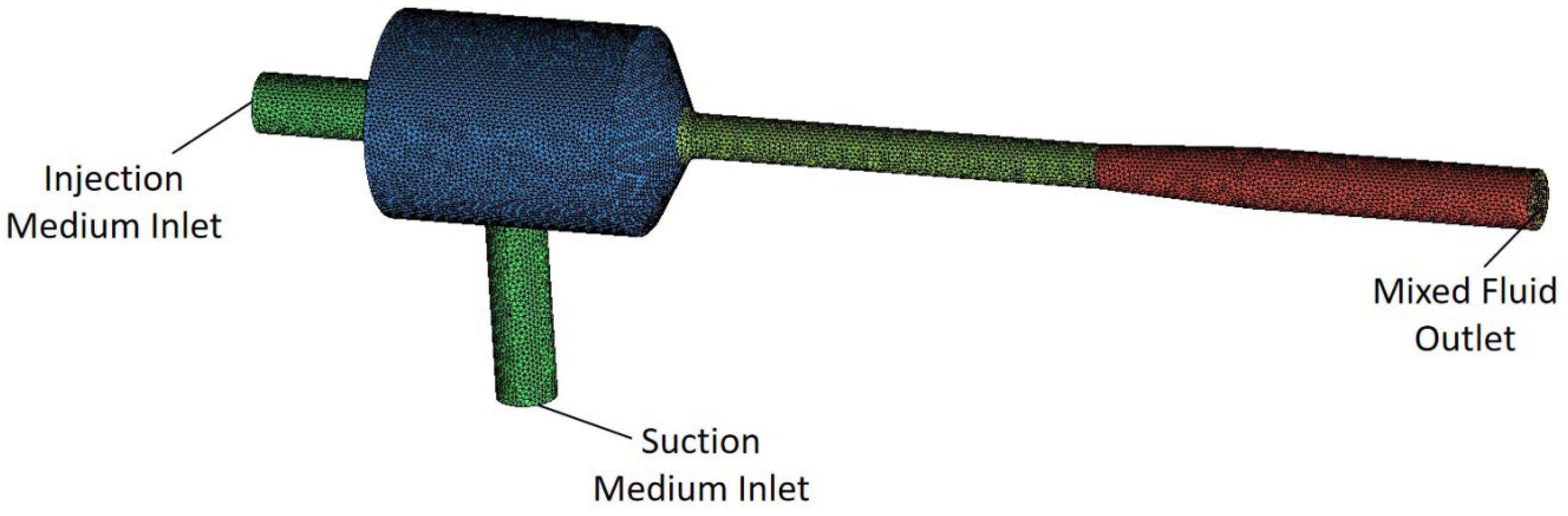
In this study, the overall flow within the jet pump is analyzed. Given the complexity of the jet pump’s geometric structure, ICEM-2022R1 software is utilized to generate adaptive tetrahedral meshes. This mesh type facilitates rapid generation and accurately conforms to the geometric features of critical components such as the nozzle, throat, and diffuser, thereby ensuring the precision of the mesh generation [25,26]. The meshing outcome is illustrated in Figure 2.
In this study, we selected water as the driving fluid and air as the entrained fluid. The choice of these fluids is based on their commonality and availability in industrial applications. The initial conditions and boundary conditions within the computational domain are presented as follows. The physical properties of water include a density of 998.21 kg/m3, dynamic viscosity of 1.002 mPa·s, and surface tension of 0.072 N/m (all measured at 25 °C), while the physical properties of air include a density of 1.225 kg/m3, dynamic viscosity of 1.81 × 10⁻⁵ mPa·s, and surface tension of 0.0728 N/m (also at 25 °C). Under the experimental conditions set in this study, the maximum flow velocity of the fluid in this study is 43.59 m/s, while the speed of sound under the temperature conditions specified in this study is 343 m/s. Its Mach number is 0.127, which is less than 0.3; thus, the gas in this study is considered an in-compressible gas. All experiments were conducted at ambient temperatures ranging from 20 °C to 25 °C, without additional heating or cooling of the fluids, to ensure the generalizability and repeatability of the experimental results. The internal fluid flow within the model established in this paper is characterized by high Reynolds number turbulent flow, and the effects of fluid viscosity can essentially be neglected. To precisely assess the suction performance of the jet pump, the inlet boundary conditions for both the driving and driven fluids are established as pressure inlets, with values set at 1.335 MPa and 0.286 MPa, respectively; the outlet for the mixed fluid employs a pressure outlet boundary condition, with the pressure value set at 0.383 MPa. Additionally, all walls of the jet pump utilize no-slip boundary conditions. During the computation, the residual convergence criterion is set to 10−5 to ensure computational accuracy. Based on prior research [27], the SST k-ω turbulence model is employed to close the Navier–Stokes equations, and the PLE (Pressure-Implicit with Splitting of Operators) algorithm is utilized for the coupled computation of pressure and velocity. In the article, the multiphase flow modeling method adopted is the Euler-Euler modeling approach. The convective terms are discretized using a second-order upwind difference scheme, while the diffusive terms are discretized with a central difference scheme to enhance the accuracy and reliability of the numerical simulation.
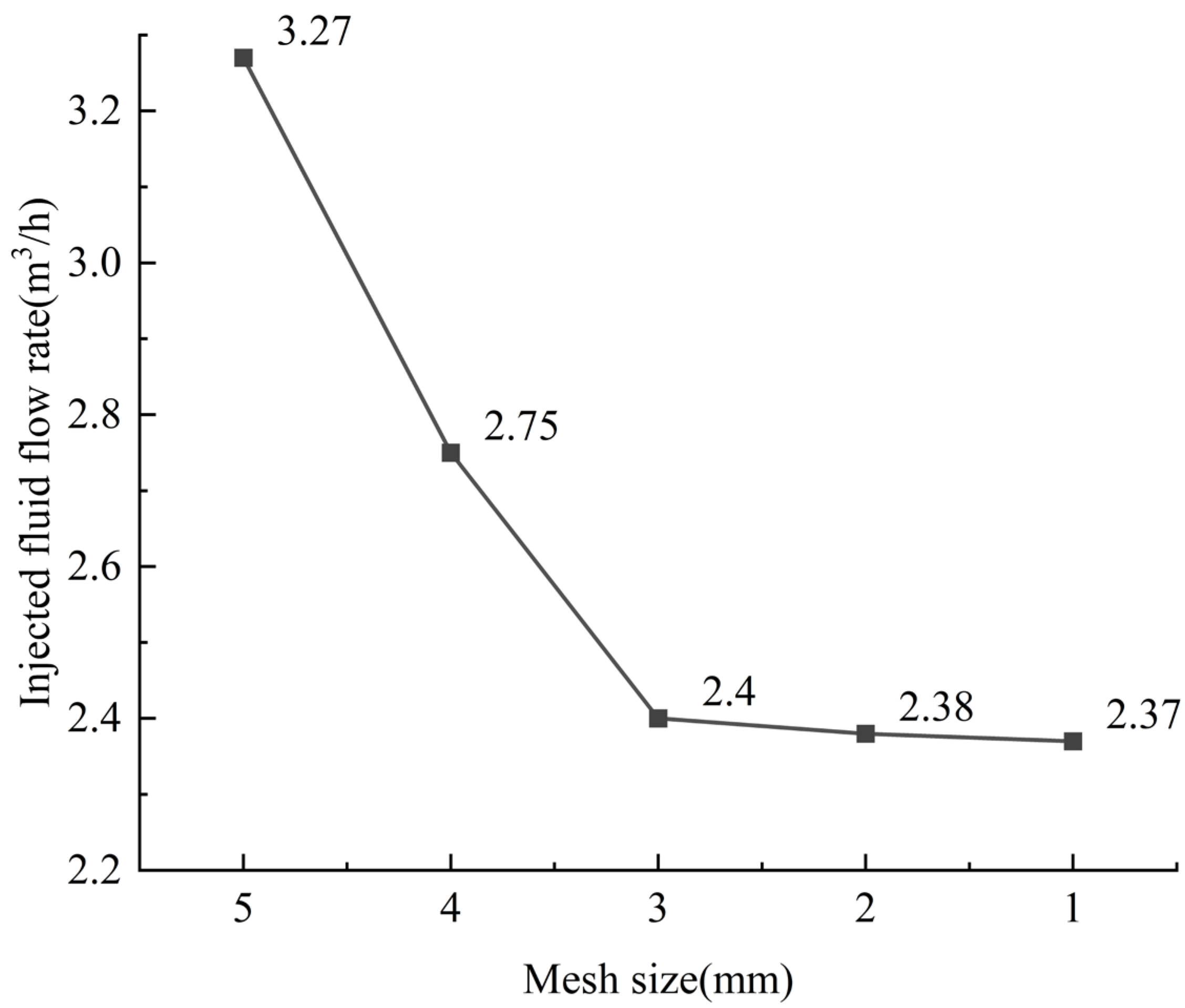
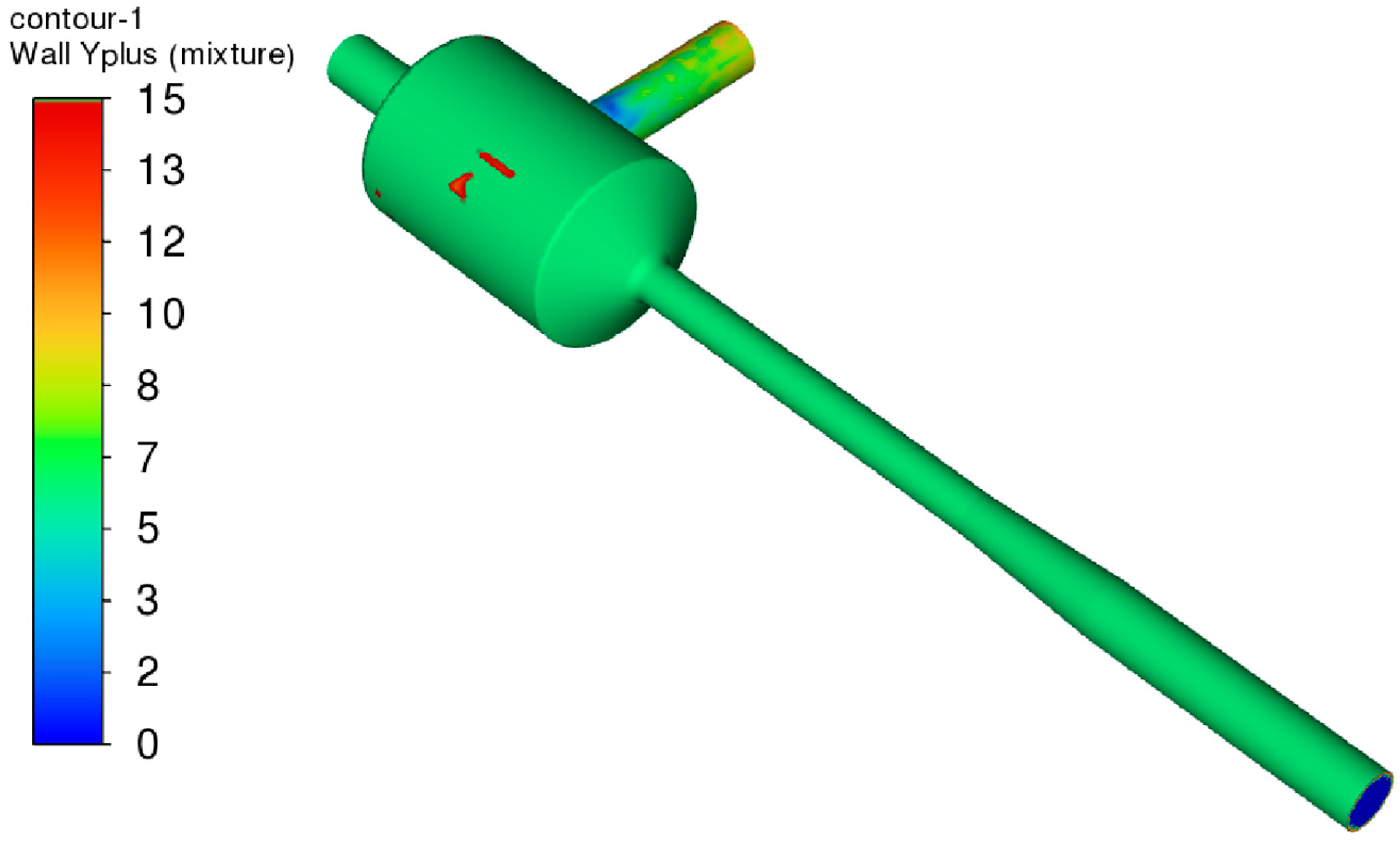
To avoid the impact of grid parameters on computational results, under the conditions of setting the continuity residual to 10-5 and iterating 4000 times, five sets of global mesh sizes were designed. The results are shown in Table 2 and Figure 3. Comparative analysis revealed that when the global mesh size is 2 mm, the variation in the aspirated liquid flow rate becomes stable, indicating that the computational results are reliable. Therefore, for subsequent numerical calculations, a global mesh size of 2 mm is chosen, local refinement is applied at three inlets and outlets, namely the Injection Medium Inlet, Suction Medium Inlet, and Mixed Fluid Outlet, with a refined grid size of 0.5 mm. Additionally, the nozzle exit region is also refined, with a refined grid size of 0.5 m with a total of 847,299 grid cells. The precision of numerical calculations for Y Plus is influenced by the grid quality, which is especially crucial for the model discussed in this paper. In this study, ANSYS-ICEM-2022R2 was used to perform structural meshing of the jet pump domain, with additional refinement around critical structural boundaries to ensure that the Y Plus values meet the computational requirements, as shown in Figure 4.

2.4. Principles of Response Surface Methodology (RSM)

Response Surface Methodology (RSM) is a statistical technique employed for the optimization of multiple variables. This methodology fundamentally relies on leveraging experimental design and mathematical modeling to discern the interrelationship among several independent variables (factors) and a dependent variable (response) [28]. This process aims to pinpoint the optimal experimental conditions that either maximize or minimize the desired outcome. Initially, the objective response to be optimized is identified—such as the suction flow rate of the driven medium—and the principal factors influencing this response are ascertained (e.g., throat length L, throat distance d, area ratio m, and diffuser angle A). Subsequently, an appropriate experimental design approach—like Central Composite Design or Box–Behnken Design—is chosen to set the levels and combinations for the experiments, execute the experiments, and gather response data for each experimental configuration. Thereafter, regression analysis is applied to construct a mathematical model correlating the response with the factors, commonly utilizing a quadratic polynomial model as illustrated below [28,29]:
Y = β 0 + i = 1 k β i X i + i = 1 k β ii X i 2 + i = 1 k β ii X i 2 + i < j β ij X i X j + ε
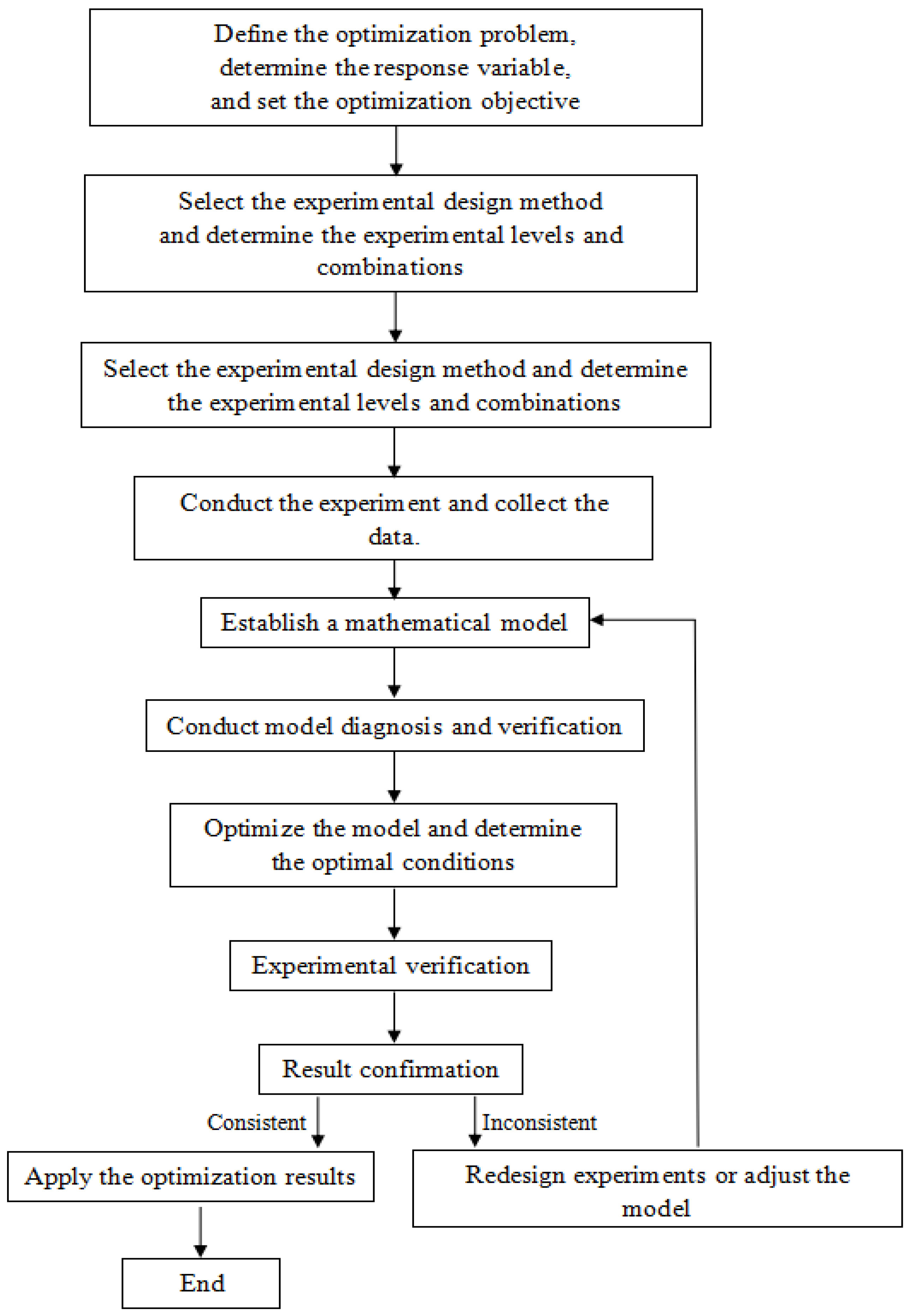
In the formula, Y represents the response variable, Xi denotes the factor variables, β0 is the constant term, βi are the linear coefficients, βii are the quadratic coefficients, βij are the interaction coefficients, and ε represents the error term. Ultimately, employing mathematical optimization techniques (such as gradient descent, genetic algorithms, etc.), the optimal solution of the model is identified. The objective of the optimization is to maximize or minimize the response, contingent upon the specific requirements of the problem. The predicted results of the model are validated through experiments to substantiate the effectiveness and reliability of the optimization scheme, thereby concluding the entire optimization process. The specific optimization procedure is depicted in Figure 5.

3. Experimental Verification

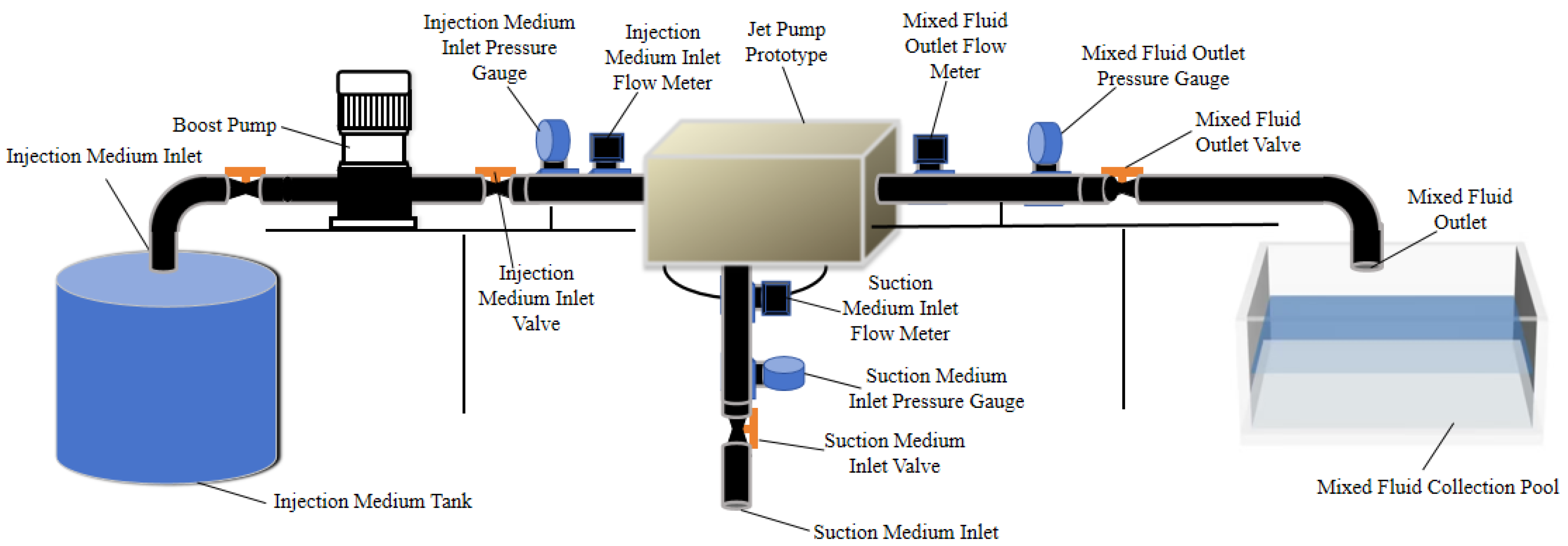
Based on the previously established boundary conditions and component parameters of the jet pump model, the design and experimental setup of the jet pump prototype were executed to validate the numerical simulation outcomes under the aforementioned operating conditions. The schematic is presented in Figure 6. Initially, the test platform was configured, featuring distinct systems for the supply of both the driving and driven fluids, as well as a collection system for the mixed fluid. The power supply system, complete with essential safety measures, was installed. The prototype was subsequently secured on the test bench, with flow meters and pressure gauges positioned at the inlets of the driven fluid, the driving fluid, and the outlet of the mixed fluid to monitor the pump’s performance. Control valves were also fitted at the necessary junctions on the test bench. Following the installation and debugging of the equipment, the main switch was engaged, and once the readings from each monitoring channel stabilized, various boundary conditions were modified to log the jet pump’s performance data across diverse working scenarios. Measurements were conducted three times to ensure the acquisition of consistent results, which were subsequently documented, the experimental object and equipment parameters are shown in Table 3.
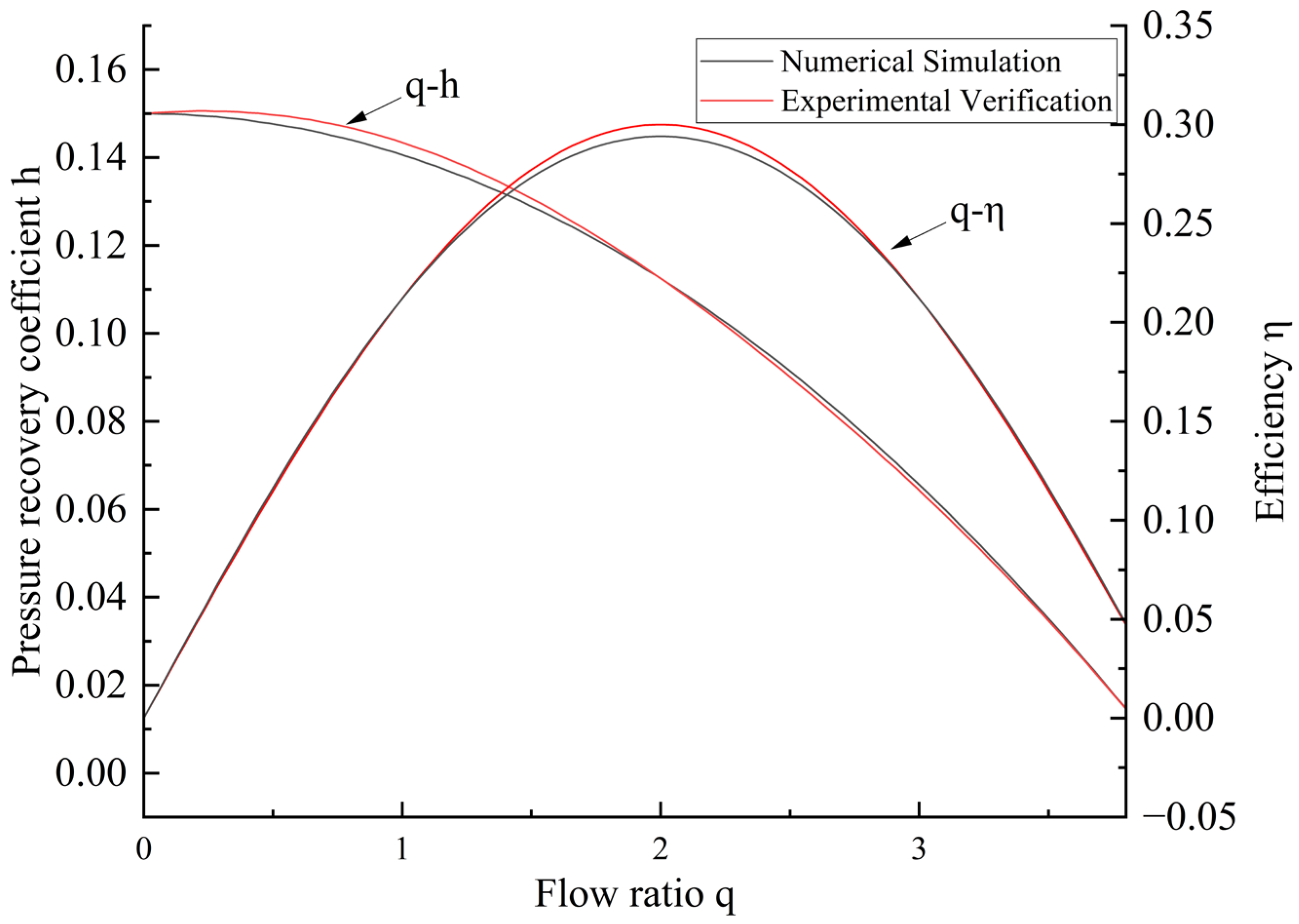
The characteristic curves of the prototype jet pump were plotted using the test outcomes and compared against those derived from numerical simulations, as depicted in Figure 7.The q-h curve represents the relationship between the entrained medium flow rate and the pressure ratio, while the q-η curve represents the relationship between the entrained medium flow rate and the jet pump efficiency. Given that the energy losses due to fluid flow within the pump were not accounted for in the simulations, the characteristic curve results from numerical simulations were marginally higher than the experimental results. The characteristic curves derived from repeated tests exhibited an overall error of 2.31% relative to the mean results of numerical simulations, which falls within the permissible error range. Consequently, the numerical simulation results from this study are deemed credible.

4. Analysis of the Influence of Single Factors on Ejector Performance

Focusing on the three main structures of the ejector—nozzle, throat, and diffuser—four representative parameters were selected based on existing research findings: throat length L, Nozzle-throat Distance d, area ratio m, and diffuser angle θ Numerical optimization studies for single-factor optimization of the jet pump were conducted using ANSYS 2022.R1 software.

4.1. Influence of Throat Length (L) on Ejector Performance

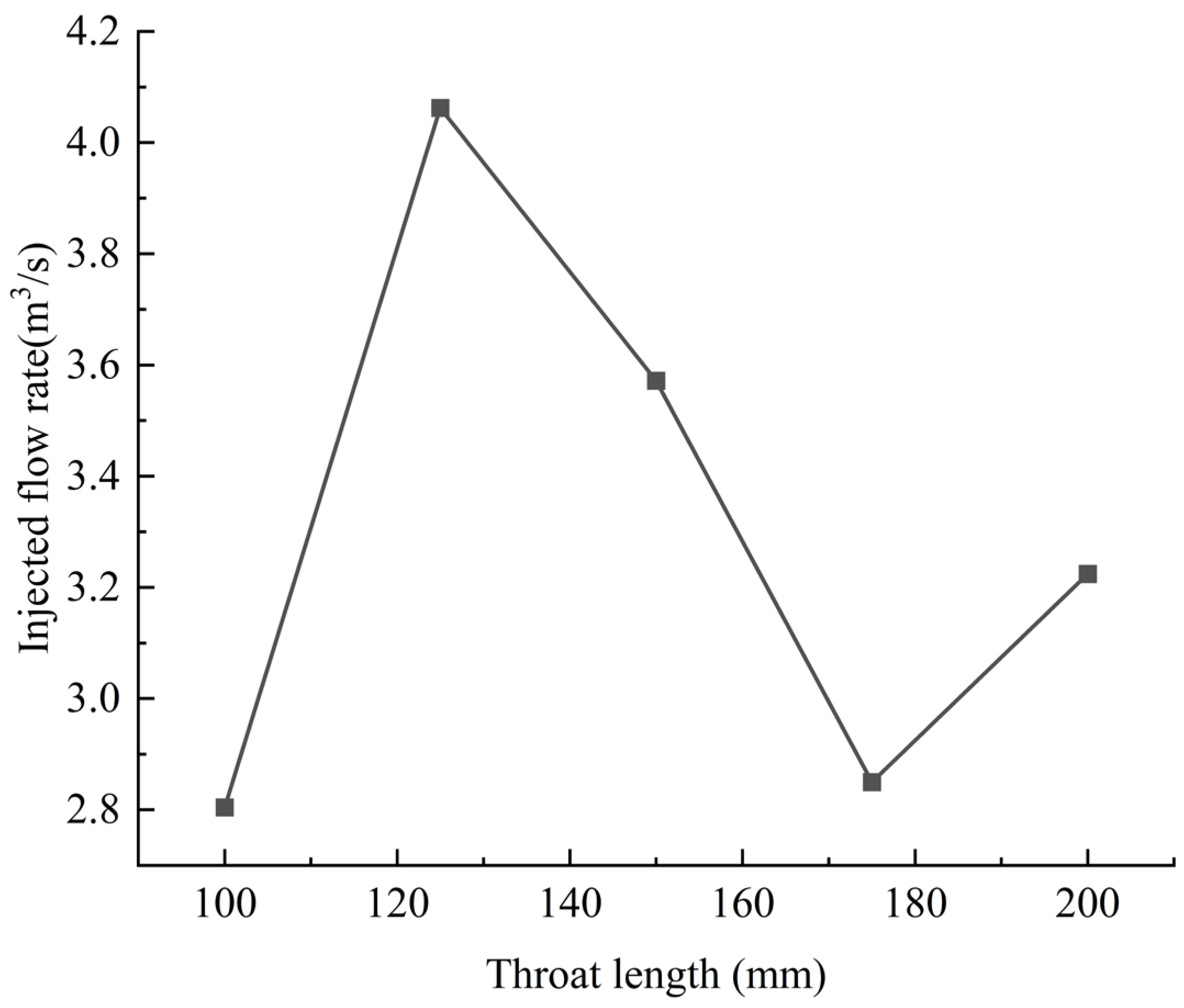
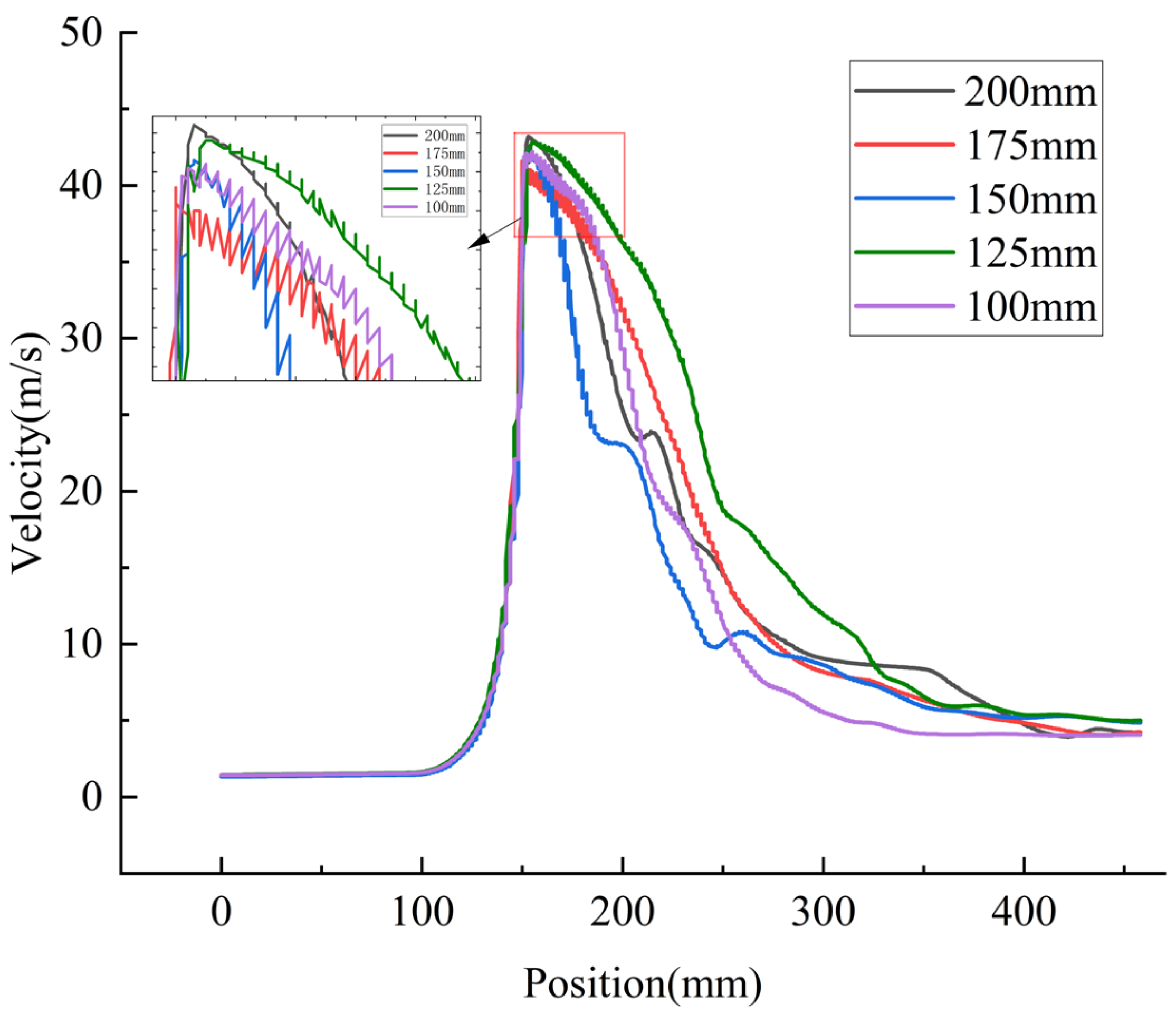
Throat length refers to the distance between the inlet and outlet sections of the throat, measured in millimeters. To assess the impact of throat length on the suction performance of the jet pump, this study conducts a series of numerical simulations based on the geometric model of the jet pump established in Section 2.2. Throughout the simulation process, to ensure the precision of the outcomes, all factors except for the varying throat length are maintained constant. Drawing on prior research regarding the optimal range of throat length [24], this study establishes five distinct experimental setups for throat length, with dimensions of 100 mm, 125 mm, 150 mm, 175 mm, and 200 mm, respectively. The changes in the suction flow rate are depicted in Figure 8 and Figure 9.
To investigate the impact of throat length on the internal velocity field within the jet pump, axial velocity data along the streamline were extracted for various throat lengths, as illustrated in Figure 9. The velocity variation along the axis of the gas–liquid jet pump aligns with the fundamental theory of gas–liquid jet pumps. Within the throat length range of 100–175 mm, the suction flow rate of the driven medium initially increases and then diminishes, peaking at a throat length of 125 mm, where the maximum value is achieved, reaching 4.063 m3/h.
The relationship between the flow rate of the driven medium and the throat length is centered on the regulatory effect of the throat length on the mixing time, momentum exchange integrity, and flow field stability of the gas–liquid two phases in the jet pump, essentially reflecting the dynamic balance between the “duration of the mixing process” and the “momentum transfer efficiency”. As the core region where the main jet (gas phase) and the driven medium (liquid phase) complete momentum exchange, the length of the throat directly determines the contact and mixing degree of the two phases: when the throat length is 100 mm, the short length leads to insufficient mixing time of the two phases in the throat, the main jet only completes preliminary momentum transfer, the driven medium fails to accelerate fully, and the suction flow rate has not reached the optimal level; as the throat length increases to 125 mm (the experimental peak point), the mixing time perfectly matches the momentum transfer requirement—the gas-phase main jet continuously and fully transfers momentum to the liquid-phase driven medium through turbulent vortices and interfacial shear forces, and the two phases form a stable “accelerated mixing flow” in the throat, which not only avoids momentum waste caused by insufficient mixing but also does not generate additional flow resistance due to excessive length, eventually making the suction flow rate reach the peak of 4.063 m3/h; when the throat length further increases to 175 mm, the excessively long throat section leads to a significant increase in flow resistance, the mixed gas–liquid two phases gradually attenuate in velocity in the rear half of the throat due to friction loss and pressure recovery, and at the same time, the excessively long flow path easily causes flow field instability (such as the generation of local backflow vortices), which instead weakens the suction capacity for the driven medium, resulting in a downward trend in the flow rate.

4.2. Influence of Nozzle-Throat Distance (d) on Ejector Performance

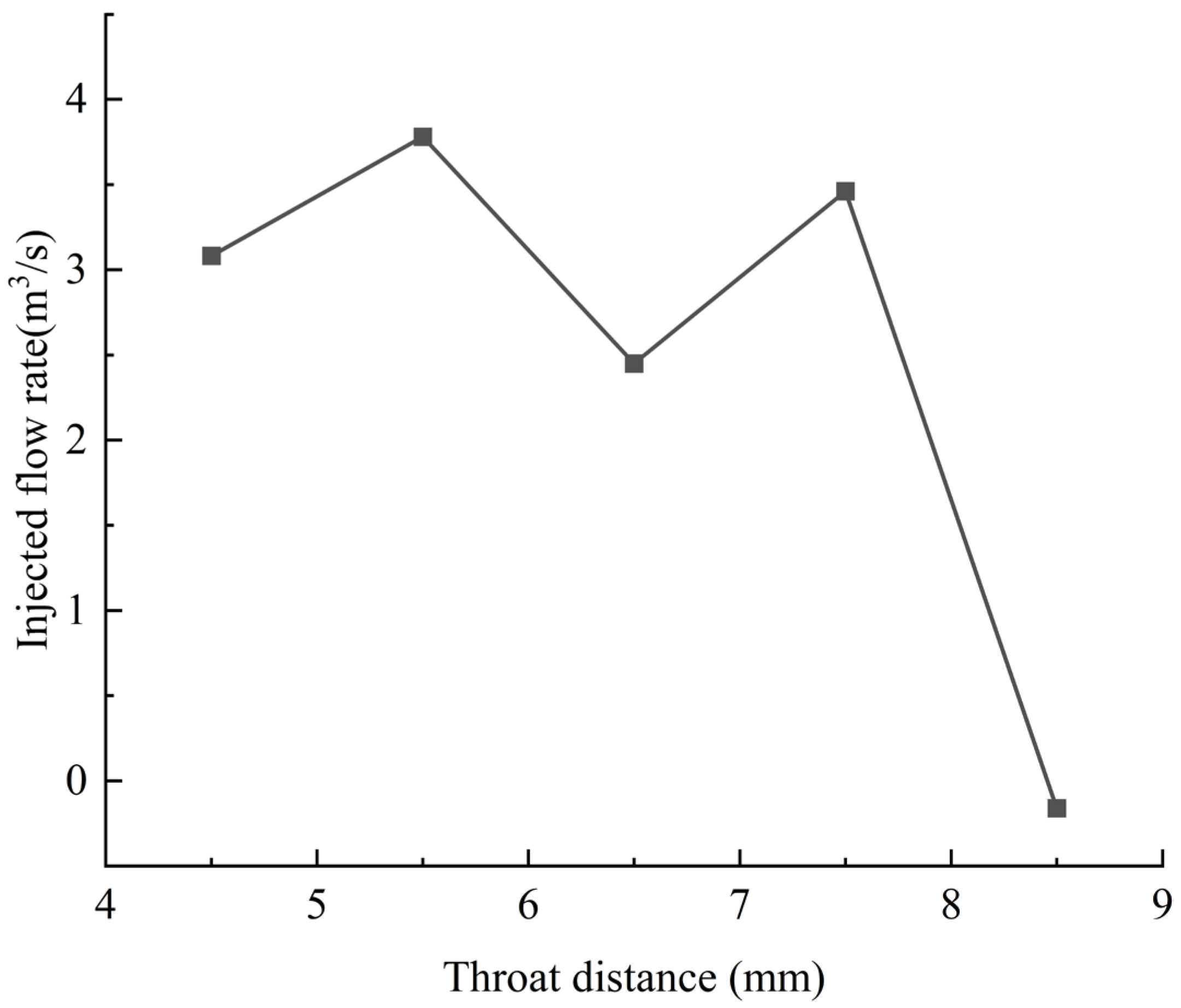
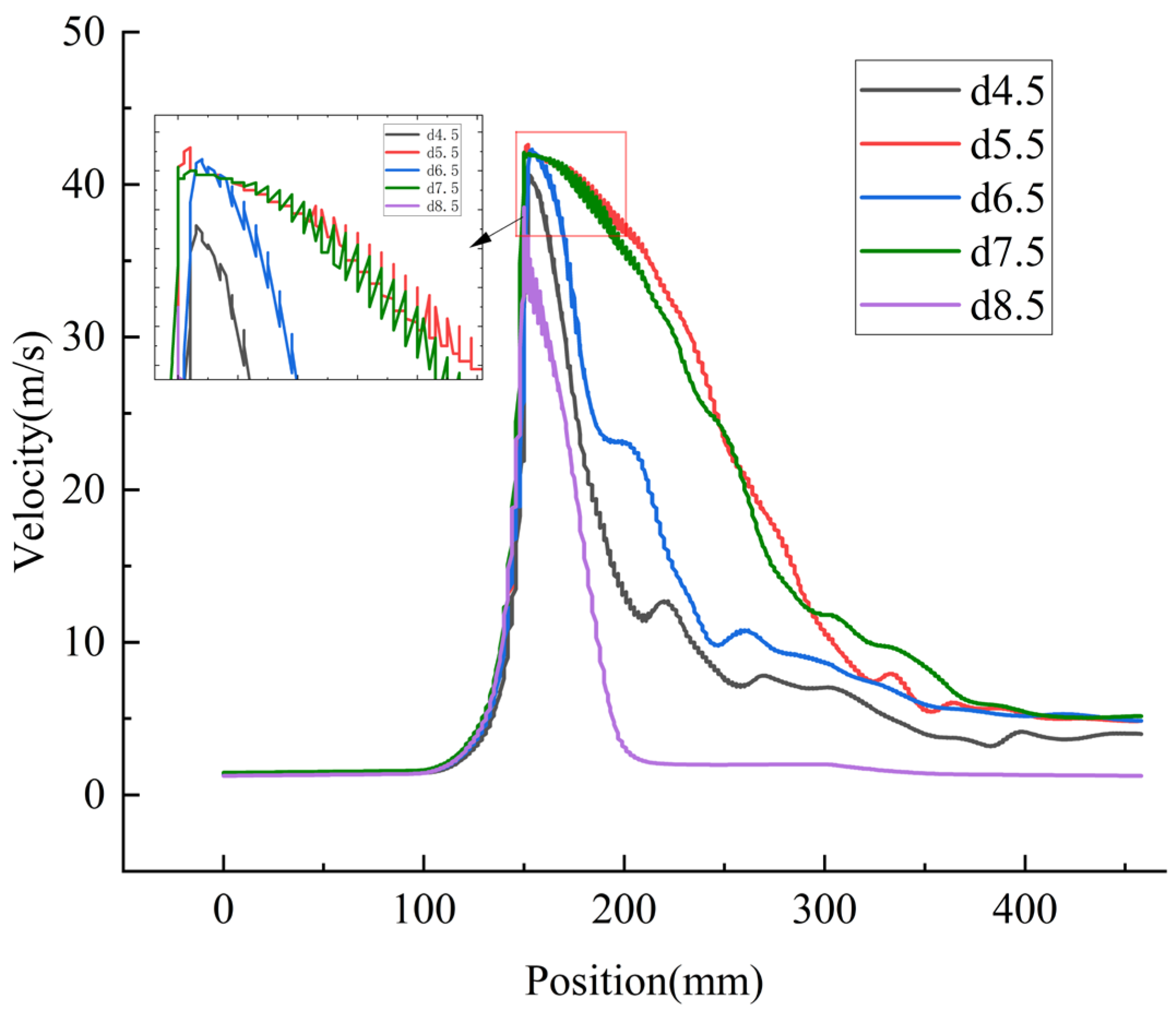
Nozzle-throat Distance refers to the distance between the nozzle exit section and the throat entrance section, measured in millimeters. To investigate the impact of Nozzle-throat Distance on the suction performance of the jet pump, this study utilizes the geometric model of the jet pump established in Section 2.2 and conducts a series of numerical simulations. During the simulation process, to ensure the accuracy of the results, only the Nozzle-throat Distance is adjusted as a variable, while other related factors remain constant. Drawing on previous research regarding the optimal range of Nozzle-throat Distance [24], this study establishes five distinct experimental schemes for Nozzle-throat Distance, with lengths of 4.5 mm, 5.5 mm, 6.5 mm, 7.5 mm, and 8.5 mm, respectively. The variation in the driven medium flow rate is depicted in Figure 10 and Figure 11.
To investigate the influence of Nozzle-throat Distance on the internal velocity field of the jet pump, axial velocity data along the streamline under various Nozzle-throat Distances were extracted, as depicted in Figure 11. Analysis of the figures reveals that within the range of Nozzle-throat Distances from 4.5 mm to 7.5 mm, the driven medium flow rate is relatively high and exhibits fluctuations. A peak value is observed at 5.5 mm, achieving 2.450 m3/h.
In the jet pump, the relationship between the flow rate of the driven medium and the nozzle-throat distance is essentially the coupling effect of the main jet diffusion characteristics, momentum exchange efficiency, and flow field pressure gradient: when the nozzle-throat distance is in the range of 4.5–7.5 mm, the main jet undergoes a full diffusion and stable entrainment process after leaving the nozzle, and the boundary mixing zone exactly covers the throat inlet, so the driven medium can enter the throat efficiently, and the flow rate is at a relatively high level overall. The flow rate fluctuation within this range originates from the inherent characteristic of random generation of turbulent vortices; when the nozzle-throat distance is 5.5 mm, the optimal state is reached—the potential core zone of the main jet ends exactly at the throat inlet, the optimal negative pressure gradient is formed at the throat inlet, and the vortex structure is dominated by small-scale dissipative vortices. The synergistic effect of momentum exchange efficiency, pressure gradient, and vortex evolution makes the flow rate reach the peak of 2.450 m3/h; if the nozzle-throat distance is too large (>7.5 mm), the main jet over-diffuses, leading to premature attenuation of momentum, the negative pressure at the throat inlet is weak, and at the same time, a dead water zone is formed in the gap between the nozzle and the throat, increasing flow resistance, so the flow rate will continue to decrease with an increased fluctuation amplitude.

4.3. Influence of Area Ratio (m) on Ejector Performance

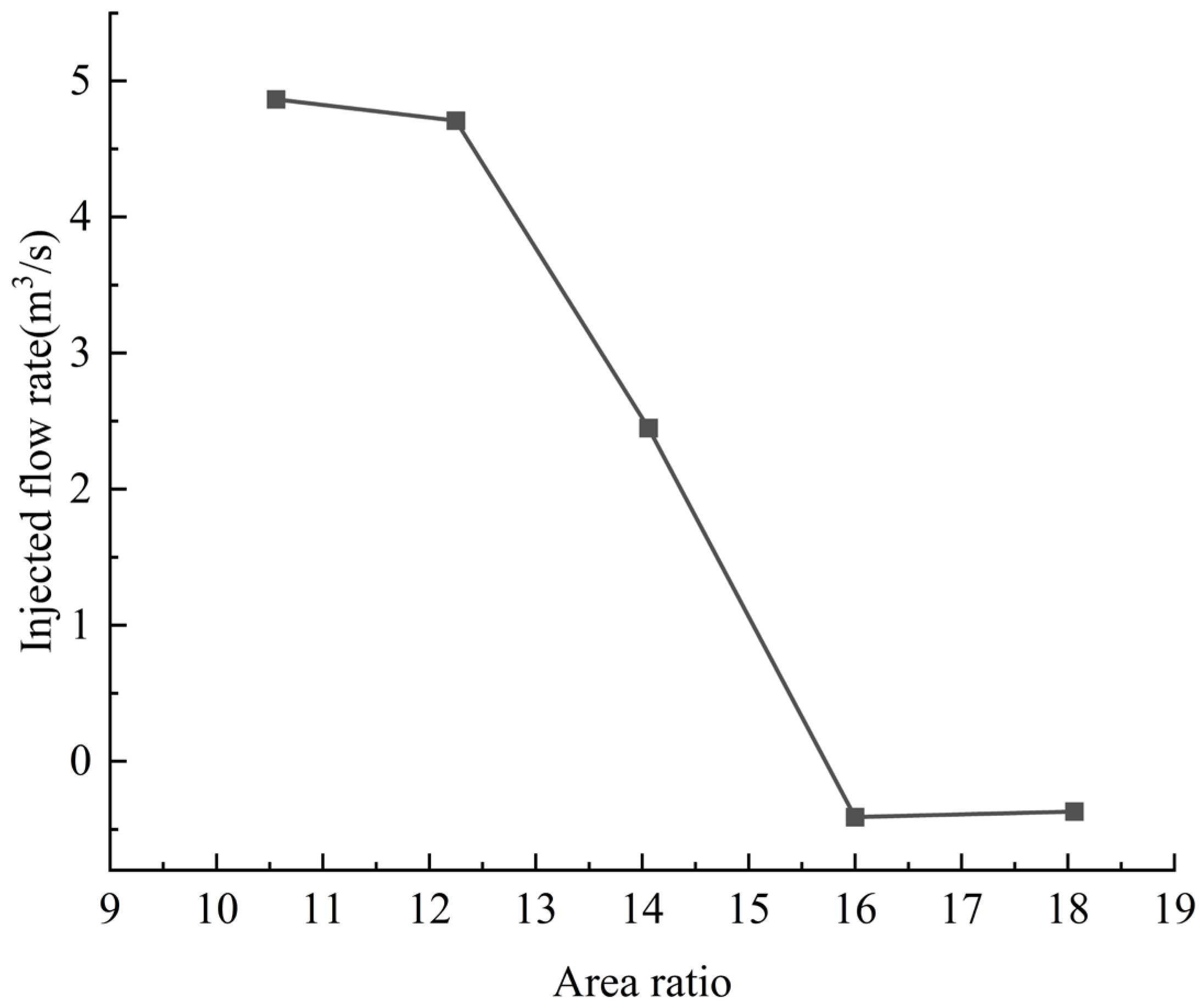
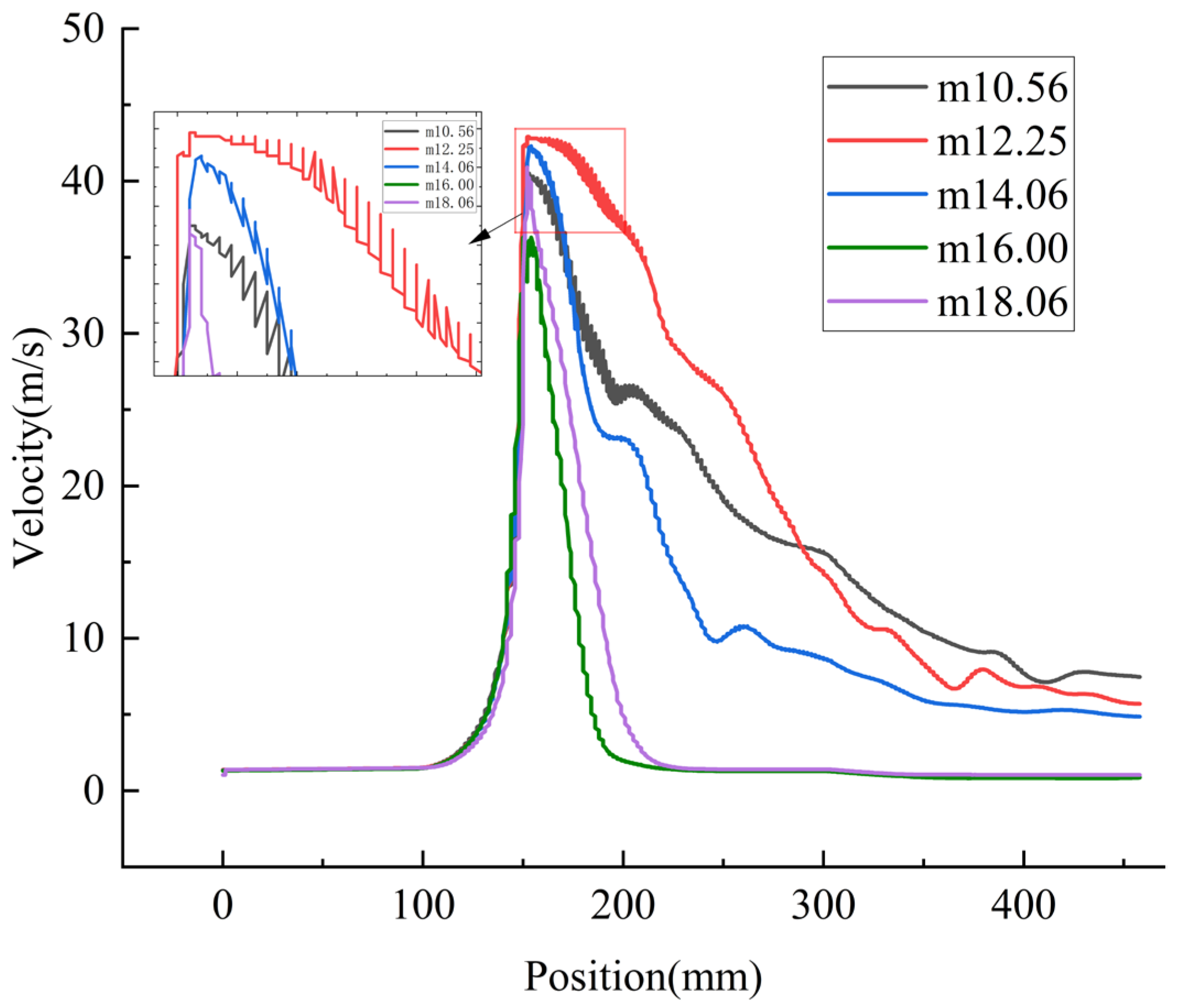
The area ratio refers to the ratio of the throat section area to the nozzle exit area, and it is a dimensionless number. To explore the impact of the area ratio on the suction performance of the jet pump, this study employs the geometric model of the jet pump constructed in Section 2.2 as a basis for a series of numerical simulations. Throughout the simulation process, to ensure the accuracy of the simulation results, only the area ratio was adjusted, while other related factors were kept constant. Drawing on previous research regarding the optimal range of the area ratio [24], this study establishes five distinct experimental schemes for the area ratio, with area ratios m of 10.56, 12.25, 14.06, 16.00, and 18.06, respectively. The variation in the driven medium flow rate is illustrated in Figure 12 and Figure 13. Through these different area ratio settings, a comprehensive numerical analysis of the jet pump was conducted to deeply explore the specific impact of changes in the ratio on the suction performance of the jet pump.
To examine the impact of the area ratio on the internal velocity field of the jet pump, axial velocity data along the streamline under various Nozzle-throat Distances were extracted, as depicted in Figure 13. Within the range of area ratios from 10.56 to 16.00, there is a gradual decrease in the driven medium flow rate, peaking at 10.56 with a value of 4.866 m3/h, and approaching a negative value near 16.
The relationship between the flow rate of the driven medium and the area ratio is centered on the synergistic effect formed by the area ratio through regulating the momentum exchange intensity, flow field pressure gradient, and flow resistance in the jet pump, essentially reflecting the influence of the matching degree between the throat and nozzle outlet cross-sectional areas on the entrainment capacity of the main jet and the medium transport path. When the area ratio is 10.56 (the experimental peak point), the throat and nozzle outlet cross-sectional areas are in the optimal matching state: the larger nozzle outlet cross-sectional area enables the main jet to form a strong jet core zone with sufficient momentum, which efficiently entrains the driven medium through turbulent pulsation and viscous action; at the same time, the throat cross-sectional area is not excessively expanded, so the entrained medium can quickly mix with the main jet in the throat, forming a stable positive pressure gradient of “moderate negative pressure entrainment at the throat inlet—pressure recovery and transport at the throat outlet”, eventually making the flow rate reach the peak of 4.866 m3/h. As the area ratio increases from 10.56 to 16.00, the excessive expansion of the throat cross-sectional area relative to the nozzle outlet breaks this balance: the main jet over-diffuses due to the sudden increase in flow space after entering the throat, the jet core zone attenuates rapidly, the momentum transfer efficiency decreases significantly, and the entrainment capacity for the driven medium weakens; at the same time, the pressure distribution in the throat reverses, the inlet negative pressure gradient decreases, and even a low-pressure backflow zone is formed in the middle section. The positive suction power of the driven medium is insufficient, and it is instead impacted by backflow, leading to a continuous decrease in the flow rate; when the area ratio is close to 16, the entrainment capacity of the main jet can no longer overcome the backflow resistance and flow loss, and the driven medium changes from forward transport to reverse backflow, which is manifested as the flow rate approaching a negative value.

4.4. Influence of Diffuser Angle (θ) on Ejector Performance

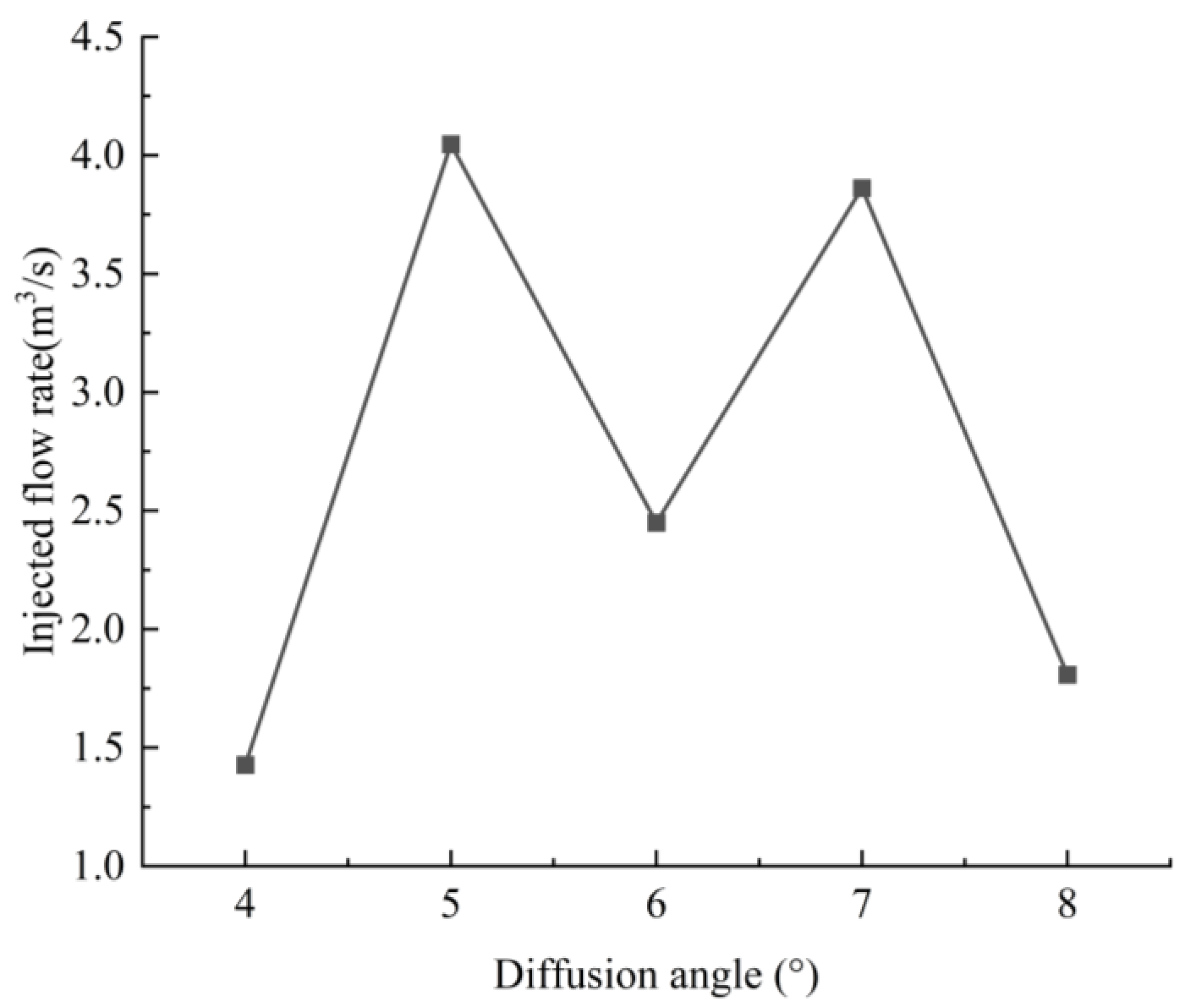
The diffuser angle refers to the angle at which the boundary lines of the jet diverge immediately after the jet leaves the nozzle in a jet pump. To investigate the effect of the diffuser angle on the suction performance of the jet pump, this study relies on the geometric model of the jet pump established in Section 2.2 to conduct multiple numerical simulations. During the simulation process, to ensure the reliability of the results, only the diffuser angle is varied as a variable, while all other related factors remain constant. Based on previous research regarding the optimal range of the diffuser angle [24], this study sets up five different experimental schemes for the diffuser angle, with angles of 4°, 5°, 6°, 7°, and 8°, respectively. The change in the driven medium flow rate is shown in Figure 14 and Figure 15. Through these different diffuser angle settings, a detailed numerical simulation analysis of the jet pump was conducted, aiming to deeply explore the specific impact of changes in the diffuser angle on the suction performance of the jet pump.
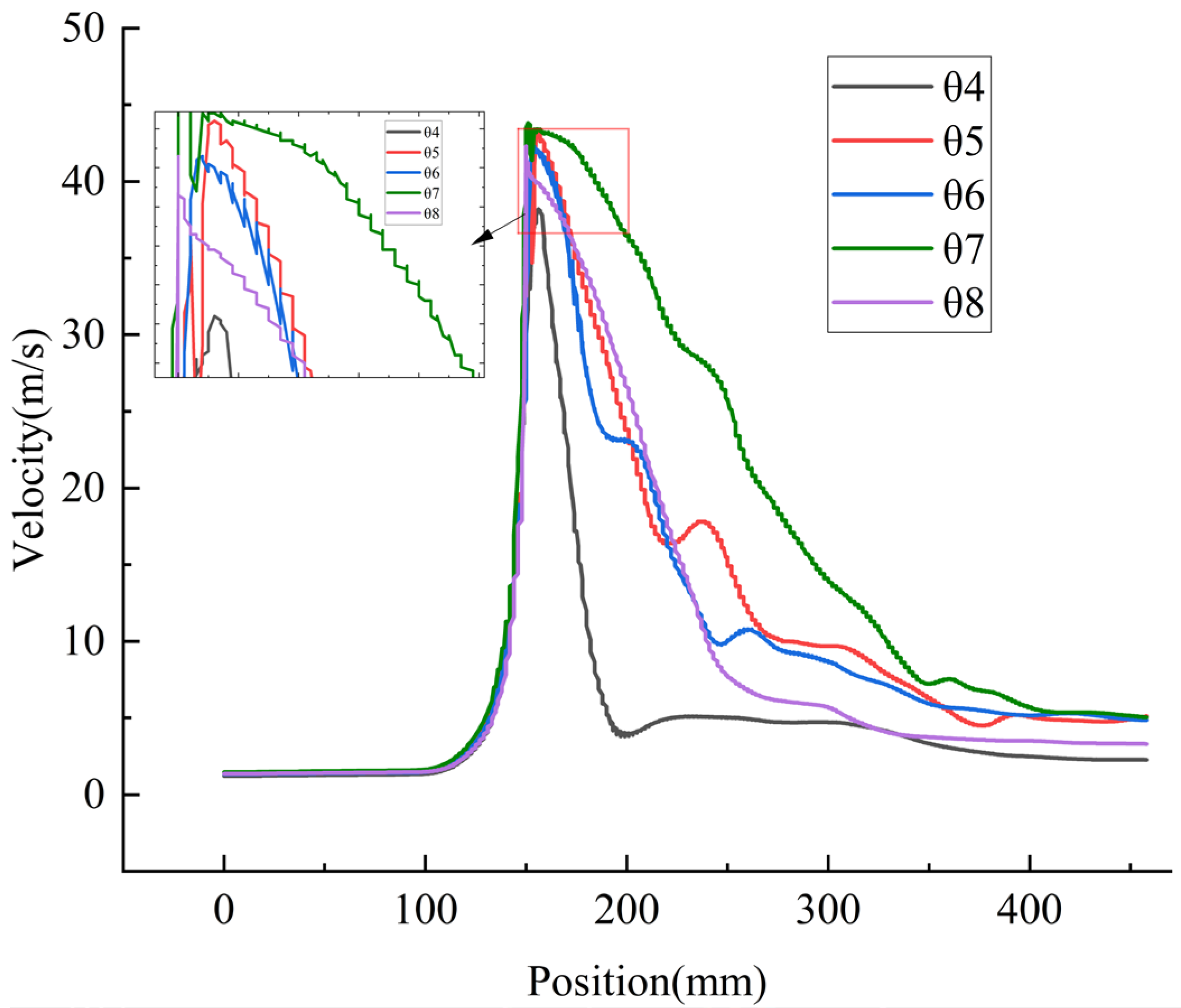
To investigate the influence of the diffuser angle on the internal velocity field of the jet pump, axial velocity data along the streamline were extracted for different diffuser angles and nozzle-throat distances, as shown in Figure 15. Within the range of 4° to 8°, the flow rate of the driven medium fluctuates, peaking at 5° with a value of 2.450 m3/h and dropping to its minimum near 4°, reaching 1.428 m3/h. By combining these observations with response surface analysis, the optimal range of the diffuser angle was determined to be centered at 5.5°, with 4.5° and 6.5° as the lower and upper boundaries, respectively.
The relationship between the flow rate of the driven medium and the diffuser angle is centered on the coupling regulation of the diffuser angle on the “kinetic energy-pressure energy conversion efficiency” and “flow resistance and flow field stability” in the jet pump. As the key region for energy conversion, the diffuser section needs to balance energy conversion and flow loss: when the diffuser angle is 4°, the slow conical expansion leads to insufficient conversion of kinetic energy to pressure energy, the insufficient outlet pressure weakens the suction negative pressure gradient, the driven medium lacks suction power, and the flow rate drops to the minimum value of 1.428 m3/h; when it increases to 5°, the energy conversion efficiency improves and the flow resistance is controllable, the mixed medium does not undergo boundary layer separation, the flow field is stable, and the entrainment and transport capacity of the main jet is optimal, forming a peak of 2.450 m3/h; when it is close to 8°, the excessive expansion causes the wall boundary layer to separate due to the sudden increase in pressure gradient, generating a large amount of eddy current loss, which not only increases resistance but also destroys the continuity of the flow field, and the entrainment effect is weakened, leading to a decrease in flow rate; the optimal range of 4.5–6.5° (centered at 5.5°) is exactly the dynamic balance point between energy conversion, flow resistance, and flow field stability. In this range, the promoting effect of energy conversion dominates, and the flow rate remains at a relatively high level.

5. Multi-Factor Analysis and Optimization Based on Response Surface Methodology

5.1. Design of Response Surface Optimization Methodology

The performance optimization of the liquid–gas jet pump is primarily influenced by four parameters: throat length (L), Nozzle-throat Distance (d), area ratio (m), and diffuser angle (θ). Based on the optimization outcomes from single-factor variable analysis and an examination of the principal experimental design methods, the Box–Behnken Design is chosen as the primary scheme for optimization.
In experiment design, the selected factors are typically categorized into three levels: −, 0, and + [30,31]. The values represented by − and + indicate the boundaries, while the value represented by 0 denotes the optimal value identified during single-factor optimization. A four-factor, three-level response surface experiment is formulated to ascertain the range of variation for each influencing factor, as detailed in Table 4. Utilizing Design Expert 13 software, in conjunction with the selection of the experimental design method and the variation in single-factor variables, the optimal range for throat length is established with 125 mm as the central point and 100 mm and 150 mm as the upper and lower boundaries; for Nozzle-throat Distance with 5.25 mm as the central point and 4.5 mm and 6 mm as the upper and lower boundaries; for area ratio with 10.56 as the central point and 9 and 12.25 as the upper and lower boundaries; and for diffuser angle with 5.5° as the central point and 4.5° and 6.5° as the upper and lower boundaries. The driven medium flow rate serves as the dependent variable, and 29 experimental schemes were devised (including 5 replicate schemes) [32,33], as outlined in Table 5.

5.2. Optimization Results

Numerical simulation tests were executed on the 29 experimental schemes designed as mentioned above, with the resulting flow rate ratios presented in Table 6.

5.3. Analysis of Optimization Results

5.3.1. Analysis of Factor Significance

Utilizing the response surface methodology, a quadratic polynomial model corresponding to the flow rate of the driven medium was derived from the numerical simulation results of the experimental design outlined above [34,35].
y = Y 1 A + Y 2 B + Y 3 C + Y 4 D + Y 5 A B + Y 6 A C + Y 7 A D + Y 8 B C + Y 9 B D + Y 10 C D + Y 11 A 2 + Y 12 B 2 + Y 13 C 2 + Y 14 D 2 + 4.35
In the formula, y represents the driven medium flow rate, Yi represents the coefficient for each term, with the specific values shown in Table 7. The coefficients A, B, C, D correspond to each term, with specific values found in Table 7. A is the coefficient for throat length L, B is the coefficient for Nozzle-throat Distance d, C is the coefficient for area ratio m, D is the coefficient for diffuser angle θ. The terms AB represent the interaction between throat length and Nozzle-throat Distance, AC represents the interaction between throat length and area ratio, AD is the interaction between throat length and diffuser angle, BC is the interaction between Nozzle-throat Distance and area ratio, BD is the interaction between Nozzle-throat Distance and diffuser angle, and CD is the interaction between area ratio and diffuser angle.
In evaluating the significance of the model equation, the F-value from the analysis of variance serves as the test statistic, and the p-value is utilized to gauge the level of significance. The significance test of the correlation coefficients is presented in Table 8. When the p-value falls within the interval [0, 1 × 10⁻²], it indicates a statistically significant fit for the model within the regression region [36]. A p-value within the interval [1 × 10⁻², 5 × 10⁻²] denotes a secondary significant impact. The p-value for this model is less than 1 × 10⁻², confirming the model’s excellent fit across the entire regression region and the rationality of the experimental design. The p-values for coefficients A, B, C, D, AB, AC, AD, BC, BD, CD in the aforementioned table are 7 × 10⁻⁷, <1 × 10⁻², <1 × 10⁻², 2.4 × 10⁻², 1.836 × 10⁻², <1 × 10⁻², 1.2 × 10⁻², 1.18 × 10⁻², 1.9 × 10⁻², 5 × 10⁻², 1.9 × 10⁻², <1 × 10⁻², 4.289 × 10⁻², 3.34 × 10⁻², respectively. Consequently, throat length L, Nozzle-throat Distance d, and area ratio m are significant influencing factors, while diffuser angle θ is a secondary significant factor. Among the interaction terms, AC, AD, BD, and CD exert significant impacts. In the quadratic terms, A2 and B2 have significant effects.
When employing Response Surface Methodology (RSM) for research, assessing the fit of the model equation is essential. To thoroughly evaluate the model’s performance, researchers commonly utilize a range of statistical metrics, including the Mean, Coefficient of Variation (C.V.), Coefficient of Determination ( R 2 ), Adjusted Coefficient of Determination ( R a d j 2 ), Predicted Coefficient of Determination ( R p r e 2 ), and Adeq Precision [37,38,39,40]. Moreover, residual analysis is a critical approach to validate the rationality of the model’s assumptions. The significance analysis results of the coefficients in the equation, presented in Table 9 offer vital evidence for the model’s validity and predictive power.
The model’s reliability can be further substantiated by the Coefficient of Determination ( R 2 ) and the Adjusted Coefficient of Determination ( R a d j 2 ). Generally, higher values of R 2 and R a d j 2 signify a superior fit of the regression model. In this model, the Coefficient of Determination attains 0.9943, and the Adjusted Coefficient of Determination is 0.9843, both indicating an excellent model fit and reliable volume parameter prediction. The discrepancy between R 2 and Adj ( R a d j 2 ) is also a crucial indicator of the model’s predictive prowess; if the gap between R 2 and R a d j 2 is within 0.2, the model exhibits commendable predictive performance. Herein, the Adjusted Coefficient of Determination stands at 0.9916, with a discrepancy of merely 0.0072. Furthermore, the Coefficient of Variation (C.V.) and Adequate Precision are two metrics that can be employed to evaluate the experiment’s reliability. A lower C.V. value implies that the experiment is reliable and precise. The C.V. value for this model is 2.9%, suggesting that the experiment possesses high reliability. An Adequate Precision value exceeding 4.0 denotes a well-conceived experiment; the Adequate Precision value for this model is 38.1853, further corroborating the precision of the experimental design.

5.3.2. Analysis of the Interactive Effects of Factors on Suction Flow

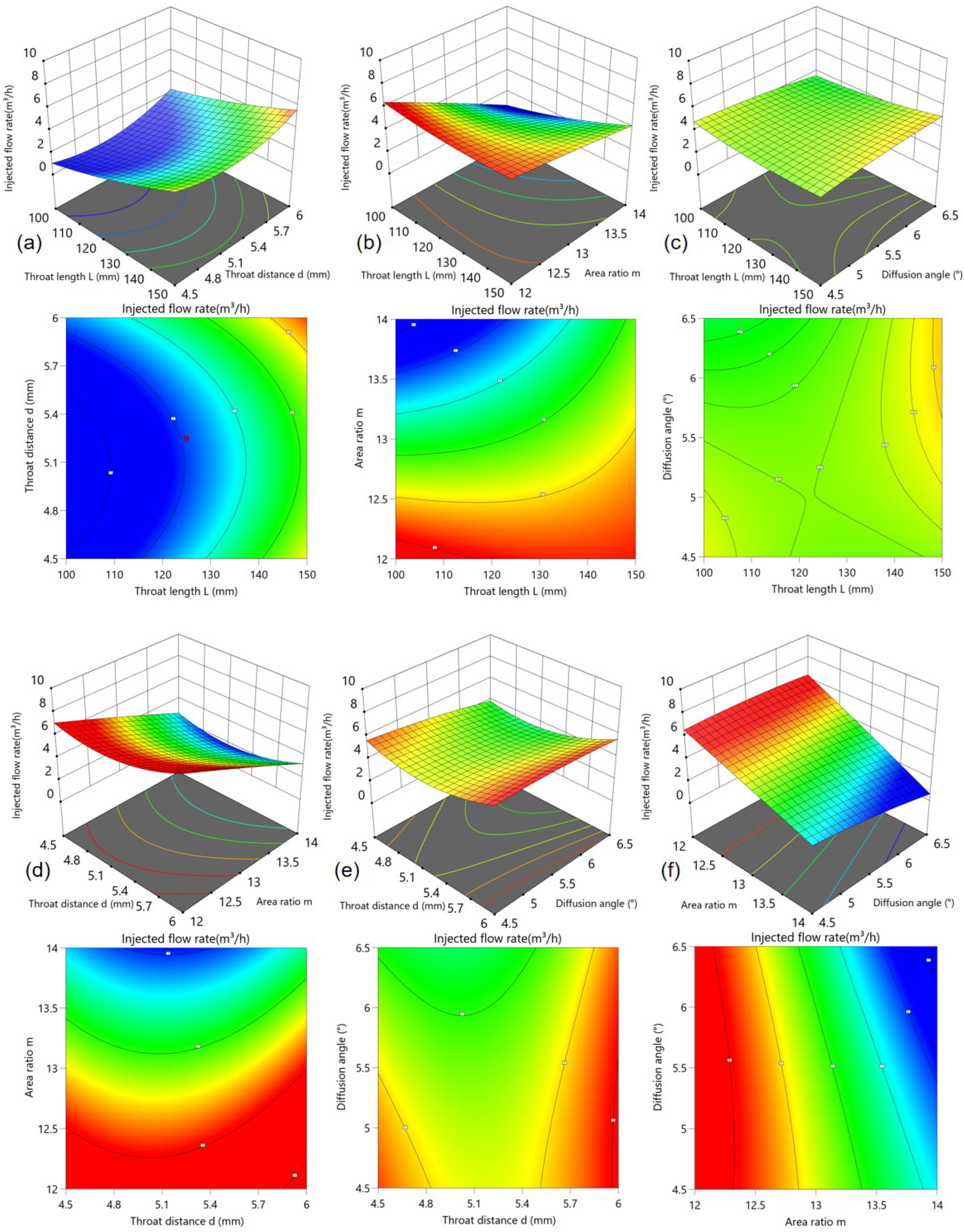
To ascertain the optimal combination interval of design factors, this study utilized the Design Expert 13 software to generate three-dimensional response surface plots and contour diagrams that illustrate the impact of the interaction between two distinct factors on the suction flow rate of the driven medium when the levels of the remaining two factors are fixed at zero. Further details are depicted in Figure 16.
In Figure 16a, the interaction effect of nozzle length L and Nozzle-throat Distance d on the entrainment flow rate was examined through the analysis of the model equation. The levels of the area ratio m and the divergence angle θ were set to 0. The results indicated that as both L and d increased from low to high levels, the entrainment medium flow rate exhibited a significant upward trend, suggesting that both factors positively influence the entrainment medium flow rate. Notably, when L and d were increased simultaneously, the increase in the entrainment medium flow rate was particularly pronounced, indicating a significant interaction effect. According to the data, to maintain a high level of entrainment medium flow rate, the nozzle length L should be controlled within the range of 130 mm to 150 mm, and the Nozzle-throat Distance d should be controlled within the range of 5 mm to 6 mm.
In Figure 16b, the interaction effect of nozzle length L and area ratio m on the ejection flow rate was examined through the analysis of the model equation, with the levels of the Nozzle-throat Distance d and the divergence angle θ set to 0. The results indicated that as the area ratio m increased, the ejection medium flow rate exhibited a significant upward trend. However, the ejection medium flow rate remained relatively stable with changes in nozzle length L. To optimize the ejection medium flow rate, the nozzle length L should be controlled within the range of 130 mm to 150 mm, and the area ratio m should be maintained within the range of 9 to 12.25.
In Figure 16c, the interaction effect of nozzle length L and divergence angle θ on the entrainment flow rate was analyzed through the model equation, with the levels of the area ratio m and the Nozzle-throat Distance d set to 0. As the nozzle length L increased, the entrainment medium flow rate showed a slight upward trend, though the overall change was not significant. Conversely, an increase in the divergence angle θ led to a more pronounced increase in the entrainment medium flow rate. To optimize the entrainment medium flow rate, the nozzle length L should be controlled within the range of 130 mm to 150 mm, and the divergence angle θ should be maintained within the range of 5° to 6.5°.
In Figure 16d, the interaction effect of the Nozzle-throat Distance d and the area ratio m on the entrainment flow rate was analyzed through the model equation, with the levels of the nozzle length L and the divergence angle θ set to 0. As the Nozzle-throat Distance d increased, the entrainment medium flow rate exhibited a slight upward trend, although the overall change was not significant and the flow rate remained at a high level. Conversely, as the area ratio m increased, the entrainment medium flow rate showed a significant upward trend. To optimize the entrainment medium flow rate, the Nozzle-throat Distance d should be controlled within the range of 5.4 mm to 6 mm, and the area ratio m should be maintained within the range of 9 to 12.25.
In Figure 16e, the interaction effect of the Nozzle-throat Distance d and the divergence angle θ on the entrainment flow rate was analyzed through the model equation, with the levels of the nozzle length L and the area ratio m set to 0. As the Nozzle-throat Distance d increased, the entrainment medium flow rate exhibited a fluctuating trend, initially decreasing slightly before increasing. In contrast, as the divergence angle θ increased, the entrainment medium flow rate remained relatively stable at a high level. To optimize the entrainment medium flow rate, the Nozzle-throat Distance d should be controlled within the range of 5.4 mm to 6 mm, and the divergence angle θ should be maintained within the range of 5° to 6.5°.
In Figure 16f, the interaction effect of the area ratio m and the divergence angle θ on the entrainment flow rate was analyzed through the model equation, with the levels of the nozzle length L and the Nozzle-throat Distance d set to 0. As both the area ratio m and the divergence angle θ increased, the entrainment medium flow rate exhibited a downward trend. The decrease in the entrainment medium flow rate was more pronounced with an increase in the area ratio m, while an increase in the divergence angle θ led to a slight decrease in the flow rate. To optimize the entrainment medium flow rate, the area ratio m should be controlled within the range of 9 to 12.25, and the divergence angle θ should be maintained within the range of 5° to 6.5°.
In summary, based on the analysis of the interaction effects of these factors, to achieve a high level of entrainment medium flow rate, the nozzle length L should be controlled within the range of 130 mm to 150 mm, the Nozzle-throat Distance d within the range of 5.4 mm to 6 mm, the area ratio m within the range of 9 to 12.25, and the divergence angle θ within the range of 5° to 6.5°.

5.4. Determination of the Optimal Combination Using Response Surface Methodology

In the preceding section, the performance-influencing parameters of the gas–liquid jet pump were optimized using response surface methodology, thereby determining more precise ranges for the parameter values. Upon inputting these optimized parameter ranges into Design Expert 13 software, the predicted optimal combination of parameter values was obtained as follows: nozzle length L = 148.39 mm, Nozzle-throat Distance d = 5.98 mm, area ratio m = 10.43, and divergence angle θ = 5.25°. Based on this predicted optimal combination of parameters, a three-dimensional model was created, and the optimized model was numerically simulated using the methods described in the previous sections. The optimized results indicated that the entrainment medium flow rate reached 7.129 m3/h, which represents an increase of 4.679 m3/h compared to the prototype, corresponding to a 190.66% improvement.
To verify the accuracy of the numerical simulation results of the optimized jet pump model, detailed experimental validation was conducted. Based on the optimized parameter combination obtained in the previous section, the prototype jet pump was modified and installed on the experimental rig for testing. After the equipment was assembled and calibrated, the main switch was activated. Once the readings of the monitoring equipment stabilized, the boundary conditions were adjusted to record the relevant performance data of the jet pump under different operating conditions. Each operating condition was measured three times to ensure the stability and reliability of the data.
The experimental results are presented in Table 10. Under the optimized parameter combination, the average entrainment medium flow rate of the jet pump was 7.000 m3/h, which represents an increase of 4.607 m3/h compared to the prototype, corresponding to a 192.44% improvement. This result is in close agreement with the numerical simulation prediction, thereby verifying the accuracy and reliability of the numerical simulation results and indicating that the optimized jet pump has achieved a significant enhancement in entrainment performance.

5.5. Analysis of the Reasons for the Improvement in Jet Pump Suction Performance

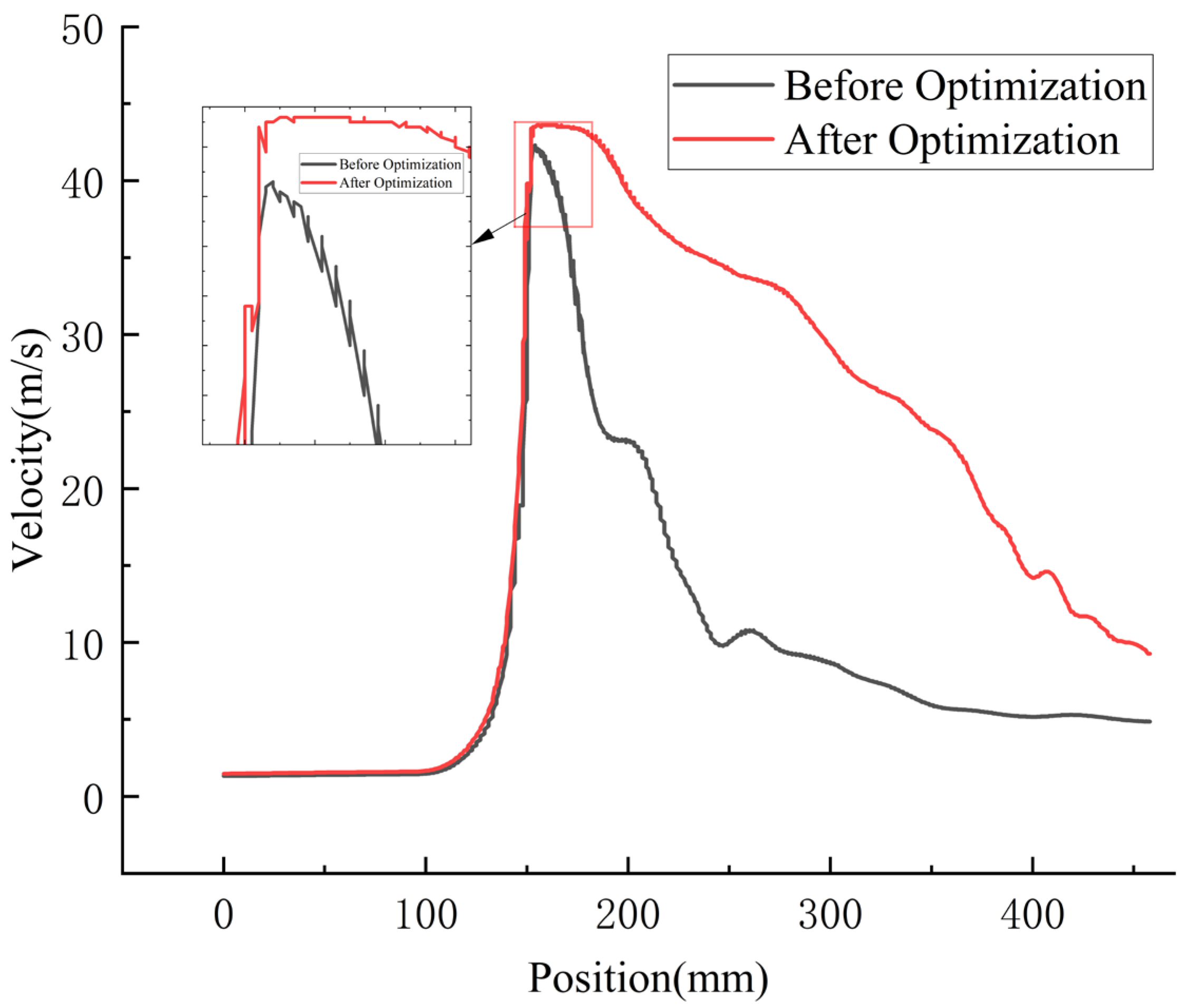
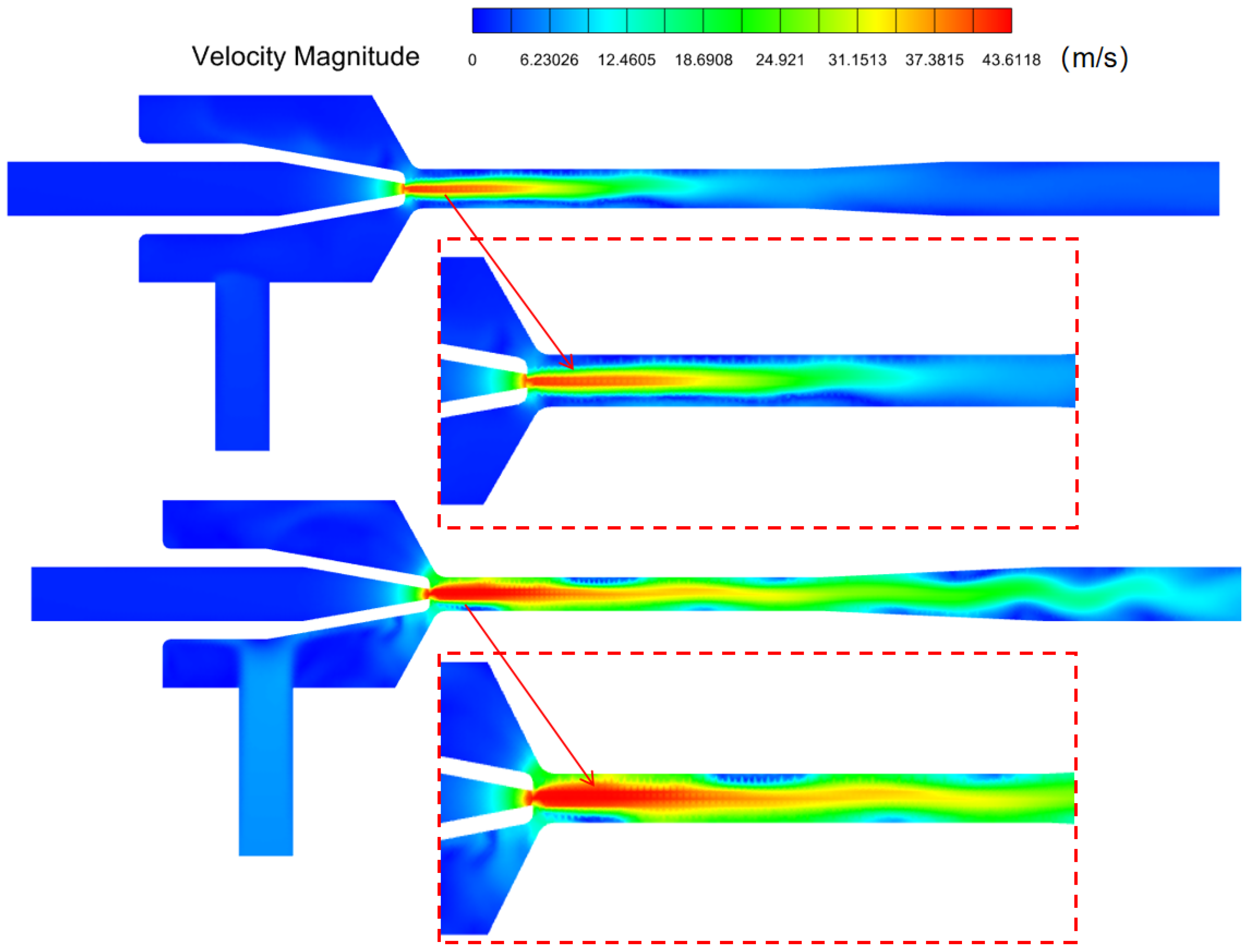
Figure 17 provides a comparative analysis of the axial velocity profiles of the jet pump before and after optimization. From the coordinate origin to the nozzle exit, the velocity distributions of both the original and optimized designs conform to the fundamental principles governing velocity variation in gas–liquid jet pumps. However, near the nozzle exit, the optimized design exhibits a more significant increase in velocity. Specifically, at the nozzle, the axial velocity of the jet reaches its maximum value. After optimization, this peak velocity increases to 43.59 m/s, which is a 3.13% improvement over the pre-optimization peak velocity of 42.26 m/s. Additionally, the optimized jet can sustain a high-speed region (In this paper, the region where the velocity exceeds 37.38 m/s—approximately 6/7 of the maximum velocity—is defined as the high-velocity zone. of approximately 18 mm in the throat section), the exact location of the throat inlet is referenced from the starting cross-section of the throat, whereas the original design only achieves a transient peak velocity without forming a sustained high-speed region. As the distance from the nozzle exit increases, the axial velocity gradually decreases in both designs. However, the optimized design maintains a relatively constant velocity for a longer distance after ejection from the nozzle, before decreasing more gradually compared to the prototype. At the diffuser exit, the mixed jet is ejected. Compared to the prototype, the optimized jet retains a higher velocity at the exit.
Further observations of the velocity contour comparisons of the main structures of the jet pump before and after optimization are illustrated in Figure 18. It is evident that after ejection from the throat, the optimized design exhibits a more uniform velocity distribution compared to the original design, with fewer low-speed regions and more extensive high-speed regions. This indicates that the suction performance of the jet pump has been improved and energy loss has been minimized.
Based on the above analysis, the optimized jet pump achieves a higher velocity peak at the nozzle exit. Furthermore, during injection, an 18 mm long high-velocity zone—whose speed exceeds 37.38 m/s (≈6/7 of the maximum)—forms at the throat entrance, measured from the throat’s starting cross-section and occupying 12.13% of the total throat length. This feature is notably absent in the original design. These characteristics contribute to improved pump performance and efficiency. Additionally, the optimized design reduces the extent of low-speed regions and increases the coverage of high-speed regions, thereby enhancing fluid dynamic efficiency and minimizing energy loss. Collectively, these improvements significantly enhance the overall working performance of the jet pump.

6. Conclusions

This paper, after analyzing the working principle of the liquid–gas jet pump and the current research status all over the world, focused on the three main structures of the jet pump: the nozzle, throat, and diffuser. Based on existing research outcomes, four representative parameters were selected: throat length (L), throat distance (d), area ratio (m), and diffuser angle (θ). Numerical simulation experiments for single-factor optimization of the jet pump were conducted based on the jet pump model established in Section 2.2 of this paper. The study investigated the impact of individual structural parameters on the suction performance of the liquid–gas jet pump. Additionally, response surface methodology was introduced to explore the combined effect of multiple factors on the optimization objective, thereby enhancing the suction performance of the liquid–gas jet pump. The innovations of this study are as follows: Unlike most existing studies that analyze the impacts of individual parameters in isolation, this study identifies the interaction effects between parameters such as throat length-area ratio and nozzle-throat distance-diffuser angle. Meanwhile, it breaks the limitation of traditional optimization methods that only output a single optimal value. Through single-factor gradient simulation and response surface interaction verification, the optimal value ranges (instead of fixed values) for each parameter are determined. The following conclusions were drawn:
(1)
The four factors—throat length L, nozzle-throat distance d, area ratio m, and diffuser angle θ—all have a significant impact on the suction performance of the liquid–gas jet pump, and each has its own optimal value range. Through single-factor and combined multi-factor analysis, this paper determined the value ranges for the design factors as follows: throat length L in the interval [130 mm,150 mm]; throat distance d in the interval [5.4 mm,6 mm]; area ratio m in the interval [9,12.25]; and diffuser angle θ in the interval [5°, 6.5°].
(2)
The optimal parameter combination of the four factors was determined using response surface methodology, with the combined scheme as follows: nozzle-throat length L = 148.39 mm, throat distance d = 5.98 mm, area ratio m = 10.43, and diffuser angle θ = 5.25°. Based on this scheme, the structure parameters of the liquid–gas jet pump resulted in an increase in the driven medium flow rate to 7.129 m3/h, an increase of 4.679 m3/h, representing a 190.66% improvement over the original scheme, thereby achieving an enhancement in the suction performance of the liquid–gas jet pump.
(3)
The optimal scheme predicted by response surface methodology achieved a higher velocity peak at the nozzle exit, reaching 43.59 m/s, a 3.13% increase compared to the pre-optimization value. Additionally, it formed a sustained high-speed region of approximately 18 mm in the throat, which helps maintain fluid kinetic energy and reduce energy loss. The optimized scheme also improved fluid dynamic efficiency by reducing low-speed regions and increasing high-speed regions, enabling the jet pump to maintain velocity more effectively after ejection and decrease at a gentler trend, ultimately enhancing overall performance and efficiency.

Author Contributions

The authors confirm contribution to the paper as follows: Study Conception and Design, Y.J.; Writing—Review and Editing, Z.C. (Zijun Chen); Writing—Original Draft Preparation, H.L.; Investigation and Supervision, Y.T.; Validation, Z.C. (Zhuo Chen); Software. All authors have read and agreed to the published version of the manuscript.

Funding

This work was supported by the National Key Research and Development Program of China (2023YFD190080401).

Data Availability Statement

The original contributions presented in this study are included in the article. Further inquiries can be directed to the corresponding author.

Acknowledgments

The authors would like to express their sincere gratitude to all those who have offered their help and support.

Conflicts of Interest

Authors Hongzhong Lu, Yong Tang, and Zhuo Chen are employed by the Technical Center of Shanghai Kaiquan Pump (Group) Co., Ltd. The remaining authors declare that the research was conducted in the absence of any commercial or financial relationships that could be construed as a potential conflict of interest.

References

  1. Zhang, H.; Zou, D.; Yang, X.; Mou, J.; Zhou, Q.; Xu, M. Liquid–Gas Jet pump: A review. Energies 2022, 15, 6978. [Google Scholar] [CrossRef]
  2. Bai, Y.; Chen, P.; Ma, R.; Qin, S. Numerical simulation of jet-pump performance using ANSYS Fluent. Chem. Eng. Mach. 2022, 49, 52–57, 64. [Google Scholar] [CrossRef]
  3. Dong, J.; Du, Z.; Chen, C.; Xu, G. Numerical investigation of spiral-flow effects on the performance of an annular jet pump. Mech. Sci. Technol. Aerosp. Eng. 2023, 42, 530–537. [Google Scholar] [CrossRef]
  4. Qi, Y.; Liu, B.; Zhang, F.; Diao, X.; Mo, R.; Shang, X.; Huang, F. Research on a negative-pressure jet device for rapid coal-powder removal in coal-bed-methane wells. J. China Univ. Min. Technol. 2014, 43, 72–78. [Google Scholar] [CrossRef]
  5. Dong, M.; Zhao, S.; Zhang, L.; Xu, M. Influence of a control-ratio ring structure on the performance of an annular jet pump. Henan Sci. 2019, 37, 1584–1589. [Google Scholar] [CrossRef]
  6. Zhao, Y.; Chen, Y.; Wang, X.; Wang, B.; Xu, Y. Numerical simulation of the effect of central throat-nozzle distance on the performance of a compound jet pump. Water Resour. Hydropower Eng. 2019, 50, 120–126. [Google Scholar] [CrossRef]
  7. Kwon, O.B.; Kim, M.K.; Kwon, H.C.; Bae, D.S. Two-dimensional numerical simulations on the performance of an annular jet pump. J. Vis. 2002, 5, 21–28. [Google Scholar] [CrossRef]
  8. Kotak, V.; Pathrose, A.; Sengupta, S.; Gopalkrishnan, S.; Bhattacharya, S. Experimental investigation of jet pump performance used for high flow amplification in nuclear applications. Nucl. Eng. Technol. 2023, 55, 3549–3558. [Google Scholar] [CrossRef]
  9. Weng, K.; Sun, C.; Han, K.; Wang, C.; Sun, S.; Li, P.; Hu, J. Experimental/numerical investigation on the hydrodynamic and noise characteristics of pump-jet propulsion. Ocean Eng. 2024, 307, 117995. [Google Scholar] [CrossRef]
  10. Wang, L.; Gan, C.; Ning, P. Numerical study on throat tube inlet function of pulsed liquid jet pump. Adv. Mater. Res. 2012, 354, 650–654. [Google Scholar] [CrossRef]
  11. Xu, X.; Mou, J.; Zhang, H.; Zou, D.; Yang, X.; Liu, X.; Qiu, Z.; Dong, B. Experimental study on performance of liquid-gas jet pump with square nozzle. Energies 2023, 16, 7951. [Google Scholar] [CrossRef]
  12. Zhang, X.; Dai, Z.; Yang, D.; Fan, H. Investigation on optimization design of high-thrust-efficiency pump jet based on orthogonal method. Energies 2024, 17, 3551. [Google Scholar] [CrossRef]
  13. Wang, C.; Weng, K.; Guo, C.; Chang, X.; Gu, L. Analysis of influence of duct geometrical parameters on pump jet propulsor hydrodynamic performance. J. Mar. Sci. Technol. 2020, 25, 640–657. [Google Scholar] [CrossRef]
  14. Myers, R.H.; Montgomery, D.C.; Anderson-Cook, C.M. Response Surface Methodology: Process and Product Optimization Using Designed Experiments; John Wiley & Sons: Hoboken, NJ, USA, 2009. [Google Scholar]
  15. Baş, D.; Boyacı, İ.H. Modeling and optimization I: Usability of response surface methodology. J. Food Eng. 2007, 78, 935–949. [Google Scholar] [CrossRef]
  16. Breig, S.J.M.; Luti, K.J.K. Response surface methodology: A review on its applications and challenges in microbial cultures. Mater. Today Proc. 2021, 42, 2277–2284. [Google Scholar] [CrossRef]
  17. Hadiyat, M.A.; Sopha, B.M.; Wibowo, B.S. Response surface methodology using observational data: A systematic review. Appl. Sci. 2022, 12, 10663. [Google Scholar] [CrossRef]
  18. Lenth, R.V. Response-surface methods in R., using RSM. J. Stat. Softw. 2009, 32, 1–17. [Google Scholar] [CrossRef]
  19. Guan, X. Modern Pump Theory and Design; Aerospace Publishing House: Beijing, China, 2011. [Google Scholar]
  20. Zhu, J.M.; Long, X.P.; Zhang, S.B.; Lu, X. Experiment on performance of adjustable jet pump. In IOP Conference Series: Earth and Environmental Science; IOP Publishing: Bristol, UK, 2012; Volume 15, p. 062063. [Google Scholar] [CrossRef]
  21. Xiang, Q.; Wu, Y.; Li, H.; Yun, Q. The influence of oscillating jet on the liquid jet gas pump’s performance. In ASME Fluids Engineering Division Summer Meeting; ASME: New York, NY, USA, 2012; pp. 413–417. [Google Scholar] [CrossRef]
  22. Wang, L.; Wu, Y.; Ning, P.; Gan, C. Numerical study on performance parameter of pulsed liquid jet pump. Adv. Mater. Res. 2012, 346, 793–796. [Google Scholar] [CrossRef]
  23. Oosterhuis, J.P.; Timmer, M.A.G.; Buhler, S.; van der Meer, T.H.; Wilcox, D. On the performance and flow characteristics of jet pumps with multiple orifices. J. Acoust. Soc. Am. 2016, 139, 2732–2740. [Google Scholar] [CrossRef]
  24. Lu, H. Theory and Application of Jet Technology; Wuhan University Press: Wuhan, China, 1990. [Google Scholar]
  25. Wang, Z.H.; Zhu, J.W.; Zhao, X.F.; Qi, X.; Hong, J. Numerical optimization of duration time for the gravitational sedimentation process of produced water in oilfield. Desalination Water Treat. 2024, 319, 100467. [Google Scholar] [CrossRef]
  26. Nataraj, M.; Singh, R.R. Analyzing pump impeller for performance evaluation using RSM and CFD. Desalination Water Treat. 2014, 52, 6822–6831. [Google Scholar] [CrossRef]
  27. Kumar, R.S.; Kumaraswamy, S.; Mani, A. Experimental investigations on a two-phase jet pump used in desalination systems. Desalination 2007, 204, 437–447. [Google Scholar] [CrossRef]
  28. Zhang, D.S.; Mei, J.; Zhao, R.J.; Huang, J.; Jin, Y. Response surface method-based optimization of impeller of fluoroplastic two-phase flow centrifugal pump. J. Drain. Irrig. Mach. Eng. 2020, 38, 898–903, 921. [Google Scholar]
  29. Hong, S.; Hu, X. Optimization of impeller of deep-sea mining pump for erosive wear reduction based on response surface methodology. Mar. Georesources Geotechnol. 2023, 41, 295–311. [Google Scholar] [CrossRef]
  30. Thakkar, S.; Vala, H.; Patel, V.K.; Patel, R. Performance improvement of the sanitary centrifugal pump through an integrated approach based on response surface methodology, multi-objective optimization and CFD. J. Braz. Soc. Mech. Sci. Eng. 2021, 43, 24. [Google Scholar] [CrossRef]
  31. Babu, M.N.; Muthukrishnan, N. Investigation on surface roughness in abrasive water-jet machining by the response surface method. Mater. Manuf. Process. 2014, 29, 1422–1428. [Google Scholar] [CrossRef]
  32. Peng, C.; Zhang, X.; Gao, Z.; Wu, J.; Gong, Y. Research on cooperative optimization of multiphase pump impeller and diffuser based on adaptive refined response surface method. Adv. Mech. Eng. 2022, 14, 168781. [Google Scholar] [CrossRef]
  33. Alawadhi, K.; Alzuwayer, B.; Mohammad, T.A.; Buhemdi, M.H. Design and optimization of a centrifugal pump for slurry transport using the response surface method. Machines 2021, 9, 60. [Google Scholar] [CrossRef]
  34. Yang, W.; Xiao, R. Multiobjective optimization design of a pump-turbine impeller based on an inverse design using a combination optimization strategy. J. Fluids Eng. Trans. ASME 2014, 136, 014501. [Google Scholar] [CrossRef]
  35. Long, Y.; Tian, C.; Zhu, R.; Yin, J.; Wang, D. Optimization of water-jet pump based on the coupling of multi-parameter and multi-objective genetic algorithms. J. Braz. Soc. Mech. Sci. Eng. 2024, 46, 719. [Google Scholar] [CrossRef]
  36. Lu, Y.; Li, C.; Gu, Z.; Wu, C.; Shao, S. Research on multi-objective optimisation design of pump-jet propulsion. Ocean Eng. 2025, 322, 120086. [Google Scholar] [CrossRef]
  37. Yang, P.; Chen, H.; Liu, Y.-W. Application of response surface methodology and desirability approach to investigate and optimize the jet pump in a thermoacoustic Stirling heat engine. Appl. Therm. Eng. 2017, 127, 1005–1014. [Google Scholar] [CrossRef]
  38. Li, J.; Li, H.; Wang, W.; Wang, Y. Multi-objective optimization design and simulation for fuel centrifugal pump. J. Propuls. Technol. 2021, 42, 666–674. [Google Scholar]
  39. Zhang, R.; Yun, L. Investigation on the effect of slot pulse jet on centrifugal pump performance. Int. J. Fluid Mach. Syst. 2018, 11, 139–145. [Google Scholar] [CrossRef]
  40. Nourbakhsh, A.; Safikhani, H.; Derakhshan, S. The comparison of multi-objective particle swarm optimization and NSGA II algorithm: Applications in centrifugal pumps. Eng. Optim. 2011, 43, 1095–1113. [Google Scholar] [CrossRef]
Figure 1. Schematic diagram of the prototype jet pump structure.
Water 17 03423 g001
Figure 2. Meshing of the computational domain.
Water 17 03423 g002
Figure 3. Effect of mesh size on entrained fluid flow rate.
Water 17 03423 g003
Figure 4. Illustrates the Y Plus values on the surface of the model.
Water 17 03423 g004
Figure 5. Flowchart of the response surface methodology optimization process.
Water 17 03423 g005
Figure 6. Schematic diagram of the jet pump test platform.
Water 17 03423 g006
Figure 7. Comparison of characteristic curves between numerical simulation and experimental verification.
Water 17 03423 g007
Figure 8. Influence of different throat lengths on the flow rate of suction medium.
Water 17 03423 g008
Figure 9. Axial velocity changes in the ejector for different throat lengths.
Water 17 03423 g009
Figure 10. Influence of different Nozzle-throat Distances on the flow rate of suction medium.
Water 17 03423 g010
Figure 11. Axial velocity changes in the ejector for different nozzle-to-Nozzle-throat Distances.
Water 17 03423 g011
Figure 12. Influence of different area ratios on the flow rate of suction medium.
Water 17 03423 g012
Figure 13. Axial velocity changes in the ejector for different area ratios.
Water 17 03423 g013
Figure 14. Influence of different diffuser angles on the flow rate of suction medium.
Water 17 03423 g014
Figure 15. Axial velocity changes in the ejector for different diffuser angles.
Water 17 03423 g015
Figure 16. Influence of Interaction Terms on Suction Flow Rate; (a) The interaction effect between throat length (L) and throat distance (d) on suction flow rate; (b) The interaction effect between throat length (L) and area ratio (m) on suction flow rate; (c) The interaction effect between throat length (L) and diffuser angle (θ) on suction flow rate; (d) The interaction effect between throat distance (d) and area ratio (m) on suction flow rate; (e) The interaction effect between throat distance (d) and diffuser angle (θ) on suction flow rate; (f) The interaction effect of area ratio (m) and diffuser angle (θ) on suction flow rate.
Water 17 03423 g016
Figure 17. Comparison of velocity changes along the axis of the jet pump before and after optimization.
Water 17 03423 g017
Figure 18. Comparison of velocity contours of the main structures of the jet pump before and after optimization.
Water 17 03423 g018
Table 1. Prototype jet pump dimension parameters.
Structure NameDimension
Nozzle Diameter4 mm
Nozzle-throat Distance6.5 mm
Throat Length150 mm
Throat Diameter15 mm
Area Ratio (m)14.06
Diffuser Length54.38 mm
Diffuser Angle
Table 2. Mesh configurations.
Mesh ConfigurationScheme 1Scheme 2Scheme 3Scheme 4Scheme 5
Global Mesh
Size/mm
54321
Total Mesh Count59,107110,811255,428847,2996,564,120
Table 3. Experimental object and equipment parameter.
NameSpecific Introduction
Experimental ObjectJet pump prototype consistent with the numerical simulation model; key parameters refer to Table; material is stainless steel
Driving Fluid SystemHigh-pressure water pump (maximum flow rate 2 m3/h, maximum pressure 2.0 MPa),
electromagnetic flowmeter (range 0–10 m3/h, accuracy ±0.5%)
Suction Fluid SystemAir compressor (maximum pressure 1.0 MPa, flow rate 0–0.2 m3/min), gas mass flowmeter (range 0–0.3 m3/min, accuracy ±1.0%)
Pressure MeasurementPiezoelectric pressure sensor (range 0–2.5 MPa, accuracy ±0.2% FS)
Data AcquisitionData acquisition card (sampling frequency 100 Hz) and supporting analysis software, which records flow rate and pressure data in real time
Table 4. Range of values for influencing factors.
FactorsThroat Length L/mmNozzle-Throat Distance
d/mm
Area Ratio
m
Diffuser Angle
θ/°
Levels
1004.594.5
01255.2510.565.5
+150612.256.5
Table 5. Response Surface Optimization Experimental Scheme Design.
Experimental PlanFactors
Throat Length L/mmNozzle-Throat Distance
d/mm
Area Ratio
m
Diffuser Angle
θ/°
100
2+00
3+00
4++00
500
600+
700+
800++
900
10+00+
1100+
12+00+
1300
140+0
150+0
160++0
1700
18+00
190+0
20+0+0
2100
220+0
2300+
240+0+
250000
260000
270000
280000
290000
Table 6. Numerical simulation results of response surface test.
Experimental PlanFactorsInjected Flow Rate
m 3 /h
Throat Length L/mmNozzle-Throat Distance
d/mm
Area Ratio
m
Diffuser Angle
θ/°
1004.8772
2+005.8919
3+005.826
4++005.8819
5005.2021
600+2.5139
700+5.8321
800++1.9945
9004.8628
10+00+2.6336
1100+3.6857
12+00+5.0701
13004.2519
140+04.7529
150+03.9246
160++04.3422
17005.6564
18+005.2147
190+01.8018
20+0+04.4576
21005.1776
220+05.4855
2300+4.395
240+0+5.9097
2500004.3732
2600004.3501
2700004.3501
2800004.3501
2900004.3501
Table 7. Coefficient values.
CoefficientValueCoefficientValue
Y 1 +0.3055 Y 8 −0.1917
Y 2 +0.4005 Y 9 +0.3017
Y 3 −1.39 Y 10 −0.5025
Y 4 −0.1396 Y 11 +0.2862
Y 5 −0.1291 Y 12 +1.11
Y 6 +1.04 Y 13 −0.0574
Y 7 +0.4467 Y 14 −0.1790
Table 8. Significance Test of Model Equation Coefficients.
FactorSum of SquaresDegrees of FreedomMean SquareF-Valuep-ValueSignificance
Model Equation24.83141.7799.62<0.0001Significant
Throat Length (A)0.514710.514728.910.0007Significant
Nozzle-to-Throat Distance (B)0.927510.927552.1<0.0001Significant
Area Ratio (C)8.5318.53478.98<0.0001Significant
Diffuser Angle (D)0.135210.13527.60.0248Marginally significant
AB0.037710.03772.120.1836Non-significant
AC2.3712.37133.18<0.0001Significant
AD0.42910.42924.090.0012Significant
BC0.054610.05463.070.118Non-significant
BD0.364110.364120.450.0019Significant
CD0.574910.574932.290.0005Significant
A 2 0.369710.369720.760.0019Significant
B 2 5.1315.13288.34<0.0001Significant
C 2 0.012410.01240.69420.4289Non-significant
D 2 0.117110.11716.580.0334Marginally significant
Residuals0.142480.0178
Error of Fit0.14240.0355332.63<0.0001
Pure Error0.000440.0001
Total Sum24.9722
Table 9. Model reliability analysis.
Reference CoefficientValue
Mean4.60
Coefficient of Variation (C.V.)2.90
Coefficient of Determination (R2)0.9943
Adjusted Coefficient of Determination (R2adj)0.9843
Predicted Coefficient of Determination (R2pre)0.8585
Adeq Precision38.1853
Table 10. Comparison of simulation and experimental results for the optimal parameter combination.
Test CountSimulation Result (m3/h)Test Result (m3/h)Error (%)
First Time7.1297.0441.23
Second Time7.1286.9971.89
Third Time7.1326.9492.56
Disclaimer/Publisher’s Note: The statements, opinions and data contained in all publications are solely those of the individual author(s) and contributor(s) and not of MDPI and/or the editor(s). MDPI and/or the editor(s) disclaim responsibility for any injury to people or property resulting from any ideas, methods, instructions or products referred to in the content.