You are currently on the new version of our website. Access the old version .
WaterWater
  • Article
  • Open Access

16 October 2025

The Risk Assessment for Water Conveyance Channels in the Yangtze-to-Huaihe Water Diversion Project (Henan Reach)


,
,
,
and
1
Hubei Key Laboratory of Water Resources & Eco-Environmental Sciences, Changjiang River Scientific Research Institute, Wuhan 430010, China
2
Innovation Team for Basin Water Environmental Protection and Governance of Changjiang River Resources Commission, Wuhan 430010, China
3
School of Civil and Hydraulic Engineering, Huazhong University of Science and Technology, Wuhan 430074, China
*
Author to whom correspondence should be addressed.
This article belongs to the Section Water Resources Management, Policy and Governance

Abstract

Water conveyance channels, as critical components of water diversion projects, feature numerous structures, complex configurations, and intensive operational management requirements, making them vulnerable to multiple risks, such as extreme flooding, channel blockage, structural failures, and management deficiencies. To ensure an accurate assessment of the operational safety risk, this study proposes a comprehensive risk assessment framework that integrates risk probability and risk loss. The former is quantified using the Consequence Reverse Diffusion Method (CRDM), which systematically identifies and categorizes key factors of primary dike failure modes into four domains: hydrological characteristics, channel morphology, engineering structures, and operational management. The latter is assessed by integrating socioeconomic impacts, including population exposure, infrastructure investment, and industrial and agricultural production. A structured assessment framework is established through systematic indicator selection, justified weight assignment, and standardized scoring criteria. Application of the framework to Yangtze-to-Huaihe Water Diversion Project (Henan Reach) reveals that the risk probability across four segments falls within the (1, 3) range, indicating a generally low to moderate risk profile, while channel morphology shows greater spatial variability than hydrological, structural, and management indicators, driven by local differences in crossing structure density, sinuosity, and regime coefficients. Meanwhile, the segments along the Qingshui River face higher risk losses owing to their upstream location and large-scale water supply capacity, resulting in a relatively higher comprehensive risk level.

1. Introduction

Climatic variability, topographic differences, and seasonal rainfall patterns have caused significant spatial imbalances in water availability, leading to supply–demand mismatches that hinder sustainable development in water-scarce regions [1,2,3,4]. To address this challenge, numerous water diversion projects have been developed in the past few decades, such as the South-to-North Water Diversion (Middle and Eastern Routes), Brazil’s cross-basin water transfer, and the Yangtze-to-Huaihe River Water Diversion Project [1,5,6].
In recent years, numerous studies have been conducted on diverse risks associated with large-scale water diversion projects. Some studies have examined the economic [7,8,9], social [9], and environmental impacts [10] in both water-supplying and water-receiving areas at the macro level. As the main component of water diversion projects, conveyance channels face significant safety risks and have therefore drawn extensive scholarly attention. Some studies have focused on individual risk factors affecting operational safety, including hydrological risks such as flood [11,12,13,14], geological risks such as landslides [15], and water quality safety risks such as pollutants migration and transformation patterns [16,17,18].
For example, Fu et al. [13] established a systematic approach to flood control risk assessment by integrating the dimensions of hazard, exposure, and vulnerability, leading to the development of a structured index system. Do and Yin [15] proposed a rainfall threshold and a Bayesian probability model to assess shallow landslide occurrence in Ha Giang City and surrounding areas, Vietnam, using daily rainfall data in conjunction with historical landslide event data; Barco et al. [17] developed a multi-tier analytical framework that integrates remote sensing, GIS, and Bayesian Networks with openly available Earth Observation data to assess the pollutant transport and diffusion mechanisms. However, these studies primarily focus on single factor analysis, particularly extreme events, with relatively limited attention paid to risks under normal operational conditions. Other studies adopt multi-dimensional perspective, incorporating hydrological, engineering, and operational management factors [19,20]. For instance, Geng et al. [19] developed an analytic hierarchy process (AHP)-based framework to assess operational risks in the Eastern Route of the South-to-North Water Diversion Project. The approach integrates factors related to external load, internal structure, and operational management, and uses channel length as a proxy for estimating failure consequence levels. Ma and Liu [20] explored a risk assessment model based on a fuzzy inference system according to critical failure modes, enabling the calculation and ranking of risk priority levels. Moreover, research efforts have been directed toward the risk assessment of key hydraulic structures in water transfer systems, including pump stations [21], beam-type aqueducts [22], and river crossing works. Existing assessment frameworks adequately address external loads and structural risks, but often overlook key channel morphological features, such as spatial morphology (e.g., cross-sectional, longitudinal profiles, and crossing structures) and sedimentation-erosion dynamics, which critically influence water supply and drainage performance. This results in an incomplete risk profile. Furthermore, given the strong anthropogenic interference inherent in water conveyance channels, operational management factors require more precise consideration. Importantly, risk arises from the combined effect of failure likelihood and consequence severity. While existing research focuses predominantly on the former, the latter remains understudied, creating a critical gap in comprehensive risk assessment.
To address these limitations, this study proposes a comprehensive risk assessment framework through the following key steps: (i) developing a multidimensional risk probability assessment system based on risk identification; (ii) formulating a risk loss index S to describe severity of failure consequences; (iii) establishing a comprehensive risk assessment framework that integrates risk probability and risk loss; (iv) applying the proposed framework to Yangtze-to-Huaihe Water Diversion Project (Henan Reach) as a case study, providing a scientific basis for risk management.

2. Study Area

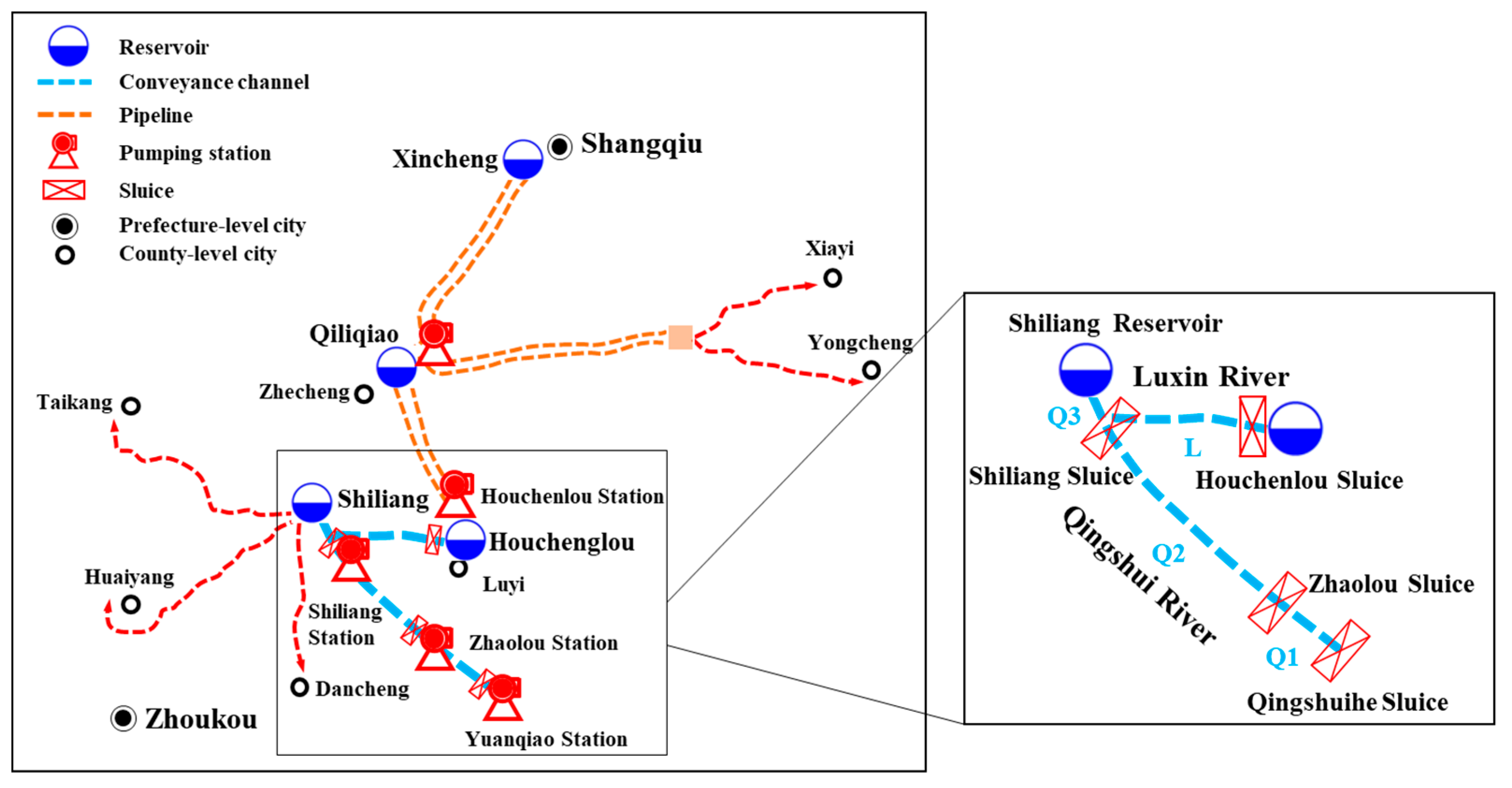
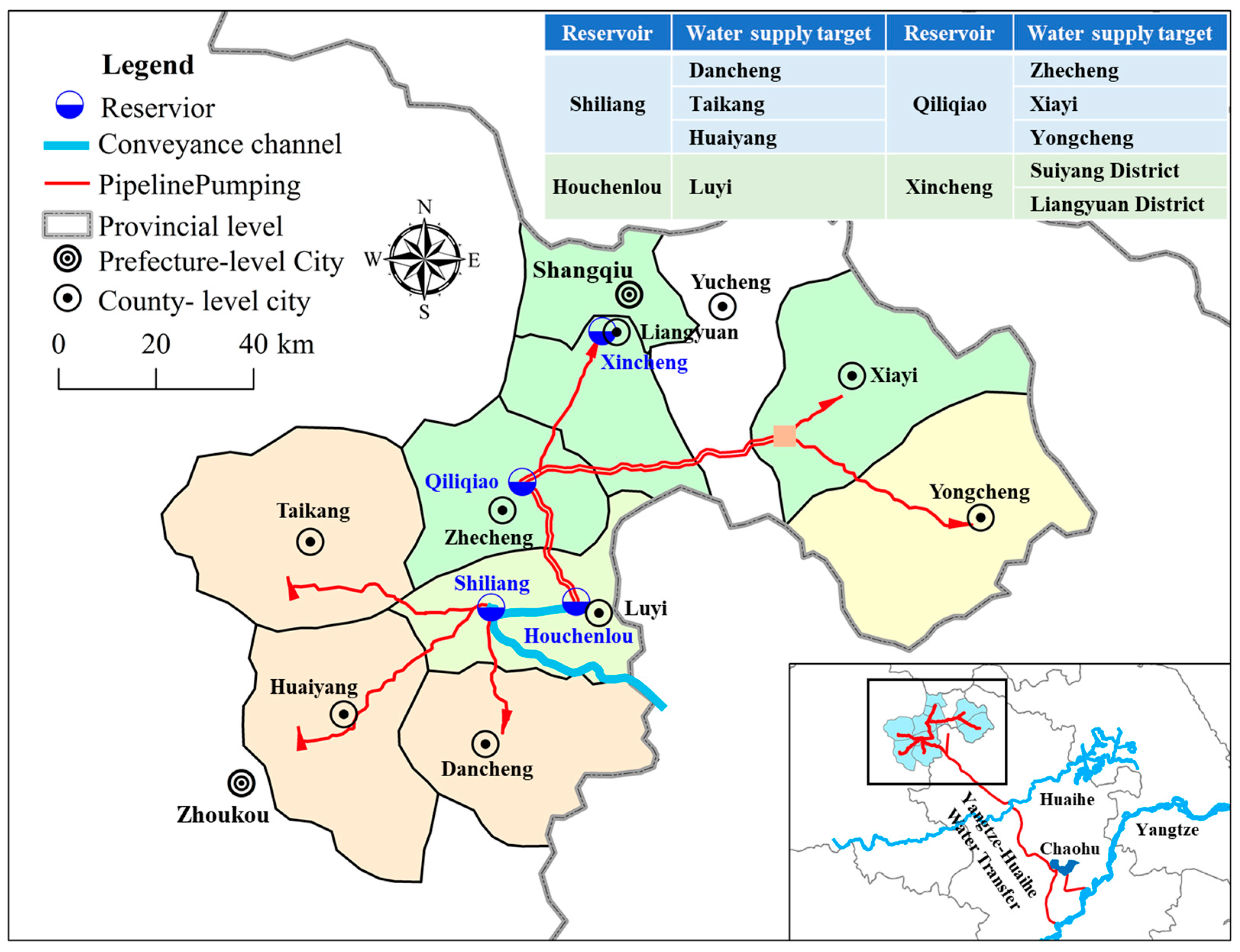
The Yangtze-to-Huaihe Water Diversion Project is an inter-basin water transfer initiative focused on optimizing regional water resource distribution and enhancing comprehensive utilization, with a primary emphasis on urban and rural water supply. Stretching from south to north, the project consists of three key components: (1) diverting water from the Yangtze River to Chaohu Lake, (2) establishing a hydraulic link between the Yangtze and Huaihe River basins, and (3) conveying water northward from the Yangtze River. Administratively, the project can be divided into two components: the Henan Reach and the Anhui Reach. This study focuses on the Henan Reach. The water conveyance system supplies nine administrative regions through the Qingshui River and Luxin River. The service areas comprise Dancheng, Taikang, Huaiyang, Liangyuan District, Suiyang District, Yongcheng, Xiayi, Zhecheng, and Luyi. The system’s water flow is regulated by four reservoirs: Shiliang, Houchenlou, Qiliqiao, and Xincheng. Figure 1 illustrates the geographical layout and the water supply area. For a comprehensive understanding of regional water demand characteristics, Table 1 summarizes the key socioeconomic information for each water supply target, including population, industrial value-added. Table 2 provides detailed data on water demand.
Figure 1. Schematic diagram of the water supply area of the Yangtze-to-Huaihe Water Diversion Project (Henan Reach).
Table 1. Statistics on the socioeconomic scale of each water supply target.
Table 2. Statistics on the water demand of each water supply target (×106 m3).
The Henan Reach features a complex engineering layout comprising two water conveyance channels, five pumping stations, and four regulating reservoirs. Delineated by key control sluices, these channels are divided into four primary segments: (1) Qingshuihe Sluice–Zhaolou Sluice (Q1), (2) Zhaolou Sluice–Shiliang Sluice (Q2), (3) Shiliang Sluice–Shiliang Reservoir (Q3), and (4) Shiliang Sluice–Houchenlou Sluice (L). The first three segments are located along the Qingshui River, where the Qingshuihe Sluice, Zhaolou Sluice, and Shiliang Reservoir serve as major regulation nodes. In contrast, the fourth segment L lies on the Luxin River, connecting to Houchenlou Sluice and Houchenlou Reservoir. The schematic layout of the entire system, highlighting the spatial arrangement of channels, sluices, and reservoirs, is shown in Figure 2, and the corresponding basic information are summarized in Table 3.
Figure 2. Schematic diagram of engineering structures of the Yangtze-to-Huaihe Water Diversion Project (Henan Reach).
Table 3. Segments characteristics of Yangtze-to-Huaihe Water Diversion Project (Henan Reach).

3. Comprehensive Risk Assessment Framework for Water Conveyance Channels

3.1. Risk Probability Assessment System for Water Conveyance Channels

3.1.1. Consequence Reverse Diffusion Method

The Consequence Reverse Diffusion Method (CRDM) is a systematic, deductive approach that traces risk factors back from failure modes. It follows a structured hierarchical framework that includes the following steps: failure types, triggering causes, risk factors, factor categorization, indicator establishment and selection [23,24]. Compared to traditional risk identification methods such as Fault Tree Analysis, Expert Survey Method, and Scenario Analysis, CRDM demonstrates distinct advantages in comprehensively identifying multiple risk factors that contribute to consequences. It effectively avoids omission of crucial risk factors while preventing redundancy among similar factors, thereby ensuring the singularity, independence, comprehensiveness, and representativeness of the resulting assessment indicator system. In recent years, CRDM has been successfully applied in various fields including mountain flood disaster risk assessment and fluvial river dike safety analysis, demonstrating strong adaptability and practical effectiveness. Given its structured framework and consequence to cause logic, CRDM is ideally suited to engineered water conveyance systems, which are characterized by high interdependency among structural, hydrological, and operational components.

3.1.2. Identification of Operational Safety Risk Factors

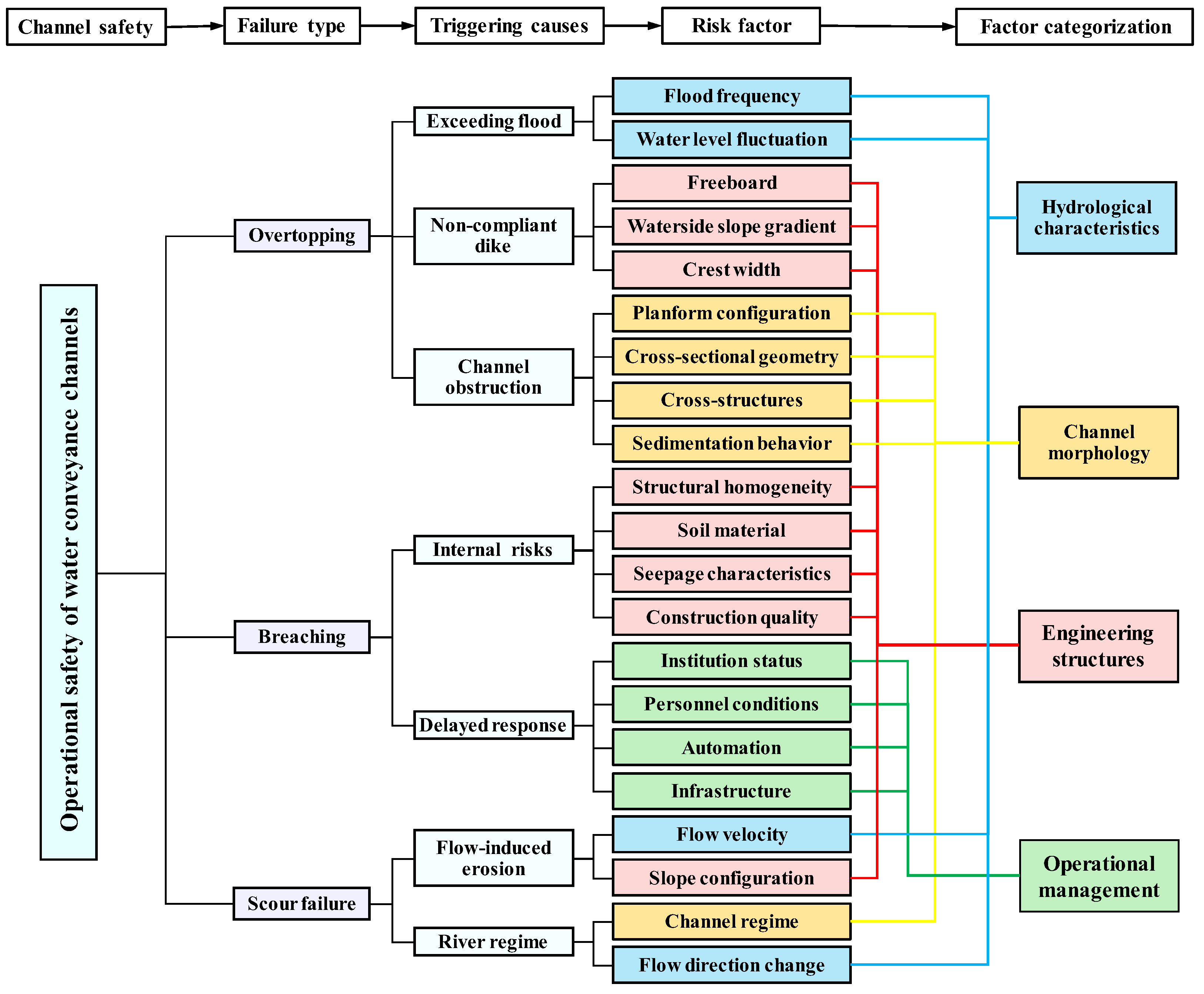
To systematically identify and organize the relevant risk factors, this study employs the CRDM process illustrated in Figure 3. The process encompasses five components: channel safety, failure types, triggering causes, associated risk factors, and factor categorization.
Figure 3. Risk factor identification process in water conveyance channels based on CRDM.
Dike failure is recognized as the principal safety hazard threatening the operation of conveyance channels in water diversion projects, typically occurring in three forms: (1) overtopping, caused by sustained high water levels or wind-driven wave run-up; (2) internal seepage, leading to soil instability within the dike body or foundation; and (3) partial or complete structural collapse, induced by prolonged hydraulic actions [25,26,27]. The principal failure modes, namely overtopping, breaching, and scour failure, may be triggered by various causes. Overtopping failures are generally associated with extreme flood events, non-compliant dike conditions, and channel obstructions. Breaching failures are primarily influenced by internal factors such as weak foundation conditions, unfavorable dike material properties, and delayed response, the latter being highly dependent on management capacity. Scour failures are mainly driven by flow-induced erosion and alterations in channel regime. Building on these identified triggering causes, a series of risk factors were selected and categorized into four major dimensions: regional hydrological conditions, channel morphology, engineering structures, and operational management practices. In contrast to natural rivers, water conveyance channels in water diversion project are distinguished by two defining features: the high density of crossing structures (e.g., sluices, pumping stations, and bridges) and the intensive role of human operational management. Both aspects are explicitly emphasized in this study to ensure the framework reflects the unique characteristics of diversion channels.

3.1.3. Construction of Risk Probability Assessment System

The proposed risk probability assessment system was guided by three key principles: (1) direct relevance to the operational safety of water conveyance channels; (2) measurability and data availability, enabling quantification based on existing hydrological surveys and operational records; and (3) consistency with the CRDM framework, with each indicator directly traceable to primary failure modes such as overtopping, breaching, and scouring. The details are as follows:
(1)
Hydrological characteristics
Along water diversion project routes, hydrometeorological conditions vary significantly in space and are highly complex due to the diverse climatic zones and topographic features [28]. Consequently, in addition to routine water transfer operations, conveyance channels are often required to serve emergency flood control functions during extreme events. Under these circumstances, extreme floods represent the most intense external hydrological loads, and the flood frequency (D1) is designed to effectively characterize the magnitude of these loads [29]. Moreover, fluctuations in flow direction and water level are also critical factors that influence bank safety, and thus the flow condition (D2) is selected [30].
(2)
Channel morphology
Water conveyance channels in diversion projects often feature a high density of cross-structures (e.g., sluices, pumping stations, and bridges), which disrupt natural flow patterns and increase the flood conveyance pressure due to the reduced channel cross-sectional area. Therefore, crossing structure density (D3) is selected as an indicator [31]. Meanwhile, the sinuosity coefficient (D4) is used to represent the channel’s planform configuration, as higher sinuosity increases flow path and reduces conveyance efficiency [32]. The river regime coefficient (D5), defined as ratio of square root of channel width to average depth, characterizes cross-sectional geometry and strongly influences hydraulic stability and overall channel performance [33]. Furthermore, since many channel reaches traverse agricultural lands and are susceptible to sediment inflow, sedimentation intensity (D6) is included to assess the risk of riverbed deposition and its impact on flow capacity [34].
(3)
Engineering structures
Dike failure modes are closely associated with the structural configuration, seepage conditions, and overall stability of both the dike body and its foundation. Accordingly, the assessment system in this study is organized into three principal dimensions: dike structures, foundation properties, and construction materials, based on established evaluation documents, including the Standardized Management Evaluation Criteria for Dike Projects, the River and Lake Health Assessment Guidelines, and the Guidelines for Levee Safety Evaluation (SL/Z 679-2015) [35]. The structural dimension consists of flood standard compliance (D7), bank stability (D8), and revetment integrity (D9). The foundation dimension includes foundation seepage characteristics (D10) and foundation compaction degree (D11). The construction material dimension evaluates the material seepage characteristics (D12) and compaction degree (D13) of the dike body [19,36].
(4)
Operational management
The quality of operational management in water conveyance channels is a critical component of safety assessment. Effective management must address both routine operations and emergency response, involving institutional systems, personnel capability, automation, and infrastructure support. The institutional implementation dimension consists of organization completeness (D14), scheme rationality (D15), operational plan implementation (D16), and emergency plan completeness (D17). The personnel dimension includes personnel structure suitability (D18) and personnel technical proficiency (D19). The automation dimension evaluates monitoring automation maturity (D20), control automation level (D21), and office automation degree (D22). The infrastructure dimension considers material reserve adequacy (D23), transport accessibility (D24), and communication and power supply (D25) [37].

3.1.4. Wight Assignment of Risk Probability Assessment System

Indicator weights are determined using AHP, which systematically quantifies the relative importance of risk factors by incorporating expert judgment [38]. The main steps:
(i) Through hierarchical decomposition of the assessment goal, four senior experts and decision-makers from engineering management company were invited to assess the importance of indicators by constructing judgment matrices. The matrix elements 1, 3, 5, 7, and 9 represent equal, slight, moderate, strong, and extreme importance, respectively;
(ii) Calculating the weight vector: normalize each column of the judgment matrix and compute the average value of each row;
(iii) Calculating the consistency index and consistency ratio of the judgment matrix to test the matrix’s consistency.
The calculation of consistency index CI is shown in Equation (1) as below:
C I = λ m a x n n 1 ,
where λ m a x denotes the maximum eigenvalue of the judgment matrix; n denotes the order of the matrix.
The average random consistency index RI can be derived from Table 4.
Table 4. Average Random Consistency Index RI.
Then, the consistency ratio CR can be obtained as follows:
C R = C I / R I .
The smaller the value of the consistency ratio (CR), the better the consistency of the judgment matrix. When CR < 0.1, the consistency of the judgment matrix is considered acceptable. If CR ≥ 0.1, the consistency is deemed unsatisfactory, and the process should return to the first step for revision.
The judgment matrices for the criterion and sub-criterion layers of the obtained risk probability system are as follows:
A = 1 2 1 3 / 2 1 / 2 1 2 / 3 1 1 3 / 2 1 6 / 5 2 / 3 1 5 / 6 1 ,
B 2 = 1 2 1 / 2 1 ,
B 3 = 1 3 / 4 4 / 5 4 / 3 1 6 / 5 5 / 4 5 / 6 1 ,
B 4 = 1 3 / 4 4 / 5 4 / 5 4 / 3 1 6 / 5 6 / 5 5 / 4 5 / 6 1 1 5 / 4 5 / 6 1 1 .
The calculated weight results and consistency index (CR) values are shown in Table 5. Similarly, the above procedure is applied to determine the weights of the indictor layer for risk probability, and the detailed process is not repeated here.
Table 5. Calculated weight results and consistency index values.
Based on the indicators selection and weight assignment results above, the operational safety risk probability assessment system for water conveyance channels in inter-basin water transfer projects is structured as follows (Table 6 and Table 7):
Table 6. The operational safety risk probability assessment indicator and weight for water conveyance channels.
Table 7. Standard for risk probability assessment indicators of water conveyance channels.

3.2. Risk Loss Index for Water Conveyance Channels

As widely acknowledged, risk is determined by the combination of event probability and potential consequences. Assessing probability alone is insufficient to capture the operational risks of water conveyance channels; therefore, evaluating the severity of potential consequences, that is, the associated losses or impacts, is equally critical. However, the structural complexity and vast spatial extent of water conveyance channels pose significant challenges to quantifying risk loss, resulting in a notable lack of research in this area.
To address this gap, this study adapts a risk consequence assessment principle originally developed for dam failures, which classifies consequences into three main categories: loss of life, economic losses, and social and environmental impacts [39]. For the Yangtze-to-Huaihe Water Diversion Project (Henan Reach), the relatively small design discharge and predominantly agricultural land use along the channel suggest a low likelihood of life loss. Meanwhile, environmental impacts are highly complex and data resources are limited, making them impractical to quantify. Given these limitations, this study focuses on a preliminary assessment of failure consequences in terms of economic and social losses. Further study may consider the influence on the nature reserve zone, biodiversity, or soil erosion, etc.
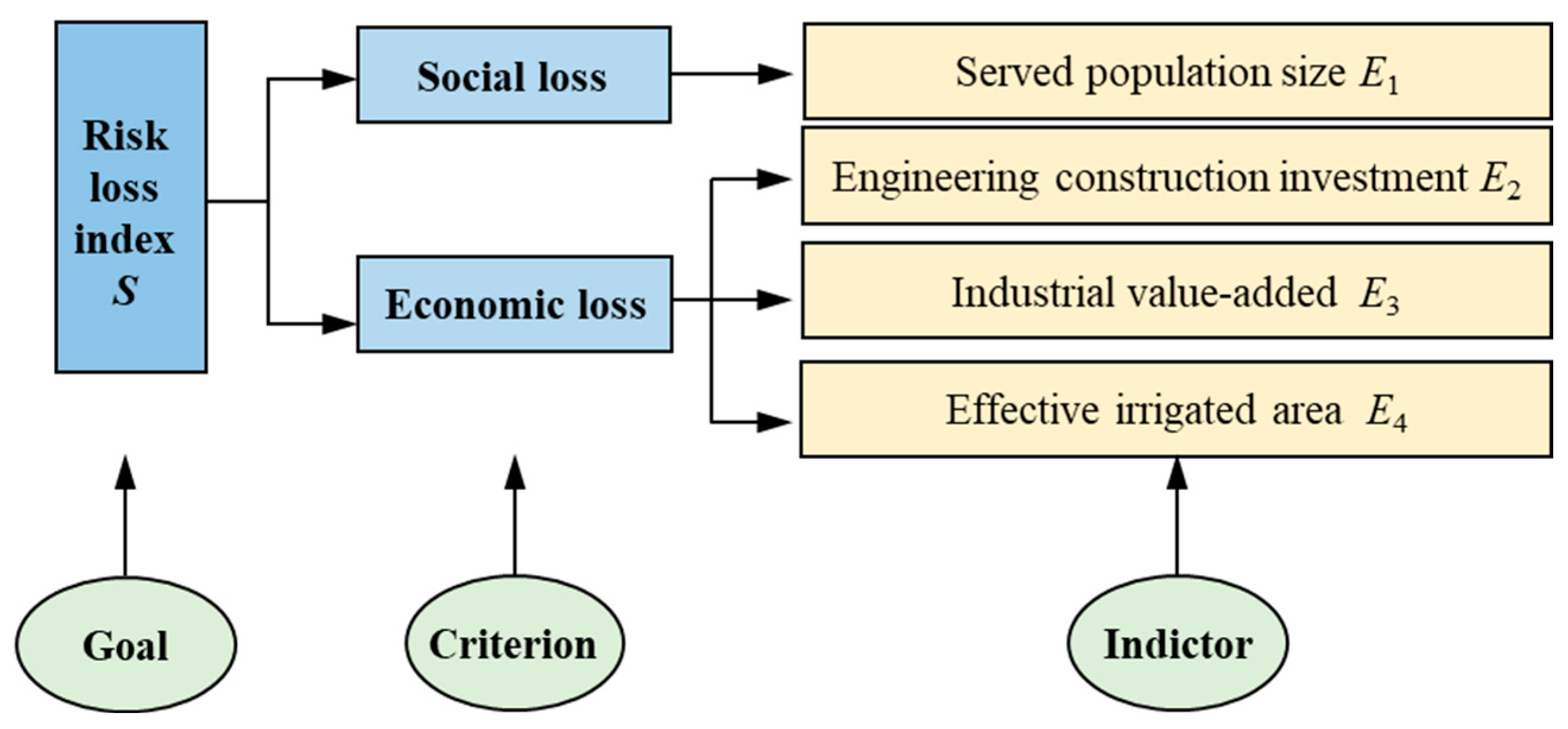
Given these challenges, this study focuses on a preliminary assessment of failure consequences in terms of economic and social losses. Damage to engineering structures directly results in economic losses, and given the project’s critical role in water supply, the scale of these losses is strongly associated with the local levels of industrial and agricultural development. Herein, three indicators, engineering construction investment, industrial value-added, and effective irrigated area, are selected to characterize economic loss. Additionally, the scale of the affected population is used to quantify the degree of social loss. Furthermore, the assessment system for the risk loss index S is represented in Figure 4, and the indicator weights and scoring criteria are provided in Table 8 and Table 9, respectively. The scoring criteria refers to previous studies on water diversion risk assessment, and adapted to the specific conditions of the Henan Reach. For example, the thresholds for the engineering construction investment and industrial value criteria were refined based on project records and expert judgment [31]. It should be noted that establishing accurate grading criteria for risk loss levels in water conveyance channels is highly challenging. To enable quantitative analysis of failure consequences, the preliminary system proposed above, designed to reflect the relative magnitude of potential impacts, serves as an ordinal indicator of impact severity and is not intended to represent absolute loss magnitudes.
Figure 4. Assessment system for the risk loss index S.
Table 8. The indicator weights of risk loss assessment indicator for water conveyance channels.
Table 9. Standard for Risk Loss Assessment Indicators of Water Conveyance Channels.

3.3. Integration of Risk Probability and Loss for Comprehensive Assessment

According to the assessment system of risk probability and risk loss proposed above, the comprehensive risk assessment framework of water conveyance channels can be established:
A = β a i W a i ,
S = β s i W s i ,
where A and S represent the risk level of risk probability and risk loss, respectively; β a i and β s i denote the risk probability level and risk loss level of the i-th indicator, respectively; and W a i and W s i are their corresponding comprehensive weights.
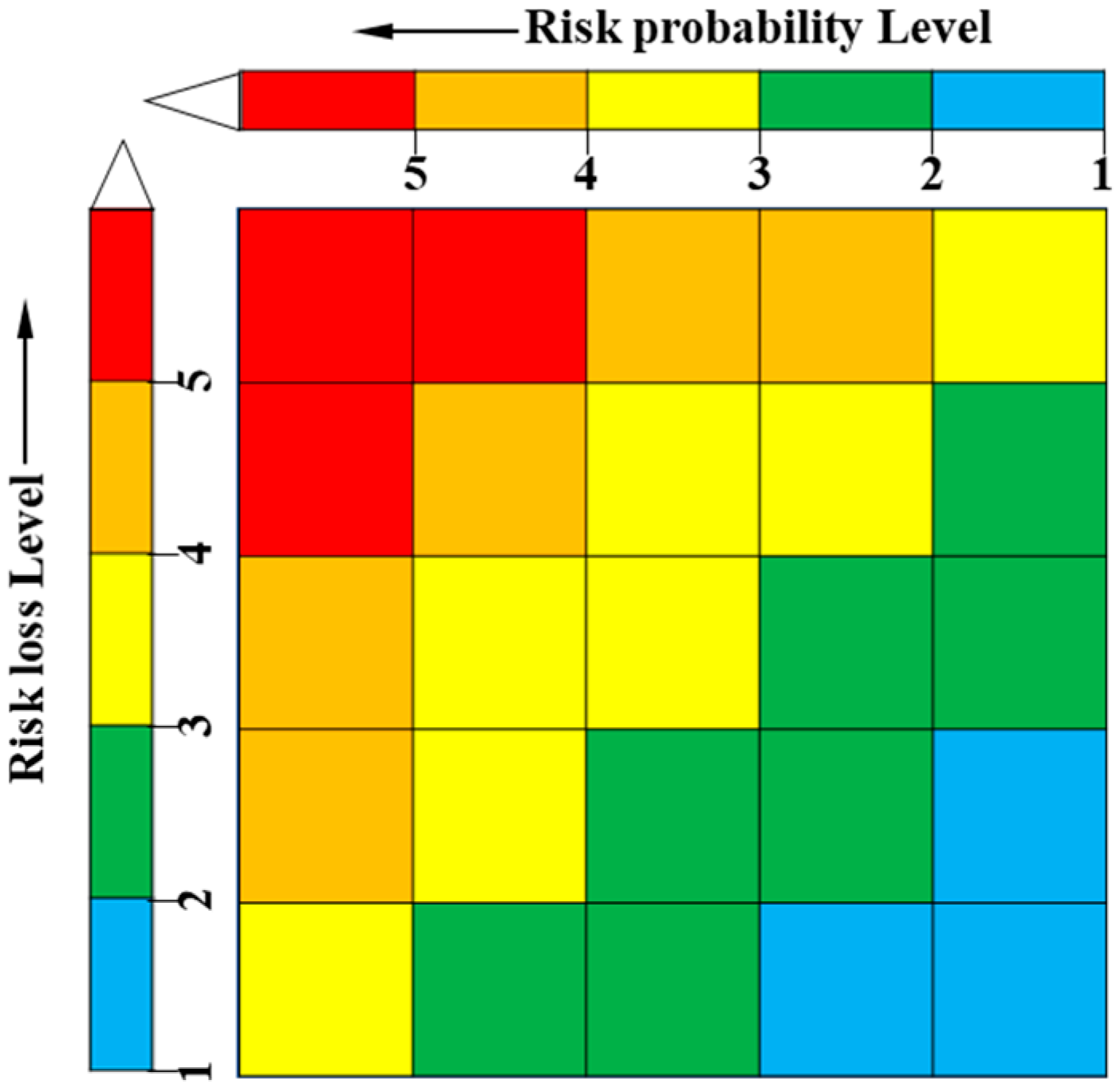
A two-dimensional risk matrix, integrating the risk probability A and the risk loss S, is proposed to determine the comprehensive operational safety risk classification for water conveyance channels, as shown in Figure 5. The consistent color gradient from blue to red indicates increasing risk severity, representing low, relatively low, moderate, relatively high, and high risk levels, respectively.
Figure 5. The comprehensive assessment standards of operational safety risk. Note: The direction of the arrow indicates an increased risk level.

4. Case Application for Water Conveyance Channels in the Yangtze-to-Huaihe Water Diversion Project (Henan Reach)

4.1. Risk Probability Assessment for Water Conveyance Channels

4.1.1. Individual Indicator Values

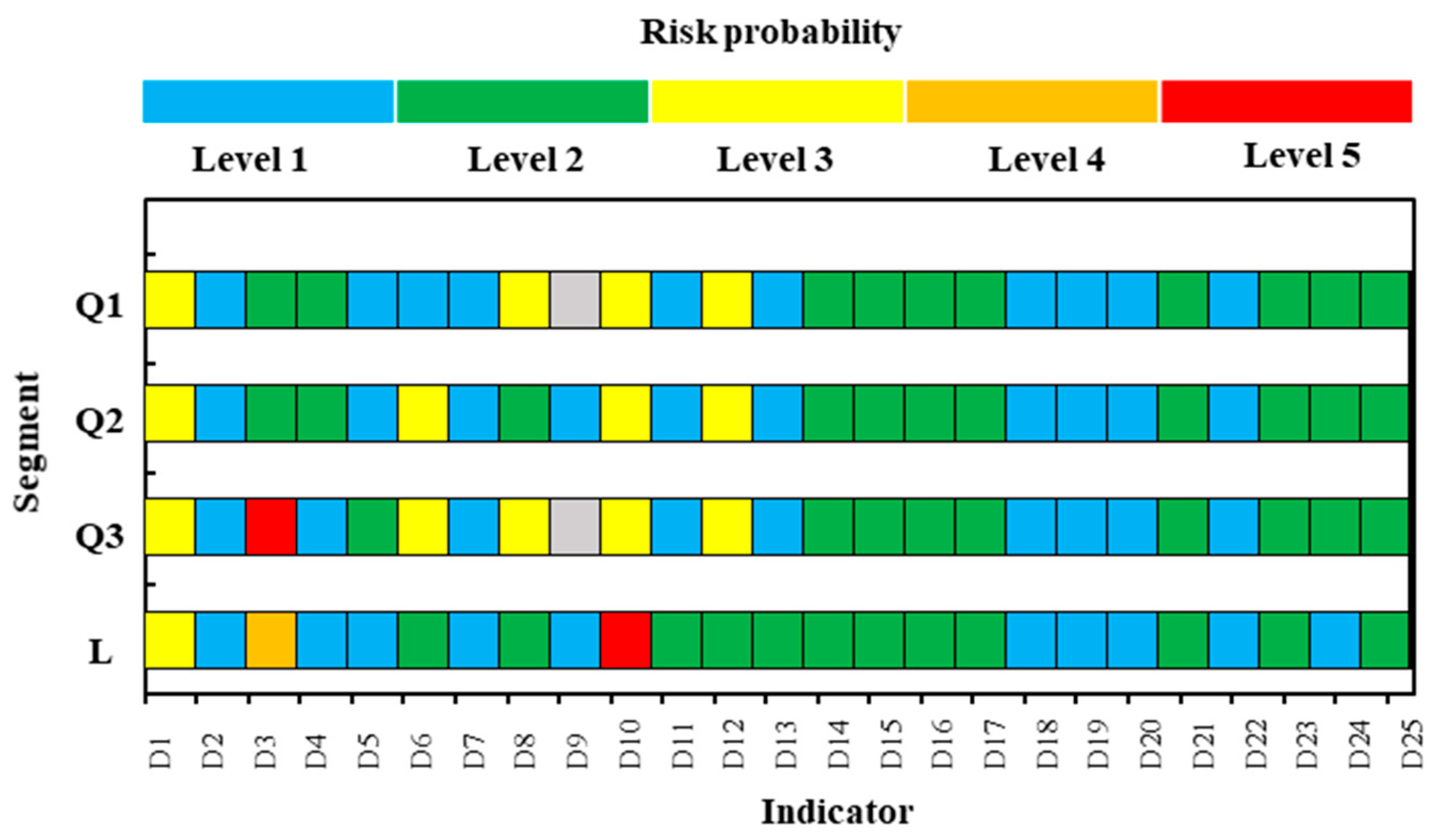
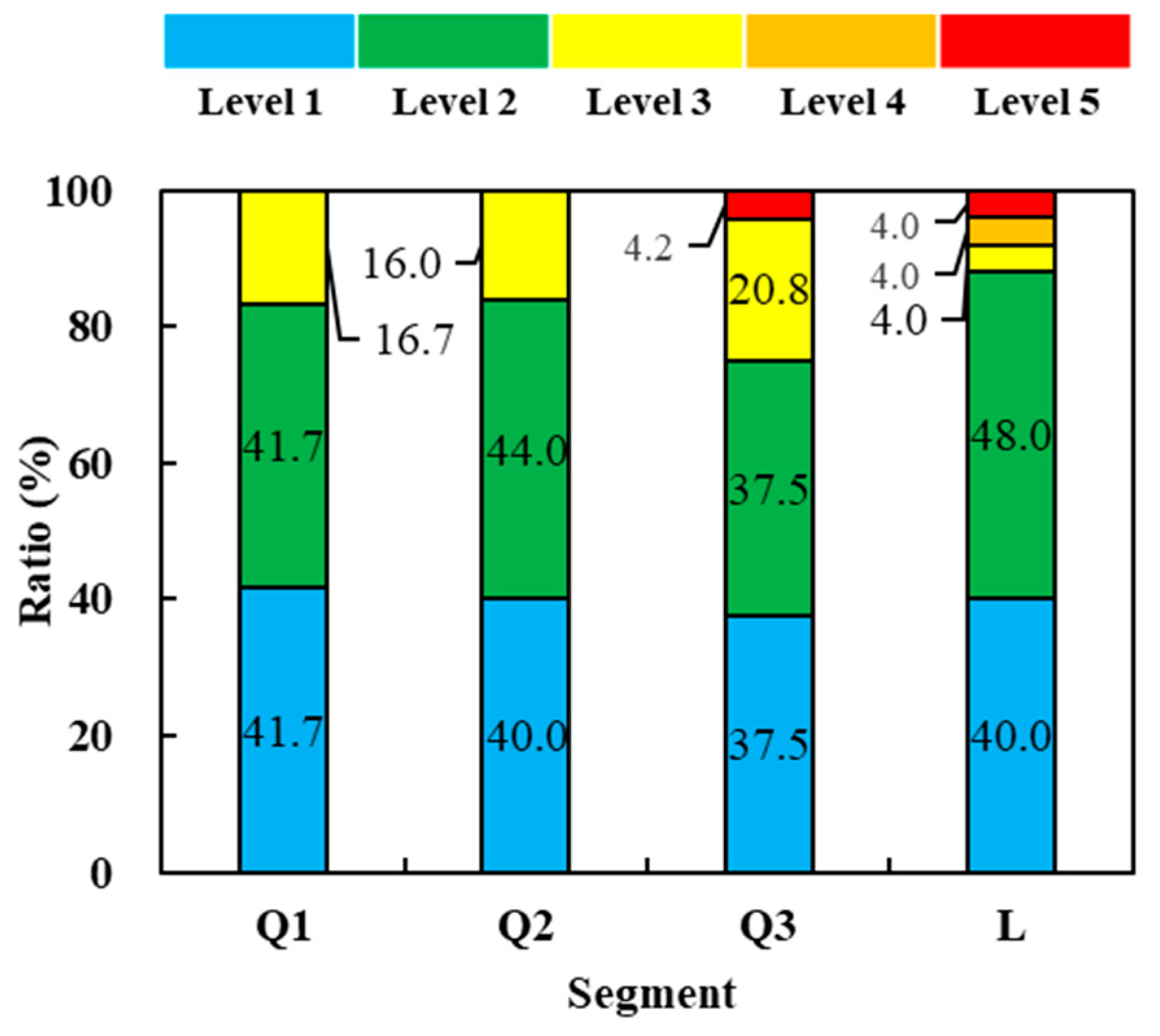
Figure 6 presents the operational safety risk probabilities for individual indicators across the studied segments, while Figure 7 illustrates the distribution of their risk levels. As shown in the individual indicator results (Figure 6), for the four segments Q1, Q2, Q3, and L, the number of Level 1 indicators is 10, 10, 9, and 10, respectively; Level 2 indicators are 10, 11, 9, and 12; Level 3 indicators are 4, 4, 5, and 1; Level 4 indicators are 0, 0, 0, and 1; and Level 5 indicators are 0, 0, 1, and 1. The vast majority of individual indicators are classified as either Level 1 or Level 2, indicating generally low risk across the system. As shown in the distribution (Figure 7), Level 1 and Level 2 indicators predominate across the four segments. The proportions of Level 1 indicators are 41.7%, 40.0%, 37.5%, and 40.0%, respectively, while those of Level 2 indicators are 41.7%, 44.0%, 37.5%, and 48.0%. Level 3 indicators constitute a moderate share, ranging from 4.0% to 20.8%. In contrast, higher-risk levels are rare: Level 4 occurs only in reach L (4.0%), corresponding to the crossing structure count (D3); Level 5 is observed exclusively in reaches Q3 and L, each at 4.0%, attributed to D3 in Q3 and foundation seepage characteristics (D10) in L.
Figure 6. Risk probability levels of individual indicators for each segment. The Q1 and Q3 lack revetments, resulting in missing values for indicator D9. The weight of D9 is therefore proportionally redistributed to the other indicators, and gray blocks are used to indicate corresponding location.
Figure 7. Distribution of risk probability indicators.
Notably, both the overall risk level and individual risk indicators should be considered, as safety failures in water conveyance systems are often triggered when one or more risk factors exceed their critical thresholds. Although, the overall risk probability across all channel reaches is generally low. However, several individual risk indicators exhibit elevated levels, signaling localized vulnerabilities. The flood characteristics indicator reached Level 3, primarily due to extreme hydrological events such as Typhoon Rumbia (No. 18) in 2018, which caused severe flooding in Shangqiu City and resulted in peak discharges on the Qingshui River and Luxin River exceeding the 50-year return period. Similarly, the sedimentation intensity indicator reached Level 3 in the Q2 and Q3. This is attributed to their flat-bottomed channel design, minimal longitudinal riverbed slope, which collectively impair sediment transport capacity and aggravate deposition. Furthermore, the crossing structures indicator registered the highest risk grades, Level 5 and Level 4, in the Q3 (0.75 km, 2 crossings) and L (16.26 km, 19 crossings), respectively. These high values reflected the exceptional structural complexity and hydraulic interference associated with dense concentrations of cross-channel infrastructure, which can amplify operational failure potential.

4.1.2. Criterion-Level Analysis

Table 10 presents a comparison of risk probabilities across the different segments at the criterion level. It can be observed that the risk probabilities under the operational management criterion are significantly lower than those under other criteria across all reaches, remaining below Level 2. This is consistent with the project’s status as a newly constructed water diversion system, which features well-established risk management protocols, qualified technical personnel, a high degree of automation, and comprehensive facility configurations. Meanwhile, risk probabilities under the hydrological characteristics and engineering structures criteria exhibit minimal variation, ranging from 2.0 to 2.5. This uniformity is attributed to the limited geographical extent of the study area, as well as similar regional hydrological conditions and comparable dike structures, foundation properties, and construction materials. Notably, the channel morphology criterion exhibits significant variability, with values of 1.50, 2.16, 3.17, and 2.34 for Q1, Q2, Q3, and L, respectively, indicating the lowest risk in Q1 and the highest in Q3. This discrepancy is primarily due to the high density of cross structures, elevated river sinuosity, and high hydraulic geometry coefficients in Q3, all of which amplify flow conveyance instability and associated risks.
Table 10. Risk probability assessment results across channel reaches at the criterion level.

4.1.3. Comprehensive Risk Probability

Using the weighted function described in Section 3.3, the comprehensive risk level for each studied segment can be evaluated. As shown in Table 11, the risk indices for Q1, Q2, Q3, and L of the water conveyance channel of the Yangtze-to-Huaihe Water Diversion Project (Henan Reach) are 1.97, 2.05, 2.29, and 2.22, respectively, all within the (1, 3], indicating generally low to moderate risk across the system. Reach Q1 is classified as relatively low risk, while Q2, Q3, and L fall within the moderate risk category.
Table 11. The operational safety risk probability of each studied channel reach.

4.2. Risk Loss Assessment of Water Conveyance Channels

The calculation of risk loss S involves three main steps: (1) collecting data and calculating the corresponding assessment indexes as specified in Table 12; (2) scoring each indicator based on the risk loss assessment system and the standardized criteria defined in Section 3.2; (3) aggregating the individual scores into the comprehensive index S using the weighted function presented in Section 3.3. As discussed in Section 3.2, quantifying failure induced losses in water conveyance channels is constrained by data availability, making precise assessment challenging. The values in Table 13 are therefore approximate estimates, intended to reflect the relative severity of potential losses across segments and to serve as a basis for distinguishing risk levels.
Table 12. Indicator calculation equation and data sources.
Table 13. Indicator values and risk loss levels.
The results indicate that the single indicator risk loss levels for segments Q1, Q2, Q3, and L range from III to V, with corresponding comprehensive risk index S values of 4.5, 4.5, 4.5, and 3.5, respectively. The three study segments on the Qingshui River (Q1–Q3) exhibit uniformly high risk levels, exceeding that of the Luxin River (L). The severity of risk losses in water conveyance channels is closely associated with the extent of water supply coverage. Due to the serial configuration of the water transfer system, a failure in any upstream reach propagates downstream, disrupting water delivery to all subsequent segments. The Qingshui River segments are located upstream and serve as the primary supply route for industrial, agricultural, and urban–rural domestic water across the entire service area. As a result, a failure in any of these segments would impact the entire water-receiving region. In contrast, the Luxin River serves only a localized downstream area, leading to relatively limited consequences. Owing to their upstream position and larger service scale, the failure impacts of the Qingshui River segments are significantly more severe than those of the Luxin River, see Table 14.
Table 14. Risk loss index S of each studied segment of the Yangtze-to-Huaihe River Water Diversion Engineering (Henan Reach).

4.3. Comprehensive Operation Safety Risk Level

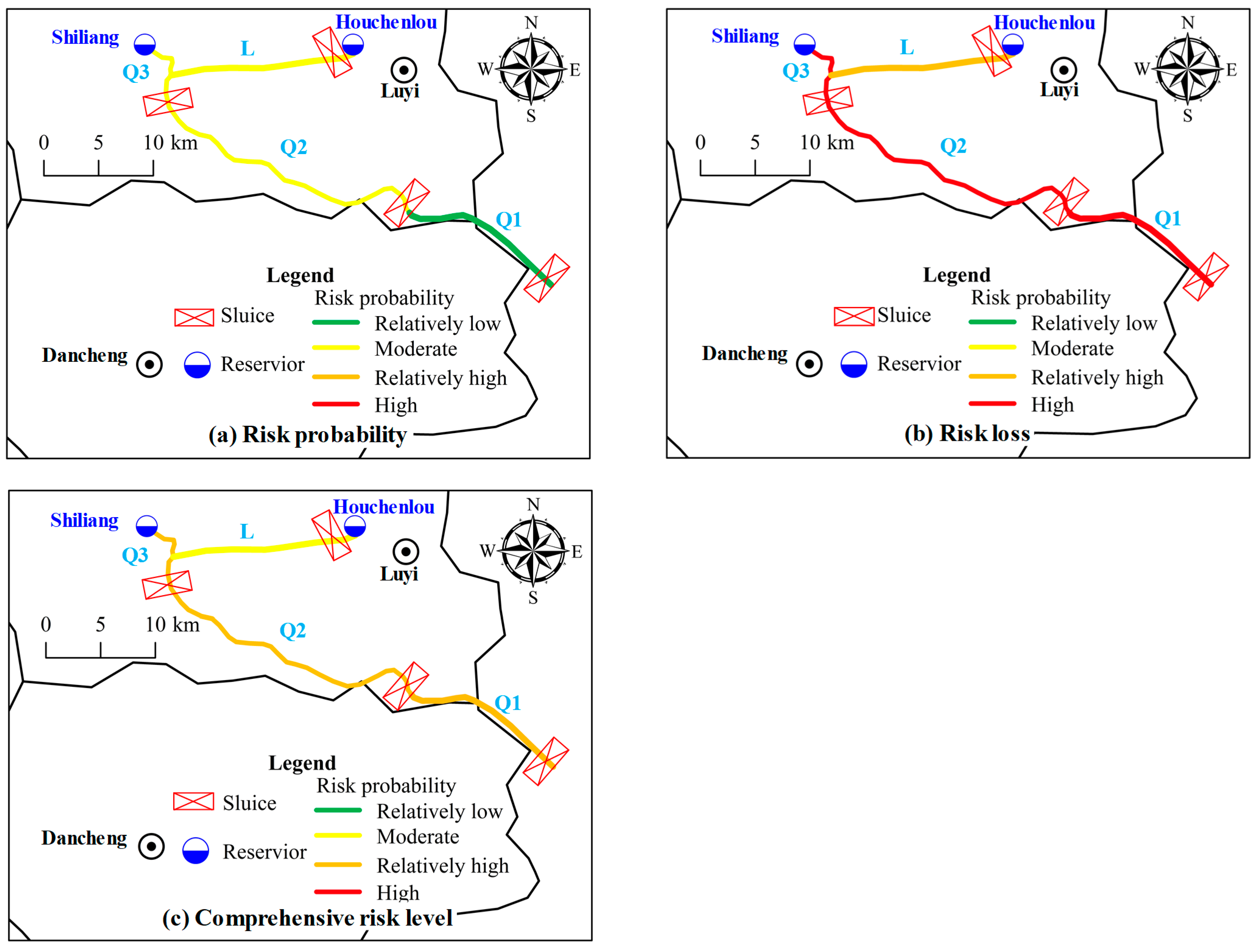
Based on the calculation results above, a two-dimensional risk matrix, integrating failure probability and potential loss magnitude is presented in Table 15. Meanwhile, the spatial distribution of the risk assessment results is illustrated in Figure 8, which maps (a) risk probability, (b) risk loss, and (c) the resulting comprehensive risk level across four segments.
Table 15. Risk probability–risk loss two-dimensional matrix graph of the Yangtze-to-Huaihe River Water Diversion Project (Henan Reach).
Figure 8. Spatial distribution of risk assessment results of the Yangtze-to-Huaihe Water Diversion Project (Henan Reach). (a) Risk probability; (b) risk loss; (c) comprehensive risk level.
The results reveal that the risk probabilities for Q1, Q2, Q3, and L are classified as relatively low, moderate, moderate, and moderate, respectively (Figure 8a), whereas their corresponding risk losses are assessed as high, high, high, and relatively high (Figure 8b). Consequently, the comprehensive risk levels are evaluated as relatively high for Q1, Q2, and Q3, and moderate for reach L (Figure 8c). A notable discrepancy can be observed between the single dimensional risk probability assessment (Figure 8a) and the comprehensive risk assessment (Figure 8c). While the former shows no discernible spatial pattern, the latter exhibits a distinct longitudinal trend: risk levels generally decrease along the conveyance path from upstream to downstream. This discrepancy arises because comprehensive assessment explicitly accounts for both the likelihood of failure and the severity of its consequences. In particular, risk loss magnitude is strongly correlated with the water supply capacity and its position within the upstream–downstream network. Reaches with larger supply capacities, such as those along the Qingshui River, serve more extensive industrial, agricultural, and municipal demand zones, resulting in greater economic and social impacts when failure occurs. Moreover, due to the serial (i.e., cascading) connectivity of water conveyance system, a failure in any upstream segment propagates downstream, disrupting water delivery across all subsequent reaches and amplifying cumulative consequences. Consequently, the combined effects of water transmission burden and the system’s inherent sequential configuration leads to significantly higher operational risk in the Qingshui River reaches compared to the Luxin River. This finding aligns well with actual operational experience and observed vulnerability patterns. Importantly, it demonstrates that traditional probability only assessments may underestimate risk in high-consequence zones, particularly in upstream segments with large service areas. Thus, incorporating risk loss, which quantified through economic, social, and systemic impact indicators, enables a more realistic and operationally meaningful representation of overall risk.

5. Discussion

In order to demonstrate the reliability and advancement of this framework, we choose to make a qualitative comparison with the indicator system used for the South-to-North Water Diversion Project. In view of risk probability, this framework explicitly considers channel morphology dimension, making the assessment more comprehensive. The common criterion layer weight is compared in Table 16, showing consistent order of importance. Both methods indicate that the hydrological characteristics contribute the most, followed by engineering structures and operational management. As for risk loss, the previous framework used channel length to roughly represent the failure consequence severity. In contrast, this study integrates social and economic dimensions. The infrastructure value, agricultural and industrial production, and population exposure are considered to evaluate potential consequences. Using the Yangtze-to-Huaihe Water Diversion Project (Henan Reach) as an example, the evaluation results from Reference [19] show an order of Q2 > L > Q1 > Q3, which emphasize that longer channel length implies greater risk loss. The evaluation results from this paper are Q1 = Q2 = Q3 > L, which highlight that the degree of risk loss is closely related to both the water supply capacity and position within the upstream–downstream network (see Section 4.3 for detail). This conclusion is consistent with operational experience and observation. Therefore, this study demonstrates the necessity of incorporating consequence severity as a crucial component in risk assessment frameworks for conveyance channels in Water Diversion Projects.
Table 16. Comparison of criterion layer weights between this study and reference [19].
This study proposes a more systematic integration of failure probability and consequence severity, providing a comprehensive framework for holistic risk assessment in water diversion projects, while pointing out that limitations remain to be further developed, for example, issues related to uncertainty and bias, as well as the comprehensiveness of indicator coverage.
The uncertainties and potential biases in this framework primarily stem from two sources: subjective judgments of experts and data variability. To mitigate these effects, rigorous consistency checks were implemented by enforcing strict thresholds for consistency indices to ensure logical coherence in pairwise comparisons, while expert judgments were averaged to minimize individual biases. Furthermore, the adoption of risk grades and risk classifications enhances the robustness of the results. Minor fluctuations in indicator scores typically lead to outcomes that remain within the original or an adjacent risk category, thereby constraining error propagation. For future studies, systematic uncertainty quantification approaches, such as probabilistic simulation techniques (e.g., Monte Carlo simulation or Bayesian inference), could be introduced into the risk assessment framework to explicitly characterize parameter uncertainty, model variability, and expert judgment bias. This would enable the derivation of probability distributions for risk outcomes, thereby further enhance the reliability of risk assessments.
Given that environmental impacts involve high complexity and are constrained by limited data availability, this study focuses on a preliminary assessment of failure consequences in terms of economic and social losses, while it must be highlight that the ecological and environmental impact assessment of water diversion projects is of significant importance. To further improve the risk loss evaluation system, future research should focus on addressing the current limitation in quantifying ecological and environmental losses. One promising direction is to develop a comprehensive assessment framework that incorporates ecological functions. This may include constructing a proxy indicator system, including affected habitat area, ecological water demand, biodiversity indices, and vegetation cover change, based on a combination of remote sensing inversion, field monitoring, and model simulations. This approach would enable quantitative or spatially explicit characterization of ecosystem responses to hydrological disturbances.

6. Conclusions

This study advances a comprehensive risk assessment framework for water conveyance channels. In contrast to earlier approaches, the framework explicitly incorporates risk loss, thereby capturing the severity of potential consequences, and integrates channel morphology, which perform a critical influence on water supply reliability and drainage performance. These enhancements enable a more systematic evaluation of operational safety risks in diversion projects. The main conclusions are as follows:
To accurately assess operational safety risks in water conveyance channels of inter-basin water diversion projects, this study proposes a comprehensive risk assessment framework integrating risk probability and risk loss. Based on the CRDM, the risk probability is quantified through 3 major failure modes, i.e., overtopping, breaching, and scouring. They are further considered in terms of 4 aspects, hydrological conditions, channel morphology, engineering structures, and operational management. By incorporating socioeconomic impact dimensions, risk loss is evaluated with infrastructure value, agricultural and industrial output, and population exposure. Through systematic indicator selection, justified weight determination, and standardized scoring criteria, a structured quantitative assessment approach is finally established.
Application of the framework to the Henan Reach of the Yangtze-to-Huaihe Water Diversion Project reveals that the risk probability across all channel reaches falls within the (1, 3] range, indicating a generally low to moderate risk profile. While hydrological, structural, and management-related indicators exhibit relatively stable risk levels, the channel morphology domain shows pronounced spatial variability. This heterogeneity is primarily attributed to localized conditions, such as a higher density of crossing structures, increased river sinuosity, and larger river regime coefficients, particularly in the Shiliang Sluice–Shiliang Reservoir segment (Q3). Meanwhile, the segments from Qingshuihe Sluice to Zhaolou Sluice (Q1), Zhaolou Sluice to Shiliang Sluice (Q2), and Shiliang Sluice to Shiliang Reservoir (Q3) exhibit higher risk losses due to their upstream position and large-scale water supply capacity, resulting in a relatively higher comprehensive risk level. In contrast, the reach from Shiliang Sluice to Houchenlou Sluice, serving a smaller and more localized demand area, experiences lower risk consequences and thus a moderate comprehensive risk level.
Compared to existing approaches, the comprehensive risk assessment framework proposed in this study offers a more systematic integration of failure probability and consequence severity, enabling a holistic evaluation of risk levels. This capability provides practical guidance for risk-informed decision-making, maintenance prioritization, and emergency preparedness in large-scale water diversion systems. Nevertheless, the current implementation is limited in uncertainty analysis and the ecological indicator and can be further developed. Future research therefore could prioritize the optimization of uncertainty quantification approaches and the qualification of ecological function to enhance the robustness of the framework.

Author Contributions

Conceptualization, H.J. and Y.W. (Yanjun Wang); methodology, H.J., Y.W. (Yanjun Wang) and Y.W. (Yongqiang Wang); modeling, H.J., J.X. and M.Y.; investigation, Y.W. (Yanjun Wang); resources, Y.W. (Yongqiang Wang) and J.X.; writing—original draft preparation, H.J.; writing—review and editing, H.J. and Y.W. (Yanjun Wang); visualization, Y.W. (Yanjun Wang); project administration, Y.W. (Yongqiang Wang); funding acquisition, M.Y. All authors have read and agreed to the published version of the manuscript.

Funding

This research was funded by the National Key Research and Development Program of China (Grant No. 2022YFC3202300), the National Natural Science Foundation of China (Grant Nos. 52261145744, 42271044), the National Natural Science Foundation of Hubei Province (Grant No. 2024AFB012), and the Henan Provincial Water Conservancy Science and Technology Key Research and Development Program (Grant No. GG202311).

Data Availability Statement

The original contributions presented in this study are included in the article. Further inquiries can be directed to the corresponding author.

Conflicts of Interest

The authors declare no conflicts of interest.

References

  1. Long, Y.; Xu, L.Y.; Lei, X.H.; Zhang, Z.; Yang, Y.L.; Li, Y.X. The risk assessment model for water diversion projects based on a fuzzy Bayesian network. J. Hydrol. 2025, 662, 134053. [Google Scholar] [CrossRef]
  2. Kattel, G.R.; Shang, W.; Wang, Z.; Langford, J. China’s South-to-North Water Diversion Project Empowers Sustainable Water Resources System in the North. Sustainability 2019, 11, 3735. [Google Scholar] [CrossRef]
  3. Kummu, M.; Guillaume, J.H.A.; De Moel, H.; Eisner, S.; Flörke, M.; Porkka, M.; Siebert, S.; Veldkamp, T.I.E.; Ward, P.J. The world’s road to water scarcity: Shortage and stress in the 20th century and pathways towards sustainability. Sci. Rep. 2016, 6, 38495. [Google Scholar] [CrossRef]
  4. Donoso, M.; Baldassarre, G.D.; Boegh, E.; Browning, A.; Oki, T.; Tindimugaya, C.; Vairavamoorthy, K.; Vrba, J.; Zalewski, M.; Zubari, W.K. International Hydrological Programme (IHP) eighth phase: Water security: Responses to local, regional and global challenges. Strategic plan, IHP-VIII (2014–2021). In Zbornik Nije Izdan; UNESCO: Paris, France, 2012. [Google Scholar]
  5. Li, P.Y.; Dong, F.D.; Lv, G.B.; Wang, Y.S.; Sheng, Y.G.; Cheng, F.; Wang, B. Multiple Correlation Analysis of Operational Safety of Long-Distance Water Diversion Project Based on Copula Bayesian Network. Water 2025, 17, 2389. [Google Scholar] [CrossRef]
  6. Andreide, J.P.G.; Zhu, Q. Comparison of Brazil’s cross-basin water transfer practice and inter-national cases. Water Resour. Hydropower Bull. 2011, 32, 1–6. [Google Scholar]
  7. Bagheri, S.; Haskuee, M.B.; Yazdani, S.; Hayati, B. Investigating the economic impacts of inter-basin water transfer projects with a water- embedded multi-regional computable general equilibrium approach. Water Resour. Manag. 2024, 10, 3875–3895. [Google Scholar] [CrossRef]
  8. Pohlner, H. Institutional change and the political economy of water megaprojects: China’s south-north water transfer. Glob. Environ. Chang. 2016, 38, 205–216. [Google Scholar] [CrossRef]
  9. Crow-Miller, B. Discourses of deflection: The politics of framing China’s South-North Water Transfer Project. Water Altern. 2015, 8, 173–192. [Google Scholar]
  10. Nickum, J.E. The status of the South to North Water Transfer Plans in China. In Report to United Nations Development Programme, Human Development Reports; United Nations: New York, NY, USA, 2006. [Google Scholar]
  11. Tian, Y.; Jiang, B.; Huang, H.; Shen, F. Study on risk factor identification and risk control of transboundary river security. Water Resour. Hydropower Eng. 2018, 49, 9–15. [Google Scholar]
  12. Fang, G.; Zhu, X.; Huang, X. Risk analysis of floodwater resources utilization along water diversion project: A case study of the Eastern Route of the South-to-North Water Diversion Project in China. Water Supply 2019, 19, 2464–2475. [Google Scholar] [CrossRef]
  13. Fu, X.D.; Wang, G.; Ren, M.L.; Ding, L.Q.; Jiang, X.M.; He, X.Y.; Zhao, L.P.; Wu, N. Flood Control Risk Identification and Quantitative Assessment of a Large-Scale Water Transfer Project. Water 2021, 13, 1770. [Google Scholar] [CrossRef]
  14. Zhang, W.; Liu, G.; Chiwuikem, C.J.; Yang, Z. Flood risk cascade analysis and vulnerability assessment of watershed based on Bayesian network. J. Hydrol. 2023, 626 Pt A, 130144. [Google Scholar] [CrossRef]
  15. Do, H.M.; Yin, K. Rainfall Threshold analysis and bayesian probability method for landslide initiation based on landslides and rainfall events in the past. Open J. Geol. 2018, 8, 674–696. [Google Scholar] [CrossRef]
  16. Agwu, E.J.; Odanwu, S.E.; Ezewudo, B.I.; Odo, G.E.; Nzei, J.I.; Iheanacho, S.C.; Islam, M.S. Assessment of water quality status using heavy metal pollution indices: A case from Eha-Amufu catchment area of Ebonyi River, Nigeria. Acta Ecol. Sin. 2023, 6, 989–1000. [Google Scholar] [CrossRef]
  17. Barco, M.K.D.; Furlan, E.; Pham, H.V.; Torresan, S.; Zachopoulos, K.; Kokkos, N.; Critto, A. Multi-scenario analysis in the Apulia shoreline: A multi-tiers analytical framework for the combined evaluation and management of coastal erosion and water quality risks. Environ. Sci. Policy 2024, 153, 103665. [Google Scholar] [CrossRef]
  18. Long, Y.; Xu, G.; Ma, C.; Chen, L. Emergency control system based on the analytical hierarchy process and coordinated development degree model for sudden water pollution accidents in the middle route of the south-to-north water transfer project in China. Environ. Sci. Pollut. Res. Int. 2016, 23, 12332–12342. [Google Scholar] [CrossRef]
  19. Geng, L.H.; Jiang, B.L.; Fu, K.W.; Mao, Y.J. Risk Analysis and Assessment of the Water Conveyance System Operation in the East Route of South-to-North Water Transfer Project. Yellow River 2012, 34, 92–95. [Google Scholar]
  20. Ma, L.; Liu, H.D. Safety Risk Assessment of Water Conveyance Channel Operation of the South-to-North Water Diversion Project. Yellow River 2022, 44, 138–143. [Google Scholar]
  21. Jing, H.; Wang, Y.Z.; Song, Z.H.; Wang, H.; Fang, J.; Wang, Y.Q. Long-term service risk assessment of pumping station system in the Yangtze-to-Huaihe River Water Diversion Project (Henan Reach). S. N. Water Transf. Water Sci. Technol. 2023, 21, 1174–1183. [Google Scholar]
  22. Hu, J.; Ye, W.; Ma, F.H. Comprehensive risks assessment of engineering safety for long-distance water transfer projects. S. N. Water Transf. Water Sci. Technol. 2024, 22, 417–426. [Google Scholar]
  23. Feng, F.; Gu, X.W.; He, H.M. Study on eco-safety evaluation index system for Yellow River embankment based on consequence-reverse-diffusion method. Water Resour. Hydropower Eng. 2013, 44, 37–40. [Google Scholar]
  24. Feng, F.; Ni, G.H.; He, H.M. Research on safety evaluation of Yellow River embankment based on consequence-reverse diffusion and layered-weight method. J. Hydraul. Eng. 2014, 45, 1048–1056. [Google Scholar]
  25. Danka, J.; Zhang, L.M. Dike Failure Mechanisms and Breaching Parameters. J. Geotech. Geoenviron. Eng. 2015, 141, 04015039. [Google Scholar] [CrossRef]
  26. Wu, S.B.; Yu, M.H.; Wei, H.Y.; Liang, Y.J.; Zeng, J. Non-symmetrical levee breaching processes in a channel bend due to overtopping. Int. J. Sediment Res. 2018, 33, 208–215. [Google Scholar] [CrossRef]
  27. Seo, H.; Kang, T.; Felix, M.L.; Lee, S. A Study to determine the location of perforated drainpipe in a levee for controlling the seepage line. KSCE J. Civ. Eng. 2018, 22, 153–160. [Google Scholar] [CrossRef]
  28. Yang, Y.; Lei, X.; Long, Y.; Tian, Y.; Zhang, Y.; Yao, Y.; Hou, X.; Shi, M.; Wang, P.; Zhang, C.; et al. A novel comprehensive risk assessment method for sudden water accidents in the Middle Route of the South–North Water Transfer Project (China). Sci. Total Environ. 2020, 698, 134167. [Google Scholar] [CrossRef]
  29. Shrestha, S.; Shrestha, M.; Babel, M.S. Assessment of climate change impact on water diversion strategies of Melamchi Water Supply Project in Nepal. Theor. Appl. Climatol. 2017, 128, 311–323. [Google Scholar] [CrossRef]
  30. Maihemuti, B.; Wang, E.; Hudan, T.; Xu, Q. Numerical simulation analysis of reservoir bank fractured rock-slope deformation and failure processes. Int. J. Geomech. 2016, 16, 04015058. [Google Scholar]
  31. Chen, S.; Wang, H.; Zhang, T.H.; Fan, J.Y.; Liu, S.; Wang, J. Risk Assessment of Water Pollution Emergencies for Water Diversion Project Based on Cloud Model: A Case Study on Henan Section of the Yangtze River to Huaihe River Diversion Project. J. Chang. River Sci. Res. Inst. 2024, 41, 48–55+62. [Google Scholar]
  32. Leopold, L.B.; Maddock, T. The Hydraulic Geometry of Stream Channels and Some Physiographic Implications; US Government Printing Office: Washington, DC, USA, 1953; Volume 252.
  33. Leopold, L.B.; Wolman, M.G. River Channel Patterns: Braided, Meandering, and Straight; U.S. Geological Survey Professional Paper 282-B; US Government Printing Office: Washington, DC, USA, 1957.
  34. Costa, J.E. Effects of agriculture on erosion and sedimentation in the Piedmont Province, Maryland. Geol. Soc. Am. Bull. 1975, 86, 1281–1286. [Google Scholar] [CrossRef]
  35. SL/Z 679-2015; Guidelines for Levee Safety Evaluation. Ministry of Water Resources of the People’s Republic of China: Beijing, China, 2015.
  36. Luo, R.H.; Huang, J.L.; Zhang, J.W.; Ye, X. Dike safety evaluation based on combined weighting and cloud model. S. N. Water Transf. Water Sci. Technol. 2021, 19, 1217–1226. [Google Scholar] [CrossRef] [PubMed]
  37. Fang, G.H.; Gao, Y.Q.; Tan, W.X.; Zheng, Z.Z.; Guo, N. Establishment of evaluation index system for modernization of water conservancy project management. Adv. Sci. Technol. Water Resour. 2013, 33, 39–44. [Google Scholar]
  38. Saaty, T.L. Analytic Hierarchy Process; Springer: Boston, MA, USA, 2013. [Google Scholar]
  39. Wang, X.B.; Zhang, Q.; Xia, X.Z. Research progress on safety operation risk analysis of embankment projects. Yellow River 2020, 42, 25–31+35. [Google Scholar]
Disclaimer/Publisher’s Note: The statements, opinions and data contained in all publications are solely those of the individual author(s) and contributor(s) and not of MDPI and/or the editor(s). MDPI and/or the editor(s) disclaim responsibility for any injury to people or property resulting from any ideas, methods, instructions or products referred to in the content.

Article Metrics

Citations

Article Access Statistics

Multiple requests from the same IP address are counted as one view.