You are currently viewing a new version of our website. To view the old version click .
Water
  • Article
  • Open Access

26 September 2025

Optimizing Water–Sediment, Ecological, and Socioeconomic Management in Cascade Reservoirs in the Yellow River: A Multi-Target Decision Framework


,
,
and
1
Yellow River Institute of Hydraulic Research, Yellow River Water Conservancy Commission, Zhengzhou 450003, China
2
Yellow River Laboratory, Zhengzhou 450003, China
3
Key Laboratory of Lower Yellow River Channel and Estuary Regulation, Ministry of Water Resources, Zhengzhou 450003, China
4
Hydrology Bureau of Yellow River Conservancy Commission, Zhengzhou 450004, China
This article belongs to the Special Issue Yellow River Basin Management Under Pressure: Present State, Restoration and Protection, 4th Edition

Abstract

Multi-target optimization management of reservoirs plays a crucial role in balancing multiple scheduling objectives, thereby contributing to watershed sustainability. In this study, a model was developed for the multi-target optimization scheduling of water–sediment, ecological, and socioeconomic objectives of reservoirs with multi-dimensional scheduling needs, including flood control, sediment discharge, ecological protection, and socio-economic development. After obtaining the Pareto solution set by solving the optimization model, a decision model based on cumulative prospect theory (CPT) was constructed to select optimal scheduling schemes, resulting in the development of a multi-target decision framework for reservoirs. The proposed framework not only mitigates multi-target conflicts among water–sediment, ecological, and socioeconomic objectives but also quantifies the different preferences of decision-makers. The framework was then applied to six cascade reservoirs (Longyangxia, Liujiaxia, Haibowan, Wanjiazhai, Sanmenxia, and Xiaolangdi) in the Yellow River basin of China. A whole-river multi-target decision model was developed for water–sediment, ecological, and socioeconomic objectives, and the cooperation–competition dynamics among multiple objectives and decision schemes were analyzed for wet, normal, and dry years. The results demonstrated the following: (1) sediment discharge goals and ecological goals were somewhat competitive, and sediment discharge goals and power generation goals were highly competitive, while ecological goals and power generation goals were cooperative, and cooperation–competition relationships among the three objectives was particularly pronounced in dry years; (2) the decision plans for abundant, normal, and low water years were S293, S241, and S386, respectively, and all are consistent with actual dispatch conditions; (3) compared to local models, the whole-river multi-target scheduling model achieved increases of 71.01 × 10⁶ t in maximum sediment discharge, 0.72% in maximum satisfaction rate of suitable ecological flow, and 0.20 × 10⁹ kW·h in maximum power generation; and (4) compared to conventional decision methods, the CPT-based approach yielded rational results with substantially enhanced sensitivity, indicating its suitability for selecting and decision-making of various schemes. This study provides insights into the establishment of multi-target dispatching models for reservoirs and decision-making processes for scheduling schemes.

1. Introduction

Reservoir operation and management not only contribute to beneficial uses (i.e., power generation, shipping, and water supply) and disaster prevention (i.e., flood control, drought relief, and sediment reduction) but also provide essential hydroelectric resources for the sustainable development of river basins [1]. Currently, more than 2.8 million reservoirs (storage volume > 1000 m3) have been constructed worldwide, and this number is expected to continue increasing [2]. Therefore, the development of multi-target reservoir optimization scheduling models and the selection of scheduling schemes have become key research priorities, particularly for maintaining flood control and sediment discharge, enhancing ecological conditions, and supporting socioeconomic development [3].
To meet the different demands of reservoir operation, mathematical programming is widely used to develop multi-target optimization operation models and obtain scheduling schemes. For instance, Zhu et al. built a new multi-target scheduling framework for flood operation water levels in cascade reservoirs, focusing on hydropower generation and flood control, and applied it to seven mega reservoirs in the Yangtze River basin [4]. Moura de Figueiredo et al. developed a model for managing multiple water uses to balance the water conflicts between reservoir power generation and downstream navigation of dams [5]. Feng et al. constructed a reservoir multi-target optimal scheduling model, taking into account power generation benefits and ecological flow requirements, and proposed an efficient multi-target cooperative search algorithm to solve the model [6]. Wu et al. formulated a multi-target optimization model for water supply, hydroelectric power, and environmental conservation at Jiayan reservoir to better comprehend the feedback relationship between adaptive reservoir management, environmental consciousness, and decision-making preferences [7]. Although these cases provide novel ideas and models for reservoir scheduling in competitive water use, their applicability to sandy rivers is limited because they do not address sediment regulation. In fact, sediment discharge from reservoirs in sandy rivers is an important scheduling objective. For instance, Bai et al. built a multi-target optimal operation model for flood prevention, water supply, hydroelectric power, and silt reduction in the Longyangxia, Liujiagxia, and Heishanxia cascade reservoirs in the upper reaches of the Yellow River [8]. Li et al. established a multi-target optimal operation model for the Wanjiazhai, Sanmenxia, and Xiaolangdi cascade reservoirs in the middle reaches of the Yellow River, which has the largest sand discharge capacity and the lowest flood risk [9]. Li et al. developed a multi-target collaborative water and sand management model for the Heishanxia reservoir, with the goals of maximizing river channel erosion, ecological satisfaction, and power generation [10]. However, these model scheduling objectives only involve two dimensions, namely water–sediment and socioeconomic or water–sediment and ecological aspects, and do not sufficiently consider multiple dispatching requirements of water–sediment, ecological, and socioeconomic for watersheds.
Multi-target reservoir operation plans often reflect the interests of multiple parties, which may be different or even conflicting [11]. How to balance the conflicting interests of all parties and select a scheduling plan that is acceptable to all parties is a critical issue in multi-target decision-making [12]. In other words, the optimization of scheduling schemes is essentially a multi-attribute decision-making problem [13]. Multi-attribute decision-making methods can generally be divided into three categories: a priori methods, incremental methods, and a posteriori methods. Since a posteriori methods can obtain a more complete and comprehensive set of solutions, they are most widely used in multi-target decision-making for reservoirs [14]. With the introduction of posterior methods, many new decision-making methods have emerged. Some methods focus on analyzing the geometric properties of Pareto solutions, providing decision-makers with more comprehensive decision-making tools by quantitatively describing the cooperative and competitive relationships between different objectives [15,16]. Other methods are based on the subjective preferences of decision makers, also known as subjective analysis methods, which involve analyzing and making decisions based on the subjective information of decision makers [17]. In addition, there are methods for analyzing the quantitative characteristics, quantitative relationships, and quantitative changes in each scheme, namely objective analysis methods, which mainly include entropy value methods [18], projection tracing methods [19], and TOPSIS models [20]. However, subjective preferences often exist in the actual reservoir dispatch decision-making process, which directly affects the reliability of the decision results [21]. Because it takes into account the preferences of decision makers, cumulative prospect theory (CPT) can yield decision results that are more in line with actual circumstances and has been applied in multiple fields [22,23].
Therefore, taking into account multiple dispatching requirements of water–sediment, ecological and socioeconomic for watersheds, a reservoir multi-target optimization operation model is constructed. CPT is then introduced to characterize the preferences of reservoir dispatch decision-makers in terms of gains and losses, thereby constructing a decision model to select the optimal dispatch plan. Improvements in our work include: (1) the ability to balance conflicts between multiple objectives such as water–sediment, ecological and socioeconomic parameters; (2) the ability to quantify the different preferences of decision-makers and select scheduling plans that are in line with the actual situation.
Water scarcity and excessive sedimentation are complex and difficult problems for the Yellow River. Combined dispatch of cascade reservoirs is a key measure to reduce sediment accumulation and coordinate the relationship between water and sand [24]. While extensive research has been conducted on single-objective (e.g., flood protection, hydroelectric power, sedimentation reduction) and multi-target (e.g., flood protection–hydroelectric power, flood protection–sedimentation reduction, water supply–ecological protection) [25,26,27] optimization scheduling models for reservoirs in the Yellow River basin, several limitations remain: (1) insufficient consideration of the need for multi-dimensional scheduling of flood control, sediment discharge, ecological protection, and socioeconomic development; (2) the absence of a whole-river multi-target optimization operation model for cascade reservoirs; and (3) challenges in accurately quantifying decision-makers’ preferences to ensure that the selected scheduling scheme aligns with real-world conditions.
In the present study, a multi-target decision framework for cascade reservoirs operation based on CPT in the Yellow River was proposed. Six cascade reservoirs were selected to develop a whole-river multi-target optimization operation model for water–sediment, ecological and socioeconomic objectives. The cooperation–competition dynamics among multiple objectives and decision schemes in wet, normal, and dry years were examined. The study offers the following contributions: (1) the development of a whole-river multi-target optimization operation model for cascade reservoirs, providing a wide range of dispatch plans; (2) an analysis of the cooperation–competition dynamics among water–sediment, ecological and socioeconomic objectives; and (3) the application of a CPT-based decision method to various preferences and determine realistic decision scheme.

2. Materials and Methods

2.1. A Multi-Target Decision Framework for Cascade Reservoirs Operation Based on CPT

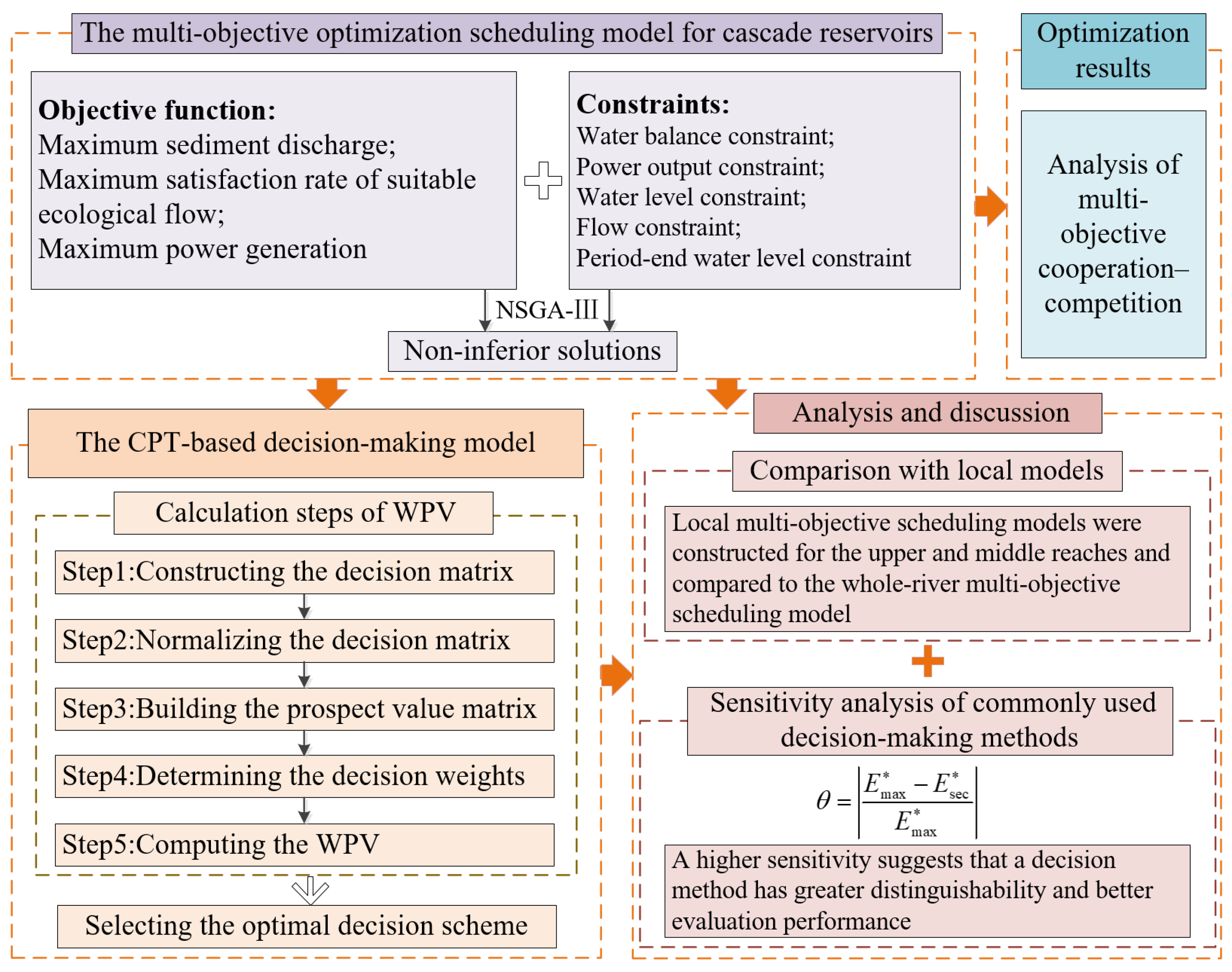
A multi-target decision framework for cascade reservoirs operation based on CPT was developed, as illustrated in Figure 1. First, considering the multi-dimensional dispatch requirements of water–sediment, ecological and socioeconomic management in the Yellow River, three goal functions (maximum sediment discharge (SD), maximum satisfaction rate of suitable ecological flow (SRSEF), and maximum power generation (PG)) were determined. Consequently, a multi-target operation model for cascade reservoirs was constructed.
Figure 1. A multi-target decision framework for cascade reservoirs operation based on CPT.
Non-dominated sorting genetic algorithm III (NSGA-III) was employed to generate a non-inferior solution set, facilitating the analysis of multi-target cooperation–competition and providing a scheduling scheme set for the decision model. The construction of the CPT-based decision model involved five steps, as described below. The proposed model was compared with local models to highlight the advantages of a whole-river multi-target scheduling model. Additionally, the proposed CPT-based decision-making model was evaluated against conventional decision-making methods to verify its performance.

2.2. Reservoir Optimization Operation Model

The reservoir optimal dispatching model incorporates three dimensions. In the dimension of flood control and sediment discharge, the objective is to maximize SD. In the dimension of the ecological environment, the objective is to maximize SRSEF. In the dimension of socio-economic development, the objective is to maximize PG. The goal functions of the reservoir optimization operation model are presented below.
(1)
Objective 1, Maximum SD:
Max f 1 = l = 1 L t = 1 T ( S R o u t l , t )
where S R o u t l , t refers to the outflow sediment load of the lth reservoir in the tth time period (t).
(2)
Objective 2, Maximum SRSEF:
Max f 2 = l = 1 L t = 1 T ( Q E l , t D E l , t ) (   if Q E l , t > D E l , t , Q E l , t = D E l , t )  
where D E l , t and Q E l , t refer to the ecologically suitable flow and the flow of the downstream channel of the lth reservoir in the tth time period, respectively (m3/s).
(3)
Objective 3, Maximum PG:
Max f 3 = l = 1 L t = 1 T K l Q l , t H l , t Δ t p
where K l refers to the output of the hydroelectric power station of the lth reservoir; Q l , t refers to the power discharge of the lth reservoir in the tth time period (m3/s); H l , t refers to the water head of the hydropower station of the lth reservoir in the tth time period (m); and Δ t p refers to the duration of power generation in the tth time period(s).
The constraints include the water balance constraint, power output constraint, upper and lower limits of water level constraint, flow constraint, and period-end water level constraint.

2.3. NSGA-III

NSGA-III is an evolutionary algorithm specifically designed to solve multi-target optimization problems. It not only inherits the advantages of NSGA-II, but also significantly improves performance and efficiency in handling multi-target optimization problems by introducing reference points and optimization selection mechanisms, especially in finding uniformly distributed Pareto fronts. The algorithm follows these steps [28]:
Step 1: Initialize the population.
Step 2: Perform selection, crossover, and mutation on the parent population to generate the offspring population.
Step 3: Merge the parent and offspring populations into a new population and perform non-dominated sorting to form non-dominated layers.
Step 4: Define reference points, normalize the objective space, associate each individual in the population with the corresponding reference point, and perform environmental selection to form the next-generation parent population.
Step 5: Determine whether the termination criterion is met. If met, go to Step 6; otherwise, return to Step 2.
Step 6: Output the optimal Pareto solution set.

2.4. CPT-Based Decision-Making Model

2.4.1. CPT

CPT [29] uses transformed cumulative probabilities to reflect the decision-maker’s preferences towards losses and profits, capturing their practical psychological behavior more accurately than traditional models. Whole prospect value (WPV) consists of a value function, which describes the decision-maker’s subjective valuation of the scheme’s profit, and a probability weight function, which describes the decision-maker’s subjective judgment of the probability of realizing that profit.
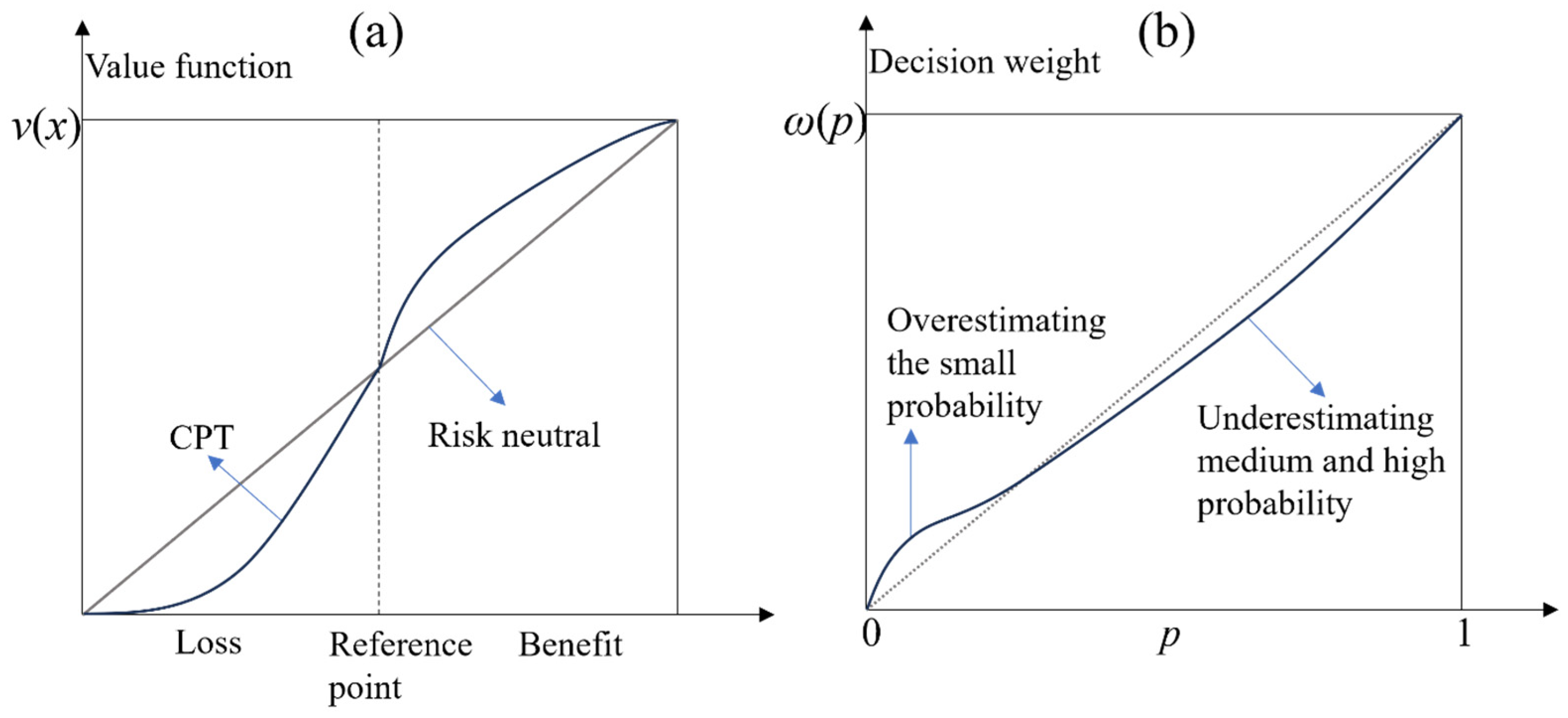
The independent variable x of the value function is a relative change and indicates the difference between the current value and the reference point. As shown in Figure 2, the variation curve of the value function is concave in an area of loss and convex in an area of gain. it also has a steeper slope in an area of loss than in an area of gain, meaning that decision makers are more sensitive to losses. The specific expression is [30]:
v ( x i j ) = a ( x i j x 0 ) γ , x i j x 0 b ( x 0 x i j ) λ , x i j x 0
where xij refers to the outcome at a random time point, x0 refers to the reference point, a refers to the profit pursuit coefficient, b refers to the loss aversion coefficient, and 0 < a < b. Generally, a = 1, and b = 2.25. γ and λ reflect the decision-maker’s preference, smaller values imply greater sensitivity to risk, and 0 < γ, λ < 1. Typically, γ = λ = 0.88 [30].
Figure 2. Components of CPT, (a) Value function, (b) Decision weight.
The decision maker can make subjective adjustments based on the event occurrence probability, whose value is the decision weight function. Shown as an inverted-S curve (Figure 2), the expression is given below:
ω ( p j ) = p j κ p j κ + ( 1 p j κ ) κ 1 κ
When the decision maker faces profits:
ω + ( p j ) = p j τ p j τ + ( 1 p j τ ) τ 1 τ
When the decision maker faces losses:
ω ( p j ) = p j μ p j μ + ( 1 p j μ ) μ 1 μ
where τ and μ are the curvatures of the weight function. Typically, τ = 0.61 and μ = 0.69 [30].
When a decision maker faces profits, the whole prospect value profit is:
W P V i + = j = 1 n v + ( x i j ) ω + ( p j )
When a decision maker faces losses, the whole prospect value loss is:
W P V i = j = 1 n v ( x i j ) ω ( p j )
Then, the WPV of the evaluation scheme is:
W P V i = W P V i + + W P V i
The larger the WPV, the better the evaluation scheme.

2.4.2. Calculation

Development of decision matrix
Suppose there are m reservoir operation schemes, recorded as S = S 1 , S 2 , , S m , and each scheme is evaluated by n indicators, denoted as I = I 1 , I 2 , , I n . If the jth indicator value of the ith scheme is xij, then a decision matrix is X = ( x i j ) m × n , i = 1 , 2 , , m ; j = 1 , 2 , , n .
Normalization of decision matrix
Normalize the decision matrix with a linear transformation operator. In case the index value is above average, a positive value in [0, 1] is awarded; otherwise, a negative value in [−1, 0] is assigned. The average value of this indicator can then be calculated as follows [31]:
Y j = 1 m i = 1 m x i j ,
When I j is a profit-based index, there is:
r i j = x i j Y j max max 1 j n ( x i j ) Y j , Y j min 1 j n ( x i j )
When I j is a cost-type index, there is:
r i j = Y j x i j max max 1 j n ( x i j ) Y j , Y j min 1 j n ( x i j )
By means of transformation, a normalized decision matrix can be obtained.
Construction of prospect value matrix
Based on a normalized decision matrix, the positive and negative ideal plans can be readily obtained, as follows:
B + = r 1 + , r 2 + , , r n +
B = r 1 , r 2 , , r n
where r j + = max r i j 1 i m , r j = min r i j 1 i m , j = 1 , 2 , , n .
As indicated in the GRA method, the correlation coefficients of the ith plan and the ideal plan with respect to the index I j are calculated and shown below [32]:
δ i j + = min 1 i m min 1 j n r i j r j + + ρ max 1 i m max 1 j n r i j r j + r i j r j + + ρ max 1 i m max 1 j n r i j r j +
δ i j = min 1 i m min 1 j n r i j r j + ρ max 1 i m max 1 j n r i j r j r i j r j + ρ max 1 i m max 1 j n r i j r j
where ρ is the calculation parameter and ρ = 0.5 .
Then, Equation (4) can be rewritten as:
v ( r i j ) = a ( 1 δ i j ) γ , B +   as   a   reference   point b ( δ i j + 1 ) λ , B   as   a   reference   point
Furthermore, the positive and negative prospect value matrices of the evaluation plan can be obtained as listed below:
V + = ( v i j + ) m × n = v 11 + v 12 + v 1 n + v 21 + v 22 + v 2 n + v m 1 + v m 2 + v m n +
V = ( v i j ) m × n = v 11 v 12 v 1 n v 21 v 22 v 2 n v m 1 v m 2 v m n
Determination of decision weight
First, according to a decision matrix, the objective weights ω e = ( ω i j ) n × 1 are identified using the entropy weight method [33], and the subjective weights ω a = ( ω i j ) n × 1 are identified using the analytic hierarchy process approach [34]. Then, a weighted average of the objective and subjective weights is calculated to obtain the original weight ω o = ( ω e + ω a ) / 2 . Finally, according to Equations (6) and (7), the decision weights, ω + ( p j ) and ω ( p j ) , are calculated.
Calculation of WPV
Equations (8)–(10) are used to calculate WPV. A larger WPV indicates a higher overall recognition of the scheme. In this study, the scheme with the maximum WPV was selected as the decision scheme.

2.5. Sensitivity Analysis

The sensitivity θ is used to compare the distinguishability and advantages of different decision methods. It is defined as [35]:
θ = E max E sec E max
where E max and E sec are the largest and second-largest evaluation values among all schemes. A higher sensitivity suggests that a decision method has greater distinguishability and better evaluation performance.

2.6. Case Study

2.6.1. Problem Statement

The Yellow River, the seventh-longest river in the world, is characterized by the highest sediment concentration in the world and faces considerable water management challenges. The upper reaches of the river experience severe water scarcity, while the middle reaches face reservoir sedimentation and ecological degradation. In the lower reaches, river sedimentation and flood control are the main concerns [36].
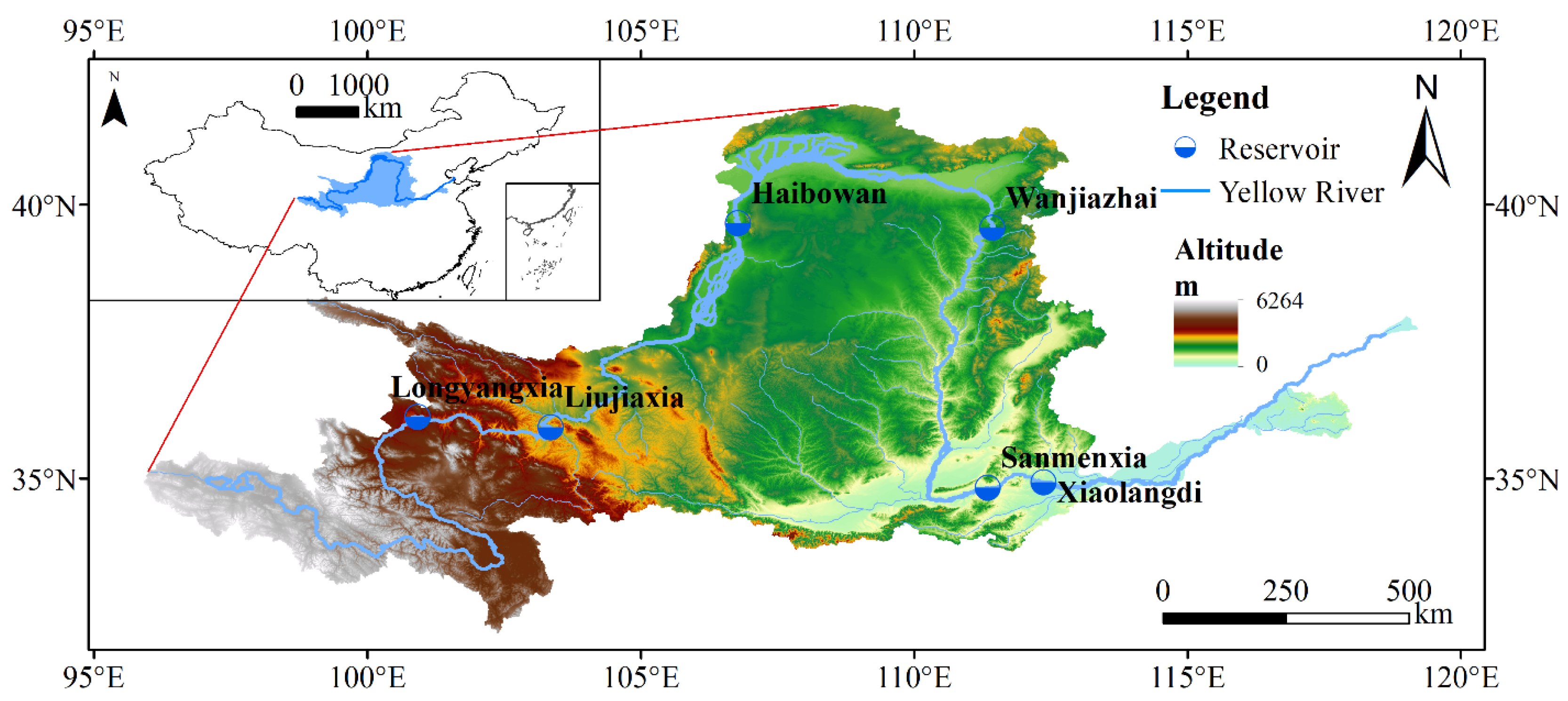
The Yellow River reservoirs serve multiple functions, including water supply, flood control, sediment discharge, and ecological protection, while also playing a key part in coordinating water and sediment management [10]. At present, 33 dams have been built on the main stream of the Yellow River, forming the core component of the basin’s water resource regulation and flood control system. In particular, six cascade reservoirs (Longyangxia, Liuyaxia, Haibowan, Wanjiazhai, Sanmenxia, and Xiaolangdi) possess storage and regulation capacities, as shown in Figure 3.
Figure 3. Location of reservoirs.
In the context of ecological conservation and high-quality development in the Yellow River basin, achieving the joint scheduling of cascade reservoirs is essential. A key challenge is balancing multi-target conflicts across water–sediment management, ecological preservation, and socioeconomic progress while enhancing overall water use efficiency.

2.6.2. Data Collection

In this study, the six reservoirs were selected as research objects, and typical hydrological years were chosen: 2020 (a wet year with a hydrological frequency of 11.1%); 2022 (an average year with a hydrological frequency of 64.2%); and 2016 (a dry year with a hydrological frequency of 95.5%) to conduct optimization scheduling and decision-making on a ten-day scale. The six target reservoirs and their basic characteristics are presented in Table 1. The amount of sediment discharged from a reservoir was calculated based on an empirical formula [37]. Data on flow rates in and out of reservoirs, sediment transport rates, and other data were taken from the official website of the Yellow River Conservancy Commission (i.e., by obtaining data through methods such as hydrological monitoring networks, gauging stations, or long-term observational programs). Hydrological station flow data (e.g., ice-flood flows, bankfull flows) were sourced from the Yellow River Hydrological Yearbook. Additionally, the Tennant method [38] was used to calculate the suitable ecological flow for the river channel, and the results are shown in Table 2.
Table 1. Characteristic information of six reservoirs.
Table 2. Suitable ecological flow for river channel (m3/s).

3. Results

3.1. Pareto Solution Set of Reservoir Optimal Dispatching Model

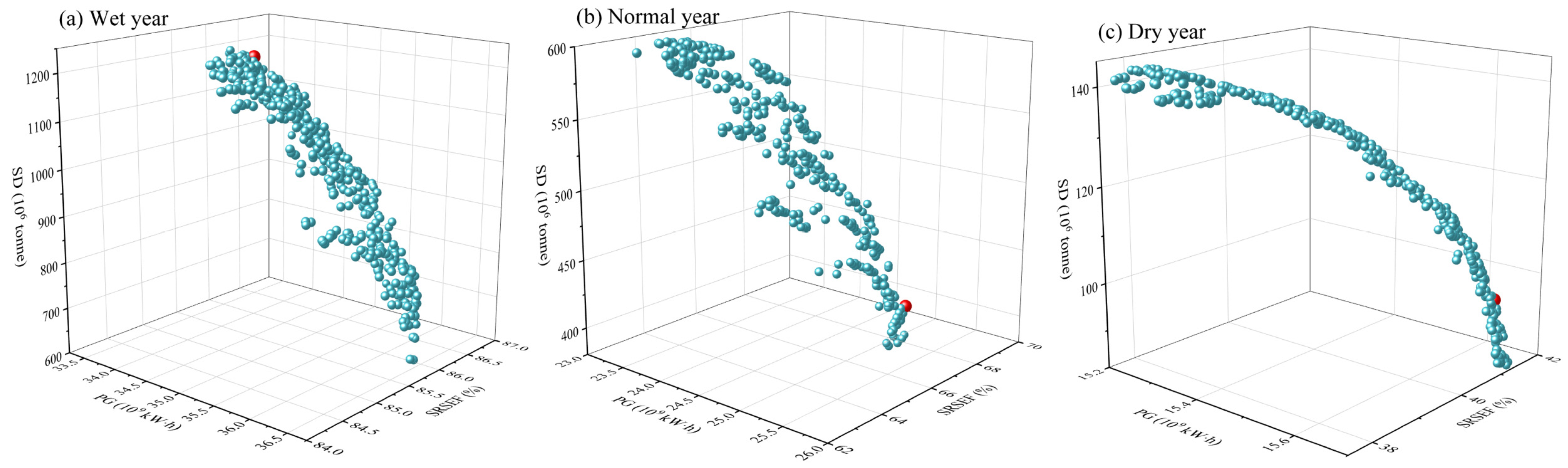
The NSGA-III algorithm was adopted to solve the multi-target optimal dispatching model of six cascade reservoirs. Five hundred populations were randomly generated and iterated two thousand times. A uniformly distributed Pareto solution set was obtained, as shown in Figure 4, which indicates that a whole-river scheduling model for Longyangxia, Liujiaxia, Haibeowan, Wanjiazhai, Sanmenxia, and Xiaolangdi cascade reservoirs is feasible. SD, SRSEF, and PG are highest in a wet year, followed by a normal year, and lowest in a dry year. This means that with more water coming in, it is easier to meet the three targets.
Figure 4. Pareto solution set of multi-target optimal dispatching model.

3.2. Cooperation–Competition Relationships Between Multiple Objectives

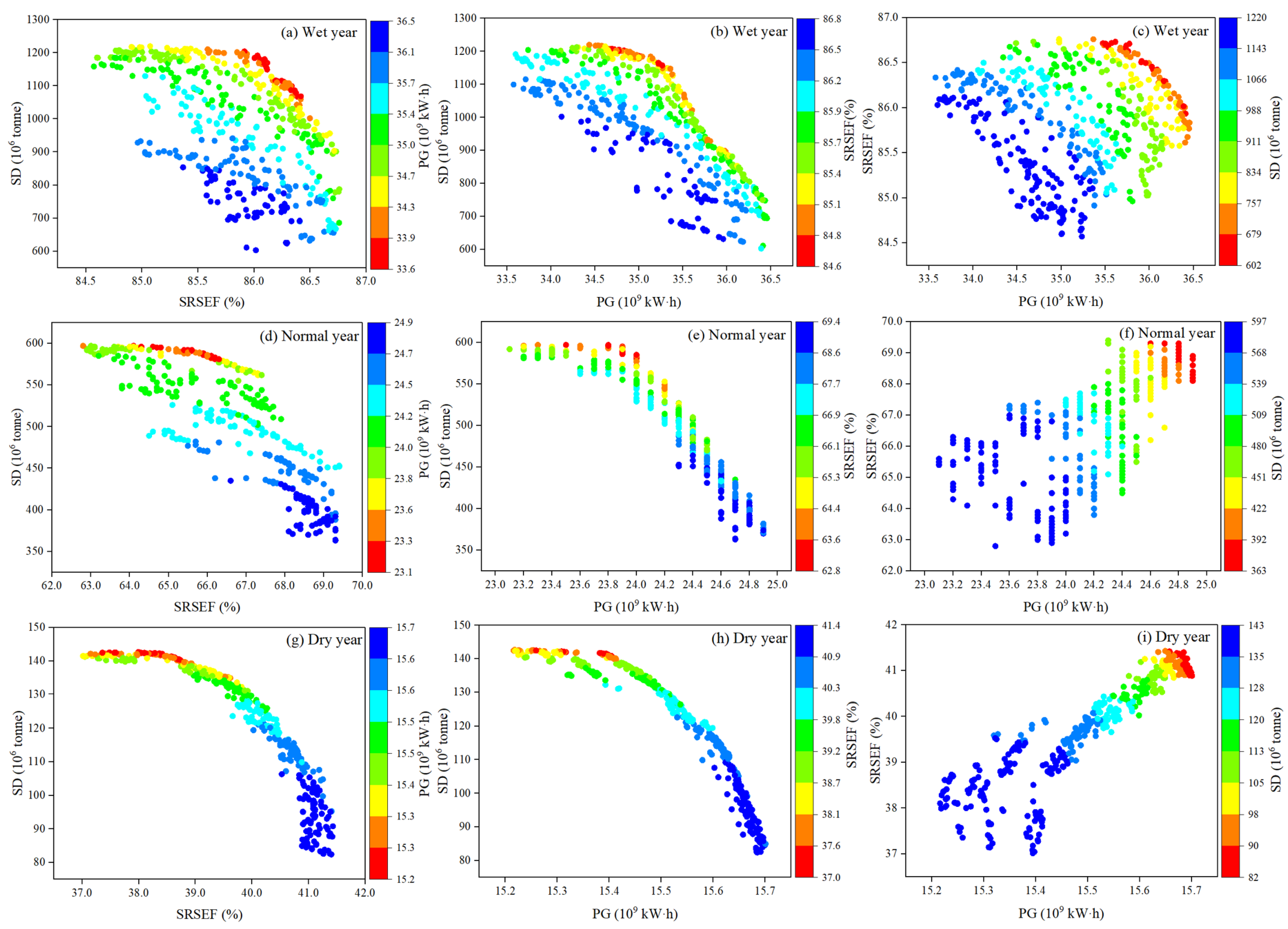
Pareto solution set projections of various classic hydrological years are illustrated in Figure 5, while the correlation coefficients among the three objectives are summarized in Table 3.
Figure 5. Pareto solution set projections of various classic hydrological years.
Table 3. Correlation coefficients among the three goals.
The correlation coefficient between SD and SRSEF is negative with a relatively large absolute value, and the projection distribution exhibits a clear negative correlation, indicating a competitive relationship between these two objectives. Similarly, the SD–PG correlation coefficient is negative, with the absolute value approaching 1 and the projection distribution exhibiting a strong negative correlation, suggesting strong competition between SD and PG. In contrast, the SRSEF–PG correlation coefficient is positive. The projection distribution for wet years is relatively dispersed, indicating weak cooperation, whereas the projection distribution in normal and dry years is more regular, suggesting a degree of cooperation between SRSEF and PG.
In wet years, the cooperation–competition dynamics among the three objectives are less pronounced, with a relatively scattered projection distribution. However, in dry years, the cooperation–competition relationships become significant, and the projection distribution is highly regular. These findings highlight the significant influence of inflow water levels on multi-target cooperation–competition dynamics.

3.3. Decision Weight

The decision weights assigned to each indicator are summarized in Table 4. In wet years, SD has the highest decision weight, while SRSEF and PG have similar weights. In normal years, the decision weights of all three indicators are similar. However, in dry years, PG exhibits the highest decision weight, followed by SD, with SRSEF receiving the lowest weight.
Table 4. Weight calculation results.
Overall, the integrated scheduling scheme for cascade reservoirs prioritizes sediment discharge in wet years and power generation in dry years. This prioritization aligns with the practical reservoir scheduling practices in the Yellow River basin.

3.4. WPV Distribution

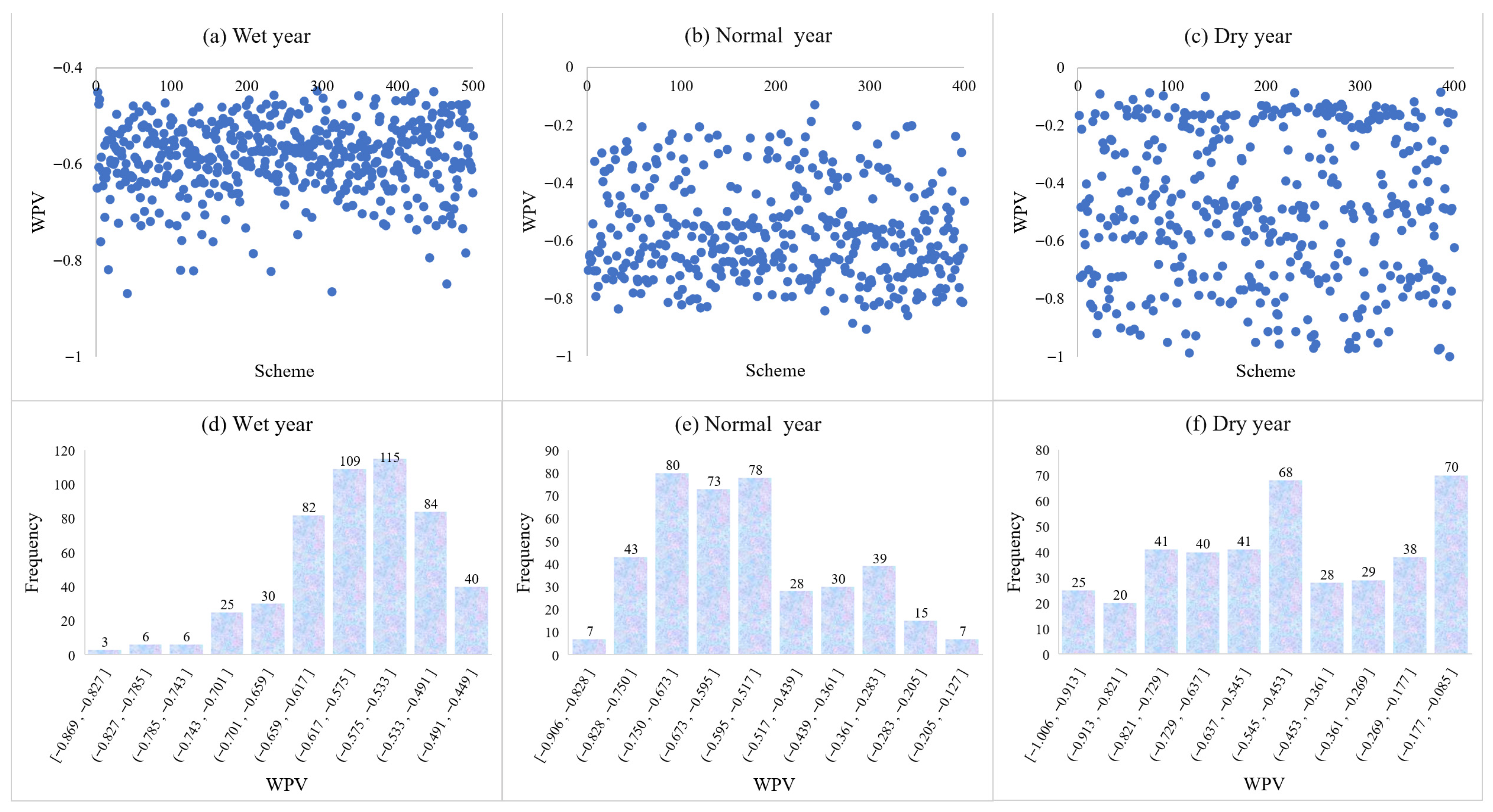
To clearly illustrate the WPV distribution characteristics, the calculated WPV values were categorized into 10 intervals, as shown in Figure 6. In wet years, WPV values range from [−0.869, −0.449], with 86.00% of the values falling within the interval (−0.659, −0.449], suggesting that most scheme WPV values fall within the upper part of the interval. In normal years, WPV values range from [−0.906, −0.127], with 70.25% of the values distributed in the interval [−0.906, −0.517], suggesting that most scheme WPV values fall within the lower part of the interval. In dry years, WPV values range from [−1.006, −0.085], with a relatively uniform WPV distribution, where 41.75% of the values fall in the lower part and 58.25% in the upper part of the interval. These findings indicate that the WPV value range and distribution patterns differ significantly across the three typical hydrological years. It can also be seen that the range of WPV values in wet years is small, and the largest in dry years, illustrating that the evaluation results of optimization scheduling plans in wet years are concentrated.
Figure 6. Distribution of WPV.

3.5. Optimized Decision Scheme

In the wet year, the selected decision scheme is S293, and WPV is −0.449. In the normal year, the selected decision scheme is S241, and WPV is −0.127. In the dry year, the selected decision scheme is S386, and WPV is −0.085. The positions of decision schemes on the Pareto solution set are marked as red dots in Figure 2. In the optimized scheduling framework, the wet-year scheme prioritizes sediment discharge, whereas the normal- and dry-year schemes emphasize power generation. These decision schemes align with practical scheduling situations, where sediment discharge is prioritized during periods of abundant water availability, and ensuring water supply for socioeconomic needs takes precedence during periods of water scarcity.
A comparison of goal function values of practical dispatching schemes and optimized decision schemes is presented in Table 5. Notably, optimized decision plans for normal and dry years demonstrate improvements in all three objective values. In wet years, although PG decreases by 1.64%, SD increases by 38.2%, and SRSEF increases by 5.89%. This suggests that greater emphasis is placed on power generation, at the expense of other objectives, in practical scheduling during wet years. Therefore, it is recommended that during wet years, high-flow processes continue to be used to continuously discharge sediment from reservoirs, restore reservoir capacity, and flush downstream river channels. During normal years and dry years, optimized decision schemes can be used as a reference to further increase sediment discharge, ecological adaptive flow satisfaction rates, and electricity production. In summary, by establishing a whole-river multi-target optimization operation model for cascade reservoirs, it is feasible to achieve collaborative governance of water–sediment, ecological and socioeconomic objectives in the Yellow River basin.
Table 5. Goal function values of practical dispatching schemes and optimized decision schemes.

4. Discussion

4.1. Comparison with Local Models

Without changing the objective functions and constraints, local multi-target scheduling models were constructed for the upper (Longyangxia, Liujiaxia, Haibowan cascade reservoirs) and middle reaches (Wanjiazhai, Sanmenxia, Xiaolangdi cascade reservoirs).
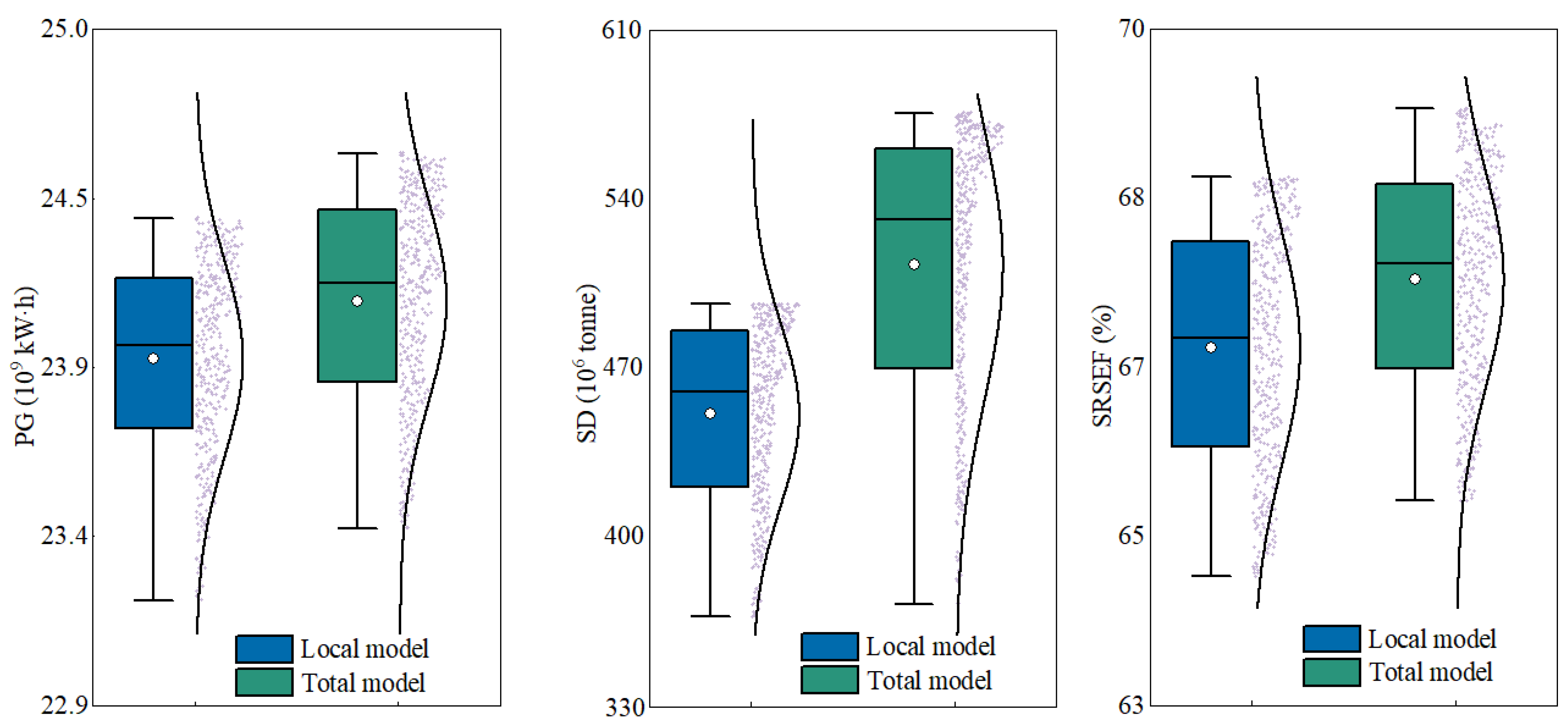
Taking normal years as an example, the whole-river multi-target scheduling model (i.e., the total model) was compared with local models. As shown in Figure 7, the values of all three objective functions from the total model exceed the sum of the corresponding functions from the two local models, suggesting that the total model can significantly improve the combined benefits of the watershed. Specifically, the total model achieves an increase of 71.01 × 10⁶ t in maximum SD, a 0.72% improvement in maximum SRSEF, and an increase of 0.20 × 10⁹ kW·h in maximum PG.
Figure 7. Comparison between the total model and local models.
Moreover, the increase in objective function value for the total model compared to the local model under different hydrological years is shown in Table 6. The SRSEF improved by 2.10% and 3.64% during the wet year and the dry year, respectively. Namely, SRSEF performs reasonably well during both wet and dry years, indicating that the total model can enhance certain ecological benefits. This is consistent with the findings of Liu et al. [24].
Table 6. Increase in objective function value for the total model compared to the local model.

4.2. Comparison with Other Decision Methods

To evaluate the reliability of the CPT-based method, the top five scheduling schemes with the highest WPV values for each typical year were ranked using two conventional decision techniques. As indicated in Table 7, the ranking results for all three methods in each typical year were identical, confirming the reliability of the CPT-based approach. In addition, when compared to other decision methodologies, the CPT-based method showed the best sensitivity performance in all typical years. Namely, the sensitivity of the CPT-based method is significantly improved, applicable to situations where decisions need to be made on a wide range of options. This aligns with the findings of Li et al. [39], indicating that CPT holds certain advantages over traditional decision-making methods.
Table 7. Results of comparison with commonly used decision approaches.

4.3. Limitations

When evaluating the reliability of the CPT, although the whole-river multi-target scheduling model in typical years can improve the overall water–sediment, ecological and socioeconomic benefits of the Yellow River basin, it does not satisfactorily help in reducing sediment deposition in downstream channels [40]. Future research should focus on the development of a multi-year, whole-river multi-target scheduling model that can fully exploit the potential of multi-year regulation reservoirs (e.g., Longyangxia) and further increase sediment discharge from the Yellow River cascade reservoirs and downstream channels.
Moreover, although the CPT-based method can be used to select an ideal decision scheme from the scheduling scheme set, considering only the Pareto solution set may not suffice [41]. Additional water–sediment, ecological and socioeconomic evaluation indicators should be introduced to comprehensively assess the advantages and disadvantages of different scheduling schemes.

5. Conclusions

To address the multi-dimensional operation requirements of water–sediment, ecological, and socioeconomic management in the Yellow River basin, a whole-river multi-target optimization operation model for cascade reservoirs was developed. After obtaining the Pareto solution set by solving the multi-target optimal operation model, the CPT was employed to build a decision model for selecting the optimal scheduling scheme. Thus, a multi-target decision framework for cascade reservoirs was established.
The proposed framework effectively mitigates conflicts among water–sediment, ecological and socioeconomic goals, while quantifying decision-makers’ preferences. Additionally, by applying this framework in the Yellow River basin, a whole-river multi-target optimization operation model for water–sediment, ecological and socioeconomic management of cascade reservoirs was built, and multi-target cooperation–competition and decision schemes in wet, normal, and dry years were verified. The following conclusions can be drawn: (1) sediment discharge goals and ecological goals were somewhat competitive, and sediment discharge goals and power generation goals were highly competitive, while ecological goals and power generation goals were cooperative, and cooperation–competition relationships among the three objectives was particularly pronounced in dry years; (2) the decision dispatching plans in wet, normal, and dry years were S293, S241, and S386, respectively, which aligned with practical scheduling situation; (3) compared with local models, the whole-river multi-target scheduling model showed an increase of 71.01 × 10⁶ t in the maximum SD, an increase of 0.72% in the maximum SRSEF, and an increase of 0.20 × 10⁹ kW·h in the maximum PG; and (4) compared with conventional decision methods, the CPT-based method yielded reasonable results and offered sensitivity that was several times higher than that of conventional decision methods, making it highly suitable for selecting the best scheme from a large set of candidate schemes.

Author Contributions

Conceptualization, D.L.; methodology, D.L.; software, G.L.; validation, C.Z.; formal analysis, R.L.; investigation, C.Z.; resources, R.L.; data curation, G.L.; writing—original draft preparation, D.L.; writing—review and editing, C.Z.; visualization, R.L.; supervision, G.L.; project administration, C.Z.; funding acquisition, R.L. All authors have read and agreed to the published version of the manuscript.

Funding

This research was supported by the National Key Research and Development Program of China (2021YFC3200400), the National Natural Science Foundation of China (U2243601, U2243241), the Natural Science Foundation of Henan Province (252300421559), the Special Project for Basic Research Business Fees of the Yellow River Institute of Hydraulic Research (HKY-JBYW-2024-01), and the Science and Technology Development Fund of the Yellow River Institute of Hydraulic Research (HKF202401).

Data Availability Statement

The original contributions presented in this study are included in the article. Further inquiries can be directed to the corresponding author.

Acknowledgments

The authors appreciate the reviewers’ insightful comments, which have made significant contributions to improving the manuscript.

Conflicts of Interest

The authors declare no conflicts of interest.

References

  1. Nguyen, B.Q.; Van Binh, D.; Tran, T.N.D.; Kantoush, S.A.; Sumi, T. Response of streamflow and sediment variability to cascade dam development and climate change in the Sai Gon Dong Nai River basin. Clim. Dyn. 2024, 62, 7997–8017. [Google Scholar] [CrossRef]
  2. Li, D.; Li, J.; Wang, Y.; Jiang, E.; Zhao, W.; Liu, G.; Yang, Z. A multi-attribute decision-making method of cascade reservoir joint scheduling schemes considering water–sediment, eco-environment, and socio-economy in the Yellow River Basin. J. Hydrol. 2025, 660, 133393. [Google Scholar] [CrossRef]
  3. Jia, D.; Zhang, T.; Wu, L.; Su, X.; Bai, T.; Huang, Q. Multi-objective cooperative optimization of reservoir scheduling and water resources allocation for inter-basin water transfer project based on multi-stage coupling model. J. Hydrol. 2024, 630, 130673. [Google Scholar] [CrossRef]
  4. Zhu, Y.; Zhou, Y.; Wang, Y.; Ning, Z.; Guo, S.; Chang, F.-J.; Xu, C.-Y. Compromising power generation and flood control: Optimizing flood operating water levels in mega reservoirs. Sustain. Energy Technol. Assess. 2024, 70, 103963. [Google Scholar] [CrossRef]
  5. Moura de Figueiredo, N.; Cavalcante Blanco, C.J.; Pinheiro Campos Filho, L.C.; Mesquita, A. MUWOS-Multiple use water optimization system for the power generation and navigation trade-offs analysis. Renew. Energy 2023, 203, 205–218. [Google Scholar] [CrossRef]
  6. Feng, Z.; Zhang, L.; Mo, L.; Wang, Y.-Q.; Niu, W.-J. A multi-objective cooperation search algorithm for cascade reservoirs operation optimization considering power generation and ecological flows. Appl. Soft Comput. 2024, 150, 111085. [Google Scholar] [CrossRef]
  7. Wu, Z.; Liu, D.; Mei, Y.; Guo, S.; Xiong, L.; Liu, P.; Yin, J.; Zeng, Y. Delayed feedback between adaptive reservoir operation and environmental awareness within water supply-hydropower generation-environment nexus. J. Clean. Prod. 2022, 345, 131181. [Google Scholar] [CrossRef]
  8. Bai, T.; Yu, J.; Jin, W.; Wan, J.; Gou, S.; Ma, X.; Ma, P. Multi-objective and multi-scheme research on water and sediment regulation potential of reservoirs in the upper Yellow River. Int. J. Sediment Res. 2023, 38, 203–215. [Google Scholar] [CrossRef]
  9. Li, X.; Wang, Q.; Wang, Y.; Zhang, H.; Li, J.; Li, D. Multi-Dimensional Collaborative Operation Model and Evaluation of Cascade Reservoirs in the Middle Reaches of the Yellow River. Water 2023, 15, 3523. [Google Scholar] [CrossRef]
  10. Li, J.; Li, H.; Wang, Y.; Liu, G.; Yang, F.; Wang, Q.; Li, D. Multi-objective synergy and competition relationship of water and sediment regulation of the Heishanxia reservoir in upstream of the Yellow River Basin. J. Hydrol. Reg. Stud. 2024, 56, 102045. [Google Scholar] [CrossRef]
  11. Li, D.; Zuo, Q.; Jiang, E.; Zhang, Z.; Wu, Q.; Wang, Y. An integrated water resources management model considering carbon source and sink under uncertainty: A case study of agricultural water-dominated basin. J. Clean. Prod. 2024, 436, 140667. [Google Scholar] [CrossRef]
  12. Yaykiran, S.; Ekdal, A. Sustainable Water Optimization Tool (SUWO): An Optimization Framework for the Water–Energy–Food–Ecosystem Nexus. Water 2025, 17, 1280. [Google Scholar] [CrossRef]
  13. Agrawal, A.V.; Soni, M.; Keshta, I.; Savithri, V.; Abdinabievna, P.S.; Singh, S. A probability-based fuzzy algorithm for multi-attribute decision-analysis with application to aviation disaster decision-making. Decis. Anal. J. 2023, 8, 100310. [Google Scholar] [CrossRef]
  14. Luo, T.; Sun, X.; Zhou, H.; Xu, Y.; Zhang, Y. A Reservoir Group Flood Control Operation Decision-Making Risk Analysis Model Considering Indicator and Weight Uncertainties. Water 2025, 17, 2145. [Google Scholar] [CrossRef]
  15. Hadi-Vencheh, A.; Mirjaberi, M. Fuzzy inferior ratio method for multiple attribute decision making problems. Inf. Sci. 2014, 277, 263–272. [Google Scholar] [CrossRef]
  16. Malekmohammadi, B.; Zahraie, B.; Kerachian, R. Ranking solutions of multi-objective reservoir operation optimization models using multi-criteria decision analysis. Expert Syst. Appl. 2011, 38, 7851–7863. [Google Scholar] [CrossRef]
  17. Xing, X.H.; Luo, J.G.; Xie, J.C. Multi-objective decision model of reservoir flood control operation. Appl. Mech. Mater. 2012, 212, 715–720. [Google Scholar] [CrossRef]
  18. Wu, Q.; Zuo, Q.; Li, D.; Li, J.; Han, C.; Ma, J. Integrated assessment of multiple characteristics for extreme climatic events under climate change: Application of a distribution-evolution-attribution-risk framework. Atmos. Res. 2023, 282, 106515. [Google Scholar] [CrossRef]
  19. Li, D.; Zuo, Q.; Zhang, Z. A new assessment method of sustainable water resources utilization considering fairness-efficiency-security: A case study of 31 provinces and cities in China. Sustain. Cities Soc. 2022, 81, 103839. [Google Scholar] [CrossRef]
  20. Huang, X.; Xu, B.; Zhong, P.; Yao, H.; Yue, H.; Zhu, F.; Lu, Q.; Sun, Y.; Mo, R.; Li, Z.; et al. Robust multi objective reservoir operation and risk decision-making model for real-time flood control coping with forecast uncertainty. J. Hydrol. 2022, 605, 127334. [Google Scholar] [CrossRef]
  21. Zhu, D.; Chen, H.; Zhou, Y.; Xu, X.; Guo, S.; Chang, F.-J.; Xu, C.-Y. Exploring a multi-objective cluster-decomposition framework for optimizing flood control operation rules of cascade reservoirs in a river basin. J. Hydrol. 2022, 614, 128602. [Google Scholar] [CrossRef]
  22. Evangelista, S.S.; Maturan, F.; Wenceslao, C.; Atibing, N.M.; Villarosa, R.; Ocampo, L. Cumulative prospect theory under different types of input data for public health resilience assessment during natural disasters. Expert Syst. Appl. 2024, 258, 125172. [Google Scholar] [CrossRef]
  23. Gao, K.; Sun, L.; Yang, Y.; Meng, F.; Qu, X. Cumulative prospect theory coupled with multi-attribute decision making for modeling travel behavior. Transp. Res. Part A Policy Pract. 2021, 148, 1–21. [Google Scholar] [CrossRef]
  24. Liu, G.; Jiang, E.; Li, D.; Li, J.; Wang, Y.; Zhao, W.; Yang, Z. Annual multi-objective optimization model and strategy for scheduling cascade reservoirs on the yellow river mainstream. J. Hydrol. 2025, 659, 133306. [Google Scholar] [CrossRef]
  25. Bai, T.; Wei, J.; Chang, F.J.; Yang, W.; Huang, Q. Optimize multi-objective transformation rules of water-sediment regulation for cascade reservoirs in the Upper Yellow River of China. J. Hydrol. 2019, 577, 123987. [Google Scholar] [CrossRef]
  26. Chen, L.; Ge, L.; Wang, D.; Zhong, W.; Zhan, T.; Deng, A. Multi-objective water-sediment optimal operation of cascade reservoirs in the Yellow River Basin. J. Hydrol. 2022, 609, 127744. [Google Scholar] [CrossRef]
  27. Wang, Y.; Tang, F.; Jiang, E.; Wang, X.; Zhao, J. Optimizing hydropower generation and sediment transport in Yellow River basin via cooperative game theory. J. Hydrol. 2022, 614, 128581. [Google Scholar] [CrossRef]
  28. Zhang, J.; Cai, J.; Zhang, H.; Chen, T. NSGA-III integrating eliminating strategy and dynamic constraint relaxation mechanism to solve many-objective optimal power flow problem. Appl. Soft Comput. 2023, 146, 110612. [Google Scholar] [CrossRef]
  29. Tversky, A.; Kahneman, D. Advances in prospect theory: Cumulative representation of uncertainty. J. Risk Uncertain. 1992, 5, 297–323. [Google Scholar] [CrossRef]
  30. Rieger, M.O.; Wang, M.; Hens, T. Estimating cumulative prospect theory parameters from an international survey. Theory Decis. 2017, 82, 567–596. [Google Scholar] [CrossRef]
  31. Wang, Z.X.; Dang, Y.G.; Pei, L.L.; Wang, Y.Y. Multi-index grey relational decision-making based on cumulative prospect theory. Control Decis. 2010, 25, 232–236. [Google Scholar]
  32. Senthilkumar, V.; Adinarayanan, A.; Jagatheesan, K. Grey Relational Analysis (GRA) for optimization of CO2 laser cutting of stainless steel. Mater. Today Proc. 2023, 72, 2437–2442. [Google Scholar] [CrossRef]
  33. Liu, J.; Zhang, Q.; Xie, M.; Lin, M.; Xu, Z. A blockchain platform selection method with heterogeneous multi-criteria Decision-Making based on hybrid distance measures and an AHP-EWM weight method. Expert Syst. Appl. 2024, 256, 124910. [Google Scholar] [CrossRef]
  34. Carpitella, S.; Kratochvíl, V.; Pištěk, M. Multi-criteria decision making beyond consistency: An alternative to AHP for real-world industrial problems. Comput. Ind. Eng. 2024, 198, 110661. [Google Scholar] [CrossRef]
  35. Li, R.; Su, H.; Ling, W.; Tang, L.; Li, Z.; Wang, W. Optimization of flue gas desulphurization technologies based on cloud model and grey relation projection method. Proc. Chin. Soc. Electr. Eng. 2012, 32, 21–26. [Google Scholar]
  36. Wang, G.; Wu, B.; Wang, Z.Y. Sedimentation problems and management strategies of Sanmenxia reservoir, Yellow River, China. Water Resour. Res. 2005, 41, W09417. [Google Scholar] [CrossRef]
  37. Ren, S.; Gao, Y.; Wang, W.J.; Zhou, Y.; Zhao, H. Estimating sediment trap efficiency of flood events during flood season in the Three Gorges Reservoir. Water Resour. Res. 2024, 60, e2023WR036975. [Google Scholar] [CrossRef]
  38. Zhang, X.; Yu, J.; Wang, L.; Zhang, R. Determination of river ecological flow thresholds and development of early warning programs based on coupled multiple hydrological methods. Water 2024, 16, 1986. [Google Scholar] [CrossRef]
  39. Li, D.; Li, R.; Liu, G.; Wang, Y.; Li, J. A multi-objective scheduling decision-making model based on modified cumulative prospect theory for water-sediment, eco-environment, and socio-economy of cascade reservoirs in the Yellow River Basin. Water Resour. Prot. 2025, 41, 173–179. [Google Scholar]
  40. Chen, J.; Zhou, W.; Han, S.; Sun, G. Influences of retrogressive erosion of reservoir on sedimentation of its downstream river channel—A case study on Sanmenxia Reservoir and the Lower Yellow River. Int. J. Sediment Res. 2017, 32, 373–383. [Google Scholar] [CrossRef]
  41. Ni, X.; Dong, Z.; Jiang, Y.; Xie, W.; Yao, H.; Chen, M. A subjective-objective integrated multi-objective decision-making method for reservoir operation featuring trade-offs among non-inferior solutions themselves. J. Hydrol. 2022, 613, 128430. [Google Scholar] [CrossRef]
Disclaimer/Publisher’s Note: The statements, opinions and data contained in all publications are solely those of the individual author(s) and contributor(s) and not of MDPI and/or the editor(s). MDPI and/or the editor(s) disclaim responsibility for any injury to people or property resulting from any ideas, methods, instructions or products referred to in the content.

Article Metrics

Citations

Article Access Statistics

Multiple requests from the same IP address are counted as one view.