


Watershed Eco-Compensation Mechanism in China: Policies, Practices and Recommendations
Abstract
:1. Introduction
2. Material and Methods
3. WCE Policies, Legal Basis and Economic Instruments in China
3.1. Policies and Legal Framework of WEC in China
3.1.1. Policies of WEC in China
3.1.2. Legal Basis of WEC in China
3.1.3. Relevant Economic Instruments in WEC
3.2. Discussion of Significant Challenges and Opportunities
3.2.1. Discussion of Significant Challenges in WEC
3.2.2. Political Dynamics and Opportunities in WEC
4. Domestic WEC and Foreign WEPS Practices and Comparisons
4.1. Current Practice of WEC in China
4.2. The Practices of PWES in Foreign Countries
4.3. Comparative Analysis of Domestic and Foreign Watershed Eco-Compensation
5. Recommendation for Establishing WEC Mechanism in China
5.1. Promoting Diversified Approaches of WEC
5.1.1. Mixed Eco-Compensation Model in WEC
5.1.2. Multi-Stakeholder Engagement in WEC
5.1.3. Diversified Funding Sources of WEC
5.2. Strengthening Market-Oriented Approaches in WEC
5.2.1. Improving Laws and Regulations on Market-Oriented WEC
5.2.2. Establishing a WEC Mechanism for Ecological Products in the Watershed
6. Conclusions and Future Prospects of WEC in China
Author Contributions
Funding
Institutional Review Board Statement
Informed Consent Statement
Data Availability Statement
Conflicts of Interest
References
- Bösch, M.; Elsasser, P.; Wunder, S. Why do payments for watershed services emerge? A cross-country analysis of adoption contexts. World Dev. 2019, 119, 111–119. [Google Scholar] [CrossRef]
- Zhang, Q.; Brouwer, R. Is China affected by the resource curse? A critical review of the Chinese literature. J. Policy Model. 2020, 42, 133–152. [Google Scholar] [CrossRef]
- Arthington, A.H.; Bunn, S.E.; Poff, N.L.; Naiman, R.J. The challenge of providing environmental flow rules to sustain river ecosystems. Ecol. Appl. 2006, 16, 1311–1318. [Google Scholar] [CrossRef]
- Zheng, Y.C.; Zhang, H.N.; Ge, Y.X.; Jie, Y.M. Analysis Framework of Diversified Watershed Eco-compensation: A Perspective of Compensation Subject. China Popul. Resour. Environ. 2019, 29, 131–139. (In Chinese) [Google Scholar]
- Wang, L.A.; Xu, X.M. Research status and prospect of marine ecological compensation. Econ. Res. Guide 2016, 22, 25–29. [Google Scholar]
- Van den Bergh, J. Externality or sustainability economics? Ecol. Econ. 2010, 69, 2047–2052. [Google Scholar] [CrossRef]
- Benchekroun, H.; Chaudhuri, A.R. Transboundary pollution and clean technologies. Resour. Energ. Econ. 2014, 36, 601–619. [Google Scholar] [CrossRef] [Green Version]
- Kosoy, N.; Martinez-Tuna, M.; Muradian, R.; Martinez-Alier, J. Payments for environmental services in watersheds: Insights from a comparative study of three cases in Central America. Ecol. Econ. 2007, 61, 446–455. [Google Scholar] [CrossRef]
- Zhang, H.Y.; Liu, G.H.; Wang, J.N. Policy and Practice Progress of Watershed Eco-compensation in China. Chin. Geogr. Sci. 2007, 17, 179–185. [Google Scholar] [CrossRef]
- Wang, H.; Dong, Z.; Xu, Y.; Ge, C. Eco-compensation for watershed services in China. Water. Int. 2016, 41, 271–289. [Google Scholar] [CrossRef]
- Costanza, R.; d’Arge, R.; De Groot, R.; Farber, S.; Grasso, M.B.; Hannon, B.; Raskin, R.G. The value of the world’s ecosystem services and natural capital. Nature 1997, 387, 253. [Google Scholar] [CrossRef]
- Costanza, R.; Groot, R.; De Braat, L.; Kubiszewski, I.; Fioramonti, L.; Sutton, P.; Grasso, M. Twenty years of ecosystem services: How far have we come and how far do we still need to go? Ecosyst. Serv. 2017, 28, 1–16. [Google Scholar] [CrossRef]
- Untied Nations. World Urbanization Prospects: The 2015 Revision; Untied Nations: New York, NY, USA, 2015. [Google Scholar]
- National Development and Reform Commission (NDRC). Development and Planning Outline of the Yangtze River Economic Belt Officially Released; NDRC: Beijing, China, 2016. (In Chinese) [Google Scholar]
- Yan, D.D.; Fu, Y.C.; Liu, B. Theoretical Study of Watershed Eco-Compensation Standards. IOP Conf. Ser. Mater. Sci. Eng. 2018, 301, 012100. [Google Scholar] [CrossRef]
- Meng, Y.; Liu, M.; Guan, X.; Liu, W. Comprehensive evaluation of ecological compensation effect in the Xiaohong River Basin. China Environ. Sci. Pollut. Res. 2019, 26, 7793–7803. [Google Scholar] [CrossRef]
- Madsen, B.; Carroll, N.; Moore Brands, K. State of Biodiversity Markets: Offset and Compensation Programs Worldwide; Ecosystem Marketplace: Washington, DC, USA, 2010. [Google Scholar]
- Stanton, T.; Echavarria, M.; Hamilton, K.; Ott, C. State of Watershed Payments: An Emerging Marketplace. J. Sustain. For. 2010, 28, 497–524. [Google Scholar]
- OECD (Organization for Economic Co-operation and Development). Scaling-Up Finance Mechanisms for Biodiversity; OECD Publishing: Paris, France, 2013. [Google Scholar]
- Engel, S.; Pagiola, S.; Wunder, S. Designing payments for environmental services in theory and practice: An overview of the issues. Ecol. Econ. 2008, 65, 663–674. [Google Scholar] [CrossRef]
- Pascual, U.; Phelps, J.; Garmendia, E.; Brown, K.; Corbera, E.; Martin, A.; GomezBaggethun, E.; Muradian, R. Social equity matters in payments for ecosystem services. Bioscience 2014, 64, 1027–1036. [Google Scholar] [CrossRef] [Green Version]
- OECD (Organization for Economic Co-operation and Development). Biodiversity Offsets: Effective Design and Implementation—Policy Highlights; OECD Publishing: Paris, France, 2014. [Google Scholar]
- Shang, W.X.; Gong, Y.C.; Wang, Z.J.; Michael, J. Eco-compensation in China: Theory, practices and suggestions for the future. J. Environ. Manag. 2018, 210, 162–170. [Google Scholar] [CrossRef]
- Brown, P.H.; Lant, C.L. The effect of wetland mitigation banking on the achievement of no-net-loss. Environ. Manag. 1999, 23, 333–345. [Google Scholar] [CrossRef]
- May, J.; Hobbs, R.J.; Valentin, L.E. Are offsets effective? An evaluation of recent environmental offsets in Western Australia. Biol. Conserv. 2017, 206, 249–257. [Google Scholar] [CrossRef] [Green Version]
- Wunder, S. The efficiency of payments for environmental services in tropical conservation. Conserv. Biol. 2007, 21, 48–58. [Google Scholar] [CrossRef]
- SEPA. The Guidance on Implementation of Eco-Compensation Pilot; State Environmental Protection Administration: Beijing, China, 2007. [Google Scholar]
- Goldman-Benner, R.L.; Benitez, S.; Boucher, T.; Calvache, A.; Daily, G.; Kareiva, P.; Kroeger, T.; Ramos, A. Water funds and payments for ecosystem services: Practice learns from theory and theory can learn from practice. Oryx 2012, 46, 55–63. [Google Scholar] [CrossRef] [Green Version]
- Suhardiman, D.; Wichelns, D.; Lestrelin, G.; Hoanh, C.T. Payments for ecosystem services in Vietnam: Market-based incentives or state control of resources? Ecosyst. Serv. 2013, 6, 64–71. [Google Scholar] [CrossRef]
- Zhen, L.; Zhang, H. Payment for ecosystem services in China: An overview. Living Rev. Landsc. Res. 2011, 5, 2–21. [Google Scholar] [CrossRef] [Green Version]
- Marlene, N.; Gray, S.; Sharma, A.; Burn, S.; Muttil, N. Impact of water management practice scenarios on wastewater flow and contaminant concentration. J. Environ. Manag. 2015, 151, 461–471. [Google Scholar] [CrossRef] [PubMed]
- Noerfitriyani, E.; Hartono, D.M.; Moersidik, S.S.; Gusniani, I. Impact of leachate discharge from Cipayung landfill on water quality of Pesanggrahan River, Indonesia. IOP Conf. Ser. Earth Environ. Sci. 2018, 120, 012002. [Google Scholar] [CrossRef] [Green Version]
- Jiang, Y.H.; Zhang, J.W.; Chen, K.L.; Xue, X.Z.; Michael, A.U. Moving towards a Systematic Marine Eco-Compensation Mechanism in China: Policy, Practice and Strategy. Ocean. Coast. Manag. 2019, 169, 10–19. [Google Scholar] [CrossRef]
- Lockie, S. Market Instruments, Ecosystem Services, and Property Rights: Assumptions and Conditions for Sustained Social and Ecological Benefits. Land Use Policy 2013, 31, 90–98. [Google Scholar] [CrossRef]
- Cai, X. Water stress, water transfer and social equity in Northern China-Implications for policy reforms. J. Environ. Manag. 2008, 87, 14–25. [Google Scholar] [CrossRef]
- Shi, G.M.; Wang, J.N.; Zhang, B.; Zhang, Z.; Zhang, Y.L. Pollution control costs of a transboundary river basin Empirical tests of the fairness and stability of cost allocation mechanisms using game theory. J. Environ. Manag. 2016, 177, 145–152. [Google Scholar] [CrossRef]
- Xin, B.; Sun, M. A differential oligopoly game for optimal production planning and water savings. Eur. J. Oper. Res. 2018, 269, 206–217. [Google Scholar] [CrossRef]
- Fünfgelt, J.; Schulze, G. Endogenous environmental policy for small open economies with transboundary pollution. Econ. Model. 2016, 57, 294–310. [Google Scholar] [CrossRef]
- Standing Committee of the 12th National People’s Congress. Environmental Protection Law of the People’s Republic of China; Standing Committee of the 12th National People’s Congress: Beijing, China, 2014. [Google Scholar]
- Bennett, M.T.; Zhang, Q.; Kannan, K.; Jin, L. Payments for Ecological Services and Eco-Compensation: Practices and Innovations in the People’s Republic of China; Asian Development Bank: Mandaluyong City, Philippines, 2011. [Google Scholar]
- Palerm, J. The Habitats Directive as an instrument to achieve sustainability? An analysis through the case of the Rotterdam mainport development project. Eur. Environ. 2006, 16, 127–138. [Google Scholar] [CrossRef]
- Vaissière, A.C.; Levrel, H.; Pioch, S.; Carlier, A. Biodiversity offsets for offshore wind farm projects: The current situation in Europe. Mar. Pol. 2014, 48, 172–183. [Google Scholar] [CrossRef] [Green Version]
- Villarroya, A.; Puig, J. Ecological compensation and environmental impact assessment in Spain. Environ. Impact Assess. Rev. 2010, 30, 357–362. [Google Scholar] [CrossRef]
- Guan, X.J.; Liu, M.; Meng, Y. A comprehensive ecological compensation indicator based on pollution damage -protection bidirectional model for river basin. Ecol. Indic. 2021, 126, 107708. [Google Scholar] [CrossRef]
- Zhang, J. Practice and progress of the basin water environmental eco-compensation in watershed. Environ. Monit. China 2014, 30, 191–195. (In Chinese) [Google Scholar]
- Geng, X.Y.; Ge, Y.X.; Zhang, H.N. Study on Ecological Compensation Standard of Watershed Based on Reset Cost: A Case Study of Xiaoqing River Basin. China Popul. Resour. Environ. 2018, 28, 140–147. (In Chinese) [Google Scholar]
- Xi, J.P. Speech at the Symposium on Ecological Protection and Quality Development in the Yellow River Basin. Water Resour. Dev. Manag. 2019, 11, 1–4. (In Chinese) [Google Scholar]
- Xi, Y.Q.; Wang, J.Q. Research on Ecological Compensation Mechanism of Watersheds in China from the Perspective of Marketization and Diversification. J. UESTC 2020, 22, 54–60. (In Chinese) [Google Scholar]
- Cheng, B.; Tian, R.; Dong, Z. Patterns and assessment of the watershed eco-compensation standard practices in China. Ecol. Econ. 2012, 4, 24–29. [Google Scholar]
- Yoon, T.; Rhodes, C.; Shah, F.A. Upstream water resource management to address downstream pollution concerns: A policy framework with application to the Nakdong river basin in South Korea. Water Resour. Res. 2015, 51, 787–805. [Google Scholar] [CrossRef]
- Lu, Y.; Xu, J.; Qin, F.; Wang, J.Y. Payments for Watershed Services and Practices in China: Achievements and Challenges. Chin. Geogr. Sci. 2018, 28, 873–893. [Google Scholar] [CrossRef] [Green Version]
- Wunder, S. Revisiting the concept of payments for environmental services. Ecol. Econ. 2015, 117, 234–243. [Google Scholar] [CrossRef]
- Liu, X.J. Evaluation on the pollution control of Qingshui River Basin in Guizhou Province. Environ. Prot. Technol. 2014, 20, 33–35. (In Chinese) [Google Scholar]
- Bennett, M.T.; Trends, F. Markets for Ecosystem Services in China: An Exploration of China’s “Eco-Compensation” and Other Market-Based Environmental Policies; Forest Trends: Washington, DC, USA, 2009. [Google Scholar]
- Guan, X.J.; Hou, S.; Meng, Y.; Liu, W. Study on the quantification of ecological compensation in a river basin considering different industries based on water pollution loss value. Environ. Sci. Pollut. Res. 2019, 26, 30954–30966. [Google Scholar] [CrossRef]
- Qin, Y.C.; Wang, J. Developing Eco-Compensation Regulations in China: The Way Forward; Peking University Press: Beijing, China, 2013; pp. 301–308. [Google Scholar]
- Zhang, Y.; Jia, R.X. The implementation development of horizontal pilot eco-compensation policy in Xin’an River watershed in Anhui Province. China Econ. Trade Her. 2015, 13, 58–62. (In Chinese) [Google Scholar]
- Liu, Z.; Zhang, Y.H. On the Mechanism of Ecological Compensation from the Perspective of Shared Development: A Case Study of Xin’an River Basin. Stud. Mao Zedong Deng Xiaoping Theor. 2017, 5, 51–56. (In Chinese) [Google Scholar]
- Wang, L.J. Watershed Eco-Compensation Mechanism and Policy Study in China. Procedia Environ. Sci. 2010, 2, 1290–1295. [Google Scholar] [CrossRef] [Green Version]
- Zhang, Q.; Bennett, M.T. Eco-Compensation for Watershed Services in the People’s Republic of China; Asian Development Bank: Manila, Philippines, 2011. [Google Scholar]
- Wunder, S. Payments for Environmental Services: Some Nuts and Bolts; Center for International Forestry Research: Jakarta, Indonesia, 2005; Volume 42, pp. 1–24. [Google Scholar]
- Alvarado-Quesada, I.; Hein, L.; Weikard, H. Market-based mechanisms for biodiversity conservation: A review of existing schemes and an outline for a global mechanism. Biodivers. Conserv. 2014, 23, 1–21. [Google Scholar] [CrossRef]
- He, G.Z.; Zhang, L. Revising China’s environmental law. Science 2013, 341, 133–136. [Google Scholar] [CrossRef]
- Li, G.; Sun, F.Y.; Fu, B.T.; Deng, L.Z.; Yang, K.; Liu, Y.Y.; Che, Y. How to promote the public participation in eco-compensation in transboundary river basins: A case from Planned Behavior perspective. J. Clean. Prod. 2021, 313, 127911. [Google Scholar] [CrossRef]
- Jiang, K.; Zhang, X.X.; Wang, Y.S. Stability and influencing factors when designing incentive-compatible payments for watershed services: Insights from the Xin’an River Basin, China. Mar. Policy 2021, 134, 104824. [Google Scholar] [CrossRef]
- Teets, J.C.; Gao, M.; Wysocki, M.; Ye, W.R. The impact of environmental federalism: An analysis of watershed eco-compensation policy design in China. Environ. Policy Gov. 2021, 31, 580–591. [Google Scholar] [CrossRef]
- Wang, J.J.; Zhou, J.; Wang, Z.X. Quantification of eco-compensations based on a bidirectional compensation scheme in a water environment: A case study in the Jiangsu Province, China. Water Policy 2019, 21, 1162–1174. [Google Scholar] [CrossRef]
- Sheng, J.C.; Qiu, W.G.; Han, X. China’s PES-like horizontal eco-compensation program: Combining market-oriented mechanisms and government interventions. Ecosyst. Serv. 2020, 45, 101164. [Google Scholar] [CrossRef]
- Dong, Y.H.; Zheng, Q.; Fu, L.L. Multilevel Governments’ Decision-Making Process and Its Influencing Factors in Watershed Ecological Compensation. J. Coast. Res. 2019, 11, 60–66. [Google Scholar] [CrossRef]
- Wang, H.; Meijerink, S.; van der Krabben, E. Institutional Design and Performance of Markets for Watershed Ecosystem Services: A Systematic Literature Review. Sustainability 2020, 12, 6382. [Google Scholar] [CrossRef]
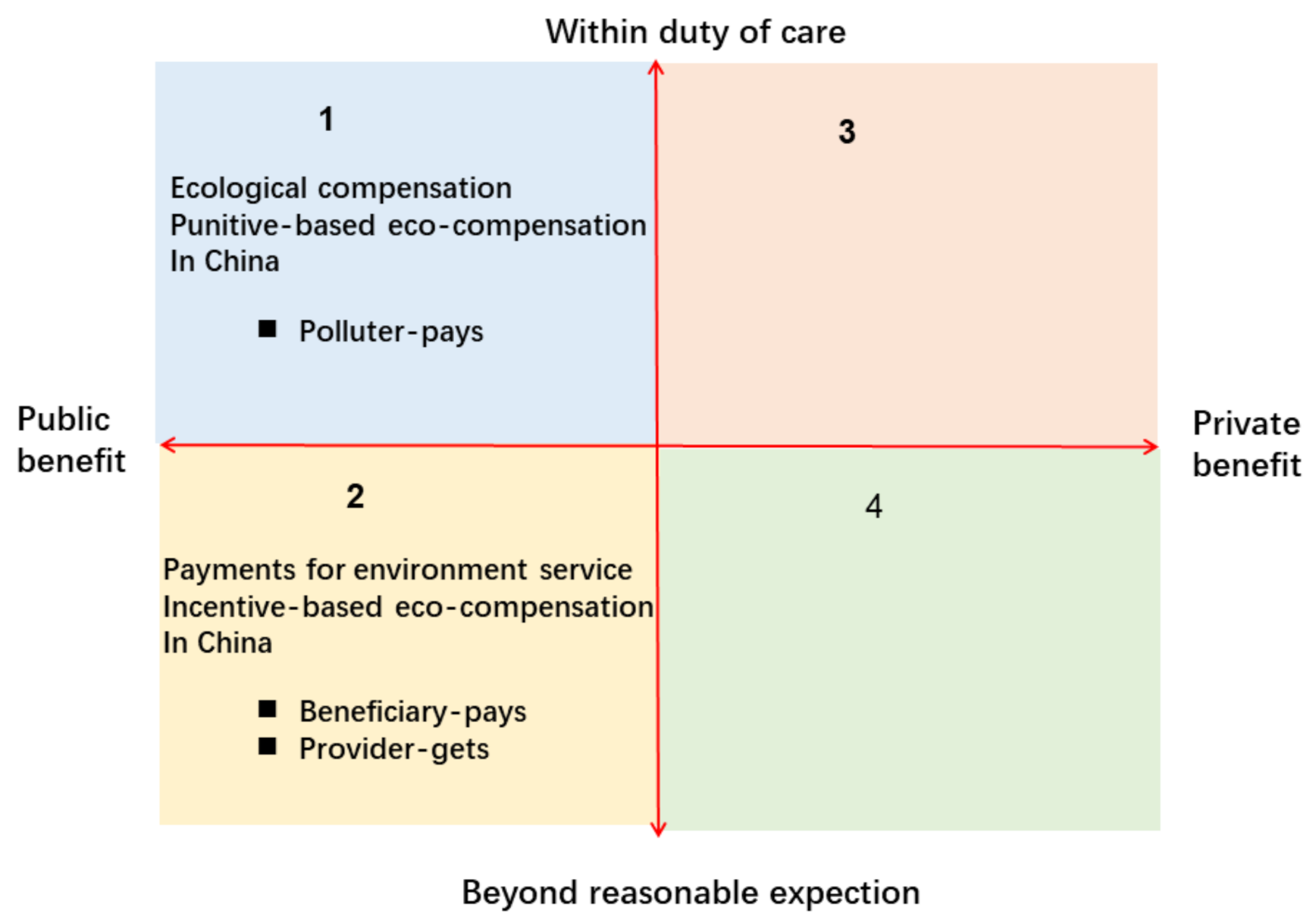
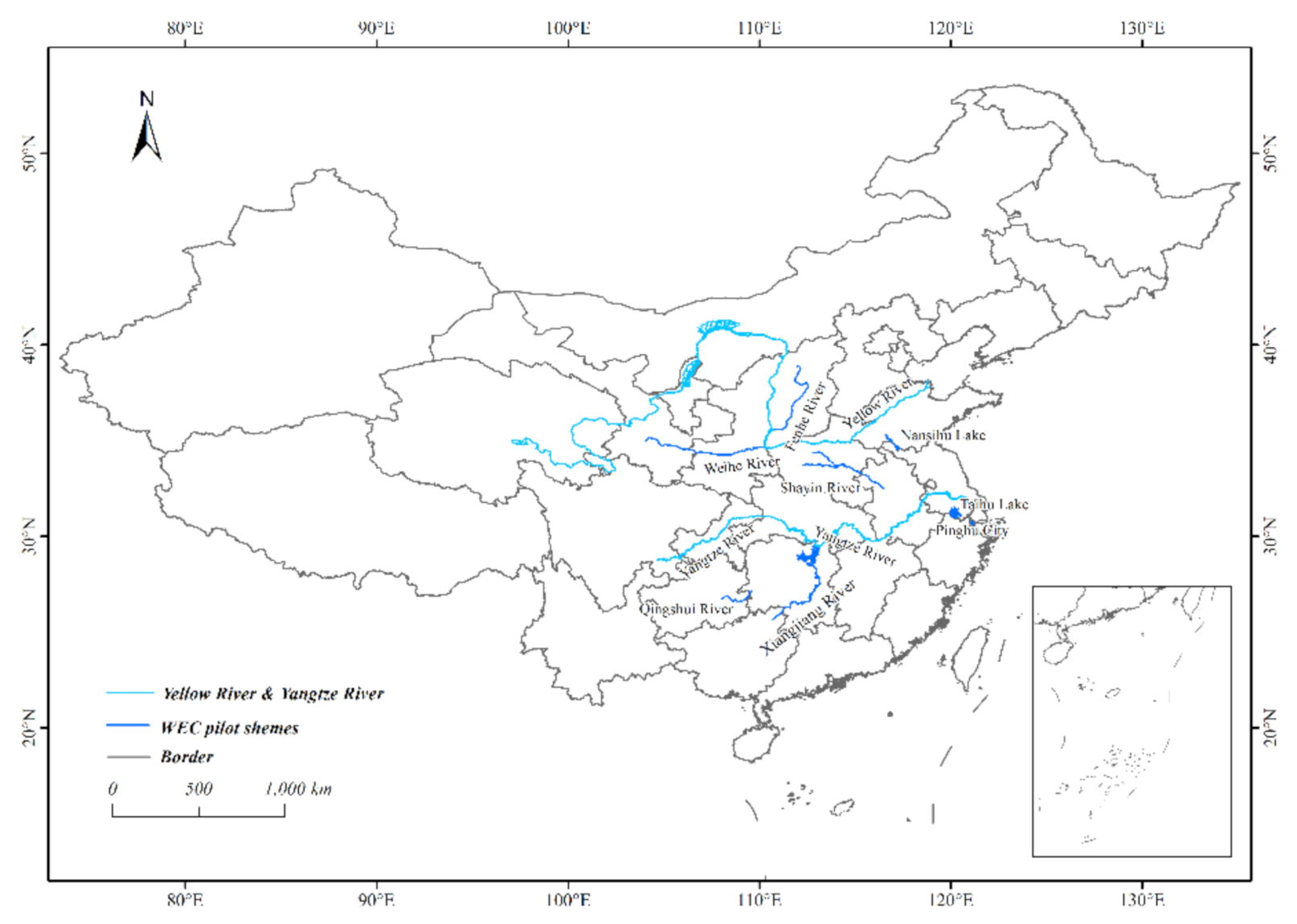

| Theoretical Backgrounds | Eco-Compensation in China | |
|---|---|---|
| PECC a | IECC b | |
| Cause | Negative externalities | Positive externalities |
| Principle of payments | Polluter-pays | Beneficiary-pays, provider-gets |
| Driver | Regulatory compliance | Government intermediary payments or voluntary transaction |
| Scope of implementation | Local, national | Local, national |
| Target | Maintenance of ecosystems | Improvement of ecosystems |
| Source of finance ideal | Polluters | beneficiaries |
| real | Polluters and the government | Mostly from the government |
| Method of implementation | One-time offsets, in-lieu fee | Payment in cash, payment in kind |
| Policy Documents | Related Goals and Strategies |
|---|---|
| Report of the 18th NCCPC, November 2012 a | To establish a system for paying for resource consumption and compensating for ecological damage, which responds to market supply and demand and resource scarcity, as well as recognizing environmental values and the interests of later generations |
| Decree No. 12 of 2015 of CCCPC on “Opinions on Accelerating the Construction of Ecological Civilization” b | To improve the ecological protective compensation mechanism. To define the rights and obligations of ecological protectors and beneficiaries, for which impairers compensate for the ecological loss, beneficiaries pay the cost and protectors gain appropriate compensation. To establish a sound system of resource fees and ecological compensation that responds to the market supply and demand and resource scarcity recognizes environmental values and the interests of later generations |
| Decree of 2015 of CCCPC and SCC on “Overall Plan for the Reform of the Ecological Civilization System” c | To explore diversified compensation mechanisms. To increase financial payments to critical ecological function areas. To formulate management regulations of the horizontal ecological compensation mechanism. To allocate funds based on the effect of ecological protection. |
| Outline of the 13th Five-year Plan for National Economic and Social Development, March 2016 | To establish diversified ecological compensation mechanisms. To link financial support with ecological protection results. |
| Decree No. 31 of 2016 of SCC on “Opinions on Improving the Ecological Protection Compensation Mechanism” | By 2020, to establish an ecological compensation system covering various key areas and important regions. To carry out comprehensive ecological protection compensation in the key drinking water sources or the critical ecological functions regions. To improve compensation standards appropriately. |
| Report of the 19th NCCPC, October 2017 d | To Increase ecological compensation funding for soil and water conservation. To establish a diversified compensation mechanism following the national conditions. To improve the ecological civilization system. |
| Report of the12th NPC, March 2018 e | To reform and improve the ecological environment management system. To promote the ecological environment damage compensation system and improve the environmental compensation mechanism |
| Laws and Regulations | Relevant Requirements |
|---|---|
| General Principles of the Civil Law of the People’s Republic of China (2019) The Constitution of the People’s Republic of China (2018 Revised) | Article 81: State-owned mineral deposits and currents, state-owned and collectively-owned forest land, mountains, grasslands, wasteland, and tidal flats may not be leased, mortgaged, sold, or illegally transferred in other forms. Article 83: The neighborhood of the estate should correctly handle the interrelations of water intake, drainage, transit, ventilation, and lighting under the principle of being beneficial to production, facilitating people’s lives, solidarity and mutual assistance, equality, and reasonableness. If damage or loss is caused to the neighborhood, the damage shall be stopped, the obstacle will be removed, and compensation will be made. Article 124: Those who violate the national environmental protection regulations, pollute the environment, or endanger others should bear civil liability. Article 9: The state guarantees the rational utilization of natural resources and protects precious animals and plants. It is forbidden for any organization or individual to invade or destroy natural resources by any means. |
| Administrative Measures for Urban Sewage Treatment Charges (2018) | Article 4: (One of the main principles: the polluter pays) The sewage treatment charge shall follow the principles of polluter-pays and user burden. Article 16: (Beneficiary compensation principle) Downstream areas for their own particular needs, requiring upstream sewage treatment enterprises to add additional investment and operating costs of sewage treatment facilities. According to beneficiary compensation, the downstream beneficiary areas shall give appropriate compensation to upstream sewage treatment enterprises. |
| The Law on Prevention and Control of Water Pollution of the People’s Republic of China (2018) | Article 5: Provinces, cities, counties, and townships establish river leader systems and organize and lead the water resource protection of rivers and lakes, waterfront management, water pollution prevention, and water environment management within the administrative region in stages. Article 8: The state establishes and improves compensation mechanisms for ecological protection of the water environment in the water source regions and the upstream of rivers, reservoirs, and lakes through fiscal transfer payments and other methods. Article 10: The discharge of water pollutants shall not exceed the national or local water pollutant discharge standards or the total discharge control index of crucial water pollutants. |
| The Water Law of the People’s Republic of China (2016 Revised) | Article 20: In the development and utilization of water resources, we must adhere to the combination of profit making and harm elimination, take into account the interests of left and right banks, upstream and downstream, and relevant areas, give full play to the comprehensive role of water resources, and obey the overall planning of flood control. Article 22: Cross-basin water transfers should be comprehensively planned and scientifically demonstrated to consider the needs of transferring water to and from the basin to prevent damage to the ecological environment. |
| Some suggestions for improving the ecological protection compensation mechanism (2016) | It is recommended to point out that it is necessary to improve the transfer payment channels, explore the establishment of a diversified EC mechanism, expand the scope of compensation, reasonably improve the compensation standard, and establish a legal system of ecological compensation for a watershed under China’s actual conditions. |
| The Environmental Protection Law of the People’s Republic of China (2014 Revised) | Article 20: The state establishes a joint prevention and coordination mechanism for environmental pollution and ecological damage in critical areas and watersheds across administrative regions and implements unified planning, unified monitoring, unified standards, and unified prevention. The prevention and control of environmental pollution and ecological damage across administrative regions other than those specified in the preceding paragraph shall be solved by the relevant local people’s government or the higher-level people’s government. Article 52: The State stimulates the purchase of environmental pollution liability insurance. Article 55: The critical pollutant discharge units shall truthfully disclose to society the names, discharge methods, concentration, and total amount of discharges of their significant pollutants, the situation of excessive emissions, and the construction and operation of pollution prevention facilities and accept social supervision. |
| Instruments | Principle | Relevant Regulations | Competent Sectors | Calculation Basis of the Fee Amount | Eco-Compensation Related Expenditure |
|---|---|---|---|---|---|
| River occupation fee | “User pays” principle | River Management Regulations | Water administrative department | According to the type of occupation (such as a river, lake, along the river) and the area of the occupied location (urban and suburban) | To manage and maintain river embankment projects To renovate and reconstruct testing facilities To explore engineering management technology and professional training |
| River engineering construction and maintenance management fees | “Beneficiary Pays” principle | River Management Regulations | Local government | According to a certain percentage of the income of the taxing individual, enterprise, or organization | To strengthen the construction, maintenance, and management of river projects To speed up the development of water conservancy construction |
| Sand mining management fee in river | “User and developer pays” principle | River Management Regulations | Local finance department | Based on the water conservancy administrative department of the State Council jointly formulated with the financial department of the State Council | To maintain river courses and dikes, renovate engineering facilities, and manage department |
| Environment protection tax | “Polluter pays” principle | Environmental Protection Tax Law | Ministry of Ecology and Environment, PRC | Based on the equivalent pollution value of the pollutant emission amount | Allocated following the budget of the government |
| Province | Major Policy or Legislation Documents | Funding Source for WEDC | Principles and Approaches of WEDC | Targets |
|---|---|---|---|---|
| Zhejiang (Pinghu city, 2019, 12) | Environmental Protection Law | Government financial investment Special funds for ecological environmental protection | “Who benefits who compensates, who pollutes who pays” principle | To strengthen water environmental protection and water conservation in the Pinghutang watershed To ensure the water environment quality’s stable improvement To improve utilization of water resources |
| Jiangsu (Tai Lake watershed, 2008) | Measures for the Administration of Paid Use Charges for Major Water Pollutant Discharge Indicators in the Tai Lake of Jiangsu Province | Government financial transfer payment | “Who pollutes, who pays, ” principle | To improve the water quality of Tai Lake To speed up the comprehensive improvement of the water environment in the Tai Lake Basin To protect watershed resources of Tai Lake |
| Henan Shayin river (2008 and 2010) (four major watersheds: Huai, Hai, Yellow, and Yangtze) | Law of the People’s Republic of China on the Prevention and Control of Water Pollution Regulations on Water Pollution Prevention of Henan Province | Finance Bureau of Henan Province | “Who pollutes and compensates, who protects and benefits” principle | To calculate the pollutant flux exceeding the standard for each assessment section according to the water quality and quantity monitoring data approved by the water administrative department Ecological compensation funds are used for upstream and downstream environmental compensation, water pollution prevention, water quality and quantity monitoring, and monitoring capacity construction To protect and improve the water environment and promote and coordinate the sustainable development of the economy and society |
| Hunan Xiangjiang Basin (2015) | Interim Measures for Xiangjiang Basin Ecological Compensation (Water Quality and Water Quantity Reward and Penalty) | Government financial transfer payment | “Who pollutes and who punishes, who protects and who rewards” principle | To follow the principle of “performance-based rewards and punishments”, the water quality and quantity targets of the Xiangjiang Basin will be assessed and rewarded To quantify the value of environmental protection in the upper reaches of the Xiangjiang Basin, make overall arrangements for funds for water quality assessment and punishment, and realize horizontal compensation between the upstream and downstream cities of the Xiangjiang Basin To improve Xiangjiang basin ecological compensation and share the “ecological dividend”. |
| Shanxi Fen River (2017) | Regulations on Ecological Restoration and Protection of Fen River Basin in Shanxi Province | Government financial transfer payment Diversified investment | “Who pollutes and who compensates, who protects and who benefits” principle | To implement the Ecological Protection and Restoration Project in Fen River Basin To follow the principle of “multiple regulations in one, one river and one policy”, and improve the ecological environment quality of the Fen River Basin To construct and establish the “river leader + river patrol” management system To explore the method of “government-led, diversified investment, market operation”, and encourage resource-based enterprises to participate in development |
| Guizhou Qingshui River (2009) | Qingshui River Basin Water Pollution Compensation Measures in Guizhou Province | Special pollution compensation funds | “Who pollutes who pays, who destroys who compensates” principle | To set water quality control objectives for river cross-sections and exit sections The unique water pollution compensation fund is used for water pollution prevention and ecological restoration in the Qingshui River Basin. To implement water recycling projects To strengthen the ecological construction of the river basin |
| Province | Major Policy or Legislation Documents | Funding Source for WEPC | Principles and Approaches of WEPC | Targets |
|---|---|---|---|---|
| Shandong (Nansi Lake watershed, 2013) | Measures for eco-compensation in the Nansi Lake Basin | Finance Bureau of Shandong Province | “Who benefits who compensates” principle | To explore the market-oriented operation mechanism of eco-compensation To establish a co-construction and sharing ecological mechanism in the watershed To establish a long-term mechanism for ecological compensation To promote the “off-site development” policy in the river basin |
| Anhui and Zhejiang Xin’an River watershed (2011) | Pilot implementation plan for water environment eco-compensation in Xin’an River watershed | Government financial transfer payment Horizontal financial transfer payment | “Who benefits, who compensates, Who pollutes and compensates” | The central government provides financial support to promote cross-provincial watershed compensation. To formulate classification assessment methods for city and county governments To establish Xin’an River Watershed Ecological Construction and Protection Bureau To establish a compensation mechanism system for mutual communication, joint monitoring, and joint prevention and control between the two provinces |
| Henna and Shandong Yellow River watershed (2021) | The Yellow River Basin (Lu-Yu Section) Horizontal Ecological Protection Compensation Agreement | Government financial transfer payment | “Who benefits, who compensates”, | To improve and perfect the horizontal ecological compensation mechanism of “shared responsibility for protection, co-governance of river basin environment, and sharing of ecological benefits” To expand cooperation in the ecological field To improve water environment quality |
| Shaanxi and Gansu Wei River (2011) | Framework Agreement of Environmental Protection Cities Alliance of Wei River Basin | Central Government Finance Ecological Compensation Fund Government Horizontal financial transfer payment | “who protects and benefits” principle | To establish a special fund for ecological protection in the Wei River basin To explore the establishment of an inter-provincial ecological compensation mechanism To explore the establishment of a market-based ecological compensation mechanism To assess the Wei River basin’s ecological value reasonably and establish a life-long accountability system for ecological environment damage |
| Project | Purpose and Main Contents of Compensation | Compensation Mode and Methodologies | Characteristic |
|---|---|---|---|
| New York City: Clean Water Supply Agreement | To protect the drinking water quality of New York City, New York City has invested the US 1–1.5 billion in the upstream Catskill basin within 10 years to improve the land use and production mode in the basin. |
| The downstream compensated the upstream. After the government made a decision, the responsibilities and compensation standards of both parties would be determined by the water authority through a consultation mechanism. |
| Ecuador: Quito Water Conservation Fund | To promote river basin protection, improve watershed water quality, and reduce the pressure of various industries on water resources demand, the fund is funded by fees imposed on water users, donations, and state financial expenditures and then improves water quality through watershed protection investment. |
| The fund was independent of the government and managed by private managers and the board of directors. NGOs played an important role in the fund. The project was implemented by professional groups and involves local participation. |
| Germany and the Czech Republic: Ecological Compensation Project in Elbe River Basin | To regulate the Elbe River, improve water quality, reduce pollution, and protect biodiversity, the Czech Republic (upstream) and Germany (middle and downstream) signed an agreement to establish bilateral cooperation organizations and eight working groups, and Germany built 7 national parks and 200 nature reserves. |
| The downstream made capital compensation to the upstream. Transnational watershed ecological compensation. Germany has also achieved a win–win situation in ecological compensation to the Czech Republic. |
| Colombia: Valle del Cauca Watershed Protection Project | To alleviate the shortage of water resources and the shortage of public financial funds in the basin, 12 water resource utilization associations, 3 water resource management foundations, and 3 river companies have been established in the basin, involving 97,000 families. The funds come from member donations in the form of consumption payment for water resources, and the participation of local communities ensures the sustainability of the action. |
| The beneficiaries of watershed protection paid to the providers; extensive community participation and high enthusiasm. The association has received strong support from farmers. |
Publisher’s Note: MDPI stays neutral with regard to jurisdictional claims in published maps and institutional affiliations. |
© 2022 by the authors. Licensee MDPI, Basel, Switzerland. This article is an open access article distributed under the terms and conditions of the Creative Commons Attribution (CC BY) license (https://creativecommons.org/licenses/by/4.0/).
Share and Cite
Cheng, X.; Fang, L.; Mu, L.; Li, J.; Wang, H. Watershed Eco-Compensation Mechanism in China: Policies, Practices and Recommendations. Water 2022, 14, 777. https://doi.org/10.3390/w14050777
Cheng X, Fang L, Mu L, Li J, Wang H. Watershed Eco-Compensation Mechanism in China: Policies, Practices and Recommendations. Water. 2022; 14(5):777. https://doi.org/10.3390/w14050777
Chicago/Turabian StyleCheng, Xinyi, Lan Fang, Lan Mu, Jun Li, and Heng Wang. 2022. "Watershed Eco-Compensation Mechanism in China: Policies, Practices and Recommendations" Water 14, no. 5: 777. https://doi.org/10.3390/w14050777
APA StyleCheng, X., Fang, L., Mu, L., Li, J., & Wang, H. (2022). Watershed Eco-Compensation Mechanism in China: Policies, Practices and Recommendations. Water, 14(5), 777. https://doi.org/10.3390/w14050777

