


Abstract
This paper proposes a methodology for the layout selection of an urban drainage system as an extension to the methodology for an optimal sewer network design proposed by Duque, Duque, Aguilar, & Saldarriaga. The layout selection approach proposed in this paper uses an objective function that takes into account all input data in the problem, such as: land topography, street network topology, and inflow to each manhole. Once the layout is selected, the network is optimally designed using dynamic programming. The problem of layout selection is solved as a mixed-integer programming problem and is divided into two steps. The first step tries to define an initial layout using the network topology and land topography as a criterion. This allows for an initial hydraulic design and an approximation of the sewer network’s construction costs. The second step uses the data obtained in the previous process to establish an approximation of the construction costs of each arc that can be part of the layout. This is in order to minimize the objective function of the layout selection problem so that the hydraulic design cost is also minimized. The methodology was successfully tested on three case studies: the Chicó sewer network proposed by Duque et al. and two sewer network benchmarks from the literature.
1. Introduction
The design of an urban drainage system is a process that can be divided into two components: layout selection and hydraulic design. The objective of the layout selection is to determine the type, direction, and flow rate of each pipe. This is commonly defined by the designer’s experience based on the area topography [1]. The above implies that the process of selecting the layout is subjective and lacks any optimization method or criterion that allows guaranteeing low-cost solutions. For the hydraulic design, once the layout has been obtained, each pipe is designed with the combination of diameter and slope that allows the flow rate to comply with operational and hydraulic restrictions established by local regulations. Each of these components is a problem that has different variables, constraints, and input data, which makes it difficult to have a single methodology to solve both processes.
The problem of sewer network design optimization was first proposed in the mid-1960s [2], and historically, each component of the problem, i.e., the layout selection and hydraulic design, has been addressed independently. For the hydraulic design, the literature shows that different methodologies have been developed using mathematical programming (MP), among which are linear programming (LP) [3,4,5,6,7,8], nonlinear programming (NLP) [2,9,10,11], and Dynamic Programming (DP) [12,13,14,15,16]. Recently, Duque, Duque, and Saldarriaga [17] proposed a methodology using dynamic programming, where pipes and manholes are modeled with graph theory, and the problem is solved using a shortest path algorithm that finds a globally optimal solution for a given cost function.
Because of the high computational capacity that mathematical programming requires, metaheuristics have been widely used. Among the most popular techniques are genetic algorithms (GA) [18,19,20,21,22], ant colony optimization (ACO) [23,24,25], particle swarm optimization (PSO) [26], cellular automata (CA) [27], tabu search (TS), and simulated annealing (SA) [28,29,30]. Other variations of genetic algorithms were proposed with linear programming [31], quadratic programming [32], integer programming [20], and heuristic programming (HP) [33]. Although metaheuristics are efficient with computational time, there is no guarantee of optimality in their solutions.
For the layout selection, Li and Matthew [34] proposed one of the first studies that were very successful. Their methodology solved the two components of sewer networks’ optimal design through the searching direction method for the layout selection and discrete differential dynamic programming (DDDP) for the hydraulic design. In addition, to test their methodology, the authors proposed a theoretical sewer network that would become a benchmark studied to this day by researchers interested in the optimal sewer network design. This sewer network was tested again by Haghighi [35], who proposed to solve the layout selection problem with an algorithm called the loop-by-loop cutting algorithm, based on graph theory, where the sewer network is represented as a graph with undirected loops and relies on genetic algorithms for better results.
Subsequently, the methodology was completed by Haghighi and Bakhshipour [28], who integrated the loop-by-loop cutting algorithm with the resolution of hydraulic design using TS. Other methodologies were developed for the layout selection, such as DP [15], GA [22,36], ACO [37], tree growing algorithm (TGA) [24,25], hanging gardens algorithm (HGA) [38], and heuristic approaches [39,40,41,42]. Research into the optimized design of urban drainage networks has grown in such a way that some authors, such as Bakhshipour, Hespen, Haghighi, Dittmer and Nowak [43], have incorporated other optimization criteria, such as resilience into their methodology. Moreover, in the last few years, some authors have been using LID methodologies to help in the optimal design of sewer networks, especially in relation to peak discharges reduction [44].
Recently, Duque et al. [45] proposed an iterative methodology to sequentially solve both components of the sewer network design optimization problem. First, the layout selection is solved with mixed-integer programming (MIP). Then, the result of this model enters as a parameter of the hydraulic design model, which is solved with a shortest path algorithm. Both models are embedded into an iterative scheme that improves the cost function of the layout selection model upon learning the actual design cost of the hydraulic design model. The methodology was applied to three case studies, one of which is the sewer network proposed by Li and Matthew [34], where the lowest cost reported in the literature was obtained.
The present research is an extension of the methodology proposed by Duque et al. [45] and proposes a new strategy to improve the accuracy of the layout selection model objective function. The strategy is based on the known information regarding a sewer network design: the inflow in each manhole, the urban streets and avenues topology, and the land topography. With a novel use of this information, we were able to solve the layout selection model with less computational effort and also obtain hydraulic designs with lower construction costs in comparison to the methodology of Duque et al. [45] and other methodologies proposed in the literature.
2. Background
Since the present work suggests an extension to the methodology proposed by Duque et al. [45], the section of background briefly describes what this methodology consists of.
In the layout selection problem, Duque et al. [45] use MIP to model the drainage system as a network design problem that defines the flow direction, flow rate, and connection type of each pipe that conforms to the sewer network.
The input of the model is an undirected graph composed by a set of nodes that represent the manholes of the sewer network, and a set of edges that refer to the undirected connection between two nodes. It is also known the coordinates x, y, and z and the inlet flow from each manhole. Further, in order to model the directed links between two nodes, that is, pipes with a defined flow direction, a set of arcs is established from the set . This set is defined as .
For a layout to be feasible, it cannot allow the recirculation of water through the pipes. For this reason, a tree-shaped structure is required, that is, a network composed of several series of pipes with a single discharge. In order to achieve this structure, two types of pipes are used, outer-branch and inner-branch. An outer-branch pipe is considered to be the first pipe in a series and receives inflow only from its upstream manhole. On the contrary, inner-branch pipes are the rest of the pipes in a series. In the model, the pipe type is represented by the set , where represents an outer-branch pipe and a an inner-branch pipe. Figure 1 shows a scheme of outer and inner branch pipes.
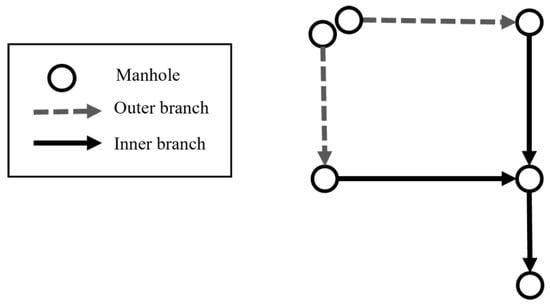
Figure 1.
Types of pipes in the sewer network.
The methodology has two decision variables: , a binary variable that takes the value of one (1) if the pipe from to , that is of type , is part of the layout solution; and , a non-negative real variable that represents the flow rate in the pipe of type that goes from to .
Lastly, the decision variables are multiplied by two cost coefficients in the objective function. These coefficients are , which represents the estimated cost per flow unit that passes through the pipe from to ; and , which describes the cost associated with using a pipe with flow direction to . These costs are estimated by a linear regression that is updated with the costs obtained in the hydraulic design model. Duque et al. [45] propose an iterative scheme between the layout selection model and the hydraulic design model, in which the accuracy of the cost function of the layout selection is improved with each iteration. The disadvantage of this iteration scheme is that it requires random values of and to start the process, and this affects the convergence of the algorithm.
The estimated cost of the layout selection model is minimized by Equation (1), which considers flow rate, flow direction, and pipes required. The weakness of this objective function is that it does not include the land topography criterion. This can cause the selection of layouts that do not match the land slope, especially in non-flat areas.
According to Haghighi and Bakhshipour [1] (p. 790), “in the case of steep basins, based on engineering judgments it is almost possible to create a cost-effective layout”, this is, for sewer networks located in steep topography, an engineer can be guided by the natural land slope to define a feasible and cost-effective layout. However, the design of the layout is subjective and depends on the engineer’s experience, especially in flat topography, where it is not easy to be guided by the natural land slope. Therefore, several layout proposals are possible, each one of them with its own different cost, some of them being cheaper than others. In addition, there are many engineering criteria to create the layout, such as: pipes with higher natural slope, pipes with a greater difference of elevation between manholes, distance to discharge, number of outer-branch pipes. Therefore, whether steep topography or not, it is necessary to have a methodology that considers all the components involved in the layout selection problem.
This research proposes a methodology as an extension of the mathematical optimization framework proposed by Duque et al. [45], which seeks to solve the layout selection problem taking into account all the data known in this problem, i.e., land topography, streets network topology, and inflow to each manhole. This is in order to eliminate the subjectivity of the layout selection cost function, to obtain a more general methodology that could be applied to sewer networks with any type of topography, and to decrease computational effort.
3. Methodology
The present methodology proposes some changes to the objective function of the layout selection model proposed by Duque et al. [45]. First, it is proposed to add a term to the equation that models the land topography. This term is presented in Equation (2), where is a coefficient that depends on the land topography in the pipe from to of type .
Another change proposed by the methodology is the way the coefficients and are calculated, since Duque et al. [45] propose an estimation with linear regression, but the relation between construction cost and flow rate is not linear. To define the new values of the coefficients , , and the methodology proposes two stages: the selection of an initial layout and an iteration with penalties in excavation. This section explains those stages.
3.1. Selection of an Initial Layout
To determine the value of the coefficients , , and an initial hydraulic design is required, and therefore, an initial layout. Duque et al. [45] propose a random initial layout, but this affects the convergence of the method. Hence, the present methodology proposes a method to determine an initial layout close to the optimal one based on engineering criteria.
The method assigns a weight to each pipe, which will be a large value for non-efficient pipes and, therefore, a small value for the pipes that are desirable on the layout. Equation (3) defines the objective function of the initial layout, which minimizes the sum of the weights assigned to the pipes in order to select those with the lowest weight.
Considering that pipes and land slope should be in the same direction in order to avoid increments in excavation depths, three criteria were proposed to define the value of the coefficient .
3.1.1. Criterion 1
This criterion seeks to give priority to the pipes with the same direction of the land slope by multiplying the slope of the pipe by −1. In this way, the pipes that are against the slope will have a positive and will be discarded from the layout since the objective function is to be minimized.
Furthermore, this criterion seeks to minimize the number of outer-branch pipes; therefore, a penalty coefficient is assigned to this type of pipe. In order to make the outer-branch pipes less desirable for the layout selection model, the value of should be a number between 0 and 1 for outer-branch pipes with positive slopes and a value greater than 1 for outer-branch pipes with negative slopes.
To select the most appropriate value of for positive and negative slopes, a sensitivity analysis was performed. In the analysis, the value of for positive slopes ranged between 0.2 and 0.8, while for negative slopes, it ranged between 1.05 and 1.95. Different combinations were tested with these values, and it was concluded that a recommended combination is 0.65 for positive slopes and 1.65 for negative slopes since designs with the lowest costs were obtained with these values. However, if another combination of values of is chosen within those tested in the analysis, the change in the cost obtained is approximately 1%. To resume, the values of used are shown in Equation (4).
where:
is the land slope of the outer-branch pipe from
is the penalty for outer-branch pipes in the selection of the initial layout.
Summarizing, this criterion calculates the coefficient as follows:
where:
is the land slope of the inner-branch pipe from
is the coefficient that depends on the land topography in the outer-branch pipe from .
is the coefficient that depends on the land topography in the inner-branch pipe from .
Figure 2 shows an example of how the coefficient is calculated with Criterion 1 in the two types of pipes with positive and negative slopes. The gray dotted line represents an outer-branch pipe, where is calculated using Equation (6). On the contrary, the black continuous line represents an inner-branch pipe, where is calculated using Equation (5).
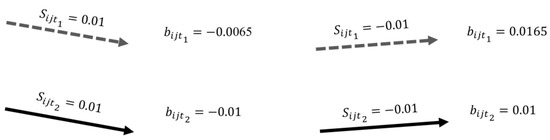
Figure 2.
Example of the calculation of with Criterion 1.
3.1.2. Criterion 2
This criterion works the same way as Criterion 1; the slope of each pipe is multiplied by −1, and the outer-branch pipes are penalized as explained above. However, this criterion also seeks to involve the energy per unit weight or head available to transport the design flow rate in a pipe and, in this way, prioritize the pipes with greater head or energy differences. To achieve this, the slope of the pipe is also multiplied by its length, and in this way, making use of the available head as an input variable. To summarize, with this criterion, the coefficient is calculated as follows:
where:
is the length of the pipe from .
Figure 3 shows an example of how the coefficient is calculated with Criterion 2 in the two types of pipes with positive and negative slopes, where all pipes are 10 m in length. In outer-branch pipes the coefficient is calculated using Equation (8), while in inner-branch pipes Equation (7) is used.
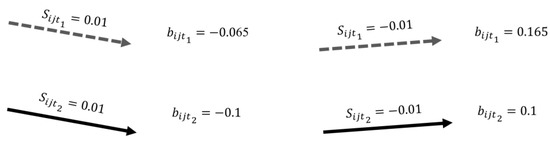
Figure 3.
Example of the calculation of with Criterion 2.
3.1.3. Criterion 3
With this criterion, the coefficient is calculated as the Euclidean distance between the downstream manhole of the pipe, where the weight will be assigned, and the outfall. This criterion is proposed especially for flat topographies and seeks to minimize the length of the sewer network main series so that the final excavation depth decreases. In this criterion, the outer-branch pipes have the same weight as the inner-branch ones.
Figure 4 shows an example of how the coefficient is calculated with Criterion 3.
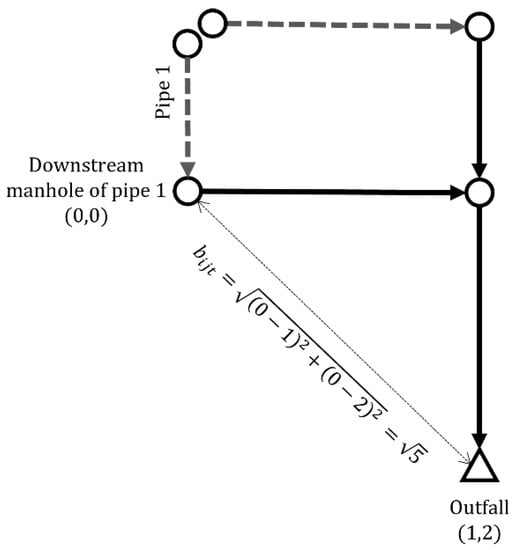
Figure 4.
Example of the calculation of with Criterion 3.
With the criteria explained above, three different layouts are obtained, one with each criterion. The one with the lowest cost is chosen as the initial layout. Then, the coefficients and are calculated to run the iteration with penalties in excavation. This process will be explained in the next section.
3.2. Iteration with Penalties in Excavation
Duque et al. [45] proposed to determine the value of and through a linear regression between the total cost of a pipe and its design flow rate. However, this methodology has two problems. First, the outer-branch pipes are included in the linear regression. This means that a big part of the data is concentrated in the intercept, where costs and design flow rates are low. Second, the length of the pipes is not considered in the linear regression because it relates the flow rate of a pipe to its total cost, not the cost per unit length. This means that costs with different magnitudes are related to the same flow rate in the regression.
For the first problem, this paper proposes not to include the outer-branch pipes in the linear regression since most of the time, this type of pipe uses the minimum diameter and excavation depth. This means that, generally, the cost per unit length is the same for every outer-branch pipe. For this reason, the cost of these pipes can be determined only by the coefficient , which means that coefficients and are zero for these pipes.
With the initial layout, an initial hydraulic design is obtained, and in this way, it is possible to determine the average cost per unit length of the outer-branch pipes and the cost that will be assigned to the arcs of the layout selection model in the next iteration.
The above applies when the land slope is greater than or equal to the average installation slope of the outer-branch pipes in the previous iteration. If this is not the case, the excavation depth of the downstream manhole may become greater, which causes an increase in the construction cost. This increment in cost is considered by a penalty in the coefficient and is calculated as the cost of the extra excavated volume based on the diameter and slope of the pipes from the initial layout, the natural land slope, and the cost function from the hydraulic design model. Equation (9) defines the value of for outer-branch pipes in the iteration with penalties in excavation.
where:
is the average cost per unit length of outer-branch pipes.
is the average installation slope of outer-branch pipes.
is the penalty for increments in excavation cost in pipe from to .
For the second problem of the methodology proposed by Duque et al. [45], that is, not considering the effect of the pipes’ length in the linear regression, this article proposes to perform the regression between the costs per unit length and the flow rate of each inner-branch pipe, where is equivalent to the slope of the linear equation and to the intercept.
Similar to outer-branch pipes, when the sewer network is located on steep terrain, there is a possibility that the methodology selects inner-branch pipes that are against the natural land slope to try to minimize the cost per flow unit. In this case, there is the problem again of obtaining pipes with greater excavation depths. This should be considered in the model the same way that with outer-branch pipes, this is, with the penalty for the increments in excavation costs.
Unlike outer-branch pipes, when the land slope is greater than the average installation slope, the depth of the upstream manhole may decrease. This implies a cost reduction associated with less excavation depth required, and it also should be considered in the coefficient through a bonus that is calculated as the cost of the excavation depth multiplied by −1.
In other words, for inner-branch pipes, the coefficient must include a bonus or penalty depending on the land slope and the average installation slope of these pipes. Equations (10) and (11) define the value of for this type of pipe as explained above.
where:
is the average installation slope of inner-branch pipes.
is the bonus for reduction in excavation cost in pipe from to .
Unlike the methodology proposed by Duque et al. [45], the current methodology does not require several iterations because if the procedure performed in the iteration with penalties in excavation is repeated, similar coefficients will be obtained. Therefore, computational time will be greater and similar designs will be obtained and not necessarily with lower costs. On the other hand, the iteration with penalties in excavation does not always manage to reduce the costs of the sewer network design; sometimes the use of Criteria 1, 2 and 3 is sufficient to obtain the design with the lowest cost.
To resume, in the iteration scheme proposed in the present work, first, a sewer network design is obtained with each criterion; then, the initial layout is selected, which is the one with the lowest cost. Next, with the selected initial layout, the coefficients , , and are estimated and the iteration with penalties in excavation is performed. Finally, the design obtained with the initial layout and the one obtained with the penalties in the excavation are compared to select the design with the lowest cost as the solution. The above is summarized in Figure 5.
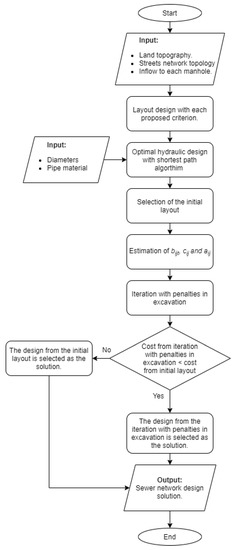
Figure 5.
Methodology flow chart.
3.3. Case Studies
To compare the proposed approach with others found in the literature, the methodology was tested in three sewer networks. Each of them is composed of a number of manholes and pipes that are established by the street topology. Additionally, in each manhole, there is an inlet flow and the sum of these forms the total flow rate. This information is part of the input data of the model and is described below for each case study.
The first network was proposed by Li and Matthew [34]; it is composed of 57 manholes and 79 pipes, has a flat topography, and a total flow rate of 0.338 m3/s. The second sewer network was proposed by Moeini and Afshar [46]; it has 81 manholes, 144 pipes, a total flow rate of 0.593 m3/s, and its topography is completely flat since each manhole has the same elevation. The third sewer network is called Chicó and was proposed by Duque et al. [45]; it is part of a real sewer network located in Bogotá, Colombia. It has 109 manholes, 160 pipes, it is located in wavy topography terrain, and the total flow rate is 1.526 m3/s.
Table 1 presents the hydraulic constrains used in the three designs. For the velocity calculation, Manning’s equation was used with a coefficient (concrete). The set diameters, in meters, used are 0.2, 0.25, 0.3, 0.35, 0.38, 0.4, 0.45, 0.5, 0.53, 0.6, 0.7, 0.8, 0.9, 1.0, 1.05, 1.20, 1.35, 1.4, 1.5, 1.6, 1.8, 2, 2.2, 2.4. The elevation change utilized was , because in a 100-m-long pipe, this is the elevation that allows a 0.001 slope, which is the minimum buildable slope.

Table 1.
Hydraulic constraints.
To compare the designs with previous designs, two cost functions were used. The first cost function was proposed by Li and Matthew [34], and it is presented in Equations (12) and (13), where and are the construction cost in yuan for a pipe and a manhole, respectively.
In Equations (12) and (13), is the pipe diameter (m), is the pipe average buried depth (m), and is the pipe length (m).
The second cost function used was proposed by Maurer, Wolfram, and Anja [47]. This is presented in Equations (14)–(16).
where is the pipe construction cost in USD, is the pipe length (m), α is a coefficient related to the excavation depth cost (USD*m−2), is the buried depth (m), β is the pipe cost per unit length (USD*m−1), , , , and are constants and their values are presented in Table 2.
Table 2.
Constants of the cost function proposed by Maurer et al. [47].
4. Results
For each sewer network, Criteria 1, 2, and 3 were applied to obtain three different layouts. Then, for each network, the layout with the lowest cost was selected to estimate the value of coefficient , the penalties, and bonuses. Lastly, the iteration with penalties in the excavation was run to try to obtain a lower cost than the cost obtained with the initial layout.
4.1. Benchmark Network Proposed by Li and Matthew
Table 3 presents the construction cost obtained with the cost function of Li and Matthew [34] and Maurer et al. [47].
Table 3.
Construction cost for each criterion in the benchmark proposed by Li and Matthew [34].
For the cost function of Li and Matthew, the design obtained with Criterion 2 has the lowest cost. On the other hand, for the cost function of Maurer et al., the design with the lowest cost is the one obtained with Criterion 3. The layouts of these designs are selected as the initial layouts, and with these layouts, the iteration with penalties in the excavation was calculated. The construction cost obtained in the iteration with penalties in excavation with the cost function of Li and Matthew was and with the cost function of Maurer et al. was . In both cases, the cost was reduced with the iteration with penalties in excavation.
Table 4 presents the construction cost achieved with the function of Li and Matthew with different methodologies proposed in the literature.
Table 4.
Construction cost with different methods for the benchmark proposed by Li and Matthew [34].
Figure 6 shows the designs for the lowest costs obtained with the cost function of Li and Matthew and with the cost function of Maurer et al. in the benchmark network proposed by Li and Matthew. The depth shown corresponds to the invert depth of manholes. This depth is with respect to the ground level on the manhole location. This notation does not mean that a pipe can go from a deeper to a shallower manhole because it is not taking into account the ground levels. This also applies to Figure 7 and Figure 8.
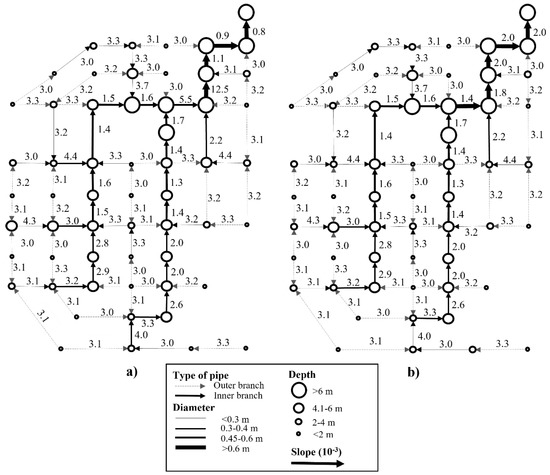
Figure 6.
Scheme (not to scale) of the best design of the benchmark network proposed by Li and Matthew [34] with (a) their cost function and (b) the cost function of Maurer et al. [47].
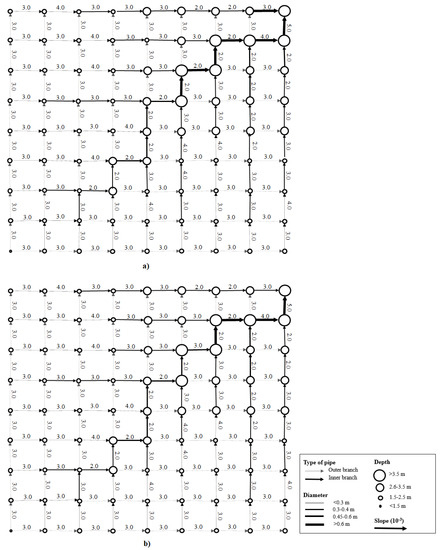
Figure 7.
Scheme (not to scale) of the best design of the benchmark network proposed by Moeini and Afshar [46] with (a) the cost function of Li and Matthew [34] and (b) the cost function of Maurer et al. [47].
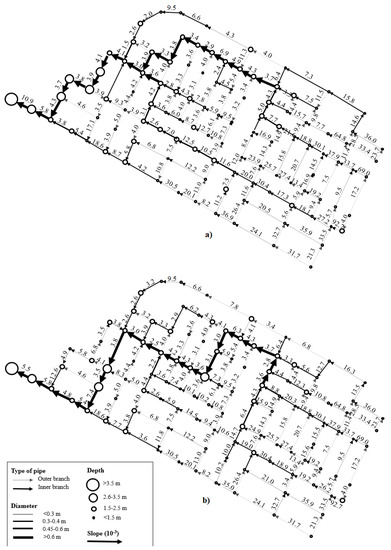
Figure 8.
Scheme (not to scale) of the best design of the benchmark network proposed by Duque et al. [45] with (a) the cost function of Li and Matthew [34] and (b) the cost function of Maurer et al. [47].
4.2. Benchmark Network Proposed by Moeini and Afshar
To apply Criteria 1 and 2, it is necessary to have a pipe slope different from zero, which does not happen in the Moeini and Afshar network because originally, it was totally flat. For this reason, to apply Criteria 1 and 2, the manhole elevations were modified so that instead of a flat terrain, a small slope (0.001) was used for the layout selection. This was done only to obtain the layout, and then, in the hydraulic design, the original elevations were used, i.e., 1000 m for each manhole.
Table 5 presents the costs obtained with the different criteria and cost functions.
Table 5.
Construction cost for each criterion in the benchmark proposed by Moeini and Afshar [46].
In this sewer network, designs with lower costs were obtained with Criterion 2 for both cost functions, and in the iteration with penalties in excavation, the cost achieved was with the cost function of Li and Matthew, and with the cost function of Maurer et al. The iteration with penalties in excavation did not reduce the cost of the designs; therefore, the best designs are those obtained with Criterion 2. Table 6 presents the comparison of construction cost between different methods for this sewer network, and Figure 7 shows the designs with the lowest cost obtained with the cost function of Li and Matthew and with the cost function of Maurer et al.
Table 6.
Construction cost with different methods for the benchmark proposed by Moeini and Afshar [46].
4.3. Benchmark Network Proposed by Duque et al.: Chicó
In the sewer network Chicó, the lowest cost was achieved with Criterion 2 using the Li and Matthew function and with Criterion 1 using the Maurer et al. function. Table 7 presents the cost obtained with each criterion.
Table 7.
Construction cost for each criterion in the benchmark proposed by Duque et al. [45].
After running the iteration with penalties in excavation, the cost obtained was with the cost function of Li and Matthew and with the cost function of Maurer et al.; this means the iteration with penalties in excavation did not achieve a lower cost. Consequently, the best designs are the ones found in the initial layout stage. Table 8 compares this cost with the cost achieved by Duque et al. [1].
Table 8.
Construction cost with different methods for the benchmark proposed by Duque et al. [45].
Figure 8 shows the designs with the lowest cost obtained with the cost function of Li and Matthew and with the cost function of Maurer et al.
The input data and the detailed hydraulic design of each sewer network tested can be found in the Supplementary Material.
4.4. Computational Effort
In order to compare the computational effort in the methodology proposed by Duque et al. [45] and the current methodology, Table 9 shows the iterations and computational time used with each approach in each case study with the cost function of Li and Matthew and an elevation change of . In MIP and DP Extension, three of the four iterations correspond to the three different designs obtained with each criterion describing land topography, and the other iteration corresponds to the one with penalties in excavation.
Table 9.
Computational effort in MIP and DP, and MIP and DP Extension.
5. Discussion
In all three case studies, the proposed methodology achieved designs with lower costs than previously reported in the literature. This demonstrates the importance of incorporating the land topography criterion into the layout selection model, especially in very-flat or non-uniform terrain, where it is difficult for an engineer to select the optimal layout or one close to it.
The most significant cost reduction was obtained in the sewer network Chicó. This is mainly due to the decrease in the maximum excavation depth. This shows that considering the land topography achieves very satisfactory results in sewer networks located on wavy or non-flat topography. On the other hand, in the sewer network of Moeini and Afshar, it was more difficult to apply the methodology due to the change in elevations that had to be made since it is a hypothetical sewer network without slope. Although this network also managed to improve the costs reported in the literature, the cost reduction was not as significant.
Comparing the methodology proposed by Duque et al. [45] with the proposal in this paper, it can be seen that the construction cost of the sewer networks tested was reduced. In addition, this was achieved with a much shorter computational effort, since the methodology of Duque et al. [45] used between 10 and 30 iterations per network, while in this methodology, only four iterations per network are necessary, three for the selection of the initial layout and another one for the iteration with penalties in excavation. As for computational time, this was reduced by approximately 88% in the Li and Matthew, and Moeini and Afshar benchmark networks, and by about 94% in the Chicó network.
Achieving the design of a sewer network that complies with hydraulic restrictions and has a lower construction cost is important, especially for populations that have a limited budget and that often opt for cheaper alternatives that do not meet all the necessary restrictions for proper hydraulic operation. In addition, having cheaper sewer networks designs favors achieving equitable and adequate access to sanitation services, which is one of the targets related to Sustainable Development Goal 6 (Clean Water and Sanitation) [49].
6. Conclusions
This article proposes an objective function for the layout selection problem of a sewer network system that considers all the variables known in this problem, such as: land topography, streets network topology, and inflows to each manhole.
To apply the proposed function, two stages are needed. The first one consists of the selection of an initial layout and its hydraulic design. This initial layout is determined through criteria that seek to follow the topography of the area. The hydraulic design of the initial layout is carried out according to the methodology proposed by Duque et al. [45], which guarantees global optimality.
The second stage consists of penalizing the excavation of the pipes and determining the coefficients of the proposed objective function so that an accurate approximation of the construction cost of each arc of the layout selection problem can be made. This is in order to try to achieve lower costs than in the first stage.
The methodology was tested in three benchmarks using two cost functions proposed by Li and Matthew [34] and Maurer et al. [47]. The cost obtained with the function of Li and Matthew was used to compare the designs obtained with the designs of other methodologies of the literature. With the results obtained, the following conclusions were made:
- In the three case studies tested, the present methodology achieved the lowest construction cost reported in the literature. The cost reduction was more significant in the network with wavy topography, i.e., Chicó. While in the other networks, which are flat, the cost reduction was not so big, especially in the Moini and Afshar network, which is completely flat.
- The cost reduction was achieved in fewer iterations and in significantly less computational time when compared to the methodology of Duque et al. [1]. This shows that when selecting an optimal layout or one close to it, it is only required to perform the shortest path algorithm once to obtain a cost-effective sewer network design.
- Land topography turned out to be an important input in the layout selection model since whether the land topography is flat or not, a layout that follows the land slope and maximizes the number of inner-branch pipes allows a cost-effective layout to be obtained.
In future research, the current methodology could be easily extended to include drop manholes in hilly terrains and pumping stations in very flat terrains. Moreover, other cost functions could be used in the layout selection problem, such as nonlinear equations, to represent more accurately the construction costs of each arc. Further, in the future, the resilience of the sewer network should be considered in a multi-objective optimization scheme, as well as consider the possibility of dividing the layout to increase the resilience of the system.
Supplementary Materials
The following are available online at https://www.mdpi.com/article/10.3390/w13182491/s1, Table S1: Input data of the benchmark proposed by Li and Matthew [34], Table S2: Hydraulic design for the benchmark proposed by Li and Matthew [34] with cost function of Li and Matthew [34], Table S3: Hydraulic design for the benchmark proposed by Li and Matthew [34] with cost function of Maurer et al. [47], Table S4: Input data benchmark proposed by Moeini and Afshar [46], Table S5: Hydraulic design for the benchmark proposed by Moeini and Afshar [46] with cost function of Li and Matthew [34], Table S6: Hydraulic design for the benchmark proposed by Moeini and Afshar [46] with cost function of Maurer et al. [47], Table S7: Input data benchmark proposed by Duque et al.: Chicó [45], Table S8: Hydraulic design for the benchmark proposed by Duque et al.: Chicó [45] with cost function of Li and Matthew [34], Table S9: Hydraulic design for the benchmark proposed by Duque et al.: Chicó [45] with cost function of Maurer et al. [47].
Author Contributions
Conceptualization, J.S. and J.Z.; methodology, J.S. and J.H.; software, J.Z.; validation, J.S., J.H. and P.L.I.-R.; formal analysis, J.S. and J.H; investigation, J.S., J.Z, J.H. and P.L.I.-R.; writing—original draft preparation, J.Z. and J.H.; writing—review and editing, J.S., J.H. and P.L.I.-R. All authors have read and agreed to the published version of the manuscript.
Funding
This research received no external funding.
Conflicts of Interest
The authors declare no conflict of interest.
Nomenclature
| From methodology proposed by Duque et al. [45]: | |
| set of nodes representing manholes. | |
| set of undirected edges representing links between two nodes | |
| set of directed links between two manholes, and , so that ( | |
| set of possible types of pipes, containing outer-branch pipes () and inner-branch pipes (). | |
| binary decision variable that represents the flow direction and connection type in the network layout, for all ( and . | |
| continuous decision variable that represents the flow through arc of type , for all for all (. | |
| fixed cost estimate for selecting the flow direction to | |
| estimation of cost per flow unit that traverses from to | |
| From present methodology: | |
| coefficient that depends on the land topography in the pipe from of type | |
| land slope in the pipe from to of type | |
| average installation slope of outer-branch pipes. | |
| average installation slope of inner-branch pipes. | |
| length of the pipe from . | |
| average cost per unit length of outer-branch pipes. | |
| penalty for outer-branch pipes in the selection of the initial layout. | |
| penalty for increments in excavation cost in pipe from to . | |
| bonus for reduction in excavation cost in pipe from to . | |
References
- Haghighi, A.; Bakhshipour, A. Reliability-based layout design of sewage collection systems in flat areas. Urban Water J. 2015, 13, 790–802. [Google Scholar] [CrossRef]
- Holland, M.E. Computer Models of Waste-Water Collection Systems. Ph.D. Thesis, Harvard University, Cambridge, MA, USA, May 1966. [Google Scholar]
- Dajani, J.S.; Hasit, Y. Capital cost minimization of drainage networks. J. Environ. Eng. Div. 1974, 100, 325–337. [Google Scholar] [CrossRef]
- Deininger, R.A. Computer aided design of waste collection and treatment systems. In Proceedings of the 2nd Annual Conference of American Water Resources, Chicago, IL, USA, 18 May 1966; pp. 247–258. [Google Scholar]
- Elimam, A.A.; Charalambous, C.; Ghobrial, F.H. Optimum design of large sewer networks. J. Environ. Eng. 1989, 115, 1171–1190. [Google Scholar] [CrossRef]
- Gupta, M.; Rao, P.; Jayakumar, K. Optimization of integrated sewerage system by using simplex method. VFSTR J. Stem. 2017, 3, 2455–2062. [Google Scholar]
- Safavi, H.; Geranmehr, M.A. Optimization of sewer networks using the mixed-integer linear programming. Urban Water J. 2016, 14, 452–459. [Google Scholar] [CrossRef]
- Swamee, P.K.; Sharma, A.K. Optimal design of a sewer line using linear programming. Appl. Math. Model. 2013, 37, 4430–4439. [Google Scholar] [CrossRef]
- Mansouri, M.; Khanjani, M. Optimization of sewer networks using nonlinear programming. J. Water Wastewater 1999, 10, 20–30. [Google Scholar]
- Price, R.K. Design of storm water sewers for minimum construction cost. In Proceedings of the 1st International Conference on Urban Storm Drainage, Southampton, UK, 1 January 1978; pp. 636–647. [Google Scholar]
- Swamee, P.K. Design of Sewer Line. J. Environ. Eng. 2001, 127, 776–781. [Google Scholar] [CrossRef]
- Gupta, A.; Mehndiratta, S.L.; Khanna, P. Gravity Wastewater Collection Systems Optimization. J. Environ. Eng. 1983, 109, 1195–1209. [Google Scholar] [CrossRef]
- Kulkarni, V.S.; Khanna, P. Pumped Wastewater Collection Systems Optimization. J. Environ. Eng. 1985, 111, 589–601. [Google Scholar] [CrossRef]
- Mays, L.W.; Yen, B.C. Optimal cost design of branched sewer systems. Water Resour. Res. 1975, 11, 37–47. [Google Scholar] [CrossRef]
- Walters, G.A. The design of the optimal layout for a sewer network. Eng. Optim. 1985, 9, 37–50. [Google Scholar] [CrossRef]
- Walters, G.A.; Templeman, A.B. Non-optimal dynamic programming algorithms in the design of minimum cost drainage systems. Eng. Optim. 1979, 4, 139–148. [Google Scholar] [CrossRef]
- Duque, N.; Duque, D.; Saldarriaga, J. A new methodology for the optimal design of series of pipes in sewer systems. J. Hydroinform. 2016, 18, 757–772. [Google Scholar] [CrossRef] [Green Version]
- Afshar, M.H. Rebirthing genetic algorithm for storm sewer network design. Sci. Iran. 2012, 19, 11–19. [Google Scholar] [CrossRef] [Green Version]
- Afshar, M.H.; Afshar, A.; Mariño, M.A.; Darbandi, A.A.S. Hydrograph-based storm sewer design optimization by genetic algorithm. Can. J. Civ. Eng. 2006, 33, 319–325. [Google Scholar] [CrossRef]
- Haghighi, A.; Bakhshipour, A. Optimization of sewer networks using an adaptive genetic algorithm. Water Resour. Manag. 2012, 26, 3441–3456. [Google Scholar] [CrossRef]
- Palumbo, A.; Cimorelli, L.; Covelli, C.; Cozzolino, L.; Mucherino, C.; Pianese, D. Optimal design of urban drainage networks. Civ. Eng. Environ. Syst. 2014, 31, 79–96. [Google Scholar] [CrossRef]
- Walters, G.A.; Lohbeck, T. Optimal layout of tree networks using genetic algorithms. Eng. Optim. 1993, 22, 27–48. [Google Scholar] [CrossRef]
- Afshar, M. A parameter free continuous ant colony optimization algorithm for the optimal design of storm sewer networks: Constrained and unconstrained approach. Adv. Eng. Softw. 2010, 41, 188–195. [Google Scholar] [CrossRef]
- Moeini, R.; Afshar, M.H. Layout and size optimization of sanitary sewer network using intelligent ants. Adv. Eng. Softw. 2012, 51, 49–62. [Google Scholar] [CrossRef]
- Moeini, R.; Afshar, M. Arc based ant colony optimization algorithm for optimal design of gravitational sewer networks. Ain Shams Eng. J. 2017, 8, 207–223. [Google Scholar] [CrossRef] [Green Version]
- Ahmadi, A.; Zolfagharipoor, M.A.; Nafisi, M. Development of a hybrid algorithm for the optimal design of sewer networks. J. Water Resour. Plan. Manag. 2018, 144, 4018045. [Google Scholar] [CrossRef]
- Afshar, M.; Zaheri, M.; Kim, J. Improving the efficiency of cellular automata for sewer network design optimization problems using adaptive refinement. Procedia Eng. 2016, 154, 1439–1447. [Google Scholar] [CrossRef] [Green Version]
- Haghighi, A.; Bakhshipour, A. Deterministic integrated optimization model for sewage collection networks using tabu search. J. Water Resour. Plan. Manag. 2015, 141, 4014045. [Google Scholar] [CrossRef]
- Yeh, S.F.; Chang, Y.J.; Lin, M.D. Optimal design of sewer network by tabu search and simulated annealing. In Proceedings of the 2013 IEEE International Conference on Industrial Engineering and Engineering Management, Bangkok, Thailand, 10–13 December 2013; Institute of Electrical and Electronics Engineers (IEEE): Piscataway, NJ, USA, 2013; pp. 1636–1640. [Google Scholar]
- Yeh, S.-F.; Chu, C.-W.; Chang, Y.-J.; Lin, M.-D. Applying tabu search and simulated annealing to the optimal design of sewer networks. Eng. Optim. 2011, 43, 159–174. [Google Scholar] [CrossRef]
- Cisty, M. Hybrid genetic algorithm and linear programming method for least-cost design of water distribution systems. Water Resour. Manag. 2009, 24, 1–24. [Google Scholar] [CrossRef]
- Pan, T.-C.; Kao, J.-J. GA-QP Model to Optimize Sewer System Design. J. Environ. Eng. 2009, 135, 17–24. [Google Scholar] [CrossRef] [Green Version]
- Hassan, W.H.; Jassem, M.H.; Mohammed, S.S. A GA-HP Model for the Optimal Design of Sewer Networks. Water Resour. Manag. 2017, 32, 865–879. [Google Scholar] [CrossRef]
- Li, G.; Matthew, R.G.S. New approach for optimization of urban drainage systems. J. Environ. Eng. 1990, 116, 927–944. [Google Scholar] [CrossRef]
- Haghighi, A. Loop-by-Loop Cutting Algorithm to Generate Layouts for Urban Drainage Systems. J. Water Resour. Plan. Manag. 2013, 139, 693–703. [Google Scholar] [CrossRef]
- Walters, G.A.; Smith, D.K. Evolutionary design algorithm for optimal layout of tree networks. Eng. Optim. 1995, 24, 261–281. [Google Scholar] [CrossRef]
- Afshar, M.H.; Mariño, M.A. Application of an ant algorithm for layout optimization of tree networks. Eng. Optim. 2006, 38, 353–369. [Google Scholar] [CrossRef]
- Bakhshipour, A.E.; Bakhshizadeh, M.; Dittmer, U.; Haghighi, A.; Nowak, W. Hanging gardens algorithm to generate decentralized layouts for the optimization of urban drainage systems. J. Water Resour. Plan. Manag. 2019, 145, 4019034. [Google Scholar] [CrossRef]
- Bakhshipour, A.E.; Makaremi, Y.; Dittmer, U. Multiobjective design of sewer networks. J. Hydraul. Struct. 2017, 3, 49–56. [Google Scholar] [CrossRef]
- Diogo, A.F.; Graveto, V.M. Optimal layout of sewer systems: A deterministic versus a stochastic model. J. Hydraul. Eng. 2006, 132, 927–943. [Google Scholar] [CrossRef]
- Rohani, M.; Afshar, M.; Moeini, R. Layout and size optimization of sewer networks by hybridizing the GHCA model with heuristic algorithms. Sci. Iranica. Trans. A Sch. J. 2015, 22, 1742–1754. [Google Scholar]
- Steele, J.C.; Mahoney, K.; Karovic, O.; Mays, L.W. Heuristic optimization model for the optimal layout and pipe design of sewer systems. Water Resour. Manag. 2016, 30, 1605–1620. [Google Scholar] [CrossRef]
- Bakhshipour, A.; Hespen, J.; Haghighi, A.; Dittmer, U.; Nowak, W. Integrating structural resilience in the design of urban drainage networks in flat areas using a simplified multi-objective optimization framework. Water 2021, 13, 269. [Google Scholar] [CrossRef]
- Liu, Y.; Bralts, V.F.; Engel, B.A. Evaluating the effectiveness of management practices on hydrology and water quality at watershed scale with a rainfall-runoff model. Sci. Total. Environ. 2015, 511, 298–308. [Google Scholar] [CrossRef]
- Duque, N.; Duque, D.; Aguilar, A.; Saldarriaga, J. Sewer network layout selection and hydraulic design using a mathematical optimization framework. Water 2020, 12, 3337. [Google Scholar] [CrossRef]
- Moeini, R.; Afshar, M.H. Extension of the hybrid ant colony optimization algorithm for layout and size optimization of sewer networks. J. Environ. Inform. 2018. [Google Scholar] [CrossRef]
- Maurer, M.; Wolfram, M.; Anja, H. Factors affecting economies of scale in combined sewer systems. Water Sci. Technol. 2010, 62, 36–41. [Google Scholar] [CrossRef] [PubMed]
- Liu, C.; Han, H.G.; Wang, C.; Qiao, J. An adaptive di_erential evolution algorithm for sewer networks design. In Proceedings of the 11th World Congress on Intelligent Control and Automation, Shenyang, China, 29 June–4 July 2014; Institute of Electrical and Electronics Engineers (IEEE): Piscataway, NJ, USA, 2014; pp. 3577–3583. [Google Scholar]
- United Nations (UN). Transforming Our World: The 2030 Agenda for Sustainable Development. Available online: https://sustainabledevelopment.un.org/content/documents/21252030%20Agenda%20for%20Sustainable%20Development%20web.pdf (accessed on 21 August 2017).
Publisher’s Note: MDPI stays neutral with regard to jurisdictional claims in published maps and institutional affiliations. |
© 2021 by the authors. Licensee MDPI, Basel, Switzerland. This article is an open access article distributed under the terms and conditions of the Creative Commons Attribution (CC BY) license (https://creativecommons.org/licenses/by/4.0/).