


Abstract
Physicochemical parameters determining Dal Lake water quality were evaluated at four different sites during 2016–2017 in four different seasons Spring (April), Summer (July), Autumn (October), and Winter (January). The observed physicochemical values were analyzed by statistical (discriminant analysis) and arithmetic (WQI) methods to ascertain sources and levels of pollution. Discriminant analysis helped to access the contribution of each physicochemical parameter in water quality in the context of sampling sites (spatial) and seasons (temporal) to discriminate pollution loading between sites and as well as seasons. Factors such as temperature, alkalinity, ammoniacal nitrogen, total phosphorous, and orthophosphorous exhibited a strong contribution in the discrimination of sampling sites, while factors such as temperature, alkalinity, hardness, BOD, nitrate nitrogen, and total phosphorous exhibited a strong contribution in the discrimination of sampling seasons. The WQI values for four sampling sites were calculated and indicated that the water at Site I was the most contaminated followed by Site IV, while Site III was the least contaminated. Thus, highlighting that the pressure of anthropogenic activities is subjecting Dal Lake to an unnatural death.
1. Introduction
Dal Lake—known as the ‘Jewel of Kashmir’ is one of the most attractive tourist destinations in the world. The lake is surrounded by mountains on its three sides, Zabarwan in the east, Kohimaraan in the west, and Shankacharya in the south and is adjoined by beautiful Mughal gardens [1]. It is well known for its tourism and economic potential, as a multi-basin lake, covering an area of 16.6 km2 and with a water holding capacity of 15.45 × 10⁶ m3 [2]. Dal Lake has evolved as eutrophic in nature because of the discharge of organic rich effluents, sewage, sediments, and other nutrients from the surroundings and the floating gardens established within it. Several anthropogenic activities and ecological stress have forced the lake to shrink like other cases of the world, such as the Aral Sea [3] and the Dead Sea [4], in terms of its surface area, water quality as well as the nature of biodiversity [5]. The beauty of Dal Lake (Figure S1 in the Supplementary Materials) has been described and appreciated for centuries. Walter Roper Lawrence, as Resettlement Commissioner of Srinagar in 1887, wrote about the Dal Lake: “Perhaps in the whole world there is no corner as pleasant as Dal Lake”. Praising the water of Dal Lake, he mentioned “The water of the Dal is clear and soft as silk, and the people say that the shawls of Kashmir owe much of their excellence to being washed in the soft waters of the lake” [6].
Lake waters hold a well-defined part of freshwater sources, which are essential for the survival and well-being of different forms of life in an ecosystem. These serve in multidimensional activities, such as sources of drinking water, irrigation, fishery, landscape entertainment, trade, and energy production. However, these functions depend on the water quality, which needs to be kept at a certain level to maintain a well-balanced environment in terms of its physical, chemical, and biological variables. Moreover, a few elements are necessary when their concentrations are under sure cutoff points: trace metals become toxic when they exceed certain concentration limits, organic matter makes water eutrophic, and excess minerals may make water of awful quality [7]. Lamentably, in the most recent couple of decades, these characteristic freshwater assets are being contaminated because of unpredictable human intercession for the sake of advancement and urbanization [8]. The serious issue in lake wellbeing is the nutrient advancement, which invigorates the development of plants and at last prompts the decrease in water quality and the whole ecosystem [7]. Globally, the greater part of the lakes have been overwhelmed by this progression of eutrophication and as an outcome, the attributes displayed are non-consumable water, reduced fish production, undermined biodiversity, and poor flood retention limit [9]. Surface water quality in a water body is subjective to both natural and anthropogenic processes. Dumping of sewage, household squanders, use of fertilizers, and pesticides and over abuse of lake services and products in and around water bodies engenders stress on these biological systems, which changes the physical and chemical factors [10]. It has been reported that such activities have imparted huge pressure on aquatic ecosystems, resulting in a decrease in water quality and biodiversity, loss of critical habitats, and an overall decrease in quality of life for people living in the vicinity [11,12,13]. Hence, periodical monitoring of physicochemical parameters is imperative for the assessment of water quality.
The lake has tremendous ecological, cultural, and socio-economic importance in the region as it is a major tourist attraction in the Kashmir valley, which attracts tourists from whole world and is an important source of vegetables, fisheries, and recreation to the people of Srinagar city. Therefore, the present study was designed to assess the pollution sources, levels, and causes of spatiotemporal variations in lake water quality by determination of both similarity and differences in physicochemical attributes of water during the four seasons at four sites of Dal Lake using a multivariate technique (discriminant analysis) and arithmetic approach (water quality index).
2. Material and Methods
2.1. Study Area
This study was aimed at the assessment of physicochemical parameters of the surface waters of Dal Lake (Figure 1), which is situated in Srinagar, India, and lies between the geographical coordinates of 34°5′–34°9′ N and 74°49′–74°53′ E at an altitude of 1585above sea level. The criteria for selection of sampling sites were based on the population density and lake catchment areas. Therefore, a total of four different sites were selected; Site I (Hazratbal Dhobi Ghat), Site II (near Tailbal Nallah), Site III (near Sher-i-Kashmir International Conference Centre (SKICC)), and Site IV (near the Dal Lock-Gate). Based on the designed criteria Site I is heavily populated area, Site II is near major inlet, Site III is least populated, and Site IV is near the outlet and populated as well.
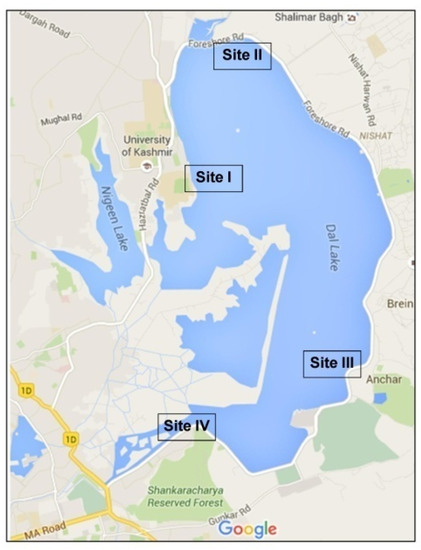
Figure 1.
Map of Dal Lake showing layout of study area(Google maps).
2.2. Methodology
Surface water samples were drawn thrice from the selected sites of Dal Lake in each season for the year 2016–2017 and were analyzed for several physicochemical parameters, which include temperature, pH, alkalinity, conductivity, chlorides, total hardness, dissolved oxygen (DO), biological oxygen demand (BOD), chemical oxygen demand (COD), nitrate nitrogen, ammoniacal nitrogen, total phosphorous, and orthophosphorous. However, temperature, pH and the samples for dissolved oxygen estimation were fixed at the sampling sites at the time of sampling. The analysis was performed as per the standard methods [14,15,16]. In this spatiotemporal study, four different sampling sites (spatial) and four seasons (temporal) were taken into account for comparative assessment of water quality parameters.
2.3. Statistical Analysis
Discriminant analysis (DA), a multivariate statistical technique, was used to evaluate obtained datasets and illustrate conclusions regarding the similarities and dissimilarities existing amongst sampling sites and monitoring periods, as well as to identify variables specific to spatial and temporal water quality variations in Dal Lake [17].
2.4. Water Quality Index (WQI)
In this study, water quality was estimated using Brown’s Water Quality Equation [18]. The water quality index (WQI) demonstrates the water quality in terms of index number and offers a valuable introduction of general water quality for open or any expected use, in addition to the pollution remediation programs and in-water quality management [19]. WQI was calculated by the following equation:
where, qn = quality rating; Vn = observed value; Vi = ideal value; Vs = standard permissibility limit;
where, Wn = unit weight for nth parameter; Sn = standard permissible value for nth parameter; k = proportionality constant;
WQI = ΣqnWn/ΣWn
qn=100(Vn − Vi)/(Vs − Vi)
Wn = k/Sn
k = [1/(Σ1/Sn = 1,2,…n)]
In this study, a total of 8 physicochemical parameters (as given in Table 1) were used as indicators for calculation of WQI. The suitability of WQI values for human consumption is rated from “excellent water” to “water unfit for use”. These WQI values are prescribed in such a way that 0–25(Excellent); 26–50(Good); 51–75(Bad); 76–100(Very Bad), and above 100(Unfit). The Equations (2)–(4) were applied to various indicators and annotated values were further incorporated into Equation (1) to obtain the results [20].

Table 1.
Relative weight of parameters used for WQI calculation.
3. Results and Discussion
3.1. Physicochemical Analysis
Evaluation of physicochemical factors is basic to the understanding of the trophic status of the concerned water body. These deduced characteristics of the lake water analyzed in different seasons at different sites 2016–2017 are presented as whisker and mean plots with standard deviations in Figure 2. In present study, most of the physicochemical parameters showed a high standard deviation, which is an indication of spatiotemporal variations expectedly caused due to anthropogenic activities and climatic aspects. Water temperature, a characteristic seasonal feature, ranged from a minimum of 3 °C in winter at Site I to a maximum of 25.5 °C in summer at Site IV. pH recorded during the course of study was in alkaline range and ranged from 7.0 at Site III during autumn to 8.5 in summer at Site IV, suggesting the lake as well buffered and productive in nature [21]. Total alkalinity ranged from 110 mg/L at Site III during spring to 190 mg/L at Site IV during winter. The alkaline nature of the lake may be attributed to photosynthetic activity of primary producers [5,21]. Electrical conductivity was found to be maximum in autumn at Site IV and minimum during summer at Site II. The higher conductivity during autumn may be attributed to a higher rate of decomposition and decreasing water levels in the lake. The low values in summer may be due to higher rates of assimilation by lake biota [22]. The catchment areas of lake are rich in limestone and dolomites, the wealthy sources of calcium and magnesium ions [23]. Total hardness was maximum 378.6 mg/L at Site IV during summer and minimum 60 mg/L at Site III during autumn. Maximum water flow, precipitation of calcium carbonate, and photosynthetic activity of primary producers may be the other reasons for higher hardness during summer. Chloride concentration was minimum 18.3 mg/L at Site III during winter and maximum 43 mg/L at Site IV during summer. Higher chloride values at Sites I and IV are indicating higher anthropogenic pressures in these areas [24]. DO and water temperature are negatively related because warm water can hold less DO than cold water as the solubility of oxygen decreases with increase in temperature [25]. DO was minimum 5.1 mg/L at Site I during summer and maximum 8.5 mg/L at Site III during winter. Maximum BOD and COD were recorded at Site I and IV during autumn and minimum at Site II in winter. Sites I and IV have higher BOD and COD, which is in accordance with previous studies and is attributed to higher loads of agricultural runoff and domestic wastewater [26]. Higher proportions of ammoniacal nitrogen, nitrate nitrogen, total phosphorous, and orthophosphorous were observed during summer and low during winter, which may be attributed to the increased pollution loads and agricultural runoff during summer [26,27].
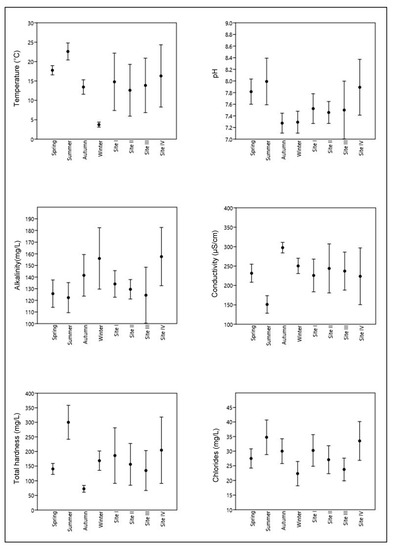
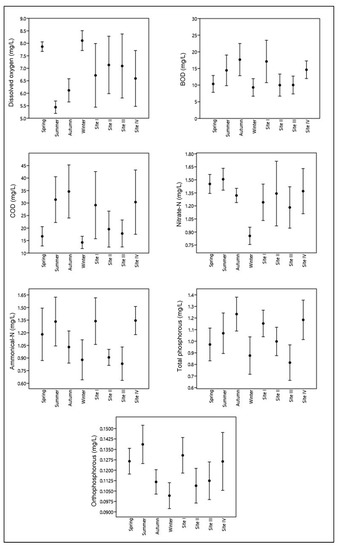
Figure 2.
Whisker and mean plots showing spatiotemporal dynamics of physicochemical parameters.
Water quality monitoring and assessment is not only obliging to assess the impact of different sources of pollution but also to protect aquatic life and to establish efficient management of water sources [28]. Temperature, pH, DO, and orthophosphate are among some physicochemical parameters that need to be monitored continuously for water quality management. The safety ranges of pH, alkalinity, DO, and ammonia nitrogen leads to health growth and avoids mortalities. Higher values of alkalinity (>100 mg/L) helps the assimilation of nitrogen by heterotrophic bacteria and nitrification process by chemoautotrophic bacteria [29]. Higher levels of total nitrogen, ammonia nitrogen, and total phosphorous are of common concern because of their ability to cause nuisance algal growth [30]. Chlorides are harmful to freshwater vegetation, and its presence in water is responsible for increased rate of corrosion [31]. The presence of enormous biodegradable organic matter in water leads to consumption of DO by bacteria and consequently drops the DO levels below the threshold point. This exhibits negative impact on aquatic life including fish as they are unable to grow and reproduce [32]. DO above 4.0 mg/L is considered good for fish, shrimp, microbiota respiration, and growth. DO concentrations exhibit an inverse relationship with BOD/COD levels. Low BOD/COD indicate good water quality, whereas high levels of BOD/COD indicate polluted water and cause harm to aquatic life [33].
This study was aimed at analysis of physicochemical parameters to evaluate the drift in physical and chemical properties of lake water in the context of anthropogenic pressure and different climatic conditions of a year as a function of water quality. However, more advanced techniques, such as geographic information system (GIS) and remote sensing technology, can be used for real-time monitoring and assessment of this resource to track the encroachments for settlement and infrastructural development as the natural population growth increases the amount of land cover by urban and agricultural development over this time period as well as the groundwater demand due to an increase in drinking water demand, urban water usage, and irrigation [34,35,36].
3.2. Discriminant Analysis
Stepwise DA was used to assess the spatial and temporal variations in physicochemical parameters of Dal Lake waters. On analysis, three discriminant functions (DFs) were found for each sampling site and season to discriminate between the quality of these sites and seasons. All the functions were found statistically significant (p < 0.05) by Wilks’ Lambda test.
For spatial variations, the first two DFs accounted for 96.2% total variance between the four sampling sites, where the first and second DF accounted for 82.5% and 13.7% of total spatial variance, respectively. The factors temperature, alkalinity, ammoniacal nitrogen, total phosphorous, and orthophosphorous exhibited a strong contribution in first group (DF1) followed by BOD and nitrate in second group (DF2) and putative for the majority of expected temporal variations in lake, while the remaining parameters exhibited a relatively weak contribution in discrimination of four sampling sites. The relative contribution of each parameter in each DF is given in Table 2. Canonical discriminant plot for spatial variations (Figure 3a) elucidated that DF1 best discriminates Sites III and IV than Sites I and II, while the y-axis shows that DF2 best discriminates Sites I from IV than Sites II and III. Site IV followed by Site I exhibited positive loadings for DF1 factors, which implies that these sites were characterized by elevated levels of temperature, alkalinity, ammoniacal nitrogen, total phosphorous, and orthophosphorous, however Sites II and III exhibited a negative association with these factors. For DF2 factors, Site IV exhibited positive loadings followed by Site II, which implies that these sites were characterized by elevated levels of BOD and nitrate nitrogen whereas, Sites I and III exhibited negative association with these factors. The high loading values for these parameters may be directly attributed to higher anthropogenic pressures and agricultural runoff, sewage, and waste disposal because of a high human population living in these hamlets (Sites I and IV).
Table 2.
Summary of canonical discriminant functions for spatial variations in lake water.
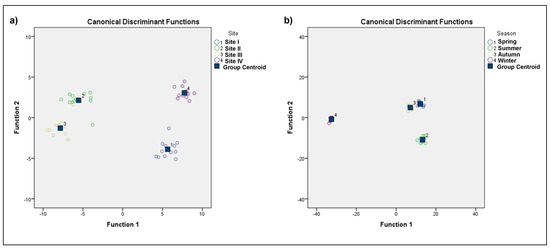
Figure 3.
Canonical discriminant plot showing (a) spatial variation and (b) temporal variation of physicochemical parameters of Dal Lake water.
For temporal variations, the first two DFs accounted for 97% total variance between the four sampling seasons, where the first and second DF accounted for 85.8% and 11.3% of total variance, respectively. Temperature, alkalinity, hardness, BOD, nitrate nitrogen, and total phosphorous exhibited a strong contribution in first group (DF1) followed by DO in second group (DF2) and putative for majority of expected temporal variations in lake, while remaining parameters exhibited a relatively weak contribution in discrimination of four sampling seasons. The relative contribution of each parameter in each DF is given in Table 3. A canonical discriminant plot for temporal variations (Figure 3b) elucidated that DF1 best discriminated summer and winter than spring and autumn, which lie close to each other. Summer exhibited positive loadings for DF1 factors, which indicate that summer was characterized by elevated levels of temperature, alkalinity, hardness, BOD, and nitrate nitrogen, whereas winter exhibited strong negative association with these factors. For DF2 factors, spring and autumn exhibited positive loadings with less difference, which implies that these sites were characterized by elevated levels of DO, whereas summer exhibited a negative association with DO. These temporal variations may be attributed to increasing volumes of inlet waters from spring to summer and higher anthropogenic pressures during summer.
Table 3.
Summary of canonical discriminant functions for temporal variations in lake water.
3.3. Water Quality Index
Calculation of WQI by weighted arithmetic index method initiates with the estimation of unit weight (Wn) for each physicochemical parameter used in the calculation of WQI. Water quality standards and the assigned unit weights for each physicochemical parameter used for WQI calculation are given in Table 1. On the basis of Wn, DO and BOD were of highest significance, as these were assigned a maximum weight of 0.3578 each. WQI was calculated for each season at each site and is given in Table 4, Table 5, Table 6 and Table 7.
Table 4.
Calculation of WQI at Site I.
Table 5.
Calculation of WQI at Site II.
Table 6.
Calculation of WQI at Site III.
Table 7.
Calculation of WQI at Site IV.
The WQI values elucidated that the water of Dal Lake is excessively polluted and unfit for human consumption. The average WQI for Site I, Site II, Site III, and Site IV are 161, 122, 109, and 150 respectively, demonstrating that the maximum deteriorated water quality was observed at Site I—a highly populated area—and least at Site III—the least populated area—thus suggesting that anthropogenic pressures are the main reason behind the deterioration of water quality of Dal Lake. Spatiotemporally, Site I was observed as the most contaminated during autumn followed by summer.
4. Conclusions
The main focus of this study was to evaluate spatiotemporal variations in the surface water quality of Dal Lake using statistical and arithmetic exploratory techniques to ascertain pollution sources. The results of these methods exhibited that the variation in water quality of the lake is more subjected to anthropogenic pressures than change in the climatic conditions. The discriminant analysis separated sampling sites and seasons in a simpler, illustrative manner and highlighted the contribution of each physicochemical parameter. The water quality index is helpful in assessment and management of water quality. Based on obtained WQI values, this study provides necessary understanding into the status of overall suitability of the Dal Lake water. The WQI helped in the transformation of complex datasets into a numeric expression and presented the status of water quality as a single number, which elucidates that indiscriminate anthropogenic pressures by (population loads) are pushing the lake ecosystem towards an unnatural death. Thus, as a result of this study, it can be concluded that the lake is moving towards its definite end. For restoration of this aesthetic asset and biologically diverse natural habitat, effective treatment measures are urgently required; encroachments for settlement and infrastructural development must be banned and existing ones should be removed, in addition to regulation of sewage and waste disposal into the lake to conserve this ecosystem of high socio-economic importance.
The overall water quality was evaluated using WQI, which has some limitations, so it may not convey enough information about the actual situation of the Lake, but in the future, this study can be used as a case study to strengthen the research findings related to Dal Lake water quality management. Our results can be helpful to decision makers to elucidate priorities in pollution prevention efforts and management of the lake. Besides this, geographic information system (GIS) and remote sensing technology can be further employed for real-time monitoring and assessment of this resource as urbanization is forcing the lake to shrink.
Supplementary Materials
The following are available online at https://www.mdpi.com/2073-4441/12/9/2365/s1, Figure S1: Dal Lake.
Author Contributions
Conceptualization, T.A., G.G., B.K. and P.A.; methodology, T.A., G.G. and A.S.; software, A.A.A.; validation, G.G., A.S. and B.K.; formal analysis, P.A.; investigation, T.A.; resources, B.K.; data curation, B.K. and P.A.; writing—original draft preparation, T.A., G.G., A.S. and B.K.; writing—review and editing, B.K., A.A.A. and P.A.; visualization, G.G.; supervision, B.K.; project administration, B.K.; funding acquisition, A.A.A. and P.A. All authors have read and agreed to the published version of the manuscript.
Acknowledgments
The authors would like to extend their sincere appreciation to the Researchers Supporting Project Number (RSP-2020/236), King Saud University, Riyadh, Saudi Arabia.
Conflicts of Interest
The authors declare no conflict of interest.
References
- Zutshi, D.; Vass, K. Limnological Studies on Dal Lake, Srinagar. III. Biological Features. Proc. Indian Natl. Sci. Sect. B 1982, 48, 234–241. [Google Scholar]
- Ul Solim, S.; Wanganeo, A. Excessive phosphorus loading to Dal Lake, India: Implications for managing shallow eutrophic lakes in urbanized watersheds. Int. Rev. Hydrobiol. 2008, 93, 148–166. [Google Scholar] [CrossRef]
- Micklin, P. The Aral sea disaster. Annu. Rev. Earth Planet. Sci. 2007, 35, 47–72. [Google Scholar] [CrossRef]
- Hussein, H. Politics of the Dead Sea Canal: A historical review of the evolving discourses, interests, and plans. Water Int. 2017, 42, 527–542. [Google Scholar] [CrossRef]
- Qadri, H.; Yousuf, A. Dal Lake ecosystem: Conservation strategies and problems. In Proceedings of the TAAL 2007: The 12th World Lake Conference, Jaipur, India, 28 October–2 November 2007; pp. 1453–1457. [Google Scholar]
- Lawrence, W.R. The Valley of Kashmir; H. Frowde: London, UK, 1895. [Google Scholar]
- Yu, F.C.; Fang, G.H.; Ru, X.W. Eutrophication, health risk assessment and spatial analysis of water quality in Gucheng Lake, China. Environ. Earth Sci. 2010, 59, 1741–1748. [Google Scholar] [CrossRef]
- Bora, M.; Goswami, D.C. Water quality assessment in terms of water quality index (WQI): Case study of the Kolong River, Assam, India. Appl. Water Sci. 2016, 7, 3125–3135. [Google Scholar] [CrossRef]
- Fink, G.; Alcamo, J.; Flörke, M.; Reder, K. Phosphorus loadings to the world’s largest lakes: Sources and trends. Glob. Biogeochem. Cycles 2018, 32, 617–634. [Google Scholar] [CrossRef]
- Zhao, Y.; Xia, X.H.; Yang, Z.F.; Wang, F. Assessment of water quality in Baiyangdian Lake using multivariate statistical techniques. Procedia Environ. Sci. 2012, 13, 1213–1226. [Google Scholar] [CrossRef]
- Niemi, G.J.; DeVore, P.; Detenbeck, N.; Taylor, D.; Lima, A.; Pastor, J.; Yount, J.D.; Naiman, R.J. Overview of case studies on recovery of aquatic systems from disturbance. Environ. Manag. 1990, 14, 571–587. [Google Scholar] [CrossRef]
- Kazi, T.; Arain, M.; Jamali, M.K.; Jalbani, N.; Afridi, H.; Sarfraz, R.; Baig, J.; Shah, A.Q. Assessment of water quality of polluted lake using multivariate statistical techniques: A case study. Ecotoxicol. Environ. Saf. 2009, 72, 301–309. [Google Scholar] [CrossRef]
- Herrera-Silveira, J.A.; Morales-Ojeda, S.M. Evaluation of the health status of a coastal ecosystem in southeast Mexico: Assessment of water quality, phytoplankton and submerged aquatic vegetation. Mar. Pollut. Bull. 2009, 59, 72–86. [Google Scholar] [CrossRef] [PubMed]
- Eaton, A.D.; Clesceri, L.S.; Rice, E.W.; Greenberg, A.E.; Franson, M. Standard Methods for the Examination of Water and Wastewater, 21st ed.; American Public Health Association, American Waterworks Association, Water Environmental Federation: Washington, DC, USA, 2005; pp. 1–88. [Google Scholar]
- Trivedy, R.; Goel, P. Chemical and Biological Methods for Water Pollution Studies; Environmental Publications: Portland, OR, USA, 1984. [Google Scholar]
- US-EPA. Methods for Chemical Analysis of Water and Wastes; Environmental Protection Agency: Washington, DC, USA, 1991.
- Singh, K.P.; Malik, A.; Mohan, D.; Sinha, S. Multivariate statistical techniques for the evaluation of spatial and temporal variations in water quality of Gomti River (India)—A case study. Water Res. 2004, 38, 3980–3992. [Google Scholar] [CrossRef] [PubMed]
- Brown, R.M.; McClelland, N.I.; Deininger, R.; Tozer, R.G. A water quality index-do we dare? water sewage works. Ojahio Mcred 1970, 117, 339–343. [Google Scholar]
- Bhat, S.A.; Pandit, A.K. Surface Water Quality Assessment of Wular Lake, A Ramsar Site in Kashmir Himalaya, Using Discriminant Analysis and WQI. J. Ecosyst. 2014, 2014, 1–18. [Google Scholar] [CrossRef]
- Brown, R.M.; McClelland, N.I.; Deininger, R.A.; O’Connor, M.F. A Water Quality Index—Crashing the Psychological Barrier. In Indicators of Environmental Quality; Springer: New York, NY, USA, 1972; pp. 173–182. [Google Scholar] [CrossRef]
- Garg, R.; Rao, R.; Uchchariya, D.; Shukla, G.; Saksena, D. Seasonal variations in water quality and major threats to Ramsagar reservoir, India. Afr. J. Environ. Sci. Technol. 2010, 4, 61–76. [Google Scholar]
- Lu, Q.; He, Z.L.; Graetz, D.A.; Stoffella, P.J.; Yang, X. Phytoremediation to remove nutrients and improve eutrophic stormwaters using water lettuce (Pistia stratiotes L.). Environ. Sci. Pollut. Res. 2010, 17, 84–96. [Google Scholar] [CrossRef]
- Jeelani, G.; Shah, A.Q. Geochemical characteristics of water and sediment from the Dal Lake, Kashmir Himalaya: Constraints on weathering and anthropogenic activity. Environ. Geol. 2006, 50, 12–23. [Google Scholar] [CrossRef]
- Rashid, I.; Romshoo, S.A.; Amin, M.; Khanday, S.A.; Chauhan, P. Linking human-biophysical interactions with the trophic status of Dal Lake, Kashmir Himalaya, India. Limnologica 2017, 62, 84–96. [Google Scholar] [CrossRef]
- Solanki, V.R.; Hussain, M.M.; Raja, S.S. Water quality assessment of Lake Pandu Bodhan, Andhra Pradesh State, India. Environ. Monit. Assess. 2010, 163, 411–419. [Google Scholar] [CrossRef]
- Najar, I.A.; Khan, A.B. Assessment of seasonal variation in water quality of Dal Lake (Kashmir, India) using multivariate statistical techniques. In Proceedings of the Water Pollution XI, Southampton, UK, 10 July 2012. [Google Scholar]
- Khan, M.Y.A.; Hu, H.; Tian, F.; Wen, J. Monitoring the spatio-temporal impact of small tributaries on the hydrochemical characteristics of Ramganga River, Ganges Basin, India. Int. J. River Basin Manag. 2020, 18, 231–241. [Google Scholar] [CrossRef]
- Varol, M.; Gökot, B.; Bekleyen, A.; Şen, B. Spatial and temporal variations in surface water quality of the dam reservoirs in the Tigris River basin, Turkey. Catena 2012, 92, 11–21. [Google Scholar] [CrossRef]
- Emerenciano, M.G.C.; Martínez-Córdova, L.R.; Martínez-Porchas, M.; Miranda-Baeza, A. Biofloc technology (BFT): A tool for water quality management in aquaculture. In Water Quality; Tutu, H., Ed.; IntechOpen: Rijeka, Croatia, 2017; pp. 92–109. [Google Scholar]
- Sharip, Z.; Suratman, S. Formulating specific water quality criteria for lakes: A Malaysian perspective. In Water Quality; Tutu, H., Ed.; IntechOpen: Rijeka, Croatia, 2017; pp. 293–313. [Google Scholar]
- Ruman, M.; Polkowska, Ż.; Zygmunt, B. Processes and the Resulting Water Quality in the Medium-Size Turawa Storage Reservoir after 60-Year Usage. In Water Quality; Tutu, H., Ed.; IntechOpen: Rijeka, Croatia, 2017; pp. 377–400. [Google Scholar]
- Igbinosa, E.; Okoh, A. Impact of discharge wastewater effluents on the physico-chemical qualities of a receiving watershed in a typical rural community. Int. J. Environ. Sci. Technol. 2009, 6, 175–182. [Google Scholar] [CrossRef]
- Edokpayi, J.N.; Odiyo, J.O.; Durowoju, O.S. Impact of wastewater on surface water quality in developing countries: A case study of South Africa. In Water Quality; Tutu, H., Ed.; IntechOpen: Rijeka, Croatia, 2017; pp. 401–416. [Google Scholar]
- Mohammad, A.H.; Jung, H.C.; Odeh, T.; Bhuiyan, C.; Hussein, H. Understanding the impact of droughts in the Yarmouk Basin, Jordan: Monitoring droughts through meteorological and hydrological drought indices. Arab. J. Geosci. 2018, 11, 103. [Google Scholar] [CrossRef]
- Odeh, T.; Mohammad, A.H.; Hussein, H.; Ismail, M.; Almomani, T. Over-pumping of groundwater in Irbid governorate, northern Jordan: A conceptual model to analyze the effects of urbanization and agricultural activities on groundwater levels and salinity. Environ. Earth Sci. 2019, 78, 40. [Google Scholar] [CrossRef]
- Riad, P.; Graefe, S.; Hussein, H.; Buerkert, A. Landscape transformation processes in two large and two small cities in Egypt and Jordan over the last five decades using remote sensing data. Landsc. Urban.Plan. 2020, 197, 103766. [Google Scholar] [CrossRef]
© 2020 by the authors. Licensee MDPI, Basel, Switzerland. This article is an open access article distributed under the terms and conditions of the Creative Commons Attribution (CC BY) license (http://creativecommons.org/licenses/by/4.0/).