Article

Effect of Stoniness on the Hydraulic Properties of a Soil from an Evaporation Experiment Using the Wind and Inverse Estimation Methods


1
Sección Sistemas Sostenibles, Instituto Navarro de Tecnologías e Infraestructuras Agroalimentarias, 631610 Villava, Spain
2
Department Ciencias, IS-FOOD, Universidad Pública de Navarra, 31006 Pamplona, Spain
3
Department of Plant and Soil Sciences, University of Kentucky, Lexington, KY 40506, USA
*
Author to whom correspondence should be addressed.
Water 2019, 11(3), 440; https://doi.org/10.3390/w11030440
Submission received: 31 January 2019 / Revised: 21 February 2019 / Accepted: 26 February 2019 / Published: 28 February 2019
(This article belongs to the Special Issue Soil and Water Quality: Transport through Soil)

Abstract

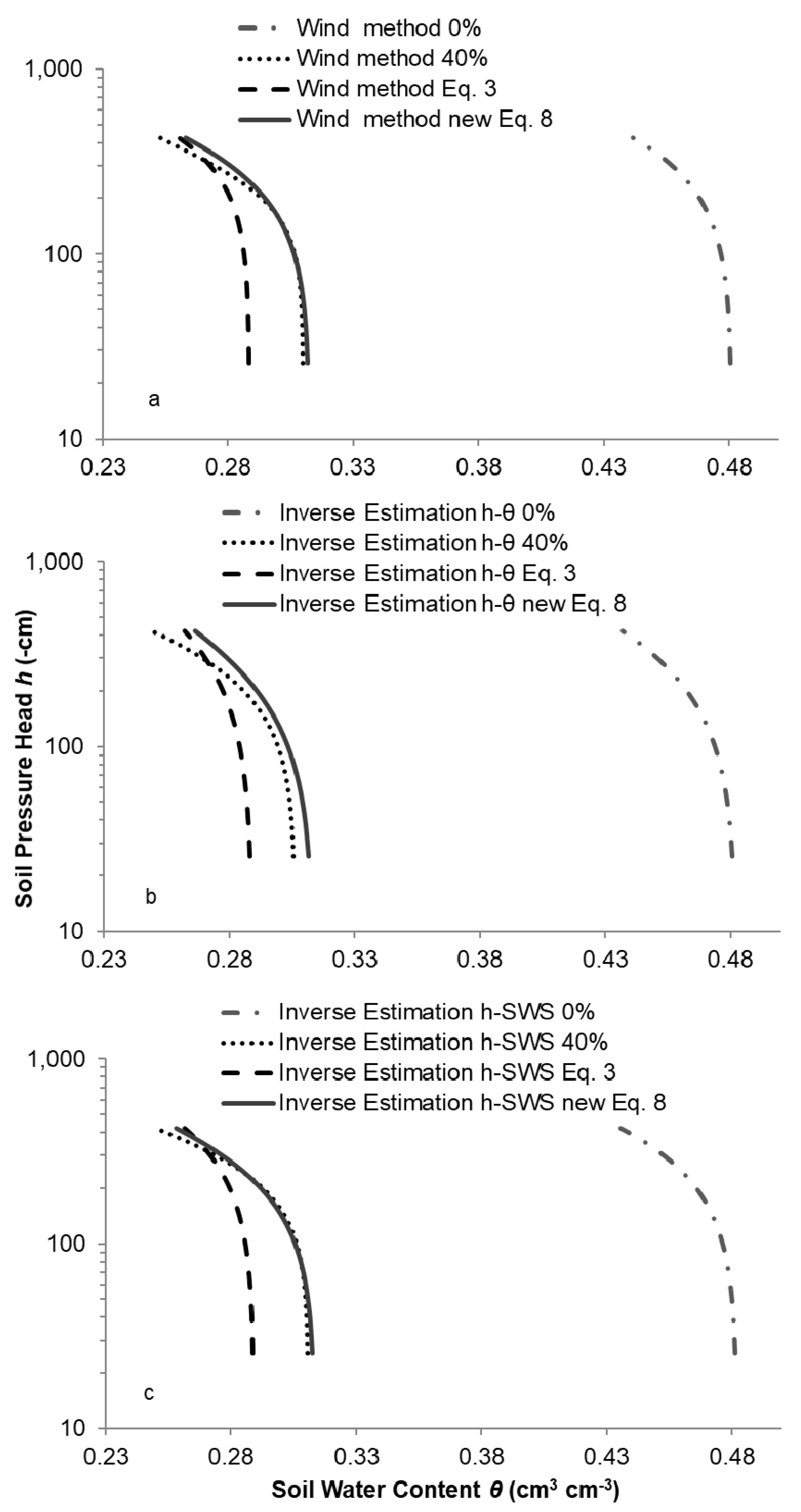
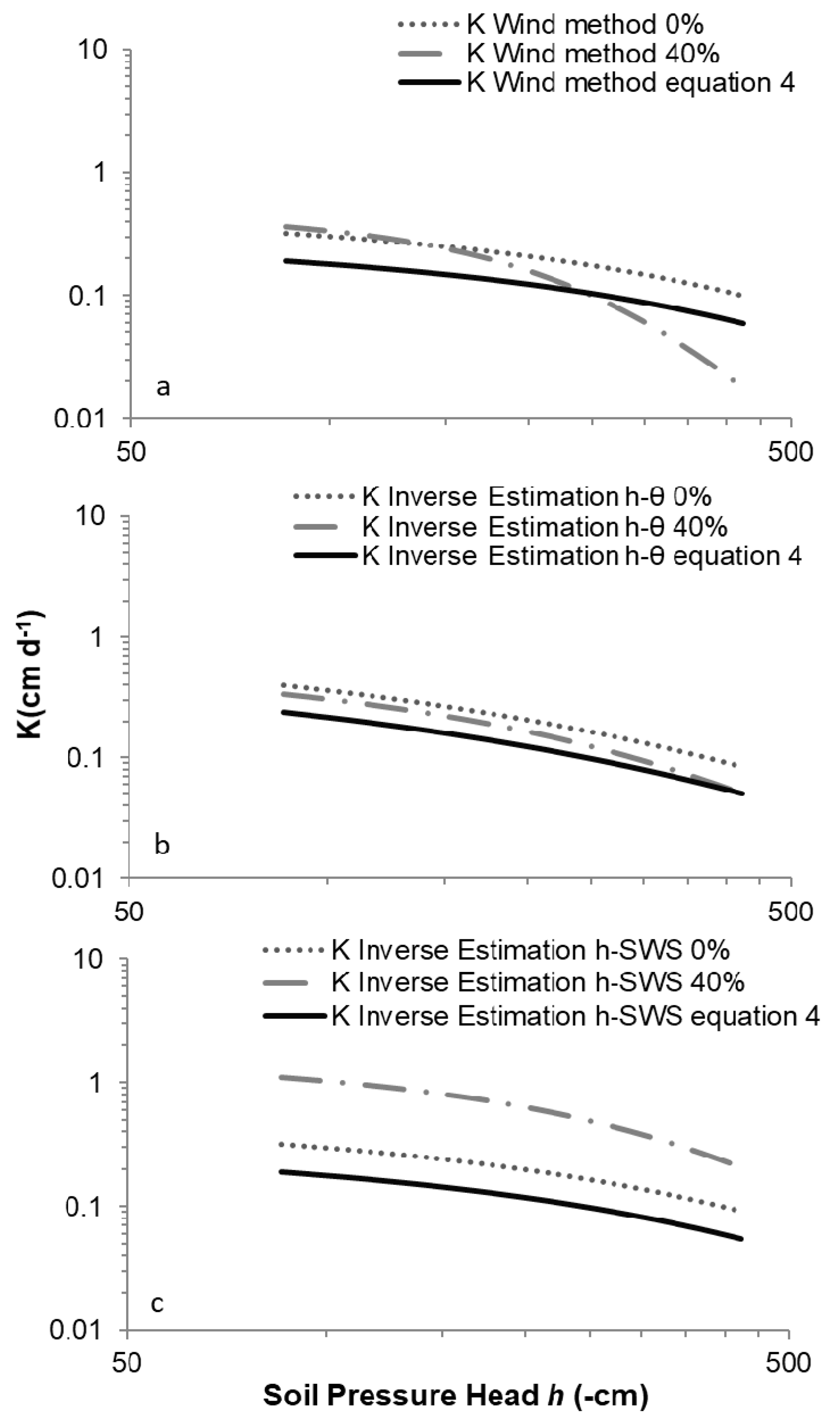
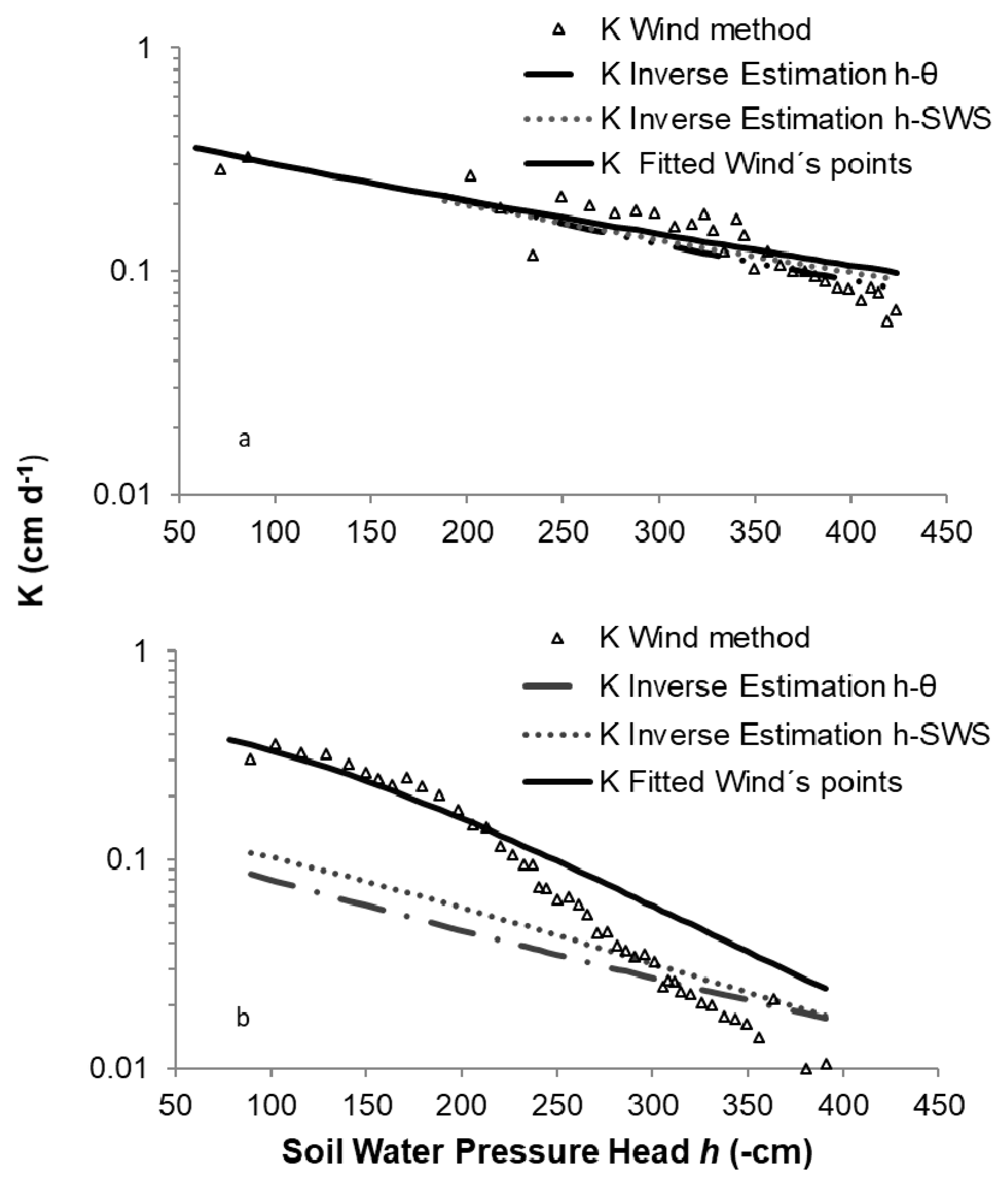
Stony soils are distributed all over the world. The study of their characteristics has gained importance lately due to their increasing use as agricultural soils. The effect that rock fragments exert on the soil hydraulic properties is difficult to measure in situ, and is usually derived from the fine earth properties. However, the corrections used so far do not seem accurate for all types of stony soils. Our objective was to assess the adequacy of estimating the hydraulic properties of a stony soil from the fine earth ones by correcting the latter by the volume occupied by rock fragments. To do that, we first assessed the validity of different approaches for estimating the hydraulic properties of a stone-free and a stony (40% rock fragments) cylinder prepared with samples from the same silt loam soil. The functions relating to the soil hydraulic properties (θ-h, K-h-θ) were estimated by the Wind method and by inverse estimation, using data from an evaporation experiment where the soil water content and pressure head were measured at different soil depths over time. Results from the evaporation experiment were compared to those obtained by applying the equation that corrects fine earth properties by the rock fragments volume. Wind and the Inverse Estimation methods were successfully applied to estimate soil water content and hydraulic conductivity from the stony soil experiment, except for some uncertainties caused by the limited range of suction in which the experiment was conducted. The application of an equation for adjusting the soil water content at different pressure heads (allowing for defining the soil water retention curve, SWRC), and the unsaturated hydraulic conductivity (K) directly from the stone content was not satisfactory. K values obtained from the measured data were higher than those inferred by the correcting equation in the wet range, but decreased much faster with a decreasing pressure head. The use of this equation did therefore not take into account the effect that the creation of lacunar pores by the presence of rock fragments likely exerts on water flow processes. The use of such correction needs therefore to be revised and new approaches are needed for estimating the hydraulic conductivity in stony soils. In relation to SWRC, a new equation to calculate the water content of a stony soil accounting for the influence of possible lacunar pores is proposed.
Keywords: stony soils; soil hydraulic properties; soil water retention curve; unsaturated hydraulic conductivity; wind method; inverse estimation stony soils; soil hydraulic properties; soil water retention curve; unsaturated hydraulic conductivity; wind method; inverse estimation