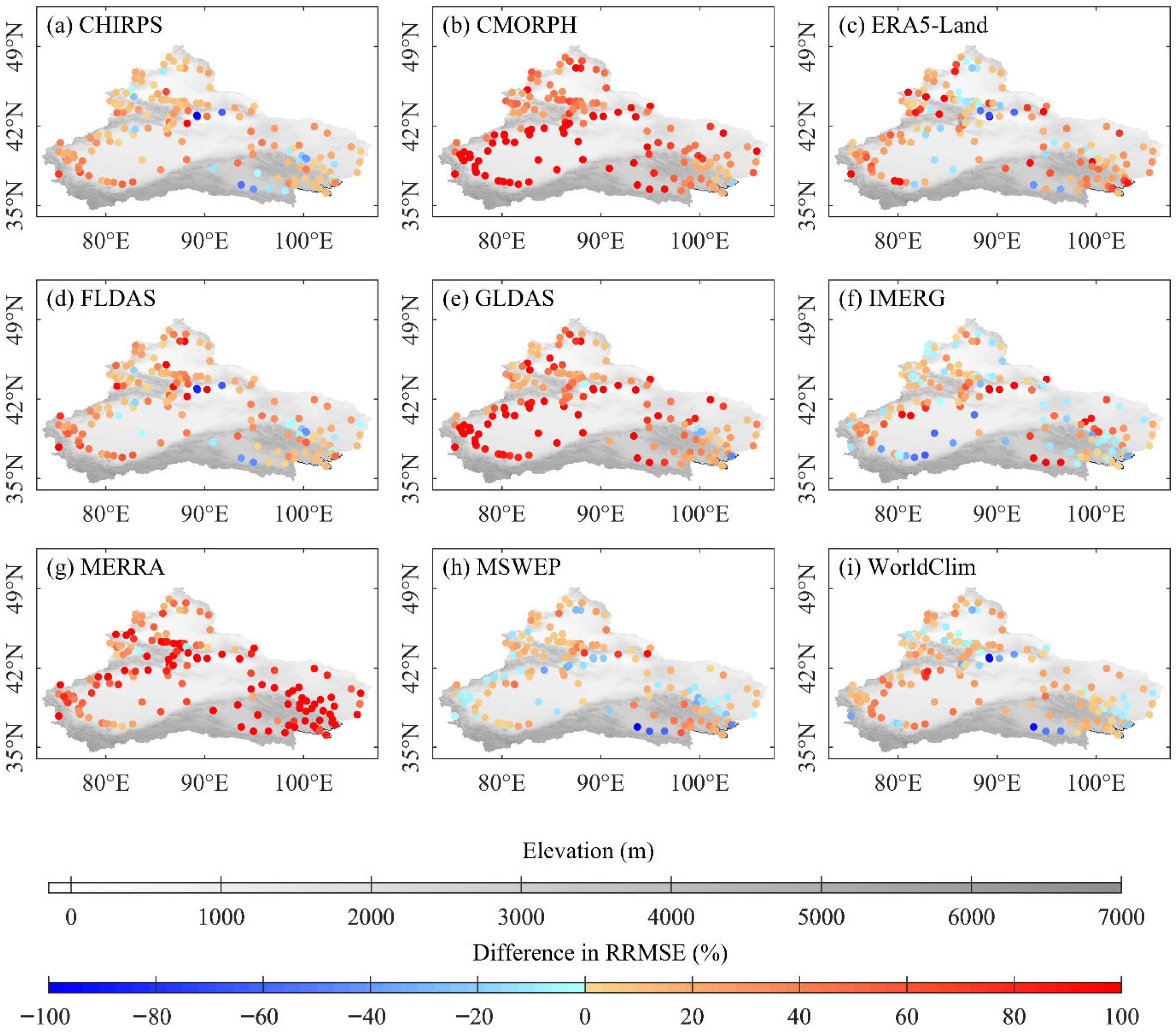
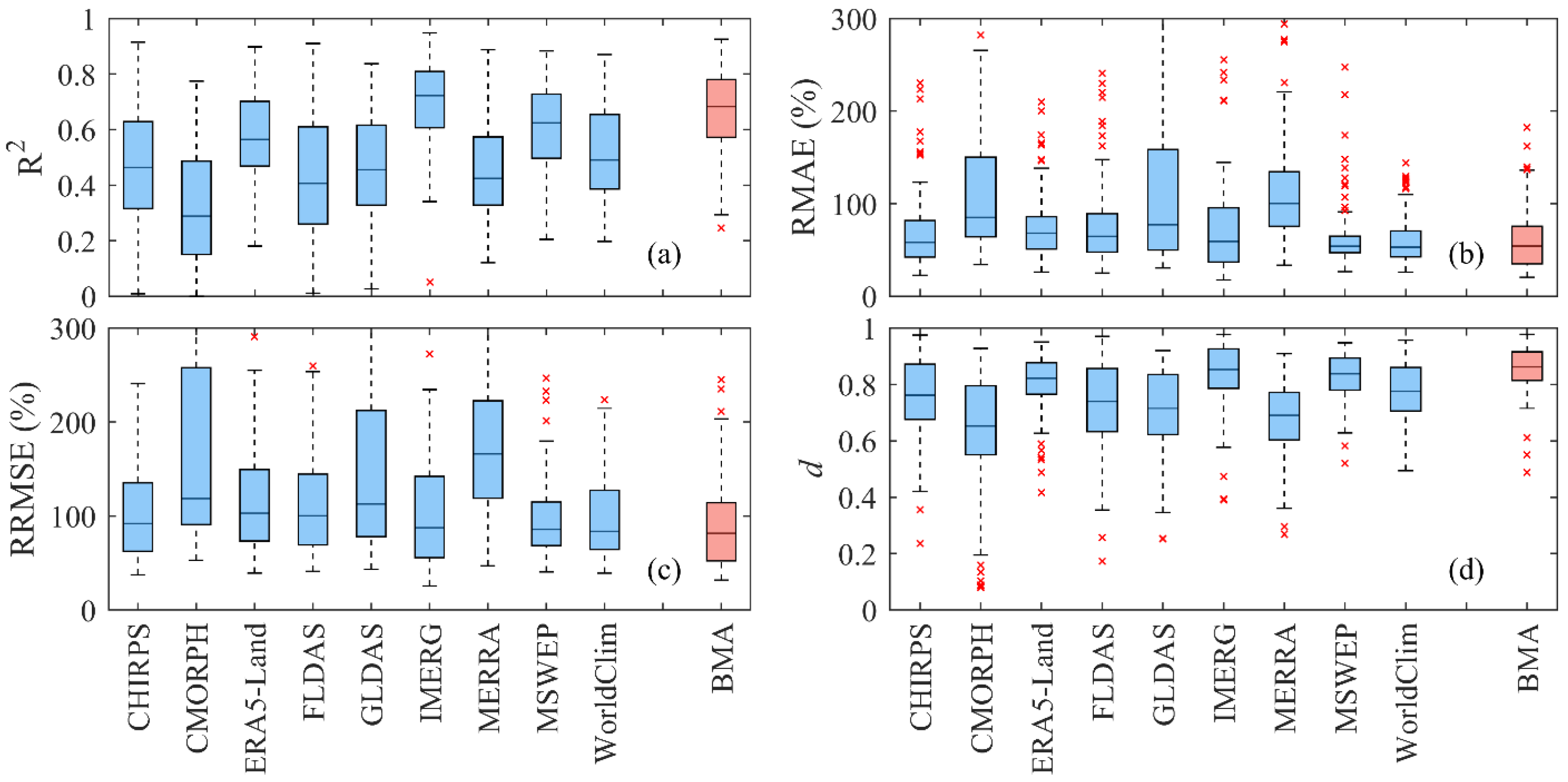
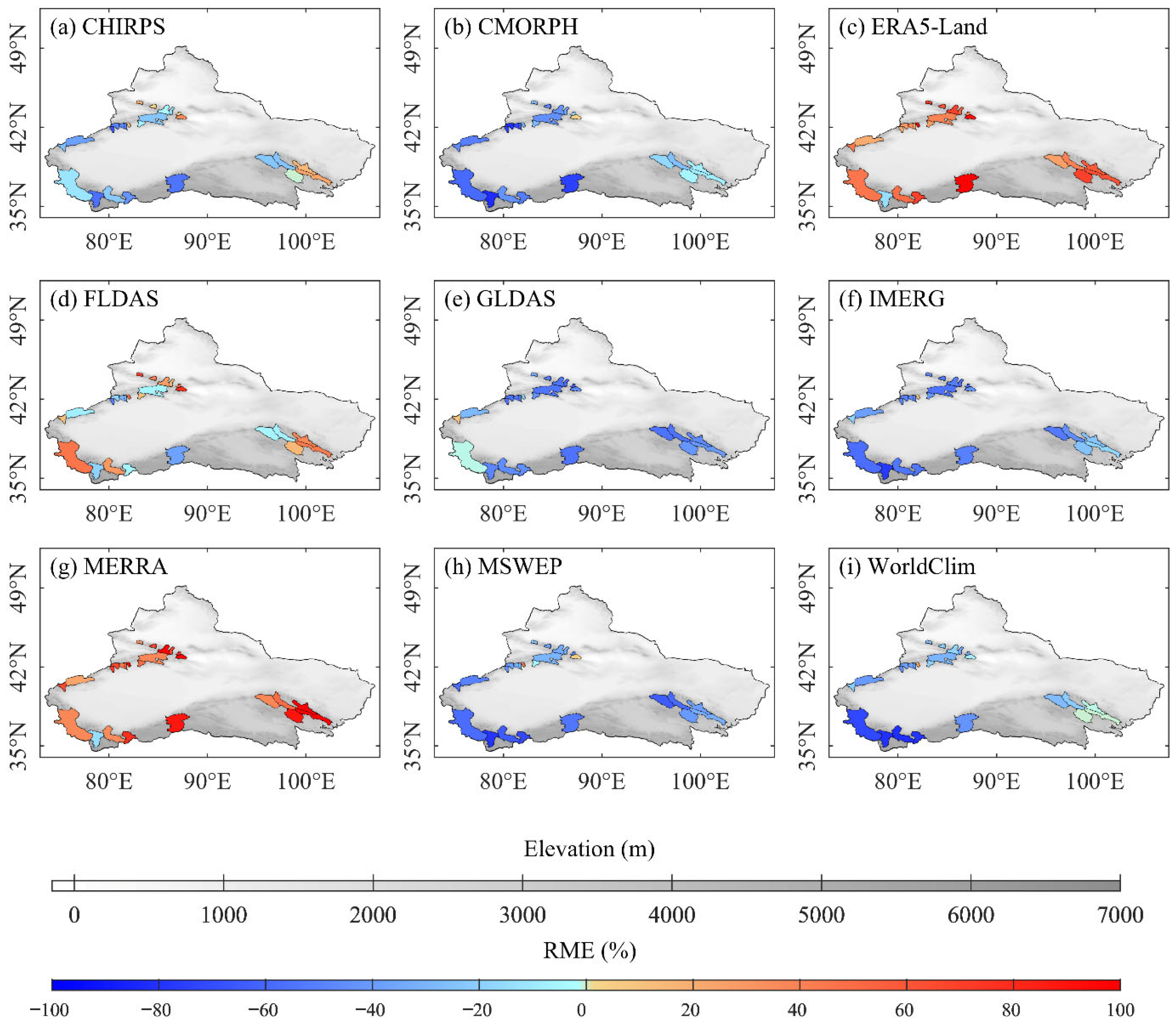
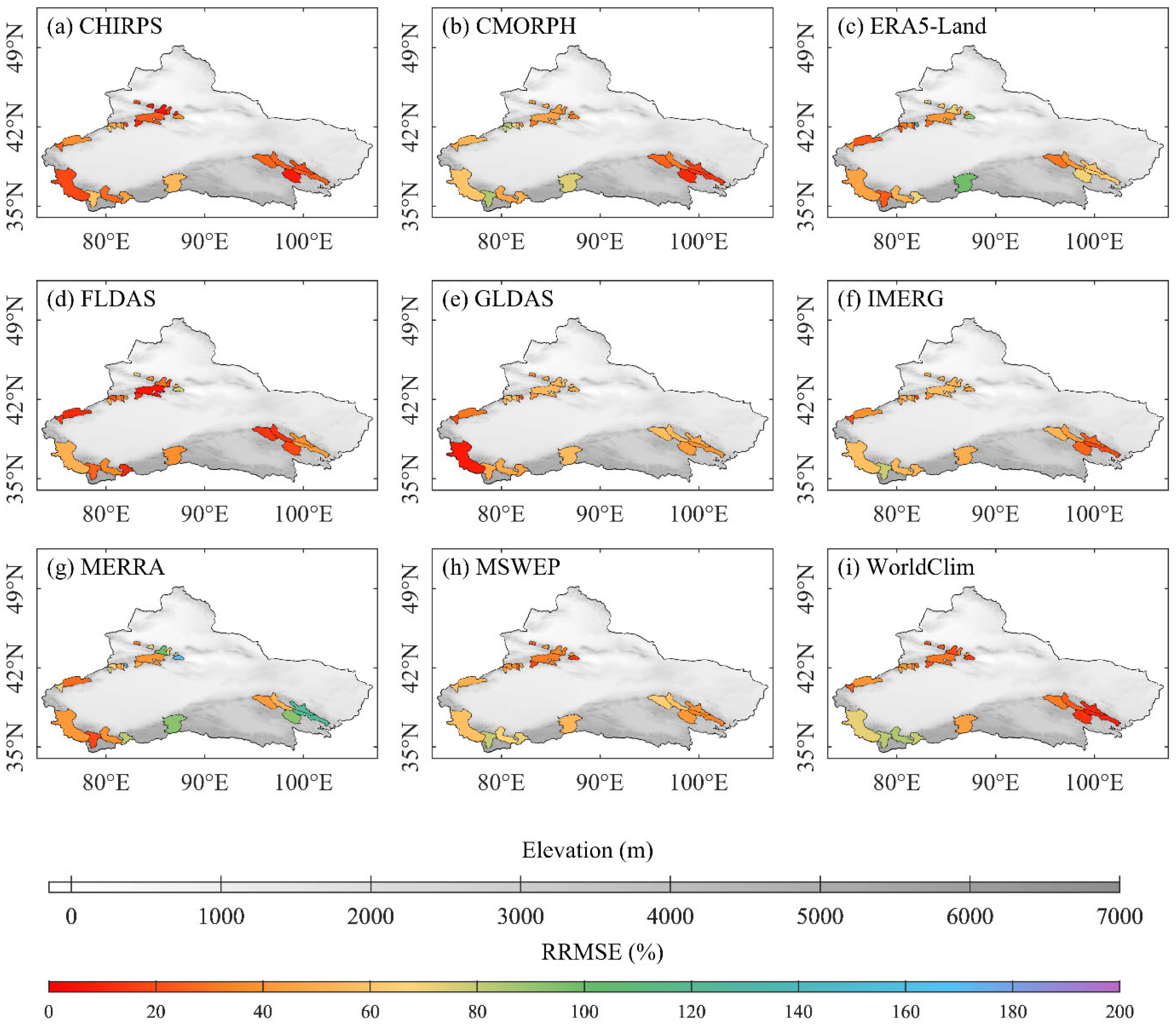
Bayesian Model Averaging Method for Merging Multiple Precipitation Products over the Arid Region of Northwest China



Abstract
1. Introduction
2. Materials and Methods
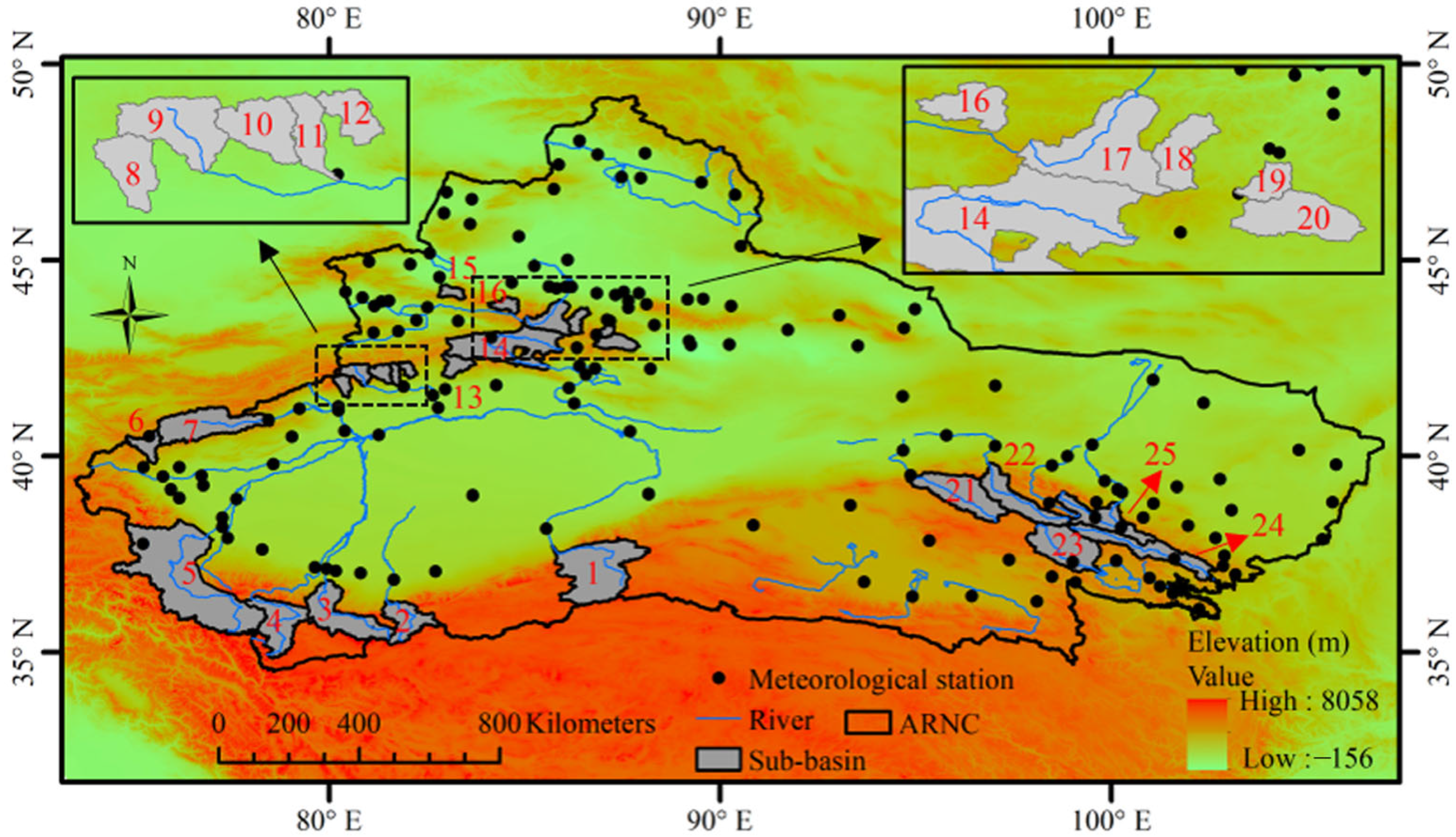
2.1. Study Area

| Number | Sub-Basin | Hydrologic Station | Basin Area (km2) | Runoff Data Period |
|---|---|---|---|---|
| 1 | Cheercen | Qiemo | 24,780.0 | 2000–2011 |
| 2 | Keliya | Keliya | 8141.9 | 2000–2011 |
| 3 | Yulongkash | Tongguziluoke | 14,923.6 | 2000–2011 |
| 4 | Kalakash | Tuoman | 12,484.2 | 2000–2011 |
| 5 | Yarkand | Kaqun | 48,624.7 | 2000–2011 |
| 6 | Qiakemake | Qiaqiga | 3333.5 | 2000–2011 |
| 7 | Tuoshigan | Shaliguilanke | 14,822.6 | 2000–2011 |
| 8 | Tailan | Tailan | 1547.3 | 2000–2011 |
| 9 | Muzhati | Pochengzi | 2604.0 | 2000–2011 |
| 10 | Kamuslang | Kamuluk | 1852.0 | 2000–2011 |
| 11 | Taileweiqiuke | Baicheng | 1137.3 | 2000–2011 |
| 12 | Kalasu | Kalasu | 1038.0 | 2000–2011 |
| 13 | Kuqa | Langan | 2625.0 | 2000–2011 |
| 14 | Kaidu | Dashankou | 17,191.8 | 2000–2011 |
| 15 | Jinghe | Jinghe Shankou | 1406.0 | 2000–2011 |
| 16 | Kuitun | Jiangjunmiao | 1749.4 | 2000–2011 |
| 17 | Manas | Kensiwate | 5183.4 | 2000–2011 |
| 18 | Hutubi | Shimen | 1827.9 | 2000–2020 |
| 19 | Urumqi | Yingxiongqiao | 922.1 | 2000–2011 |
| 20 | Alagou | Alagou | 2874.5 | 2000–2011 |
| 21 | Danghe | Dangchengwan | 14,374.6 | 2000–2020 |
| 22 | Shule | Changmabao | 10,948.5 | 2000–2020 |
| 23 | Buha | Buha | 14,469.0 | 2000–2020 |
| 24 | Datong | Tiantang | 12,488.1 | 2000–2020 |
| 25 | Heihe | Yingluoxia | 10,018.1 | 2000–2020 |
2.2. Data Collection
2.2.1. In Situ Observation Precipitation Data
2.2.2. Grided Precipitation Data
- Climate Hazards group infrared precipitation with stations (CHIRPS; CHIRPS V2).
- 2.
- Climate prediction center (CPC) morphing technique (CMORPH; CMORPH V1).
- 3.
- Land component of the fifth generation of European ReAnalysis (ERA5-Land).
- 4.
- Famine early warning systems network land data assimilation system (FLDAS; FLDAS_NOAH01_C_GL_M).
- 5.
- Global land data assimilation system (GLDAS; GLDAS_NOAH025_M_2.1).
- 6.
- Integrated multi-satellite retrievals for global precipitation measurement (IMERG; GPM_3IMERGM V7).
- 7.
- Modern-Era Retrospective Analysis for Research and Applications (MERRA; MERRA-2).
- 8.
- Multi-Source Weighted-Ensemble Precipitation (MSWEP; MSWEP V3.15).
- 9.
- WorldClim (WorldClim V2.1).
2.2.3. Evapotranspiration, Total Water Storage, and Runoff Data
- 1.
- Global land evaporation amsterdam model (GLEAM; GLEAM V4.2a).
- 2.
- Gravity recovery and climate experiment (GRACE; GRACE-Center for space research (CSR), GRACE-Goddard space flight center (GSFC), and GRACE-Jet propulsion laboratory (JPL)).
- 3.
- Measured river runoff data.
2.3. Water Balance
2.4. Evaluation Criteria
2.5. Bayesian Model Averaging Method
2.6. Trend Analysis
3. Results
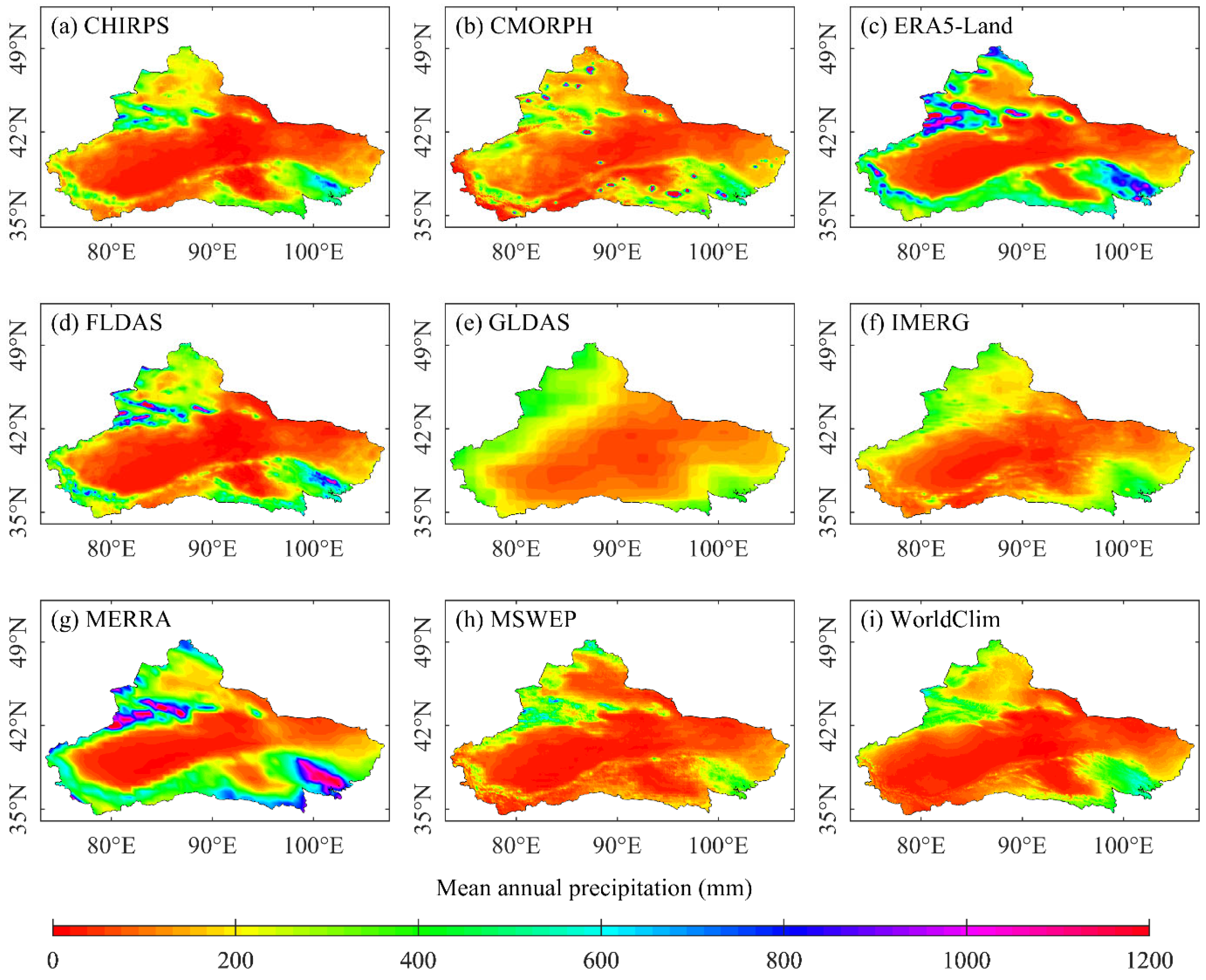
3.1. The Precipitation Values from 9 Products
3.2. Point-to-Pixel Evaluation Using Observational Data from Meteorological Stations
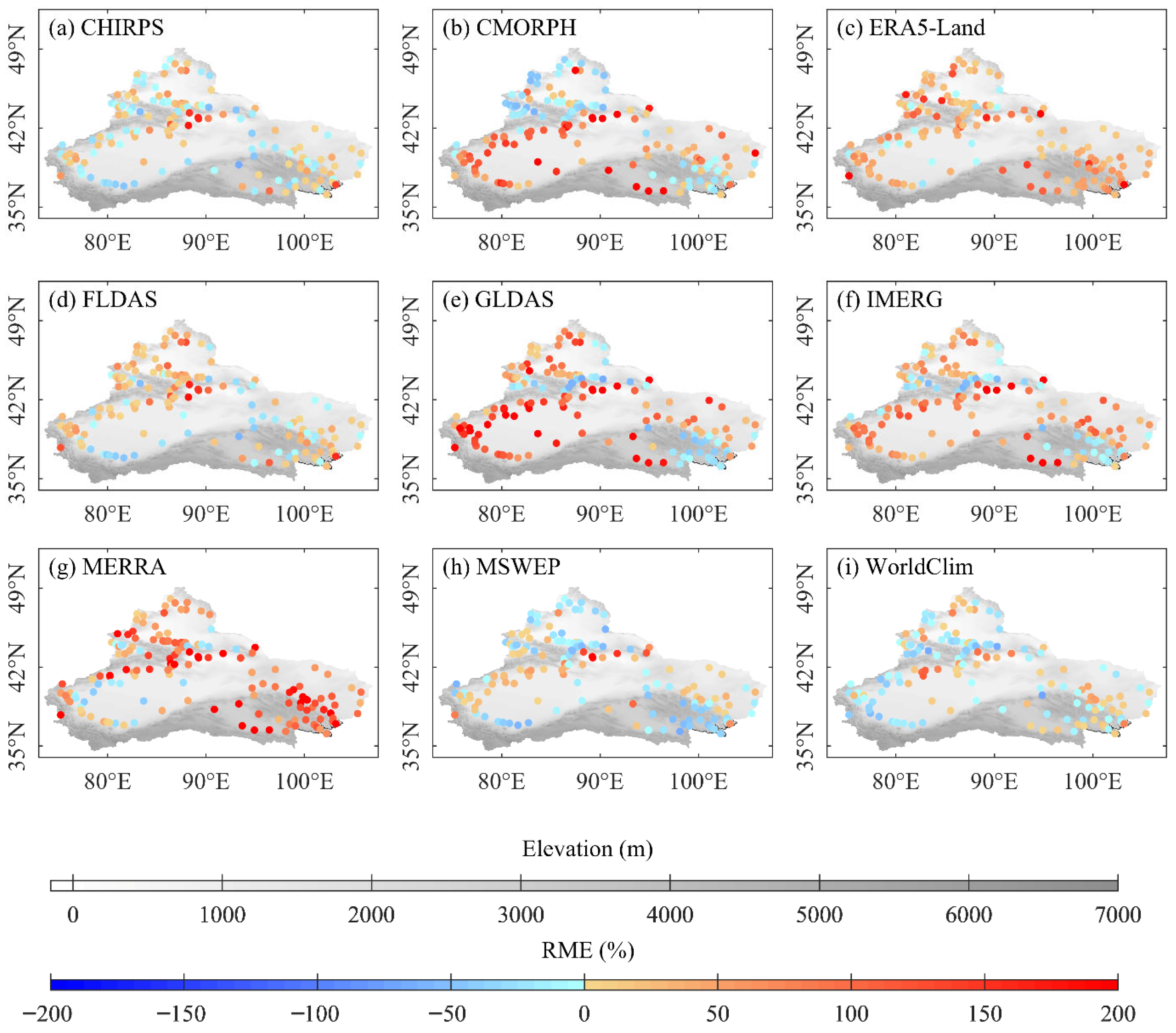
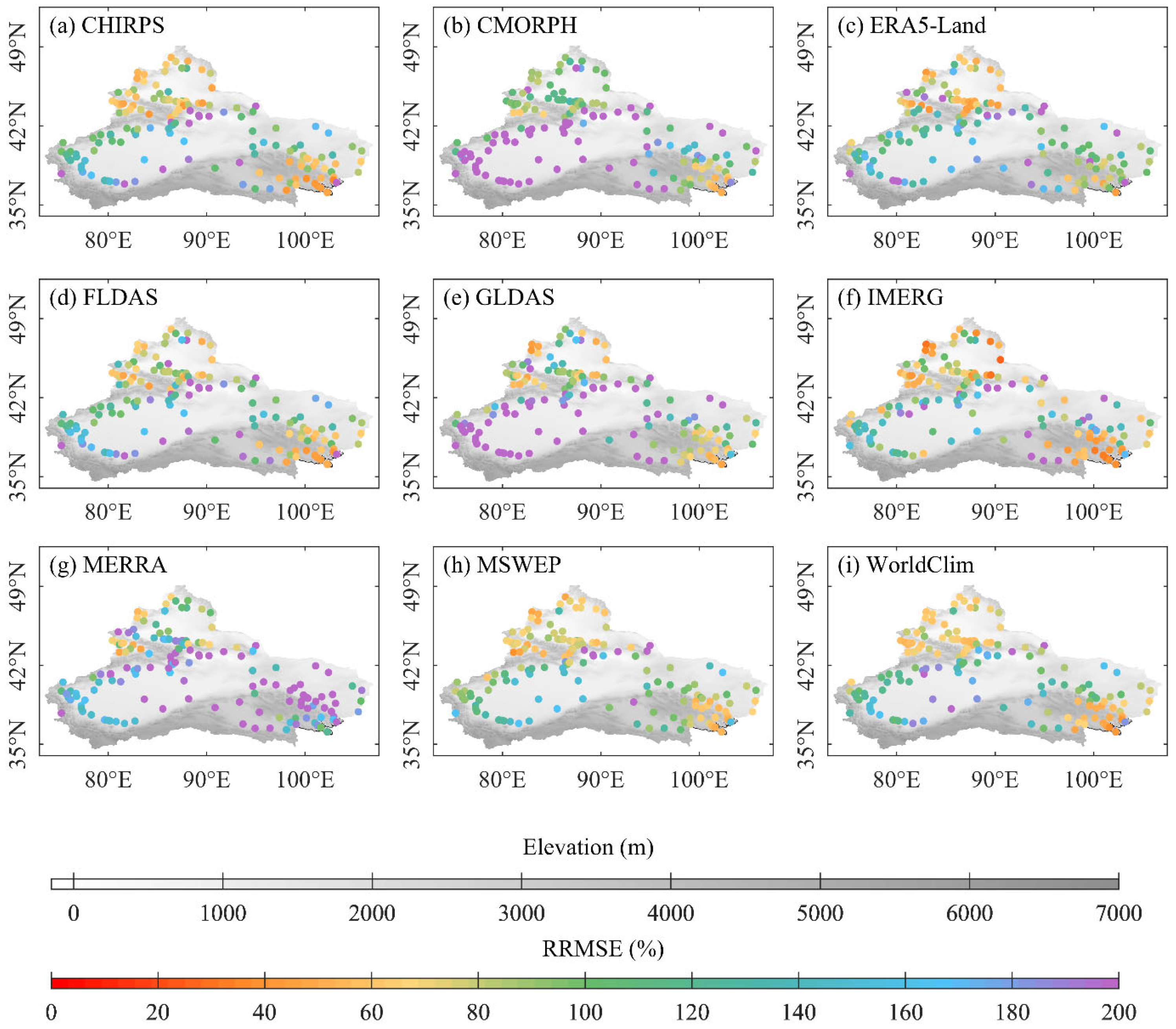
3.2.1. Evaluation of the Precipitation Products
3.2.2. Performance of the Bayesian Model Averaging Method
3.3. Sub-Basin Evaluation Using Water Balance Method
3.3.1. Evaluation of the Precipitation Products
3.3.2. Performance of the Bayesian Model Averaging Method
3.4. Temporal and Spatial Variability in Precipitation in the Arid Region of Northwest China
4. Discussion
4.1. Differences Between Evaluation at Meteorological Station and Sub-Basin Scales
4.2. Advantages of Bayesian Model Averaging for Precipitation Merging
4.3. Uncertainties and Limitations
5. Conclusions
Supplementary Materials
Author Contributions
Funding
Institutional Review Board Statement
Informed Consent Statement
Data Availability Statement
Acknowledgments
Conflicts of Interest
References
- Shen, Y.; Chen, Y. Global perspective on hydrology, water balance, and water resources management in arid basins. Hydrol. Process. 2009, 24, 129–135. [Google Scholar] [CrossRef]
- Zuo, M.; Zhou, T.; Man, W. Wetter Global Arid Regions Driven by Volcanic Eruptions. J. Geophys. Res. Atmos. 2019, 124, 13648–13662. [Google Scholar] [CrossRef]
- Lewin, A.; Murali, G.; Rachmilevitch, S.; Roll, U. Global evaluation of current and future threats to drylands and their vertebrate biodiversity. Nat. Ecol. Evol. 2024, 8, 1448–1458. [Google Scholar] [CrossRef] [PubMed]
- Lu, J.; Jia, L.; Menenti, M.; Zheng, C.; Hu, G.; Ji, D. The impacts of drought on water availability: Spatial and temporal analysis in the Belt and Road region (2001–2020). Int. J. Climatol. 2025, 18, 2449706. [Google Scholar] [CrossRef]
- Ershadfath, F.; Shahnazari, A.; Sarjaz, M.R.; Andaryani, S.; Trolle, D.; Olesen, J.E. Blue and green water availability under climate change in arid and semi-arid regions. Ecol. Inform. 2024, 82, 102743. [Google Scholar] [CrossRef]
- Wang, L.; Collins, S.L. The complex relationship between precipitation and productivity in drylands. Camb. Prism. Drylands 2024, 1, e1. [Google Scholar] [CrossRef]
- Sang, L.; Zhu, G.; Qiu, D.; Zhang, Z.; Liu, Y.; Zhao, K.; Wang, L.; Sun, Z. Spatial variability of runoff recharge sources and influence mechanisms in an arid mountain flow-producing zone. Hydrol. Process. 2022, 36, e14642. [Google Scholar] [CrossRef]
- Zhang, Y.; Gentine, P.; Luo, X.; Lian, X.; Liu, Y.; Zhou, S.; Michalak, A.M.; Sun, W.; Fisher, J.B.; Piao, S.; et al. Increasing sensitivity of dryland vegetation greenness to precipitation due to rising atmospheric CO2. Nat. Commun. 2022, 13, 4875. [Google Scholar] [CrossRef]
- Xu, L.; Zheng, C.; Ma, Y. Variations in precipitation extremes in the arid and semi-arid regions of China. Int. J. Climatol. 2020, 41, 1542–1554. [Google Scholar] [CrossRef]
- Saidaliyeva, Z.; Shahgedanova, M.; Yapiyev, V.; Wade, A.J.; Akbarov, F.; Esenaman uulu, M.; Kalashnikova, O.; Kapitsa, V.; Kasatkin, N.; Rakhimov, I.; et al. Precipitation in the mountains of Central Asia: Isotopic composition and source regions. Atmos. Chem. Phys. 2024, 24, 12203–12224. [Google Scholar] [CrossRef]
- Chakri, A.; Abakarim, S.; Rodrigues, J.C.A.; Laftouhi, N.-E.; Ibouh, H.; Zouhri, L.; Zaitseva, E. Spatial Bias Correction of ERA5_Ag Reanalysis Precipitation Using Machine Learning Models in Semi-Arid Region of Morocco. Atmosphere 2025, 16, 1234. [Google Scholar] [CrossRef]
- Elahi, E.; Abro, M.I.; Khaskheli, M.A.; Kandhro, G.A.; Zehra, T.; Ali, S.; Shaikh, M.N.; Laghari, B.A.; Hassan, M.; Memon, M.A. Long-term evaluation of rainfall in the arid region of Pakistan using multi-source data. Theor. Appl. Climatol. 2023, 155, 2819–2840. [Google Scholar] [CrossRef]
- Han, J.; Miao, C.; Gou, J.; Zheng, H.; Zhang, Q.; Guo, X. A new daily gridded precipitation dataset for the Chinese mainland based on gauge observations. Earth Syst. Sci. Data 2023, 15, 3147–3161. [Google Scholar] [CrossRef]
- Zhao, C.; Yao, S.; Ding, Y.; Zhao, Q. A Gridded Monthly Precipitation Merged Rain Gauge and Satellite Analysis Dataset for the Tian Shan Range between 1981 and 2019. J. Appl. Meteorol. Clim. 2023, 62, 691–708. [Google Scholar] [CrossRef]
- Dou, Y.; Shi, K.; Cai, H.; Xie, M.; Liu, R. Review of Utilisation Methods of Multi-Source Precipitation Products for Flood Forecasting in Areas with Insufficient Rainfall Gauges. Atmosphere 2025, 16, 835. [Google Scholar] [CrossRef]
- Liu, Y.; Zheng, Y.; Li, W.; Zhou, T. Evaluating the Performance of Satellite-Based Precipitation Products Using Gauge Measurement and Hydrological Modeling: A Case Study in a Dry Basin of Northwest China. J. Hydrometeorol. 2022, 23, 541–559. [Google Scholar] [CrossRef]
- Miao, C.; Gou, J.; Hu, J.; Duan, Q. Impacts of Different Satellite-Based Precipitation Signature Errors on Hydrological Modeling Performance Across China. Earth’s Future 2024, 12, e2024EF004954. [Google Scholar] [CrossRef]
- Ferguglia, O.; Palazzi, E.; Arnone, E. Elevation dependent change in ERA5 precipitation and its extremes. Clim. Dyn. 2024, 62, 8137–8153. [Google Scholar] [CrossRef]
- Li, Y.; Qin, X.; Liu, Y.; Jin, Z.; Liu, J.; Wang, L.; Chen, J. Evaluation of Long-Term and High-Resolution Gridded Precipitation and Temperature Products in the Qilian Mountains, Qinghai–Tibet Plateau. Front. Environ. Sci. 2022, 10, 906821. [Google Scholar] [CrossRef]
- Gebrechorkos, S.H.; Leyland, J.; Dadson, S.J.; Cohen, S.; Slater, L.; Wortmann, M.; Ashworth, P.J.; Bennett, G.L.; Boothroyd, R.; Cloke, H.; et al. Global-scale evaluation of precipitation datasets for hydrological modelling. Hydrol. Earth Syst. Sci. 2024, 28, 3099–3118. [Google Scholar] [CrossRef]
- Islam, M.A.; Yu, B.; Cartwright, N. Assessment and comparison of five satellite precipitation products in Australia. J. Hydrol. 2020, 590, 125474. [Google Scholar] [CrossRef]
- Dehaghani, A.M.; Gohari, A.; Zareian, M.J.; Torabi Haghighi, A. A comprehensive evaluation of the satellite precipitation products across Iran. J. Hydrol. Reg. 2023, 46, 101360. [Google Scholar] [CrossRef]
- Mahmoud, M.T.; Al-Zahrani, M.A.; Sharif, H.O. Assessment of global precipitation measurement satellite products over Saudi Arabia. J. Hydrol. 2018, 559, 1–12. [Google Scholar] [CrossRef]
- Wang, X.; Xu, M.; Kang, S.; Li, X.; Han, H.; Li, X. Comprehensive applicability evaluation of four precipitation products at multiple spatiotemporal scales in Northwest China. J. Arid Land 2024, 16, 1232–1254. [Google Scholar] [CrossRef]
- Yang, Y.; Chen, R.; Ding, Y.; Qing, W.; Li, H.; Han, C.; Liu, Z.; Liu, J. Evaluation of 12 precipitation products and comparison of 8 multi-model averaging methods for estimating precipitation in the Qilian Mountains, Northwest China. Atmos. Res. 2023, 296, 107075. [Google Scholar] [CrossRef]
- Jia, Y.; Lei, H.; Yang, H.; Hu, Q. Terrestrial Water Storage Change Retrieved by GRACE and Its Implication in the Tibetan Plateau: Estimating Areal Precipitation in Ungauged Region. Remote Sens. 2020, 12, 3129. [Google Scholar] [CrossRef]
- Koukoula, M.; Nikolopoulos, E.I.; Dokou, Z.; Anagnostou, E.N. Evaluation of Global Water Resources Reanalysis Products in the Upper Blue Nile River Basin. J. Hydrometeorol. 2020, 21, 935–952. [Google Scholar] [CrossRef]
- Wang, Y.; Zhao, N. Evaluation of Eight High-Resolution Gridded Precipitation Products in the Heihe River Basin, Northwest China. Remote Sens. 2022, 14, 1458. [Google Scholar] [CrossRef]
- Ajami, N.K.; Duan, Q.; Gao, X.; Sorooshian, S. Multimodel Combination Techniques for Analysis of Hydrological Simulations: Application to Distributed Model Intercomparison Project Results. J. Hydrometeorol. 2006, 7, 755–768. [Google Scholar] [CrossRef]
- Moges, E.; Demissie, Y.; Larsen, L.; Yassin, F. Review: Sources of Hydrological Model Uncertainties and Advances in Their Analysis. Water 2020, 13, 28. [Google Scholar] [CrossRef]
- Akaike, H. ANew Look at the Statistical Model Identification. IEEE Trans. Automat. Contr. 1974, 19, 716–723. [Google Scholar] [CrossRef]
- Schwarz, G. Estimating the dimension of a model. Ann. Statist. 1978, 6, 461–464. [Google Scholar] [CrossRef]
- Bates, J.M.; Granger, C.W.J. The Combination of Forecasts. J. Oper. Res. Soc. 1969, 20, 451–468. [Google Scholar] [CrossRef]
- Granger, C.W.J.; Ramanathan, R. Improved methods of combining forecasts. J. Forecast. 1984, 3, 197–204. [Google Scholar] [CrossRef]
- Chmielecki, R.M.; Raftery, A.E. Probabilistic Visibility Forecasting Using Bayesian Model Averaging. Mon. Weather Rev. 2011, 139, 1626–1636. [Google Scholar] [CrossRef]
- Neuman, S.P. Maximum likelihood Bayesian averaging of uncertain model predictions. Stoch. Environ. Res. Risk Assess. 2003, 17, 291–305. [Google Scholar] [CrossRef]
- Duan, Q.; Ajami, N.K.; Gao, X.; Sorooshian, S. Multi-model ensemble hydrologic prediction using Bayesian model averaging. Adv. Water Resour. 2007, 30, 1371–1386. [Google Scholar] [CrossRef]
- Seifi, A.; Ehteram, M.; Soroush, F.; Torabi Haghighi, A. Multi-model ensemble prediction of pan evaporation based on the Copula Bayesian Model Averaging approach. Eng. Appl. Artif. Intel. 2022, 114, 105124. [Google Scholar] [CrossRef]
- Wu, H.; Su, X.; Singh, V.P.; Zhang, T. Predicting Hydrological Drought With Bayesian Model Averaging Ensemble Vine Copula (BMAViC) Model. Water Resour. Res. 2022, 58, e2022WR033146. [Google Scholar] [CrossRef]
- Ning, S.; Cheng, Y.; Zhou, Y.; Wang, J.; Zhang, Y.; Jin, J.; Thapa, B.R. Bayesian Model Averaging for Satellite Precipitation Data Fusion: From Accuracy Estimation to Runoff Simulation. Remote Sens. 2025, 17, 1154. [Google Scholar] [CrossRef]
- Duan, K.; Wang, X.; Liu, B.; Zhao, T.; Chen, X. Comparing Bayesian Model Averaging and Reliability Ensemble Averaging in Post-Processing Runoff Projections under Climate Change. Water 2021, 13, 2124. [Google Scholar] [CrossRef]
- Dusa, S.; Manikanta, V.; Das, J.; Umamahesh, N.V. Does the performance enhancement through multi-model averaging at the catchment outlet gets translated to the interior ungauged points? J. Hydrol. 2023, 627, 130389. [Google Scholar] [CrossRef]
- Yang, X.; Yuan, F.; Liu, S.; Xu, C.-Y.; Ren, L.; Jiang, S. Quantifying multi-source uncertainties in multi-model predictions using the Bayesian model averaging scheme. Hydrol. Res. 2018, 49, 954–970. [Google Scholar]
- Yang, Z.; Chen, R.; Liu, Z.; Zhao, Y.; Liu, Y.; Wu, W. Spatiotemporal variability of rain-on-snow events in the arid region of Northwest China. J. Arid Land 2024, 16, 483–499. [Google Scholar] [CrossRef]
- Yang, Y.; Shen, L.; Wang, B. How is the precipitation distributed vertically in arid mountain region of Northwest China? J. Geogr. Sci. 2022, 32, 241–258. [Google Scholar] [CrossRef]
- Weng, J.; Yand, Y.; Mu, Z.; Yang, L. Mechanisms and spatiotemporal variation characteristics of flooding over northwestern China. Acta Geogr. Sin. 2024, 79, 2768–2779. (In Chinese) [Google Scholar]
- Chen, Y.; Li, B.; Li, Z.; Li, W. Water resource formation and conversion and water security in arid region of Northwest China. J. Geogr. Sci. 2016, 26, 939–952. [Google Scholar] [CrossRef]
- China Meteorological Administration. Specifications for Surface Meteorological Observation; China Meteorological Press: Beijing, China, 2003. [Google Scholar]
- Chen, F.; Li, X. Evaluation of IMERG and TRMM 3B43 Monthly Precipitation Products over Mainland China. Remote Sens. 2016, 8, 472. [Google Scholar] [CrossRef]
- Qian, L.; Zhao, P. Assessment of ERA5-Land Reanalysis Precipitation Data in the Qilian Mountains of China. Atmosphere 2025, 16, 826. [Google Scholar] [CrossRef]
- Wei, D.; Di, W.; Tian, W.; Cheng, S.; Xie, H.; Xie, L.; Jing, Z. Assessment of Integrated Multi-Satellite Retrievals for Global Precipitation Measurement (IMERG) Precipitation Products in Northwest China. Remote Sens. 2025, 17, 1364. [Google Scholar] [CrossRef]
- Funk, C.; Peterson, P.; Landsfeld, M.; Pedreros, D.; Verdin, J.; Shukla, S.; Husak, G.; Rowland, J.; Harrison, L.; Hoell, A.; et al. The climate hazards infrared precipitation with stations--a new environmental record for monitoring extremes. Sci. Data 2015, 2, 150066. [Google Scholar] [CrossRef] [PubMed]
- Xie, P.; Joyce, R.; Wu, S.; Yoo, S.; Yarosh, Y.; Sun, F.; Lin, R. Reprocessed, Bias-Corrected CMORPH Global High-Resolution Precipitation Estimates from 1998. J. Hydrometeorol. 2017, 18, 1617–1641. [Google Scholar] [CrossRef]
- Muñoz-Sabater, J.; Dutra, E.; Agustí-Panareda, A.; Albergel, C.; Arduini, G.; Balsamo, G.; Boussetta, S.; Choulga, M.; Harrigan, S.; Hersbach, H.; et al. ERA5-Land: A state-of-the-art global reanalysis dataset for land applications. Earth Syst. Sci. Data 2021, 13, 4349–4383. [Google Scholar] [CrossRef]
- McNally, A.; Jacob, J.; Arsenault, K.; Slinski, K.; Sarmiento, D.P.; Hoell, A.; Pervez, S.; Rowland, J.; Budde, M.; Kumar, S.; et al. A Central Asia hydrologic monitoring dataset for food and water security applications in Afghanistan. Earth Syst. Sci. Data 2022, 14, 3115–3135. [Google Scholar] [CrossRef]
- Rui, H.; Beaudoing, H. README Document for NASA GLDAS Version 2 Data Products, National Aeronautics and Space Administration Goddard Earth Science Data Information Center (GES DISC); NASA: Greenbelt, MD, USA, 2022. [Google Scholar]
- Huffman, G.J.; Stocker, E.F.; Bolvin, D.T.; Nelkin, E.J.; Tan, J. GPM IMERG Final Precipitation L3 1 Month 0.1 Degree × 0.1 Degree V07; Goddard Earth Sciences Data and Information Services Center (GES DISC); NASA: Greenbelt, MD, USA, 2023. [Google Scholar]
- Reichle, R.H.; Liu, Q.; Koster, R.D.; Draper, C.S.; Mahanama, S.P.P.; Partyka, G.S. Land Surface Precipitation in MERRA-2. J. Clim. 2017, 30, 1643–1664. [Google Scholar] [CrossRef]
- Beck, H.E.; Wood, E.F.; Pan, M.; Fisher, C.K.; Miralles, D.G.; van Dijk, A.I.J.M.; McVicar, T.R.; Adler, R.F. MSWEP V2 Global 3-Hourly 0.1° Precipitation: Methodology and Quantitative Assessment. Bull. Amer. Meteor. Soc. 2019, 100, 473–500. [Google Scholar] [CrossRef]
- Fick, S.E.; Hijmans, R.J. WorldClim 2: New 1-km spatial resolution climate surfaces for global land areas. Int. J. Climatol. 2017, 37, 4302–4315. [Google Scholar] [CrossRef]
- Martens, B.; Miralles, D.G.; Lievens, H.; van der Schalie, R.; de Jeu, R.A.M.; Fernández-Prieto, D.; Beck, H.E.; Dorigo, W.A.; Verhoest, N.E.C. GLEAM v3: Satellite-based land evaporation and root-zone soil moisture. Geosci. Model Dev. 2017, 10, 1903–1925. [Google Scholar] [CrossRef]
- Jahromi, M.N.; Miralles, D.; Koppa, A.; Rains, D.; Zand-Parsa, S.; Mosaffa, H.; Jamshidi, S. Ten Years of GLEAM: A Review of Scientific Advances and Applications. In Computational Intelligence for Water and Environmental Sciences; Bozorg-Haddad, O., Zolghadr-Asli, B., Eds.; Springer Nature: Singapore, 2022; pp. 525–540. [Google Scholar]
- Michel, D.; Jiménez, C.; Miralles, D.G.; Jung, M.; Hirschi, M.; Ershadi, A.; Martens, B.; McCabe, M.F.; Fisher, J.B.; Mu, Q.; et al. The WACMOS-ET project—Part 1: Tower-scale evaluation of four remote-sensing-based evapotranspiration algorithms. Hydrol. Earth Syst. Sci. 2016, 20, 803–822. [Google Scholar] [CrossRef]
- Miralles, D.G.; Bonte, O.; Koppa, A.; Baez-Villanueva, O.M.; Tronquo, E.; Zhong, F.; Beck, H.E.; Hulsman, P.; Dorigo, W.; Verhoest, N.E.C.; et al. GLEAM4: Global land evaporation and soil moisture dataset at 0.1 resolution from 1980 to near present. Sci. Data 2025, 12, 416. [Google Scholar] [CrossRef]
- Zhao, Y.; Hoeltgebaum, L.E.B.; Kukal, M.S.; Zhao, M. Leading Satellite-Based Evapotranspiration Products Insufficiently Capture Interannual Variability: Evidence from GRACE/FO and In Situ Observations. Geophys. Res. Lett. 2025, 52, e2025GL116784. [Google Scholar] [CrossRef]
- Landerer, F.W.; Flechtner, F.M.; Save, H.; Webb, F.H.; Bandikova, T.; Bertiger, W.I.; Bettadpur, S.V.; Byun, S.H.; Dahle, C.; Dobslaw, H.; et al. Extending the Global Mass Change Data Record: GRACE Follow-On Instrument and Science Data Performance. Geophys. Res. Lett. 2020, 47, e2020GL088306. [Google Scholar] [CrossRef]
- Luo, Z.; Fu, H.; Shao, Q.; Dong, W.; Chen, X.; Ding, X.; Wang, L.; Gu, X.; Sarukkalige, R.; Huang, H.; et al. A novel method for correcting water budget components and reducing their uncertainties by optimally distributing the imbalance residual without full closure. Hydrol. Earth Syst. Sci. 2025, 29, 4607–4635. [Google Scholar] [CrossRef]
- Sattar, H.; Kinouchi, T. Streamflow estimation in the Indus River Basin using a water balance framework and artificial neural networks with satellite- and model-derived global hydro-climatic data sources. J. Hydrol. Reg. Stud. 2025, 60, 102510. [Google Scholar] [CrossRef]
- Zhao, H.; Ma, J.; Zhang, L.; Zeng, H.; Huang, Q. Human activities have exacerbated groundwater depletion in arid regions: A case study of the Hexi Corridor, China. J. Hydrol. Reg. Stud. 2025, 61, 102649. [Google Scholar] [CrossRef]
- Ouatiki, H.; Boudhar, A.; Leblanc, M.; Fakir, Y.; Chehbouni, A. When climate variability partly compensates for groundwater depletion: An analysis of the GRACE signal in Morocco. J. Hydrol. Reg. Stud. 2022, 42, 101177. [Google Scholar] [CrossRef]
- Chen, A.; Chen, D.; Azorin-Molina, C. Assessing reliability of precipitation data over the Mekong River Basin: A comparison of ground-based, satellite, and reanalysis datasets. Int. J. Climatol. 2018, 38, 4314–4334. [Google Scholar] [CrossRef]
- Baran, S.; Hemri, S.; El Ayari, M. Statistical Postprocessing of Water Level Forecasts Using Bayesian Model Averaging With Doubly Truncated Normal Components. Water Resour. Res. 2019, 55, 3997–4013. [Google Scholar] [CrossRef]
- Kendall, M.G. Rank Correlation Methods, 4th ed.; Charles Griffin: London, UK, 1975. [Google Scholar]
- Mann, H.B. Nonparametric tests against trend. Econometrica 1945, 13, 245–259. [Google Scholar] [CrossRef]
- Gavrilov, M.B.; Marković, S.B.; Janc, N.; Nikolić, M.; Valjarević, A.; Komac, B.; ZorN, M.; PuNišić, M.; Bačević, N. Assessing average annual air temperature trends using the Mann–Kendall test in Kosovo. Acta Geogr. Slov. 2018, 58, 7–25. [Google Scholar] [CrossRef]
- Sen, P.K. Estimates of the regression coefficient based on Kendall’s tau. J. Am. Stat. Assoc. 1968, 63, 1379–1389. [Google Scholar] [CrossRef]
- Li, Y.; Yang, M.; Wan, G.; Man, Y.; Wang, X. Coupled statistical analysis and hydrological simulation to evaluate the performance of satellite and reanalysis precipitation products in the Qilian Mountains, Northwest China. Clim. Dyn. 2025, 63, 134. [Google Scholar] [CrossRef]
- Beck, H.E.; Vergopolan, N.; Pan, M.; Levizzani, V.; van Dijk, A.I.J.M.; Weedon, G.P.; Brocca, L.; Pappenberger, F.; Huffman, G.J.; Wood, E.F. Global-scale evaluation of 22 precipitation datasets using gauge observations and hydrological modeling. Hydrol. Earth Syst. Sci. 2017, 21, 6201–6217. [Google Scholar] [CrossRef]
- Mao, R.; Wang, L.; Zhou, J.; Li, X.; Qi, J.; Zhang, X. Evaluation of Various Precipitation Products Using Ground-Based Discharge Observation at the Nujiang River Basin, China. Water 2019, 11, 2308. [Google Scholar] [CrossRef]
- Behrangi, A.; Gardner, A.S.; Reager, J.T.; Fisher, J.B. Using GRACE to constrain precipitation amount over cold mountainous basins. Geophys. Res. Lett. 2017, 44, 219–227. [Google Scholar] [CrossRef]
- Nourani, V.; Tosan, M.; Huang, J.J.; Gebremichael, M.; Kantoush, S.A.; Dastourani, M. Advances in multi-source data fusion for precipitation estimation: Remote sensing and machine learning perspectives. Earth-Sci. Rev. 2025, 270, 105253. [Google Scholar] [CrossRef]
- Zhang, H.; Wei, L.; Zhu, Y.; Zhou, J.; Liu, S.; Sun, X.; Kang, X.; Gao, M.; Duan, Z.; Crow, W.T.; et al. Comparison of multi-source merged precipitation products using independent gauge observations. Atmos. Res. 2026, 328, 108427. [Google Scholar] [CrossRef]
- Chen, Y.; Li, W.; Fang, G.; Li, Z. Review article: Hydrological modeling in glacierized catchments of central Asia—Status and challenges. Hydrol. Earth Syst. Sci. 2017, 21, 669–684. [Google Scholar] [CrossRef]
- Cheng, W.; Feng, Q.; Xi, H.; Yin, X.; Cheng, L.; Sindikubwabo, C.; Zhang, B.; Chen, Y.; Zhao, X. Modeling and assessing the impacts of climate change on groundwater recharge in endorheic basins of Northwest China. Sci. Total Environ. 2024, 918, 170829. [Google Scholar] [CrossRef]


| Name | Abbreviation | Resolution | Period | Data Access | Last Accessed |
|---|---|---|---|---|---|
| CHIRPS V2 | CHIRPS | 0.05° | 1981–NRT | https://data.chc.ucsb.edu/products/CHIRPS-2.0 | 20 October 2025 |
| CMORPH V1 | CMORPH | 8 km | 1998–NRT | https://doi.org/10.5065/0EFN-KZ90 | 10 August 2025 |
| ERA5-Land | ERA5-Land | 0.1° | 1950–NRT | https://doi.org/10.24381/cds.68d2bb30 | 25 October 2025 |
| FLDAS_NOAH01_C_GL_M | FLDAS | 0.1° | 1982–NRT | https://doi.org/10.5067/5NHC22T9375G | 8 July 2025 |
| GLDAS_NOAH025_M | GLDAS | 0.25° | 2000–NRT | https://doi.org/10.5067/SXAVCZFAQLNO | 25 September 2025 |
| GPM_3IMERGM V07 | IMERG | 0.1° | 2000–NRT | https://doi.org/10.5067/GPM/IMERG/3B-MONTH/07 | 27 August 2025 |
| MERRA V5.12.4 | MERRA | 0.5° | 1980–NRT | https://doi.org/10.5067/0JRLVL8YV2Y4 | 29 October 2025 |
| MSWEP V3.15 | MSWEP | 0.1° | 1979–NRT | http://www.gloh2o.org/mswep/ | 20 September 2025 |
| WorldClim | WorldClim | 2.5′ | 1960–NRT | https://www.worldclim.org/data/monthlywth.html | 28 September 2025 |
| GLEAM v4.2a | GLEAM | 0.1° | 1980–NRT | https://www.gleam.eu/ | 6 December 2025 |
| GRACE-CSR RL06 V3 | GRACE | 0.25° | 2002–NRT | https://www2.csr.utexas.edu/grace/RL06_mascons.html | 27 August 2025 |
| GRACE-GSFC RL06 V2 | 0.5° | 2002–NRT | https://earth.gsfc.nasa.gov/geo/data/grace-mascons | 27 August 2025 | |
| GRACE-JPL RL06 V4 | 0.5° | 2002–NRT | https://grace.jpl.nasa.gov/data/get-data/jpl_global_mascons/ | 27 August 2025 |
Disclaimer/Publisher’s Note: The statements, opinions and data contained in all publications are solely those of the individual author(s) and contributor(s) and not of MDPI and/or the editor(s). MDPI and/or the editor(s) disclaim responsibility for any injury to people or property resulting from any ideas, methods, instructions or products referred to in the content. |
© 2026 by the authors. Licensee MDPI, Basel, Switzerland. This article is an open access article distributed under the terms and conditions of the Creative Commons Attribution (CC BY) license.
Share and Cite
Yang, Y.; Chen, R.; Lu, X.; Mao, W.; Liu, Z.; Wang, X. Bayesian Model Averaging Method for Merging Multiple Precipitation Products over the Arid Region of Northwest China. Atmosphere 2026, 17, 94. https://doi.org/10.3390/atmos17010094
Yang Y, Chen R, Lu X, Mao W, Liu Z, Wang X. Bayesian Model Averaging Method for Merging Multiple Precipitation Products over the Arid Region of Northwest China. Atmosphere. 2026; 17(1):94. https://doi.org/10.3390/atmos17010094
Chicago/Turabian StyleYang, Yong, Rensheng Chen, Xinyu Lu, Weiyi Mao, Zhangwen Liu, and Xueliang Wang. 2026. "Bayesian Model Averaging Method for Merging Multiple Precipitation Products over the Arid Region of Northwest China" Atmosphere 17, no. 1: 94. https://doi.org/10.3390/atmos17010094
APA StyleYang, Y., Chen, R., Lu, X., Mao, W., Liu, Z., & Wang, X. (2026). Bayesian Model Averaging Method for Merging Multiple Precipitation Products over the Arid Region of Northwest China. Atmosphere, 17(1), 94. https://doi.org/10.3390/atmos17010094