1. Introduction
Asthma is a chronic, non-communicable respiratory disease that affects individuals of all ages. Asthma remains a significant public health concern in the United States, with more than 25 million individuals reporting current asthma, including approximately 21 million adults and 4 million children [
1]. Each year, more than 3500 asthma-related deaths occur nationwide [
1,
2]. Although asthma outcomes have improved over time, asthma continues to contribute substantially to morbidity, including an estimated 10 million missed workdays among adults in 2018 and about 10 million physician office visits annually [
2,
3].
The burden of asthma is not evenly distributed. Women and racial and ethnic minority groups experience higher prevalence and worse outcomes compared with non-Hispanic White adults [
2,
3,
4,
5,
6]. Non-Hispanic Black adults consistently report higher asthma morbidity, while Hispanic populations show mixed patterns that may reflect cultural and environmental differences [
6,
7,
8]. These disparities are shaped by social and environmental determinants, including access to care, socioeconomic status, and housing quality [
5,
7,
9].
Indoor environmental exposures significantly influence asthma morbidity [
10,
11]. Adults spend up to 90% of their time indoors, where pollutant concentrations can exceed outdoor levels [
12,
13]. Important indoor triggers include tobacco smoke, chemical cleaning products, mold, dust mites, cockroaches, rodents, and pet allergens [
1,
11,
14,
15,
16]. Housing characteristics and occupant behaviors, including home type, flooring, wood-burning stoves, cleaning practices, renovations, and ventilation, further influence exposure [
14,
16,
17,
18,
19]. For example, carpets can serve as reservoirs for allergens and particulates [
20], while cleaning can lower allergen burden but increase short-term exposure to volatile organic compounds [
21,
22]. Pet ownership has been linked to both protective and adverse effects depending on the timing of exposure and individual sensitization [
23,
24]. Conversely, protective measures such as dehumidifiers, pillows, and mattress covers, the use of HEPA air filters, and exhaust fans that vent outdoors have been associated with improved symptom control [
20,
25,
26]. These examples highlight the need to consider multiple household and environmental factors simultaneously, rather than focusing on single exposures.
Despite this knowledge, relatively few studies have comprehensively assessed the combined influence of multiple household and environmental determinants on asthma morbidity among adults [
10,
14,
16,
18,
27,
28]. Much of the existing evidence comes from pediatric populations, leaving a critical gap in understanding how overall household indoor exposures affect adult asthma, even though adults represent the majority of cases in the United States. Texas is an important setting for this study because of its diverse population, fast growth, and wide range of housing conditions, which may combine with social determinants of health to influence asthma burden [
29]. The state has multiple climate zones, including hot–humid and arid regions, where prolonged high temperatures increase air-conditioning use, reduce natural ventilation, and may elevate indoor pollutant levels [
30]. Texas also has a substantial proportion of older housing, mobile homes, and multi-unit residences where inadequate ventilation, moisture intrusion, and pest exposure are more common [
31]. Additionally, the state has substantial racial, ethnic, and income diversity, with well-documented disparities in housing quality and access to healthcare that may contribute to unequal asthma burden [
32]. Together, these characteristics make Texas a critical setting for evaluating indoor environmental contributors to asthma morbidity.
This study aimed to evaluate the association between household and environmental determinants and asthma morbidity among adults in Texas using the pooled Asthma Call-Back Survey (ACBS) data from 2019 to 2022. We focused on four asthma morbidity outcomes—episodes or attacks, symptoms, sleep difficulty, and activity limitation—and assessed their associations with sociodemographic and environmental factors. By focusing on adults, this study contributes to the evidence base needed to guide targeted interventions and public health strategies to reduce the burden of asthma.
2. Materials and Methods
2.1. Data Source
This study used data from the ACBS, a state-level telephone survey conducted annually as a follow-up to the CDC’s Behavioral Risk Factor Surveillance System (BRFSS). The ACBS collects detailed information on asthma management, healthcare utilization, and household environmental exposures among adults with asthma. Public-use adult ACBS data from 2019 through 2022 were pooled for this analysis.
2.2. Study Population
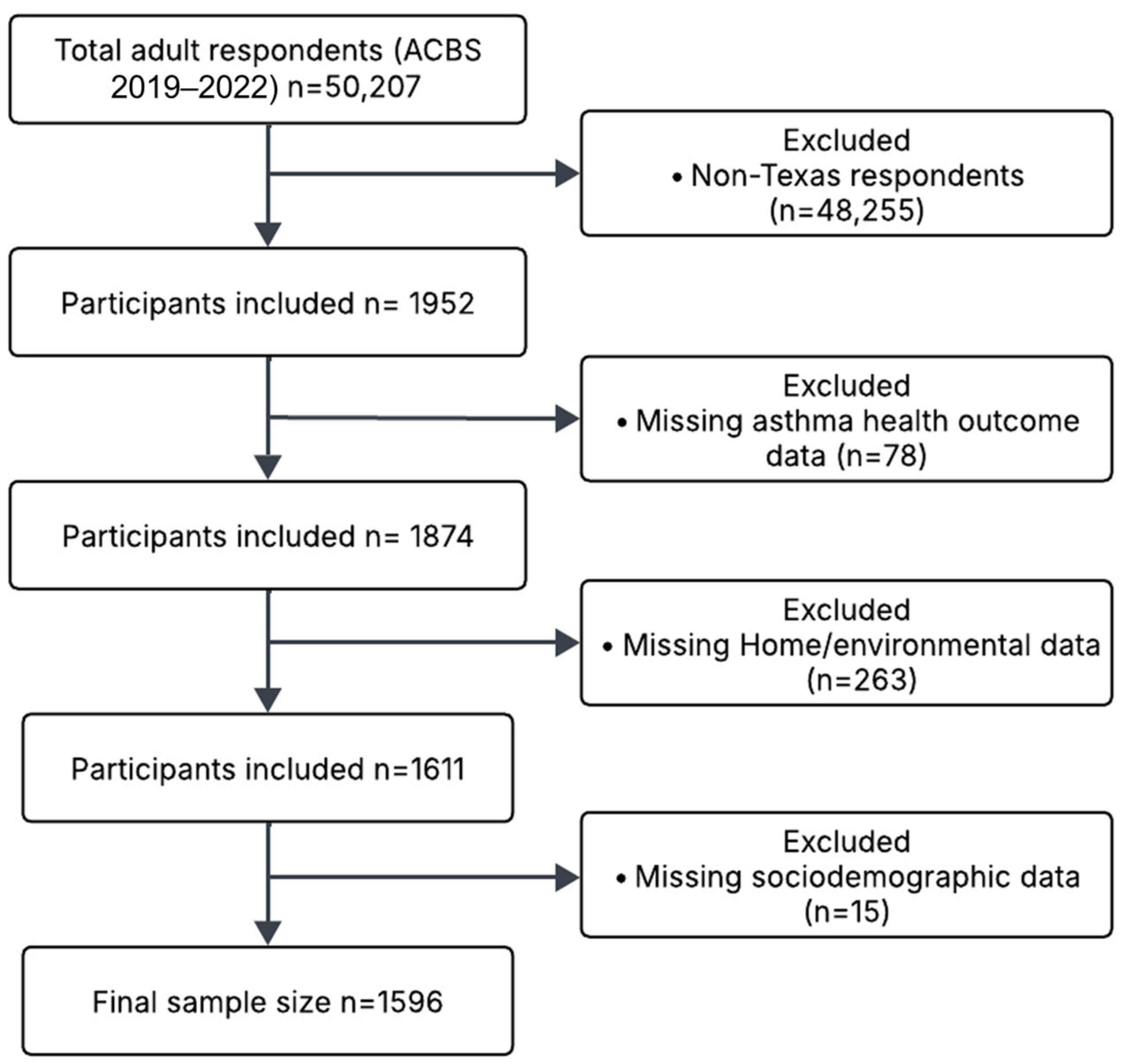
The analytic sample was restricted to respondents residing in Texas who reported ever receiving a diagnosis of asthma. After limiting to those who completed the adult ACBS interview between 2019 and 2022, the pooled dataset included 1596 respondents. Individuals with missing information on primary outcomes or exposures were excluded on a case-by-case basis. The process of participant selection and exclusion is summarized in
Figure 1 below. When comparing included participants with the 278 excluded due to missing sociodemographic or home environmental data, age and race/ethnicity distributions were generally similar. For example, White participants comprised 57.2% of the included sample and 59.0% of the excluded sample, while Hispanic participants accounted for 24.7% and 21.0%, respectively. However, excluded participants were more likely to be female (80.0% vs. 63.3% among included participants), resulting in the underrepresentation of females in the included sample.
2.3. Asthma Morbidity Outcomes
Four binary outcomes were used to assess asthma-related morbidity. These included (1) at least one asthma episode or attack in the past 12 months, (2) any asthma symptoms in the past 30 days, (3) sleep difficulty due to asthma in the past 30 days, and (4) activity limitation due to asthma in the past 30 days. Responses of “don’t know,” “refused,” or otherwise invalid codes were treated as missing.
2.4. Household and Environmental Exposures
Household and environmental determinants included indicators of biological exposures, such as the presence of mold, indoor furry pets, cockroaches, and rodents. Combustion-related factors included wood-burning stoves or fireplaces and smoking inside the home. Housing characteristics included carpeting and home ownership status. Environmental control and mitigation measures included the use of air purifiers, dehumidifiers, exhaust fans vented outdoors (bathroom and kitchen), mattress and pillow covers, and whether a health professional had advised respondents to modify their home environment to improve asthma outcomes. All exposures were recoded as binary indicators (1 = yes, 0 = no). Responses of “don’t know” or “refused” were treated as missing.
2.5. Sociodemographic Variables
Sociodemographic variables included sex (male, female), age group (18–34, 35–54, ≥55 years), race/ethnicity (non-Hispanic White, non-Hispanic Black, Hispanic, and other race), education (<high school, high school graduate, some college/technical school and college/technical school graduate), marital status (married, not married, unmarried couple), and insurance status (insured, uninsured). Survey year (2019–2022) was also included as a covariate.
2.6. Statistical Analysis
The BRFSS–ACBS uses a multistage sampling design that integrates stratification, clustering, and oversampling of specific population groups. To account for this design, all analyses incorporated survey sampling weights. Descriptive statistics were calculated to summarize demographic characteristics, environmental exposures, and asthma outcomes using frequencies and weighted percentages.
Associations between household and environmental exposures and asthma outcomes were first examined using survey-year adjusted univariate logistic regression models. Exposures with p < 0.10 in univariate screening were entered as candidates into multivariable models. Multivariable logistic regression models with stepwise selection were used for each asthma outcome to assess the independent association of exposures with asthma morbidity. All covariates, including sex, age group, race/ethnicity, education, marital status, insurance status, and survey year, were retained in the final model, which reduces concerns related to variable selection-induced overfitting. Unadjusted odds ratios (uORs), adjusted odds ratios (aORs), and 95% confidence intervals (CIs) were reported. Model fit was evaluated with post hoc goodness-of-fit tests. All analyses were conducted using SAS version 9.4 (SAS Institute Inc., Cary, NC, USA).
This analysis used publicly available, de-identified data from the Centers for Disease Control and Prevention (CDC) BRFSS-ACBS. As such, it was not considered human subjects research and did not require Institutional Review Board (IRB) approval.
4. Discussion
This study evaluated the association between household and environmental determinants and asthma morbidity among adults in Texas using pooled ACBS data from 2019 to 2022. Four asthma outcomes were examined: episodes or attacks in the past year, symptoms, sleep difficulty, and activity limitation in the past 30 days. The findings reinforce the documented role of indoor environmental exposures in shaping asthma outcomes. Across outcomes, several consistent patterns emerged, such as older adults, women, and non-Hispanic Black respondents reported higher odds of morbidity, while Hispanic adults demonstrated lower odds for certain outcomes. Several household and environmental determinants were shown as significant predictors. Lack of exhaust fan and bathroom fan use, and smoking were associated with increased morbidity, while the absence of furry pets, mold, or rodents was generally protective. The use of air purifiers also appeared to reduce morbidity for some outcomes.
We found that poor air exchange was a significant risk factor for asthma morbidity, consistent with prior research. Poor ventilation contributes to the buildup of indoor pollutants, allergens, and moisture, worsening respiratory symptoms [
14,
17,
33]. Similar associations were observed in studies linking inadequate home ventilation and gas stove use with increased asthma symptoms [
12,
13,
17]. Our findings add to this evidence by showing that both bathroom and kitchen ventilation systems were protective in adults.
This study showed mold and rodent exposure as risk factors, as the absence of these exposures was strongly protective across multiple outcomes. These findings align with previous research documenting that substandard housing conditions, dampness, and pest infestations contribute to asthma morbidity, particularly among low-income and minority households [
19,
34,
35].
Findings related to furry pets and asthma outcomes are mixed in earlier studies. While pet ownership has been associated with sensitization and exacerbation in some studies [
36,
37], other evidence suggests potential protective effects, particularly when exposure occurs early in life [
23,
24]. In our study, the absence of furry pets was consistently protective across outcomes, suggesting that pet allergens were an essential trigger for adults with asthma in our population.
Tobacco smoke was among the strongest predictors of morbidity. Current smokers had noticeably higher odds of attacks, symptoms, and sleep difficulty. This finding is consistent with evidence identifying smoking as a key modifiable predictor of poor asthma control and exacerbations [
5,
9,
15,
38].
Air purifiers also played a key role. Adults who did not use an air purifier were more likely to report sleep problems, asthma symptoms, and limits in daily activity. This finding supports growing evidence that portable air cleaners can reduce indoor particulate matter and improve asthma control [
25,
26,
39,
40]. Although cost and access may limit their use, our findings suggest that encouraging air purifier use could be a practical way to help adults with poorly controlled asthma.
The disparities we observed by demographics align with national trends. Women reported more asthma problems across outcomes, consistent with known biological, hormonal, and behavioral influences [
4]. Non-Hispanic Black adults had elevated odds of every asthma outcome. In contrast, Hispanic adults showed mixed results, with lower odds of activity limitation and asthma attacks but higher odds of sleep difficulty, underscoring complex cultural and environmental influences [
8,
34]. Higher genetic variation within Hispanic populations, arising from diverse ancestral contributions, may further contribute to within-group differences and inconsistent findings [
41]. Moreover, the non-Hispanic “Other” group exhibited a distinct pattern, with little change between unadjusted and adjusted estimates. This may reflect the highly heterogeneous composition of this category, which includes multiple small subgroups with diverse sociodemographic, exposure, and behavioral profiles that are not fully captured by the available covariates [
42,
43]. Additionally, the relatively small sample size (n = 92) may have limited the impact of covariate adjustment on this estimate.
Age disparities were also notable: compared with younger adults, older adults were more likely to report asthma symptoms, sleep difficulty, activity limitation, and attacks, with the highest risks seen among those aged 55 and older. These findings support prior evidence that asthma morbidity increases with age, with older adults experiencing worse clinical outcomes and higher risks of exacerbation [
6,
44,
45]. The observed racial and age-related disparities in asthma morbidity likely reflect broader structural determinants of health rather than individual-level factors alone. Historical and ongoing inequities in housing quality, residential segregation, and healthcare access may increase exposure to substandard ventilation, indoor pollutants, and moisture-related hazards among certain racial and ethnic groups [
5,
7].
Insurance status presented an unexpected pattern. After adjusting for covariates, uninsured adults reported fewer asthma attacks, with little difference in activity limitation and sleep difficulty compared to insured adults. This finding likely reflects underreporting, reduced diagnosis, or differences in symptom recognition rather than an actual reduction in morbidity. It may also indicate residual confounding from unmeasured factors such as environmental exposures or health literacy.
Several findings in this study were unexpected and should be interpreted with caution. Participants who reported not using pillow or mattress covers, not using a dehumidifier, or never receiving advice to make home changes to improve asthma outcomes had lower odds of adverse asthma outcomes. Similarly, individuals who reported no secondhand smoke exposure also demonstrated higher odds of asthma-related outcomes, and the effects of home ownership (rented versus owned) were mixed. These results likely reflect reverse causation, measurement error, and residual confounding rather than true protective effects [
46]. Individuals with more severe or poorly controlled asthma may have been more likely to receive environmental advice or adopt allergen-control interventions, whereas those with milder symptoms may have had less need for such interventions [
47,
48]. In addition, the use of dehumidifiers or allergen-proof covers may indicate the presence of underlying home dampness, mold, or poor ventilation that contribute to asthma morbidity [
49]. Prior studies have also shown that while allergen-proof covers and other single-component interventions can reduce dust mite levels, their clinical impact on asthma symptoms is often inconsistent [
50,
51]. Similarly, the unexpected association between the absence of cockroaches and increased odds of sleep difficulty may reflect residual confounding or reporting bias rather than a causal relationship. Households reporting no cockroaches may differ in unmeasured characteristics such as building type, pest control practices, or neighborhood context, which could influence sleep-related outcomes. Differences between renters and homeowners may also vary according to socioeconomic factors, housing conditions, and the degree of control occupants have over their environment [
47]. Together, these findings highlight the complexity of behavioral and environmental factors influencing asthma control and emphasize the need for longitudinal studies to clarify temporal and causal relationships.
These findings underscore the importance of addressing modifiable household and environmental factors in the management of adult asthma. Providing asthma education, improving ventilation, reducing exposure to mold and pests, eliminating tobacco smoke, and promoting the use of air purifiers could lower asthma morbidity. Evidence from multicomponent interventions suggests that addressing multiple exposures simultaneously, such as allergens, moisture, and ventilation, improves asthma outcomes, especially when changes are guided by health professionals [
25,
52,
53]. Expanding these strategies to adult populations may strengthen asthma control and help reduce disparities.
This study has several strengths, including the use of a large, state-level dataset with survey weights that support population-level inference. The analysis also incorporated multiple household and environmental factors, providing a more comprehensive picture than studies limited to single exposures. However, limitations must be noted. First, asthma outcomes and household environmental factors were modeled as binary variables, which may mask the variability in exposure intensity and symptom severity and limit the ability to evaluate dose-response relationships. Second, the cross-sectional design prevents causal inference. Third, asthma outcomes and household exposures were self-reported, which may introduce recall or reporting bias and lead to misclassification, potentially resulting in attenuation or inflation of estimated associations depending on whether misclassification is non-differential or differential. For example, if individuals with more severe asthma are more likely to report adverse household conditions, the observed associations may be inflated. Fourth, because this study relied on secondary analysis of a publicly available dataset, several relevant factors could not be assessed, including COVID-19 infection and vaccination history, household chemical use (e.g., cleaning agents and biocides), specific types of air purifiers, early-life exposures, and comorbidities. These unmeasured factors may have influenced reported asthma outcomes and represent potential sources of residual confounding. Additionally, participants excluded due to missing sociodemographic or home environmental data were more likely to be female, resulting in the relative underrepresentation of females in the analytic sample and introducing the potential for sex-related selection bias. Another limitation is the lack of interaction analyses among environmental exposures and behaviors due to insufficient sample size to reliably evaluate potential synergistic effects. Moreover, the absence of objective measurements of indoor pollutants (e.g., PM2.5, VOCs) limits comparisons with health-based standards. Finally, although significant covariates were included in the models, residual confounding is possible, as evidenced by shifting associations across environmental variables.