Characterization of VOCs at Shaoxing in the Winter Campaign: Sources and Chemical Reactivity

 , ,
, , 
Abstract
1. Introduction
2. Experiments and Methods
2.1. Site Description and VOCs Analysis
2.2. Source Apportionment
2.3. Reactivity of VOCs
3. Results and Discussions
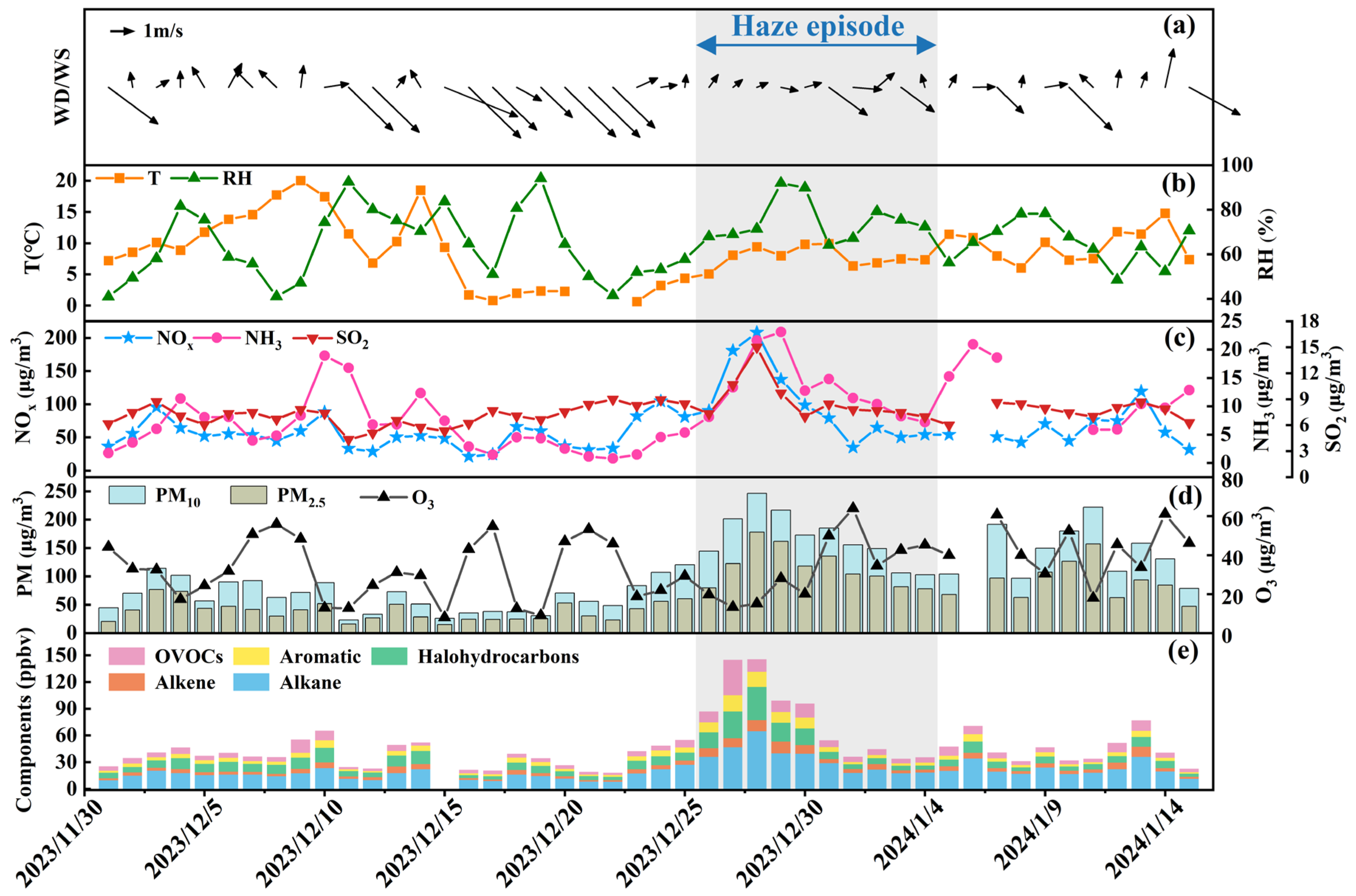
3.1. Overview of the Monitoring Campaign
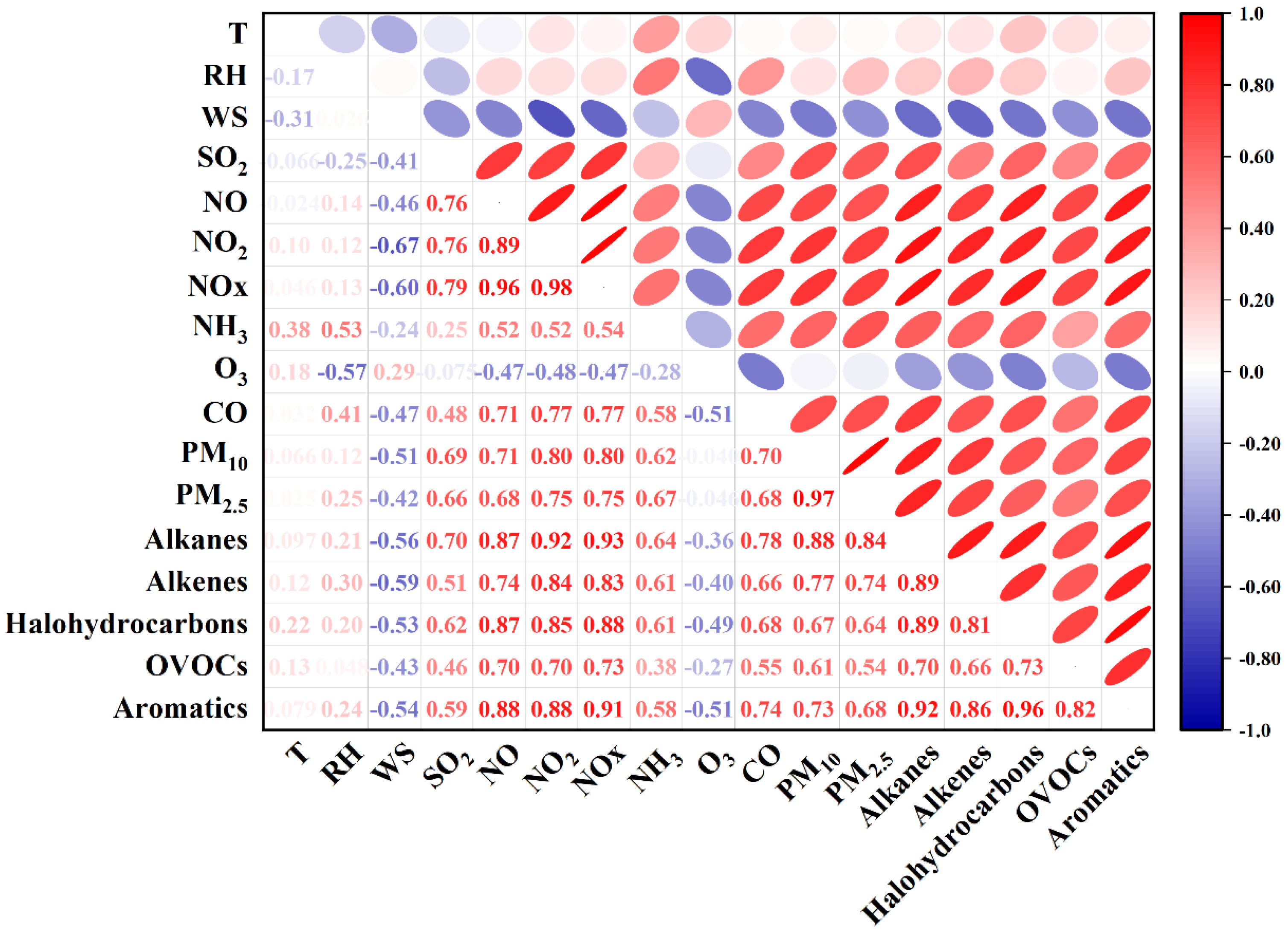
3.2. Correlation Analysis Among Air Pollutants, Meteorological Factors, and VOCs
3.3. Source Apportionment Analysis
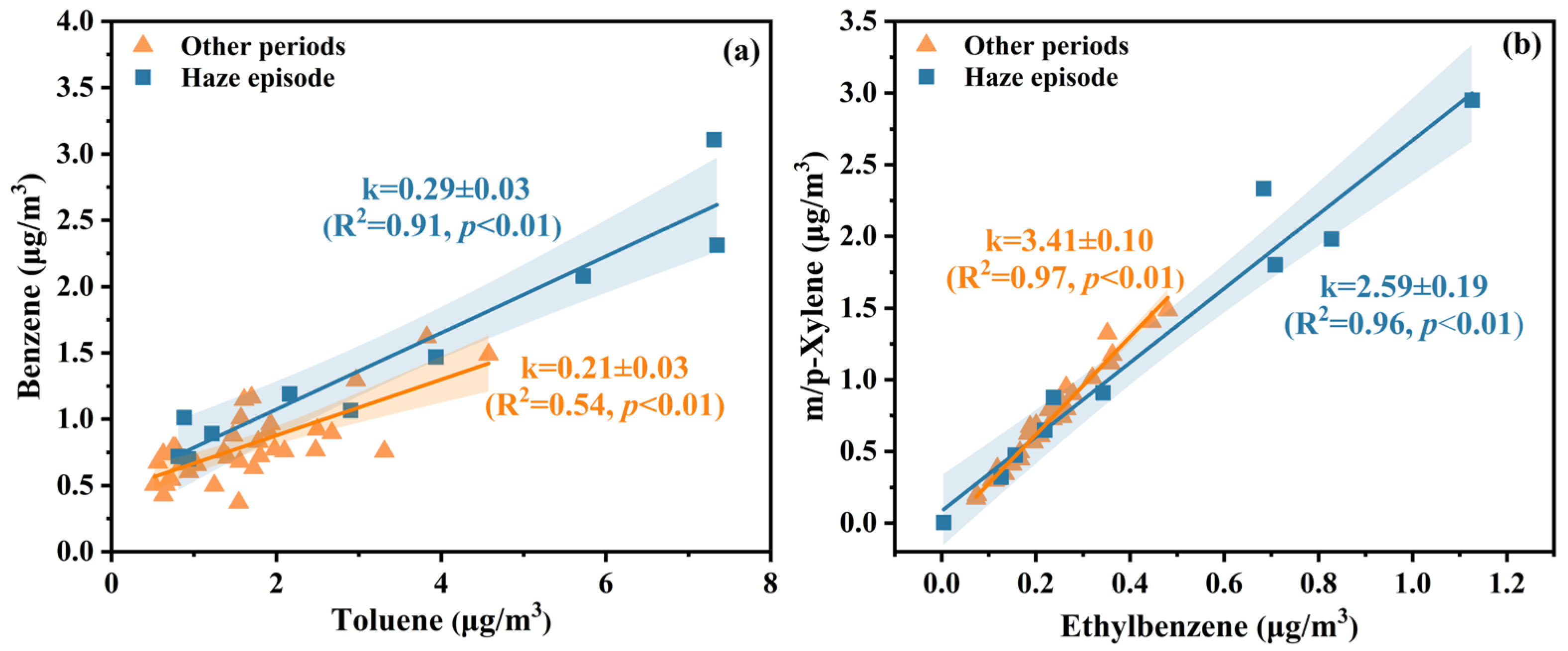
3.3.1. Species-Specific Diagnostic Ratios
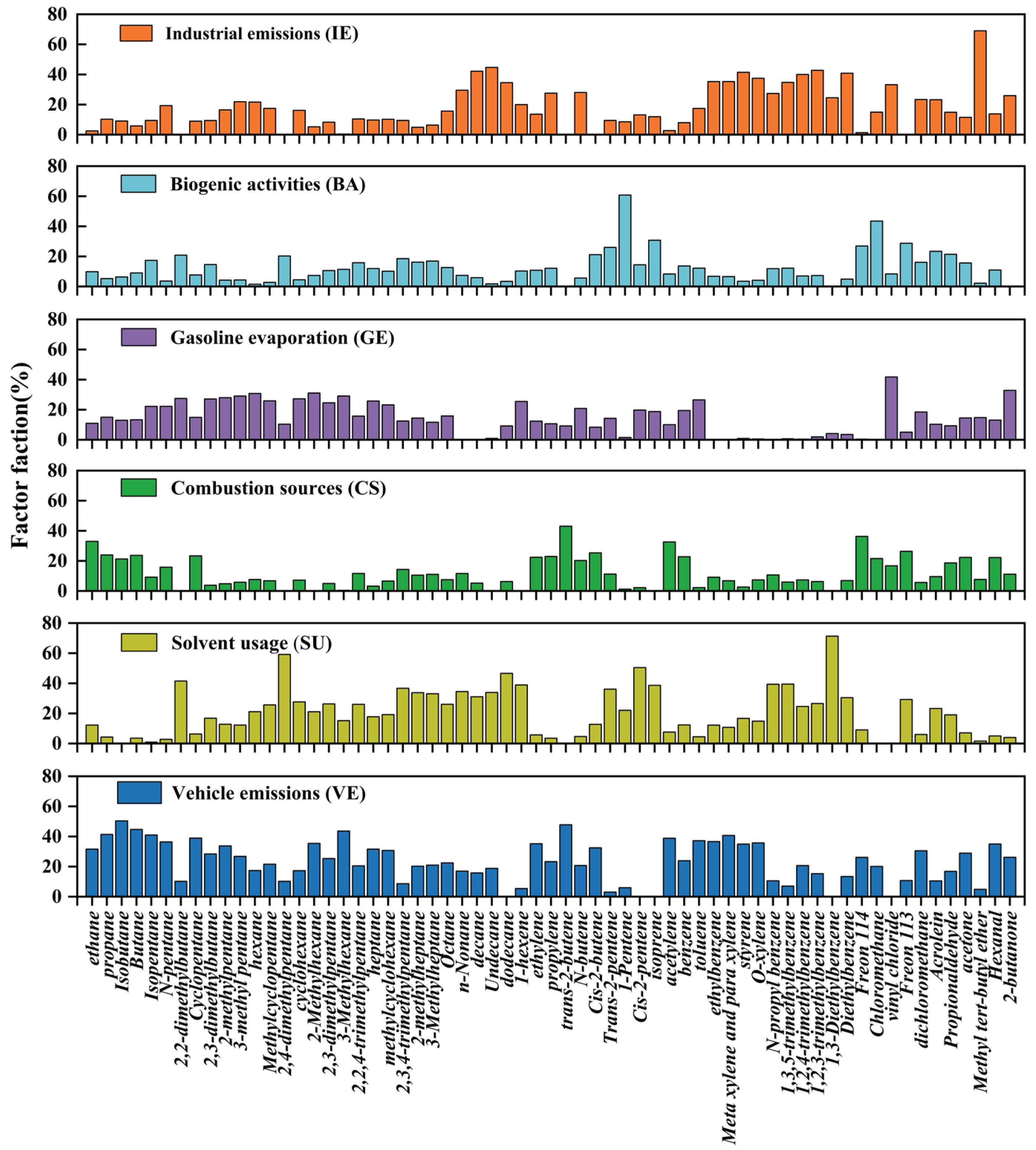
3.3.2. Sources Identified Using PMF
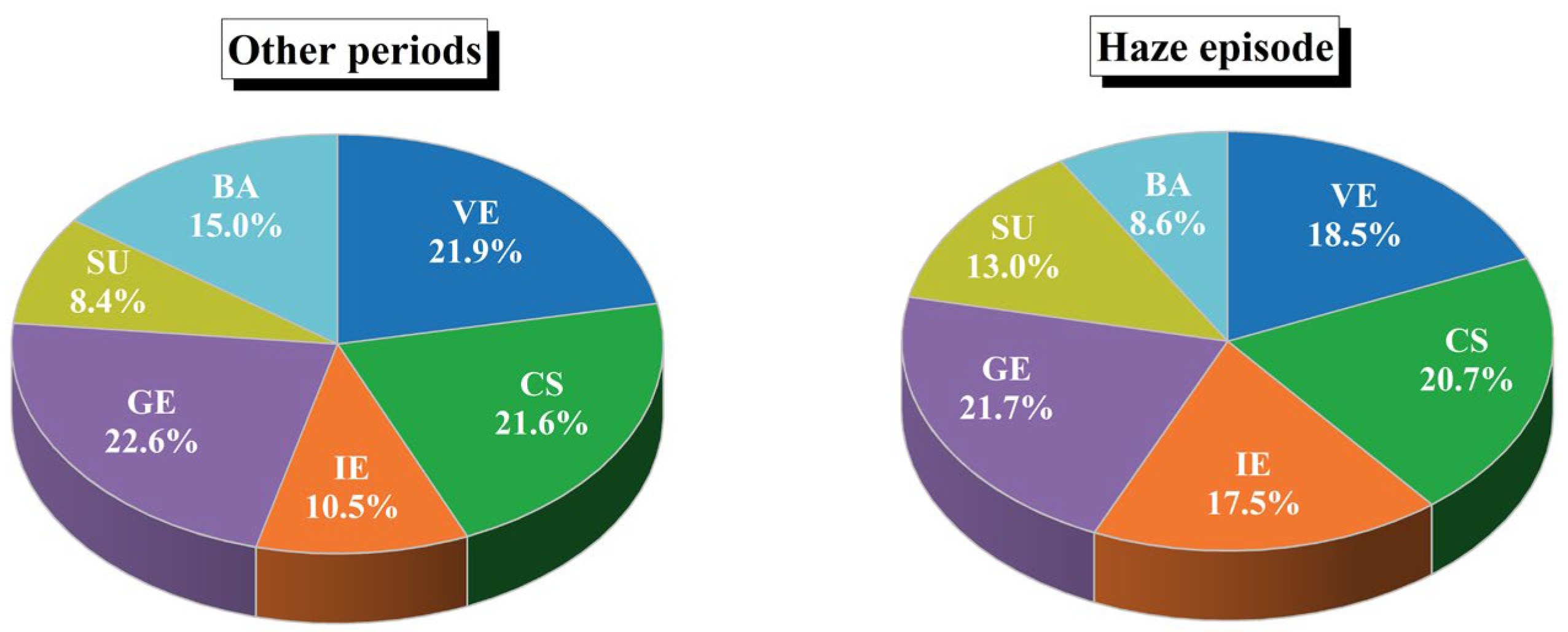
3.3.3. Source Contributions to Haze and Other Periods
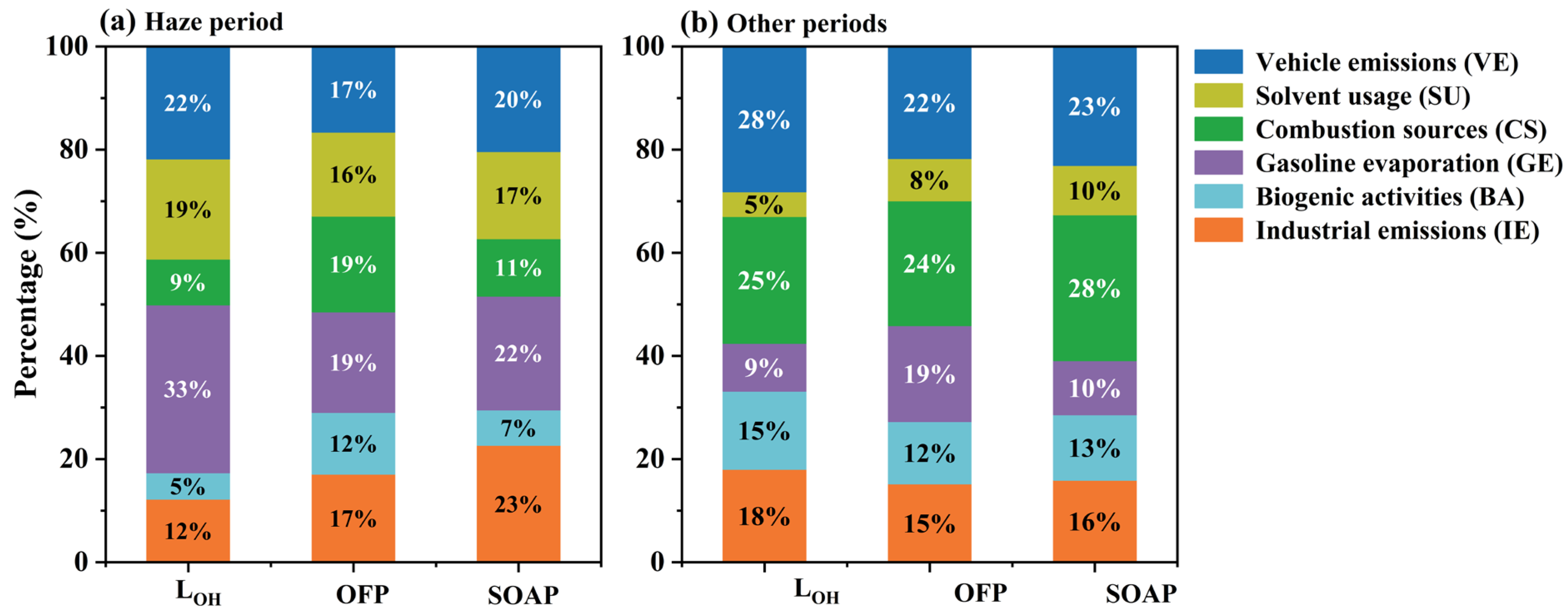
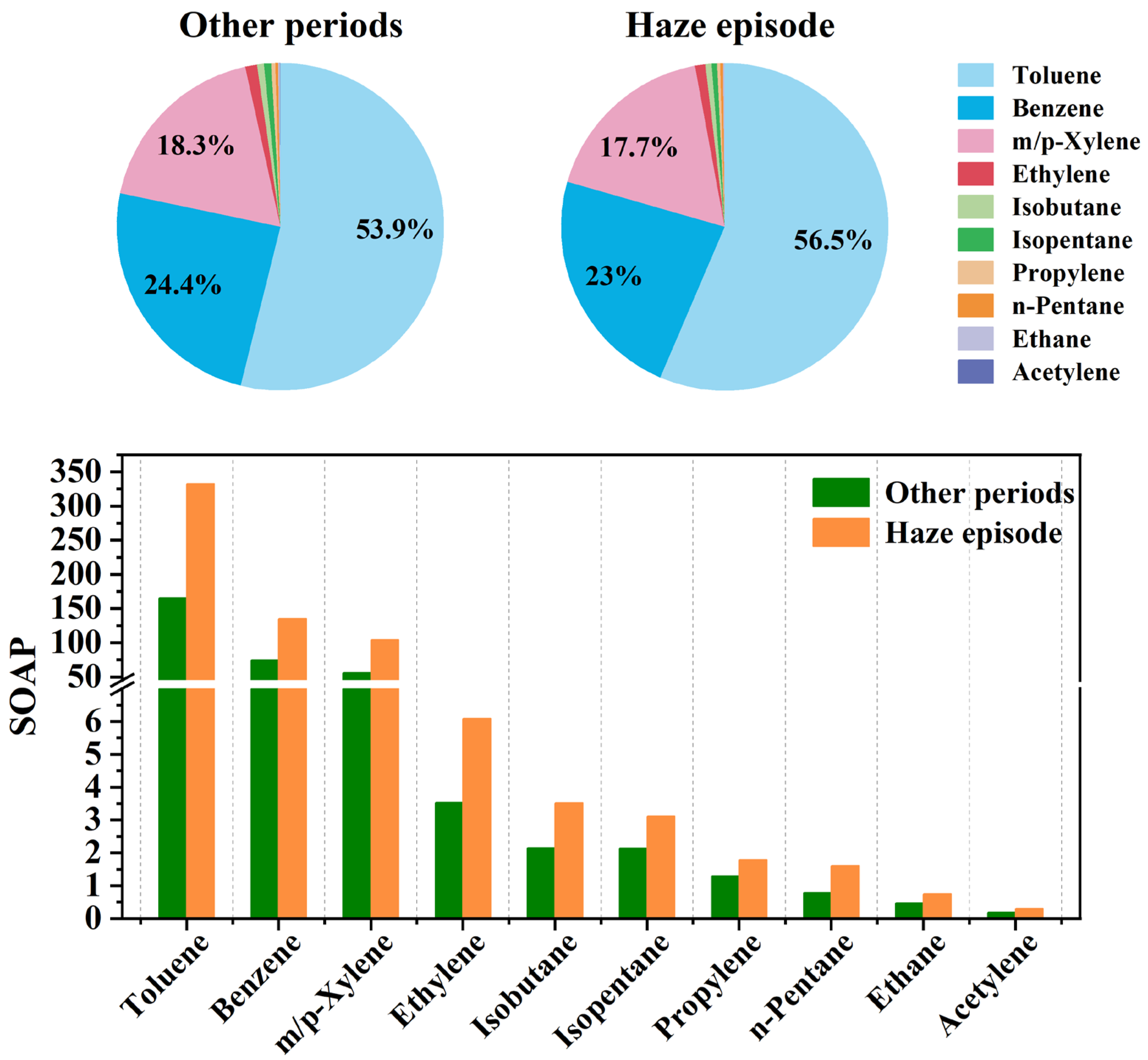
3.4. Comparison of Source-Based VOCs Reactivity Between Haze and Other Periods
4. Conclusions
Supplementary Materials
Author Contributions
Funding
Institutional Review Board Statement
Informed Consent Statement
Data Availability Statement
Conflicts of Interest
References
- Cao, J.; Situ, S.; Hao, Y.; Xie, S.; Li, L. Enhanced summertime ozone and SOA from biogenic volatile organic compound (BVOC) emissions due to vegetation biomass variability during 1981-2018 in China. Atmos. Chem. Phys. 2022, 22, 2351–2364. [Google Scholar] [CrossRef]
- Zhou, X.; Li, Z.Q.; Wang, F.T.; Zhao, Z.Z.; Kang, S.C.; Yang, J.H.; Chang, Y.H.; Xia, D.S.; Li, K.M.; Zhang, X.; et al. Characterization and source analysis of VOCs and PM2.5 species in Lanzhou, northwestern China in 2017-2021: Implications for pollution control strategies. Environ. Pollut. 2025, 384, 126964. [Google Scholar] [CrossRef] [PubMed]
- Wang, Y.; Cheng, H.M.; Kang, T.F.; Wei, W.; Liu, X.L. Spatially resolved analysis of speciated VOC emissions and their contributions to secondary pollutant formation: A comparative assessment of anthropogenic and biogenic sources in China. Environ. Int. 2025, 202, 109627. [Google Scholar] [CrossRef]
- Zhang, T.; Li, G.; Yu, Y.; Ji, Y.; An, T. Atmospheric diffusion profiles and health risks of typical VOC: Numerical modelling study. J. Clean. Prod. 2020, 275, 122982. [Google Scholar] [CrossRef]
- Wu, D.; Wu, H.; Lyu, Y.; Zhang, H.; Wang, J.; Li, X.; Pang, X. The interplay of Brown carbon (BrC) surrogates and copper: Implications for the oxidative potential of ambient particles. J. Hazard. Mater. 2024, 480, 136276. [Google Scholar] [CrossRef]
- Lyu, Y.; Wu, H.; Pang, X.; Wang, J.; Zhao, M.; Chen, J.; Qin, K. The complexation of atmospheric Brown carbon surrogates on the generation of hydroxyl radical from transition metals in simulated lung fluid. Environ. Int. 2023, 180, 108240. [Google Scholar] [CrossRef] [PubMed]
- Hallquist, M.; Munthe, J.; Hu, M.; Wang, T.; Chan, C.K.; Gao, J.; Boman, J.; Guo, S.; Hallquist, Å.M.; Mellqvist, J.; et al. Photochemical smog in China: Scientific challenges and implications for air-quality policies. Natl. Sci. Rev. 2016, 3, 401–403. [Google Scholar] [CrossRef]
- Liu, B.; Ji, J.; Zhang, B.; Huang, W.; Gan, Y.; Leung, D.Y.C.; Huang, H. Catalytic ozonation of VOCs at low temperature: A comprehensive review. J. Hazard. Mater. 2022, 422, 126847. [Google Scholar] [CrossRef]
- Lyu, Y.; Xu, H.; Wu, H.; Han, F.; Lv, F.; Kang, A.; Pang, X. Spatiotemporal variations of PM2.5 and ozone in urban agglomerations of China and meteorological drivers for ozone using explainable machine learning. Environ. Pollut. 2025, 365, 125380. [Google Scholar] [CrossRef]
- Liu, C.; Ma, Z.; Mu, Y.; Liu, J.; Zhang, C.; Zhang, Y.; Liu, P.; Zhang, H. The levels, variation characteristics, and sources of atmospheric non-methane hydrocarbon compounds during wintertime in Beijing, China. Atmos. Chem. Phys. 2017, 17, 10633–10649. [Google Scholar] [CrossRef]
- Lyu, Y.; Wu, H.; Liu, X.; Han, F.; Lv, F.; Pang, X.; Chen, J. Co-Occurring Extremes of Fine Particulate Matter (PM2.5) and Ground-Level Ozone in the Summer of Southern China. Geophys. Res. Lett. 2024, 51, e2023GL106527. [Google Scholar] [CrossRef]
- Zhao, N.; Zhang, H.Y.; Wang, G. Revealing the nonlinear responses of PM2.5 and O3 to VOC and NOx emissions from various sources in Shandong, China. J. Hazard. Mater. 2025, 489, 137655. [Google Scholar] [CrossRef]
- Huang, W.C.; Yu, X.F.; Deng, H.; Chen, B.N.; Cheng, P.; Yang, W.D.; Li, M.; Yuan, B.; Wang, M.; Gong, Y.C. Strong Seasonal Transition and Complex Sources of Volatile Organic Compounds at an Urban Site in Guangzhou, China. J. Geophys. Res.-Atmos. 2024, 129, e2024JD040890. [Google Scholar] [CrossRef]
- Tan, Y.; Han, S.; Chen, Y.; Zhang, Z.; Li, H.; Li, W.; Yuan, Q.; Li, X.; Wang, T.; Lee, S.-c. Characteristics and source apportionment of volatile organic compounds (VOCs) at a coastal site in Hong Kong. Sci. Total Environ. 2021, 777, 146241. [Google Scholar] [CrossRef]
- Zhang, Y.; Wang, X.; Zhang, Z.; Lu, S.; Shao, M.; Lee, F.S.C.; Yu, J. Species profiles and normalized reactivity of volatile organic compounds from gasoline evaporation in China. Atmos. Environ. 2013, 79, 110–118. [Google Scholar] [CrossRef]
- Zhao, Y.; Sun, H.; Kim, Y.; Shu, Y.; Wang, H.; Li, H.; Deng, Y. A comprehensive provincial-level VOCs emission inventory and scenario analysis for China: Enhanced sectoral resolution through GAINS-China model. Atmos. Environ. X 2025, 25, 100316. [Google Scholar] [CrossRef]
- Zheng, J.; Shao, M.; Che, W.; Zhang, L.; Zhong, L.; Zhang, Y.; Streets, D. Speciated VOC Emission Inventory and Spatial Patterns of Ozone Formation Potential in the Pearl River Delta, China. Environ. Sci. Technol. 2009, 43, 8580–8586. [Google Scholar] [CrossRef] [PubMed]
- Wang, D.; Du, J.; Yang, L.; Zhao, J.; Zhang, X.; Zhang, Z.; Zhao, W.; Zhang, W.; Zhang, Y.; Ma, J.; et al. Identifying omitted high reactive VOCs emission sources in China based on new speciated emission inventory. J. Clean. Prod. 2025, 524, 146471. [Google Scholar] [CrossRef]
- Lu, X.; Zhang, D.; Wang, L.; Wang, S.; Zhang, X.; Liu, Y.; Chen, K.; Song, X.; Yin, S.; Zhang, R.; et al. Establishment and verification of anthropogenic speciated VOCs emission inventory of Central China. J. Environ. Sci. 2025, 149, 406–418. [Google Scholar] [CrossRef]
- Yan, Y.; Peng, L.; Li, R.; Li, Y.; Li, L.; Bai, H. Concentration, ozone formation potential and source analysis of volatile organic compounds (VOCs) in a thermal power station centralized area: A study in Shuozhou, China. Environ. Pollut. 2017, 223, 295–304. [Google Scholar] [CrossRef]
- Wang, H.L.; Gao, Y.Q.; Jing, S.A.; Lou, S.R.; Hu, Q.Y.; An, J.Y.; Wu, Y.H.; Gao, W.; Zhu, L.; Huang, C. Characterization of Volatile Organic Compounds (VOCs) Using Mobile Monitoring Around the Industrial Parks in the Yangzte River Delta Region of China. Huan Jing Ke Xue 2021, 42, 1298–1305. [Google Scholar] [CrossRef]
- Lu, Y.; Pang, X.; Lyu, Y.; Li, J.; Xing, B.; Chen, J.; Mao, Y.; Shang, Q.; Wu, H. Characteristics and sources analysis of ambient volatile organic compounds in a typical industrial park: Implications for ozone formation in 2022 Asian Games. Sci. Total Environ. 2022, 848, 157746. [Google Scholar] [CrossRef]
- Lv, Y.; Li, X.; Xu, T.T.; Cheng, T.T.; Yang, X.; Chen, J.M.; Iinuma, Y.; Herrmann, H. Size distributions of polycyclic aromatic hydrocarbons in urban atmosphere: Sorption mechanism and source contributions to respiratory deposition. Atmos. Chem. Phys. 2016, 16, 2971. [Google Scholar]
- Liu, C.; Xin, Y.; Zhang, C.; Liu, J.; Liu, P.; He, X.; Mu, Y. Ambient volatile organic compounds in urban and industrial regions in Beijing: Characteristics, source apportionment, secondary transformation and health risk assessment. Sci. Total Environ. 2023, 855, 158873. [Google Scholar] [CrossRef] [PubMed]
- Qin, J.; Wang, X.; Yang, Y.; Qin, Y.; Shi, S.; Xu, P.; Chen, R.; Zhou, X.; Tan, J.; Wang, X. Source apportionment of VOCs in a typical medium-sized city in North China Plain and implications on control policy. J. Environ. Sci. 2021, 107, 26–37. [Google Scholar] [CrossRef] [PubMed]
- Zheng, H.; Kong, S.; Chen, N.; Niu, Z.; Zhang, Y.; Jiang, S.; Yan, Y.; Qi, S. Source apportionment of volatile organic compounds: Implications to reactivity, ozone formation, and secondary organic aerosol potential. Atmos. Res. 2021, 249, 105344. [Google Scholar] [CrossRef]
- Meng, Y.; Song, J.; Zeng, L.; Zhang, Y.; Zhao, Y.; Liu, X.; Guo, H.; Zhong, L.; Ou, Y.; Zhou, Y.; et al. Ambient volatile organic compounds at a receptor site in the Pearl River Delta region: Variations, source apportionment and effects on ozone formation. J. Environ. Sci. 2022, 111, 104–117. [Google Scholar] [CrossRef]
- Liu, Y.; Kong, L.; Liu, X.; Zhang, Y.; Li, C.; Zhang, Y.; Zhang, C.; Qu, Y.; An, J.; Ma, D.; et al. Characteristics, secondary transformation, and health risk assessment of ambient volatile organic compounds (VOCs) in urban Beijing, China. Atmos. Pollut. Res. 2021, 12, 33–46. [Google Scholar] [CrossRef]
- Li, Y.; Liu, Y.; Hou, M.; Huang, H.; Fan, L.; Ye, D. Characteristics and sources of volatile organic compounds (VOCs) in Xinxiang, China, during the 2021 summer ozone pollution control. Sci. Total Environ. 2022, 842, 156746. [Google Scholar] [CrossRef]
- Abeleira, A.; Pollack, I.B.; Sive, B.; Zhou, Y.; Fischer, E.V.; Farmer, D.K. Source characterization of volatile organic compounds in the Colorado Northern Front Range Metropolitan Area during spring and summer 2015. J. Geophys. Res. Atmos. 2017, 122, 3595–3613. [Google Scholar] [CrossRef]
- Mo, Z.; Shao, M.; Lu, S.; Niu, H.; Zhou, M.; Sun, J. Characterization of non-methane hydrocarbons and their sources in an industrialized coastal city, Yangtze River Delta, China. Sci. Total Environ. 2017, 593, 641–653. [Google Scholar] [CrossRef]
- Lyu, Y.; Gao, Y.; Pang, X.; Sun, S.; Luo, P.; Cai, D.; Qin, K.; Wu, Z.; Wang, B. Elucidating contributions of volatile organic compounds to ozone formation using random forest during COVID-19 pandemic: A case study in China. Environ. Pollut. 2024, 346, 123532. [Google Scholar] [CrossRef]
- Wang, S.G.; Zhao, Y.; Han, Y.; Li, R.; Fu, H.; Gao, S.; Duan, Y.; Zhang, L.; Chen, J.J.A.E. Spatiotemporal variation, source and secondary transformation potential of volatile organic compounds (VOCs) during the winter days in Shanghai, China. Atmos. Environ. 2022, 286, 119203. [Google Scholar]
- Hui, L.; Liu, X.; Tan, Q.; Feng, M.; An, J.; Qu, Y.; Zhang, Y.; Jiang, M. Characteristics, source apportionment and contribution of VOCs to ozone formation in Wuhan, Central China. Atmos. Environ. 2018, 192, 55–71. [Google Scholar] [CrossRef]
- Gu, S.; Guenther, A.; Faiola, C. Effects of Anthropogenic and Biogenic Volatile Organic Compounds on Los Angeles Air Quality. Environ. Sci. Technol. 2021, 55, 12191–12201. [Google Scholar] [CrossRef]
- Atkinson, R.; Arey, J. Atmospheric Degradation of Volatile Organic Compounds. Chem. Rev. 2003, 103, 4605–4638. [Google Scholar] [CrossRef]
- Wang, T.; Xue, L.; Brimblecombe, P.; Lam, Y.F.; Li, L.; Zhang, L. Ozone pollution in China: A review of concentrations, meteorological influences, chemical precursors, and effects. Sci. Total Environ. 2017, 575, 1582–1596. [Google Scholar] [CrossRef] [PubMed]
- Huang, R.-J.; Zhang, Y.; Bozzetti, C.; Ho, K.-F.; Cao, J.-J.; Han, Y.; Daellenbach, K.R.; Slowik, J.G.; Platt, S.M.; Canonaco, F.; et al. High secondary aerosol contribution to particulate pollution during haze events in China. Nature 2014, 514, 218–222. [Google Scholar] [CrossRef] [PubMed]
- Zhang, L.; Wang, X.; Li, H.; Cheng, N.; Zhang, Y.; Zhang, K.; Li, L. Variations in Levels and Sources of Atmospheric VOCs during the Continuous Haze and Non-Haze Episodes in the Urban Area of Beijing: A Case Study in Spring of 2019. Atmosphere 2021, 12, 171. [Google Scholar] [CrossRef]
- Shao, P.; An, J.; Xin, J.; Wu, F.; Wang, J.; Ji, D.; Wang, Y. Source apportionment of VOCs and the contribution to photochemical ozone formation during summer in the typical industrial area in the Yangtze River Delta, China. Atmos. Res. 2016, 176–177, 64–74. [Google Scholar] [CrossRef]
- Joshi, D.; Adhikari, N. An Overview on Common Organic Solvents and Their Toxicity. J. Pharm. Res. Int. 2019, 28, 1–18. [Google Scholar] [CrossRef]
- Harrison, J.J. New and improved infrared absorption cross sections for trichlorofluoromethane (CFC-11). Atmos. Meas. Tech. 2018, 11, 5827–5836. [Google Scholar] [CrossRef]
- Yu, S.; Xue, C.; Deng, F.; Xu, Q.; Zhao, B. VOCs Concentration, SOA Formation Contribution and Festival Effects during Heavy Haze Event: A Case Study in Zhengzhou, Central China. Atmosphere 2024, 15, 1009. [Google Scholar] [CrossRef]
- Wang, S.; Shao, P.; Yang, X.; Wu, J.; Zhang, S.; Zeng, S.; Fan, J.; Ni, C.; Wang, S. Impact of photochemistry on wintertime haze in the Southern Sichuan Basin, China. Atmos. Pollut. Res. 2024, 15, 102300. [Google Scholar] [CrossRef]
- Rossabi, S.; Helmig, D. Changes in Atmospheric Butanes and Pentanes and Their Isomeric Ratios in the Continental United States. J. Geophys. Res. Atmos. 2018, 123, 3772–3790. [Google Scholar] [CrossRef]
- Brocco, D.; Fratarcangeli, R.; Lepore, L.; Petricca, M.; Ventrone, I. Determination of aromatic hydrocarbons in urban air of Rome. Atmos. Environ. 1997, 31, 557–566. [Google Scholar] [CrossRef]
- So, K.L.; Wang, T. C3–C12 non-methane hydrocarbons in subtropical Hong Kong: Spatial–temporal variations, source–receptor relationships and photochemical reactivity. Sci. Total Environ. 2004, 328, 161–174. [Google Scholar] [CrossRef] [PubMed]
- Kuntasal, Ö.O.; Kılavuz, S.A.; Karman, D.; Wang, D.; Tuncel, G. C5–C12 volatile organic compounds at roadside, residential, and background locations in Ankara, Turkey: Temporal and spatial variations and sources. J. Air Waste Manag. Assoc. 2013, 63, 1148–1162. [Google Scholar] [CrossRef] [PubMed]
- Yurdakul, S.; Civan, M.; Kuntasal, Ö.; Doğan, G.; Pekey, H.; Tuncel, G. Temporal variations of VOC concentrations in Bursa atmosphere. Atmos. Pollut. Res. 2018, 9, 189–206. [Google Scholar] [CrossRef]
- Paglione, M.; Kiendler-Scharr, A.; Mensah, A.A.; Finessi, E.; Giulianelli, L.; Sandrini, S.; Facchini, M.C.; Fuzzi, S.; Schlag, P.; Piazzalunga, A.; et al. Identification of humic-like substances (HULIS) in oxygenated organic aerosols using NMR and AMS factor analyses and liquid chromatographic techniques. Atmos. Chem. Phys. 2014, 14, 25–45. [Google Scholar] [CrossRef]
- Song, M.; Tan, Q.; Feng, M.; Qu, Y.; Liu, X.; An, J.; Zhang, Y. Source Apportionment and Secondary Transformation of Atmospheric Nonmethane Hydrocarbons in Chengdu, Southwest China. J. Geophys. Res. Atmos. 2018, 123, 9741–9763. [Google Scholar] [CrossRef]
- Zhu, B.; Zhong, X.; Cai, W.; Shi, C.; Shao, X.; Chen, Z.; Yang, J.; Chen, Y.; Ni, E.; Guo, S.; et al. Characterization of VOC source profiles, chemical reactivity, and cancer risk associated with petrochemical industry processes in Southeast China. Atmos. Environ. X 2024, 21, 100236. [Google Scholar] [CrossRef]
- Wang, S.; Zhang, J.; Zhang, Y.; Wang, L.; Sun, Z.; Wang, H. Review on Source Profiles of Volatile Organic Compounds (VOCs) in Typical Industries in China. Atmosphere 2023, 14, 878. [Google Scholar] [CrossRef]
- Cai, C.; Geng, F.; Tie, X.; Yu, Q.; An, J. Characteristics and source apportionment of VOCs measured in Shanghai, China. Atmos. Environ. 2010, 44, 5005–5014. [Google Scholar] [CrossRef]
- Lobert, J.M.; Scharffe, D.H.; Hao, W.-M.; Kuhlbusch, T.A.; Seuwen, R.; Warneck, P.; Crutzen, P.J. Experimental Evaluation of Biomass Burning Emissions: Nitrogen and Carbon Containing Compounds. In Global Biomass Burning: Atmospheric, Climatic, and Biospheric Implications; Levine, J.S., Ed.; The MIT Press: Cambridge, MA, USA, 1991. [Google Scholar]
- Ling, Z.H.; Guo, H.; Cheng, H.R.; Yu, Y.F. Sources of ambient volatile organic compounds and their contributions to photochemical ozone formation at a site in the Pearl River Delta, southern China. Environ. Pollut. 2011, 159, 2310–2319. [Google Scholar] [CrossRef]
- Liu, Y.; Shao, M.; Fu, L.; Lu, S.; Zeng, L.; Tang, D. Source profiles of volatile organic compounds (VOCs) measured in China: Part I. Atmos. Environ. 2008, 42, 6247–6260. [Google Scholar] [CrossRef]
- Wu, F.; Yu, Y.; Sun, J.; Zhang, J.; Wang, J.; Tang, G.; Wang, Y. Characteristics, source apportionment and reactivity of ambient volatile organic compounds at Dinghu Mountain in Guangdong Province, China. Sci. Total Environ. 2016, 548–549, 347–359. [Google Scholar] [CrossRef] [PubMed]
- Barletta, B.; Meinardi, S.; Sherwood Rowland, F.; Chan, C.-Y.; Wang, X.; Zou, S.; Yin Chan, L.; Blake, D.R. Volatile organic compounds in 43 Chinese cities. Atmos. Environ. 2005, 39, 5979–5990. [Google Scholar] [CrossRef]
- Chan, L.-Y.; Chu, K.-W.; Zou, S.-C.; Chan, C.-Y.; Wang, X.-M.; Barletta, B.; Blake, D.R.; Guo, H.; Tsai, W.-Y. Characteristics of nonmethane hydrocarbons (NMHCs) in industrial, industrial-urban, and industrial-suburban atmospheres of the Pearl River Delta (PRD) region of south China. J. Geophys. Res. Atmos. 2006, 111, D11304. [Google Scholar] [CrossRef]
- Liu, B.; Liang, D.; Yang, J.; Dai, Q.; Bi, X.; Feng, Y.; Yuan, J.; Xiao, Z.; Zhang, Y.; Xu, H. Characterization and source apportionment of volatile organic compounds based on 1-year of observational data in Tianjin, China. Environ. Pollut. 2016, 218, 757–769. [Google Scholar] [CrossRef]
- Ou, J.; Guo, H.; Zheng, J.; Cheung, K.; Louie, P.K.K.; Ling, Z.; Wang, D. Concentrations and sources of non-methane hydrocarbons (NMHCs) from 2005 to 2013 in Hong Kong: A multi-year real-time data analysis. Atmos. Environ. 2015, 103, 196–206. [Google Scholar] [CrossRef]
- Shen, L.; Xiang, P.; Liang, S.; Chen, W.; Wang, M.; Lu, S.; Wang, Z. Sources Profiles of Volatile Organic Compounds (VOCs) Measured in a Typical Industrial Process in Wuhan, Central China. Atmosphere 2018, 9, 297. [Google Scholar] [CrossRef]
- Dumanoglu, Y.; Kara, M.; Altiok, H.; Odabasi, M.; Elbir, T.; Bayram, A. Spatial and seasonal variation and source apportionment of volatile organic compounds (VOCs) in a heavily industrialized region. Atmos. Environ. 2014, 98, 168–178. [Google Scholar] [CrossRef]
- Huang, X.-F.; Zhang, B.; Xia, S.-Y.; Han, Y.; Wang, C.; Yu, G.-H.; Feng, N. Sources of oxygenated volatile organic compounds (OVOCs) in urban atmospheres in North and South China. Environ. Pollut. 2020, 261, 114152. [Google Scholar] [CrossRef] [PubMed]
- McDonald, B.C.; de Gouw, J.A.; Gilman, J.B.; Jathar, S.H.; Akherati, A.; Cappa, C.D.; Jimenez, J.L.; Lee-Taylor, J.; Hayes, P.L.; McKeen, S.A.; et al. Volatile chemical products emerging as largest petrochemical source of urban organic emissions. Science 2018, 359, 760–764. [Google Scholar] [CrossRef]
- Manavi, S.E.I.; Pandis, S.N. Contribution of intermediate-volatility organic compounds from on-road transport to secondary organic aerosol levels in Europe. Atmos. Chem. Phys. 2024, 24, 891–909. [Google Scholar] [CrossRef]
- Borbon, A.; Gilman, J.B.; Kuster, W.C.; Grand, N.; Chevaillier, S.; Colomb, A.; Dolgorouky, C.; Gros, V.; Lopez, M.; Sarda-Esteve, R.; et al. Emission ratios of anthropogenic volatile organic compounds in northern mid-latitude megacities: Observations versus emission inventories in Los Angeles and Paris. J. Geophys. Res. Atmos. 2013, 118, 2041–2057. [Google Scholar] [CrossRef]
- Bari, M.A.; Kindzierski, W.B. Ambient volatile organic compounds (VOCs) in Calgary, Alberta: Sources and screening health risk assessment. Sci. Total Environ. 2018, 631–632, 627–640. [Google Scholar] [CrossRef]
- Na, K.; Kim, Y.P.; Moon, K.C. Diurnal characteristics of volatile organic compounds in the Seoul atmosphere. Atmos. Environ. 2003, 37, 733–742. [Google Scholar] [CrossRef]
- Wu, R.; Xie, S. Spatial Distribution of Ozone Formation in China Derived from Emissions of Speciated Volatile Organic Compounds. Environ. Sci. Technol. 2017, 51, 2574–2583. [Google Scholar] [CrossRef]



Disclaimer/Publisher’s Note: The statements, opinions and data contained in all publications are solely those of the individual author(s) and contributor(s) and not of MDPI and/or the editor(s). MDPI and/or the editor(s) disclaim responsibility for any injury to people or property resulting from any ideas, methods, instructions or products referred to in the content. |
© 2025 by the authors. Licensee MDPI, Basel, Switzerland. This article is an open access article distributed under the terms and conditions of the Creative Commons Attribution (CC BY) license (https://creativecommons.org/licenses/by/4.0/).
Share and Cite
Shi, D.; Lyu, Y.; Song, J.; Ren, Q.; Chen, X.; Hu, L.; Zhuge, W.; Hu, K.; Cai, D.; Gong, X.; et al. Characterization of VOCs at Shaoxing in the Winter Campaign: Sources and Chemical Reactivity. Atmosphere 2025, 16, 1404. https://doi.org/10.3390/atmos16121404
Shi D, Lyu Y, Song J, Ren Q, Chen X, Hu L, Zhuge W, Hu K, Cai D, Gong X, et al. Characterization of VOCs at Shaoxing in the Winter Campaign: Sources and Chemical Reactivity. Atmosphere. 2025; 16(12):1404. https://doi.org/10.3390/atmos16121404
Chicago/Turabian StyleShi, Dongfeng, Yan Lyu, Junpeng Song, Qing Ren, Xing Chen, Liyong Hu, Wenting Zhuge, Kewen Hu, Dongmei Cai, Xianda Gong, and et al. 2025. "Characterization of VOCs at Shaoxing in the Winter Campaign: Sources and Chemical Reactivity" Atmosphere 16, no. 12: 1404. https://doi.org/10.3390/atmos16121404
APA StyleShi, D., Lyu, Y., Song, J., Ren, Q., Chen, X., Hu, L., Zhuge, W., Hu, K., Cai, D., Gong, X., & Chen, J. (2025). Characterization of VOCs at Shaoxing in the Winter Campaign: Sources and Chemical Reactivity. Atmosphere, 16(12), 1404. https://doi.org/10.3390/atmos16121404