


Abstract
As many countries transition to electric vehicles (EVs) to reduce tailpipe emissions from internal combustion engine vehicles (ICEVs), both vehicle types continue to generate non-exhaust particulate matter (PM), including tire wear, brake wear, road surface wear, and particularly road dust resuspension. Among these, road dust resuspension is a major contributor to non-exhaust PM. While factors such as vehicle weight and drivetrain configuration have been extensively studied in fleet-level research, direct comparisons between ICEVs and EVs of the same model have not been explored. This study investigates the effects of drivetrain, vehicle weight, and payload on road dust resuspension emissions from ICEV and EV models. Two experimental approaches were employed: (1) acceleration from 0 to 60 km/h, and (2) a simulated real-world driving cycle (RDC). Each test was conducted under both light and heavy payload conditions. The results show that the EV consistently emitted more PM than the ICEV during both acceleration and RDC tests, based on factory-standard vehicle weights. Under identical vehicle weight conditions, the EV demonstrated higher PM resuspension levels, likely due to its higher torque and more immediate power delivery, which increases friction between the tires and the road, particularly during rapid acceleration. Both vehicle types exhibited significant increases in PM emissions under heavy payload conditions. These findings underscore the importance of addressing non-exhaust emissions from EVs, particularly road dust resuspension, and highlight the need for further research into mitigation strategies, such as vehicle lightweighting.
1. Introduction
Air pollution caused by PM has become an increasingly critical public health concern, particularly in urban areas with high vehicular density. PM, defined as solid/liquid/gaseous particles suspended in air, is commonly categorized based on particle diameter into PM10 (≤10 µm) and PM2.5 (≤2.5 µm) [1]. These particles, especially PM2.5, can penetrate deep into the human respiratory tract and are associated with cardiovascular and pulmonary diseases, including asthma, lung cancer, and systemic inflammation [2,3].
Traditionally, ICEV has been recognized as a major contributor to airborne PM through tailpipe exhaust emissions. However, in recent years, the focus has expanded to include non-exhaust emissions, which arise from brake wear, tire wear, road surface abrasion, and road dust resuspension [4,5]. These sources are estimated to account for over 90% of total PM10 and more than 85% of PM2.5 in some urban traffic environments [6,7]. Among these non-exhaust PM emissions, road dust resuspension is considered a notable source in road environments. The literature pointed out that road dust resuspension depends on various physical factors such as vehicle mass and suspension (higher load increases dust lifting), tire–road interaction (the more friction, the more dust turbulence), aerodynamic disturbance beneath the vehicle (types of vehicle, i.e., passenger car or truck affect airflow underneath body, which in turn influences the resuspension of road dust), and road surface conditions (porous or unpaved roads tend to trap more dust). Environmental factors, e.g., weather, humidity, wind, and rainfall in various locations in the world also affect road dust dispersion [8,9,10].
With the global transition toward EVs as a solution to reduce greenhouse gas emissions and tailpipe pollutants, there has been an assumption of improved urban air quality. Nevertheless, several studies have questioned this assumption by highlighting that EVs, due to their typically greater vehicle weight from battery packs, may generate equal or even greater non-exhaust PM emissions compared to ICEVs [7,11,12]. For example, regenerative braking systems in EV, while beneficial in reducing brake dust, do not mitigate emissions from road dust resuspension or tire wear [12,13]. Past studies have shown comparative studies in road dust resuspension between ICEV and EV, but the data were presented in fleet studies among various brands of ICEV and EV sold in that country, but not head-to-head comparison on the same vehicle’s body [14,15,16]. In Refs. [15,16], they emphasize that heavier vehicles resuspend more particles, but results vary significantly depending on size of vehicles, measurement methods, and environmental conditions [17]. The U.S. EPA and European Environment Agency both acknowledge limitations in current modeling of resuspension, often due to inadequate empirical data. Thus, a controlled, model-consistent experimental evaluation of road dust resuspension rates between ICE and EV variants of the same vehicle model is therefore lacking in the literature.
Given the lack of controlled, model-consistent comparisons, the current research focuses on evaluation of road dust resuspension using the same vehicle platform (same make, body, tires, and suspension) with only the powertrain (ICE vs. EV) differing. This approach removes structural variability and allows for a more accurate assessment of how EV-related design features (e.g., additional weight from battery pack, regenerative braking) influence resuspension via acceleration tests. Additionally, by testing both powertrains in RDC, it will clarify whether EV truly reduces total PM in urban settings when non-exhaust sources are considered. Findings from this study are expected to provide empirical data to support or challenge assumptions about EVs being cleaner in terms of road dust resuspension. In addition, it will help government and policymakers develop comprehensive EV regulations, considering non-exhaust pollutants. Lastly, it will contribute to urban air quality models and vehicle life-cycle impact assessments.
2. Materials and Methods
2.1. Materials
Two tested vehicles were selected to perform in this research:
Vehicle A (ICEV) and Vehicle B (EV) are identical in model and body design, differing only in their powertrain systems as illustrated in Figure 1. A comparative summary of their technical specifications is provided in Table 1. Notably, Vehicle B is significantly heavier than Vehicle A by approximately 300 kg, primarily due to the added weight of the battery pack and electric drivetrain components. Despite this weight difference, the EV (Vehicle B) exhibits superior performance characteristics compared to the ICEV (Vehicle A). Both vehicles utilize the same factory-installed suspension system. However, they differ in tire specifications—particularly the aspect ratio—which results in varying ground clearance between the two. For this research, all components remain in their original factory configuration to ensure consistency in comparison.
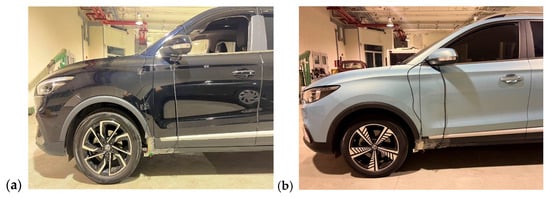
Figure 1.
Test vehicles: Vehicle A: (a) ICEV and Vehicle B: (b) EV with the same model.

Table 1.
Vehicle specifications: Vehicle A (ICEV) vs. Vehicle B (EV).
PM from road dust resuspension is measured by DustTrak DRX 8533 (TSI Incorporated, Shoreview, MN, USA), a real-time laser-based aerosol monitor capable of simultaneously measuring PM1, PM2.5, PM4, PM10, and total mass concentrations from 0.001 to 150 mg/m3 [18]. The system operates with a 3 L/min airflow and records data at 1 s intervals, allowing high-resolution temporal analysis [19]. Photo of DustTrak DRX 8533 and its working principle is shown in Figure 2. The specification of the DustTrak DRX 8533 is shown in Table 2. The unit was placed inside the vehicle and powered by an additional battery pack.
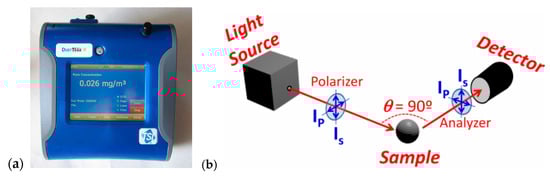
Figure 2.
Photo of DustTrak DRX (a) and schematic of particle detection using 90° light scattering method (b).
Table 2.
The specification of the DustTrak DRX 8533.
The DustTrak DRX sampling probe was positioned at the rear of the curb adjacent to the front left wheel, as illustrated in Figure 3. This location is selected based on TRAKER, a mobile monitoring platform for measuring road dust resuspension found in [20,21].
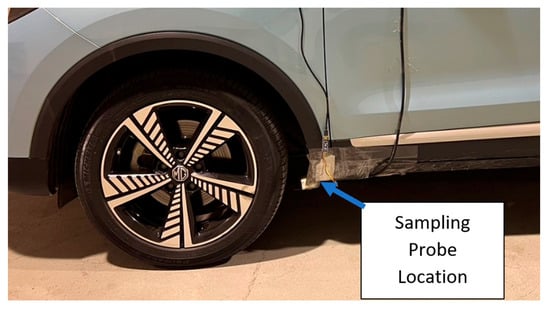
Figure 3.
DustTrak DRX sampling probe placement at the front left wheel for real-time mass concentration monitoring.
2.2. Methods
To evaluate the behavior of PM emissions originating from road dust resuspension, this research employed two primary driving test scenarios: the acceleration Test (0–60 km/h) and the real-world driving cycle (RDC). Both tests were conducted under control and repeatable conditions to minimize external influences and enhance data validity.
The acceleration test was designed to investigate road dust PM emissions during rapid vehicle movements, capturing the evolution of PM during both acceleration and braking phases. The vehicle started from a stationary position (0 km/h), then accelerated at full throttle up to 60 km/h. Upon reaching this target speed, the driver released the accelerator and applied the brakes to bring the vehicle to a complete stop within a predefined safe distance. Figure 4 illustrates the velocity profile of a single 0–60 km/h test cycle, specifically designed to isolate the effects of kinetic forces on dust resuspension from the road surface.
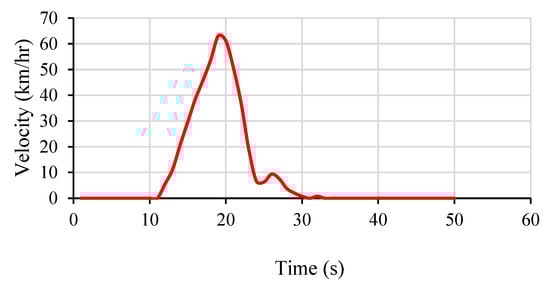
Figure 4.
A single 0–60 km/h test cycle employed in the current study.
The RDC was designed to replicate realistic driving behavior under congested urban traffic conditions. The driving session lasted approximately 2000 s and encompassed the full range of driving dynamics—acceleration, deceleration, cruising, and idling—conducted within a closed test area to eliminate interference from external vehicles and environmental variability [22]. As shown in Figure 5a, the RDC velocity-time profile features multiple transient phases. The route was driven repeatedly in a closed loop, as illustrated in Figure 5b, to ensure consistency and to capture variations in PM emissions throughout the entire driving sequence.
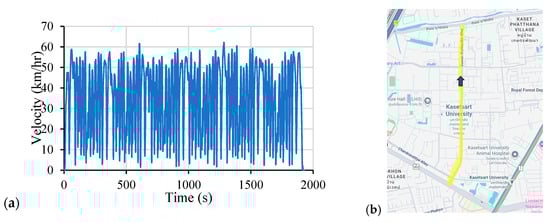
Figure 5.
Example of RDC employed in the current study (a), a looping route for RDC (b).
All tests were conducted during the nighttime to eliminate external sources of PM contamination from nearby vehicles and ensure consistent atmospheric conditions. The road surface was kept dry throughout all trials to avoid interference from moisture, which could affect dust particle behavior. These measures were taken to ensure that PM measurements reflected only the emissions induced by the test vehicles themselves.
Previous studies have shown that vehicle weight significantly influences non-exhaust particulate matter (PM) emissions. Increased payload is associated with elevated PM levels, primarily due to greater frictional forces at the tire–road interface and increased mechanical stress [7,19,22]. To investigate this effect, the current study incorporated variable payloads into the testing protocol to assess the impact of vehicle weight on road dust resuspension. Two payload conditions were defined for comparative analysis.
Light payload: This scenario included only the vehicle and a single driver, serving as the baseline condition representing minimal loading.
Heavy payload: An additional weight of approximately 300 kg was added to simulate a fully occupied passenger car with four adult occupants. This configuration was designed to evaluate PM emissions under more realistic, fully loaded conditions. Furthermore, the 300 kg payload was carefully selected to compensate for the weight difference between Vehicle A and Vehicle B, as shown in Table 1, enabling a fair comparison of powertrain effects between the two vehicles.
3. Results and Discussion
Figure 6 presents an example of PM emissions recorded during the acceleration test of Vehicle A (ICEV) under both light and heavy payload conditions. The results indicate a clear increase in PM emissions with the addition of payload. Under the light payload condition, the PM10 concentration reached up to 1.53 mg/m3, whereas the heavy payload condition resulted in a significantly higher concentration of 3.44 mg/m3, highlighting the notable impact of vehicle weight on road dust resuspension.
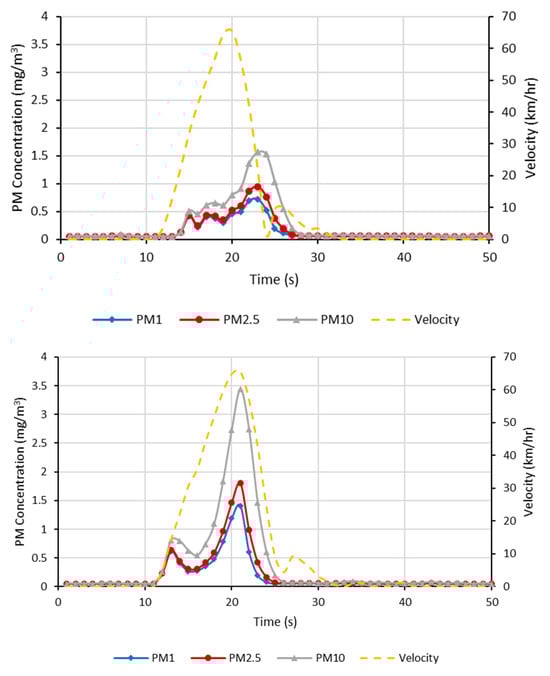
Figure 6.
PM emissions during 0–60 km/h acceleration tests of Vehicle A (ICEV): light payload (top) and heavy payload (bottom).
In the light payload scenario, PM concentrations increased gradually, showing limited dispersion following the acceleration and deceleration phases. In contrast, under heavy payload conditions, PM emissions closely tracked the acceleration and deceleration sequences—an emission pattern consistent with findings in [17]. Additionally, two small but distinct PM peaks observed in the heavy payload further corroborate the results reported in [22,23].
Similarly, Figure 7 presents PM emissions from Vehicle B (EV) under identical test conditions. In the light payload scenario, PM10 concentrations reached up to 4.43 mg/m3, while in the heavy payload scenario, concentrations increased to 8.27 mg/m3. These findings align with the trends observed for Vehicle A, further confirming that increased vehicle payload leads to higher levels of dust resuspension during the acceleration test. Notably, two distinct PM peaks are observed in the EV test cycle, with the first peak showing higher PM emissions compared to the ICEV under similar conditions.
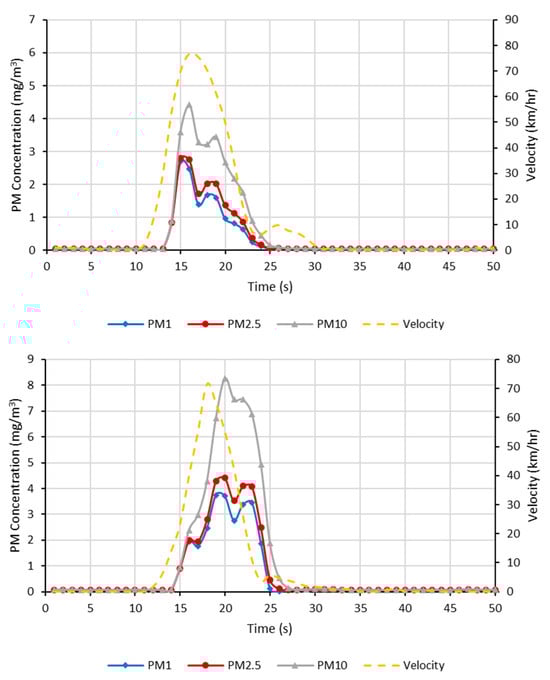
Figure 7.
PM emissions during 0–60 km/h acceleration tests of the Vehicle B (EV): light payload (top) and heavy payload (bottom).
Based on the results presented in Figure 6 and Figure 7, the average area under the PM10 emission curve during the 0–60 km/h acceleration phase was calculated. The outcomes are summarized in Figure 8 for both vehicles. Error bars represent the standard deviation from the average of three test repetitions for each experiment scenario. As PM10 was identified as the dominant component of road dust resuspension, it was used as the primary metric for comparison.
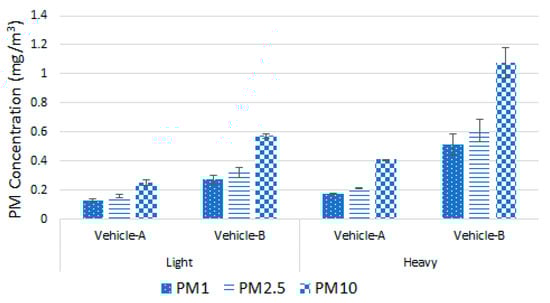
Figure 8.
Comparisons of averaged PM10 concentrations during 0–60 km/hr acceleration test for both Vehicle A (ICEV) and Vehicle B (EV).
When comparing the performance of the ICEV and EV, it is evident that the EV achieves 60 km/h in a shorter acceleration time. Under identical vehicle weight conditions (see Figure 8—2nd column [ICEV] and 3rd column [EV]), the EV exhibits generally higher levels of PM dust resuspension [24]. This is likely due to the higher torque of the EV powertrain, which may contribute to immediate power delivery that leads to more friction between the tires and the road, particularly when accelerating quickly. Additionally, the strong aerodynamic forces generated by the EV could aid in dispersing resuspended dust more rapidly—a hypothesis that warrants further investigation in future studies. The results for both vehicles indicate that PM dust resuspension can be up to twice as high when the vehicle is fully occupied compared to the single-driver scenario.
Figure 9 illustrates PM emissions recorded during the RDC of Vehicle A (ICEV) under both light and heavy payload conditions. The results clearly show that the heavy payload condition resulted in significantly higher PM10 concentrations compared to the light payload scenario, consistent with the trends observed in Figure 6. In some instances, PM levels under the heavy load condition reached as high as 13.7 mg/m3, highlighting the substantial influence of vehicle mass on PM emissions.
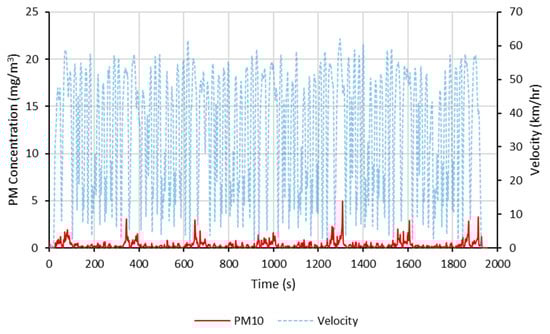
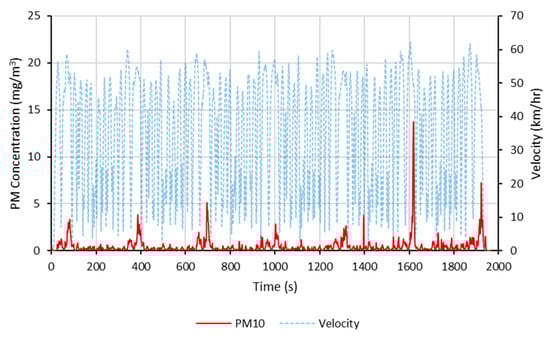
Figure 9.
PM10 emissions from road dust resuspension during RDC of Vehicle A (ICEV): light payload (top) and heavy payload (bottom).
Notably, wave-like patterns in PM concentration were observed in Figure 9. These fluctuations correspond to the repeated cycles of the vehicle traversing different road surface conditions [25]. Elevated PM levels were detected when the vehicle passed over dirtier sections of the road, while cleaner segments resulted in lower PM concentrations. The contrast in surface conditions is shown in Figure 10.
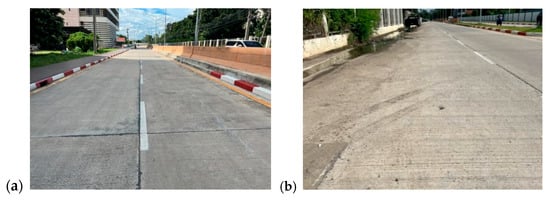
Figure 10.
Road conditions: clean paved road (a) and dirty paved road (b).
Similarly, Figure 11 presents the PM emission profiles for Vehicle B under both payload conditions. Wave-like patterns in PM concentration were still observed as seen in Figure 9. Due to its heavier weight and drivetrain characteristics, Vehicle B exhibited higher PM emissions even under the light payload condition compared to Vehicle A. As shown in Table 1, the higher vehicle weight of Vehicle B contributed to greater road dust disturbance. Maximum PM concentrations under the light payload condition reached approximately 11.96 mg/m3, while the heavy payload tests recorded values as high as 24.2 mg/m3. The average peak emissions for the heavy payload configuration consistently exceeded those observed in the light payload scenario.
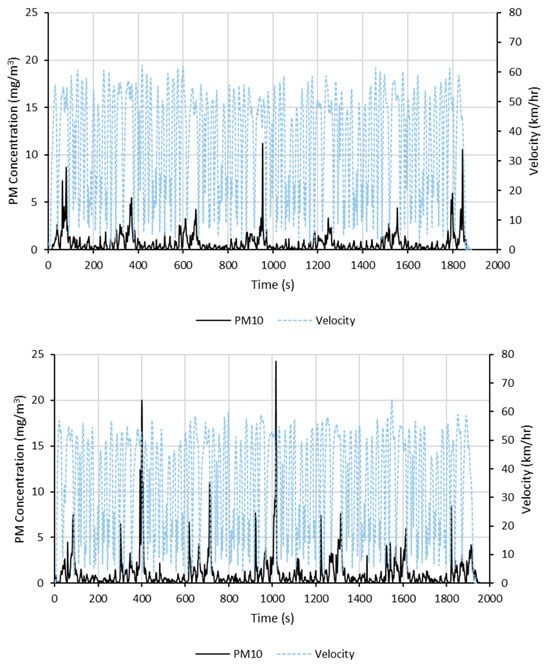
Figure 11.
PM10 emissions from road dust resuspension during RDC of the Vehicle B (EV): light payload (top) and heavy payload (bottom).
Based on the results presented in Figure 9 and Figure 11, the average area under the PM10 emission curve during RDC was calculated. The outcomes are summarized in Figure 12 for both vehicles. Error bars represent the standard deviation from the average of three test repetitions for each experiment scenario. As PM10 was identified as the dominant component of road dust resuspension, it was used as the primary metric for comparison.
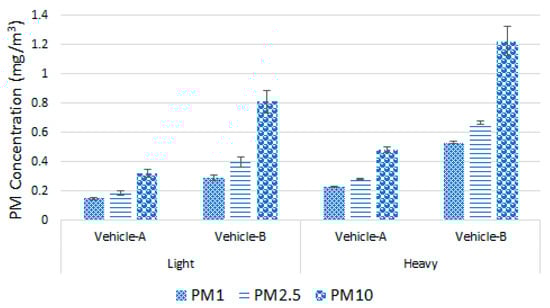
Figure 12.
Comparisons of averaged PM10 concentrations during RDC for both Vehicle A (ICEV) and Vehicle B (EV).
When comparing ICEV and EV during RDC in each payload, the results suggest that ICEV produces lower PM concentrations across all sizes (PM1, PM2.5, PM10) under both payload conditions. The data suggest that although EVs have zero tailpipe emissions in everyday usage, they may still contribute to significantly higher particle pollution, with dust resuspension levels about three times greater than those of ICEVs.
Under identical vehicle weight conditions, the result seen in Figure 12 is similar to Figure 8. The higher torque and instant acceleration of EV could lead to greater tire wear and thus higher emissions of PM, especially in the form of larger PM10 particles. EVs typically have heavier batteries, which could lead to increased friction between the tires and the road, contributing to higher PM. Finally, more aggressive driving style (which may be more frequent in EVs due to their quick torque delivery) might also cause increased tire degradation and higher PM road dust emissions.
Based on the results in the current study, if EVs are shown to contribute more significant road dust resuspension due to higher torque or weight, manufacturers could use this data to adjust vehicle design (e.g., modifying aerodynamics or weight distribution) to mitigate the issue. Car manufacturers may gain insights into the role of various vehicle parameters—such as drivetrain, weight, and aerodynamics—in road dust disturbance, guiding the design of more environmentally friendly vehicles.
4. Conclusions
This study evaluated the influence of drivetrain type, weight, and payload under acceleration tests and RDC. The key findings are as follows:
- During acceleration tests (0–60 km/h), increasing the payload, from a single driver to fully occupied passengers, there was a significant rise in PM road dust emissions, with a twofold increase observed in both ICEV and EV of the same model;
- Under identical vehicle weight conditions, EV demonstrated higher levels of PM dust resuspension than ICEV. This is likely due to the higher torque of the EV powertrain, which results in more immediate power delivery and increased friction between the tires and the road, particularly during rapid acceleration;
- In the RDC tests, the higher torque and weight of the EV contributed to increased tire friction and wear, leading to elevated PM10 emissions, especially under heavy payload conditions. Additionally, road surface cleanliness played a significant role, with dirtier surfaces contributing to higher PM levels. EV produces dust resuspension levels about three times greater than those of ICEV;
- The study confirms that increased vehicle weight directly contributes to elevated PM emissions. As such, exploring vehicle lightweighting strategies is recommended to mitigate non-exhaust PM emissions. Additionally, while EV offers environmental benefits by reducing tailpipe emissions, this study highlights that they may generate more non-exhaust PM than ICEV due to their heavier weight and higher torque. This finding suggests the need for future regulatory measures addressing non-exhaust emissions from EV.
Author Contributions
Conceptualization, E.W.; methodology, E.W.; formal analysis, S.P.-A.-M.; investigation, W.S. and E.W.; resources, C.B.; data curation, S.P.-A.-M.; writing—original draft preparation, W.S. and S.P.-A.-M.; writing—review and editing, W.S. and E.W.; supervision, T.A. All authors have read and agreed to the published version of the manuscript.
Funding
This research was financed through a subsidy from the Thailand Toray Science Foundation. This work was also financially supported by the Faculty of Engineering, Kasetsart University, Bangkok, Thailand, under a Graduate Research Scholarship Contract [No. 66/04/ME/M.ENG].
Data Availability Statement
The data presented in this study are available on request from the corresponding author. The data are not publicly available due to privacy.
Acknowledgments
Special thanks to Mechanical Engineering Department, Faculty of Engineering, Kasetsart University for laboratory supports in this research.
Conflicts of Interest
The authors declare no conflicts of interest. The funders had no role in the design of the study; in the collection, analyses, or interpretation of data; in the writing of the manuscript; or in the decision to publish the results.
Abbreviations
The following abbreviations are used in this manuscript:
| EV | Electric vehicle |
| ICEV | Internal combustion engine vehicle |
| PM | Particulate atter |
| RDC | Real-world driving cycle |
References
- Pant, P.; Harrison, R.M. Estimation of the contribution of road traffic emissions to particulate matter concentrations from field measurements: A review. Atmos. Environ. 2013, 77, 78–97. [Google Scholar] [CrossRef]
- Pope, C.A.; Dockery, D.W. Health effects of fine particulate air pollution: Lines that connect. J. Air Waste Manag. Assoc. 2006, 56, 709–742. [Google Scholar] [CrossRef] [PubMed]
- World Health Organization (WHO). Health Effects of Particulate Matter: Policy Implications for Countries in Eastern Europe, Caucasus and Central Asia; WHO Regional Office for Europe: Copenhagen, Denmark, 2013. [Google Scholar]
- Thorpe, A.; Harrison, R.M. Sources and properties of non-exhaust particulate matter from road traffic: A review. Sci. Total Environ. 2008, 400, 270–282. [Google Scholar] [CrossRef]
- Denier van der Gon, H.A.; Gerlofs-Nijland, M.E.; Gehrig, R.; Gustafsson, M.; Janssen, N.; Harrison, R.M.; Hulskotte, J.; Johansson, C.; Jozwicka, M.; Keuken, M.; et al. The policy relevance of wear emissions from road transport, now and in the future. Int. J. Urban Sci. 2013, 27, 491–502. [Google Scholar]
- Amato, F.; Pandolfi, M.; Moreno, T.; Alastuey, A.; Orza, J.A.G.; Lumbreras, J.; Borge, R.; Boldo, E.; Linares, C.; Querol, X. Emission factors from road dust resuspension in Mediterranean urban areas: Comparison with other sources. Sci. Total Environ. 2014, 488–489, 481–489. [Google Scholar]
- Timmers, V.R.J.H.; Achten, P.A.J. Non-exhaust PM emissions from electric vehicles. Atmos. Environ. 2016, 134, 10–17. [Google Scholar] [CrossRef]
- Hussein, T.; Johansson, C.; Karlsson, H.; Hansson, H.-C. Factors affecting non-tailpipe aerosol particle emissions from paved roads: On-road measurements in Stockholm, Sweden. Atmos. Environ. 2008, 42, 688–702. [Google Scholar] [CrossRef]
- Rienda, I.C.; Alves, C.A. Road dust resuspension: A review. Atmos. Res. 2021, 261, 105740. [Google Scholar] [CrossRef]
- Simons, A. Road transport: New life cycle inventories for non-exhaust emissions. Int. J. Life Cycle Assess. 2013, 18, 158–169. [Google Scholar]
- Liu, Y.; Chen, H.; Gao, J.; Li, Y.; Dave, K.; Chen, J.; Federici, M.; Perricone, G. Comparative analysis of non-exhaust particulate emissions from electric and internal combustion engine vehicles. Sci. Total Environ. 2021, 755, 142470. [Google Scholar]
- Wang, Y.; Zhang, R.; Wang, W.; Li, J. Effect of regenerative braking on non-exhaust PM emissions: A case study on electric taxis. J. Environ. Manag. 2022, 306, 114376. [Google Scholar]
- Sanders, P.G.; Xu, N.; Dalka, T.M.; Maricq, M.M. Airborne brake wear debris: Size distributions, composition, and a comparison of dynamometer and vehicle tests. Environ. Sci. Technol. 2003, 37, 4060–4069. [Google Scholar] [CrossRef] [PubMed]
- Thorpe, A.J.; Harrison, R.M.; Boulter, P.G.; McCrae, I.S. Estimation of particle resuspension source strength on a major London Road. Atmos. Environ. 2007, 41, 8007–8020. [Google Scholar] [CrossRef]
- Amato, F.; Cassee, F.R.; Denver van der Gon, H.A.C.; Gehrig, R.; Gustafsson, M.; Hafner, W.; Harrison, R.M.; Jazwicka, M.; Kelly, F.J.; Moreno, T.; et al. Urban air quality: The challenge of traffic non-exhaust emissions. J. Hazard. Mater. 2014, 275, 31–36. [Google Scholar] [CrossRef] [PubMed]
- Berger, J.; Denby, B. A generalized model for traffic induced road dust emissions. Atmos. Environ. 2011, 45, 3692–3703. [Google Scholar] [CrossRef]
- Songkitti, W.; Sa-ard-iam, S.; Plengsa-Ard, C.; Wirojaskunchai, E. Effects of Payloads on Non-exhaust PM Emissions from A Hybrid Electric Vehicle during A Braking Sequence. Aerosol Air Qual. Res. 2022, 22, 220150. [Google Scholar] [CrossRef]
- TSI Incorporated. DustTrak DRX Aerosol Monitor 8533 User Manual. 2020. Available online: https://tsi.com/products/aerosol-and-dust-monitors/aerosol-and-dust-monitors/dusttrak%E2%84%A2-drx-aerosol-monitor-8533 (accessed on 24 September 2025).
- Barreda, A.; Sanz, D.; González, M. Design and development of a PM2.5 monitoring system based on the light scattering method. Sens. Actuators A Phys. 2015, 233, 24–35. [Google Scholar] [CrossRef]
- Kuhns, H.; Etyemezian, V.; Landwehr, D.; MacDougall, C.; Pitchford, M.; Green, M. Testing re-entrained aerosol kinetic emissions from roads (TRAKER): A new approach to infer silt loading on roadways. Atmos. Environ. 2001, 35, 2815–2825. [Google Scholar] [CrossRef]
- Etyemezian, V.; Kuhns, H.; Gillies, J.; Green, M.; Pitchford, M.; Watson, J. Vehicle-based road dust emission measurement: I. Methods and calibration. Atmos. Environ. 2003, 37, 4559–4571. [Google Scholar] [CrossRef]
- Songkitti, W.; Wirojsakunchai, E.; Aroonsrisopon, T. Identifying Factors That Affect Brake Wear PM Emissions During Real-World Test Conditions; SAE Technical Paper 2022-01-0570; SAE: Evanston, IL, USA, 2022. [Google Scholar] [CrossRef]
- Mathissen, M.; Grigoratos, T.; Lahde, T.; Vogt, T. Brake wear particle emissions of a passenger car measured on a chassis dynamometer. Atmosphere 2019, 10, 556. [Google Scholar] [CrossRef]
- Hagino, H.; Oyama, M.; Sasaki, S. Laboratory testing of airborne brake wear particle emissions using a dynamometer system under urban city driving cycles. Atmos. Environ. 2016, 131, 269–278. [Google Scholar] [CrossRef]
- Pirjola, A.; Johansson, C.; Kupiainen, K.J.; Stojiljkovic, A.; Karlsson, H.; Hussein, T. Road dust emissions from paved roads measured using different mobile systems. J. Air Waste Manag. Assoc. 2010, 60, 1422–1433. [Google Scholar] [CrossRef]
Disclaimer/Publisher’s Note: The statements, opinions and data contained in all publications are solely those of the individual author(s) and contributor(s) and not of MDPI and/or the editor(s). MDPI and/or the editor(s) disclaim responsibility for any injury to people or property resulting from any ideas, methods, instructions or products referred to in the content. |
© 2025 by the authors. Licensee MDPI, Basel, Switzerland. This article is an open access article distributed under the terms and conditions of the Creative Commons Attribution (CC BY) license (https://creativecommons.org/licenses/by/4.0/).