Abstract
Background: Men treated with androgen deprivation therapy (ADT) for prostate cancer are at risk for cognitive decline. Patient genetics and endocrine state may shape gut microbiome features that relate to cognition. Methods: We studied a subsample of 79 prostate cancer survivors with prior ADT exposure previously enrolled in a randomized controlled exercise trial comparing three training modalities (strength training, Tai Chi training, or stretching control) who completed an additional food-frequency questionnaire and remote Montreal Cognitive Assessment (MoCA) and provided saliva and stool for APOE genotyping, salivary testosterone, and 16S rRNA sequencing. We used beta regression for MoCA (scaled 0–1), linear models for testosterone, alpha diversity regressions, PERMANOVA for beta diversity, and DESeq2 for genus-level differential abundance, with false-discovery correction. Results: Compared to post-stretching control, post-strength training testing was associated with higher MoCA scores whereas post-Tai Chi testing was not. APOE ε4 carriers exhibited a greater testosterone increase with strength training than non-carriers. Testosterone, and its interactions with exercise modality and APOE ε2 status, was related to presence/absence-based community structure; APOE ε4 interacted with exercise intervention to influence alpha diversity. At the genus level, exercise was linked to lower levels of Bacteroidota taxa (including Muribaculaceae) and higher levels of Enterobacteriaceae; APOE ε4 status was linked to higher Megamonas and lower Rikenellaceae RC9 levels; and higher salivary testosterone levels were linked to higher Prevotellaceae taxa and Succinivibrio levels. Higher MoCA scores were associated with lower abundances of several Firmicutes genera. Conclusions: Endocrine state and APOE genotype may condition the gut microbiome’s response to exercise intervention in ADT-treated prostate cancer survivors, with downstream associations with cognition. These findings could inform precision survivorship strategies pairing strength training with genotype- and hormone-informed microbiome monitoring to optimize cognitive performance.
1. Introduction
The number of cancer survivors continues to increase due to a growing, aging population and improved cancer detection and treatment. Within 10 years, the number of cancer survivors in the US is projected to increase by 31% [1]. Therefore, it is critical to understand how individual genetic susceptibility factors influence symptom burden and the efficacy of mitigation strategies such as exercise. Cancer survivors often experience impaired functioning long after cancer treatment [2]. Often-reported symptoms include behavioral and cognitive changes, including difficulty concentrating, memory impairment, fatigue, and increased anxiety [3]. Cancer survivors are more likely to report a limitation in activities of daily living and an inability to work due to poor health. Symptoms include an impaired ability to think clearly, lack of concentration, memory, depression, loss of sense of self, and reduced physical functioning [4].
Prostate cancer is the most common cancer in men, with cases exceeding 3 million and growing by 100,000 each year in the US alone [5]. While highly survivable, men suffer from the impact of the disease and treatment on their health and well-being [6]. Persistent symptoms and side effects from treatments, including surgery, radiation therapy and androgen ablation, impact physical and cognitive functioning and emotional health.
Assessing genetic factors of neurological vulnerability may increase the understanding of behavioral and cognitive impairments and the efficacy of rehabilitation strategies among prostate cancer patients. One such genetic risk factor is apolipoprotein E (apoE) isoform, which is involved in cholesterol and lipid homeostasis and synaptic functions [7]. The role of apoE in immunomodulation has been recognized [8]. Prostate tumor-derived apoE induces senescence of Triggering Receptor Expressed on Myeloid cells 2 (TREM2)-positive neutrophils. ApoE and TREM2 expression are increased in prostate cancer and correlate with poor prognosis [9]. There are three major isoforms of apoE present in humans: E2, E3, and E4. Compared to E3, E4 is associated with increased risk of developing Alzheimer’s disease (AD) and cognitive impairments might be related to testosterone [10]. Several studies have identified an association between E4 and increased vulnerability to cognitive dysfunction after cancer treatment in survivors with breast cancer, lymphoma, and testicular cancer receiving chemotherapy [11]. ApoE isoforms may also moderate the influence of lifestyle modification and cancer treatment-related toxicities on cognition.
Treatment for prostate cancer often includes androgen deprivation therapy (ADT), but this treatment can increase cardiovascular risk [12] and increase the risk of diabetes and osteoporosis as well [13]. This might be especially a concern in E4 carriers as, in addition to AD risk, E4 carriers have an increased risk of developing cardiovascular disease compared to E3 carriers [14]. Prostate cancer patients on androgen deprivation therapy (ADT) have an increased AD risk compared to men who do not receive ADT, and this is more pronounced when ADT is given for longer than 12 months [15]. While ADT can slow prostate cancer progression, it also causes many side effects that can impact cognitive and physical functioning, and life-style-related factors like exercise might modulate this impact.
Lifestyle-related factors might mediate the relationship between the apoE isoform and long-term cancer-related toxicity. For example, exercise may curb side effects during cancer treatment and lower the risk of cancer recurrence and improve quality of life in survivors [16]. Exercise has cardio-metabolic benefits and may attenuate the increased risk of cardiovascular disease following cancer treatment [17]. Despite recognition of exercise as a salient protective factor against functional decline in E4 carriers in the setting of other medical comorbidities, this relationship has not yet been fully explored in the context of cancer. The APOE genotype may modulate long-term cancer-related toxicity through various pathways. E3 can function in an antitumor capacity through suppression of angiogenesis and cell invasion [18]. E2 is associated with a decreased risk of gastric cancer [18]. E4 is associated with prolonged survival in survivors with melanoma; in contrast, E2 is associated with shorter survival [19]. The APOE genotype also modulates the physiology in prostate cancer cells by modulating cholesterol metabolism [20]. In a study of fall prevention exercise in post-treatment female cancer survivors aged 50–75 years old (ClinicalTrials.gov NCT01635413), the APOE genotype modulated cancer treatment-related side effects and symptoms and response to exercise intervention [21]. Similar effects might be seen in men with prostate cancer.
The gut microbiome interacts with the brain to contribute to health and disease [22]. Gut microbiomes diversify with age, reflect healthy aging, associate with healthy lipids, and predict survival [23]. The gut microbiome communicates with the brain via the gut–brain axis and affects behavioral phenotypes [24,25,26,27,28,29,30,31,32,33]. In mouse studies, sex and genotype modulate the association of the gut microbiome with behavioral and cognitive measures [34,35,36,37]. ApoE is expressed in the gut [38], yields differential inflammation, and impacts gastrointestinal health [39], so it likely influences the structure and function of the gut microbiome. Work in humans and mice [39] support this supposition, finding that microbiome composition varies as a function of APOE. For example, in 13-month-old KI mice carrying either E2, E3, or E4, APOE genotypes lead to significantly distinct gut microbiome compositions.
In prostate cancer patients who have received ADT, the gut microbiome can generate testosterone and as a result promote prostate cancer growth [40]. The gut microbiome might be critical in prostate cancer in relation to several aspects. In prostate cancer patients on ADT or in castrated mice, the gut microbiome can generate testosterone and fuel prostate cancer growth and in this way contribute to a treatment-resistance condition [41]. There might be long-term effects on the brain too. Given the gut microbiome’s role in mediating cancer [42], hormonal regulation [43], and neurodegenerative disorders [44], variation in the gut microbiome, which can be driven by genetic [39,45] or environmental factors [46,47,48,49,50,51,52,53], might define how ADT impacts these physiological outcomes. ApoE is expressed in the gut, yields differential inflammation, generates testosterone, and impacts gastrointestinal health, so it likely influences the structure and function of the gut microbiome.
In an ancillary study of prostate cancer survivors who recently participated in an exercise trial, we had an opportunity to assess whether the gut microbiome is associated with cognitive measures in men with prostate cancer treated with ADT, and whether the APOE genotype, exercise history, and salivary testosterone levels modulate this relationship.
2. Materials and Methods
2.1. Subject Recruitment
Following consent, we recruited 92 men with a history of androgen deprivation therapy (ADT) for prostate cancer (currently being treated or treated within the last 10 years) who had recently completed participation in a clinical fall prevention exercise trial (men were randomized to strength or Tai Chi training compared to a stretching control group) as part of the GET FIT prostate trial (NCT03741335) [54]. All three study arms were trained concurrently in supervised group exercise classes for 6 months. The study participants are well characterized by self-reports they completed.
2.2. Cognitive Testing
The Montreal Cognitive Assessment [55] was administered through videoconferencing (https://www.mocatest.org/remote-moca-testing/) to provide objective cognitive measures (short-term memory, visuospatial ability, executive function, orientation, and attention) in addition to the self-report measures. This test takes only 10 min to administer and cover eight domains.
2.3. Diet Questionnaire
Stool donors completed a food frequency questionnaire to provide background information about their diet using the National Cancer Institute DHQIII.
2.4. Collection of Saliva and Stool Samples
We collected stool for gut microbiome analysis and saliva samples for APOE genotyping and analysis of salivary testosterone (T) levels. The kits for these assays were shipped to the study participants and back so that they did not have to visit OHSU. Saliva samples were stored in a normal −20 °C freezer at home prior to shipping to our laboratory. While salivary testosterone is pretty stable [56], if the samples are not kept cold, bacteria will grow that could interfere with the assay.
2.5. 16S rRNA Gut Microbiome Analysis
2.5.1. DNA Extraction and Sequencing
DNA was extracted from stool samples using the DNeasy 96 Powersoil Pro Kit (Qiagen, Hilden, Germany) following the kit protocol. The V4 region of the 16S rRNA gene was amplified using a modified version of the Earth Microbiome Project 16S Illumina (San Diego, CA, USA) Amplicon Protocol [57]. The 515F indexing primers and the 806R primer were used to amplify the V4 region of the small subunit (SSU) rRNA gene, using Platinum II Hot-Start PCR Master Mix (2x) from ThermoFisher Scientific (Waltham, MA, USA). PCR products were visualized on a 1.5% agarose gel to confirm the expected ~350 bp amplicon. Quantification of the PCR amplicons was performed using the Quant-iT 1x ds DNA HS Assay Kit (ThermoFisher Scientific), with fluorescence measured on a BioTek Synergy H1 Hybrid Multi-Mod Plate Reader at the Center for Quantitative Life Sciences (CQLS) at Oregon State University. Amplicons (100 µg per sample) from each stool sample, including molecular-grade water and kit blank quality controls, were pooled to generate a composite 16S library. The pooled library was purified using the QIAquick PCR Purificiation Kit (Qiagen) and quantified using the Qubit 1x dsDNA HS Assay Kit on the Qubit 2.0 fluorometer. Amplicons were sequenced on an Illumina MiSeq (v3; 2 × 300 bp) at the CQLS, targeting ≥40,000 reads per sample.
2.5.2. Sequence Processing
Demultiplexed 16S reads were trimmed and processed with DADA2 [58] for quality control, denoising, paired-end merging, chimera filtering, and amplicon sequence variant (ASV) selection. Taxonomy was assigned using the SILVA database [59], and phylogenies were constructed using FastTree v2.2 [60].
2.6. Statistical Analysis
2.6.1. Data Preparation
One sample with an unclear APOE genotype was excluded, along with five samples that could not be genotyped for technical reasons, resulting in seventy-nine samples for analysis. APOE genotypes were categorized three ways: (1) tripartite classification (E3_E3 homozygotes, E2 carriers, E4 carriers), (2) E4 carrier status (carrier vs. non-carrier), (3) E2 carrier status (carrier vs. non-carrier). Samples with E2/E4 genotypes were excluded from genetic analyses. Testosterone levels were log-transformed to improve normality. Microbiome data were rarefied to an even depth (minimum library size) using the phyloseq package in R.
2.6.2. Host Factor Analysis
To understand relationships between host factors independent of microbiome considerations, we analyzed associations between exercise intervention, APOE genotype, cognitive function, and hormonal status. For cognitive function analysis, MoCA scores were scaled to the 0–1 interval and analyzed using beta regression models. Model selection was performed using the Akaike Information Criterion (AIC), testing main effects and interactions between exercise intervention, APOE status, and testosterone levels. The best model was selected based on the lowest AIC value. For hormonal analysis, log-transformed testosterone levels were analyzed using linear models with APOE status, exercise intervention, and their interaction as predictors. Model selection followed the same AIC-based approach. Direct effects of APOE genotype on MoCA scores and testosterone levels were assessed using beta regression and linear models, respectively, with APOE status as the sole predictor.
2.6.3. Microbiome Analyses
Three alpha diversity metrics were calculated: Shannon diversity (accounting for abundance and evenness), Simpson diversity (emphasizing dominant taxa), and observed species richness (total detected taxa). Associations with host factors were assessed using linear regression models for continuous variables and ANOVA for categorical variables. Interaction terms were included to test for exercise by APOE genotype effects. Models were adjusted for relevant covariates when appropriate. Community composition was assessed using Bray–Curtis (abundance-weighted) and Sorenson (presence/absence) dissimilarity matrices. Distance-based redundancy analysis (dbRDA) as implemented by the capscale function in R was performed for ordination. Permutational multivariate analysis of variance (PERMANOVA) with 999 permutations tested associations between community composition and host factors, including main effects and interactions. For taxon level analyses, ASVs were agglomerated to genus level, and taxa with <5% prevalence were filtered, resulting in 211 genera for analysis. Differential abundance testing was performed using DESeq2 with negative binomial generalized linear models. Separate models were fit for each host factor (exercise intervention, APOE genotype, testosterone levels, MoCA scores, and age). False-discovery rate correction was applied to account of multiple tests using the Benjamini–Hochberg approach.
3. Results
3.1. Participant Characteristics and Data Quality
To establish the foundation for our analyses, we first characterized the study cohort and assessed data completeness. The final analytical cohort consisted of 79 men with prostate cancer who had received ADT, with 47 (59.5%) having metastatic disease. Among this subsample from the full trial, men were assigned to one of three study arms: strength training (n = 36, 45.6%), Tai Chi (n = 23, 29.1%), and stretching control (n = 20, 25.3%). Data completeness exceeded 88% for all key variables. MoCA cognitive scores were available for 78/79 samples (98.7%), ranging from 11 to 21 (median = 17, mean = 16.73, SD = 2.4), with scores below 15 in 14 participants indicating moderate cognitive impairment. Testosterone measurements, available for 73/79 samples (92.4%), showed substantial variation after log-transformation (range: 0.97–5.24, median = 4.00, mean = 3.83, SD = 0.87). Ages ranged from 55 to 84 years (mean = 71.2, SD = 6.8), with complete data for all participants. APOE genotyping successfully characterized 70/79 samples (88.6%), revealing a distribution consistent with general population frequencies: 46 E3/E3 homozygotes (65.7%), 17 E4 carriers (24.3%), and 7 E2 carriers (10.0%). The high data completeness and balanced group distributions provided robust statistical power for downstream analyses.
3.2. Host Factor Relationships Independent of Microbiome
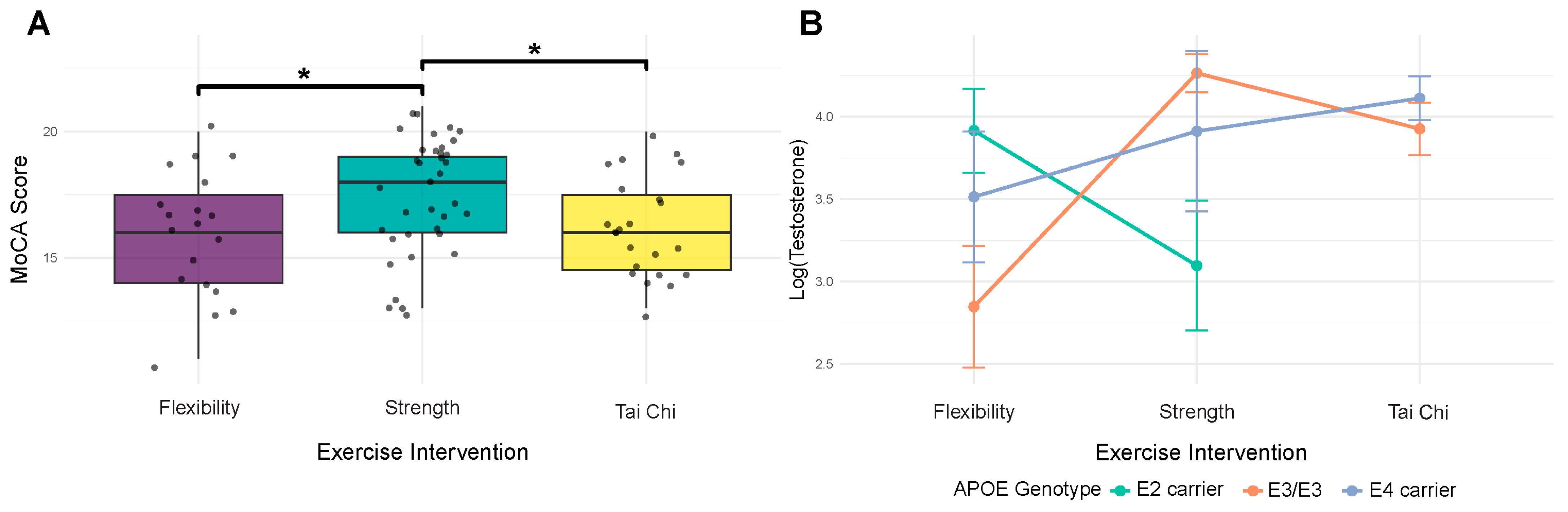
Before examining microbiome associations, we analyzed relationships between host factors to understand their interdependencies. For cognitive function, AIC-based model selection identified the combination of exercise modality and testosterone as the best predictor of MoCA scores (AIC = −3.34, pseudo R2 = 0.127). Strength training showed a significant positive relationship with cognitive function (β = 0.794, p = 0.007), while Tai Chi showed no significant difference to flexibility control (Figure 1A). Testosterone demonstrated a positive but non-significant association with MoCA scores (β = 0.183, p = 0.163) (Figure 1B).
Figure 1.
Strength training participation is associated with better cognitive function and may moderate testosterone responses in ApoE4 carriers. (A) MoCA cognitive scores by exercise modality. Participation in strength training was associated with higher MoCA scores than participation in flexibility (beta = 0.794, p = 0.007) and Tai Chi (beta = 0.617, p = 0.018) exercise. Tai Chi does not differ from flexibility (beta = 0.212, p = 0.479). Boxplots show group distributions; brackets with asterisks indicate significant pairwise differences using p < 0.05 as a threshold. (B) Testosterone varies as a function of the interaction between ApoE and exercise. We observe a significant interaction (p = 0.023) such that E4 carriers exhibit a positive association of strength training participation on testosterone (beta = 0.847, p = 0.012), whereas E2 (likely due to small sample size) and E3_E3 groups show no significant association with exercise modality. Lines and points summarize group means with standard errors.
Analysis of hormonal function revealed a significant interaction between APOE genotype and exercise modality on testosterone levels (interaction p = 0.023, model R2 = 0.156). This interaction was driven by E4 carriers, who showed a significant positive association with participation in strength training (β = 0.847, p = 0.012), while E3/E3 homozygotes and E2 carriers showed no significant association with any exercise modality. Direct examination of APOE effects revealed no significant associations with either MoCA scores (pseudo R2 = 0.007, all p > 0.63) or testosterone levels (R2 = 0.012, all p > 0.21), indicating that genetic effects operate primarily through interactions rather than direct pathways.
3.3. Alpha Diversity Patterns Reveal Complex Host–Microbiome Interactions
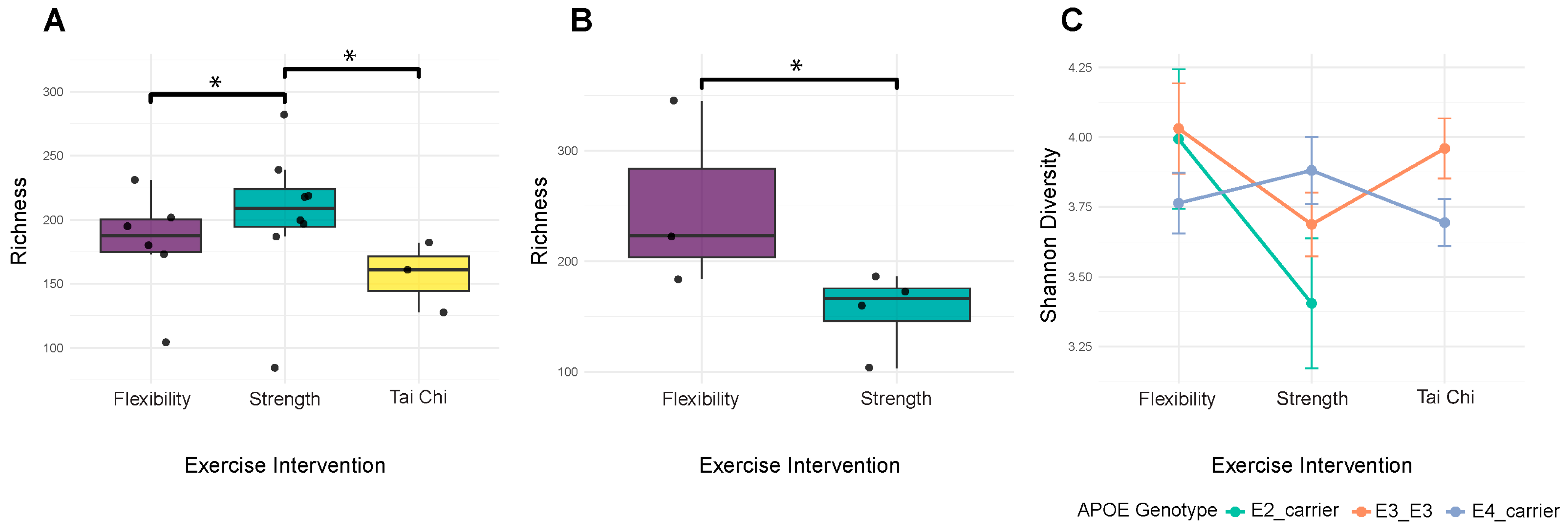
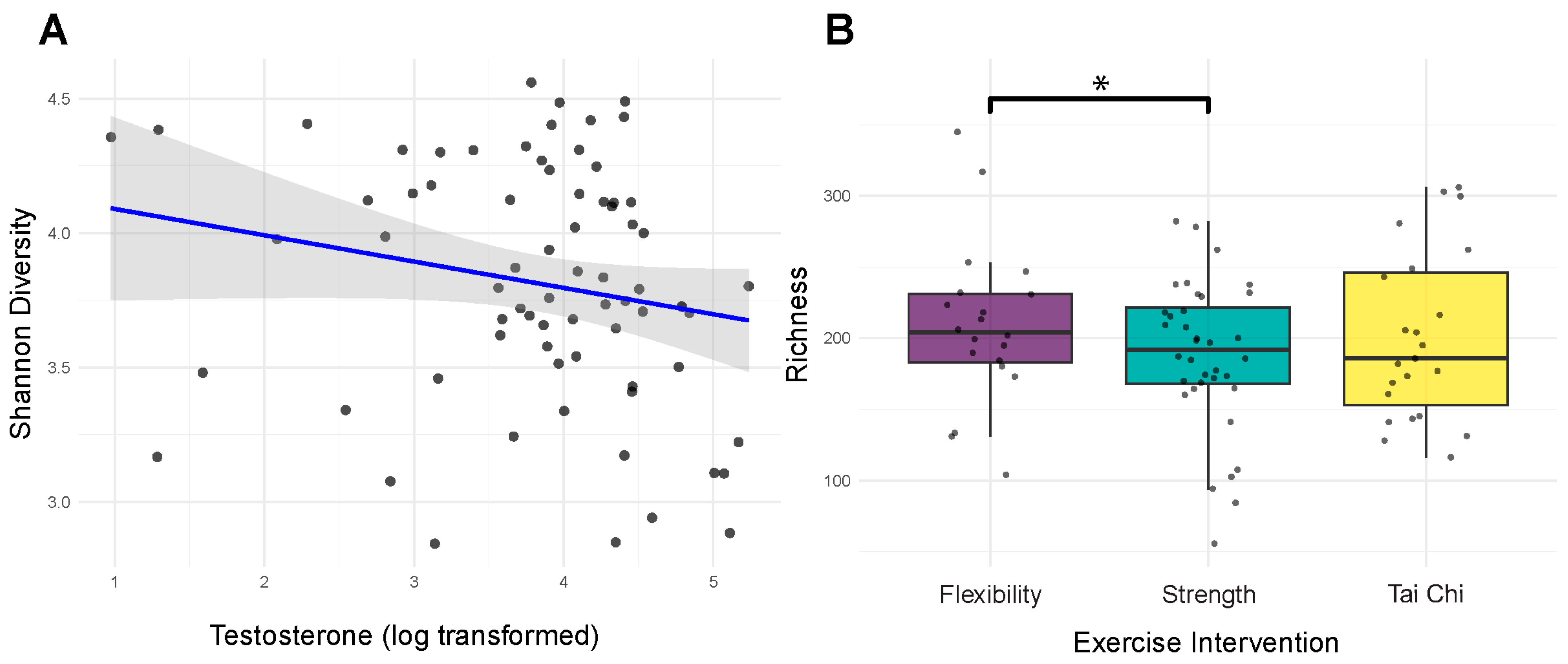
Alpha diversity metrics captured distinct aspects of microbial community structure. Shannon diversity (mean: 3.799 ± 0.457) and Simpson diversity (mean: 0.940 ± 0.041) reflected community evenness, while observed species richness (mean: 196.9 ± 55.6) measured community complexity. The wide ranges observed across all metrics indicated substantial inter-individual variation in microbiome composition. Age significantly influenced Simpson diversity (F = 1.79, p = 0.035, R2 = 0.515), with trending effects on other diversity metrics (observed species (F = 1.49, p = 0.106, R2 = 0.469) and Shannon diversity (F = 1.46, p = 0.121, R2 = 0.463)), suggesting age-related changes affect overall community structure rather than specific diversity components. The relationship between exercise modality and microbiome diversity depended critically on APOE genotype. For E4 carriers, exercise modality produced significant positive interactions with observed species richness (β = 127.142, p = 0.017) (Figure 2A) and Shannon diversity (β = 0.857, p = 0.047) (Figure 2C), while the main association with strength training participation was negative (β = −98.837, p = 0.023) (Figure 2B). E2 carriers showed a different pattern, with significant exercise intervention interactions only for observed species (β = 105.885, p = 0.031) (Figure 2B). These genotype-specific responses suggest that genetic background could modulate the microbiome’s response to exercise. Hormonal status also influenced diversity patterns. Salivary testosterone levels showed significant negative correlations with Shannon diversity (ρ = −0.232, p = 0.049) (Figure 3A) and trending negative association with Simpson diversity (ρ = −0.195, p = 0.099). MoCA scores demonstrated consistent positive trends across all diversity metrics (p = 0.060–0.099), though none reached significance after correction. Together, these findings indicate that microbiome diversity in prostate cancer patients reflects a complex interplay of demographic, genetic, hormonal, and behavioral factors.
Figure 2.
APOE genotype modifies exercise associations with microbiome diversity. (A) Observed richness varies by exercise in E4 carriers. This plot only shows data for E4 carrier samples. Strength impacts community richness among E4 carriers (beta = 127.142, p = 0.017); brackets mark significant pairwise comparisons with asterisks, which indicate p < 0.05. (B) Observed species richness varies by exercise among E2 carriers. This plot only shows data for E2 carrier samples. A significant exercise interaction is observed (beta = 105.885, p = 0.031); the bracket indicates the significant flexibility vs. strength comparison with the asterisk indicating p < 0.05. No Tai Chi group is shown in this plot because our study included no E2 carriers within the Tai Chi group. (C) Shannon diversity varies by exercise across ApoE genotypes. The exercise x APOE interaction is significant (beta = 0.857, p = 0.047); mean Shannon diversity ± standard error lines by genotype illustrate genotype-specific exercise responses.
Figure 3.
Testosterone and exercise modality are independently associated with gut microbiome diversity. (A) Shannon diversity vs. testosterone (on log scale) as illustrated by a scatterplot with linear fit reveals a negative association (Spearman rho ≈ −0.232, p ≈ 0.049). (B) Observed species richness by exercise intervention. Boxplots show distributions across groups. A bracket highlights the significant strength main effect relative to flexibility (beta ≈ −98.8, p ≈ 0.023); the asterisk denotes statistical significance using p < 0.05.
3.4. Beta Diversity Analysis Reveals Hormonal and Interactive Effects on Community Composition
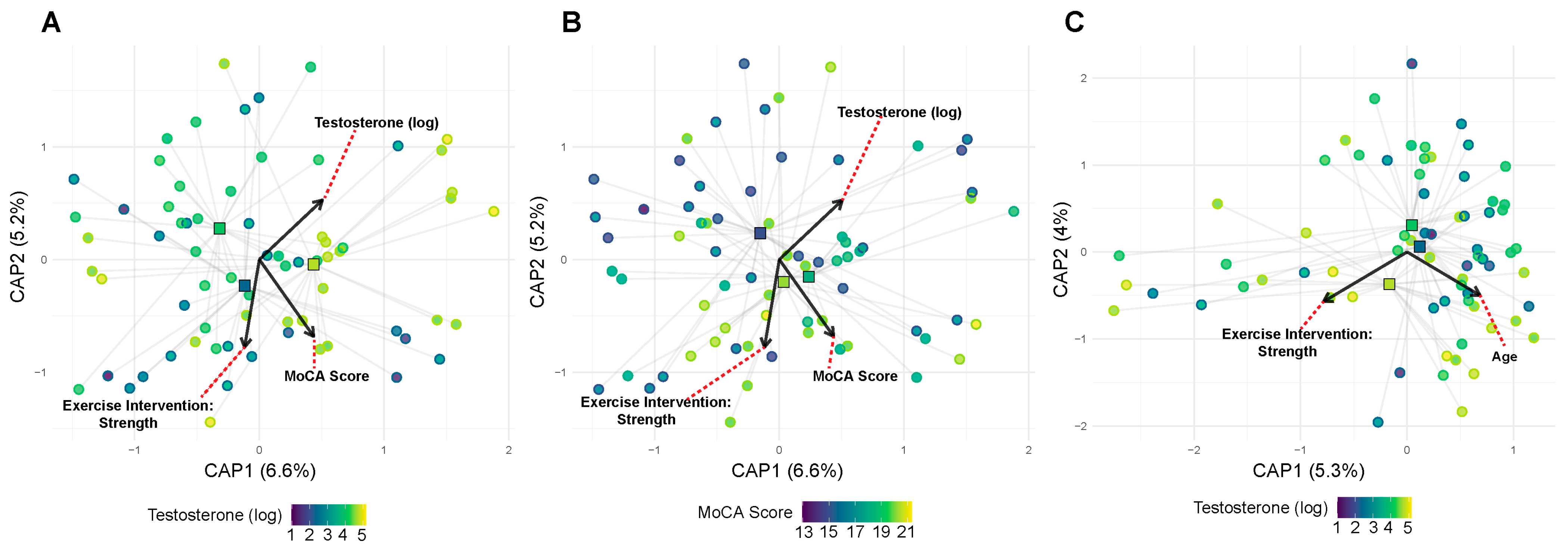
Community composition analysis provided insights that were complementary to alpha diversity findings. Unlike diversity metrics, which showed strong age effects, community composition was primarily influenced by hormonal factors. Testosterone levels significantly affected bacterial community membership (Sorenson distances: R2 = 0.024, p = 0.017) (Figure 4A), with trending effects on abundance-weighted metrics (Bray–Curtis: R2 = 0.019, p = 0.103) (Figure 4C). Neither exercise intervention nor APOE status showed significant main effects on community structure (all p > 0.15). MoCA showed a suggestive association with community composition (R2 = 0.020, p = 0.056) (Figure 4B).
Figure 4.
Testosterone and cognitive function structure gut microbial community composition. (A) Community structure by testosterone (Sorenson). Testosterone shows a significant main effect (R2 = 0.024, p = 0.017). Points are filled by log-transformed testosterone levels. To aid interpretation for a continuous covariate, samples are split into tertiles (low/mid/high); faint “spider” segments connect points to their tertile centroid, and larger squares show centroids filled by the tertile midpoint on the same color scale. A thin colored ring around each point indicates tertile membership. Covariate vectors indicate the strongest drivers of ordination axes, where red dotted lines connect covariate vector labels to their corresponding vectors. (B) Community structure by cognitive function (Sorenson). MoCA shows a suggestive association (R2 = 0.020, p = 0.056). Same styling as A except with MoCA as the continuous fill; centroids are filled by MoCA tertile midpoints. (C) Community structure by testosterone (Bray–Curtis). Testosterone shows a suggestive association (R2 = 0.019, p = 0.103). Same styling as A except with Bray–Curtis distances and testosterone as the continuous fill.
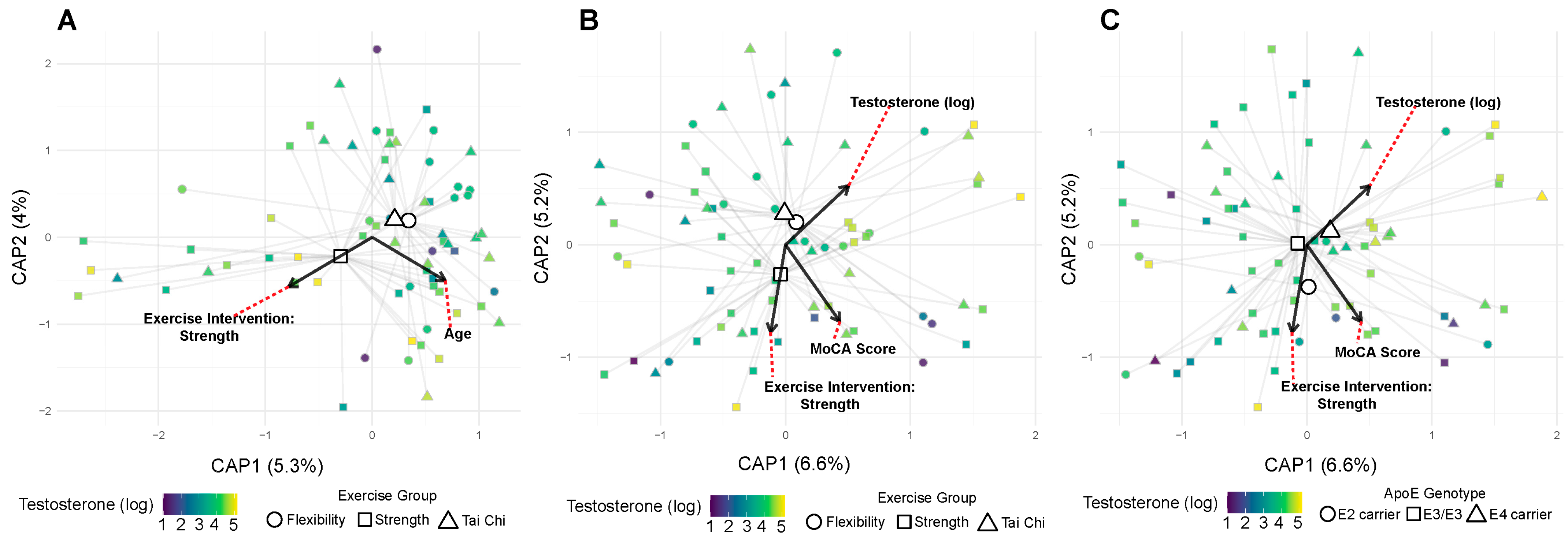
However, significant interactions emerged when examining combined factors. Exercise and testosterone showed synergistic effects on both abundance-based (Bray–Curtis: R2 = 0.037, p = 0.049) and membership-based (Sorenson: R2 = 0.041, p = 0.012) (Figure 5A) community metrics. Additionally, E2 carrier status modified the testosterone effect on community membership (Sorenson: R2 = 0.022, p = 0.046). MoCA scores showed a trending association with community composition (Sorenson: R2 = 0.020, p = 0.056) (Figure 5B), and salivary testosterone levels showed a suggestive association (R2 = 0.019, p = 0.103) (Figure 5C). These beta diversity patterns suggest that while individual factors may have limited effects on overall community structure, their interactions create distinct microbial signatures. The stronger effects on Sorenson (presence/absence) versus Bray–Curtis (abundance-weighted) distances indicate that hormonal and exercise factors primarily affect which bacteria are present rather than their relative abundances.
Figure 5.
Exercise and APOE genotype interact with testosterone to shape microbial community structure. (A) Community structure by exercise and testosterone (Bray–Curtis). The exercise-by-testosterone interaction is significant (R2 = 0.037, p = 0.049). Points are filled by log-transformed testosterone levels and shaped by exercise modality (circle/square/triangle). Faint spider segments connect points to their exercise-modality centroids; centroids are drawn as larger versions of the same shape. Covariate vectors indicate the strongest drivers of ordination axes, where red dotted lines connect covariate vector labels to their corresponding vectors. (B) Community structure by exercise and testosterone (Sorenson). The exercise-by-testosterone interaction is significant (R2 = 0.041, p = 0.012). Same styling as in (A). (C) Community structure by APOE genotype and testosterone (Sorenson). The APOE-by-testosterone interaction is significant (R2 = 0.022, p = 0.046). Same styling as in A with APOE genotype shaping instead of the exercise group.
3.5. Taxon-Level Analysis Identifies Specific Bacterial Signatures of Host Factors
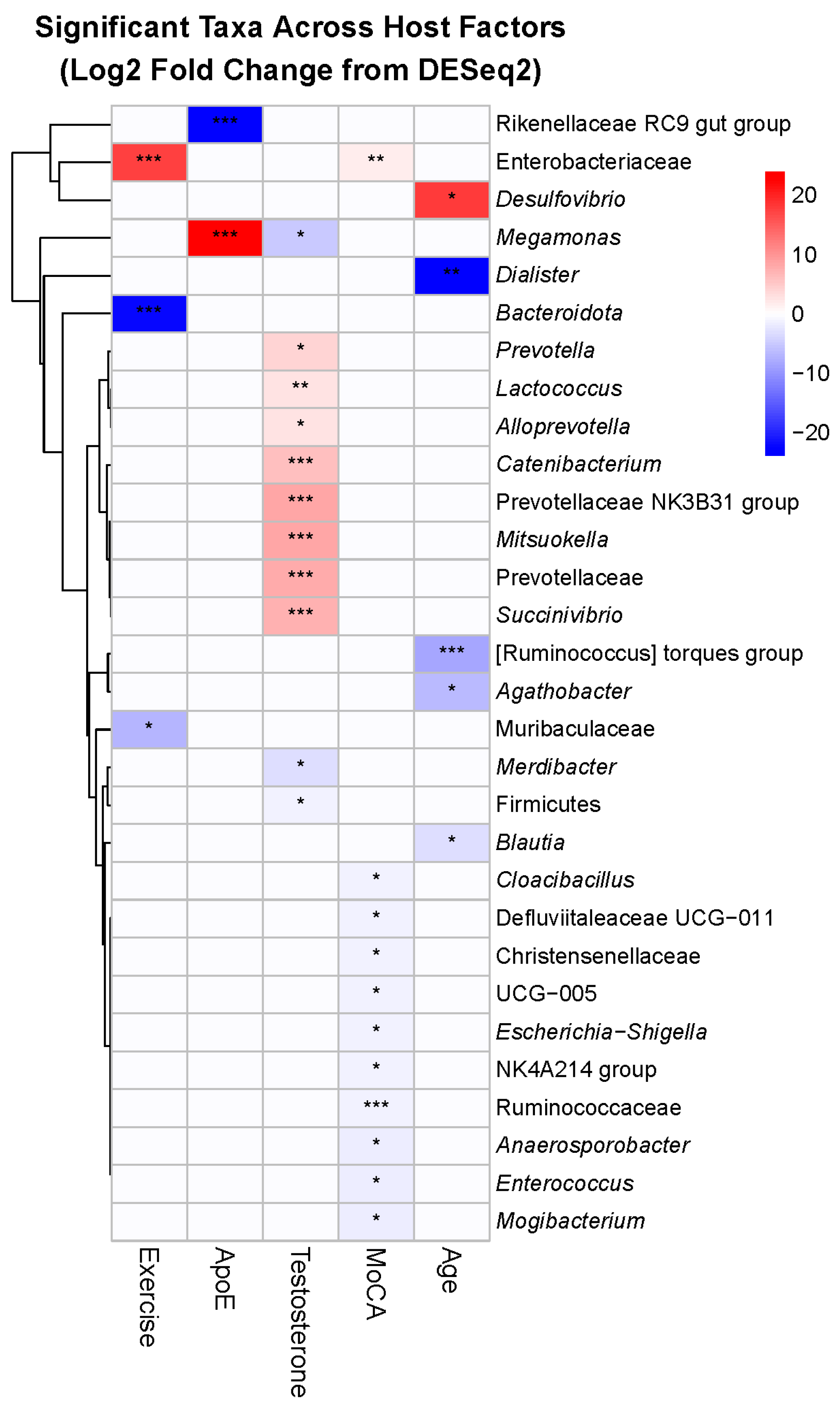
To identify the specific bacteria driving diversity patterns, we analyzed differential abundance across 211 genus-level taxa, revealing 32 significant associations (15.2%) with host factors, indicating selective rather than global microbiome changes (Figure 6). Exercise modality produced contrasting effects on anaerobic bacteria. Two obligate anaerobes decreased significantly: an unclassified Bacteroidota taxon (log2FC = −21.96, padj = 1.23 × 10⁻¹⁵) and Muribaculaceae (log2FC = −6.80, padj = 0.028). Conversely, the facultative anaerobe family Enterobacteriaceae increased markedly (log2FC = 17.61, padj = 8.93 × 10⁻⁶). This shift from obligate to facultative anaerobes may reflect exercise-induced changes in gut oxygen tension or transit time.
Figure 6.
Host factors associate with distinct bacterial taxon relative abundances. Significant taxa (FDR-corrected p < 0.05) were identified across host factors: exercise (3 taxa), ApoE genotype (2 taxa), testosterone (11 taxa), MoCA score (11 taxa), and age (5 taxa). Rows represent significant taxa (genus-level); columns are host factors. Values are DESeq2 log2 fold changes; cells display significance with asterisks (* p < 0.05, ** p < 0.01, *** p < 0.001). To improve legibility, very small but significant effects are visualized with a minimum color intensity so that all significant cells appear non-white, while non-significant effects remain white (0). Row labels prioritize genus (or else family or phylum when genus annotations are not available) for readability; color breaks are symmetric about zero.
APOE E4 carrier status was associated with a phylum-level trade-off: increased Megamonas from Firmicutes (log2FC = 23.86, padj = 4.26 × 10⁻¹⁰) coupled with decreased Rikenellaceae RC9 from Bacteroidota (log2FC = −23.36, padj = 2.88 × 10⁻¹¹). This Firmicutes/Bacteroidota ratio shift represents a fundamental alteration in community structure associated with the E4 genotype.
Salivary testosterone levels showed the broadest taxonomic associations, affecting 11 genera across multiple phyla. The Prevotellaceae family showed consistent positive associations with testosterone, including the NK3B31 group (log2FC = 8.30, padj = 5.74 × 10⁻⁶), Prevotella (log2FC = 4.14, padj = 0.025), and Alloprevotella (log2FC = 2.84, padj = 0.0014). The proteobacterium Succinivibrio also increased (log2FC = 7.40, padj = 1.01 × 10⁻⁶), while Catenibacterium decreased (log2FC = −5.59, padj = 0.00012). Given that some gut bacteria can metabolize hormones, these associations may reflect bidirectional host–microbe interactions.
Cognitive function showed intriguing taxonomic patterns, with 11 associated genera predominantly from Firmicutes (8/11). Most Firmicutes members decreased with higher MoCA scores, including multiple Ruminococcaceae genera (UCG-005: log2FC = −0.46, padj = 0.012; NK4A214: log2FC = −0.42, padj = 0.033). In contrast, Enterobacteriaceae increased with better cognitive function (log2FC = 1.89, padj = 0.0056), paralleling its positive association with exercise.
Age uniformly reduced putatively beneficial taxa, particularly within the Lachnospiraceae family. Three members showed significant age-related decreases: [Ruminococcus] torques (log2FC = −8.24, padj = 0.00053), Agathobacter (log2FC = −6.47, padj = 0.036), and Blautia (log2FC = −2.91, padj = 0.036). Dialister showed the largest magnitude decrease (log2FC = −23.85, padj = 0.0032). These taxa are known short-chain fatty acid producers, suggesting an age-related loss of beneficial metabolic functions. Overall, the taxon-level findings provide mechanistic insights into the diversity patterns, revealing that host factors do not uniformly affect the microbiome but rather target specific bacterial groups with distinct functional capabilities.
4. Discussion
In this cohort of men with prostate cancer and prior or current androgen deprivation therapy (ADT), we observed three principal findings. First, host factors independent of the microbiome showed that participation in strength training was associated with higher Montreal Cognitive Assessment (MoCA) scores, and APOE genotype modified the association of exercise with salivary testosterone, with E4 carriers that received strength training demonstrating higher testosterone levels. Second, gut community structure was associated with hormonal status—salivary testosterone levels related to differences in presence/absence-based community metrics—and with interactions between salivary testosterone and exercise modality (and, for membership, testosterone and APOE E2 status). Third, taxon-level analyses identified specific bacterial signatures linked to exercise modality (decreased Bacteroidota taxa and increased Enterobacteriaceae), APOE E4 (increased Megamonas, decreased Rikenellaceae RC9), salivary testosterone (increased Prevotellaceae taxa and Succinivibrio), age (decreases in several Lachnospiraceae), and cognitive scores (multiple Firmicutes genera decreased as MoCA increased). Together, these findings support a model in which genetic background and endocrine milieu shape the microbiome’s association with exercise history, with potential implications for cognition in ADT-treated prostate cancer survivors.
The gut–brain axis is increasingly recognized as a determinant of behavioral and cognitive phenotypes [24,31,32]. In our study, testosterone showed a main association with community membership (Sorenson) and interacted with exercise history to influence both membership and abundance-weighted metrics, suggesting that endocrine state could be a key dimension along which exercise “reprograms” gut communities after ADT. These associations, while not evidence of causal relationships themselves, are consistent with evidence for bidirectional links between sex steroids and the microbiome [61] and with mechanistic studies showing that commensal bacteria can synthesize androgens that fuel endocrine resistance in prostate cancer [41]. Notably, APOE E2 status modified testosterone’s association with membership, and APOE E4 status interacted with exercise to influence alpha diversity (observed richness and Shannon). Prior human and murine work have shown that the APOE genotype shapes gut microbial composition and function [39,45], providing a biologically plausible basis for the genotype-dependent microbiome responses we detected.
Age was a prominent correlate of alpha diversity, and age-related declines were evident in several genera within Lachnospiraceae and in Dialister. This is consistent with population studies linking aging to characteristic shifts in gut communities that track health status and survival [23]. The observed associations between MoCA and community membership (trend) and between MoCA and multiple genera (notably several Firmicutes with lower abundance at higher MoCA) further underscore cognitive–microbiome coupling in this clinical context, while also highlighting that directionality may differ from patterns described in community-dwelling older adults, likely reflecting disease, treatment (including ADT), and comorbidity influences [24,31,32].
Exercise history was associated with reduced abundance of two Bacteroidota taxa (including Muribaculaceae) and higher Enterobacteriaceae. The APOE E4-linked profile—higher Megamonas and lower Rikenellaceae RC9—represents a shift across Firmicutes/Bacteroidota boundaries and mirrors prior reports of APOE-dependent restructuring of the gut ecosystem [39,45]. Salivary testosterone levels correlated positively with multiple Prevotellaceae taxa and Succinivibrio, genera frequently linked to carbohydrate fermentation and, in some settings, to host metabolic and hormonal phenotypes [61]. Although our cross-sectional design precludes causal inference, these signals are consistent with a scenario in which endocrine status, exercise behavior, and genetic background jointly select for microbial modules with distinct metabolic capacities.
From a clinical perspective, three implications emerge. First, recent participation in strength training was associated with better cognitive performance independent of APOE genotype and microbiome measures, reinforcing current guidance to include strength training in survivorship care plans [16]. Second, the APOE E4-specific testosterone response to strength training raises the possibility that APOE genotype-informed exercise prescriptions [21] could be leveraged to optimize endocrine and functional outcomes after ADT. Third, given evidence that gut microbes can contribute to extra-gonadal androgen biosynthesis, and thereby to ADT resistance [41], the observed testosterone–microbiome coupling suggests that tracking (and potentially targeting) gut community features may complement exercise-based strategies to improve long-term neurological and oncologic outcomes in patients with prostate cancer.
This study has several limitations. The analysis is cross-sectional and not longitudinal. The microbiome data are taxonomic data only and do not include metagenomic or metabolomic data to determine pathway changes related to androgen or short-chain fatty acid metabolism. The cohort is relatively small and based on the occurrence of APOE ε2 (8%), ε3 (77%), and ε4 (15%); alleles in the general population contains much less E2 and E4 than E3 carriers. Cognitive outcomes were only assessed with the MoCA. It is conceivable that as a result, subtle or domain-specific deficits in men with prostate cancer treated with ADT might have been missed. Diet was recorded but not modeled in depth as a potential confounder.
Going forward, prospective, longitudinal trials that integrate APOE genotyping, detailed ADT exposure (drug, dose, duration), standardized strength-training protocols, and multi-omics (shotgun metagenomics, metabolomics, including steroidomics and short-chain fatty acids) are needed to test whether targeted exercise alters microbial functions tied to androgen biology and cognition [41,49,51,52]. Parallel measurement of neuroimmune markers and microglial-modulating pathways relevant to APOE genotype and TREM2 [8] could clarify mechanistic links between exercise, the microbiome, and neurocognitive outcomes. In addition, it will be important to assess whether in men with prostate cancer who received ADT and exercise intervention there might be signatures in the diet or diet-based scores that affect the gut microbiome and/or cognition.
In summary, our results indicate that genetic background and endocrine milieu potentially condition the gut microbiome’s response to exercise in ADT-treated prostate cancer survivors, with downstream associations with cognition. These data may inform precision survivorship strategies that pair strength training with APOE genotype- and hormone-informed monitoring of the gut ecosystem to optimize cognitive function.
Author Contributions
Conceptualization, J.R.; methodology, J.R., K.W.-S., K.D.K. and T.J.S.; software, K.D.K. and T.J.S.; validation, J.R. and T.J.S.; formal analysis, J.R., K.D.K. and T.J.S.; investigation, J.R., A.O., K.D.K., A.P., N.R., C.C., K.W.-S. and T.J.S.; resources, J.R., K.W.-S. and T.J.S.; data curation, C.G., K.D.K. and T.J.S.; writing—original draft preparation, J.R.; writing—review and editing, J.R., A.O., K.D.K., A.P., N.R., C.G., C.C., K.W.-S. and T.J.S.; visualization, T.J.S.; supervision, J.R., K.W.-S. and T.J.S.; project administration, J.R.; funding acquisition, J.R. and K.W.-S. All authors have read and agreed to the published version of the manuscript.
Funding
This research was funded by a CCSG CPCP-2023-002 pilot project of the OHSU Knight Cancer Institute.
Institutional Review Board Statement
The study was conducted in accordance with the Declaration of Helsinki and approved by the Institutional Review Board (or Ethics Committee) of the Oregon Health & Science University (approval code: MOD00049193; approval date: 10 May 2023).
Informed Consent Statement
Informed consent was obtained from all subjects involved in the study.
Data Availability Statement
The original contributions presented in this study are included in the article. Further inquiries can be directed to the corresponding author.
Conflicts of Interest
The authors declare no conflicts of interest. The funders had no role in the design of the study; in the collection, analyses, or interpretation of data; in the writing of the manuscript; or in the decision to publish the results.
References
- Miller, K.; Nogueira, L.; Mariotto, A.; Rowland, J.H.; Yabroff, K.R.; Alfano, C.M.; Jemal, A.; Kramer, J.L.; Siegel, R.L. Cancer treatment and survivorship statistics. CA Cancer J. Clin. 2019, 69, 363–385. [Google Scholar]
- Hardy, S.; Krull, K.; Wefel, J.; Janelsins, M. Cognitive Changes in Cancer Survivors. Am. Soc. Clin. Oncol. Educ. Book 2018, 38, 795–806. [Google Scholar] [CrossRef] [PubMed]
- Bower, J.; Ganz Pa Tao, M. Inflammatory biomarkers and fatigue during radiation therapy for breast and prostate cancer. Clin. Cancer Res. 2009, 15, 5534–5540. [Google Scholar] [CrossRef] [PubMed]
- Yang, Y.; Von Ah, D. Cancer-related cognitive impairment: Updates to treatment, the need for more evidence, and impact on quality of life—A narrative review. Ann. Palliat. Med. 2024, 13, 1265–1280. [Google Scholar] [CrossRef] [PubMed]
- Erim, D.; Bensen, J.T.; Mohler, J.L.; Fontham, E.T.H.; Song, L.; Farnan, L.; Delacroix, S.E.; Peters, E.S.; Erim, T.N.; Chen, R.C.; et al. Prevalence and predictors of probable depression in prostate cancer survivors. Cancer 2019, 125, 3418–3427. [Google Scholar] [CrossRef]
- Ettridge, K.; Bowden, J.; Chambers, S.; Smith, D.; Murphy, M.; Evans, S.; Roder, D.; Miller, C. Prostate cancer is far more hidden…”: Perceptions of stigma, social isolation and help-seeking among men with prostate cancer. Eur. J. Cancer 2018, 27, e12790. [Google Scholar] [CrossRef]
- Raber, J.; Huang, Y.; Ashford, J. ApoE genotype accounts for the vast majority of AD risk and AD pathology. Neurobiol. Aging 2004, 25, 641–650. [Google Scholar] [CrossRef]
- Shi, Y.; Holtzman, D. Interplay between innate immunity and Alzheimer disease: APOE and TREM2 in the spotlight. Nat. Rev. Immunol. 2018, 18, 759–772. [Google Scholar] [CrossRef]
- Bancaro, N.; Calì, B.; Troiani, M.; Elia, A.R.; Arzola, R.A.; Attanasio, G.; Lai, P.; Crespo, M.; Gurel, B.; Pereira, R.; et al. Apolipoprotein E induces pathogenic senescent-like myeloid cells in prostate cancer. Cancer Cell 2023, 41, 602–619. [Google Scholar] [CrossRef]
- Raber, J. AR, apoE, and cognitive function. Horm. Behav. 2008, 53, 706–715. [Google Scholar] [CrossRef]
- Ahles, T.; Saykin, A.; Noll, N.; Furstenberg, C.T.; Guerin, S.; Cole, B.; Mott, L.A. The relationship of APOE genotype to neuropsychological performance in long-term cancer survivors treated with standard dose chemotherapy. Psycho-Oncology 2003, 12, 612–619. [Google Scholar] [CrossRef]
- Narayan, V.; Ross, A.E.; Parikh, R.B.; Nohria, A.; Morgans, A.K. How to Treat Prostate Cancer with Androgen Deprivation and Minimize Cardiovascular Risk. JACC CardioOncol. 2021, 3, 737–741. [Google Scholar] [CrossRef]
- Shim, M.; Bang, W.J.; Oh, C.Y.; Lee, Y.S.; Cho, J.S. Androgen deprivation therapy and risk of cognitive dysfunction in men with prostate cancer: Is there a possible link? Prostate Int. 2022, 10, 68–74. [Google Scholar] [CrossRef]
- Scuteri, A.; Najjar, S.S.; Muller, D.; Andres, R.; Morrell, C.H.; Zonderman, A.B.; Lakatta, E.G. ApoE4 allele and the natural history of cardiovascular risk factors. AJP Endocrinol. Metab. 2005, 289, E322–E327. [Google Scholar] [CrossRef] [PubMed]
- Motlagh, R.; Quhal, F.; Mori, K.; Miura, N.; Aydh, A.; Laukhtina, E.; Pradere, B.; Karakiewicz, P.I.; Enikeev, D.V.; Deuker, M.; et al. The Risk of New Onset Dementia and/or Alzheimer Disease Among Patients with Prostate Cancer Treated with Androgen Deprivation Therapy: A Systematic Review and Meta-Analysis. J. Urol. 2021, 205, 60–67. [Google Scholar] [CrossRef]
- Patel, A.; Friedenreich, C.; Moore, S.; Hayes, S.C.; Silver, J.K.; Campbell, K.L.; Winters-Stone, K.; Gerber, L.H.; George, S.M.; Fulton, J.E.; et al. American College of Sports Medicine Roundtable Report on Physical Activity, Sedentary Behavior, and Cancer Prevention and Control. Med. Sci. Sports Excercise 2019, 51, 2391–2402. [Google Scholar] [CrossRef]
- Bardia, A.; Arieas, E.; Zhang, Z.; DeFilippis, A.; Tarpinian, K.; Jeter, S.; Nguyen, A.; Henry, N.L.; Flockhart, D.A.; Hayes, D.F.; et al. Comparison of breast cancer recurrence risk and cardiovascular disease incidence risk among postmenopausal women with breast cancer. Breast Cancer Res. Treat. 2012, 131, 907–914. [Google Scholar] [CrossRef]
- Pencheva, N.; Tran, H.; Buss, C.; Huh, D.; Drobnjak, M.; Busam, K.; Tavazoie, S.F. Convergent Multi-miRNA Targeting of ApoE Drives LRP1/LRP8-Dependent Melanoma Metastasis and Angiogenesis. Cell 2012, 151, 1068–1082. [Google Scholar] [CrossRef] [PubMed]
- Ostndorf, B.; Bilanovic, J.; Adaku, N.; Tafreshian, K.N.; Tavora, B.; Vaughan, R.D.; Tavazoie, S.F. Common germline variants of the human APOE gene modulate melanoma progression and survival. Nat. Med. 2020, 26, 1048–1053. [Google Scholar] [CrossRef]
- Ifere, G.; Desmond, R.; Demark-Wahnefried, W.; Nagy, T. Apolipoprotein E gene polymorphism influences aggressive behavior in prostate cancer cells by deregulating cholesterol homeostasis. Int. J. Oncol. 2013, 43, 1002–1010. [Google Scholar] [CrossRef]
- McGinnis, G.; Holden, S.; Yu, B.; Ransom, C.; Guidarelli, C.; De, B.; Diao, K.; Boyce, D.; Thomas, C.R.; Winters-Stone, K.; et al. Association of fall rate and functional status by APOE genotype in cancer survivors after exercise intervention. Oncotarget 2022, 13, 1229–1270. [Google Scholar] [CrossRef]
- Afzaal, M.; Saeed, F.; Shah, Y.A.; Hussain, M.; Rabail, R.; Socol, C.T.; Hassoun, A.; Pateiro, M.; Lorenzo, J.M.; Rusu, A.V.; et al. Human gut microbiota in health and disease: Unveiling the relationship. Front. Microbol. 2022, 10, 3389. [Google Scholar] [CrossRef] [PubMed]
- Wilmanski, T.; Diener, C.; Rappaport, N.; Patwardhan, S.; Wiedrick, J.; Lapidus, J.; Earls, J.C.; Zimmer, A.; Glusman, G.; Robinson, M.; et al. Gut microbiome pattern reflects healthy ageing and predicts survival in humans. Nat. Metab. 2021, 3, 274–286. [Google Scholar] [CrossRef]
- Foster, J.; McVey Neufeld, K.-A. Gut-brain axis: How the microbiome influences anxiety and depression. Trends Neurosci. 2013, 36, 305–312. [Google Scholar] [CrossRef]
- Allen, A.; Dinan, T.; Clarke, G.; Cryan, J. A psychology of the human brain-gut-microbiome axis. Soc. Personal. Psychol. Compass 2017, 11, e12309. [Google Scholar] [CrossRef] [PubMed]
- Kelly, J.; Kennedy, P.; Cryan, J.F.; Dinan, T.; Clarke, G.; Hyland, H. Breaking down the barriers: The gut miocrobiome, intestinal permeability and stress-related psychiatric disorders. Front. Cell Neurosci. 2015, 9, 392. [Google Scholar] [CrossRef] [PubMed]
- Lynch, J.; Hsiao, E. Microbiomes as sources of emergent host phenotypes. Science 2019, 365, 1405–1409. [Google Scholar] [CrossRef]
- Vuong, H.; Yano, J.; Fung, T.; Hsiao, E. The microbbiome and host behavior. Annu. Rev. Neurosci. 2017, 40, 21–49. [Google Scholar] [CrossRef]
- Sudo, N.; Chida, Y.; Aiba, Y.; Sonoda, J.; Oyama, N.; Yu, X.-N.; Kubo, C.; Koga, Y. Postnatal microbbila colonization programs the hypothalamic-pituitary-adrenal system for stress response in mice. J. Physiol. 2004, 558, 263–275. [Google Scholar] [CrossRef]
- Monteiro-Cardoso, V.; Corliano, M.; Singaraja, R. Bile Acids: A Communication Channel in the Gut-Brain Axis. Neuromolecular Med. 2020, 23, 99–117. [Google Scholar] [CrossRef]
- Cryan, J.F.; O’Mahony, S. The microbiome-gut-brain axis: From bowel to behavior. Neurogastroenterol. Motil. 2011, 23, 187–192. [Google Scholar] [CrossRef] [PubMed]
- Cryan, J.F.; Dinan, T.G. Mind-altering microorganisms: The impact of the gut microbiota on brain and behaviour. Nat. Rev. Neurosci. 2012, 13, 701–712. [Google Scholar] [CrossRef]
- Clarke, G.; Grenham, S.; Scully, P.; Fitzgerald, P.; Moloney, R.; Shanahan, F.; Dinan, T.G.; Cryan, J.F. The microbiome-gut-brain axis during early life regulates the hippocampal serotonergic system in a sex-dependent manner. Mol. Psychiatry 2013, 18, 666–673. [Google Scholar] [CrossRef]
- Raber, J.; Yamazaki, J.; Torres, E.; Kirchoff, N.; Stagaman, K.; Sharpton, T.J.; Turker, M.S.; Kronenberg, A. Combined effects of three high energy charged particle beams important for space flight on brain, behavioral and cognitive endpoints in B6D2F1 female and male mice. Frontiers 2019, 10, 179. [Google Scholar] [CrossRef]
- Raber, J.; Fuentes Anaya, A.; Torres, E.; Lee, J.; Boutros, S.; Grygoryev, D.; Hammer, A.; Kasschau, K.D.; Sharpton, T.J.; Turker, M.S.; et al. Effects of Six Sequential Charged Particle Beams on Behavioral and Cognitive Performance in B6D2F1 Female and Male Mice. Front. Physiol. 2020, 11, 959. [Google Scholar] [CrossRef]
- Holden, S.; Kundu, P.; Torres, E.; Sudhakar, R.; Krenik, D.; Grygoryev, D.; Turker, M.S.; Raber, J. Apolipoprotein E Isoform-Dependent Effects on Human Amyloid Precursor Protein/Aβ-Induced Behavioral Alterations and Cognitive Impairments and Insoluble Cortical Aβ42 Levels. Front. Aging Neurosci. 2022, 14, 767558. [Google Scholar] [CrossRef]
- Kundu, P.; Stagaman, K.; Kasschau, K.; Holden, S.; Shulzhenko, N.; Sharpton, T.; Raber, J. Fecal implants from AppNL-G-F and AppNL-G-F/E4 donor mice sufficient to induce behavioral phenotypes in germ-free mice. Front. Behav. Neurosci. 2022, 16, 791128. [Google Scholar] [CrossRef]
- Niemi, M.; Hakkinen, T.; Karttunen, T.; Eskelinen, S.; Kervinen, K.; Savolainen, M.; Lehtola, J.; Makela, J.; Yla-Herttuala, S.; Kesaniemi, Y.A. Apolipoprotein E and colon cancer: Expression in normal and malignant human intestine and effect on cultured human colonic adenocarcinoma cells. Eur. J. Intern. Med. 2002, 13, 37–43. [Google Scholar] [CrossRef] [PubMed]
- Tran, T.; Corsini, S.; Kellinggray, L.; Hegarty, C.; Le Gail, C.; Narbad, A.; Müller, M.; Tejera, N.; O’Toole, P.W.; Minihane, A.-M.; et al. APOE genotype influences the gut microbiome structure and function in humans and mice: Relevance for Alzheimer’s disease pathophysiology. FASEB J. 2019, 33, 8221–8231. [Google Scholar] [CrossRef] [PubMed]
- Kaul, S.; Miller, J.G.; Grayburn, P.A.; Hashimoto, S.; Hibberd, M.; Holland, M.R.; Houle, H.C.; Klein, A.L.; Knoll, P.; Lang, R.M.; et al. A suggested roadmap for cardiovascular ultrasound research for the future. J. Am. Soc. Echocardiogr. 2011, 24, 455–464. [Google Scholar] [CrossRef]
- Pernigoni, N.; Zagato, E.; Calcinotto, A.; Troiani, M.; Mestre, R.P.; Calì, B.; Attanasio, G.; Troisi, J.; Minini, M.; Mosole, S.; et al. Commensal bacteria promote endocrine resistance in prostate cancer through androgen biosynthesis. Science 2021, 374, 216–224. [Google Scholar] [CrossRef]
- Jain, A.; Madkan, S.; Patil, P. The Role of Gut Microbiota in Neurodegenerative Diseases: Current Insights and Therapeutic Implications. Cureus 2023, 15, e47861. [Google Scholar] [CrossRef]
- Santos-Marcos, J.; Mora-Ortiz, M.; Tena-Sempere, M.; Lopez-Miranda, J.; Camargo, A. Interaction between gut microbiota and sex hormones and their relation to sexual dimorphism in metabolic diseases. Biol. Sex. Differ. 2023, 14, 8863. [Google Scholar] [CrossRef] [PubMed]
- Kim, M.; Zou, W. Ultra-high dose rate FLASH radiation therapy for cancer. Med. Phys. 2023, 50, 58–61. [Google Scholar] [CrossRef]
- Parikh, I.; Estus, J.; Zajc, D.; Malik, M.; Weng, J.; Tai, L.; Chlipala, G.E.; LaDu, M.J.; Green, S.J.; Estus, S. Murine Gut Microbiome Association with APOE Alleles. Front. Immunol. 2020, 11, 200. [Google Scholar] [CrossRef]
- Qin, Y.; Havulinna, A.S.; Liu, Y.; Jousilahti, P.; Ritchie, S.C.; Tokolyi, A.; Sanders, J.G.; Valsta, L.; Brożyńska, M.; Zhu, Q.; et al. Combined effects of host genetics and diet on human gut microbiota and incident disease in a single population cohort. Nat. Genet. 2022, 54, 134–142. [Google Scholar] [CrossRef]
- Turnbaugh, P.; Ley, R.; Mahowald, M.; Magrini, V.; Mardis, E.; Gordon, J. An obesity-associated gut microbiome with increased capacity for energy harvest. Nature 2006, 444, 1027–1031. [Google Scholar] [CrossRef]
- Fukuda, S.; Ohno, H. Gut microbiome and metabolic diseases. Semin. Immunopathol. 2014, 36, 103–114. [Google Scholar] [CrossRef] [PubMed]
- Lucy, M.; Allen, J.; Buford, T.; Fields, C.; Woods, J. Exercise and the Gut Microbiome: A Review of the Evidence, Potential Mechanisms, and Implications for Human Health. Exerc. Sport Sci. Rev. 2019, 47, 75–89. [Google Scholar] [CrossRef]
- Askarova, S.; Umbayev, B.; Masoud, A.-R.; Kaiyrlykyzy, A.; Safarova, Y.; Olzhayev, F.; Kushugulova, A. The Links Between the Gut Microbiome, Aging, Modern Lifestyle and Alzheimer’s Disease. Front. Cell Infect. Microbiol. 2020, 10, 104. [Google Scholar] [CrossRef]
- Clauss, M.; Gerard, P.; Mosca, A.; Leclerc, M. Interplay Between Exercise and Gut Microbiome in the Context of Human Health and Performance. Front. Nutr. 2021, 8, 637010. [Google Scholar] [CrossRef]
- Koblinsky, N.; Power, K.; Middleton, L.; Ferland, G.; Anderson, N. The Role of the Gut Microbiome in Diet and Exercise Effects on Cognition: A Review of the Intervention Literature. J. Gerontol. 2023, 78, 195–205. [Google Scholar] [CrossRef]
- Chaklai, A.; O’Niel, A.; Goel, S.K.; Margolies, N.; Krenik, D.; Perez, R.; Kessler, K.; Staltontall, E.; Yoon, H.K.; Pantoja, M.; et al. Effects of Paraquat, Dextran Sulfate Sodium, and Irradiation on Behavioral and Cognitive Performance and the Gut Microbiome in A53T and A53T-L444P Mice. Genes 2024, 15, 282. [Google Scholar] [CrossRef]
- Winters-Stone, K.; Lyons, K.; Dieckmann, N.; Lee, C.; Mitri, Z.; Beer, T. Study protocol for the Exercising Together© trial: A randomized, controlled trial of partnered exercise for couples coping with cancer. Trials 2021, 22, 579. [Google Scholar] [CrossRef] [PubMed]
- Nasreddine, Z.; Phillips, N.; Bedirian, V.; Charbonneau, S.; Whitehead, V.; Collin, I.; Cummings, J.L.; Chertkow, H. The Montreal Cognitive Assessment, MoCA: A brief screening tool for mild cognitive impairment. J. Am. Ger. Soc. 2005, 53, 695–699. [Google Scholar] [CrossRef] [PubMed]
- Keevil, B.; MacDonald, P.; Macdowall, W.; Lee, D.; Wu, F.; Team, N. Salivary testosterone measurement by liquid chromatography tandem mass spectrometry in adult males and females. Ann. Clin. Biochem. 2014, 51, 368–378. [Google Scholar] [CrossRef]
- Caporaso, J.; Lauber, C.; Walters, W.; Berg-Lyons, D.; Lozupone, C.; Turnbaugh, P.; Fierer, N.; Knight, R. Global patterns of 16S rRNA diversity at a depth of millions of sequences per samples. Proc. Nath. Acad. Sci. USA 2011, 108, 4516–4522. [Google Scholar] [CrossRef]
- Callahan, B.; McDurdie, P.; Rosen, M.; Han, A.W.; Johnson, A.; Holmes, S. DADA2: High-resolution sample inference from Illumina amplicon data. Nat. Methods 2016, 13, 581–583. [Google Scholar] [CrossRef]
- Pruesse, E.; Quast, C.; Knittel, K.; Fuchs, B.; Ludwig, W.; Pe’plies, J.; Glöckner, F.O. SILVA: A Comprehensive Online Resource for Quality Checked and Aligned Ribosomal RNA Sequence Data Compatible with ARB. Nuc. Acids Res. 2007, 35, 7188–7196. [Google Scholar] [CrossRef]
- Price, M.; Dehal, P.; Arkin, A. FastTree: Computing Large Minimum Evolution Trees with Profiles instead of a Distance Matrix. Mol. Biol. Evol. 2009, 26, 1641–1650. [Google Scholar] [CrossRef]
- Pakpahan, C.; Laurus, G.; Hartanto, M.C.; Singh, R.; Saharan, A.; Darmadi, D.; Rezano, A.; Wasian, G. Potential relationship of the gut microbiome with testosterone level in men: A systematic review. PeerJ 2025, 13, e19289. [Google Scholar] [CrossRef] [PubMed]
Disclaimer/Publisher’s Note: The statements, opinions and data contained in all publications are solely those of the individual author(s) and contributor(s) and not of MDPI and/or the editor(s). MDPI and/or the editor(s) disclaim responsibility for any injury to people or property resulting from any ideas, methods, instructions or products referred to in the content. |
© 2025 by the authors. Licensee MDPI, Basel, Switzerland. This article is an open access article distributed under the terms and conditions of the Creative Commons Attribution (CC BY) license (https://creativecommons.org/licenses/by/4.0/).