You are currently viewing a new version of our website. To view the old version click .
Genes
  • Systematic Review
  • Open Access

16 December 2025

Insights into the Genetic and Epigenetic Landscape of Endocrine Autoimmunity: A Systematic Review

,
,
and
1
Department of Pediatric Endocrinology, Regina Margherita Children’s Hospital, 10124 Turin, Italy
2
Department of Pediatrics, University of Turin, 10124 Turin, Italy
*
Author to whom correspondence should be addressed.
This article belongs to the Special Issue Genetic and Epigenetic Factors for Autoimmune Diseases

Abstract

Background/Objectives: Endocrine autoimmune diseases, including autoimmune thyroid, pituitary, parathyroid, adrenal, and gonadal diseases, result from complex interactions between genetic susceptibility and environmental triggers. Advances in genomics and epigenomics have provided novel insights into the molecular pathways leading to immune dysregulation and endocrine tissue destruction. This review summarizes recent progress in understanding the genetic and epigenetic bases, emphasizing shared and disease-specific mechanisms that contribute to autoimmunity and endocrine dysfunction. Methods: A comprehensive literature search was performed in PubMed, Scopus, and Web of Science up to August 2025, focusing on genome-wide association studies (GWAS), next-generation sequencing, and epigenetic profiling (DNA methylation, histone modification, and non-coding RNA regulation). Results: More than 60 susceptibility loci have been identified across endocrine autoimmune diseases (EADs), including key genes in immune tolerance (HLA, CTLA4, PTPN22) and endocrine-specific pathways. Epigenetic studies reveal that altered DNA methylation and histone acetylation patterns in immune and endocrine cells modulate gene expression without changing the DNA sequence, linking environmental exposures to disease onset. Dysregulated microRNAs further influence immune signaling and cytokine networks. Conclusions: Genetic and epigenetic discoveries highlight the multifactorial nature of EADs and reveal potential biomarkers for early detection and targets for precision immunotherapy. Future research integrating multi-omics and longitudinal analyses will be crucial to unravel causal mechanisms and develop personalized preventive strategies.

1. Introduction

Autoimmune diseases occur when the immune system mistakenly attacks the body’s own tissues, leading to chronic inflammation, tissue damage, and dysfunction that may be systemic or organ specific. These conditions encompass a wide spectrum of disorders, including autoimmune thyroid disease, hypophysitis, autoimmune parathyroid disease, and Addison’s disease. Other non-endocrine disorders include the nervous, cardiovascular, respiratory, and digestive systems; skin; kidney; and blood cells.
Endocrine autoimmune diseases (EADs) encompass both common and rare entities. Autoimmune thyroid diseases (AITD), including Graves’ disease (GD) and Hashimoto’s thyroiditis (HT), are among the most frequent autoimmune disorders, affecting approximately 5% of the population [1]. In contrast, primary adrenal insufficiency affects about 100 per million individuals in Europe, while primary (autoimmune) hypophysitis is much rarer, with an estimated incidence of roughly 1 per 9 million per year [2,3]. Although their clinical presentations differ, these conditions share a common genetic susceptibility framework. Monogenic autoimmune polyendocrine syndrome type 1 (APS-1), or autoimmune polyendocrinopathy-candidiasis-ectodermal dystrophy (APECED), caused by AIRE mutations, exemplifies a lifelong predisposition to multiple endocrine autoimmune targets, notably hypoparathyroidism and Addison’s disease. Furthermore, common AIRE variants and immune-regulatory loci (e.g., HLA, CTLA4, PTPN22) contribute polygenically to disease risk in the general population [4,5,6,7,8,9].
Genetic studies have highlighted the contribution of susceptibility loci within immune-regulatory pathways, particularly genes encoding HLA molecules, costimulatory receptors, and transcription factors essential for immune tolerance (Table 1).
Table 1. Susceptibility loci involved in endocrine autoimmune disease.
Copy-number or single-nucleotide variations in loci such as PTPN22, CTLA4, and FOXP3 and thyroid-specific antigens (TSHR, TPO, TG) are implicated across several autoimmune entities. These loci encode proteins involved in key immune tolerance mechanisms, such as T-cell activation and regulation, costimulatory signaling, and maintenance of self-tolerance by regulatory T-cells. Variants in PTPN22 and CTLA4, for example, alter signaling thresholds in lymphocytes, predisposing them to aberrant immune activation, while mutations in FOXP3 can impair regulatory T-cell function. Similarly, polymorphisms affecting TSHR, TPO, and TG may enhance the presentation of thyroid autoantigens, promoting thyroid-specific autoimmunity. The involvement of these shared genetic pathways helps to explain the well-recognized clustering of autoimmune disorders within individuals and families and the tendency for patients with autoimmune thyroid disease to develop additional autoimmune conditions, such as type 1 diabetes, celiac disease, or autoimmune adrenalitis [9,10,11,12,13,14,15,16]. In AITD, twin, family, and segregation data further underscore a substantial heritable component while also revealing an overlap between GD and HT within kindreds [1].
Epigenetic alterations, including DNA methylation and histone modifications, are emerging as key modulators of immune tolerance and effector function. Disease-specific methylation signatures have been described in AITD and Addison’s disease, and epigenetic programs likely mediate environmental influences such as smoking, iodine exposure, infection, and endocrine-disrupting chemicals [13,15,17,18,19]. These findings provide a conceptual bridge linking inherited susceptibility with dynamic environmental cues.
The aim of this work is to synthesize genetic and epigenetic mechanisms across major endocrine autoimmune diseases (AITD, hypophysitis, autoimmune parathyroid disease, and Addison’s disease), highlighting both shared and disease-specific pathways of immune dysregulation. Principal conclusions emphasize (i) convergent immune-regulatory genetics (HLA, checkpoints, AIRE) that create a common risk scaffold, (ii) epigenetic programs that shape organ selectivity and treatment response, and (iii) clinically actionable implications for risk prediction and targeted therapy.

2. Materials and Methods

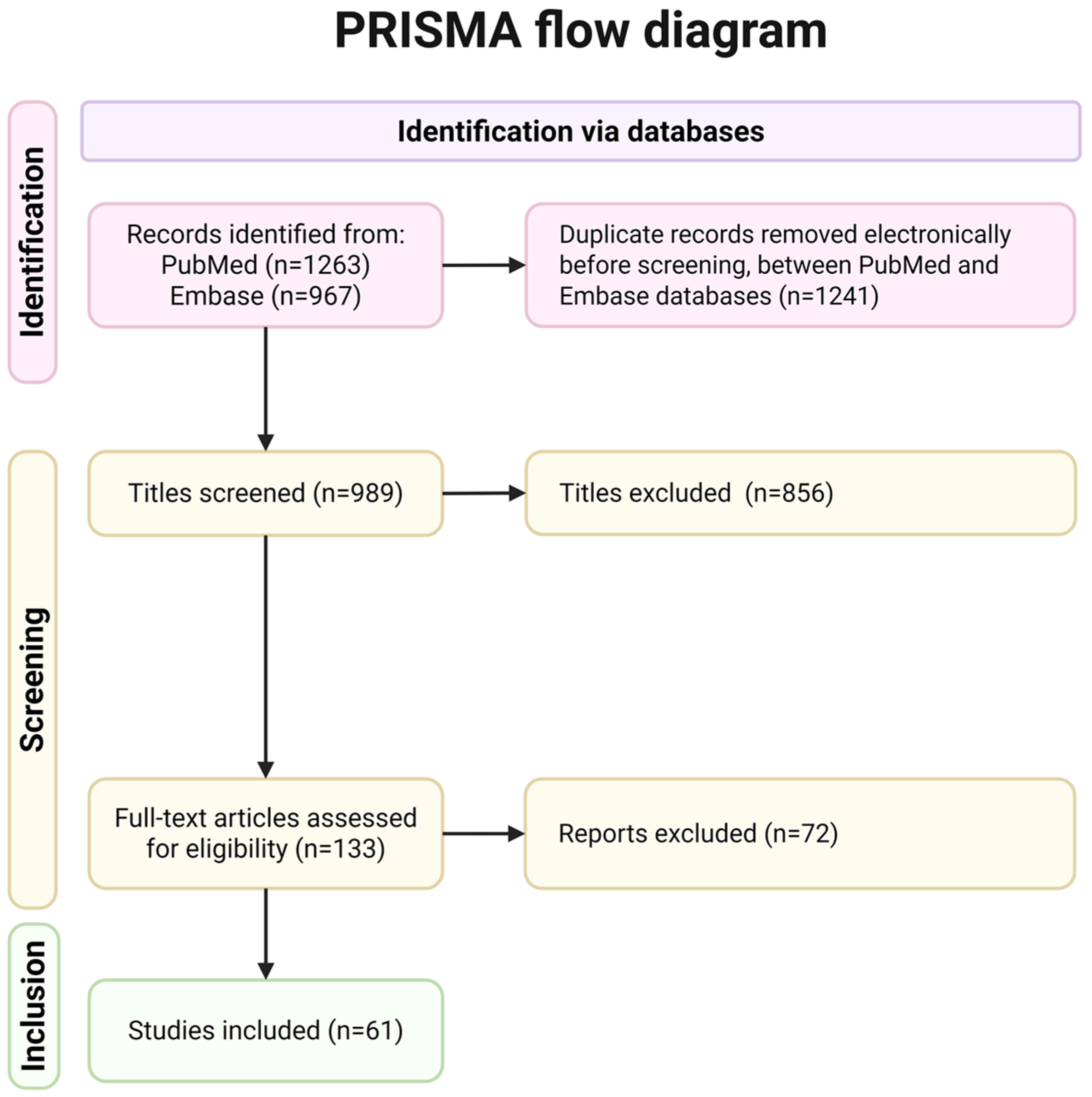
We conducted a literature search on the Pubmed and Embase databases, with a timeframe from 2010 to September 2025. Only English language articles were included. All types of articles were included as long as the studies were relevant for future studies in humans.
We performed an electronic search using database-specific keywords (see Table 1).
We performed a screening of all the material, focusing on title and abstract, if they were linked with autoimmune endocrine diseases, and their genetic and epigenetic mechanism; they were then selected to be further analyzed. Articles that were duplicates, were not strict about autoimmune disease, or were not applicable to humans were ruled out. Further screening was performed based on the material being free. The selected material to be read was then further screened on the same basis as before and on their ability to provide a deeper look into the genetic mechanism (Figure 1).
Figure 1. PRISMA flowchart showing the process of literature search and study selection.

3. Results

3.1. Autoimmune Thyroid Diseases (AITD)

Autoimmune thyroid diseases (AITD), encompassing Graves’ disease (GD) and Hashimoto’s thyroiditis (HT), are among the most common autoimmune disorders, affecting ~5% of the population [1]. Loss of immune tolerance underpins both entities but with distinct effector patterns. In GD, thyroidal T-cell infiltration and B-cell activation lead to the production of TSH-receptor autoantibodies (TRAb), whose binding to TSHR drives goiter, hyperthyroidism, and extrathyroidal manifestations such as ophthalmopathy and dermopathy. In HT, a predominantly cell-mediated response with high inflammatory load and apoptosis causes progressive thyroid tissue destruction and hypothyroidism; humoral autoimmunity frequently coexists, with anti-TPO and anti-Tg positivity [1,10]. The etiology of AITD is multifactorial: genetic factors explain a substantial share of susceptibility, while epigenetic and environmental modifiers contribute to phenotypic variation (Table 2).
Table 2. Reported genes and epigenetic mechanisms linked to autoimmune thyroid disease.

3.1.1. Genetic Mechanisms in AITD

AITD cluster in families, and quantitative data underscore strong heritability with cross-phenotype overlap. In GD, concordance has been reported at 35% in monozygotic (MZ) twins versus 3% in dizygotic (DZ) twins; in HT, concordance rates of 55% (MZ) and 0% (DZ) have been described, with concordance for autoantibodies also higher in MZ than DZ twins (e.g., TgAb 59% vs. 23%; TPOAb 47% vs. 29%) [12]. Family studies reveal elevated recurrence among first- and second-degree relatives; a total of 6.1% of first-degree relatives of GD probands have GD, 4.9% of first-degree relatives of HT probands have HT, and a Mendelian dominant pattern has been suggested for the tendency to develop thyroid autoantibodies [1]. Importantly, intrafamilial and intrapair variation is common: in MZ twins, the co-twin of a GD case may develop HT (and vice versa), illustrating shared genetic architecture with divergent clinical expression [1,12]. These data support a model in which shared susceptibility alleles are modulated by epigenetic and environmental inputs to determine phenotype.
Susceptibility genes fall broadly into (i) immune-regulatory loci—HLA-DR3, PTPN22, CD40, FOXP3, CTLA4—and (ii) thyroid-specific antigen genes—Tg, TPO, TSHR [1,10,11].
HLA Region
The MHC on 6p21 encodes HLA molecules that present peptides to T-cells, shaping central and peripheral tolerance. Polymorphisms influence peptide binding, thymic selection, and downstream immune programs [10]. HLA-DR3 (DRB1*03) shows a strong association with GD—~40–55% in Caucasian GD versus 15–30% in the general population—and contributes to shared susceptibility with type 1 diabetes [2,6]. Signals for HT are less consistent, but a predisposing effect is often suggested [10,14]. Graves ophthalmopathy (GO) and response to therapy have been linked to specific HLA patterns [15].
Costimulation and Lymphocyte Signaling (CTLA4, PTPN22, CD40, FOXP3)
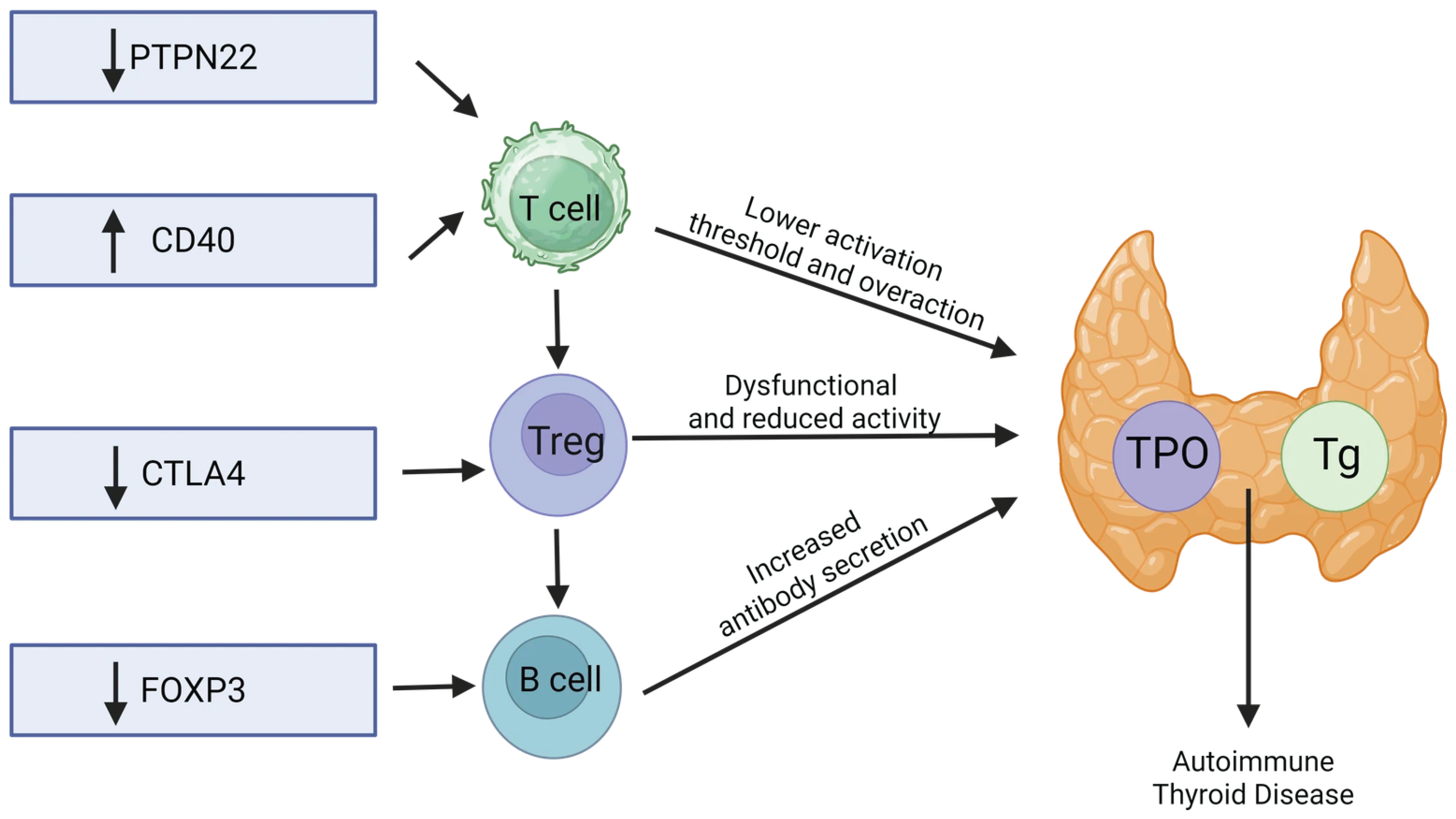
PTPN22 (R620W, rs2476601) is a well-replicated non-HLA risk allele for AITD (Figure 2), with population-dependent effects [1,10,14]. CD40 promoter/UTR variants (e.g., rs1883832) influence expression and associate with GD, with distinct signals reported in HT [1]. CTLA4 variants (e.g., +49A/G; rs231775/rs231779) alter checkpoint function and have been repeatedly linked to GD and broader AITD phenotypes [1,10,14]. FOXP3 polymorphisms (e.g., rs3761548, rs3761549) may compromise Treg stability or function; meta-analyses report GD associations (ancestry-specific for rs3761548) and links to HT and TPOAb titers [1,13,15].
Figure 2. Thyroid autoimmune disease mechanisms.
FOXP3 genetic variation has also been associated with clinical course—e.g., remission versus intractable GD and HT severity—suggesting prognostic value [1].

3.1.2. Thyroid-Specific Susceptibility Genes

TSHR
TSHR (14q31) encodes the GPCR essential for thyroid growth and hormone synthesis and is a central autoantigen in GD, where TRAb mimics TSH signaling. Multiple intron-1 SNPs (notably rs179247, rs12101255) reproducibly associate with GD across cohorts and ancestries; additional variants influence ophthalmopathy risk [1,10,14]. The proposed mechanisms include altered alternative splicing in the thyroid (increasing soluble isoforms with greater immunogenicity) and modulation of thymic TSHR expression that shapes central tolerance [15].
TSHR variant patterns have been linked to ophthalmopathy, helping stratify prognosis for eye disease in GD [1,15].
TG
TG (8q24) encodes thyroglobulin, the iodinated precursor of T3/T4. Linkage/association studies across exons 10, 12, and 33 and intron 41 report haplotypes and SNPs associated with GD, HT, and TgAb positivity, with cohort-dependent effect sizes [1,10,14]. Structural changes to TG under conditions of high iodine may remodel processing and enhance the presentation of immunogenic peptides by HLA-DRβ-Arg74, increasing T-cell recognition [1,17].
TPO
TPO (2p25) encodes thyroid peroxidase. Several SNPs (e.g., rs2071400, rs2071403, rs732609) associate with TPOAb levels, HT risk, and disease course in selected cohorts, though the effects vary by ancestry and phenotype [1,10,14].

3.2. Epigenetics and AITD

Epigenetic remodeling integrates genetic risk with environmental input. In GD, global leukocyte hypomethylation is accompanied by pathway-specific changes, with many differentially methylated sites in intragenic regions; T-cell activation/signaling genes often display hypermethylation signatures [13,16,21]. The TSHR locus shows hypermethylation with reduced active histone marks in GD, consistent with regulatory control over transcript levels and splicing in the thyroid and thymus [16,20]. Epigenome-wide comparisons of GD and HT identify distinct DMPs/DMRs that persist after treatment and correlate with thyroid hormone levels, supporting disease-specific epigenetic architectures [20,21]. Age-related methylation trajectories at ATG4C, BECN1, and PRKAB1 further modulate AITD risk with aging [9]. From pre-clinical studies, histone-mark biology adds phenotype nuance: JMJD3/KDM6B (H3K27 demethylase) contributes to inflammatory stabilization in HT (pharmacologic GSK-J4 is modulatory) [22], whereas LSD1/KDM1A (H3K9 demethylase) promotes orbital adipogenesis in GD-associated ophthalmopathy [18].
Promoter DNA-methylation patterns have been associated with GD severity and treatment response, indicating potential prognostic utility [16,20].

3.3. Environmental Factors and AITD

Multiple exposures modulate risk, including smoking, alcohol, iodine status, infections, medications (e.g., interferon-α, amiodarone), stress, pregnancy/postpartum, selenium status, ionizing radiation, and features of the gut microbiome and broader exposome [10,20,23].
Excess iodine is a risk factor for AITD, plausibly by increasing TG antigenicity (e.g., reactive-oxygen-species–mediated structural changes) and amplifying autoimmune responses [1,19,21].
Infectious triggers—commonly assessed serologically—include Yersinia enterocolitica, Helicobacter pylori, Borrelia burgdorferi, hepatitis C virus, Hantavirus, Saccharomyces, Toxoplasma gondii, and HIV; differences in gut microbiota composition between GD and HT have been reported [1,23,24]. Therapy-related exposures are clinically relevant: interferon-α is strongly associated with thyroiditis in predisposed individuals [10,20].

3.4. Other Nongenetic and Nonnutritional Factors

Fetal–maternal microchimerism reflects bidirectional trafficking of cells during pregnancy, with long-term persistence in the host. Data on its role in AITD are conflicting, with studies reporting both higher and lower fetal cell counts in cases versus controls, suggesting context-dependent effects on tolerance and inflammation [10].

3.5. Autoimmune Pituitary Disease

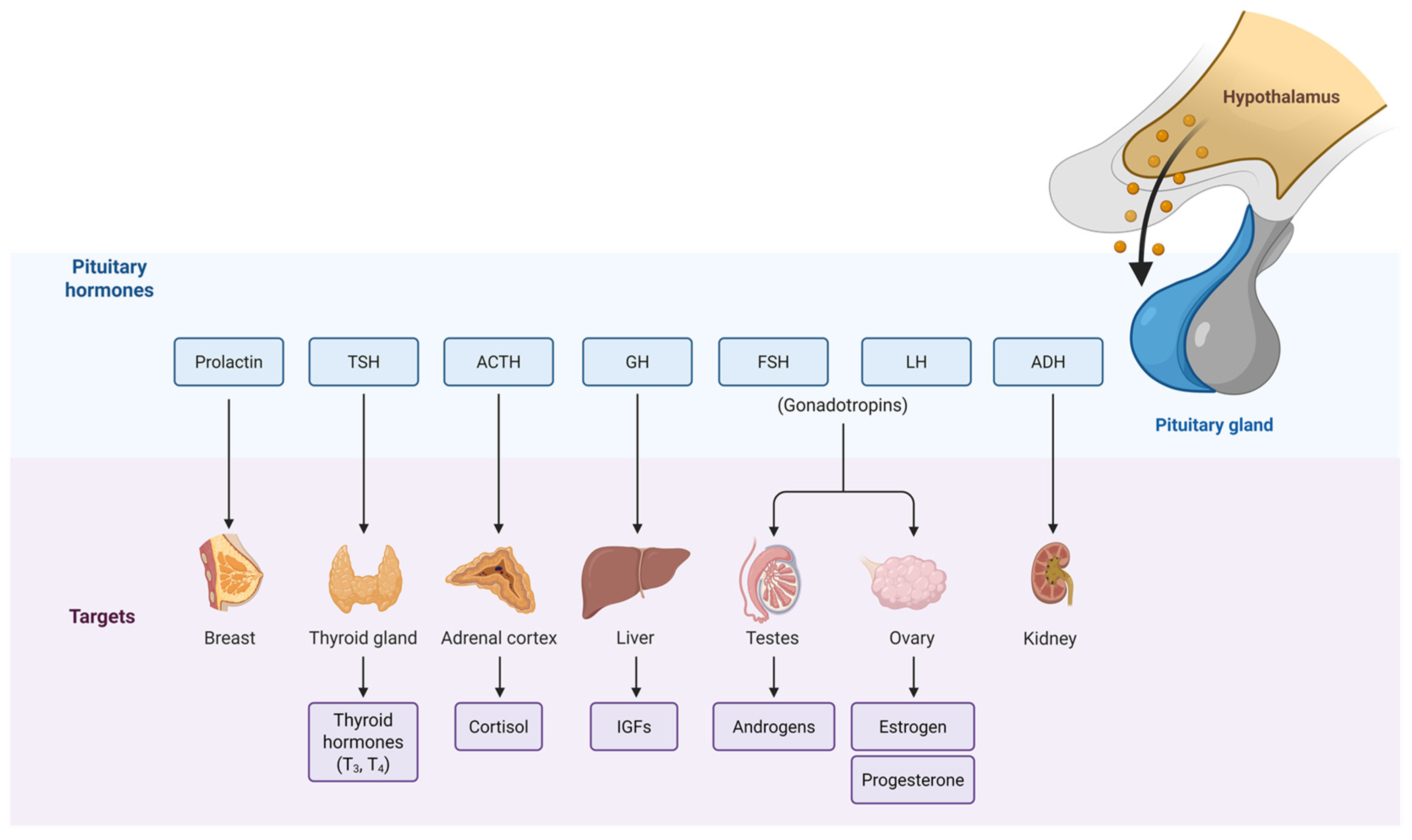
Hypopituitarism is a condition characterized by the reduced secretion of one or more of the hormones produced by the pituitary gland. Because the pituitary gland orchestrates endocrine axes that regulate growth, metabolism, reproduction, and stress responses, hypopituitarism disrupts systemic homeostasis and is linked to impaired quality of life and a worse prognosis; importantly, secondary adrenal insufficiency may precipitate life-threatening adrenal crisis (Figure 3). It is classically divided into congenital and acquired causes. Hypopituitarism is frequently accompanied by other systemic and localized diseases [9].
Figure 3. Hypothalamic–pituitary–peripheral action axis.
Congenital hypopituitarism often stems from disruptions in transcription factors and signaling pathways critical for pituitary organogenesis. Acquired hypopituitarism, frequently associated with pituitary tumors or systemic diseases, has also been increasingly linked to autoimmune mechanisms.
Hypophysitis is an inflammatory disorder of the pituitary that commonly presents with hypopituitarism. Clinically, corticotroph (ACTH) and thyrotroph (TSH) deficiencies are typical, with hypogonadism also frequent; diabetes insipidus and hyperprolactinemia may occur. By etiology, hypophysitis is classified as primary (idiopathic/autoimmune) or secondary (due to a systemic disease, local lesion, or drug) [9,25].

3.5.1. Primary Hypophysitis

Primary hypophysitis is rare (around 1 per 9 million per year), and the definitive diagnosis requires histological confirmation; a probable diagnosis may include typical neuroimaging criteria (symmetricaly thickened pituitary stalk, homogeneous enhancement after contrast agents, dural tail sign, intact sellar floor, or pituitary shrinkage over time in chronic phase), any pituitary deficiency, and the exclusion of secondary causes such as tumors or infiltrative lesions. The histopathologic subtypes include lymphocytic (the most common), granulomatous, xanthogranulomatous, and necrotizing. Lymphocytic hypophysitis, otherwise known as autoimmune hypophysitis, can be anatomically subdivided into lymphocytic adenohypophysitis (LAH), lymphocytic infundibulo-neurohypophysitis (LINH), and lymphocytic panhypophysitis (LPH) [9].
Lymphocytic hypophysitis (LH) represents the most frequent form of hypophysitis, accounting for approximately two-thirds of all cases. LH predominantly affects women, particularly during the late stages of pregnancy or the immediate postpartum period, with a primary impact on the anterior pituitary. A common symptom of LH is adrenocorticotrophic hormone (ACTH) deficiency. Autoimmunity underpins primary disease, with genetic susceptibility (e.g., specific HLA backgrounds) and pituitary-directed autoantibodies reported (Table 3).
Table 3. Currently reported genetic associations in autoimmune hypophysitis.
An autoimmune basis is supported by HLA associations—HLA-DQ8 and HLA-DR53—and by identified pituitary autoantigens and autoantibodies, including GH1/GH2, ENOL1, PGSF1a/PGSF2, SCG2, and lactotroph-targeting antibodies [9,26].
Genetics and Hypopituitarism
Hypophysitis is a disorder whose genetic basis is still not fully understood due to its complex etiology and the possible involvement of other causes of hypopituitarism, such as congenital diseases that lead to abnormal pituitary gland development. Patients carrying mutations in the POU1F1 or PROP1 genes may present with this disorder, making it necessary to differentiate child-onset hypopituitarism from pediatric hypophysitis and pituitary hyperplasia. Multiple studies report the presence of certain human leukocyte antigen (HLA) polymorphisms in patients with PAH, supporting an antigen-presentation-driven mechanism. For example, HLA-DR4 and HLA-DR5 were found in 44% and 23% of cases, respectively, between 1987 and 1999, and HLA haplotypes DQ8 and DR53 were identified in 87% and 80% of cases, respectively, in a series of 15 PAH patients. A recent study identified the presence of 12 HLA haplotypes associated with celiac disease in 16 consecutive Caucasian patients affected by PAH, with the prevalence of the DQ8 haplotype being 25%. Moreover, individuals carrying the DQ8 haplotype were four times more likely to develop PAH [9,25].

3.5.2. Secondary Hypophysitis

Secondary hypophysitis results from systemic or local conditions, including Sjögren’s syndrome, systemic lupus erythematosus, sarcoidosis, Langerhans cell histiocytosis, and IgG4-related disease; it also includes drug-induced forms (e.g., immune checkpoint inhibitors targeting CTLA4 or PDCD1/PDCDL1, daclizumab) and rare post-vaccination cases (including reports linked to SARS-CoV-2 infection or vaccination) [25].

3.5.3. ICI-Induced Hypophysitis

Hypophysitis is an increasingly frequent endocrine toxicity of clinical significance observed in patients on treatment with ICIs, particularly monoclonal antibodies (mAbs) that target cytotoxic T-lymphocyte antigen 4 (CTLA4) and programmed cell death-1 (PDCD1). Nonetheless, there are limited data available on the molecular mechanism underlying this disorder.
Genetic Factors and ICI-Induced Hypophysitis
The pathogenesis of IIHs involves various mechanisms, among which genetic factors play a crucial role.
It is well known that genetic polymorphisms of CTLA4 and PDCD1 genes can increase the risk of developing autoimmune diseases, including IIHs. These polymorphisms may not alter the CTLA4 amino acid sequence but can affect the affinity for CTLA4 mAbs, thereby increasing the risk of immunotherapy-induced autoimmune disorders.
Several HLA haplotypes have been shown to be associated. A Japanese study showed that HLACw12 and HLA-DR15 were significantly associated with anti-CTLA4-related hypophysitis, whereas HLA-DQB106:01, HLA-DPB109:01, and HLA-DRB5*01:02 were significantly associated with anti-PD-1-related hypophysitis. Another study found that HLA-Cw12, HLA-DR15, HLA-DQ7, and HLA-DPw9 were significantly more prevalent in patients with immunotherapy-induced central hypoadrenalism.
This HLA association presents a possible alternative mechanistic hypothesis in contrast to the proposed hypothesis that ICI hypophysitis is due to direct binding of CTLA4 inhibitors to pituitary cells.
Additionally, copy number variations (CNVs) and small variations (VARs) may also be associated with the occurrence of IIHs. A study analyzing 95 melanoma patients treated with ICIs found that genes affected by VARs associated with hypophysitis include SMAD3, PRDM1, and IL1RN, while genes affected by CNVs related to the occurrence of hypophysitis are TERT, SMAD3, JAK2, PRDM1, FAN1, CD274, and UNG [26].

3.5.4. Anti-POUF1F1 Hypophysitis

Anti-POU1F1 hypophysitis (anti-POU1F1 antibody syndrome) is a newly described pituitary autoimmune disease characterized by acquired and specific growth hormone (GH), prolactin (PRL), and thyroid-stimulating hormone (TSH) deficiencies.
This disorder is associated with a thymoma or neoplasm that ectopically expresses pituitary-specific transcription factor 1 (POU1F1) protein. Circulating anti-POU1F1 antibody is a disease marker, and POU1F1-reactive cytotoxic T-cells (CTLs) play a pivotal role in disease development. Immunohistochemical analyses of pituitary tissue from autopsies revealed the persistence of ACTH-, LH-, and FSH-positive cells, while POU1F1-positive (GH, PRL, and TSH) cells were absent. Lymphocytes (rather than serum alone) are reactive to POU1F1, and tolerance appears to break via ectopic POU1F1 expression in tumors (classically thymoma but also other malignancies).
Genetic and Anti-POU1F1 Hypophysitis
The genetic background regulating the threshold of autoantibody production in B-cells has also been implicated. Studies established that processed POU1F1 epitopes are presented on the cell surfaces of anterior pituitary cells via major histocompatibility complex (MHC)/human leukocyte antigen (HLA) class I molecules [9].
With regard to thymoma, it has been reported that various genes associated with regulation are mutated in thymic carcinoma, and epigenetic abnormalities are common in thymoma. Given that many malignancies exhibit abnormal epigenetic regulation, it is plausible that these altered epigenetic modifications result in ectopic POU1F1 expression, and some studies are being conducted, even if no detected methylation abnormalities have been found in the regulatory region of the POU1F1 gene in thymoma [2]. Prospective, multi-center cohorts integrating germline HLA/immune-gene genotyping, tumor genomics, and paired blood/tumor epigenomics (methylome, chromatin accessibility) are needed to define causal pathways and develop predictive risk tools for autoimmune hypophysitis.

3.6. Autoimmune Parathyroid Disorders

Hypoparathyroidism is an endocrine disorder characterized by insufficient secretion of parathyroid hormone (PTH), presenting with hypocalcemia, hyperphosphatemia, and a relatively high urinary calcium excretion [27]. Autoimmune hypoparathyroidism is rare and may occur as an isolated, acquired disease or as part of autoimmune polyendocrinopathy syndromes (APS) [27,28]. It can be caused by permanent hypoparathyroidism, owing to irreversible, immune-mediated damage to the parathyroid glands, or functional hypoparathyroidism as a result of antibody-induced activation of signaling pathway(s) regulating parathyroid function [29].
In isolated cases, pathogenic mechanisms include activating autoantibodies against the calcium-sensing receptor (CaSR), which suppresses parathyroid hormone (PTH) secretion despite hypocalcemia [30], as shown in sporadic patients and in immune checkpoint inhibitor-induced hypoparathyroidism [29,31,32].
In APS-1, otherwise known as autoimmune polyendocrinopathy-candidiasis-ectodermal dystrophy (APECED), hypoparathyroidism represents one of the three major diagnostic criteria and occurs in 73–90% of patients, usually together with chronic mucocutaneous candidiasis and Addison’s disease [33,34]. Screening for anti-IFN-ω and anti-IL-22 autoantibodies provides highly sensitive diagnostic markers [4,5,28,34] often accompanied by anti-IL-17A/F; these cytokine autoantibodies are valuable for early recognition and risk stratification, while antibodies against NALP5 and CaSR may predict or accompany parathyroid failure [27]. Outside APS-1, autoimmune hypoparathyroidism can coexist with autoimmune thyroid disease (often catalogued as APS-3) or with diverse organ-specific autoimmunity (APS-4), and when no APS-1 hallmarks or disease-specific autoantibodies are detected, the autoimmune etiology rests on clinical clustering and exclusion of alternatives [27]. In the forms without specific autoantibodies (NALP5Abs, IFNωAbs, etc.) or AIRE gene mutations, the autoimmune etiology remains hypothetical (Table 4).
Table 4. Reported genetic and epigenetic mechanisms in parathyroid autoimmune disease.
In such non-APS-1 HP, only the association with class I human leucocyte antigen (HLA) allele A*2601 and with class II HLA alleles DRB1*01 and DRB1*09 has been demonstrated [28,30].

3.6.1. Genetic Mechanisms in Autoimmune Parathyroid Disease

The best defined genetic substrate of autoimmune parathyroid disease is biallelic loss-of-function mutations in AIRE [5], a transcriptional regulator that ensures central immune tolerance by promoting thymic expression of tissue-specific antigens [27]. More than 120 AIRE mutations have been described worldwide, with population-specific founder effects [33,34,35]:
-
p.R257X in Finland and Eastern/Central Europe;
-
p.R139X in Sardinia;
-
p.Y85C in Iranian Jews;
-
p.R203X in Southern Italy/Sicily;
-
The 13 bp exon 8 deletion (p.Leu323fs) in British and North American cohorts [4,6,33].
Despite identical AIRE mutations, striking phenotypic variability occurs, even in siblings [38]. For example, in Finnish and Indian cohorts, patients homozygous for the same founder mutation presented with divergent severity, some showing early candidiasis and others predominately endocrine failure [4,5,38]. This variability highlights the modifying role of nongenetic factors. Rarely, isolated hypoparathyroidism due to AIRE mutations has been documented [30,34,39], with decades of follow-up in which no other APS-1 features developed (exome-sequencing series and kindreds) [39].
In addition to recessive inheritance, dominant-negative AIRE mutations have been reported, leading to milder or non-classical APS-1 with incomplete penetrance [36]. Indeed, the G228W mutation was discovered in a patient from Tuscany affected by CH and autoimmune thyroiditis with the presence of circulating 21OH antibodies [13]; whilst the c.932G>A (p.C311Y) AIRE variant was found in a North-African patient affected by CMC, AAD, enamel dystrophy, partial diabetes insipidus, and pernicious anemia [6]. Oftedal and colleagues identified heterozygous, dominantly acting AIRE missense variants clustering in the PHD1 zinc-finger domain, associated with later onset, milder autoimmunity and reduced penetrance (“non-classical” APS-1), whereas most recessive missense variants in classical APS-1 map to the N-terminal CARD/HSR region; thus, whether an AIRE allele behaves recessively or dominantly is strongly influenced by its position and the domain it perturbs [37]. They propose that APS-1 can be dived into (i) a “classical” recessive entity (≥2 core components and anti–type-I-IFN antibodies) and (ii) a “non-classical” entity due to dominant heterozygous PHD1 variants with milder, less penetrant autoimmunity [32].
Genotype–phenotype nuances support this view: in Iranian Jews, p.Y85C has been associated with lower rates of chronic mucocutaneous candidiasis (CMC) and Addison disease; most Finnish carriers of p.R257X manifest CMC; exon-8 c.967–979del13bp cohorts showed less CMC but more alopecia in some European series; whereas an Indian APECED series homozygous for c.967–979del13bp exhibited frequent CMC (~75%) and relatively infrequent alopecia (~17%), underscoring population modifiers [5].
Beyond AIRE, immune effectors also play a genetic/immunologic role. Autoantibodies against CaSR can act as functional receptor agonists, directly inhibiting PTH secretion and causing hypocalcemia [29,31,32]. Similarly, NALP5 autoantibodies have been associated with parathyroid autoimmunity in APS-1 [34]. Furthermore, HLA associations support an adaptive immune contribution: HLA-A*26:01 (MHC class I) is strongly linked to idiopathic hypoparathyroidism, implicating CD8+ cytotoxic T-cells, while HLA-DRB1*01 and HLA-DRB1*09 alleles are enriched in affected patients [27].

3.6.2. Epigenetics and Hypoparathyroidism

Although direct epigenetic studies in autoimmune hypoparathyroidism are limited, AIRE function is inherently chromatin dependent. AIRE induces transcription of tissue-specific antigens at loci with a repressive chromatin state, promoting the deletion of autoreactive T-cells and the development of regulatory T-cells (Cranston et al., 2022 [34]). AIRE also exerts TSA-independent functions relevant to central tolerance, including modulation of chemokine expression, regulation of mTEC apoptosis and differentiation, and control of thymocyte migration [27].
Post-transcriptional regulation has been implicated as well: miR-220b has been shown to directly regulate AIRE expression, linking microRNA dysregulation to defective immune tolerance [37]. Other transcriptional regulators such as Fezf2 can independently orchestrate TSA expression programs, providing an additional chromatin-based mechanism that cooperates with or compensates for AIRE [37].
Evidence from clinical cohorts further supports an epigenetic/environmental contribution. In Indian and Finnish series, siblings with identical AIRE mutations often displayed markedly different clinical courses [5,36]. Similarly, microbiota differences across populations may contribute to variability in autoimmune phenotype despite shared genotypes [33]. Moreover, sex-specific penetrance of hypoparathyroidism in APS-1 underscores the likely role of epigenetic or hormonal modifiers [27]. Taken together, these findings indicate that, while APS-1 is a monogenic disorder, its clinical expression reflects a complex interplay between genetics, epigenetics, and environment [39].
Of note, sex differences exist: penetrance of hypoparathyroidism in APS-1 is nearly 100% in women but <60% in men, while Addison’s disease shows no sex bias [27,38]. This discrepancy suggests hormonal or epigenetic modifiers influence the expression of parathyroid autoimmunity.
Collectively, these data reinforce that AIRE’s role in parathyroid and broader organ-specific autoimmunity is not binary (present/absent) but gradated by the affected domain, allelic behavior (recessive vs. dominant-negative), and modifying factors (sex, environment, microbiome).

3.7. Autoimmune Adrenal Disease

Adrenal insufficiency (AI) denotes impaired glucocorticoid production due to reduced adrenal function. Three etiologic categories are recognized: primary AI (PAI) due to adrenal pathology; secondary AI from deficient pituitary ACTH; and tertiary AI from hypothalamic dysfunction (often grouped with secondary AI). Primary AI, known as Addison’s disease (AD), is rare, with a prevalence of 100 per million in Europe, and results from damage or malfunction of the adrenal cortex leading to deficient cortisol, aldosterone, and DHEA synthesis. In autoimmune AD (often termed autoimmune Addison disease, AAD), a consistent serological hallmark is the presence of 21-hydroxylase (CYP21A2) autoantibodies, detectable in ~85% of patients near diagnosis. By contrast, secondary AI reflects inadequate ACTH drive with consequent glucocorticoid deficiency and relatively preserved mineralocorticoid production [7,8].

3.7.1. Addison’s Disease

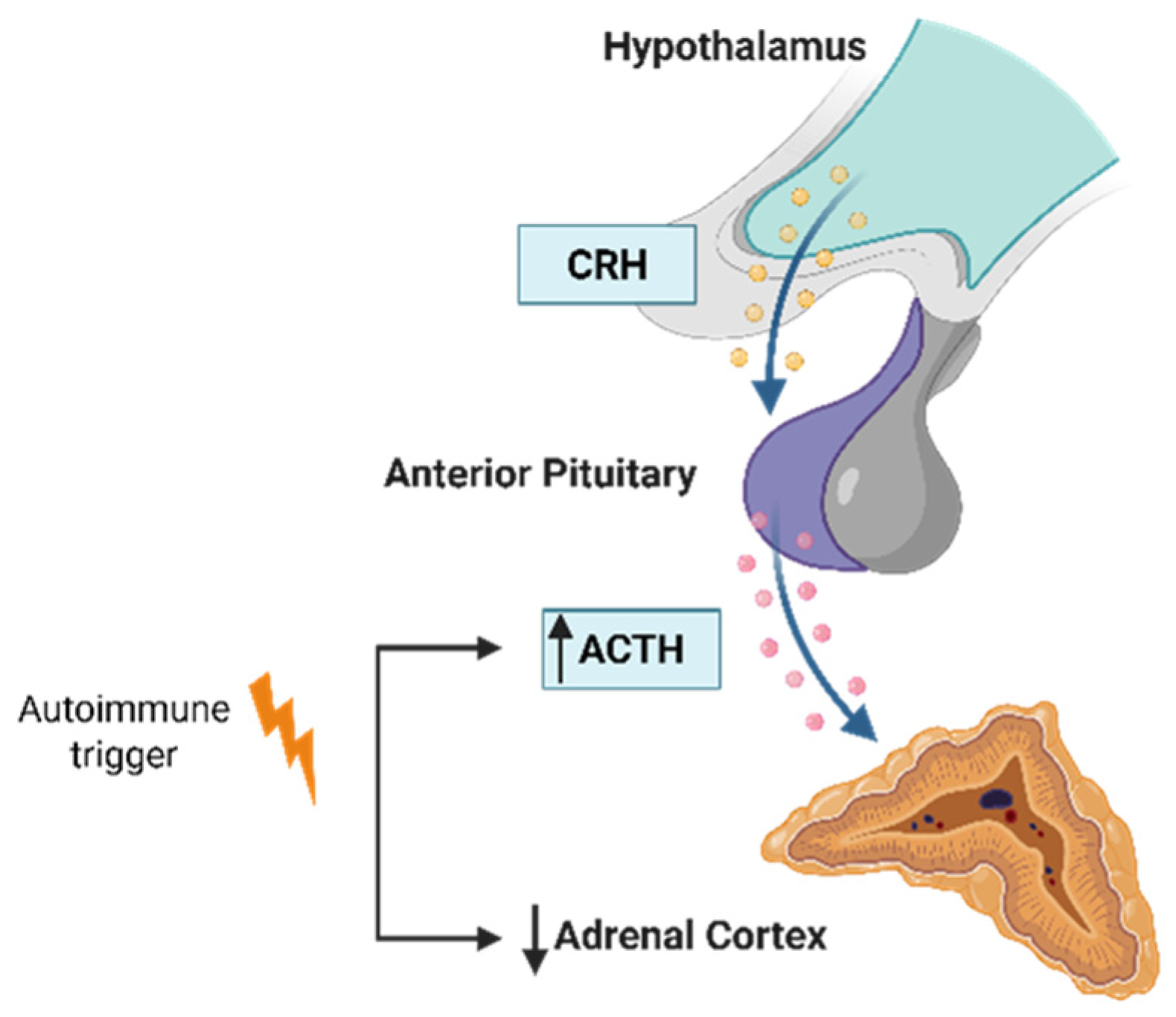
Autoimmune destruction of the adrenal cortex is the most common cause of PAI. Pathogenesis is multifactorial, with polygenic genetic susceptibility and environmental modifiers (Figure 4). AAD may occur in isolation or, in a substantial fraction, co-aggregate within autoimmune polyglandular syndromes (APS)—particularly APS-2 but can also present in the context of APS-1 due to AIRE mutations (Table 5) [7,8]. Large population analyses (including a UK cohort exceeding 22 million individuals) indicate that AAD risk clusters with many other autoimmune diseases, consistent with shared genetic architecture and, in some settings, iatrogenic influences from immunomodulatory therapies used for coexisting autoimmunity [37,40].
Figure 4. Adrenal autoimmunity mechanism.
Table 5. Reported genetic and epigenetic associations in autoimmune adrenal disease.
Addison’s Disease and Genetic Mechanisms
Except for monogenic APS-1, most AAD does not follow Mendelian inheritance; nevertheless, familial clustering and twin data support high heritability [7,8]. Candidate gene studies established HLA class II as the dominant susceptibility region, particularly DR3–DQ2 and DR4–DQ8 haplotypes. Additional immune-regulatory loci include MICA/MICB, CTLA4, PTPN22, CIITA, CLEC16A, CD274 (PD-L1), and NLRP1 (NALP1)—variants shared with other autoimmune diseases, underscoring common immune checkpoints rather than AAD-specific genes. A disease-specific AAD locus has not been definitively identified, although HLA-DRB1*04:04 has been implicated in some populations [8]. Beyond common variants, rare variants in immune genes such as RAG1, TNFAIP3 (A20), LAT, and IKZF2 (HELIOS) have been described in autoimmune syndromes that include adrenal autoimmunity [8].
The first genome-wide association study of AAD (1200 cases; Wolff et al. [7]) reported nine risk loci, collectively explaining 40% of common-variant risk, with the HLA region contributing the largest effect. Previously implicated genes (BACH2, PTPN22, CTLA4) were confirmed, and additional loci (LPP, SH2B3, SIGLEC5, UBASH3A) were identified. Notably, AIRE showed common-variant associations, indicating that AIRE contributes to risk both in monogenic APS-1 and in the polygenic spectrum. Together with AIRE signals in type 1 diabetes and pernicious anemia, these data support an AIRE dosage/functional-level effect on organ-specific autoimmunity [7,8]. In Swedish AAD, polygenic risk modeling (Røyrvik et al.) showed that each additional risk allele more than doubled the odds of disease and advanced age at onset by >8 years when comparing individuals with >9 versus <5 risk alleles; a polygenic risk score (PRS) distinguished typical autoimmune PAI from pediatric monogenic PAI, in which PRS values were clearly lower—suggesting clinical utility for triage toward genetic testing when PRS is low [8].
  • Copy-Number Variation (CNV)
A CNV study (Brønstad et al.) identified two loci associated with AAD near UGT2B28 (chromosome 4) and ADAM3A (chromosome 8) [3]. Although mechanisms remain to be clarified, UGT2B28 participates in steroid glucuronidation (implicating altered steroid inactivation), and ADAM-family genes influence inflammatory signaling and T-cell biology (suggesting effects on immune maturation). The UGT2B28 single-copy state (CN = 1) was enriched in cases but is also relatively common in the general population, and the locus overlaps the UGT2B17 region, so specificity for autoimmunity remains uncertain. These data highlight that gene dosage (copy number) may add to sequence variation in shaping AAD risk [3].
Addison’s Disease and Epigenetic Mechanisms
Because AAD is strongly associated with HLA class II, CD4+ T-cell-mediated processes are central. Epigenetic profiling in CD4+ T-cells has reported global hypomethylation in AAD relative to controls, with a majority of differentially methylated regions (DMRs) in promoter elements and an overall skew toward hypomethylation; these patterns are comparable to those observed across other organ-specific autoimmune diseases and may reflect persistent activation states in disease-relevant pathways [8].

3.7.2. Autoimmune Polyendocrine Syndrome (APS)

APS-1 (APECED) is a rare, typically childhood-onset disorder caused by biallelic pathogenic variants in AIRE, resulting in defective central tolerance. Classically, diagnosis rests on two of three major features: primary adrenal insufficiency, hypoparathyroidism, and chronic mucocutaneous candidiasis, although numerous minor components occur and clinical expressivity is broad [33,35,37]. The human AIRE gene (21q22.3) spans 14 exons encoding a 545 aa protein with a CARD/HSR region (oligomerization), SAND domain, LXXLL motifs, and two PHD zinc fingers that coordinate co-factor recruitment and chromatin engagement. More than 100 pathogenic variants have been reported; many alter splicing, producing exon-skipped or intron-retained transcripts with reduced transcriptional activity. Founder effects contribute to geographic clustering (e.g., p.R257X in Finland and parts of Central/Eastern Europe; p.R139X in Sardinia; p.Y85C in Iranian Jews; recurrent 13 bp exon 8 deletions in British/Irish/North American cohorts) [30,33,36]. Although robust genotype–phenotype rules are elusive, dose–response between residual AIRE function and disease severity is emerging: dominant-negative or hypomorphic alleles can cause non-classical APS-1 with later onset and reduced penetrance [36]. Beyond monogenic APS-1, common AIRE variation (e.g., p.R471C) contributes to polygenic risk for Addison’s disease, pernicious anemia, and type 1 diabetes, reinforcing the concept that AIRE dosage influences a continuum from rare to common autoimmunity [7,8].
Autoantibodies are a defining feature of APS-1. Neutralizing anti–type I interferon (IFN-α subtypes and IFN-ω) antibodies are highly specific, often present before clinical disease, and now serve as early diagnostic biomarkers; other antibodies (e.g., anti–IL-17/IL-22) explain susceptibility to candidiasis, while organ-specific targets (e.g., NALP5 in APS-1 hypoparathyroidism) can assist phenotypic classification and monitoring [33,35,37]. Importantly, non-endocrine manifestations may precede the classic triad; incorporating such features into diagnostic criteria improves early detection and care trajectories [33].

3.8. Autoimmune Gonadal Disease

Autoimmunity connected to gonadal failure, namely autoimmune oophoritis in females and autoimmune orchitis in males, arises when immune tolerance to gonadal antigens breaks down, leading to inflammatory damage of hormone-producing and gametogenic tissues. The clinical consequence is frequently subfertility or infertility [40]. Risk is heightened in patients with coexisting endocrine (e.g., Hashimoto’s thyroiditis, Graves’ disease, autoimmune polyglandular syndromes) and non-endocrine autoimmune diseases due to underlying mechanisms of genetic predisposition, dysregulated immune responses, and environmental triggers (Table 6) [40]. Genetic predisposition plays a significant role; a prominent example is mainly linked to autoimmune regulator (AIRE) gene mutations as the AIRE gene is crucial for maintaining self-tolerance by preventing T-cell attacks on the body’s tissues [41].
Table 6. Reported genetic and epigenetic mechanisms involved in autoimmune gonad disease.

3.8.1. Autoimmune Testicular Disease

The testis is considered an immunoprivileged organ: the blood–testis barrier, specialized Sertoli–germ cell junctions, local immunoregulatory mediators, and constrained antigen presentation together protect from immune attack germ cells that appear after puberty when immunocompetence is already established [56]. Nonetheless, infection, trauma, surgery, or congenital anomalies can expose sperm antigens to the immune system and precipitate anti-sperm antibodies (ASAs). ASAs are detectable in ~5–12% of men evaluated for infertility and can bind sperm in serum or seminal plasma, impairing motility and fertilizing capacity. When testicular immune privilege is breached and immune regulation fails to re-establish tolerance, a sustained autoimmune orchitis may ensue, characterized by testicular inflammation with ASAs in the absence of an infectious origin [3].
While environmental triggers such as infection or trauma may initiate inflammation, genetic predisposition is the primary determinant of whether a chronic autoimmune response develops. Evidence from human monogenic disease highlights both central tolerance defects and peripheral regulation of antigen presentation as key genetic mechanisms [41,42].
Genetic Mechanisms
The best characterized genetic cause is the AIRE gene. AIRE encodes a transcriptional regulator that establishes central tolerance by driving thymic expression of tissue-restricted antigens, including those from the male reproductive tract [41]. Inactivating mutations of AIRE causes autoimmune polyendocrine syndrome type 1 (APS-1), a monogenic disorder in which 12–30% of males develop primary hypogonadism with anti-sperm autoantibodies [42,43] In Aire-deficient mice, infertility is multifactorial: males show impaired mating, reduced testosterone, defective sperm fertilization, and autoimmune infiltration of the testis, epididymis, and prostate [42]. Autoreactivity can be directed to male reproductive proteins such as transglutaminase-4 (TGM4) and seminal vesicle secretory protein-2 (SVS2), underscoring that AIRE-dependent thymic display of reproductive antigens is central to preventing testicular autoimmunity [41].
Finally, MHC gene variants themselves remain the strongest polygenic contributors to autoimmune disease risk [3,7]. Certain MHC class II alleles present testis-specific antigens more effectively, favoring the activation of autoreactive T-cells and the development of orchitis. The role of MHC thus operates both directly, through allele-specific antigen presentation, and indirectly.
Epigenetic Mechanisms
Direct studies of epigenetic regulation in autoimmune male gonadal disease are lacking; however, AIRE itself functions through an epigenetic mechanism: it binds to non-methylated histone H3K4 (H3K4me0) and recruits transcriptional machinery to otherwise silent loci, enabling expression of testis-restricted antigens in the thymus [41]. In the absence of this chromatin-based control, autoreactive T-cells escape deletion and drive autoimmune orchitis. Beyond AIRE, no data currently implicate DNA methylation, histone modification, or non-coding RNAs in autoimmune orchitis specifically, highlighting an important research gap.

3.8.2. Autoimmune Ovarian Disease

The ovary is not an immunologically privileged organ, but a breakdown in tolerogenic mechanisms for ovary-specific antigens has disastrous consequences on fertility in women. Primary ovarian insufficiency (POI) denotes loss of ovarian function before age 40 and typically presents with persistent oligo/amenorrhea, menopausal-range gonadotropins, and low estradiol [40]. A total of 20–30% of cases show autoimmune involvement, manifesting as an isolated ovarian disorder, in association with other organ-specific autoimmunity—most commonly autoimmune thyroid disease or Addison disease—or within autoimmune polyglandular syndromes (APS) [44,45]. Serologic markers (anti-ovarian or steroidogenic-cell antibodies) are variably positive and lack sufficient sensitivity and specificity for routine diagnosis; ovarian biopsy is discouraged because of low diagnostic yield and the risk of depleting residual follicles. Across series, autoimmune involvement is reported in roughly one-fifth to one-third of POI, and co-aggregation with thyroid and adrenal autoimmunity is frequent, underscoring shared susceptibility across endocrine organs [45].
A particularly important clinical interface is APS. When adrenal autoimmunity is present—typically signaled by steroidogenic-cell or 21-hydroxylase antibodies—histological autoimmune oophoritis is well documented; conversely, histological oophoritis is uncommon in the absence of adrenal autoimmunity. Additional ovarian antigens such as MATER/NLRP5 further support an ovary-targeted autoimmune endotype in a subset. In parallel, thyroid autoimmunity co-aggregates with ovarian hypofunction more often than expected by chance, reinforcing the view that ovarian and thyroid disease frequently express a common susceptibility architecture [46].
Genetic Mechanisms of POI
The most direct genetic route to autoimmune ovarian disease is failure of central tolerance. In APS-1, loss-of-function variants in AIRE impair thymic expression of tissue-restricted antigens, weaken negative selection, and permit survival of autoreactive T-cells; ovarian autoimmunity and infertility are well-recognized components, making AIRE the clearest germline determinant linking tolerance defects to ovarian failure [41].
Beyond this rare monogenic context, available evidence supports a polygenic liability shared with other autoimmune disorders: a bidirectional, two-sample Mendelian randomization analysis reported genetic links between autoimmune diseases and POI, consistent with distributed risk across immune checkpoints and lymphocyte-signaling pathways that can manifest in different endocrine targets, including ovary and thyroid [47]. Genomic background outside classical immune genes also modulates phenotype. High-resolution mapping reveals copy-number variation on the X chromosome enriched among women with POI; although not specific to the autoimmune subset, dosage effects in meiosis, DNA repair, and oocyte-maintenance genes plausibly reduce functional ovarian reserve and lower the threshold at which immune-mediated injury produces clinical failure [48]. Immune profiling in POI that shows diminished FOXP3+ regulatory T-cell tone and Th17 skewing is compatible with inherited tolerance fragility and aligns with the frequent coexistence of other autoimmune diseases or APS [44,49].
The thyroid–ovarian connection exemplifies this shared genetic architecture in practice: women with autoimmune thyroid disease have higher rates of menstrual disturbance, subfertility, diminished ovarian response, and POI, and women with autoimmune POI frequently carry thyroid autoimmunity. Indeed, HLA-DR3 haplotype is associated with increased risk of POF. This reciprocity argues for two-way clinical surveillance at diagnosis and follow-up [50].
Epigenetics of POI
Genetic predisposition alone does not explain why some women develop isolated ovarian disease, others evolve into APS, and still others manifest a thyroid–ovary dyad. Epigenetic programs (DNA methylation, histone modifications, and non-coding RNAs) translate genetic susceptibility and environmental cues into durable transcriptional states in immune and ovarian compartments, shaping penetrance, organ selectivity, and clinical course. Three complementary axes emerge consistently from the corpus provided.
First is a microRNA-tolerance checkpoint centered on microRNA-21 (miR-21) and Pellino-1 (Peli1). In patients with autoimmune POI, miR-21 and its target Peli1, an E3 ligase that restrains T-cell activation via MAPK and NF-κB, are concomitantly down-regulated. Lower levels correlate with reduced ovarian reserve (lower AMH and estradiol; smaller ovarian and uterine size), higher gonadotropins, and greater autoantibody burden. These observations place the miR-21–Peli1 axis at the interface of systemic autoimmunity and ovarian failure and cohere with reports of reduced regulatory T-cell tone in POI [51,52].
Second is an ovarian-intrinsic survival and steroidogenesis module governed by miR-21, MSX1, and Notch signaling. In ZP3-induced autoimmune POI, bone marrow mesenchymal-stem-cell exosomes enriched in miR-21-5p restore ovarian structure and function by directly repressing MSX1, a transcriptional brake on Notch. Relief of MSX1 repression activates Notch signaling, reduces granulosa-cell apoptosis (with decreases in p53 and Bax and an increase in Bcl-2), enhances proliferation, and up-regulates steroidogenic genes (FSHR, CYP11A1, CYP19A1), with concordant endocrine improvement (higher estradiol and AMH, lower FSH) and higher follicle counts. This pathway provides an ovarian counterpart to the tolerance module and explains how the same regulatory RNA can couple immune tone to granulosa-cell fate and steroidogenesis [53].
Third is an inflammatory–epigenetic circuit centered on NF-κB-primed NLRP3 inflammasome activation and pyroptosis. In autoimmune POI models (for example, IFN-γ injury and ZP3 immunization), aberrant NF-κB signaling primes NLRP3–caspase-1–GSDMD-mediated granulosa-cell pyroptosis. Mesenchymal-stromal-cell-derived exosomes suppress NF-κB and NLRP3, reduce pyroptosis, restore endocrine function, improve folliculogenesis, and, in vivo, enhance fertility—highlighting a tractable chromatin-linked inflammatory axis in autoimmune POI [54].

4. Discussion

Endocrine autoimmunity involves mainly T-cells, including CD4+ helper cells, such as Th1, Th17, and Tfh, that drive inflammation and support B-cell activation as well as CD8+ cytotoxic T-cells that directly kill endocrine cells [55]. Regulatory T-cells normally suppress autoreactive responses, and their dysfunction allows autoimmunity to develop. B-cells produce autoantibodies and present antigens to T-cells, sustaining the immune attack. Antigen-presenting cells, like dendritic cells and macrophages, initiate and amplify responses, while stressed or hyper-secreting endocrine cells can contribute to their own recognition by the immune system. Other cells such as stromal cells, endothelial cells, and natural killer cells also support inflammation and tissue damage.
Endocrine autoimmune diseases (EADs) result from complex interactions between genetic susceptibility and environmental triggers. The intricate relationship between infectious pathogens and autoimmunity has long been a central question in immunology. While infections can act as triggers of autoimmune processes, they may also confer protection against them, reflecting a dual, context-dependent influence [57]. Pathogen exposure thus represents a double-edged sword: depending on timing, genetic background, and the immune context, it can either initiate or suppress autoimmune responses. Among pathogens, Staphylococcus aureus hemolysin has been shown to influence the epigenome of Th1 and Th17 cells—key players in autoimmune pathogenesis—through alterations in gene expression and changes in DNA methylation [58,59,60].
Endocrine organs operate feedback loops controlling proliferation and secretion. Mutant cells that over-sense signals may hyper-proliferate and hyper-secrete, threatening homeostasis. To counter this, autoreactive T-cells may preferentially eliminate such aberrant cells—but this surveillance comes with a trade-off: a fragility to autoimmune disease [61].
The neuroendocrine immune system also plays an important role in several systemic diseases, including autoimmune disorders. Among the major players of NEI pathways are steroid hormones of the adrenal (cortisol) and gonadal glands (sex hormones), neurohormones such as melatonin, and, more recently, the vitamin D endocrine system [62].
Although there is increasing knowledge about autoimmunity mechanisms, in many endocrine autoimmune disorders, the standard of care is still hormone replacement rather than therapies addressing the autoimmune mechanism [63].
Across the endocrine axes examined, the literature supports a model in which shared immune-regulatory genetics (dominant HLA class II signals with reproducible contributions from CTLA4 and PTPN22) interact with organ-proximal antigenic loci and epigenetic programs to produce distinct clinical phenotypes. In the thyroid, this framework is particularly well developed: immune-checkpoint loci converge with thyroid-specific genes (TSHR, TG, TPO), helping explain why susceptibility clusters within families yet partitions into Graves’ disease (GD) or Hashimoto’s thyroiditis (HT) depending on additional modifiers [1,2,3,6,10,11,14,15,16]. Family and twin evidence shows high heritability for both GD and HT, antibody concordance in monozygotic pairs, and occasional cross-phenotype switching, consistent with shared background risk and variable expression over time [1,12].
Epigenetically, global hypomethylation in GD coexists with locus- and pathway-specific changes, including hypermethylation/reduced active histone marks at TSHR and distinct DMP/DMR signatures separating GD from HT—even persisting after treatment, which argues that epigenetic state is not merely a consequence of thyroid status [16,20,21,22,52]. Several reports connect promoter methylation with disease severity and response in GD, suggesting emerging prognostic utility that warrants prospective validation [16,20,64]. Environmental inputs appear to be routed through these programs: excess iodine augments TG antigenicity and associates with methylation shifts in autophagy and signaling genes; infections (e.g., hepatitis C) and drugs (interferon-α, amiodarone) further lower the threshold for clinical disease [1,17,19,21]. The microbiome differs between GD and HT, but causality remains unsettled [23]. Together, these data support that epigenetic machinery encodes environmental exposures on a genetically primed immune system, shaping phenotype and course [13,15,16,17,19,20,21,23,24,65].
In hypophysitis, idiopathic/primary forms show HLA associations and candidate pituitary autoantigens, whereas ICI-induced hypophysitis highlights a live controversy: is toxicity driven by direct anti-CTLA-4 binding to pituitary cells or by host immunogenetic predisposition (specific HLA haplotypes and immune-gene variation) that primes the axis for injury under checkpoint blockade? Both mechanisms have support; limited multi-omic integration currently constrains inference. Reported VAR/CNV signals (e.g., TERT, CD274 (PD-L1), JAK2) and HLA associations with PD-1- or CTLA-4-related hypophysitis suggest that a host–tumor–drug triad—rather than a single pathway—drives risk, underscoring the need for HLA/immunogenetic + tumor genomic models to enable pre-therapy stratification [20,22,26].
For autoimmune hypoparathyroidism, APS-1 (biallelic AIRE defects) is the canonical central-tolerance failure, but agonistic anti-CaSR and anti-NALP5 antibodies explain isolated/APS-like phenotypes outside classic APS-1. Founder mutations and dominant-negative AIRE variants expand the clinical spectrum to “non-classical” APS-1 with lower penetrance, and striking intra-family variability argues for epigenetic and environmental modulation (and probable sex effects) in organ targeting and timing [27,28,29,30,31,32,33,34,35,36,37]. Neutralizing anti-type-I IFN antibodies are highly specific early biomarkers that improve recognition and risk stratification, illustrating how serology can shorten time to diagnosis beyond the traditional triad [33,35].
In autoimmune Addison’s disease (AAD), candidate-gene and GWAS data converge on HLA-DR3/DR4 with replicated non-HLA signals (CTLA4, PTPN22, BACH2, SH2B3) and common AIRE effects, extending an “AIRE dosage” concept from rare monogenic APS-1 into common, complex autoimmunity. Copy-number variation near UGT2B28 and ADAM3A suggests an added contribution from gene dosage, though mechanisms need clarification. Notably, polygenic risk scores (PRS) already separate typical autoimmune PAI from monogenic pediatric PAI and correlate with age at onset, providing a tractable route to triage genetic testing and to focus surveillance on high-risk carriers [3,7,8,40,41,42,43,46,56].
Gonadal autoimmunity illustrates the clinical reach of central tolerance pathways: AIRE deficiency perturbs reproductive-tract immune homeostasis (male infertility in Aire-null mice; human associations with testicular/epididymal pathology), while in women, a substantial subset of POI shows immune signatures (Th17 skewing; microRNA changes). Early-stage interventional studies (e.g., MSC-derived exosomes delivering miR-21-5p, repression of MSX1, suppression of NF-κB→NLRP3 pyroptosis) are mechanistically coherent but remain pre-clinical; translation will require robust human trials. Epidemiologic reciprocity between thyroid autoimmunity and ovarian hypofunction reinforces the value of two-way screening across these axes [44,45,46,47,48,49,50,51,52,53,54].
Clinical implications are as follows. (i) Adopt cross-axis surveillance: in AAD/APS-1, screen thyroid/ovary/parathyroid; in AITD, consider adrenal/ovarian autoimmunity. (ii) Use biomarkers with diagnostic and prognostic leverage: 21-hydroxylase for AAD; neutralizing anti-IFN for APS-1; anti-CaSR for unexplained hypocalcemia; DNAm signatures for risk stratification in AITD (pending validation). (iii) Manage iodine exposure prudently in genetically susceptible populations from iodine fasting areas. (iv) For ICIs, pilot HLA/PRS-based pre-treatment risk tools to personalize monitoring and consent. Limitations of the evidence include small or ancestry-restricted cohorts, cross-sectional epigenetics, heterogeneous phenotyping, and retrospective exposure assessment; these temper causal inference and generalizability.
Future directions include (1) longitudinal, multi-omic cohorts (germline, cell-type–resolved epigenome, transcriptome, microbiome) with harmonized outcomes; (2) external validation and clinical calibration of PRS (AAD) and HLA/immunogenetic panels (ICI-hypophysitis); (3) pragmatic trials of exposure modification (iodine, selenium) with molecular readouts; (4) early-phase studies of epigenetic-targeted strategies (e.g., JMJD3 and LSD1 modulators) in carefully phenotyped subsets; and (5) international standardization of biomarker panels (anti-IFN, anti-CaSR, NALP5) to unify screening and follow-up.

5. Conclusions

Endocrine autoimmunity reflects the intersection of shared immune genetics (HLA, CTLA4, PTPN22, AIRE), organ-specific antigen biology, and epigenetic/environmental context. This model accounts for co-aggregation across glands, intra-family heterogeneity, and GD↔HT switching. Translation to practice is already feasible in parts of the field—biomarker-guided diagnosis (anti-IFN, 21-OH, anti-CaSR), cross-axis screening, and early PRS-informed triage—while epigenetic and microRNA circuits offer promising but still experimental therapeutic footholds. Strategic investment in prospective, multi-omic, multi-ancestry research should convert these mechanistic insights into reliable prediction, prevention, and personalized treatment.

Author Contributions

Conceptualization, G.T. and J.M.; methodology, K.S.D.F.; validation, G.T. and L.D.S.; formal analysis, K.S.D.F.; resources, K.S.D.F.; data curation, J.M. and K.S.D.F.; writing—original draft preparation, K.S.D.F.; writing—review and editing, G.T. and J.M.; supervision, L.D.S. All authors have read and agreed to the published version of the manuscript.

Funding

This research received no external funding.

Institutional Review Board Statement

This study was conducted in accordance with the Declaration of Helsinki. Ethical review and approval were waived for this study, as they are not required for review articles.

Data Availability Statement

All data are available upon request to the corresponding author.

Conflicts of Interest

The authors declare no conflicts of interest.

Abbreviations

The following abbreviations are used in this manuscript:
AITDAutoimmune thyroid diseases
GDGraves’ disease
HTHashimoto’s thyroiditis
APS-1Autoimmune polyendocrine syndrome type 1
APECEDAutoimmune polyendocrinopathy-candidiasis-ectodermal dystrophy
TRAbTSH-receptor autoantibodies
DZDizygotic
MZMonozygotic
GOGraves ophthalmopathy
ACTHCorticotroph
TSHThyrotroph
LAHLymphocytic adenohypophysitis
LINHLymphocytic infundibulo-neurohypophysitis
LPHLymphocytic panhypophysitis
HLAHuman leukocyte antigen
ICIImmune checkpoint inhibitors
IIHICI-induced hypophysitis
mAbsMonoclonal antibodies
CTLA-4Cytotoxic T-lymphocyte antigen 4
PD-1Programmed cell death-1
CNVsCopy number variations
VARsSmall variations
GHGrowth hormone
PRLProlactin
CaSRCalcium-sensing receptor
PTHParathyroid hormone
CMCChronic mucocutaneous candidiasis
ASAsAnti-sperm antibodies
TGM4Transglutaminase-4
SVS2Seminal vesicle secretory protein-2
POIPrimary ovarian insufficiency

References

  1. Vargas-Uricoechea, H. Molecular Mechanisms in Autoimmune Thyroid Disease. Cells 2023, 12, 918. [Google Scholar] [CrossRef]
  2. Bando, H.; Kanie, K.; Takahashi, Y. Paraneoplastic Autoimmune Hypophysitis: An Emerging Concept. Best Pract. Res. Clin. Endocrinol. Metab. 2022, 36, 101601. [Google Scholar] [CrossRef]
  3. Brønstad, I.; Wolff, A.S.; Løvås, K.; Knappskog, P.M.; Husebye, E.S. Genome-Wide Copy Number Variation (CNV) in Patients with Autoimmune Addison’s Disease. BMC Med. Genet. 2011, 12, 111. [Google Scholar] [CrossRef]
  4. Skrabic, V.; Skrabic, I.; Skrabic, R.; Roje, B.; Simunovic, M. Clinical Characteristics in the Longitudinal Follow-Up of APECED Syndrome in Southern Croatia—Case Series. Genes 2022, 13, 558. [Google Scholar] [CrossRef]
  5. Fierabracci, A.; Arena, A.; Toto, F.; Gallo, N.; Puel, A.; Migaud, M.; Kumar, M.; Chengappa, K.G.; Gulati, R.; Negi, V.S.; et al. Autoimmune Polyendocrine Syndrome Type 1 (APECED) in the Indian Population: Case Report and Review of a Series of 45 Patients. J. Endocrinol. Investig. 2021, 44, 661–677. [Google Scholar] [CrossRef] [PubMed]
  6. Fierabracci, A.; Lanzillotta, M.; Vorgučin, I.; Palma, A.; Katanić, D.; Betterle, C. Report of Two Siblings with APECED in Serbia: Is There a Founder Effect of c.769C>T AIRE Genotype? Ital. J. Pediatr. 2021, 47, 126. [Google Scholar] [CrossRef]
  7. Wolff, A.S.B.; Kucuka, I.; Oftedal, B.E. Autoimmune Primary Adrenal Insufficiency-Current Diagnostic Approaches and Future Perspectives. Front. Endocrinol. 2023, 14, 1285901. [Google Scholar] [CrossRef]
  8. Røyrvik, E.C.; Husebye, E.S. The Genetics of Autoimmune Addison Disease: Past, Present and Future. Nat. Rev. Endocrinol. 2022, 18, 399–412. [Google Scholar] [CrossRef] [PubMed]
  9. Bando, H.; Urai, S.; Kanie, K.; Yamamoto, M. Hypopituitarism: Genetic, Developmental, and Acquired Etiologies with a Focus on the Emerging Concept of Autoimmune Hypophysitis. Endocr. J. 2025, 72, 649–662. [Google Scholar] [CrossRef] [PubMed]
  10. Hasham, A.; Tomer, Y. Genetic and Epigenetic Mechanisms in Thyroid Autoimmunity. Immunol. Res. 2012, 54, 204–213. [Google Scholar] [CrossRef]
  11. Radziszewski, M.; Kuś, A.; Bednarczuk, T. Genotype-Phenotype Correlations in Graves’ Disease. Best Pract. Res. Clin. Endocrinol. Metab. 2023, 37, 101745. [Google Scholar] [CrossRef]
  12. Brix, T.H.; Hegedüs, L. Twins as a Tool for Evaluating the Influence of Genetic Susceptibility in Thyroid Autoimmunity. Ann. D’endocrinol. 2011, 72, 103–107. [Google Scholar] [CrossRef]
  13. Wang, B.; Shao, X.; Song, R.; Xu, D.; Zhang, J. The Emerging Role of Epigenetics in Autoimmune Thyroid Diseases. Front. Immunol. 2017, 8, 396. [Google Scholar] [CrossRef]
  14. Tomer, Y. Mechanisms of Autoimmune Thyroid Diseases: From Genetics to Epigenetics. Annu. Rev. Pathol. 2014, 9, 147–156. [Google Scholar] [CrossRef] [PubMed]
  15. Razmara, E.; Salehi, M.; Aslani, S.; Bitaraf, A.; Yousefi, H.; Colón, J.R.; Mahmoudi, M. Graves’ Disease: Introducing New Genetic and Epigenetic Contributors. J. Mol. Endocrinol. 2021, 66, R33–R55. [Google Scholar] [CrossRef] [PubMed]
  16. Limbach, M.; Saare, M.; Tserel, L.; Kisand, K.; Eglit, T.; Sauer, S.; Axelsson, T.; Syvänen, A.-C.; Metspalu, A.; Milani, L.; et al. Epigenetic Profiling in CD4+ and CD8+ T Cells from Graves’ Disease Patients Reveals Changes in Genes Associated with T Cell Receptor Signaling. J. Autoimmun. 2016, 67, 46–56. [Google Scholar] [CrossRef] [PubMed]
  17. Ren, B.; Wan, S.; Wu, H.; Qu, M.; Chen, Y.; Liu, L.; Jin, M.; Zhou, Z.; Shen, H. Effect of Different Iodine Levels on the DNA Methylation of PRKAA2, ITGA6, THEM4 and PRL Genes in PI3K-AKT Signaling Pathway and Population-Based Validation from Autoimmune Thyroiditis Patients. Eur. J. Nutr. 2022, 61, 3571–3583. [Google Scholar] [CrossRef]
  18. Xu, Y.; Hu, J.; Fan, Y.; Sun, L.; Shen, N.; Jin, Q.; Zhang, L.; Zhang, J.; Zhang, F.; Chen, H. LSD1 Induces H3 K9 Demethylation to Promote Adipogenesis in Thyroid-Associated Ophthalmopathy. Epigenet. Chromatin 2025, 18, 28. [Google Scholar] [CrossRef]
  19. Cyna, W.; Wojciechowska, A.; Szybiak-Skora, W.; Lacka, K. The Impact of Environmental Factors on the Development of Autoimmune Thyroiditis—Review. Biomedicines 2024, 12, 1788. [Google Scholar] [CrossRef] [PubMed]
  20. Lafontaine, N.; Wilson, S.G.; Walsh, J.P. DNA Methylation in Autoimmune Thyroid Disease. J. Clin. Endocrinol. Metab. 2023, 108, 604–613. [Google Scholar] [CrossRef] [PubMed]
  21. Ren, B.; Chen, Y.; Liu, J.; Zhou, Z.; He, Y.; Wan, S.; Chen, Y.; Wu, X.; Du, M.; Gao, H.; et al. DNA Methylation of Genes That Mediate Autophagosome Formation Contributes to Iodine-Induced Autoimmune Thyroiditis: A Population-Based Study Conducted at Regions with Different Iodine Levels in China. Int. J. Hyg. Environ. Health 2025, 265, 114537. [Google Scholar] [CrossRef]
  22. Lu, X.; Liu, Y.; Xu, L.; Liang, H.; Zhou, X.; Lei, H.; Sha, L. Role of Jumonji Domain-Containing Protein D3 and Its Inhibitor GSK-J4 in Hashimoto’s Thyroiditis. Open Med. 2023, 18, 20230659. [Google Scholar] [CrossRef] [PubMed]
  23. Cornejo-Pareja, I.; Ruiz-Limón, P.; Gómez-Pérez, A.M.; Molina-Vega, M.; Moreno-Indias, I.; Tinahones, F.J. Differential Microbial Pattern Description in Subjects with Autoimmune-Based Thyroid Diseases: A Pilot Study. J. Pers. Med. 2020, 10, 192. [Google Scholar] [CrossRef]
  24. Tywanek, E.; Michalak, A.; Świrska, J.; Zwolak, A. Autoimmunity, New Potential Biomarkers and the Thyroid Gland—The Perspective of Hashimoto’s Thyroiditis and Its Treatment. Int. J. Mol. Sci. 2024, 25, 4703. [Google Scholar] [CrossRef]
  25. Yamamoto, M.; Iguchi, G.; Bando, H.; Kanie, K.; Hidaka-Takeno, R.; Fukuoka, H.; Takahashi, Y. Autoimmune Pituitary Disease: New Concepts with Clinical Implications. Endocr. Rev. 2020, 41, 261–272. [Google Scholar] [CrossRef]
  26. Menotti, S.; Giampietro, A.; Raia, S.; Veleno, M.; Angelini, F.; Tartaglione, T.; Gaudino, S.; Doglietto, F.; De Marinis, L.; Pontecorvi, A.; et al. Unveiling the Etiopathogenic Spectrum of Hypophysitis: A Narrative Review. J. Pers. Med. 2023, 13, 1210. [Google Scholar] [CrossRef] [PubMed]
  27. Betterle, C.; Garelli, S.; Presotto, F. Diagnosis and Classification of Autoimmune Parathyroid Disease. Autoimmun. Rev. 2014, 13, 417–422. [Google Scholar] [CrossRef]
  28. Mannstadt, M.; Cianferotti, L.; Gafni, R.I.; Giusti, F.; Kemp, E.H.; Koch, C.A.; Roszko, K.L.; Yao, L.; Guyatt, G.H.; Thakker, R.V.; et al. Hypoparathyroidism: Genetics and Diagnosis. J. Bone Miner. Res. 2022, 37, 2615–2629. [Google Scholar] [CrossRef]
  29. Piranavan, P.; Li, Y.; Brown, E.; Kemp, E.H.; Trivedi, N. Immune Checkpoint Inhibitor-Induced Hypoparathyroidism Associated with Calcium-Sensing Receptor-Activating Autoantibodies. J. Clin. Endocrinol. Metab. 2019, 104, 550–556. [Google Scholar] [CrossRef]
  30. Bastepe, M.; Gensure, R.C. Hypoparathyroidism and Pseudohypoparathyroidism—Endotext—NCBI Bookshelf. Available online: https://www.ncbi.nlm.nih.gov/books/NBK279165/ (accessed on 12 September 2025).
  31. Lupi, I.; Brancatella, A.; Cetani, F.; Latrofa, F.; Kemp, E.H.; Marcocci, C. Activating Antibodies to The Calcium-Sensing Receptor in Immunotherapy-Induced Hypoparathyroidism. J. Clin. Endocrinol. Metab. 2020, 105, 1581–1588. [Google Scholar] [CrossRef]
  32. Teisseyre, M.; Moranne, O.; Renaud, S. Late Diagnosis of Chronic Hypocalcemia Due to Autoimmune Hypoparathyroidism. BMJ Case Rep. 2021, 14, e243299. [Google Scholar] [CrossRef]
  33. Ferre, E.M.N.; Rose, S.R.; Rosenzweig, S.D.; Burbelo, P.D.; Romito, K.R.; Niemela, J.E.; Rosen, L.B.; Break, T.J.; Gu, W.; Hunsberger, S.; et al. Redefined Clinical Features and Diagnostic Criteria in Autoimmune Polyendocrinopathy-Candidiasis-Ectodermal Dystrophy. JCI Insight 2016, 1, e88782. [Google Scholar] [CrossRef]
  34. Cranston, T.; Boon, H.; Olesen, M.K.; Ryan, F.J.; Shears, D.; London, R.; Rostom, H.; Elajnaf, T.; Thakker, R.V.; Hannan, F.M. Spectrum of Germline AIRE Mutations Causing APS-1 and Familial Hypoparathyroidism. Eur. J. Endocrinol. 2022, 187, 111–122. [Google Scholar] [CrossRef] [PubMed]
  35. Ferré, E.M.N.; Schmitt, M.M.; Lionakis, M.S. Autoimmune Polyendocrinopathy-Candidiasis-Ectodermal Dystrophy. Front. Pediatr. 2021, 9, 723532. [Google Scholar] [CrossRef] [PubMed]
  36. Oftedal, B.E.; Berger, A.H.; Bruserud, Ø.; Goldfarb, Y.; Sulen, A.; Breivik, L.; Hellesen, A.; Ben-Dor, S.; Haffner-Krausz, R.; Knappskog, P.M.; et al. A Partial Form of AIRE Deficiency Underlies a Mild Form of Autoimmune Polyendocrine Syndrome Type 1. J. Clin. Investig. 2023, 133, e169704. [Google Scholar] [CrossRef]
  37. Guo, C.-J.; Leung, P.S.C.; Zhang, W.; Ma, X.; Gershwin, M.E. The Immunobiology and Clinical Features of Type 1 Autoimmune Polyglandular Syndrome (APS-1). Autoimmun. Rev. 2018, 17, 78–85. [Google Scholar] [CrossRef]
  38. Mora, M.; Hanzu, F.A.; Pradas-Juni, M.; Aranda, G.B.; Halperin, I.; Puig-Domingo, M.; Aguiló, S.; Fernández-Rebollo, E. New Splice Site Acceptor Mutation in AIRE Gene in Autoimmune Polyendocrine Syndrome Type 1. PLoS ONE 2014, 9, e101616. [Google Scholar] [CrossRef]
  39. Li, D.; Streeten, E.A.; Chan, A.; Lwin, W.; Tian, L.; Pellegrino da Silva, R.; Kim, C.E.; Anderson, M.S.; Hakonarson, H.; Levine, M.A. Exome Sequencing Reveals Mutations in AIRE as a Cause of Isolated Hypoparathyroidism. J. Clin. Endocrinol. Metab. 2017, 102, 1726–1733. [Google Scholar] [CrossRef] [PubMed]
  40. Dharia, A.; Anastasopoulou, C.; Singh, M. Autoimmune Disease and Gonadal Failure. In StatPearls; StatPearls Publishing: Treasure Island, FL, USA, 2025. [Google Scholar]
  41. Zou, X.; Zhang, Y.; Wang, X.; Zhang, R.; Yang, W. The Role of AIRE Deficiency in Infertility and Its Potential Pathogenesis. Front. Immunol. 2021, 12, 641164. [Google Scholar] [CrossRef]
  42. Warren, B.D.; Ahn, S.H.; Brittain, K.S.; Nanjappa, M.K.; Wang, H.; Wang, J.; Blanco, G.; Sanchez, G.; Fan, Y.; Petroff, B.K.; et al. Multiple Lesions Contribute to Infertility in Males Lacking Autoimmune Regulator. Am. J. Pathol. 2021, 191, 1592–1609. [Google Scholar] [CrossRef]
  43. Ahn, S.H.; Halgren, K.; Grzesiak, G.; MacRenaris, K.W.; Sue, A.; Xie, H.; Demireva, E.; O’Halloran, T.V.; Petroff, M.G. Autoimmune Regulator Deficiency Causes Sterile Epididymitis and Impacts Male Fertility through Disruption of Inorganic Physiology. J. Immunol. 2025, 214, 1504–1516. [Google Scholar] [CrossRef]
  44. Meng, X.; Peng, L.; Wei, X.; Li, S. FOXO3 is a Potential Biomarker and Therapeutic Target for Premature Ovarian Insufficiency (Review). Mol. Med. Rep. 2022, 27, 34. [Google Scholar] [CrossRef]
  45. Chon, S.J.; Umair, Z.; Yoon, M.-S. Premature Ovarian Insufficiency: Past, Present, and Future. Front. Cell Dev. Biol. 2021, 9, 672890. [Google Scholar] [CrossRef]
  46. Chen, J.; Wu, S.; Wang, M.; Zhang, H.; Cui, M. A Review of Autoimmunity and Immune Profiles in Patients with Primary Ovarian Insufficiency. Medicine 2022, 101, e32500. [Google Scholar] [CrossRef] [PubMed]
  47. Luo, R.; Wang, J.; Liu, Y. Assessment of Bidirectional Relationships Between Autoimmune Diseases and Primary Ovarian Insufficiency: Insights from a Bidirectional Two-Sample Mendelian Randomization Analysis|Archives of Gynecology and Obstetrics. Arch. Gynecol. Obstet. 2024, 309, 2853–2861. [Google Scholar] [CrossRef]
  48. Yatsenko, S.A.; Wood-Trageser, M.; Chu, T.; Jiang, H.; Rajkovic, A. A High-Resolution X Chromosome Copy-Number Variation Map in Fertile Females and Women with Primary Ovarian Insufficiency. Genet. Med. 2019, 21, 2275–2284. [Google Scholar] [CrossRef] [PubMed]
  49. Nouri, N.; Aghebati-Maleki, L.; Soltani-Zangbar, M.S.; Kamrani, A.; Mehdizadeh, A.; Danaii, S.; Heris, J.A.; Chakeri-Khiavi, F.; Yousefi, M. Analysis of Th17 Cell Population and Expression of microRNA and Factors Related to Th17 in Patients with Premature Ovarian Failure. J. Reprod. Immunol. 2024, 165, 104290. [Google Scholar] [CrossRef]
  50. Wang, R.; Lv, Y.; Dou, T.; Yang, Q.; Yu, C.; Guan, Q. Autoimmune Thyroid Disease and Ovarian Hypofunction: A Review of Literature. J. Ovarian Res. 2024, 17, 125. [Google Scholar] [CrossRef]
  51. Li, X.; Xie, J.; Wang, Q.; Cai, H.; Xie, C.; Fu, X. miR-21 and Pellino-1 Expression Profiling in Autoimmune Premature Ovarian Insufficiency. J. Immunol. Res. 2020, 2020, 3582648. [Google Scholar] [CrossRef] [PubMed]
  52. Wang, Y.; Zhuo, A.; Yang, Y.; Wang, Q.; Xie, J.; Ma, W.; Chen, Y.; Gao, M.; Tang, L.; Fu, X. Regulatory T Cells Overexpressing Peli1 Show Better Efficacy in Repairing Ovarian Endocrine Function in Autoimmune Premature Ovarian Insufficiency. Lab. Investig. 2023, 103, 100005. [Google Scholar] [CrossRef] [PubMed]
  53. Yang, Y.; Tang, L.; Xiao, Y.; Huang, W.; Gao, M.; Xie, J.; Yang, M.; Wu, Y.; Fu, X. miR-21-5p-Loaded Bone Mesenchymal Stem Cell-Derived Exosomes Repair Ovarian Function in Autoimmune Premature Ovarian Insufficiency by Targeting MSX1. Reprod. Biomed. Online 2024, 48, 103815. [Google Scholar] [CrossRef] [PubMed]
  54. Xie, J.; Yang, Y.; Zhuo, A.; Gao, M.; Tang, L.; Xiao, Y.; Zhu, H.; Fu, X. Exosomes Derived from Mesenchymal Stem Cells Attenuate NLRP3-Related Pyroptosis in Autoimmune Premature Ovarian Insufficiency via the NF-κB Pathway. Reprod. Biomed. Online 2024, 48, 103814. [Google Scholar] [CrossRef]
  55. Janyga, S.; Marek, B.; Kajdaniuk, D.; Ogrodowczyk-Bobik, M.; Urbanek, A.; Bułdak, Ł. CD4+ cells in autoimmune thyroid disease. Endokrynol. Pol. 2021, 72, 572–583. [Google Scholar] [CrossRef]
  56. Jacobo, P.; Guazzone, V.A.; Theas, M.S.; Lustig, L. Testicular Autoimmunity. Autoimmun. Rev. 2011, 10, 201–204. [Google Scholar] [CrossRef] [PubMed]
  57. Christen, U. Pathogen infection and autoimmune disease. Clin. Exp. Immunol. 2019, 195, 10–14. [Google Scholar] [CrossRef]
  58. Pastwińska, J.; Karwaciak, I.; Karaś, K.; Sałkowska, A.; Chałaśkiewicz, K.; Strapagiel, D.; Sobalska-Kwapis, M.; Dastych, J.; Ratajewski, M. α-Hemolysin from Staphylococcus aureus Changes the Epigenetic Landscape of Th17 Cells. Immunohorizons 2024, 8, 606–621. [Google Scholar] [CrossRef]
  59. Karwaciak, I.; Pastwińska, J.; Sałkowska, A.; Karaś, K.; Sobalska-Kwapis, M.; Dastych, J.; Ratajewski, M. Staphylococcus aureus α-hemolysin induces DNA methylation changes in human Th1 cells. Immunol. Res. 2025, 73, 95. [Google Scholar] [CrossRef]
  60. Dardalhon, V.; Korn, T.; Kuchroo, V.K.; Anderson, A.C. Role of Th1 and Th17 cells in organ-specific autoimmunity. J. Autoimmun. 2008, 31, 252–256. [Google Scholar] [CrossRef]
  61. Kohanim, Y.K.; Tendler, A.; Mayo, A.; Friedman, N.; Alon, U. Endocrine Autoimmune Disease as a Fragility of Immune Surveillance against Hypersecreting Mutants. Immunity 2020, 52, 872–884. [Google Scholar] [CrossRef]
  62. Cutolo, M.; Straub, R.H. Insights into endocrine-immunological disturbances in autoimmunity and their impact on treatment. Arthritis Res Ther. 2009, 11, 218. [Google Scholar] [CrossRef] [PubMed]
  63. Oftedal, B.E.; Wolff, A.S.B. New era of therapy for endocrine autoimmune disorders. Scand. J. Immunol. 2020, 92, e12961. [Google Scholar] [CrossRef] [PubMed]
  64. Lafontaine, N.; Shore, C.J.; Campbell, P.J.; Mullin, B.H.; Brown, S.J.; Panicker, V.; Dudbridge, F.; Brix, T.H.; Hegedüs, L.; Wilson, S.G.; et al. Epigenome-Wide Association Study Shows Differential DNA Methylation of MDC1, KLF9, and CUTA in Autoimmune Thyroid Disease. J. Clin. Endocrinol. Metab. 2024, 109, 992–999. [Google Scholar] [CrossRef] [PubMed]
  65. Ralli, M.; Angeletti, D.; Fiore, M.; D’Aguanno, V.; Lambiase, A.; Artico, M.; de Vincentiis, M.; Greco, A. Hashimoto’s Thyroiditis: An Update on Pathogenic Mechanisms, Diagnostic Protocols, Therapeutic Strategies, and Potential Malignant Transformation. Autoimmun. Rev. 2020, 19, 102649. [Google Scholar] [CrossRef]
Disclaimer/Publisher’s Note: The statements, opinions and data contained in all publications are solely those of the individual author(s) and contributor(s) and not of MDPI and/or the editor(s). MDPI and/or the editor(s) disclaim responsibility for any injury to people or property resulting from any ideas, methods, instructions or products referred to in the content.

Article Metrics

Citations

Article Access Statistics

Multiple requests from the same IP address are counted as one view.