A R3-Type MYB Transcription Factor LrMYB30 Negatively Regulates L. ruthenicum Fruit Coloration


Abstract
1. Introduction
2. Materials and Methods
2.1. Plant Materials
2.2. Anthocyanins Measurements
2.3. Proanthocyanidins Determination
2.4. Bioinformatic Analysis of LrMYB30
2.5. Subcellular Localization Assay for LrMYB30 Gene
2.6. Promoter Cloning
2.7. Yeast One-Hybrid Assay
2.8. Dual Luciferase (Dual-Luc) Assay
2.9. Virus-Induced LrMYB30 Gene Silencing
2.10. Real-Time PCR
2.11. Statistical Analysis
3. Results
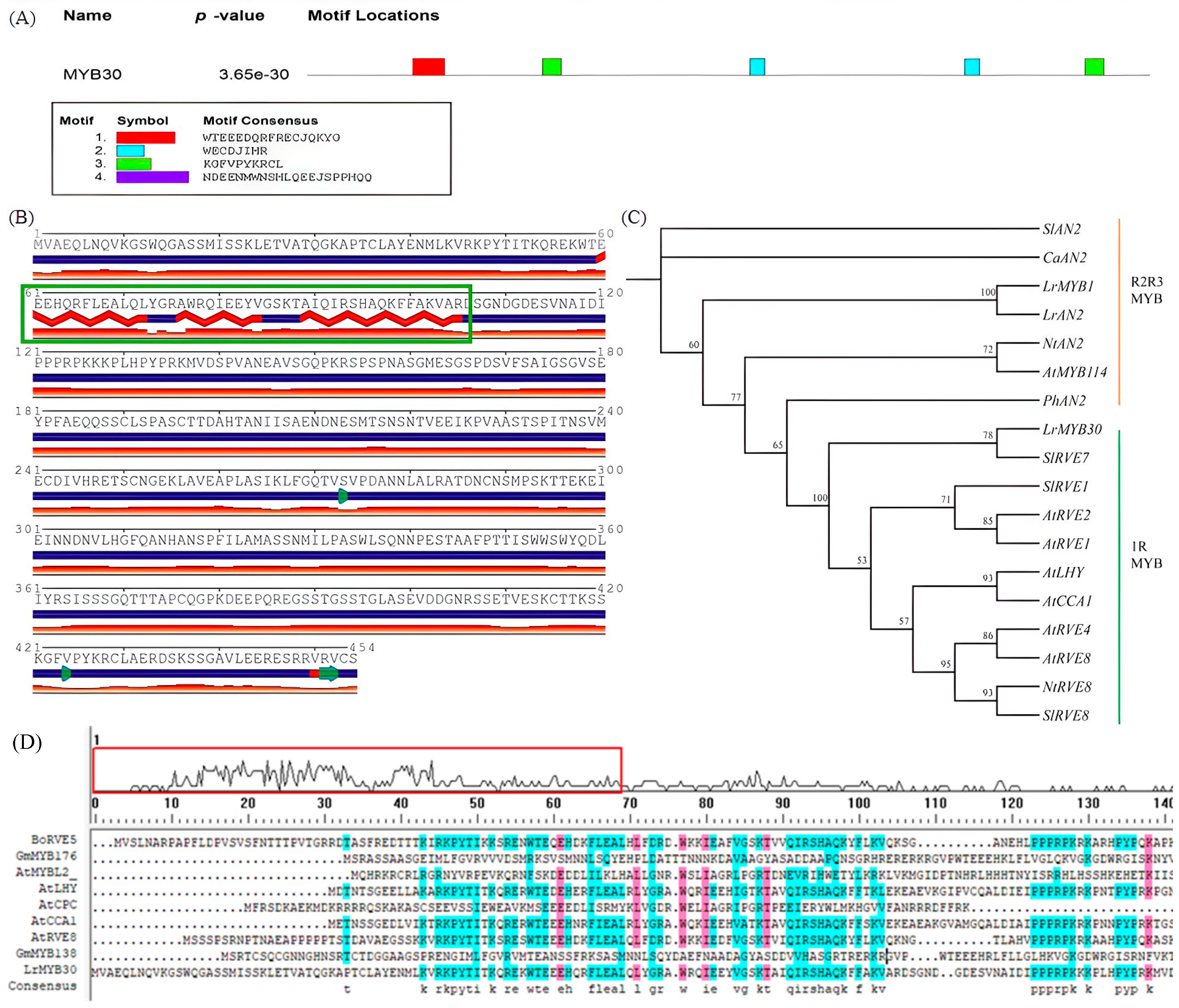
3.1. LrMYB30 Is a R3-Type Transcriptional Factor of MYB
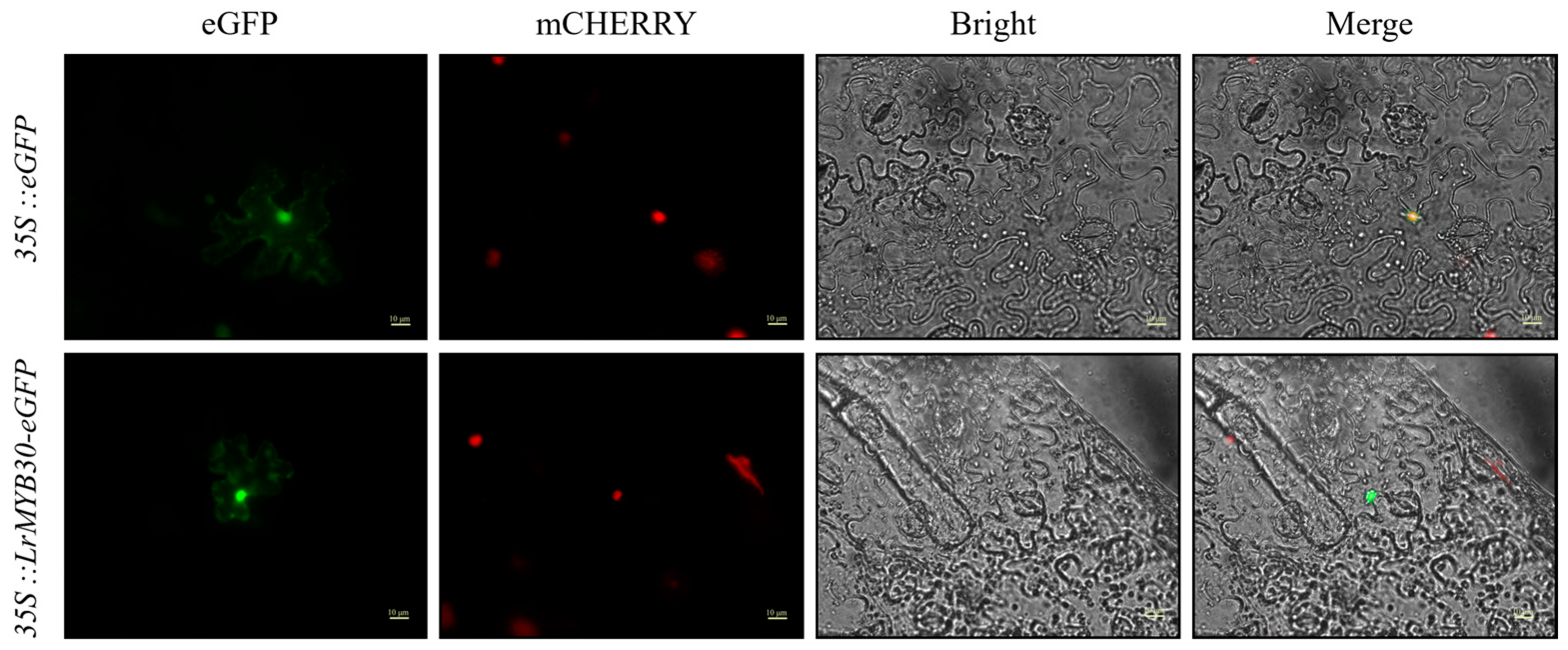
3.2. Subcellular Localization Analysis of LrMYB30
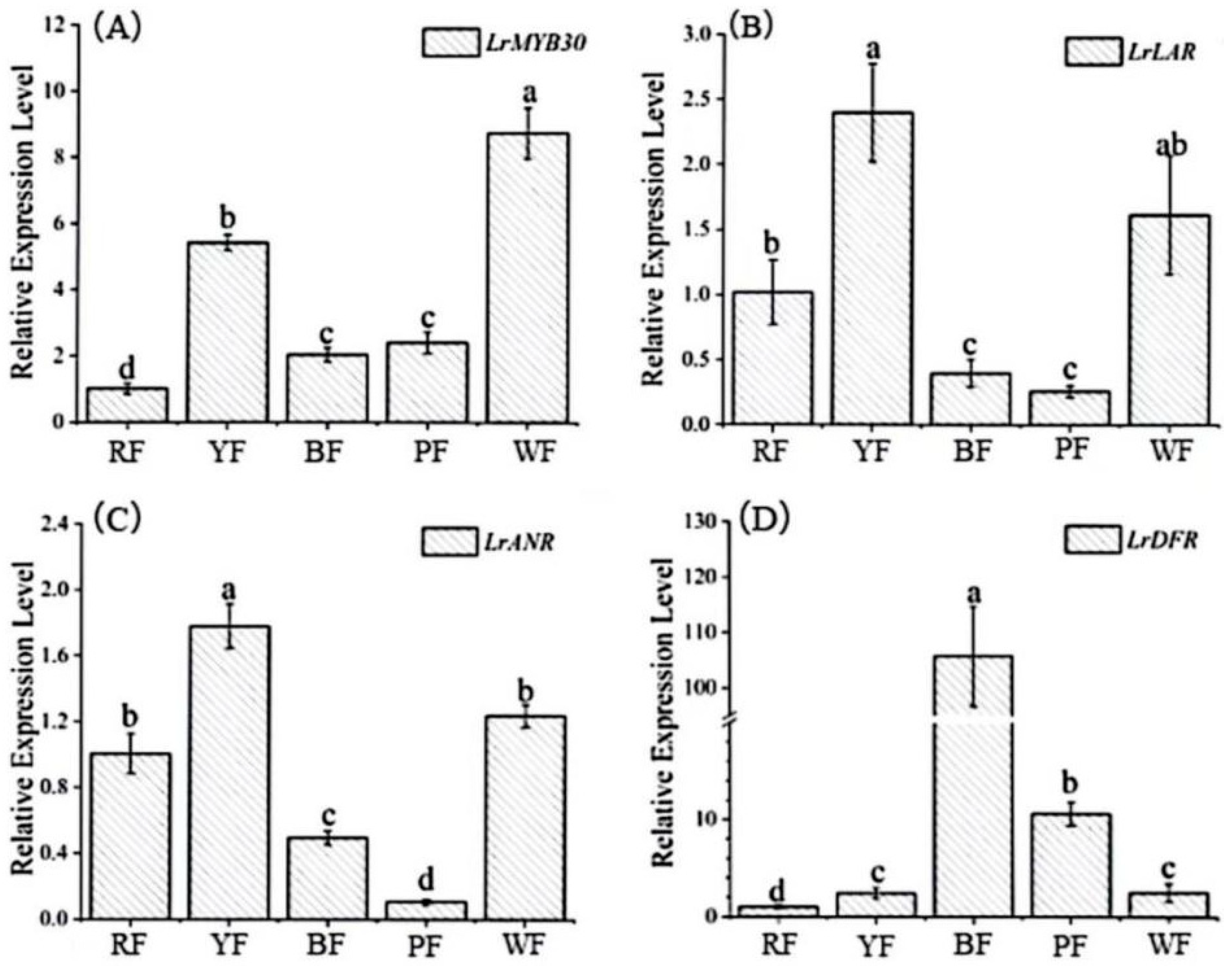
3.3. Analysis of the Expression Characteristics of LrMYB30 in Fruits of Different Colors
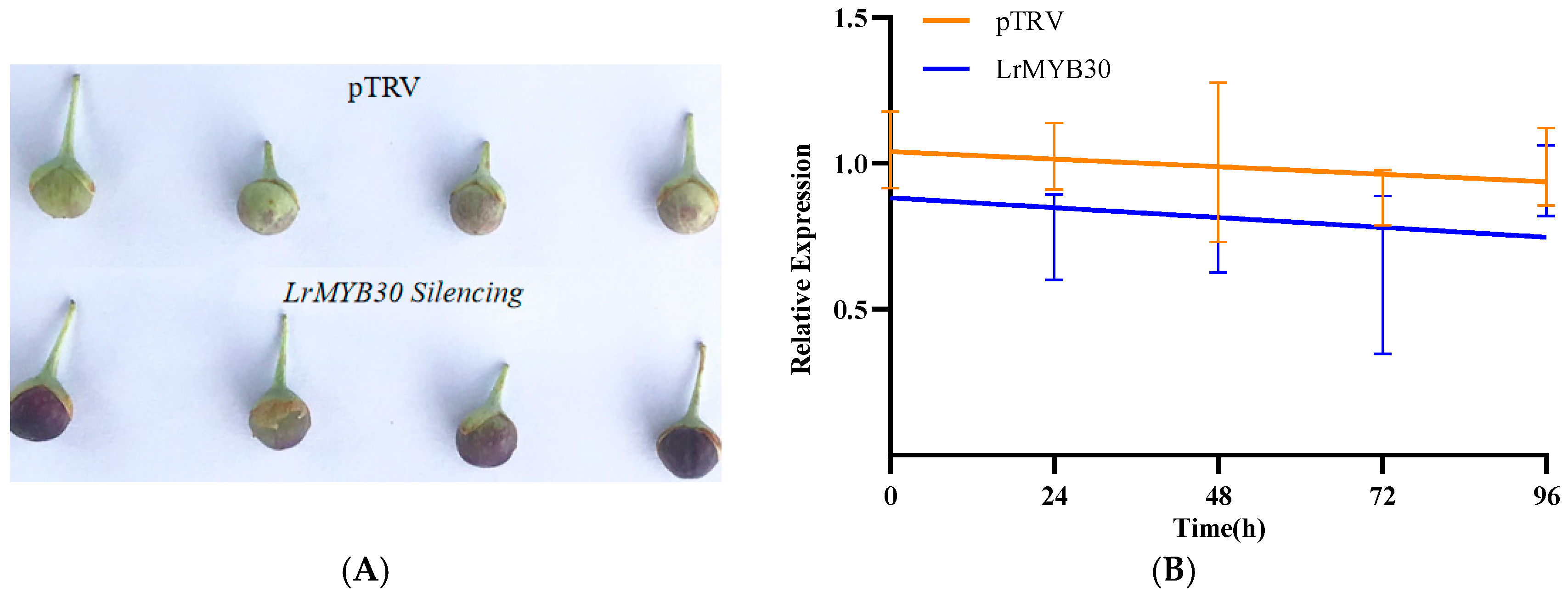
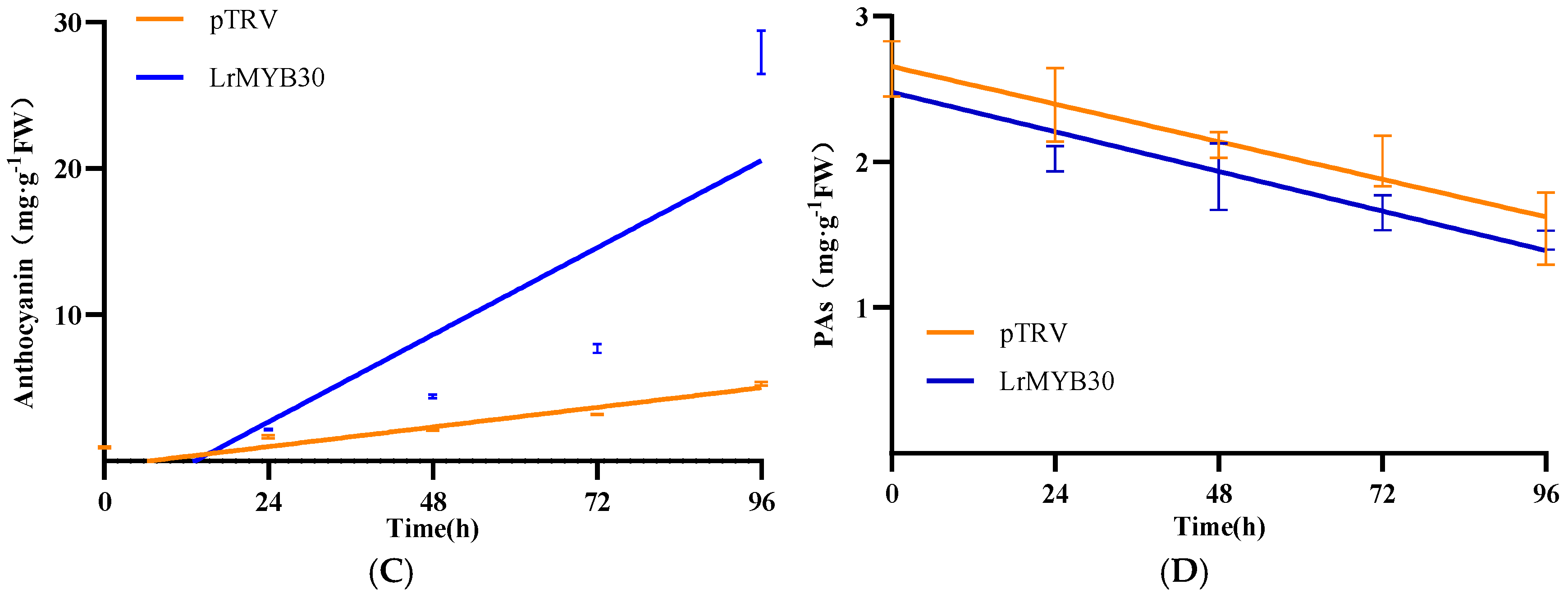
3.4. Effects of VIGS Mediated LrMYB30 Silencing on the Biosynthesis of Anthocyanins and PAs in Black Wolfberry
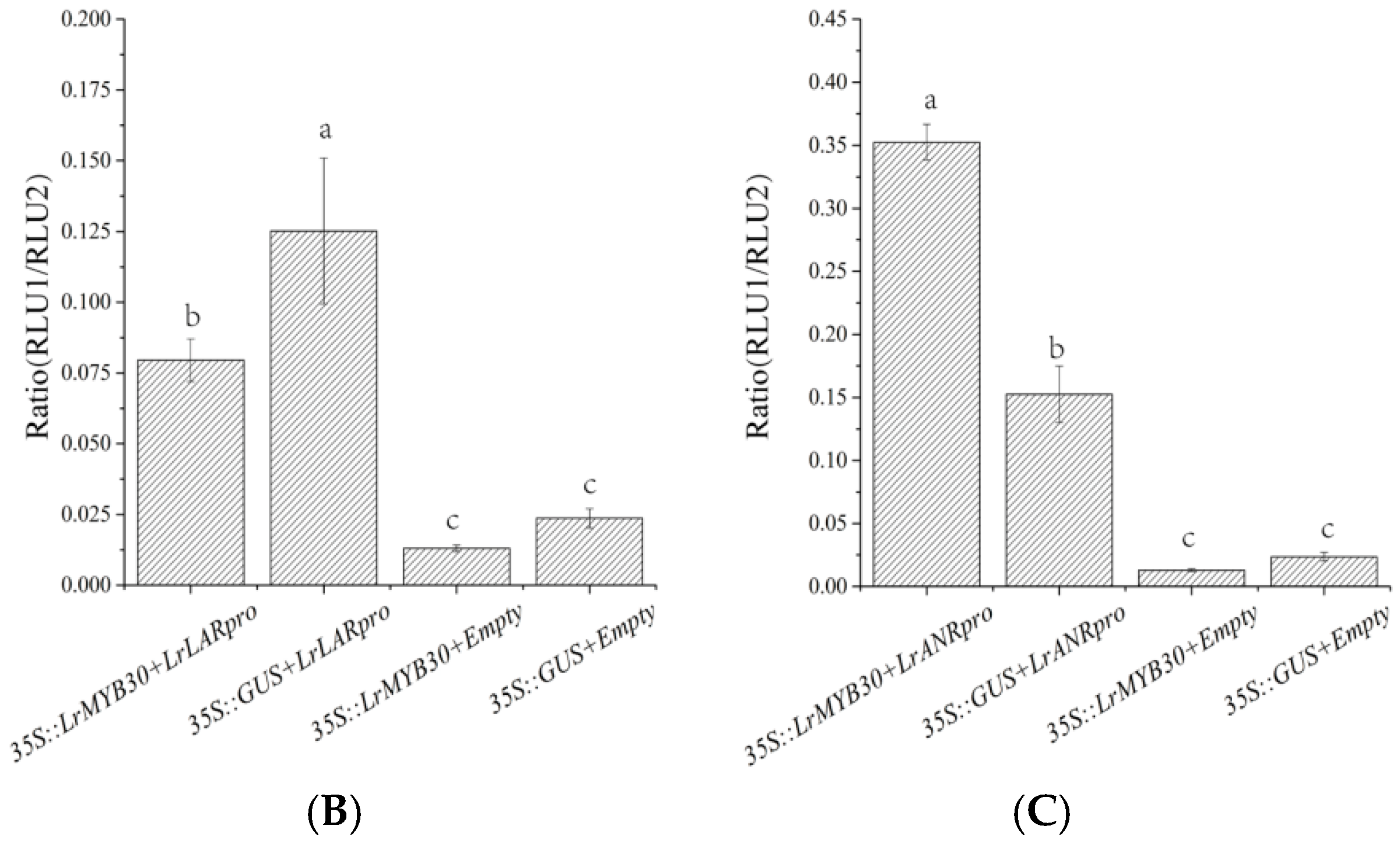
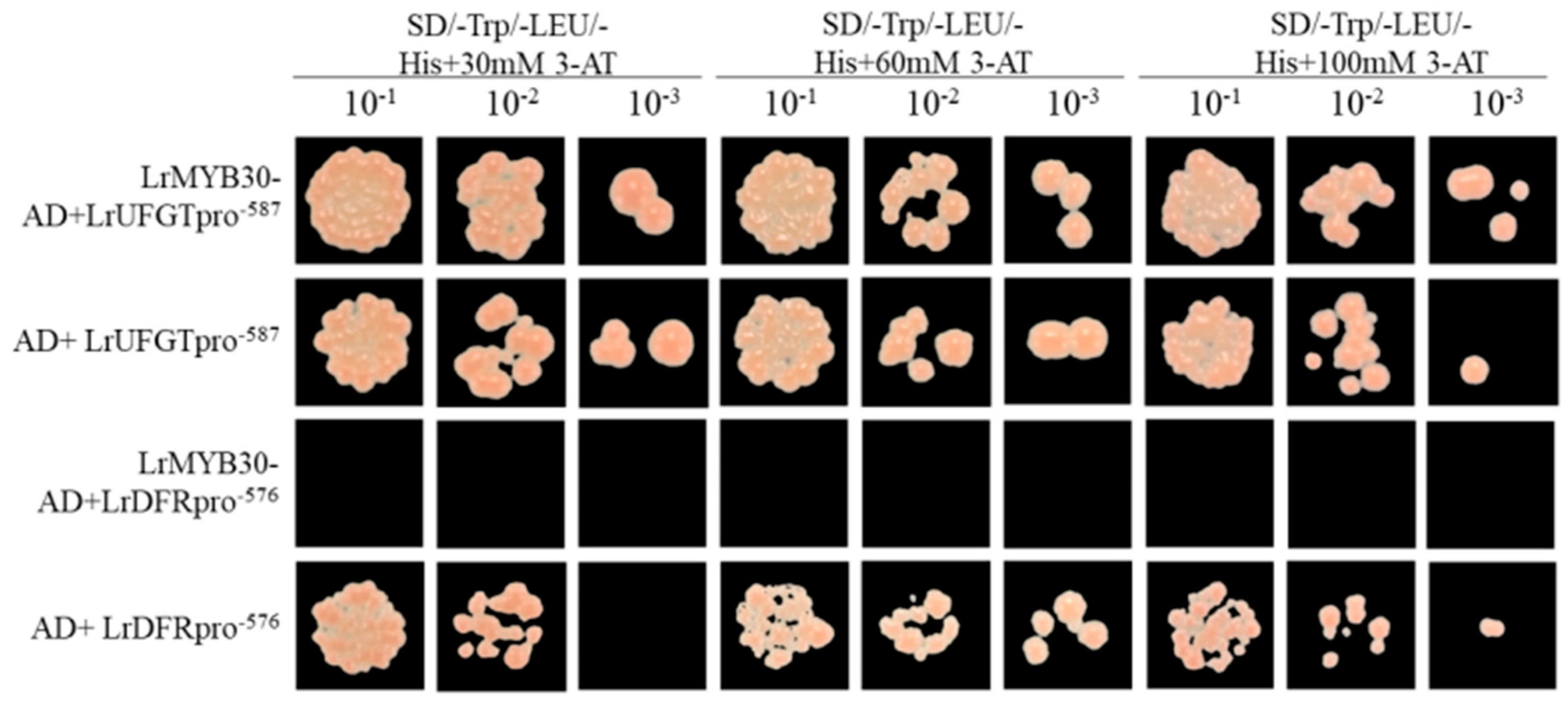
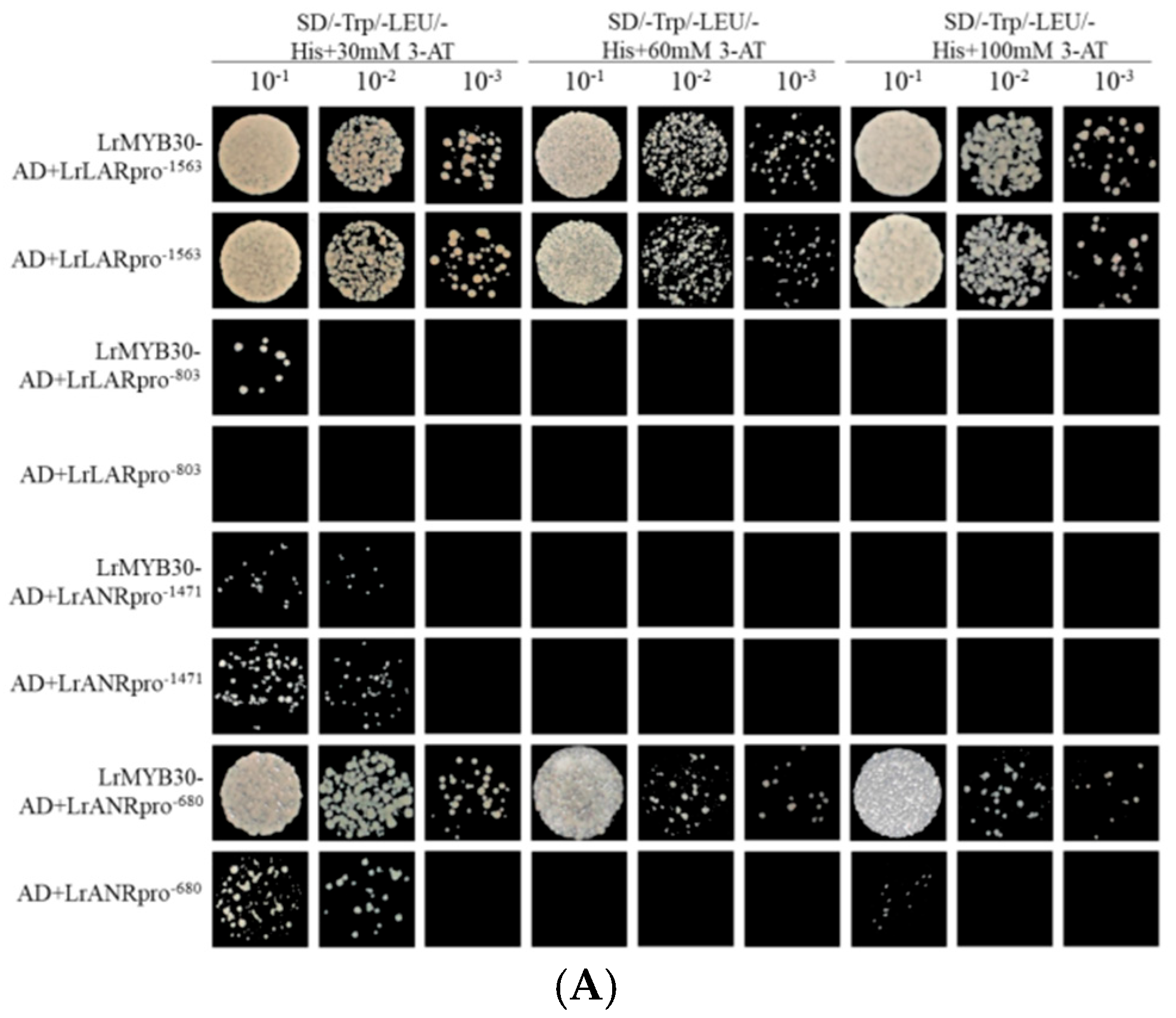
3.5. The Transcriptional Activation Effect of LrMYB30 on PAs Biosynthesis Genes
4. Discussion
Author Contributions
Funding
Institutional Review Board Statement
Informed Consent Statement
Data Availability Statement
Acknowledgments
Conflicts of Interest
Appendix A


| Primer Name | Sequence (5′-3′) | Length (bp) |
|---|---|---|
| gfp-MYB30F | AGAACACGGGGGACTCTAATGGTAGCAGAACAACTGAA | 35 |
| gfp-MYB30R | GGTGGCGACCGGTACCCGTGAACACACACGGACCCTTC | 37 |
| Gene Name | Primer Direction | Sequence (5′-3′) | Length (bp) | Amplicon Length (bp) |
|---|---|---|---|---|
| LrActin | F | CTCAGCACCTTCCAGCAGAT | 20 | 162 |
| LrActin | R | TAACACTGCAACCGCATTTC | 20 | 162 |
| LrMYB30 | F | TGCCAAGGTTGCTCGAGATT | 20 | 137 |
| LrMYB30 | R | CCTCGTTAGCTACAGGGGAATC | 22 | 137 |
| LrDFR | F | TCTGTTAGAATTGCCGAAAG | 20 | 133 |
| LrDFR | R | CTCGAAATCCATAGGTGTTG | 20 | 133 |
| LrLAR | F | AAGTGTGGTTGCAGCTTTGACA | 22 | 174 |
| LrLAR | R | ATTTTGGGCATGTCATCCATCT | 22 | 174 |
| LrANR | F | CCTCTCTCATGGCTGGTCCTTA | 22 | 165 |
| LrANR | R | GGGCACGACAAACATCCTCTAC | 22 | 165 |
| Primer Name | Sequence (5′-3′) | Length (bp) |
|---|---|---|
| LrMYB30-F | CGACGACAAGACCCTATGGTAGCAGAACAACTGAA | 35 |
| LrMYB30-R | GAGGAGAAGAGCCCTCTATGAACACACACGGACCC | 35 |
| Primer Name | Sequence (5′-3′) | Length (bp) |
|---|---|---|
| UF3GTproR | CTCAGCACCTTCCAGCAGAT | 20 |
| UF3GTproF | TAACACTGCAACCGCATTTC | 20 |
| DFRproR | TGCCAAGGTTGCTCGAGATT | 20 |
| DFRproR | CCTCGTTAGCTACAGGGGAATC | 22 |
| ANRproF | TCTGTTAGAATTGCCGAAAG | 20 |
| ANRproR | CTCGAAATCCATAGGTGTTG | 20 |
| LARproR | AAGTGTGGTTGCAGCTTTGACA | 22 |
| LARproF | ATTTTGGGCATGTCATCCATCT | 22 |
| Primer Name | Primer Sequence (5′-3′) | Length (bp) |
|---|---|---|
| UFHIS | GACTCACTATAGGGCTTTCTAGACAAGTTCACCTACAT | 38 |
| URHIS | TCGCGAACGCGTGAGCTCTGTTCAAATGTTGGTTTAGGCT | 40 |
| DFRFHIS | GACTCACTATAGGGCGATCTCCAAAATTGTGTTGCAC | 37 |
| DFRRHIS | TCGCGAACGCGTGAGCTCTGTCTTTATACTGCTTGCACGT | 40 |
| ANRFHIS | GACTCACTATAGGGCTGGTTAATCATGGTGGACTCA | 36 |
| ANRRHIS | TCGCGAACGCGTGAGCTCCAGAAGTGGGGAAGACAACT | 38 |
| LARFHIS | GACTCACTATAGGGCGCTGATGGCGTGTGATCTAT | 35 |
| LARRHIS | TCGCGAACGCGTGAGCTCATTGGTTTGGAGGTGATGGT | 38 |
| pHIS-M3PRO-F | TCACTATAGGGCGAATTCGGGTTAAGGGTCTTGGTGTC | 38 |
| pHIS-M3PRO-R | TCGCGAACGCGTGAGCTCATAGTTGGAATCGAAACCTC | 38 |
| pHIS-A2PRO-F | TCACTATAGGGCGAATTCCGTGTGCATAAGATGGGAAA | 38 |
| pHIS-A2PRO-R | TCGCGAACGCGTGAGCTCGACCGCGATTCATTCTTATG | 38 |
| MYB-AD-F | GGAATTCCATATGATGGTAGCAGAACAACTGAA | 33 |
| MYB-AD-R | CCGGAATTCTCAACTATGAACACACACGG | 29 |
| Primer Name | Primer Sequence (5′-3′) | Length (bp) |
|---|---|---|
| UFG | CACTATAGGGCGAATTGTTTCTAGACAAGTTCACCTACAT | 40 |
| URG | GCCGCTCTAGAACTAGTTGTTCAAATGTTGGTTTAGGCT | 39 |
| DFG | CACTATAGGGCGAATTGGATCTCCAAAATTGTGTTGCAC | 39 |
| DRG | GCCGCTCTAGAACTAGTTGTCTTTATACTGCTTGCACGT | 39 |
| RFG | CACTATAGGGCGAATTGTGGTTAATCATGGTGGACTCA | 38 |
| RRG | CCGCTCTAGAACTAGTCAGAAGTGGGGAAGACAACT | 36 |
| LFG | CACTATAGGGCGAATTGGCTGATGGCGTGTGATCTAT | 37 |
| LRG | GCCGCTCTAGAACTAGTATTGGTTTGGAGGTGATGGT | 37 |
| PG-A2PRO-F | ACTATAGGGCGAATTGCGTGTGCATAAGATGGGAAA | 36 |
| PG-A2PRO-R | GCCGCTCTAGAACTAGTGACCGCGATTCATTCTTATG | 36 |
| PG-M3PRO-F | CACTATAGGGCGAATTGGGGTTAAGGGTCTTGGTGTC | 36 |
| PG-M3PRO-R | GCCGCTCTAGAACTAGTATAGTTGGAATCGAAACCTC | 36 |
| pBI-MYB30F | CGGGTACCGGTCGCCACCATGGTAGCAGAACAACTGAA | 38 |
| pBI-MYB30R | GATCGGGGAAATTCGTCTATGAACACACACGGACCC | 36 |
References
- Jaakola, L. New insights into the regulation of anthocyanin biosynthesis in fruits. Trends Plant Sci. 2013, 18, 477–483. [Google Scholar] [CrossRef] [PubMed]
- Dixon, R.A.; Sarnala, S. Proanthocyanidin biosynthesis-a matter of protection. Plant Physiol. 2020, 184, 579–591. [Google Scholar] [CrossRef]
- Zeng, S.; Lin, S.; Wang, Z.; Zong, Y.; Wang, Y. The health-promoting anthocyanin petanin in Lycium ruthenicum fruit: A promising natural colorant. Crit. Rev. Food Sci. Nutr. 2024, 64, 10484–10497. [Google Scholar] [CrossRef]
- Cammareri, M.; Frary, A.; Frary, A.; Grandillo, S. Genetic and biotechnological approaches to improve fruit bioactive content: A focus on eggplant and tomato anthocyanins. Int. J. Mol. Sci. 2024, 25, 6811. [Google Scholar] [CrossRef] [PubMed]
- Menconi, J.; Perata, P.; Gonzali, S. In pursuit of purple: Anthocyanin biosynthesis in fruits of the tomato clade. Trends Plant Sci. 2024, 29, 589–604. [Google Scholar] [CrossRef]
- Leng, X.; Li, C.; Wang, P.; Ren, Y.; Chen, J.; Liu, G.; Hakeem, A.; Liu, Y.; Shi, X.; Hou, T.; et al. The transcription factor VvMYB44-1 plays a role in reducing grapevine anthocyanin biosynthesis at high temperature. Plant Physiol. 2025, 197, e657. [Google Scholar] [CrossRef]
- Li, G.; Zhao, J.H.; Qin, B.B.; Yin, Y.; An, W.; Mu, Z.X.; Cao, Y.L. ABA mediates development-dependent anthocyanin biosynthesis and fruit coloration in Lycium plants. BMC Plant Biol. 2019, 19, 317. [Google Scholar] [CrossRef]
- Kou, X.; Feng, Y.; Yuan, S.; Zhao, X.; Wu, C.; Wang, C.; Xue, Z. Different regulatory mechanisms of plant hormones in the ripening of climacteric and non-climacteric fruits: A review. Plant Mol. Biol. 2021, 107, 477–497. [Google Scholar] [CrossRef]
- Mattus-Araya, E.; Guajardo, J.; Herrera, R.; Moya-León, M.A. ABA speeds up the progress of color in developing F. chiloensis fruit through the activation of PAL, CHS and ANS, key genes of the phenylpropanoid/flavonoid and anthocyanin pathways. Int. J. Mol. Sci. 2022, 23, 3854. [Google Scholar] [CrossRef] [PubMed]
- Manjunatha, G.; Lokesh, V.; Neelwarne, B. Nitric oxide in fruit ripening: Trends and opportunities. Biotechnol. Adv. 2010, 28, 489–499. [Google Scholar] [CrossRef] [PubMed]
- Corpas, F.J.; González-Gordo, S.; Palma, J.M. Nitric oxide: A radical molecule with potential biotechnological applications in fruit ripening. J. Biotechnol. 2020, 324, 211–219. [Google Scholar] [CrossRef]
- Zhang, J.; Yao, Y.; Yao, K.; Ding, Z.; Zhang, W.; Zhu, Y.; Su, W.; Liao, W. Nitric oxide delayed tomato fruit coloring by regulating chlorophyll- and carotenoid-related genes in a SlSPL6c-dependent manner. Plant Cell Physiol. 2025, 66, 991–1004. [Google Scholar] [CrossRef] [PubMed]
- Li, G.; Qin, B.B.; Li, S.D.; Yin, Y.; Zhao, J.H.; An, W.; Cao, Y.L.; Mu, Z.X. LbNR-derived nitric oxide delays Lycium fruit coloration by transcriptionally modifying flavonoid biosynthetic pathway. Front. Plant Sci. 2020, 11, 1215. [Google Scholar] [CrossRef]
- Sun, Y.; Zheng, Y.; Wang, W.; Yao, H.; Ali, Z.; Xiao, M.; Ma, Z.; Li, J.; Zhou, W.; Cui, J.; et al. VvFHY3 links auxin and endoplasmic reticulum stress to regulate grape anthocyanin biosynthesis at high temperatures. Plant Cell 2024, 37, koae303. [Google Scholar] [CrossRef]
- Xu, W.; Dubos, C.; Lepiniec, L. Transcriptional control of flavonoid biosynthesis by MYB-bHLH-WDR complexes. Trends Plant Sci. 2015, 20, 176–185. [Google Scholar] [CrossRef]
- Zhang, Z.; Wang, X.; Gao, Y.; Xian, X.; Zhang, D.; Zhao, W.; Wang, X.; Wang, Y. Orchestrating anthocyanin biosynthesis in fruit of fruit trees: Transcriptional, post-transcriptional, and post-translational regulation. Int. J. Biol. Macromol. 2025, 307, 141835. [Google Scholar] [CrossRef]
- Ma, D.; Constabel, C.P. MYB repressors as regulators of phenylpropanoid metabolism in plants. Trends Plant Sci. 2019, 24, 275–289. [Google Scholar] [CrossRef] [PubMed]
- Du, Y.; Ma, H.; Liu, Y.; Gong, R.; Lan, Y.; Zhao, J.; Liu, G.; Lu, Y.; Wang, S.; Jia, H.; et al. Major quality regulation network of flavonoid synthesis governing the bioactivity of black wolfberry. New Phytol. 2024, 242, 558–575. [Google Scholar] [CrossRef] [PubMed]
- Allan, A.C.; Espley, R.V. MYBs drive novel consumer traits in fruits and vegetables. Trends Plant Sci. 2018, 23, 693–705. [Google Scholar] [CrossRef]
- Peng, Y.; Thrimawithana, A.H.; Cooney, J.M.; Jensen, D.J.; Espley, R.V.; Allan, A.C. The proanthocyanin-related transcription factors MYBC1 and WRKY44 regulate branch points in the kiwifruit anthocyanin pathway. Sci. Rep. 2020, 10, 14161. [Google Scholar] [CrossRef]
- Ni, J.; Zhao, Y.; Tao, R.; Yin, L.; Gao, L.; Strid, Å.; Qian, M.; Li, J.; Li, Y.; Shen, J.; et al. Ethylene mediates the branching of the jasmonate-induced flavonoid biosynthesis pathway by suppressing anthocyanin biosynthesis in red Chinese pear fruits. Plant Biotechnol. J. 2020, 18, 1223–1240. [Google Scholar] [CrossRef] [PubMed]
- Xu, H.; Zou, Q.; Yang, G.; Jiang, S.; Fang, H.; Wang, Y.; Zhang, J.; Zhang, Z.; Wang, N.; Chen, X. MdMYB6 regulates anthocyanin formation in apple both through direct inhibition of the biosynthesis pathway and through substrate removal. Hortic. Res. 2020, 7, 72. [Google Scholar] [CrossRef] [PubMed]
- Li, P.; Dong, Q.; Ge, S.; He, X.; Verdier, J.; Li, D.; Zhao, J. Metabolic engineering of proanthocyanidin production by repressing the isoflavone pathways and redirecting anthocyanidin precursor flux in legume. Plant Biotechnol. J. 2016, 14, 1604–1618. [Google Scholar] [CrossRef] [PubMed]
- Lu, N.; Rao, X.; Li, Y.; Jun, J.H.; Dixon, R.A. Dissecting the transcriptional regulation of proanthocyanidin and anthocyanin biosynthesis in soybean (Glycine max). Plant Biotechnol. J. 2021, 19, 1429–1442. [Google Scholar] [CrossRef]
- Wang, H.; Li, J.; Tao, W.; Zhang, X.; Gao, X.; Yong, J.; Zhao, J.; Zhang, L.; Li, Y.; Duan, J.A.; et al. Lycium ruthenicum studies: Molecular biology, phytochemistry and pharmacology. Food Chem. 2018, 240, 759–766. [Google Scholar] [CrossRef]
- Wang, C.; Dong, Y.; Zhu, L.; Wang, L.; Yan, L.; Wang, M.; Zhu, Q.; Nan, X.; Li, Y.; Li, J. Comparative transcriptome analysis of two contrasting wolfberry genotypes during fruit development and ripening and characterization of the LrMYB1 transcription factor that regulates flavonoid biosynthesis. BMC Genom. 2020, 21, 295. [Google Scholar] [CrossRef]
- Qi, Y.; Wei, H.; Gu, W.; Shi, W.; Jiang, L.; Deng, L.; Liu, X. Transcriptome profiling provides insights into the fruit color development of wild Lycium ruthenicum Murr. from Qinghai-Tibet Plateau. Protoplasma 2021, 258, 33–43. [Google Scholar] [CrossRef]
- Ma, Y.J.; Duan, H.R.; Zhang, F.; Li, Y.; Yang, H.S.; Tian, F.P.; Zhou, X.H.; Wang, C.M.; Ma, R. Transcriptomic analysis of Lycium ruthenicum Murr. during fruit ripening provides insight into structural and regulatory genes in the anthocyanin biosynthetic pathway. PLoS ONE 2018, 13, e0208627. [Google Scholar] [CrossRef]
- Xu, Y.; Li, H.; Shi, T.; Luo, Q.; Chen, Y.; Guo, S.; Tian, W.; An, W.; Zhao, J.; Yin, Y.; et al. High-quality genome of black wolfberry (Lycium ruthenicum Murr.) provides insights into the genetics of anthocyanin biosynthesis regulation. Hortic. Res. 2024, 12, uhae298. [Google Scholar] [CrossRef]
- Yisilam, G.; Zheng, E.; Li, C.; Zhang, Z.; Su, Y.; Chu, Z.; Li, P.; Tian, X. The chromosome-scale genome of black wolfberry (Lycium ruthenicum) provides useful genomic resources for identifying genes related to anthocyanin biosynthesis and disease resistance. Plant Divers. 2025, 47, 201–213. [Google Scholar] [CrossRef]
- Zong, Y.; Zhu, X.; Liu, Z.; Xi, X.; Li, G.; Cao, D.; Wei, L.; Li, J.; Liu, B. Functional MYB transcription factor encoding gene AN2 is associated with anthocyanin biosynthesis in Lycium ruthenicum Murray. BMC Plant Biol. 2019, 19, 169. [Google Scholar] [CrossRef]
- Li, T.; Fan, Y.; Qin, H.; Dai, G.; Li, G.; Li, Y.; Wang, J.; Yin, Y.; Chen, F.; Qin, X.; et al. Transcriptome and flavonoids metabolomic analysis identifies regulatory networks and hub genes in black and white fruits of Lycium ruthenicum Murray. Front. Plant Sci. 2020, 11, 1256. [Google Scholar] [CrossRef]
- Li, T.; Wang, J.; Zhang, Z.; Fan, Y.; Qin, H.; Yin, Y.; Dai, G.; Cao, Y.; Tang, L. Anthocyanin biosynthesis in goji berry is inactivated by deletion in a bHLH transcription factor LrLAN1b promoter. Plant Physiol. 2024, 195, 1461–1474. [Google Scholar] [CrossRef]
- Livak, K.J.; Schmittgen, T.D. Analysis of Relative Gene Expression Data Using Real-Time Quantitative PCR and the 2−ΔΔCT Method. Methods 2001, 25, 402–408. [Google Scholar] [CrossRef]
- Zhang, D.; Zhou, H.; Zhang, Y.; Zhao, Y.; Zhang, Y.; Feng, X.; Lin, H. Diverse roles of MYB transcription factors in plants. J. Integr. Plant Biol. 2025, 67, 539–562. [Google Scholar] [CrossRef] [PubMed]
- Ai, P.; Wei, G.; Biao, A.; Yang, C.; Wang, Y.; Zeng, S. Multi-omics reveal the molecular basis of LrAN2 overexpression in black goji callus promoting the excessive accumulation of a promising food blue colorant. Food Front. 2024, 5, 2221–2234. [Google Scholar] [CrossRef]
- LaFountain, A.M.; Yuan, Y.W. Repressors of anthocyanin biosynthesis. New Phytol. 2021, 231, 933–949. [Google Scholar] [CrossRef] [PubMed]
- Zhu, H.F.; Fitzsimmons, K.; Khandelwal, A.; Kranz, R.G. CPC, a single-repeat R3 MYB, is a negative regulator of anthocyanin biosynthesis in Arabidopsis. Mol. Plant 2009, 2, 790–802. [Google Scholar] [CrossRef]
- Albert, N.W.; Davies, K.M.; Lewis, D.H.; Zhang, H.; Montefiori, M.; Brendolise, C.; Boase, M.R.; Ngo, H.; Jameson, P.E.; Schwinn, K.E. A conserved network of transcriptional activators and repressors regulates anthocyanin pigmentation in eudicots. Plant Cell 2014, 26, 962–980. [Google Scholar] [CrossRef]
- Colanero, S.; Perata, P.; Gonzali, S. The atroviolacea gene encodes an R3-MYB protein repressing anthocyanin synthesis in tomato plants. Front. Plant Sci. 2018, 9, 830. [Google Scholar] [CrossRef]
- Kim, J.; Kim, D.H.; Lee, J.Y.; Lim, S.H. The R3-type MYB transcription factor BrMYBL2.1 negatively regulates anthocyanin biosynthesis in Chinese cabbage (Brassica rapa L.) by repressing MYB-bHLH-WD40 complex activity. Int. J. Mol. Sci. 2022, 23, 3382. [Google Scholar] [CrossRef] [PubMed]
- Xiang, L.; Liu, X.; Li, H.; Yin, X.; Grierson, D.; Li, F.; Chen, K. CmMYB#7, an R3 MYB transcription factor, acts as a negative regulator of anthocyanin biosynthesis in chrysanthemum. J. Exp. Bot. 2019, 70, 3111–3123. [Google Scholar] [CrossRef] [PubMed]
- Xing, M.; Xin, P.; Wang, Y.; Han, C.; Lei, C.; Huang, W.; Zhang, Y.; Zhang, X.; Cheng, K.; Zhang, X. A negative feedback regulatory module comprising R3-MYB repressor MYBL2 and R2R3-MYB activator PAP1 fine-tunes high light-induced anthocyanin biosynthesis in Arabidopsis. J. Exp. Bot. 2024, 75, 7381–7400. [Google Scholar] [CrossRef] [PubMed]
- Yang, G.; Xue, Z.; Lin-Wang, K.; Chen, G.; Zhao, Y.; Chang, Y.; Xu, S.; Sun, M.; Xue, C.; Li, J.; et al. An ‘activator-repressor’ loop controls the anthocyanin biosynthesis in red-skinned pear. Mol. Hortic. 2024, 4, 26. [Google Scholar] [CrossRef]
- Yuan, Y.W.; Rebocho, A.B.; Sagawa, J.M.; Stanley, L.E.; Bradshaw, H.D.; Yuan, Y.W., Jr. Competition between anthocyanin and flavonol biosynthesis produces spatial pattern variation of floral pigments between Mimulus species. Proc. Natl. Acad. Sci. USA 2016, 113, 2448–2453. [Google Scholar] [CrossRef]
- Lin, Y.; Wang, C.; Cao, S.; Sun, Z.; Zhang, Y.; Li, M.; He, W.; Wang, Y.; Chen, Q.; Zhang, Y.; et al. Proanthocyanidins delay fruit coloring and softening by repressing related gene expression during strawberry (Fragaria × ananassa Duch.) ripening. Int. J. Mol. Sci. 2023, 24, 3139. [Google Scholar] [CrossRef]
- Jiang, L.; Yue, M.; Liu, Y.; Zhang, N.; Lin, Y.; Zhang, Y.; Wang, Y.; Li, M.; Luo, Y.; Zhang, Y.; et al. A novel R2R3-MYB transcription factor FaMYB5 positively regulates anthocyanin and proanthocyanidin biosynthesis in cultivated strawberries (Fragaria ananassa). Plant Biotechnol. J. 2023, 21, 1140–1158. [Google Scholar] [CrossRef]



Disclaimer/Publisher’s Note: The statements, opinions and data contained in all publications are solely those of the individual author(s) and contributor(s) and not of MDPI and/or the editor(s). MDPI and/or the editor(s) disclaim responsibility for any injury to people or property resulting from any ideas, methods, instructions or products referred to in the content. |
© 2025 by the authors. Licensee MDPI, Basel, Switzerland. This article is an open access article distributed under the terms and conditions of the Creative Commons Attribution (CC BY) license (https://creativecommons.org/licenses/by/4.0/).
Share and Cite
Wang, Y.; Wang, T.; Tan, Z.; Mu, Z. A R3-Type MYB Transcription Factor LrMYB30 Negatively Regulates L. ruthenicum Fruit Coloration. Genes 2025, 16, 1501. https://doi.org/10.3390/genes16121501
Wang Y, Wang T, Tan Z, Mu Z. A R3-Type MYB Transcription Factor LrMYB30 Negatively Regulates L. ruthenicum Fruit Coloration. Genes. 2025; 16(12):1501. https://doi.org/10.3390/genes16121501
Chicago/Turabian StyleWang, Yuejie, Tingting Wang, Zhanming Tan, and Zixin Mu. 2025. "A R3-Type MYB Transcription Factor LrMYB30 Negatively Regulates L. ruthenicum Fruit Coloration" Genes 16, no. 12: 1501. https://doi.org/10.3390/genes16121501
APA StyleWang, Y., Wang, T., Tan, Z., & Mu, Z. (2025). A R3-Type MYB Transcription Factor LrMYB30 Negatively Regulates L. ruthenicum Fruit Coloration. Genes, 16(12), 1501. https://doi.org/10.3390/genes16121501