Evaluation of the Association between FGFR2 Gene Polymorphisms and Breast Cancer Risk in the Bangladeshi Population

 , , , and
Abstract
1. Introduction
2. Materials and Methods
2.1. Study Population
2.2. Sample Preparation
2.3. Genotyping
2.4. Statistical Analysis
3. Results
3.1. Demographic and Clinicopathological Characteristics
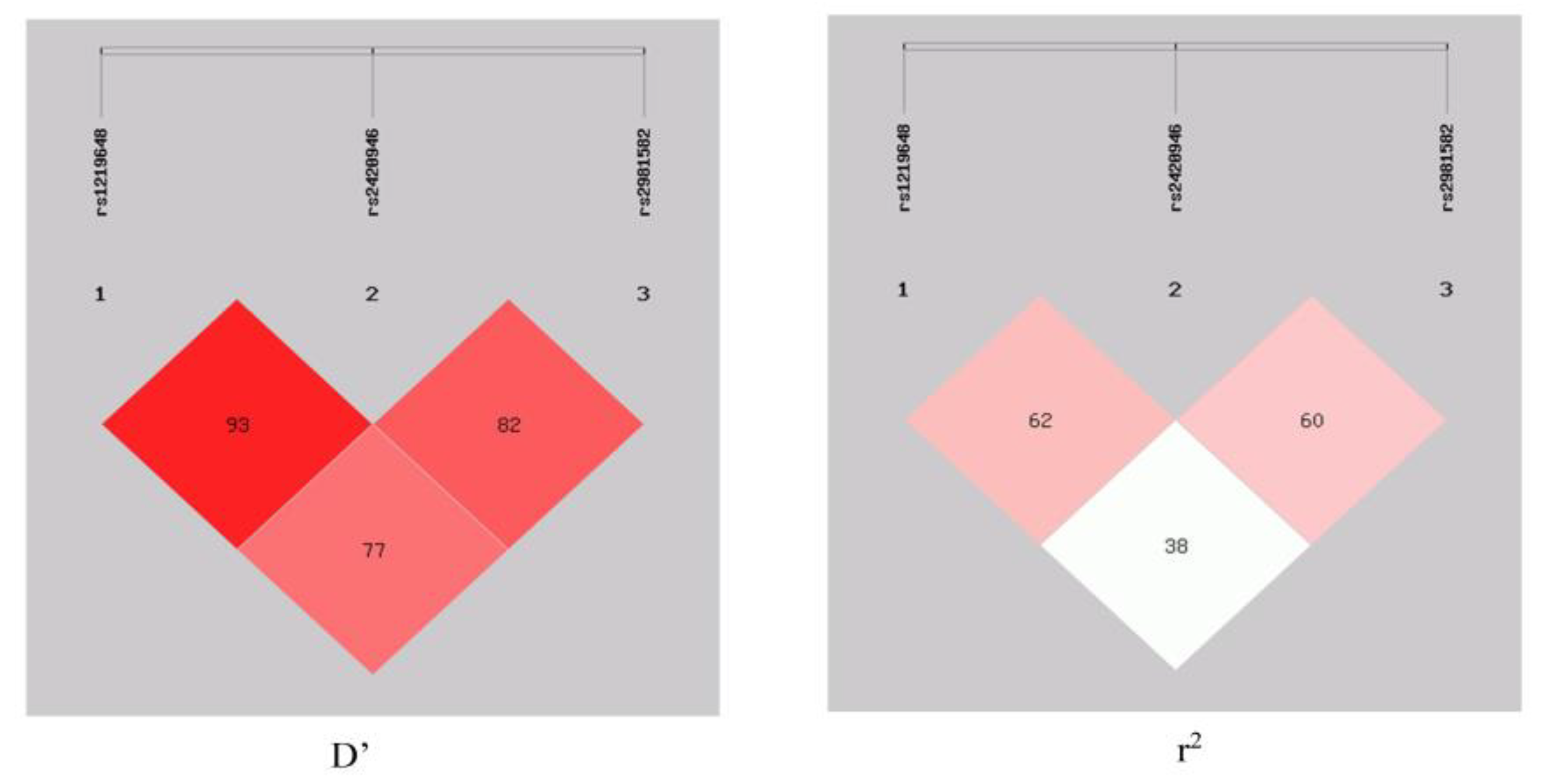
3.2. Association of FGFR2 Polymorphisms with Breast Cancer
3.3. Association of FGFR2 Polymorphisms with Clinicopathological Variables
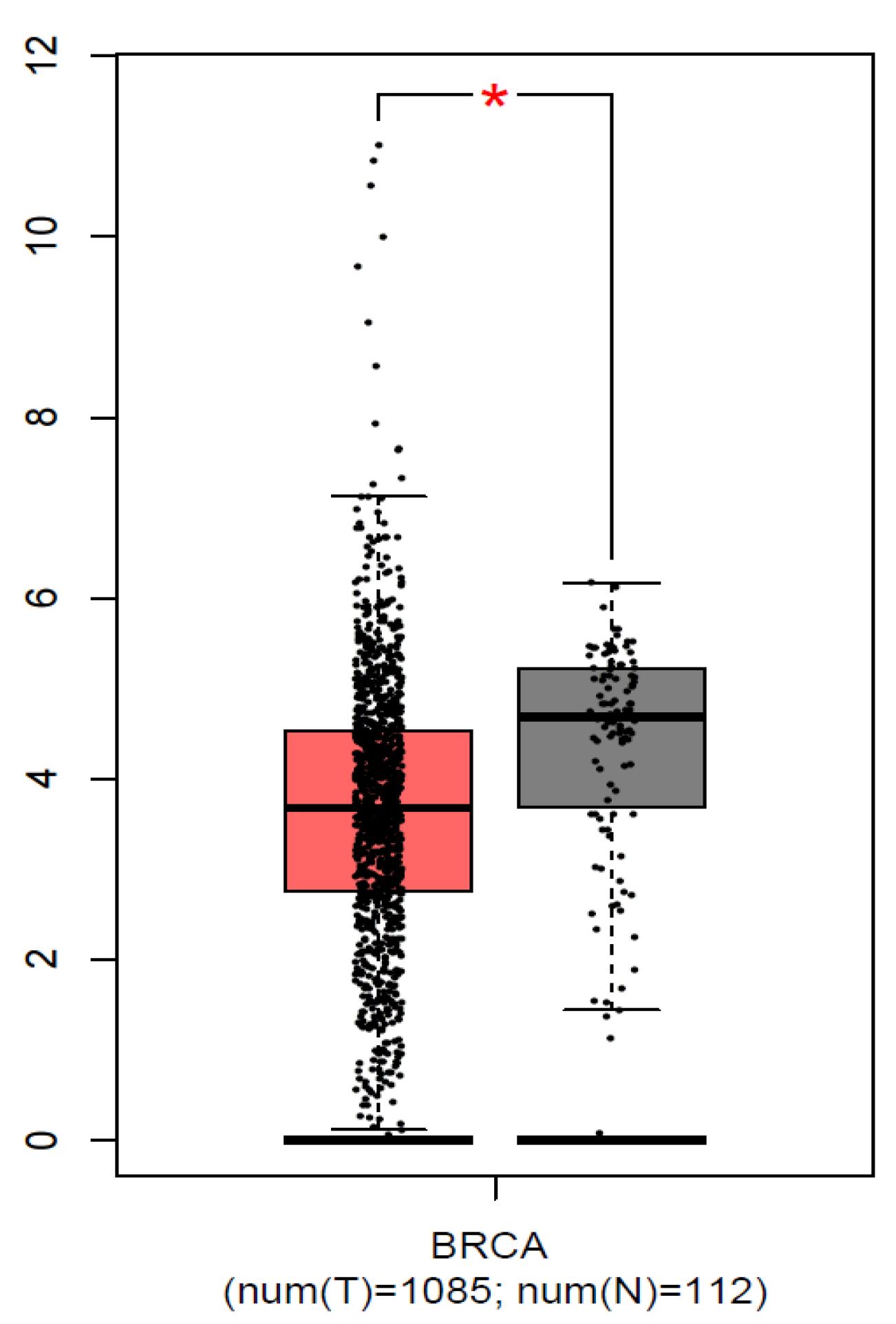
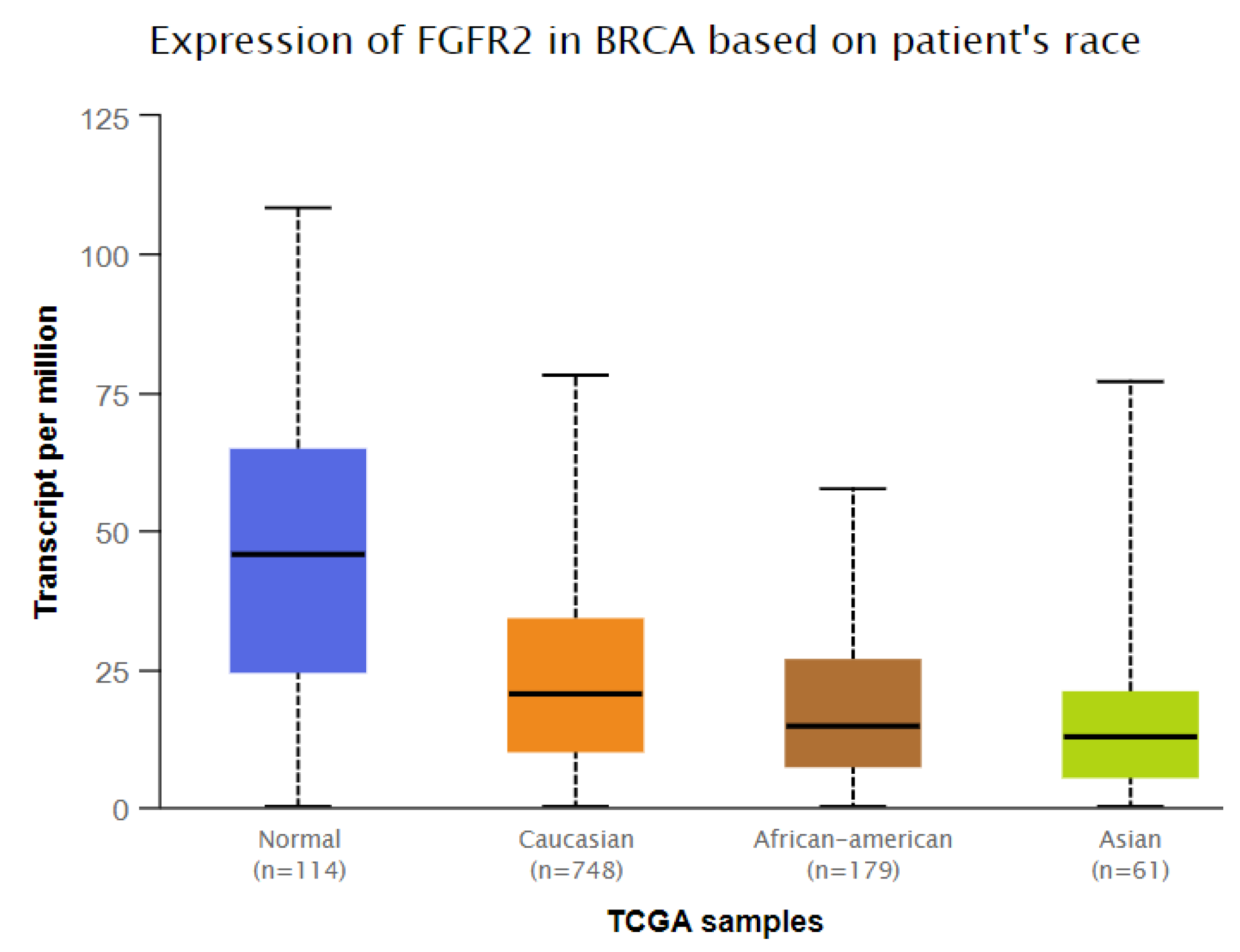
3.4. Analysis of In Silico Gene Expression
3.5. Genotype-Based FGFR2 mRNA Expression
4. Discussion
5. Conclusions
Supplementary Materials
Author Contributions
Funding
Institutional Review Board Statement
Informed Consent Statement
Data Availability Statement
Acknowledgments
Conflicts of Interest
References
- Sung, H.; Ferlay, J.; Siegel, R.L.; Laversanne, M.; Soerjomataram, I.; Jemal, A.; Bray, F. Global cancer statistics 2020: GLOBOCAN estimates of incidence and mortality worldwide for 36 cancers in 185 countries. CA Cancer J. Clin. 2021, 71, 209–249. [Google Scholar] [CrossRef] [Scilit] [PubMed]
- Begum, S.; Mahmud, T.; Rahman, T.; Zannat, J.; Khatun, F.; Nahar, K.; Towhida, M.; Joarder, M.; Harun, A.; Sharmin, F. Knowledge, attitude and practice of Bangladeshi women towards breast cancer: A cross sectional study. Mymensingh Med. J. 2019, 28, 96–104. [Google Scholar] [PubMed]
- Alam, N.E.; Islam, M.S.; Ullah, H.; Molla, M.T.; Shifat, S.K.; Akter, S.; Aktar, S.; Khatun, M.M.; Ali, M.R.; Sen, T.C. Evaluation of knowledge, awareness and attitudes towards breast cancer risk factors and early detection among females in Bangladesh: A hospital based cross-sectional study. PLoS ONE 2021, 16, e0257271. [Google Scholar] [CrossRef] [Scilit] [PubMed]
- Barek, M.A.; Begum, M.; Noor, F.; Aziz, M.A.; Islam, M.S. The link between IL-6 rs2069840 SNP and cancer risk: Evidence from a systematic review and meta-analysis. Meta Gene 2021, 30, 100972. [Google Scholar] [CrossRef] [Scilit]
- Aziz, M.A.; Akter, T.; Sarwar, M.S.; Islam, M.S. The first combined meta-analytic approach for elucidating the relationship of circulating resistin levels and RETN gene polymorphisms with colorectal and breast cancer. Egypt. J. Med. Hum. Genet. 2022, 23, 27. [Google Scholar] [CrossRef] [Scilit]
- Touat, M.; Ileana, E.; Postel-Vinay, S.; André, F.; Soria, J.-C. Targeting FGFR signaling in cancer. Clin. Cancer Res. 2015, 21, 2684–2694. [Google Scholar] [CrossRef] [Scilit]
- Turner, N.; Grose, R. Fibroblast growth factor signalling: From development to cancer. Nat. Rev. Cancer 2010, 10, 116–129. [Google Scholar] [CrossRef] [Scilit]
- Zhao, Y.; Adjei, A.A. Targeting angiogenesis in cancer therapy: Moving beyond vascular endothelial growth factor. Oncologist 2015, 20, 660–673. [Google Scholar] [CrossRef] [Scilit]
- Eswarakumar, V.; Lax, I.; Schlessinger, J. Cellular signaling by fibroblast growth factor receptors. Cytokine Growth Factor Rev. 2005, 16, 139–149. [Google Scholar] [CrossRef] [Scilit]
- Bai, A.; Meetze, K.; Vo, N.Y.; Kollipara, S.; Mazsa, E.K.; Winston, W.M.; Weiler, S.; Poling, L.L.; Chen, T.; Ismail, N.S. GP369, an FGFR2-IIIb–Specific Antibody, Exhibits Potent Antitumor Activity against Human Cancers Driven by Activated FGFR2 Signaling In vivo Efficacy of GP369 in FGFR2-Amplified Tumors. Cancer Res. 2010, 70, 7630–7639. [Google Scholar] [CrossRef] [Scilit]
- Ota, S.; Zhou, Z.-Q.; Link, J.M.; Hurlin, P.J. The role of senescence and prosurvival signaling in controlling the oncogenic activity of FGFR2 mutants associated with cancer and birth defects. Hum. Mol. Genet. 2009, 18, 2609–2621. [Google Scholar] [CrossRef] [Scilit] [PubMed]
- Katoh, M. Cancer genomics and genetics of FGFR2. Int. J. Oncol. 2008, 33, 233–237. [Google Scholar] [PubMed]
- Fletcher, M.N.C.; Castro, M.A.A.; Wang, X.; de Santiago, I.; O’Reilly, M.; Chin, S.-F.; Rueda, O.M.; Caldas, C.; Ponder, B.A.J.; Markowetz, F.; et al. Master regulators of FGFR2 signalling and breast cancer risk. Nat. Commun. 2013, 4, 2464. [Google Scholar] [CrossRef] [Scilit] [PubMed]
- Hunter, D.J.; Kraft, P.; Jacobs, K.B.; Cox, D.G.; Yeager, M.; Hankinson, S.E.; Wacholder, S.; Wang, Z.; Welch, R.; Hutchinson, A. A genome-wide association study identifies alleles in FGFR2 associated with risk of sporadic postmenopausal breast cancer. Nat. Genet. 2007, 39, 870–874. [Google Scholar] [CrossRef] [Scilit] [PubMed]
- Easton, D.F.; Pooley, K.A.; Dunning, A.M.; Pharoah, P.D.; Thompson, D.; Ballinger, D.G.; Struewing, J.P.; Morrison, J.; Field, H.; Luben, R. Genome-wide association study identifies novel breast cancer susceptibility loci. Nature 2007, 447, 1087–1093. [Google Scholar] [CrossRef] [Scilit]
- Meyer, K.B.; Maia, A.-T.; O’Reilly, M.; Teschendorff, A.E.; Chin, S.-F.; Caldas, C.; Ponder, B.A.J. Allele-specific up-regulation of FGFR2 increases susceptibility to breast cancer. PLoS Biol. 2008, 6, e108. [Google Scholar] [CrossRef] [Scilit]
- Raskin, L.; Pinchev, M.; Arad, C.; Lejbkowicz, F.; Tamir, A.; Rennert, H.S.; Rennert, G.; Gruber, S.B. FGFR2 is a breast cancer susceptibility gene in Jewish and Arab Israeli populations. Cancer Epidemiol. Biomark. Prev. 2008, 17, 1060–1065. [Google Scholar] [CrossRef] [Scilit]
- Liang, J.; Chen, P.; Hu, Z.; Zhou, X.; Chen, L.; Li, M.; Wang, Y.; Tang, J.; Wang, H.; Shen, H. Genetic variants in fibroblast growth factor receptor 2 (FGFR2) contribute to susceptibility of breast cancer in Chinese women. Carcinogenesis 2008, 29, 2341–2346. [Google Scholar] [CrossRef] [Scilit]
- General Assembly of the World Medical, A. World Medical Association Declaration of Helsinki: Ethical principles for medical research involving human subjects. J. Am. Coll. Dent. 2014, 81, 14–18. [Google Scholar]
- Islam, M.S.; Ahmed, M.U.; Sayeed, M.S.B.; Al Maruf, A.; Mostofa, A.; Hussain, S.M.A.; Kabir, Y.; Daly, A.K.; Hasnat, A. Lung cancer risk in relation to nicotinic acetylcholine receptor, CYP2A6 and CYP1A1 genotypes in the Bangladeshi population. Clin. Chim. Acta 2013, 416, 11–19. [Google Scholar] [CrossRef] [Scilit]
- Goeman, J.J.; Solari, A. Multiple hypothesis testing in genomics. Stat. Med. 2014, 33, 1946–1978. [Google Scholar] [CrossRef] [Scilit] [PubMed]
- Morgan, J.F. p Value fetishism and use of the Bonferroni adjustment. Evid.-Based Ment. Health 2007, 10, 34–35. [Google Scholar] [CrossRef] [Scilit] [PubMed]
- Lichtenstein, P.; Holm, N.V.; Verkasalo, P.K.; Iliadou, A.; Kaprio, J.; Koskenvuo, M.; Pukkala, E.; Skytthe, A.; Hemminki, K. Environmental and heritable factors in the causation of cancer—Analyses of cohorts of twins from Sweden, Denmark, and Finland. N. Engl. J. Med. 2000, 343, 78–85. [Google Scholar] [CrossRef] [Scilit]
- Yager, J.D.; Davidson, N.E. Estrogen carcinogenesis in breast cancer. N. Engl. J. Med. 2006, 354, 270–282. [Google Scholar] [CrossRef] [Scilit] [PubMed]
- Rebbeck, T.R.; Mitra, N.; Wan, F.; Sinilnikova, O.M.; Healey, S.; McGuffog, L.; Mazoyer, S.; Chenevix-Trench, G.; Easton, D.F.; Antoniou, A.C. Association of type and location of BRCA1 and BRCA2 mutations with risk of breast and ovarian cancer. JAMA 2015, 313, 1347–1361. [Google Scholar] [CrossRef] [Scilit] [PubMed]
- Torre, L.A.; Bray, F.; Siegel, R.L.; Ferlay, J.; Lortet-Tieulent, J.; Jemal, A. Global cancer statistics, 2012. CA Cancer J. Clin. 2015, 65, 87–108. [Google Scholar] [CrossRef] [Scilit]
- Wesche, J.; Haglund, K.; Haugsten, E.M. Fibroblast growth factors and their receptors in cancer. Biochem. J. 2011, 437, 199–213. [Google Scholar] [CrossRef] [Scilit]
- Siddiqui, S.; Chattopadhyay, S.; Akhtar, M.S.; Najm, M.Z.; Deo, S.; Shukla, N.; Husain, S.A. A study on genetic variants of Fibroblast growth factor receptor 2 (FGFR2) and the risk of breast cancer from North India. PLoS ONE 2014, 9, e110426. [Google Scholar] [CrossRef] [Scilit]
- Wang, Y.; Zhang, H.; Lin, M.; Wang, Y. Association of FGFR2 and PI3KCA genetic variants with the risk of breast cancer in a Chinese population. Cancer Manag. Res. 2018, 10, 1305. [Google Scholar] [CrossRef] [Scilit]
- Andersen, S.W.; Trentham-Dietz, A.; Figueroa, J.D.; Titus, L.J.; Cai, Q.; Long, J.; Hampton, J.M.; Egan, K.M.; Newcomb, P.A. Breast cancer susceptibility associated with rs1219648 (fibroblast growth factor receptor 2) and postmenopausal hormone therapy use in a population-based United States study. Menopause 2013, 20, 354–358. [Google Scholar] [CrossRef] [Scilit]
- Michailidou, K.; Hall, P.; Gonzalez-Neira, A.; Ghoussaini, M.; Dennis, J.; Milne, R.L.; Schmidt, M.K.; Chang-Claude, J.; Bojesen, S.E.; Bolla, M.K. Large-scale genotyping identifies 41 new loci associated with breast cancer risk. Nat. Genet. 2013, 45, 353–361. [Google Scholar] [CrossRef] [Scilit] [PubMed]
- Boyarskikh, U.A.; Zarubina, N.A.; Biltueva, J.A.; Sinkina, T.V.; Voronina, E.N.; Lazarev, A.F.; Petrova, V.D.; Aulchenko, Y.S.; Filipenko, M.L. Association of FGFR2 gene polymorphisms with the risk of breast cancer in population of West Siberia. Eur. J. Hum. Genet. 2009, 17, 1688–1691. [Google Scholar] [CrossRef] [Scilit] [PubMed]
- Jara, L.; Gonzalez-Hormazabal, P.; Cerceno, K.; Di Capua, G.A.; Reyes, J.M.; Blanco, R.; Bravo, T.; Peralta, O.; Gomez, F.; Waugh, E. Genetic variants in FGFR2 and MAP3K1 are associated with the risk of familial and early-onset breast cancer in a South-American population. Breast Cancer Res. Treat. 2013, 137, 559–569. [Google Scholar] [CrossRef] [Scilit] [PubMed]
- Hosseini, M.; Houshmand, M.; Froozan, S. Association of FGFR2 and TOX3 Genetic Variants with the Risk of Breast Cancer in Iranian Women. Arch. Breast Cancer 2018, 10, 118–121. [Google Scholar]
- Arif, K.M.T.; Bradshaw, G.; Nguyen, T.T.N.; Smith, R.A.; Okolicsanyi, R.K.; Youl, P.H.; Haupt, L.M.; Griffiths, L.R. Genetic Association Analysis Implicates Six MicroRNA-Related SNPs With Increased Risk of Breast Cancer in Australian Caucasian Women. Clin. Breast Cancer 2021, 21, e694–e703. [Google Scholar] [CrossRef] [Scilit] [PubMed]
- Al-Eitan, L.N.; Rababa’H, D.M.; Aman, H.A. The Associations of Common Genetic Susceptibility Variants with Breast Cancer in Jordanian Arabs: A Case-Control Study. Asian Pac. J. Cancer Prev. 2020, 21, 3045–3054. [Google Scholar] [CrossRef] [Scilit] [PubMed]
- Liu, C.-L.; Hu, X.-P.; Guo, W.-D.; Yang, L.; Dang, J.; Jiao, H.-Y. Case-control study on the fibroblast growth factor receptor 2 gene polymorphisms associated with breast cancer in Chinese Han women. J. Breast Cancer 2013, 16, 366–371. [Google Scholar] [CrossRef] [Scilit]
- Liang, H.; Yang, X.; Chen, L.; Li, H.; Zhu, A.; Sun, M.; Wang, H.; Li, M. Heterogeneity of breast cancer associations with common genetic variants in FGFR2 according to the intrinsic subtypes in Southern Han Chinese women. BioMed Res. Int. 2015, 2015, 626948. [Google Scholar] [CrossRef] [Scilit]



| SNP | Primer Sequences | PCR Conditions | No. of Cycles | Size of PCR Products | RE | Digestion Conditions | Digested Fragment Size (bp) |
|---|---|---|---|---|---|---|---|
| rs1219648A > G | FP: 5′-ACGCCTATTTTACTTGACACGC-3′ RP: 5′-GCTGGACAGGTCATTGTGGTG-3′ | 94 °C for 5 min 94 °C for 30 s 53 °C for 30 s 72 °C for 30 s 72 °C for 10 min 4 °C for ∞ | 35 | 230 bp | HinP1I | Incubation at 37 °C, 12 h. | NH: 230 (AA) HE: 230, 211, 19 (AG) MH: 211, 19 (GG) |
| rs2420946 C > T | FP: 5′-TTGGTGGAAGAGTCAGAAGA-3′ RP: 5′-GTGGAAAGGGACGAAGTT-3′ | 94 °C for 3 min 94 °C for 30 s 53 °C for 30 s 72 °C for 45 s 72 °C for 5 min 4 °C for ∞ | 35 | 429 bp | HinP1I | Incubation at 37 °C, 12 h. | NH: 107, 322 (CC) HE: 107, 322, 429 (CT) MH: 429 (TT) |
| rs2981582 C > T | F: 5′-CCCTTTGGAGACAACGTGAGCC-3′ R: 5′-CAGGCACCAGGTGGACTCTGC-3′ | 94 °C for 3 min 94 °C for 30 s 63 °C for 30 s 72 °C for 30 s 70 °C for 5 min 4 °C for ∞ | 35 | 176 bp | HinP1I | Incubation at 37 °C, 12 h. | NH: 22,154 (CC) HE: 22, 154, 176 (CT) MH: 176 (TT) |
| Parameters | Cases (226) | Controls (220) | p-Value |
|---|---|---|---|
| Age (Years) | 42.89 (10.20) | 41.41 (9.55) | 0.114 |
| ≤35 | 69 (30.53) | 85 (38.64) | 0.072 |
| >35 | 157 (69.47) | 135 (61.36) | |
| Marital Status | |||
| Married | 220 (97.35) | 208 (94.55) | 0.142 |
| Unmarried | 6 (2.65) | 12 (4.55) | |
| BMI | |||
| Underweight (<18.5) | 15 (6.64) | 12 (5.45) | 0.850 |
| Normal (18.50–24.9) | 77 (34.07) | 83 (37.73) | |
| Overweight (25–29.9) | 65 (28.76) | 60(27.27) | |
| Obese (>29.9) | 69 (30.51) | 65 (29.55) | |
| Family History of Breast Cancer | |||
| Yes | 28 (12.39 | 15 (6.82) | 0.049 |
| No | 198 (87.61) | 205 (93.18) | |
| Smoking | |||
| Never | 223 (98.67) | 218 (99.09) | 0.677 |
| Ever | 3 (1.33) | 2 (0.91) | |
| Age at Menarche | |||
| ≤13 | 161 (71.24) | 158 (71.82) | |
| >13 | 65 (28.76) | 62 (28.18) | 0.892 |
| Menopausal Status | |||
| Continue | 149 (65.93) | 159 (72.27) | 0.148 |
| Stop | 77 (34.07) | 61 (27.73) | |
| History of OCP | |||
| Yes | 167 (73.89) | 167(75.91) | 0.624 |
| No | 59 (26.11) | 53 (24.09) | |
| Alcoholism | |||
| Yes | 1 (0.44) | 0 (0.00) | - |
| No | 225 (99.56) | 220 (100) | |
| Cases’ Clinicopathological Characteristics | |||
| Estrogen Receptor Status | Grade of cancer | ||
| ER (+) | 88 (38.94) | Grade 1 | 62 (27.43) |
| ER (-) | 138 (61.06) | Grade 2 | 131 (57.96) |
| Progesterone Receptor Status | Grade 3 | 33 (14.60) | |
| PR (+) | 86 (38.05) | Tumor size | |
| PR (-) | 140 (61.95) | T0 | 4 (1.77) |
| HER2/neu Status | T1 | 53 (23.45) | |
| HER2 (+) | 60 (26.55) | T2 | 94 (41.59) |
| HER2 (-) | 166 (73.45) | T3 | 34 (15.04) |
| Histological Type of Cancer | T4 | 41 (18.14) | |
| Infiltrating Ductal Carcinoma | 83 (36.73) | Lymph Node Status | |
| Invasive Ductal Carcinoma | 129 (57.08) | Negative (-) | 81 (35.84) |
| Others | 14 (6.19) | Positive (+) | 145 (64.16) |
| Nodal Status | Distant Metastasis | ||
| N0 | 81 (25.84) | Mx | 170 (75.22) |
| N1 | 100 (44.25) | M0 | 51 (22.57) |
| N2 | 36 (15.93) | M1 | 5 (2.21) |
| N3 | 9 (3.98) | ||
| SNP ID | Model | Genotype/ Allele | Case (%) | Control (%) | HWE | Association Analysis | |
|---|---|---|---|---|---|---|---|
| aOR (95% Cl) | p-Value | ||||||
| rs1219648 | AA | 84 (37.17) | 132 (60.00) | 0.054 | 1 | ||
| Additive model 1 (AG vs. AA) | AG | 100 (44.25) | 70 (31.82) | 2.87 (1.76–3.69) | <0.0001 | ||
| Additive model 2 (GG vs. AA) | GG | 42 (18.58) | 18 (8.18) | 5.62 (2.52–12.54) | <0.0001 | ||
| Dominant model (AG + GG vs. AA) | AA | 84 (37.17) | 132 (60.00) | 1 | |||
| AG + GG | 142 (62.83) | 88 (40.00) | 2.87 (1.76–4.69) | <0.0001 | |||
| Recessive model (GG vs. AA + AG) | AA + AG | 184 (81.42) | 202 (91.82) | 1 | |||
| GG | 42 (18.58) | 18(8.18) | 4.04 (190–8.59) | <0.0001 | |||
| Overdominant model (AG vs. AA + GG) | AA + GG | 126 (55.75) | 150 (68.18) | 1 | |||
| AG | 100 (44.25) | 70 (31.82) | 1.51 (0.93–2.46) | 0.095 | |||
| Allele | A | 268 (59.29) | 334 (75.91) | 1 | |||
| G | 184 (40.71) | 106 (24.09) | 2.16 (1.62–2.89) | <0.0001 | |||
| rs2420946 | CC | 82 (36.28) | 70 (31.82) | 0.117 | 1 | ||
| Additive model 1 (CT vs. CC) | CT | 108 (47.79) | 118 (53.64) | 0.65 (0.38–1.11) | 0.112 | ||
| Additive model 2 (TT vs. CC) | TT | 36 (15.93) | 32 (14.55) | 1.30 (0.61–2.76) | 0.499 | ||
| Dominant model (CT + TT vs. CC) | CC | 82 (36.28) | 70 (31.82) | 1 | |||
| CT + TT | 144 (63.72) | 150 (68.18) | 0.77 (0.47–1.26) | 0.302 | |||
| Recessive model (TT vs. CC + CT) | CC + CT | 190 (84.07) | 188 (85.45) | 1 | |||
| TT | 36 (15.93) | 32 (14.55) | 1.57 (0.82–3.0) | 0.173 | |||
| Overdominant model (CT vs. CC + TT) | CC + TT | 118 (52.21) | 102 (46.36) | 1 | |||
| CT | 108 (47.79) | 118 (53.64) | 0.62 (0.39–1.0) | 0.048 | |||
| Allele | C | 272 (60.18) | 258 (58.64) | 1 | |||
| T | 180 (39.82) | 182 (41.36) | 0.94 (0.72–1.23) | 0.640 | |||
| rs2981582 | CC | 78 (34.51) | 90 (40.91) | 1 | |||
| Additive model 1 (CT vs. CC) | CT | 98 (43.36) | 102 (46.36) | 0.914 | 0.92 (0.54–1.57) | 0.087 | |
| Additive model 2 (TT vs. CC) | TT | 50 (22.12) | 28 (12.73) | 2.60 (1.25–5.37) | 0.010 | ||
| Dominant model (CT + TT vs. CC) | CC | 78 (34.51) | 90 (40.91) | 1 | |||
| CT + TT | 148 (65.49) | 130 (59.09) | 1.23 (0.76–1.99) | 0.408 | |||
| Recessive model (TT vs. CC + CT) | CC + CT | 176 (77.88) | 192 (87.27) | 1 | |||
| TT | 50 (22.12) | 28 (12.73) | 2.47 (1.13–4.69) | 0.006 | |||
| Overdominant model (CT vs. CC + TT) | CC + TT | 128 (56.64) | 172 (53.64) | 1 | |||
| CT | 98 (43.36) | 102 (46.36) | 0.72 (0.45–1.16) | 0.174 | |||
| Allele | C | 254 (56.19) | 282 (64.09) | 1 | |||
| T | 198 (43.81) | 158 (35.90) | 1.39 (1.06–1.82) | 0.016 | |||
| Haplotype | Cases | Controls | χ2 | OR (95% CI) | p-Value | ||
| rs1219648, rs2420946, and rs2981582 | ACC | 0.481 | 0.510 | 0.720 | 0.91 (0.70–1.19) | 0.502 | |
| GTT | 0.324 | 0.158 | 33.43 | 2.57 (1.86–3.55) | <0.0001 | ||
| ATT | 0.029 | 0.144 | 37.69 | 0.18 (0.10–0.33) | <0.0001 | ||
| ACT | 0.076 | 0.056 | 1.49 | 1.37 (0.80–2.34) | 0.248 | ||
| GTC | 0.038 | 0.062 | 2.54 | 0.61 (0.33–1.13) | 0.115 | ||
| GCC | 0.036 | 0.020 | 1.96 | 1.78 (0.78–4.08) | 0.171 | ||
| ATC | 0.006 | 0.049 | 15.44 | 0.13 (0.04–0.43) | 0.0009 | ||
| Variables | Total | rs1219648 | OR (95% CI) | p-Value | rs2420946 | OR (95% CI) | p-Value | rs2981582 | OR (95% CI) | p-Value | |||
|---|---|---|---|---|---|---|---|---|---|---|---|---|---|
| AG + GG | AA | CT + TT | CC | CT + TT | CC | ||||||||
| Age | |||||||||||||
| ≤35 | 68 | 42 | 26 | 1 | 41 | 27 | 1 | 48 | 20 | 1 | |||
| >35 | 158 | 100 | 58 | 1.07 (0.59–1.92) | 0.828 | 103 | 55 | 1.23 (0.69–2.22) | 0.483 | 100 | 58 | 0.72 (0.39–1.33) | 0.291 |
| BMI | |||||||||||||
| Underweight (<18.5) | 15 | 9 | 6 | 0.91 (0.29–2.81) | 0.865 | 10 | 5 | 0.85 (0.26–2.77) | 0.791 | 7 | 8 | 0.45 (0.15–1.37) | 0.157 |
| Normal (18.50–24.9) | 77 | 48 | 29 | 1 | 54 | 23 | 1 | 51 | 26 | 1 | |||
| Overweight (25.00–29.9) | 65 | 32 | 33 | 0.59 (0.30–1.15) | 0.118 | 33 | 32 | 0.44 (0.22–0.87) | 0.019 | 37 | 28 | 0.67 (0.34–1.33) | 0.256 |
| Obese (>30) | 69 | 53 | 16 | 2.00 (0.97–4.13) | 0.061 | 47 | 22 | 0.91 (0.45–1.84) | 0.793 | 53 | 16 | 1.69 (0.81–3.51) | 0.161 |
| Estrogen Receptor Status | |||||||||||||
| ER (−) | 138 | 82 | 56 | 1 | 86 | 52 | 1 | 96 | 42 | 1 | |||
| ER (+) | 88 | 60 | 28 | 1.46 (0.83–2.57) | 0.185 | 58 | 30 | 1.17 (0.67–2.05) | 0.584 | 52 | 36 | 0.63 (0.36–1.10) | 0.107 |
| Progesterone Receptor Status | |||||||||||||
| PR (−) | 140 | 84 | 56 | 1 | 86 | 54 | 1 | 96 | 42 | 1 | |||
| PR (+) | 86 | 58 | 28 | 1.38 (0.79–2.43) | 0.262 | 58 | 28 | 1.30 (0.74–2.29) | 0.362 | 52 | 36 | 0.63 (0.36–1.10) | 0.107 |
| HER2/neu Receptor Status | |||||||||||||
| HER2 (-) | 166 | 97 | 69 | 1 | 110 | 56 | 1 | 111 | 55 | 1 | |||
| HER2 (+) | 60 | 45 | 15 | 2.13 (1.10–4.13) | 0.025 | 34 | 26 | 0.67 (0.36–1.22) | 0.186 | 37 | 23 | 0.80 (0.43–1.47) | 0.468 |
| Histologic Type of Cancer | |||||||||||||
| Infiltrating Ductal Carcinoma | 83 | 54 | 29 | 1 | 49 | 34 | 1 | 57 | 26 | 1 | |||
| Invasive Ductal Carcinoma | 129 | 78 | 51 | 0.82 (0.46–1.46) | 0.501 | 88 | 41 | 1.49 (0.84–2.64) | 0.173 | 83 | 46 | 0.82 (0.46–1.48) | 0.516 |
| Others | 14 | 10 | 4 | 1.34 (0.39–4.66) | 0.643 | 7 | 7 | 0.69 (0.22–2.16) | 0.528 | 8 | 6 | 0.61 (0.19–1.93) | 0.399 |
| Grade of Cancer | |||||||||||||
| Grade 1 | 62 | 48 | 14 | 1 | 43 | 19 | 1 | 43 | 19 | 1 | |||
| Grade 2 | 131 | 74 | 57 | 0.38 (0.19–0.75) | 0.006 | 80 | 51 | 0.69 (0.36–1.32) | 0.265 | 83 | 48 | 0.76 (0.40–1.46) | 0.415 |
| Grade 3 | 33 | 20 | 13 | 0.45 (0.18–1.12) | 0.087 | 21 | 12 | 0.77 (0.32–1.89) | 0.572 | 22 | 11 | 0.88 (0.36–2.18) | 0.789 |
| Tumor Size | |||||||||||||
| To | 4 | 3 | 1 | 1 | 3 | 1 | 1 | 2 | 2 | 1 | |||
| T1 | 53 | 36 | 17 | 0.71 (0.07–7.30) | 0.770 | 30 | 23 | 0.43 (0.04–4.46) | 0.483 | 35 | 18 | 1.94 (0.25–14.97) | 0.523 |
| T2 | 94 | 60 | 36 | 0.56 (0.06–5.54) | 0.617 | 61 | 33 | 0.62 (0.06–6.16) | 0.680 | 58 | 36 | 1.61 (0.22–11.95) | 0.641 |
| T3 | 34 | 18 | 16 | 0.38 (0.04–3.98) | 0.416 | 22 | 12 | 0.61 (0.08–6.54) | 0.684 | 25 | 9 | 2.78 (0.34–22.75) | 0.341 |
| T4 | 41 | 27 | 14 | 0.64 (0.06–6.76) | 0.713 | 28 | 13 | 0.72 (0.07–7.58) | 0.783 | 28 | 13 | 2.15 (0.27–17.03) | 0.467 |
| Lymph Node Status | |||||||||||||
| Negative (-) | 81 | 58 | 23 | 1 | 51 | 30 | 1 | 63 | 18 | 1 | |||
| Positive (+) | 145 | 84 | 61 | 0.55 (0.30–0.98) | 0.043 | 93 | 52 | 1.05 (0.60–1.85) | 0.860 | 85 | 60 | 0.40 (0.22–0.75) | 0.004 |
| Nodal Status | |||||||||||||
| No | 81 | 48 | 33 | 1 | 42 | 39 | 1 | 53 | 28 | 1 | |||
| N1 | 100 | 68 | 32 | 1.46 (0.79–2.69) | 0.224 | 74 | 26 | 2.64 (1.42–4.93) | 0.002 | 63 | 37 | 0.90 (0.49–1.66) | 0.735 |
| N2 | 36 | 21 | 15 | 0.96 (0.43–2.14) | 0.925 | 23 | 13 | 1.64 (0.73–3.68) | 0.228 | 26 | 10 | 1.37 (0.58–3.25) | 0.470 |
| N3 | 9 | 5 | 4 | 0.86 (0.21–3.44) | 0.831 | 5 | 4 | 1.16 (0.29–4.64) | 0.833 | 6 | 3 | 1.06 (0.25–4.55) | 0.941 |
| Distant Metastasis | |||||||||||||
| Mx | 170 | 113 | 57 | 1 | 115 | 55 | 1 | 112 | 58 | 1 | |||
| M0 | 51 | 27 | 24 | 0.57 (0.30–1.07) | 0.081 | 27 | 24 | 0.54 (0.28–1.02) | 0.057 | 35 | 16 | 1.13 (0.58–2.22) | 0.716 |
| M1 | 5 | 2 | 3 | 0.34 (0.05–2.07) | 0.240 | 2 | 3 | 0.32 (0.05–1.96) | 0.218 | 1 | 4 | 0.13 (0.01–1.19) | 0.070 |
Disclaimer/Publisher’s Note: The statements, opinions and data contained in all publications are solely those of the individual author(s) and contributor(s) and not of MDPI and/or the editor(s). MDPI and/or the editor(s) disclaim responsibility for any injury to people or property resulting from any ideas, methods, instructions or products referred to in the content. |
© 2023 by the authors. Licensee MDPI, Basel, Switzerland. This article is an open access article distributed under the terms and conditions of the Creative Commons Attribution (CC BY) license (https://creativecommons.org/licenses/by/4.0/).
Share and Cite
Jahan, N.; Begum, M.; Barek, M.A.; Aziz, M.A.; Hossen, M.S.; Bhowmik, K.K.; Akter, T.; Islam, M.R.; Abdulabbas, H.S.; Islam, M.S. Evaluation of the Association between FGFR2 Gene Polymorphisms and Breast Cancer Risk in the Bangladeshi Population. Genes 2023, 14, 819. https://doi.org/10.3390/genes14040819
Jahan N, Begum M, Barek MA, Aziz MA, Hossen MS, Bhowmik KK, Akter T, Islam MR, Abdulabbas HS, Islam MS. Evaluation of the Association between FGFR2 Gene Polymorphisms and Breast Cancer Risk in the Bangladeshi Population. Genes. 2023; 14(4):819. https://doi.org/10.3390/genes14040819
Chicago/Turabian StyleJahan, Nusrat, Mobashera Begum, Md Abdul Barek, Md. Abdul Aziz, Md. Shafiul Hossen, Khokon Kanti Bhowmik, Tahmina Akter, Md. Rabiul Islam, Hadi Sajid Abdulabbas, and Mohammad Safiqul Islam. 2023. "Evaluation of the Association between FGFR2 Gene Polymorphisms and Breast Cancer Risk in the Bangladeshi Population" Genes 14, no. 4: 819. https://doi.org/10.3390/genes14040819
APA StyleJahan, N., Begum, M., Barek, M. A., Aziz, M. A., Hossen, M. S., Bhowmik, K. K., Akter, T., Islam, M. R., Abdulabbas, H. S., & Islam, M. S. (2023). Evaluation of the Association between FGFR2 Gene Polymorphisms and Breast Cancer Risk in the Bangladeshi Population. Genes, 14(4), 819. https://doi.org/10.3390/genes14040819