
Selection for Reduced Fear of Humans Changes Intra-Specific Social Behavior in Red Junglefowl—Implications for Chicken Domestication

Abstract
1. Introduction
2. Materials and Methods
2.1. Animals and Housing
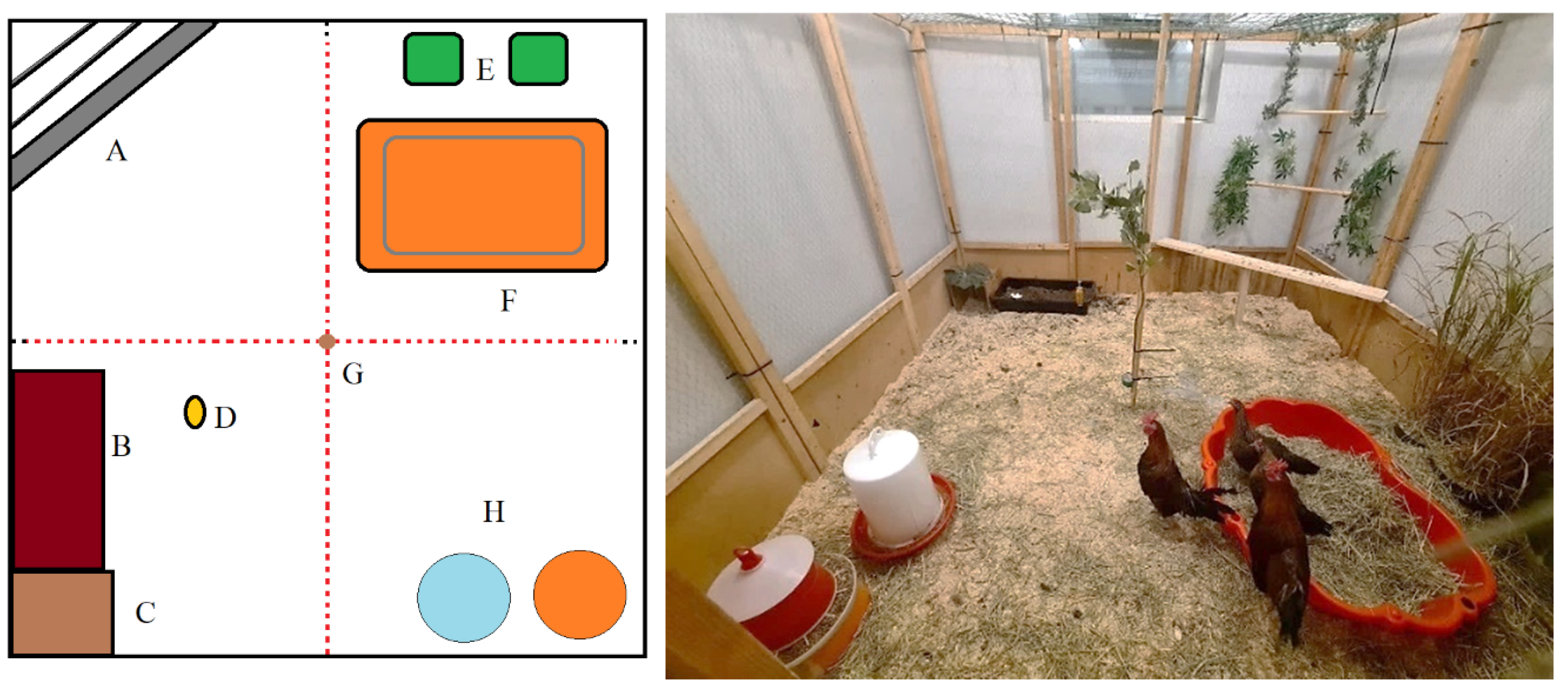
2.2. Observation Pens
2.3. Procedure and Experimental Design
2.4. Statistical Analysis
3. Results
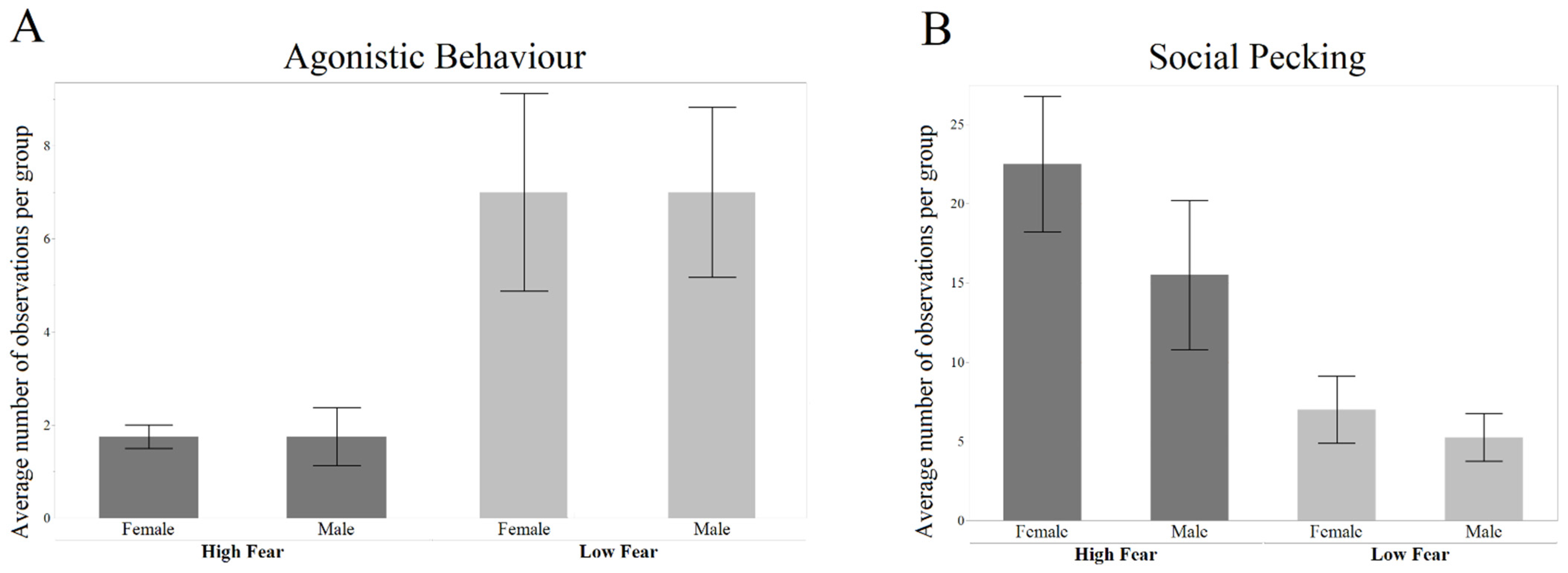
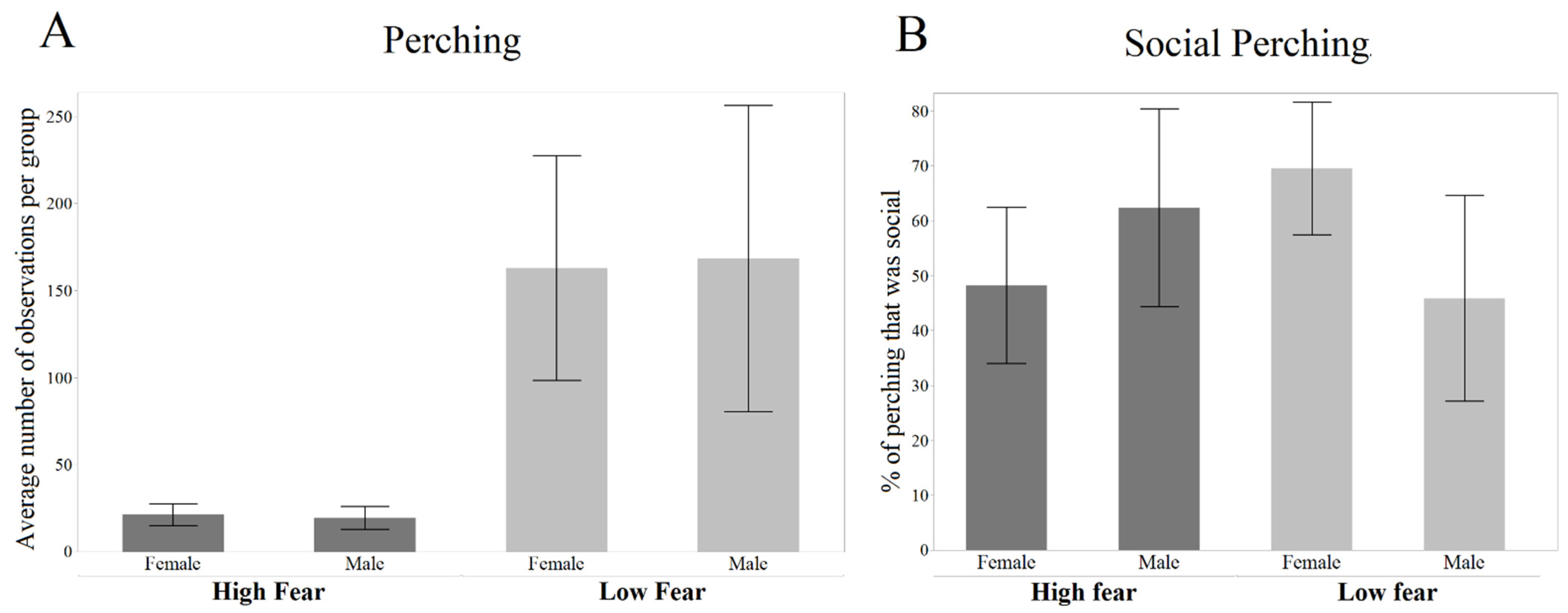
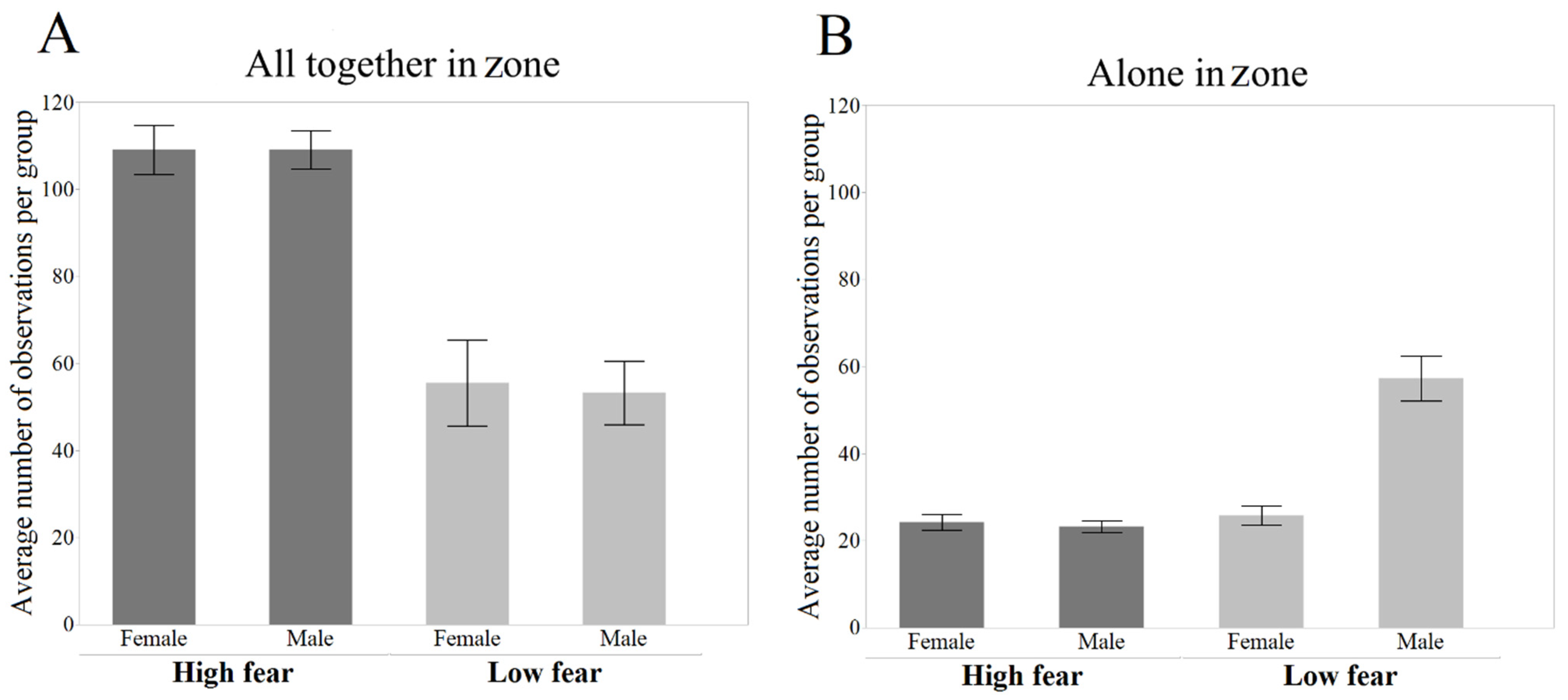
4. Discussion
5. Conclusions
Supplementary Materials
Author Contributions
Funding
Institutional Review Board Statement
Informed Consent Statement
Data Availability Statement
Acknowledgments
Conflicts of Interest
References
- Price, E.O. Behavioral Aspects of Animal Domestication. Q. Rev. Biol. 1984, 59, 1–32. [Google Scholar] [CrossRef] [Scilit]
- Price, E.O. Animal Domestication and Behavior; CABI Publishing: Wallingford, UK, 2002; pp. 21–29. [Google Scholar]
- Tixier-Boichard, M.; Bed’hom, B.; Rognon, X. Chicken domestication: From archeology to genomics. Comptes Rendus Biol. 2011, 334, 197–204. [Google Scholar] [CrossRef] [Scilit] [PubMed]
- Thirstrup, J.P.; Villumsen, T.M.; Malmkvist, J.; Lund, M.S. Selection for temperament has no negative consequences on important production traits in farmed mink. J. Anim. Sci. 2019, 97, 1987–1995. [Google Scholar] [CrossRef] [Scilit]
- Belyaev, D.K. Destabilizing selection as a factor in domestication. J. Hered. 1979, 70, 301–308. [Google Scholar] [CrossRef] [Scilit] [PubMed]
- Wright, D.; Henriksen, R.; Johnsson, M. Defining the domestication syndrome: Comment on Lord et al. 2020. Trends Ecol. Evol. 2020, 35, 1059–1060. [Google Scholar] [CrossRef] [Scilit] [PubMed]
- Nagayama, H.; Matsumoto, Y.; Tanave, A.; Nihei, M.; Goto, T.; Koide, T. Measuring Active and Passive Tameness Separately in Mice. J. Vis. Exp. 2018, 138, e58048. [Google Scholar] [CrossRef] [Scilit]
- West, B.; Zhou, B.-X. Did chickens go north? New evidence for domestication. J. Archaeol. Sci. 1988, 15, 515–533. [Google Scholar] [CrossRef] [Scilit]
- Liu, Y.-P.; Wu, G.; Yao, Y.; Miao, Y.; Luikart, G.; Baig, M.; Beja-Pereira, A.; Ding, Z.; Palanichamy, M.G.; Zhang, Y. Multiple maternal origins of chickens: Out of the Asian jungles. Mol. Phylogenet. Evol. 2006, 38, 12–19. [Google Scholar] [CrossRef] [Scilit] [PubMed]
- Trut, L.; Oskina, I.; Kharlamova, A. Animal evolution during domestication: The domesticated fox as a model. Bioessays 2009, 31, 349–360. [Google Scholar] [CrossRef] [Scilit] [PubMed]
- Agnvall, B.; Bélteky, J.; Jensen, P. Brain size is reduced by selection for tameness in Red Junglefowl–correlated effects in vital organs. Sci. Rep. 2017, 7, 3306. [Google Scholar] [CrossRef] [Scilit] [PubMed]
- Katajamaa, R.; Jensen, P. Selection for reduced fear in red junglefowl changes brain composition and affects fear memory. R. Soc. Open Sci. 2020, 7, 200628. [Google Scholar] [CrossRef] [Scilit] [PubMed]
- Katajamaa, R.; Larsson, L.H.; Lundberg, P.; Sörensen, I.; Jensen, P. Activity, social and sexual behaviour in Red Junglefowl selected for divergent levels of fear of humans. PLoS ONE 2018, 13, e0204303. [Google Scholar] [CrossRef] [Scilit]
- Agnvall, B.; Katajamaa, R.; Altimiras, J.; Jensen, P. Is domestication driven by reduced fear of humans? Boldness, metabolism and serotonin levels in divergently selected red junglefowl (Gallus gallus). Biol. Lett. 2015, 11, 20150509. [Google Scholar] [CrossRef] [Scilit] [PubMed]
- Agnvall, B.; Jöngren, M.; Strandberg, E.; Jensen, P. Heritability and genetic correlations of fear-related behaviour in red junglefowl–possible implications for early domestication. PLoS ONE 2012, 7, e35162. [Google Scholar] [CrossRef] [Scilit] [PubMed]
- Kaiser, S.; Hennessy, M.B.; Sachser, N. Domestication affects the structure, development and stability of biobehavioural profiles. Front. Zool. 2015, 12 (Suppl. S1), S19. [Google Scholar] [CrossRef] [Scilit]
- Schütz, K.E.; Forkman, B.; Jensen, P. Domestication effects on foraging strategy, social behaviour and different fear responses: A comparison between the red junglefowl (Gallus gallus) and a modern layer strain. Appl. Anim. Behav. Sci. 2001, 74, 1–14. [Google Scholar] [CrossRef] [Scilit]
- Künzl, C.; Sachser, N. The Behavioral Endocrinology of Domestication: A Comparison between the Domestic Guinea Pig (Cavia apereaf.porcellus) and Its Wild Ancestor, the Cavy (Cavia aperea). Horm. Behav. 1999, 35, 28–37. [Google Scholar] [CrossRef] [Scilit]
- Malmkvist, J.; Hansen, S.W. Generalization of fear in farm mink, Mustela vison, genetically selected for behaviour towards humans. Anim. Behav. 2002, 64, 487–501. [Google Scholar] [CrossRef] [Scilit]
- Augère-Granier, M.-L. The EU Poultry Meat and Egg Sector: Main Features, Challenges and Prospects:In-depth Analysis. Eur. Parliam. 2019. [Google Scholar] [CrossRef]
- Jones, R.; Hocking, P. Genetic selection for poultry behaviour: Big bad wolf or friend in need? Anim. Welf. 1999, 8, 343–360. [Google Scholar]
- Forkman, B.; Boissy, A.; Meunier-Salaün, M.-C.; Canali, E.; Jonese, R.B. A critical review of fear tests used on cattle, pigs, sheep, poultry and horses. Physiol. Behav. 2007, 92, 340–374. [Google Scholar] [CrossRef] [Scilit]
- RStudio, T. RStudio: Integrated Development for R; RStudio, PBC: Boston, MA, USA, 2020. [Google Scholar]
- JMP®. JMP®, Version 16; SAS Institute Inc.: Cary, NC, USA, 2021. [Google Scholar]
- Agnvall, B.; Bélteky, J.; Katajamaa, R.; Jensen, P. Is evolution of domestication driven by tameness? A selective review with focus on chickens. Appl. Anim. Behav. Sci. 2018, 205, 227–233. [Google Scholar] [CrossRef] [Scilit]
- SchuÈtz, K.E.; Jensen, P. Effects of resource allocation on behavioural strategies: A comparison of red junglefowl (Gallus gallus) and two domesticated breeds of poultry. Ethology 2001, 107, 753–765. [Google Scholar] [CrossRef] [Scilit]
- Agnvall, B.; Jensen, P. Effects of divergent selection for fear of humans on behaviour in Red Junglefowl. PLoS ONE 2016, 11, e0166075. [Google Scholar] [CrossRef] [Scilit] [PubMed]
- Väisänen, J.; Jensen, P. Social versus exploration and foraging motivation in young red junglefowl (Gallus gallus) and White Leghorn layers. Appl. Anim. Behav. Sci. 2003, 84, 139–158. [Google Scholar] [CrossRef] [Scilit]
- Väisänen, J.; Håkansson, J.; Jensen, P. Social interactions in Red Junglefowl (Gallus gallus) and White Leghorn layers in stable groups and after re-grouping. Br. Poult. Sci. 2005, 46, 156–168. [Google Scholar] [CrossRef] [Scilit] [PubMed]
- Eklund, B.; Jensen, P. Domestication effects on behavioural synchronization and individual distances in chickens (Gallus gallus). Behav. Process. 2011, 86, 250–256. [Google Scholar] [CrossRef] [Scilit]
- Collias, N.E. Statistical analysis of factors which make for success in initial encounters between hens. Am. Nat. 1943, 77, 519–538. [Google Scholar] [CrossRef] [Scilit]
- Foreman, D.; Allee, W. A correlation between posture stance and outcome in paired contests of domestic hens. Anim. Behav. 1959, 7, 180–188. [Google Scholar] [CrossRef] [Scilit]
- Cloutier, S.; Newberry, R.C. Recent social experience, body weight and initial patterns of attack predict the social status attained by unfamiliar hens in a new group. Behaviour 2000, 136, 705–726. [Google Scholar]
- Favati, A.; Leimar, O.; Løvlie, H. Personality predicts social dominance in male domestic fowl. PLoS ONE 2014, 9, e103535. [Google Scholar]
- Leonard, M.L.; Horn, A.G. Crowing in relation to status in roosters. Anim. Behav. 1995, 49, 1283–1290. [Google Scholar] [CrossRef] [Scilit]
- Fessler, E.; Zuk, M.; Johnsen, T. Social dominance, male behaviour and mating in mixed-sex flocks of red jungle fowl. Behaviour 2001, 138, 1–18. [Google Scholar] [CrossRef] [Scilit]
- Favati, A.; Leimar, O.; Radesäter, T.; Løvlie, H. Social status and personality: Stability in social state can promote consistency of behavioural responses. Proc. R. Soc. B Biol. Sci. 2014, 281, 20132531. [Google Scholar] [CrossRef] [Scilit]
- Agnvall, B.; Ali, A.; Olby, S.; Jensen, P. Red Junglefowl (Gallus gallus) selected for low fear of humans are larger, more dominant and produce larger offspring. Animal 2014, 8, 1498–1505. [Google Scholar] [CrossRef] [Scilit]
- Collias, N.E.; Collias, E.C. Social organization of a red junglefowl, Gallus gallus, population related to evolution theory. Anim. Behav. 1996, 51, 1337–1354. [Google Scholar] [CrossRef] [Scilit]
- Appleby, M.C.; Mench, J.A.; Hughes, B.O. Poultry Behaviour and Welfare; CABI Publishing: Wallingford, UK, 2004. [Google Scholar]



| Behavior | Definition |
|---|---|
| Social pecking | Non-aggressive pecking or manipulating gently at other |
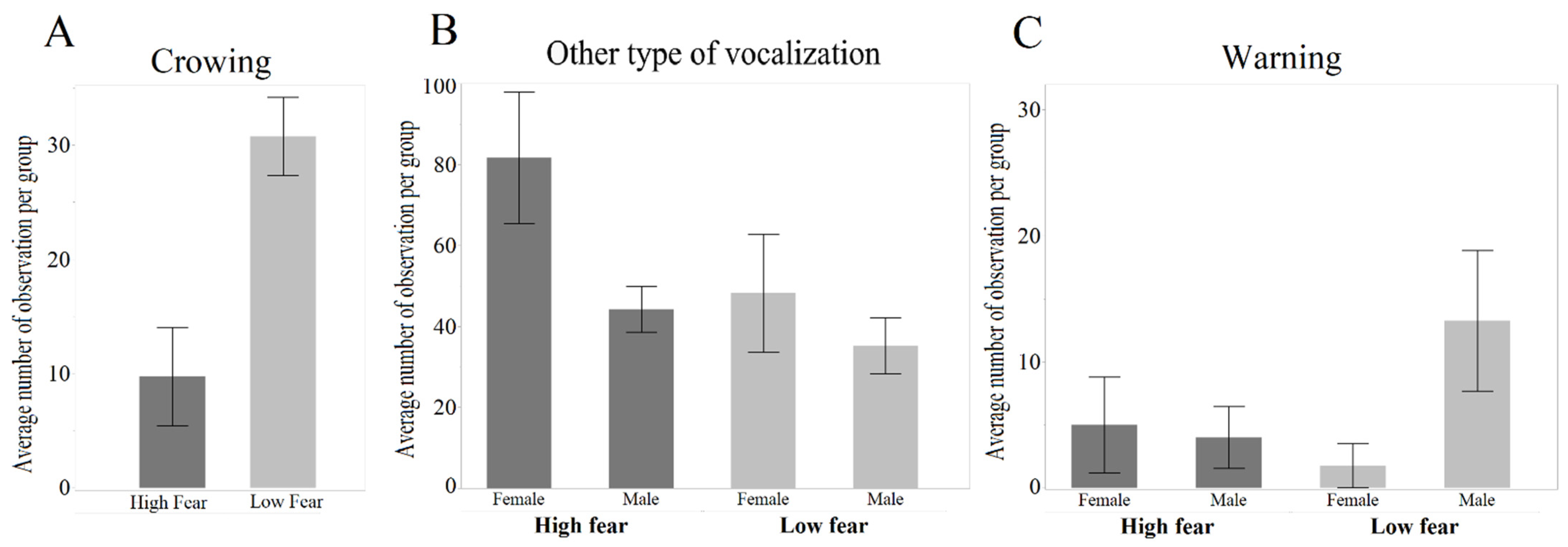
| Warning | Excited and exaggerated repeated “ka-ka-ka-kaaa” |
| Crow | Cockerel crowing |
| Other vocalization | Any unspecified vocalization, not cockerel crowing or warning |
| Give/receive threat | Bird directs beak towards another bird with head high, the other bird moving away by walking, running, jumping, flying |
| Raise Hackle threat | Body horizontal or in pecking position, head towards opponent, hackles raised |
| Chase | Bird follows other bird with head high, other bird moving away |
| Attack | Bird moves swiftly towards opponent to give aggressive peck. Head over opponent |
| Perching | Sits or stands in any position on a perch |
| Zone sharing | Whether the bird is alone or with companions in its “zone” at the end of each 45 s of focal observation |
Publisher’s Note: MDPI stays neutral with regard to jurisdictional claims in published maps and institutional affiliations. |
© 2021 by the authors. Licensee MDPI, Basel, Switzerland. This article is an open access article distributed under the terms and conditions of the Creative Commons Attribution (CC BY) license (https://creativecommons.org/licenses/by/4.0/).
Share and Cite
Gjøen, J.; Jensen, P. Selection for Reduced Fear of Humans Changes Intra-Specific Social Behavior in Red Junglefowl—Implications for Chicken Domestication. Genes 2022, 13, 43. https://doi.org/10.3390/genes13010043
Gjøen J, Jensen P. Selection for Reduced Fear of Humans Changes Intra-Specific Social Behavior in Red Junglefowl—Implications for Chicken Domestication. Genes. 2022; 13(1):43. https://doi.org/10.3390/genes13010043
Chicago/Turabian StyleGjøen, Johanna, and Per Jensen. 2022. "Selection for Reduced Fear of Humans Changes Intra-Specific Social Behavior in Red Junglefowl—Implications for Chicken Domestication" Genes 13, no. 1: 43. https://doi.org/10.3390/genes13010043
APA StyleGjøen, J., & Jensen, P. (2022). Selection for Reduced Fear of Humans Changes Intra-Specific Social Behavior in Red Junglefowl—Implications for Chicken Domestication. Genes, 13(1), 43. https://doi.org/10.3390/genes13010043