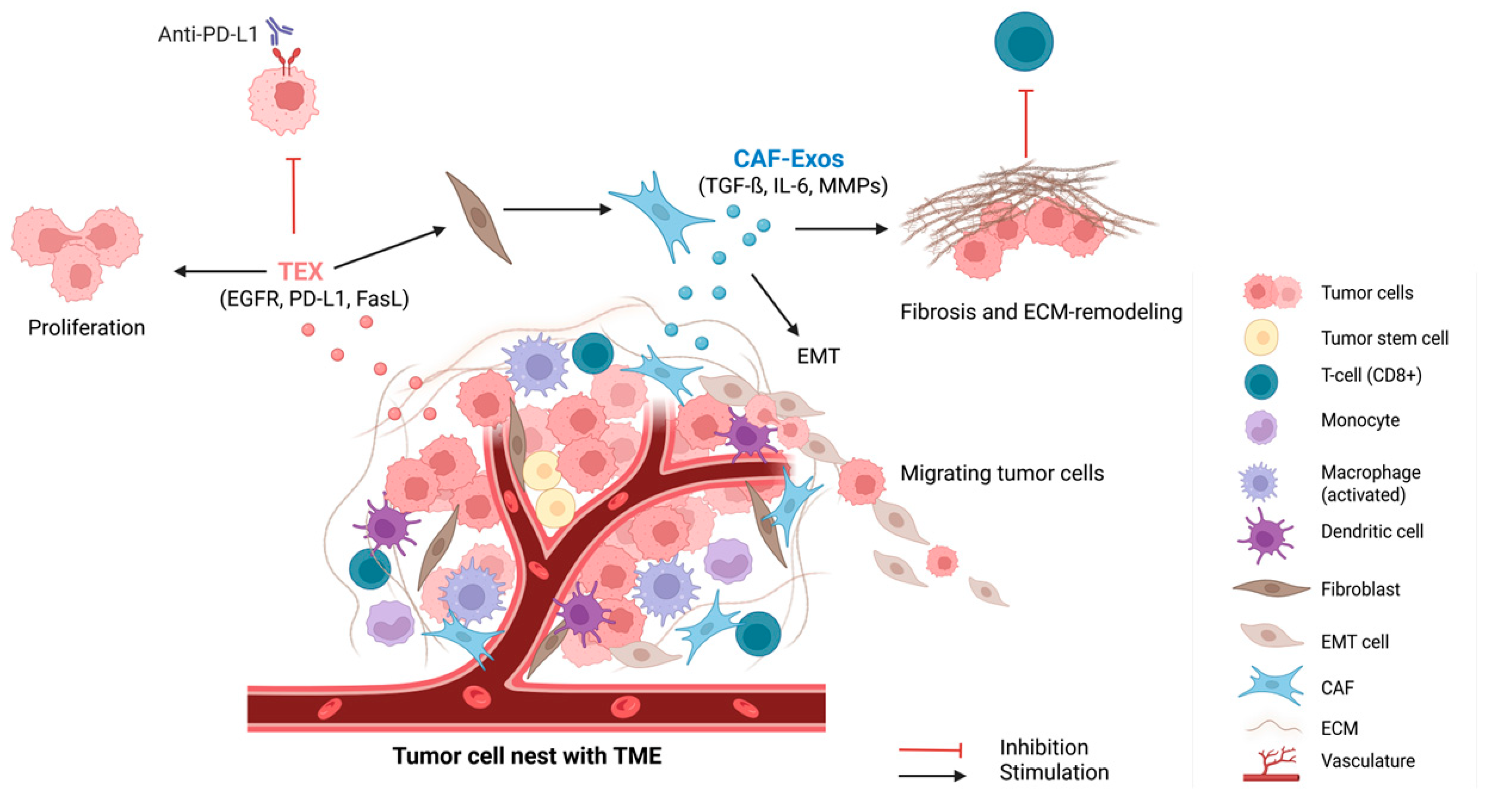
Cancer-Associated Fibroblasts-Derived Exosomes as Mediators of Immunotherapy Resistance in Head and Neck Squamous Cell Carcinoma
 ,
,  , ,
, ,  and
and
Abstract
1. Introduction
2. Materials and Methods
3. Exosomes in CAF-Tumor Crosstalk and Immune Regulation
3.1. Exosomes Biogenesis and Composition
3.2. Experimental Approaches for Isolating CAF-Exos and TEX
3.3. CAFs Heterogeneity and Immunosuppressive Mechanisms
3.4. CAF-Exos and ECM Components
3.5. CAF-Mediated Immune Exclusion Correlates with ICI Resistance, Clinical Relation
3.6. Exosomal miRNAs Mediate Bidirectional Communication Between CAFs and Tumor Cells
3.7. Tumor Cells Independent Direct Effects of CAFs on Effective Immune Cells via Exosomes
4. Impact of HNSCC Patient-Derived Exosomes on Immunotherapy
5. Conclusions
Supplementary Materials
Author Contributions
Funding
Institutional Review Board Statement
Informed Consent Statement
Data Availability Statement
Conflicts of Interest
Abbreviations
| Arg-1 | Arginase-1 |
| AKT | Protein kinase B |
| BCL2 | B-cell lymphoma 2 |
| CAFs | Cancer-Associated Fibroblasts |
| CD | Cluster of Differentiation |
| CDKN1B | Cyclin-dependent kinase inhibitor 1B |
| CX3CR1 | C-X3-C motif chemokine receptor 1 |
| CXCL | C-X-C motif chemokine ligand |
| EGF | Epidermal Growth Factor |
| EMT | Epithelial-to-Mesenchymal Transition |
| FasL | Fas Ligand |
| GLUT-1 | Glucose transporter type 1 |
| HGF | Hepatocyte Growth Factor |
| HNCAF | Head and neck cancer-associated fibroblasts |
| ICIs | Immune checkpoint inhibCX3CR1 blasts |
| IL | Interleukin |
| ING5 | Inhibitor of Growth Family Member 5 |
| LAG-3 | Lymphocyte-activation gene 3 |
| MAPK | Mitogen-activated protein kinase |
| MHC | Major Histocompatibility Complex |
| PDCD4 | Programmed Cell Death 4 |
| PD-1 | Programmed Death 1 |
| PD-L1 | Programmed Death-Ligand 1 |
| PTEN | Phosphatase and Tensin Homolog |
| Rab3D | Ras-related protein Rab-3D |
| RB1 | Retinoblastoma 1 |
| SMAD | Suppressor of Mothers against Decapentaplegic |
| STAT3 | Signal Transducer and Activator of Transcription 3 |
| Th17 | T helper 17 cells |
| TSG101 | Tumor Susceptibility Gene 101 |
| TIM-3 | T-cell immunoglobulin and mucin-domain containing-3 |
| TIGIT | T-cell immunoreceptor with Ig and ITIM domains |
| UICC | Union for International Cancer Control |
| WNT | Wingless-type MMTV integration site family |
References
- Uppaluri, R.; Haddad, R.I.; Tao, Y.; Le Tourneau, C.; Lee, N.Y.; Westra, W.; Chernock, R.; Tahara, M.; Harrington, K.J.; Klochikhin, A.L.; et al. Neoadjuvant and Adjuvant Pembrolizumab in Locally Advanced Head and Neck Cancer. N. Engl. J. Med. 2025, 393, 37–50. [Google Scholar] [CrossRef]
- Pereira, D.; Martins, D.; Mendes, F. Immunotherapy in Head and Neck Cancer When, How, and Why? Biomedicines 2022, 10, 2151. [Google Scholar] [CrossRef] [PubMed]
- Ferris, R.L.; Blumenschein, G.; Fayette, J.; Guigay, J.; Colevas, A.D.; Licitra, L.; Harrington, K.; Kasper, S.; Vokes, E.E.; Even, C.; et al. Nivolumab for Recurrent Squamous-Cell Carcinoma of the Head and Neck. N. Engl. J. Med. 2016, 375, 1856–1867. [Google Scholar] [CrossRef]
- Groupe Oncologie Radiotherapie Tete et Cou. A Phase III Randomized Trial of Post-Operative Adjuvant Nivolumab and Concomitant Chemo-Radiotherapy in High-Risk Patients with Resected Squamous Cell Carcinoma of Head and Neck. 2025. Available online: https://clinicaltrials.gov/study/NCT03576417 (accessed on 4 August 2025).
- GORTEC. GORTEC Announces New Trial Success for Head and Neck Cancer Treatment. Available online: https://www.prnewswire.com/news-releases/gortec-announces-new-trial-success-for-head-and-neck-cancer-treatment-302344120.html (accessed on 5 August 2025).
- Sun, G.; Liu, H.; Shi, X.; Tan, P.; Tang, W.; Chen, X.; Sun, G.; Yang, W.; Kong, X.; Zheng, Z.; et al. Treatment of patients with cancer using PD-1/PD-L1 antibodies: Adverse effects and management strategies (Review). Int. J. Oncol. 2022, 60, 74. [Google Scholar] [CrossRef] [PubMed]
- Ferris, R.L. Immunology and Immunotherapy of Head and Neck Cancer. J. Clin. Oncol. 2015, 33, 3293–3304. [Google Scholar] [CrossRef]
- Freeman, G.J.; Long, A.J.; Iwai, Y.; Bourque, K.; Chernova, T.; Nishimura, H.; Fitz, L.J.; Malenkovich, N.; Okazaki, T.; Byrne, M.C.; et al. Engagement of the PD-1 immunoinhibitory receptor by a novel B7 family member leads to negative regulation of lymphocyte activation. J. Exp. Med. 2000, 192, 1027–1034. [Google Scholar] [CrossRef]
- Sun, J.-Y.; Zhang, D.; Wu, S.; Xu, M.; Zhou, X.; Lu, X.-J.; Ji, J. Resistance to PD-1/PD-L1 blockade cancer immunotherapy: Mechanisms, predictive factors, and future perspectives. Biomark. Res. 2020, 8, 35. [Google Scholar] [CrossRef]
- Garcia-Diaz, A.; Shin, D.S.; Moreno, B.H.; Saco, J.; Escuin-Ordinas, H.; Rodriguez, G.A.; Zaretsky, J.M.; Sun, L.; Hugo, W.; Wang, X.; et al. Interferon Receptor Signaling Pathways Regulating PD-L1 and PD-L2 Expression. Cell Rep. 2017, 19, 1189–1201. [Google Scholar] [CrossRef]
- Han, Y.; Liu, D.; Li, L. PD-1/PD-L1 pathway: Current researches in cancer. Am. J. Cancer Res. 2020, 10, 727–742. [Google Scholar]
- Smussi, D.; Mattavelli, D.; Paderno, A.; Gurizzan, C.; Lorini, L.; Romani, C.; Bignotti, E.; Grammatica, A.; Ravanelli, M.; Bossi, P. Revisiting the concept of neoadjuvant and induction therapy in head and neck cancer with the advent of immunotherapy. Cancer Treat. Rev. 2023, 121, 102644. [Google Scholar] [CrossRef] [PubMed]
- Cai, L.; Li, Y.; Tan, J.; Xu, L.; Li, Y. Targeting LAG-3, TIM-3, and TIGIT for cancer immunotherapy. J. Hematol. Oncol. 2023, 16, 101. [Google Scholar] [CrossRef]
- Ribas, A.; Dummer, R.; Puzanov, I.; VanderWalde, A.; Andtbacka, R.H.I.; Michielin, O.; Olszanski, A.J.; Malvehy, J.; Cebon, J.; Fernandez, E.; et al. Oncolytic Virotherapy Promotes Intratumoral T Cell Infiltration and Improves Anti-PD-1 Immunotherapy. Cell 2017, 170, 1109–1119.e10. [Google Scholar] [CrossRef] [PubMed]
- Liu, J.-F.; Wu, L.; Yang, L.-L.; Deng, W.-W.; Mao, L.; Wu, H.; Zhang, W.-F.; Sun, Z.-J. Blockade of TIM3 relieves immunosuppression through reducing regulatory T cells in head and neck cancer. J. Exp. Clin. Cancer Res. 2018, 37, 44. [Google Scholar] [CrossRef] [PubMed]
- Peyraud, F.; Guégan, J.-P.; Rey, C.; Lara, O.; Odin, O.; Del Castillo, M.; Vanhersecke, L.; Coindre, J.-M.; Clot, E.; Brunet, M.; et al. Spatially resolved transcriptomics reveal the determinants of primary resistance to immunotherapy in NSCLC with mature tertiary lymphoid structures. Cell Rep. Med. 2025, 6, 101934. [Google Scholar] [CrossRef] [PubMed]
- Ribas, A. Adaptive Immune Resistance: How Cancer Protects from Immune Attack. Cancer Discov. 2015, 5, 915–919. [Google Scholar] [CrossRef] [PubMed]
- Piwocka, O.; Piotrowski, I.; Suchorska, W.M.; Kulcenty, K. Dynamic interactions in the tumor niche: How the cross-talk between CAFs and the tumor microenvironment impacts resistance to therapy. Front. Mol. Biosci. 2024, 11, 1343523. [Google Scholar] [CrossRef]
- Whiteside, T.L. The Role of Tumor-Derived Exosomes (TEX) in Shaping Anti-Tumor Immune Competence. Cells 2021, 10, 3054. [Google Scholar] [CrossRef]
- Whiteside, T.L. Tumor-derived Exosomes and Antitumor Immunity. J. Immunol. 2024, 213, 923–931. [Google Scholar] [CrossRef]
- Li, C.; Teixeira, A.F.; Zhu, H.-J.; Ten Dijke, P. Cancer associated-fibroblast-derived exosomes in cancer progression. Mol. Cancer 2021, 20, 154. [Google Scholar] [CrossRef]
- Seto, T.; Sam, D.; Pan, M. Mechanisms of Primary and Secondary Resistance to Immune Checkpoint Inhibitors in Cancer. Med. Sci. 2019, 7, 14. [Google Scholar] [CrossRef]
- Wu, H.; Gao, P.; Zhou, W.; Chen, C.; Wang, M.; Han, L. Exosome-like nanovesicles (EVNs): A comprehensive overview of their isolation, characterization and biological applications. Food Chem. 2025, 495, 146575. [Google Scholar] [CrossRef]
- Zeng, L.; Chen, X.; Du, J.; Yu, Z.; Zhang, R.; Zhang, Y.; Yang, H. Label-free separation of nanoscale particles by an ultrahigh gradient magnetic field in a microfluidic device. Nanoscale 2021, 13, 4029–4037. [Google Scholar] [CrossRef]
- Tricco, A.C.; Lillie, E.; Zarin, W.; O’Brien, K.K.; Colquhoun, H.; Levac, D.; Moher, D.; Peters, M.D.J.; Horsley, T.; Weeks, L.; et al. PRISMA Extension for Scoping Reviews (PRISMA-ScR): Checklist and Explanation. Ann. Intern. Med. 2018, 169, 467–473. [Google Scholar] [CrossRef] [PubMed]
- Rajput, A.; Varshney, A.; Bajaj, R.; Pokharkar, V. Exosomes as New Generation Vehicles for Drug Delivery: Biomedical Applications and Future Perspectives. Molecules 2022, 27, 7289. [Google Scholar] [CrossRef] [PubMed]
- Simons, M.; Raposo, G. Exosomes--vesicular carriers for intercellular communication. Curr. Opin. Cell Biol. 2009, 21, 575–581. [Google Scholar] [CrossRef] [PubMed]
- Steinbichler, T.B.; Dudás, J.; Riechelmann, H.; Skvortsova, I.-I. The role of exosomes in cancer metastasis. Semin. Cancer Biol. 2017, 44, 170–181. [Google Scholar] [CrossRef]
- Blott, E.J.; Griffiths, G.M. Secretory lysosomes. Nat. Rev. Mol. Cell Biol. 2002, 3, 122–131. [Google Scholar] [CrossRef]
- Yang, J.; Liu, W.; Lu, X.; Fu, Y.; Li, L.; Luo, Y. High expression of small GTPase Rab3D promotes cancer progression and metastasis. Oncotarget 2015, 6, 11125–11138. [Google Scholar] [CrossRef]
- Parolini, I.; Federici, C.; Raggi, C.; Lugini, L.; Palleschi, S.; De Milito, A.; Coscia, C.; Iessi, E.; Logozzi, M.; Molinari, A.; et al. Microenvironmental pH is a key factor for exosome traffic in tumor cells. J. Biol. Chem. 2009, 284, 34211–34222. [Google Scholar] [CrossRef]
- Balaji, S.; Kim, U.; Muthukkaruppan, V.; Vanniarajan, A. Emerging role of tumor microenvironment derived exosomes in therapeutic resistance and metastasis through epithelial-to-mesenchymal transition. Life Sci. 2021, 280, 119750. [Google Scholar] [CrossRef]
- Zhou, Y.; Zhang, Y.; Gong, H.; Luo, S.; Cui, Y. The Role of Exosomes and Their Applications in Cancer. Int. J. Mol. Sci. 2021, 22, 12204. [Google Scholar] [CrossRef]
- Wang, H.; You, Y.; Zhu, X. The Role of Exosomes in the Progression and Therapeutic Resistance of Hematological Malignancies. Front. Oncol. 2022, 12, 887518. [Google Scholar] [CrossRef] [PubMed]
- Guo, Q.-R.; Wang, H.; Yan, Y.; Liu, Y.; Su, C.-Y.; Chen, H.-B.; Yan, Y.-Y.; Adhikari, R.; Wu, Q.; Zhang, J.-Y. The Role of Exosomal microRNA in Cancer Drug Resistance. Front. Oncol. 2020, 10, 472. [Google Scholar] [CrossRef]
- Razzo, B.M.; Ludwig, N.; Hong, C.-S.; Sharma, P.; Fabian, K.P.; Fecek, R.J.; Storkus, W.J.; Whiteside, T.L. Tumor-derived exosomes promote carcinogenesis of murine oral squamous cell carcinoma. Carcinogenesis 2020, 41, 625–633. [Google Scholar] [CrossRef] [PubMed]
- Kim, J.W.; Wieckowski, E.; Taylor, D.D.; Reichert, T.E.; Watkins, S.; Whiteside, T.L. Fas ligand-positive membranous vesicles isolated from sera of patients with oral cancer induce apoptosis of activated T lymphocytes. Clin. Cancer Res. 2005, 11, 1010–1020. [Google Scholar] [CrossRef] [PubMed]
- Gastpar, R.; Gehrmann, M.; Bausero, M.A.; Asea, A.; Gross, C.; Schroeder, J.A.; Multhoff, G. Heat shock protein 70 surface-positive tumor exosomes stimulate migratory and cytolytic activity of natural killer cells. Cancer Res. 2005, 65, 5238–5247. [Google Scholar] [CrossRef]
- Tang, X.; Chang, C.; Guo, J.; Lincoln, V.; Liang, C.; Chen, M.; Woodley, D.T.; Li, W. Tumour-Secreted Hsp90α on External Surface of Exosomes Mediates Tumour—Stromal Cell Communication via Autocrine and Paracrine Mechanisms. Sci. Rep. 2019, 9, 15108. [Google Scholar] [CrossRef]
- Xiao, C.; Song, F.; Zheng, Y.L.; Lv, J.; Wang, Q.F.; Xu, N. Exosomes in Head and Neck Squamous Cell Carcinoma. Front. Oncol. 2019, 9, 894. [Google Scholar] [CrossRef] [PubMed]
- Nelhűbel, G.A.; Cserepes, M.; Szabó, B.; Türk, D.; Kárpáti, A.; Kenessey, I.; Rásó, E.; Barbai, T.; Hegedűs, Z.; László, V.; et al. EGFR Alterations Influence the Cetuximab Treatment Response and c-MET Tyrosine-Kinase Inhibitor Sensitivity in Experimental Head and Neck Squamous Cell Carcinomas. Pathol. Oncol. Res. 2021, 27, 620256. [Google Scholar] [CrossRef]
- Miao, J.; Hsu, P.; Yang, Y.; Xu, Z.; Dai, Y.; Wang, Y.; Chan, G.; Huang, Z.; Hu, B.; Li, H.; et al. YAP regulates PD-L1 expression in human NSCLC cells. Oncotarget 2017, 8, 114576–114587. [Google Scholar] [CrossRef]
- Teng, Y.; Gao, L.; Loveless, R.; Rodrigo, J.P.; Strojan, P.; Willems, S.M.; Nathan, C.-A.; Mäkitie, A.A.; Saba, N.F.; Ferlito, A. The Hidden Link of Exosomes to Head and Neck Cancer. Cancers 2021, 13, 5802. [Google Scholar] [CrossRef] [PubMed]
- Li, C.; Guo, H.; Zhai, P.; Yan, M.; Liu, C.; Wang, X.; Shi, C.; Li, J.; Tong, T.; Zhang, Z.; et al. Spatial and Single-Cell Transcriptomics Reveal a Cancer-Associated Fibroblast Subset in HNSCC That Restricts Infiltration and Antitumor Activity of CD8+ T Cells. Cancer Res. 2024, 84, 258–275. [Google Scholar] [CrossRef] [PubMed]
- Bartoschek, M.; Oskolkov, N.; Bocci, M.; Lövrot, J.; Larsson, C.; Sommarin, M.; Madsen, C.D.; Lindgren, D.; Pekar, G.; Karlsson, G.; et al. Spatially and functionally distinct subclasses of breast cancer-associated fibroblasts revealed by single cell RNA sequencing. Nat. Commun. 2018, 9, 5150. [Google Scholar] [CrossRef]
- Mhaidly, R.; Mechta-Grigoriou, F. Fibroblast heterogeneity in tumor micro-environment: Role in immunosuppression and new therapies. Semin. Immunol. 2020, 48, 101417. [Google Scholar] [CrossRef] [PubMed]
- Puram, S.V.; Tirosh, I.; Parikh, A.S.; Patel, A.P.; Yizhak, K.; Gillespie, S.; Rodman, C.; Luo, C.L.; Mroz, E.A.; Emerick, K.S.; et al. Single-Cell Transcriptomic Analysis of Primary and Metastatic Tumor Ecosystems in Head and Neck Cancer. Cell 2017, 171, 1611–1624.e24. [Google Scholar] [CrossRef]
- Hu, C.; Zhang, Y.; Wu, C.; Huang, Q. Heterogeneity of cancer-associated fibroblasts in head and neck squamous cell carcinoma: Opportunities and challenges. Cell Death Discov. 2023, 9, 124. [Google Scholar] [CrossRef]
- Hellevik, T.; Berzaghi, R.; Lode, K.; Islam, A.; Martinez-Zubiaurre, I. Immunobiology of cancer-associated fibroblasts in the context of radiotherapy. J. Transl. Med. 2021, 19, 437. [Google Scholar] [CrossRef]
- Ren, F.; Meng, L.; Zheng, S.; Cui, J.; Song, S.; Li, X.; Wang, D.; Li, X.; Liu, Q.; Bu, W.; et al. Myeloid cell-derived apCAFs promote HNSCC progression by regulating proportion of CD4+ and CD8+ T cells. J. Exp. Clin. Cancer Res. 2025, 44, 33. [Google Scholar] [CrossRef]
- Louault, K.; Li, R.-R.; DeClerck, Y.A. Cancer-Associated Fibroblasts: Understanding Their Heterogeneity. Cancers 2020, 12, 3108. [Google Scholar] [CrossRef]
- Ghahremanifard, P.; Chanda, A.; Bonni, S.; Bose, P. TGF-β Mediated Immune Evasion in Cancer-Spotlight on Cancer-Associated Fibroblasts. Cancers 2020, 12, 3650. [Google Scholar] [CrossRef]
- Hoffmann, F.; Franzen, A.; de Vos, L.; Wuest, L.; Kulcsár, Z.; Fietz, S.; Maas, A.P.; Hollick, S.; Diop, M.Y.; Gabrielpillai, J.; et al. CTLA4 DNA methylation is associated with CTLA-4 expression and predicts response to immunotherapy in head and neck squamous cell carcinoma. Clin. Epigenet. 2023, 15, 112. [Google Scholar] [CrossRef] [PubMed]
- Taylor, A.; Verhagen, J.; Blaser, K.; Akdis, M.; Akdis, C.A. Mechanisms of immune suppression by interleukin-10 and transforming growth factor-β: The role of T regulatory cells. Immunology 2006, 117, 433–442. [Google Scholar] [CrossRef] [PubMed]
- Arneth, B. Molecular Mechanisms of Immune Regulation: A Review. Cells 2025, 14, 283. [Google Scholar] [CrossRef] [PubMed]
- Meci, A.; Goyal, N.; Slonimsky, G. Mechanisms of Resistance and Therapeutic Perspectives in Immunotherapy for Advanced Head and Neck Cancers. Cancers 2024, 16, 703. [Google Scholar] [CrossRef]
- Barrett, R.; Puré, E. Cancer-associated fibroblasts: Key determinants of tumor immunity and immunotherapy. Curr. Opin. Immunol. 2020, 64, 80–87. [Google Scholar] [CrossRef] [PubMed]
- Li, K.; Shi, H.; Zhang, B.; Ou, X.; Ma, Q.; Chen, Y.; Shu, P.; Li, D.; Wang, Y. Myeloid-derived suppressor cells as immunosuppressive regulators and therapeutic targets in cancer. Sig Transduct. Target. Ther. 2021, 6, 362. [Google Scholar] [CrossRef]
- Walsh, R.M.; Ambrose, J.; Jack, J.L.; Eades, A.E.; Bye, B.A.; Ruckert, M.T.; Messaggio, F.; Olou, A.A.; Chalise, P.; Pei, D.; et al. Depletion of tumor-derived CXCL5 improves T cell infiltration and anti-PD-1 therapy response in an obese model of pancreatic cancer. J. Immunother. Cancer 2025, 13, e010057. [Google Scholar] [CrossRef] [PubMed]
- Lee, B.-S.; Jang, J.Y.; Seo, C.; Kim, C.-H. Crosstalk between head and neck cancer cells and lymphatic endothelial cells promotes tumor metastasis via CXCL5-CXCR2 signaling. FASEB J. 2021, 35, e21181. [Google Scholar] [CrossRef]
- Steinbichler, T.B.; Metzler, V.; Pritz, C.; Riechelmann, H.; Dudas, J. Tumor-associated fibroblast-conditioned medium induces CDDP resistance in HNSCC cells. Oncotarget 2016, 7, 2508–2518. [Google Scholar] [CrossRef]
- Federspiel, J.; Steinbichler, T.B.; Vorbach, S.M.; Eling, M.T.; Borena, W.; Seifarth, C.; Hofauer, B.G.; Dudas, J. Patient-Derived Cancer-Associated Fibroblasts Support the Colonization of Tumor Cells in Head and Neck Squamous Cell Carcinoma. Biomedicines 2025, 13, 358. [Google Scholar] [CrossRef]
- Mito, I.; Takahashi, H.; Kawabata-Iwakawa, R.; Horikawa, M.; Ida, S.; Tada, H.; Matsuyama, T.; Misawa, K.; Takeda, S.; Chikamatsu, K. Tumor-derived exosomes elicit cancer-associated fibroblasts shaping inflammatory tumor microenvironment in head and neck squamous cell carcinoma. Oral Oncol. 2023, 136, 106270. [Google Scholar] [CrossRef]
- Szabo, P.M.; Vajdi, A.; Kumar, N.; Tolstorukov, M.Y.; Chen, B.J.; Edwards, R.; Ligon, K.L.; Chasalow, S.D.; Chow, K.-H.; Shetty, A.; et al. Cancer-associated fibroblasts are the main contributors to epithelial-to-mesenchymal signatures in the tumor microenvironment. Sci. Rep. 2023, 13, 3051. [Google Scholar] [CrossRef] [PubMed]
- Jung, A.R.; Jung, C.-H.; Noh, J.K.; Lee, Y.C.; Eun, Y.-G. Epithelial-mesenchymal transition gene signature is associated with prognosis and tumor microenvironment in head and neck squamous cell carcinoma. Sci. Rep. 2020, 10, 3652. [Google Scholar] [CrossRef] [PubMed]
- Steinbichler, T.B.; Dudas, J.; Ingruber, J.; Glueckert, R.; Sprung, S.; Fleischer, F.; Cidlinsky, N.; Dejaco, D.; Kofler, B.; Giotakis, A.I.; et al. Slug Is A Surrogate Marker of Epithelial to Mesenchymal Transition (EMT) in Head and Neck Cancer. J. Clin. Med. 2020, 9, 2061. [Google Scholar] [CrossRef] [PubMed]
- Federspiel, J.; do Carmo Greier, M.; Ladányi, A.; Dudas, J. p38 Mitogen-Activated Protein Kinase Inhibition of Mesenchymal Transdifferentiated Tumor Cells in Head and Neck Squamous Cell Carcinoma. Biomedicines 2023, 11, 3301. [Google Scholar] [CrossRef]
- Ingruber, J.; Dudás, J.; Savic, D.; Schweigl, G.; Steinbichler, T.B.; do Carmo Greier, M.; Santer, M.; Carollo, S.; Trajanoski, Z.; Riechelmann, H. EMT-related transcription factors and protein stabilization mechanisms involvement in cadherin switch of head and neck squamous cell carcinoma. Exp. Cell Res. 2022, 414, 113084. [Google Scholar] [CrossRef]
- Trapani, J.A.; Sutton, V.R. Granzyme B: Pro-apoptotic, antiviral and antitumor functions. Curr. Opin. Immunol. 2003, 15, 533–543. [Google Scholar] [CrossRef]
- Jiang, L.; Wang, Y.-J.; Zhao, J.; Uehara, M.; Hou, Q.; Kasinath, V.; Ichimura, T.; Banouni, N.; Dai, L.; Li, X.; et al. Direct Tumor Killing and Immunotherapy through Anti-SerpinB9 Therapy. Cell 2020, 183, 1219–1233.e18. [Google Scholar] [CrossRef] [PubMed]
- Ferruzzi, J.; Sun, M.; Gkousioudi, A.; Pilvar, A.; Roblyer, D.; Zhang, Y.; Zaman, M.H. Compressive Remodeling Alters Fluid Transport Properties of Collagen Networks—Implications for Tumor Growth. Sci. Rep. 2019, 9, 17151. [Google Scholar] [CrossRef]
- Jumaniyazova, E.; Lokhonina, A.; Dzhalilova, D.; Kosyreva, A.; Fatkhudinov, T. Role of Microenvironmental Components in Head and Neck Squamous Cell Carcinoma. J. Pers. Med. 2023, 13, 1616. [Google Scholar] [CrossRef] [PubMed]
- Wu, Y.; Chen, W.; Deng, J.; Zhou, X.; Chen, J.; Yang, Z.; Cao, X.; Liu, J.; Tan, Q.; Zhou, E.; et al. Cancer-associated fibroblast-derived extracellular vesicles loaded with GLUT1 inhibitor synergize anti-PD-L1 to suppress tumor growth via degrading matrix stiffness and remodeling tumor microenvironment. J. Control. Release 2025, 385, 113998. [Google Scholar] [CrossRef] [PubMed]
- Dong, G.; Chen, P.; Xu, Y.; Liu, T.; Yin, R. Cancer-associated fibroblasts: Key criminals of tumor pre-metastatic niche. Cancer Lett. 2023, 566, 216234. [Google Scholar] [CrossRef]
- Zhang, F.; Guo, J.; Yu, S.; Zheng, Y.; Duan, M.; Zhao, L.; Wang, Y.; Yang, Z.; Jiang, X. Cellular senescence and metabolic reprogramming: Unraveling the intricate crosstalk in the immunosuppressive tumor microenvironment. Cancer Commun. 2024, 44, 929–966. [Google Scholar] [CrossRef] [PubMed]
- Baba, A.B.; Rah, B.; Bhat, G.R.; Mushtaq, I.; Parveen, S.; Hassan, R.; Hameed Zargar, M.; Afroze, D. Transforming Growth Factor-Beta (TGF-β) Signaling in Cancer-A Betrayal Within. Front. Pharmacol. 2022, 13, 791272. [Google Scholar] [CrossRef]
- Chandra Jena, B.; Sarkar, S.; Rout, L.; Mandal, M. The transformation of cancer-associated fibroblasts: Current perspectives on the role of TGF-β in CAF mediated tumor progression and therapeutic resistance. Cancer Lett. 2021, 520, 222–232. [Google Scholar] [CrossRef] [PubMed]
- Kieffer, Y.; Hocine, H.R.; Gentric, G.; Pelon, F.; Bernard, C.; Bourachot, B.; Lameiras, S.; Albergante, L.; Bonneau, C.; Guyard, A.; et al. Single-Cell Analysis Reveals Fibroblast Clusters Linked to Immunotherapy Resistance in Cancer. Cancer Discov. 2020, 10, 1330–1351. [Google Scholar] [CrossRef]
- Fabre, M.; Ferrer, C.; Domínguez-Hormaetxe, S.; Bockorny, B.; Murias, L.; Seifert, O.; Eisler, S.A.; Kontermann, R.E.; Pfizenmaier, K.; Lee, S.Y.; et al. OMTX705, a Novel FAP-Targeting ADC Demonstrates Activity in Chemotherapy and Pembrolizumab-Resistant Solid Tumor Models. Clin. Cancer Res. 2020, 26, 3420–3430. [Google Scholar] [CrossRef]
- Taddio, M.F.; Doshi, S.; Masri, M.; Jeanjean, P.; Hikmat, F.; Gerlach, A.; Nyiranshuti, L.; Rosser, E.W.; Schaue, D.; Besserer-Offroy, E.; et al. Evaluating [225Ac]Ac-FAPI-46 for the treatment of soft-tissue sarcoma in mice. Eur. J. Nucl. Med. Mol. Imaging 2024, 51, 4026–4037. [Google Scholar] [CrossRef]
- Hansen, A.R.; Gomez-Roca, C.A.; Robbrecht, D.G.J.; Verlingue, L.; Italiano, A.; Bauman, J.E.; Steeghs, N.; Prenen, H.; Fayette, J.; Spicer, J.; et al. Phase Ib Study of the Immunocytokine Simlukafusp Alfa (FAP-IL2v) in Combination with Cetuximab in Patients with Head and Neck Squamous Cell Carcinoma. Clin. Cancer Res. 2024, 30, 5540–5547. [Google Scholar] [CrossRef] [PubMed]
- Duan, Y.; Zhou, M.; Ye, B.; Yue, K.; Qiao, F.; Wang, Y.; Lai, Q.; Wu, Y.; Cao, J.; Wu, Y.; et al. Hypoxia-induced miR-5100 promotes exosome-mediated activation of cancer-associated fibroblasts and metastasis of head and neck squamous cell carcinoma. Cell Death Dis. 2024, 15, 215. [Google Scholar] [CrossRef]
- Ye, B.; Duan, Y.; Zhou, M.; Wang, Y.; Lai, Q.; Yue, K.; Cao, J.; Wu, Y.; Wang, X.; Jing, C. Hypoxic tumor-derived exosomal miR-21 induces cancer-associated fibroblast activation to promote head and neck squamous cell carcinoma metastasis. Cell Signal 2023, 108, 110725. [Google Scholar] [CrossRef] [PubMed]
- Golestannejad, P.; Monkaresi, M.; Zhian Zargaran, F.; Khosravani, M.; Asgari, P.; Mobaraki, H.; Gorjizad, M.; Hasany, S.; Senobari Ghezeljehmeidan, A.; Hemmati, S.; et al. Role of Cancer Associated Fibroblast (CAF) derived miRNAs on head and neck malignancies microenvironment: A systematic review. BMC Cancer 2025, 25, 582. [Google Scholar] [CrossRef] [PubMed]
- Wu, X.; Zhou, Z.; Xu, S.; Liao, C.; Chen, X.; Li, B.; Peng, J.; Li, D.; Yang, L. Extracellular vesicle packaged LMP1-activated fibroblasts promote tumor progression via autophagy and stroma-tumor metabolism coupling. Cancer Lett. 2020, 478, 93–106. [Google Scholar] [CrossRef]
- Kalluri, R.; LeBleu, V.S. The biology, function, and biomedical applications of exosomes. Science 2020, 367, eaau6977. [Google Scholar] [CrossRef]
- Qin, X.; Guo, H.; Wang, X.; Zhu, X.; Yan, M.; Wang, X.; Xu, Q.; Shi, J.; Lu, E.; Chen, W.; et al. Exosomal miR-196a derived from cancer-associated fibroblasts confers cisplatin resistance in head and neck cancer through targeting CDKN1B and ING5. Genome Biol. 2019, 20, 12. [Google Scholar] [CrossRef] [PubMed]
- Zhu, G.; Cao, B.; Liang, X.; Li, L.; Hao, Y.; Meng, W.; He, C.; Wang, L.; Li, L. Small extracellular vesicles containing miR-192/215 mediate hypoxia-induced cancer-associated fibroblast development in head and neck squamous cell carcinoma. Cancer Lett. 2021, 506, 11–22. [Google Scholar] [CrossRef]
- Wang, X.; Qin, X.; Yan, M.; Shi, J.; Xu, Q.; Li, Z.; Yang, W.; Zhang, J.; Chen, W. Loss of exosomal miR-3188 in cancer-associated fibroblasts contributes to HNC progression. J. Exp. Clin. Cancer Res. 2019, 38, 151. [Google Scholar] [CrossRef]
- Milosevic, V.; Östman, A. Interactions between cancer-associated fibroblasts and T-cells: Functional crosstalk with targeting and biomarker potential. Ups. J. Med. Sci. 2024, 129, e10710. [Google Scholar] [CrossRef]
- Obradovic, A.; Graves, D.; Korrer, M.; Wang, Y.; Roy, S.; Naveed, A.; Xu, Y.; Luginbuhl, A.; Curry, J.; Gibson, M.; et al. Immunostimulatory Cancer-Associated Fibroblast Subpopulations Can Predict Immunotherapy Response in Head and Neck Cancer. Clin. Cancer Res. 2022, 28, 2094–2109. [Google Scholar] [CrossRef]
- Zhang, S.; Zhou, C.; Zhang, D.; Huang, Z.; Zhang, G. The anti-apoptotic effect on cancer-associated fibroblasts of B7-H3 molecule enhancing the cell invasion and metastasis in renal cancer. OncoTargets Ther. 2019, 12, 4119–4127. [Google Scholar] [CrossRef]
- Hofmann, L.; Ludwig, S.; Vahl, J.; Brunner, C.; Hoffmann, T.; Theodoraki, M.-N. The Emerging Role of Exosomes in Diagnosis, Prognosis, and Therapy in Head and Neck Cancer. Int. J. Mol. Sci. 2020, 21, 4072. [Google Scholar] [CrossRef]
- Hofmann, L.; Medyany, V.; Ezić, J.; Lotfi, R.; Niesler, B.; Röth, R.; Engelhardt, D.; Laban, S.; Schuler, P.J.; Hoffmann, T.K.; et al. Cargo and Functional Profile of Saliva-Derived Exosomes Reveal Biomarkers Specific for Head and Neck Cancer. Front. Med. 2022, 9, 904295. [Google Scholar] [CrossRef]
- Huber, D.; Kors, T.A.; Schütt, L.; Hofmann, L.; Betzler, A.; Lotfi, R.; Oliveri, F.; Schmid, S.; Wollenberg, B.; Hoffmann, T.K.; et al. The role of plasma-derived small extracellular vesicles in pre-metastatic niche formation through modulation of macrophages in head and neck squamous cell carcinoma. Br. J. Cancer 2025, 133, 121–130. [Google Scholar] [CrossRef]
- Theodoraki, M.-N.; Hofmann, L.; Huber, D.; Brunner, C.; Hoffmann, T.K.; Idel, C.; Fleckner, J.; Bruchhage, K.-L.; Pries, R. Plasma-derived CD16 exosomes and peripheral blood monocytes as correlating biomarkers in head and neck cancer. Oncol. Lett. 2023, 25, 200. [Google Scholar] [CrossRef] [PubMed]
- Hofmann, L.; Ludwig, S.; Schuler, P.J.; Hoffmann, T.K.; Brunner, C.; Theodoraki, M.-N. The Potential of CD16 on Plasma-Derived Exosomes as a Liquid Biomarker in Head and Neck Cancer. Int. J. Mol. Sci. 2020, 21, 3739. [Google Scholar] [CrossRef]
- Theodoraki, M.-N.; Huber, D.; Hofmann, L.; Werner, L.; Idel, C.; Fleckner, J.; Plötze-Martin, K.; Schütt, L.; Brunner, C.; Depping, R.; et al. Type 2-like polarization and elevated CXCL4 secretion of monocyte derived macrophages upon internalization of plasma-derived exosomes from head and neck cancer patients. BMC Cancer 2024, 24, 1173. [Google Scholar] [CrossRef] [PubMed]
- Schroeder, J.C.; Puntigam, L.; Hofmann, L.; Jeske, S.S.; Beccard, I.J.; Doescher, J.; Laban, S.; Hoffmann, T.K.; Brunner, C.; Theodoraki, M.-N.; et al. Circulating Exosomes Inhibit B Cell Proliferation and Activity. Cancers 2020, 12, 2110. [Google Scholar] [CrossRef] [PubMed]
- Beccard, I.; Hofmann, L.; Schröder, J.; Ludwig, S.; Laban, S.; Brunner, C.; Lotfi, R.; Hoffmann, T.; Jackson, E.; Schuler, P.; et al. Immune Suppressive Effects of Plasma-Derived Exosome Populations in Head and Neck Cancer. Cancers 2020, 12, 1997. [Google Scholar] [CrossRef]
- Hofmann, L.; Waizenegger, M.; Röth, R.; Schmitteckert, S.; Engelhardt, D.; Schuler, P.J.; Laban, S.; Hoffmann, T.K.; Brunner, C.; Theodoraki, M.-N. Treatment dependent impact of plasma-derived exosomes from head and neck cancer patients on the epithelial-to-mesenchymal transition. Front. Oncol. 2022, 12, 1043199. [Google Scholar] [CrossRef]
- Tengler, L.; Schütz, J.; Tiedtke, M.; Jablonska, J.; Theodoraki, M.-N.; Nitschke, K.; Weiß, C.; Seiz, E.; Affolter, A.; Jungbauer, F.; et al. Plasma-derived small extracellular vesicles unleash the angiogenic potential in head and neck cancer patients. Mol. Med. 2023, 29, 69. [Google Scholar] [CrossRef]
- Théry, C.; Witwer, K.W.; Aikawa, E.; Alcaraz, M.J.; Anderson, J.D.; Andriantsitohaina, R.; Antoniou, A.; Arab, T.; Archer, F.; Atkin-Smith, G.K.; et al. Minimal information for studies of extracellular vesicles 2018 (MISEV2018): A position statement of the International Society for Extracellular Vesicles and update of the MISEV2014 guidelines. J. Extracell. Vesicles 2018, 7, 1535750. [Google Scholar] [CrossRef] [PubMed]


| miRNA | Source | Primary Targets | Affected Pathways | Functional Consequences |
|---|---|---|---|---|
| miR-5100 | TEXs | QKI | AKT, STAT3 | induces CAF differentiation; ↑ α-SMA; ↑ cytokine secretion; ECM remodeling |
| miR-21 | TEXs; CAF | PTEN, PDCD4 | SMAD-dependent signaling, Wnt/β-catenin, JAK/STAT3, non-canonical TGF-β/p38 MAPK | promotes EMT, CAF differentiation, immune evasion (↑ PD-L1); enhances tumor growth and stress response; contributes to metastasis and therapy resistance |
| miR-196a | CAF | CDKN1B, ING5 | cell-cycle regulation, apoptosis pathways | confers cisplatin resistance; promotes EMT and stemness; inhibition restores chemosensitivity |
| miR-215 | TEX; CAF (hypoxia-induced) | RB1, p53-associated regulators | DNA damage response, cell survival pathways | enhances tumor survival; promotes chemoresistance; supports CAF-like differentiation via TGF-β/SMAD activation |
| miR-192/215 | TEXs | Caveolin-1 | TGF-β/SMAD | induces CAF-like differentiation of normal fibroblasts; reinforces pro-invasive microenvironment |
| miR-3188 | CAF (↓ in CAFs vs. normal fibroblasts) | BCL2 | apoptosis regulation | loss in CAF-Exos promotes proliferation and inhibits apoptosis in tumor cells; miR-3188 supplementation suppresses tumor growth |
Disclaimer/Publisher’s Note: The statements, opinions and data contained in all publications are solely those of the individual author(s) and contributor(s) and not of MDPI and/or the editor(s). MDPI and/or the editor(s) disclaim responsibility for any injury to people or property resulting from any ideas, methods, instructions or products referred to in the content. |
© 2025 by the authors. Licensee MDPI, Basel, Switzerland. This article is an open access article distributed under the terms and conditions of the Creative Commons Attribution (CC BY) license (https://creativecommons.org/licenses/by/4.0/).
Share and Cite
Federspiel, J.; Dudas, J.; Hofauer, B.G.; Wollenberg, B.; Steinbichler, T.B. Cancer-Associated Fibroblasts-Derived Exosomes as Mediators of Immunotherapy Resistance in Head and Neck Squamous Cell Carcinoma. Cells 2025, 14, 1978. https://doi.org/10.3390/cells14241978
Federspiel J, Dudas J, Hofauer BG, Wollenberg B, Steinbichler TB. Cancer-Associated Fibroblasts-Derived Exosomes as Mediators of Immunotherapy Resistance in Head and Neck Squamous Cell Carcinoma. Cells. 2025; 14(24):1978. https://doi.org/10.3390/cells14241978
Chicago/Turabian StyleFederspiel, Julia, Jozsef Dudas, Benedikt Gabriel Hofauer, Barbara Wollenberg, and Teresa Bernadette Steinbichler. 2025. "Cancer-Associated Fibroblasts-Derived Exosomes as Mediators of Immunotherapy Resistance in Head and Neck Squamous Cell Carcinoma" Cells 14, no. 24: 1978. https://doi.org/10.3390/cells14241978
APA StyleFederspiel, J., Dudas, J., Hofauer, B. G., Wollenberg, B., & Steinbichler, T. B. (2025). Cancer-Associated Fibroblasts-Derived Exosomes as Mediators of Immunotherapy Resistance in Head and Neck Squamous Cell Carcinoma. Cells, 14(24), 1978. https://doi.org/10.3390/cells14241978