


A Concise Review on Dysregulation of LINC00665 in Cancers

 , ,
, ,  ,
,
Abstract
1. Introduction
2. Cell Line Studies
3. Animal Studies
4. Studies in Clinical Samples
5. Conclusions
Author Contributions
Funding
Institutional Review Board Statement
Informed Consent Statement
Data Availability Statement
Acknowledgments
Conflicts of Interest
References
- Fang, Y.; Fullwood, M.J. Roles, functions, and mechanisms of long non-coding RNAs in cancer. Genom. Proteom. Bioinform. 2016, 14, 42–54. [Google Scholar]
- Statello, L.; Guo, C.-J.; Chen, L.-L.; Huarte, M. Gene regulation by long non-coding RNAs and its biological functions. Nat. Rev. Mol. Cell Biol. 2021, 22, 96–118. [Google Scholar] [CrossRef] [PubMed]
- Guo, B.; Wu, S.; Zhu, X.; Zhang, L.; Deng, J.; Li, F.; Wang, Y.; Zhang, S.; Wu, R.; Lu, J. Micropeptide CIP 2A-BP encoded by LINC 00665 inhibits triple-negative breast cancer progression. EMBO J. 2020, 39, e102190. [Google Scholar] [CrossRef] [PubMed]
- Yang, X.; Wang, Y.; Pang, S.; Li, X.; Wang, P.; Ma, R.; Ma, Y.; Song, C. LINC00665 promotes the progression of acute myeloid leukemia by regulating the miR-4458/DOCK1 pathway. Sci. Rep. 2021, 11, 5009. [Google Scholar] [CrossRef]
- Ji, W.; Diao, Y.-L.; Qiu, Y.-R.; Ge, J.; Cao, X.-C.; Yu, Y. LINC00665 promotes breast cancer progression through regulation of the miR-379-5p/LIN28B axis. Cell Death Dis. 2020, 11, 1–11. [Google Scholar]
- Zhou, J.; Zou, L.; Zhu, T. Long non-coding RNA LINC00665 promotes metastasis of breast cancer cells by triggering EMT. Eur. Rev. Med. Pharm. Sci. 2020, 24, 3097–3104. [Google Scholar]
- Qi, L.; Sun, B.; Yang, B.; Lu, S. LINC00665 Stimulates Breast Cancer Progression via Regulating miR-551b-5p. Cancer Manag. Res. 2021, 13, 1113. [Google Scholar] [CrossRef]
- Lv, M.; Mao, Q.; Li, J.; Qiao, J.; Chen, X.; Luo, S. Knockdown of LINC00665 inhibits proliferation and invasion of breast cancer via competitive binding of miR-3619-5p and inhibition of catenin beta 1. Cell. Mol. Biol. Lett. 2020, 25, 1–13. [Google Scholar]
- Xia, L.; Chen, Y.-X.; Lian, J.-B. LINC00665 promotes HeLa cell proliferation, migration, invasion and epithelial-mesenchymal transition by activating the WNT-CTNNB1/β-catenin signaling pathway. Sheng Li Xue Bao Acta Physiol. Sin. 2021, 73, 233–243. [Google Scholar]
- Zhao, X.; Weng, W.; Long, Y.; Pan, W.; Li, Z.; Sun, F. LINC00665/miR-9-5p/ATF1 is a novel axis involved in the progression of colorectal cancer. Hum. Cell 2020, 33, 1142–1154. [Google Scholar] [CrossRef]
- Han, T.; Gao, M.; Wang, X.; Li, W.; Zhuo, J.; Qu, Z.; Chen, Y. LINC00665 activates Wnt/β-catenin signaling pathway to facilitate tumor progression of colorectal cancer via upregulating CTNNB1. Exp. Mol. Pathol. 2021, 120, 104639. [Google Scholar] [CrossRef] [PubMed]
- Wu, C.-L.; Shan, T.-D.; Han, Y.; Kong, Y.; Li, Y.-B.; Peng, X.-G.; Shang, L.; Wang, P.-G.; Li, L.-P. Long intergenic noncoding RNA 00665 promotes proliferation and inhibits apoptosis in colorectal cancer by regulating miR-126-5p. Aging 2021, 13, 13571. [Google Scholar] [CrossRef] [PubMed]
- Cai, Y.; Hao, M.; Chang, Y.; Liu, Y. LINC00665 enhances tumorigenicity of endometrial carcinoma by interacting with high mobility group AT-hook 1. Cancer Cell Int. 2021, 21, 1–10. [Google Scholar] [CrossRef] [PubMed]
- Yang, B.; Bai, Q.; Chen, H.; Su, K.; Gao, C. LINC00665 induces gastric cancer progression through activating Wnt signaling pathway. J. Cell. Biochem. 2020, 121, 2268–2276. [Google Scholar] [CrossRef]
- Qi, H.; Xiao, Z.; Wang, Y. Long non-coding RNA LINC00665 gastric cancer tumorigenesis by regulation miR-149-3p/RNF2 axis. OncoTargets Ther. 2019, 12, 6981. [Google Scholar] [CrossRef]
- Yue, C.; Yu, C.; Peng, R.; Wang, J.; Li, G.; Xu, L. LINC00665/miR-379-5p/GRP78 regulates cisplatin sensitivity in gastric cancer by modulating endoplasmic reticulum stress. Cytotechnology 2021, 1–10. [Google Scholar] [CrossRef]
- Zhang, X.; Wu, J. LINC00665 promotes cell proliferation, invasion, and metastasis by activating the TGF-β pathway in gastric cancer. Pathol.-Res. Pract. 2021, 224, 153492. [Google Scholar] [CrossRef]
- Ruan, X.; Zheng, J.; Liu, X.; Liu, Y.; Liu, L.; Ma, J.; He, Q.; Yang, C.; Wang, D.; Cai, H. lncRNA LINC00665 stabilized by TAF15 impeded the malignant biological behaviors of glioma cells via STAU1-mediated mRNA degradation. Mol. Ther.-Nucleic Acids 2020, 20, 823–840. [Google Scholar] [CrossRef]
- Dai, Y.; Zhang, Y.; Hao, M.; Zhu, R. LINC00665 functions as a competitive endogenous RNA to regulate AGTR1 expression by sponging miR-34a-5p in glioma. Oncol. Rep. 2021, 45, 1202–1212. [Google Scholar] [CrossRef]
- Wan, H.; Tian, Y.; Zhao, J.; Su, X. LINC00665 Targets miR-214-3p/MAPK1 Axis to Accelerate Hepatocellular Carcinoma Growth and Warburg Effect. J. Oncol. 2021, 2021. [Google Scholar] [CrossRef]
- Shan, Y.; Li, P. Long intergenic non-protein coding RNA 665 regulates viability, apoptosis, and autophagy via the MiR-186-5p/MAP4K3 axis in hepatocellular carcinoma. Yonsei Med. J. 2019, 60, 842–853. [Google Scholar] [CrossRef] [PubMed]
- Ding, J.; Zhao, J.; Huan, L.; Liu, Y.; Qiao, Y.; Wang, Z.; Chen, Z.; Huang, S.; Zhao, Y.; He, X. Inflammation-Induced Long Intergenic Noncoding RNA (LINC00665) Increases Malignancy Through Activating the Double-Stranded RNA–Activated Protein Kinase/Nuclear Factor Kappa B Pathway in Hepatocellular Carcinoma. Hepatology 2020, 72, 1666–1681. [Google Scholar] [CrossRef] [PubMed]
- Wang, H.; Wang, L.; Zhang, S.; Xu, Z.; Zhang, G. Downregulation of LINC00665 confers decreased cell proliferation and invasion via the miR-138-5p/E2F3 signaling pathway in NSCLC. Biomed. Pharmacother. 2020, 127, 110214. [Google Scholar]
- Wei, W.; Zhao, X.; Liu, J.; Zhang, Z. Downregulation of LINC00665 suppresses the progression of lung adenocarcinoma via regulating miR-181c-5p/ZIC2 axis. Aging 2021, 13, 17499. [Google Scholar] [CrossRef] [PubMed]
- Cong, Z.; Diao, Y.; Li, X.; Jiang, Z.; Xu, Y.; Zhou, H.; Qiang, Y.; Wu, H.; Shen, Y. Long non-coding RNA linc00665 interacts with YB-1 and promotes angiogenesis in lung adenocarcinoma. Biochem. Biophys. Res. Commun. 2020, 527, 545–552. [Google Scholar] [CrossRef]
- Cong, Z.; Diao, Y.; Xu, Y.; Li, X.; Jiang, Z.; Shao, C.; Ji, S.; Shen, Y.; De, W.; Qiang, Y. Long non-coding RNA linc00665 promotes lung adenocarcinoma progression and functions as ceRNA to regulate AKR1B10-ERK signaling by sponging miR-98. Cell Death Dis. 2019, 10, 1–15. [Google Scholar]
- Wang, A.; Zhang, T.; Wei, W.; Wang, H.; Zhang, Z.; Yang, W.; Xia, W.; Mao, Q.; Xu, L.; Jiang, F. The Long Noncoding RNA LINC00665 facilitates c-myc transcriptional activity via the miR-195-5p MYCBP axis to promote progression of lung adenocarcinoma. Front. Oncol. 2021, 11, 2530. [Google Scholar] [CrossRef]
- Liu, X.; Lu, X.; Zhen, F.; Jin, S.; Yu, T.; Zhu, Q.; Wang, W.; Xu, K.; Yao, J.; Guo, R. LINC00665 induces acquired resistance to gefitinib through recruiting EZH2 and activating PI3K/AKT pathway in NSCLC. Mol. Ther.-Nucleic Acids 2019, 16, 155–161. [Google Scholar] [CrossRef]
- Wang, X.; Wang, Y.; Lin, F.; Xu, M.; Zhao, X. Long non-coding RNA LINC00665 promotes melanoma cell growth and migration via regulating the miR-224-5p/VMA21 axis. Exp. Dermatol. 2020. [Google Scholar] [CrossRef]
- Zhang, D.; Gu, G.; Chen, X.; Zha, G.; Yuan, Z.; Wu, Y. LINC00665 facilitates the progression of osteosarcoma via sponging miR-3619-5p. Eur. Rev. Med. Pharmacol. Sci. 2020, 24, 9852–9859. [Google Scholar]
- Wang, L.; Song, X.; Yu, L.; Liu, B.; Ma, J.; Yang, W. LINC00665 Facilitates the Malignant Processes of Osteosarcoma by Increasing the RAP1B Expression via Sponging miR-708 and miR-142-5p. Anal. Cell. Pathol. 2021, 2021. [Google Scholar] [CrossRef] [PubMed]
- Xu, D.; Song, Q.; Liu, Y.; Chen, W.; Lu, L.; Xu, M.; Fang, X.; Zhao, W.; Zhou, H. LINC00665 promotes Ovarian Cancer progression through regulating the miRNA-34a-5p/E2F3 axis. J. Cancer 2021, 12, 1755. [Google Scholar] [CrossRef] [PubMed]
- Chen, W.; Yu, Z.; Huang, W.; Yang, Y.; Wang, F.; Huang, H. LncRNA LINC00665 promotes prostate cancer progression via miR-1224-5p/SND1 axis. OncoTargets Ther. 2020, 13, 2527. [Google Scholar] [CrossRef] [PubMed]
- Xue, P.; Yan, M.; Wang, K.; Gu, J.; Zhong, B.; Tu, C. Up-Regulation of LINC00665 Facilitates the Malignant Progression of Prostate Cancer by Epigenetically Silencing KLF2 Through EZH2 and LSD1. Front. Oncol. 2021, 11, 1165. [Google Scholar] [CrossRef] [PubMed]
- Abuduer, M.; EZG, A. LINC00665 promotes the viability, migration and invasion of T cell acute lymphoblastic leukemia cells by targeting miR-101 via modulating PI3K/Akt pathway. Tissue Cell 2021, 71, 101579. [Google Scholar]
- Li, Y.; Zong, R.; Zhang, H.-Y.; Meng, X.; Wu, F. Mechanism Analysis of LINC00665 and Its Peptides CIP2A-BP in Hepatocellular Carcinoma. Front. Genet. 2022, 13. [Google Scholar] [CrossRef]
- Dai, H.; Sheng, X.; Sha, R.; Peng, J.; Yang, F.; Zhou, L.; Lin, Y.; Xu, Y.; Zhang, S.; Yin, W. Linc00665 can predict the response to cisplatin-paclitaxel neoadjuvant chemotherapy for breast cancer patients. Front. Oncol. 2021, 11. [Google Scholar] [CrossRef]
- Wen, D.-Y.; Lin, P.; Pang, Y.-Y.; Chen, G.; He, Y.; Dang, Y.-W.; Yang, H. Expression of the long intergenic non-protein coding RNA 665 (LINC00665) gene and the cell cycle in hepatocellular carcinoma using the cancer genome atlas, the gene expression omnibus, and quantitative real-time polymerase chain reaction. Med. Sci. Monit. Int. Med. J. Exp. Clin. Res. 2018, 24, 2786. [Google Scholar] [CrossRef]
- Huang, Y.; Zhong, L.; Nie, K.; Li, L.; Song, S.; Liu, F.; Li, P.; Cao, D.; Liu, Y. Identification of LINC00665-miR-let-7b-CCNA2 competing endogenous RNA network associated with prognosis of lung adenocarcinoma. Sci. Rep. 2021, 11, 4434. [Google Scholar] [CrossRef]
- Gao, L.; Li, X.; Nie, X.; Guo, Q.; Liu, Q.; Qi, Y.; Liu, J.; Lin, B. Construction of novel mRNA-miRNA-lncRNA regulatory networks associated with prognosis of ovarian cancer. J. Cancer 2020, 11, 7057. [Google Scholar] [CrossRef]


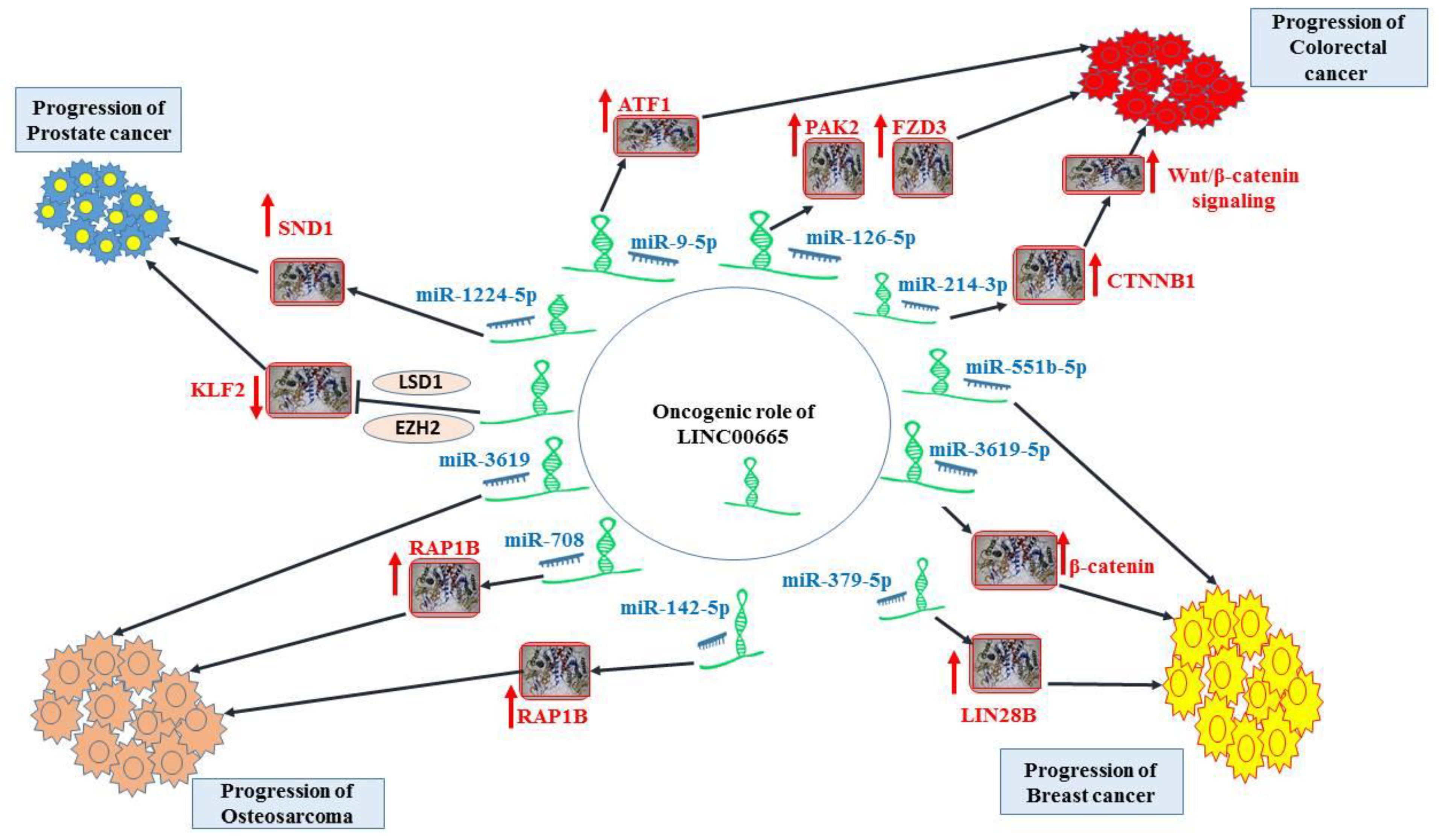
| Tumor Type | Interactions | Cell Line | Function | Reference |
|---|---|---|---|---|
| Acute myeloid leukemia | miR-4458/DOCK1 axis | KG1, U937, NB4 and HL60 and HS-5 | ∆ LINC00665: ↓ proliferation, migration and adhesion and ↑ apoptosis | [4] |
| Breast cancer | miR-379-5p/LIN28B axis | MCF10A, 293FT, MCF7, BT474, BT549, MDA-MB-231, MDA-MB-468, and T47D | ∆ LINC00665: ↓ proliferation, migration, and invasion ↑↑ LINC00665: ↑ proliferation, migration, and invasion, EMT process | [5] |
| _ | MCF-10A, MCF-7, MDA-MB-231, ZR-75-30, and MDA-MB-415 | ∆ LINC00665: ↓ migration, invasion and EMT process | [6] | |
| miR-551b-5p | MCF10A and HCC-1937, MDA-MB-231, and MCF-7 | ∆ LINC00665: ↓ cell growth and ↑ apoptosis | [7] | |
| miR-3619-5p/β-catenin axis | MDA-MB-231 and MCF-7 and MCF-10A | ∆ LINC00665: ↓ cell proliferation, migration, and invasion | [8] | |
| Cervical cancer | WNT-CTNNB1/β-catenin signaling pathway | HeLa and HEK293T cells | ∆ LINC00665: ↓ cell viability, migration, invasion and EMT process | [9] |
| Cholangiocarcinoma | miR-424-5p/ BCL9L axis, Wnt/β-Catenin signaling | HuCCT1, HuH28, SNU-1196, SNU-1079, SNU-308, SNU-245, SNU-478 and SNU-869 | ∆ LINC00665: ↓ sphere formation, migration, invasion, EMT process, gemcitabine resistance, and stemness ↑↑ LINC00665: ↑ gemcitabine resistance | [9] |
| Colorectal cancer | miR-9-5p/ATF1 axis | DLD-1, SW480, KM12, SW116, SW620 and NCM460 | ∆ LINC00665: ↓ cell proliferation, migration, invasion and ↑ apoptosis ↑↑ LINC00665: ↑ cell proliferation, migration, invasion and ↓ apoptosis | [10] |
| miR-214-3p/CTNNB1 axis, U2AF2, Wnt/β-catenin signaling pathway | NCM460, SW620, LoVo, HCT-116, SW480 | ∆ LINC00665: ↓ cell growth, migration and invasion, and ↑ apoptosis LINC00665 was found to up-regulate expression of CTNNB1. | [11] | |
| miR-126-5p/ PAK2 and FZD3 axis | DLD1, RKO, HCT116, LOVO, SW480 and NCM460 | ∆ LINC00665: ↓ proliferation and ↑ apoptosis | [12] | |
| Endometrial carcinoma | HMGA1 | RL-95-2, Ishikawa, HEC-1B, KLE and HHUA | ∆ LINC00665: ↓ viability, migration and invasion, ↑ apoptosis and G1 phase arrest | [13] |
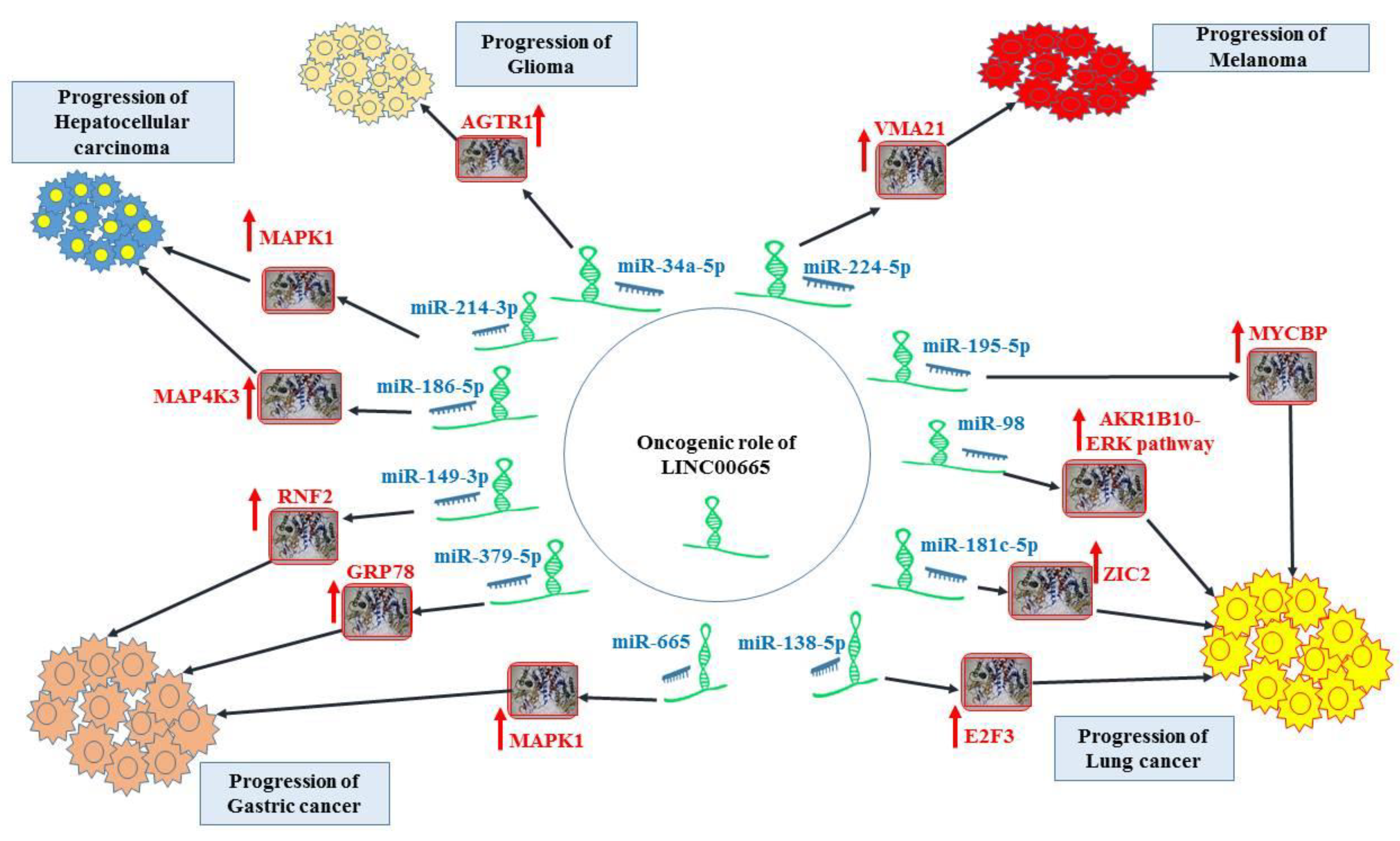
| Gastric cancer | Wnt signaling | MKN28, BGC-823, SGC-7901, AGS, HGC-27 and GES-1 | ∆ LINC00665: ↓ proliferation, migration, invasion, and ↑ apoptosis and cell cycle arrest | [14] |
| miR-149-3p/RNF2 axis | AGS, SGC-7901, HGC27, MGC-803, MKN-45, BGC-823 and GES-1 | ∆ LINC00665: ↓ cell viability and invasion | [15] | |
| miR-379-5p/ GRP78 axis | GES-1, SGC-7901, AGS, HST2 | ∆ LINC00665: ↓ DDP-resistant GC cell proliferation, Endoplasmic reticulum (ER) stress, and ↑ apoptosis | [16] | |
| TGF-β signal pathway | AGS, MKN45, HGC27, and SGC7901, MKN28 and GES | ∆ LINC00665: ↓ proliferation, invasion, metastasis, EMT process, ↑ cell apoptosis and G0/G1 phase arrest | [17] | |
| miR-665/MAPK1 axis | Apatinib-resistant gastric cancer cells | Paeonol treatment: ↓ LINC00665 levels, thus ↓ proliferation, migratory potential, invasive aptitude and glycolysis, and ↑ apoptosis of Apatinib-resistant gastric cancer cells | [16] | |
| Glioma | TAF15, STAU1, MTF1 and YY2 | U251, U87 glioma cells and HEK293T | LINC00665 Stabilized by TAF15 was found to destabilize MTF1 and YY2 transcripts via interplay with STAU1. | [18] |
| miR-34a-5p/AGTR1 axis | U87 MG, LN229, A172, U373 MG, U251, NHA and 293T cells | ↑↑ LINC00665: ↑ proliferation and invasion | [19] | |
| Hepatocellular carcinoma | miR-214-3p/MAPK1 axis | SNU-387, SNU-423, SNU-449, and SNU-398 | ↑↑ LINC00665: ↑ cell viability migration, invasion and aerobic glycolysis | [20] |
| miR-186-5p/MAP4K3 axis | Huh-7, HepG2, HCCLM6, MHCC-97H, Hep3B and HL-7702 | ∆ LINC00665: ↓ viability, ↑apoptosis and autophagy | [21] | |
| PKR, NF-κB signaling | EK-293T, Huh-7 and HepG2, and SK-Hep1, pWPXL-LINC00665 | LINC00665 was found to stabilize PKR by blocking its ubiquitination and involvement in the activation of NF-κB signaling. | [22] | |
| Lung cancer | miR-138-5p/E2F3 axis | A549, H520, H1299, SPC-A-1, SK-MES-1 and NHBE | ∆ LINC00665: ↓ proliferation and invasion | [23] |
| miR-181c-5p/ZIC2 axis | SK-LU-1 and Calu-3 | ∆ LINC00665: ↓ cell viability, clone formation, invasion and tumorigenesis | [24] | |
| YB-1-ANGPT4/ANGPTL3/VEGFA axis | HUVECs, A549 and H1299 | Linc00665 was found to interact with YB-1 and induce angiogenesis in lung adenocarcinoma by activating YB-1-ANGPT4/ANGPTL3/VEGFA axis. | [25] | |
| miR-98/AKR1B10 axis and AKR1B10-ERK signaling pathway | A549, H1299, H1650, H520, SPCA-1, and SK-MES-1, 16HBE and HEK-293T | ∆ LINC00665: ↓ proliferation, migration, and invasion | [26] | |
| miR-195-5p/MYCBP axis | HBE, A549, H1299, H1975, PC9, and SPCA-1 | ∆ LINC00665: ↓ proliferation, cell migration, invasion, and ↑ apoptosis | [27] | |
| EZH2 and PI3K/AKT pathway | PC9 and PC9/GR | ∆ LINC00665: ↓ proliferation, ↑ apoptosis and gefitinib sensitivity | [28] | |
| EZH2 CDKN1C | 16HBE, PC9, SPC-A1, H1975, H1299, and A549 | ∆ LINC00665: ↓ proliferation, migration ↑ apoptosis, G0/G1 phase arrest, and drug sensitivity of cells to DDP | [27] | |
| Melanoma | miR-224-5p/VMA21 axis | A375, M21, A2058, A-875 and HEMa-LP | ∆ LINC00665: ↓ proliferation and migration | [29] |
| Osteosarcoma | miR-3619 | 143B, U2OS, MG63 and Saos-2, hFOB1.19 and 293T cells | ∆ LINC00665: ↓ viability, invasion, and migration | [30] |
| miR-708 and miR-142-5p, RAP1B | MG63, U2OS, 143B and Saos-2 and hFOB | ∆ LINC00665: ↓ proliferation, migration, and invasion | [31] | |
| Ovarian cancer | miR-34a-5p/E2F3 axis | A2780, OVCAR3, CAOV3, SKOV3 and IOSE80 | ∆ LINC00665: ↓ proliferation, migration, and invasion | [32] |
| Prostate cancer | miR-1224-5p/SND1 axis | LNCaP, PC-3, DU-145, 22RV1 and RWPE-1 | ∆ LINC00665: ↓ growth and metastasis | [33] |
| KLF2, EZH2 and LSD1 | PC-3, DU-145, 22RV1, LNCaP and WPMY-1 | ∆ LINC00665: ↓ proliferation and migration LINC00665 was found to inhibit KLF2 expression by binding to EZH2 and LSD1. | [34] | |
| T cell acute lymphoblastic leukemia | miR-101 and PI3K/Akt pathway | T-ALL cells | ∆ LINC00665: ↓ viability, migration and invasion | [35] |
| Tumor Type | Animal Models | Results | Reference |
|---|---|---|---|
| Breast cancer | 5-week-old female SCID mice | ∆ LINC00665: ↓ tumor volume ↑↑ LINC00665: ↑ tumor volume | [5] |
| 4-week-old BALB/c nude mice | ∆ LINC00665: ↓ tumor growth | [7] | |
| Cholangiocarcinoma | nude mice | ∆ LINC00665: ↓Tumor growth, and tumor weight | [9] |
| Colorectal cancer | Female nude mice | ∆ LINC00665: ↓ tumor growth, tumor volumes and tumor weights | [11] |
| Endometrial carcinoma | 12 8-week-old female mice | ∆ LINC00665: ↓ tumor growth and tumor volume | [13] |
| Gastric cancer | 6-week-old male nude mice | ∆ LINC00665: ↓ tumor weights and tumor development | [14] |
| 6-week-old BALB/c nude mice | ∆ LINC00665: ↓ tumor growth | [17] | |
| Glioma | 4-week-old nude mice | ↑↑ LINC00665: ↑ tumor growth and tumor weights | [19] |
| Hepatocellular carcinoma | 6-week-old male BALB/c nude mice | ∆ LINC00665: ↓ tumor volumes and weights | [20] |
| female BALB/c nude mice | ∆ LINC00665: ↓ tumor growth and tumor volume | [21] | |
| Lung cancer | BALB/c nude mice | ∆ LINC00665: ↓ tumor volumes, tumor weights and proliferation | [23] |
| 6–8-week-old BALB/c nude male mice | ∆ LINC00665: ↓ tumor formation | [24] | |
| 4-week-old female BALB/c athymic nude mice | ∆ LINC00665: ↓ tumor size, tumor growth, tumor weight and metastasis | [26] | |
| male BALB/c nude mice | ∆ LINC00665: ↓ tumor growth and metastasis | [27] | |
| 5-week-old male athymic BALB/c nude mice | ∆ LINC00665: ↓ tumor growth and ↑ gefitinib sensitivity | [28] | |
| 4–5-week-old male BALB/c nude mice | ∆ LINC00665: ↓ tumor size and tumor weight | [27] | |
| Melanoma | 6-week-old male BALB/C nude mice | ∆ LINC00665: ↓ tumor volumes and weights | [29] |
| Prostate cancer | 4-week-old female Balb/c nude mice | ∆ LINC00665: ↓ tumor volumes and tumor weights | [33] |
| 8-week-old male nude mice | ∆ LINC00665: ↓ tumor growth and tumor weights | [34] |
| Tumor Type | Samples | Expression (Tumor vs. Normal) | Kaplan—Meier Analysis (Impact of LINC00665 Up-Regulation) | Univariate/ Multivariate Cox Regression | Association of LINC00665 Expression with Clinicopathologic Characteristics | Reference |
|---|---|---|---|---|---|---|
| Acute myeloid leukemia | 36 patients and 36 healthy controls | Up-regulated | _ | _ | _ | [4] |
| Breast cancer | TCGA database | Up-regulated | _ | _ | _ | [5] |
| GEPIA database60 pairs of tumors and ANCTs | Up-regulated | Shorter OS and DFS | _ | tumor stage and tumor metastasis | [6] | |
| 36 pairs of tumors and ANCTs | Up-regulated | Shorter OS | LINC00665 was found to be a possible biomarker to predict OS of BC patients. | TNM stage and lymph node metastasis | [7] | |
| SHPD002 study (102 advanced breast cancer patients) | Up-regulated | _ | Linc00665 expression was found to be an independent predictor of pCR, especially in HR-positive/HER2-negative subtype patients. | lymph node metastasis | [37] | |
| 106 pairs of tumors and ANCTs | Up-regulated | _ | _ | tumor size and tumor, node, and metastasis stages | [8] | |
| Cholangiocarcinoma | 100 pairs of tumors and ANCTs | Up-regulated | Shorter OS and recurrence-free survival time | _ | higher TNM stage, lymph node involvement, and distant metastasis | [9] |
| Colorectal cancer | 46 pairs of tumors and ANCTs | Up-regulated | _ | _ | local lymph node metastasis and poor differentiation | [10] |
| 67 pairs of tumors and ANCTs | Up-regulated | _ | _ | _ | [12] | |
| Endometrial carcinoma | 10 pairs of tumors and ANCTs | Up-regulated | _ | _ | _ | [13] |
| Gastric cancer | 49 pairs of tumors and ANCTs | Up-regulated | Shorter OS | _ | TNM stage, histological grade, and poor prognosis of GC patients | [15] |
| GEO and TCGA databases | Up-regulated | Shorter OS and DFS | LINC00665 was found to be an independent prognostic biomarker in GC patients. | tumor depth, lymph node metastasis, and TNM stage | [17] | |
| GEPIA database, and GEO datasets (GSE109476 and GSE93415 | Up-regulated | _ | _ | _ | [16] | |
| Glioma | 48 pairs of tumors and ANCTs TCGA database | Up-regulated | Shorter OS | _ | _ | [19] |
| Hepatocellular carcinoma | 50 pairs of tumors and ANCTs | Up-regulated | Shorter OS | _ | _ | [20] |
| 76 pairs of tumors and ANCTs | Up-regulated | Shorter OS | _ | tumor size and Edmondson grade | [21] | |
| 50 pairs of tumors and ANCTs GSE77314 | Up-regulated | _ | _ | _ | [22] | |
| TCGA, GEPIA and GEO databases 39 pairs of tumors and ANCTs | Up-regulated | Shorter OS | _ | gender, histological grade, stage, and vascular invasion | [38] | |
| Lung cancer | 37 pairs of tumors and ANCTs | Up-regulated | _ | _ | TNM stage | [23] |
| GEPIA and starBase databases 84 pairs of tumors and ANCTs | Up-regulated | Shorter OS | _ | _ | [24] | |
| 60 pairs of tumors and ANCTs | Up-regulated | _ | _ | differentiation, tumor size, lymph node metastasis, TNM stage, and lymphovascular invasion | [25] | |
| 80 pairs of tumors and ANCTs GEO database (GSE27262) | Up-regulated | Shorter OS and recurrence-free survival time | High levels of linc00665, positive lymph node metastasis, high TNM stage, were found to be independent prognostic factors for predicting poor recurrence-free survival in LUAD patients. | larger tumor size, advanced TNM stage, and lymph node metastasis | [26] | |
| TCGA database 52 pairs of tumors and ANCTs | Up-regulated | Shorter OS | _ | poor prognosis and advanced T stage | [27] | |
| GEO database (GSE18842, GSE19188, and GSE33532) | Up-regulated | _ | _ | _ | [39] | |
| 20 patients | Up-regulated gefitinib-resistance | _ | _ | _ | [28] | |
| TCGA database 60 pairs of tumors and ANCTs | Up-regulated | Shorter OS and PFS | _ | advanced TNM stage, lymph node metastasis, and tumor size | [27] | |
| Osteosarcoma | 33 pairs of tumors and ANCTs | Up-regulated | Shorter OS | _ | _ | [30] |
| 42 pairs of tumors and ANCTs | Up-regulated | Shorter OS | _ | larger tumor size and later clinical stages | [31] | |
| Ovarian cancer | 56 pairs of tumors and ANCTs TCGA database | Up-regulated | Shorter OS and PFS | tumor size, FIGO stage, and lymph node metastasis | [32] | |
| GEO database (GSE5438, GSE40595, GSE38666 and GSE26712) | Up-regulated | Shorter OS | _ | _ | [40] | |
| Prostate cancer | 41 pairs of tumors and ANCTs | Up-regulated | Shorter OS | _ | _ | [33] |
| 50 pairs of tumors and ANCTs | Up-regulated | Shorter OS | _ | higher T stage and lymph node metastasis | [34] |
Publisher’s Note: MDPI stays neutral with regard to jurisdictional claims in published maps and institutional affiliations. |
© 2022 by the authors. Licensee MDPI, Basel, Switzerland. This article is an open access article distributed under the terms and conditions of the Creative Commons Attribution (CC BY) license (https://creativecommons.org/licenses/by/4.0/).
Share and Cite
Ghafouri-Fard, S.; Khoshbakht, T.; Hussen, B.M.; Baniahmad, A.; Taheri, M.; Hajiesmaeili, M. A Concise Review on Dysregulation of LINC00665 in Cancers. Cells 2022, 11, 3575. https://doi.org/10.3390/cells11223575
Ghafouri-Fard S, Khoshbakht T, Hussen BM, Baniahmad A, Taheri M, Hajiesmaeili M. A Concise Review on Dysregulation of LINC00665 in Cancers. Cells. 2022; 11(22):3575. https://doi.org/10.3390/cells11223575
Chicago/Turabian StyleGhafouri-Fard, Soudeh, Tayyebeh Khoshbakht, Bashdar Mahmud Hussen, Aria Baniahmad, Mohammad Taheri, and Mohammadreza Hajiesmaeili. 2022. "A Concise Review on Dysregulation of LINC00665 in Cancers" Cells 11, no. 22: 3575. https://doi.org/10.3390/cells11223575
APA StyleGhafouri-Fard, S., Khoshbakht, T., Hussen, B. M., Baniahmad, A., Taheri, M., & Hajiesmaeili, M. (2022). A Concise Review on Dysregulation of LINC00665 in Cancers. Cells, 11(22), 3575. https://doi.org/10.3390/cells11223575