Water-Use Efficiency and Responsiveness of a Popcorn Panel Grown Under Different Water Regimes and Cropping Seasons

 ,
,  ,
,  ,
,  , and
, and 
Abstract
1. Introduction
2. Materials and Methods
2.1. Germplasm
2.2. Crop Management and Experimental Conditions
2.3. Phenotyping
2.4. ANOVA
2.5. Classification of Inbred Lines for Water-Use Efficiency and Responsiveness
2.6. Principal Component Analysis
3. Results
3.1. Combined Analysis of Variance for Agronomic Traits
3.2. Analysis of Variance and Overall Means of Agronomic Traits in the 2020 and 2021 Crop Seasons
3.3. Mean Estimates for Agronomic Traits of Popcorn Inbred Lines Grown Under Well-Watered (WW) and Water-Stressed (WS) Conditions Across Cropping Seasons
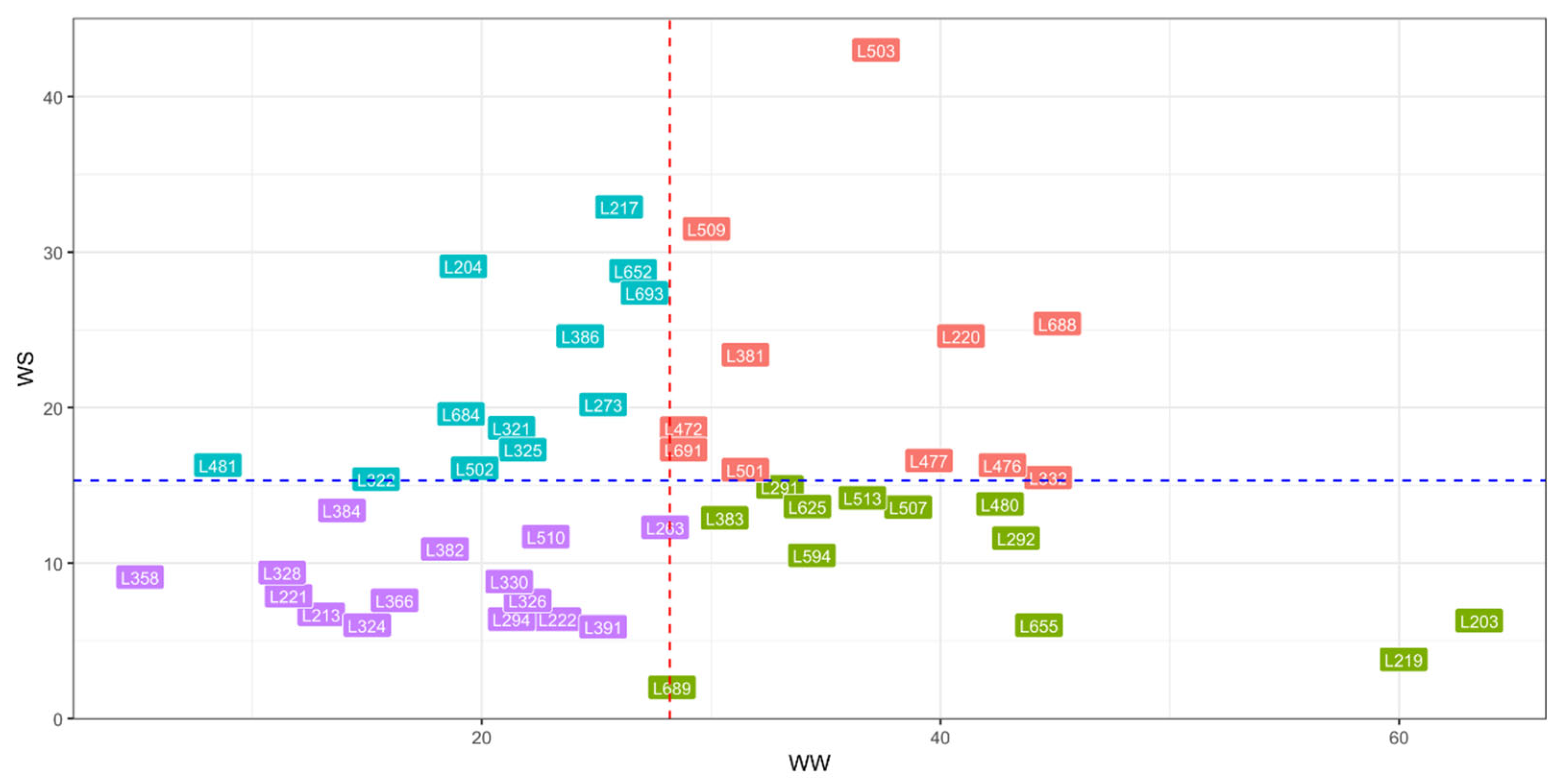
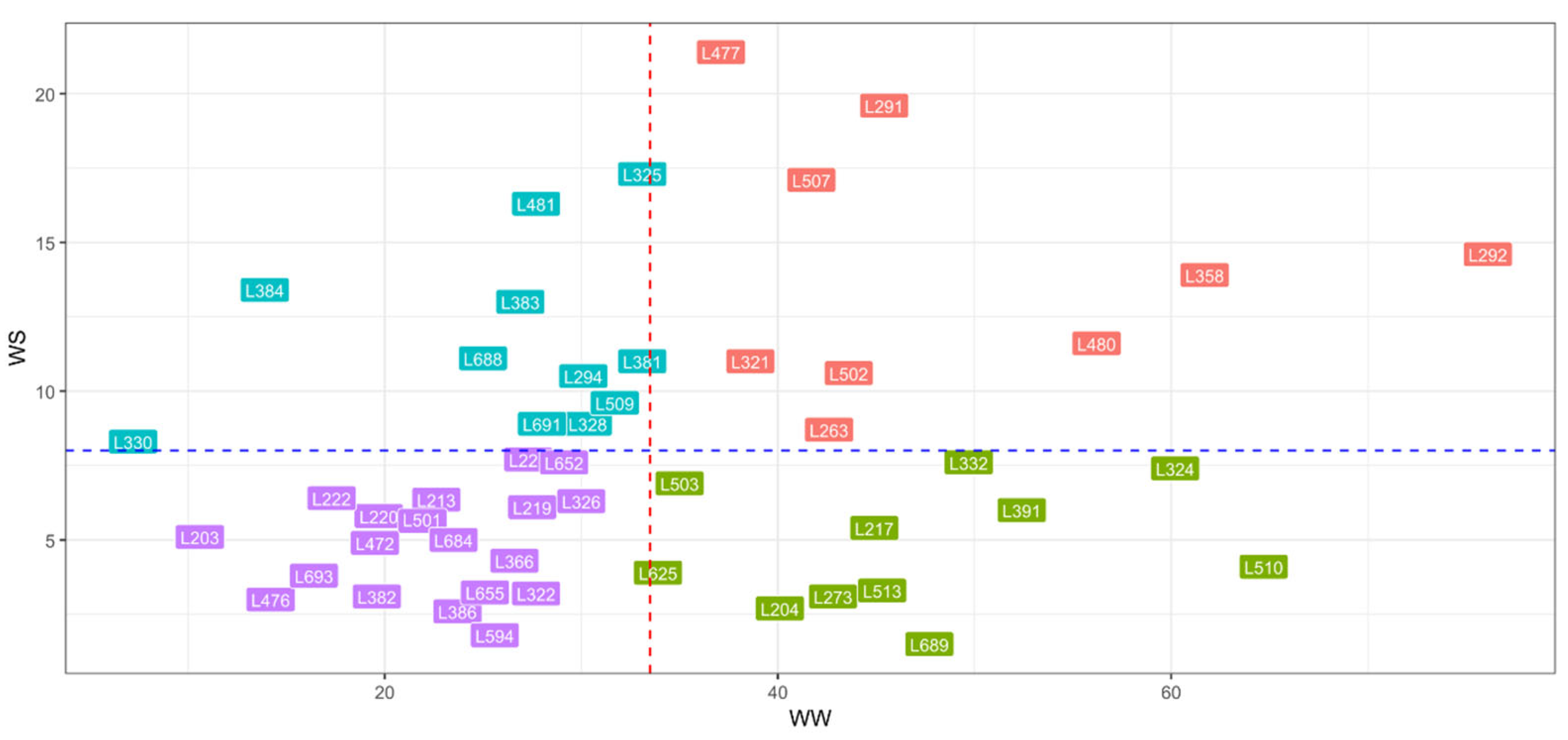
3.4. Water-Use Efficiency and Responsiveness of the Inbred Lines Across Crop Seasons
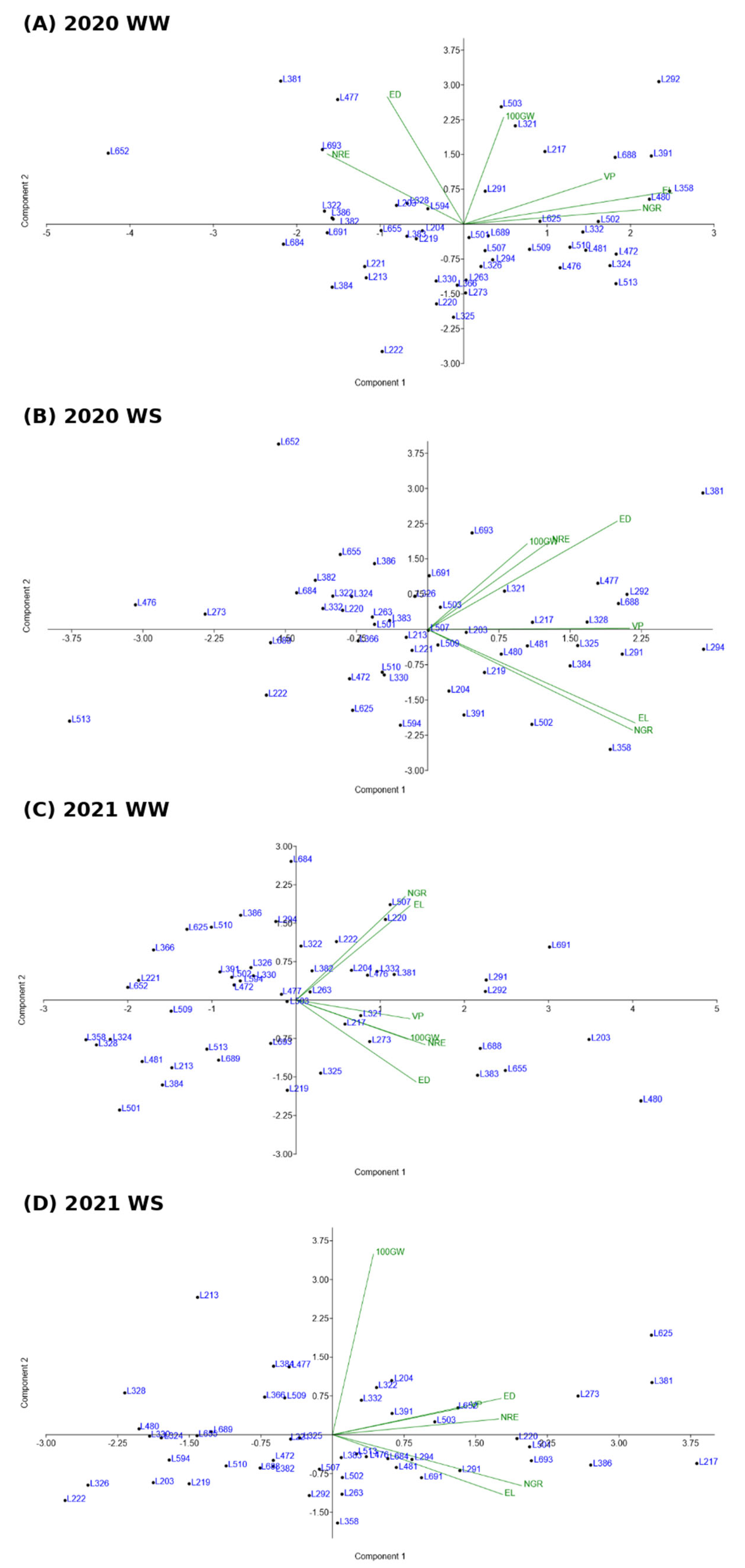
3.5. Principal Component Analysis of Agronomic Traits in the 2020 (WW and WS) and 2021 (WW and WS) Crop Seasons
4. Discussion
4.1. Genotype × Water Condition × Crop Season Interaction and Its Implications for Plant Breeding
4.2. Impact of Water Limitation on Agronomic Traits Across Crop Seasons
4.3. Water-Use Efficiency and Responsiveness of the Inbred Lines Across Crop Seasons
4.4. Principal Component Analysis
4.5. Implications for Plant Breeding Programs
5. Conclusions
Supplementary Materials
Author Contributions
Funding
Data Availability Statement
Acknowledgments
Conflicts of Interest
Abbreviations
| ANOVA | Analysis of variance |
| CS | Cropping season |
| ED | Ear diameter |
| EL | Ear length |
| ENR | Efficient and non-responsive |
| ER | Efficient and responsive |
| G | Genotype |
| NGR | Grain number per row |
| GY | Grain yield |
| INR | Inefficient and non-responsive |
| IR | Inefficient and responsive |
| MPa | Megapascal |
| PCA | Principal component analysis |
| PE | Popping expansion |
| PWP | Permanent wilting point |
| NRE | Row number per ear |
| VP | Expanded popcorn volume per hectare |
| WC | Water condition |
| WS | Water-stressed |
| WW | Well-watered |
References
- Schmitt, K.F.M.; do Amaral Junior, A.T.; Kamphorst, S.H.; Pinto, V.B.; de Lima, V.J.; de Oliveira, U.A.; Viana, F.N.; Leite, J.T.; Gomes, L.P.; Silva, J.G.d.S.; et al. Decoding the Effects of Drought Stress on Popcorn (Zea mays Var. Everta) Flowering Combining Proteomics and Physiological Analysis. Plant Physiol. Biochem. 2024, 208, 108444. [Google Scholar] [CrossRef]
- Salami, M.; Tan, H.; Alizadeh, B.; Heidari, B. Photosynthetic Performance, Pigments and Biochemicals Influence Seed Yield in Rapeseed under Water Deficit Conditions: MGIDI Index Helps Screening Drought-Tolerant Genotypes. Field Crops Res. 2025, 322, 109733. [Google Scholar] [CrossRef]
- Araus, J.L.; Kefauver, S.C. Breeding to Adapt Agriculture to Climate Change: Affordable Phenotyping Solutions. Curr. Opin. Plant Biol. 2018, 45, 237–247. [Google Scholar] [CrossRef]
- Abberton, M.; Batley, J.; Bentley, A.; Bryant, J.; Cai, H.; Cockram, J.; Costa de Oliveira, A.; Cseke, L.J.; Dempewolf, H.; De Pace, C.; et al. Global Agricultural Intensification during Climate Change: A Role for Genomics. Plant Biotechnol. J. 2016, 14, 1095–1098. [Google Scholar] [CrossRef]
- Araus, J.L.; Serret, M.D.; Edmeades, G.O. Phenotyping Maize for Adaptation to Drought. Front. Physiol. 2012, 3, 305. [Google Scholar] [CrossRef]
- Cairns, J.E.; Sanchez, C.; Vargas, M.; Ordoñez, R.; Araus, J.L. Dissecting Maize Productivity: Ideotypes Associated with Grain Yield under Drought Stress and Well-Watered Conditions. J. Integr. Plant Biol. 2012, 54, 1007–1020. [Google Scholar] [CrossRef]
- Adebayo, M.A.; Menkir, A. Combining Ability of Adapted and Exotic Drought-Tolerant Maize Inbred Lines Under Full Irrigation and Rainfed Conditions in Nigeria. J. Crop Improv. 2015, 29, 117–130. [Google Scholar] [CrossRef]
- Adebayo, M.A.; Menkir, A.; Blay, E.; Gracen, V.; Danquah, E.; Hearne, S. Genetic Analysis of Drought Tolerance in Adapted × Exotic Crosses of Maize Inbred Lines under Managed Stress Conditions. Euphytica 2014, 196, 261–270. [Google Scholar] [CrossRef]
- Silva, M.B.; Amaral, A.M.; Pereira, S.B.; Santos, M.Â.C.M.d.; Brito, A.F.C.d.; Anorato, L.R. Desenvolvimento Inicial de Diferentes Híbridos de Milho Sob Variabilidade Hídrica No Solo. Rev. Delos 2025, 18, e4035. [Google Scholar] [CrossRef]
- Vidotto, M.L.; Santos, R.F.; Nogueira, C.E.C.; Da Silva, E.V.C.; Frenhe, R.M.; Bissani, F.M.; Dos Santos, N.B.; Zitha, A.R. Influência das chuvas no rendimento do milho safrinha em cascavel, pr. DESAFIOS—Rev. Interdiscip. Univ. Fed. Tocantins 2025, 12, 5. [Google Scholar] [CrossRef]
- Leite, J.T.; Amaral Junior, A.T.d.; Kamphorst, S.H.; Lima, V.J.d.; Santos Junior, D.R.d.; Alves, U.O.; Azeredo, V.C.; Pereira, J.L.; Bispo, R.B.; Schmidt, K.F.M.; et al. All Are in a Drought, but Some Stand Out: Multivariate Analysis in the Selection of Agronomic Efficient Popcorn Genotypes. Plants 2022, 11, 2275. [Google Scholar] [CrossRef] [PubMed]
- Lima, V.J.d.; Amaral Júnior, A.T.d.; Kamphorst, S.H.; Santos, A.d.; Schmidt, K.F.M.; Azeredo, V.C.; Leite, J.T.; Santos Junior, D.R.d.; Santos, T.d.O.; Bispo, R.B.; et al. UENF WS01: Popcorn Hybrid with Water Use Efficiency for the State of Rio de Janeiro. Crop Breed. Appl. Biotechnol. 2021, 21, e375821411. [Google Scholar] [CrossRef]
- Anglin, N.L.; Wenzl, P.; Azevedo, V.; Lusty, C.; Ellis, D.; Gao, D. Genotyping Genebank Collections: Strategic Approaches and Considerations for Optimal Collection Management. Plants 2025, 14, 252. [Google Scholar] [CrossRef] [PubMed]
- Vittorazzi, C.; Júnior, A.T.A.; Guimarães, A.G.; Silva, F.H.L.; Pena, G.F.; Daher, R.F.; Gerhardt, I.F.S.; Oliveira, G.H.F.; Santos, P.H.A.D.; Souza, Y.P.; et al. Evaluation of Genetic Variability to Form Heterotic Groups in Popcorn. Genet. Mol. Res. 2018, 17, 18083. [Google Scholar] [CrossRef]
- Santos, T.d.O.; Amaral Junior, A.T.d.; Bispo, R.B.; Lima, V.J.d.; Kamphorst, S.H.; Leite, J.T.; Santos Júnior, D.R.d.; Santos, P.H.A.D.; Oliveira, U.A.d.; Schmitt, K.F.M.; et al. Phenotyping Latin American Open-Pollinated Varieties of Popcorn for Environments with Low Water Availability. Plants 2021, 10, 1211. [Google Scholar] [CrossRef]
- Teixeira, F.F.; Gomide, R.L.; Albuquerque, P.E.P.d.; Andrade, C.L.T.d.; Leite, C.E.P.; Parentoni, S.N.; Guimarães, P.E.d.O.; Guimarães, L.J.M.; Silva, A.R.; Bastos, E.A.; et al. Evaluation of Maize Core Collection for Drought Tolerance. Crop Breed. Appl. Biotechnol. 2010, 10, 312–320. [Google Scholar] [CrossRef]
- Dias, K.O.D.G.; Gezan, S.A.; Guimarães, C.T.; Parentoni, S.N.; Guimarães, P.E.d.O.; Carneiro, N.P.; Portugal, A.F.; Bastos, E.A.; Cardoso, M.J.; Anoni, C.d.O.; et al. Estimating Genotype × Environment Interaction for and Genetic Correlations among Drought Tolerance Traits in Maize via Factor Analytic Multiplicative Mixed Models. Crop Sci. 2018, 58, 72. [Google Scholar] [CrossRef]
- Adebayo, M.A.; Menkir, A.; Hearne, S.; Kolawole, A.O. Gene Action Controlling Normalized Difference Vegetation Index in Crosses of Elite Maize (Zea mays L.) Inbred Lines. Cereal Res. Commun. 2017, 45, 675–686. [Google Scholar] [CrossRef]
- Gao, Y.; Lynch, J.P. Reduced Crown Root Number Improves Water Acquisition under Water Deficit Stress in Maize (Zea mays L.). J. Exp. Bot. 2016, 67, 4545–4557. [Google Scholar] [CrossRef]
- Bernini, C.S.; Guimarães, P.d.S.; Gallo, P.B.; Paterniani, M.E.A.G.Z. Parâmetros genéticos de progênies interpopulacionais de milho para caracteres relacionados com tolerância à seca. Sci. Electron. Arch. 2021, 14, 9. [Google Scholar] [CrossRef]
- Wang, L.; Yu, X.; Gao, J.; Ma, D.; Guo, H.; Hu, S. Patterns of Influence of Meteorological Elements on Maize Grain Weight and Nutritional Quality. Agronomy 2023, 13, 424. [Google Scholar] [CrossRef]
- Minuzzi, R.B.; Medeiros, S.R.R. Influência de Secas Agrícolas e Ondas de Calor Na Produtividade de Milho e Da Soja Em Chapecó, Estado de Santa Catarina. Rev. Delos 2025, 18, e4528. [Google Scholar] [CrossRef]
- Kamphorst, S.H.; do Amaral Junior, A.T.; de Lima, V.J.; Carena, M.J.; Azeredo, V.C.; Mafra, G.S.; Santos, P.H.A.D.; Leite, J.T.; Schmitt, K.F.M.; dos Santos Junior, D.R.; et al. Driving Sustainable Popcorn Breeding for Drought Tolerance in Brazil. Front. Plant Sci. 2021, 12, 732285. [Google Scholar] [CrossRef] [PubMed]
- Zinselmeier, S.A.; Lauer, M.J.; Boyer, J.S. Reversing Drought-Induced Losses in Grain Yield: Sucrose Maintains Embryo Growth in Maize. Crop Sci. 1995, 35, 1390. [Google Scholar] [CrossRef]
- Lu, Y.; Hao, Z.; Xie, C.; Crossa, J.; Araus, J.; Gao, S.; Vivek, B.S.; Magorokosho, C.; Mugo, S.; Makumbi, D.; et al. Field Crops Research Large-Scale Screening for Maize Drought Resistance Using Multiple Selection Criteria Evaluated under Water-Stressed and Well-Watered Environments. Field Crops Res. 2011, 124, 37–45. [Google Scholar] [CrossRef]
- Zia, S.; Romano, G.; Spreer, W.; Sanchez, C.; Cairns, J.; Araus, J.L.; Müller, J. Infrared Thermal Imaging as a Rapid Tool for Identifying Water-Stress Tolerant Maize Genotypes of Different Phenology. J. Agron. Crop Sci. 2013, 199, 75–84. [Google Scholar] [CrossRef]
- Zhuang, Y.; Ren, G.; Yue, G.; Li, Z.; Qu, X.; Hou, G.; Zhu, Y.; Zhang, J. Effects of Water-Deficit Stress on the Transcriptomes of Developing Immature Ear and Tassel in Maize. Plant Cell Rep. 2007, 26, 2137–2147. [Google Scholar] [CrossRef]
- Cruz, C.D. GENES—A Software Package for Analysis in Experimental Statistics and Quantitative Genetics. Acta Sci. Agron. 2013, 35, 271–276. [Google Scholar] [CrossRef]
- Cruz, C.D.; Regazzi, A.J.; Carneiro, P.C.S. Modelos Biométricos Aplicados Ao Melhoramento Genético; UFV: Viçosa, Brazil, 2012; Volume 1, ISBN 9788572694339. [Google Scholar]
- Araus, J.L.; Sánchez, C.; Cabrera-Bosquet, L. Is Heterosis in Maize Mediated through Better Water Use? New Phytol. 2010, 187, 392–406. [Google Scholar] [CrossRef]
- Kamphorst, S.H.; Gonçalves, G.M.B.; Amaral Júnior, A.T.d.; Lima, V.J.d.; Schmitt, K.F.M.; Leite, J.T.; Azeredo, V.C.; Gomes, L.P.; Silva, J.G.d.S.; Carvalho, C.M.; et al. Supporting Physiological Trait for Indirect Selection for Grain Yield in Drought-Stressed Popcorn. Plants 2021, 10, 1510. [Google Scholar] [CrossRef]
- Liu, S.; Qin, F. Genetic Dissection of Maize Drought Tolerance for Trait Improvement. Mol. Breed. 2021, 41, 8. [Google Scholar] [CrossRef] [PubMed]
- Lindsey, A.J.; Barker, D.J.; Metzger, J.D.; Mullen, R.W.; Thomison, P.R. Physiological and Morphological Response of a Drought-Tolerant Maize Hybrid to Agronomic Management. Agron. J. 2018, 110, 1354. [Google Scholar] [CrossRef]
- Nemali, K.S.; Bonin, C.; Dohleman, F.G.; Stephens, M.; Reeves, W.R.; Nelson, D.E.; Castiglioni, P.; Whitsel, J.E.; Sammons, B.; Silady, R.A.; et al. Physiological Responses Related to Increased Grain Yield under Drought in the First Biotechnology-Derived Drought-Tolerant Maize. Plant Cell Environ. 2015, 38, 1866–1880. [Google Scholar] [CrossRef]
- Lunduka, R.W.; Mateva, K.I.; Magorokosho, C.; Manjeru, P. Impact of Adoption of Drought-Tolerant Maize Varieties on Total Maize Production in South Eastern Zimbabwe. Clim. Dev. 2019, 11, 35–46. [Google Scholar] [CrossRef] [PubMed]
- Kamphorst, S.H.; Amaral Júnior, A.T.d.; Vergara-Diaz, O.; Gracia-Romero, A.; Fernandez-Gallego, J.A.; Chang-Espino, M.C.; Buchaillot, M.L.; Rezzouk, F.Z.; Lima, V.J.d.; Serret, M.D.; et al. Heterosis and Reciprocal Effects for Physiological and Morphological Traits of Popcorn Plants under Different Water Conditions. Agric. Water Manag. 2022, 261, 107371. [Google Scholar] [CrossRef]
- Kim, K.-H.; Lee, B.-M. Effects of Climate Change and Drought Tolerance on Maize Growth. Plants 2023, 12, 3548. [Google Scholar] [CrossRef]
- Hallauer, A.R.; Carena, M.J.; Miranda Filho, J.B. Quantitative Genetics in Maize Breeding; Springer: New York, NY, USA, 2010; ISBN 978-1-4419-0765-3. [Google Scholar]
- Cruz, C.D.; Carneiro, P.C.S.; Regazzi, A.J. Modelos Biométricos Aplicados Ao Melhoramento Genético—Vol. II; UFV: Viçosa, Brazil, 2014; ISBN 8572691510. [Google Scholar]
- Oguz, M.C.; Aycan, M.; Oguz, E.; Poyraz, I.; Yildiz, M. Drought Stress Tolerance in Plants: Interplay of Molecular, Biochemical and Physiological Responses in Important Development Stages. Physiologia 2022, 2, 180–197. [Google Scholar] [CrossRef]
- Chairi, F.; Elazab, A.; Sanchez-Bragado, R.; Araus, J.L.; Serret, M.D. Heterosis for Water Status in Maize Seedlings. Agric. Water Manag. 2016, 164, 100–109. [Google Scholar] [CrossRef]
- Buckley, T.N. How Do Stomata Respond to Water Status? New Phytol. 2019, 224, 21–36. [Google Scholar] [CrossRef]
- Hetherington, A.M.; Woodward, F.I. The Role of Stomata in Sensing and Driving Environmental Change. Nature 2003, 424, 901–908. [Google Scholar] [CrossRef]
- Blankenagel, S.; Yang, Z.; Avramova, V.; Schön, C.-C.; Grill, E. Generating Plants with Improved Water Use Efficiency. Agronomy 2018, 8, 194. [Google Scholar] [CrossRef]
- Blum, A. Effective Use of Water (EUW) and Not Water-Use Efficiency (WUE) Is the Target of Crop Yield Improvement under Drought Stress. Field Crops Res. 2009, 112, 119–123. [Google Scholar] [CrossRef]
- Zhang, C.; Zhang, J.; Zhang, H.; Zhao, J.; Wu, Q.; Zhao, Z.; Cai, T. Mechanisms for the Relationships between Water-Use Efficiency and Carbon Isotope Composition and Specific Leaf Area of Maize (Zea mays L.) under Water Stress. Plant Growth Regul. 2015, 77, 233–243. [Google Scholar] [CrossRef]
- Sousa, R.S.; Bastos, E.A.; Cardoso, M.J.; Ribeiro, V.Q.; Brito, R.R. Desempenho Produtivo de Genótipos de Milho Sob Déficit Hídrico. Rev. Bras. De Milho E Sorgo 2015, 14, 49–60. [Google Scholar] [CrossRef]
- Reddy, S.G.M.; Lal, G.M.; Krishna, T.V.; Reddy, Y.V.S.; Sandeep, N. Correlation and Path Coefficient Analysis for Grain Yield Components in Maize (Zea mays L.). Int. J. Plant Soil Sci. 2022, 34, 24–36. [Google Scholar] [CrossRef]



| Line | Pedigree | Country of Origin | Donor Institution | Climatic Adaptation |
|---|---|---|---|---|
| L203 | IAC 125 | Brazil | IAC | Tropical |
| L204 | IAC 125 | Brazil | IAC | Tropical |
| L213 | IAC 125 | Brazil | IAC | Tropical |
| L217 | IAC 125 | Brazil | IAC | Tropical |
| L219 | IAC 125 | Brazil | IAC | Tropical |
| L220 | IAC 125 | Brazil | IAC | Tropical |
| L221 | IAC 125 | Brazil | IAC | Tropical |
| L222 | IAC 125 | Brazil | IAC | Tropical |
| L263 | PARA 172 | Paraguai | CIMMYT | Temperada |
| L273 | PARA 172 | Paraguai | CIMMYT | Temperada |
| L291 | URUG 298 | Uruguai | CIMMYT | Temperada |
| L292 | URUG 298 | Uruguai | CIMMYT | Temperada |
| L294 | URUG 298 | Uruguai | CIMMYT | Temperada |
| L321 | UFV M-2 Barão de Viçosa | Brazil | UFV | Tropical |
| L322 | UFV M-2 Barão de Viçosa | Brazil | UFV | Tropical |
| L324 | UFV M-2 Barão de Viçosa | Brazil | UFV | Tropical |
| L325 | UFV M-2 Barão de Viçosa | Brazil | UFV | Tropical |
| L326 | UFV M-2 Barão de Viçosa | Brazil | UFV | Tropical |
| L328 | UFV M-2 Barão de Viçosa | Brazil | UFV | Tropical |
| L330 | UFV M-2 Barão de Viçosa | Brazil | UFV | Tropical |
| L332 | UFV M-2 Barão de Viçosa | Brazil | UFV | Tropical |
| L358 | PR 023 | Brazil | UEM | Tropical |
| L366 | PR 023 | Brazil | UEM | Tropical |
| L381 | SAM | USA | USA | Temperada |
| L382 | SAM | USA | USA | Temperada |
| L383 | SAM | USA | USA | Temperada |
| L384 | SAM | USA | USA | Temperada |
| L386 | SAM | USA | USA | Temperada |
| L391 | SAM | USA | USA | Temperada |
| L472 | SE 013 | Brazil | UEM | Tropical |
| L476 | SE 013 | Brazil | UEM | Tropical |
| L477 | SE 013 | Brazil | UEM | Tropical |
| L480 | SE 013 | Brazil | UEM | Tropical |
| L481 | SE 013 | Brazil | UEM | Tropical |
| L501 | PA 170 Roxo | Paraguay | CIMMYT | Temperada |
| L502 | PA 170 Roxo | Paraguay | CIMMYT | Temperada |
| L503 | PA 170 Roxo | Paraguay | CIMMYT | Temperada |
| L507 | PA 170 Roxo | Paraguay | CIMMYT | Temperada |
| L509 | PA 170 Roxo | Paraguay | CIMMYT | Temperada |
| L510 | PA 170 Roxo | Paraguay | CIMMYT | Temperada |
| L513 | PA 170 Roxo | Paraguay | CIMMYT | Temperada |
| L594 | RS 20 | Brazil | IPAGRO/AGROESTE | Temperada |
| L625 | PA 091 | Brazil | UEM | Tropical |
| L652 | ARZM 13 050 | Argentina | CIMMYT | Temperada |
| L655 | ARZM 13 050 | Argentina | CIMMYT | Temperada |
| L684 | UENF 14 | Brazil | UENF | Tropical |
| L688 | UENF 14 | Brazil | UENF | Tropical |
| L689 | UENF 14 | Brazil | UENF | Tropical |
| L691 | UENF 14 | Brazil | UENF | Tropical |
| L693 | UENF 14 | Brazil | UENF | Tropical |
| Traits | Combined ANOVA | |||||||||||||
|---|---|---|---|---|---|---|---|---|---|---|---|---|---|---|
| CS | WC | G | CS × WC | CS × G | WC × G | CS × WC × G | ||||||||
| ED | 33.02 | *** | 719.20 | *** | 32.44 | *** | 25.68 | *** | 14.80 | *** | 20.88 | *** | 25.76 | *** |
| EL | 613.30 | *** | 120.30 | *** | 11.23 | *** | 18.04 | *** | 12.32 | *** | 7.89 | *** | 5.49 | *** |
| NRE | 6.46 | *** | 186.90 | *** | 11.78 | *** | 12.97 | *** | 8.19 | *** | 5.55 | *** | 5.15 | *** |
| NGR | 502.00 | *** | 720.30 | *** | 69.50 | *** | 560.90 | *** | 68.84 | *** | 34.02 | *** | 43.61 | *** |
| 100 GW | 33.17 | *** | 246.91 | *** | 13.24 | *** | 28.28 | *** | 9.88 | *** | 8.36 | *** | 7.93 | *** |
| PE | 73.99 | *** | 2578.20 | *** | 71.78 | *** | 83.39 | *** | 76.27 | *** | 44.72 | *** | 50.82 | *** |
| GY | 506,485.01 | *** | 87,937,436.50 | *** | 721,163.11 | *** | 12,850,978.60 | *** | 727,817.32 | *** | 611,937.75 | *** | 494,822.69 | *** |
| PV | 169.39 | *** | 55,167.20 | *** | 363.09 | *** | 5890.98 | *** | 406.61 | *** | 319.17 | *** | 305.18 | *** |
| Traits | WC | MS (DF = 49) | Means and SE | Proportional Reduction (%) | CVe (%) | |
|---|---|---|---|---|---|---|
| G | G × WC | |||||
| 2020 | ||||||
| Ear diameter (mm) | WW | 15.43 ** | 6.59 ** | 27.79 ± 1.79 | 9.39 | 5.57% |
| WS | 23.16 ** | 25.18 ± 2.07 | ||||
| Ear length (cm) | WW | 7.40 ** | 5.08 ** | 10.96 ± 1.34 | 11.31 | 6.93% |
| WS | 10.78 ** | 9.72 ± 1.51 | ||||
| Row number per ear (unit) | WW | 6.25 ** | 3.56 ** | 22.90 ± 3.21 | 18.3 | 5.90% |
| WS | 9.37 ** | 18.71 ± 2.86 | ||||
| Grain number per row (unit) | WW | 48.01 ** | 24.66 ** | 13.11 ± 1.07 | 11.21 | 8.19% |
| WS | 34.83 ** | 11.64 ± 1.34 | ||||
| 100-grain weight (g) | WW | 11.54 ** | 6.05 ** | 10.91 ± 1.60 | 15.49 | 6.30% |
| WS | 8.51 ** | 9.22 ± 1.39 | ||||
| Popping expansion (g ml−1) | WW | 69.53 ** | 42.93 ** | 22.20 ± 3.87 | 21.44 | 6.70% |
| WS | 66.83 ** | 17.44 ± 3.90 | ||||
| Grain yield (kg ha−1) | WW | 1,118,030.00 ** | 556,780.08 ** | 1519.64 ± 504.04 | 69.66 | 14.46% |
| WS | 195,448.00 ** | 461.02 ± 200.62 | ||||
| Expanded popcorn volume per hectare (m3 ha−1) | WW | 647.68 ** | 307.20 ** | 33.46 ± 11.63 | 75.88 | 18.10% |
| WS | 70.56 ** | 8.07 ± 3.91 | ||||
| 2021 | ||||||
| Ear diameter (mm) | WW | 29.43 ** | 40.06 ** | 27.85 ± 2.37 | 6.40 | 6.85% |
| WS | 25.88 ** | 26.07 ± 2.13 | ||||
| Ear length (cm) | WW | 8.18 ** | 8.30 ** | 12.63 ± 1.33 | 4.36 | 5.52% |
| WS | 10.57 ** | 12.08 ± 1.39 | ||||
| Row number per ear (unit) | WW | 6.35 ** | 7.14 ** | 22.79 ± 3.01 | 1.10 | 8.67% |
| WS | 8.72 ** | 22.54 ± 4.23 | ||||
| Grain number per row (unit) | WW | 43.48 ** | 52.97 ** | 12.61 ± 1.22 | 6.50 | 10.92% |
| WS | 89.64 ** | 11.79 ± 1.30 | ||||
| 100-grain weight (g) | WW | 11.38 ** | 10.25 ** | 10.00 ± 1.56 | 8.50 | 13.02% |
| WS | 7.99 ** | 9.15 ± 1.25 | ||||
| Popping expansion (g ml−1) | WW | 58.62 ** | 52.61 ** | 22.16 ± 3.47 | 15.38 | 6.98% |
| WS | 48.61 ** | 18.76 ± 3.18 | ||||
| Grain yield (kg ha−1) | WW | 803,262.00 ** | 549,979.57 ** | 1285.05 ± 419.59 | 36.82 | 14.98% |
| WS | 439,000.00 ** | 812.08 ± 303.25 | ||||
| Expanded popcorn volume (m3 ha−1) | WW | 457.25 ** | 317.14 ** | 28.25 ± 9.62 | 45.69 | 18.69% |
| WS | 218.59 ** | 15.34 ± 6.47 | ||||
Disclaimer/Publisher’s Note: The statements, opinions and data contained in all publications are solely those of the individual author(s) and contributor(s) and not of MDPI and/or the editor(s). MDPI and/or the editor(s) disclaim responsibility for any injury to people or property resulting from any ideas, methods, instructions or products referred to in the content. |
© 2026 by the authors. Licensee MDPI, Basel, Switzerland. This article is an open access article distributed under the terms and conditions of the Creative Commons Attribution (CC BY) license.
Share and Cite
Santos, M.d.S.; Kamphorst, S.H.; Amaral Junior, A.T.d.; Leite, J.T.; Lima, V.J.d.; Oliveira, U.A.d.; Vasconcelos, C.M.; Viana, F.N.; Santos, T.d.O.; Gonçalves, G.R.; et al. Water-Use Efficiency and Responsiveness of a Popcorn Panel Grown Under Different Water Regimes and Cropping Seasons. Agronomy 2026, 16, 258. https://doi.org/10.3390/agronomy16020258
Santos MdS, Kamphorst SH, Amaral Junior ATd, Leite JT, Lima VJd, Oliveira UAd, Vasconcelos CM, Viana FN, Santos TdO, Gonçalves GR, et al. Water-Use Efficiency and Responsiveness of a Popcorn Panel Grown Under Different Water Regimes and Cropping Seasons. Agronomy. 2026; 16(2):258. https://doi.org/10.3390/agronomy16020258
Chicago/Turabian StyleSantos, Monique de Souza, Samuel Henrique Kamphorst, Antônio Teixeira do Amaral Junior, Jhean Torres Leite, Valter Jário de Lima, Uéliton Alves de Oliveira, Christiane Mileib Vasconcelos, Flávia Nicácio Viana, Talles de Oliveira Santos, Gabriella Rodrigues Gonçalves, and et al. 2026. "Water-Use Efficiency and Responsiveness of a Popcorn Panel Grown Under Different Water Regimes and Cropping Seasons" Agronomy 16, no. 2: 258. https://doi.org/10.3390/agronomy16020258
APA StyleSantos, M. d. S., Kamphorst, S. H., Amaral Junior, A. T. d., Leite, J. T., Lima, V. J. d., Oliveira, U. A. d., Vasconcelos, C. M., Viana, F. N., Santos, T. d. O., Gonçalves, G. R., Daher, R. F., Cruz, C. D., & Campostrini, E. (2026). Water-Use Efficiency and Responsiveness of a Popcorn Panel Grown Under Different Water Regimes and Cropping Seasons. Agronomy, 16(2), 258. https://doi.org/10.3390/agronomy16020258