A Spectral Device for Rice Chlorophyll Content Detection with Background Classification Capability

 ,
,  , ,
, ,
Abstract
1. Introduction
2. Materials and Methods
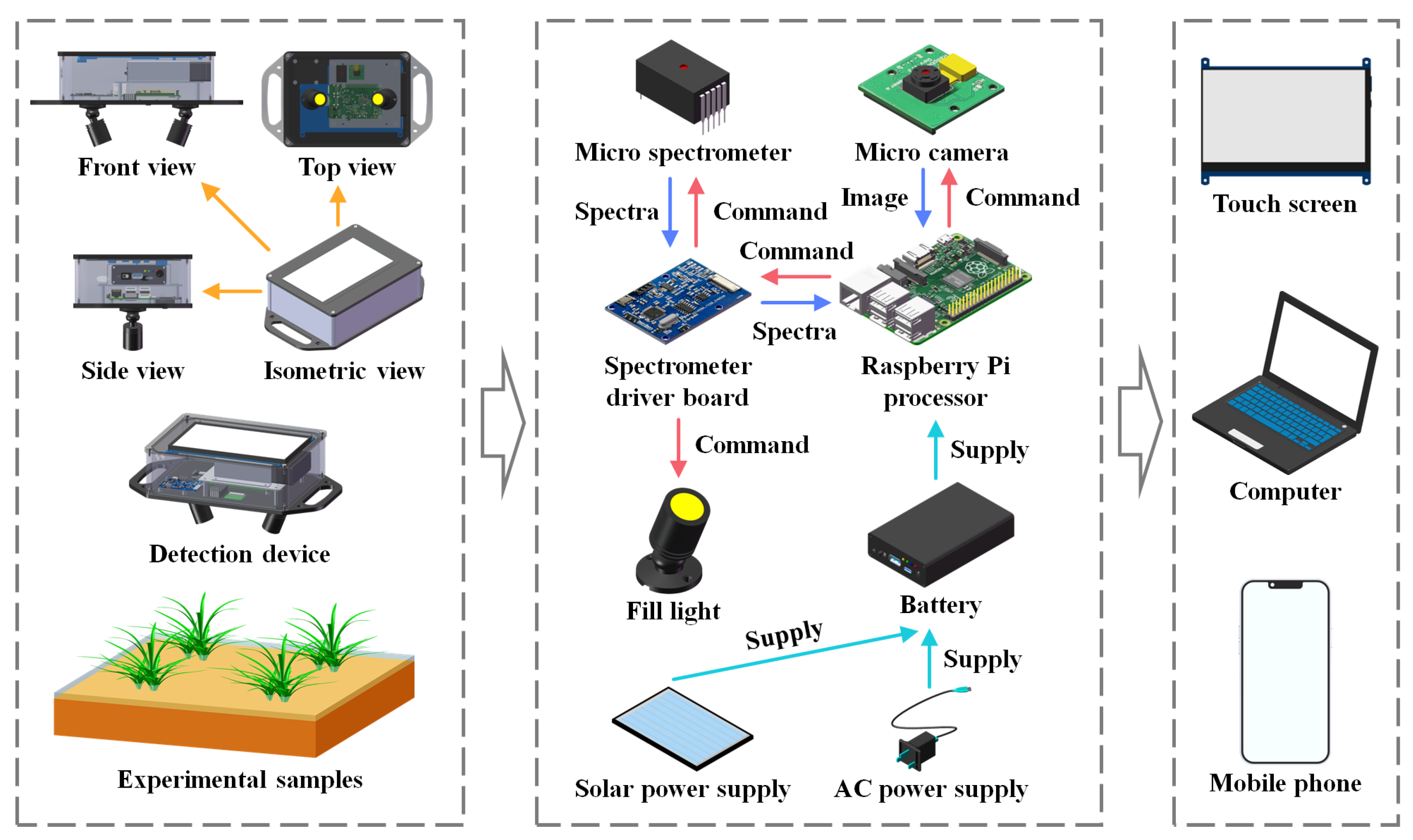
2.1. Hardware System
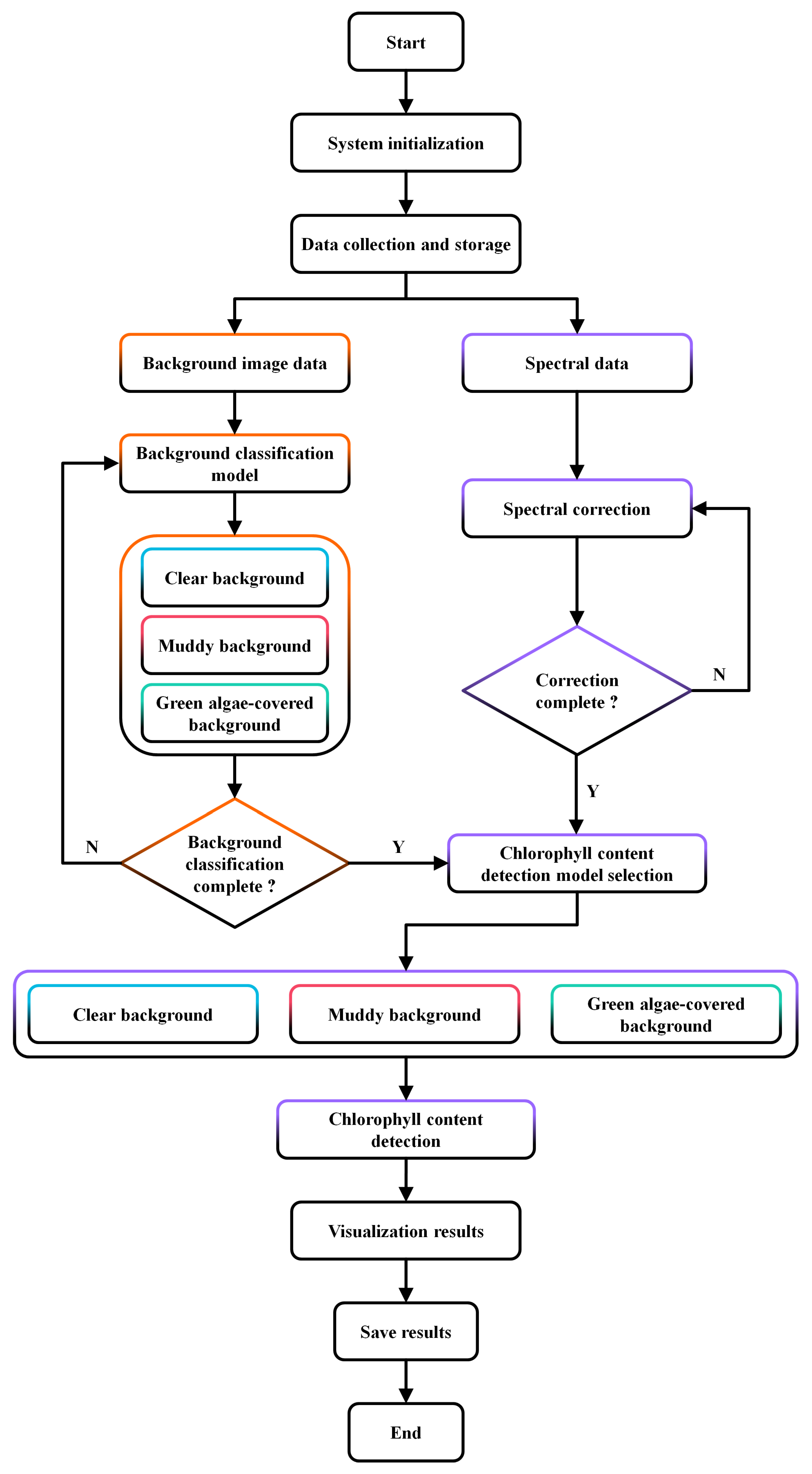
2.2. Software System
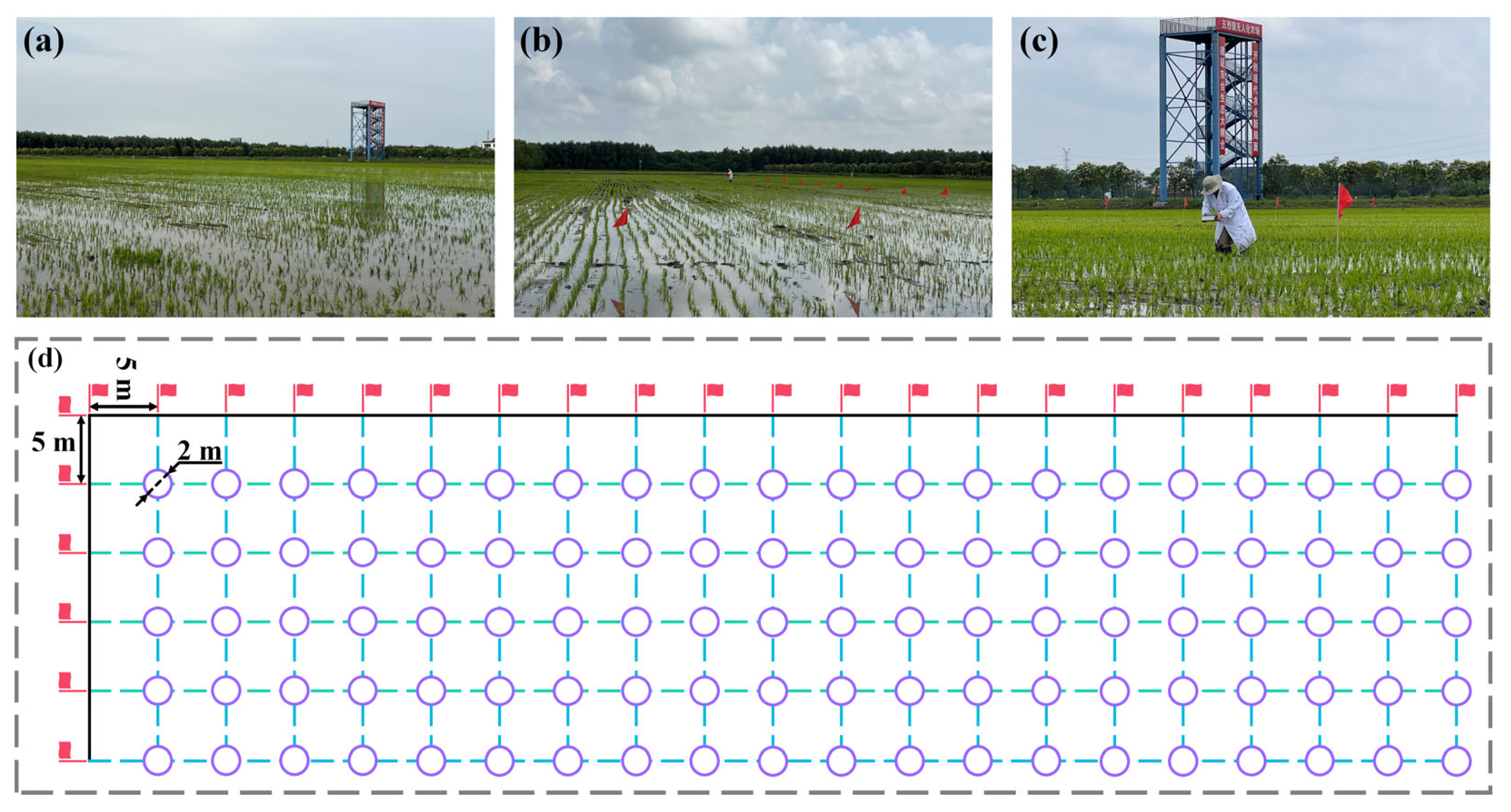
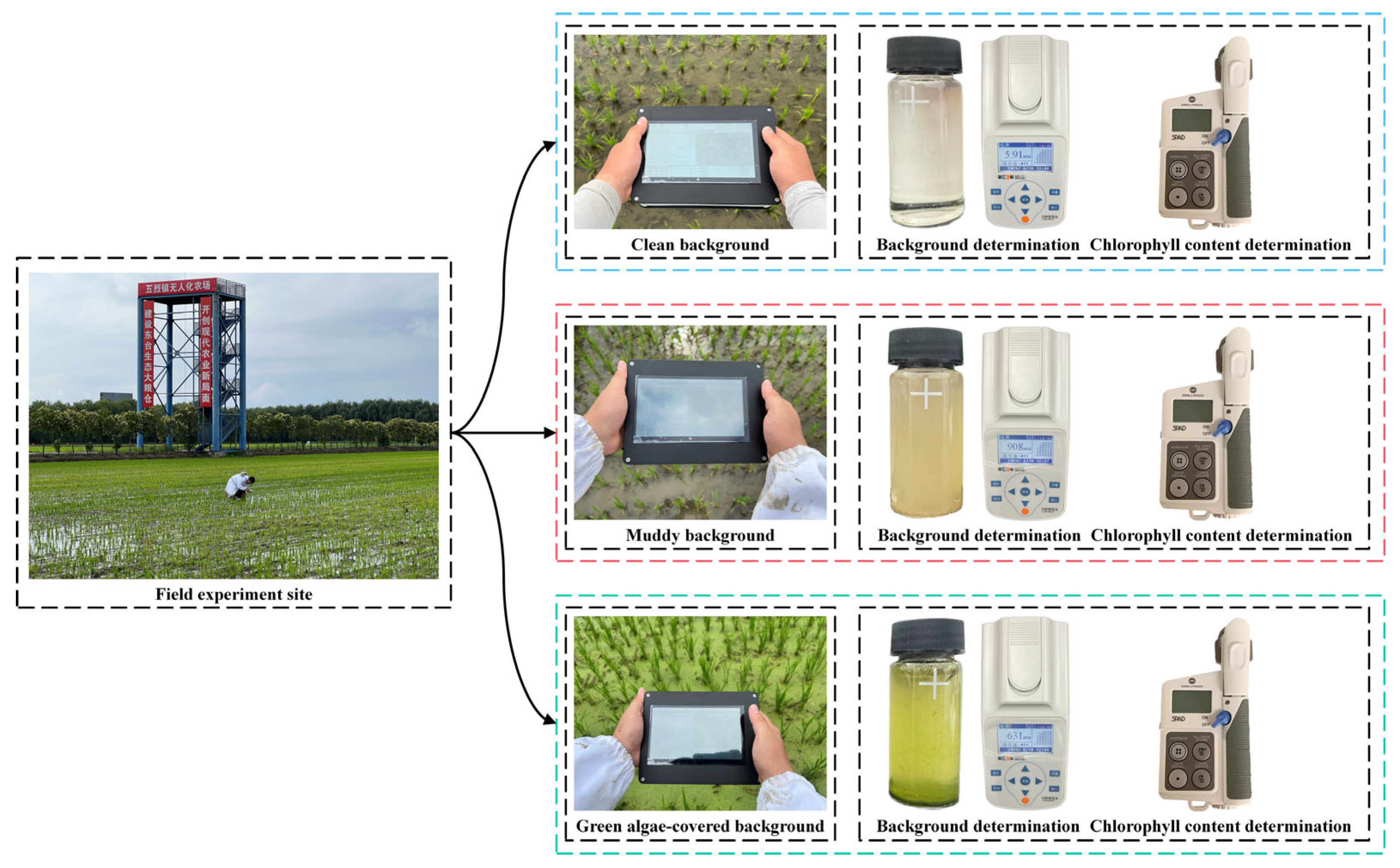
2.3. Experimental Design
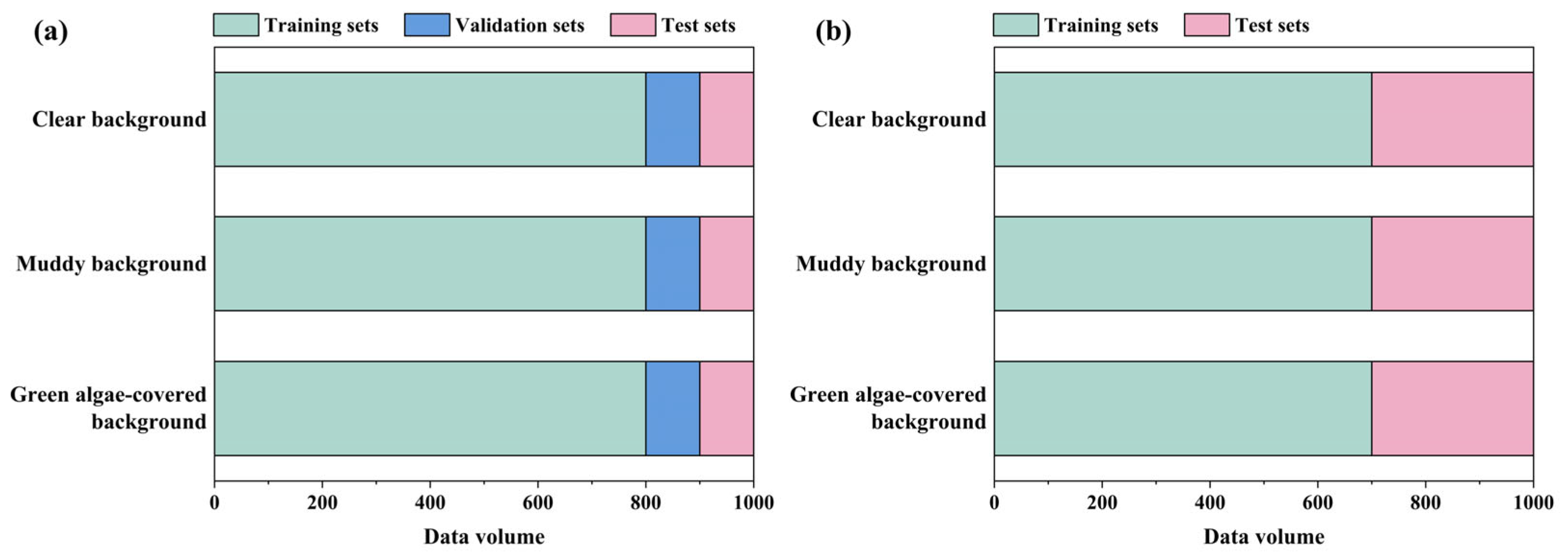
2.4. Data Acquisition and Processing
2.4.1. Spectral Data
2.4.2. Background Image Data
2.4.3. Chlorophyll Content Data
2.5. Establishment and Evaluation of Rice Background Classification Model
2.5.1. Model Structure
2.5.2. Loss Function
2.5.3. Evaluation Index
2.6. Establishment and Evaluation of Rice Chlorophyll Content Detection Model
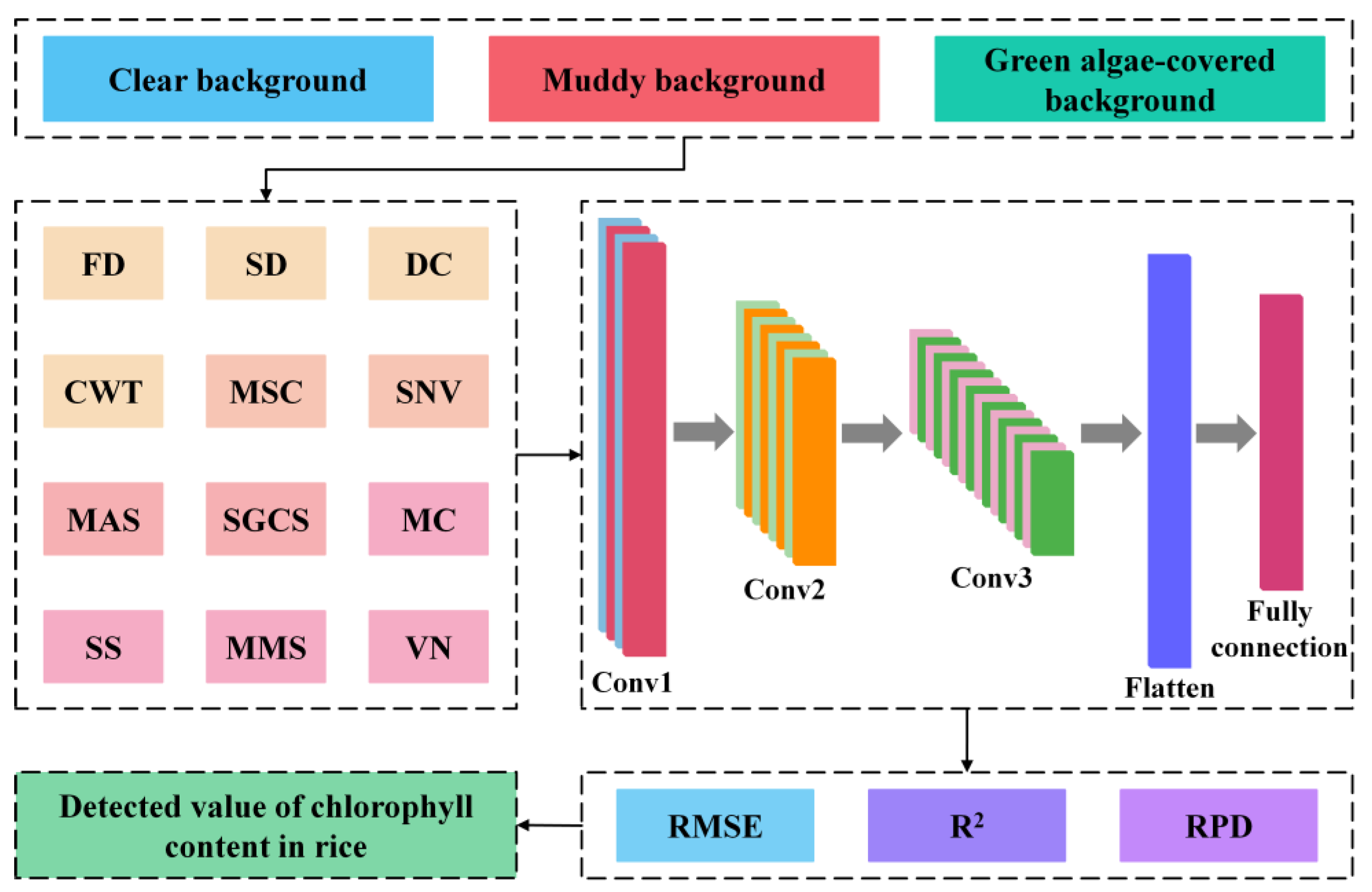
2.6.1. Model Structure
2.6.2. Evaluation Index
2.7. Field Experiment
3. Results and Analysis
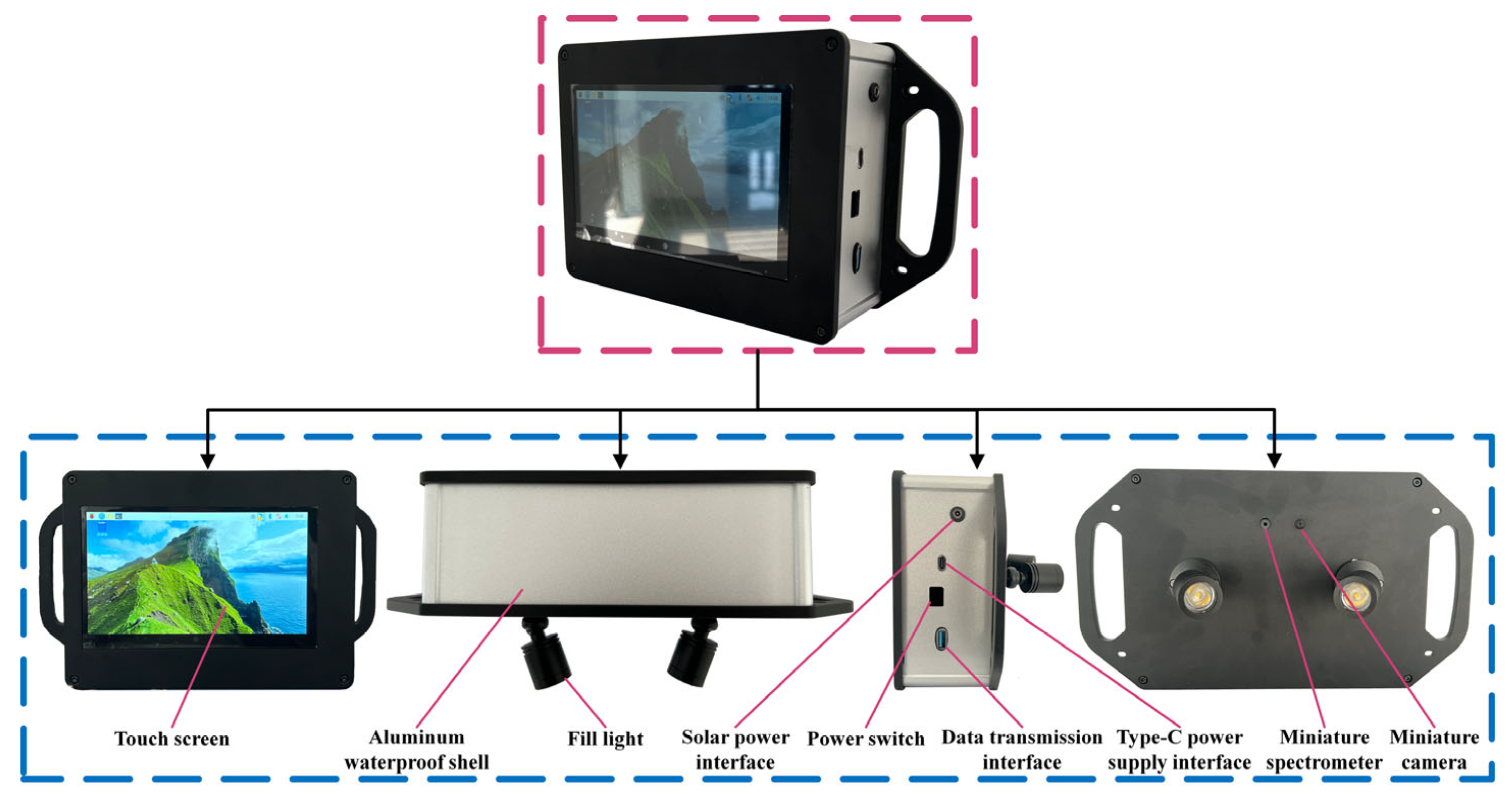
3.1. Integral Structure
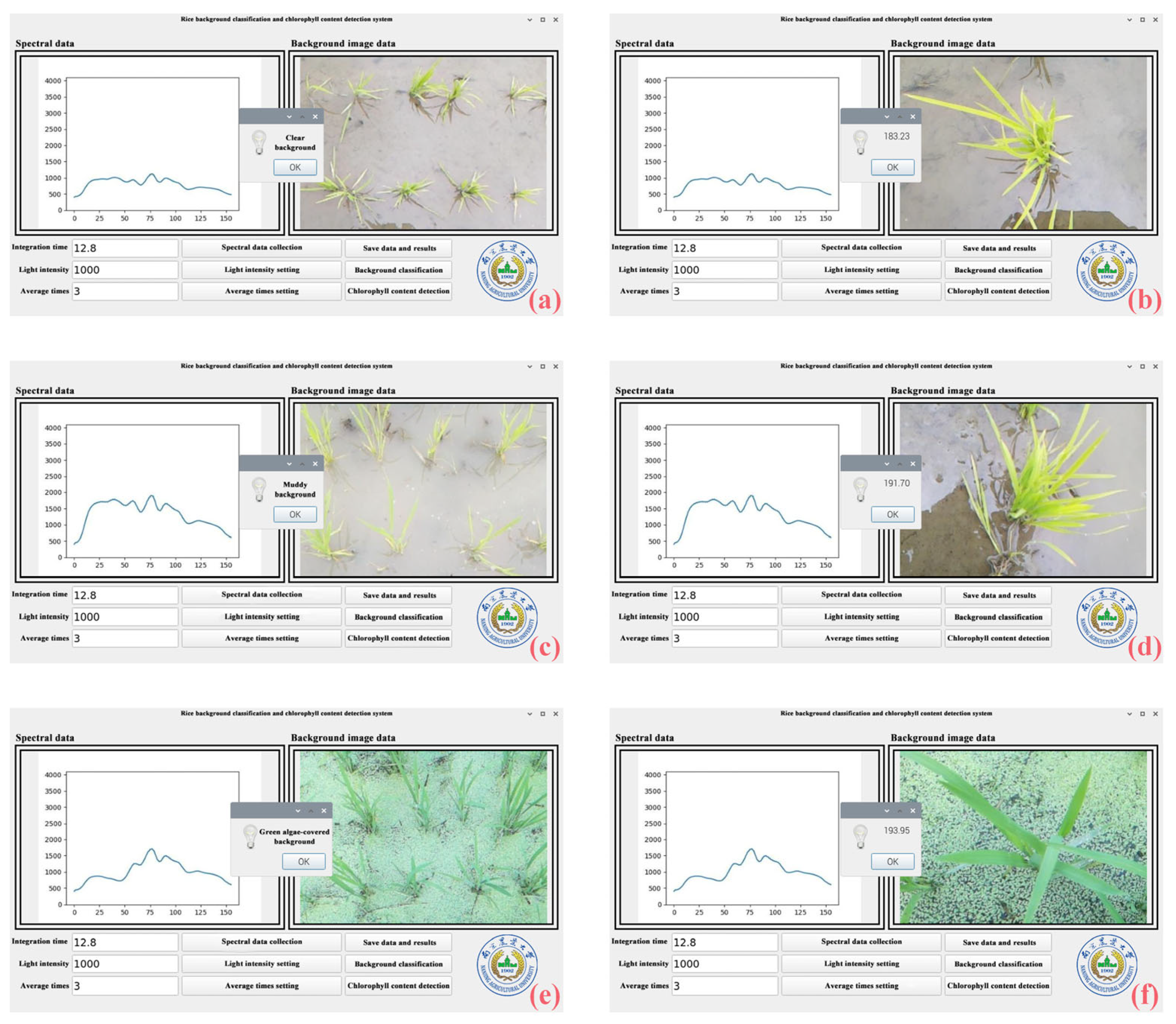
3.2. Software Interface
3.3. Statistical Analysis of Data
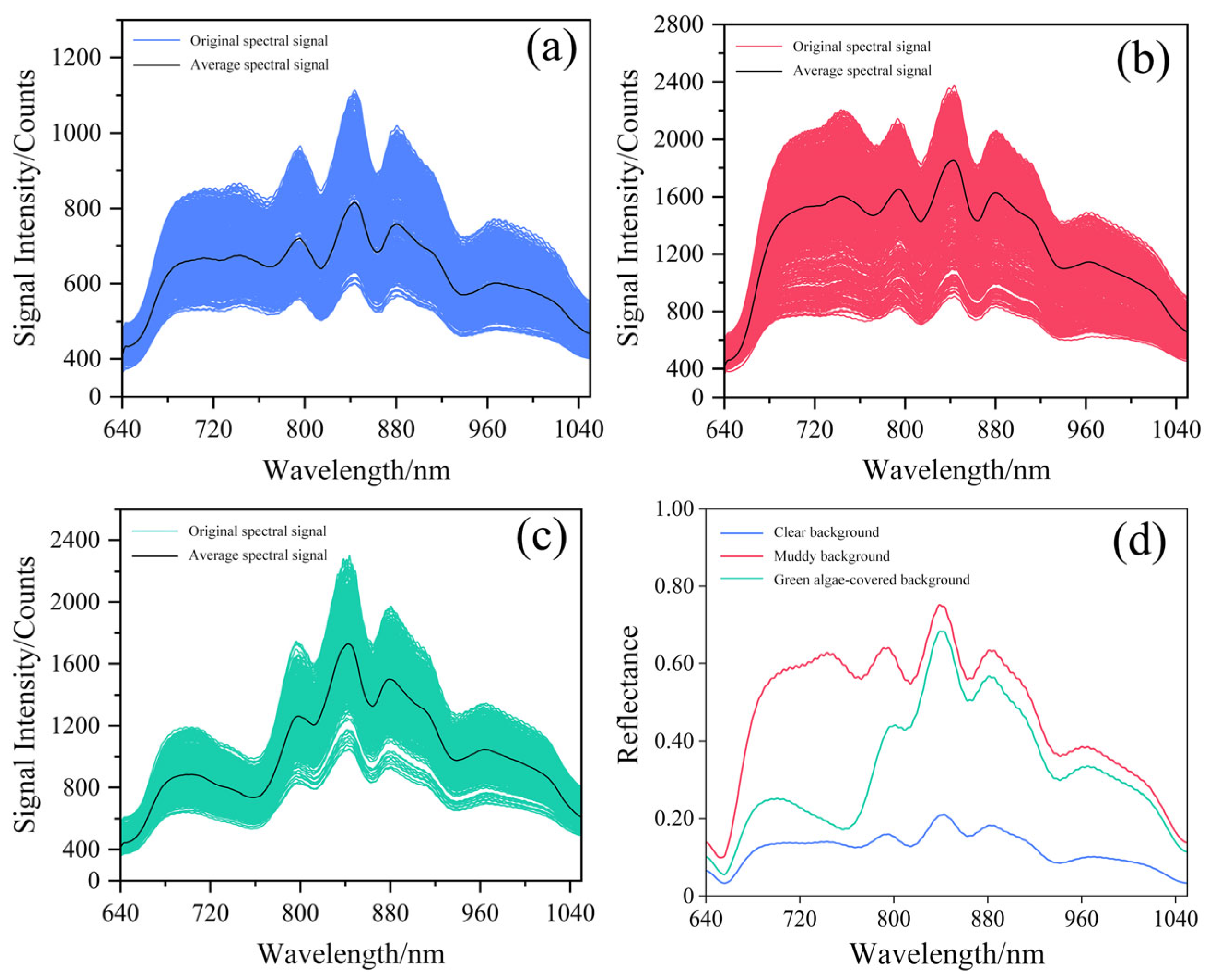
3.3.1. Spectral Data
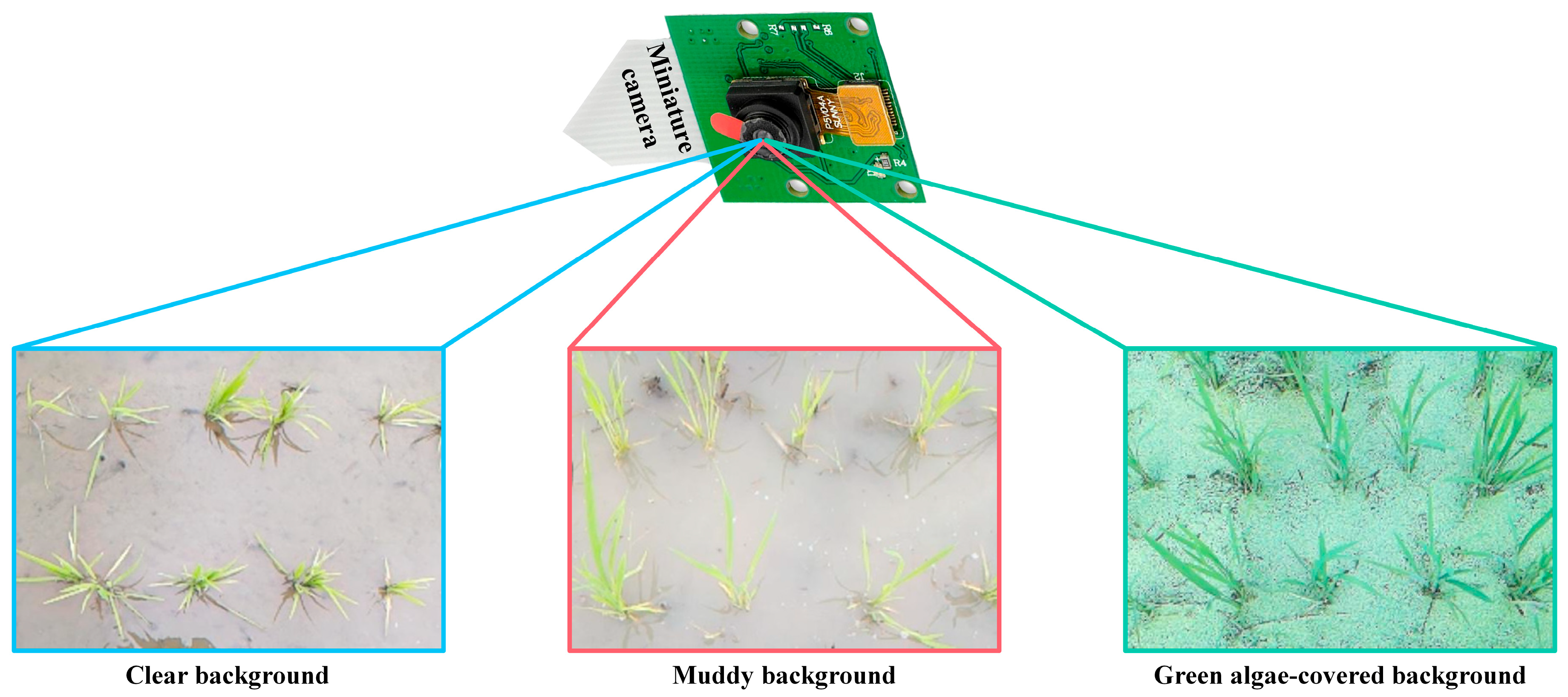
3.3.2. Background Image Data
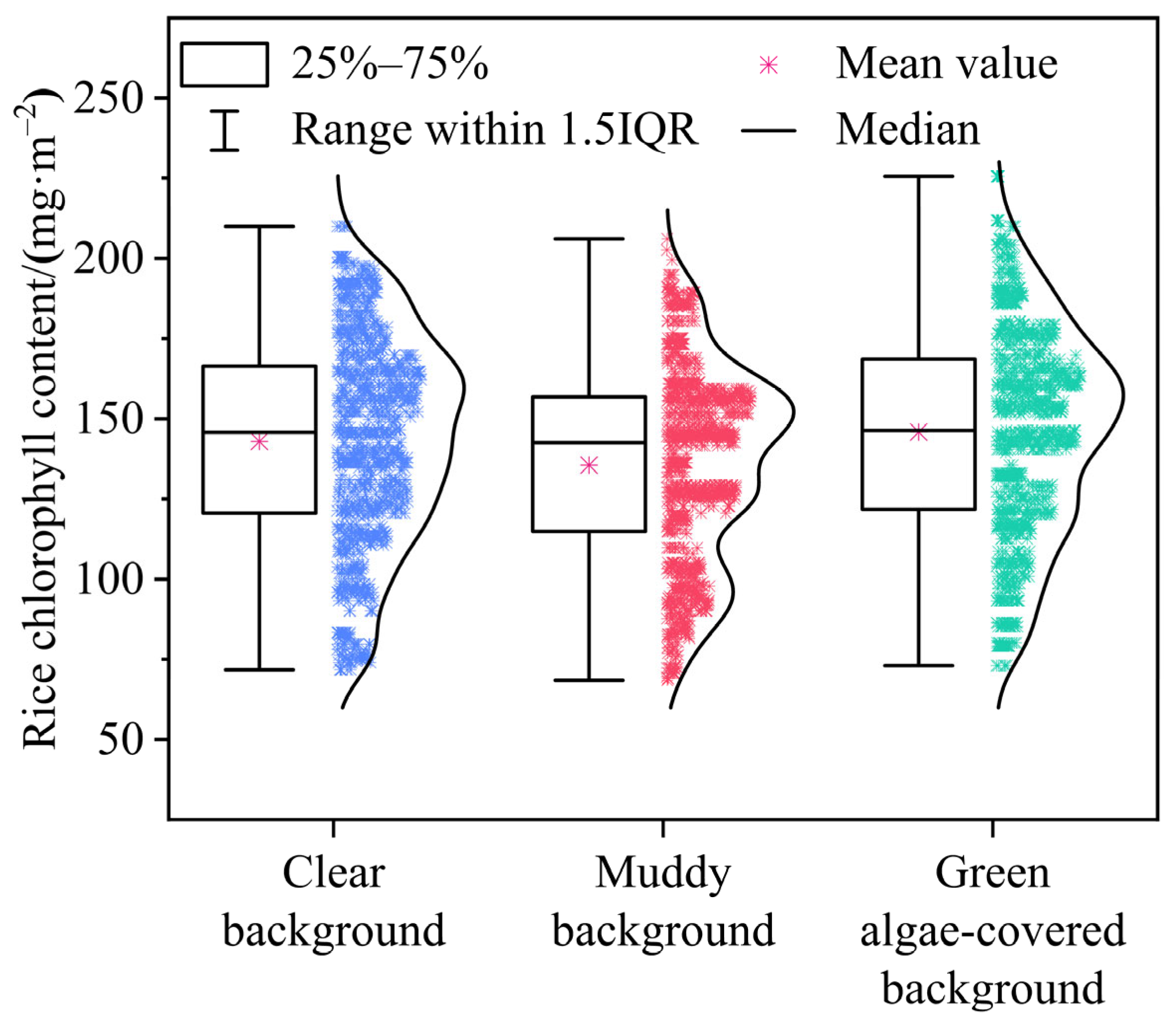
3.3.3. Chlorophyll Content Data
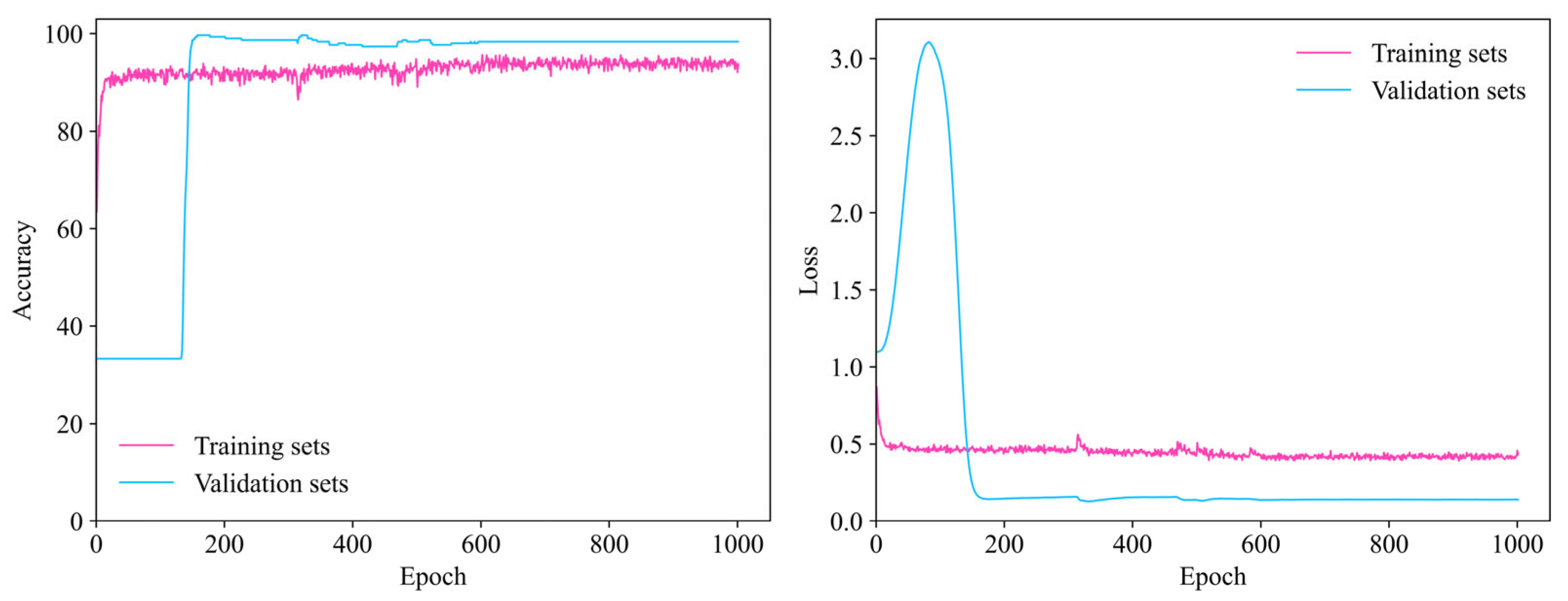
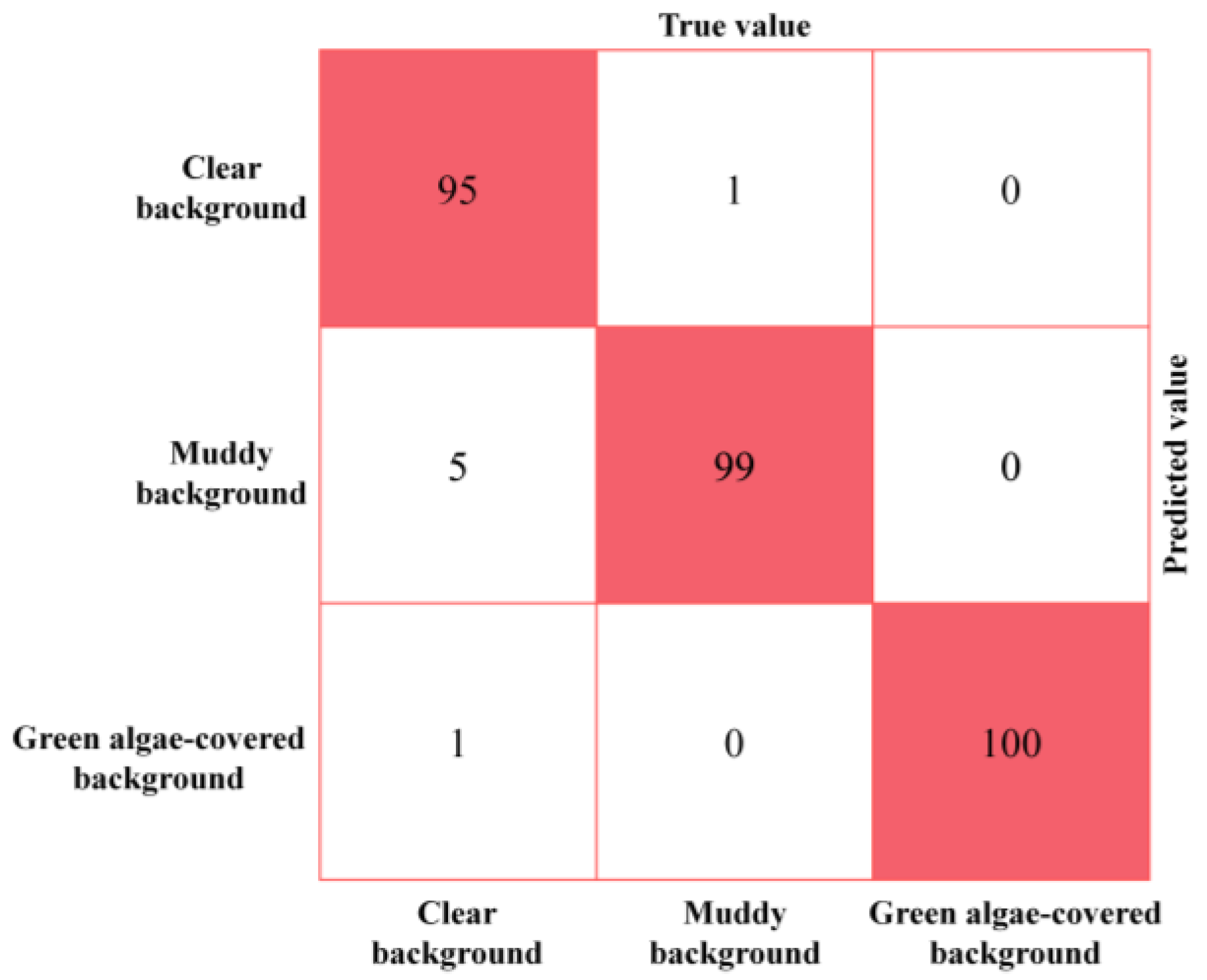
3.4. Evaluation Results and Analysis of Rice Background Classification Model
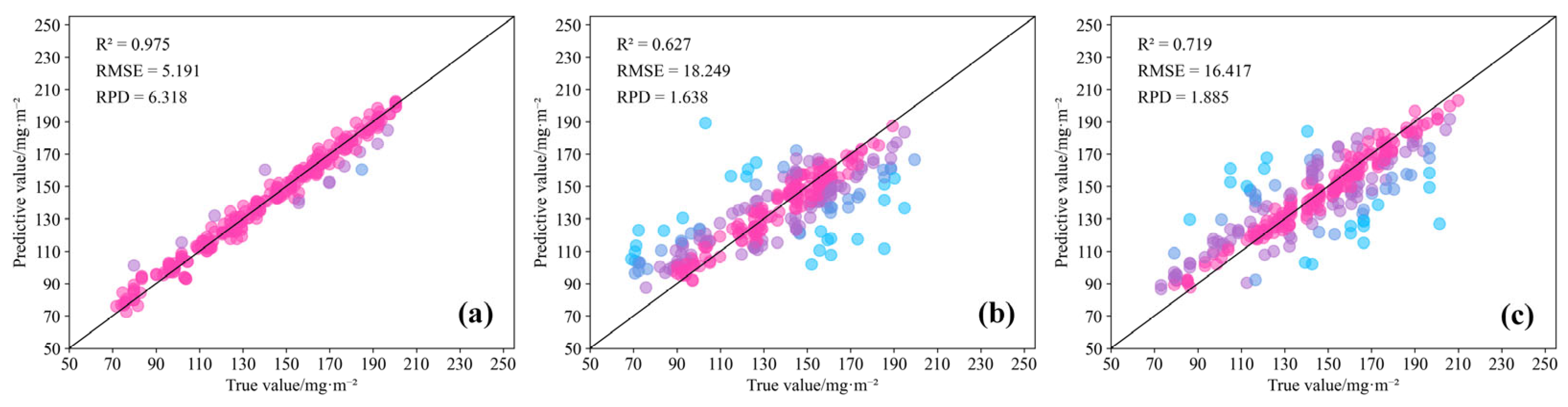
3.5. Evaluation Results and Analysis of Rice Chlorophyll Content Detection Model
3.5.1. Clear Background
3.5.2. Muddy Background
3.5.3. Green Algae-Covered Background
3.6. Field Experiment Results and Analysis
3.6.1. Rice Background Classification Experiment
3.6.2. Rice Chlorophyll Content Detection Experiment
4. Discussion
4.1. Advantages and Challenges of Rice Background Classification Model
4.2. Advantages and Limitations of Rice Chlorophyll Content Detection Model
4.3. Feasibility of System Integration and Its Prospects for Practical Application
5. Conclusions
Supplementary Materials
Author Contributions
Funding
Data Availability Statement
Conflicts of Interest
References
- Asma, J.; Subrahmanyam, D.; Krishnaveni, D. The global lifeline: A staple crop sustaining two thirds of the world’s population. Agric. Arch. 2023, 2, 15–18. [Google Scholar] [CrossRef]
- Zheng, J.; Song, X.; Yang, G.; Du, X.; Mei, X.; Yang, X. Remote sensing monitoring of rice and wheat canopy nitrogen: A review. Remote Sens. 2022, 14, 5712. [Google Scholar] [CrossRef]
- Li, X.; Zhu, B.; Li, S.; Liu, L.; Song, K.; Liu, J. A Comprehensive Review of Crop Chlorophyll Mapping Using Remote Sensing Approaches: Achievements, Limitations, and Future Perspectives. Sensors 2025, 25, 2345. [Google Scholar] [CrossRef] [PubMed]
- Zaman, Q.U. Chapter 1—Precision Agriculture Technology: A Pathway toward Sustainable Agriculture. In Precision Agriculture; Zaman, Q., Ed.; Academic Press: Cambridge, MA, USA, 2023; pp. 1–17. ISBN 978-0-443-18953-1. [Google Scholar]
- Donnelly, A.; Yu, R.; Rehberg, C.; Meyer, G.; Young, E.B. Leaf chlorophyll estimates of temperate deciduous shrubs during autumn senescence using a SPAD-502 meter and calibration with extracted chlorophyll. Ann. For. Sci. 2020, 77, 30. [Google Scholar] [CrossRef]
- Parry, C.; Blonquist, J.M., Jr.; Bugbee, B. In situ measurement of leaf chlorophyll concentration: Analysis of the optical/absolute relationship. Plant Cell Environ. 2014, 37, 2508–2520. [Google Scholar] [CrossRef]
- Kuhlgert, S.; Austic, G.; Zegarac, R.; Osei-Bonsu, I.; Hoh, D.; Chilvers, M.I.; Roth, M.G.; Bi, K.; TerAvest, D.; Weebadde, P.; et al. MultispeQ Beta: A tool for large-scale plant phenotyping connected to the open PhotosynQ network. R. Soc. Open Sci. 2016, 3, 160592. [Google Scholar] [CrossRef]
- Nur Cahyo, A.; Murti, R.H.; TS Putra, E.; Nuringtyas, T.R.; Fabre, D.; Montoro, P. SPAD-502 and atLEAF CHL PLUS values provide good estimation of the chlorophyll content for Hevea brasiliensis Müll. Arg. Leaves. Menara Perkeb. 2020, 88, 1–8. [Google Scholar]
- Hura, K.; Dziurka, M.; Hura, T.; Wójcik-Jagła, M.; Zieliński, A. Physiological and molecular responses of the flag leaf under l-phenylalanine ammonia-lyase inhibition. Cells 2025, 14, 1368. [Google Scholar] [CrossRef] [PubMed]
- Moreira, L.A.; Tränkner, M.; Mariano, E.; Otto, R. Molybdenum supply increases 15N-nitrate uptake by maize. Front. Plant Sci. 2025, 16, 1546132. [Google Scholar] [CrossRef]
- Zhang, H.; Zhang, L.; Wu, H.; Wang, D.; Ma, X.; Shao, Y.; Jiang, M.; Chen, X. Unmanned-Aerial-Vehicle-Based Multispectral Monitoring of Nitrogen Content in Canopy Leaves of Processed Tomatoes. Agriculture 2025, 15, 309. [Google Scholar] [CrossRef]
- Jiang, L.; Dai, J.; Wang, L.; Chen, L.; Zeng, G.; Liu, E.; Zhou, X.; Yao, H.; Xiao, Y.; Fang, J. Ca(H2PO4)2 and MgSO4 activated nitrogen-related bacteria and genes in thermophilic stage of compost. Appl. Microbiol. Biotechnol. 2024, 108, 331. [Google Scholar] [CrossRef]
- Wang, W.; Liao, H.; Zhou, L.; Zheng, Y.; Li, L.; Zhang, Q.; Chen, Q.; Mu, K. Effects of organic waste liquids on Chinese cabbage growth and cadmium accumulation in cadmium-contaminated soils. Trans. Chin. Soc. Agric. Eng. 2023, 39, 235–244. [Google Scholar]
- Nurhermawati, R.; Lubis, I.; Junaedi, A. Respon Karakter Pengisian Biji dan Hasil terhadap Pemberian Pupuk Urea pada Empat Varietas Padi. J. Agron. Indones. 2021, 49, 235–241. [Google Scholar] [CrossRef]
- Nie, R.; Wu, C.; Ji, X.; Li, A.; Zheng, X.; Tang, J.; Sun, L.; Su, Y.; Zhang, J. Methyl Jasmonate Orchestrates Multi-Pathway Antioxidant Defense to Enhance Salt Stress Tolerance in Walnut (Juglans regia L.). Antioxidants 2025, 14, 974. [Google Scholar] [CrossRef]
- Zhang, C.; Liu, M.; Chao, J.; Tang, B.; Li, M.; Sun, H. Contact-based Crop Chlorophyll Detection System Based on Feature Wavelengths. Trans. Chin. Soc. Agric. Mach. 2024, 55, 255–262. [Google Scholar]
- Li, J.; Wang, N.; Li, Z.; Liu, M.; Sun, H.; Li, M. Development of Handheld Chlorophyll Detector Based on Characteristic Wavelengths Optimization. Trans. Chin. Soc. Agric. Mach. 2023, 54, 270–277. [Google Scholar]
- Wang, N.; Li, Z.; Li, J.; Zhang, Y.; Sun, H.; Li, M. Fusing Multispectral Imaging and Deep Learning in Plant Chlorophyll Index Detection System. Trans. Chin. Soc. Agric. Mach. 2023, 5454, 260–269. [Google Scholar]
- Zhang, Z.; Ma, X.; Long, Y.; Li, S.; Sun, H.; Li, M. Design and Development of Crop Chlorophyll Dynamic Monitoring System Based on Internet of Things. Trans. Chin. Soc. Agric. Mach. 2019, 50, 115–121, 166. [Google Scholar]
- Tang, W.; Wang, N.; Liu, G.; Zhao, R.; Li, M.; Sun, H. Design of Portable Crop Chlorophyll Detector with Ambient Light Correction. Trans. Chin. Soc. Agric. Mach. 2022, 53, 249–256. [Google Scholar]
- Sun, H.; Xing, Z.; Zhang, Z.; Long, Y.; Li, M.; Zhang, Q. Design and Experiment of Chlorophyll Content Detection Device for Active Light Source Based on RED-NIR. Trans. Chin. Soc. Agric. Mach. 2019, 50, 175–181, 296. [Google Scholar]
- Chen, J. Design and Experiment of Reflective Leaf Chlorophyll Content Detector Based on Active Light Source. Master’s Thesis, Jiangsu University, Zhenjiang, China, 2020. [Google Scholar]
- Yang, Z.; Li, G.; Zhang, Y.; Su, W.; Wu, J.; Duan, T.; Qi, L. Plant Chlorophyll a and Chlorophyll b Nondestructive Testing System: Research and Development. Chin. Agric. Sci. Bull. 2021, 37, 147–152. [Google Scholar]
- Yang, B.; Du, R.; Yang, Y.; Zhu, D.; Guo, W.; Zhu, X. Design of Portable Nondestructive Detector for Chlorophyll Content of Plant Leaves. Trans. Chin. Soc. Agric. Mach. 2019, 50, 180–186. [Google Scholar]
- Liu, M.; Li, Z. Principle and design of chlorophyll spectrometry meter for plants. J. Chin. Agric. Mech. 2017, 38, 74–79. [Google Scholar] [CrossRef]
- Chen, Y.; Wang, X.; Zhang, X.; Wang, D.; Xu, X.; Huang, X. Parameter optimization for spectral data collection in dark environments for rice leaf chlorophyll content estimation. Comput. Electron. Agric. 2025, 230, 109828. [Google Scholar] [CrossRef]
- Chen, Y.; Wang, X.; Zhang, X.; Xu, X.; Huang, X.; Wang, D.; Amin, A. Spectral-based estimation of chlorophyll content and determination of background interference mechanisms in low-coverage rice. Comput. Electron. Agric. 2024, 226, 109442. [Google Scholar] [CrossRef]
- Monje, O.A.; Bugbee, B. Inherent Limitations of Nondestructive Chlorophyll Meters: A Comparison of Two Types of Meters. HortSci 1992, 27, 69–71. [Google Scholar] [CrossRef]
- Wang, D.; Wang, X.; Shi, Y.; Zhang, X.; Chen, Y.; Zheng, J.; Liu, N. A lightweight keypoint detection model-based method for strawberry recognition and picking point localization in multi-occlusion scenes. Artif. Intell. Agric. 2025, 16, 316–341. [Google Scholar] [CrossRef]
- Liu, Y.; Wang, Z.; Wang, R.; Chen, J.; Gao, H. Flooding-based MobileNet to identify cucumber diseases from leaf images in natural scenes. Comput. Electron. Agric. 2023, 213, 108166. [Google Scholar] [CrossRef]
- Qin, D.; Leichner, C.; Delakis, M.; Fornoni, M.; Luo, S.; Yang, F.; Wang, W.; Banbury, C.; Ye, C.; Akin, B.; et al. MobileNetV4: Universal Models for the Mobile Ecosystem. In Proceedings of the Computer Vision–ECCV 2024, Milan, Italy, 29 September–4 October 2024; Leonardis, A., Ricci, E., Roth, S., Russakovsky, O., Sattler, T., Varol, G., Eds.; Springer Nature: Cham, Switzerland, 2025; pp. 78–96. [Google Scholar]
- Liu, B.; Jia, R.; Zhu, X.; Yu, C.; Yao, Z.; Zhang, H.; He, D. Lightweight identification model for apple leaf diseases and pests based on mobile terminals. Trans. Chin. Soc. Agric. Eng. 2022, 38, 130–139. [Google Scholar]
- Wang, D.; Wang, X.; Chen, Y.; Wu, Y.; Zhang, X. Strawberry ripeness classification method in facility environment based on red color ratio of fruit rind. Comput. Electron. Agric. 2023, 214, 108313. [Google Scholar] [CrossRef]
- Xu, X.; Chen, Y.; Yin, H.; Wang, X.; Zhang, X. Nondestructive detection of SSC in multiple pear (Pyrus pyrifolia Nakai) cultivars using Vis-NIR spectroscopy coupled with the Grad-CAM method. Food Chem. 2024, 450, 139283. [Google Scholar] [CrossRef] [PubMed]
- Chen, Y.; Wang, X.; Zhang, X.; Wang, D.; Xu, X. A band selection method combining spectral color characteristics for estimating chlorophyll content of rice in different backgrounds. Spectrochim. Acta A Mol. Biomol. Spectrosc. 2025, 330, 125681. [Google Scholar] [CrossRef] [PubMed]
- Zhang, X.; Zou, Y.; Shi, W. Dilated convolution neural network with LeakyReLU for environmental sound classification. In Proceedings of the 2017 22nd International Conference on Digital Signal Processing (DSP), London, UK, 23–25 August 2017; pp. 1–5. [Google Scholar]
- Ioffe, S.; Szegedy, C. Batch Normalization: Accelerating Deep Network Training by Reducing Internal Covariate Shift. In Proceedings of the 32nd International Conference on Machine Learning, Lille, France, 7–9 July 2015. [Google Scholar]



| Type | Manufacturer | Ref. |
|---|---|---|
| Konica Minolta SPAD-502 Plus | Japan | [5] |
| Opti-Sciences CCM-200 plus | America | [6] |
| PhotosynQ MultispeQ V2.0 | America | [7] |
| atLEAF CHL PLUS | America | [8] |
| Hansatech CL-01 | Britain | [9] |
| Pessl Instruments Dualex | Austria | [10] |
| ZKWH TYS-4N | China | [11] |
| JC-YLS01 | China | [12] |
| LD-YB | China | [13] |
| YLS-A | China | [14] |
| Yaxin-1162 | China | [15] |
| Parameters | Value |
|---|---|
| Overall size (length × width × height) | 275.0 mm × 154.0 mm × 72.0 mm |
| Spectral resolution | ≤20 nm |
| Spectral wavelength range | 640–1050 nm |
| Spectral wavelength repeatability | −0.5–0.5 nm |
| Image resolution | 2592 × 1944 |
| Number of image pixels | 500W pixels |
| Power supply requirements | 5V 3A |
| Working temperature | 35.0–50.0 °C |
| Input | Block | DW K1 | DW K2 | Extended Dim | Output Dim | Stride |
|---|---|---|---|---|---|---|
| 2242 × 3 | Conv2D | – | 3 × 3 | – | 32 | 3 |
| 1122 × 32 | FusedIB | – | 3 × 3 | 32 | 32 | 2 |
| 562 × 32 | FusedIB | – | 3 × 3 | 96 | 64 | 2 |
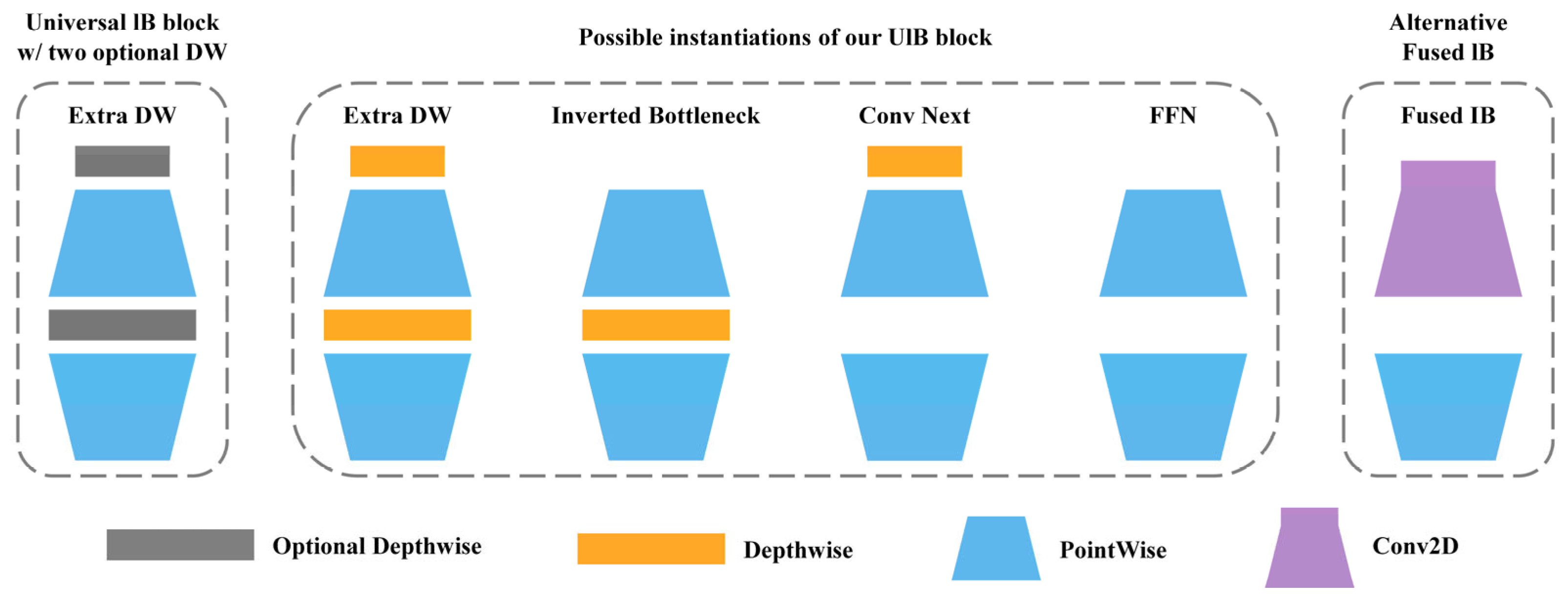
| 282 × 64 | ExtraDW | 5 × 5 | 5 × 5 | 192 | 96 | 2 |
| 142 × 96 | IB | – | 3 × 3 | 192 | 96 | 1 |
| 142 × 96 | IB | – | 3 × 3 | 192 | 96 | 1 |
| 142 × 96 | IB | – | 3 × 3 | 192 | 96 | 1 |
| 142 × 96 | IB | – | 3 × 3 | 192 | 96 | 1 |
| 142 × 96 | ConvNext | 3 × 3 | – | 384 | 96 | 1 |
| 142 × 96 | ExtraDW | 3 × 3 | 3 × 3 | 576 | 128 | 2 |
| 72 × 128 | ExtraDW | 5 × 5 | 5 × 5 | 512 | 128 | 1 |
| 72 × 128 | IB | – | 5 × 5 | 512 | 128 | 1 |
| 72 × 128 | IB | – | 5 × 5 | 384 | 128 | 1 |
| 72 × 128 | IB | – | 3 × 3 | 512 | 128 | 1 |
| 72 × 128 | IB | – | 3 × 3 | 512 | 128 | 1 |
| 72 × 128 | Conv2D | – | 1 × 1 | – | 960 | 1 |
| 72 × 960 | AvgPool | – | 7 × 7 | – | 960 | 1 |
| 12 × 960 | Conv2D | – | 1 × 1 | – | 1280 | 1 |
| 12 × 128 | Conv2D | – | 1 × 1 | – | 1000 | 1 |
| Statistical Parameter | Clear Background | Muddy Background | Green Algae-Covered Background |
|---|---|---|---|
| Number of data | 1000 | 1000 | 1000 |
| Upper quartile | 165.99 | 156.86 | 168.58 |
| Median | 145.76 | 142.59 | 146.33 |
| Lower quartile | 120.61 | 114.87 | 121.78 |
| Mean | 142.92 | 135.56 | 145.87 |
| Coefficient of variation | 0.23 | 0.22 | 0.22 |
| Background | Accuracy/% | Precision/% | Recall/% | F1 Score/% |
|---|---|---|---|---|
| Clear | 97.33 | 98.94 | 93.00 | 95.88 |
| Muddy | 97.33 | 94.29 | 99.00 | 96.59 |
| Green algae-covered | 97.33 | 99.01 | 100.00 | 99.50 |
| Model | Training Set | Test Set | ||||
|---|---|---|---|---|---|---|
| RMSE | R2 | RPD | RMSE | R2 | RPD | |
| FD + CNN | 0.990 | 3.187 | 10.231 | 0.975 | 5.191 | 6.318 |
| DC + CNN | 0.983 | 4.269 | 7.637 | 0.970 | 5.710 | 5.743 |
| MC + CNN | 0.979 | 4.705 | 6.930 | 0.967 | 5.993 | 5.473 |
| SD + CNN | 0.990 | 3.269 | 9.972 | 0.964 | 6.183 | 5.304 |
| SNV + CNN | 0.978 | 4.826 | 6.756 | 0.964 | 6.228 | 5.265 |
| VN + CNN | 0.979 | 4.720 | 6.907 | 0.961 | 6.440 | 5.093 |
| MMS + CNN | 0.984 | 4.091 | 7.970 | 0.961 | 6.440 | 5.092 |
| MSC + CNN | 0.966 | 6.011 | 5.425 | 0.957 | 6.830 | 4.802 |
| CWT + CNN | 0.974 | 5.278 | 6.177 | 0.955 | 6.948 | 4.720 |
| SS + CNN | 0.982 | 4.424 | 7.370 | 0.948 | 7.477 | 4.386 |
| MAS + CNN | 0.830 | 13.452 | 2.424 | 0.792 | 14.955 | 2.193 |
| SGCS + CNN | 0.831 | 13.420 | 2.430 | 0.791 | 14.992 | 2.188 |
| Model | Training Set | Test Set | ||||
|---|---|---|---|---|---|---|
| RMSE | R2 | RPD | RMSE | R2 | RPD | |
| SS + CNN | 0.854 | 11.613 | 2.614 | 0.627 | 18.249 | 1.638 |
| MMS + CNN | 0.770 | 14.543 | 2.087 | 0.569 | 19.618 | 1.524 |
| FD + CNN | 0.836 | 12.286 | 2.471 | 0.544 | 20.190 | 1.481 |
| SD + CNN | 0.833 | 12.400 | 2.448 | 0.492 | 21.298 | 1.404 |
| MC + CNN | 0.534 | 20.730 | 1.464 | 0.436 | 22.446 | 1.332 |
| CWT + CNN | 0.553 | 20.296 | 1.496 | 0.419 | 22.786 | 1.312 |
| SGCS + CNN | 0.482 | 21.847 | 1.389 | 0.409 | 22.982 | 1.301 |
| DC + CNN | 0.566 | 19.988 | 1.519 | 0.388 | 23.388 | 1.278 |
| MAS + CNN | 0.443 | 22.663 | 1.339 | 0.384 | 23.458 | 1.274 |
| VN + CNN | 0.393 | 23.641 | 1.284 | 0.344 | 24.216 | 1.234 |
| SNV + CNN | 0.417 | 23.173 | 1.310 | 0.342 | 24.250 | 1.233 |
| MSC + CNN | 0.241 | 26.440 | 1.148 | 0.269 | 25.556 | 1.170 |
| Model | Training Set | Test Set | ||||
|---|---|---|---|---|---|---|
| RMSE | R2 | RPD | RMSE | R2 | RPD | |
| SS + CNN | 0.952 | 7.267 | 4.543 | 0.719 | 16.417 | 1.885 |
| SD + CNN | 0.939 | 8.127 | 4.062 | 0.696 | 17.061 | 1.814 |
| MMS + CNN | 0.896 | 10.633 | 3.105 | 0.653 | 18.222 | 1.698 |
| VN + CNN | 0.748 | 16.566 | 1.993 | 0.601 | 19.534 | 1.584 |
| FD + CNN | 0.875 | 11.666 | 2.830 | 0.547 | 20.827 | 1.486 |
| MC + CNN | 0.589 | 21.154 | 1.560 | 0.499 | 21.905 | 1.413 |
| SNV + CNN | 0.515 | 22.986 | 1.436 | 0.448 | 22.995 | 1.346 |
| DC + CNN | 0.574 | 21.537 | 1.533 | 0.430 | 23.353 | 1.325 |
| CWT + CNN | 0.485 | 23.698 | 1.393 | 0.393 | 24.116 | 1.283 |
| MSC + CNN | 0.407 | 25.423 | 1.298 | 0.374 | 24.485 | 1.264 |
| SGCS + CNN | 0.439 | 24.732 | 1.335 | 0.357 | 24.814 | 1.247 |
| MAS + CNN | 0.233 | 28.917 | 1.142 | 0.220 | 27.332 | 1.132 |
| Item | Sample Size | Number of Correct Classifications | Correct Rate/% |
|---|---|---|---|
| Clear | 59 | 51 | 86.44% |
| Muddy | 48 | 48 | 100.00% |
| Green algae-covered | 43 | 43 | 100.00% |
| Overall results | 150 | 142 | 94.67% |
| Item | Sample Size | Number of Relative Error <5% | Number of 5% ≤Relative Error ≤10% | Number of Relative Error >10% |
|---|---|---|---|---|
| Clear | 59 | 52 (88.14%) | 4 (6.78%) | 3 (5.08%) |
| Muddy | 48 | 21 (43.75%) | 13 (27.08%) | 14 (29.17%) |
| Green algae-covered | 43 | 20 (46.51%) | 16 (37.21%) | 7 (16.28%) |
| Overall results | 150 | 93 (62.00%) | 33 (22.00%) | 24 (16.00%) |
Disclaimer/Publisher’s Note: The statements, opinions and data contained in all publications are solely those of the individual author(s) and contributor(s) and not of MDPI and/or the editor(s). MDPI and/or the editor(s) disclaim responsibility for any injury to people or property resulting from any ideas, methods, instructions or products referred to in the content. |
© 2026 by the authors. Licensee MDPI, Basel, Switzerland. This article is an open access article distributed under the terms and conditions of the Creative Commons Attribution (CC BY) license.
Share and Cite
Chen, Y.; Wang, X.; Xing, X.; Xu, S.; Zhang, X.; Chen, S.; Yin, Y.; Wang, D.; Xi, R.; Xu, X. A Spectral Device for Rice Chlorophyll Content Detection with Background Classification Capability. Agronomy 2026, 16, 192. https://doi.org/10.3390/agronomy16020192
Chen Y, Wang X, Xing X, Xu S, Zhang X, Chen S, Yin Y, Wang D, Xi R, Xu X. A Spectral Device for Rice Chlorophyll Content Detection with Background Classification Capability. Agronomy. 2026; 16(2):192. https://doi.org/10.3390/agronomy16020192
Chicago/Turabian StyleChen, Yanyu, Xiaochan Wang, Xiaoyang Xing, Sheng Xu, Xiaolei Zhang, Shengfeng Chen, Yue Yin, Dezhi Wang, Rui Xi, and Xin Xu. 2026. "A Spectral Device for Rice Chlorophyll Content Detection with Background Classification Capability" Agronomy 16, no. 2: 192. https://doi.org/10.3390/agronomy16020192
APA StyleChen, Y., Wang, X., Xing, X., Xu, S., Zhang, X., Chen, S., Yin, Y., Wang, D., Xi, R., & Xu, X. (2026). A Spectral Device for Rice Chlorophyll Content Detection with Background Classification Capability. Agronomy, 16(2), 192. https://doi.org/10.3390/agronomy16020192