Article

Chromosome Analysis of Mitosis on Interspecific Hybrid Progenies on (Fagopyrum tataricum) with Golden Buckwheat (Fagopyrum cymosum Complex)

by
Fan Zhang
1,†,
Lian Tang
1,2,3,†,
Lijuan Yang
1,
Ziyang Liu
1,
Yuanzhi Cheng
1,
Hongyou Li
1,
Taoxiong Shi
1 and
Qingfu Chen
1,*
1
Research Center of Buckwheat Industry Technology, Guizhou Key Laboratory of Biotechnology Breeding for Special Minor Cereals, College of Life Science, West Campus of Guizhou Normal University, Guiyang 550025, China
2
School of Karst Science, Guizhou Normal University, Guiyang 550025, China
3
Guizhou Light Industry Polytechnic University, Department of Light Industry and Chemical Engineering, Guiyang 550025, China
*
Author to whom correspondence should be addressed.
These authors contributed equally to this work.
Agronomy 2026, 16(2), 190; https://doi.org/10.3390/agronomy16020190
Submission received: 7 November 2025 / Revised: 11 December 2025 / Accepted: 31 December 2025 / Published: 13 January 2026
(This article belongs to the Section Crop Breeding and Genetics)

Abstract

Tartary buckwheat has increasingly become the focus of people’s attention due to its powerful health benefits. Golden buckwheat is a traditional Chinese medicine. People have begun to utilize it through wide hybridization to further enhance the health benefits of Tartary buckwheat. To study the genetic stability of the interspecific hybrids of Tartary buckwheat with golden buckwheat, and to provide scientific basis for the interspecific cross breeding of buckwheat, the mitotic chromosomes of two buckwheat double lines and their interspecific hybrids with golden buckwheat were subjected to observe the karyotypes. The results showed as follows: (1) The two autotetraploid Tartary buckwheat lines (Long Black-4T and Daku-1) have chromosome number 2n = 32. The karyotype formula of 2n = 4x = 32 consisted of 16 pairs of metacentric chromosomes for Long Black-4T (TTTT) while Daku-1 (TTTT) has 1sm + 7m Gui Jinqiao 4 with 2n = 32 has a karyotype formula of 2n = 4x = 32 that consisted 1sm + 6m + 1M (genome M) and 2sm + 5m + 1M (genome M’). The normal fertile tetraploid hybrid F1 plants between Long Black-4T and Gui Jinqiao 4 has 2n = 4x = [1sm + 7m (M), 1sm + 7m (M’), 14m + 2M (TT)]. The normal fertile variety Gui Jinku 1 from the above hybrid progenies shows 2n = 4x = [3sm + 5m (M), 2sm + 6m (M’), 16m (TT)], indicating an increment of sm chromosomes by rearrangements of chromosome structure in the M and M’ genomes. The above parents and their hybrids with the MM’TT genome show fertility. A plant from F2 of the above cross, showing highly infertility, has 2n = 3x= [1sm + 7m (M), 1sm + 7m (M’), 8m (T)]; and back cross progeny plant from Daku 1/Gui Jinqiao 4 F2//Gui Jinqiao 2 golden buckwheat has 2n = 4x = [16m (MM), 5sm + 3m (M’), 1sm + 7m (T)], showed high infertility, which is caused by genome aneuploidy and non-even ploidy. The above shows that there are obvious variations of genome karyotypes from the same parent, indicated by certain chromosome structural rearrangements in genomes T, M, and M’.

1. Introduction

Compared with major crops such as rice, wheat and corn, Tartary buckwheat not only contains more abundant high-quality protein (with essential amino acid composition close to human needs), dietary fiber, and resistant starch etc. nutrients, but is also much richer in bioactive substances such as flavonoids, phenolic acids, alkaloids, triterpenoids, and anthraquinones [1]. It has multiple healthcare functions such as lowering the “three highs” (hypertension, hyperglycemia, hyperlipidemia), anti-inflammation, anti-oxidation, anti-virus, anti-arteriosclerosis, anti-diabetes, and anti-cancer [1,2]. Given these prominent nutritional and health benefits, market demand for high-quality and high-yielding buckwheat varieties is increasing. Nevertheless, the further improvement of these key agronomic traits is hampered by the narrow genetic base and limited germplasm resources available in currently cultivated buckwheat, necessitating the adoption of advanced breeding technologies. The genetic breeding of buckwheat started late, and different species of buckwheat have different superior genes [3].
As one of the main buckwheat producing areas in the world, China has the most abundant wild buckwheat species resources, which is an important gene pool for buckwheat breeding and improvement. While cultivated buckwheat is grown in temperate regions worldwide, the genetic diversity of wild buckwheat species is concentrated in specific geographic centers. The eastern Himalayan foothills (including Nepal and Bhutan), Southwest China, and parts of East Asia (such as Japan and Korea) are recognized as key areas for wild Fagopyrum species diversity [4,5]. However, the origin center of world buckwheat, southwest China, has approximately 23 Fagopyrum species [6], much more than other regions with 2–12 Fagopyrum species. Among them, common buckwheat (F. esculentum) and Tartary buckwheat (F. tataricum) are the most important special food crops, and perennial golden buckwheat (F. cymosum complex) is planted as Chinese medicine. The F. cymosum complex group, including three species of diploid big wild golden buckwheat (F. megaspartanium), diploid pilous golden buckwheat (F. pilous), and tetraploid golden buckwheat (F. cymosum), has many excellent traits such as perennial and productivity potential, yield potential, drug components, etc. Beyond the traits previously mentioned, they exhibit enhanced tolerance to abiotic stresses, including drought, low temperature, and poor soil conditions such as acidity and low nutrient availability [7]. Furthermore, these species demonstrate high nutrient use efficiency, characterized by a superior capacity to absorb phosphorus and potassium from low-fertility soils, thereby reducing dependence on chemical fertilizers [8], and are important resources for buckwheat plant breeding in the future.
In buckwheat breeding, wide hybridization is critical for creating new germplasm and varieties [6]. Introducing favorable genes from perennial buckwheat into conventional buckwheat is an effective way to enhance the genetic improvement of buckwheat. Making full use of the excellent characteristics of perennial buckwheat and developing new excellent varieties of buckwheat is the key in buckwheat breeding.
There have been some reports about wide hybridization [9,10,11]. However, wide hybridization often leads to problems such as hybrid incompatibility, sterility of hybrids, and instability of hybrid offspring, making it difficult to conduct interspecific hybridization and gene introduction in cultivated buckwheat. Among them, sterility is primarily caused by cytological barriers, notably the failure of chromosome pairing during meiosis, which results in the formation of univalents and the production of unbalanced, non-viable gametes [11,12].
In recent years, buckwheat breeding has expanded its research beyond traditional systematic breeding and induced mutation breeding to include hybrid breeding and distant hybridization. Researchers have successfully overcome the difficulty of hybridization by using a high crossability female parent, achieving some successful hybrids among different species at the rate of about 32% [13].
In addition, the use of biotechnology can be employed to modify golden buckwheat. The combination of polyploid breeding and tissue culture has shown promising results. Furthermore, the technique of combining tissue culture with colchicine treatment for inducing polyploidy is also becoming increasingly mature [6,14,15].
Chen et al. [6,13] developed a new variety Gui Jinqiao 1 of F. magaspartanium (2n = 2x = 16) from natural populations of F. cymosum complex collected from various places. Chen [6] treated the stem tip growth point of Gui Jinqiao 1 with 0.2% colchicine solution to obtain the dwarf variety Gui Jinqiao 2, which was an autotetraploid variant of Gui Jinqiao 1. Subsequently, Chen et al. [6] developed tetraploid Gui Jinqiao 4 (F. cymosum) with low shattering property.
The cytological studies of buckwheat mainly focus on mitosis karyotype analysis and meiosis of cultivated buckwheat and some perennial wild buckwheat. There are few studies on interspecific hybrids of cultivated buckwheat with perennial buckwheat. Few karyotype parameters and indices have been proposed that can be compared for understanding the karyo-evolutionary trends among different hybrid progenies and among taxa [13,16].
During the time from 2014 to 2017, Chen et al. [6] carried out some wide hybridization crosses such as tetraploid Tartary buckwheat × golden buckwheat, Juqiao × Gui Jinqiao 4, Juqiao × Tartary buckwheat, and Juqiao × common buckwheat, and obtained many hybrid plants. In addition, the hybrid of tetraploid Tartary buckwheat with golden buckwheat showed normal fertility and developed partly perennial double-diploid varieties (F. tatari-cymosum). However, all of the other hybrids were completely sterile. The fertility of these hybrids is mainly determined by the chromosomes’ karyotype. The karyotypes of these hybrids and their parents are unknown. This study was the first to study the chromosome karyotype of the root or stem tips of the interspecific hybrid progenies of perennial buckwheat, which provided a theoretical basis for the research of the interspecific crossbreeding of buckwheat.

2. Materials and Methods

2.1. Experimental Materials

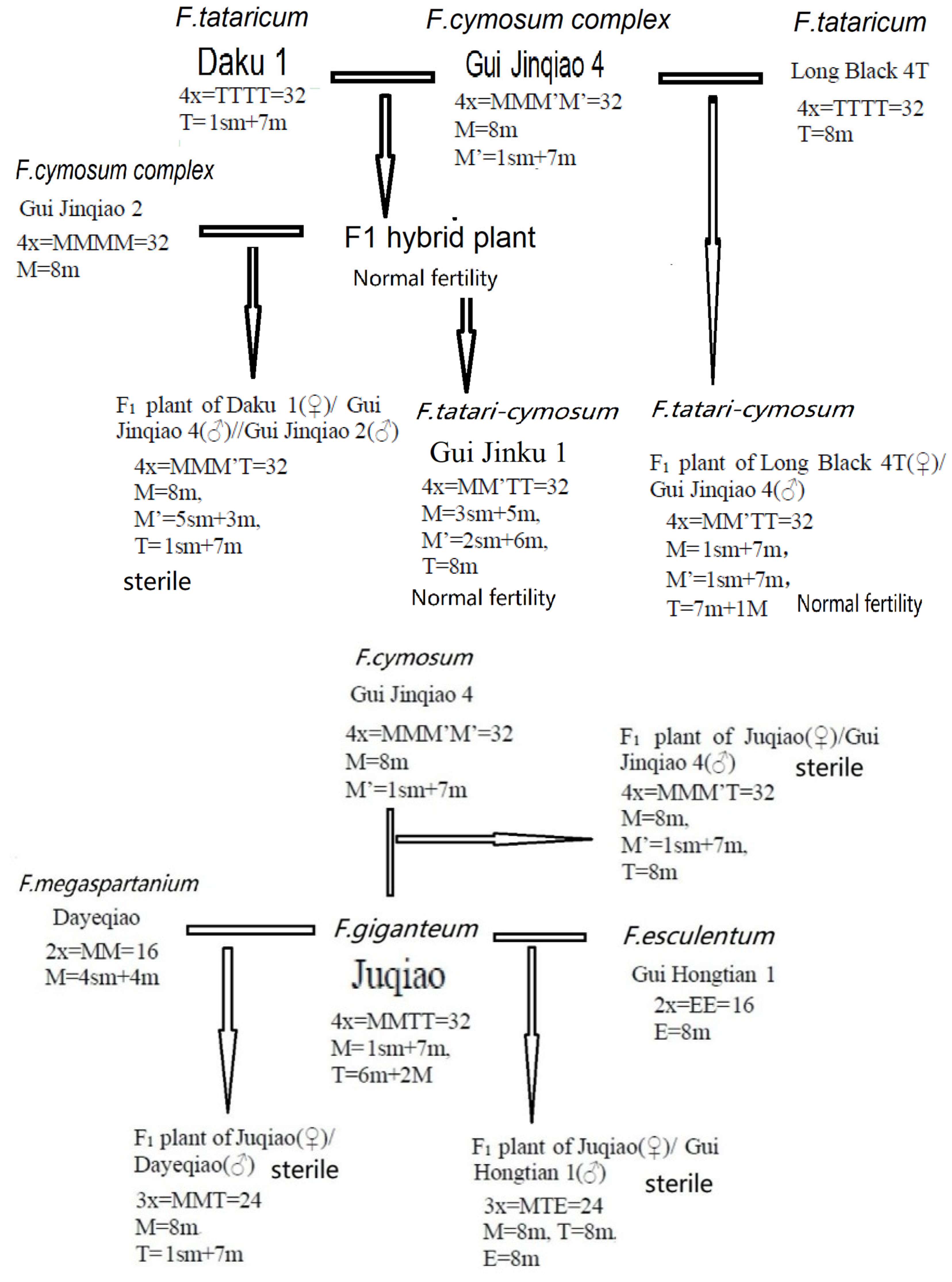
The materials used in this study (Table 1 and Figure 1) were provided by the Research Center of Buckwheat Industry Technology (RCBIT), Guizhou Normal University. All of the hybrids were generated by sexual hybridization by Chen et al. [6] and most of the interspecific hybrids were perennial. All materials were planted in pots in the laboratory of RCBIT.

2.2. Methods

2.2.1. Observation of Mitosis from Root Apex

The root tips of parents with normal fertility were used for karyotype analysis as follows [17].
Step 1. Seed germination: The achenes were treated at 50 °C for 30 min; subsequently, they were placed in a germinating box covered with wet filter paper, germinated in an incubator at 25 °C, and watered regularly during culture to keep the filter paper moist.
Step 2. Fixing root tips: When the root length was 1–2 cm, we took the root tips and pre-treated them in 0.2% colchicine at 10–15 °C for 3~5 h on a fine day from 9:00 a.m. to 10:00 a.m.; then fixed in the fixing solution (ethanol:glacial acetic acid = 3:1) for 5~12 h.
Step 3. Preparing slides by means of cell wall removal and low permeability [18]: The fixed root tips were washed with distilled water, dissociated in 3 mol/L HCl at 60 °C for 5–10 min, washed with distilled water, made hypotonic in 0.075 mol/L KCl for 30 min, then treated with a mixture of 4% cellulase and pectinase solution at 37 °C for 2–3 h, and made hypotonic in distilled water for 80 min. Placed a tip on the center of the slide, brought a small amount of water, squeezed to disperse the cells, and added several drops of fixing solution to disperse and fix the cells.
Step 4. Dyeing and observation: After drying in air, the slides were dyed with 3% Giemsa solution for 1 h and observed under optical microscopic examination for microphotography by OLYMPUS (BX54-DP70, Nagano Prefecture, Japan).

2.2.2. Observation of Mitosis from Stem Apex

The following methods applied for all hybrid plants.
Step 1. Sampling pretreatment and fixation: The stem tips of potted buckwheat seedlings at 2~4 leaf stage were cut and pretreated with 0.2% colchicine at 10~15 °C for 4~5 h on a fine day from 9:00 a.m. to 10:00 a.m., and fixed in ethanol:glacial acetic acid (3:1) fixing solution for 5~12 h.
Other steps were similar to the above Steps 3–4.

2.2.3. Chromosome Karyotype Analysis

Karyotype analysis of the parents and hybrids were carried out according to the method of Li and Chen [19]. Well-spread metaphase chromosomes from five complete cells per sample were selected for measurement. The absolute length of each chromosome and its arms was measured under microscope. These values were then used to calculate the relative length and the arm ratio for each chromosome. The calculation formula of karyotype parameters was as follows: absolute chromosome length (μm) = amplified chromosome length (mm) × 1000/magnification; chromosome relative length (%) = chromosome length/total length of genome × 100; chromosome arm ratio = chromosome long arm length/chromosome short arm length. While the chromosome centromere was recognized under the microscope, the images were also printed on photo paper and the chromosomes’ arms on photo paper were measured by vernier caliper. Therefore, absolute chromosome length (μm) = amplified chromosome length (mm) × 1000/magnification. We used traditional technology instead of programs. Five chromosome spreads were analyzed to establish each karyotype formula as their average.

2.2.4. Chromosome Naming

According to the four-point and four-region system naming rule proposed by Levan et al. [20], each chromosome was named according to the arm ratio.

3. Results and Analysis

3.1. Chromosome Number of Parents and Hybrids

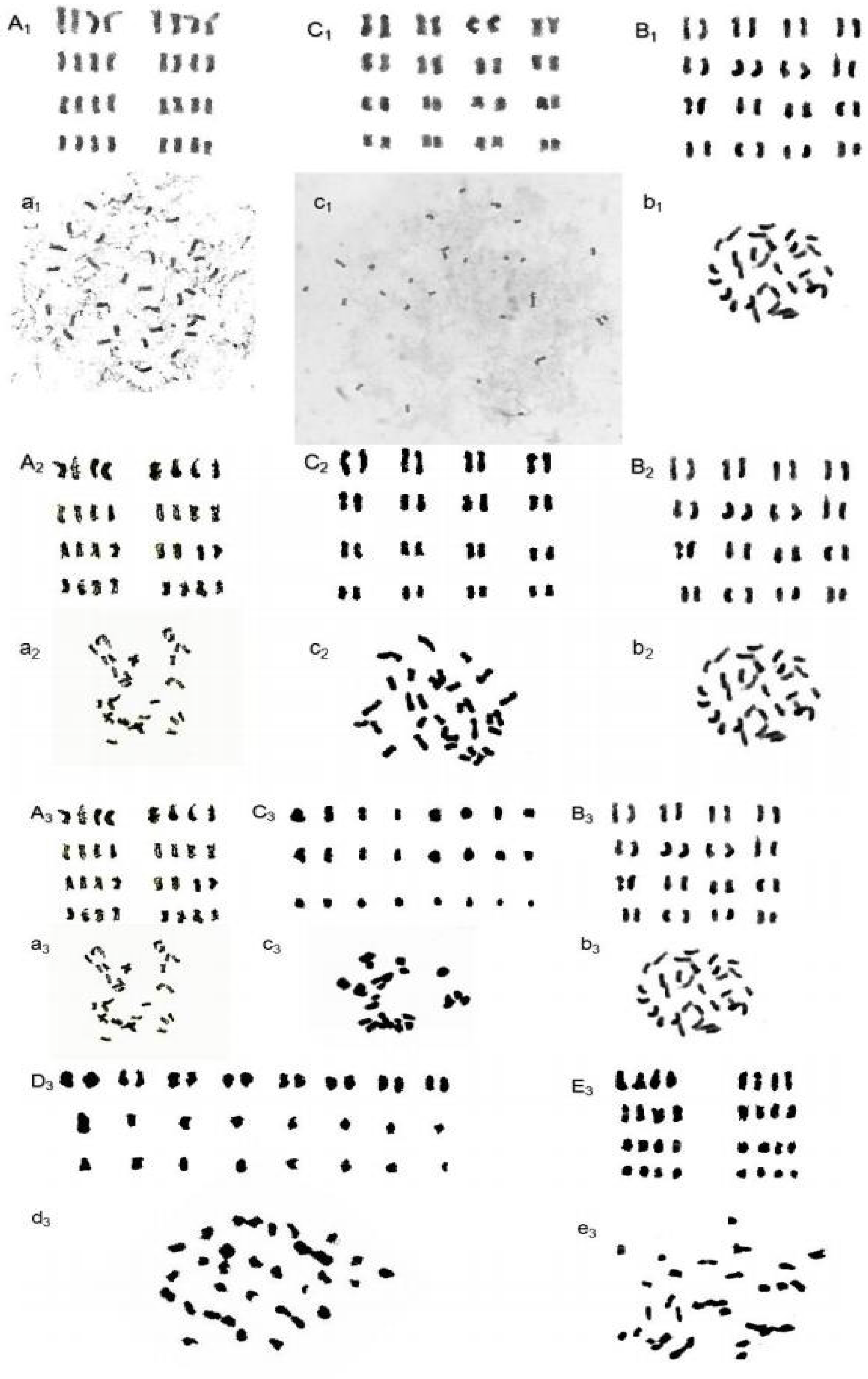
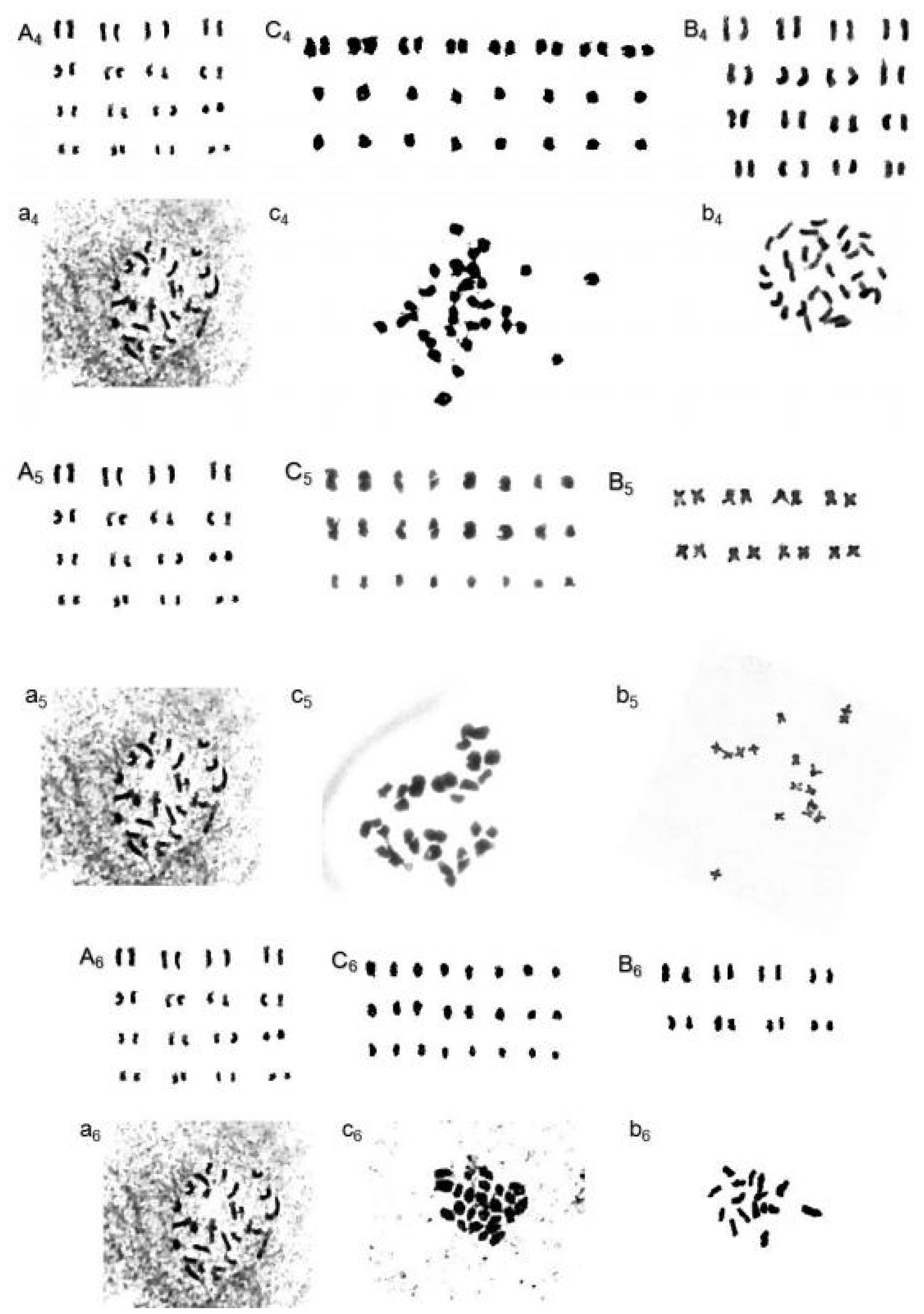
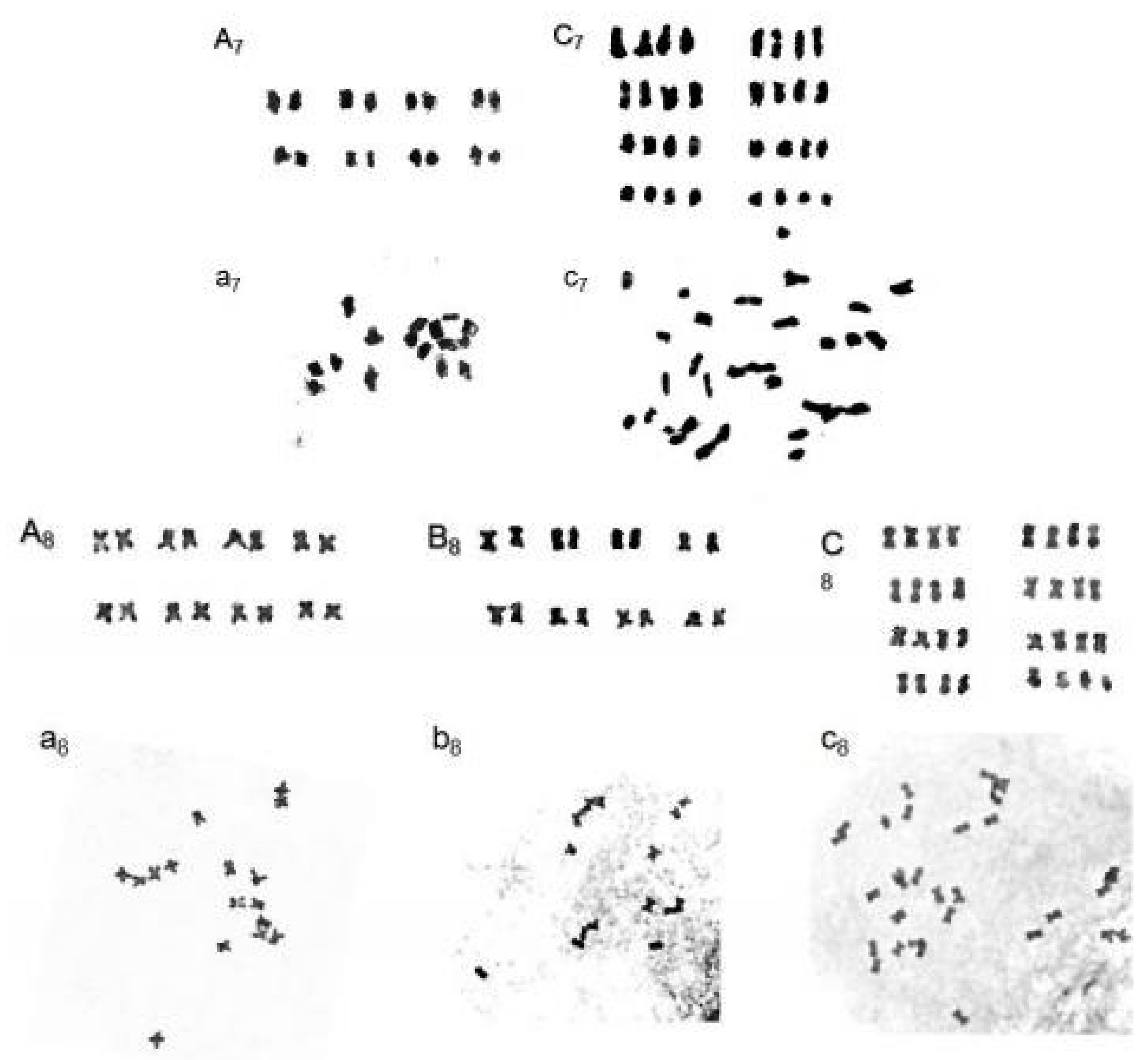
The results of mitotic chromosome observation on the root tips and stem tips (Table 1, Figure 2) showed that Big wild buckwheat, Gui Jinqiao 1, and Guitian 1 were diploids, and Datian 1, Long Black 4T, Daku 1, Gui Jinqiao 2, Gui Jinqiao 4, and Juqiao were tetraploid.
Among the interspecific hybrids and its progenies, the hybrid F1 of the cross Duaku 1/Gui Jinqiao 4, of the cross Long Black 4T/Gui Jinqiao 4, were all allotetraploid with two different genomes in size and normally fertile, but the F2 sterile plant of cross Duaku 1/Gui Jinqiao 4, the hybrids of the cross Juqiao/Gui Hongtian 1, the hybrid of the cross Juqiao/Big wild buckwheat were all triploid with two different genomes and highly sterile. Although the hybrid of the cross Daku 1/Gui Jinqiao 4//Gui Jinqiao 2 was also tetraploid, it showed severe infertility because of T genome aneuploidy and M genome non-even ploidy.

3.2. Karyotype Analysis of Parental and Their Hybrid Progenies

As can be seen from Table 2 and Figure 2, the karyotypes of all parents and hybrid progenies belonged to symmetric karyotypes and were dominated by m (metacentric) chromosomes.
Among all of the tested materials, the diploid parent material Gui Hongtian 1 had EE genomes, with 8 pairs of m chromosomes per genome. The karyotype formula was 2n = 2x = 16 = 8m. The variation range of arm ratio, absolute length, and relative length was 1.09–1.63, 2.38–3.25 μm, and 10.58–14.48%, respectively.
Gui Hongtian 2 also has EE genomes with 8 pairs of m chromosomes per genome. The karyotype formula is 2n = 2x = 16 = 16m. The variation range of arm ratio, absolute length, and relative length is 1.04~1.25, 2.25~3.25 μm, and 9.97~15.24%, respectively.
Dantian 1 has EEEE genomes with 7 pairs of m chromosomes and one pair of right metacentric chromosomes per genome. The karyotype formula is 2n = 4x = 32 = 32m. The variation range of arm ratio, absolute length, and relative length is 1.00~1.26, 2.50~3.15 μm, and 11.13~14.00%, respectively.
Because of high crossability and bigger flowers convenient to man-made cross as compared with other buckwheat, the autotetraploid Tartary buckwheat Long Black 4T and Daku 1 were selected as the female parent. The former, Long Black 4T, has TTTT genomes, and the karyotype formula is 2n = 4x = 32 = 32m. The variation range of arm ratio, absolute, length, and relative length variation range is 1.05~1.44, 1.47~2.59 μm, 9.55~16.86%, respectively. Daku 1 has TTTT genomes with one pair of submetacentric (sm)chromosomes and 7 pairs of m chromosomes per genome. Its karyotype formula is 2n = 4x = 32= 4sm + 28m. The variation range of arm ratio, absolute length, and relative length is 1.17–2.56, 1.47–2.34 μm, and 10.07~16.06%, respectively.
Big wild buckwheat has MM genomes, with 4 pairs of sm chromosomes and 4 pairs of m chromosomes. The karyotype formula is 2n = 2x = 16 = 8sm + 8m. The variation range of arm ratio, absolute length, and relative length is 1.10~2.29, 1.69~2.88 μm, and 8.44~14.38%, respectively. Gui Jinqiao 1 has MM genomes with 8 pairs of m chromosomes. The karyotype formula is 2n = 2x = 16= 16m. The variation range of arm ratio, absolute length, and relative length is 1.08~1.63, 2.06~3.38 μm, and 9.59~15.70%, respectively.
Gui Jinqiao 2 has MMMM genomes and m chromosomes. The karyotype formula is 2n = 4x = 32 = 32m. The variation range of arm ratio, absolute length, and relative length is 1.08~1.39, 1.54~3.42 μm, and 7.57~16.78%, respectively.
The partly allotetraploid parent material Gui Jinqiao 4 has MMM’M’ genomes, whose karyotypes are 1sm + 6m + 1M, 1sm + 6m + 1M, 2sm + 5m + 1M, and 2sm + 5m + 1M, respectively. In the M genome, the variations of arm ratio, absolute length, and relative length ranged from 1.00 to 1.91, 2.17 to 3.00 μm, and 10.79 to 14.94%, respectively. In the M’ genome, the variation of corresponding parameters ranged from 1.00 to 2.00, 1.67 to 2.25 μm, and 10.47 to 14. 13%, respectively.
Juqiao has MMTT genomes, whose karyotypes are 1sm + 7m, 1sm + 7m, 6m + 2M, and 6m + 2M, respectively. In the M genome, the variation of arm ratio, absolute length, and relative length ranges from 1.05 to 2.14, 2.14 to 3.21 μm, and 9.83 to 14.75%, respectively. The corresponding parameters in the T genome ranged from 1.00 to 1.70, 1.11 to 2.00 μm, and 8.33 to 15.05%, respectively.
The F1 allotetraploid hybrid of Long Black 4T/Gui Jinqiao 4 chromosome has four genomes, M, M’, T, and T, and their karyotypes are 1sm + 7m, 1sm + 7m, 7m + 1M, and 7m + 1M, respectively. In the M genome, the variations of arm ratio, absolute length, and relative length ranged from 1.06 to 1.80, 1.63 to 2.50 μm, and 10.12 to 15.57%, respectively. In the M’ genome, the variation of corresponding parameters ranged from 1.06 to 1.80, 1.69 to 2.50 μm, and 10.47 to 15.50%, respectively. In the T genome, the variation of corresponding parameters ranged from 1.00 to 1.20, 1.31 to 1.69 μm, and 11.20 to 14.40%, respectively.
Hybrid F1 tetraploid sterile material Juqiao/Gui Jinqiao 4 has four genomes, M, M, M’ and T, and their karyotypes are 8m, 8m, 1sm + 7m and 8m, respectively. In the M genome, the variations of arm ratio, absolute length, and relative length ranged from 1.05 to 1.61, 1.81 to 2.67 μm, and 10.80 to 15.91%, respectively. In the M’ genome, the variation of corresponding parameters ranged from 1.06 to 1.79, 1.62 to 1.90 μm, and 11.52 to 13.56% respectively. In the T genome, the corresponding parameters ranged from 1.06 to 1.67, 1.43 to 1.71 μm, and 11.54 to 13.82%, respectively.
Hybrid F1 triploid material Juqiao/Gui Hongtian 1 has three genomes (M, E, and T) with karyotypes of 8m, 8m, and 8m, respectively. In the M genome, the variation range of arm ratio, absolute length, and relative length is 1.04~1.44, 1.62~3.14 μm, and 8.85~17. 19%, respectively. In the E genome, the variation range of the corresponding parameters was 1.04~1.24, 1.52~3.24 μm, and 8.21~17.44%, respectively. In the T genome, the variation range was 1.03~1.57, 1.05~1.93 μm, and 8.51~15.67%, respectively.
Hybrid F1 triploid material Juqiao/Big wild buckwheat has three genomes, M, M, and T, and their karyotypes are 8m, 8m, and 1sm + 7m, respectively. In the M genome, the variations of arm ratio, absolute length and relative length ranged from 1.06 to 1.25, 1.81 to 2.63 μm, and 10.07 to 14.58%, respectively. In the T genome, the variation of corresponding parameters ranged from 1.07 to 1.75, 1.25 to 1.88 μm, and 9.76 to 14.64%, respectively.
Hybrid F2 sterile plant of Daku 1/Gui Jinqiao 4 has four genomes: M, M, M’, and T, and their karyotypes are 1sm + 7m, 1sm + 7m, 1sm + 7m, and 8m, respectively. In the M genome, the variations of arm ratio, absolute length, and relative length ranged from 1.06 to 2.11, 2.0 to 3.04 μm, and 9.96 to 15.15%, respectively. In the M’ genome, the variation of corresponding parameters ranged from 1.06 to 2.00, 2.00 to 3.04 μm, and 10.07 to 15.32%, respectively. In the T genome, the variation range of the corresponding parameters was 1.04~1.29, 1.39~2.04 μm, and 9.97~14.64%, respectively.
Hybrid F1 of Daku 1/Gui Jinqiao 4//Gui Jinqiao 2 has four genomes, M, M, M’, and T, and its karyotypes are 8m, 8m, 5sm + 3m and 1sm + 7m, respectively. In the M genome, the variations of arm ratio, absolute length, and relative length ranged from 1.24 to 1.63, 1.67 to 2.33 μm, and 10.94 to 15.31%, respectively. In the M’ genome, the variation of corresponding parameters ranged from 1.09 to 2.67, 1.10 to 1.81 μm, and 8.52 to 14.07%, respectively. In the T genome, the corresponding parameters ranged from 1.03 to 2.00, 1.10 to 1.71 μm, and 10.15 to 15.89%, respectively.
The variety Gui Jinku 1 from hybrid progeny of Daku 1/Gui Jinqiao 4 has four genomes of M, M’, T, and T, and their karyotypes are 3sm + 5m, 2sm + 6m, 8m, and 8m, respectively, indicating an increase in sm chromosomes by rearrangements of chromosome structure between the M and M’ genomes. In the M genome, the variation of arm ratio, absolute length, and relative length ranges from 1.09 to 2.17, 1.50 to 2.33 μm, and 10.22 to 15.91%, respectively. In the M’ genome, the variation ranges from 1.09 to 2.00, 1.50 to 2.33 μm, and 10.29 to 16.00%, respectively, and in the T genome, the variation ranges from 1.13 to 1.67, 0.96 to 1.42 μm, and 9.66 to 14.28%, respectively.
The above results show that the hybrids with MM’TT genomes and MMTT genomes show fertility and otherwise may be infertile.

4. Discussion

Chen [6,13] reported that common buckwheat, Tartary buckwheat, and Big wild buckwheat were all diploid, and their genomes were named E, T, and M according to their karyotype characteristics. Juqiao is tetraploid, with two smaller genome T and two larger genome M. Common buckwheat are all m chromosomes and Tartary buckwheat and Big wild buckwheat all have two pairs of sm chromosomes and six pairs of m chromosomes, which are consistent with the results reported by Lin [21]. The T genome in Juqiao has 7 pairs of m chromosomes and 1 pair of sm chromosomes, and the M genome has 6 pairs of m chromosomes and 2 pairs of sm chromosomes, which are derived from Tartary buckwheat and Big wild buckwheat.
In this study, all common buckwheat genome showed m chromosomes, which is consistent with the previous results. For the T genome, there were different karyotypes (8m, 1sm + 7m, 6m + 2M, or 7m + 1M) among varieties and their hybrid progenies. Most of the M genome were 8m and few were 1sm + 7m. Genome M’ had some variation of karyotype such as 7m + 1M, 2sm + 6m, or 5sm + 3m among the varieties and their hybrid progenies. Obviously, these results are richer than the previous results. These differences may be due to the different materials and methods used, different periods of cell phase, obvious differences in chromosome concentration degree, and measurement deviation. Furthermore, it may also be from recombination among chromosomes.
In this study, the karyotype analysis of the interspecific hybrid of perennial buckwheat was conducted for the first time and confirmed that chromosome aneuploidy and non-even ploidy are the important reasons for buckwheat interspecific hybrid infertility. Furthermore, two tetraploid fertile hybrids obtained by crossing were found. The F1 hybrid of Long Black 4T/Gui Jinqiao 4 showed allotetraploid and has four genomes M (1sm + 7m), M’ (1sm + 7m), T (7m + 1M), T (7m + 1M), and the F1 hybrid of Daku 1/Gui Jinqiao 4 has genomes M (3sm + 5m), M’ (2sm + 6m), T (8m), T (8m). They all have the same two genome T. The first hybrid shows the same karyotypes M and M’, and the second hybrid shows different karyotypes of genomes M and M’. In consideration of their normal fertility, genomes M and M’ may be partially homologous, and presumably, there is a good match in meiosis, because meiosis pairing is largely determined by its chromosomal homology. Recombination among homology genomes with different karyotypes in buckwheat interspecific hybrids may produce some construction variation of chromosomes. Regarding this, further study on its meiosis chromosome pairing configuration is needed.
The karyotype usually represents the basic stable genetic properties of an eukaryotic species. Species identification also often depends on chromosome karyotype characteristics as indices [22,23,24]. The structural rearrangements of inter-chromosomes and no inter-chromosomes may be observed on any chromosomes among different accessions [23,24]. However, there have been few reports about the variation of chromosome karyotype on interspecific hybrid progenies. This is the first study that reports that there are obvious different variations in karyotypes.

5. Conclusions

The karyotypes of four diploid common buckwheat (F. esculentum), one tetraploid common buckwheat (F. esculentum), two tetraploid Tartary buckwheat (F. tataricum), three Big wild buckwheat species buckwheat (F. megaspartnium), one tetraploid golden buckwheat (F. cymosum), and one tetraploid giant buckwheat (F. giganteum) were analyzed by Giemsa dyeing technology, and their chromosome numbers and karyotype formulas were determined. Common buckwheat all had the same karyotype 8m, but Tartary buckwheat had a diversity of karyotypes (8m or 1sm + 7m). Big wild buckwheat had the same karyotype 8m as common buckwheat. Tetraploid F. cymosum had a bigger genome (8m) and a smaller genome (1sm + 7m).
The karyotypes of six interspecific hybrids were also first obtained. Among them, two hybrid progenies with genome MM’TT showed normal fertility, suggesting the homology between M and M’ and effective path to produce a new buckwheat food crop (F. tatari-cymosum) by widely crossing autotetraploid Tartary buckwheat (F. tataricum) and the tetraploid F. cymosum complex. The other four hybrid progenies with genomes MMM’T, MMT, or MTE all showed high infertility caused by aneuploidy and non-even ploidy.
Comparison of the same genome karyotype between hybrid progenies with the parent showed karyotype difference on genomes T, M, and M’, which may be caused by chromosome re-arrangement and construction variation.

Author Contributions

Conceptualization, Q.C.; Methodology, L.Y.; Software, F.Z.; Validation L.Y.; Formal analysis, L.T.; Investigation, Z.L.; Resources, Q.C.; Data curation, L.Y.; Writing—original draft preparation, Q.C.; Writing—review and editing, Q.C. and L.T.; Visualization, Y.C.; Supervision, H.L.; Project administration, T.S.; Funding acquisition, Q.C. All authors have read and agreed to the published version of the manuscript.

Funding

The authors are grateful to the Earmarked Fund for China Agriculture Research System (CARS-07-A5), project of provincial-level agricultural germplasm resources protection unit in 2025 and in Guizhou, and the Guizhou Key Laboratory of Biotechnology Breeding for Special Minor Cereals (QKHPT[2025]026) for providing the funds.

Data Availability Statement

The data presented in this study are available upon request from the corresponding author.

Acknowledgments

The author is grateful to the editors and reviewers for proofing the English.

Conflicts of Interest

The authors declare no conflicts of interest.

References

  1. Li, H.; Lv, Q.; Liu, A.; Wang, J.; Sun, X.; Deng, J.; Chen, Q.; Wu, Q. Comparative metabolomics study of Tartary (Fagopyrum tataricum L. Gaertn) and common (Fagopyrum esculentum Moench) buckwheat seeds. Food Chem. 2022, 371, 131125. [Google Scholar] [CrossRef] [PubMed]
  2. Huda, M.N.; Lu, S.; Jahan, T.; Ding, M.; Jha, R.; Zhang, K.; Zhang, W.; Georgiev, M.I.; Park, S.U.; Zhou, M. Treasure from garden: Bioactive compounds of buckwheat. Food Chem. 2021, 335, 127653. [Google Scholar] [CrossRef] [PubMed]
  3. Singh, M.; Malhotra, N.; Sharma, K. Buckwheat (Fagopyrum sp.) genetic resources: What can they contribute towards nutritional security of changing world? Genet. Resour. Crop. Evol. 2020, 67, 1639–1658. [Google Scholar] [CrossRef]
  4. Pirzadah, T.B.; Rehman, R.U. Buckwheat: Forgotten Crop for the Future: Issues and Challenges; CRC Press: Boca Raton, FL, USA, 2021. [Google Scholar]
  5. Kim, C.-S.; Seo, Y.-O. History of the Discovery of Genus Fagopyrum and Their Biological Characteristics. Soc. Jeju Stud. 2021, 56, 189–221. [Google Scholar] [CrossRef]
  6. Chen, Q.F.; Huang, X.Y.; Li, H.Y.; Yang, L.J.; Cui, Y.S. Recent Progress in Perennial Buckwheat Development. Sustainability 2018, 10, 536. [Google Scholar] [CrossRef]
  7. Selwal, N.; Bedi, M.; Hamid, S.; Pujari, M. Buckwheat (Fagopyrum esculentum) response and tolerance to abiotic stress. In Omics Approach to Manage Abiotic Stress in Cereals; Springer Nature: Singapore, 2022; pp. 575–597. [Google Scholar]
  8. Rangappa, K.; Kumar, A.; Choudhury, B.U.; Moirangthem, P.; Layek, J.; Rajkhowa, D.; Sarma, A.K.; Chanu, K.; Debnath, S.; Ayam, G. Buckwheat: Potential stress-tolerant crop for mid-hills of Eastern Himalaya under changing climate. In Pseudocereals-Recent Advances and New Perspectives; IntechOpen: London, UK, 2023. [Google Scholar]
  9. Liu, G.; Li, M.; Zhu, Q.; Li, Y.; Gui, S. The esearch advance on resource plant Fagopyrum dibotrys. Chin. Agric. Sci. Bull. 2006, 22, 380–389. Available online: https://kns.cnki.net/kcms2/article/abstract?v=N3LLzWa1SrV8lAFtVREkm5y-6DUdh0GYcrhb6xCNSEDPTP2Ag9BGvOAdMGAGrZIqlvvbV_-A5AAFbkPbSDeTEq4e7lGsX643929WTaew7KJYAYdhCmnBneNtGUBj_qRxANQpk4gNb-TjI3XZx2RwLrnM3Tv9A7LCpFD7F5ftWMQBbqQaRZZhQA==&uniplatform=NZKPT&language=CHS (accessed on 30 December 2025). (In Chinese)
  10. Mendler-Drienyovszki, N.; Cal, A.J.; Dobránszki, J. Progress and prospects for interspecific hybridization in buckwheat and the genus Fagopyrum. Biotechnol. Adv. 2013, 31, 1768–1775. [Google Scholar] [CrossRef] [PubMed]
  11. Samimy, C.; Bjorkman, T.; Siritunga, D.; Blanchard, L. Overcoming the barrier to interspecific hybridization of Fagopyrum esculentum with Fagopyrum tataricum. Euphytica 1996, 91, 323–330. [Google Scholar] [CrossRef]
  12. Suvorova, G. Interspecific crosses in buckwheat breeding. In Molecular Breeding and Nutritional Aspects of Buckwheat; Academic Press: Amsterdam, The Netherlands, 2016; pp. 87–97. [Google Scholar]
  13. Chen, Q.; Hsam, S.L.K.; Zeller, F.J. A Study of Cytology, Isozyme, and Interspecific Hybridization on the Big-Achene Group of Buckwheat Species (Fagopyrum, Polygonaceae). Crop. Sci. 2004, 44, 1511–1518. [Google Scholar] [CrossRef]
  14. Wu, Q.; Xiang, S.; Yan, Y. Rapid propagation and autotetraploidy induction for fagopyrum cymosum (trev.) meisn. J. Southwest Agric. Univ. 2001, 23, 108–110. [Google Scholar]
  15. Sun, C.X.; Ma, Q.W. Advances of Tissue Culture of Medicinal Plants; Higher Education Press: Beijing, Chian, 2003; pp. 237–244. [Google Scholar]
  16. Vimala, Y.; Lavania, S.; Lavania, U.C. Chromosome change and karyotype differentiation—Implications in speciation and plant systematics. Nucleus 2021, 64, 33–54. [Google Scholar] [CrossRef]
  17. Chen, Q.F. A study of resources ofFagopyrum (Polygonaceae) native to China. Bot. J. Linn. Soc. 1999, 130, 53–64. [Google Scholar] [CrossRef]
  18. Li, M.X.; Zhang, Z.P. Plant Chromosomes and Research Techniques; China Agriculture Press Co.: Beijing, China, 1996; pp. 5–40. [Google Scholar]
  19. Li, M.X.; Chen, R.Y. A suggestion on the standardization of karyotype analysis in plants. Plant Sci. J. 1985, 3, 297–302. Available online: https://kns.cnki.net/kcms2/article/abstract?v=N3LLzWa1SrU4KcNt7qdXccrDbvxPTNA7NF7tuTWBZM9286K4T241WtJF1gbz75lHgAGiXDVDTuj0MrlMaXY-gy7V6YM8iOjuutODt9EMMNqy_yI6JeAcx8RMVvgU5zuCh_m6SvD2bEoYC1-BaHqlg0XQECojSil1WBI_X99QcKFee5_Tmx44sA==&uniplatform=NZKPT&language=CHS (accessed on 30 December 2025). (In Chinese)
  20. LeVan, A.; Fredga, K.; Sandberg, A.A. Nomenclature for centromeric position on chromosomes. Hereditas 1964, 52, 201–220. [Google Scholar] [CrossRef]
  21. Lin, R. Fagopyrum of China; China Agriculture Press Co.: Beijing, China, 1994; Available online: https://www.las.ac.cn/front/book/detail?id=c01640d3406a04007a29d250de6d47cf# (accessed on 30 December 2025). (In Chinese)
  22. Dehery, S.K.; Panda, E.; Saha, P.R.; Sinha, R.K.; Das, A.B. Chromosome diversity and karyotype asymmetry analysis in four cultivated triploid and three diploid wild genotypes of Musa from North-East India. Nucleus 2021, 64, 167–179. [Google Scholar] [CrossRef]
  23. Patel, P.; Dehery, S.K.; Jena, S.N.; Pradhan, C.; Das, A.B. Chromosomal variations in twelve ecotypes of a medicinal plant Drimia indica (Roxb.) Jessop: Karyotypes and 2C DNA content analysis. Genet. Resour. Crop Evol. 2024, 71, 621–634. [Google Scholar] [CrossRef]
  24. Xin, H.; Zhang, T.; Wu, Y.; Zhang, W.; Zhang, P.; Xi, M.; Jiang, J. An extraordinarily stable karyotype of the woody Populus species revealed by chromosome painting. Plant J. 2020, 101, 253–264. [Google Scholar] [CrossRef] [PubMed]
Figure 1. The pedigree for accessions in this study.
Agronomy 16 00190 g001
Figure 2. Metaphase chromosome and karyotype maps of mitotic cells of tetraploid Long Black 4T (A1,a1), Gui Jinqiao 4 (B1,b1) and their Hybrid F1 (C1,c1); metaphase chromosome and karyotype maps of mitotic cells of Daku 1 (A2,a2), Gui Jinqiao 4 (B2,b2), and their Hybrid (C2,c2); metaphase chromosome and karyotype maps of mitotic cells of Daku 1 (A3,a3), Gui Jinqiao 4 (B3,b3) and their Hybrid F2 sterile plant (C3,c3), the hybrid of Daku 1/Gui Jinqiao 4//Gui Jinqiao 2 (D3,d3) and Gui Jinqiao 2 (E3,e3); metaphase chromosome and karyotype maps of mitotic cells of Juqiao (A4,a4), Gui Jinqiao 4 (B4,b4) and their Hybrid (C4,c4); metaphase chromosome and karyotype maps of mitotic cells of Juqiao (A5,a5), Gui Hongtian 1 (B5,b5), and their Hybrid F1 (C5,c5); metaphase chromosome and karyotype maps of mitotic cells of Juqiao (A6,a6), Big wild buckwheat. (B6,b6), and their Hybrid F1 (C6,c6); chromosome and karyotype maps of mitotic cells of Gui Jinqiao 1 (A7,a7) and Gui Jinqiao 2 (C7,c7); chromosome and karyotype maps of mitotic cells of Gui Hongtian 1 (A8,a8) and Gui Hongtian 2 (B8,b8) and tetraploid Datian 1 (C8,c8).
Agronomy 16 00190 g002aAgronomy 16 00190 g002bAgronomy 16 00190 g002c
Table 1. The scientific name of the genus and species, ploidy level, corresponding genomes, and type of seed setting of parents and hybrids.
No.AccessionsScientific NamesPloidy and GenomeFertility
1Gui Jinku 1F. tatari-cymosum4x = MM’TT = 32 M = 3sm + 5m,
M’ = 2sm + 6m, T = 8m
Normal fertility
2F1 plant of Daku 1(♀)/Gui Jinqiao 4(♂)//Gui Jinqiao 2(♂)F. tataricum/F. cymosum//F. megaspartanium4x = MMM’T = 32 M = 8m,
M’ = 5sm + 3m, T = 1sm + 7m
Sterile
3F1 plant of Juqiao(♀)/Gui Jinqiao 4(♂)F. giganteum/F. cymosum4x = MMM’T = 32 M = 8m,
M’ = 1sm + 7m, T = 8m
Sterile
4F1 plant of Long Black 4T(♀)/Gui Jinqiao 4(♂)F. tataricum/F. cymosum4x = MM’TT = 32
M= 1sm + 7m,
M’ = 1sm + 7m, T = 7m + 1M
Normal fertility
5F1 plant of Juqiao(♀)/Dayeqiao(♂)F. giganteum/F. megaspartanium3x = MMT = 24 M = 8m,
T = 1sm + 7m
Sterile
6F1 plant of Juqiao(♀)/Gui Hongtian 1(♂)F. giganteum/F. esculentum3x = MTE = 24
M = 8m, T = 8m, E = 8m
Sterile
7Gui Jinqiao 2F. megaspartanium4x = MMMM = 32 M = 8mLow seed set
8Gui Hongtian 2F. esculentum2x = EE = 16 E = 8mNormal fertility
9Datian 1F. esculentum4x = EEEE = 32 E = 8mNormal fertility
10Long Black 4TF. tataricum.4x = TTTT = 32 T = 8mNormal fertility
11Daku 1F. tataricum4x = TTTT = 32
T = 1sm + 7m
Normal fertility
12Gui Jinqiao 4F. cymosum4x = MMM’M’ = 32
M = 8m,
M’ = 1sm + 7m
Normal fertility
13DayeqiaoF. megaspartanium2x = MM = 16
M = 4sm + 4m
Normal fertility
14JuqiaoF. giganteum4x = MMTT = 32
M = 1sm + 7m, T = 6m + 2M
Normal fertility
15Gui Jinqiao 1F. megaspartanium2x = MM = 16 M = 8mNormal fertility
16Gui Hongtian 1F. esculentum2x = EE = 16 E = 8mNormal fertility
17Guitian 1F. esculentum2x = EE = 16 E = 8mNormal fertility
18Guitian 2F. esculentum2x = EE = 16 E = 8mNormal fertility
Table 2. Chromosome karyotype parameters of mitotic cells on diploid buckwheat and autotetraploid buckwheat and hybrid progenies.
MaterialsChromosome No.
12345678
Guitian 1AL3.253.002.832.882.752.752.632.38
RL14.4813.3612.5812.8112.2512.2511.6910.58
AR1.171.401.091.261.201.201.631.11
PCmmmmmmmm
Guitian 2AL2.292.171.961.831.831.751.711.50
RL15.2414.4113.0212.1912.1911.6411.369.97
AR1.041.171.141.201.201.101.051.25
PCmmmmmmmm
Gui Jinqiao 1AL3.383.192.752.752.632.382.382.06
RL15.7014.8312.7912.7912.2111.0511.059.59
AR1.081.221.321.201.381.381.631.54
PCmmmmmmmm
DayeqiaoAL2.882.882.692.752.632.502.001.69
RL14.3814.3813.4413.7513.1312.5010.008.44
AR2.291.881.751.871.101.221.461.45
PCsmsmsmsmmmmm
Datian 1AL3.153.072.862.782.782.732.602.50
RL14.0013.6612.7212.3712.3712.1411.5911.13
AR1.261.231.141.111.111.091.041.00
PCmmmmmmmM
Long Black 4TAL2.592.442.001.841.771.721.551.47
RL16.8615.8513.0011.9911.4811.1810.069.55
AR1.441.441.291.271.051.121.251.35
PCmmmmmmmm
Daku 1AL2.342.051.971.781.761.631.591.47
RL16.0614.0513.4912.2112.0811.1410.9210.07
AR1.271.431.332.561.521.171.551.24
PCmmsmmmmmm
Gui Jinqiao 2AL3.423.463.082.732.342.001.791.54
RL16.7816.9915.1413.4011.509.828.807.57
AR1.081.221.241.381.341.181.151.39
PCmmmmmmmm
2. Juqiao
MALRL             ARPCTALRL                    ARPC
13.2114.75                1.05m12.0015.05                 1.33m
23.1414.42                2.14sm22.0015.05                 1.00M
33.0714.10                1.15m31.9314.51                 1.70m
42.9313.44                1.16m41.6112.09                1.14m
52.5711.80                1.40m51.5711.82                 1.20m
62.4311.15                1.13m61.5711.82                 1.00M
72.2910.49                1.29m71.5011.29                 1.10m
82.149.83                 1.14m81.118.33                 1.07m
1sm + 7m 6m + 2M
3. Gui Jinqiao 4
MALRLARPCM’ALRL                 ARPC
13.0014.941.57m12.2514.13                 1.08m
22.6713.281.91sm22.1713.61                 1.60m
32.5812.871.21m32.0813.09                 1.08m
42.5012.451.50m42.0012.56                 1.00M
52.5012.451.50m52.0012.56                2.00sm
62.3311.621.33m62.0012.56                 1.40m
72.3311.621.00M71.7510.99                2.00sm
82.1710.791.17m81.6710.47                1.50m
1sm + 6m + 1M 2sm + 5m + 1M
4. Juqiao × Gui Hongtian 1 F1 hybrid
MALRL         ARPCEALRL        ARPCTALRL     ARPC
13.1417.19     1.36m13.2417.44     1.43m11.9315.67     1.03m
22.7615.10     1.42m22.7614.87     1.07m21.8114.70    1.11m
32.7114.84     1.04m32.4313.08     1.04m31.7113.93     1.25m
42.4814.93     1.36m42.3812.82     1.08m41.7113.93     1.57m
52.3813.02     1.27m52.3812.82     1.27m51.5212.38     1.29m
62.3813.02     1.27m61.9510.51     1.05m61.4311.60     1.50m
72.1011.46     1.44m71.9010.26     1.22m71.149.28        1.40m
81.628.85        1.43m81.528.21        1.29m81.058.51        1.20m
8m 8m 8m
5. Juqiao × Dayeqiao F1 hybrid
MALRLARPCTALRL                 ARPC
12.6314.581.21m11.8814.64                1.14m
22.4413.541.17m21.8114.15                 1.07m
32.3112.851.18m31.6913.17                 1.08m
42.3112.851.18m41.6312.69                 1.17m
52.2512.501.25m51.6312.69                 1.17m
62.1912.151.06m61.5612.20                 1.08m
72.0611.461.20m71.3810.73                 1.75sm
81.8110.071.23m81.259.76                 1.50m
8m 1sm + 7m
6. Juqiao/Gui Jinqiao 4 F1 hybrid
MALRL        ARPCMALRL        ARPCTALRL     ARPC
12.6715.91     1.07m11.9013.56     1.79sm11.7113.85     1.25m
22.3313.92     1.23m21.8613.22     1.29m21.6213.08     1.13m
32.2413.35     1.61m31.8613.22     1.50m31.5712.69     1.54m
42.0512.22     1.39m41.8112.88     1.11m41.5712.69     1.06m
51.9511.65     1.05m51.7112.20     1.57m51.5212.31     1.67m
61.9011.36     1.35m61.6711.86     1.06m61.4811.92     1.07m
71.8110.80     1.11m71.6211.52     1.13m71.4811.92     1.38m
81.8110.80     1.24m81.6211.52     1.13m81.4311.54     1.14m
8m 1sm + 7m 8m
7. tetraploid Long Black 4T/GuiJinqiao 4
MALRL         ARPCMALRL        ARPCTALRL        ARPC
12.5015.57     1.50m12.5015.50     1.50m11.6914.40     1.08m
22.2514.01     1.25m22.2513.95     1.25m21.5613.33     1.08m
32.1913.62     1.06m32.1913.57     1.06m31.5012.80     1.40m
42.0012.45     1.29m42.0012.40     1.29m41.5012.80     1.00M
52.0012.45     1.29m52.0012.40     1.29m51.4112.00     1.14m
61.7510.90     1.80sm61.7510.85     1.80sm61.3811.73     1.20m
71.7510.90     1.33m71.7510.85     1.33m71.3811.73     1.20m
81.6310.12     1.60m81.6910.47     1.08m81.3111.20     1.10m
1sm + 7m 1sm + 7m 7m + 1M
8. Daku 1/Gui Jinqiao 4 (Gui Jinku 1)
MALRL        ARPCMALRL     ARPCTALRL         ARPC
12.3315.91     1.80sm12.3316.00     1.80sm11.4214.28     1.13m
22.1714.77     1.17m22.1714.86     1.36m21.3813.86     1.54m
31.9213.07     1.09m31.9213.15     1.09m31.3313.44     1.67m
41.8312.50     1.20m41.9213.15     1.09m41.2913.02     1.58m
51.7511.93     1.10m51.7512.00     1.10m51.2512.60     1.50m
61.5810.79     1.11m61.5010.29     1.25m61.1711.76     1.33m
71.5810.79    2.17sm71.5010.29     1.57m71.1311.34     1.25m
81.5010.22    2.00sm81.5010.29    2.00sm80.969.66        1.30m
3sm + 5m 2sm + 6m 8m
9. Daku 1/Gui Jinqiao 4 F2 sterile Plant
MALRL         ARPCM’ALRL     ARPCTALRL         ARPC
13.0415.15     1.06m13.0415.32     1.33m12.0414.64     1.04m
22.8714.28     1.07m23.0415.32     1.06m21.9113.70     1.20m
32.7013.42     1.64m32.6513.35     1.03m31.8313.08     1.10m
42.5212.55    2.11sm42.4312.25     1.55m41.7812.77     1.05m
52.4312.12     1.15m52.3511.82    2.00sm51.7812.77     1.22m
62.4312.12     1.54m62.3511.82     1.08m61.7412.46     1.05m
72.0910.39     1.40m72.0010.07     1.30m71.4810.59     1.13m
82.009.96        1.30m82.0010.07     1.30m81.399.97        1.29m
1sm + 7m 1sm + 7m 8m
10. Daku 1/Gui Jinqiao 4//Gui Jinqiao 2
MALRL         ARPCMALRL     ARPCTALRL         ARPC
12.3315.31     1.58m11.8114.07     1.71sm11.7115.89    2.00sm
22.0013.12     1.63m21.7113.33     1.25m21.5214.12     1.29m
31.9012.50     1.50m31.7113.33    2.00sm31.4313.24     1.14m
41.9012.50     1.50m41.7113.33    2.00sm41.4313.24     1.14m
51.8612.19     1.44m51.6212.59     1.43m51.3312.36     1.33m
61.8111.87     1.24m61.6212.59     1.83sm61.1410.59     1.40m
71.7611.56     1.31m71.5712.22    2.67sm71.1210.42     1.03m
81.6710.94     1.33m81.108.52        1.09m81.1010.15     1.09m
8m 5sm + 3m 1sm + 7m
Note: AL = absolute length (micron); RL = relative length (%); AR = arm ratio; PC = centromere position.
Disclaimer/Publisher’s Note: The statements, opinions and data contained in all publications are solely those of the individual author(s) and contributor(s) and not of MDPI and/or the editor(s). MDPI and/or the editor(s) disclaim responsibility for any injury to people or property resulting from any ideas, methods, instructions or products referred to in the content.