


Abstract
Localized phosphorus (P) application stimulates root proliferation in nutrient-rich zones, aligns root growth with soil P distribution, and enhances nutrient uptake efficiency. However, whether localized P supply benefits pitaya remains unclear. In this study, pitaya seedlings were used in a rhizobox experiment with four P treatments: no P (No-P), uniform P (Uniform-P1, 50 mg kg−1), localized P (Local-P1, 50 mg kg−1), and uniform high P (Uniform-P2, 200 mg kg−1). Phosphorus treatments significantly affected shoot growth. Localized P supply produced greater shoot biomass than both uniform and high uniform P. It also increased shoot nitrogen and potassium content but did not significantly affect P content. Localized P application strongly promoted root development. Compared with Uniform-P1, Local-P1 increased root biomass, total root length, root surface area, and root volume by 142.11%, 121.77%, 110.25%, and 100.19%, respectively. Moreover, total root length, root surface area, and root volume were positively correlated with nitrogen and potassium content as well as total biomass. These findings demonstrate that localized P supply improves root morphology, enhances nitrogen and potassium acquisition, and promotes shoot growth in pitaya.
1. Introduction
Phosphorus (P) is an essential macronutrient for plant growth and development [1]. It is a key component of nucleic acids and phospholipids, and it plays a crucial role in genetic information transfer, material transformation, and energy metabolism [2,3]. Phosphorus fertilization effectively promotes plant growth and root development, thereby improving crop yield and quality [4,5,6,7]. However, farmers often apply P in excess of crop requirements, and combined with inappropriate application methods, this leads to P surplus in farmland and low fertilizer use efficiency within a single growing season [8]. As a non-renewable resource, phosphate rock reserves are being rapidly depleted, with easily accessible reserves expected to run out within the next few decades. In China, high-quality phosphate rock accounts for only 7% of the country’s total P reserves [9]. Limited reserves and excessive or improper application not only increase production costs and waste resources but also pose serious environmental risks [10,11,12,13,14]. Rational P management and strategies to improve P use efficiency are therefore urgent priorities for sustainable agricultural production.
Phosphorus (P) in soil exhibits poor mobility, is easily fixed, and diffuses slowly [15]. After fertilizer application, soil cations such as Fe3+, Al3+, Ca2+, and Mg2+ rapidly react with soluble P to form insoluble compounds, while microbial processes further contribute to immobilization [16]. As a result, only 10–25% of applied P is available for crop uptake [17,18]. Limited P mobility is therefore a key constraint on plant P acquisition [19,20]. Localized fertilization, which concentrates nutrients in specific soil zones, has been proposed as an effective strategy to reduce P fixation by limiting contact with soil cations or Fe/Al oxides [21]. In intensive systems, applying nutrients at proper distances and depths near roots enhances crop productivity, increases fertilizer use efficiency, and reduces environmental risks [22,23,24]. Numerous studies demonstrate that localized P supply improves P utilization, recovery, and availability [25,26,27,28,29].
Roots are highly plastic during development [30]. Their architecture strongly influences plant growth and nutrient use efficiency. For phosphorus (P), which is easily fixed and poorly mobile in soil, greater root–soil contact enhances absorption. Fertilizer placement regulates root growth and distribution. It shapes root architecture and enables crops to maximize nutrient capture [31,32]. Localized P supply improves plant growth by aligning spatial root development with soil P availability [33]. Plant roots exploit nutrient-rich soil patches by altering morphology or increasing nutrient uptake rates [34,35,36]. For example, localized P increased maize first-order lateral root density and length in fertile layers as compared with uniform application [37]. In maize–faba bean intercropping, localized P increased maize root density but had no effect on faba bean [38]. Similarly, studies on Brassica chinensis showed that localized P increased root length density in nutrient-rich zones and improved P uptake compared with homogeneous P [39]. These findings indicate that localized P supply substantially alters root morphology and physiological uptake capacity, with species-specific differences in response.
Pitaya is an important economic crop in tropical regions. It is valued for its nutritional, medicinal, and ornamental properties [40,41,42]. The fruit is widely favored by consumers worldwide. In recent years, rising economic benefits have driven rapid expansion of pitaya cultivation. In China, planting now exceeds 66,700 hectares [43]. Preliminary research showed that P input in pitaya production ranges from 1000 to 1200 kg ha−1 yr−1, while soil available P exceeds the abundant threshold (>40 mg kg−1) by 6.3-fold [44,45]. However, phosphate fertilizer use efficiency remains low in pitaya systems. This highlights the need for more efficient P fertilizer management. Currently, optimization strategies for P fertilizer application in pitaya have only been reported with regard to the application rate [45]. Drip and sprinkler irrigation are the main practices in pitaya production. Among them, drip fertigation supplies nutrients directly to the root zone. This localized method optimizes root and shoot traits, enhancing water and nutrient use efficiency [46]. Despite these advantages, research on localized P supply in pitaya is limited. Its effects on root morphology, structure, and physiology remain unclear. Therefore, clarifying how pitaya seedling roots respond to different P supply methods is of great theoretical and practical significance for P management in pitaya production.
This study investigated how localized and uniform P supply affects root morphology and nutrient content in Hylocereus polyrhizus, using a rhizobox experiment. The objectives were to (i) characterize root morphology under different P supply methods, (ii) evaluate nutrient content under localized P supply, and (iii) examine correlations among shoot growth, soil nutrient content, and root development across P treatments. We hypothesized that localized P application promotes root growth, thereby improving plant biomass and nutrient content.
2. Materials and Methods
2.1. Plant Materials and Growth Conditions
The experiment was conducted in the greenhouse of Hainan University, in Jianfeng Town, Ledong County (18°63′ N, 108°75′ E). The site has an average annual temperature of 24 °C and receives approximately 2200 h of sunshine annually. The pitaya cultivar used was Hylocereus polyrhizus cv. “Dahong”. Fresh cuttings originated from intermediate segments of cladodes with similar length were selected, each weighing 130 ± 2 g. Soil was collected from Donghe Town, Dongfang City, Hainan Province (18°54′ N, 108°88′ E). It was air-dried, sieved through a 2 mm mesh, and stored in labeled plastic bags. The soil had the following properties: pH 6.92, organic matter 2.71 g kg−1, alkali-hydrolyzable nitrogen 16.78 mg kg−1, available phosphorus 7.30 mg kg−1, and available potassium 93.20 mg kg−1.
2.2. Experimental Design
The rhizobox experiment included four treatments: (1) no P supply (No-P), (2) uniform P supply at 50 mg P kg−1 soil (Uniform-P1), (3) localized P supply at 50 mg P kg−1 soil (Local-P1), and (4) uniform high-P supply at 200 mg P kg−1 soil (Uniform-P2). The total amount of phosphorus applied in Uniform-P1 and Local-P1 treatment were the same. The Uniform-P2 treatment was included primarily to assess whether localized low-phosphorus supply could achieve similar nutrient content as a uniform high-phosphorus supply. Each treatment included four replicates arranged in a randomized block design. The planting container was a custom-made detachable rectangular rhizobox (length 22 cm, width 3 cm, and height 32 cm), with one side made of transparent plexiglass. Each rhizobox was divided into three layers: upper (0–8 cm), middle (8–16 cm), and lower (16–32 cm). In the localized P treatment, all fertilizer was applied to the middle layer (8–16 cm), whereas in the Uniform-P1 and Uniform-P2 treatments, fertilizer was evenly applied across all layers.
Each rhizobox was filled with 1.9 kg of soil mixed with basal nutrients as a solution: (NH4)2SO4 100, MgCl2·6H2O 50, CaSO4·2H2O 100, MnSO4·H2O 3.25, ZnSO4·7H2O 0.79, CuSO4·5H2O 0.50, H3BO3 0.17, and Fe-EDTA 3.25 mg kg−1 soil. Potassium dihydrogen phosphate was used as phosphate fertilizer. The potassium introduced by the phosphate fertilizer was supplemented with K2SO4. Pitaya cladodes cuttings were planted in each rhizobox. Once roots had developed, 50 mL of a 15 mmol L−1 (NH4)2SO4 solution was applied to each seedling every 15 days. Water and nutrient solution levels were maintained constant throughout the experiment. Each rhizobox was repositioned at 7-day intervals, and pitaya seedlings were harvested 102 days after planting.
2.3. Root Sampling and Morphological Analysis
At harvest, shoots and roots were separated. Roots were washed with deionized water. They were immersed in 50% alcohol to prevent deformation and stored at 4 °C for morphological analysis. Root samples were scanned with a flat scanner (Epson Expression V800, Seiko Epson Corporation, Suwa, Japan) at 600 dpi. The scanned images were analyzed with WinRHIZO Pro 2009b software (Regent Instruments Inc., Quebec, QC, Canada) to quantify total root length, root surface area, root volume, and root diameter. Roots were classified into five diameter categories: 0–0.3, 0.3–0.6, 0.6–0.9, 0.9–1.2, and >1.2 mm. For each category, root length and its proportion of the total root length were calculated. The scanned roots were oven-dried at 80 °C to a constant weight to determine root biomass. Specific root length (SRL, cm g−1), specific root area (SRA, cm2 g−1), root tissue density (RTD, g cm−3), and root-to-shoot ratio (RSR, g g−1) were calculated as follows: SRL = total root length/root dry weight; SRA = root surface area/root dry weight; RTD = root dry weight/root volume; and RSR = root dry weight/shoot dry weight.
2.4. Mineral Element Determination
Aboveground branches were cut into pieces and heated at 105 °C for 30 min. They were then dried at 80 °C to a constant weight, and dry weight was recorded. Dried shoot and root samples were finely ground and digested with H2SO4 and H2O2. Digest solutions were analyzed for nitrogen using the Nessler’s reagent colorimetric method, for phosphorus using the molybdo-vanadophosphate method, and for potassium using the flame photometer method [47]. Plant N, P, and K content were calculated as the product of nutrient concentration and the corresponding dry matter mass.
2.5. Soil Sampling and Determination of Available Nitrogen, Phosphorus, and Potassium
After plant harvest, soil samples were collected from each layer after homogenization. Samples were air-dried, sieved, and analyzed for alkali-hydrolyzable nitrogen, available phosphorus, and available potassium. For nitrogen, soil was hydrolyzed with 1.0 mol L−1 NaOH, and the released NH3 was absorbed by H3BO3 and titrated with standard acid to calculate alkali-hydrolyzable nitrogen content [47]. Available phosphorus was extracted with 1.0 mol L−1 NH4F and 0.5 mol L−1 HCl and quantified using the molybdenum blue spectrophotometric method at 700 nm [47]. Available potassium was measured by flame photometry [47].
2.6. Statistical Analysis
Experimental data were processed and visualized using Excel 2019, Origin 2021, and Adobe Photoshop 21.0.1. Statistical analyses were performed by one-way analysis of variance (ANOVA) in IBM SPSS Statistics 26, and Duncan’s multiple range test (p < 0.05) was applied to assess treatment differences for each parameter presented in the figures and tables.
3. Results
3.1. Effects of Phosphorus Application Methods on Pitaya Seedling Biomass
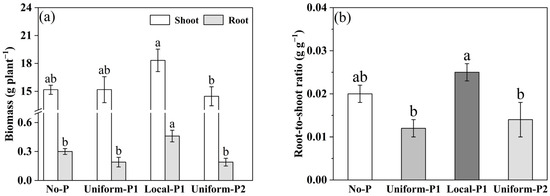
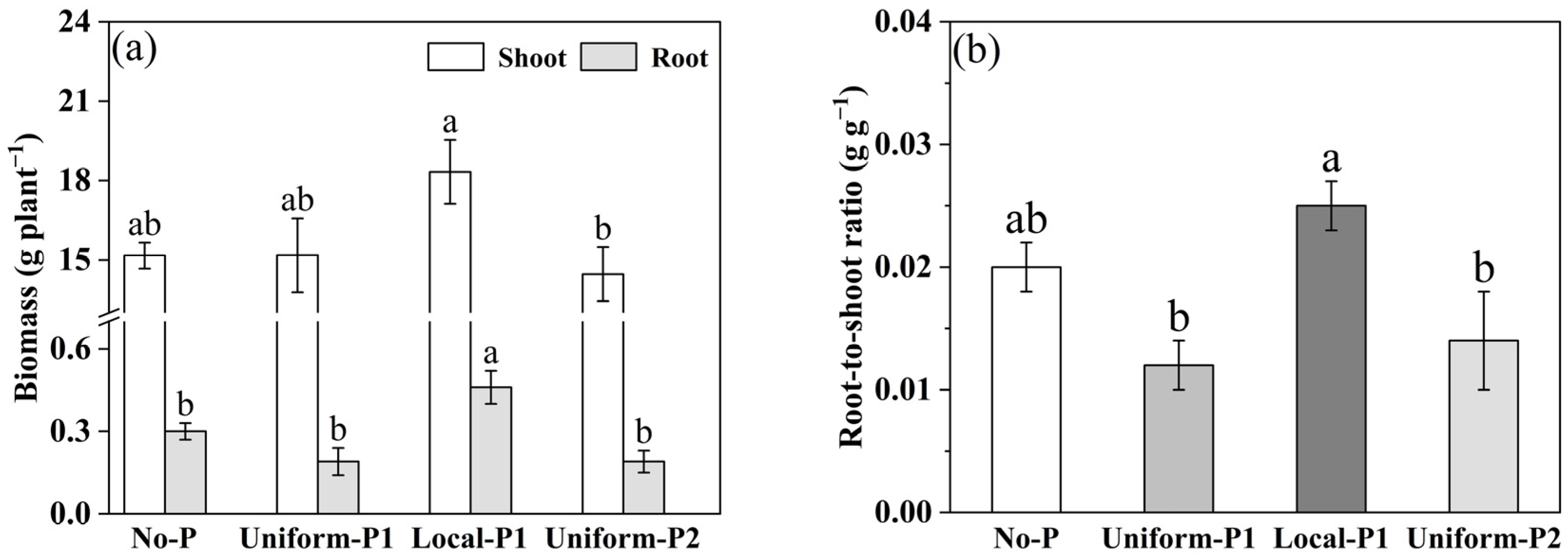
The P application method strongly influenced plant growth (Figure 1). It had distinct effects on shoot and root development. Among the treatments, localized P supply (Local-P1) produced the greatest shoot biomass, reaching 18.33 g plant−1 (Figure 1a). Shoot biomass under Local-P1 was significantly higher than under Uniform-P2. However, it did not differ from Uniform-P1. Local-P1 also enhanced root growth. Root biomass increased by 53.33%, 142.11%, and 142.11% compared with No-P, Uniform-P1, and Uniform-P2, respectively (Figure 1a). The root-to-shoot ratio under Local-P1 was also significantly greater than under Uniform-P1 and Uniform-P2. Compared with Uniform-P1, Local-P1 increased the root-to-shoot ratio by 108.33% (Figure 1b).
Figure 1.
Biomass (a) and root-to-shoot ratio (b) of pitaya seedlings under different P treatments. Treatments: No-P—no P supply; Uniform-P1—uniform P supply; Local-P1—localized P supply; Uniform-P2—uniform high-P supply. Error bars indicate standard errors of the means (n = 4). Different lowercase letters above the bars denote significant differences among treatments (p < 0.05).
3.2. Effects of Phosphorus Application Methods on Nutrient Content in Pitaya Seedlings
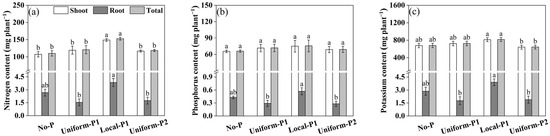
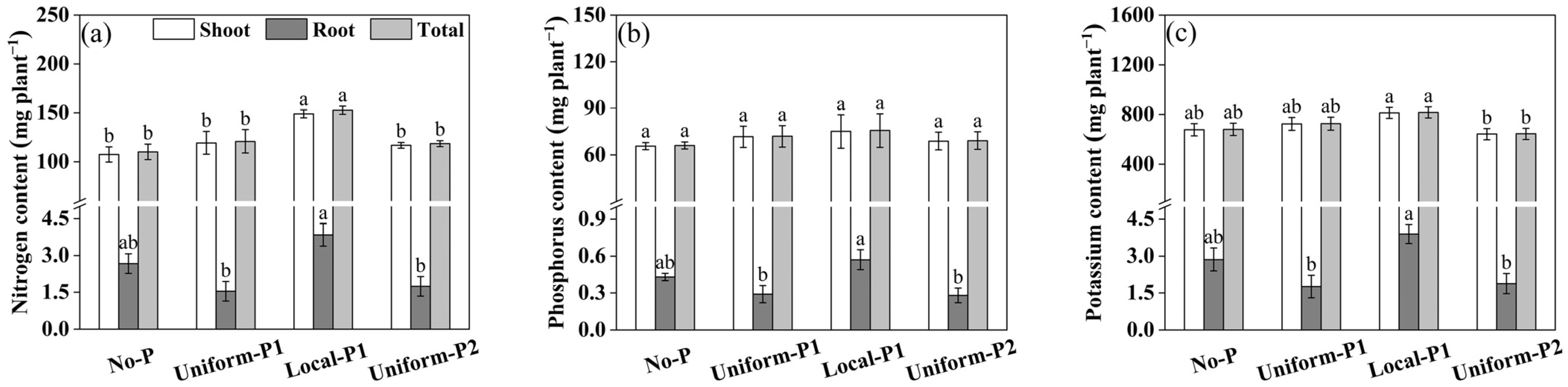
The P application method significantly affected nitrogen content in both shoots and roots (Figure 2a). Compared with No-P, Uniform-P1, and Uniform-P2, localized P supply (Local-P1) increased shoot nitrogen content by 38.53%, 24.78%, and 27.36%, respectively. Root nitrogen content was also highest under Local-P1. It was 2.5- and 2.2-fold greater than under Uniform-P1 and Uniform-P2, respectively. Total nitrogen content reached 152.76 mg plant−1 in Local-P1, the highest among all treatments. Compared to No-P, Uniform-P1, and Uniform-P2, total nitrogen content increased by 38.65%, 26.36%, and 22.31%, respectively.
Figure 2.
Nitrogen content (a), phosphorus content (b), and potassium content (c) of pitaya seedlings under different P treatments. Treatments: No-P—no P supply; Uniform-P1—uniform P supply; Local-P1—localized P supply; Uniform-P2—uniform high-P supply. Error bars indicate standard errors of the means (n = 4). Different lowercase letters above the bars denote significant differences among treatments (p < 0.05).
Shoot and total P content showed no significant differences among treatments (Figure 2b). However, root P content was significantly higher in Local-P1. It increased by 96.55% compared with Uniform-P1 and by 103.57% compared with Uniform-P2, but did not differ from No-P.
The P application method also influenced potassium content (Figure 2c). Shoot potassium content exceeded that of nitrogen and P. Localized P application enhanced potassium content more effectively than uniform application. In Local-P1, shoot and total potassium content were 26.68% and 26.91% higher than in Uniform-P2. Root potassium content under Local-P1 was also greater, reaching 2.2- and 2.1-fold that of Uniform-P1 and Uniform-P2, respectively.
3.3. Effects of Phosphorus Application Methods on Root Morphology in Pitaya Seedlings
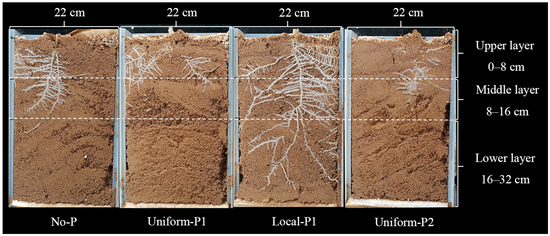
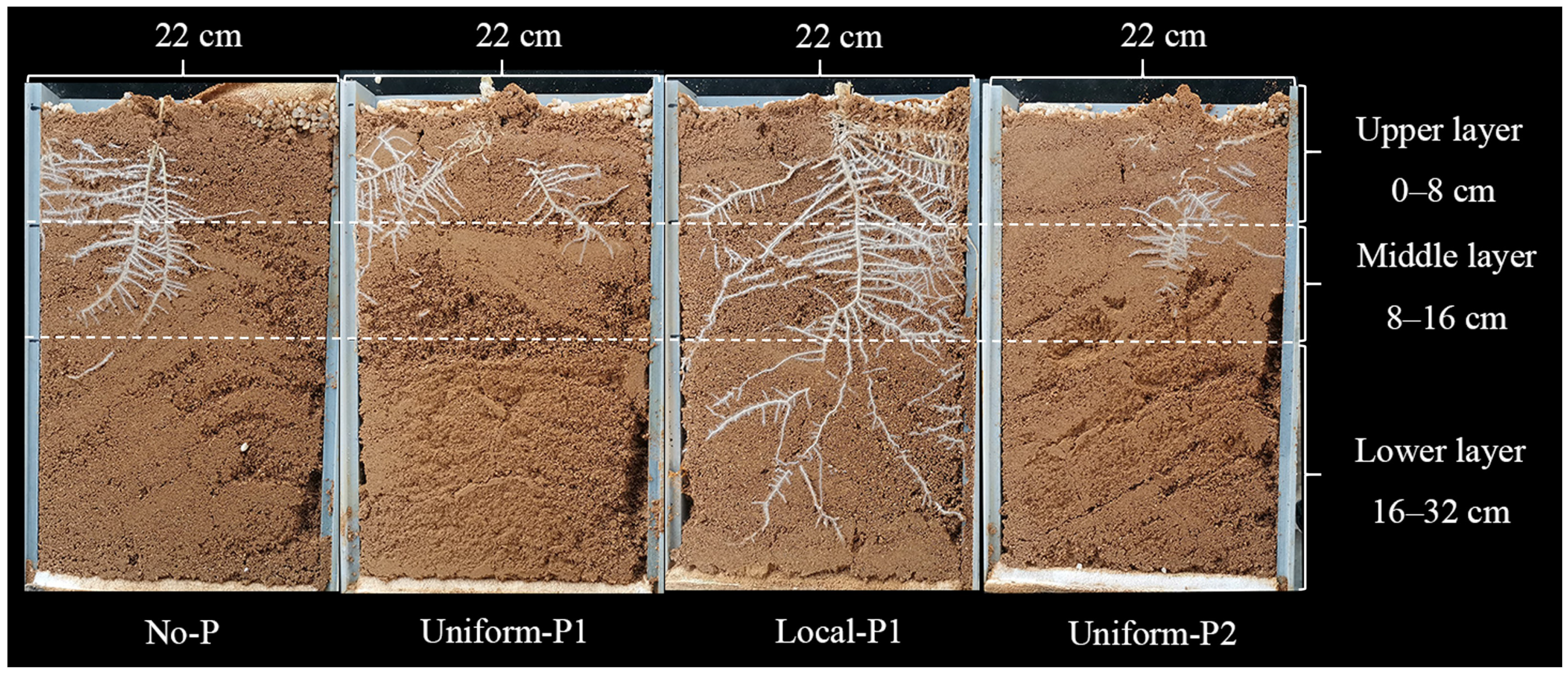
Analysis of pitaya root traits showed that P treatments significantly affected root morphology, including total root length, surface area, volume, and diameter (Figure 3, Table 1). Total root length and root surface area followed similar trends across the four treatments (Table 1). Compared with No-P, Uniform-P1, and Uniform-P2, Local-P1 significantly increased total root length by 71.96%, 121.77%, and 124.97%, respectively. Local-P1 also increased root surface area by 56.10%, 110.25%, and 116.34%, respectively. Root volume under Local-P1 was significantly higher than under uniform P application, reaching 3.14 m3 (Table 1). With the same total P supply, Local-P1 increased root volume by 100.19% compared with Uniform-P1. Phosphorus supply method did not significantly affect the specific root length of pitaya seedlings (Table 1). Among the treatments, Local-P1 showed the smallest specific root area, which was 14.57% lower than that of Uniform-P1. Root tissue density under Local-P1 increased significantly by 23.14% compared with Uniform-P1 and 17.32% compared with Uniform-P2. Overall, localized P supply promoted longer, denser, and more compact roots than uniform supply.
Figure 3.
Root morphology of pitaya seedlings under different P treatments. Treatments: No-P—no P supply; Uniform-P1—uniform P supply; Local-P1—localized P supply; Uniform-P2—uniform high-P supply.
Table 1.
Total root length, root surface area, root volume, specific root length, specific root area, and root tissue density of pitaya seedlings treated with different P application methods.
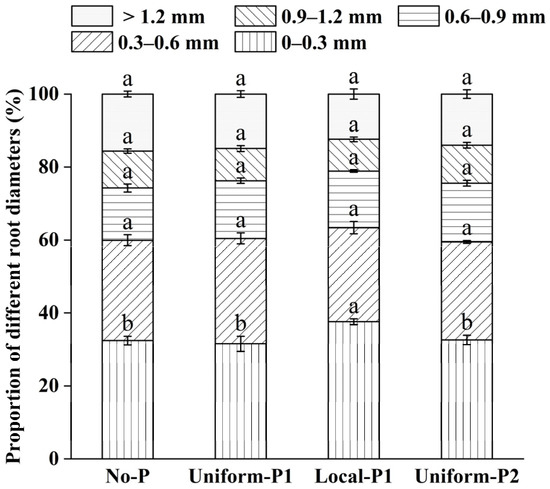
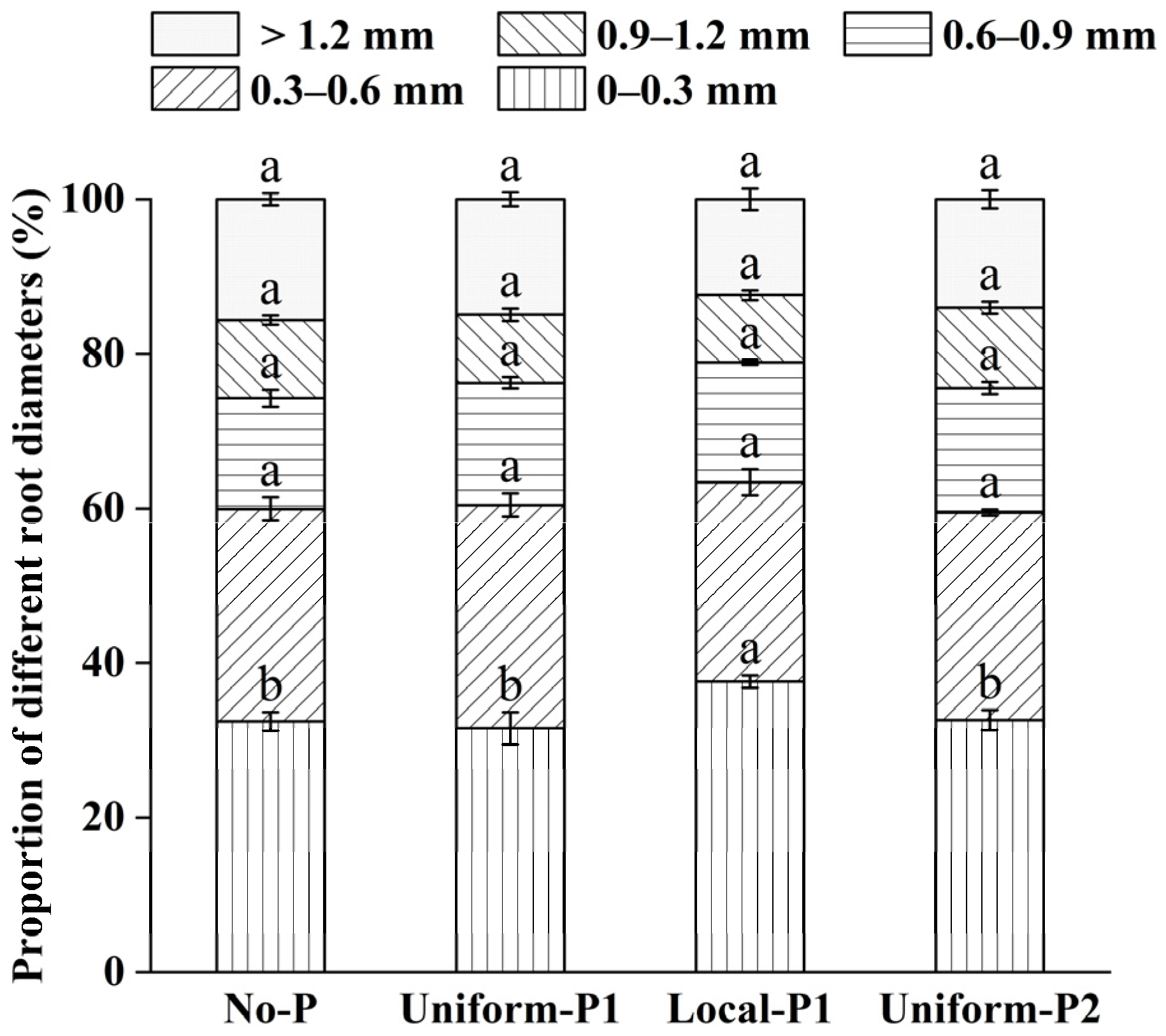
Most pitaya roots had diameters <0.3 mm, and P supply mainly affected this root class (Figure 4). The proportion of root length in this class was significantly lower in No-P, Uniform-P1, and Uniform-P2 than in Local-P1. Local-P1 showed a 6.06% higher proportion of fine roots (<0.3 mm) than Uniform-P1. No significant differences were found among treatments for roots with diameters of 0.3–0.6 mm, 0.6–0.9 mm, 0.9–1.2 mm, or >1.2 mm. Thus, localized P mainly promoted the development of fine roots.
Figure 4.
Proportion of different root diameters of pitaya seedlings under different P treatments. Treatments: No-P—no P supply; Uniform-P1—uniform P supply; Local-P1—localized P supply; Uniform-P2—uniform high-P supply. Different lowercase letters denote significant differences in root diameter proportions among treatments (p < 0.05).
3.4. Effects of Phosphorus Application Methods on Soil Nutrient Availability
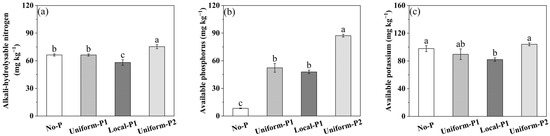
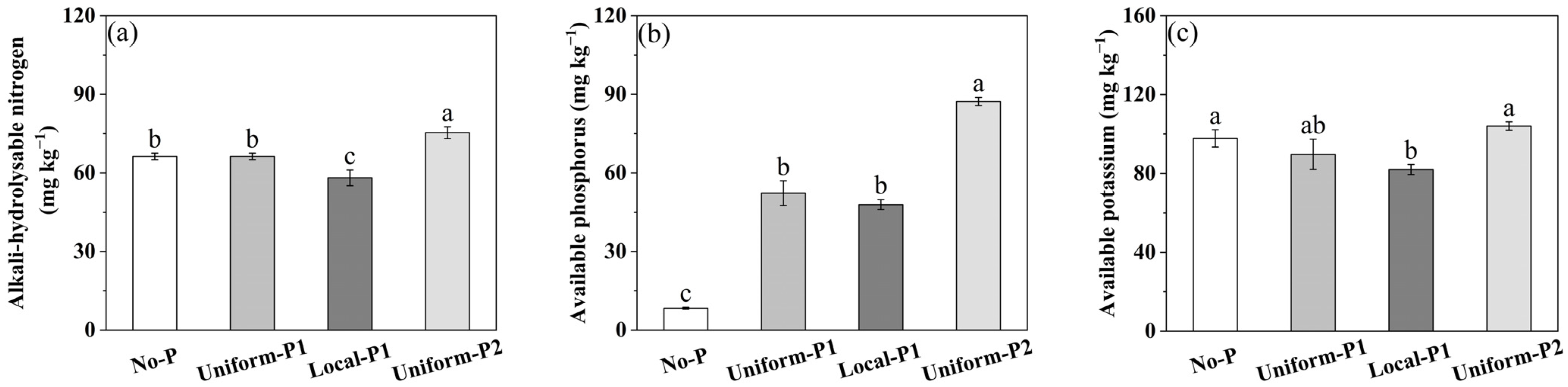
The P application method significantly influenced soil alkali-hydrolysable nitrogen, with the lowest level under localized P application (Figure 5a). Compared with Uniform-P1 and Uniform-P2, Local-P1 reduced soil alkali-hydrolysable nitrogen by 12.43% and 22.86%, respectively. Relative to the No-P treatment, soil available P content was significantly higher in the Uniform-P1, Local-P1, and Uniform-P2 treatments (Figure 5b). Furthermore, available soil P in Uniform-P1 and Local-P1 decreased by 40.09% and 45.07% compared with Uniform-P2, with no significant difference between Uniform-P1 and Local-P1. Available soil potassium was lowest under localized P application (Figure 5c). Local-P1 showed a significant reduction compared with Uniform-P2.
Figure 5.
Effect of P treatments on soil alkali-hydrolysable nitrogen (a), available phosphorus (b), and available potassium (c). Treatments: No-P—no P supply; Uniform-P1—uniform P supply; Local-P1—localized P supply; Uniform-P2—uniform high-P supply. Error bars indicate standard errors of the means (n = 4). Different lowercase letters above the bars denote significant differences among treatments (p < 0.05).
3.5. Correlation and Principal Component Analyses of Indicators Across Phosphorus Application Methods
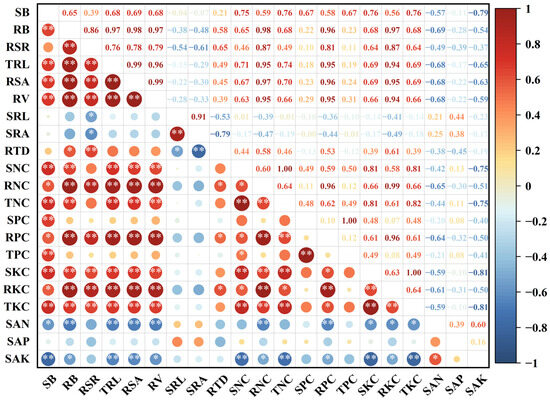
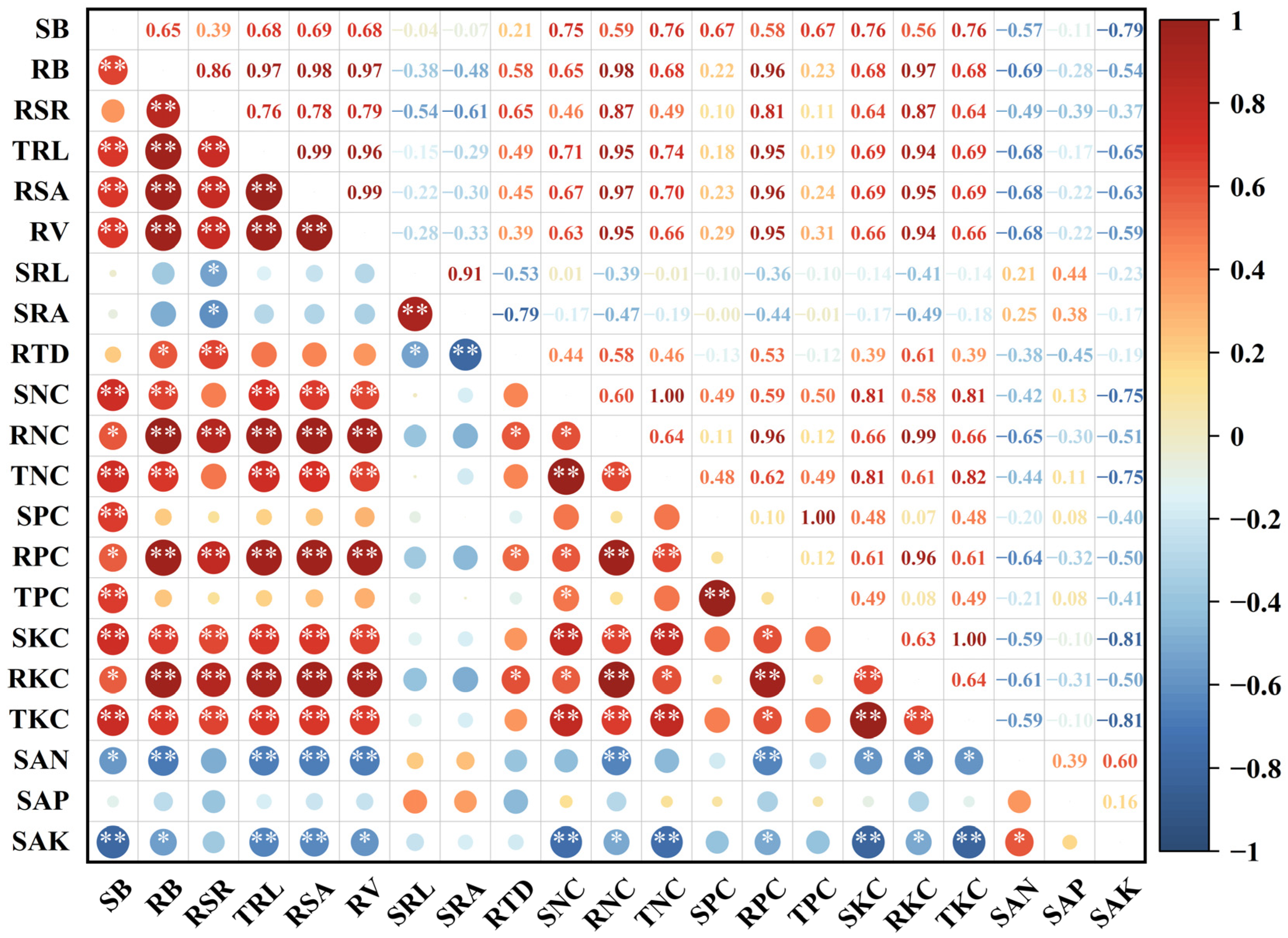
Correlation analysis showed strong positive relationships between shoot biomass and root traits, including total root length, root surface area, and root volume (Figure 6). Shoot biomass was also highly correlated with shoot content of nitrogen, P, and potassium (p < 0.01). It was positively correlated with root content of these nutrients as well (p < 0.05). In contrast, shoot biomass was negatively correlated with soil available potassium and alkali-hydrolysable nitrogen (p < 0.05). Root biomass showed similar patterns, being positively associated with root traits and nutrient content, but negatively correlated with soil available K and alkali-hydrolysable N (p < 0.05 or p < 0.01).
Figure 6.
Correlation analysis of biomass, root morphology, nutrient content, and soil nutrient availability. Abbreviations: SB—shoot biomass; RB—root biomass; RSR—root-to-shoot ratio; TRL—total root length; RSA—root surface area; RV—root volume; SRL—specific root length; SRA—specific root area; RTD—root tissue density; SNC—shoot nitrogen content; RNC—root nitrogen content; TNC—total nitrogen content; SPC—shoot phosphorus content; RPC—root phosphorus content; TPC—total phosphorus content; SKC—shoot potassium content; RKC—root potassium content; TKC—total potassium content; SAN—soil alkali-hydrolysable nitrogen; SAP—soil available phosphorus; SAK, soil available potassium. **: Significant at p < 0.01 level, *: Significant at p < 0.05 level. The size of the central circles represents the magnitude of the correlation coefficient, with larger circles indicating that the coefficient is closer to either 1 or −1.
Shoot nitrogen content was positively correlated with root traits, while root N content was negatively correlated with soil alkali-hydrolysable N. Root P content was positively correlated with root traits (total root length, surface area, volume), root-to-shoot ratio, and root tissue density. Potassium content showed strong positive correlations with root traits and root-to-shoot ratio (p < 0.01). It was negatively correlated with soil available potassium (p < 0.05). These results indicate that P supply influences nutrient content and biomass mainly by enhancing root growth and morphology.
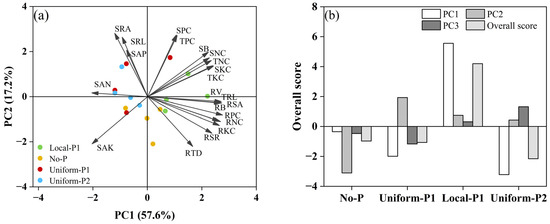
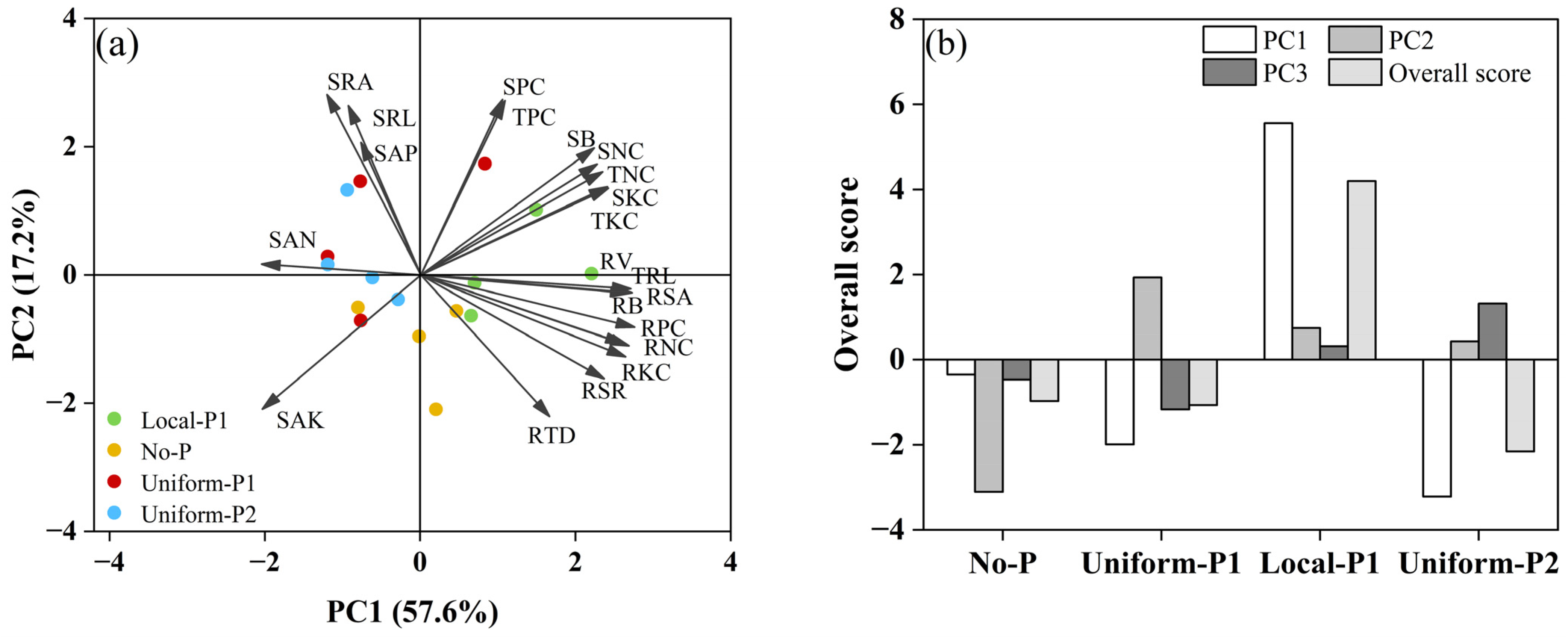
Principal component analysis showed that the PC1 and PC2 explained 57.6% and 17.2% of the variance, respectively (Figure 7a). These components were used to calculate overall scores for each treatment. Local-P1 achieved the highest overall score (4.20), whereas Uniform-P2 had the lowest (−2.16). The ranking of overall scores was Local-P1 > No-P > Uniform-P1 > Uniform-P2 (Figure 7b).
Figure 7.
(a) Principal component analysis of biomass, root traits, nutrient content, and soil nutrient availability; (b) Overall scores of different P treatments. Treatments: No-P—no P supply; Uniform-P1—uniform P supply; Local-P1—localized P supply; Uniform-P2—uniform high-P supply. Abbreviations: SB—shoot biomass; RB—root biomass; RSR—root-to-shoot ratio; TRL—total root length; RSA—root surface area; RV—root volume; SRL—specific root length; SRA—specific root area; RTD—root tissue density; SNC—shoot nitrogen content; RNC—root nitrogen content; TNC—total nitrogen content; SPC—shoot phosphorus content; RPC—root phosphorus content; TPC—total phosphorus content; SKC—shoot potassium content; RKC—root potassium content; TKC—total potassium content; SAN—soil alkali-hydrolysable nitrogen; SAP—soil available phosphorus; SAK—soil available potassium.
4. Discussion
4.1. Localized Phosphorus Application Altered Biomass Allocation Between Shoot and Root
Plants show plasticity in both shoot and root growth, enabling adaptation to heterogeneous and changing environments [34]. Phosphorus application methods can shift growth patterns and influence P use efficiency and yield [48]. Localized P application has been shown to increase seedling dry matter and promote root proliferation [22,26,49,50,51]. In this study, localized P application improved pitaya growth compared with uniform application, consistent with findings in other crops such as rice, wheat, maize, and faba bean [52,53,54]. With the same total P applied, pitaya seedlings performed better under localized application (Local-P1) than under uniform application (Uniform-P1), with a 142.11% increase in root biomass (Figure 1a). This is because, compared with the broadcast fertilization method, the localized fertilization method applies fertilizer to only limited regions of the soil. By doing so, it minimizes the contact area between soil and fertilizer, thereby reducing soil P fixation and facilitating enhanced P uptake and utilization by plants [21]. Ultimately, this translates to a significant improvement in the growth performance of pitaya under localized P supply. Localized P application (Local-P1) also significantly promoted both shoot and root growth compared with uniform high-P application (Uniform-P2) (Figure 1). This indicated that localized P application is an effective strategy to improve P use efficiency while reducing fertilizer input.
Shoot and root development are tightly connected, forming an interdependent system. Changes in the root-to-shoot ratio across growth stages indicate shifts in the center of plant growth [54]. Under P deficiency, assimilates are preferentially allocated to the root system to enhance soil exploration, resulting in an earlier slowdown of shoot growth and an increased root-to-shoot ratio [55,56]. Previous studies show that in heterogeneous nutrient environments, this ratio often increases or remains stable [57]. In our study, localized P supply significantly increased the root-to-shoot ratio compared with uniform supply (Figure 1b). This effect was mainly driven by root proliferation. Phosphorus content in pitaya roots correlated strongly with the root-to-shoot ratio (Figure 6). Lower root-to-shoot ratios in Uniform-P1 and Uniform-P2 suggest nutrient limitation on plant growth.
4.2. Localized Phosphorus Application Improved Root Morphology
The plasticity of root morphology, structure, and spatial distribution in response to localized nutrient supply has been well documented across various plant species [35,58]. Localized P supply alters root traits and plant growth. Some plants adapt by enhancing root length, surface area, and volume [54,59,60,61,62]. They also form more lateral roots and reduce root diameter. These adjustments are compensatory response to spatial uneven P availability. Specifically, extensive root proliferation in nutrient-rich zones compensates for the uneven distribution of soil nutrients [63,64]. Furthermore, the localized application of P fertilizers containing NH4+-N acidifies the root zone membrane, thereby softening the cell walls of the roots and accelerating cell division, which in turn promotes root growth [65]. In our rhizobox experiment, P fertilizer was concentrated in the middle soil layer (8–16 cm) to facilitate root access. Results indicated that, compared with uniform P application (Uniform-P1 and Uniform-P2), localized P supply (Local-P1) significantly increased total root length, surface area, and volume. Compared with uniform P application (Uniform-P1 and Uniform-P2), localized P supply (Local-P1) greatly increased root traits. Total root length, surface area, and volume in Local-P1 were 121.77%, 110.25%, and 100.19% higher than in Uniform-P1, respectively (Table 1). The results show strong root proliferation and downward growth into nutrient-rich patches (Figure 3), which is consistent with previous findings for rice, common bean, and sorghum [53,66,67]. Under localized P supply conditions, plants showed the lowest specific root area together with the highest root tissue density (Table 1). This inverse relationship generally indicates that root dry matter allocation shifts toward denser structural components, such as thickened cortical tissues or enhanced vascular development, rather than toward expanding root surface area [68]. These morphological adjustment patterns indicate high plasticity of the pitaya root system under localized P supply.
Root diameter has a strong effect on total length, surface area, and volume [69,70]. Fine roots are essential for plant growth, as they are primarily responsible for absorbing water and nutrients. Localized P supply often stimulates fine root proliferation [31,51,53]. In this study, the proportion of roots with diameters <0.3 mm was significantly higher under localized P supply (Local-P1) than under other treatments, showing a 6.06% increase compared with uniform P supply (Uniform-P1) (Figure 4). This greater fine root abundance likely explains the increase in total root length under localized P. In summary, these root morphological changes under localized P supply can be interpreted as an efficient plant foraging strategy aimed at optimizing P acquisition [71].
Root morphology and structure largely determine nutrient acquisition. Root number and activity are closely associated with the production, transport, and allocation of assimilates, as well as crop yield formation. Correlation analysis showed that total root length, root surface area, and root volume were all significantly positively correlated with biomass (Figure 6). Previous studies reported that localized and moderate P supply effectively improved the growth in Rosa multiflora and maize by enhancing root development, particularly through changes in root morphology and physiology [33,37,51]. Localized P supply facilitates better root morphology during initial crop growth, leading to expanded soil exploration and subsequently increased plant nutrient content [26]. Therefore, localized P application likely promotes pitaya growth by strengthening the positive coupling between root morphology and nutrient absorption. Furthermore, the nutrients in soil patches also affect root physiological processes such as proton exudation and acid phosphatase activity in the rhizosphere [31,72]. It is necessary to study the potential mechanisms of root morphological changes in order to elucidate the relationship between root and nutrient content.
4.3. Local Phosphorus Application Increased Nitrogen and Potassium Content
Plant P content is generally thought to increase with higher P inputs [73]. Many studies have tested the effects of localized P application on crop P content. It has been shown to enhance P content in plants such as rice, chili, Rosa multiflora, and Pinus massoniana [26,33,53,60]. In contrast, other studies found no significant difference in maize P content between broadcast and localized P application [31]. In this study, P supply method and rate had no effect on shoot P content in pitaya seedlings. This suggests that pitaya may have high P use efficiency and can maintain growth across a wide range of P levels. By contrast, root P content was significantly higher under localized than under uniform P supply (Figure 2b). The improved root growth of pitaya under localized P supply provides a potential explanation. Plants often upregulate high-affinity P transporters to optimize uptake in the rhizosphere [74], suggesting that localized P supply may enhance root P content in pitaya seedlings.
Nitrogen content is a key driver of plant growth and yield. It strongly influences biomass formation [75]. Graciano et al. [76] found that the positive effects of localized P application result from both increased P availability and sustained nitrogen assimilation. Our results confirm that both the amount and method of P application influence nutrient content in plants. Localized P (Local-P1) increased shoot nitrogen content by 24.78% compared to uniform P (Uniform-P1), and root potassium content under Local-P1 was 2.2-fold that under Uniform-P1 (Figure 2a,c). Shoot biomass was strongly and positively correlated with nitrogen and potassium content under all P treatments. Plant nitrogen and potassium content were also highly correlated with total root length, root surface area, and root volume (Figure 6). These findings suggest that enhanced nitrogen and potassium content play a major role in pitaya seedling growth. Improved root growth expands the absorption zone, increasing nitrogen and potassium uptake and promoting shoot growth. The results support our hypothesis that localized P application promotes root growth, thereby improving plant biomass and nutrient content. The lack of significant difference in growth and P content between plants without and with P addition can be attributed to the plants’ initial adaptive responses to low P stress [77,78,79], their efficient use of soil inherent P, and the likely rapid fixation of the applied fertilizer.
5. Conclusions
Localized P supply produced greater shoot biomass than both uniform P and uniform high-P treatments. It also increased shoot nitrogen and potassium content but had no significant effect on P content. This effect was associated with improvements in root morphology induced by localized nutrient supply. Under localized P supply, root biomass, total root length, root surface area, and root volume increased significantly, with roots < 0.3 mm in diameter accounting for the largest proportion of total root length. We conclude that localized P application enhances root morphology, improves nitrogen and potassium content, and promotes shoot growth in pitaya. Under field conditions, local P application can be achieved through methods including hole application, strip application, concurrent seeding and fertilizer application, and drip irrigation fertilization. It is an efficient fertilization strategy that optimizes root development, reduces fertilizer use, and increases nutrient use efficiency.
Author Contributions
Conceptualization, W.G.; Methodology, C.C.; Investigation, C.C. and J.W.; Data curation, J.W., C.C., Y.F. and W.G.; Formal Analysis, J.W.; Resources, F.P. and Z.C.; Writing—Original Draft Preparation, J.W. and C.C.; Writing—Review and Editing, J.W., Y.F., Y.R., J.Q. and W.G.; Supervision, Y.R.; Project Administration, W.G.; Funding Acquisition, W.G. All authors have read and agreed to the published version of the manuscript.
Funding
This work was supported by the National Natural Science Foundation of China (32202586), the Hainan Provincial Sanya Yazhou Bay Science and Technology Innovation Joint Project (No: ZDYF2025GXJS131), and the Scientific Fertilization Technology System for Characteristic Crops in Hainan (RH2300006505).
Data Availability Statement
Data are available upon request from the corresponding author.
Conflicts of Interest
Authors Junfeng Qu, Fanrong Pan and Zhiliang Chen were employed by the company China BlueChemical Ltd. The remaining authors declare that the research was conducted in the absence of any commercial or financial relationships that could be construed as a potential conflict of interest.
References
- Schachtman, D.P.; Reid, R.J.; Ayling, S.M. Phosphorus uptake by plants: From soil to cell. Plant Physiol. 1998, 116, 447–453. [Google Scholar] [CrossRef] [Scilit]
- Raghothama, K.G. Phosphate acquisition. Annu. Rev. Plant Biol. 1999, 50, 665–693. [Google Scholar] [CrossRef] [Scilit] [PubMed]
- Michigami, T.; Kawai, M.; Yamazaki, M.; Ozono, K. Phosphate as a signaling molecule and its sensing mechanism. Physiol. Rev. 2018, 98, 2317–2348. [Google Scholar] [CrossRef] [Scilit] [PubMed]
- Chen, G.; Li, Y.; Jin, C.; Wang, J.; Wang, L.; Wu, J. Physiological and morphological responses of hydroponically grown pear rootstock under phosphorus treatment. Front. Plant Sci. 2021, 12, 696045. [Google Scholar] [CrossRef] [Scilit] [PubMed]
- Wan, C.; Gao, S.; Wang, J.; Lei, X.; Ge, J.; Tao, J.; Wang, Q.; Dang, P.; Wang, M.; Yang, P.; et al. Optimal planting density combined with phosphorus input promotes common buckwheat resource use efficiency and productivity to increase grain yield. Agric. Water Manag. 2023, 287, 108468. [Google Scholar] [CrossRef] [Scilit]
- Ma, J.; Wang, G.; Liu, X.; Lei, B.; Xing, G. Effects of phosphorus application levels on its uptake and utilization in foxtail millet. Agronomy 2024, 14, 2078. [Google Scholar] [CrossRef] [Scilit]
- Wang, Y.; Xie, J.; Fan, F.; Sun, Z.; Yuan, F.; Wang, Q.; Yu, L.; Liu, Y.; Li, J.; Cui, L. Phosphorus fertilization enhanced overwintering, root system and forage yield of late-seeded alfalfa in sodic soils. Sci. Rep. 2024, 14, 18090. [Google Scholar] [CrossRef] [Scilit]
- Ma, J.; He, P.; Xu, X.; He, W.; Liu, Y.; Yang, F.; Chen, F.; Li, S.; Tu, S.; Jin, J.; et al. Temporal and spatial changes in soil available phosphorus in China (1990–2012). Field Crops Res. 2016, 192, 13–20. [Google Scholar] [CrossRef] [Scilit]
- Zhang, W.; Ma, W.; Ji, Y.; Fan, M.; Oenema, O.; Zhang, F. Efficiency, economics, and environmental implications of phosphorus resource use and the fertilizer industry in China. Nutr. Cycl. Agroecosys. 2008, 80, 131–144. [Google Scholar] [CrossRef] [Scilit]
- Simpson, R.J.; Oberson, A.; Culvenor, R.A.; Ryan, M.H.; Veneklaas, E.J.; Lambers, H.; Lynch, J.P.; Ryan, P.R.; Delhaize, E.; Smith, F.A.; et al. Strategies and agronomic interventions to improve the phosphorus-use efficiency of farming systems. Plant Soil 2011, 349, 89–120. [Google Scholar] [CrossRef] [Scilit]
- Scholz, R.W.; Wellmer, F.W. Approaching a dynamic view on the availability of mineral resources: What we may learn from the case of phosphorus? Global Environ. Change 2013, 23, 11–27. [Google Scholar] [CrossRef] [Scilit]
- Zhang, F.; Wang, J.; Zhang, W.; Cui, Z.; Ma, W.; Chen, X.; Jiang, R. Nutrient use efficiencies of major cereal crop in China and measures for improvement. Acta Pedol. Sin. 2008, 45, 915–924. [Google Scholar]
- Conley, D.J.; Paerl, H.W.; Howarth, R.W.; Boesch, D.F.; Seitzinger, S.P.; Havens, K.E.; Lancelot, C.; Likens, G.E. Controlling eutrophication: Nitrogen and phosphorus. Science 2009, 323, 1014–1015. [Google Scholar] [CrossRef] [Scilit] [PubMed]
- Herrera-Estrella, L.; López-Arredondo, D. Phosphorus: The underrated element for feeding the world. Trends Plant Sci. 2016, 21, 461–463. [Google Scholar] [CrossRef] [Scilit] [PubMed]
- Lambers, H.; Plaxton, W.C. Phosphorus: Back to the roots. In Annual Plant Reviews Volume 48: Phosphorus Metabolism in Plants; John Wiley & Sons, Ltd.: Hoboken, NJ, USA, 2015; Volume 48, pp. 1–22. [Google Scholar]
- Zhu, J.; Li, M.; Whelan, M. Phosphorus activators contribute to legacy phosphorus availability in agricultural soils: A review. Sci. Total Environ. 2018, 612, 522–537. [Google Scholar] [CrossRef] [Scilit] [PubMed]
- Syers, J.K.; Johnston, A.E.; Curtin, D. Efficiency of soil and fertilizer phosphorus use: Reconciling changing concepts of soil phosphorus behavior with agronomic information. FAO Fertil. Plant Nutr. Bull. 2008, 45, 128. [Google Scholar]
- Johnston, A.E.; Poulton, P.R.; Fixen, P.E.; Curtin, D. Phosphorus: Its efficient use in agriculture. Adv. Agron. 2014, 123, 177–228. [Google Scholar]
- David, T.C. Factors affecting mineral nutrient acquisition by plants. Annu. Rev. Plant Physiol. 1985, 36, 77–115. [Google Scholar]
- Tinker, P.B.; Nye, P.H. Solute Movement in the Rhizosphere; Oxford University Press: New York, NY, USA, 2000. [Google Scholar]
- Fernandez, J.Q.P.; Dias, L.E.; Barros, N.F.; Novais, R.F.; Moraes, E.J. Productivity of Eucalyptus camaldulensis affected by rate and placement of two phosphorus fertilizers to a Brazilian Oxisol. Forest Ecol. Manag. 2000, 127, 93–102. [Google Scholar] [CrossRef] [Scilit]
- Ma, Q.; Zhang, F.; Rengel, Z.; Shen, J. Localized application of NH4+-N plus P at the seedling and later growth stages enhances nutrient uptake and maize yield by inducing lateral root proliferation. Plant Soil 2013, 372, 65–80. [Google Scholar] [CrossRef] [Scilit]
- Quinn, D.J.; Lee, C.D.; Poffenbarger, H.J. Corn yield response to sub-surface banded starter fertilizer in the US: A meta-analysis. Field Crops Res. 2020, 254, 107834. [Google Scholar] [CrossRef] [Scilit]
- Freiling, M.; von Tucher, S.; Schmidhalter, U. Factors influencing phosphorus placement and effects on yield and yield parameters: A meta-analysis. Soil Tillage Res. 2022, 216, 105257. [Google Scholar] [CrossRef] [Scilit]
- Xia, Z.; He, Y.; Yu, L.; Lv, R.; Korpelainen, H.; Li, C. Sex-specific strategies of phosphorus (P) acquisition in Populus cathayana as affected by soil P availability and distribution. New Phytol. 2020, 225, 782–792. [Google Scholar] [CrossRef] [Scilit] [PubMed]
- Swain, S.K.; Kalidas-Singh, S.; Puyam, A.; Thakuria, D.; Maimom, S.; Zhiipao, R.R.; Debnath, A.; Bhuyan, S.; Homeshwari-Devi, M.; Huidrom, S.; et al. A comparative study of localized phosphorus application and broadcasting method on biomass production and their use efficiency on Chilli (Capsicum annuum) under alkaline soil. Front. Plant Sci. 2024, 15, 1304963. [Google Scholar] [CrossRef] [Scilit]
- Lynch, P.J. Root phenes for enhanced soil exploration and phosphorus acquisition: Tools for future crops. Plant Physiol. 2011, 156, 1041–1049. [Google Scholar] [CrossRef] [Scilit]
- Wang, X.; Feng, J.; White, P.J.; Shen, J.; Cheng, L. Heterogeneous phosphate supply influences maize lateral root proliferation by regulating auxin redistribution. Ann. Bot. 2020, 125, 119–130. [Google Scholar] [CrossRef] [Scilit]
- Peng, Q.; Zhang, Z.; Su, R.; Zhang, X.; Lambers, H.; He, H.; Cavagnaro, T. Phosphorus and selenium uptake, root morphology, and carboxylates in the rhizosheath of alfalfa (Medicago sativa) as affected by localised phosphate and selenite supply in a split-root system. Funct. Plant Biol. 2021, 48, 1161–1174. [Google Scholar] [CrossRef] [Scilit]
- van der Bom, F.J.T.; Lösel, P.D.; Kingston, A.M.; Weng, Z.; Raymond, N.S.; Maksimenko, A.; Hausermann, D.; Bell, M.J.; Doolette, C.L.; Lombi, E.; et al. Synchrotron-based 3D X-ray computed tomography reveals root system architecture: Plastic responses to phosphorus placement. Geoderma 2025, 457, 117299. [Google Scholar] [CrossRef] [Scilit]
- Jing, J.; Rui, Y.; Zhang, F.; Rengel, Z.; Shen, J. Localized application of phosphorus and ammonium improves growth of maize seedlings by stimulating root proliferation and rhizosphere acidification. Field Crops Res. 2010, 119, 355–364. [Google Scholar] [CrossRef] [Scilit]
- Hansel, F.D.; Amado, T.J.; Ruiz Diaz, D.A.; Rosso, L.H.; Nicoloso, F.T.; Schorr, M. Phosphorus fertilizer placement and tillage affect soybean root growth and drought tolerance. Agron. J. 2017, 109, 2936–2944. [Google Scholar] [CrossRef] [Scilit]
- Ma, Q.; Chen, L.; Du, M.; Zhang, Y.; Zhang, Y. Localized and moderate phosphorus application improves plant growth and phosphorus accumulation in Rosa multiflora thunb. ex murr. via efficient root system development. Forests 2020, 11, 570. [Google Scholar] [CrossRef] [Scilit]
- Hodge, A. The plastic plant: Root responses to heterogeneous supplies of nutrients. New Phytol. 2004, 162, 9–24. [Google Scholar] [CrossRef] [Scilit]
- Weligama, C.; Tang, C.; Sale, P.W.G.; Conyers, M.K.; Liu, D.L. Localised nitrate and phosphate application enhances root proliferation by wheat and maximises rhizosphere alkalisation in acid subsoil. Plant Soil 2008, 312, 101–115. [Google Scholar] [CrossRef] [Scilit]
- Zhou, C.; Jiang, W.; Li, Y.; Hou, X.; Liu, A.; Cai, L. Morphological plasticity and phosphorus uptake mechanisms of hybrid Eucalyptus roots under spatially heterogeneous phosphorus stress. J. For. Res. 2017, 28, 713–724. [Google Scholar] [CrossRef] [Scilit]
- Wang, L.; Rengel, Z.; Cheng, L.; Shen, J. Coupling phosphate type and placement promotes maize growth and phosphorus uptake by altering root properties and rhizosphere processes. Field Crops Res. 2024, 306, 109225. [Google Scholar] [CrossRef] [Scilit]
- Zhang, D.; Zhang, C.; Tang, X.; Li, H.; Zhang, F.; Rengel, Z.; Whalley, W.R.; Davies, W.J.; Shen, J. Increased soil phosphorus availability induced by faba bean root exudation stimulates root growth and phosphorus uptake in neighbouring maize. New Phytol. 2016, 209, 823–831. [Google Scholar] [CrossRef] [Scilit]
- Gao, W.; Zhang, D.; Tang, X.; Ruan, Y. Localized phosphorus promotes nutrient productivity of Brassica chinensis genotype with strong root morphological plasticity. Sci. Hortic. 2023, 310, 111779. [Google Scholar] [CrossRef] [Scilit]
- Wu, L.; Hsu, H.W.; Chen, Y.; Chiu, C.C.; Lin, Y.; Ho, J.A.A. Antioxidant and antiproliferative activities of red pitaya. Food Chem. 2005, 95, 319–327. [Google Scholar] [CrossRef] [Scilit]
- Trivellini, A.; Lucchesini, M.; Ferrante, A.; Massa, D.; Orlando, M.; Incrocci, L.; Mensuali-Sodi, A. Pitaya, an attractive alternative crop for Mediterranean region. Agronomy 2020, 10, 1065. [Google Scholar] [CrossRef] [Scilit]
- Attar, Ş.H.; Gündeşli, M.A.; Urün, I.; Kafkas, S.; Kafkas, N.E.; Ercisli, S.; Ge, C.; Mlcek, J.; Adamkova, A. Nutritional analysis of red-purple and white-fleshed pitaya (Hylocereus) species. Molecules 2022, 27, 808. [Google Scholar] [CrossRef] [Scilit]
- Wang, M.; Li, J.; Li, T.; Kang, S.; Jiang, S.; Huang, J.; Tang, H. Light supplementation in pitaya orchards induces pitaya flowering in winter by promoting phytohormone biosynthesis. Int. J. Mol. Sci. 2024, 25, 4794. [Google Scholar] [CrossRef] [Scilit] [PubMed]
- Li, X.; Fan, J.; Deng, R.; Cai, Y.; Zhong, J. Effects of different N, P and K combination on yield and quality of pitaya. Guizhou Agric. Sci. 2012, 40, 56–60. [Google Scholar]
- Chen, C.; Yang, Y.; Gan, L.; Lv, L.; Gao, W.; Ruan, Y. Effects of different phosphorus supply levels on the growth and nutrient absorption of pitaya seedlings. Chin. J. Trop. Crops 2021, 42, 2909–2914. [Google Scholar]
- Ma, S.; Meng, Y.; Han, Q.; Ma, S. Drip fertilization improve water and nitrogen use efficiency by optimizing root and shoot traits of winter wheat. Front. Plant Sci. 2023, 14, 1201966. [Google Scholar] [CrossRef] [Scilit] [PubMed]
- Bao, S. Soil and Agricultural Chemistry Analysis, 3rd ed.; China Agriculture Press: Beijing, China, 2000. [Google Scholar]
- Wang, S.; Ruan, Y.; Du, M.; Sun, W.; Zhang, Y.; Wang, Y.; Guo, J.; Shao, R.; Yang, Q.; Wang, H. Optimization of phosphate fertilizer application strategies to improve phosphorus availability and utilization in maize. Agron. J. 2024, 116, 453–464. [Google Scholar] [CrossRef] [Scilit]
- Roth, G.W.; Beegle, D.B.; Heinbaugh, S.M.; Antle, M.E. Starter fertilizers for corn on soils testing high in phosphorus in the northeastern USA. Agron. J. 2006, 98, 1121–1127. [Google Scholar] [CrossRef] [Scilit]
- Jing, J.; Zhang, F.; Rengel, Z.; Shen, J. Localized fertilization with P plus N elicits an ammonium-dependent enhancement of maize root growth and nutrient uptake. Field Crop Res. 2012, 133, 176–185. [Google Scholar] [CrossRef] [Scilit]
- Zhang, A.; Wang, X.; Zhang, D.; Dong, Z.; Ji, H.; Li, H. Localized nutrient supply promotes maize growth and nutrient acquisition by shaping root morphology and physiology and mycorrhizal symbiosis. Soil Till. Res. 2023, 225, 105550. [Google Scholar] [CrossRef] [Scilit]
- Sun, H.; Zhang, F.; Li, L.; Tang, C. The morphological changes of wheat genotypes as affected by the levels of localized phosphate supply. Plant Soil 2002, 245, 233–238. [Google Scholar] [CrossRef] [Scilit]
- He, Y.; Liao, H.; Yan, X. Localized supply of phosphorus induces root morphological and architectural changes of rice in split and stratified soil cultures. Plant Soil 2003, 248, 247–256. [Google Scholar] [CrossRef] [Scilit]
- Li, H.; Ma, Q.; Li, H.; Zhang, F.; Rengel, Z.; Shen, J. Root morphological responses to localized nutrient supply differ among crop species with contrasting root traits. Plant Soil 2014, 376, 151–163. [Google Scholar] [CrossRef] [Scilit]
- Place, G.; Bowman, D.; Burton, M.; Rufty, T. Root penetration through a high bulk density soil layer: Differential response of a crop and weed species. Plant Soil 2008, 307, 179–190. [Google Scholar] [CrossRef] [Scilit]
- Wu, P.; Ma, X.; Tigabu, M.; Wang, C.; Liu, A.; Oden, P.C. Root morphological plasticity and biomass production of two Chinese fir clones with high phosphorus efficiency under low phosphorus stress. Can. J. Forest Res. 2011, 41, 228–234. [Google Scholar] [CrossRef] [Scilit]
- Johnson, H.A.; Biondini, M.E. Root morphological plasticity and nitrogen uptake of 59 plant species from the Great Plains grasslands, USA. Basic Appl. Ecol. 2011, 2, 127–143. [Google Scholar] [CrossRef] [Scilit]
- Williamson, L.C.; Ribrioux, S.P.; Fitter, A.H.; Leyser, H.O. Phosphate availability regulates root system architecture in Arabidopsis. Plant Physiol. 2001, 126, 875–882. [Google Scholar] [CrossRef] [Scilit]
- Richardson, A.E.; Lynch, J.P.; Ryan, P.R.; Delhaize, E.; Smith, F.A.; Smith, S.E.; Harvey, P.R.; Ryan, M.H.; Veneklaas, E.J.; Lambers, H.; et al. Plant and microbial strategies to improve the phosphorus efficiency of agriculture. Plant Soil 2011, 349, 121–156. [Google Scholar] [CrossRef] [Scilit]
- Zhang, Y.; Zhou, Z.; Yang, Q. Genetic variations in root morphology and phosphorus efficiency of Pinus massoniana under heterogeneous and homogeneous low phosphorus conditions. Plant Soil 2013, 364, 93–104. [Google Scholar] [CrossRef] [Scilit]
- Gao, W.; Blaser, S.R.; Schlüter, S.; Shen, J.; Vetterlein, D. Effect of localised phosphorus application on root growth and soil nutrient dynamics in situ–comparison of maize (Zea mays) and faba bean (Vicia faba) at the seedling stage. Plant Soil 2019, 441, 469–483. [Google Scholar] [CrossRef] [Scilit]
- Yan, X.; Wang, C.; Ma, X.; Wu, P. Root morphology and seedling growth of three tree species in southern China in response to homogeneous and heterogeneous phosphorus supplies. Trees 2019, 33, 1283–1297. [Google Scholar] [CrossRef] [Scilit]
- Richardson, A.E.; Hocking, P.J.; Simpson, R.J.; George, T.S. Plant mechanisms to optimise access to soil phosphorus. Crop Pasture Sci. 2009, 60, 124–143. [Google Scholar] [CrossRef] [Scilit]
- Péret, B.; Clément, M.; Nussaume, L.; Desnos, T. Root developmental adaptation to phosphate starvation: Better safe than sorry. Trends Plant Sci. 2011, 16, 442–450. [Google Scholar] [CrossRef] [Scilit] [PubMed]
- Edwards, K.L.; Scott, T.K. Rapid growth responses of corn root segments: Effect of pH on elongation. Planta 1974, 119, 27–37. [Google Scholar] [CrossRef] [Scilit] [PubMed]
- Snapp, S.; Koide, R.; Lynch, J.P. Exploitation of localized phosphorus-patches by common bean roots. Plant Soil 1995, 177, 211–218. [Google Scholar] [CrossRef] [Scilit]
- van der Bom, F.; Williams, A.; Raymond, N.; Sulman, R.; McLean, G.; Bell, M. Spatio-temporal distribution of water and phosphorus determine growth of sorghum genotypes with contrasting nodal root angle. Plant Soil 2024, 499, 37–54. [Google Scholar] [CrossRef] [Scilit]
- Gao, Y.; Zhang, Z.; Zeng, F.; Ma, X. Root morphological and physiological traits are committed to the phosphorus acquisition of the desert plants in phosphorus-deficient soils. BMC Plant Biol. 2023, 23, 188. [Google Scholar] [CrossRef] [Scilit]
- Fusseder, A. The longevity and activity of the primary root of maize. Plant Soil 1987, 101, 257–265. [Google Scholar] [CrossRef] [Scilit]
- Cahn, M.D.; Zobel, R.W.; Bouldin, D.R. Relationship between root elongation rate and diameter and duration of growth of lateral roots of maize. Plant Soil 1989, 119, 271–279. [Google Scholar] [CrossRef] [Scilit]
- Hammond, J.P.; White, P.J. Sucrose transport in the phloem: Integrating root responses to phosphorus starvation. J. Exp. Bot. 2008, 59, 93–109. [Google Scholar] [CrossRef] [Scilit]
- Jing, J.; Gao, W.; Cheng, L.; Wang, X.; Duan, F.; Yuan, L.; Rengel, Z.; Zhang, F.; Li, H.; Cahill, J.F., Jr.; et al. Harnessing root-foraging capacity to improve nutrient-use efficiency for sustainable maize production. Field Crops Res. 2022, 279, 108462. [Google Scholar] [CrossRef] [Scilit]
- Wen, Z.; Li, H.; Shen, J.; Rengel, Z. Maize responds to low shoot P concentration by altering root morphology rather than increasing root exudation. Plant Soil 2017, 416, 377–389. [Google Scholar] [CrossRef] [Scilit]
- Deng, S.; Guan, D.X.; Cao, Y.; Wang, C.; Liu, C.; Ma, L.Q. Arsenic-hyperaccumulator Pteris vittata effectively uses sparingly-soluble phosphate rock: Rhizosphere solubilization, nutrient improvement, and arsenic accumulation. Environ. Sci. Technol. 2024, 58, 7870–7879. [Google Scholar] [CrossRef] [Scilit]
- Zhang, G.; Liu, S.; Dong, Y.; Liao, Y.; Han, J. A nitrogen fertilizer strategy for simultaneously increasing wheat grain yield and protein content: Mixed application of controlled-release urea and normal urea. Field Crops Res. 2022, 277, 108405. [Google Scholar] [CrossRef] [Scilit]
- Graciano, C.; Tambussi, E.A.; Castán, E.; Guiamet, J.J. Dry mass partitioning and nitrogen uptake by Eucalyptus grandis plants in response to localized or mixed application of phosphorus. Plant Soil 2009, 319, 175–184. [Google Scholar] [CrossRef] [Scilit]
- Li, Y.; Yang, X.; Liu, H.; Wang, W.; Wang, C.; Ding, G.; Xu, F.; Wang, S.; Cai, H.; Hammond, J.P.; et al. Local and systemic responses conferring acclimation of Brassica napus roots to low phosphorus conditions. J. Exp. Bot. 2022, 73, 4753–4777. [Google Scholar] [CrossRef] [Scilit]
- Soumya, P.R.; Vengavasi, K.; Pandey, R. Adaptive strategies of plants to conserve internal phosphorus under P deficient condition to improve P utilization efficiency. Physiol. Mol. Biol. Plants 2022, 28, 1981–1993. [Google Scholar] [CrossRef] [Scilit]
- Ceasar, S.A.; Ebeed, H.T.; Ramakrishnan, M.; García-Caparrós, P.; Ignacimuthu, S. Understanding low-phosphate stress responses in plants: Opportunities for genome editing to improve phosphorous use efficiency (PUE). Biotechnol. Adv. 2025, 84, 108686. [Google Scholar] [CrossRef] [Scilit]

Disclaimer/Publisher’s Note: The statements, opinions and data contained in all publications are solely those of the individual author(s) and contributor(s) and not of MDPI and/or the editor(s). MDPI and/or the editor(s) disclaim responsibility for any injury to people or property resulting from any ideas, methods, instructions or products referred to in the content. |
© 2026 by the authors. Licensee MDPI, Basel, Switzerland. This article is an open access article distributed under the terms and conditions of the Creative Commons Attribution (CC BY) license.