1. Introduction
Red beet (
Beta vulgaris L., Conditiva Group) is a root vegetable eatable with high nutritional value and increasing demand in both fresh markets and the food-processing industry [
1]. Its production has become established in temperate regions worldwide due to its adaptability and economic value. However, as with other horticultural crops, its yield is severely affected by competition with weed species that emerge simultaneously during the early phenological stages [
1]. These weeds compete for essential resources such as water, light, nutrients, and space, reducing not only total yield but also the commercial quality of the roots. According to recent studies, weed interference can cause yield losses that in some cases exceed 42% when no adequate control is implemented [
2]. Currently, the most widely used methods for weed control in red beet are pre- and post-emergence herbicide applications and, to a lesser extent, mechanical weeding. However, both approaches present significant limitations. The indiscriminate use of herbicides poses environmental and health risks [
3], while manual or mechanical weeding entails high operating costs, making it economically unfeasible to sustain these crops, particularly on small and medium-sized farms. This situation has motivated the development of intelligent management systems, among which precision weeding stands out. This strategy enables localized herbicide application only where weeds are detected, thereby optimizing resource use and reducing environmental impact. The basis of these systems is the ability to automatically and reliably identify weeds in crop images. However, this task is challenging due to the high visual similarity between beet leaves and those of particular broadleaf weed species, as well as additional factors such as occlusion, morphological variability, and changing illumination conditions [
4]. In view of these challenges, deep learning (DL) approaches, particularly convolutional neural networks (CNNs), have become increasingly relevant.
In automatic weed detection using computer vision, convolutional neural networks (CNNs) are at the core of most modern detectors, learning hierarchical representations of the image from local filters applied to specific regions [
5,
6]. This capability allows them to capture everything from basic patterns (edges, texture) to complex morphological features associated with plant structures, which are decisive in discriminating between crops and weeds in multi-class scenarios [
7]. In precision agriculture, CNN-based DL has become particularly established in detection and localization tasks due to its speed and accuracy in species identification and its integration with acquisition platforms such as unmanned aerial vehicles (UAVs) and tractor-mounted systems, which facilitates deployment under biological variability and lighting changes typical of operating conditions [
8,
9,
10,
11]. As a result, more accurate and efficient automatic weeding systems have been developed, where the quality of detection directly determines the effectiveness of selective intervention [
12,
13,
14]. In this context, various studies have demonstrated the potential of DL to support site-specific weed detection, segmentation, and control in different crops, enabling targeted herbicide applications or assisted mechanical weeding [
15,
16]. To this end, models capable of real-time operation on robotic platforms and embedded systems have been proposed, seeking a balance between performance and computational cost [
17,
18,
19]. More recently, the incorporation of attention mechanisms and hybrid schemes has shown improvements in dealing with occlusions, overlaps, and lighting variations, factors that dominate errors in weed detection and limit its use in real-world scenarios [
20,
21]. Taken together, this evidence positions deep learning-based automatic weed detection as a key component in reducing chemical inputs and improving agronomic efficiency in precision control strategies.
Regarding the application of DL in beet cultivation, recent advances have focused mainly on the sugar variety (
Beta vulgaris L. var. saccharifera), due to the availability of datasets and its industrial relevance, as well as a reference model for developing and validating weed detection and classification algorithms in real agricultural environments [
22,
23,
24]. In contrast, red beet (
Beta vulgaris L., Conditiva Group), although it shares morphological similarities with the sugar variety, presents distinctive chromatic, structural, and phenotypic traits, such as the reddish coloration of its tissues, greater variability in leaf reflectance, and a more compact growth habit, which may affect the performance and generalization capacity of models trained in other domains. The scarcity of specific studies on this variety reveals a scientific and technological gap in applying DL to intelligent weed management in this crop. Consequently, the available related literature focuses mainly on sugar beet, where approaches have been explored that integrate detection and segmentation networks with spectral information derived from the red and near-infrared (NIR) bands, taking advantage of the crop–weed contrast to improve the discrimination and robustness of the system under operational conditions. Among these studies, the work of Sunil et al. [
25] stands out, in which DL models were trained for site-specific herbicide application, implementing YOLOv8 and YOLOv9 models, and a customised lightweight version (YOLOv9_CW5) for the multi-species detection of crops and weeds in real field conditions using ground robots (Weedbot and Mini Weedbot). Their system, trained on RGB images collected at four locations in North Dakota, achieved mAP@0.5 values of 78.4–83.9% and up to 96.9% for specific detections such as beet and maize. The lightweight version (YOLOv9_CW5) maintained competitive performance with only 26.5 GFLOPs, demonstrating its viability for integration into robotic platforms and real-time intelligent spraying systems.
As additional context, various studies on beet cultivation show that deep learning has provided solutions beyond object detection, also incorporating segmentation approaches and other computer vision tasks; Hu et al. [
26] developed ATT-NestedUNet, an enhanced UNet++ model integrating the Convolutional Block Attention Module (CBAM) to discriminate sugar beet plants and weeds under field conditions, achieving 91.42% mIoU on 1026 BoniRob images and reducing false positives and background noise. Likewise, Liu et al. [
27] proposed a real-time semantic segmentation model with a ResNet18-based multi-branch design and fusion modules to improve spatial discrimination, reporting mIoU values of 0.713–0.906 on datasets such as BoniRob and CWFID, and 93.6 FPS on a GTX1050 GPU. In a practical site-specific application, Spaeth et al. [
28] evaluated a smart sprayer based on RGB segmentation with an R/NIR filter (without deep neural networks or species classification), obtaining control efficiencies of 72–99%, herbicide savings of 10–55%, and yield increases of up to 15% in beet, maize, and sunflower, supporting the relevance of vision-based strategies for precision weed management in row crops. In Ortatas et al. [
29], a hybrid deep learning approach was proposed for selective weed identification in sugar beet fields using 1336 RGB images. The system, based on Faster R-CNN and Federated Learning, showed robustness under illumination changes and occlusions, supporting the feasibility of automated weed detection in open-field conditions.
In this context, the present study aims to evaluate and adapt DL models for automated weed detection in red beet, analyzing their performance and their potential integration into precision weeding systems. The results are intended to provide empirical evidence to support the optimization of computer vision models aimed at reducing herbicide use, improving operational efficiency, and strengthening the sustainability of horticultural production in high-value crops.
The paper is organized into four main sections.
Section 1 presents the introduction and theoretical background, highlighting the relevance of DL and CNNs in automated weed detection, with emphasis on advances achieved in beet crops.
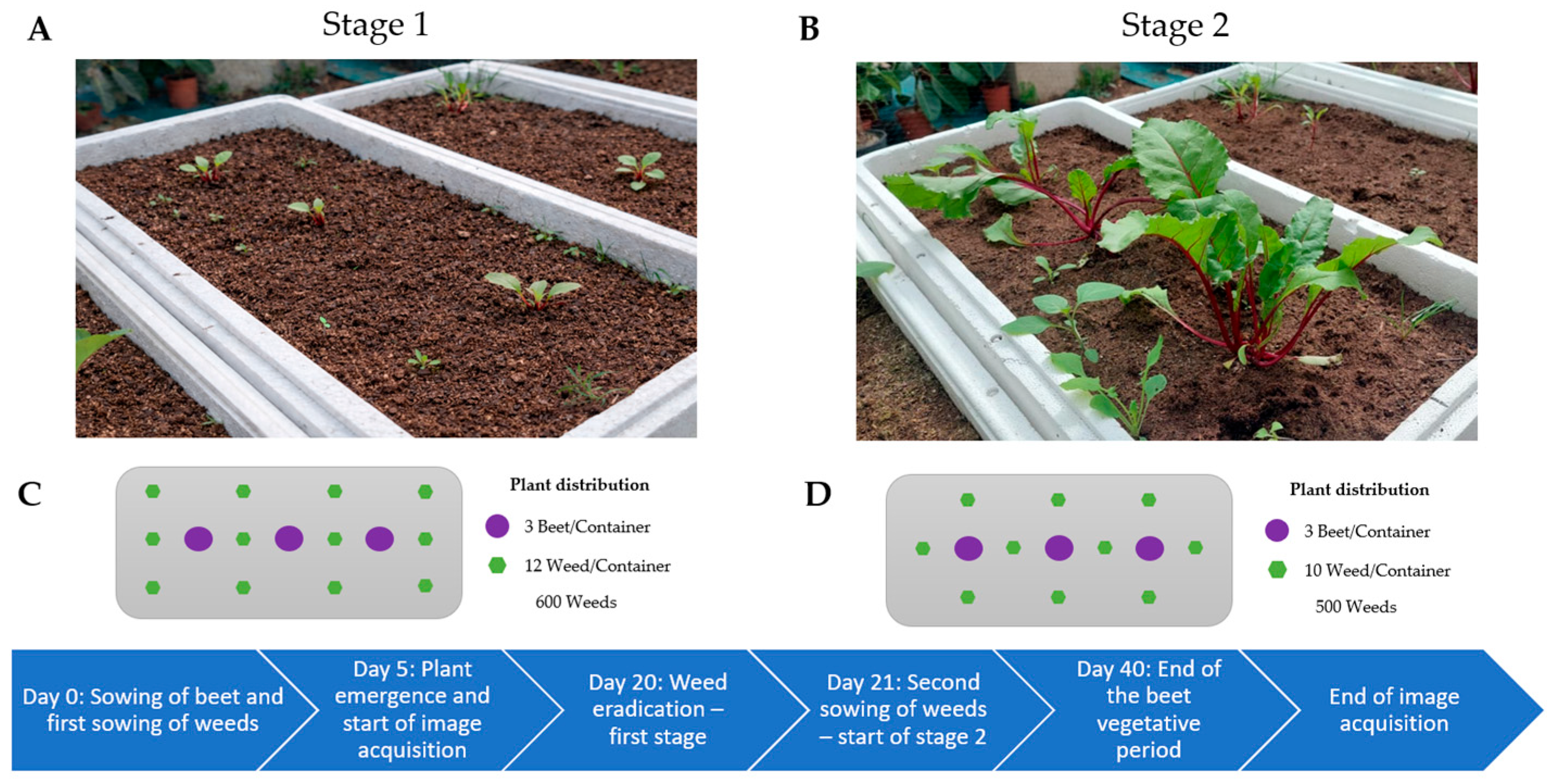
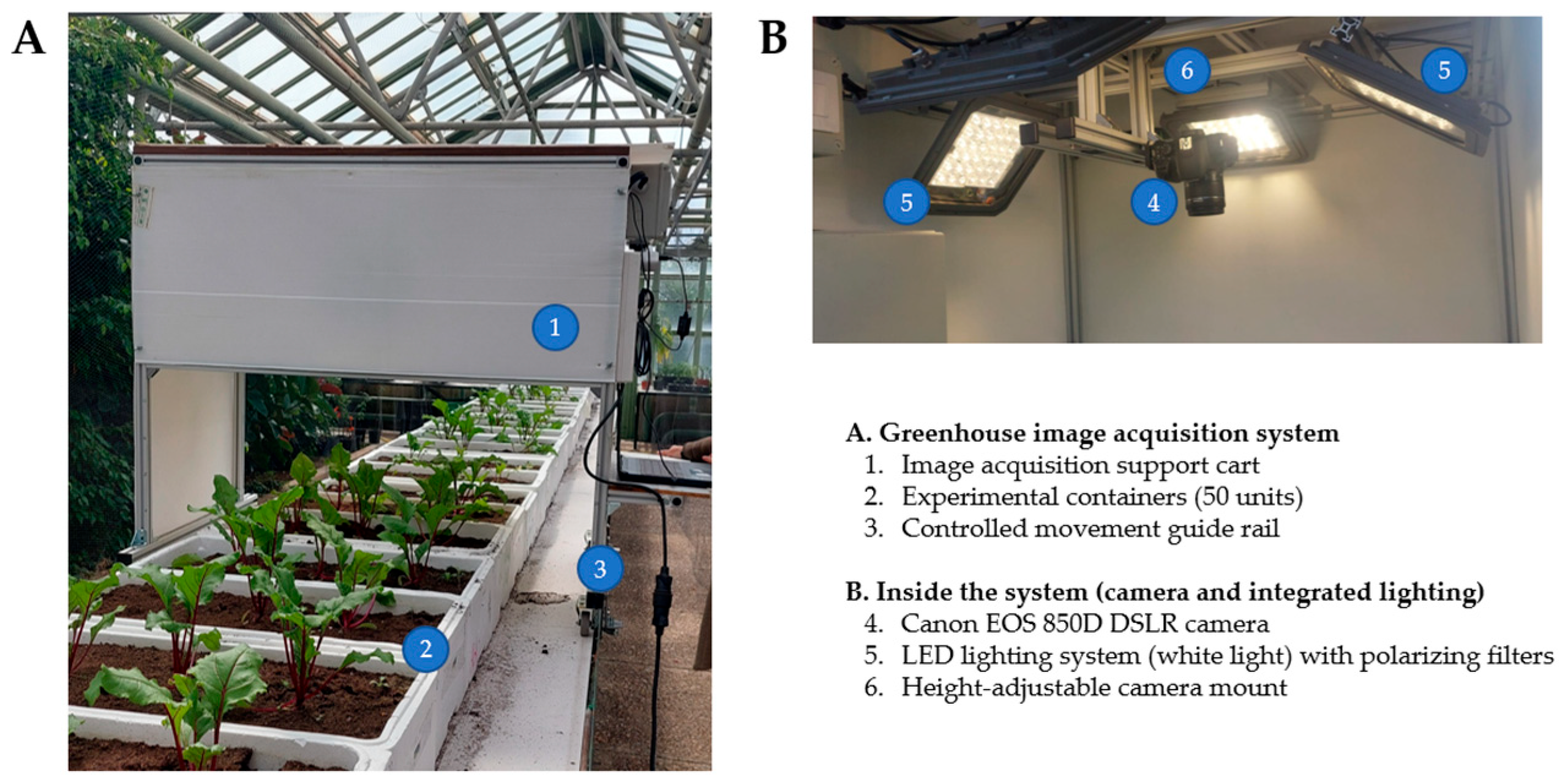
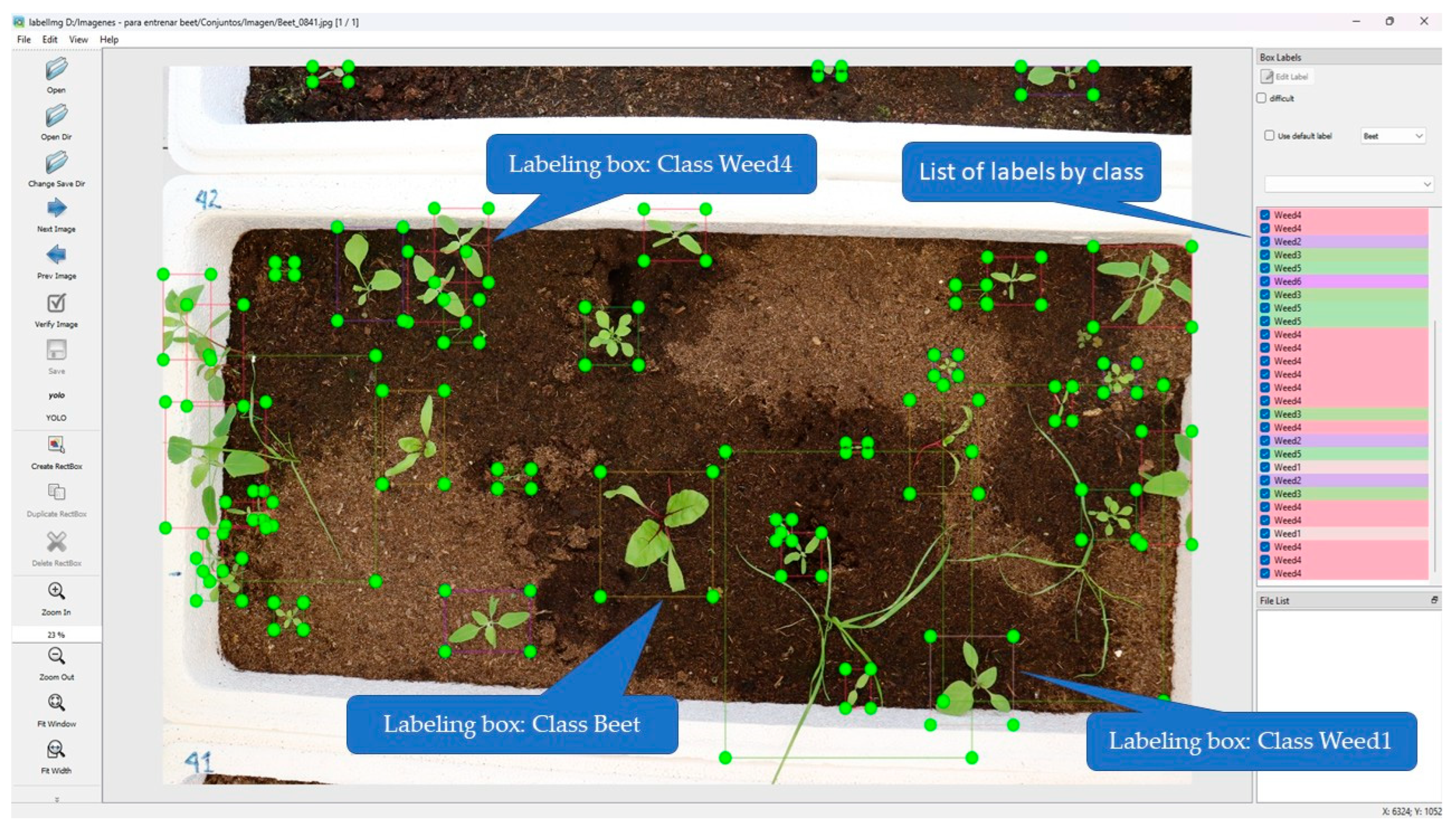
Section 2 describes in detail the materials and methods employed, including the experimental design, the biological material used, the image acquisition and annotation process, and the model configurations and evaluation metrics.
Section 3 presents the results obtained and their comparative analysis, examining the performance of the different CNN architectures for weed detection under controlled greenhouse conditions. Finally,
Section 4 presents the conclusions of the study, highlighting the main contributions, observed limitations, and future perspectives for implementing computer vision systems for precision weeding in high-value horticultural crops such as red beet (
Beta vulgaris L., Conditiva Group). The major contributions of this work are as follows: (1) build a greenhouse RGB dataset for red beet (1630 annotated images; crop + six weed classes) in YOLO format; (2) we propose a three-phase protocol to select architecture, model scale, and input resolution using operationally relevant criteria with emphasis on reducing false negatives; (3) we evaluate multiple YOLO versions (v8–v12) and RT-DETR-l under the same acquisition setting and quantify the effect of scaling and resolution (1024 and 2048 px); and (4) we analyze error modes using precision–recall behavior and confusion patterns to identify candidate configurations for subsequent field validation.
3. Results and Analysis
The following subsections present the results from each phase, highlighting the performance of the evaluated architectures and the experimental decisions that guided the study.
3.1. Results Phase 1: Baseline Configuration (YOLOv9s vs. RT-DETR-l, 640 × 640)
3.1.1. Performance of the YOLOv9s Baseline Configuration
The YOLOv9s model achieved moderately satisfactory overall performance in detecting the beet crop and the six weed classes (
Table 3), with an average F1-score of 0.686 and an mAP@0.5 of 0.688. These metrics indicate an acceptable level of accuracy, although still insufficient for an operational in-field weed control system. Overall precision (0.711) and recall (0.665) values indicate balanced performance, but with a tendency to miss true instances (FN = 28.9%), which is critical in agricultural contexts, where each missed detection represents an uncontrolled weed and therefore a potential yield loss.
The model showed strong discriminative ability for the classes Beet, Weed3, and Weed6, with F1-scores ranging from 0.740 to 0.752, indicating stable performance for species with well-defined morphology and high chromatic contrast. However, classes Weed4 (Chenopodium album) and Weed5 (Conyza canadensis) recorded the lowest values (0.654 and 0.609), along with high rates of false positives and false negatives (>40%). These shortcomings suggest that the model struggles to distinguish foliar structures similar to those of the crop and to handle illumination variability or overlapping vegetation.
From an agronomic perspective, the magnitude of the observed false negatives compromises the operational reliability of the model for precision weeding applications. In such systems, the priority is not only to avoid erroneous detections, but to ensure exhaustive identification of weeds, even at the cost of increasing false positives. In this sense, the global F1-score below 0.70 indicates that YOLOv9s still does not meet the performance threshold required for direct deployment in field conditions.
3.1.2. Performance of the RT-DETR-l Baseline Configuration
The RT-DETR-l model exhibited an overall intermediate performance, characterized by high sensitivity but limited precision, resulting in less balanced behaviour than that observed for YOLOv9s (
Table 4). The model achieved a global F1-score of 0.648 and an mAP@0.5 of 0.716, indicating adequate spatial detection capability, albeit with notable errors in final classification. On average, it achieved Precision = 0.549 and Recall = 0.798, indicating a clear tendency toward overprediction, at the expense of accuracy.
The high global recall (0.798) demonstrates that the model can identify most crop and weed instances in the image, reducing the risk of omission (FN = 45.14%, higher than that observed with YOLOv9s). However, this gain in sensitivity comes at the cost of a high false-positive rate (FP = 20.20%), reducing the practical reliability of the system. In automated control scenarios, this behaviour may lead to unnecessary herbicide applications or mechanical weeding errors, affecting both operational efficiency and agronomic precision.
At the class level, the most consistent detections were obtained for Beet (F1 = 0.717), Weed4 (0.662), and Weed6 (0.681), all with mAP@0.5 values above 0.69, suggesting that the model robustly recognizes larger objects or those with regular morphology. However, species Weed2, Weed3, and Weed5, which exhibit more variable leaf structures or partial occlusions, showed a decline in precision (0.45–0.52) combined with high recall (>0.80), indicating a tendency to over-detect when classifying ambiguously. This pattern is characteristic of Transformer-based architectures, which prioritize global attention at the expense of fine details, especially when spectral differences between crop and weeds are minimal.
From an agronomic standpoint, although RT-DETR-l reduces the false negative rate and improves detection coverage, its F1-score below 0.65 limits its direct applicability in the field. The model shows promising potential for assisted or combined detection systems (ensembles), where its high sensitivity could complement more precise models such as YOLOv9s. However, its current performance highlights the need to optimize confidence thresholds and spatial attention mechanisms to better balance sensitivity and precision, ensuring exhaustive detection without compromising system reliability.
3.1.3. Comparison Between YOLOv9s and RT-DETR-l
Table 5 summarizes the overall behaviour of both models, revealing clear differences in their balance between precision and sensitivity. YOLOv9s exhibited more stable and controlled performance, with the highest F1-score (0.686) and a better trade-off between precision and recall, whereas RT-DETR-l, despite achieving higher recall, substantially reduced precision, resulting in more incorrect detections. This contrast reflects two opposing tendencies: YOLOv9s is conservative and tends to miss some weeds, whereas RT-DETR-l is more sensitive but less reliable in its final classification.
From an agronomic standpoint, both scenarios are problematic: omissions (false negatives) reduce weed control effectiveness, and erroneous detections undermine the operational precision of weeding. Therefore, the results confirm that neither of the two architectures achieves an adequate balance between sensitivity and specificity, which justifies the need for new training runs, parameter tuning, and the evaluation of more advanced architectures aimed at improving sensitivity without sacrificing precision in weed detection in red beet.
In interpretive terms, the comparison reveals different operating behaviours. YOLOv9s maintains a more controlled trade-off between precision and sensitivity, whereas RT-DETR-l achieves higher sensitivity at the cost of a marked reduction in precision, leading to increased spurious detections and limiting practical reliability. This is relevant for weed management because an automated system must maximise coverage to avoid leaving weeds untreated, while keeping false activations low to prevent unnecessary interventions. Consequently, these findings support proceeding to an optimisation stage focused on reducing omissions without compromising robust overall performance.
3.2. Results Phase 2: Extended Architecture Evaluation (YOLOv8s, YOLOv9s, YOLOv10s, YOLO11s YOLO12s + RT-DETR-l, 640 × 640)
3.2.1. Performance of the YOLOv8s Baseline Configuration
The YOLOv8s model showed limited overall performance, with a global F1-score of 0.651 and an mAP@0.5 of 0.666, indicating moderate detection capability and poorer generalization compared with later YOLO versions. Although the average precision (0.673) and recall (0.636) remained balanced, the model exhibited a marked tendency to omit true instances (FN = 32.7%), a critical issue in weed detection, since each omission represents an uncontrolled plant and therefore a potential loss of efficiency in weeding or localized herbicide application. The per-class analysis revealed a wide variability in performance (
Table 6), with outstanding results for Beet (F1 = 0.714) and Weed3 (F1 = 0.715), whereas Weed2 (F1 = 0.614) and Weed5 (F1 = 0.585) showed the greatest limitations, with error rates above 40%, associated with morphological similarity to the crop and illumination variations during image acquisition.
From an agronomic perspective, recall levels below 0.65 in most classes indicate that the model does not achieve sufficient detection coverage for direct field implementation. In practice, this behaviour would imply that a significant number of weeds remain undetected, reducing the effectiveness of intelligent spraying systems or precision weeding. Although the achieved precision is moderate, the operational cost of false negatives far outweighs the benefit of avoiding false detections.
3.2.2. Performance of the YOLOv10s Baseline Configuration
The YOLOv10s model achieved a global F1-score of 0.676 and an mAP@0.5 of 0.665, slightly better than YOLOv8s but still limited for reliable field deployment. Although the model maintained a high average precision of 0.749, its recall of 0.617 indicates insufficient sensitivity (
Table 6), with a marked tendency to miss true detections (FN = 25.1%). This gap between precision and sensitivity suggests that, while the model is often correct when it produces a detection, it still fails to identify a substantial number of weeds, compromising the effective coverage of the system.
At the class level, the most consistent detections corresponded to Beet (F1 = 0.722), Weed3 (F1 = 0.725), and Weed6 (F1 = 0.714), with moderate error rates (FP < 35% and FN < 25%), indicating stable recognition in species with greater morphological and chromatic contrast. In contrast, Weed5 (F1 = 0.604) and Weed1 (F1 = 0.633) yielded the poorest results, with false-positive rates above 44%, revealing high confusion with the background and crop foliage. From an agronomic standpoint, recall levels below 0.65 confirm that the model does not achieve sufficiently comprehensive detection for effective weed control in the field. This limitation implies that a relevant fraction of weeds could go unnoticed, reducing the effectiveness of weeding or localized herbicide application. In crops such as beet, where early competition is critical, model sensitivity is more decisive than precision to guarantee operational applicability.
3.2.3. Performance of the YOLO11s Baseline
The YOLO11s model achieved an average F1-score of 0.674 and an mAP@0.5 of 0.691, showing stable performance and more homogeneous behaviour across classes compared with its predecessors. The mean precision (0.687) and recall (0.665) indicate a slight improvement in detection consistency (
Table 6). However, the model still exhibits a false-negative rate of 31.3%, indicating that a significant number of true instances are still missed. Nevertheless, the reduction in false positives (33.5%) relative to earlier versions suggests progress in the model’s ability to discriminate background vegetation, providing greater control over spurious detections.
Individually, the crop Beet (F1 = 0.730) and the weeds Weed3 (F1 = 0.714) and Weed6 (F1 = 0.754) showed the strongest results, with a good balance between precision and sensitivity, reflecting robust performance across chromatic and morphological variability. In contrast, Weed1 (F1 = 0.585) and Weed5 (F1 = 0.630) remained the most challenging classes, due to confusion with the background and their lower representation in the training set. From an agronomic viewpoint, the model exhibits intermediate operational capability, sufficient for experimental applications or decision-support systems, but still limited for the exhaustive detection required in selective weed control, where the omission of individuals can compromise the effectiveness of intervention. However, the improvement observed in inter-class stability suggests that YOLO11s provides a more mature baseline for subsequent optimizations aimed at field implementation.
3.2.4. Performance of the YOLO12s Baseline Configuration
The YOLO12s model achieved an average F1-score of 0.671 and an mAP@0.5 of 0.690, demonstrating stable, predictable behaviour across classes (
Table 6), though without a substantial performance leap over YOLO11s. The global precision of 0.685 and recall of 0.663 reflect a balanced relationship between correct detections and sensitivity, with a slight improvement in the management of false positives (FP = 33.7%) compared with previous models. This balance points to a more refined architecture that maintains consistency without degrading performance for minority classes. However, the false negative rate (31.5%) still limits its direct use in field scenarios. Per-class performance was relatively uniform, with Beet (F1 = 0.710), Weed3 (F1 = 0.732), and Weed6 (F1 = 0.717) standing out for their stability and low error levels, suggesting good discrimination in species with well-defined leaf structures. Conversely, Weed5 (F1 = 0.571) remained the most problematic category, with more than 50% false positives associated with confusion with the background and less distinctive visual patterns. From an agronomic perspective, the model offers relative reliability for assisted applications but still lacks the sensitivity required for exhaustive detection in precision weeding systems. While the achieved precision indicates a more mature and efficient architecture, the magnitude of false negatives suggests that YOLO12s requires additional modifications to achieve better performance.
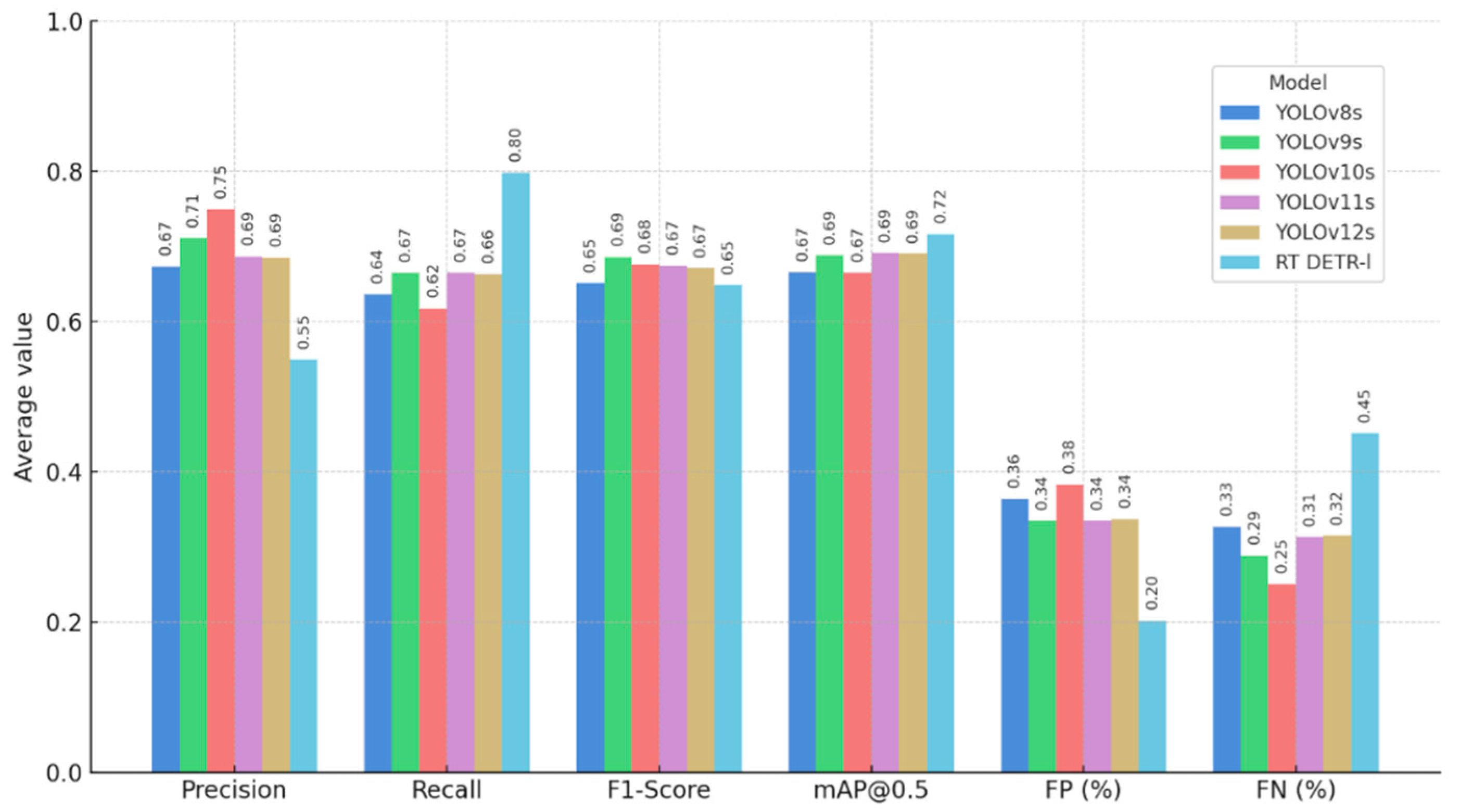
3.2.5. Global Benchmarking and Selection of Architectures for Scaling Based on F1 and FN
The comparative analysis reveals a progressive evolution in the performance of the YOLO models across versions (
Table 6). From a technical and agronomic standpoint, the comparative analysis of the models shows that YOLOv9s and YOLOv10s were the architectures with the best overall performance (
Figure 5), combining the highest F1-scores (0.686 and 0.676, respectively) with the lowest false negative rates (28.9% and 25.1%). This result is particularly relevant in the agricultural context, where FNs correspond to undetected weeds that persist in the field, maintaining direct competition with the crop and reducing the effectiveness of control measures.
Although none of the models achieves perfect detection, both provide an adequate balance between precision and sensitivity, ensuring effective coverage without generating excessive false detections. In particular, YOLOv9s stands out for its inter-class stability and consistency in identifying both the crop and the weeds, whereas YOLOv10s exhibits more conservative behaviour but with an acceptable error margin for precision weeding applications. Consequently, a third phase was initiated, consisting of training the higher-capacity variants (s, m, l, and x) of the selected architectures (YOLOv9 and YOLOv10) to analyse whether the increase in structural complexity, number of parameters, and network depth translates into improved performance and stability in weed detection. In addition, the effect of input resolution (1024 × 1024 and 2048 × 2048 pixels) on system precision and sensitivity was evaluated to determine the most robust and agronomically viable configuration for implementation in computer vision systems for precision weeding.
Based on the homogeneous 640 × 640 px benchmark, the results indicate that architectural differences alone do not necessarily translate into fewer omissions, as several models exhibit comparable overall performance and similar sensitivity constraints under identical training conditions. Consequently, candidate selection for scaling was driven by the stability of the precision–sensitivity trade-off, since missed weeds impose a higher operational cost than overdetections in selective control. Therefore, Phase 2 served to narrow the search space and advance only those model families most likely to benefit from increased capacity and higher input resolution in the subsequent phase.
3.3. Results Phase 3: Model Scaling and Input Resolution (YOLOv9–YOLOv10, 1024 and 2048)
The results obtained in this phase provide an accurate view of model behaviour under different scaling levels, enabling the identification of the most efficient and robust configurations for their application in computer vision systems for precision weeding in red beet cultivation (
Table 7).
The scaling of the YOLOv9 and YOLOv10 models revealed a general trend of improved stability and consistency in detections as both network capacity and input resolution increased. Overall, the models trained on 2048 × 2048 pixel images systematically outperformed their 1024 × 1024 counterparts, with F1-score gains of up to 7% and marked reductions in false-negative rates. This behaviour confirms that higher spatial density contributes to better delineation of fine structures such as leaf margins, overlaps, and partial occlusions—elements that are critical for discriminating between crop and weeds under real field conditions.
Within the YOLOv9 family, the YOLOv9e-2048 variant emerged as the best configuration, achieving an F1-score of 0.738, an FN rate of 28.34%, and the highest mAP@0.5 of the entire phase (0.779). This model exhibited a solid balance between precision and sensitivity, showing consistent detection performance even for species with morphological or colour features similar to the crop. By contrast, the smaller versions (YOLOv9s and YOLOv9m) delivered acceptable performance but with a slight loss of sensitivity (FN > 28.5%), suggesting that increasing the number of parameters and network depth enhances generalization capacity without compromising operational efficiency.
3.4. Comparative Summary Across Phases
The three-phase approach allowed us to move from an initial comparison between detector families (CNN vs. Transformer) to an informed selection of architectures and, finally, to the optimization of capacity and resolution to reduce false negatives (FN), which is the most critical failure mode in weed control. The strength of the approach lies in the fact that each phase restricts the search space and converts performance findings (F1, FN%, and mAP@0.5) into explicit experimental decisions about which models to scale and at what resolution to evaluate.
In Phase 1 (baseline, 640 × 640), under homogeneous conditions, YOLOv9s showed moderate and relatively balanced overall performance (F1 = 0.686; FN = 28.9%), while RT-DETR-l showed high sensitivity but low precision (Recall = 0.798; Precision = 0.549), with a lower F1 (0.648) despite a higher mAP@ 0.5 (0.716), confirming that mAP alone does not reflect the operational cost of errors when the system tends to overpredict or when the final classification is unstable. Therefore, this phase contributes to the use of F1 and FN% as primary criteria for selecting the most efficient architecture and most aligned with the agronomic objective of minimizing undetected weeds.
In Phase 2 (extended benchmark, 640 × 640), the homogeneous comparison between YOLO versions revealed systematic differences under the same training configuration: YOLOv8s was the most limited (F1 = 0.651; FN = 32.7%), YOLOv9s maintained the best balance (F1 = 0.686; FN = 28.9%), and YOLOv10s stood out for its high precision (0.749) and lowest FN at 640 (25.1%), although with moderate recall (0.617; F1 = 0.676). YOLO11s/YOLO12s showed stability in mAP (0.690–0.691) but no clear improvements in FN (31%), limiting their operational advantage. Overall, this phase consolidated a reproducible ranking and justified limiting scaling to YOLOv9 and YOLOv10 due to their better overall profile and lower omission rate.
In Phase 3 (scaling + 1024/2048 resolution), the increase in resolution and, to a lesser extent, model capacity consistently improved performance and reduced omissions, demonstrating that greater spatial detail favors detection under overlaps and occlusions. In YOLOv9, going from 1024 to 2048 increased F1 (e.g., 0.689 → 0.734 in YOLOv9s) and reduced FN (32.5% → 28.2%), with an increase in mAP@0.5 (0.727 → 0.774), with YOLOv9e-2048 standing out as the most robust configuration (F1 = 0.738; FN = 28.34%; mAP@0.5 = 0.779). In YOLOv10, the 2048 variants achieved the best F1 scores in the study, with YOLOv10m-2048 as the best compromise (F1 = 0.744; FN = 27.48%; mAP@0.5 = 0.775), while larger variants showed marginal gains or changes in the trade-off. Methodologically, the phase confirms that resolution is a dominant factor and that scaling must be justified by net improvements in F1/FN, not just mAP.
Overall, Phase 1 provided a diagnosis of the trade-off between families (control vs. overprediction) and established decision metrics; Phase 2 provided a homogeneous benchmark for selecting candidates with the best operational profile; and Phase 3 quantified the impact of resolution and scaling, identifying priority configurations (YOLOv9e-2048 and YOLOv10m-2048) for further validation. This progression reduces experimental redundancy because each stage fulfills a different function (baseline → screening → optimization) and transforms results into design decisions, improving methodological traceability and the reproducibility of the architecture selection process for multi-class weed detection in red beets.
Moreover, phase 3 indicates that input resolution is a dominant factor in crop–weed scenes with overlap and partial occlusion, as it preserves fine details such as leaf edges, textures, and small structures, which improves separability between visually similar classes. Consequently, configurations with 2048 × 2048 px tend to stabilize performance and reduce omissions compared to 1024 × 1024 px, consolidating the finalist models as more consistent alternatives for a greenhouse environment. This reinforces that scaling should be justified by net improvements in operational metrics, not just slight increases in mAP.
3.5. Class Evaluation and Performance Analysis of the Finalist Models
3.5.1. Analysis of YOLOv9e at 2048-Pixel Resolution
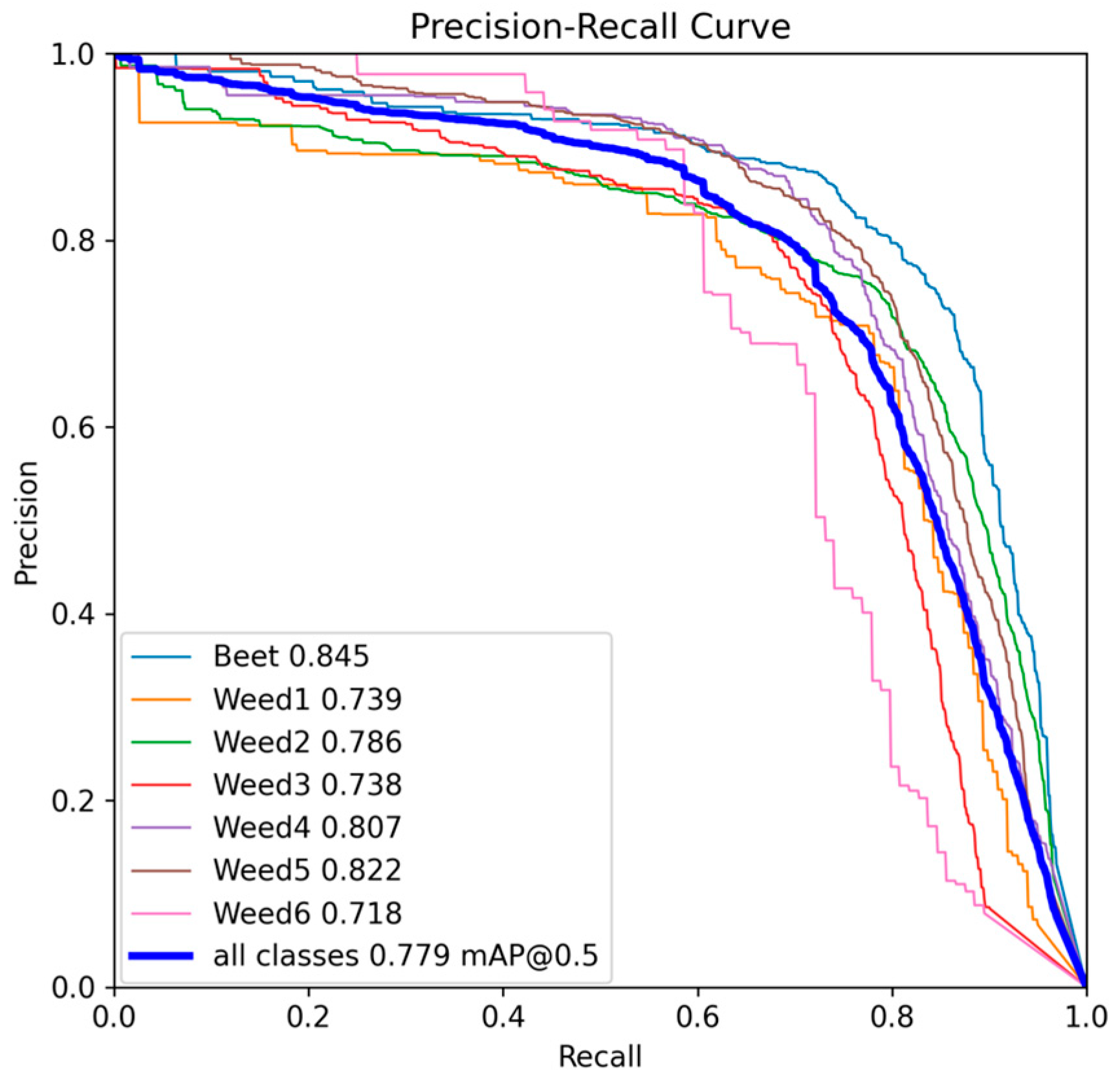
As noted above, the YOLOv9e model at 2048 pixels exhibited a consistent balance between precision and sensitivity, achieving an mAP@0.5 of 0.779 and a global F1-score of approximately 0.738.
The PR curves (
Figure 6) show smooth trajectories without early collapses, indicating stable behaviour across different thresholds. The area under the curve (AP) confirms the following order of per-class performance: Beet (0.845), followed by Weed5 (0.822), then Weed4 (0.807), Weed2 (0.786), Weed3 (0.738), Weed1 (0.739), and finally Weed6 (0.718). In practical terms, Beet, Weed5, and Weed4 maintain high precision even at elevated recall values; Weed2 retains solid behaviour but loses precision when recall exceeds approximately 0.8; and Weed1, Weed3, and Weed6 exhibit an earlier drop in precision, indicating greater sensitivity to occlusions, background texture, and inter-species similarity.
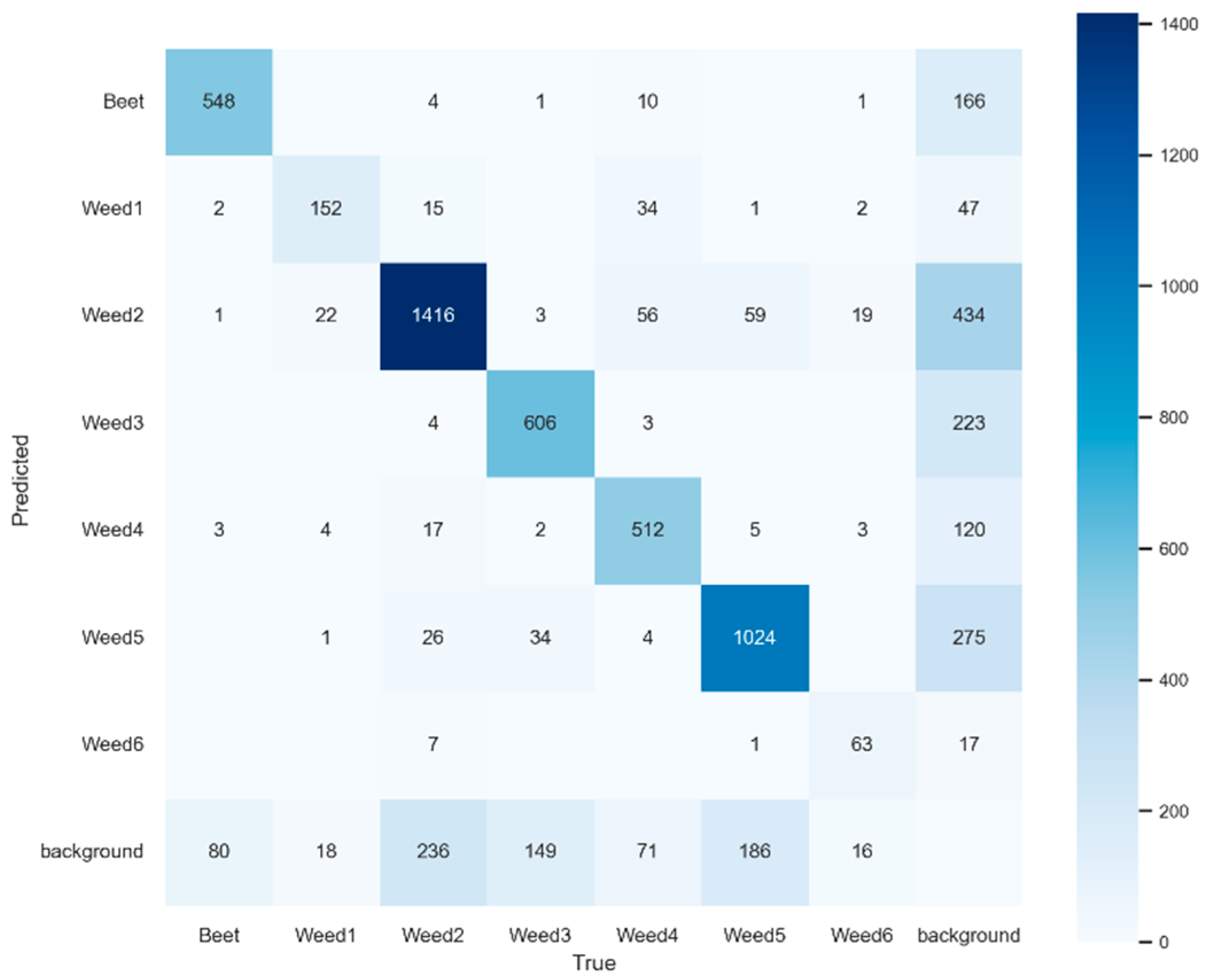
Taken together, the model keeps errors under control in the dominant classes. Beet shows FP of 13.56% and FN of 24.93% (
Table 8), consistent with 166 Beet predictions drifting to background and 80 true Beet instances missed to background (
Figure 7), yielding an F1 of 0.804. Weed5 and Weed2 display an operationally solid profile: Weed5 with FP of 19.75% and FN of 24.93% (F1 = 0.776); Weed2 with FP of 17.91% and FN of 29.55% (F1 = 0.758). In both cases, the main error source is FN falling into the background (Weed5: 186; Weed2: 236), consistent with omissions driven by occlusion, object size, or NMS effects rather than by inter-species confusion.
In the intermediate block, Weed4 and Weed3 maintain F1 values of 0.755 and 0.743, with FP rates of 25.80% and 23.77%, and FN rates of 23.12% and 27.51%, respectively. The matrix (
Figure 7) shows that Weed4 does suffer from cross-confusion (FN distributed toward Weed2: 56 and Weed1: 34, in addition to 71 to background), whereas Weed3 is mainly lost to background (223) with very little drift to other classes. This suggests prioritising techniques for recovering partially occluded objects rather than hardening inter-class decision boundaries.
The critical classes are Weed1 and Weed6. Weed1 combines an FN of 39.92%, an FP of 22.84%, and an F1 of 0.676; the matrix shows that almost half of its FN drifts to Weed2 (15) and Weed4 (34), in addition to 18 to background, highlighting the impact of morphological similarity. Weed6 exhibits an FP of 39.42% and an FN of 28.41%, with an F1 of 0.656; its errors concentrate on confusion with Weed2 (7) and losses to background (17), which increases with the low sample size.
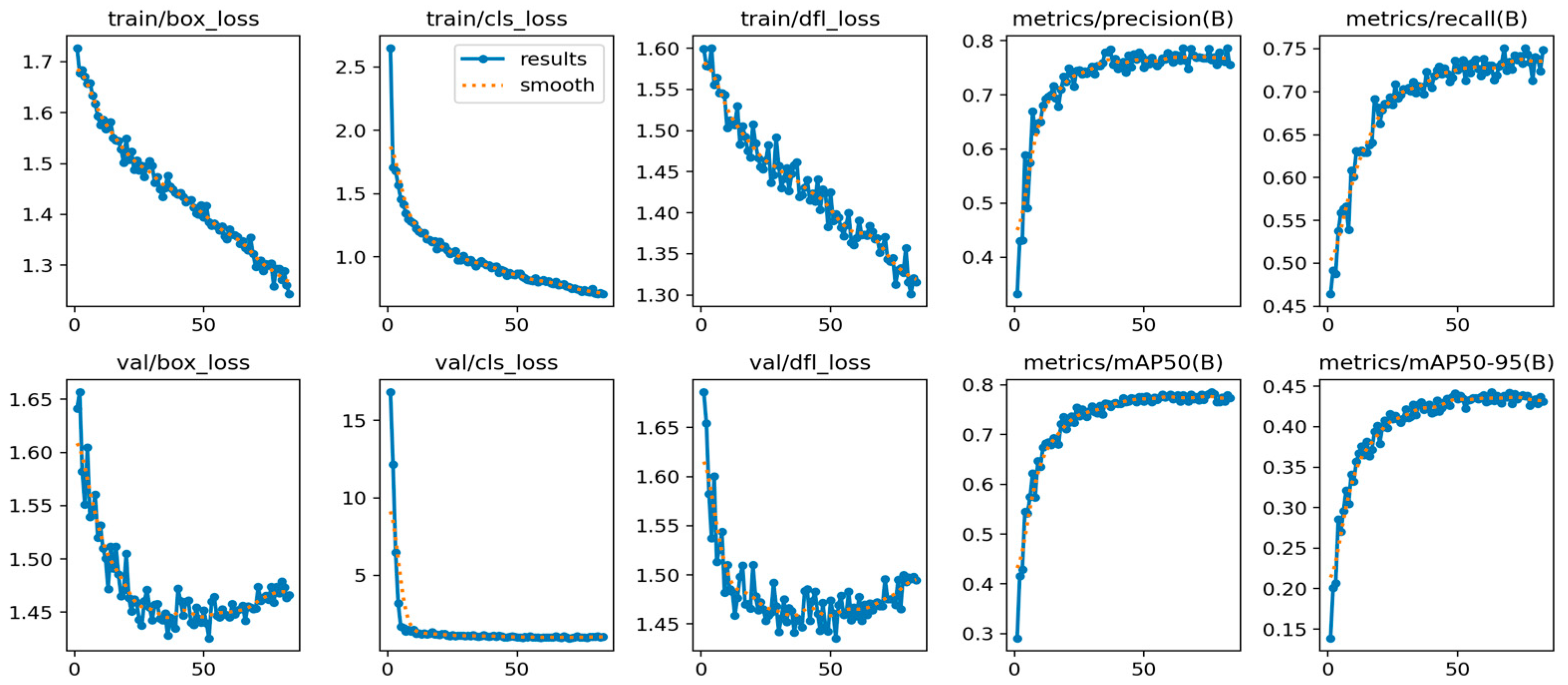
Regarding training, YOLOv9e-2048 (
Figure 8), the learning dynamics show a continuous reduction in training losses, with regular decreases in train/box_loss, train/cls_loss, and train/dfl_loss, confirming a progressive adjustment of both box regression and class discrimination. In validation, val/cls_loss stabilizes early after the initial drop, indicating that the separation between categories is consolidated in a few epochs. In contrast, val/box_loss and val/dfl_loss decline rapidly and then stabilize with a slight final increase, a typical pattern when the improvement in localization becomes marginal and an incipient loss of generalization appears in the geometric adjustment, without this translating into relevant operational degradation.
In terms of metrics, the model reaches a consistent regime with precision (0.78) and recall (0.74–0.75), accompanied by mAP@0.5 = 0.78 and mAP@0.5:0.95 = 0.44, with clear stabilization after the first few dozen epochs. This behavior suggests that the final performance is dominated by an early stage of efficient learning and that, subsequently, training enters a zone of fine refinement with limited gains.
3.5.2. Analysis of YOLOv10m at 2048-Pixel Resolution
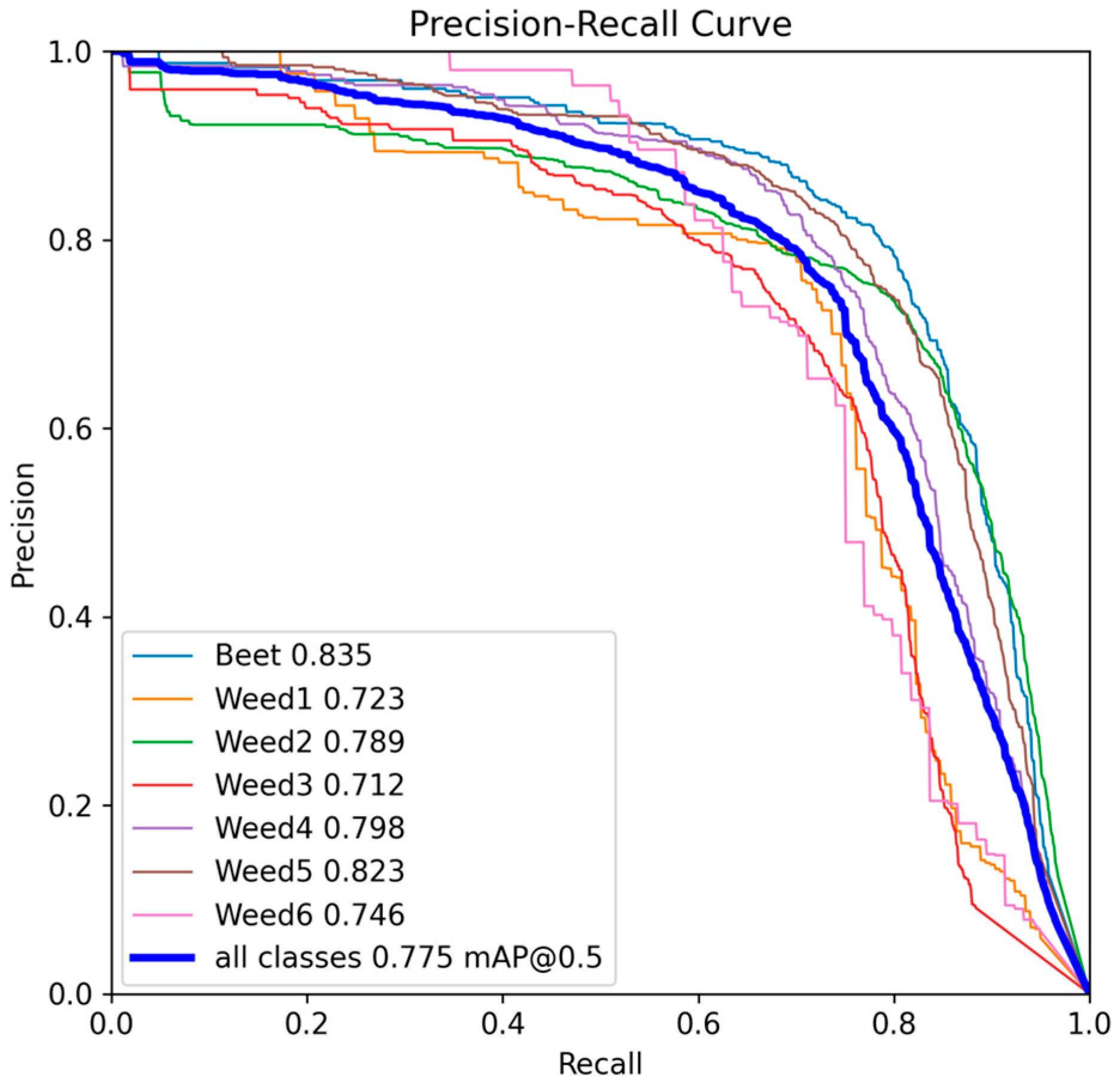
Within the YOLOv10 family, the YOLOv10m variant at 2048-pixel resolution maintained a well-balanced global performance, achieving an mAP@0.5 of 0.775 and an average F1-score of 0.744, placing it among the best-performing models in the entire series. This result reflects an appropriate relationship between precision (0.725) and sensitivity (0.766), with a noticeable reduction in false negatives compared with lower-resolution models. The overall stability of the model confirms that the increase in capacity and spatial detail favoured the detection of fine structures and the separation of morphologically similar classes.
The PR curves (
Figure 9) show stable behaviour without abrupt drops, indicating a coherent model response to changes in confidence thresholds. The area under the curve (AP) reveals the following order of per-class performance: Beet (0.835), Weed5 (0.823), Weed4 (0.798), Weed2 (0.789), Weed6 (0.746), Weed1 (0.723), and Weed3 (0.712). In practical terms, Beet, Weed5, and Weed4 maintain high precision even at elevated recall levels, suggesting good morphological discrimination; Weed2 preserves stable performance, although it is more sensitive at high thresholds, whereas Weed1, Weed3, and Weed6 exhibit earlier drops in precision, associated with visual similarity and low occurrence frequency.
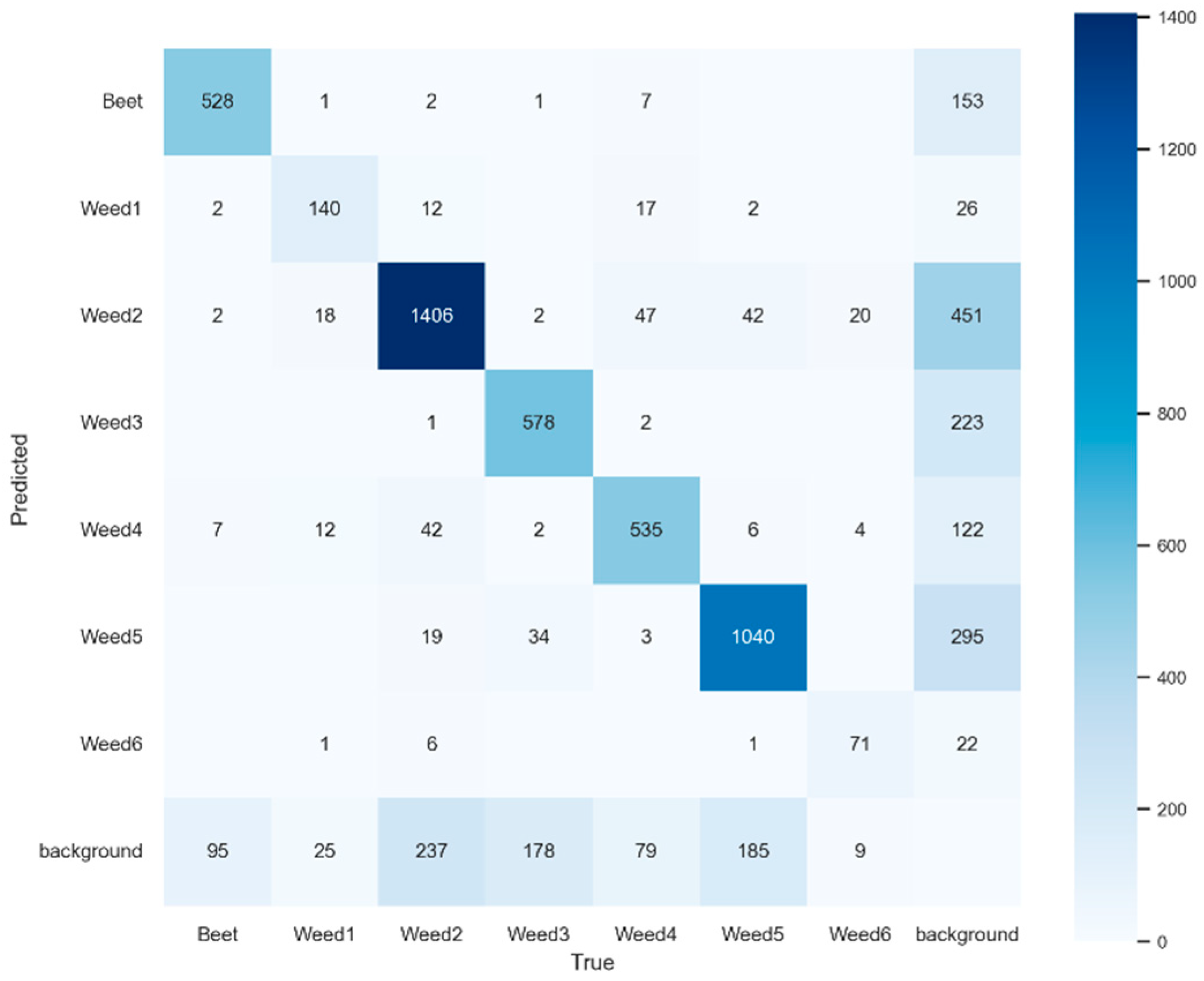
According to the confusion matrix (
Figure 10), the dominant classes showed low error rates. The Beet class reached an F1-score of 0.796, with 16.72% FP and 23.70% FN (
Table 9), values consistent with 153 incorrect predictions to background and 95 true instances not detected. Among the weed classes, Weed5 (F1 = 0.780), Weed2 (F1 = 0.757), and Weed4 (F1 = 0.754) exhibited stable operational performance, with FN ranging from 25% to 29% and FP below 23%. Most errors corresponded to omissions to background, with 295, 451, and 122 instances, respectively. Occasional inter-class confusion was also observed, mainly between Weed2 and Weed5 and between Weed2 and Weed4, attributable to chromatic and morphological similarities at early phenological stages. These patterns suggest the need to refine non-maximum suppression mechanisms and spatial separation between classes to reduce losses due to overlap.
The intermediate classes, Weed3 (F1 = 0.723) and Weed1 (F1 = 0.707), maintained acceptable performance, with false negatives around 29% and false positives in the 27–29% range. In both cases, most omissions corresponded to detections classified as background (223 and 26 cases, respectively), indicating limitations in segmenting partially occluded structures. Weed6 (F1 = 0.693) remains the least stable class, with 31.7% false positives and 29.70% false negatives, which is associated with its low representation in the training set and its morphological similarity to other narrow-leaved species.
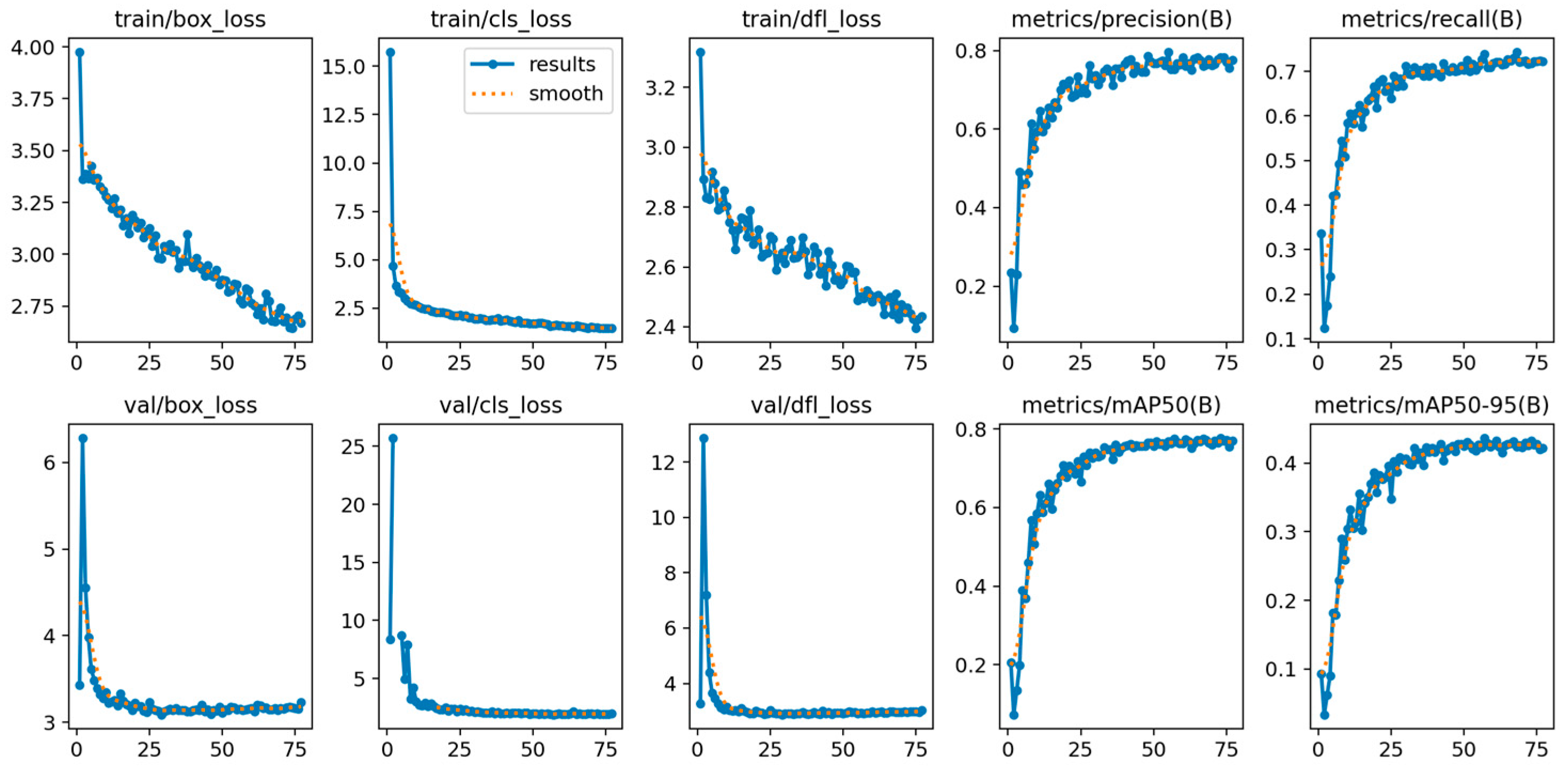
With regard to the training process, YOLOv10m-2048 (
Figure 11), the curves show a stable training process with good generalization. First, training losses (train/box_loss, train/cls_loss, and train/dfl_loss) decrease steadily throughout the epochs, without abrupt oscillations, indicating a progressive improvement in both localization and classification. In validation, the losses (val/box_loss, val/cls_loss, val/dfl_loss) show a sharp drop in the first ~10–15 epochs and then enter a plateau with small variations, without increasing separation from the training losses; this pattern is consistent with the absence of significant overfitting and suggests early convergence.
At the same time, performance metrics increase rapidly at the beginning and then stabilize: Precision increases to values close to 0.78–0.79, Recall converges around 0.72–0.73, and mAP@0.5 reaches a plateau close to 0.78, while mAP@0.5:0.95 stabilizes around 0.43. Most of the gain occurs in the first ~20–30 epochs, and subsequent improvements are marginal, supporting that the model reaches a stable and reproducible performance regime.
Overall, class-level results indicate that remaining errors are mainly due to omissions that end up being assigned to the background and confusion between morphologically similar weeds, especially in low-frequency classes. Precision–Recall (PR) curves show stable behavior for dominant classes, while minority classes show earlier degradation of precision, consistent with occlusions and limited representation. These patterns suggest that robustness is limited less by overall learning dynamics and more by the detection of small or overlapping objects and class imbalance at the inference stage.
From an agronomic perspective, false negatives are the most critical factor, as they imply undetected weeds that are not treated during weeding or selective spraying. In this context, both YOLOv9e-2048 and YOLOv10m-2048 stand out for combining high sensitivity and precision with moderate error levels, ensuring sufficient detection coverage to maintain crop competitiveness against weed interference. Although neither model achieves perfect performance, both provide a stable response aligned with the operational requirements of precision agriculture, making them the most suitable candidates for subsequent field validation stages.
4. Conclusions
This study confirms the preliminary feasibility, under controlled conditions, of deep learning–based detection models for automated weed identification in red beet, under a phased protocol and with selection criteria centred on F1-score and false negatives (FN) as key metrics. The initial comparison of architectures, followed by capacity scaling and increased input resolution, enabled a rigorous characterization of the trade-off between precision, sensitivity, and inter-class stability in a controlled experimental setting.
In the baseline evaluation, YOLOv9s showed the best initial balance (global F1 of 0.686). In contrast, RT-DETR-l, despite its high recall, yielded a lower F1 score (<0.648) and a high FN rate, limiting its operational usefulness. With architectural scaling and increased resolution to 2048 × 2048 pixels, the best results were obtained with YOLOv9e-2048 (global F1 of 0.738; mAP@0.5 of 0.779) and YOLOv10m-2048 (global F1 of 0.744; mAP@0.5 of 0.775). These models maintained FN rates around 27–29% without a proportional increase in FP, and showed smooth Precision–Recall curves—altogether indicators of threshold robustness and good inter-class generalization.
From a weed management standpoint, FNs represent the system’s critical cost: each omission results in an untreated weed that continues to compete for water, light, and nutrients during the most sensitive crop stages. In this sense, YOLOv9e-2048 and YOLOv10m-2048 offer the best balance between sensitivity and overtreatment, emerging as potential candidates for integration into selective weeding/spraying systems, with sufficiently high F1 scores and acceptable FP/FN ratios for real-time operation. The per-class hierarchy derived from PR curves and AP supports this conclusion: the crop (Beet) and dominant weeds (e.g., Weed2, Weed4, Weed5) are consistently detected, while minority classes (Weed1, Weed6) require closer attention.
The findings of this study allow the selected models to be integrated into a selective weed control system in controlled environments, given that increasing the input resolution and scale of the models consistently reduces FN, which is critical because each FN implies an untreated weed. In practice, the detected crop and weed boxes are transformed into coordinates on the container plane through camera-plane calibration and translated into action commands according to the control mechanism. In selective spraying, each weed detection activates a nozzle and defines an application pulse; additionally, multi-class detection distinguishes weed types, allowing the application strategy to be adjusted by pulse intensity/time or dose variation. In mechanical weeding, crop detections delimit exclusion zones, and weed detections define weeding zones where the tool acts without affecting the crop.
Future Directions
Future work should prioritise field validation of the selected models across different phenological stages and soil management conditions. In open-field scenarios, lighting variability, soil background heterogeneity, wind-induced motion, and broader phenological diversity shift distributions relative to greenhouse imagery. Therefore, expanding the dataset with field images covering multiple growth stages and operational conditions for both crop and weeds is essential to improve class balance, reduce bias in underrepresented classes, and obtain a realistic assessment of performance under deployment conditions. In addition, model operation should be refined by evaluating confidence-threshold calibration and the suppression of overlapping detections under agronomic cost-sensitive criteria, aiming to reduce omissions while keeping unnecessary interventions under control. Finally, to enable embedded deployment in automated weed management platforms, future studies should quantify real-time constraints and assess lightweight optimisation strategies, such as model compression or efficient model combinations, while preserving the precision–sensitivity trade-off achieved in this work.