Article

Soil Environmental Factors Dominate over Nitrifier and Denitrifier Abundances in Regulating Nitrous Oxide Emissions Following Nutrient Additions in Alpine Grassland

1
College of Life Science and Engineering, Shenyang University, Shenyang 110044, China
2
State Key Laboratory of Desert and Oasis Ecology, Xinjiang Institute of Ecology and Geography, Chinese Academy of Sciences, Urumqi 830011, China
3
Department of Soil Science, University of Manitoba, Winnipeg, MB R3T 2N2, Canada
4
College of Life Science, Shihezi University, Shihezi 832003, China
5
Key Laboratory of Oasis Ecology, Ministry of Education, College of Ecology and Environment, Xinjiang University, Urumqi 830011, China
6
Research Center of Forest Management Engineering of State Forestry and Grassland Administration, Beijing Forestry University, Beijing 100083, China
*
Authors to whom correspondence should be addressed.
Agronomy 2026, 16(2), 168; https://doi.org/10.3390/agronomy16020168

Submission received: 1 December 2025 / Revised: 29 December 2025 / Accepted: 6 January 2026 / Published: 9 January 2026

Abstract

Nutrient additions including nitrogen (N) and phosphorus (P) are widely considered as an important strategy for enhancing grassland productivity. However, the effects of these nutrients additions on soil nitrous oxide (N2O) emissions and the underlying mechanisms remain debated. We conducted a two-year field experiment in an alpine grassland on Kunlun Mountain in northwestern China to assess the effects of N and P additions on N2O emissions, in relation with nitrifying enzyme activity (NEA), denitrifying enzyme activity (DEA), and key functional genes abundance responsible for nitrification (amoA and Nitrobacter-like nxrA) and denitrification (narG, nirS, nirK and nosZ). Compared to the Control without nutrient addition (CK), N addition alone substantially increased cumulative N2O emission (ƩN2O) by 2.0 times. In contrast, P addition or combined N and P (N+P) addition did not significantly affect ƩN2O, though both treatments significantly increased plant aboveground biomass. Such results indicate that P addition may mitigate N-induced N2O emission, likely by reducing soil N availability through enhanced plant and microbial N uptake. Compared to CK, N or N+P addition significantly elevated NEA but did not affect DEA. Structural equation modeling (SEM) indicated that NEA was directly influenced by the gene abundances of ammonia-oxidizing bacteria (AOB) and Nitrobacter-like nxrA but not by ammonia-oxidizing archaea (AOA). However, SEM also revealed that soil environmental variables including soil temperature, pH, and water-filled pore space (WFPS) had a stronger direct influence on N2O emissions than the abundances of nitrifiers. These results demonstrate that soil environmental conditions play a more significant role than functional gene abundances in regulating N2O emissions following N and P additions in semi-arid alpine grasslands. This study highlights that the N+P application can potentially decrease N2O emissions than N addition alone, while increasing productivity in the alpine grassland ecosystems.

1. Introduction

Nitrous oxide (N2O), recognized as the third most significant greenhouse gas (GHGs) globally, is responsible for 7.9% of global warming and for ozone layer depletion. Since the pre-industrial period, atmospheric N2O concentrations have increased from approximately 270 ppb to 338 ppb in 2025 [1], mainly driven by anthropogenic disturbance in the global nitrogen cycle, with the applications of synthetic nitrogen (N) fertilizers identified as a key contributor in the agriculture sector [2]. In addition to N, phosphorus (P) fertilizer has also been shown to affect N2O emissions, especially in the context of globally increasing P inputs. This is likely attributed to the strong link between N and P cycles [3,4]. Grasslands occupy about 20% of the global land area and serve as a major contributor to N2O emissions [5]. Application of N and P fertilizers is commonly used management practice in these systems to improve grass productivity [6]. Thus, it is crucial to clarify how N and P additions, either separately or together, affect N2O emissions in order to develop effective N2O mitigation strategies in grassland ecosystems.
Although many studies have assessed how N addition affects N2O emissions, fewer have examined the impacts of P or N+P addition, while also reporting inconsistent findings. For example, some laboratory and field studies found that P addition reduced N2O emissions by improving N absorption by plants or enhancing microbial N immobilization [7,8,9]. In contrast, using a 15N incubation experiment, Mehnaz and Dijkstra [10] reported increased N2O emission with P addition, likely due to stimulated denitrification activity when microbial P limitation was removed. Also using the 15N tracing approach, He and Dijkstra [11] demonstrated that P addition significantly increased N2O emission, driven by enhanced nitrification and denitrification. A few other studies showed no consistent effect. For instance, Mehnaz et al. [12] observed no effect of P addition on N2O emissions in grassland soils, possibly because P may not be a limiting factor for nitrifiers and denitrifiers in their grassland systems. For a forest study in southern China, Zheng et al. [13] similarly showed that N2O emissions were not higher with P or N+P addition than with N alone, suggesting that P addition could mitigate N-induced N2O emissions. However, these studies often relied on short-term incubation experiments and were mostly conducted in forest soils, making it hard to draw firm conclusions for grasslands.
N2O is primarily generated in soils via nitrification (including ammonia oxidation and nitrifier denitrification) and denitrification, both mediated by a diverse range of microbes, especially nitrifiers and denitrifiers [14]. Nitrification is the stepwise oxidation of ammonium (NH4+) to nitrite (NO2) and subsequently to nitrate (NO3). The primary and rate-limiting step, ammonia oxidation, is performed by ammonia-oxidizing bacteria (AOB) and archaea (AOA), both of which possess the amoA gene encoding for ammonia monooxygenase, responsible for catalyzing the oxidation of NH4+ to hydroxylamine (NH2OH), a key intermediate in the production of NO2. NO2 is then further oxidized to NO3 by nitrite-oxidizing bacteria (especially Nitrobacter in soil) [15]. Denitrification is mediated by denitrifiers through a series of reductive steps, involving nitrate reductase (narG), nitrite reductase (nirS and nirK), and nitrous oxide reductase (nosZ), which catalyze the sequential reduction of NO3 to NO2, NO, N2O, and finally to N2 [16]. The relative importance of nitrification and denitrification to N2O emissions is regulated by both environmental factors, such as soil pH, temperature, moisture, oxygen availability, and nutrient availability (N, P, and carbon), and biological factors, including the population size and metabolic activity of nitrifiers and denitrifiers [17,18]. Some studies have evaluated how N fertilization influences the microbial genes related to N2O production and reduction. However, the impacts of P addition, particularly the N-P interactions, have received limited attention [19], and the results so far have been inconsistent. For instance, a global meta-analysis by You et al. [20] revealed that N addition significantly enhanced N2O emissions and the copy numbers of functional genes responsible for N2O production and reduction, as well as NEA and DEA. This study specifically addressed the key roles of nitrifiers of AOB and AOA, and the N2O reductase nosZ gene. Also using a global meta-analysis, Song et al. [21] showed that N addition significantly enhanced NEA, DEA, and AOB abundance but had no significant impact on other associated functional genes abundance, suggesting that N-induced N2O emissions were primarily driven by the enhanced nitrification. In a long-term fertilization field experiment in the temperate steppes of Inner Mongolia, Chen et al. [22] found that P addition significantly decreased AOB abundance, while N+P addition increased it. Wei et al. [23] found that P addition significantly increased N2O emissions from P-limiting grassland soils, presumably by enhanced denitrification through the stimulation of denitrifier abundance. In contrast, Tang et al. [24] found in subtropical forest that P addition, but not N addition, increased NEA and DEA, with soil N/P ratio being more important than microbial gene abundance. In addition, Domeignoz-Horta et al. [25], using more than 59,000 field observations, showed that soil chemical and physical characteristics such as pH, soil organic matter, and C/N ratio were more important determinants when N2O emissions were generally low (≤25th percentile of N2O emission), whereas microbial gene abundances are more important for determining high emissions (75–95th percentiles of N2O emission). It is important to recognize that many of these studies primarily focus on quantifying gene copy numbers at a single time point, neglecting the seasonal changes in N2O-associated microbial activity and abundance. Therefore, further field-based studies are essential for evaluating the roles of environmental and microbial factors in regulating real-time N2O fluxes in grassland ecosystems.
This study aimed to assess how N and P addition, individually and combined, affect N2O emission from a semi-arid alpine grassland in northwest China, in relation with the soil environmental and microbial factors. Previous research in this region found that two dominant grass species responded more strongly to P addition compared to N addition, suggesting that P is the primary limiting nutrient in this ecosystem [26,27]. Based on this, we hypothesized that N addition would increase N2O emission by stimulating microbial nitrification and denitrification, while P or N+P addition would reduce N2O emission by enhancing plant and microbial N uptake due to alleviation of P limitation. We also hypothesized that all nutrient additions would increase the abundance and activity of nitrifying and denitrifying communities by relieving nutrient limitations. Confirmation of these hypotheses would offer more effective nutrient addition practices to enhance plant productivity while reducing N2O emissions in fragile alpine grassland ecosystems.

2. Materials and Methods

2.1. Experimental Site and Design

A two-year (2017 and 2018) field experiment was conducted in the alpine grassland of Kunlun Mountain (80°35′08″ E, 36°08′02″ N; 3236 m a.s.l.), Xinjiang, China. The region is characterized by a semi-arid climate, with an average annual air temperature of 8.5 °C and average annual precipitation of 350 mm, most of which occurs in May to September. The soils are classified as mountain meadow soil in the Chinese Soil Classification System, or Typic Cryaquoll in the USDA-NRCS Soil Taxonomy System. At the beginning of the experiment in 2017, the top (0–20 cm) soil core samples were collected and analyzed to determine the texture as silt loam (32.6% sand, 57.9% silt, and 9.6% clay) with bulk density 1.2 Mg m−3, pH (H2O) 8.0, organic matter 10.8 g kg−1, total N 0.58 g kg−1, extractable P 2.7 mg kg−1, extractable potassium (K) 121 mg kg−1, NH4+-N 9.1 mg kg−1, and NO3-N 22.4 mg kg−1. Soil characteristics were analyzed following the methods described by Carter et al. [28]. The dominant vegetation in the experimental area consists mainly of Alpine silk and Stipa capillata [26]. During the study period, measurements of daily air temperature and precipitation were obtained from a nearby meteorological station. Soil temperature and WFPS at 20 cm depth were monitored by 5TM moisture and temperature sensors (Decagon Devices Inc., Pullman, WA, USA).
The study used a randomized block design with four replicates. Treatments included no fertilizer (Control), and applications of N (160 kg N ha−1 year−1), P (30 kg P ha−1 year−1) and N+P (160 kg N ha−1 year−1 + 30 kg P ha−1 year−1). Each experimental plot measured 2 × 3 m, with a 1 m-wide buffer zone between neighboring plots. Nitrogen was applied as urea, and P as NaH2PO4. All fertilizer granules were thoroughly mixed with in situ soil and evenly spread on the soil surface on 22 April 2017 and 20 April 2018, coinciding with expected rainfall. The application rates and methods were based on a previous study conducted in the same region, reflecting management practices commonly used in local grassland [26,29].

2.2. N2O Flux Determination

N2O flux was monitored bi-weekly from April to October in both years using the static-vented opaque chamber, resulting in 16 sampling events in 2017 and 13 in 2018. Each static chamber comprised a cylindrical PVC collar (0.20 m diameter × 0.12 m deep) and a lid that could be easily removed for fitting. The lid was equipped with a butyl rubber stopper for syringe insertion and an air pressure buffer tube for pressure equilibrium. One collar was firmly inserted 5 cm into the soil, centrally located within each plot. During gas sampling, the collar was covered with a lid and sealed using rubber belts. A 30 mL headspace gas sample was collected every 15 min after the lid was closed, resulting in four sampling intervals in total (0, 15, 30 and 45 min). Gas samples were promptly transferred into 12 mL vacuum vials and taken to the laboratory for measurement. Sampling was mostly conducted between 10:00 and 12:00 a.m. Tall plants were gently folded inside chambers during sampling. N2O concentrations in gas samples were analyzed using a gas chromatograph (Shimadzu GC-2014C, Shimadzu Scientific, Kyoto, Japan). Daily N2O flux rate (g N2O-N ha−1 d−1) of each chamber was estimated using the HMR package in R version 4.0.3. A linear or non-linear simulation was applied depending on whether the N2O accumulation rate coincided or increased over sampling time, respectively. If the N2O accumulation rate did not change significantly over sampling time, the N2O flux rate was set to zero [30]. Cumulative N2O emissions (ƩN2O) over the growing season were estimated by adding up the daily fluxes, with missing values obtained through linear interpolation.

2.3. Soil and Plant Collection

Soil samples from each plot were collected in May (early vegetation), August (peak growth), and October (late reproduction) in both years. Three soil subsamples were sampled adjacent to the chambers at 0–20 cm, mixed, and formed a composite sample at each plot. Each soil sample was then split into three portions. One portion was dried at room temperature and prepared for chemical analysis of NH4+-N, NO3-N, available P, pH, and dissolved organic carbon (DOC) concentrations. The second portion was used for NEA and DEA analysis and stored at −20 °C. The third portion was used for microbial analysis and frozen at −80 °C.
Plant above-ground biomass was sampled in each plot using four 0.25 m2 quadrats during June, July, and August of 2017. Plants were cut at the soil surface and dried at 80 °C for 48 h to determine above-ground biomass [31]. Biomass was not measured in 2018 owing to limitations in labor.

2.4. Soil Chemical Analysis

Following the method of Carter et al. [28], soil pH was determined with a pH meter (PHS-3C, Shanghai INESA, Shanghai, China) at a soil to water ratio of 1:2.5. Soil NH4+-N and NO3-N concentrations were extracted with 0.01 M CaCl2 and measured using a continuous flow analyzer (Alpkem, OI Analytical, College Station, TX, USA). Total N was measured using a Kjeltec 1035 analyzer (Tecator AB, Hoeganas, Sweden) after standard Kjeldahl acid digestion. Soil total C was quantified using the H2SO4-K2Cr2O7 oxidation method. DOC was extracted with deionized water at a 1:5 soil-water ratio and quantified with a total organic carbon analyzer (1030, OI, Santa Clarita, CA, USA). Soil available P and K were extracted using 0.5 M NaHCO3 extraction and 1.0 M NH4OAc, respectively, and then analyzed using an ARL 3410 ICP unit (Thermo Fisher Scientific, Waltham, MA, USA). Total P was measured after HClO4-H2SO4 digestion using the molybdenum colorimetric method.

2.5. Determination of Denitrifying and Nitrifying Enzyme Activity

Soil NEA was reported as μg N-(NO3 + NO2) g−1 dry soil h−1 and measured following Hart et al. [32]. In brief, 15 g fresh soil were transferred to a 200 mL serum bottle containing 100 mL of 1.5 mM ammonium sulfate and 1 mM phosphate buffer (pH = 7.2). The mixture was shaken at 200 rpm and 28 °C for 24 h. Soil slurry samples (10 mL) were subsequently collected via a syringe at five intervals over a 24 h period, then centrifuged at 5000× g for 10 min. The concentrations of NO3 + NO2 in the suspension aliquots were later determined with a continuous flow analyzer. NEA was determined by calculating the slope of the linear regression between NO2 + NO3 concentrations and time.
Soil DEA was determined using the method described by Beauchamp and Bergstrom [33]. Briefly, 25 g soil (dry weight equivalent) was transferred to a 125 mL sterile flask containing 25 mL buffer solution composed of 10 mM potassium nitrate, 10 mM glucose, 50 mM dipotassium hydrogen phosphate, and 0.1 g L−1 chloramphenicol. The atmosphere in the flasks was extracted and replaced with a 90:10 N2-C2H2 gas combination, ensuring anaerobic environments and preventing N2O-reductase activity. The flasks were then shaken at 180 rpm at 25 °C for 60 min. Headspace gas samples were collected every 15 min for 1 h, and then, the equal volume of helium gas was replenished into the flask to maintain internal air pressure. N2O concentration was measured as previously described. DEA was reported as ng N-N2O g−1 dry soil h−1.

2.6. Soil DNA Extraction and Quantitative PCR

Soil DNA was extracted from 0.3 g of fresh soil using the Power Soil Total DNA Isolation Kit (MoBio Laboratories, Carlsbad, CA, USA) following the operating instructions. The concentration and purity of the DNA extracts were assessed using a spectrophotometer (NanoDrop Technologies, Wilmington, DE, USA). Tenfold dilution of DNA extracts were performed to minimize PCR inhibition.
The copy numbers of nitrifiers (AOA amoA, AOB amoA and Nitrobacter-like nxrA), and denitrifiers (narG, nirK, nirS and nosZ) were analyzed using quantitative PCR. Reactions were conducted on a CFX96TM Real-Time PCR System (BIO-RAD, Laboratories, Inc., Hercules, CA, USA) in a 20 μL mixture, including 1 μL of DNA template, 10 μL SYBR® Premix Ex TaqTM II (TaKaRa, Kyoto, Japan), 0.6 μL of each primer (10 μM), and 7.8 μL sterile water. Details of primers and thermocycler conditions were provided in Table S1. Plasmids harboring the corresponding gene fragments were obtained through the insertion of functional gene sequences into the plasmid. Amplicon sequencing was performed for each plasmid harboring inserts of the targeted genes to confirm that the inserted gene fragments corresponded to the intended gene targets. Standard curves were established using tenfold dilutions (10−1–10−8) of plasmid containing the target gene sequences. A single peak in the melting curve was observed for all samples at the end of the qPCR runs, confirming the specificity of the qPCR amplifications. The amplification efficiencies of each functional gene ranged between 83% and 100%, with a coefficient (R2 > 0.993) in all standard curves.

2.7. Statistical Analysis

Statistical analyses were carried out in SAS 9.3 (SAS Institute, Cary, NC, USA), with a significance threshold of p < 0.05 applied throughout. Data were logarithmic transformation to ensure the normality and homogeneity of variance when required. Two-way analysis of variance (ANOVA) was performed to examine the major and interactive effects of fertilizer treatment and year on ƩN2O, and also the effects of fertilizer treatment, sampling time, and their interaction on NEA, DEA, and the abundances of functional genes. One-way ANOVA was performed to assess treatment effects on daily N2O flux rate. Means were tested using Tukey’s LSD. Structural equation modeling (SEM) was developed to elucidate the key drivers predicting N2O emission in response to fertilizer treatments [34], using the R package “piecewiseSEM” in R 4.0.3. Model fit was evaluated using Fisher’s C statistic, Akaike information criterion (AIC), and p values. Good model fit was suggested by a p value between 0.05 and 1.00 and the lowest AIC value [35].

3. Results

3.1. Environmental Condition

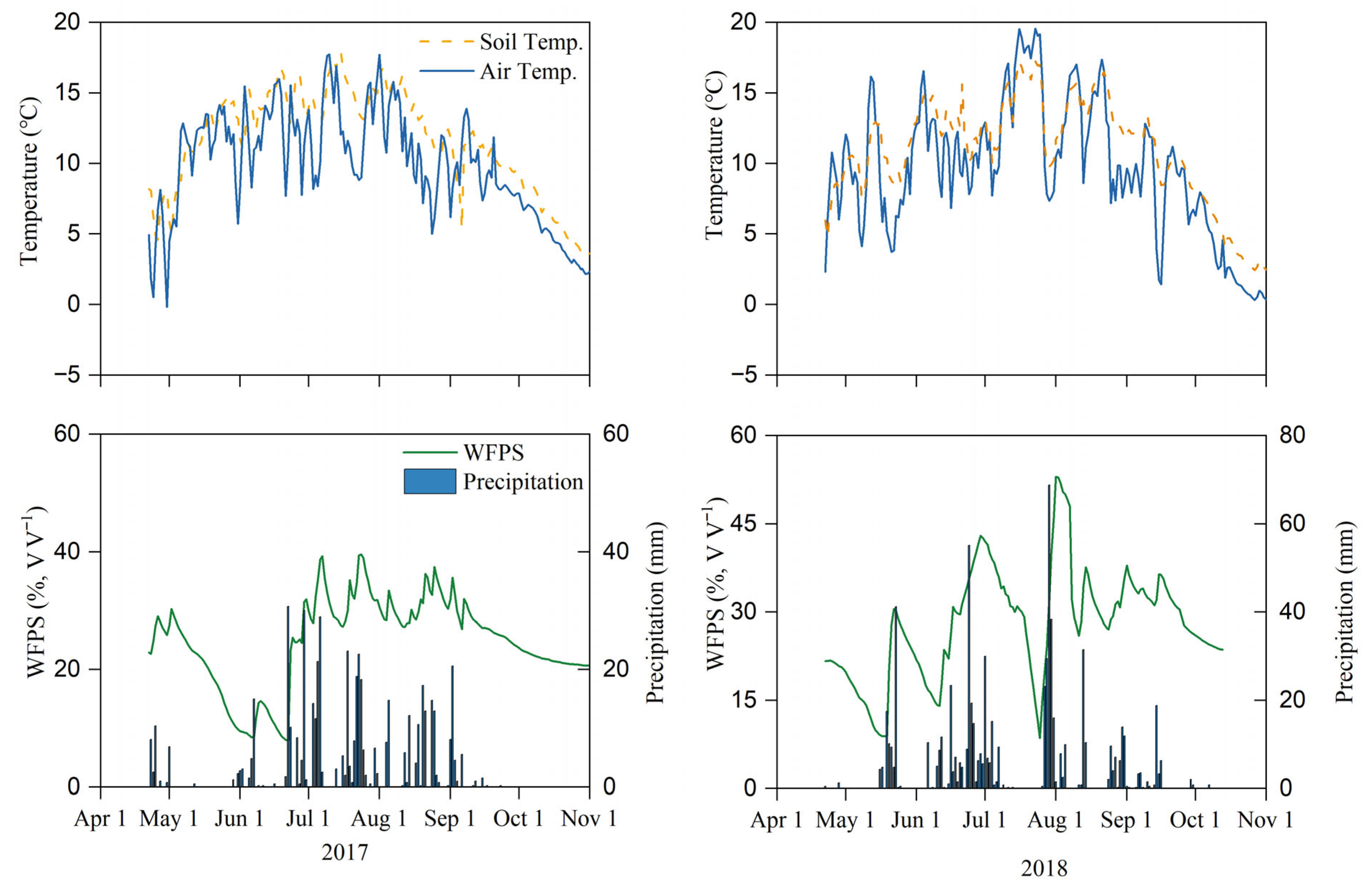
Total annual precipitation was 535 mm in 2017 and 813 mm in 2018, of which most fell between June and September (Figure 1). The average daily WFPS at 20 cm during the experimental period ranged from 7.4% to 39.6% in 2017, and from 8.9% to 53.0% in 2018, closely following rainfall patterns in both years. Average air temperature from April to November in 2017 and 2018 was 10.5 °C and 11.0 °C, respectively. Daily mean soil temperature at 20 cm depth generally tracked air temperature, rising steadily until May, peaking in July, and declining thereafter in both years.

3.2. N2O Flux and Plant Biomass

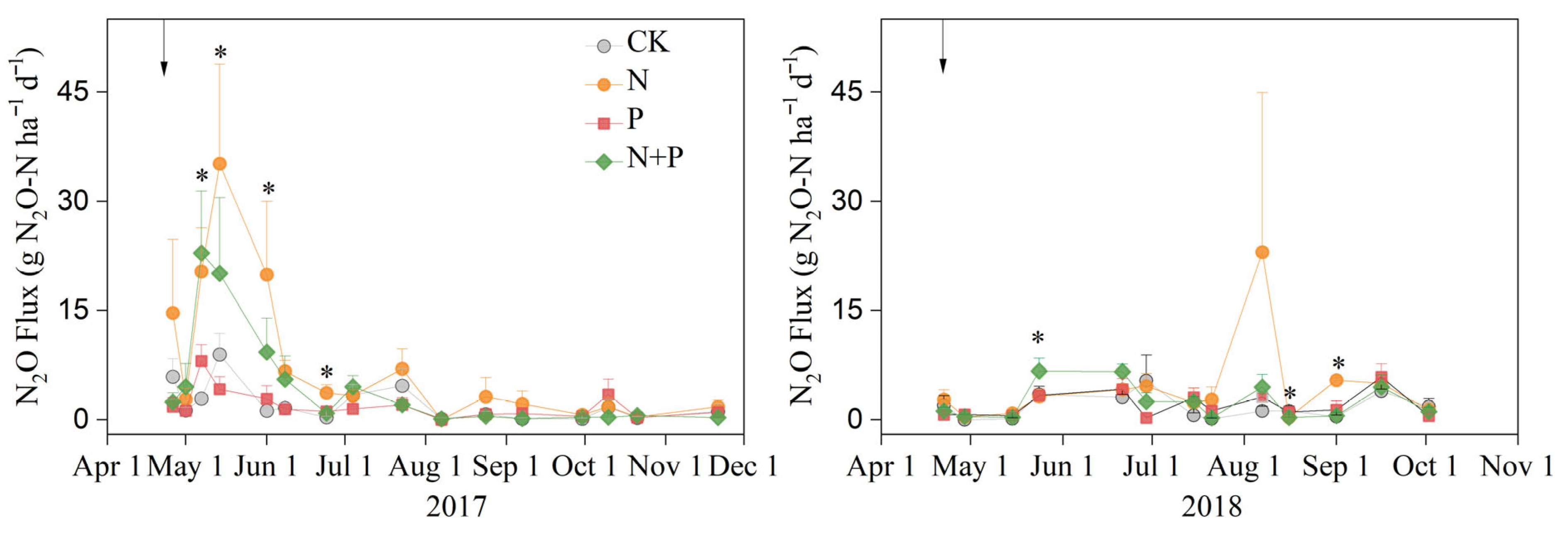
In 2017, peak N2O fluxes were observed within 4 weeks after fertilizer application (Figure 2). Distinct N2O emission peaks occurred for both N and N+P treatments during this period, with the highest daily N2O flux rate reaching 35 and 23 g N2O-N ha−1 d−1, respectively. In contrast, the CK and P fertilizer treatments did not result in notable N2O flux events. In 2018, N2O emission peaks occurred later in the growing season, primarily triggered by several large rainfall events. Significant differences in N2O flux between fertilizer treatments were found in 4 out of the 16 sampling events in 2017, and in 3 out of the 13 sampling events in 2018. In both years, plots receiving N generally exhibited higher flux rates than the other treatments. Over the two growing seasons, average daily N2O flux rates were 2.0, 6.2, 2.0, and 3.7 g N2O-N ha−1 d−1 for CK, N, P, and N+P treatments, respectively. N2O emissions were greater in 2017 than in 2018, with mean daily N2O flux rate across all treatments being 58% higher in 2017.
The area-scaled ƩN2O averaged across all fertilizer treatments was 643 g N2O-N ha−1 in 2017, which was 34.8% higher than in 2018 (p = 0.093, Table 1). The coefficients of variation (CV) were 75.3% in 2017 and 83.7% in 2018, respectively. N treatment significantly increased ƩN2O by approximately 2.0 times compared to the CK or P treatments. However, the addition of P or N+P did not lead to significant changes in ƩN2O compared to the CK. The interaction between treatment and year did not affect ƩN2O. The CV for ƩN2O in the CK, N, P, and N+P treatments were 19.9, 66.2, 24.7, and 30.7%, respectively.
In 2017, plant biomass varied significantly with sampling time (Table 2). In June, the addition of N+P significantly enhanced plant biomass relative to CK, while N or P addition alone did not result in significant increase in plant biomass. In July, all fertilizer treatments significantly increased plant biomass relative to CK. In August, both N addition and N+P addition resulted in a significant increase in plant biomass compared to CK, whereas P addition alone did not. Across all sampling times, average plant biomass was 172, 236, 285, 307 g m−2 for CK, P, N, and N+P treatments, respectively, with CV of 41.2, 39.2, 41.4, and 45.2%, respectively.

3.3. Soil Chemical Characteristics

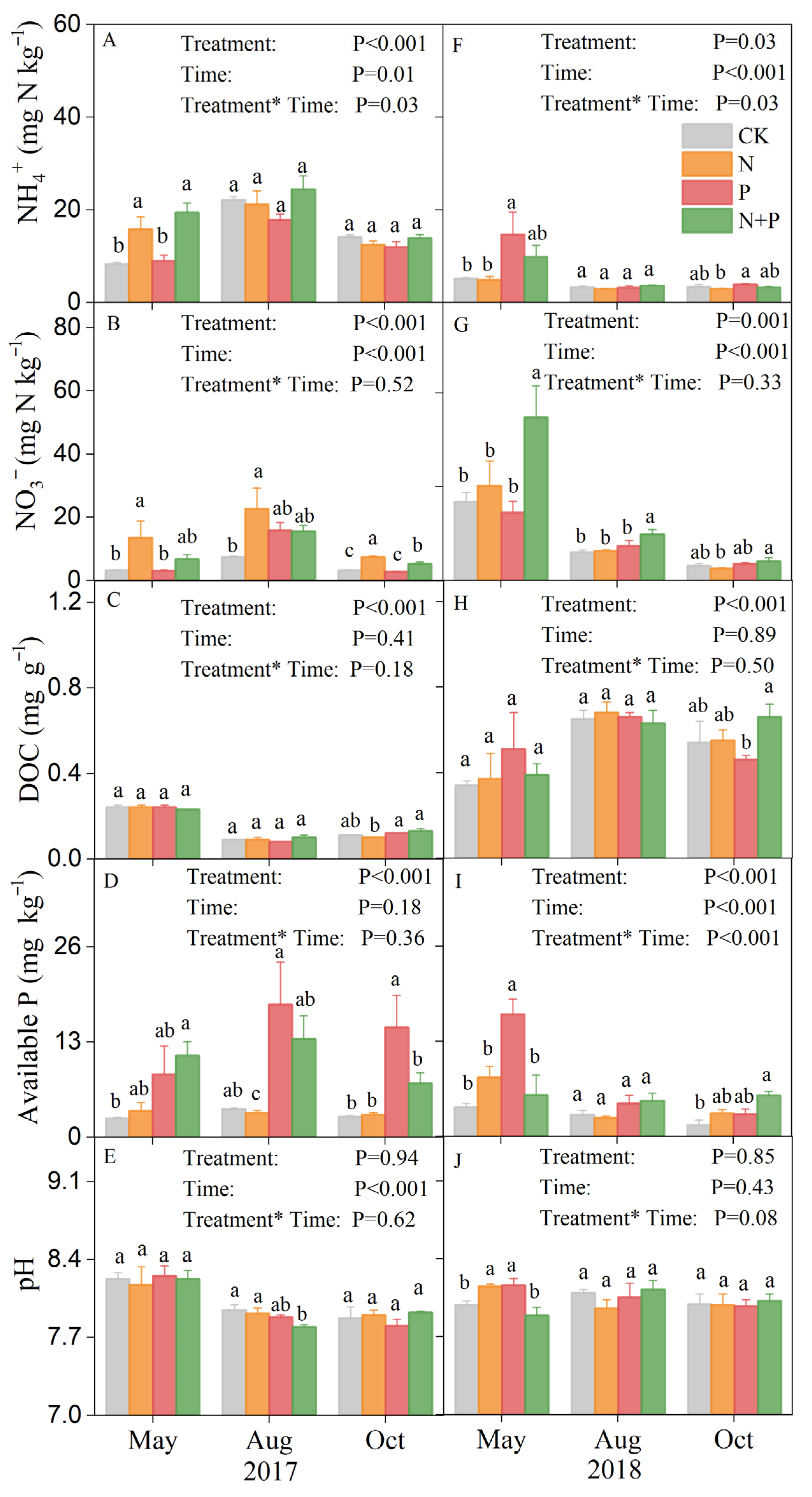
Soil NH4+ concentrations varied significantly with sampling time, fertilizer treatment, and their interaction in both study years (Figure 3). In May 2017, the N and N+P treatments exhibited significantly higher NH4+ concentrations than the CK and P treatments. In contrast, in May and October 2018, the P treatment resulted in significantly higher NH4+ concentrations than the CK or N treatments. At other sampling times, NH4+ concentrations were similar across all fertilizer treatments. Overall, soil NH4+ concentrations were generally higher in 2018 than in 2017.
In contrast, soil NO3 concentrations were significantly affected by sampling time and fertilizer treatment but not by their interactions (Figure 3). In 2017, N addition significantly increased soil NO3 concentrations relative to CK, whereas the N+P treatment showed no significant effect, except for a significant increase in October. By contrast, in 2018, the N+P treatment significantly increased soil NO3 concentrations compared to the CK and P treatments at all sampling times.
In October 2017, Soil DOC concentration under N treatment showed a significant decline relative to the P and N+P treatments (Figure 3). In October 2018, DOC concentration was significantly lower under the P treatment than under the N+P treatment. At other sampling times, DOC concentrations were similar across fertilizer treatments. Overall, DOC concentrations were generally higher in 2018 soil samples than in 2017.
In 2018 but not in 2017, available P concentrations were significantly influenced by the interaction between sampling time and fertilizer treatment (Figure 3). In 2017, Available P was obviously higher in the P and N+P treatments than in the CK and N treatments. In 2018, the P treatment led to a significant enhancement of available P in May, while the N+P treatment showed higher levels than CK in October. No significant differences among treatments were observed during other sampling times.
Soil pH showed limited variation among treatments. In August 2017, there was a significantly higher pH in the CK and N treatments compared to the N+P treatment (Figure 3). In August 2018, pH in the N and P treatments was greater than in the other treatments. At all other sampling times, pH remained similar across treatments.

3.4. Nitrifying Enzyme Activity and Denitrifying Enzyme Activity

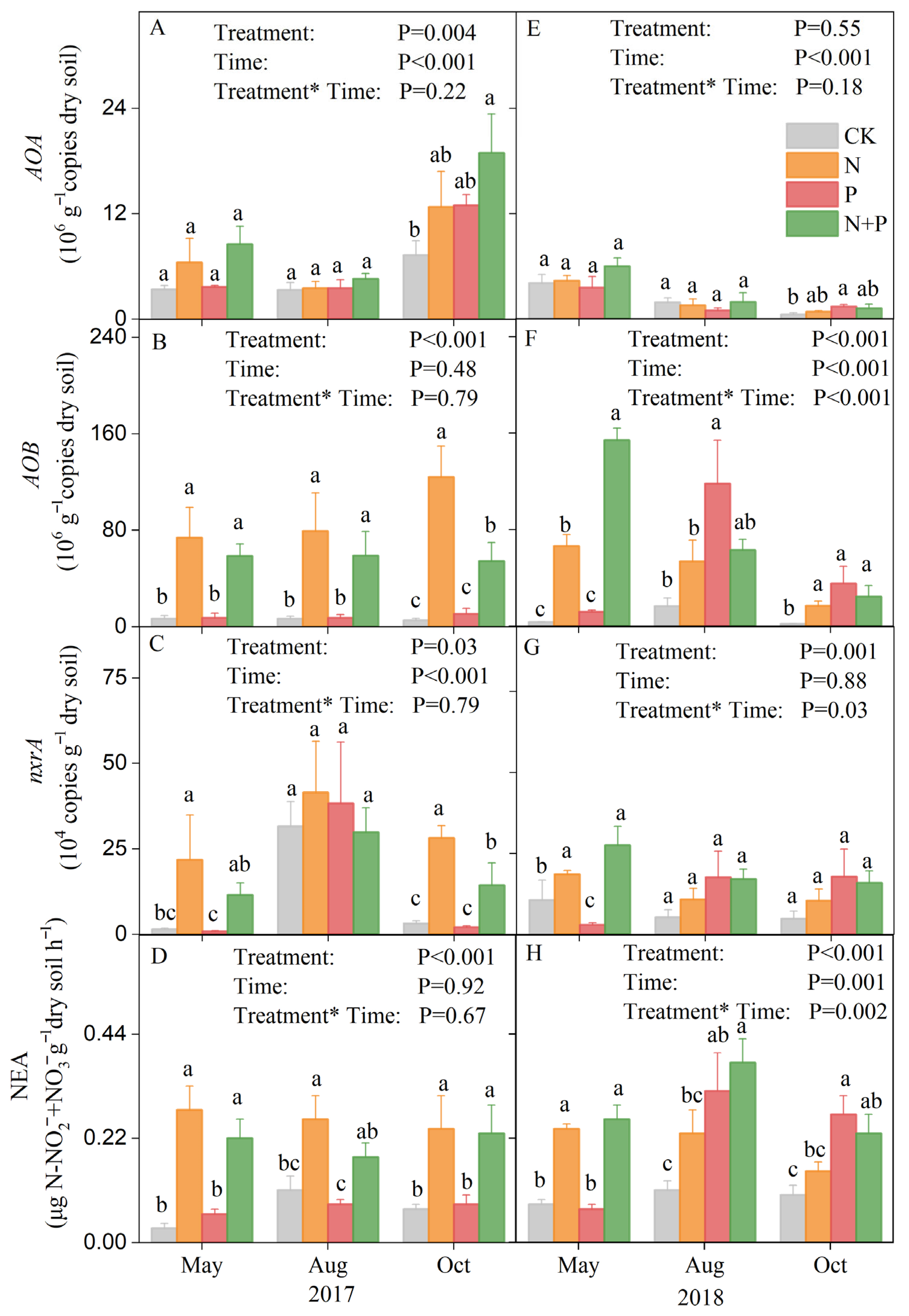
In both years, fertilizer treatments showed significant impacts on NEA (Figure 4). At all sampling times in 2017, NEA levels in the P treatment were comparable to those in CK but were notably reduced compared with the N or N+P treatments (p < 0.05). It was also observed that NEA was generally lower in the N+P treatment than in the N treatment, but the differences did not reach statistical significance. In 2018, N addition led to significantly higher NEA than CK in May, but not in August or October, resulting in a significant treatment by sampling time interaction. However, the N+P treatment significantly increased NEA compared to CK at all sampling times.
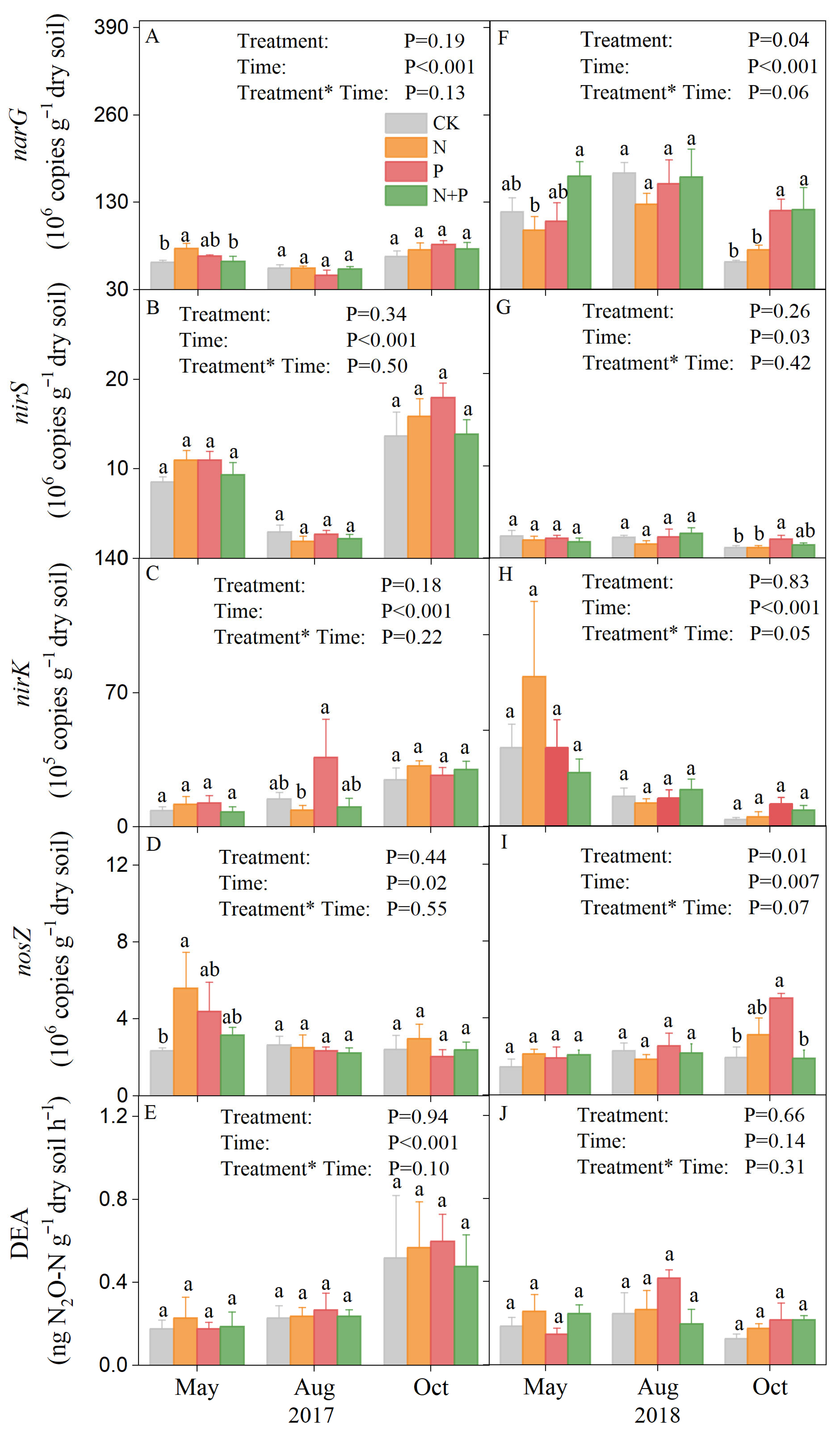
In contrast, DEA was not significantly affected by fertilizer treatments in both years (Figure 5). In 2017, DEA varied with sampling time, with values being higher (p < 0.05) in October compared to May and August. In contrast, no significant difference was found between sampling times in 2018.

3.5. Abundance of Functional Genes

Fertilizer treatments had limited impacts on the abundance of AOA over the study period (Figure 4). Compared to the CK, nutrient addition treatments did not affect AOA abundance at all sampling times except in October 2017 or October 2018 where the N+P or the P addition significantly elevated AOA abundance. In contrast, the abundance of AOB showed substantial responses to fertilizer treatments in both years. In 2017, the N and N+P treatments consistently had higher AOB abundance than the CK and P treatments. In 2018, a similar trend was observed in May but not in August and October where the P treatment instead resulted in higher AOB than the CK. Compared with CK, the N treatment significantly increased nxrA abundance in May and October 2017, and in May 2018. Similarly, the N+P addition led to significantly higher nxrA abundance than the CK and P treatments in October 2017 and May 2018. No significant differences in nxrA abundance among fertilizer treatments were observed at other sampling points.
For denitrifiers, the abundance of nitrate reductase, narG, varied with sampling time but showed limited response to fertilizer treatments (Figure 5). In 2017, nutrient addition in general did not affect narG abundance at each sampling point. In contrast, in May 2018, narG abundance was significantly higher under the N+P treatment than under the N treatment. Furthermore, in October 2018, narG abundance was significantly higher in the P or N+P treatments compared to the CK or N treatment. There was no significant influence of nutrient addition on nitrite reductase abundance, nirS, in either year, except in October 2018, when the P treatment significantly increased nirS abundance compared to the CK or N treatment. Similarly, no significant variation in nitrite reductase, nirK, abundance was observed among fertilizer treatments in either year, except in August 2017, when P addition significantly increased nirK abundance compared to N addition. By contrast, the N2O reductase, nosZ, abundance was in general not affected by fertilizer treatments in 2017, except in May 2017, when N addition significantly increased nosZ abundance compared to the CK treatment. In 2018, however, the P treatment significantly increased nosZ abundance compared to the CK and N+P treatments in October but not at other sampling times.

3.6. Relationships Between N2O Emissions, Soil Properties, and Functional Gene Abundance

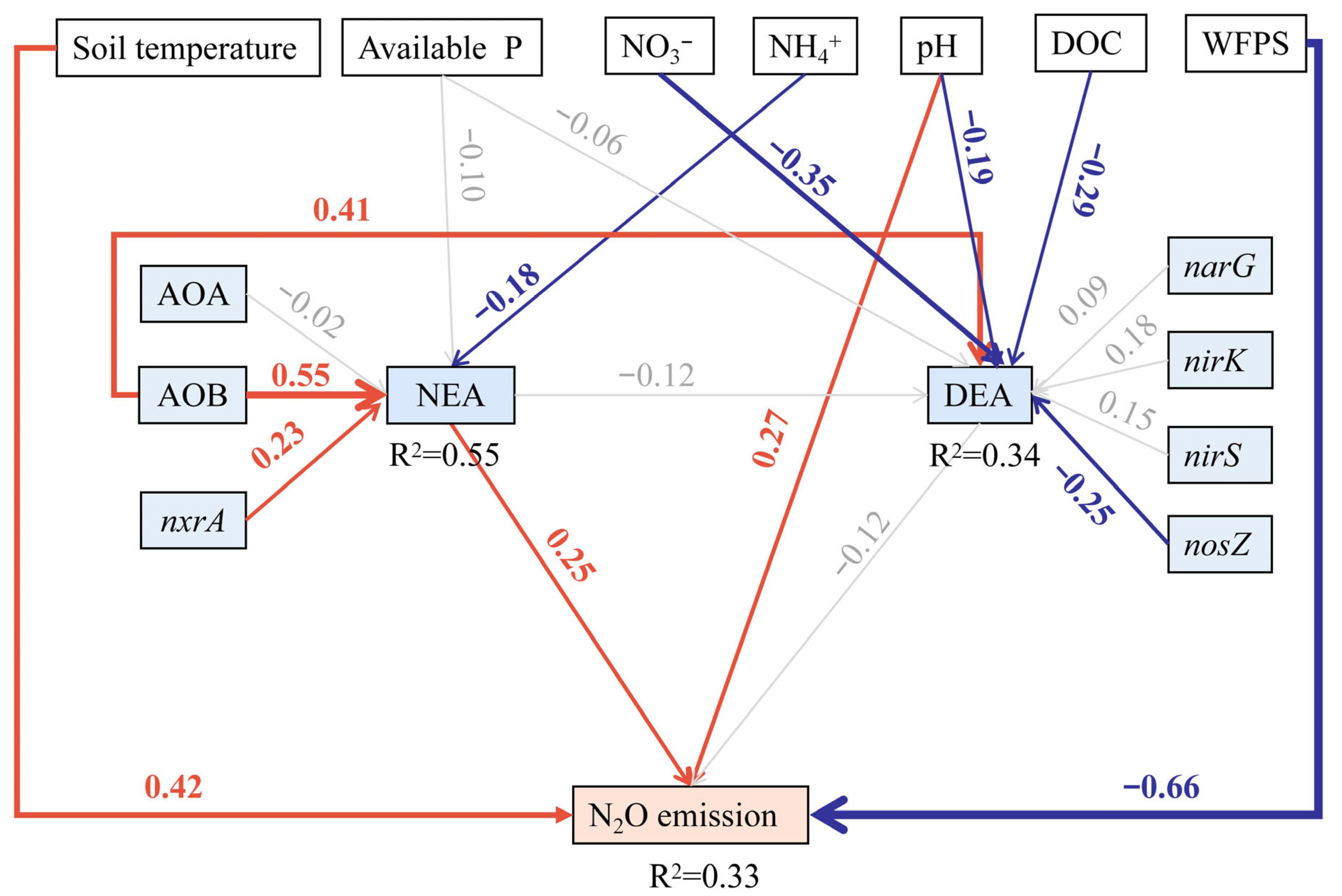
The SEM revealed significant direct relationships between N2O emissions and soil temperature, WFPS, pH, and NEA (Figure 6). These variables collectively explained 33% of the variation in N2O emissions. No significant direct correlations were found for the abundance of N2O-producing or N2O-reducing genes, nor for DEA. Significant direct correlations were also observed between NEA with variables including the abundance of AOB and Nitrobacter-like nxrA, as well as soil NH4+ concentration, with these three variables together accounting for 55% of the variation in NEA. Furthermore, soil NO3 concentration, pH, DOC, and the abundances of AOB and nosZ together explained 34% of the variation in DEA.

4. Discussion

4.1. Effect of N and P Additions on N2O Emissions

In this study, growing seasons cumulative N2O emissions ranged between 0.35 and 1.04 kg N2O-N ha−1, which is lower than values reported for fertilized temperate grasslands in Inner Mongolia [37], alpine meadow on the Qinghai-Tibetan Plateau [38], and humid grassland in Hokkaido, Japan [39]. However, our results are comparable to those reported in the alpine grassland in China [40] and semi-arid steppes in Inner Mongolia [41,42]. The relatively low N2O emissions observed in this study may be due to the absence of heavy rainfall following fertilizer application. During the measurement periods, soil WFPS values rarely exceeded 50%, and mostly remained below 45%, which is suboptimal for nitrification and denitrification [43,44]. In addition, low organic matter content in this alpine grassland likely limited available C substrates for microbial processes, thereby constraining both nitrification and denitrification and ultimately resulting in a generally low level of N2O production.
As expected, N addition significantly increased N2O emissions relative to CK, aligning with previous studies indicating that N input enhances N2O emissions in grasslands [42,45]. In contrast, P addition alone did not affect N2O emissions, consistent with previous findings where P alone did not significantly affect N2O emissions in grassland ecosystems limited by N [10,12,45]. For example, Chen et al. [18] reported that P input alone did not affect N2O emissions in two N-limited forests but significantly reduced emissions in an N-saturated forest, indicating that the influence of P is largely dependent on initial soil N status. However, our findings differ from several studies that reported increased N2O emissions following P addition, which were attributed to the stimulation of nitrification or denitrification [8,46]. In our study, P addition treatment generally did not affect mineral N concentrations, nitrifier and denitrifier abundance, NEA, and DEA, suggesting that nitrifier and denitrifier activity in this alpine grassland was not primarily restricted by P availability. The high of CV of ƩN2O in N treatments across two years likely resulted from the changes in weather conditions that affected the soil moisture and temperature. In 2017, but not in 2018, Peak N2O fluxes were observed within 4 weeks after fertilizer application, coinciding with the large rainfall event. These results highlight that multi-year measurements are necessary for reducing uncertainty of N2O emission.
In line with our hypothesis and earlier findings from forest ecosystems [18,47,48], the N+P addition reduced N2O emissions relative to N alone. This suggests that P input can help reduce N-induced N2O emissions in alpine grasslands. The most plausible explanation is that P addition promoted plant growth and enhanced soil nitrogen uptake, thereby reducing soil N available for microbial N2O production [7,49]. This assertion is supported by the observations that compared to CK and N alone treatments, the N+P addition significantly increased plant biomass, while reducing soil NO3-N concentrations by the end of the 2017 growing season. Similarly to our results, previous research in this alpine grassland has identified P as the primary limiting nutrient [26,27]. Overall, these results imply that N+P input is a more effective strategy than N alone in mitigating N2O emissions while simultaneously enhancing grass productivity in fragile alpine grassland ecosystems.

4.2. Impact of N and P Additions on the Abundance and Activity of Nitrifiers and Denitrifiers

Few studies have simultaneously investigated individual and combined effects of N+P addition on the abundance and activity of nitrifiers and denitrifiers, particularly while also accounting for their seasonal dynamics in grassland ecosystems. In the current study, both N alone and N+P applications significantly increased the abundance of AOB and Nitrobacter-like nxrA but did not affect AOA abundance. These changes were consistent with observed increases in NEA, as indicated by its positive relationships with abundances of AOB and Nitrobacter-like nxrA. Our findings are in agreement with previous research conducted in N-rich grassland soils [31,50] and fertilized forest soils [51], which reported that N alone and N+P addition increased the abundance of AOB and Nitrobacter-like nxrA rather than AOA abundance, and that NEA was primarily driven by AOB but not AOA. The different responses between AOA and AOB may be explained by their ecological niche differentiation. AOA tend to be less responsive to inorganic N inputs and exhibit a stronger affinity for organic N sources [52], whereas AOB and Nitrobacter-like nxrA prefer habitats with high inorganic N availability [53].
In contrast, the abundance of denitrifier genes and DEA varied seasonally but showed limited response to N or P treatments, with only a few exceptions, indicating that the abundance of denitrifiers was primarily regulated by environmental conditions, such as soil temperature and moisture, rather than nutrient inputs. Our findings contrast with previous studies which reported N or P additions significantly increased [54,55,56] or decreased [57] the abundance of denitrifier. However, our results agreed with Tang et al. [24], who reported no significant changes in abundance of nirK- and nirS-denitrifier or DEA following N or P additions in a temperate forest. It is worth noting that most previous studies relied on a single time-point sampling, thereby overlooking temporal variability in microbial responses. In the present study, we captured changes over time and showed that, although soil NO3-N and available P increased under nutrient addition treatments, DOC levels remained unchanged, suggesting that denitrifier activity may have been restricted by C supply rather than by N or P. This assumption is supported by previous studies [58,59], which found that the availability of organic C was a more critical factor than N supply in regulating denitrifier abundance.
Overall, N or N+P addition significantly enhanced the nitrifier abundance (AOB and Nitrobacter-like nxrA) and NEA but did not significantly influence denitrifier gene abundance and DEA. These results indicate that in semi-arid alpine grassland ecosystems, nitrification plays a more dominant role than denitrification in driving N2O emissions.

4.3. Linkage Between Functional Genes and N2O Flux

Our conclusion that N2O production under the conditions of this study was largely driven by environmental factors rather than microbial availability has been further confirmed by the SEM results, which revealed that abiotic factors (such as soil temperature, WFPS, and pH) have stronger relationships with N2O emissions compared to individual biological indicators (such as functional gene abundance). Relative to the absent effect of DEA, the positive contribution from NEA on N2O emissions also suggests that nitrification rather than denitrification was the primary process responsible for the N2O emissions. This pattern likely reflects that the C-limited and relatively dry conditions (low WFPS) in this alpine grassland are not conducive to denitrification. Further support for this conclusion comes from the positive relationship between NEA and the abundance of AOB and Nitrobacter-like nxrA, especially under N and N+P treatments. These results indicate that N addition stimulated the nitrifying microbial community, which in turn increased nitrification and N2O emissions.
These results align with previous studies [25,36,60], which demonstrated that the abundances of ammonia oxidizers and denitrifiers are poor predictors of soil N2O emissions. Therefore, soil environmental conditions play a more decisive role than functional gene abundances in controlling N2O emissions in response to nutrient additions. This insight supports the argument that predictive models and mitigation strategies should focus more on environmental conditions rather than solely on microbial community composition when identifying N2O emission hotspots in alpine and semi-arid ecosystems [61]. Future studies should quantify the relationship between soil N2O emissions and the transcript abundances of N2O-producing and N2O-reducing functional genes.

5. Conclusions

This study investigates the temporal dynamics of N2O emissions and associated microbial responses in alpine grasslands under N and P additions, applied individually and in combination. We found that N addition alone significantly increased growing season cumulative N2O emissions, whereas N+P addition did not. This suggests that combined nutrient addition can reduce N-induced N2O emissions in the alpine grassland by alleviating P limitation and enhancing plant and microbial N uptake. Furthermore, N or N+P treatments significantly increased nitrifier (AOB and Nitrobacter-like nxrA) abundance and NEA but did not influence the abundance of denitrifiers and DEA, suggesting nitrification was the main microbial pathway driving N2O emissions in this semi-arid alpine grassland, due to limited C and moisture availability. Structural equation modeling also identified soil temperature, soil pH, and WFPS as the most important predictors, explaining 33.0% of the variation in N2O emissions. These findings demonstrate that soil environmental conditions including soil temperature, pH, and WFPS play a more decisive role than functional gene abundances in controlling N2O emissions in response to nutrient additions in alpine grasslands. Overall, our results suggest that N+P addition is a more effective management strategy than N alone for reducing N2O emissions and enhancing plant productivity in fragile alpine grassland ecosystems.

Supplementary Materials

The following supporting information can be downloaded at https://www.mdpi.com/article/10.3390/agronomy16020168/s1, Table S1: The target genes, primer sets and thermocycle conditions used for real-time qPCR reactions. References [62,63,64,65,66,67] are cited in Supplementary Materials.

Author Contributions

Conceptualization, F.Z. and L.L.; Formal analysis, Y.L.; Funding acquisition, M.Y. and Y.W.; Investigation, M.Y., Y.L., Y.W., L.L. and W.K.; Methodology, M.Y., X.G., Y.W. and L.L.; Project administration, X.G. and F.Z.; Resources, F.Z. and L.L.; Supervision, X.G. and F.Z.; Validation, W.K.; Writing—original draft, M.Y.; Writing—review and editing, M.Y. and X.G. All authors have read and agreed to the published version of the manuscript.

Funding

This study was funded by the National Natural Science Foundation of China (No. 42307433, 32271660), the Scientific Research Project of the Educational Department of Liaoning Province (JYTMS20231166, LJ212411035019), the Tianchi Talent Program Second Cohort of Young Doctoral Scholars (CZ001621), Shenyang City Science and Technology Planning Project (24-213-3-12), the Liao Ning Revitalization Talents Program (XLYC2203070), Science and Technology Plan Joint Project Natural Science Foundation-General Program of Liaoning Province (2024-MSLH-506, 2024-MSLH-507), and the funding project of Northeast Geological S&T Innovation Center of China Geological Survey (QCJJ2022-44).

Data Availability Statement

Data supporting the findings of this research are included in the manuscript. Any additional data can be obtained from the corresponding author upon request.

Conflicts of Interest

The authors declare no conflict of interest.

References

  1. NOAA Global Monitoring Laboratory. Nitrous Oxide Trends. National Oceanic and Atmospheric Administration, 2025. National Oceanic and Atmospheric Administration. Available online: https://gml.noaa.gov/ccgg/trends_n2o/ (accessed on 1 January 2025).
  2. IPCC. Climate Change 2013: The Physical Science Basis; Cambridge University Press: New York, NY, USA, 2013. [Google Scholar]
  3. Smil, V. Phosphorus in the environment: Natural flows and human interferences. Annu. Rev. Energy Environ. 2000, 25, 53–88. [Google Scholar] [CrossRef]
  4. de Groot, C.C.; Marcelis, L.F.; van den Boogaard, R.; Kaiser, W.M.; Lambers, H. Interaction of nitrogen and phosphorus nutrition in determining growth. Plant Soil 2003, 248, 257–268. [Google Scholar] [CrossRef]
  5. Wolf, B.; Zheng, X.; Bruggemann, N.; Chen, W.; Dannenmann, M.; Han, X.; Sutton, M.A.; Wu, H.; Yao, Z.; Butterbach-Bahl, K. Grazing-induced reduction of natural nitrous oxide release from continental steppe. Nature 2010, 464, 881–884. [Google Scholar] [CrossRef] [PubMed]
  6. Bünemann, E.K.; Oberson, A.; Frossard, E. Phosphorus in Action: Biological Processes in Soil Phosphorus Cycling; Springer Science and Business Media: Berlin/Heidelberg, Germany, 2010. [Google Scholar]
  7. Baral, B.R.; Kuyper, T.W.; van Groenigen, J.W. Liebig’s law of the minimum applied to a greenhouse gas: Alleviation of P-limitation reduces soil N2O emission. Plant Soil 2014, 374, 539–548. [Google Scholar] [CrossRef]
  8. Mori, T.; Ohta, S.; Ishizuka, S.; Konda, R.; Wicaksono, A.; Heriyanto, J. Phosphorus application reduces N2O emissions from tropical leguminous plantation soil when phosphorus uptake is occurring. Biol. Fertil. Soils 2013, 50, 45–51. [Google Scholar] [CrossRef]
  9. Chen, J.; Ma, X.; Lu, X.; Xu, H.; Chen, D.; Li, Y.; Zhou, Z.; Li, Y.; Ma, S.; Yakov, K. Long-term phosphorus addition alleviates CO2 and N2O emissions via altering soil microbial functions in secondary rather than primary tropical forests. Environ. Pollut. 2023, 323, 121295. [Google Scholar] [CrossRef]
  10. Mehnaz, K.R.; Dijkstra, F.A. Denitrification and associated N2O emissions are limited by phosphorus availability in a grassland soil. Geoderma 2016, 284, 34–41. [Google Scholar] [CrossRef]
  11. He, M.; Dijkstra, F.A. Phosphorus addition enhances loss of nitrogen in a phosphorus-poor soil. Soil Biol. Biochem. 2015, 82, 99–106. [Google Scholar] [CrossRef]
  12. Mehnaz, K.R.; Keitel, C.; Dijkstra, F.A. Effects of carbon and phosphorus addition on microbial respiration, N2O emission, and gross nitrogen mineralization in a phosphorus-limited grassland soil. Biol. Fertil. Soils 2018, 54, 481–493. [Google Scholar] [CrossRef]
  13. Zheng, M.H.; Zhang, T.; Li, L.; Zhu, W.X.; Zhang, W.; Mo, J.M. Effects of nitrogen and phosphorus additions on nitrous oxide emission in a nitrogen-rich and two nitrogen-limited tropical forests. Biogeosciences 2016, 13, 3503–3517. [Google Scholar] [CrossRef]
  14. Kuypers, M.M.M.; Marchant, H.K.; Kartal, B. The microbial nitrogen-cycling network. Nat. Rev. Microbiol. 2018, 16, 263–276. [Google Scholar] [CrossRef] [PubMed]
  15. Kowalchuk, G.A.; Stephen, J.R. Ammonia-oxidizing bacteria: A model for molecular microbial ecology. Annu. Rev. Microbiol. 2001, 55, 485. [Google Scholar] [CrossRef] [PubMed]
  16. Simon, J.; Klotz, M.G. Diversity and evolution of bioenergetic systems involved in microbial nitrogen compound transformations. Biochim. Biophys. Acta 2013, 1827, 114–135. [Google Scholar] [CrossRef] [PubMed]
  17. Butterbach-Bahl, K.; Baggs, E.M.; Dannenmann, M.; Kiese, R.; Zechmeister-Boltenstern, S. Nitrous oxide emissions from soils: How well do we understand the processes and their controls? Philos. Trans. R. Soc. Lond. B Biol. Sci. 2013, 368, 20130122. [Google Scholar] [CrossRef]
  18. Chen, H.; Zhang, W.; Gurmesa, G.A.; Zhu, X.; Li, D.; Mo, J. Phosphorus addition affects soil nitrogen dynamics in a nitrogen-saturated and two nitrogen-limited forests. Eur. J. Soil Sci. 2017, 68, 472–479. [Google Scholar] [CrossRef]
  19. Romero, I.C.; Jacobson, M.; Fuhrman, J.A.; Fogel, M.; Capone, D.G. Long-term nitrogen and phosphorus fertilization effects on N2 fixation rates and nifH gene community patterns in mangrove sediments. Mar. Ecol. 2012, 33, 117–127. [Google Scholar] [CrossRef]
  20. You, L.; Ros, G.H.; Chen, Y.; Yang, X.; Cui, Z.; Liu, X.; Jiang, R.; Zhang, F.; Vries, W.D. Global meta-analysis of terrestrial nitrous oxide emissions and associated functional genes under nitrogen addition. Soil Biol. Biochem. 2022, 165, 108523. [Google Scholar] [CrossRef]
  21. Song, L.; Niu, S. Increased soil microbial AOB amoA and narG abundances sustain long-term positive responses of nitrification and denitrification to N deposition. Soil Biol. Biochem. 2022, 166, 108539. [Google Scholar] [CrossRef]
  22. Chen, Y.L.; Hu, H.W.; Han, H.Y.; Du, Y.; Wan, S.Q.; Xu, Z.W.; Chen, B.D. Abundance and community structure of ammonia-oxidizing archaea and bacteria in response to fertilization and mowing in a temperate steppe in Inner Mongolia. FEMS Microbiol. Ecol. 2014, 89, 67–79. [Google Scholar] [CrossRef]
  23. Wei, X.; Hu, Y.; Peng, P.; Zhu, Z.; Atere, C.T.; O’Donnell, A.G.; Wu, J.; Ge, T. Effect of P stoichiometry on the abundance of nitrogen-cycle genes in phosphorus-limited paddy soil. Biol. Fertil. Soils 2017, 53, 767–776. [Google Scholar] [CrossRef]
  24. Tang, Y.; Yu, G.; Zhang, X.; Wang, Q.; Tian, D.; Tian, J.; Niu, S.; Ge, J. Environmental variables better explain changes in potential nitrification and denitrification activities than microbial properties in fertilized forest soils. Sci. Total Environ. 2019, 647, 653–662. [Google Scholar] [CrossRef] [PubMed]
  25. Domeignoz-Horta, L.A.; Philippot, L.; Peyrard, C.; Bru, D.; Breuil, M.C.; Bizouard, F.; Justes, E.; Mary, B.; Leonard, J.; Spor, A. Peaks of in situ N2O emissions are influenced by N2O-producing and reducing microbial communities across arable soils. Glob. Chang. Biol. 2018, 24, 360–370. [Google Scholar] [CrossRef] [PubMed]
  26. Liu, Y.; Li, L.; Li, X.; Yue, Z.; Liu, B. Effect of nitrogen and phosphorus addition on leaf nutrient concentrations and nutrient resorption efficiency of two dominant alpine grass species. J. Arid Land 2021, 13, 1041–1053. [Google Scholar] [CrossRef]
  27. Liu, Y.; Liu, B.; Yue, Z.; Zeng, F.; Li, X.; Li, L. Effects of short-term nitrogen and phosphorus addition on leaf stoichiometry of a dominant alpine grass. PeerJ 2021, 9, e12611. [Google Scholar] [CrossRef]
  28. Carter, M.R. Soil sampling and methods of analysis. J. Environ. Qual. 1993, 38, 15–24. [Google Scholar]
  29. Yue, P.; Li, K.; Gong, Y.; Hu, Y.; Mohammat, A.; Christie, P.; Liu, X. A five-year study of the impact of nitrogen addition on methane uptake in alpine grassland. Sci. Rep. 2016, 6, 32064. [Google Scholar] [CrossRef]
  30. Pedersen, A.R. R Package, Version 0.3.1; HMR: Flux Estimation with Static Chamber Data. 2011. Available online: https://cran.r-project.org/web/packages/HMR/index.html (accessed on 10 February 2018).
  31. Dong, J.; Che, R.; Jia, S.; Wang, F.; Zhang, B.; Cui, X.; Wang, S.; Wang, S. Responses of ammonia-oxidizing archaea and bacteria to nitrogen and phosphorus amendments in an alpine steppe. Eur. J. Soil Sci. 2019, 71, 940–954. [Google Scholar] [CrossRef]
  32. Hart, S.C.; Stark, J.M.; Davidson, E.A.; Firestone, M.K. Nitrogen mineralization, immobilization, and nitrification. In Methods of Soil Analysis: II. Microbiological and Biochemical Properties; Weaver, R.W., Ed.; SSSA: Madison, WI, USA, 1994; pp. 985–1018. [Google Scholar]
  33. Beauchamp, E.G.; Bergstrom, D.W. Denitrification. In Soil Sampling and Methods of Analysis; Carter, M.R., Ed.; Lewis Publishers: Boca Raton, FL, USA, 1993; pp. 351–357. [Google Scholar]
  34. Wang, Z.; Li, T.; Wen, X.; Liu, Y.; Han, J.; Liao, Y.; DeBruyn, J.M. Fungal communities in rhizosphere soil under conservation tillage shift in response to plant growth. Front. Microbiol. 2017, 8, 1301. [Google Scholar] [CrossRef]
  35. Schermelleh-Engel, K.; Moosbrugger, H.; Müller, H. Evaluating the fit of structural equation models: Tests of significance and descriptive goodness-of-fit measures. Methods Psychol. Res. 2003, 8, 23–74. [Google Scholar] [CrossRef]
  36. Yin, M.; Gao, X.; Tenuta, M.; Li, L.; Gui, D.; Li, X.; Zeng, F. Enhancement of N2O emissions by grazing is related to soil physicochemical characteristics rather than nitrifier and denitrifier abundances in alpine grassland. Geoderma 2020, 375, 114511. [Google Scholar] [CrossRef]
  37. Zhang, J.; Han, X. N2O emission from the semi-arid ecosystem under mineral fertilizer (urea and superphosphate) and increased precipitation in northern China. Atmos. Environ. 2008, 42, 291–302. [Google Scholar] [CrossRef]
  38. Yan, Y.; Ganjurjav, H.; Hu, G.; Liang, Y.; Li, Y.; He, S.; Danjiu, L.; Yang, J.; Gao, Q. Nitrogen deposition induced significant increase of N2O emissions in a dry alpine meadow on the central Qinghai–Tibetan Plateau. Agric. Ecosyst. Environ. 2018, 265, 45–53. [Google Scholar] [CrossRef]
  39. Jin, T.; Shimizu, M.; Marutani, S.; Desyatkin, A.R.; Iizuka, N.; Hata, H.; Hatano, R. Effect of chemical fertilizer and manure application on N2O emission from reed canary grassland in Hokkaido, Japan. Soil Sci. Plant Nutr. 2010, 56, 53–65. [Google Scholar] [CrossRef]
  40. Wu, Y.; Gao, X.; Cao, D.; Li, L.; Li, X.; Zeng, F. Nitrous oxide emissions from an alpine grassland as affected by nitrogen addition. Atmosphere 2021, 12, 976. [Google Scholar] [CrossRef]
  41. Peng, Q.; Qi, Y.; Dong, Y.; Xiao, S.; He, Y. Soil nitrous oxide emissions from a typical semiarid temperate steppe in Inner Mongolia: Effects of mineral nitrogen fertilizer levels and forms. Plant Soil 2011, 342, 345–357. [Google Scholar] [CrossRef]
  42. Gu, X.; Wang, Y.; Laanbroek, H.J.; Xu, X.; Song, B.; Huo, Y.; Chen, S.; Li, L.; Zhang, L. Saturated N2O emission rates occur above the nitrogen deposition level predicted for the semi-arid grasslands of Inner Mongolia, China. Geoderma 2019, 341, 18–25. [Google Scholar] [CrossRef]
  43. Linn, D.M.; Doran, J.W. Effect of water-filled pore space on carbon dioxide and nitrous oxide production in tilled and nontilled soils. Soil Sci. Soc. Am. J. 1984, 48, 1267–1272. [Google Scholar] [CrossRef]
  44. Granli, T.; Bockman, O.C. Nitrous oxide from agriculture. Norw. J. Agric. Sci. 1994, 12, 1–128. [Google Scholar]
  45. Lin, Z.; Shi, L.; Wei, X.; Han, B.; Peng, C.; Yao, Z.; He, Y.; Xiao, Q.; Lu, X.; Deng, Y. Soil properties and fungal community jointly explain N2O emissions following N and P enrichment in an alpine meadow. Environ. Pollut. 2024, 344, 123344. [Google Scholar] [CrossRef]
  46. Mori, T.; Ohta, S.; Ishizuka, S.; Konda, R.; Wicaksono, A.; Heriyanto, J.; Hardjono, A. Effects of phosphorus addition on N2O and NO emissions from soils of an Acacia mangium plantation. Soil Sci. Plant Nutr. 2010, 56, 782–788. [Google Scholar] [CrossRef]
  47. Martinson, G.O.; Corre, M.D.; Veldkamp, E. Responses of nitrous oxide fluxes and soil nitrogen cycling to nutrient additions in montane forests along an elevation gradient in southern Ecuador. Biogeochemistry 2012, 112, 625–636. [Google Scholar] [CrossRef]
  48. Zhang, W.; Zhu, X.; Luo, Y.; Rafique, R.; Chen, H.; Huang, J.; Mo, J. Responses of nitrous oxide emissions to nitrogen and phosphorus additions in two tropical plantations with N-fixing vs. non-N-fixing tree species. Biogeosciences 2014, 11, 4941–4951. [Google Scholar] [CrossRef]
  49. Sundareshwar, P.V.; Morris, J.T.; Koepfler, E.K.; Fornwalt, B. Phosphorus limitation of coastal ecosystem processes. Science 2003, 299, 563–565. [Google Scholar] [CrossRef] [PubMed]
  50. Di, H.J.; Cameron, K.C.; Shen, J.P.; Winefield, C.S.; O’Callaghan, M.; Bowatte, S.; He, J.Z. Nitrification driven by bacteria and not archaea in nitrogen-rich grassland soils. Nat. Geosci. 2009, 2, 621–624. [Google Scholar] [CrossRef]
  51. Wertz, S.; Leigh, A.K.K.; Grayston, S.J. Effects of long-term fertilization of forest soils on potential nitrification and on the abundance and community structure of ammonia oxidizers and nitrite oxidizers. FEMS Microbiol. Ecol. 2012, 79, 142–154. [Google Scholar] [CrossRef]
  52. Prosser, J.I.; Nicol, G.W. Archaeal and bacterial ammonia-oxidisers in soil: The quest for niche specialisation and differentiation. Trends Microbiol. 2012, 20, 523–531. [Google Scholar] [CrossRef]
  53. Simonin, M.; Le Roux, X.; Poly, F.; Lerondelle, C.; Hungate, B.A.; Nunan, N.; Niboyet, A. Coupling between and among ammonia oxidizers and nitrite oxidizers in grassland mesocosms submitted to elevated CO2 and nitrogen supply. Microb. Ecol. 2015, 70, 809–818. [Google Scholar] [CrossRef]
  54. Tang, Y.; Zhang, X.; Li, D.; Wang, H.; Chen, F.; Fu, X.; Fang, X.; Sun, X.; Yu, G. Impacts of nitrogen and phosphorus additions on the abundance and community structure of ammonia oxidizers and denitrifying bacteria in Chinese fir plantations. Soil Biol. Biochem. 2016, 103, 284–293. [Google Scholar] [CrossRef]
  55. Wang, Y.; Ji, H.; Wang, R.; Guo, S. Responses of nitrification and denitrification to nitrogen and phosphorus fertilization: Does the intrinsic soil fertility matter? Plant Soil 2019, 440, 443–456. [Google Scholar] [CrossRef]
  56. Chen, Z.; Zhang, N.; Li, Y.; Xu, S.; Liu, Y.; Miao, S.; Ding, W. Extreme rainfall amplified the stimulatory effects of soil carbon availability on N2O emissions. Glob. Change Biol. 2025, 31, e70164. [Google Scholar] [CrossRef]
  57. Peng, Y.; Wang, G.; Li, F.; Zhou, G.; Yang, G.; Fang, K.; Liu, L.; Qin, S.; Zhang, D.; Yang, Y. Soil temperature dynamics modulate N2O flux response to multiple nitrogen additions in an alpine steppe. J. Geophys. Res. Biogeosci. 2018, 123, 3308–3319. [Google Scholar] [CrossRef]
  58. Kandeler, E.; Deiglmayr, K.; Tscherko, D.; Bru, D.; Philippot, L. Abundance of narG, nirS, nirK, and nosZ genes of denitrifying bacteria during primary successions of a glacier foreland. Appl. Environ. Microbiol. 2006, 72, 5957–5962. [Google Scholar] [CrossRef] [PubMed]
  59. Mergel, A.; Schmitz, O.; Mallmann, T.; Bothe, H. Relative abundance of denitrifying and dinitrogen-fixing bacteria in layers of a forest soil. FEMS Microbiol. Ecol. 2001, 36, 33–42. [Google Scholar] [CrossRef] [PubMed]
  60. Zhang, Y.; Zhang, F.; Abalos, D.; Luo, Y.; Hui, D.; Hungate, B.A.; García-Palacios, P.; Kuzyakov, Y.; Olesen, J.E.; Jørgensen, U.; et al. Stimulation of ammonia oxidizer and denitrifier abundances by nitrogen loading: Poor predictability for increased soil N2O emission. Glob. Change Biol. 2022, 28, 2158–2168. [Google Scholar] [CrossRef] [PubMed]
  61. Yang, Y.; Liu, L.; Zhang, F.; Zhang, X.; Xu, W.; Liu, X.; Wang, Z.; Xie, Y. Soil nitrous oxide emissions by atmospheric nitrogen deposition over global agricultural systems. Environ. Sci. Technol. 2021, 55, 4420–4429. [Google Scholar] [CrossRef]
  62. Francis, C.A.; Roberts, K.J.; Beman, J.M.; Santoro, A.E.; Oakley, B.B. Ubiquity and diversity of ammonia-oxidizing archaea in water columns and sediments of the ocean. Proc. Natl. Acad. Sci. USA 2005, 102, 14683–14688. [Google Scholar] [CrossRef]
  63. Rotthauwe, J.H.; Witzel, K.P.; Liesack, W. The ammonia monooxygenase structural gene amoA as a functional marker: Molecular fine scale analysis of natural ammonia oxidizing populations. Appl. Environ. Microbiol. 1997, 63, 4704–4712. [Google Scholar] [CrossRef]
  64. Wertz, S.; Poly, F.; Le Roux, X.; Degrange, V. Development and application of a PCR denaturing gradient gel electrophoresis tool to study the diversity of Nitrobacter like nxrA sequences in soil. FEMS Microbiol. Ecol. 2008, 63, 261–271. [Google Scholar] [CrossRef]
  65. Bru, D.; Sarr, A.; Philippot, L. Relative abundances of proteobacterial membrane bound and periplasmic nitrate reductases in selected environments. Appl. Environ. Microbiol. 2007, 73, 5971–5974. [Google Scholar] [CrossRef]
  66. Throbäck, I.N.; Enwall, K.; Jarvis, A.; Hallin, S. Reassessing PCR primers targeting nirS, nirK and nosZ genes for community surveys of denitrifying bacteria with DGGE. FEMS Microbiol. Ecol. 2004, 49, 401–417. [Google Scholar] [CrossRef]
  67. Scala, D.J.; Kerkhof, L.J. Nitrous oxide reductase (nosZ) gene specific PCR primers for detection of denitrifiers and three nosZ genes from marine sediments. FEMS Microbiol. Lett. 1998, 162, 61–68. [Google Scholar] [CrossRef]
Figure 1. Daily air and soil temperatures (20 cm depth), soil water filled pore space (WFPS), and precipitation over the 2017 and 2018 growing seasons. Daily air temperature, soil temperature, and WFPS are from Yin et al. [36].
Agronomy 16 00168 g001
Figure 2. Daily N2O flux rate as affected by fertilizer treatments during the growing season over the two years. * represents significant difference between fertilizer treatments at p < 0.05. CK: Control; N: N addition at 160 kg N ha−1 yr−1; P: P addition at 30 kg P ha−1 yr−1; N+P: N+P addition. Solid arrows indicate date of fertilizer application. Bars represent ± 1 standard error of mean, n = 4.
Agronomy 16 00168 g002
Figure 3. Soil concentrations of NH4+ (A,F), NO3 (B,G), dissolved organic carbon (DOC, (C,H)), available P (D,I), and pH (E,J) during the growing season over the two years. Bars represent ± 1 standard error of mean, n = 4. Different lowercase letters above bars indicate significant differences within each sampling date at p < 0.05. CK: Control; N: N addition at 160 kg N ha−1 yr−1; P: P addition at 30 kg P ha−1 yr−1; N+P: N+P addition.
Agronomy 16 00168 g003
Figure 4. The abundances of archaeal and bacterial amoA (A,B,E,F), nxrA genes (C,G) and nitrifying enzyme activity (NEA, (D,H)) as affected by different fertilizer treatments during the growing season over the two years. Bars represent ± 1 standard error of mean, n = 4. Different lowercase letters above bars indicate significant differences within each sampling date at p < 0.05. CK: Control; N: N addition at 160 kg N ha−1 yr−1; P: P addition at 30 kg P ha−1 yr−1; N+P: N+P addition.
Agronomy 16 00168 g004
Figure 5. Gene copy numbers of narG (A,F), nirS (B,G), nirK (C,H), nosZ (D,I) and denitrifying enzyme activity (DEA, (E,J)) as affected by different fertilizer treatments during the growing season over the two years. Different lowercase letters above bars indicate significant differences within each sampling date at p < 0.05. Bars represent ± 1 standard error of mean, n = 4. CK: Control; N: N addition at 160 kg N ha−1 yr−1; P: P addition at 30 kg P ha−1 yr−1; N+P: N+P addition.
Agronomy 16 00168 g005
Figure 6. Structural equation model (SEM) displaying the effects of key abiotic and biotic factors on N2O emissions. The red and blue arrows represent significant positive and negative (p < 0.05) relationships, respectively, while gray arrows indicate non-significant pathways. Numbers on arrows are standardized path coefficients, with arrow width proportional to their magnitude. R2 denotes the proportion of variation in N2O emissions explained by the model. For the model fitness statistics: Fisher’s C = 46.1, p = 0.629, df = 32, AIC = 93.1, n = 96.
Agronomy 16 00168 g006
Table 1. Growing season cumulative (ƩN2O) as affected by fertilizer treatments over the 2017 and 2018 growing seasons. Values are means ± 1 standard error, n = 16 for Year, and 8 for Treatment.
ƩN2O (g N2O-N ha−1)CV (%)
Year
2017643 ± 17175.3
2018477 ± 14183.7
Treatment
CK347 ± 24 b19.9
N1039 ± 243 a66.2
P355 ± 31 b24.7
N+P498 ± 54 ab30.7
ANOVA p value
Treatment (T)0.003
Year (Y)0.093
T × Y0.165
Note: Means within a column followed by the different letters are significantly different at p < 0.05. CV denotes the variation coefficient of the mean. Abbreviations: CK: Control; N: N addition at 160 kg N ha−1 yr−1; P: P addition at 30 kg P ha−1 yr−1; N+P: N+P additions.
Table 2. Plant above-ground biomass as affected by fertilizer treatments in 2017. Values are means ± 1 standard error, n = 4.
TreatmentPlant Above-Ground Biomass (g m−2)CV (%)
JuneJulyAugust
CK100.2 ± 10.8 b157.6 ± 12.7 c258.7 ± 6.4 c41.2
N159.7 ± 28.7 ab314.0 ± 26.9 a381.5 ± 36.2 ab39.2
N+P211.7 ± 24.0 a250.4 ± 9.5 ab 459.3 ± 48.3 a 41.4
P126.1 ± 9.2 b230.7 ± 38.6 b349.7 ± 22.1 bc45.2
Note: Means within a column followed by the different letters are significantly different at p < 0.05. CV denotes the variation coefficient of the mean. Abbreviations: CK: Control; N: N addition at 160 kg N ha−1 yr−1; P: P addition at 30 kg P ha−1 yr−1; N+P: N+P additions.
Disclaimer/Publisher’s Note: The statements, opinions and data contained in all publications are solely those of the individual author(s) and contributor(s) and not of MDPI and/or the editor(s). MDPI and/or the editor(s) disclaim responsibility for any injury to people or property resulting from any ideas, methods, instructions or products referred to in the content.