You are currently on the new version of our website. Access the old version .
AgronomyAgronomy
  • Article
  • Open Access

8 January 2026

Control of Postharvest Longevity of Cut Inflorescences of Matthiola incana (L.) W.T.Aiton ‘Mera’

,
,
and
1
The National Institute of Horticultural Research, 96-100 Skierniewice, Poland
2
Section of Ornamental Plants, Institute of Horticultural Sciences, Warsaw University of Life Sciences—SGGW, 02-787 Warsaw, Poland
*
Author to whom correspondence should be addressed.
This article belongs to the Special Issue Fruit Quality Improvement and Postharvest Biotechnology

Abstract

Cut flowers of Matthiola incana ‘Mera’ are widely used in floristics but because of wilting, premature leaf yellowing, and flower/inflorescence drying their ornamental value quickly drops. The postharvest performance of this valuable cut flower in terms of symptoms of wilting, relative water content (RWC), carbohydrate content, enzyme activity, and free proline content was studied in relation to the different preservative added to the vases with flowers. The tested preservatives were based on two biocides: 200 mg/L 8-hydroxyquinoline citrate (8-HQC) and nanosilver (NS) in two concentrations, 1 and 5 mg/L, with the addition of 2% sucrose (S). Control inflorescences were kept in distilled water alone. The above preservatives did not prolong vase life, but, on the contrary, decreased it, so flowers placed in distilled water lasted the longest. The contents of both total soluble and reducing sugars increased during flower senescence, reaching the highest level in flowers held in the solution of 5 mg/L NS plus 2% S. Similarly, the content of free proline increased, especially in flowers held in the 8-HQC with 2% S (standard preservative). The contents of hydrogen peroxide (H2O2) varied in flowers from different solutions; however, they kept increasing during senescence in flowers from all the treatments. The highest activity of the antioxidative enzymes was found in flowers placed in water.

1. Introduction

Ornamental plants have always accompanied humans, and their cultivation methods, especially for cut flowers, have developed more and more dynamically over time. They are an inseparable ornamental element during many celebrations related to our culture and tradition, which is why the demand for them is constantly growing. It is common knowledge that cut flowers are delicate and perishable. More and more species of ornamental plants are grown for cut flowers, because the demand for them is constantly growing. They are widely used in floral compositions, which is why it is necessary to conduct experiments to check the postharvest longevity of individual species. Cut flowers, despite being cut off from the mother plant, are still living organisms in which numerous biochemical processes occur that cause their natural aging. This highly organized process occurring in every plant cell is inevitable, but thanks to appropriate postharvest treatments it can be significantly slowed down [1,2]. The simplest and most frequently used way to extend the vase life of cut flowers is to cool them after harvesting and remove the lower leaves [2,3,4,5,6]. There are many methods and chemical agents that allow for extending the postharvest longevity of cut flowers, but their use does not always give beneficial results. Flower aging is a naturally occurring process that cannot be completely stopped, but only its consequences, such as drying, falling leaves and petals, changing the intensity of colors, or loss of turgor, can be slowed down [1,2,3]. As flowers age, their ornamental value decreases, which is of great importance to both florists and consumers. However, to extend the vase life of flowers, they are also conditioned after harvesting in various chemical compounds [1,2]. It was shown by many authors that growing conditions (fertilization, humidity, light) during flower cultivation can influence postharvest parameters [5,6,7,8,9]. The effect of preservatives on the quality of the cut flowers of plants is varied and depends on many factors, including the species and cultivar, the physiological state of the plant when it was cut, or the conditions of the cultivation itself [10,11]. The preservatives used for flower treatments usually contain sugar, fungicides, and bactericides [2,8,11,12].
The purpose of using sucrose as a flower preservative in vases is to achieve a full bloom and a more intense flower color, while biocides are to limit the development of harmful microflora that prevent the flowers from taking up water [1,13,14,15,16,17,18]. Sucrose allows the flower buds to fully open and maintain an intense color, while fungicidal and bactericidal substances limit the development of harmful microflora that block the xylem and prevent the flower from absorbing water [3,19,20,21]. By using different additives to water during vase life such as silver thiosulfate (STS), nanosilver (NS), or 8-hydroxyquinoline citrate (8-HQC) together with sucrose it is possible to obtain many benefits, such as restoring turgor, better and faster bud blooming, maintaining the intensity of flower colors, inhibiting leaf yellowing and fall, limiting flower pruning, and changing the water in the vases [20,22,23]. Especially the chemicals that prevent ethylene biosynthesis, such as 1-methylocyclopropene (1-MCP), are effective in increasing flower vase life [1,11,22,23,24]. As in the case of other cut flowers, special growing conditions or pretreatments can influence stock flowers (Matthiola incana L.) postharvest. M. incana belongs to the family Brassicaceae and is native to the Mediterranean. Flowers have a very pleasant smell, single or double flowers, and a delicate range of colors, and they are commonly grown as specialty cut flowers for spring and early summer occasions [1,3,13,25]. Due to its multitude of colors, erect habit, and the possibility of obtaining full flower in inflorescences of M. incana, the plants are grown for cut flowers, thanks to which they are used in floral arrangements. Its vase life is greatly influenced by the growing conditions and the physiological state during harvest. All changes occurring in the flower after it is cut are accelerated by stress conditions, which intensify the aging processes, so understanding them is crucial for extending the longevity of cut flowers after harvesting. It has been shown that EthylBlockTM had a positive effect on the vase life of Matthiola flowers after harvesting [25,26,27]. However, Regan and Dole [28] found that stems of M. incana ‘Vivas Blue’ treated with exogenous ethylene or anti-ethylene agents such as silver thiosulfate (STS) or 1-methylocyclopropene (1-MCP) did not show positive effects on flowers after harvest. This cultivar lasted longer, up to 13.3 days, when flowers were kept dry in a cooler at a low temperature (2 °C). Pulsing with sucrose before storage at a concentration of 10% or 20% had no positive effect on the vase life of cut flowers. The longevity of Matthiola flowers is greatly influenced by growing conditions and physiological states of harvest. All changes occurring in the flower after cutting are accelerated by stress conditions, which intensify the aging processes, so understanding them is crucial for extending the longevity of cut flowers. It seems that different growing factors during cultivation and postharvest treatments that affect flowers after harvesting may also be dependent on the cultivar [28,29,30].
The aim of the study was to determine the effect of preservatives on the postharvest vase life of Matthiola incana ‘Mera’ cut flowers. The ‘Mera’ cultivar is characterized by white, full flowers with an intense fragrance, gathered in dense inflorescences. This cultivar is ideal for accelerated cultivation under cover.

2. Materials and Methods

2.1. Plant Material

The fresh inflorescence shoots with at least one floret open of Matthiola incana L. ‘Mera’ for experiments were purchased from a professional farm (Serock, Poland). All inflorescence shoots before starting the experiment were recut to a length of 70 cm and the leaves at the bottom part were removed, leaving 10 to 12 on each shoot in order to limit transpiration. The inflorescence stems were in good condition, uniform in size, healthy, and without any mechanical damage or infestation by pests or pathogens. Immediately after preparing inflorescence stems, they were placed into vases with 4 experimental solutions: I. H2O—distilled water (control); II—200 mg/L 8-hydroxyquinoline citrate + 2% sucrose (8-HQC + 2% S) called standard preservative; III—1 mg/L nanosilver + 2% sucrose (1 mg/L NS + 2% S); IV—5 mg/L nanosilver + 2% sucrose (5 mg/L NS + 2% S). The preservative solutions and water in the vases were not replaced, but only replenished if necessary during the experiment. The experiment was conducted at the phytotron with controlled climate parameters at the Department of Ornamental Plants, Warsaw University of Life Sciences. There were 18 inflorescence stems in each treatment (3 repetitions with 6 stems in each). The climate parameters at the phytotron were as follows: temperature 20 °C, relative humidity 60%, photoperiod 12/12 day/night, quantum radiation intensity at plant level 35 µmol·m−2·s−1 (fluorescent lamp LF80 36 W/850, Natural Daylight, Pila, Poland).
The longevity of vase life was expressed in days, counting from the start of the experiments until they lost their ornamental value. The main signs of decorativeness loss were a decrease in turgor, wilting and drying of petals, petal drop, and discoloration of petals and leaves. Plants were considered non-decorative when 30% of the flowers in the inflorescence showed the above-mentioned signs.

2.2. Water Balance Evaluation

The relative water content (RWC) was determined in leaves and flower petals (10 samples per each treatment) according to Smart and Bingham [31] and expressed in %.
RWC   ( % ) = F W D W T W D W × 100 %
  • FW—fresh weight (just after harvesting samples);
  • TW—turgid fresh weight (after immersing samples for 24 h in distilled water);
  • DW—dry weight (after drying samples in 105 °C for 72 h).

2.3. Biochemical Analyses

The samples of plant tissues for analyses were taken three times on different dates: day 0—at starting experiments and at 2 and 5 days later, respectively. Mixed batches of flowers from inflorescences (6 plants from each treatment) were prepared for analyses. Flower petals were finely cut, mixed, and then 3 samples of 0.5 g each were taken. The weighed plant material was wrapped in aluminum foil and then stored in a refrigerator at −84 °C until analyses. Three extracts were made for each sample and then 3 readings were made for each extract. In total, there were 9 readings for each treatment. The reducing sugars in tissue samples were performed according to the Somogyi colorimetric method modified by Nelson [32], and expressed in milligram glucose per g of dry weight (DW). The plant material was homogenized in 80% ethanol and then the extracts were incubated for 20 min in a boiling water bath with the copper reagent; the molybdenum arsenic reagent was added and the extinction was measured spectrophotometrically (Shimadzu UV-1800, Kyoto, Japan) at 520 nm. The amounts of reducing sugars were calculated from a previously plotted standard curve, prepared for glucose. The total sugar content was measured according to the method of Dubois et al. [33]. The material was also homogenized in 80% ethanol. The extracts were incubated for 20 min in a boiling water bath with 5% phenol and 96% H2SO4, and the absorbance was measured at 490 nm. The total sugar content was calculated from a previously plotted standard curve prepared for glucose and expressed in mg glucose·g−1 DW. For measuring oxidative stress flower petals, the hydrogen peroxide (H2O2) content was measured spectrophotometrically after the reaction with potassium iodide (KI), as described by Jędrzejuk et al. [34], and expressed at 390 nm as microgram of hydrogen peroxide (H2O2) per gram on DW basis. The catalase (CAT) activity (EC 1.11.1.6) was determined spectrophotometrically as the rate of H2O2 disappearance at 405 nm according to Goth [35] and expressed as mcatals per gram of DW. The activity of peroxidases (POX) (EC 1.11.1.7.) was determined as described by Jędrzejuk et al. [36]. It was estimated spectrophotometrically at 430 nm and expressed in µmols of purpurogaline formed within 1 min per g of DW. The free proline content in flower petals was determined according to the method described by Bates et al. [37] by measuring the quantity of a colored reaction product of proline with ninhydric acid. The absorbance of samples was read at 520 nm. The content of free proline was calculated from a previously plotted standard curve and expressed in milligram g−1 DW.

2.4. Statistical Analysis

Results were statistically evaluated by ANOVA 1 using IBM SPSS Statistics 27.0 program. To evaluate the significance between the means, the Duncan’s test at p ≤ 0.05 was applied.

3. Results and Discussion

3.1. Vase Life

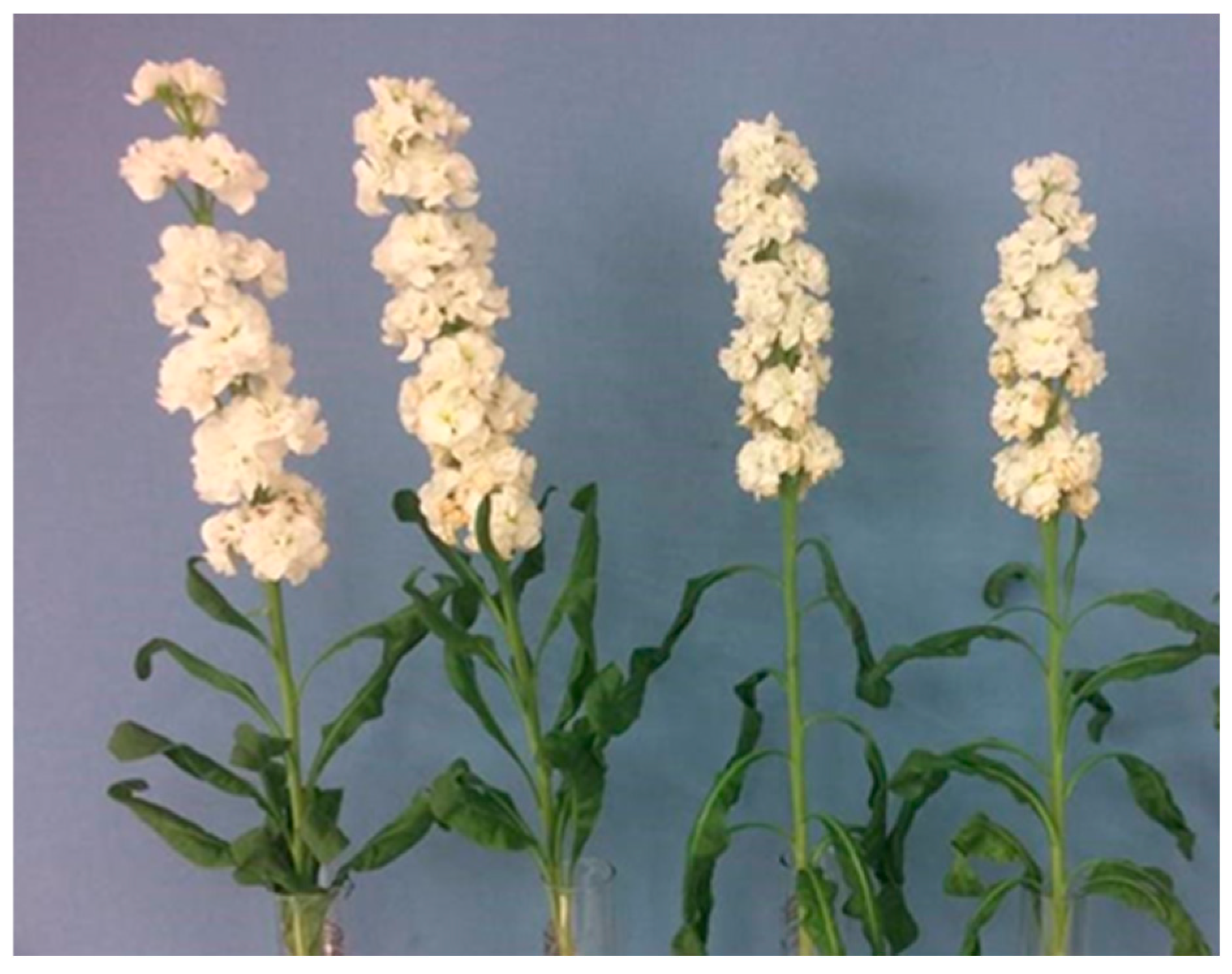
The vase life of M. incana ‘Mera’ flowers evaluated in the presented experiment lasted on average 5.4 days for all tested treatments. This is a relatively short period compared to the results of other authors [3,26,29,30], where Matthiola flowers’ longevity lasted usually from 7 to 10 days [2,14,30,38]. Here, the longest vase life (8.3 days) had stock flowers kept in distilled water as a control treatment (Table 1). The preservative solutions reduced the vase life compared to the control, and by almost a half when nanosilver (NS) was used. This was contrary to many reports, which showed that Matthiola flowers’ vase life can be positively influenced by different treatments [28,30,38,39]. In the present study, the solution which contained 5 mg/L NS with 2% S were worse for M. incana ‘Mera’ flower longevity and leaf quality. Stock flowers in this treatment lasted only 3.9 days. It seems that NS, which acts as a biocide, was not a good solution in which to keep the stock flowers in the vases all the time during postharvest life (Figure 1). Probably, if it were used as a short pretreatment (pulsed) and the flowers were transferred to water, the effect could be positive. The effects of many postharvest additives to water (biocides such as NS or 8-hydroxquinoline citrate (8-HQC), sugars, or other chemicals) vary and depend on many other factors, including even the plant freshness, the physiological state at the time of cutting, the nutrient content related to plant fertilization during cultivation, light conditions, and also the cultivar [1,3,7,18].
Table 1. The effect of holding solutions on the vase life (days) of Matthiola incana ‘Mera’ cut flowers.
Figure 1. Appearance of cut Matthiola ‘Mera’ flowers placed into different preservatives, 5 days after harvest. The treatments from left to right: I—water (control); II—8HQC + 2% S; III—1 mg NS + 2% S; IV—5 mg NS + 2% S.
The role of sugars added to the water is to ensure that the plant has a source of energy for developing flowers from flower buds, keeping the color of the petals, and maintaining the leaf conditions [1,11,22,26,27]. Not only the flowers but also the leaf greenness during vase life is also a very important parameter of quality. To prevent leaf yellowing for Matthiola flowers, Ferrante et al. [40] showed an effective treatment with thidiazuron and gibberellic acid (GA3). In the case of Zantedeschia aethiopica, the role of GA3 to prevent leaf yellowing has positive effects which were shown by Skutnik et al. [41]. Regan and Dole [28] stated that M. incana ‘Vivas Blue’ flowers kept at 2 or 4% sucrose solution with bactericide and flower foam (Oasis) resulted in better flower coloration during postharvest life. Sucrose also promoted flower opening and coloration. However, stems were unaffected by exogenous ethylene or by the application of the anti-ethylene agents STS and 1-MCP. Inflorescence stems had a longer vase life (up to 12–13 days) when they were stored in dry, cool conditions as compared to being stored in water, for no more than 2 weeks. The positive effect of the cold storage of M. incana flowers and 8-hydroxyquinolin sulfate (8-HQS) and sucrose application were shown also by Arab et al. [42]. Nanosilver, known for its bactericidal properties [24,43,44], did not affect the extension of the postharvest longevity of cultivar ‘Mera’ (Table 1). In the present experiment, Matthiola flowers placed in solutions with NS at concentrations of 5 mg/L and 2% S were characterized by the shortest flower longevity (only 3.9 days). Flowers kept at NS with a lower concentration of 1 mg/L NS + 2% S also lasted quite a short time—4.3 days. There were not any statistically important differences in flower longevity with different preservatives. Only flowers kept in pure distilled water (control inflorescences) lasted significantly longer. Yamanouchi and Xin Zhen [45] found that Matthiola flower quality and thus postharvest longevity can be affected also by nitrogen (N) supply during cultivation. Better water uptake, which directly affects the fresh flower mass and turgor of the whole plant, was observed in M. incana ‘Mera’ placed in distilled water, without any additives.

3.2. Relative Water Content in Flowers and Leaves

Cut flower transpiration during postharvest is affected by flower quality, freshness, temperature (flowers cooling before storage), stomata opening, and the potential blockage of water transport in the xylem [5,6,7,44]. Water content in plant tissues is a very important factor for keeping quality during the vase life of cut flowers. Any disturbances in water uptake, water content, and transport have a negative effect on flower vase life [2,8,13].
Our experiment on the inflorescences of Matthiola ‘Mera’ also determined the effect of the preservatives on the relative water content (RWC) in the petals and leaves (Table 2). The highest value of RWC in both the petals and leaves of Matthiola flowers was noticed in plants placed into distilled water (Table 2). The mean value (counted on the second and fifth day) for this treatment in the petals was 77.7%, while the average water content in the leaves was 87.4%. It is worth noting, however, that the standard preservative (8-HQS + 2% S) also had a positive effect on maintaining a high water content in the petals and leaves. Its average content in both tested components was slightly lower than the average for control inflorescences. It is worth noticing that after 5 days the lowest RWC in leaves was in treatment IV (5 mg/L NS + 2% S) and slightly higher in treatment III (1 mg/L NS + 2% S). NS, especially at 5 mg/L, resulted in a decrease in RWC in leaves after 5 days of treatment. In the experiment conducted by Ferrante et al. [40], the effect of a preservative based on 8-HQC on the water content in cut flowers of stock was also studied. The hydration state of flowers placed in this preservative was maintained at 86%, and its effect was defined as positive. On the other hand, the use of combinations containing NS generally did not have a positive effect on the hydration state of both petals and leaves of stock flowers. The opposite result was obtained in the study by Torre and Fjeld [7], where the use of silver extended the vase life of roses (Rosa hybrida L.) by over 70%, and positively influenced the maintenance of a higher water content in flowers compared to the control inflorescences.
Table 2. The effect of holding solutions on the relative water content (RWC) in petals and leaves of cut flowers of Matthiola incana ‘Mera’ after 2 and 5 days of experiment.

3.3. Sugar Content in Cut M. incana ‘Mera’ Flowers

During the progressive aging of plants, proteins, lipids, polysaccharides, and nucleic acids are broken down. Sugars play an important role in plants; they are involved in various metabolic pathways and also act as signaling molecules that regulate the expression of genes involved in photosynthesis [1,3,10,34,44]. In cut flowers, as they age, the content of sugars, the most important respiratory substrates necessary for proper water uptake and maintaining the turgor of the whole flower, decreases. After cutting, flowers only use previously accumulated sugar or exogenous sugar supplied with the preservative solution [1,13,19,23,41]. In the present experiment, in flowers placed into water the increase in the total sugars content on the second day was noticed, but after 3 days there was a decrease to a level lower than on the day of flower cutting (day 0) (Table 3). In the case of reducing sugars, a steady decrease in their content in control flowers of 40% was observed, from the day of harvest to day 5. Cut flowers placed into preservative solutions containing sucrose were characterized by a significantly higher content of endogenous sugars compared to flowers placed into distilled water. This was particularly evident 5 days after harvest. The highest total and reducing sugar contents were observed in flowers placed into 5 mg/L NS with 2% S solution, when the values were approximately twice as high as the sugar content in control flowers. Also, higher total and reducing sugars were noticed in flowers placed into other preservatives containing exogenous sugar. That is because the sugar in the preservative solution is translocated to the petals, contributing to the accumulation of carbohydrates, mainly in the form of reducing sugars [46]. The same effect was observed in cut snapdragon, clematis, and peony flowers, where supplementing biocide solutions with sucrose doubled the carbohydrate levels relative to the controls [12,43]. According to Fanourakis et al. [6], the addition of sucrose to the 8-HQC solution and NS has a beneficial effect on the quality of cut flowers and reduction in transpiration due to the closing of stomata. Flower longevity is very often related to its sugar content. However, in some species the higher sugars content does not correlate with longer vase life [12,43,44]. It is likely that the carbohydrate reserves present in the Matthiola ‘Mera’ flowers tested here are sufficient to sustain postharvest metabolic processes, and therefore the addition of sugar to the preservative solution may be unnecessary.
Table 3. The effect of holding solutions on total and reducing sugars contents in flower petals of Matthiola incana ‘Mera’ cut flowers after 2 and 5 days of experiment. Initial total sugar content (day 0) was 284.1 mg·g−1 DW; initial reducing sugar content was 238.2 mg·g−1 DW.

3.4. Enzyme Activity: Catalase and Peroxidases, Hydrogen Peroxide Content

During the senescence of cut Matthiola flowers, oxidative stress occurs as a state of imbalance between reactive oxygen species (ROS) such as hydrogen peroxide and the plant’s defense systems, leading to cell damage such as browning, petal drop, and faster wilting. Plants try to control it with enzymatic (e.g., catalase, peroxidases, and superoxide dismutase) and non-enzymatic antioxidants [47]. Catalase activity is determined by measuring the rate of the substrate it decomposes, i.e., hydrogen peroxide [47]. In this experiment, the highest activity of catalase was observed in M. incana ‘Mera’ flowers placed in distilled water (Table 4). On the second day of the experiment, the activity of this enzyme increased more than twofold in control flowers, while in the other treatments it decreased significantly compared to the initial activity.
Table 4. The effect of holding solutions on catalase and peroxidase activities in petals of Matthiola incana ‘Mera’ cut flowers after 2 and 5 days of experiment. Initial value (day 0) of catalase and peroxidase acitivity was 1205 mcat g−1 DW and 71.9 µmol min−1·g−1 DW, respectively.
Control flowers tolerated oxidative stress best, which is confirmed by their longest vase life after harvesting compared to flowers placed in other holding solutions. The lowest CAT activity was found in the standard preservative, and its average for the treatment was more than three times lower than for the control inflorescences. On the fifth day of the experiment, CAT activity decreased dramatically in the control flowers, although it was still higher compared to the activity in M. incana ‘Mera’ from other treatments. There, their activity remained at approximately the same level as on the second day of analysis. Similar observations were made by Chakrabarty et al. [47] in cut chrysanthemums (Chrysanthemum morifolium Ramat.), where the activity of this enzyme increased until they were in full bloom, but then declined rapidly when visible signs of senescence appeared.
According to Rogers [48], peroxidases together with CAT are good indicators of physiological stresses in flowers. The role of POX is to reduce hydrogen peroxide to water. An increase in the content of hydrogen peroxide in plant tissues causes a decrease in the activity of POX. This activity changes with the progressive aging of the entire plant. Zipor and Oren-Shamir [49] stated also that they play an important role in plant adaptation to environmental and biochemical changes, which result in the development of physiological stresses. In our experiments, changes in peroxidase activity were similar to those in catalase activity (Table 4). An increase in the activity of this enzyme occurred only in control flowers and was 38% higher than the initial activity (on the day the experiment was started) to fall below this value on day 5. In flowers from other treatments, POX activity decreased dramatically compared to the initial value and remained at a similar level until the end of the experiment. On the second day of the experiment, the lowest POX activity was recorded for flowers treated with nanosilver solutions (1 and 5 mg/L) with sucrose, and they were approximately 2.5 times lower than the initial activity and more than 3 times lower than the control flowers from that date. These results are confirmed by Bailly’s et al. [21] research where there was a decrease in the activity of POX in cut flowers of the iris (Iris x hollandica) ‘Blue Magic’ from the moment that the first signs of senescence appeared. Saeed et al. [50] also observed interesting changes in aging gladioli (Gladiolus grandiflorus L.), where after an initial increase in POX activity, there was a decline, but it still remained above the initial level.
Flower postharvest longevity and thus the decorativeness of flowers are largely influenced by H2O2. This relatively low-reactive and electrically neutral compound is able to easily penetrate cell membranes and also appears in places in the cell completely different from those in which it is produced [49]. This study showed that changes in the H2O2 content in the Matthiola flower petals differed depending on the solutions used (Table 5). Its content in flowers was most strongly affected by the 5 mg/L NS +2% S. With the progressive senescence, the H2O2 content in flowers placed into the preservative with the addition of NS (5 mg/L) increased. On the fifth day of the experiment, the hydrogen peroxide in flowers from this solution had risen by 33% compared to day 2 and by 80% compared to the initial level. The flowers placed in these solutions were exposed to a high level of oxidative stress, which negatively affected their postharvest longevity. The lowest content of this reactive form of oxygen was recorded in flowers placed in a solution of 8-HQC + 2% S. In control flowers, with the longest vase life, the hydrogen peroxide content was at a medium level, higher than in flowers placed into 8-HQC + 2% S and preservatives based on 1 mg/L NS but lower than in flowers placed into 1 mg/L NS with sucrose.
Table 5. The effect of holding solutions on free proline and H2O2 content in petals of Matthiola incana ‘Mera’ cut flowers after 2 and 5 days of experiment. Initial value (day 0) of free proline and H2O2 was 8.6 mg g−1 DW and 154.4 µg g−1 DW, respectively.
In many species of cut flowers, different changes in the content of this compound are observed. The H2O2 content in peony (Paeonia lactiflora Pall.) ‘Hongyam Zhenghui’ flowers increased after conditioning in NS solution (30 mg/L for 36 h) [51]. According to Panavas and Rubinstein [52], the increase in H2O2 content in cut flowers of the garden daylily (Hemerocallis) occurred even before the flowers were fully bloomed.

3.5. Free Proline Content

Proline accumulated in the cytoplasm of the plant cell acts as an osmoregulatory [12,53,54,55]. This amino acid is also a regulator of environmental changes, e.g., low temperature, the occurrence of plant pathogens and heavy metals, UV radiation, and stress resulting from changes in the content of nutrients. Based on our own results, the increase in free proline content was noticed in senescend flowers Matthiola ‘Mera’ (Table 5). In control flowers, placed after cutting into water, this increase was visible only on day 2, and on day 5 the content of this amino acid was at a similar level as on day 2. The higher free proline content was observed in flowers placed into all preservatives tested, on average three times in flowers placed in standard preservative (8-HQC + 2% S) and more than two times in flowers placed in NS-based preservatives, compared to the average level in control flowers. In the 2 days after harvest, the highest content was noticed in flowers placed into 1 mg/L NS with S, but in the 5 days after harvest it was in flowers placed into the standard preservative. On both measurement dates, the free proline content in Matthiola ‘Mera’ flowers was higher when they were placed in preservative solutions. A high content of free proline in tissues may be an indicator of stress experienced by the plant [51,54,56]. The rise in the proline content during senescence may have been triggered by a lower water potential such as in rose petals [55]. In the case of Matthiola flowers, the use of flower preservatives actually intensified oxidative stress, which intensified the aging processes and thus shortened the postharvest longevity. This is contrary to many reports, where preservatives reduced the free proline content in flowers placed in senescence-delaying solutions [12,57,58,59]. Here, water was the most effective in delaying free proline growth in Matthiola ‘Mera’ flowers.

4. Conclusions

This research confirmed the thesis that each species and even cultivar may react differently to the applied postharvest treatment. In the case of Matthiola ‘Mera’, the use of different additives, especially NS, to water during postharvest negatively affects the flowers’ postharvest longevity. The longest vase life was shown by flowers kept in distilled water. In these flowers, the symptoms of the senescence process, like the accumulation of free proline or hydrogen peroxide, were slowed down. The opposite was observed in flowers placed into preservatives based on 8-HQC or NS, with the addition of sucrose. Here, the senescence process, including oxidative stress, was intensified, despite the higher sugar content in the flowers, which directly results in a lower vase life of the tested cultivar of Matthiola flowers.
In the case of M. incana ‘Mera’ flowers, the use of flower preservatives actually intensified oxidative stress, which intensified the aging processes and thus shortened the postharvest longevity of M. incana ‘Mera’ flowers. It seems that it was the addition of sugar to the preservative solution that could have negatively affected the stock ‘Mera’ flowers, drawing water out of the cells, or that the concentrations of biocide used were insufficient to protect the flowers from bacterial growth in the solutions. Therefore, it is very important to conduct further research aimed at finding preservatives that have a positive effect on the postharvest vase life of the flowers of cultivars of this species.

Author Contributions

Conceptualization, E.S., J.R.-Ś., and P.K.; methodology, E.S., J.R.-Ś., and P.K.; investigation, P.K.; writing—original draft preparation, P.K.; writing—review and editing, P.K., E.S., J.R.-Ś., and J.T.; supervision, J.T. All authors have read and agreed to the published version of the manuscript.

Funding

This research received no external funding.

Data Availability Statement

The original contributions presented in this study are included in the article. Further inquiries can be directed to the corresponding author.

Conflicts of Interest

The authors declare no conflicts of interest.

Abbreviations

The following abbreviations are used in this manuscript:
8-HQC8-hydroxyquinoline citrate
CATcatalase
DWdry weight
NSnanosilver
POXperoxidases
RWCrelative water content
Ssucrose

References

  1. Nowak, J.; Rudnicki, R.M. Postharvest Handling and Storage of Cut Flowers, Florist Greens, and Potted Plants; Timber Press: Portland, OR, USA, 1990. [Google Scholar]
  2. Reid, M.S.; Kofranek, A.M. Postharvest physiology of cut flowers. Chron. Hortic. 1980, 20, 25–27. [Google Scholar]
  3. Halvey, A.H.; Mayak, S. Senescence and postharvest physiology of cut flowers. In Horticultural Reviews; Jancik, J., Ed.; AVI Publishing Comp.: Westport, CN, USA, 1979; Volume 1, pp. 204–236. [Google Scholar]
  4. Bhattacharjee, S.K.; De, L.C. Advanced Commercial Floriculture; Aaviskhar Publishers: Rajastan, India, 2003; pp. 180–190. [Google Scholar]
  5. Davarynejad, E.; Tehranifar, A.; Ghayoor, Z.; Davarynejad, G.H. Effect of different pre-harvest conditions on the postharvest keeping quality of cut gerbera. Acta Hortic. 2008, 804, 205–208. [Google Scholar] [CrossRef]
  6. Fanourakis, D.; Carvalho, S.M.P.; Almeida, D.P.F.; van Kooten, O.; van Doorn, V.G.; Heuvelink, E. Postharvest water relations in cut rose cultivars with contrasting sensitivity to high relative air humidity during growth. Postharvest Biol. Technol. 2012, 64, 64–73. [Google Scholar] [CrossRef]
  7. Torre, S.; Fjeld, T. Water loss and postharvest characteristics of cut roses grown at high or moderate air humidity. Sci. Hortic. 2001, 89, 217–226. [Google Scholar] [CrossRef]
  8. Çelikel, F.G. Preharvest and postharvest factors in sustainable quality management of ornamental plants. Acta Hortic. 2024, 1397, 15–22. [Google Scholar] [CrossRef]
  9. Kawabata, S.; Kusuhara, Y.; Li, Y.; Sakiyama, R. The regulation of anthocyanin biosynthesis in Eustoma grandiflorum under low light conditions. J. Jpn. Soc. Hortic. Sci. 1999, 68, 519–526. [Google Scholar] [CrossRef]
  10. van Doorn, W.G.; Woltering, E.J. Senescence and programmed cell death: Substance or semantics? J. Exp. Bot. 2004, 55, 2147–2153. [Google Scholar] [CrossRef]
  11. Serek, M.; Sisler, E.C.; Reid, M.S. Effects of 1-MCP on the vase life and ethylene response of cut flowers. Plant Growth Regul. 1995, 16, 93–97. [Google Scholar] [CrossRef]
  12. Rabiza-Swider, J.; Skutnik, E.; Jedrzejuk, A.; Łukaszewska, A. Postharvest treatments improve quality of cut peony flowers. Agronomy 2020, 10, 1583. [Google Scholar] [CrossRef]
  13. Goszczynska, D.M.; Rudnicki, R.M. Storage of cut flowers. In Horticultural Reviews; Jancik, J., Ed.; AVI Publishing Comp.: Westport, CN, USA, 1988; Volume 10, pp. 35–62. [Google Scholar] [CrossRef]
  14. Song, C.Y.; Bang, C.S.; Huh, K.Y. Effects of preservatives and cold storage on vase life and quality of hybrid stock (Matthiola incana). RDA J. Agricult. Sci. Hortic. 1996, 38, 598–603. [Google Scholar]
  15. Skutnik, E.; Rabiza-Swider, J.; Jedrzejuk, A.; Łukaszewska, A. The effect of the long-term cold storage and preservatives on ’ senescence of cut herbaceous peony flowers. Agronomy 2020, 10, 1631. [Google Scholar] [CrossRef]
  16. Kuiper, D.; Ribot, S.; van Reenen, H.S.; Marissen, N. The effect of sucrose on the flower bud opening of ‘Madelon’ cut roses. Sci. Hortic. 1995, 60, 325–336. [Google Scholar] [CrossRef]
  17. Liao, W.B.; Zhang, M.L.; Huang, G.B.; Yu, J.H. Hydrogen peroxide in the vase solution increases vase life and keeping quality of cut Oriental × Trumpet hybrid lily ‘Manissa’. Sci. Hortic. 2012, 139, 32–38. [Google Scholar] [CrossRef]
  18. Macnish, A.J.; Leonard, R.T.; Nell, T.A. Treatment with chlorine dioxide extends the vase life of selected cut flowers. Postharvest Biol. Technol. 2008, 50, 197–207. [Google Scholar] [CrossRef]
  19. Arrom, L.; Munné-Bosch, S. Sucrose accelerates flower opening and delays senescence through a hormonal effect in cut lily flowers. Plant Sci. 2012, 188, 41–47. [Google Scholar] [CrossRef]
  20. Huang, K.L.; Chen, W.S. BA and sucrose increase vase life of cut Eustoma flowers. HortScience 2002, 37, 547–549. [Google Scholar] [CrossRef]
  21. Bailly, C.; Corbineau, F.; van Doorn, W.G. Free radical scavenging and senescence in Iris tepals. Plant Physiol. Biochem. 2001, 39, 649–656. [Google Scholar] [CrossRef]
  22. Dole, J.M.; Fonteno, W.C.; Blankenship, S.M. Comparison of silver thiosulfate with 1-methycyclopropene on 19 cut flower taxa. Acta Hortic. 2005, 682, 949–953. [Google Scholar] [CrossRef]
  23. Sutrisno; Skutnik, E.; Rabiza-Świder, J. Optimizing the vase life of cut hydrangeas: A review of the impact of various treatments. Agronomy 2025, 15, 1124. [Google Scholar] [CrossRef]
  24. Skutnik, E.; Łukaszewska, A.; Rabiza-Swider, J. Effects of postharvest treatments with nanosilver on senescence of cut lisianthus (Eustoma grandiflorum (Raf.) Shinn.) flowers. Agronomy 2021, 11, 215. [Google Scholar] [CrossRef]
  25. Legnani, G. Effect of Shipping Method and EthylBloc™ Treatment on Vase-Life of Stock (Matthiola incana) Following Simulated Wholesale Storage and Exposure to Ethylene Gas. Research Update. FloraLife. 2024. Available online: https://floralife.com/2024/02/21/effect-of-shipping-method-and-ethylbloc-treatment-on-vase-life-of-stock-matthiola-incana-following-simulated-wholesale-storage-and-exposure-to-ethylene-gas/#:~:text=EthylBloc%E2%84%A2%20sachets%20applied%20prior,an%20extended%20wholesale%20storage%20period. (accessed on 28 October 2025).
  26. Celikel, F.G.; Reid, M.S. Postharvest handling of stock (Matthiola incana). HortScience 2002, 37, 144–147. [Google Scholar] [CrossRef]
  27. Khan, M.A.S.; Younis, A.; Riaz, A. Postharvest treatments for extending the vase life of cut stock (Matthiola incana L.) cv. ‘Gold Cut Series’. Agric. Commun. 2015, 1, 37–42. [Google Scholar]
  28. Regan, E.M.; Dole, J.M. Postharvest handling procedures of Matthiola incana ‘Vivas Blue’. Postharvest Biol. Technol. 2010, 58, 268–273. [Google Scholar] [CrossRef]
  29. Ball Horticultural Company. Matthiola Cut Flower Column Appleblossom; Ball Horticultural Company: West Chicago, IL, USA, 2006. [Google Scholar]
  30. Ali, H.K.; Ahmad, I.; Ali, M.; Hussain, Z.; Nadeem, M.A.; Rehman, M.A.; Ali, B.; Iftikhar, M. Efficacy of exogenously applied bio-stimulants on quality production of Matthiola incana L. Sarhad J. Agric. 2022, 38, 1392–1404. [Google Scholar] [CrossRef]
  31. Smart, R.E.; Bingham, G.E. Rapid estimates of relative water content. Plant Physiol. 1974, 53, 258–260. [Google Scholar] [CrossRef]
  32. Nelson, N. A photometric adaptation of the Somogyi method for the determination of glucose. J. Biol. Chem. 1994, 153, 375–380. [Google Scholar] [CrossRef]
  33. Dubois, M.; Gilles, K.A.; Hamilton, J.P.; Robers, P.A.; Smith, F. Colorimetric method for determination of sugars and related substances. Anal. Chem. 1956, 26, 350–356. [Google Scholar] [CrossRef]
  34. Jędrzejuk, A.; Rabiza-Swider, J.; Skutnik, E.; Łukaszewska, A. Some factors affecting longevity of cut lilacs. Postharvest Biol. Technol. 2016, 111, 247–255. [Google Scholar] [CrossRef]
  35. Goth, L. A simple method for determination of serum catalase activity and revision of reference range. Clim. Chim. Acta 1991, 196, 143–152. [Google Scholar] [CrossRef] [PubMed]
  36. Jędrzejuk, A.; Łukaszewska, A.; Rabiza-Świder, J.; Skutnik, E. Low temperature forcing reduces oxidative stress in lilac flowers. Hortic. Environ. Biotechnol. 2016, 57, 625–632. [Google Scholar] [CrossRef]
  37. Bates, L.S. Rapid determination of free proline for water stress studies. Plant Soil 1973, 39, 205–207. [Google Scholar] [CrossRef]
  38. Barendse, L.V.J. The keeping quality of stocks can be nearly doubled. Vakbl. Voor Bloemist. 1980, 35, 38–39. [Google Scholar]
  39. Armitage, A.M.; Laushman, J.M. Specialty Cut Flowers, 2nd ed.; Timber Press: Portland, OR, USA, 2003. [Google Scholar]
  40. Ferrante, A.; Trivellini, A.; Mensuali Sodi, A. Interaction of 1- methylcyclopropene and thidiazuron on cut flowers of Matthiola incana ‘Mera’ vase life. Open Hortic. J. 2012, 5, 1–5. [Google Scholar] [CrossRef]
  41. Skutnik, E.; Lukaszewska, A.; Serek, M.; Rabiza, J. Effect of growth regulators on postharvest characteristics of Zantedeschia aethiopica. Postharvest Biol. Technol. 2001, 21, 241–246. [Google Scholar] [CrossRef]
  42. Arab, M.; Khalighi, A.; Arzani, K.; Naderi, R. Influence of cold storage, 8-hydroxyquinolin sulfate and sucrose on vase life and quality of cut flowers of (Matthiola incana L.) cv. Asanami. Iranian J. Agric. Sci. 2006, 37, 83–92. [Google Scholar]
  43. Rabiza-Świder, J.; Skutnik, E.; Jędrzejuk, A.; Rochala-Wojciechowska, J. Nanosilver and sucrose delay the senescence of cut snapdragon flowers. Postharvest Biol. Technol. 2020, 165, 111165. [Google Scholar] [CrossRef]
  44. Verdonk, J.C.; van Ieperen, W.; Carvalho, D.R.A.; van Geest, G.; Schouten, R.E. Effect of preharvest conditions on cut-flower quality. Front. Plant Sci. 2023, 14, 1281456. [Google Scholar] [CrossRef] [PubMed]
  45. Yamanouchi, M.; Xin Zhen, Y. The effects of nitrogen supply on the growth and quality of cut-flower stock (Matthiola incana R. Br.). Jpn. J. Soil Sci. Plant Nutr. 2000, 71, 204–209. [Google Scholar]
  46. Halevy, A.H.; Mayak, S. Senescence and postharvest physiology of cut flowers. Hortic. Rev. 1981, 3, 59–143. [Google Scholar]
  47. Chakrabarty, D.; Chatterjee, J.; Datta, S.K. Oxidative stress and antioxidant activity as the basis of senescence in chrysanthemum florets. Plant Growth Regul. 2007, 53, 107–115. [Google Scholar] [CrossRef]
  48. Rogers, H. Is there an important role for reactive oxygen species and redox regulation during floral senescence? Plant Cell Environ. 2012, 35, 217–233. [Google Scholar] [CrossRef] [PubMed]
  49. Zipor, G.; Oren-Shamir, M. Do vacuolar peroxidases act as plant caretakers? Plant Sci. 2013, 199, 41–47. [Google Scholar] [CrossRef] [PubMed]
  50. Saeed, T.; Hassan, I.; Abbasi, N.A.; Jilani, G. Antioxidative activities and qualitative changes in gladiolus cut flowers in response to salicylic acid application. Sci. Hortic. 2016, 210, 236–241. [Google Scholar] [CrossRef]
  51. Zhao, D.; Cheng, M.; Tang, W.; Liu, D.; Zhou, S.; Meng, J.; Tao, J. Nano-silver modifies the vase life of cut herbaceous peony (Paeonia lactiflora Pall.) flowers. Protoplasma 2018, 255, 1001–1013. [Google Scholar] [CrossRef]
  52. Panavas, T.; Rubinstein, B. Oxidative events during programmed cell death of daylily (Hemerocallis hybrid) petals. Plant Sci. 1998, 133, 125–138. [Google Scholar] [CrossRef]
  53. Eason, J.R.; de Vre, L.A.; Somerfield, S.D.; Heyes, J.A. Physiological changes associated with Sandersonia aurantiaca flower senescence in response to sugar. Post. Biol. Technol. 1997, 12, 43–50. [Google Scholar] [CrossRef]
  54. Haq, A.U.; Farooq, S.; Lone, M.L.; Altaf, F.; Parveen, S.; Tahir, I. “Blossoming Beyond Time:” Proline orchestrates flower senescence in Ranunculus asiaticus L. by modulating biochemical and antioxidant machinery. J. Plant Growth Regul. 2025, 44, 1937–1947. [Google Scholar] [CrossRef]
  55. Kumar, N.; Srivastava, G.C.; Dixit, K. Hormonal regulation of flower senescence in roses (Rosa hybrida L.). Plant Growth Regul. 2008, 55, 65–71. [Google Scholar] [CrossRef]
  56. Rabiza-Świder, J.; Skutnik, E.; Jędrzejuk, A. The effect of a sugar-containing preservative on senescence-related processes in cut clematis flowers. Not. Bot. Horti Agrobot. 2019, 47, 432–440. [Google Scholar] [CrossRef]
  57. Zhang, L.; Becker, D.F. Connecting proline metabolism and signaling pathways in plant senescence. Front. Plant Sci. 2015, 6, 552. [Google Scholar] [CrossRef]
  58. Karolewski, P. Role of proline in higher plants under condition of abiotic stress. Rola proliny u roślin wyższych w warunkach stresu abiotycznego. Wiadomości Bot. 1996, 40, 67–81. (In Polish) [Google Scholar]
  59. Yakimova, E.; Atanassowa, B.; Kapchina-Toteva, V. Longevity and some metabolic events in postharvest spray carnation (D. caryophyllus f. spray, Hort) flowers. Bulg. J. Plant Physiol. 1997, 23, 57–65. [Google Scholar]
Disclaimer/Publisher’s Note: The statements, opinions and data contained in all publications are solely those of the individual author(s) and contributor(s) and not of MDPI and/or the editor(s). MDPI and/or the editor(s) disclaim responsibility for any injury to people or property resulting from any ideas, methods, instructions or products referred to in the content.

Article Metrics

Citations

Article Access Statistics

Multiple requests from the same IP address are counted as one view.