Impact of Carbon-Based Biochar Application on Red Pepper Yield and Soil Carbon Sequestration
 , , , , , and
Abstract
1. Introduction
2. Materials and Methods
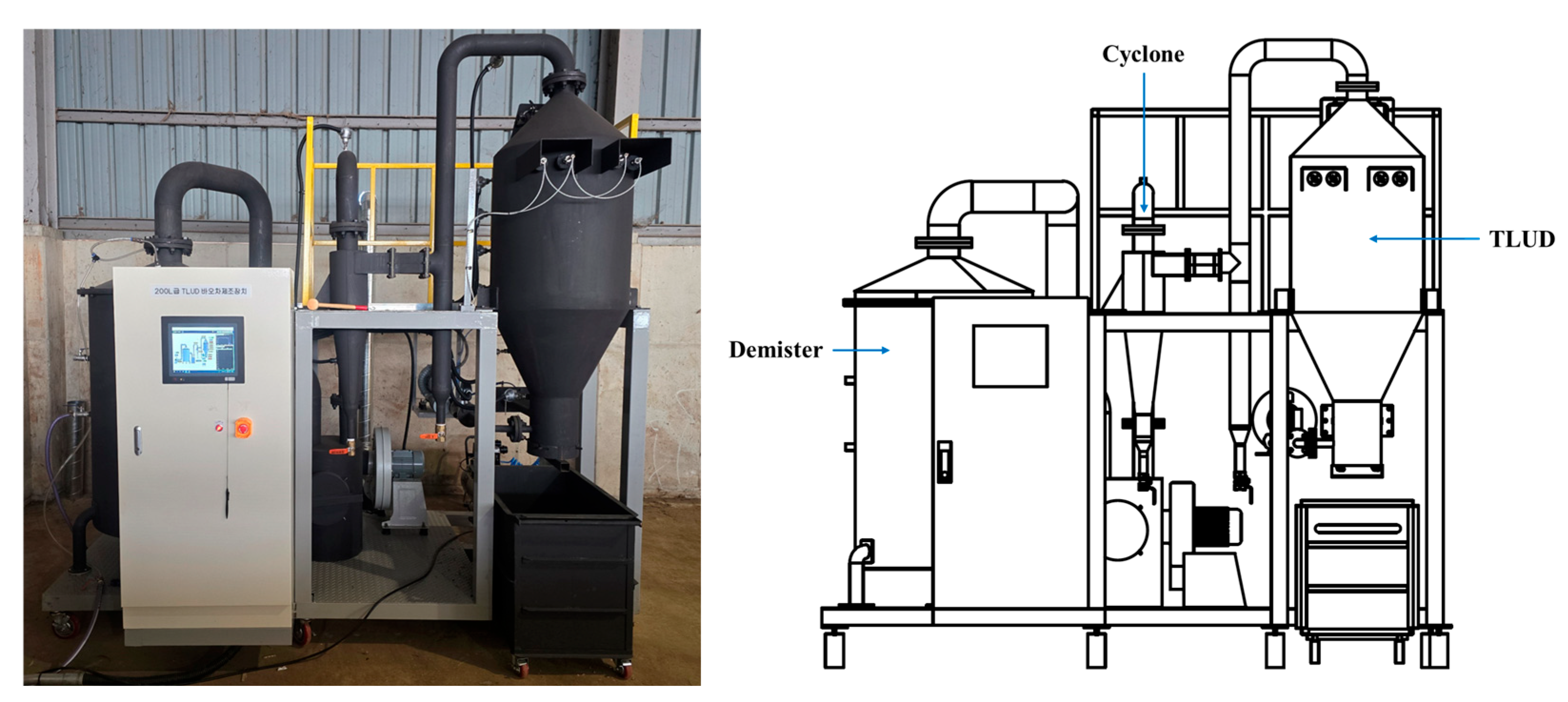
2.1. Preparation for Biochar
- W1: Dry mass of feedstock prior to pyrolysis
- W2: Dry mass of biochar.

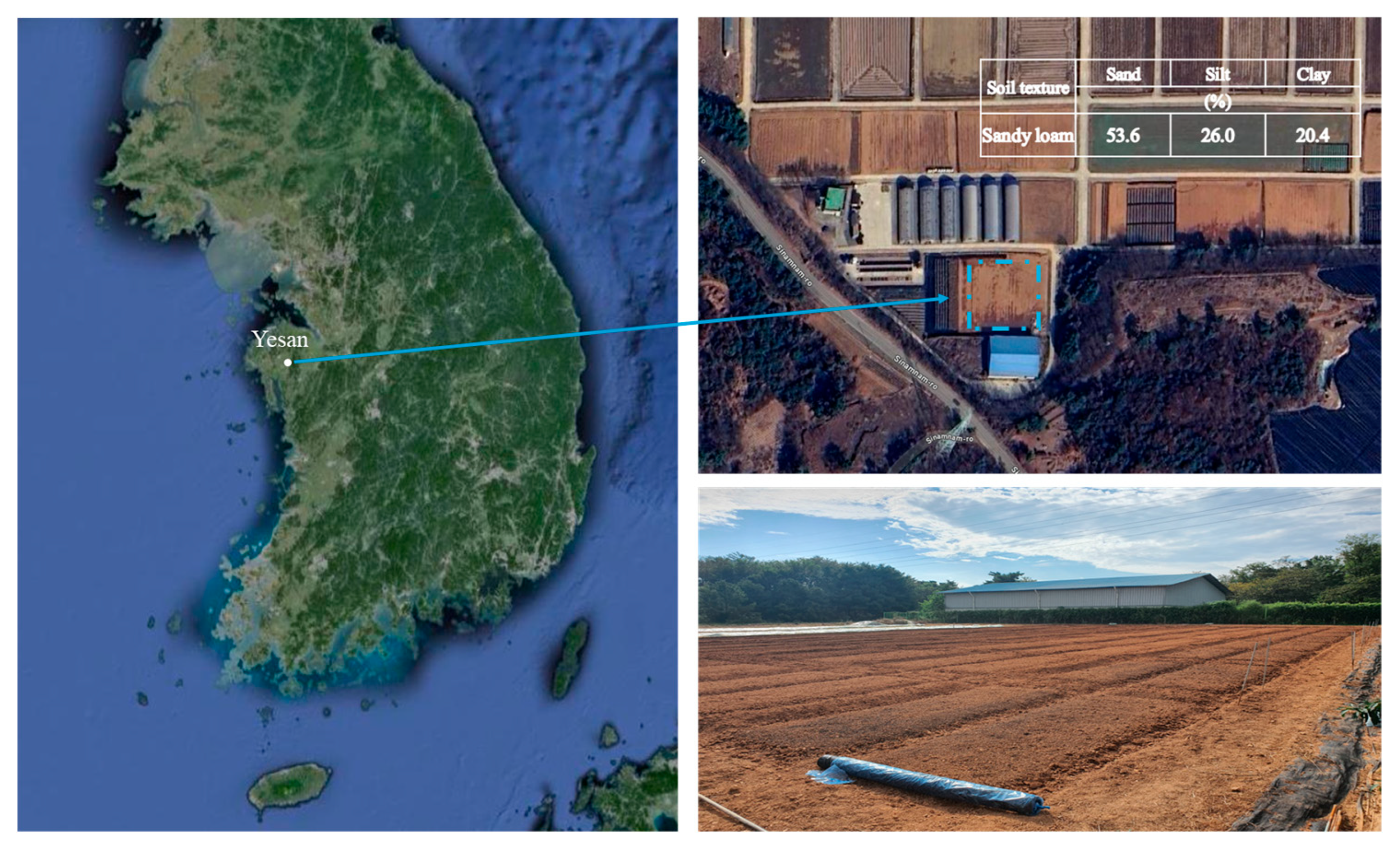
2.2. Field Experiment and Cultivation Management
- NBC: Control (No biochar application)
- BC2.5: Low application rate (2.5 Mg C ha−1; corresponding to a gross weight of 3.65 Mg ha−1)
- BC5.0: Medium application rate (5.0 Mg C ha−1; corresponding to a gross weight of 7.3 Mg ha−1)
- BC10.0: High application rate (10.0 Mg C ha−1; corresponding to a gross weight of 14.6 Mg ha−1)
2.3. Biochar and Soil Analysis
2.3.1. Biochar Analysis
2.3.2. Soil Analysis
2.3.3. Soil Carbon Stock Evaluation
- M: Soil total carbon stock (Mg C ha−1)
- C: Soil carbon concentration (g C kg−1)
- Pb: Soil bulk density (Mg m−3)
- H: Soil depth (m).
- Mtreatment: Soil carbon stock in biochar-treated plot (Mg C ha−1)
- Mcontrol: Soil carbon stock in control plot (Mg C ha−1)
- Mtreatment − Mcontrol: Net increase in soil carbon stock (Mg C ha−1)
- Capp: Applied biochar-derived carbon (Mg C ha−1)
- CRR: Carbon retention ratio (%).
2.3.4. Red Pepper Growth and Statistical Analysis
- YE: Yield efficiency (ton ha−1 per Mg C ha−1)
- Yt: Total yield of the biochar-treated plot (ton ha−1)
- Yc: Total yield of the control plot (NBC, ton ha−1)
- Capp: Applied biochar-C rate (Mg C ha−1).
3. Results and Discussion
3.1. Properties of Red Pepper Biochar
3.1.1. Physicochemical Properties
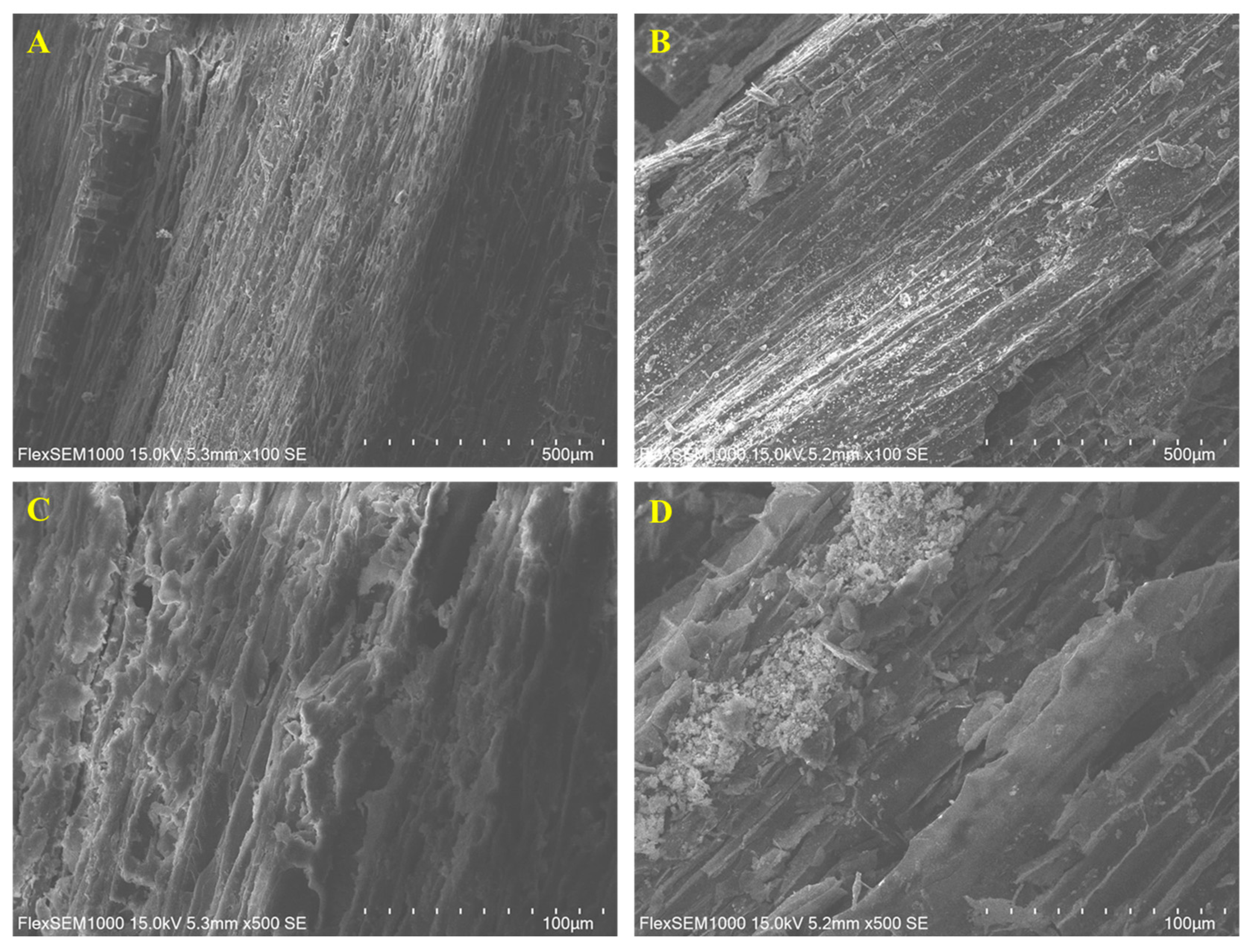
3.1.2. Morphological Properties
3.2. Soil Chemical Properties
3.3. Effects of Carbon-Based Biochar Application on Growth and Yield of Red Pepper
3.3.1. Growth Parameter Response to Biochar
3.3.2. Yield Components and Marketable Ratio
3.3.3. Yield Efficiency (Agronomic Efficiency per Mg C ha−1)
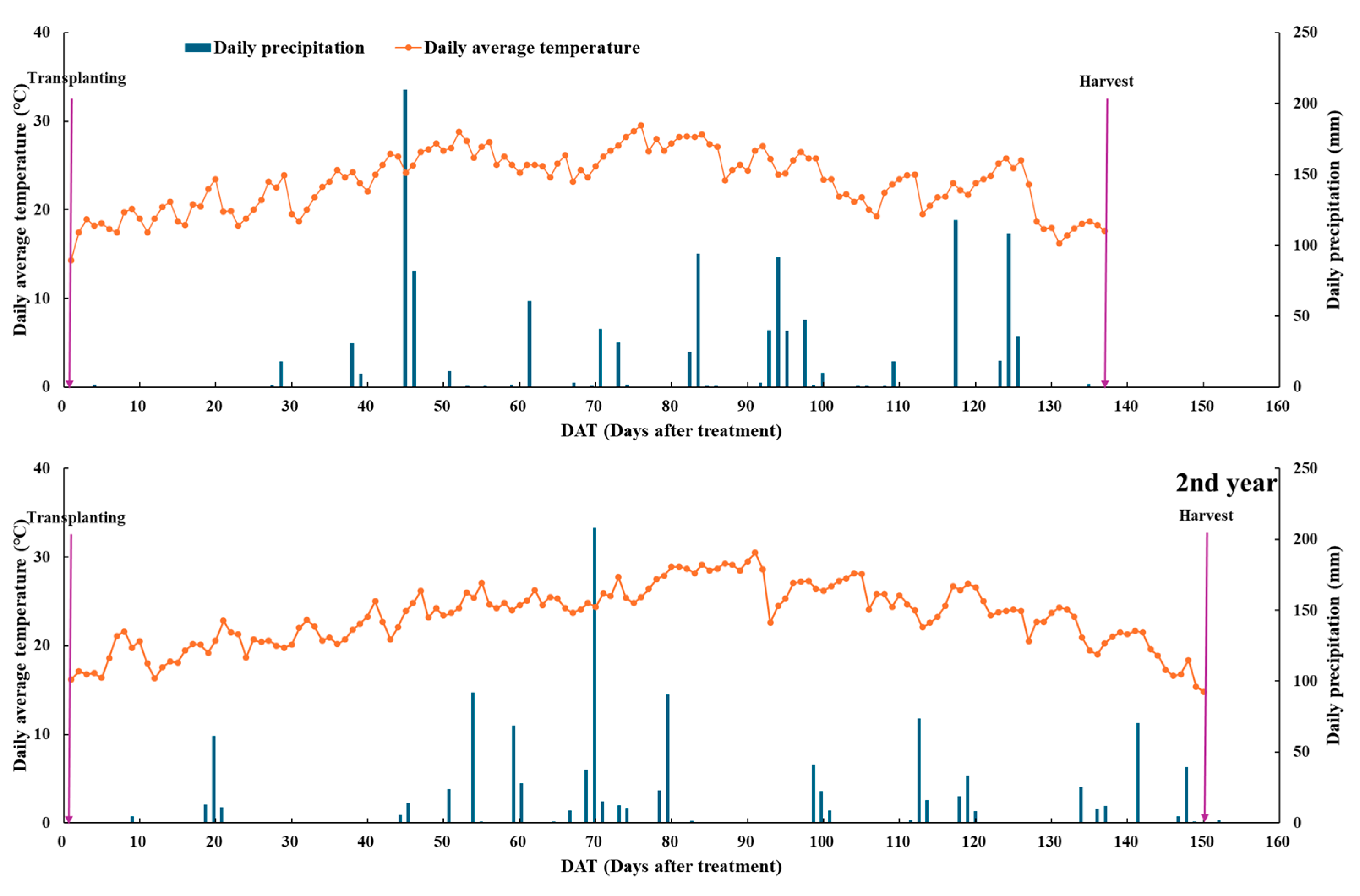
3.3.4. Yearly Variability and Environmental Effects
3.3.5. Correlation Between Growth Traits and Yield
- Fruit width: r = +0.919 (2022), +0.794 (2023)
- Stem diameter: r = +0.840 (2022), +0.606 (2023)
- Number of branches: r = +0.442 (2022), +0.558 (2023)
- Fruit weight: r = +0.700 (2022), +0.308 (2023).
3.4. Evaluation of Soil Carbon Stock
Carbon Retention Ratio (CRR) and Biochar-C Preservation Efficiency
4. Conclusions
- (1)
- Biochar application improved soil chemical properties, including pH and electrical conductivity, creating more favorable conditions for red pepper growth.
- (2)
- Red pepper yield increased with higher carbon input, whereas low-dose application (BC2.5) achieved the highest carbon-use efficiency, suggesting a practical balance between productivity and resource efficiency.
- (3)
- Although standard soil analysis underestimated carbon stock by excluding coarse biochar fragments (>2 mm), biochar clearly enhanced soil carbon retention, supporting its role as a persistent and stable carbon sink.
- (4)
- Recycling agricultural residues into biochar and applying it according to carbon content offers a promising strategy to align agricultural productivity, carbon sequestration, and circular resource use. Future work should refine soil carbon assessment protocols and establish long-term monitoring frameworks.
Author Contributions
Funding
Data Availability Statement
Acknowledgments
Conflicts of Interest
References
- Rogelj, J.; den Elzen, M.; Höhne, N.; Fransen, T.; Fekete, H.; Winkler, H.; Schaeffer, R.; Sha, F.; Riahi, K.; Meinshausen, M. Paris Agreement climate proposals need a boost to keep warming well below 2 °C. Nature 2016, 534, 631–639. [Google Scholar] [CrossRef]
- Schleussner, C.; Rogelj, J.; Schaeffer, M.; Lissner, T.; Licker, R.; Fischer, E.M.; Hare, W. Science and policy characteristics of the Paris agreement temperature goal. Nat. Clim. Change 2016, 6, 827–835. [Google Scholar] [CrossRef]
- WMO (World Meteorological Organization). Global Temperature Is Likely to Exceed 1.5 °C Above Pre-Industrial Level Temporarily in Next 5 Years. Available online: https://wmo.int/media/news/global-temperature-likely-exceed-15degc-above-pre-industrial-level-temporarily-next-5-years (accessed on 26 November 2025).
- C3S (The Copernicus Climate Change Service). Copernicus: June 2024 Marks 12th Month of Global Temperature Reaching 1.5 °C Above Pre-Industrial. Available online: https://climate.copernicus.eu/copernicus-june-2024-marks-12th-month-global-temperature-reaching-15degc-above-pre-industrial (accessed on 26 November 2025).
- EPA (United States Environmental Protection Agency). Climate Change Impacts on Agriculture and Food Supply. Available online: https://www.epa.gov/climateimpacts/climate-change-impacts-agriculture-and-food-supply (accessed on 26 November 2025).
- Parker, L.; Bourgoin, C.; Martinez-Valle, A.; Läderach, P. Vulnerability of the agricultural sector to climate change: The development of a pan-tropical Climate Risk Vulnerability Assessment to inform sub-national decision making. PLoS ONE 2019, 14, e0213641. [Google Scholar] [CrossRef] [PubMed]
- Hasegawa, T.; Wakatsuki, H.; Ju, H.; Vyas, S.; Nelson, G.C.; Farrell, A.; Deryng, D.; Meza, F.; Makowski, D. A global dataset for the projected impacts of climate change on four major crops. Sci. Data 2022, 9, 58. [Google Scholar] [CrossRef] [PubMed]
- Rezaei, E.E.; Webber, H.; Asseng, S.; Boote, K.; Durand, J.L.; Ewert, F.; Martre, P.; MacCarthy, D.S. Climate change impacts on crop yields. Nat. Rev. Earth Environ. 2023, 4, 831–846. [Google Scholar] [CrossRef]
- Lehmann, J. A handful of carbon. Nature 2007, 447, 143–144. [Google Scholar] [CrossRef]
- Du, L.; Ahmad, S.; Liu, L.; Wang, L.; Tang, J.C. A review of antibiotics and antibiotic resistance genes (ARGs) adsorption by biochar and modified biochar in water. Sci. Total Environ. 2023, 858, 159815. [Google Scholar] [CrossRef]
- Wang, J.; Xiong, Z.; Kuzyakov, Y. Biochar stability in soil: Meta-analysis of decomposition and priming effects. GCB Bioenergy 2016, 8, 512–523. [Google Scholar] [CrossRef]
- Li, S.; Tasnady, D. Biochar for Soil Carbon Sequestration: Current Knowledge, Mechanisms, and Future Perspectives. J. Carbon Res. 2023, 9, 67. [Google Scholar] [CrossRef]
- Cha, J.S.; Park, S.H.; Jung, S.C.; Ryu, C.; Jeon, J.K.; Shin, M.C.; Park, Y.K. Production and utilization of biochar: A review. J. Ind. Eng. Chem. 2016, 40, 1–15. [Google Scholar] [CrossRef]
- Yang, D.; Liu, Y.; Liu, S.; Huang, X.; Li, Z.; Tan, X.; Zeng, G.; Zhou, L. Potential benefits of biochar in agricultural soils: A review. Pedosphere 2017, 27, 645–661. [Google Scholar] [CrossRef]
- Ippolito, J.A.; Cui, L.; Kammann, C.; Wrage-Mönnig, N.; Estavillo, J.M.; Fuertes-Mendizabal, T.; Cayuela, M.L.; Sigua, G.; Novak, J.; Spokas, K.; et al. Feedstock choice, pyrolysis temperature and type influence biochar characteristics: A comprehensive meta-data analysis review. Biochar 2020, 2, 421–438. [Google Scholar] [CrossRef]
- IPCC. Climate Change and Land: An IPCC Special Report on Climate Change, Desertification, Land Degradation, Sustainable Land Management, Food Security, and Greenhouse Gas Fluxes in Terrestrial Ecosystems; Intergovernmental Panel on Climate Change (IPCC): Geneva, Switzerland, 2019. [Google Scholar]
- Lehmann, J.; Joseph, S. (Eds.) Biochar for Environmental Management: Science, Technology and Implementation, 3rd ed.; Earthscan from Routledge: Abingdon, UK; New York, NY, USA, 2024. [Google Scholar]
- Vijay, V.; Shreedhar, S.; Adlak, K.; Payyanad, S.; Sreedharan, V.; Gopi, G.; Voor, T.S.; Malarvizhi, T.; Yi, S.; Gebert, J.; et al. Review of large-scale biochar field-trials for soil amendment and the observed influences on crop yield variations. Front. Energy Res. 2021, 9, 710766. [Google Scholar] [CrossRef]
- Liu, X.; Zhang, A.; Ji, C.; Joseph, S.; Bian, R.; Li, L.; Pan, G.; Paz-Ferreiro, J. Biochar’s Effect on Crop Productivity and the Dependence on Experimental Conditions—A Meta-Analysis of Literature Data. Plant Soil 2013, 373, 583–594. [Google Scholar] [CrossRef]
- Kumar, A.; Shrivastava, A.; Vimal, V.; Gupta, A.K.; Bhujbal, S.K.; Biswas, J.K.; Singh, L.; Ghosh, P.; Pandey, A.; Sharma, P.; et al. Biochar application for greenhouse gas mitigation, contaminants immobilization and soil fertility enhancement: A state-of-the-art review. Sci. Total Environ. 2022, 853, 158562. [Google Scholar] [CrossRef]
- Qin, F.; Li, J.; Zhang, C.; Zeng, G.; Huang, D.; Tan, X.; Qin, D.; Tan, H. Biochar in the 21st century: A data-driven visualization of collaboration, frontier identification, and future trend. Sci. Total Environ. 2022, 818, 151774. [Google Scholar] [CrossRef]
- Bekchanova, M.; Campion, L.; Bruns, S.; Kuppens, T.; Lehmann, J.; Jozefczak, M.; Cuypers, A.; Malina, R. Biochar improves the nutrient cycle in sandy-textured soils and increases crop yield: A systematic review. Environ. Evid. 2024, 13, 3. [Google Scholar] [CrossRef]
- Li, X.; Wu, D.; Liu, X.; Huang, Y.; Cai, A.; Xu, H.; Ran, J.; Xiao, J.; Zhang, W. A global dataset of biochar application effects on crop yield, soil properties, and greenhouse gas emissions. Sci. Data 2024, 11, 57. [Google Scholar] [CrossRef]
- Korea Rural Economic Institute (KREI). A Study of Efficient Recycling of Agricultural and Livestock Wastes as Resources (Year 2 of 2); Korea Rural Economic Institute: Naju, Republic of Korea, 2017. [Google Scholar]
- Hwang, J.; Park, G.; Kim, S. Contents of Soil Microbial Phospholipid Fatty Acids as Affected by Continuous Cropping of Pepper under Upland. Korean. J. Soil Sci. Fert. 2010, 43, 1012–1017. [Google Scholar]
- Naeem, M.A.; Khalid, M.; Arshad, M.; Ahmad, R. Yield and nutrient composition of biochar produced from different feedstocks at varying pyrolytic temperatures. Pak. J. Agric. Sci. 2014, 51, 75–82. [Google Scholar]
- Rural Development Administration (RDA). Fertilization Standard of Crop Plants; National Institute of Agricultural Science and Technology: Suwon, Republic of Korea, 1999. [Google Scholar]
- Rural Development Administration (RDA). Fertilizer Manufacturing Standard; Rural Development Administration: Jeonju, Republic of Korea, 2024. [Google Scholar]
- National Institute of Agricultural Science and Technology (NIAST). Methods of Soil and Crop Plant Analysis; Rural Development Administration: Suwon, Republic of Korea, 2000. [Google Scholar]
- Singh, B.P.; Cowie, A.L.; Smernik, R.J. Biochar Carbon Stability in a Clayey Soil as a Function of Feedstock and Pyrolysis Temperature. Environ. Sci. Technol. 2012, 46, 11770–11778. [Google Scholar] [CrossRef] [PubMed]
- Blanco-Canqui, H.; Laird, D.A.; Heaton, E.A.; Rathke, S.; Acharya, B.S. Soil Carbon Increased by Twice the Amount of Biochar Carbon Applied after Six Years: Field Evidence of Negative Priming. GCB Bioenergy 2020, 12, 240–251. [Google Scholar] [CrossRef]
- Rural Development Administration (RDA). Standard Investigation Methods for Agriculture Experiment; Rural Development Administration: Suwon, Republic of Korea, 1995. [Google Scholar]
- Yuan, J.H.; Xu, R.K.; Zhang, H. The forms of alkalis in the biochar produced from crop residues at different temperatures. Bioresour. Technol. 2011, 102, 3488–3497. [Google Scholar] [CrossRef]
- Mukherjee, A.; Zimmerman, A.R. Organic carbon and nutrient release from a range of laboratory-produced biochars and biochar–soil mixtures. Geoderma 2013, 193–194, 122–130. [Google Scholar] [CrossRef]
- Tomczyk, A.; Sokołowska, Z.; Boguta, P. Biochar physicochemical properties: Pyrolysis temperature and feedstock kind effects. Rev. Environ. Sci. Bio/Technol. 2020, 19, 191–215. [Google Scholar] [CrossRef]
- Van Zwieten, L.; Kimber, S.; Morris, S.; Chan, K.Y.; Downie, A.; Rust, J.; Joseph, S.; Cowie, A. Effects of biochar from slow pyrolysis of papermill waste on agronomic performance and soil fertility. Plant Soil 2010, 327, 235–246. [Google Scholar] [CrossRef]
- Chun, Y.; Sheng, G.; Chiou, C.T.; Xing, B. Compositions and sorptive properties of crop residue-derived chars. Environ. Sci. Technol. 2004, 38, 4649–4655. [Google Scholar] [CrossRef]
- Chen, B.; Zhou, D.; Zhu, L. Transitional adsorption and partition of nonpolar and polar aromatic contaminants by biochars of pine needles with different pyrolytic temperatures. Environ. Sci. Technol. 2008, 42, 5137–5143. [Google Scholar] [CrossRef] [PubMed]
- Pal, P.; Kumari, K.; Jain, M.K.; Sikdar, P. Evaluation of change in biochar properties derived from different feedstock and pyrolysis temperature for environmental and agricultural application. Sci. Total Environ. 2020, 713, 136433. [Google Scholar] [CrossRef]
- Himanshi, N.; Sood, Y. Potential of biochar in improving soil fertility and carbon sequestration. Int. J. Plant Soil Sci. 2025, 37, 88–99. [Google Scholar] [CrossRef]
- Zhu, Z.; Zhang, Y.; Tao, W.; Zhang, X.; Xu, Z.; Xu, C. The Biological Effects of Biochar on Soil’s Physical and Chemical Characteristics: A Review. Sustainability 2025, 17, 2214. [Google Scholar] [CrossRef]
- Torgbenu, J.K.; Boateng, G.; Kwarteng, F.O. Short-Term Alteration of Soil Physicochemical Characteristics Induced by Biochar Application on a Ferric Acrisol. Soil Syst. 2025, 9, 7743251. [Google Scholar] [CrossRef]
- Sun, Z.; Hu, Y.; Shi, L.; Li, G.; Pang, Z.; Liu, S.; Chen, Y.; Jia, B. Effects of Biochar on Soil Chemical Properties: A Global Meta-Analysis of Agricultural Soil. Plant Soil Environ. 2022, 68, 272–289. [Google Scholar] [CrossRef]
- Dai, W.; Bao, Z.; Meng, J.; Chen, T.; Liang, X. Biochar Makes Soil Organic Carbon More Labile, but Its Carbon Sequestration Potential Remains. Agronomy 2025, 15, 1547. [Google Scholar] [CrossRef]
- Nepal, J.; Ahmad, W.; Munsif, F.; Khan, A.; Zou, Z. Advances and prospects of biochar in improving soil fertility, biochemical quality, and environmental applications. Front. Environ. Sci. 2023, 11, 1114752. [Google Scholar] [CrossRef]
- Khan, S.; Irshad, S.; Mehmood, K.; Hasnain, Z.; Nawaz, M.; Rais, A.; Gul, S.; Wahid, M.A.; Hashem, A.; AbdAllah, E.F.; et al. Biochar production and characteristics, its impacts on soil health, crop production, and yield enhancement: A review. Plants 2024, 13, 166. [Google Scholar] [CrossRef] [PubMed]
- Hardie, M.; Clothier, B.; Bound, S.; Oliver, G.; Close, D. Does Biochar Influence Soil Physical Properties and Soil Water Availability? Plant Soil 2014, 376, 347–361. [Google Scholar] [CrossRef]
- Zhang, R.; Yue, Z.; Chen, X.; Huang, R.; Zhou, Y.; Cao, X. Effects of waterlogging at different growth stages on the photosynthetic characteristics and grain yield of sorghum (Sorghum bicolor L.). Sci. Rep. 2023, 13, 7212. [Google Scholar] [CrossRef] [PubMed]
- Dai, Y.; Zheng, H.; Jiang, Z.; Xing, B. Combined effects of biochar properties and soil conditions on plant growth: A meta-analysis. Sci. Total Environ. 2020, 713, 136635. [Google Scholar] [CrossRef]
- Park, J.H.; Yun, J.J.; Kim, S.H.; Park, J.H.; Acharya, B.S.; Cho, J.J.; Kang, S.W. Biochar improves soil properties and corn productivity under drought conditions in South Korea. Biochar 2023, 5, 66. [Google Scholar] [CrossRef]
- Niklas, K.J. Plant Biomechanics: An Engineering Approach to Plant Form and Function; University of Chicago Press: Chicago, IL, USA, 1992. [Google Scholar]
- Taiz, L.; Zeiger, E.; Møller, I.M.; Murphy, A. Plant Physiology and Development, 6th ed.; Sinauer Associates: Sunderland, MA, USA, 2015. [Google Scholar]
- Marcelis, L.F.M. Sink strength as a determinant of dry matter partitioning in the whole plant. J. Exp. Bot. 1996, 47, 1281–1291. [Google Scholar] [CrossRef] [PubMed]
- Heuvelink, E. Dry matter partitioning in tomato: Validation of a dynamic simulation model. Ann. Bot. 1996, 77, 71–80. [Google Scholar] [CrossRef]



| Sample | Sand | Silt | Clay | Soil Texture | Bulk Density | pH | EC | T-C | T-N | Av. P | Exchangeable Cations (cmolc kg−1) | Soil Carbon Stock | ||
|---|---|---|---|---|---|---|---|---|---|---|---|---|---|---|
| (%) | (Mg m−3) | (1:5) | (dS m−1) | (%) | (mg kg−1) | K | Ca | Mg | (Mg C ha−1) | |||||
| Initial soil | 53.6 | 26.0 | 20.4 | Sandy loam | 1.35 | 5.9 ± 0.0 | 0.67 ± 0.02 | 1.71 ± 0.11 | 0.15 ± 0.01 | 89 ± 15 | 0.85 ± 0.04 | 4.8 ± 0.1 | 1.6 ± 0.0 | 46.17 |
| Samples | pH | Elemental Content | H/C Molar ratio | Inorganic Content | Biochar Yield | |||||
|---|---|---|---|---|---|---|---|---|---|---|
| (%) | (%) | |||||||||
| (1:10) | T-C | T-N | T-H | P2O5 | K2O | CaO | MgO | (%) | ||
| Feedstock | 5.9 ± 0.1 | 45.1 ± 0.3 | 1.0 ± 0.1 | 5.3 ± 0.2 | 1.41 | 0.12 ± 0.1 | 0.74 ± 0.11 | 1.75 ± 0.10 | 0.83 ± 0.03 | - |
| Biochar | 10.3 ± 0.1 | 68.7 ± 0.4 | 2.7 ± 0.1 | 1.5 ± 0.2 | 0.26 | 0.54 ± 0.02 | 3.15 ± 0.21 | 2.05 ± 0.07 | 0.77 ± 0.02 | 28.5 ± 1.3 |
| Official standard (1) | - | ≧40 | - | - | ≦0.7 | - | - | - | - | - |
| Treatment | Bulk Density | pH | EC | Elemental Content | Av. P | Exchangeable Cations (cmolc kg−1) | Soil Carbon Stock | |||
|---|---|---|---|---|---|---|---|---|---|---|
| (%) | ||||||||||
| (Mg m−3) | (1:5, H2O) | (dS m−1) | T-C | T-N | (mg kg−1) | K+ | Ca2+ | Mg2+ | (Mg C ha−1) | |
| NBC | 1.43 | 6.2 ± 0.1 | 0.77 ± 0.35 | 1.64 ± 0.04 | 0.16 ± 0.03 | 163 ± 16 | 1.44 ± 0.11 | 5.4 ± 0.1 | 2.2 ± 0.2 | 46.90 |
| BC2.5 | 1.40 | 6.4 ± 0.1 | 0.95 ± 0.10 | 1.73 ± 0.13 | 0.21 ± 0.05 | 164 ± 13 | 1.46 ± 0.09 | 5.6 ± 0.1 | 2.1 ± 0.1 | 48.44 |
| BC5.0 | 1.39 | 6.3 ± 0.1 | 1.02 ± 0.08 | 1.79 ± 0.12 | 0.22 ± 0.06 | 165 ± 12 | 1.42 ± 0.21 | 5.5 ± 0.1 | 2.2 ± 0.3 | 49.76 |
| BC10.0 | 1.35 | 6.5 ± 0.1 | 1.05 ± 0.08 | 1.83 ± 0.10 | 0.22 ± 0.04 | 165 ± 17 | 1.59 ± 0.21 | 5.5 ± 0.1 | 2.3 ± 0.1 | 49.41 |
| Parameters | Year | Treatment | ||||
|---|---|---|---|---|---|---|
| NBC | BC2.5 | BC5.0 | BC10.0 | |||
| Plant | Stem diameter (mm) | 2022 | 16.3 ± 0.3 C | 16.7 ± 0.2 B | 17.2 ± 0.2 A | 17.2 ± 0.2 A |
| 2023 | 14.1 ± 0.2 c | 14.4 ± 0.3 b | 14.6 ± 0.4 ab | 14.7 ± 0.3 a | ||
| Plant height (cm) | 2022 | 115.2 ± 4.5 A | 117.0 ± 3.7 A | 117.3 ± 3.2 A | 117.3 ± 2.1 A | |
| 2023 | 110.1 ± 2.4 a | 112.3 ± 2.0 a | 111.4 ± 3.0 a | 112.2 ± 1.7 a | ||
| Leaf length (cm) | 2022 | 8.3 ± 1.0 A | 8.4 ± 0.5 A | 8.3 ± 0.7 A | 8.3 ± 0.5 A | |
| 2023 | 8.3 ± 0.4 a | 8.3 ± 0.4 a | 8.3 ± 0.9 a | 8.4 ± 0.3 a | ||
| Leaf width (cm) | 2022 | 3.9 ± 0.2 B | 4.1 ± 0.3 A | 3.8 ± 0.1 B | 3.9 ± 0.2 B | |
| 2023 | 3.8 ± 0.1 a | 3.9 ± 0.4 a | 4.0 ± 0.2 a | 3.9 ± 0.3 a | ||
| Number of branches (ea plant−1) | 2022 | 12.8 ± 0.2 B | 13.1 ± 0.1 A | 13.0 ± 0.2 A | 13.1 ± 0.2 A | |
| 2023 | 12.5 ± 0.2 b | 12.8 ± 0.1 a | 12.8 ± 0.2 a | 12.9 ± 0.2 a | ||
| Chlorophyll (SPAD) | 2022 | 76.2 ± 3.2 A | 77.3 ± 2.5 A | 75.2 ± 2.7 A | 77.3 ± 5.2 A | |
| 2023 | 64.8 ± 2.4 a | 64.3 ± 1.6 a | 63.9 ± 2.5 a | 64.1 ± 3.7 a | ||
| Fruit | Fruit length (cm) | 2022 | 14.7 ± 0.5 C | 15.4 ± 0.4 B | 15.8 ± 0.2 A | 16.0 ± 0.5 A |
| 2023 | 15.4 ± 0.4 b | 16.0 ± 0.4 a | 16.0 ± 0.3 a | 15.8 ± 0.4 a | ||
| Fruit width (mm) | 2022 | 20.6 ± 0.3 C | 21.0 ± 0.4 B | 24.7 ± 0.2 A | 24.9 ± 0.3 A | |
| 2023 | 24.9 ± 0.2 c | 24.9 ± 0.2 c | 25.4 ± 0.1 b | 25.7 ± 0.3 a | ||
| Fruit weight (g) | 2022 | 25.2 ± 0.7 B | 27.2 ± 0.8 A | 27.4 ± 0.7 A | 27.5 ± 0.9 A | |
| 2023 | 26.2 ± 0.5 b | 27.3 ± 0.4 ab | 27.2 ± 0.7 a | 26.7 ± 0.8 ab | ||
| Total yield (ton ha−1) | 2022 | 33.4 ± 0.1 C | 35.6 ± 0.11 B | 36.2 ± 0.10 AB | 37.2 ± 0.08 A | |
| 2023 | 31.8 ± 0.9 c | 33.0 ± 0.07 b | 34.1 ± 0.10 a | 34.8 ± 0.10 a | ||
| Marketable fruit ratio | 2022 | 92.1 | 91.7 | 92.8 | 91.5 | |
| 2023 | 85.6 | 84.4 | 85.8 | 84.6 | ||
| Yield index | 2022 | - | 7.3 | 8.5 | 11.3 | |
| 2023 | - | 3.7 | 7.3 | 9.5 | ||
| Treatment | Total Yield Increase (vs NBC) (ton ha−1) | Biochar-C Rate (Mg C ha−1) | Yield Efficiency (YE) (ton ha−1 Mg C) |
|---|---|---|---|
| BC2.5 | 3.22 | 2.5 | 1.29 |
| BC5.0 | 4.81 | 5.0 | 0.96 |
| BC10.0 | 5.52 | 10.0 | 0.55 |
| Parameters | 2022 | 2023 |
|---|---|---|
| Stem diameter | +0.840 ** | +0.606 ** |
| Plant height | +0.211 | +0.251 |
| Leaf length | −0.012 | +0.080 |
| Leaf width | −0.173 | +0.132 |
| Number of branches | +0.442 ** | +0.558 ** |
| Chlorophyll | −0.006 | −0.127 |
| Fruit length | +0.851 ** | +0.288 |
| Fruit width | +0.919 ** | +0.794 ** |
| Fruit weight | +0.700 ** | +0.308 |
| Yield index | +0.766 ** | +0.795 ** |
| Treatment | Applied Biochar-C (Mg C ha−1) | Soil C Stock (Mg C ha−1) | ΔM (Mg C ha−1) | CRR (%) |
|---|---|---|---|---|
| NBC | 0 | 46.9 | – | – |
| BC2.5 | 2.5 | 48.44 | 1.54 | 61.6 |
| BC5.0 | 5 | 49.76 | 2.86 | 57.2 |
| BC10.0 | 10 | 49.41 | 2.51 | 25.1 |
Disclaimer/Publisher’s Note: The statements, opinions and data contained in all publications are solely those of the individual author(s) and contributor(s) and not of MDPI and/or the editor(s). MDPI and/or the editor(s) disclaim responsibility for any injury to people or property resulting from any ideas, methods, instructions or products referred to in the content. |
© 2025 by the authors. Licensee MDPI, Basel, Switzerland. This article is an open access article distributed under the terms and conditions of the Creative Commons Attribution (CC BY) license.
Share and Cite
Yun, Y.; Cho, Y.; Lee, J.s.; Choi, S.; Kim, S.; Ju, J.; Lee, J.; Lee, K. Impact of Carbon-Based Biochar Application on Red Pepper Yield and Soil Carbon Sequestration. Agronomy 2026, 16, 84. https://doi.org/10.3390/agronomy16010084
Yun Y, Cho Y, Lee Js, Choi S, Kim S, Ju J, Lee J, Lee K. Impact of Carbon-Based Biochar Application on Red Pepper Yield and Soil Carbon Sequestration. Agronomy. 2026; 16(1):84. https://doi.org/10.3390/agronomy16010084
Chicago/Turabian StyleYun, Yeouk, Yungi Cho, Jeong su Lee, Sohye Choi, Seonjoong Kim, Jungil Ju, Jaehan Lee, and Kyosuk Lee. 2026. "Impact of Carbon-Based Biochar Application on Red Pepper Yield and Soil Carbon Sequestration" Agronomy 16, no. 1: 84. https://doi.org/10.3390/agronomy16010084
APA StyleYun, Y., Cho, Y., Lee, J. s., Choi, S., Kim, S., Ju, J., Lee, J., & Lee, K. (2026). Impact of Carbon-Based Biochar Application on Red Pepper Yield and Soil Carbon Sequestration. Agronomy, 16(1), 84. https://doi.org/10.3390/agronomy16010084