The Effect of Deep Tillage Combined with Organic Amendments on Soil Organic Carbon and Nitrogen Stocks in Northeast China
Abstract
1. Introduction
2. Materials and Methods
2.1. Site Description and Experimental Design
2.2. Soil Sampling and Determination of Related Indicators
2.3. Statistical Analysis
3. Results
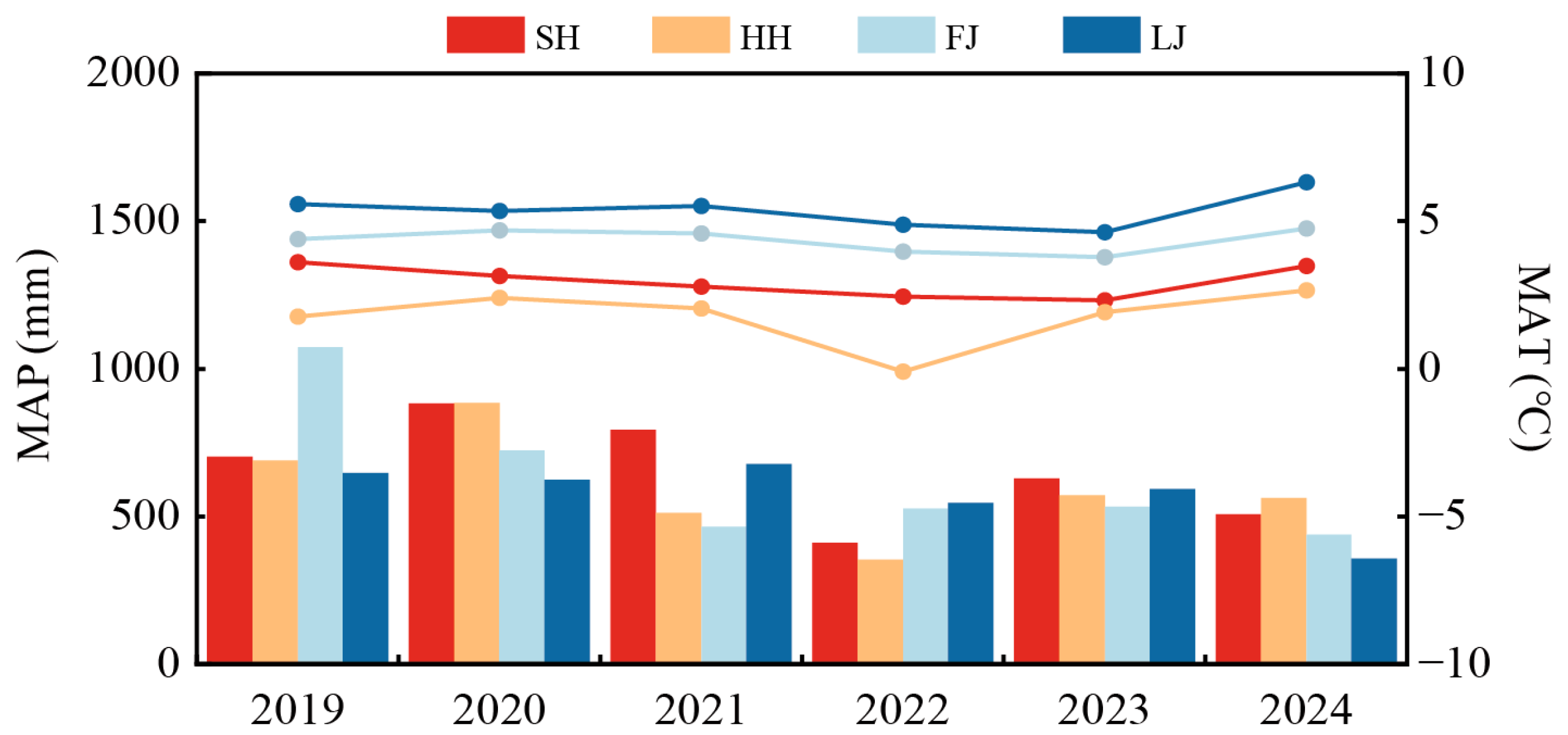
3.1. Organic C Input and Initial Soil Properties
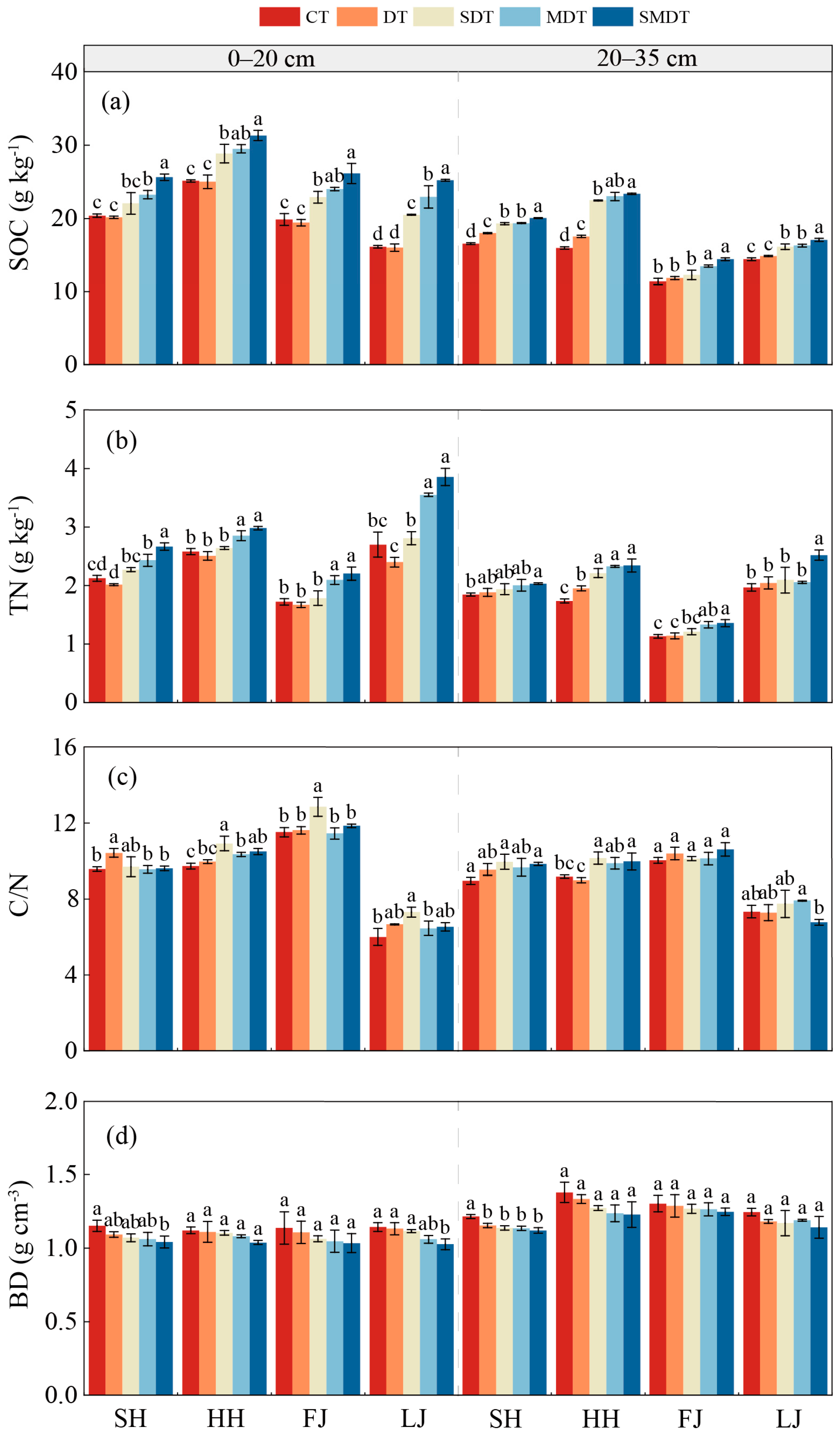
3.2. Effects of Tillage and Organic Material Return on SOC and TN Content and BD
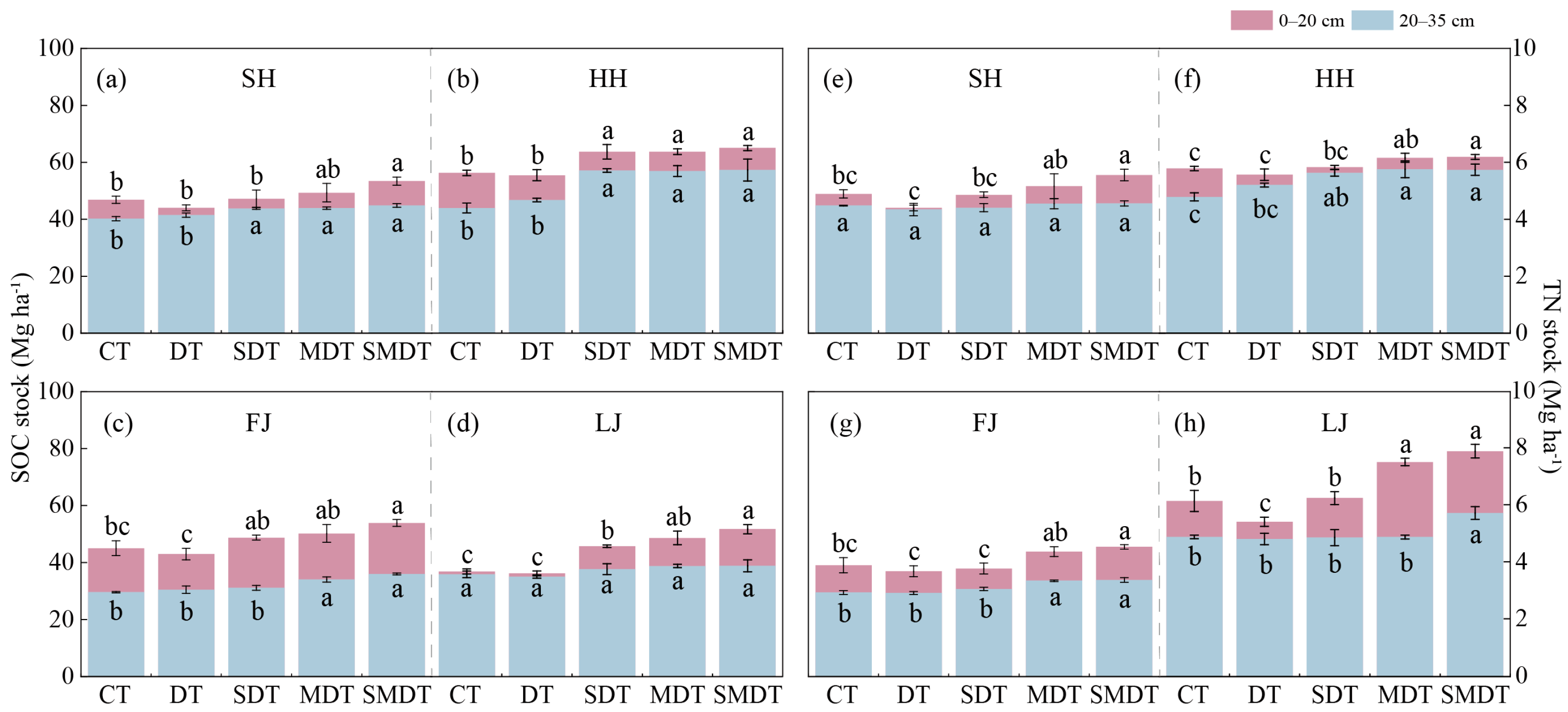
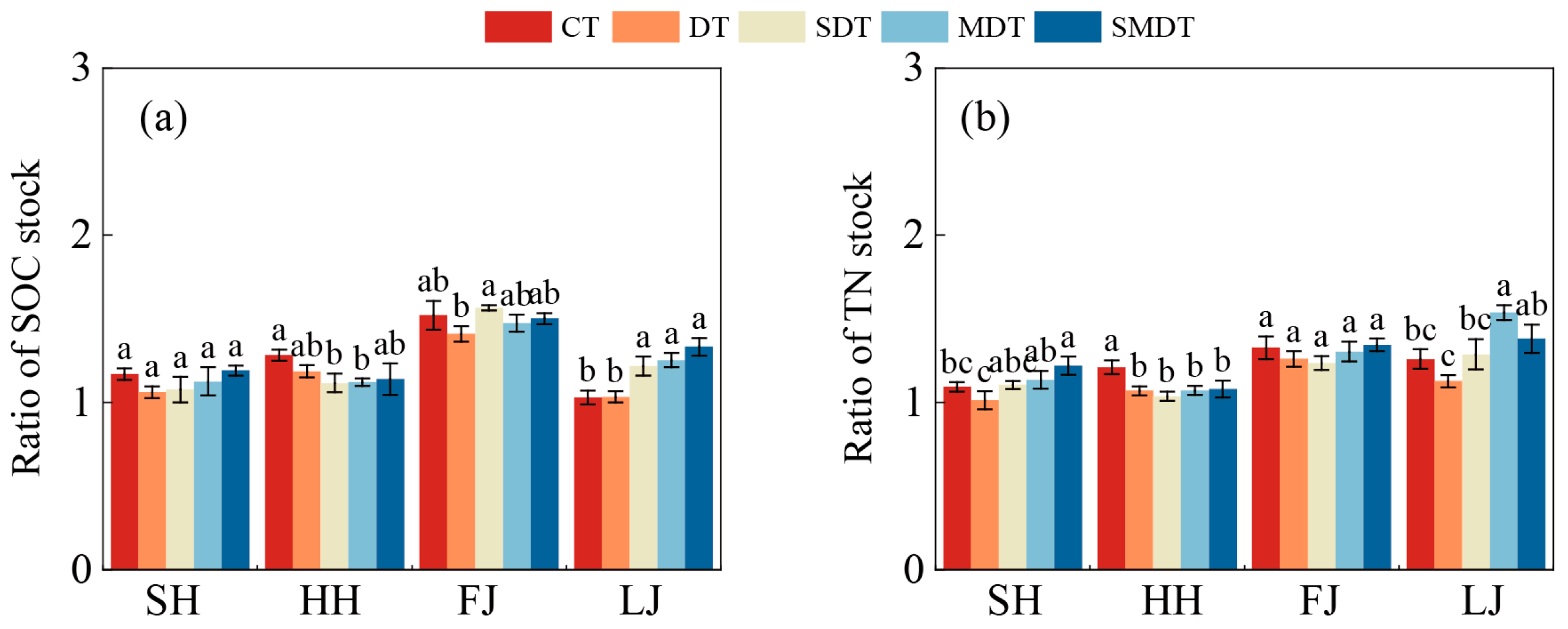
3.3. The Effect of Deep Tillage Combined with Organic Amendments on SOC and TN Stocks
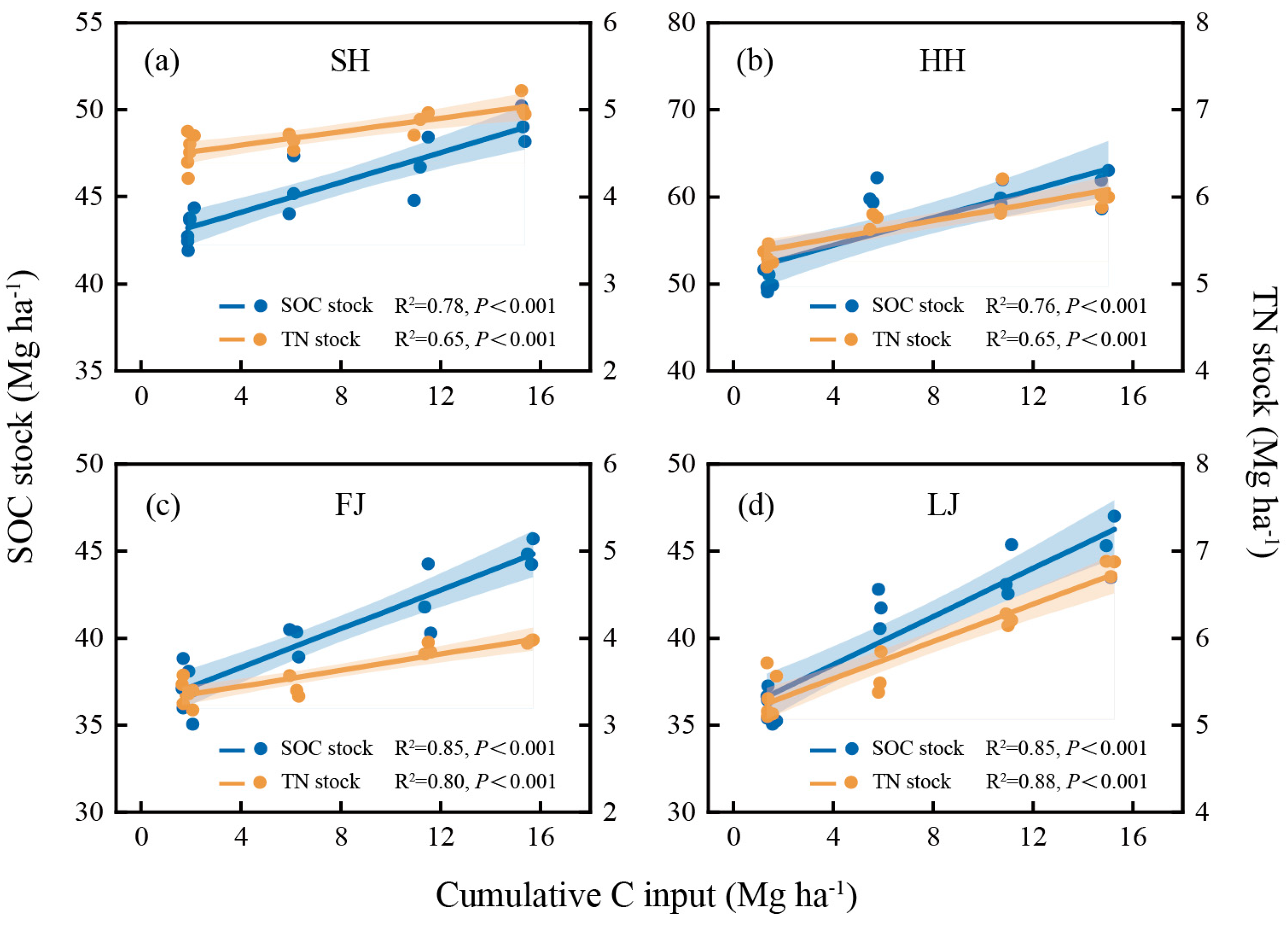
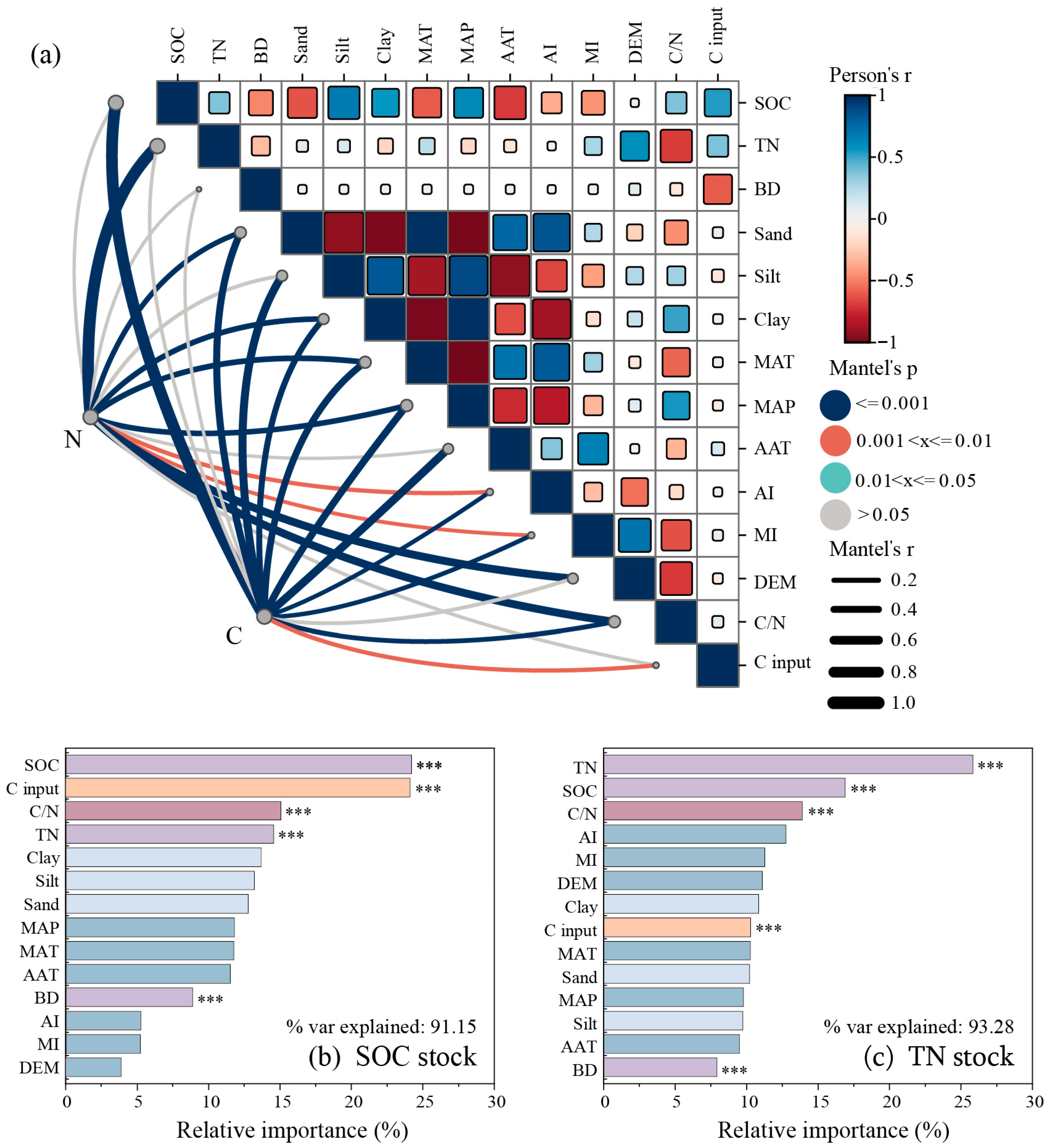
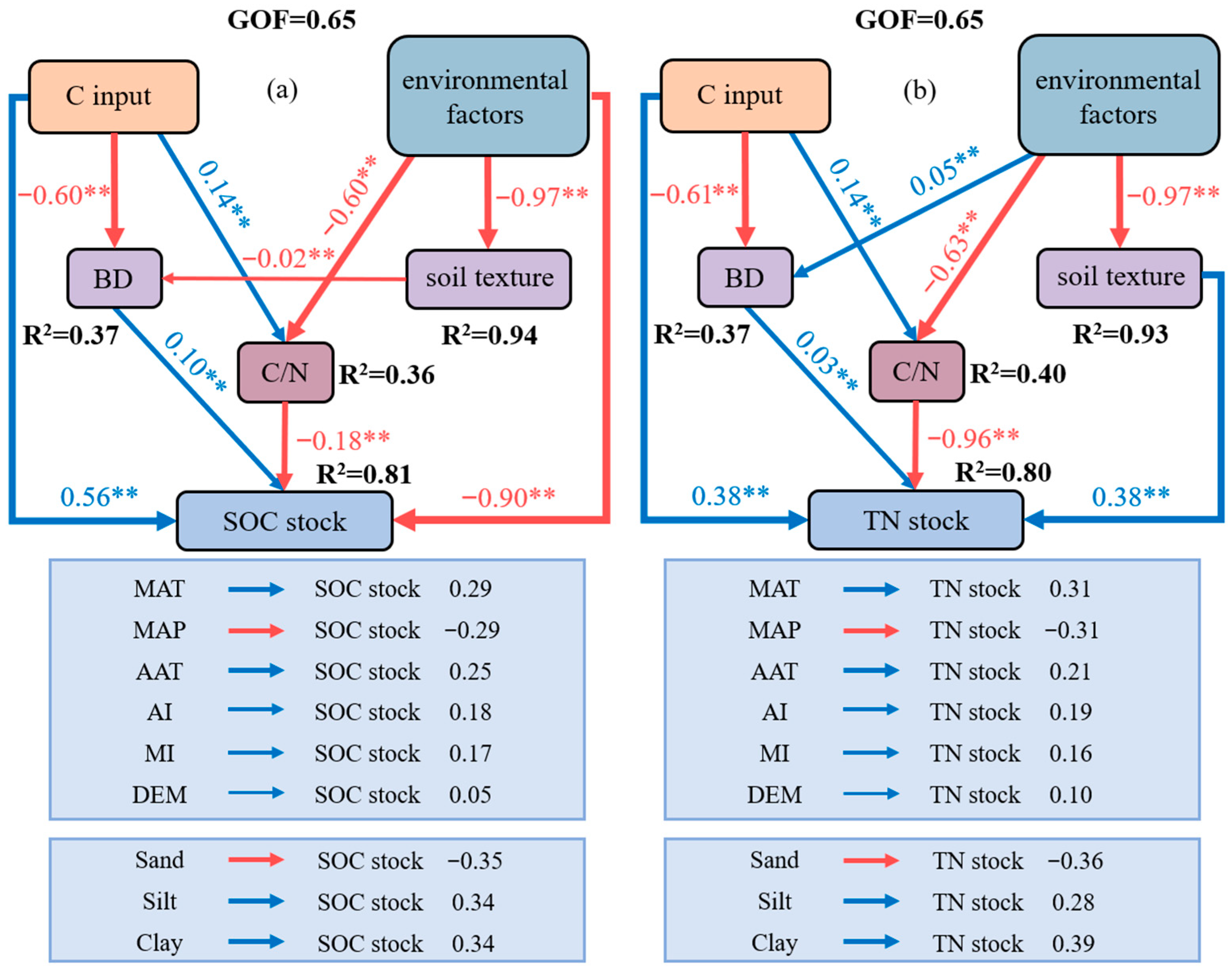
3.4. Relationship Between SOC and TN, Soil Texture, and Environmental Factors
4. Discussion
4.1. Main Driving Mechanisms of SOC and TN Accumulation Under Deep Tillage Combined with Organic Amendments
4.2. Response Characteristics and Influencing Factors of SOC and TN Under Different Soil Types
4.3. Environmental Controls on SOC and TN Accumulation
5. Conclusions
Author Contributions
Funding
Data Availability Statement
Conflicts of Interest
References
- Lal, R. Digging deeper: A holistic perspective of factors affecting soil organic carbon sequestration in agroecosystems. Glob. Change Biol. 2018, 24, 3285–3301. [Google Scholar] [CrossRef]
- Batjes, N.H. Batjes, N. H. 1996. Total carbon and nitrogen in the soils of the world. European journal of soil science, 47, 151–163. Reflections by N.H. Batjes. Eur. J. Soil Sci. 2014, 65, 2–3. [Google Scholar] [CrossRef]
- Zhang, Y.; Tan, C.; Wang, R.; Li, J.; Wang, X. Conservation tillage rotation enhanced soil structure and soil nutrients in long-term dryland agriculture. Eur. J. Agron. 2021, 131, 126379. [Google Scholar] [CrossRef]
- Miner, G.L.; Delgado, J.A.; Ippolito, J.A.; Stewart, C.E. Soil health management practices and crop productivity. Agric. Environ. Lett. 2020, 5, e20023. [Google Scholar] [CrossRef]
- Huang, T.; Yang, H.; Huang, C.; Ju, X. Effects of nitrogen management and straw return on soil organic carbon sequestration and aggregate-associated carbon. Eur. J. Soil. Sci. 2018, 69, 913–923. [Google Scholar] [CrossRef]
- Huang, T.; Yang, N.; Lu, C.; Qin, X.; Siddique, K.H.M. Soil organic carbon, total nitrogen, available nutrients, and yield under different straw returning methods. Soil Till. Res. 2021, 214, 105171. [Google Scholar] [CrossRef]
- Wang, C.; Pan, Y.; Zhang, Z.; Xiao, R.; Zhang, M. Effect of straw decomposition on organic carbon fractions and aggregate stability in salt marshes. Sci. Total Environ. 2021, 777, 145852. [Google Scholar] [CrossRef]
- Tian, J.; Lou, Y.; Gao, Y.; Fang, H.; Liu, S.; Xu, M.; Blagodatskaya, E.; Kuzyakov, Y. Response of soil organic matter fractions and composition of microbial community to long-term organic and mineral fertilization. Biol. Fert. Soils 2017, 53, 523–532. [Google Scholar] [CrossRef]
- Wu, G.; Ling, J.; Zhao, D.; Xu, Y.; Liu, Z.; Wen, Y.; Zhou, S. Deep-injected straw incorporation improves subsoil fertility and crop productivity in a wheat-maize rotation system in the North China plain. Field Crop Res. 2022, 286, 108612. [Google Scholar] [CrossRef]
- Gautam, A.; Guzman, J.; Kovacs, P.; Kumar, S. Manure and inorganic fertilization impacts on soil nutrients, aggregate stability, and organic carbon and nitrogen in different aggregate fractions. Arch. Acker-Pflanzenbau Bodenkd. 2022, 68, 1261–1273. [Google Scholar] [CrossRef]
- Tian, P.; Lian, H.; Wang, Z.; Jiang, Y.; Li, C.; Sui, P.; Qi, H. Effects of deep and shallow tillage with straw incorporation on soil organic carbon, total nitrogen and enzyme activities in northeast China. Sustainability 2020, 12, 8679. [Google Scholar] [CrossRef]
- Xie, J.; Xu, M.; Ciren, Q.; Yang, Y.; Zhang, S.; Sun, B.; Yang, X. Soil aggregation and aggregate associated organic carbon and total nitrogen under long-term contrasting soil management regimes in loess soil. J. Integr. Agric. 2015, 14, 2405–2416. [Google Scholar] [CrossRef]
- Kay, B.D.; VandenBygaart, A.J. Conservation tillage and depth stratification of porosity and soil organic matter. Soil Till. Res. 2002, 66, 107–118. [Google Scholar] [CrossRef]
- Li, J.; Chen, L.; Zhang, C.; Ma, D.; Zhou, G.; Ning, Q.; Zhang, J. Combining rotary and deep tillage increases crop yields by improving the soil physical structure and accumulating organic carbon of subsoil. Soil Till. Res. 2024, 244, 106252. [Google Scholar] [CrossRef]
- Yoo, K.; Ji, J.; Aufdenkampe, A.; Klaminder, J. Rates of soil mixing and associated carbon fluxes in a forest versus tilled agricultural field: Implications for modeling the soil carbon cycle. J. Geophys. Res. 2011, 116, G1. [Google Scholar] [CrossRef]
- Hao, X.; Han, X.; Wang, C.; Yan, J.; Lu, X.; Chen, X.; Zou, W. Temporal dynamics of density separated soil organic carbon pools as revealed by δ13c changes under 17 years of straw return. Agric. Ecosyst. Environ. 2023, 356, 108656. [Google Scholar] [CrossRef]
- Islam, M.R.; Singh, B.; Dijkstra, F.A. Stabilisation of soil organic matter: Interactions between clay and microbes. Biogeochemistry 2022, 160, 145–158. [Google Scholar] [CrossRef]
- Wan, X.; Xiao, L.; Vadeboncoeur, M.A.; Johnson, C.E.; Huang, Z. Response of mineral soil carbon storage to harvest residue retention depends on soil texture: A meta-analysis. For. Ecol. Manag. 2018, 408, 9–15. [Google Scholar] [CrossRef]
- von Luetzow, M.; Koegel-Knabner, I.; Ekschmitt, K.; Matzner, E.; Guggenberger, G.; Marschner, B.; Flessa, H. Stabilization of organic matter in temperate soils: Mechanisms and their relevance under different soil conditions: A review. Eur. J. Soil. Sci. 2006, 57, 426–445. [Google Scholar] [CrossRef]
- Jiang, F.; Peng, X.; Yao, S.; Islam, M.U.; Zhang, Z.; Chen, B.; Wang, Y.; Wang, N.; Qi, H.; Wang, Z.; et al. A six-site field study on assessing the suitability of conservation and conventional tillage in the black soil region, northeast China. Soil Till. Res. 2025, 248, 106379. [Google Scholar] [CrossRef]
- Sui, J.; Dai, Y. Analysis of conservation practices for black soil based on organic matter and nitrogen contents in the black soil region of northeast China. Sci. Rep. 2025, 15, 23989. [Google Scholar] [CrossRef] [PubMed]
- Zhang, Y.; Li, X.; Gregorich, E.G.; McLaughlin, N.B.; Zhang, X.; Guo, Y.; Liang, A.; Fan, R.; Sun, B. No-tillage with continuous maize cropping enhances soil aggregation and organic carbon storage in northeast China. Geoderma 2018, 330, 204–211. [Google Scholar] [CrossRef]
- Chang, C.; Huang, J. Soil Science, 3rd ed.; China Agricultural Press: Beijing, China, 2016; pp. 296–301. [Google Scholar]
- Chen, X.; Han, X.; Wang, X.; Guo, Z.; Lu, X.; Yan, J.; Zou, W. Application of manure and straw by deep plough rapidly improves fertility and productivity of brown sandy soil. Plant Nutr. Fertil. Sci. 2023, 29, 232–241. [Google Scholar] [CrossRef]
- Webster, R. Soil sampling and methods of analysis—Edited by M.R. Carter & E.G. Gregorich. Eur. J. Soil. Sci. 2008, 59, 1010–1011. [Google Scholar] [CrossRef]
- Dane, J.H.; Topp, C.G. Methods of Soil Analysis: Part 4. Physical Methods; John Wiley & Sons: Hoboken, NJ, USA, 2004; Volume 3, pp. 722–723. [Google Scholar]
- Bao, S. Soil Agro-Chemical Analysis, 3rd ed.; China Agriculture Press: Beijing, China, 2008; pp. 23–24. [Google Scholar]
- Hao, X.X.; Han, X.Z.; Zou, W.X.; Wang, S.Y.; Kwaw-Mensah, D. Changes in soil organic carbon and its fractions after 13 years of continuous straw return in a soybean-maize cropping system. Appl. Ecol. Environ. Res. 2020, 18, 8267–8284. [Google Scholar] [CrossRef]
- Zou, W.; Han, X.; Lu, X.; Chen, X.; Yan, J.; Song, B.; Yang, N.; Lin, Q.; He, Y. Effects of the construction of fertile and cultivated upland soil layer on soil fertility and maize yield in black soil region in Northeast China. Chin. J. Appl. Ecol. 2020, 31, 4134–4146. [Google Scholar] [CrossRef]
- Wang, X.; Xu, X.; Qiu, S.; Zhao, S.; He, P. Deep tillage enhanced soil organic carbon sequestration in China: A meta-analysis. J. Clean. Prod. 2023, 399, 136686. [Google Scholar] [CrossRef]
- Liu, M.; Feng, F.; Li, L.; Du, X.; Zhang, Z.; Ji, X. Possibility of exogenous organic carbon input to increase global soil nitrogen supply potential: A meta-analysis. Soil Till. Res. 2023, 232, 105773. [Google Scholar] [CrossRef]
- Xu, J.; Han, H.; Ning, T.; Li, Z.; Lal, R. Long-term effects of tillage and straw management on soil organic carbon, crop yield, and yield stability in a wheat-maize system. Field Crop Res. 2019, 233, 33–40. [Google Scholar] [CrossRef]
- Zhang, H.; Tang, X.; Hou, Q.; Zhu, Y.; Ren, Z.; Xie, H.; Liao, Y.; Wang, W.; Wen, X. Combining conservation tillage with nitrogen fertilization promotes maize straw decomposition by regulating soil microbial community and enzyme activities. Pedosphere 2024, 34, 783–796. [Google Scholar] [CrossRef]
- Han, X.; Xu, C.; Dungait, J.A.J.; Bol, R.; Wang, X.; Wu, W.; Meng, F. Straw incorporation increases crop yield and soil organic carbon sequestration but varies under different natural conditions and farming practices in China: A system analysis. Biogeosciences 2018, 15, 1933–1946. [Google Scholar] [CrossRef]
- Gao, R.; Yan, J.; Han, X.; Chen, X.; Zou, W.; Lu, X.; Piao, Y.; Jiang, R. Construction effect of fertile cultivated layer in albic soil I. Effects of inversion tillage with organic mate-rials on the redistribution of organic matter in surface layer of albic soil. Chin. J. Appl. Ecol. 2024, 35, 1590–1598. [Google Scholar] [CrossRef]
- He, J.; Shi, Y.; Yu, Z. Subsoiling improves soil physical and microbial properties, and increases yield of winter wheat in the Huang-Huai-Hai plain of China. Soil Till. Res. 2019, 187, 182–193. [Google Scholar] [CrossRef]
- Yang, Y.; Wu, J.; Zhao, S.; Mao, Y.; Zhang, J.; Pan, X.; He, F.; Ploeg, M. Impact of long-term sub-soiling tillage on soil porosity and soil physical properties in the soil profile. Land Degrad. Dev. 2021, 32, 2892–2905. [Google Scholar] [CrossRef]
- Shepherd, T.G.; Saggar, S.; Newman, R.H.; Ross, C.W.; Dando, J.L. Tillage-induced changes to soil structure and organic carbon fractions in New Zealand soils. Aust. J. Soil Res. 2001, 39, 465–489. [Google Scholar] [CrossRef]
- Chen, J.; Pang, D.; Jin, M.; Luo, Y.; Li, H.; Li, Y.; Wang, Z. Improved soil characteristics in the deeper plough layer can increase grain yield of winter wheat. J. Integr. Agric. 2020, 19, 1215–1226. [Google Scholar] [CrossRef]
- Ostrowska, A.; Porębska, G. Assessment of the C/N ratio as an indicator of the decomposability of organic matter in forest soils. Ecol. Indic. 2015, 49, 104–109. [Google Scholar] [CrossRef]
- Chen, R.; Senbayram, M.; Blagodatsky, S.; Myachina, O.; Dittert, K.; Lin, X.; Blagodatskaya, E.; Kuzyakov, Y. Soil c and n availability determine the priming effect: Microbial n mining and stoichiometric decomposition theories. Glob. Change Biol. 2014, 20, 2356–2367. [Google Scholar] [CrossRef]
- Liu, W.; Qiao, C.; Yang, S.; Bai, W.; Liu, L. Microbial carbon use efficiency and priming effect regulate soil carbon storage under nitrogen deposition by slowing soil organic matter decomposition. Geoderma 2018, 332, 37–44. [Google Scholar] [CrossRef]
- Qiu, L.; Zhu, H.; Liu, J.; Yao, Y.; Wang, X.; Rong, G.; Zhao, X.; Shao, M.; Wei, X. Soil erosion significantly reduces organic carbon and nitrogen mineralization in a simulated experiment. Agric. Ecosyst. Environ. 2021, 307, 107232. [Google Scholar] [CrossRef]
- Wang, Y.; Wang, Z.; Zhang, Q.; Hu, N.; Li, Z.; Lou, Y.; Li, Y.; Xue, D.; Chen, Y.; Wu, C.; et al. Long-term effects of nitrogen fertilization on aggregation and localization of carbon, nitrogen and microbial activities in soil. Sci. Total Environ. 2018, 624, 1131–1139. [Google Scholar] [CrossRef]
- Jia, P.; Huang, Y.; Wang, X.; Zhu, Z.; Dou, Y.; Huang, Q.; Zha, S.; Wang, A. Mechanisms of chemical polymers and microbial residues in affecting organic matter stabilization under varying carbon/nitrogen ratios during composting. Chem. Eng. J. 2025, 513, 162879. [Google Scholar] [CrossRef]
- Chen, Q.; Yuan, Y.; Hu, Y.; Wang, J.; Si, G.; Xu, R.; Zhou, J.; Xi, C.; Hu, A.; Zhang, G. Excessive nitrogen addition accelerates n assimilation and p utilization by enhancing organic carbon decomposition in a Tibetan alpine steppe. Sci. Total Environ. 2021, 764, 10. [Google Scholar] [CrossRef] [PubMed]
- Blanco-Canqui, H.; Lal, R. Mechanisms of carbon sequestration in soil aggregates. Crit. Rev. Plant Sci. 2004, 23, 481–504. [Google Scholar] [CrossRef]
- Li, Q.; Wang, L.; Fu, Y.; Lin, D.; Hou, M.; Li, X.; Hu, D.; Wang, Z. Transformation of soil organic matter subjected to environmental disturbance and preservation of organic matter bound to soil minerals: A review. J. Soil. Sediment. 2023, 23, 1485–1500. [Google Scholar] [CrossRef]
- Topa, D.; Cara, I.G.; Jităreanu, G. Long term impact of different tillage systems on carbon pools and stocks, soil bulk density, aggregation and nutrients: A field meta-analysis. Catena 2021, 199, 105102. [Google Scholar] [CrossRef]
- Mao, D.H.; Wang, Z.M.; Li, L.; Miao, Z.H.; Ma, W.H.; Song, C.C.; Ren, C.Y.; Jia, M.M. Soil organic carbon in the Sanjiang plain of China: Storage, distribution and controlling factors. Biogeosciences 2015, 12, 1635–1645. [Google Scholar] [CrossRef]
- Li, M.; Han, X.; Li, L. Total nitrogen stock in soil profile affected by land use and soil type in three counties of mollisols. Front. Environ. Sci. 2022, 10, 945305. [Google Scholar] [CrossRef]
- Zhong, Z.; Chen, Z.; Xu, Y.; Ren, C.; Yang, G.; Han, X.; Ren, G.; Feng, Y. Relationship between soil organic carbon stocks and clay content under different climatic conditions in central China. Forests 2018, 9, 598. [Google Scholar] [CrossRef]
- Liang, X.; Yu, S.; Ju, Y.; Wang, Y.; Yin, D. Integrated management practices foster soil health, productivity, and agroecosystem resilience. Agronomy 2025, 15, 1816. [Google Scholar] [CrossRef]
- Ye, R.; Parajuli, B.; Sigua, G. Subsurface clay soil application improved aggregate stability, nitrogen availability, and organic carbon preservation in degraded ultisols with cover crop mixtures. Soil Sci. Soc. Am. J. 2019, 83, 597–604. [Google Scholar] [CrossRef]
- Zhang, J.; Zhu, L.; Li, G.; Zhao, F.; Qin, J. Distribution patterns of SOC/TN content and their relationship with topography, vegetation and climatic factors in China’s north-south transitional zone. J. Geogr. Sci. 2022, 32, 645–662. [Google Scholar] [CrossRef]
- Chen, Q.; Niu, B.; Hu, Y.; Luo, T.; Zhang, G. Warming and increased precipitation indirectly affect the composition and turnover of labile-fraction soil organic matter by directly affecting vegetation and microorganisms. Sci. Total Environ. 2020, 714, 136787. [Google Scholar] [CrossRef]
- Zhang, W.; Munkholm, L.J.; An, T.; Liu, X.; Zhang, B.; Xu, Y.; Ge, Z.; Zhang, Y.; Zhang, J.; Li, S.; et al. Influence of environmental factors on soil organic carbon in different soil layers for Chinese Mollisols under intensive maize cropping. Sci. Total Environ. 2022, 835, 155443. [Google Scholar] [CrossRef]
- Xu, X.; Shi, Z.; Li, D.; Rey, A.; Ruan, H.; Craine, J.M.; Liang, J.; Zhou, J.; Luo, Y. Soil properties control decomposition of soil organic carbon: Results from data-assimilation analysis. Geoderma 2016, 262, 235–242. [Google Scholar] [CrossRef]
- Siaz, G.; Bird, M.I.; Dominigues, T.; Schrodt, F.; Veenendaal, E.M. Corrigendum: Variation in soil carbon stocks and their determinants across a precipitation gradient in west Africa. Glob. Change Biol. 2012, 18, 2676. [Google Scholar] [CrossRef]
- Wiesmeier, M.; Barthold, F.; Blank, B.; Kögel-Knabner, I. Digital mapping of soil organic matter stocks using random forest modeling in a semi-arid steppe ecosystem. Plant Soil 2011, 340, 7–24. [Google Scholar] [CrossRef]
- Goebel, M.; Bachmann, J.; Reichstein, M.; Janssens, I.A.; Guggenberger, G. Soil water repellency and its implications for organic matter decomposition—Is there a link to extreme climatic events. Glob. Change Biol. 2011, 17, 2640–2656. [Google Scholar] [CrossRef]





| Site | Location | Experiment Starting Year | Annual Active Accumulated Temperature (≥10 °C) | Digital Elevation Model (m) | Soil Type |
|---|---|---|---|---|---|
| SH | 46°35′ N, 126°47′ E | 2021 | 2200–2400 | 179 | Black soil |
| HH | 50°15′ N, 127°27′ E | 2019 | 2100–2300 | 161 | Dark brown soil |
| FJ | 47°03′ N, 132°16′ E | 2019 | 2600–2800 | 75 | Albic soil |
| LJ | 47°22′ N, 123°15′ E | 2019 | 2400–2700 | 177 | Chernozems |
| Site | Treatment | Organic Amendments (Mg ha−1) | Root (Mg ha−1) | Stubble (Mg ha−1) | Cumulative C Input (Mg ha−1) |
|---|---|---|---|---|---|
| SH | CT | 0 | 1.32 ± 0.07 a | 0.65 ± 0.04 a | 1.98 ± 0.11 d |
| DT | 0 | 1.26 ± 0.05 a | 0.62 ± 0.02 a | 1.88 ± 0.07 d | |
| SDT | 4070 | 1.34 ± 0.06 a | 0.66 ± 0.03 a | 6.07 ± 0.08 c | |
| MDT | 9090 | 1.43 ± 0.15 a | 0.70 ± 0.08 a | 11.22 ± 0.23 b | |
| SMDT | 13,160 | 1.44 ± 0.04 a | 0.71 ± 0.02 a | 15.30 ± 0.06 a | |
| HH | CT | 0 | 0.88 ± 0.05 b | 0.44 ± 0.02 b | 1.32 ± 0.07 d |
| DT | 0 | 0.99 ± 0.06 ab | 0.49 ± 0.03 ab | 1.47 ± 0.09 d | |
| SDT | 4070 | 1.03 ± 0.09 ab | 0.51 ± 0.05 ab | 5.60 ± 0.14 c | |
| MDT | 9090 | 1.10 ± 0.03 a | 0.54 ± 0.01 a | 10.73 ± 0.04 b | |
| SMDT | 13,160 | 1.13 ± 0.11 a | 0.56 ± 0.05 a | 14.85 ± 0.16 a | |
| FJ | CT | 0 | 1.10 ± 0.05 c | 0.54 ± 0.02 c | 1.65 ± 0.07 e |
| DT | 0 | 1.36 ± 0.06 b | 0.67 ± 0.03 b | 2.03 ± 0.08 d | |
| SDT | 4070 | 1.42 ± 0.11 b | 0.70 ± 0.06 b | 6.20 ± 0.17 c | |
| MDT | 9090 | 1.61 ± 0.07 a | 0.79 ± 0.03 a | 11.49 ± 0.10 b | |
| SMDT | 13,160 | 1.62 ± 0.09 a | 0.80 ± 0.04 a | 15.57 ± 0.13 a | |
| LJ | CT | 0 | 1.00 ± 0.08 b | 0.49 ± 0.04 b | 1.50 ± 0.21 d |
| DT | 0 | 0.96 ± 0.07 b | 0.48 ± 0.04 b | 1.44 ± 0.11 d | |
| SDT | 4070 | 1.17 ± 0.08 ab | 0.58 ± 0.04 ab | 5.82 ± 0.13 c | |
| MDT | 9090 | 1.29 ± 0.08 a | 0.64 ± 0.04 a | 11.02 ± 0.12 b | |
| SMDT | 13,160 | 1.30 ± 0.09 a | 0.64 ± 0.04 a | 15.10 ± 0.13 a |
| Soil Layer (cm) | Site | SOC (g kg−1) | TN (g kg−1) | AN (mg kg−1) | AP (mg kg−1) | AK (mg kg−1) | pH | Sand (%) | Silt (%) | Clay (%) |
|---|---|---|---|---|---|---|---|---|---|---|
| 0–20 | SH | 20.37 ± 2.67 b | 1.55 ± 0.19 a | 251.70 ± 29.60 a | 39.30 ± 3.30 a | 198 ± 26 a | 5.61 ± 0.09 c | 29.49 ± 4.22 c | 28.51 ± 2.85 ab | 42.00 ± 4.66 a |
| HH | 25.40 ± 2.33 a | 2.15 ± 0.30 a | 114.70 ± 9.40 b | 18.50 ± 2.00 b | 119 ± 15 b | 6.11 ± 0.09 b | 26.17 ± 2.58 c | 31.64 ± 3.51 a | 42.19 ± 4.37 a | |
| FJ | 18.45 ± 1.76 b | 1.51 ± 0.20 a | 120.70 ± 11.10 b | 19.90 ± 2.00 b | 79 ± 11 c | 6.04 ± 0.12 b | 39.24 ± 4.81 b | 25.73 ± 3.14 bc | 35.04 ± 3.02 b | |
| LJ | 20.71 ± 2.39 ab | 1.82 ± 0.21 a | 251.10 ± 26.50 a | 12.40 ± 1.50 c | 128 ± 17 b | 7.81 ± 0.13 a | 49.27 ± 6.20 a | 24.82 ± 3.11 c | 25.92 ± 3.03 c | |
| 20–35 | SH | 20.35 ± 2.34 a | 1.31 ± 0.17 a | 205.20 ± 22.20 b | 24.60 ± 2.90 a | 176 ± 25 a | 6.67 ± 0.11 b | 27.54 ± 3.32 b | 27.00 ± 2.80 ab | 45.46 ± 4.40 a |
| HH | 17.16 ± 2.20 a | 1.48 ± 0.19 a | 49.30 ± 5.90 d | 10.10 ± 1.10 bc | 64 ± 8 b | 6.04 ± 0.11 c | 16.19 ± 2.02 c | 35.04 ± 4.50 a | 48.77 ± 4.65 a | |
| FJ | 7.54 ± 0.99 b | 0.62 ± 0.08 b | 68.70 ± 7.50 c | 12.50 ± 1.50 b | 49 ± 7 b | 6.49 ± 0.08 b | 37.80 ± 4.51 a | 25.47 ± 3.12 b | 36.73 ± 4.01 b | |
| LJ | 15.6 ± 1.91 a | 1.38 ± 0.17 a | 222.10 ± 24.80 a | 7.00 ± 0.90 c | 68 ± 8 b | 8.12 ± 0.19 a | 40.97 ± 4.16 a | 24.89 ± 3.19 b | 34.14 ± 2.92 b |
Disclaimer/Publisher’s Note: The statements, opinions and data contained in all publications are solely those of the individual author(s) and contributor(s) and not of MDPI and/or the editor(s). MDPI and/or the editor(s) disclaim responsibility for any injury to people or property resulting from any ideas, methods, instructions or products referred to in the content. |
© 2025 by the authors. Licensee MDPI, Basel, Switzerland. This article is an open access article distributed under the terms and conditions of the Creative Commons Attribution (CC BY) license (https://creativecommons.org/licenses/by/4.0/).
Share and Cite
Liang, W.; Song, M.; Zhang, N.; Gao, M.; Han, X.; Chen, X.; Lu, X.; Yan, J.; Zhu, Y.; Wang, S.; et al. The Effect of Deep Tillage Combined with Organic Amendments on Soil Organic Carbon and Nitrogen Stocks in Northeast China. Agronomy 2025, 15, 2853. https://doi.org/10.3390/agronomy15122853
Liang W, Song M, Zhang N, Gao M, Han X, Chen X, Lu X, Yan J, Zhu Y, Wang S, et al. The Effect of Deep Tillage Combined with Organic Amendments on Soil Organic Carbon and Nitrogen Stocks in Northeast China. Agronomy. 2025; 15(12):2853. https://doi.org/10.3390/agronomy15122853
Chicago/Turabian StyleLiang, Wenyu, Mingjian Song, Naiwen Zhang, Ming Gao, Xiaozeng Han, Xu Chen, Xinchun Lu, Jun Yan, Yuanchen Zhu, Shuli Wang, and et al. 2025. "The Effect of Deep Tillage Combined with Organic Amendments on Soil Organic Carbon and Nitrogen Stocks in Northeast China" Agronomy 15, no. 12: 2853. https://doi.org/10.3390/agronomy15122853
APA StyleLiang, W., Song, M., Zhang, N., Gao, M., Han, X., Chen, X., Lu, X., Yan, J., Zhu, Y., Wang, S., & Zou, W. (2025). The Effect of Deep Tillage Combined with Organic Amendments on Soil Organic Carbon and Nitrogen Stocks in Northeast China. Agronomy, 15(12), 2853. https://doi.org/10.3390/agronomy15122853