1. Introduction
Rice is the most important staple food in China, providing energy and nutrition for about 65% of the population [
1]. To ensure national food security, a super rice breeding program was initiated by the Chinese Ministry of Agriculture in 1996 [
2]. Professor Longping Yuan proposed a strategy to breed super rice varieties by combining heterosis utilization with morphological improvement [
3], and his team has developed multiple super hybrid rice varieties, including three representative ones: Y-liangyou 1, Y-liangyou 2, and Y-liangyou 900 [
4].
However, although the three representative super hybrid rice varieties have been cumulatively grown on more than 3 million ha (
https://www.ricedata.cn/variety, accessed on 18 December 2023), they are not currently popular hybrid rice varieties in China. In contrast, Jingliangyouhuazhan, Jingliangyou 534, and Longliangyouhuazhan have been the top three hybrid rice varieties by annual planting area in China since 2018 [
5]. There is, however, limited information available on why these varieties are more popular than the representative super hybrid rice varieties. Better yield performance may be a reason, but investigations are needed to confirm this possibility. In addition, a further understanding of the yield attributes of the popular hybrids can provide useful information for developing new hybrid rice varieties.
Rice grain yield is determined by four components: panicles per m
2, spikelets per panicle, spikelet filling percentage, and grain weight [
6]; it also can be expressed as a function of biomass production and harvest index [
7]. Previous studies have demonstrated that super hybrid rice varieties produce over 10% higher grain yield than ordinary hybrid and inbred rice varieties, and the higher grain yield of super hybrid varieties is attributable to both higher spikelets per panicle and higher biomass production [
8,
9].
The gain yield and yield attributes of rice are also affected by the environment. Although it has been well documented that rice crops grown in high-yielding environments generally have high biomass production [
9,
10,
11,
12], no consistent conclusion is obtained regarding the key yield components for the difference in grain yield of rice between environments, and different studies have highlighted different components or combinations of components as being responsible. For example, Li et al. [
10] reported that higher panicles per m
2, spikelet filling percentage, and grain weight were responsible for higher grain yields of rice in the subtropical environment of Taoyuan, China compared to the subtropical environment of Nanjing, China. Katsura et al. [
11] observed that the higher grain yield of rice in the subtropical environment of Yunnan, China compared to the temperature environment of Kyoto, Japan was attributable to higher panicles per m
2 and spikelets per panicle. Ibrahim et al. [
12] found that higher spikelets per panicle were responsible for the higher grain yield of rice in the subtropical environment of Changsha, China than in two tropical environments in Gazipur and Habiganj, Bangladesh.
In this study, grain yield, yield components, biomass production, and harvest index were compared between three currently popular hybrid rice varieties and three representative super hybrid rice varieties at two subtropical sites in two years. The objective of this study was to determine whether the yield performance is better in the popular hybrids than in the super hybrids, and if so, which yield attributes are responsible for the better yield performance in the popular hybrids.
2. Materials and Methods
2.1. Sites and Soils
Field experiments were conducted at Hengyang (26°52′31″ N, 112°30′07″ E, 73 m a.s.l.), Hunan Province and Xingyi (25°01′14″ N, 104°55′45″ E, 1165 m a.s.l.), Guizhou Province, China, in 2021 and 2022. Both experimental sites have a subtropical monsoon climate. The average daily temperature during the rice growing season (from sowing to harvesting) was 29.0 and 28.9 °C at Hengyang and 23.7 and 22.9 °C at Xingyi in 2021 and 2022, respectively. Total incident solar radiation during the rice growing season was 1905 and 1787 MJ m
−2 at Hengyang and 2191 and 2527 MJ m
−2 at Xingyi in 2021 and 2022, respectively. The soils of the experimental field were a purple sandy soil at Hengyang and a yellow podzolic soil at Xingyi. The soil chemical properties in the upper 20 cm layer before transplanting in 2021 are provided in
Table 1.
Three representative super hybrid rice varieties (Y-liangyou 1, Y-liangyou 2, and Y-liangyou 900) and three currently popular hybrid rice varieties (Jingliangyouhuazhan, Jingliangyou 534, and Longliangyouhuazhan) were used in the experiment. Information about the varieties is given in
Table 2. The experiment was arranged in a randomized complete-block design with three replicates. The plot size was 20 m
2 at Hengyang and 15 m
2 at Xingyi.
Pre-germinated seeds were sown on the 8th of May at Hengyang and the 9th of April at Xingyi. Thirty- and 20-day-old seedlings were transplanted at Hengyang and Xingyi, respectively. Transplanting was performed with two seedlings per hill at a hill spacing of 20 cm × 20 cm. Urea (46% N), superphosphate (12% P2O5), and potassium chloride (60% K2O) were used as N, P, and K fertilizers, respectively. The N fertilizer rate was determined based on the average N application rate of China (180 kg N ha−1). The P and K fertilizer rates were determined according to a locally recommended N:P2O5:K2O ratio of 1:0.5:1. Basal fertilizer (90 kg N ha−1, 90 kg P2O5 ha−1, and 90 kg K2O ha−1) was applied one day before transplanting. The first top dressing (36 kg N ha−1) was applied seven days after transplanting. The second top dressing (54 kg N ha−1 and 90 kg K2O ha−1) was applied at the panicle initiation stage. Continuous flooding (5–10 cm water depth) was practiced in all plots from transplanting until one week before maturity, when the plots were drained for harvesting. Plant diseases, insects, and weeds were intensively controlled by pesticides.
2.2. Sampling and Measurements
Ten hills of rice plants were sampled diagonally from each plot at the maturity stage to determine yield attributes. Sampled plants were hand threshed after counting the panicle number. Filled and unfilled spikelets were separated by submerging them in tap water. Three subsamples of 30 g of filled spikelets and all unfilled spikelets were used to count the spikelet number. The number of filled spikelets was counted with a digital automatic seed counter (SLY-C, Zhejiang Top Cloud-Agri Technology Co., Ltd., Hangzhou, China). The number of unfilled spikelets was counted manually. All plant organs were oven-dried at 70 °C to a constant weight to determine biomass. Yield components (panicles per m2, spikelets per panicle, spikelet filling percentage, and grain weight), total biomass production, and harvest index were calculated. Rice plants were harvested from a 5 m2 area in each plot to determine grain yield. Harvested grains were weighed after sun-drying. A subsample of 50 g of sun-dried grains was oven-dried at 70 °C to a constant weight to determine moisture content. Grain yield was calculated by adjusting to a moisture content of 14%.
2.3. Statistical Analysis
All data were analyzed separately for each year. Analysis of variance (ANOVA) was performed after the Shapiro–Wilk normality test (Statistix 8.0, Analytical Software, Tallahassee, FL, USA). The statistical model of the ANOVA included varietal group, site, and the interaction between varietal group and site. A post hoc LSD test was performed if a significant effect was detected by the ANOVA. Correlation plot analysis was used to evaluate the relationships between grain yield and yield attributes (Origin 2024, OriginLab Corp., Northampton, MA, USA). The significant level was set at p < 0.05 and p < 0.01 in the ANOVA, at p < 0.05 in the LSD test, and at p < 0.05 and p < 0.01 in the correlation analysis.
4. Discussion
The currently popular hybrid rice varieties produced similar mean grain yields as the representative super hybrid rice varieties in three of four experiments (Hengyang and Xingyi in 2021 and Xingyi in 2022) in this study. In the other experiment (Hengyang in 2022), a higher mean grain yield was achieved in the popular hybrids than in the super hybrids. This experiment had the lowest grain yield among the four experiments. These findings suggest that the popular hybrids have better yield performance than the super hybrids under conditions of relatively lower productivity. This could be an important determinant for the popularity of hybrid rice varieties among Chinese farmers because medium- and low-productivity land accounts for as much as 70% of the total arable land in China [
13]. The results of this study suggest a need for further research comparing yield performance between the currently popular hybrid rice varieties and representative super hybrid rice varieties under medium- and low-productivity conditions.
A higher mean number of panicles per m
2 was observed in the popular hybrids compared to the super hybrids in all four experiments in this study. In rice crops, strong compensation always exists between the number of panicles per m
2 and the number of spikelets per panicle [
14,
15]. However, in this study, the higher number of panicles per m
2 in the popular hybrids did not lead to lower spikelets per panicle compared to the super hybrids in three of four experiments (Hengyang and Xingyi in 2021 and Hengyang in 2022), indicating reduced compensation between the two components in the popular hybrids. In general, decoupling the compensatory relationship between the number of panicles per m
2 and the number of spikelets per panicle can be accomplished by increasing biomass production during panicle formation [
16]. However, it is not clear whether this is also the case for the popular hybrids in the present study. This highlights the need for a greater understanding of physiological processes governing the relationship between the number of panicles per m
2 and the number of spikelets per panicle in the currently popular hybrid rice varieties.
The mean spikelet filling percentage between the popular hybrids and the super hybrids was different in only one of four experiments: Hengyang in 2022. In this experiment, the popular hybrids had a higher mean spikelet filling percentage than the super hybrids. In rice crops, a higher spikelet filling percentage can be achieved by increasing source capacity and/or by increasing the transportation of assimilates into grains under favorable conditions [
17]. In this study, mean total biomass production was similar, while the mean harvest index was higher in the popular hybrids compared to the super hybrids at Hengyang in 2022. Thus, the higher mean spikelet filling percentage in the popular hybrids at Hengyang in 2022 was likely attributable to the higher transport of assimilates to grains. Further investigations are required to clarify the difference in physiological characteristics related to assimilating transportation, such as the activity of key enzymes in carbon metabolism and the content of hormones in grains [
17,
18], between the popular hybrids and the super hybrids, especially under medium- and low-productivity conditions.
The popular hybrids had lower grain weight than the super hybrids in three of four experiments (Hengyang in 2021 and Hengyang and Xingyi in 2022). However, the lower grain weight did not result in lower grain yields in the popular hybrids compared to the super hybrids because it was compensated for by a higher panicle number (Hengyang in 2021 and Xingyi in 2022) or both a higher panicle number and a higher spikelet filling percentage (Hengyang in 2022). Grain weight is not only a yield component but also an important trait in determining the grain quality in rice. In general, appearance quality increases with decreasing grain weight [
19]. Most recently, Huang et al. [
20] reported that grain weight and chalky grain rate decreased synchronously with the year of varietal release in middle-season hybrid rice cultivars released in Hunan Province of China from 2006 to 2021. Although this study did not determine grain quality, regional variety testing showed that the quality of the popular hybrids used in this study reached the second or third grade of high-quality rice standards in China (
https://www.ricedata.cn/variety, accessed on 18 December 2023). This could also be a reason why farmers preferred these varieties.
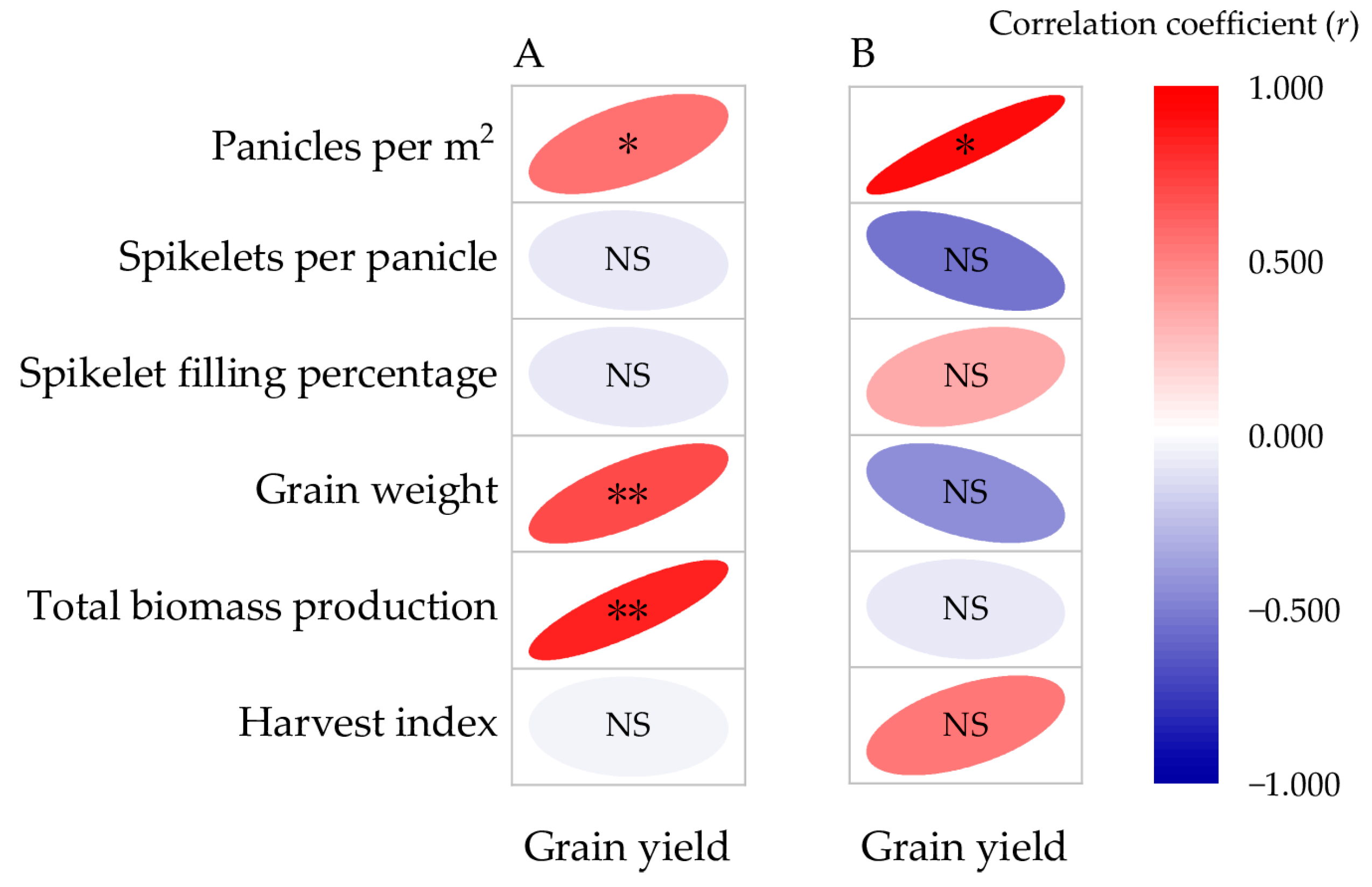
Taken together, the group of currently popular hybrid rice varieties had higher panicles per m
2, spikelet filling percentage, and harvest index, and, consequently, higher grain yield than the group of representative super hybrid rice varieties under the condition of relatively lower productivity (Hengyang in 2022). However, correlation plot analysis showed that relationships between grain yield and yield attributes under the condition of relatively lower productivity were different from those under conditions of high productivity (Hengyang and Xingyi in 2021 and Xingyi in 2022), and grain yield was only significantly related to panicles per m
2 under the condition of relatively lower productivity. This suggests that the selection of the varieties with high panicle numbers can be effective for achieving a high grain yield of rice under conditions of relatively lower productivity. This finding is consistent with the study by Liu et al. [
21], which showed that introgression of the allele associated with a high tillering into modern rice varieties increased panicle number and, consequently, boosted grain yield under conditions of medium and low productivity. The finding of this study highlights that further investigations are required to clarify the physio-biochemical and molecular mechanisms for the high yield of the popular hybrids under conditions of relatively lower productivity.
5. Conclusions
The group of three currently popular hybrid rice varieties (Jingliangyouhuazhan, Jingliangyou 534, and Longliangyouhuazhan) produced a higher mean grain yield than the group of three representative super hybrid rice varieties (Y-liangyou 1, Y-liangyou 2, and Y-liangyou 900) under conditions of relatively lower productivity. This higher yield performance in the group of popular hybrids was attributable to higher panicles per m2, spikelet filling percentage, and harvest index. However, further correlation analysis indicated that grain yield was only significantly related to panicles per m2 across six varieties under the condition of relatively lower productivity. These highlight that the yield performance under medium- and low-productivity conditions should receive more attention in hybrid rice breeding programs, and the selection of the varieties with high panicle numbers is an effective breeding strategy.