


Assessment of the Quality of ‘Red Jonaprince’ Apples during Storage after Delayed Harvesting and 1-Methylcyclopropene (1-MCP) Preharvest and Postharvest Treatment

 ,
,  ,
,  ,
,  , and
, and 
Abstract
1. Introduction
2. Materials and Methods
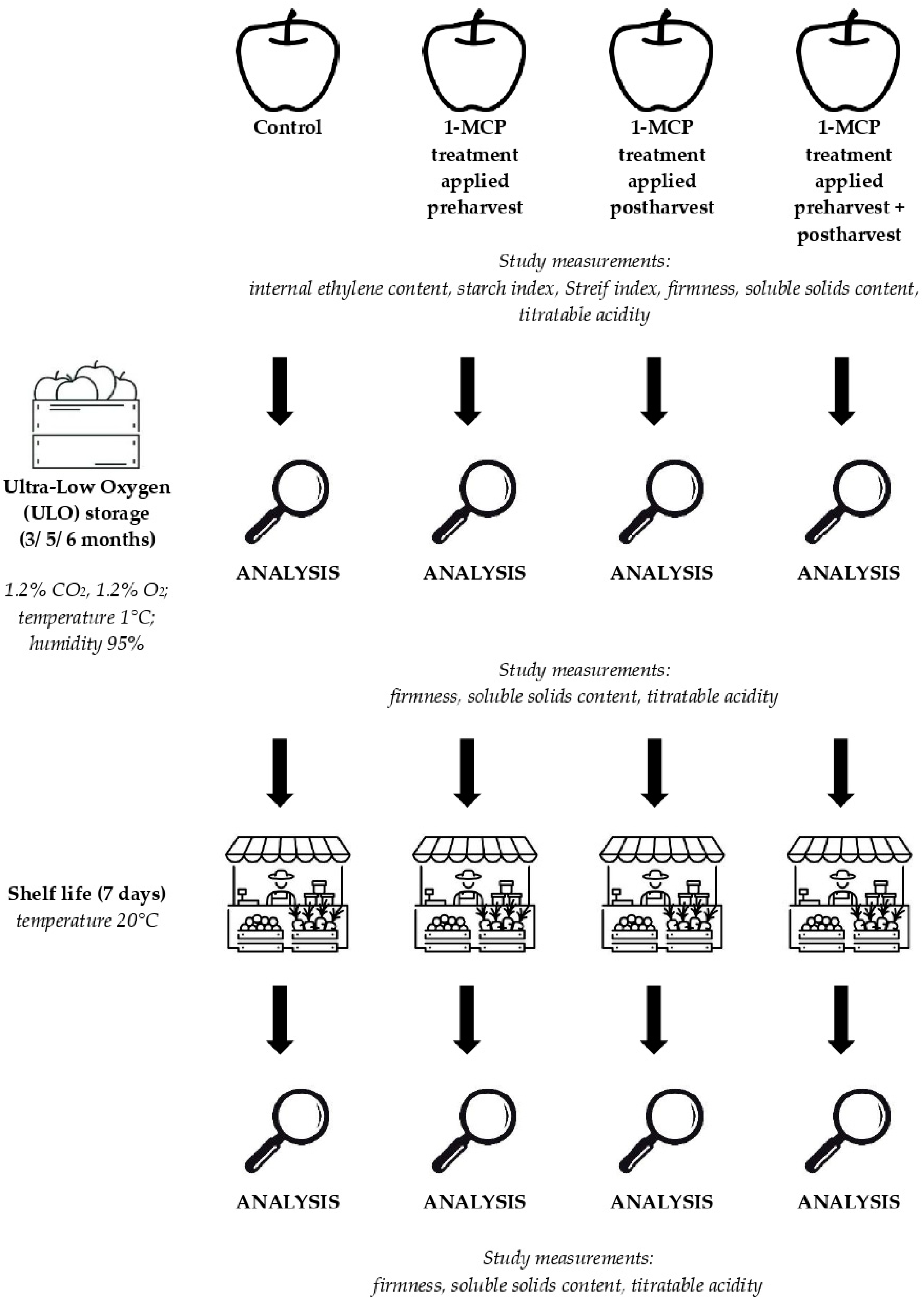
2.1. Experimental Design
- −
- Group 0 (6 boxes), being a control group with 1-MCP treatment applied neither preharvest, nor postharvest;
- −
- Group 1 (6 boxes), being a studied group with 1-MCP treatment applied preharvest (150 g/ha, sprayed in the morning 7 days before the optimum harvest window in 400 L of water-based solution; Harvista, AgroFresh Solutions Inc., Philadelphia, PA, USA);
- −
- Group 2 (6 boxes), being a studied group with 1-MCP treatment applied postharvest (0.65 µL/L, 7 days after harvesting, for 24 h; SmartFresh ProTabs, AgroFresh Solutions Inc., Philadelphia, PA, USA);
- −
- Group 3 (6 boxes), being a studied group with 1-MCP treatment applied both preharvest (150 g/ha, sprayed in the morning 7 days before optimum harvest window in 400 L of water-based solution; Harvista, AgroFresh Solutions Inc., Philadelphia, PA, USA) and postharvest (0.65 µL/L, 7 days after harvesting, for 24 h; SmartFresh ProTabs, AgroFresh Solutions Inc., Philadelphia, PA, USA).
- −
- Variant 1 (3 boxes within each studied group—one for each ULO storage time), being apples not subjected to any shelf life (assessments conducted directly after ULO storage);
- −
- Variant 2 (3 boxes within each studied group—one for each ULO storage time), being apples subjected to a shelf life (assessments conducted after 7 days of simulated shelf life following ULO storage).
2.2. Study Measurements
2.3. Statistical Analysis
3. Results
4. Discussion
5. Conclusions
Author Contributions
Funding
Data Availability Statement
Conflicts of Interest
References
- The Apple Market in the EU: Vol. 1: Production, Areas and Yields. Available online: https://agriculture.ec.europa.eu/system/files/2022-10/apples-production_en.pdf (accessed on 19 May 2023).
- Paul, V.; Pandey, R. Role of internal atmosphere on fruit ripening and storability-a review. J. Food Sci. Technol. 2014, 51, 1223–1250. [Google Scholar] [CrossRef] [PubMed]
- Prange, R.K.; Wright, A.H. A Review of Storage Temperature Recommendations for Apples and Pears. Foods 2023, 12, 466. [Google Scholar] [CrossRef] [PubMed]
- Sugar, D.; Einhorn, T.C. Conditioning temperature and harvest maturity influence induction of ripening capacity in ‘d’Anjou’ pear fruit. Postharvest Biol. Technol. 2011, 60, 121–124. [Google Scholar] [CrossRef]
- Christodoulou, M.D.; Culham, A. When do apples stop growing, and why does it matter? PLoS ONE 2021, 16, e0252288. [Google Scholar] [CrossRef]
- Ornelas-Paz, J.J.; Quintana-Gallegos, B.M.; Escalante-Minakata, P.; Reyes-Hernández, J.; Pérez-Martínez, J.D.; Rios-Velasco, C.; Ruiz-Cruz, S. Relationship between the firmness of Golden Delicious apples and the physicochemical characteristics of the fruits and their pectin during development and ripening. J. Food Sci. Technol. 2018, 55, 33–41. [Google Scholar] [CrossRef] [PubMed]
- Sajid, S.S.; Hu, G. Optimizing Crop Planting Schedule Considering Planting Window and Storage Capacity. Front. Plant Sci. 2022, 13, 762446. [Google Scholar] [CrossRef]
- Skic, A.; Szymańska-Chargot, M.; Kruk, B.; Chylińska, M.; Pieczywek, P.M.; Kurenda, A.; Zdunek, A.; Rutkowski, K.P. Determination of the Optimum Harvest Window for Apples Using the Non-Destructive Biospeckle Method. Sensors 2016, 16, 661. [Google Scholar] [CrossRef]
- Mahajan, P.V.; Caleb, O.J.; Singh, Z.; Watkins, C.B.; Geyer, M. Postharvest treatments of fresh produce. Philos. Trans. A Math. Phys. Eng. Sci. 2014, 372, 20130309. [Google Scholar] [CrossRef]
- Zhang, J.; Ma, Y.; Dong, C.; Terry, L.A.; Watkins, C.B.; Yu, Z.; Cheng, Z.M. Meta-analysis of the effects of 1-methylcyclopropene (1-MCP) treatment on climacteric fruit ripening. Hortic. Res. 2020, 7, 208. [Google Scholar] [CrossRef]
- Sriskantharajah, K.; El Kayal, W.; Ayyanath, M.M.; Saxena, P.K.; Sullivan, A.J.; Paliyath, G.; Subramanian, J. Preharvest Spray Hexanal Formulation Enhances Postharvest Quality in ‘Honeycrisp’ Apples by Regulating Phospholipase D and Calcium Sensor Proteins Genes. Plants 2021, 10, 2332. [Google Scholar] [CrossRef]
- DeEll, J.R.; Lum, G.B.; Mostofi, Y.; Lesage, S.K. Timing of Ethylene Inhibition Affects Internal Browning and Quality of ‘Gala’ Apples in Long-Term Low Oxygen Storage. Front. Plant Sci. 2022, 13, 914441. [Google Scholar] [CrossRef]
- Tomala, K.; Grzęda, M.; Guzek, D.; Głąbska, D.; Gutkowska, K. Analysis of possibility to apply preharvest 1-methylcyclopropene (1-MCP) treatment to delay harvesting of Red Jonaprince apples. Sustainability 2020, 12, 4575. [Google Scholar] [CrossRef]
- Tomala, K.; Guzek, D.; Głąbska, D.; Małachowska, M.; Widłak, Ł.; Krupa, T.; Gutkowska, K. Maintaining the Quality of ‘Red Jonaprince’ Apples during Storage by 1-Methylcyclopropene Preharvest and Postharvest Treatment. Agriculture 2022, 12, 1189. [Google Scholar] [CrossRef]
- Streif, J. Optimum harvest date for different apple cultivars in the ‘Bodensee’ area. In Determination and Prediction of Optimum Harvest Date of Apples and Pears, Proceedings of the Meeting of the Working Group on Optimum Harvest Date, Lofthus, Norway, 9–10 June 1994; de Jager, A., Johnson, D., Hohn, E., Eds.; European Commission: Brussels, Belgium, 1996; pp. 15–20. [Google Scholar]
- Sfakiotakis, E.M.; Dilley, D.R. Internal Ethylene Concentrations in Apple Fruits Attached to or Detached from the Tree. J. Am. Soc. Hortic. Sci. 1973, 98, 501–503. [Google Scholar] [CrossRef]
- Pontesegger, N.; Rühmer, T.; Siegmund, B. Physicochemical Attributes, Volatile Profile and Sensory Quality of Organic Crimson Crisp Apples during On-Tree Maturation. Foods 2023, 12, 1425. [Google Scholar] [CrossRef]
- Bertone, E.; Venturello, A.; Leardi, R.; Geobaldo, F. Prediction of the optimum harvest time of ‘Scarlet’ apples using DR-UV–Vis and NIR spectroscopy. Postharvest Biol. Technol. 2012, 69, 15–23. [Google Scholar] [CrossRef]
- The, S.L.; Kostick, S.; Brutcher, L.; Schonberg, B.; Barritt, B.; Evans, K. Trends in Fruit Quality Improvement From 15 Years of Selection in the Apple Breeding Program of Washington State University. Front. Plant Sci. 2021, 12, 714325. [Google Scholar] [CrossRef]
- Basannagari, B.; Kala, C.P. Climate change and apple farming in Indian Himalayas: A study of local perceptions and responses. PLoS ONE 2013, 8, e77976. [Google Scholar] [CrossRef]
- Sugiura, T.; Ogawa, H.; Fukuda, N.; Moriguchi, T. Changes in the taste and textural attributes of apples in response to climate change. Sci. Rep. 2013, 3, 2418. [Google Scholar] [CrossRef]
- Amyotte, B.; Bowen, A.J.; Banks, T.; Rajcan, I.; Somers, D.J. Mapping the sensory perception of apple using descriptive sensory evaluation in a genome wide association study. PLoS ONE 2017, 12, e0171710. [Google Scholar] [CrossRef]
- Win, N.M.; Yoo, J.; Naing, A.H.; Kwon, J.G.; Kang, I.K. 1-Methylcyclopropene (1-MCP) treatment delays modification of cell wall pectin and fruit softening in “Hwangok” and “Picnic” apples during cold storage. Postharvest Biol. Technol. 2021, 180, 111599. [Google Scholar] [CrossRef]
- Li, F.; Zhang, X.; Wang, J.; Jiang, Y.; Zhang, X.; Li, X. Preharvest application of 1-methylcyclopropene and Ethephon altered cuticular wax biosynthesis and fruit quality of apples at harvest and during cold storage. Hortic. Plant J. 2022, 8, 143–152. [Google Scholar] [CrossRef]
- McArtney, S.J.; Obermiller, J.D.; Schupp, J.R.; Parker, M.L.; Edgington, T.B. Preharvest 1-Methylcyclopropene Delays Fruit Maturity and Reduces Softening and Superficial Scald of Apples During Long-term Storage. HortScience 2008, 43, 366–371. [Google Scholar] [CrossRef]
- Lee, J.; Kang, I.K.; Nock, J.F.; Watkins, C.B. Effects of Preharvest and Postharvest Applications of 1-Methylcyclopropene on Fruit Quality and Physiological Disorders of ‘Fuji’ Apples during Storage at Warm and Cold Temperatures. Sci. Hortic. 2019, 54, 1375–1383. [Google Scholar] [CrossRef]
- Sakaldas, M.; Gundogdu, M.A. The effects of preharvest 1-methylcyclopropene (Harvista) treatments on harvest maturity of ‘Golden Delicious’ apple cultivar. Acta Hortic. 2016, 1139, 601–608. [Google Scholar] [CrossRef]
- Deyman, K.L.; Brikis, C.J.; Bozzo, G.G.; Shelp, B.J. Impact of 1-methylcyclopropene and controlled atmosphere storage on polyamine and 4-aminobutyrate levels in “Empire” apple fruit. Front. Plant Sci. 2014, 5, 144. [Google Scholar] [CrossRef]
- Win, N.M.; Yoo, J.; Kwon, S.I.; Watkins, C.B.; Kang, I.K. Characterization of Fruit Quality Attributes and Cell Wall Metabolism in 1-Methylcyclopropene (1-MCP)-Treated ‘Summer King’ and ‘Green Ball’ Apples During Cold Storage. Front. Plant Sci. 2019, 10, 1513. [Google Scholar] [CrossRef]
- Małachowska, M.; Tomala, K. Effect of Preharvest and Postharvest Application of 1-MCP on the Quality of Gala Schniga® SchniCo Red(s) Apples during Long-Term Storage. Agriculture 2022, 12, 2073. [Google Scholar] [CrossRef]

| Characteristic | No 1-MCP Preharvest Treatment | 1-MCP Preharvest Treatment | p | ||
|---|---|---|---|---|---|
| Mean (SD) | Median (IQR) | Mean (SD) | Median (IQR) | ||
| Internal ethylene content (µL/L) | 2.1815 (4.933) | 0.3380 * (0.690) | 0.6292 (0.5323) | 0.427 * (0.320) | 0.9016 |
| Starch index (-) | 9.75 (0.44) | 10.0 * (0.5) | 9.7 (0.5) | 10 * (1.0) | 0.4154 |
| Streif index (-) | 0.0474 (0.0008) | 0.0478 * (0.001) | 0.0501 (0.0008) | 0.0501 (0.0013) | 0.3521 |
| Firmness (N) | 62.98 (1.73) | 63.69 * (2.16) | 64.43 (1.89) | 64.84 (2.35) | 0.1489 |
| Soluble solids content (°Bx) | 13.62 (0.20) | 13.6 (0.25) | 13.33 (0.29) | 13.45 * (0.35) | 0.1124 |
| Titratable acidity (% of malic acid) | 0.6105 (0.0221) | 0.6067 * (0.0271) | 0.6374 (0.0487) | 0.6338 (0.0603) | 0.5637 |
| Treatment Group | Ultra-Low Oxygen Storage Time | p ** | ||||
|---|---|---|---|---|---|---|
| 3 Months | 5 Months | 6 Months | ||||
| Group 0 | Variant 1 | Mean ± SD | 55.33 ± 3.49 | 50.83 ± 1.76 | 45.38 ± 3.11 | 0.0604 |
| Median (IQR) | 55.4 * (6.04) | 51.15 (2.65) | 46.55 (3.85) | |||
| Variant 2 | Mean ± SD | 45.85 ± 3.07 | 46.28 ± 1.1 | 43.23 ± 2.24 | 0.8021 | |
| Median (IQR) | 45.94 (4.44) | 46.35 (1.65) | 43.55 (3.35) | |||
| p *** | 0.0209 | 0.0046 | 0.3050 | |||
| Group 1 | Variant 1 | Mean ± SD | 52.78 ± 2.5 a | 43.99 ± 1.51 b | 46.78 ± 3.08 b | 0.0010 |
| Median (IQR) | 52.34 (4.15) | 43.5 (2.08) | 46.85 (4.45) | |||
| Variant 2 | Mean ± SD | 43.29 ± 1.93 | 41.91 ± 2.32 | 44.13 ± 2.83 | 0.3679 | |
| Median (IQR) | 44.1 * (2.38) | 42.27 (3.69) | 44.6 (4.65) | |||
| p *** | 0.0209 | 0.1835 | 0.2526 | |||
| Group 2 | Variant 1 | Mean ± SD | 64.51 ± 1.86 a | 58.53 ± 0.89 b | 58 ± 2.58 b | 0.0012 |
| Median (IQR) | 64.38 (2.41) | 58.4 (1.45) | 58.4 (4.3) | |||
| Variant 2 | Mean ± SD | 62.1 ± 1.45 | 59.43 ± 2.09 | 58.2 ± 2.34 | 0.0775 | |
| Median (IQR) | 62.74 * (1.55) | 59.15 (3.45) | 58.05 (3.1) | |||
| p *** | 0.14891 | 0.4582 | 0.9123 | |||
| Group 3 | Variant 1 | Mean ± SD | 57.9 ± 3.81 | 60.68 ± 1.35 | 59.45 ± 3.23 | 0.2185 |
| Median (IQR) | 57.7 (5.3) | 61.05 (1.95) | 58.65 (4.3) | |||
| Variant 2 | Mean ± SD | 60.65 ± 4.66 | 60.48 ± 2.94 | 57.58 ± 2.11 | 0.4347 | |
| Median (IQR) | 59.5 (7.26) | 61.75 * (3.45) | 56.95 (2.75) | |||
| p *** | 0.3957 | 0.5637 | 0.3684 | |||
| Treatment Group | Ultra-Low Oxygen Storage Time | p ** | ||||
|---|---|---|---|---|---|---|
| 3 Months | 5 Months | 6 Months | ||||
| Group 0 | Variant 1 | Mean ± SD | 13.58 ± 0.22 ab | 13.18 ± 0.22 a | 13.65 ± 0.34 b | 0.0434 |
| Median (IQR) | 13.6 (6.04) | 13.1 (0.25) | 13.7 (0.5) | |||
| Variant 2 | Mean ± SD | 13.58 ± 0.15 | 13.25 ± 0.25 | 13.3 ± 0.29 | 0.0683 | |
| Median (IQR) | 13.6 (4.44) | 13.2 (0.3) | 13.3 (0.5) | |||
| p *** | 0.5374 | 0.6704 | 0.1716 | |||
| Group 1 | Variant 1 | Mean ± SD | 12.93 ± 0.15 | 13.23 ± 0.46 | 13.25 ± 0.24 | 0.2650 |
| Median (IQR) | 12.9 (0.25) | 13.15 (0.75) | 13.25 (0.4) | |||
| Variant 2 | Mean ± SD | 13.13 ± 0.21 | 12.88 ± 0.29 | 13.4 ± 0.32 | 0.3679 | |
| Median (IQR) | 13.1 (0.25) | 12.75 * (0.35) | 13.45 (0.5) | |||
| p *** | 0.1677 | 0.1124 | 0.4772 | |||
| Group 2 | Variant 1 | Mean ± SD | 13.85 ± 0.34 a | 13.25 ± 0.19 b | 13.35 ± 0.54 b | 0.0221 |
| Median (IQR) | 13.9 (0.5) | 13.3 (0.3) | 13.2 (0.8) | |||
| Variant 2 | Mean ± SD | 13.98 ± 0.17 a | 13.6 ± 0.24 a | 13.4 ± 0.14 b | 0.0458 | |
| Median (IQR) | 13.95 (0.25) | 13.6 (0.3) | 13.35 (0.2) | |||
| p *** | 0.5370 | 0.0653 | 0.8648 | |||
| Group 3 | Variant 1 | Mean ± SD | 12.98 ± 0.49 | 12.98 ± 0.25 | 13.4 ± 0.39 | 0.3094 |
| Median (IQR) | 13 (0.85) | 13.1 * (0.25) | 13.45 (0.6) | |||
| Variant 2 | Mean ± SD | 13.33 ± 0.54 | 13.3 ± 0.41 | 13.63 ± 0.52 | 0.9438 | |
| Median (IQR) | 13.15 (0.75) | 13.3 (0.7) | 13.7 (0.85) | |||
| p *** | 0.3769 | 0.5637 | 0.5146 | |||
| Treatment Group | Ultra-Low Oxygen Storage Time | p ** | ||||
|---|---|---|---|---|---|---|
| 3 Months | 5 Months | 6 Months | ||||
| Group 0 | Variant 1 | Mean ± SD | 0.5001 ± 0.0165 | 0.4820 ± 0.0280 | 0.4218 ± 0.0434 | 0.2853 |
| Median (IQR) | 0.5037 (0.0232) | 0.4821 * (0.0485) | 0.4164 (0.0731) | |||
| Variant 2 | Mean ± SD | 0.4463 ± 0.0169 a | 0.4014 ± 0.0186 b | 0.4069 ± 0.0293 ab | 0.0116 | |
| Median (IQR) | 0.4474 (0.0246) | 0.3987 (0.0274) | 0.4041 (0.0420) | |||
| p *** | 0.0035 | 0.0209 | 0.5897 | |||
| Group 1 | Variant 1 | Mean ± SD | 0.4573 ± 0.0573 | 0.5153 ± 0.0181 | 0.4328 ± 0.0394 | 0.0183 |
| Median (IQR) | 0.4559 (0.0971) ab | 0.5229 * (0.0219) a | 0.4249 (0.0524) b | |||
| Variant 2 | Mean ± SD | 0.4332 ± 0.0175 a | 0.3778 ± 0.0062 b | 0.4313 ± 0.0426 a | 0.0010 | |
| Median (IQR) | 0.4267 (0.0228) | 0.3783 (0.0106) | 0.4246 (0.0700) | |||
| p *** | 0.4522 | 0.0209 | 0.9598 | |||
| Group 2 | Variant 1 | Mean ± SD | 0.4752 ± 0.055 | 0.4296 ± 0.0197 | 0.3866 ± 0.0092 | 0.1690 |
| Median (IQR) | 0.4593 (0.0795) | 0.4249 (0.0247) | 0.3853 (0.0120) | |||
| Variant 2 | Mean ± SD | 0.4921 ± 0.0162 a | 0.4000 ± 0.0165 b | 0.3848 ± 0.0071 b | 0.0002 | |
| Median (IQR) | 0.4955 (0.0213) | 0.4063 (0.0204) | 0.3859 (0.0095) | |||
| p *** | 0.5772 | 0.0611 | 0.7627 | |||
| Group 3 | Variant 1 | Mean ± SD | 0.4704 ± 0.0890 | 0.4758 ± 0.0132 | 0.4244 ± 0.0059 | 0.9070 |
| Median (IQR) | 0.4647 (0.1526) | 0.4803 (0.0192) | 0.4261 (0.0077) | |||
| Variant 2 | Mean ± SD | 0.5049 ± 0.0493 | 0.4474 ± 0.0149 | 0.4520 ± 0.0217 | 0.0493 | |
| Median (IQR) | 0.5010 (0.0847) a | 0.4507 (0.0177) b | 0.4608 (0.0237) b | |||
| p *** | 0.5222 | 0.0290 | 0.1489 | |||
| Treatment Applied | Firmness | Soluble Solids Content (SSC) | Titratable Acidity (TA) | |
|---|---|---|---|---|
| No 1-MCP treatment | ULO storage * | - | Changes | Changes |
| Simulated shelf life ** | Changes | - | Changes | |
| 1-MCP preharvest treatment | ULO storage * | Changes | - | Changes |
| Simulated shelf life ** | Changes | - | Changes | |
| 1-MCP postharvest treatment | ULO storage * | Changes | Changes | Changes |
| Simulated shelf life ** | - | - | - | |
| 1-MCP preharvest and postharvest treatment | ULO storage * | - | - | Changes |
| Simulated shelf life ** | - | - | Changes | |
Disclaimer/Publisher’s Note: The statements, opinions and data contained in all publications are solely those of the individual author(s) and contributor(s) and not of MDPI and/or the editor(s). MDPI and/or the editor(s) disclaim responsibility for any injury to people or property resulting from any ideas, methods, instructions or products referred to in the content. |
© 2023 by the authors. Licensee MDPI, Basel, Switzerland. This article is an open access article distributed under the terms and conditions of the Creative Commons Attribution (CC BY) license (https://creativecommons.org/licenses/by/4.0/).
Share and Cite
Tomala, K.; Guzek, D.; Głąbska, D.; Małachowska, M.; Widłak, Ł.; Krupa, T.; Gutkowska, K. Assessment of the Quality of ‘Red Jonaprince’ Apples during Storage after Delayed Harvesting and 1-Methylcyclopropene (1-MCP) Preharvest and Postharvest Treatment. Agronomy 2023, 13, 1730. https://doi.org/10.3390/agronomy13071730
Tomala K, Guzek D, Głąbska D, Małachowska M, Widłak Ł, Krupa T, Gutkowska K. Assessment of the Quality of ‘Red Jonaprince’ Apples during Storage after Delayed Harvesting and 1-Methylcyclopropene (1-MCP) Preharvest and Postharvest Treatment. Agronomy. 2023; 13(7):1730. https://doi.org/10.3390/agronomy13071730
Chicago/Turabian StyleTomala, Kazimierz, Dominika Guzek, Dominika Głąbska, Maria Małachowska, Łukasz Widłak, Tomasz Krupa, and Krystyna Gutkowska. 2023. "Assessment of the Quality of ‘Red Jonaprince’ Apples during Storage after Delayed Harvesting and 1-Methylcyclopropene (1-MCP) Preharvest and Postharvest Treatment" Agronomy 13, no. 7: 1730. https://doi.org/10.3390/agronomy13071730
APA StyleTomala, K., Guzek, D., Głąbska, D., Małachowska, M., Widłak, Ł., Krupa, T., & Gutkowska, K. (2023). Assessment of the Quality of ‘Red Jonaprince’ Apples during Storage after Delayed Harvesting and 1-Methylcyclopropene (1-MCP) Preharvest and Postharvest Treatment. Agronomy, 13(7), 1730. https://doi.org/10.3390/agronomy13071730

