


Abstract
The issue of the efficiency of food processing enterprises is ever-present because of the continuous process of improving the quality standards of raw materials, complying with the procedures in food production, introducing modern production technology, and, above all, due to the large number of actors who are competing for customers in the domestic and foreign food market. In the coming years, the Polish food processing sector will be facing significant challenges with the inevitable slow and gradual decrease in the cost advantages of raw material prices as well as ready-to-eat products. Manufacturing businesses, in the long run, will need to determine the efficiency, and hence the competitiveness of the Polish food processing sector. The aim of this paper was to review the domestic and foreign literature in terms of the classification and systematization of the concept of eco-efficiency and to find the most optimal set of eco-efficiency measures based on the research in chosen food processing enterprises in Poland. In the theoretical part of the study, methods of descriptive, comparative, deductive, and synthetic analysis were used. In the practical part of the study, appropriately selected qualitative methods, such as a questionnaire, were presented. The results of the analysis were based on the results of the authors’ own calculations, as well specific findings from business practice, both from inland and abroad.
1. Introduction
There are many companies involved in the food supply chain. Each of them bears a high risk of business activity [1]. Moreover, the problem of the food economy is of great importance in all regions of the Earth, and in some it causes special problems [2].
Both small family producers and large enterprises have been processing thousands of tons of food on the food market. For them, one of the basic problems is maintaining the stability of production and sales. While raw material prices fluctuate throughout the year, prices for finished goods remain relatively stable. This forces agricultural producers to adapt them and take into account the seasonality. Some producers try to adapt to the situation through concentration of and integration between entities in the production chains. Many studies to date point to the need to analyze this issue, and in particular the need to analyze the effectiveness of food sector enterprises [3]. Previous research and empirical observations have led to the following hypothesis: The eco-efficiency of food processing enterprises results from optimizing the use of energy, water, and waste disposal, which affects the level of effectivity achieved by the examined enterprises.
This paper consists of 5 sections: Introduction (problem definition, hypothesis); discussion of the classification of efficiency and eco-efficiency; methodology; results; and conclusion.
1.1. Efficiency in Economic Studies
This part of the paper reviews literature in order to present and make the necessary comparison of economic efficiency, including eco-efficiency, methods of measurement, and taking into account the various advantages and disadvantages of its use. The study applies a method of analysis and reasoning, and in particular the methods of descriptive, comparative, deductive, and synthetic analysis. The results of the analyses are based on the results of the author’s research and studies [1,4].
Based on literature [5], it can be concluded that the concept of efficiency consists of efficiency and flexibility. Efficiency (also known as economic effectiveness) includes economic, technical, and non-economic efficiency [6]. Furthermore, economic efficiency is the ratio of the obtained result to inputs. According to the principle of a rational economy, this means that certain results should be achieved at the lowest expenditures (costs) possible, or the best possible result should be obtained with a given quantity of inputs (costs). The higher the efficiency is, the greater the result per unit of effort is. Efficiency is applied both in assessing the effects which are of a quantitative nature (as a ratio of the effects to expenditures) and qualitative (as the ability to achieve the desired effect). Methods commonly used for assessing overall efficiency are based on three approaches: Relying on ratio, parameters, and non-parameters. Table 1 presents economic processes according to the criterion of efficiency and effectiveness.

Table 1.
Comparison of economic processes according to the criterion of efficiency and effectiveness.
Economic effectivity is the basic criterion for assessing economic activity [8,9]. The combination of effectiveness and efficiency means that the results of the business outweigh the costs incurred.
On the other hand, the systemic approach treats efficiency as the ability to shape the environment in such a way as to support the achievement of goals [10,11]. Enterprises are systems that are open to the environment to the extent that they need to achieve their goals. This contributes to their competitiveness. The assessment of the company’s effectiveness must take into account both the possibility of obtaining resources and their subsequent use. Food is necessary to sustain life but at the same time it can be a vehicle for transmitting hazards, causing disease or even death. The economic consequences of contaminated food may be felt by the public [12].
1.2. Eco-Efficiency in a Sustainable Development Paradigm: Concept, Advantages, and Constraints of Its Use
The sources of the concept of sustainable development, which is currently being raised in economic and social sciences, can be found in the natural sciences. In the most general sense, sustainable development means the ability of an ecosystem to self-renew basic functions of sustaining various life forms, i.e., species in an unlimited period of time. This means that the following changes in the ecosystem are characterized by their evolutionary character; and the expansion of the species does not exceed the absorption capacity of the given ecosystem [13] (p. 122).
Although the concept of sustainable development is one of the most commonly used terms employed to describe contemporary reality, there is no single definition of it recognized by researchers and practitioners. Dovers and Handmer [14] point to numerous internal contradictions of the concept itself, and Temple [15] proves that there is no clarity as to what lies beneath these concepts. Hence, the concept of sustainable development and sustainable growth is used more often in the English literature. The author, following the supporters of the concept of sustainable growth, is of the opinion that the concept of sustainable growth more accurately reflects the complexity and multidimensionality of this meta-idea, while at the same time not overstating its cognitive value. According to Florczak [13] (p. 122), sustainable development:
- Meets the needs of modern generations without compromising on the ability to meet the needs of future generations [16];
- Improves the quality of human life within the existing limits of environmental capacity [17,18,19];
- Creates the principle that the earth’s resources can only be drawn from as much as it is able to offer over an infinite period of time, taking into account that current generations will provide future generations with access to the riches of nature no less than the current generation [20];
- Is associated with the simultaneous implementation of three objectives: Ecological sustainability, economic development, and social equity between and within each generation [21];
- Means positive changes that do not destroy the social and ecological systems on which the functioning of societies depends [22];
- Strives to increase the quality of life of all people, where economic development, social development and environmental protection are interrelated [23];
- Eco-development, called sustainable development, is a process involving social and economic transformations, in which, in order to balance opportunities in access to the environment of individual societies and their citizens, the present and future generations’ political, economic, and social activities are integrated with the preservation of natural balance and durability of basic natural processes [24,25].
- Act on the Protection and Development of the Environment in Poland, 1997; Environmental Protection Law Act, 2001. This is due to the fact that in UN standards and documents Sustainable Earth Development is defined as “development that meets the basic needs of all people, while taking care to protect, preserve and restore the health and integrity of the Earth’s ecological systems, without the risk that the needs of future generations cannot be met and the limits of Earth’s endurance will be exceeded” [26].)
Eco-efficiency is a new and key concept of consciously and deliberately combining the economic aspects of production with its environmental impact. Eco-efficiency is achieved by a gradual reduction of the environmental impact of production and the excessive use of resources throughout the life cycle of products at a level not exceeding the Earth’s assimilation capacity [27].
The concept and measurement of eco-efficiency in food processing companies is important due to the continuous process of raising raw material quality standards, to involve compliance with procedures in food production, the introduction of modern technologies, and due to the large number of entities competing for customers on the domestic and foreign food markets. For companies for which the issue of sustainable development has become an undisputed element of building competitive advantage, it is necessary to search for organizational and technological solutions that will reduce the burden on the environment and use resources effectively [28,29]. These companies are moving away from short-term profit strategies, and will ultimately decide to provide customers with more durable products. In turn, customers, due to a growing environmental awareness, are participating in the process of designing new products.
Manufacturers can benefit from information on customer expectations pertaining to products, and thus build a competitive advantage in terms of more environmentally friendly products that better meet customers’ needs [30] (p. 60). Sustainable production is about linking the production process at all stages of a product’s life cycle to the concept of reducing the use of resources in production [11]. Indeed, it can be said that although the concept of eco-efficiency appeared as early as the 1990s as a practical tool for measuring sustainability, it was not until 2000 that it was introduced by the World Business Council for Sustainable Development [31] to define a management philosophy aimed at encouraging companies to seek environmental improvements that bring economic benefits in parallel [2,32,33,34]. In other words, companies can achieve higher profitability while taking responsibility for the environment. In 1998, the OECD defined so-called eco-efficiency as the efficiency with which ecological resources are used to meet human needs, measured as the ratio of output to input. Production is the sum of the value of products and services produced by a company, sector, or economy as a whole, and input is the sum of the environmental pressures generated by the company, sector, or economy. An increase in production for a given level of inputs, or a decrease in inputs for a given level of products, can lead to an increase in eco-efficiency.
It has to be underscored that Bonfiglio and others [32] raise the question of whether the change in eco-efficiency reflects a corresponding change in overall sustainability, knowing that this indicator is measured by the relative level of environmental pressure relative to the size of economic activity. According to Czyżewski and Matuszczak [35], sustainability is more closely linked to absolute levels of environmental pressure.
One of the most popular and universal analytical tools for measuring environmental aspects with a product or a service in terms of cost reduction and savings is the LCA (life cycle assessment). The basic idea of the LCA is that all environmental burdens connected with a product or service have to be assessed in all consecutive and interlinked stages, from raw material acquisition or generation from natural resources to final disposal. There are 4 phases of the LCA study specified in the ISO14040 standard: 1. Goal and scope definition phase, 2. life cycle inventory analysis phase (LCI), 3. life cycle impact assessment (LCIA), 4. interpretation phase.
Wójcik–Augustyniak, Szajczyk, Ojstršek, and Leber [36] (pp. 5–6) claim that in the era of the circular economy, the new version of the LCA motto should be “from cradle to cradle” instead of “from cradle to grave”. The “cradle to cradle” concept is a design philosophy built on the principle that all materials involved in industrial and commercial processes can be used as raw materials (“waste equals food”). The waste, which becomes nutrients, is considered in two categories: Technical and biological.
To sum up, eco-efficiency in microeconomic terms means choosing the technology or production method that has the least environmental impact, as well as a selection of raw materials and materials that reduce their consumption and enable the offering of high-quality products. A distinction must be made between the concept of eco-effectiveness, which allows for the qualification of the suitability of products and production processes (Figure 1). For example, BASF’s analysis (is an acronym for B-aden A-niline and S-oda F-actory”) makes it possible to assess the total cost and environmental impact of a product or process during its entire life cycle, from input materials to disposal or recycling. The analysis compares different product alternatives that meet user requirements and assesses potential development prospects and possible risks. (BASF’s eco-efficiency analysis is based on DIN EN ISO with the addition of environmental audits. In addition to commonly used inventory data for the application cycle such as energy consumption, material consumption, gas emissions, water pollution, and wastewater, BASF’s eco-efficiency analysis takes into account the phenomenon of toxicity, risk factor, and management (after: [37]).
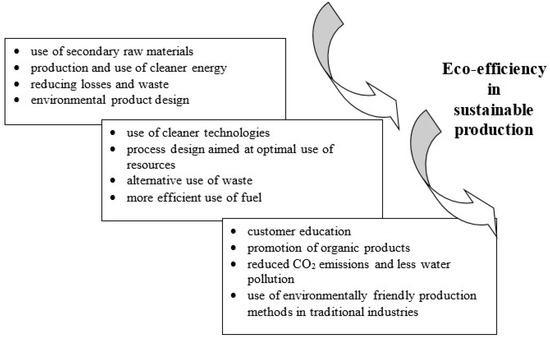
Figure 1.
Impact of eco-efficiency on sustainable production. Source: [30] (pp. 59–71).
According to Bratnicki and Austen [38] (pp. 41–48), the eco-efficiency measurement system should:
- Analyze and discuss phenomena of interest in a clear and concise manner for stakeholders;
- Go beyond control and give credible insight to improve efficiency;
- Develop and continuously stimulate a company’s improvement;
- Focus on processes and these issues of business, which are affected by them, such as: Quality, time, finances, customers’ satisfaction, human resources;
- Help to predict a company’s direction;
- Allow the use of measurement measures resulting from a current combination of activities strategies with strategic objectives of a company;
- Provide quickly detailed information in order to support appropriate decisions and action which could have been taken;
- Be simple, understandable, economical;
- Take into account different analysis perspectives as well as cause-and-effect relationships.
1.3. Design-Thinking Model—Concept, Advantages, and Constraints of Its Use
The design-thinking model is a design methodology that provides a solution-based approach to solving problems. The design-thinking model systematizes and identifies the five modes in a design project pertaining to any innovative problem-solving project which is to be carried out (Figure 2). The design-thinking model is appropriate in tackling complex problems that are ill-defined or unknown, by understanding the human needs involved, re-framing the problem in human-centric ways, creating ideas in brainstorming sessions, as well as by adopting a hands-on approach in prototyping and testing.
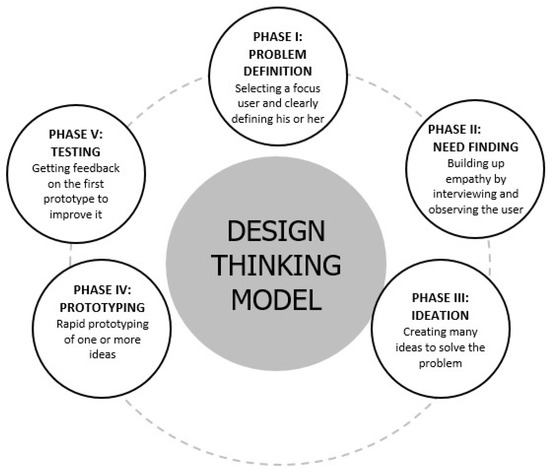
Figure 2.
Description of five stages of the design-thinking model. Source: [39].
The five stages of design thinking do not have to follow any specific order, can occur in parallel, or be repeated iteratively. The stages should be understood as different modes that contribute to a project, rather than sequential steps. Every project involves activities specific to the product under development (Table 2), but the central idea behind each stage remains the same [40].
Table 2.
Comparison of advantages and constraints of design-thinking model.
To summarize, the idea of the design-thinking model can be used for both risk-based and rule–risk-based processes. Nevertheless, it has to be emphasized that a designer must listen to users and understand their perspective. But it is still the designer who is deciding what elements of the users’ experience are relevant.
2. Materials and Methods
For the purposes of the paper, a structured questionnaire with a clearly defined research objective to select the main and complementary indicators in the areas of energy, waste, water, and pollution, making it possible to measure eco-efficiency in 100 food processing companies, was used. According to Creswell [42] and Kaczmarczyk [43], surveys are qualitative, collected in a cleaned database, verified analysis by means of statistical methods and a summary. Due to the large size of the total collective of food processing enterprises, a survey, called sample survey method, was conducted.
All questions were presented to the respondents in exactly the same way regarding content and form. The questionnaire, conducted in 2019, contained closed questions, so-called simple questions (answer: Yes/no), questions with options for answers (a/b/c/d), questions requiring a scale of assessment of responses (1—least, 5—the most), deeply closed questions (deliberately reopening the question in another part of the survey to check the accuracy of the respondent’s answers) [44] (pp. 104–110) [45], closed questions giving respondents the possibility of ticking and completing the answer “other—what?” and the questions to track changes over time were used. In the questionnaire, the options for answering were not exhaustive for a respondent. The order scale was used for reasons of clarity and for the sake of mapping the diversity and ordering the measured characteristics.
The basic criteria for the selection of the sample for the survey were as follows:
- −
- Subject of the conducted activity according to Polish Classification of Activities (2007 year);
- −
- Location within the country;
- −
- No bankruptcy or liquidation;
- −
- Raw material processing volume (t/week), number of employees (full-time), volume income (Polish zloty/year).
3. Results
The aim of this part was to create a set of eco-efficiency indicators the most suitable for food processing enterprises, taking into account the “cradle to cradle” concept, built on the principle that all materials involved in producing processes can be, in a rational sense, used as raw materials (“waste equals food”). The analysis was supported by the idea of the design-thinking model. In the first stage of the research, the constraints of eco-efficiency measures were stated. In the second stage, the questionnaire in 100 food processing enterprises was conducted (Table 3). The third stage consisted of building a set of potential factors and indicators measuring eco-efficiency within the applied processing technology (Table 4). The fourth stage stands for making comparisons and selecting the most appropriate indicators to measure eco-efficiency in examined food processing enterprises (Table 5). Such an approach had a key impact on the way the analyses were carried out, focusing on the analytical phases of the input-output set and assessment of the practical use of the chosen set of eco-efficiency indicators. The fifth stage was limited to verification of data use, completeness assessment, and identification of significant issues (Table 6).
Table 3.
Presentation of the research characteristics.
Table 4.
Presentation of potential factors and indicators shaping the eco-efficiency of food processing enterprises.
Table 5.
Presentation of the main and supplementary indicators measuring eco-efficiency in food processing enterprises in Poland.
Table 6.
Presentation of the methods measuring eco-efficiency with its advantages and constraints.
The next stage of the research consisted of collecting, measuring, and evaluating the data within the eco-efficiency model. This meant that there was a need: (a) To form a group of estimators of environmental impacts for the individual stages of the life cycle of the products, and (b) to create a standardization of the environmental impact in order to create an eco-efficiency portfolio of examined food processing enterprises in Poland.
4. Discussion
Eco-efficiency is a strategic instrument that helps suppliers and technology users in making decisions about the choice of processes or products that future investors must make. It can be measured in different ways. (Table 6). Eco-efficiency makes comparisons of possible advantages and constraints of the solutions. The analyses are conducted from the point of view of the recipient so-called the end user of the product, resulting from the given technology.
5. Conclusions
In order to highlight future reflections, it has to be said that the basic process of human activity is management, which is a process of conscious, rational, unforced decision making, which, on the one hand, must balance unlimited human needs, and on the other hand, limitation of resources. It is extremely important to stress that in the environmental context, a company uses human resources, land, tangible and financial capital, such as natural resources, raw materials, energy carriers, geographical space, and capacity assimilation of the natural environment. It means that the company has the right to emit pollution due to the fact that results of the production process are pollution and waste [54].
Eco-efficiency indicators should be constructed in such a way that all relevant environmental information should be taken into account, and this information should, in a commonly acceptable way, e aggregated to arrive at a cumulative value. In practice, an objective mapping of the actual and complete impact of a product or service in a global dynamic system is impossible to be achieve. Moreover, the more perfect this mapping is, the greater the effort it takes to work.
According to the conducted research, the hypothesis has been positively verified. The analyzed food processing enterprises are in a search of optimal, available, and affordable indicators to measure eco-efficiency. The authors are of the opinion that using the assumptions of the theoretical concepts of sustainable development has made it possible to apply selected indicators in the economic, social, and, often overlooked but very important, environmental aspects. The existing achievements of the concept of sustainable development create an advanced study in order to assess the eco-efficiency of market economy enterprises, although one should bear in mind the specificity and richness of factors determining eco-efficiency in the context of economic conditions and national legislation in force.
Some of the vivid limitations of the research refers to the difficulties concerning the eco-efficiency measures that arose from the characteristics and properties of different approaches and methods of its assessment. The article tried to capture a set of eco-efficiency indicators, which was not an easy task due to the inaccessibility and confidentiality of certain data, as well as the widespread reluctance of entrepreneurs to share information with external entities, including for theoretical and research purposes.
Some possible policy implications are as follow. Eco-efficiency indicators should be used on a larger scale in various types of projects financed or supported by the state. It is worth promoting the use of mentioned indicators in the implementation of government projects. Subsequently, it is possible to propose adequate adjustments of the taxes imposed on the food industry to meet the eco-efficiency criteria. Actions of this kind can be undertaken both at national and multinational level.
The obtained results will be used in further analyses in order to adopt existing measures for eco-efficiency in food processing enterprises. Furthermore, the outcomes can be helpful in terms of creating a strategy for companies; helping them to adjust their activities to eco-efficiency in order to gain significant competitive advantages in the agro-food market.
Author Contributions
A.Z.-C. (conceptualization, data curation, investigation, methodology, project administration, supervision, writing—original draft); A.O. (formal analisys, methodology, validation, writing—original draft); J.K. (formal analisys, investigation, methodology, visualization, writing—review & editing); E.V.A. (software, visualization, writing—review & editing). All authors have read and agreed to the published version of the manuscript.
Funding
Implemented with support of the Russian Foundation for Basic Research (project 20-011-00087 “Rural territories’ institutional factors and development forms”).
Institutional Review Board Statement
Not applicable.
Informed Consent Statement
Not applicable.
Data Availability Statement
The study did not report any data.
Conflicts of Interest
No conflict of interest.
References
- Zielińska-Chmielewska, A. Pomiar Ryzyka Działalności Gospodarczej na Przykładzie Giełdowych Spółek Mięsnych z Wykorzystaniem Finansowej Analizy Wskaźnikowej (Business Activity Risk Measurement on the Example of Listed Meat Companies with the Use of Financial Ratio Analysis); Prace Naukowe Uniwersytetu Ekonomicznego: Wrocław, Poland, 2014; pp. 543–551. [Google Scholar]
- Romashkina, G.F.; Davydenko, V.A.; Khuziakhmetov, R.R. Problems of food security in the Russian Arctic. IOP Conf. Ser. Mater. Sci. Eng. 2020, 940, 1–14. [Google Scholar] [CrossRef]
- Skripnuk, D. Analysis of the regional modernization processes in a global context with an example of the Russian northern regions. Int. J. Syst. Assur. Eng. Manag. 2020, 11, 100–110. [Google Scholar] [CrossRef]
- Zielińska-Chmielewska, A.; Alihodzić, A.; Smutka, L. Theoretical and practical concepts of financial efficiency in food processing enterprises. In Proceedings of the 8th International Scientific Symposium Economy of Eastern Croatia—Vision and Growth, Jossip Juraj Strossmayer University of Osijek, Osijek, Croatia, 29–30 May 2019; pp. 1086–1096. [Google Scholar]
- Zbierowski, P. Organizacja wysokiej efektywności. In Uwarunkowania i Prawidłowości Gospodarcze Wywierające Wpływ na Efektywność Funkcjonowania Przedsiębiorstw; Dudycz, T., Ed.; Politechnika Wrocławska: Wrocław, Poland, 2008; Volume 10, pp. 69–79. [Google Scholar]
- Kowalski, Z. Wybrane problemy definiowania i oceny efektywności gospodarowania w rolnictwie (Selected problems of defining and evaluating management efficiency in agriculture, Zeszyty Naukowe). Zag. Ekon. Rolnej 1992, 1–3, 2–22. [Google Scholar]
- Nowosielski, R.; Spilka, M.; Kania, A. Zarządzanie Środowiskowe i Systemy Zarządzania Środowiskowego (Environmental Management and Environmental Management Systems); Wydawnictwo Politechniki Śląskiej: Gliwice, Poland, 2010. [Google Scholar]
- Djamilia, S.; Kuzaeva, A.; Glushkova, A. Formation of a database of indicators and analysis of the environmental and socio-economic vital activity spheres of Russian Federation Arctic zone municipalities. Int. J. Syst. Assur. Eng. Manag. 2020, 11, 19–43. [Google Scholar] [CrossRef]
- Wilkin, J. Efektywność a sprawiedliwość. (Effectiveness and justice). 1997. Available online: www.for.org.pl (accessed on 1 October 2019).
- Didenko, N.I. Modeling the global nickel market with a triangular simultaneous equations model. Int. J. Syst. Assur. Eng. Manag. 2020, 11, 119–129. [Google Scholar] [CrossRef]
- Didenko, N.I.; Romashkina, G.F.; Skripnuk, D.F.; Kulik, S.V. Dynamics of Trust in Institutions, the Legitimacy of the Social Order, and Social Open Innovation. J. Open Innov. Technol. Mark. Complex. 2020, 6, 111. [Google Scholar] [CrossRef]
- Fusco, G.; Coluccia, B.; De Leo, F. Effect of trade openness on food security in the EU: A dynamic panel analysis. Int. J. Environ. Res. Public Health 2020, 17, 4311. [Google Scholar] [CrossRef] [PubMed]
- Florczak, W. Koncepcja zrównoważonego rozwoju w naukach społeczno-ekonomicznych (The concept of sustainable development in socio-economic sciences). Stud. Prawno Ekon. 2007, 75, 119–139. [Google Scholar]
- Dovers, S.R.; Handmer, J.W. Contradictions in sustainability. Environ. Conserv. 1993, 20, 217–222. [Google Scholar] [CrossRef]
- Temple, S. Old issue, new urgency? Wis. Environ. Dimens. 1992, 1, 1–20. [Google Scholar]
- Brudtland Report, World Commission on Environment and Development, WCED. 1987. Available online: https://www.are.admin.ch/are/en/home/sustainable-development/internationalcooperation/2030agenda/un-_milestones-in-sustainable-development/1987--brundtland-report.html (accessed on 1 June 2020).
- IUCN (International Union for Conservation of Nature). Available online: https://www.iucn.org/ (accessed on 1 June 2020).
- UNEP (United Nations Environment Programme). Available online: https://www.un.org/youthenvoy/2013/08/unep-united-nations-environment-programme/ (accessed on 1 August 2020).
- WWF (World Wide Fund for Nature). Available online: https://www.worldwildlife.org/ (accessed on 1 August 2020).
- Friends of the Earth Scotland. Available online: https://www.foe-scotland.org.uk/campaigns/sustainable-scot (accessed on 1 June 2020).
- Czaja, S.; Fiedor, B. Ekologiczne zarządzanie firmą. Wybrane elementy (Ecological management of the company. Selected issues). In Ekologizacja Zarządzania Firmą—Zielone Zarządzanie (Ecological Company’s Management—Green Management); Czaja, S., Ed.; Akademia Ekonomiczna im. O. Langego we Wrocławiu: Wrocław, Poland, 2000; pp. 57–65. [Google Scholar]
- Europejski Dialog Gmin Wiejskich o Ochronie Środowiska (European Environmental Dialogue of Rural Municipalities). Available online: www.access.zgwrp.org.pl (accessed on 1 June 2020).
- World Summit on Social Development. 1995. Available online: https://www.un.org/esa/socdev/wssd/text-version/ (accessed on 1 August 2020).
- Ustawa o ochronie i kształtowaniu środowiska w Polsce, 1997 (Act on the Protection and Development of the Environment in Poland, 1997).
- Ustawa Prawo ochrony środowiska, 2001 (Environmental Protection Law, 2001).
- Nowosielski, S. Skuteczność i Efektywność Realizacji Procesów Gospodarczych (Effectiveness and Efficiency of the Implementation of Economic Processes). In Mikroekonomiczne Aspekty Funkcjonowania Przedsiębiorstw; Dudycz, T., Ed.; AE im. O. Langego we Wrocławiu: Wrocław, Poland, 2008; pp. 39–46. [Google Scholar]
- Wursthon, S.; Poganietz, W.; Schebek, L. Economic-environmental monitoring indicators for European countries: A disaggregated sector based approach for monitoring eco-efficiency. Ecol. Econ. 2011, 70, 487–496. [Google Scholar] [CrossRef]
- Pagan, B.; Prasad, P. The Queensland food eco-efficiency project: Reducing risk and improving competitiveness. J. Clean. Prod. 2007, 15, 764–771. [Google Scholar] [CrossRef][Green Version]
- Poczta-Wajda, A.; Sapa, A.; Stępień, S.; Borychowski, M. Food Insecurity among Small-Scale Farmers in Poland. Agriculture 2020, 10, 295. [Google Scholar] [CrossRef]
- Czaplicka-Kolarz, K.; Kruczek, M.; Burchart-Korol, D. Koncepcja ekoefektywności w zrównoważonym zarządzaniu produkcją (The concept of eco-efficiency in sustainable production management). Zesz. Naukowe Ser. Organ. Zarz. 2013, 63, 59–71. [Google Scholar]
- WBCSD Congresses in Antwerpen, November (1993), March (1995), November (1995) March (2000).
- Bonfiglio, A.; Arzeni, A.; Bodini, A. Assessing eco-efficiency of arable farms in rural areas. Agric. Syst. 2017, 151, 114–125. [Google Scholar] [CrossRef]
- Czyżewski, B.; Matuszczak, A. A new land rent theory for sustainable agriculture. Land Use Policy 2016, 55, 222–229. [Google Scholar] [CrossRef]
- Czyżewski, B.; Przekota, G.; Poczta-Wajda, A. The incidence of agricultural policy on the land market in Poland: Two-dimensional and multilevel analysis. Land Use Policy 2017, 63, 174–185. [Google Scholar] [CrossRef]
- Czyżewski, B.; Matuszczak, A. Towards measuring political rents in agriculture: Case studies of different agrarian structures in the EU. Agric. Econ. 2018, 64, 101–114. [Google Scholar] [CrossRef]
- Wójcik-Augustyniak, M.; Szajczyk, M.; Ojstršek, A.; Leber, M. Life Cycle Assessment of Metallised Textiles. The Case Study of Maturolife Project; Zeszyty Naukowe Uniwersytetu Przyrodniczo-Humanistycznego: Siedlcach, Poland, 2019; pp. 5–12. [Google Scholar] [CrossRef]
- Saling, P.; Kicherer, A.; Dittrich-Kramer, B.; Wittlinger, R.; Zombik, W.; Schmidt, I.; Schmidt, S. Eco–efficiency analysis by BASF: The method. Int. J. Life Cycle Assess. 2002, 7, 203–218. [Google Scholar] [CrossRef]
- Bratnicki, M.; Austen, A. Sprzeczności w kształtowaniu postaw przedsiębiorczych (Contradictions when shaping entrepreneurial attitudes). Ekonom. Organ. Przeds. 2006, 11, 41–48. [Google Scholar]
- Gibbons, S. Design Thinking 101. 2016. Available online: www.nngroup.com/articles/design-thinking/ (accessed on 1 August 2020).
- Dam, R.F.; Siang, T.Y. 5 Stages in the Design Thinking Process. 2020. Available online: www.interaction-design.org/literature/article/5-stages-in-the-design-thinking-process (accessed on 1 August 2020).
- Karamousali, V. RBA—Risk Based-Approach: Strenghts and Weaknesses. 2020. Available online: www.pideeco.be/articles/rba-risk-based-approach-mechanisms-compliance (accessed on 1 August 2020).
- Creswell, J. Projektowanie Badań Naukowych: Metody Jakościowe, Ilościowe i Mieszane (Design Research Projects: Quality and Quantity Assessment, and Mixed); Uniwersytet Jagielloński: Kraków, Poland, 2013. [Google Scholar]
- Kaczmarczyk, S. Badania Marketingowe: Podstawy Metodyczne (Marketing Research: Methodological Foundations); Polskie Wydawnictwo Ekonomiczne: Warszawa, Poland, 2011. [Google Scholar]
- Finstad, K. Response interpolation and scale sensitivity: Evidence against 5-pont scales. J. Usabilities Stud. 2010, 5, 104–110. [Google Scholar]
- Sobczyk, W. Teoretyczna i Eksperymentalna Analiza Edukacji Ekologicznej Młodzieży (Theoretical and Experimental Analysis of Environmental Education of Young People); Wydawnictwo Naukowe Akademii Pedagogicznej: Kraków, Poland, 2003. [Google Scholar]
- National Round Table on the Environment and the Economy. Measuring Eco-Efficiency in Business: Feasibility of a Core Set of Indicators; Renouf Publishing Co. Ltd.: Ottawa, ON, Canada, 1999. [Google Scholar]
- National Round Table on the Environment and the Economy. Workbook Calculating Eco-Efficiency Indicators: A Workbook for Industry; Renouf Publishing Co. Ltd.: Ottawa, ON, Canada, 2001. [Google Scholar]
- Eco-Efficiency—State of Art. Available online: http://www.p2pays.org (accessed on 17 October 2020).
- Fussier, C. Die öko Innovation; S. Hirzel Verlag Stuttgart: Leipzigg, Germany, 1999; p. 127. [Google Scholar]
- Kleiber, M. (Ed.) Ekoefektywność Technologii (Eco-Efficiency of Technology); Wydawnictwo Naukowe Instytutu Technologii Eksploatacji—Państwowego Instytutu Badawczego: Radom, Poland, 2011. [Google Scholar]
- PN-EN ISO 14040. Zarządzanie Środowiskowe. Ocena Cyklu Życia. Zasady i Struktura (Environmental Management. Life Cycle Assessment. Principles and Structure); ISO: Geneva, Switzerland, 2009. [Google Scholar]
- PN-EN ISO 14044. Zarządzanie Środowiskowe. Ocena Cyklu Życia. Wymagania i Wytyczne (Environmental management. Life Cycle Assessment. Requirements and Guidelines); ISO: Geneva, Switzerland, 2009. [Google Scholar]
- WBCSD. Eco-Efficient Leadership for Improved Economic and Environmental Performance; WBCSD: Geneva, Switzerland, 1996. [Google Scholar]
- Hałasa, J.M.; Rumianowska, I. Ekologiczne uwarunkowania funkcjonowania firmy. In Ekologizacja Zarządzania Firmą–Zielone Zarządzanie; Czaja, S., Ed.; AE Wrocław: Wrocław, Poland, 2000; pp. 24–31. [Google Scholar]
Publisher’s Note: MDPI stays neutral with regard to jurisdictional claims in published maps and institutional affiliations. |
© 2021 by the authors. Licensee MDPI, Basel, Switzerland. This article is an open access article distributed under the terms and conditions of the Creative Commons Attribution (CC BY) license (http://creativecommons.org/licenses/by/4.0/).