Optimization of Injection Molding Processing Parameters for Thin-Walled Plastic Parts Manufactured for the Automotive Industry



Abstract
1. Introduction
2. Materials and Methods
2.1. Material
2.2. Theoretical Methodology
2.3. Experimental Methodology
3. Results
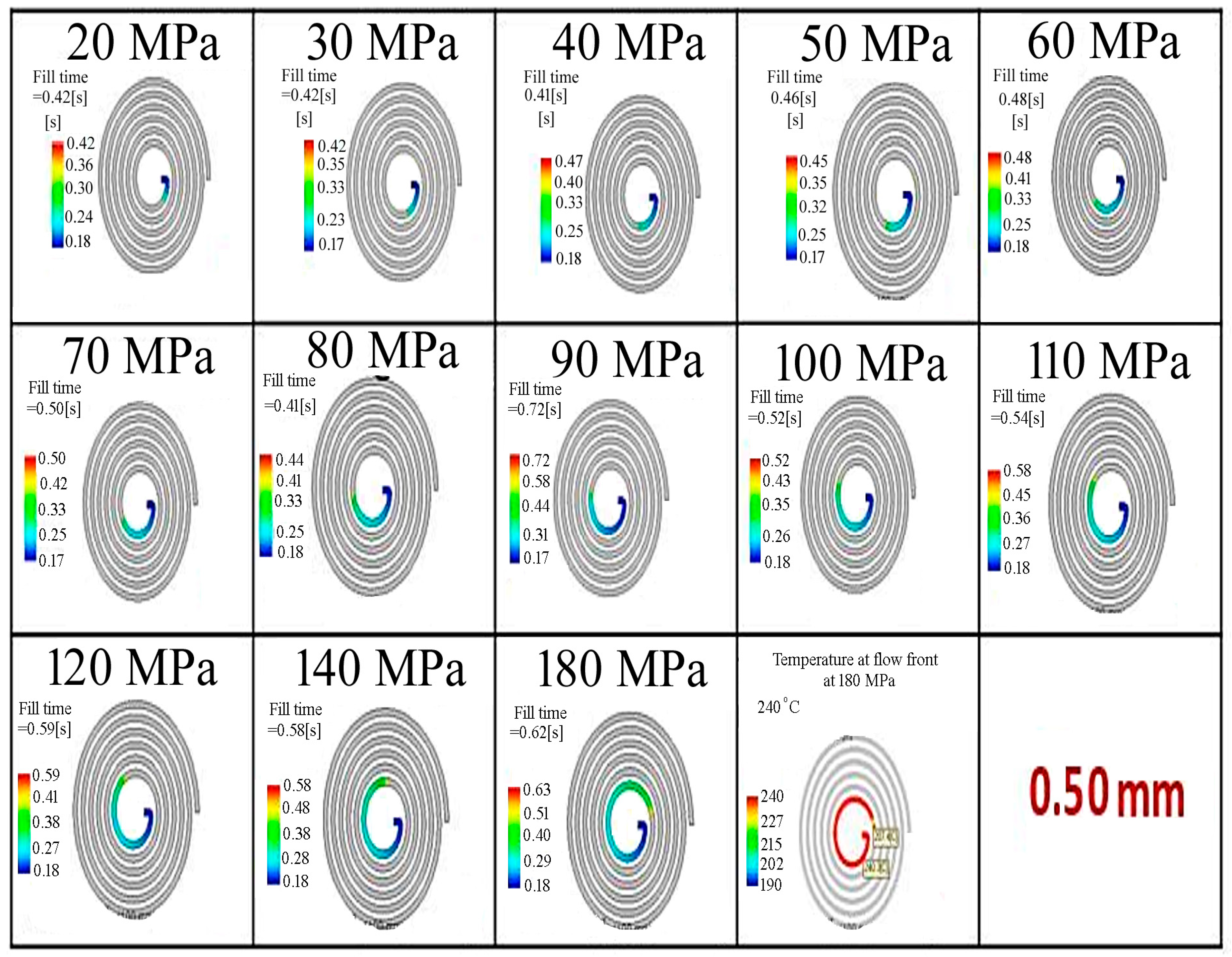
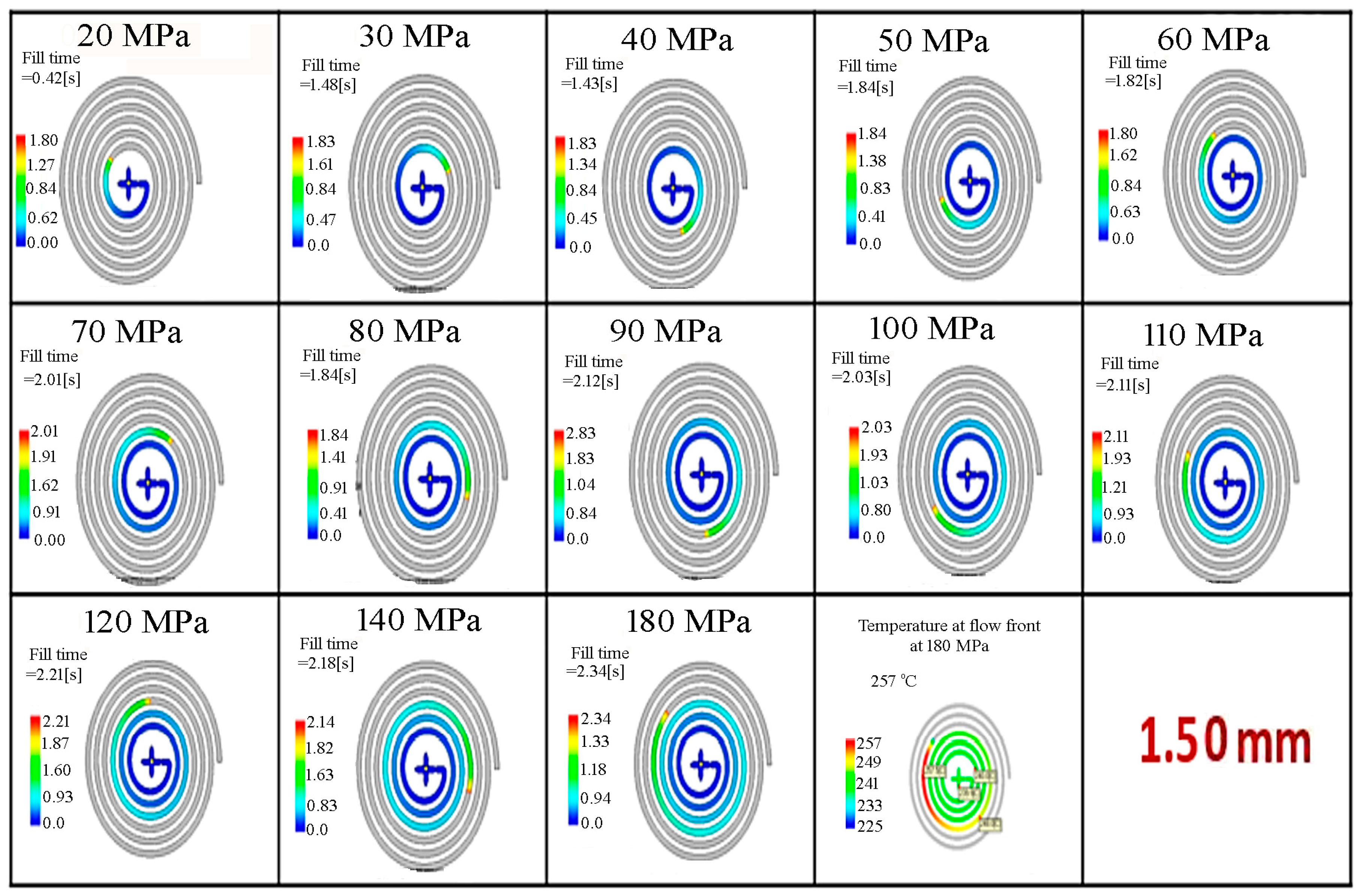
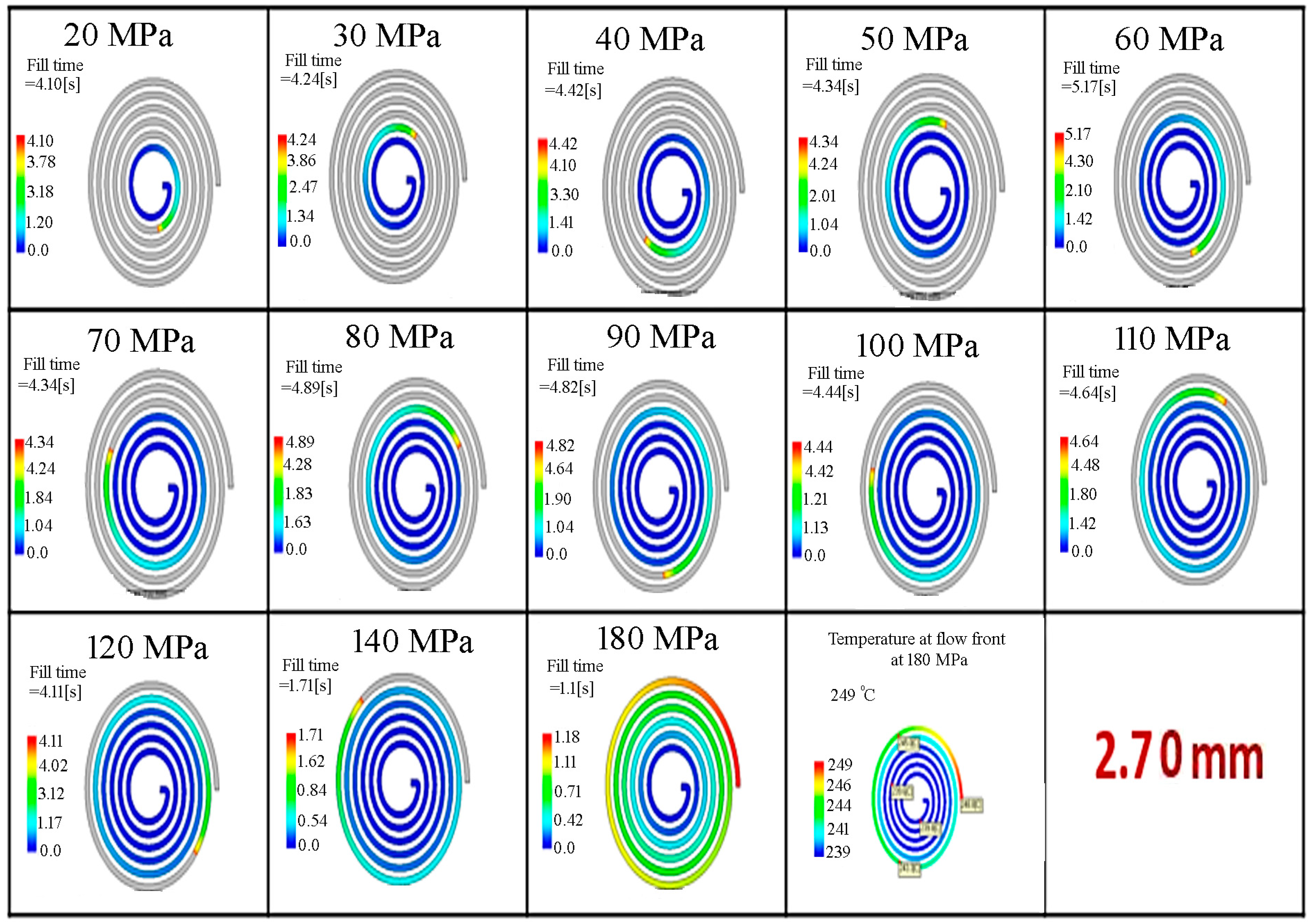
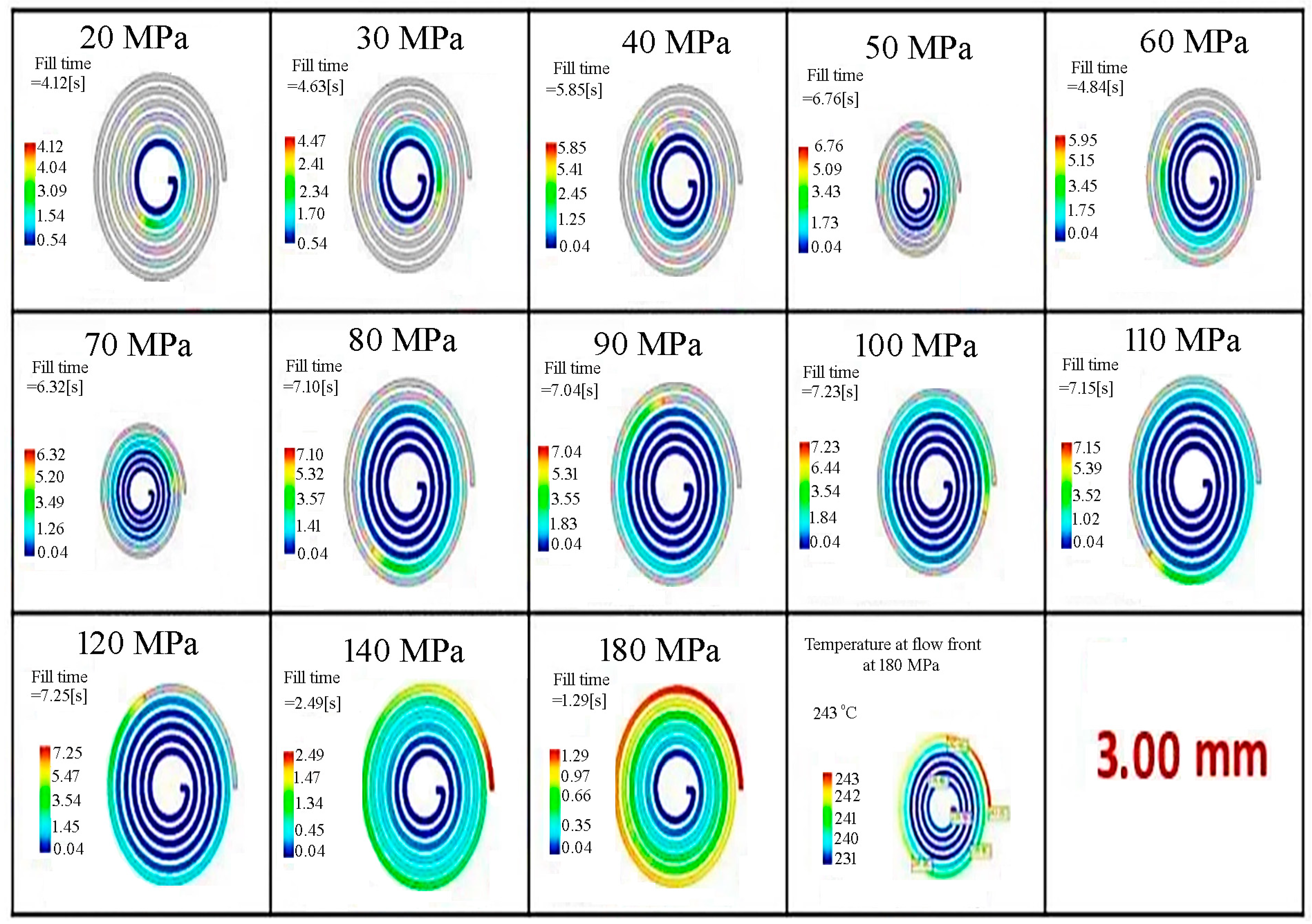
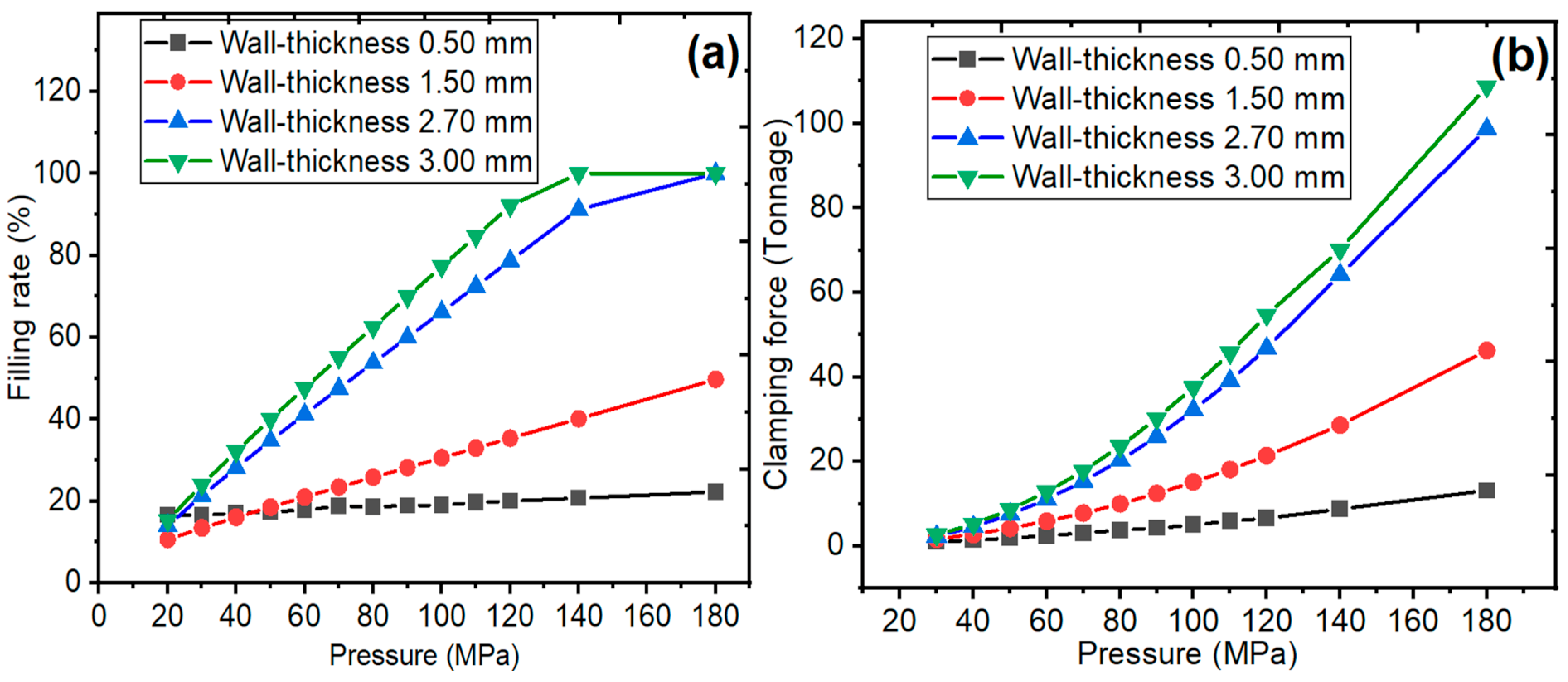
3.1. The Filling Time and Filling Rate
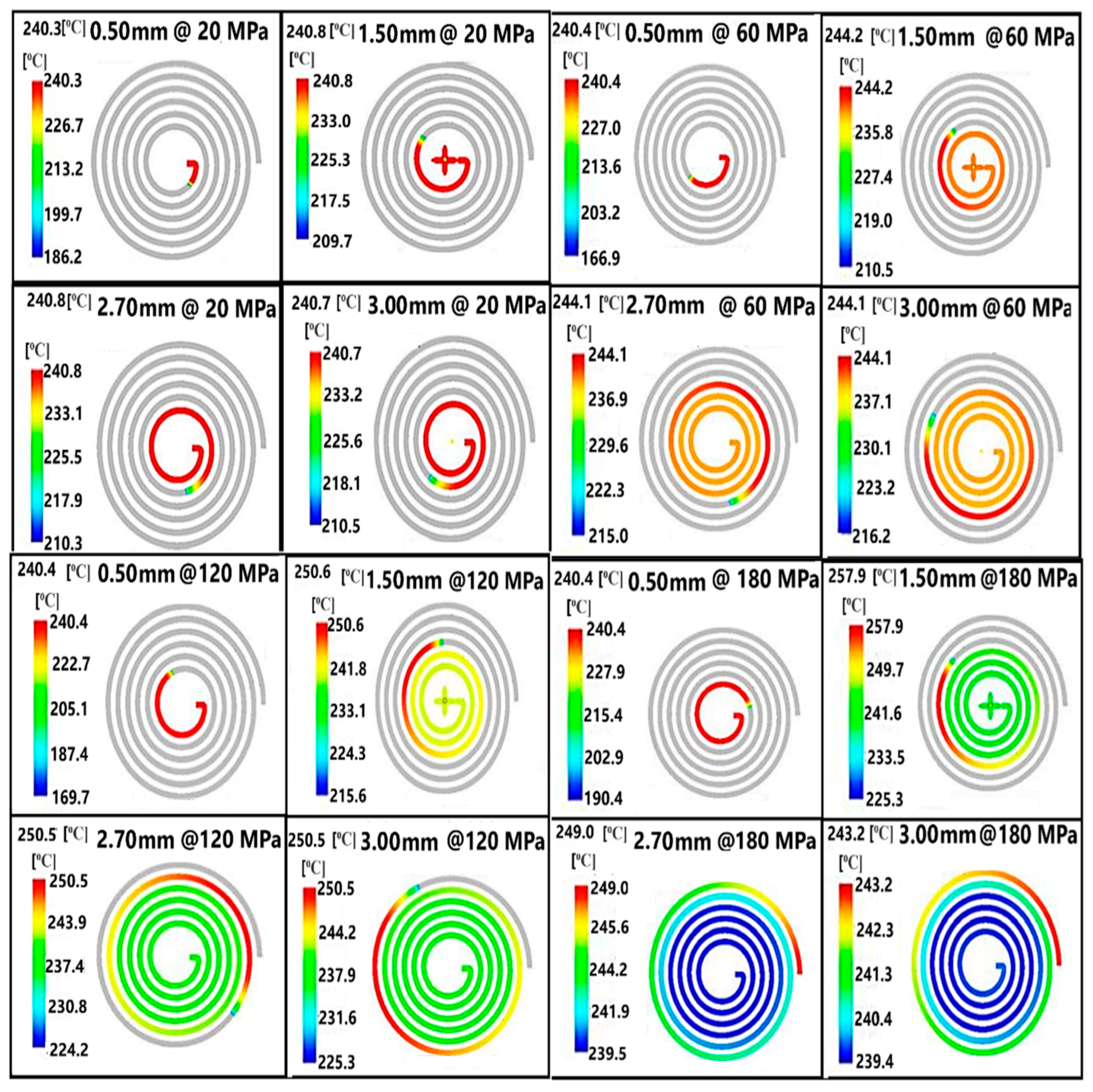
3.2. The Clamping Force and Temperature at the Flow Front
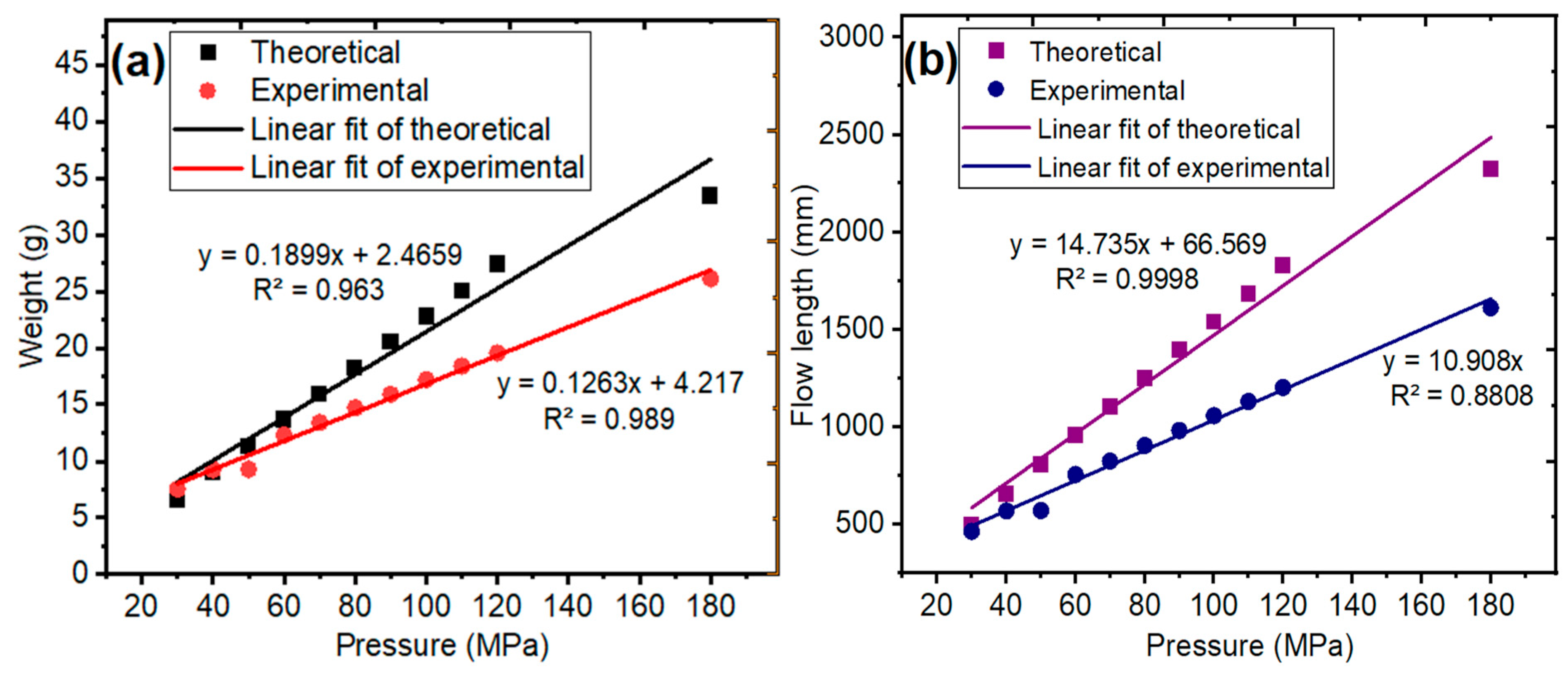
3.3. Weight and Flow Length
4. Conclusions
Author Contributions
Funding
Institutional Review Board Statement
Data Availability Statement
Acknowledgments
Conflicts of Interest
References
- Dejene, N.D.; Lemu, H.G.; Gutema, E.M. Critical Review of Comparative Study of Selective Laser Melting and Investment Casting for Thin-Walled Parts. Materials 2023, 16, 7346. [Google Scholar] [CrossRef]
- Jasiński, D.; Meredith, J.; Kirwan, K. Sustainable development model for measuring and managing sustainability in the automotive sector. Sustain. Dev. 2021, 29, 1123–1137. [Google Scholar] [CrossRef]
- Wu, X.; Su, C.; Zhang, K. 316L Stainless Steel Thin-Walled Parts Hybrid-Layered Manufacturing Process Study. Materials 2023, 16, 6518. [Google Scholar] [CrossRef]
- Liu, Y.; Lask, J.; Kupfer, R.; Gude, M.; Feldner, A. A Comparative Life Cycle Assessment of a New Cellulose-Based Composite and Glass Fibre Reinforced Composites. J. Polym. Environ. 2023, 32, 2207–2220. [Google Scholar] [CrossRef]
- Al Menen, B.; Ekinci, A.; Oksuz, M.; Ates, M.; Aydin, I. Effect of processing parameters on the properties of two-component injection molded recycled polypropylene/ethylene propylene diene monomer automotive parts. Int. J. Adv. Manuf. Technol. 2023, 127, 845–860. [Google Scholar] [CrossRef]
- Shahzad, K.; Cheema, I.I. Low-carbon technologies in automotive industry and decarbonizing transport. J. Power Sources 2024, 591, 233888. [Google Scholar] [CrossRef]
- Uyen, T.M.T.; Minh, P.S.; Thanh, B.C. Application of Cooling Layer and Thin Thickness Between Coolant and Cavity for Mold Temperature Control and Improving Filling Ability of Thin-Wall Injection Molding Product. Polymers 2025, 17, 2658. [Google Scholar] [CrossRef]
- Hartomacıoğlu, S.; Oksuz, M.; Ekinci, A.; Ates, M. Optimization of Produced Parameters for PA6/PA6GF30 Composite Produced by 3D Printing with Novel Knitting Method. Polymers 2025, 17, 1590. [Google Scholar] [CrossRef] [PubMed]
- Remigio-Reyes, J.O.; Garduño, I.E.; Rojas-García, J.M.; Arcos-Gutierrez, H.; Ortigosa, R. Topology optimization-driven design of added rib architecture system for enhanced free vibration response of thin-wall plastic components used in the automotive industry. Int. J. Adv. Manuf. Technol. 2022, 123, 1231–1247. [Google Scholar] [CrossRef]
- Song, P.P.; Putrayudanto, P.; Wu, T.Y.; Lai, J.Y.; Tsai, Y.C.; Wang, M.H.; Hsu, C.H. Decomposition of protrusion features on thin-shell parts for mold flow analysis. Eng. Comput. 2023, 39, 2757–2789. [Google Scholar] [CrossRef]
- Lai, J.Y.; Wu, J.W.; Song, P.P.; Chou, T.Y.; Tsai, Y.C.; Hsu, C.H. Hybrid mesh generation for the thin shell of thin-shell plastic parts for mold flow analysis. Eng. Comput. 2022, 38, 4895–4917. [Google Scholar] [CrossRef]
- Chen, J.Y.; Vo, T.P.L.; Huang, M.S. Real-time monitoring and quantitative analysis of residual stress in thin-walled injection-molded components. J. Manuf. Process. 2025, 141, 991–1001. [Google Scholar] [CrossRef]
- Jiang, Q.S.; Liu, H.S.; Wang, X.C.; Hu, Z.X.; Zhou, H.Y.; Nie, H.R. Three-dimensional numerical simulation on fiber orientation of short-glass-fiber-reinforced polypropylene composite thin-wall injection-molded parts simultaneously accounting for wall slip effect and pressure dependence of viscosity. J. Appl. Polym. Sci. 2022, 139, e53129. [Google Scholar] [CrossRef]
- Hiyane-Nashiro, G.; Hernández-Hernández, M.; Rojas-García, J.; Rodriguez-Resendiz, J.; Álvarez-Alvarado, J.M. Optimization of the Reduction of Shrinkage and Warpage for Plastic Parts in the Injection Molding Process by Extended Adaptive Weighted Summation Method. Polymers 2022, 14, 5133. [Google Scholar] [CrossRef]
- Peng, S.; Tan, M.; Zhang, D.; Li, M. Multi-Objective Optimization of Thin-Walled Connectors in Injection Molding Process Based on Integrated Algorithms. Materials 2025, 18, 1991. [Google Scholar] [CrossRef]
- Wang, B.; Cai, A. Influence of mold design and injection parameters on warpage deformation of thin-walled plastic parts. Polimery 2021, 66, 283–292. [Google Scholar] [CrossRef]
- Polat, Y.E.; Oksuz, M.; Ekinci, A.; Ates, M.; Aydin, I. The Effect of Injection Molding Processing Parameters on Chrome-Plated Acrylonitrile Butadiene Styrene-Based Automotive Parts: An Industrial Scale. Polymers 2025, 17, 1787. [Google Scholar] [CrossRef]
- Ekinci, A.; Oksuz, M.; Ates, M.; Aydin, I. Thermal and Mechanical Properties of Polypropylene/Post-consumer Poly (ethylene terephthalate) Blends: Bottle-to-Bottle recycling. J. Polym. Res. 2022, 29, 433. [Google Scholar] [CrossRef]
- Zhou, H.; Zhang, S.; Wang, Z. Multi-objective optimization of process parameters in plastic injection molding using a differential sensitivity fusion method. Int. J. Adv. Manuf. Technol. 2021, 114, 423–449. [Google Scholar] [CrossRef]
- Azad, R.; Shahrajabian, H. Experimental study of warpage and shrinkage in injection molding of HDPE/rPET/wood composites with multiobjective optimization. Mater. Manuf. Process 2019, 34, 274–282. [Google Scholar] [CrossRef]
- Cheng, C.P.; Chuang, M.T.; Hsiao, Y.H.; Yang, Y.K.; Tsai, C.H. Simulation and experimental study in determining injection molding process parameters for thin-shell plastic parts via design of experiments analysis. Expert Syst. Appl. 2009, 36, 10752–10759. [Google Scholar] [CrossRef]
- Oktem, H.; Erzurumlu, T.; Uzman, I. Application of Taguchi optimization technique in determining plastic injection molding process parameters for a thin-shell part. Mater. Des. 2007, 28, 1271–1278. [Google Scholar] [CrossRef]
- Azaman, M.D.; Sapuan, S.M.; Sulaiman, S.; Zainudin, E.S.; Khalina, A. Numerical simulation analysis of the in-cavity residual stress distribution of lignocellulosic (wood) polymer composites used in shallow thin-walled parts formed by the injection moulding process. Mater. Des. 2014, 55, 381–386. [Google Scholar] [CrossRef]
- Zhao, N.Y.; Lian, J.Y.; Wang, P.F.; Xu, Z.B. Recent progress in minimizing the warpage and shrinkage deformations by the optimization of process parameters in plastic injection molding: A review. Int. J. Adv. Manuf. Technol. 2022, 120, 85–101. [Google Scholar] [CrossRef]
- Rosli, M.; Termizi, S.A.; Khor, C.; Nawi, M.; Omar, A.A.; Ishak, M.I. Simulation Based Optimization of Thin Wall Injection Molding Parameter Using Response Surface Methodology. IOP Conf. Ser. Mater. Sci. Eng. 2020, 864, 012193. [Google Scholar] [CrossRef]
- Kashyap, S.; Datta, D. Process parameter optimization of plastic injection molding: A review. Int. J. Plast. Technol. 2015, 19, 1–18. [Google Scholar] [CrossRef]
- Li, K.; Yan, S.; Zhong, Y.; Pan, W.; Zhao, G. Multi-objective optimization of the fiber-reinforced composite injection molding process using Taguchi method, RSM, and NSGA-II. Simul. Model. Pract. Theory 2019, 91, 69–82. [Google Scholar] [CrossRef]
- Oketola, A.; Jamiru, T.; Ogunbiyi, O.; Rominiyi, A.L.; Smith, S.; Adedayo, O.D. Process parametric optimization of spark plasma sintered Ni–Cr–ZrO2 composites using response surface methodology (RSM). Int. J. Lightweight Mater. Manuf. 2024, 7, 14–24. [Google Scholar] [CrossRef]
- Chen, W.C.; Nguyen, M.H.; Chiu, W.H.; Chen, T.N.; Tai, P.H. Optimization of the plastic injection molding process using the Taguchi method, RSM, and hybrid GA-PSO. Int. J. Adv. Manuf. Technol. 2016, 83, 1873–1886. [Google Scholar] [CrossRef]
- Song, Z.; Liu, S.; Wang, X.; Hu, Z. Optimization and prediction of volume shrinkage and warpage of injection-molded thin-walled parts based on neural network. Int. J. Adv. Manuf. Technol. 2020, 109, 755–769. [Google Scholar] [CrossRef]
- Zhiguo, M.; Xianzhang, S.; Yulong, H.; Jun, Z.; Ming, H.; Yongzhi, L.; Chuntai, L. Co-simulation technology of mold flow and structure for injection molding reinforced thermoplastic composite (FRT) parts. Adv. Compos. Hybrid Mater. 2022, 5, 960–972. [Google Scholar] [CrossRef]
- Moayyedian, M.; Qazani, M.R.C.; Pourmostaghimi, V. Optimized injection-molding process for thin-walled polypropylene part using genetic programming and interior point solver. Int. J. Adv. Manuf. Technol. 2022, 124, 297–313. [Google Scholar] [CrossRef]
- Nasir, S.M.; Shayfull, Z.; Sharif, S.; Abdellah, A.E.H.; Fathullah, M.; Noriman, N.Z. Evaluation of shrinkage and weld line strength of thick flat part in injection moulding process. J. Braz. Soc. Mech. Sci. Eng. 2021, 43, 452. [Google Scholar] [CrossRef]
- Rosli, M.U.; Khor, C.Y.; Zailani, Z.A. Optimization of process parameters in metal injection molding for turbine blade using response surface methodology. Int. J. Adv. Manuf. Technol. 2025, 137, 5899–5912. [Google Scholar] [CrossRef]
- Cheng, F.-J.; Chang, C.-H.; Wen, C.-H.; Hwang, S.-J.; Peng, H.-S.; Chu, H.-Y. Out-of-Mold Sensor-Based Process Parameter Optimization and Adaptive Process Quality Control for Hot Runner Thin-Walled Injection-Molded Parts. Polymers 2024, 16, 1057. [Google Scholar] [CrossRef] [PubMed]
- Jung, H.; Jeon, J.; Choi, D.; Park, J.Y. Application of machine learning techniques in injection molding quality prediction: Implications on sustainable manufacturing industry. Sustainability 2021, 13, 4120. [Google Scholar] [CrossRef]
- Silva, B.; Marques, R.; Faustino, D.; Ilheu, P.; Santos, T.; Sousa, J.; Rocha, A.D. Enhance the Injection Molding Quality Prediction with Artificial Intelligence to Reach Zero-Defect Manufacturing. Processes 2023, 11, 62. [Google Scholar] [CrossRef]
- Xiao, F.; Chen, L.; Wang, X. Calculation of shrinkage rate for injection molding based on moldflow. In Proceedings of the FISITA 2012 World Automotive Congress, Beijing, China, 27–30 November 2012; Springer: Berlin/Heidelberg, Germany, 2013; pp. 1501–1510. [Google Scholar] [CrossRef]
- Praveena, B.A.; Shetty, B.P.; Lokesh, N.; Santhosh, N.; Buradi, A.; Jalapur, R. Design of Injection Mold for Manufacturing of Cup. In Recent Advances in Mechanical Engineering; Springer: Singapore, 2023; pp. 65–74. [Google Scholar] [CrossRef]
- Chauhan, V.; Kärki, T.; Varis, J. Optimization of Compression Molding Process Parameters for NFPC Manufacturing Using Taguchi Design of Experiment and Moldflow Analysis. Processes 2021, 9, 1853. [Google Scholar] [CrossRef]
- Panda, S.B.; Nayak, N.C.; Mishra, A. Characterization and optimization of tool design of an injection molded part through mold-flow analysis. In Advances in Data Science and Management; Springer: Singapore, 2020; pp. 453–461. [Google Scholar] [CrossRef]
- 1133-1-2011 (E); Plastics—Determination of the Melt Mass-Flow Rate (MFR) and Melt Volume-Flow Rate (MVR) of Thermoplastics—Part 1: Standard Method. International Organization for Standardization (ISO): Geneva, Switzerland, 2011.
- Lin, W.C.; Fan, F.Y.; Huang, C.F.; Shen, Y.K.; Wang, L. Analysis of Melt Front Behavior of a Light Guiding Plate during the Filling Phase of Micro-Injection Molding. Polymers 2022, 14, 3077. [Google Scholar] [CrossRef]
- Huang, M.S.; Lin, C.Y. A novel clamping force searching method based on sensing tie-bar elongation for injection molding. Int. J. Heat Mass Transf. 2017, 109, 223–230. [Google Scholar] [CrossRef]
- Mao, H.; Wang, Y.; Yang, D. Study of injection molding process simulation and mold design of automotive back door panel. J. Mech. Sci. Technol. 2022, 36, 2331–2344. [Google Scholar] [CrossRef]
- Cao, Y.; Fan, X.; Guo, Y.; Liu, X.; Li, C.; Li, L. Experimental-based optimization of polymer injection molding process parameters using anfis-ga method. J. Mech. Sci. Technol. 2022, 36, 1189–1196. [Google Scholar] [CrossRef]
- Rosli, M.U.; Khor, C.Y. Simulation-based optimization of plastic transfer molding parameter for thin small outline package via response surface methodology. Int. J. Adv. Manuf. Technol. 2024, 130, 5055–5073. [Google Scholar] [CrossRef]
- Solanki, B.S.; Singh, H.; Sheorey, T. Modeling and analysis of cavity modification effect on quality of injection molded polymer gear. Int. J. Interact. Des. Manuf. (IJIDeM) 2022, 16, 1615–1632. [Google Scholar] [CrossRef]
- Chang, H.; Lu, S.; Sun, Y.; Zhang, G.; Rao, L. Optical Penetration and “Fingerprinting” Analysis of Automotive Optical Liquid Silicone Components Based on Wavelet Analysis and Multiple Recognizable Performance Evaluation. Polymers 2023, 15, 86. [Google Scholar] [CrossRef]
- Dogossy, G.; Morauszki, T.; Ronkay, F. Experimental investigation and applicability of multi-stage simulations in the case of a thick-walled injection-moulded composite. Appl. Sci. 2022, 12, 8415. [Google Scholar] [CrossRef]
- Baum, M.; Anders, D.; Reinicke, T. Approaches for numerical modeling and simulation of the filling phase in injection molding: A Review. Polymers 2023, 15, 4220. [Google Scholar] [CrossRef]



| Machine Specifications | Value | Unit |
|---|---|---|
| Screw diameter | 45 | mm |
| Effective screw length (L/D) | 18 | --- |
| Screw length | 160 | mm |
| Measurement screw volume | 254 | cm3 |
| Press capacity | 232 | g |
| Shot capacity | 35 | kg/h |
| Injection pressure | 1580 | bar |
| Packing pressure | 1580 | bar |
| Parameters | Value | Unit |
|---|---|---|
| Melt temperature | 234–212–201–105 | °C |
| Mold surface temperature | 40 | °C |
| Screw rate | 35 | mm/s |
| Injection pressure (V/P) | 30–120 | MPa |
| Cooling time | 20 | s |
| Properties | Value | Unit | Flow Length |
|---|---|---|---|
| Total volume (t = 1.50 mm) | 21.09 | cm3 |  |
| Total length | 2323.62 | mm | |
| Width | 6.00 | mm | |
| Wall thickness | 1.50 | mm | |
| Surface area | 13,941.70 | mm2 |
Disclaimer/Publisher’s Note: The statements, opinions and data contained in all publications are solely those of the individual author(s) and contributor(s) and not of MDPI and/or the editor(s). MDPI and/or the editor(s) disclaim responsibility for any injury to people or property resulting from any ideas, methods, instructions or products referred to in the content. |
© 2025 by the authors. Licensee MDPI, Basel, Switzerland. This article is an open access article distributed under the terms and conditions of the Creative Commons Attribution (CC BY) license.
Share and Cite
Potuk, N.O.; Oksuz, M.; Ekinci, A.; Ates, M.; Aydin, I. Optimization of Injection Molding Processing Parameters for Thin-Walled Plastic Parts Manufactured for the Automotive Industry. Polymers 2026, 18, 91. https://doi.org/10.3390/polym18010091
Potuk NO, Oksuz M, Ekinci A, Ates M, Aydin I. Optimization of Injection Molding Processing Parameters for Thin-Walled Plastic Parts Manufactured for the Automotive Industry. Polymers. 2026; 18(1):91. https://doi.org/10.3390/polym18010091
Chicago/Turabian StylePotuk, Nedime Ozdemir, Mustafa Oksuz, Aysun Ekinci, Murat Ates, and Ismail Aydin. 2026. "Optimization of Injection Molding Processing Parameters for Thin-Walled Plastic Parts Manufactured for the Automotive Industry" Polymers 18, no. 1: 91. https://doi.org/10.3390/polym18010091
APA StylePotuk, N. O., Oksuz, M., Ekinci, A., Ates, M., & Aydin, I. (2026). Optimization of Injection Molding Processing Parameters for Thin-Walled Plastic Parts Manufactured for the Automotive Industry. Polymers, 18(1), 91. https://doi.org/10.3390/polym18010091