A Meta-Synthesis of Review Studies on Wood–Polymer Composites: Mapping the Current Research Landscape


Abstract
1. Introduction
2. Data Source and Methodology
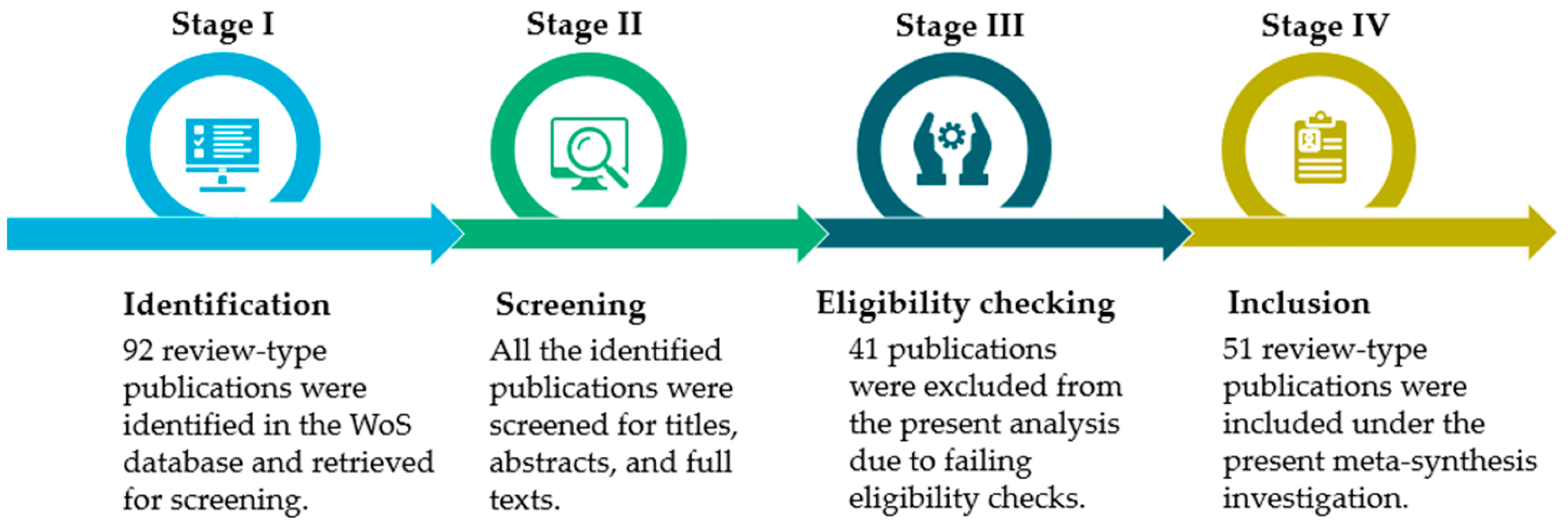
- Non-review publications: Many records were excluded because they were original research articles rather than reviews. These works include experimental investigations, material formulations, mechanical testing, or case-specific designs instead of synthesizing the existing literature.
- Publications that lack focus on wood–polymer composites as the central theme: Some articles mentioned WPCs only peripherally or within the broader material categories (e.g., biocomposites, green materials, natural fiber composites, cellulosic composites or nanocomposites, plastic and wood recycling logistics; pallets and packaging systems; additive manufacturing) without making them the primary subject of analysis.
3. Results and Discussion
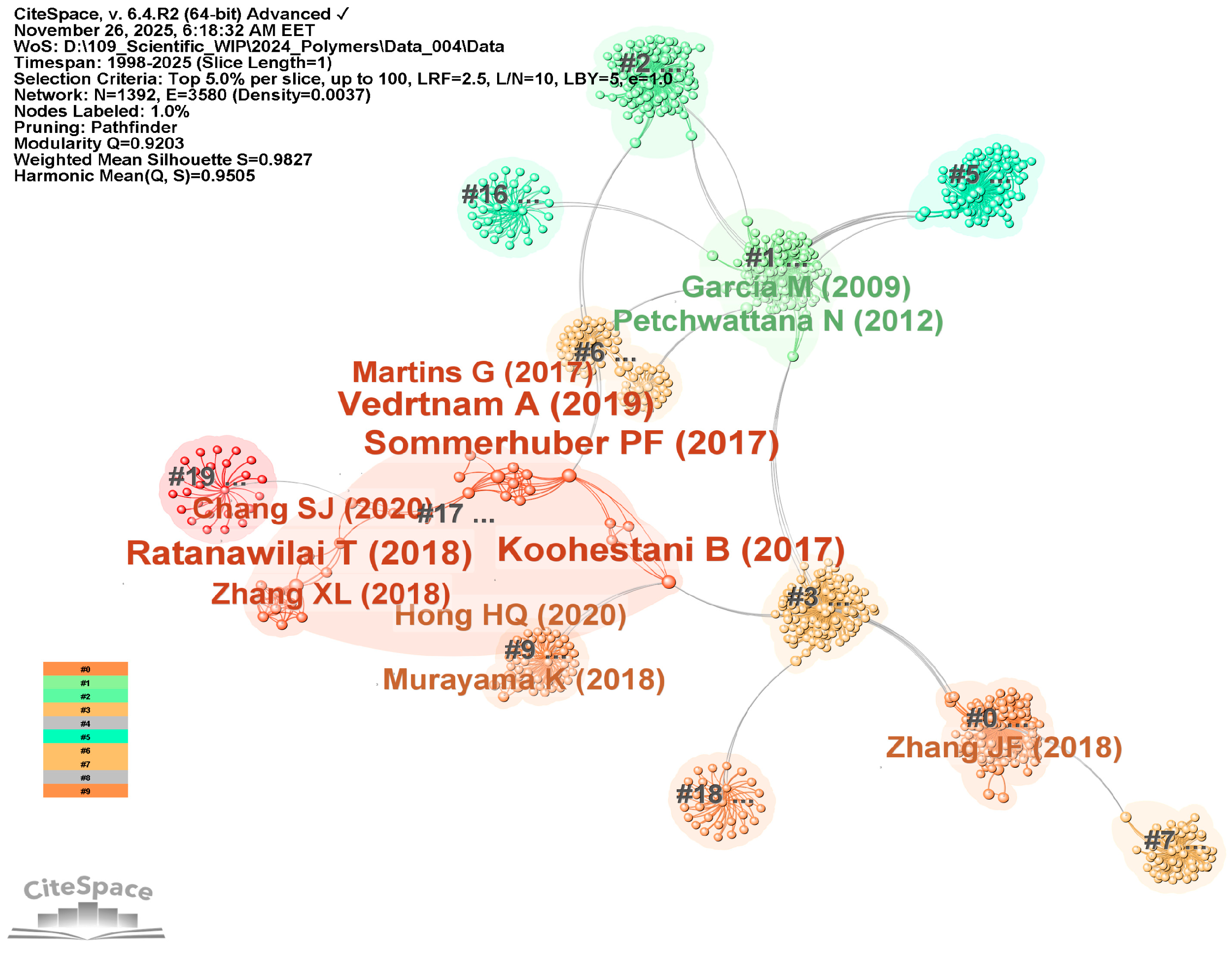
3.1. Co-Citation Analysis of References—RQ1
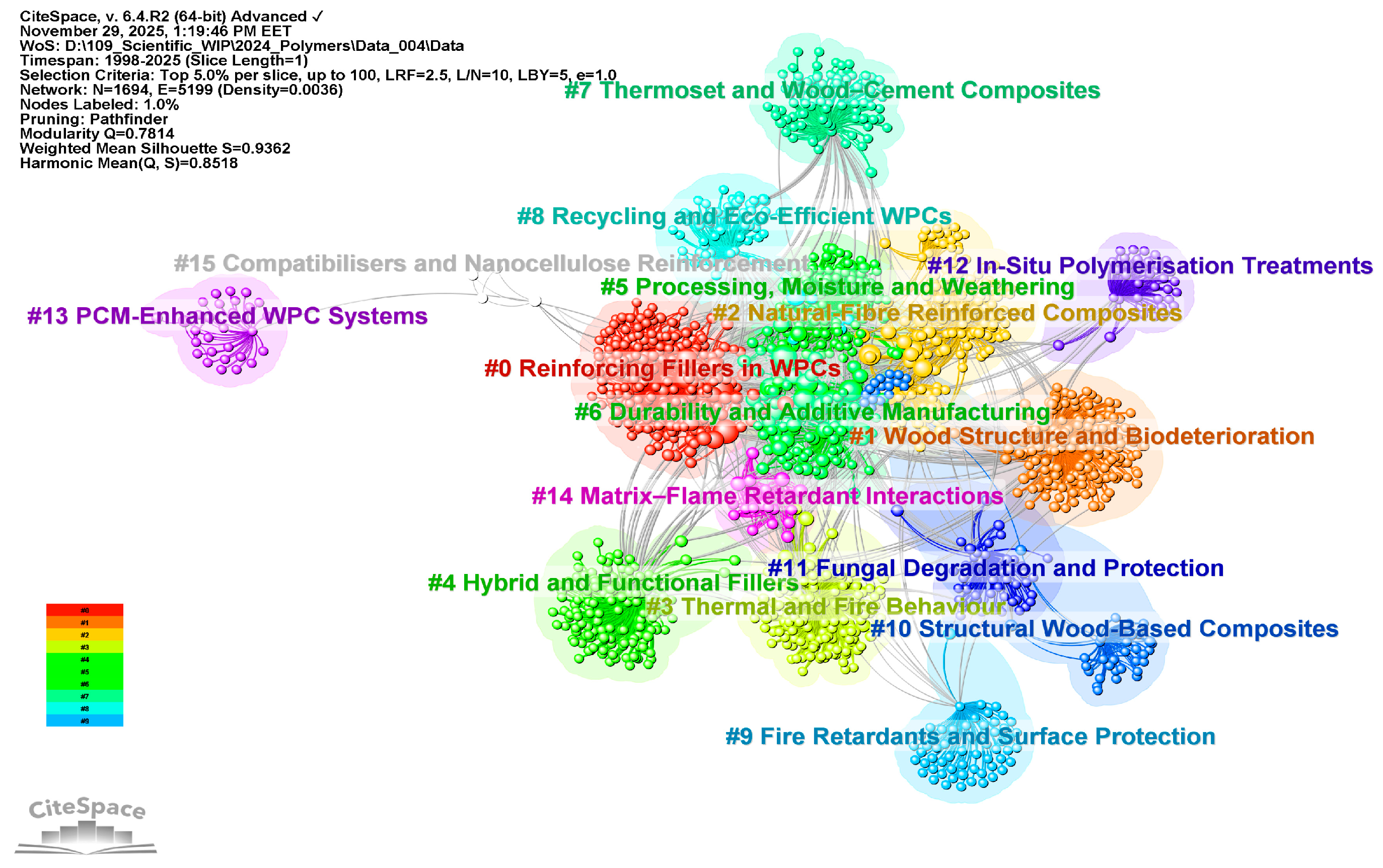
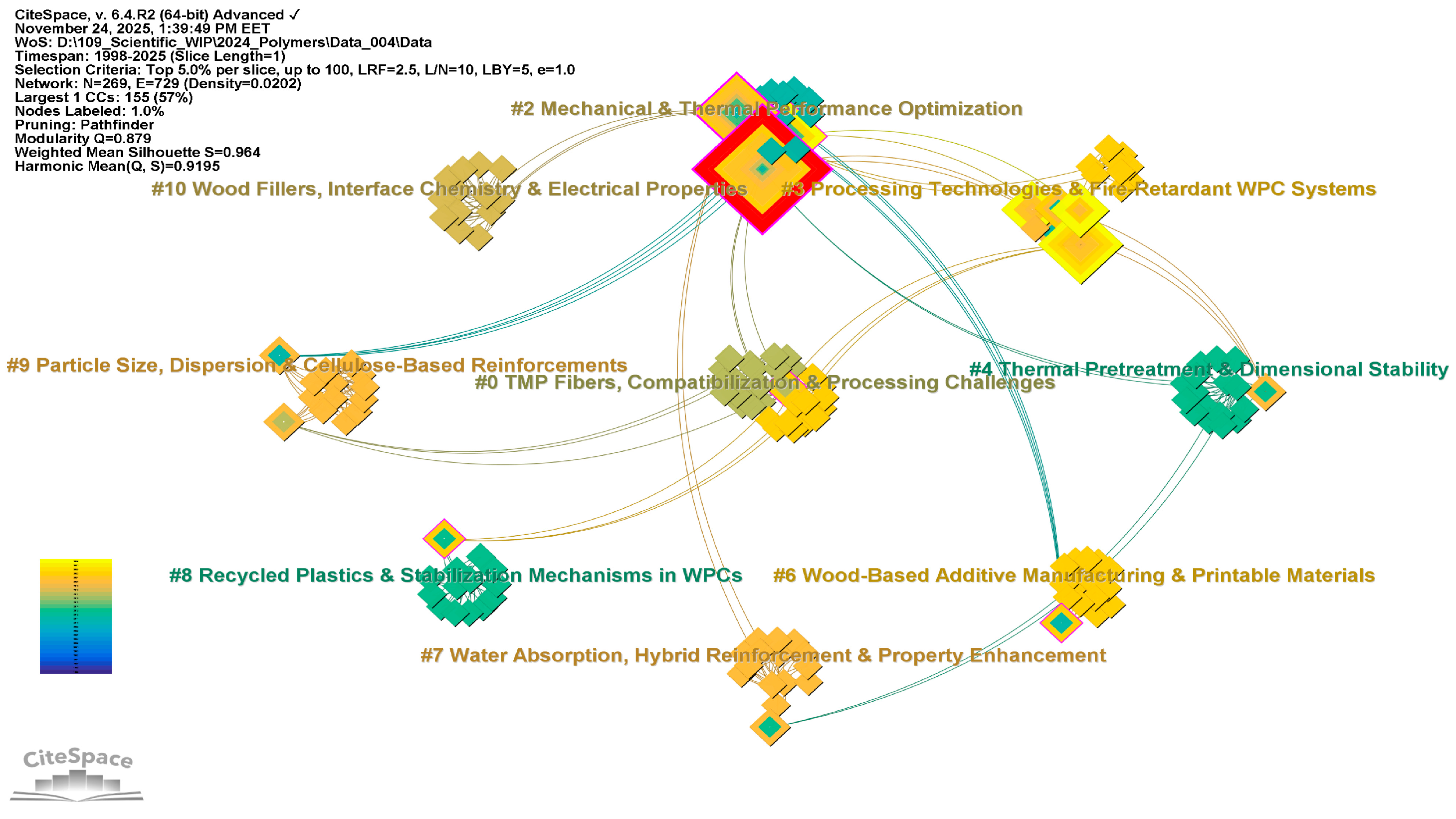
3.2. Clustering of Co-Cited Literature—RQ2
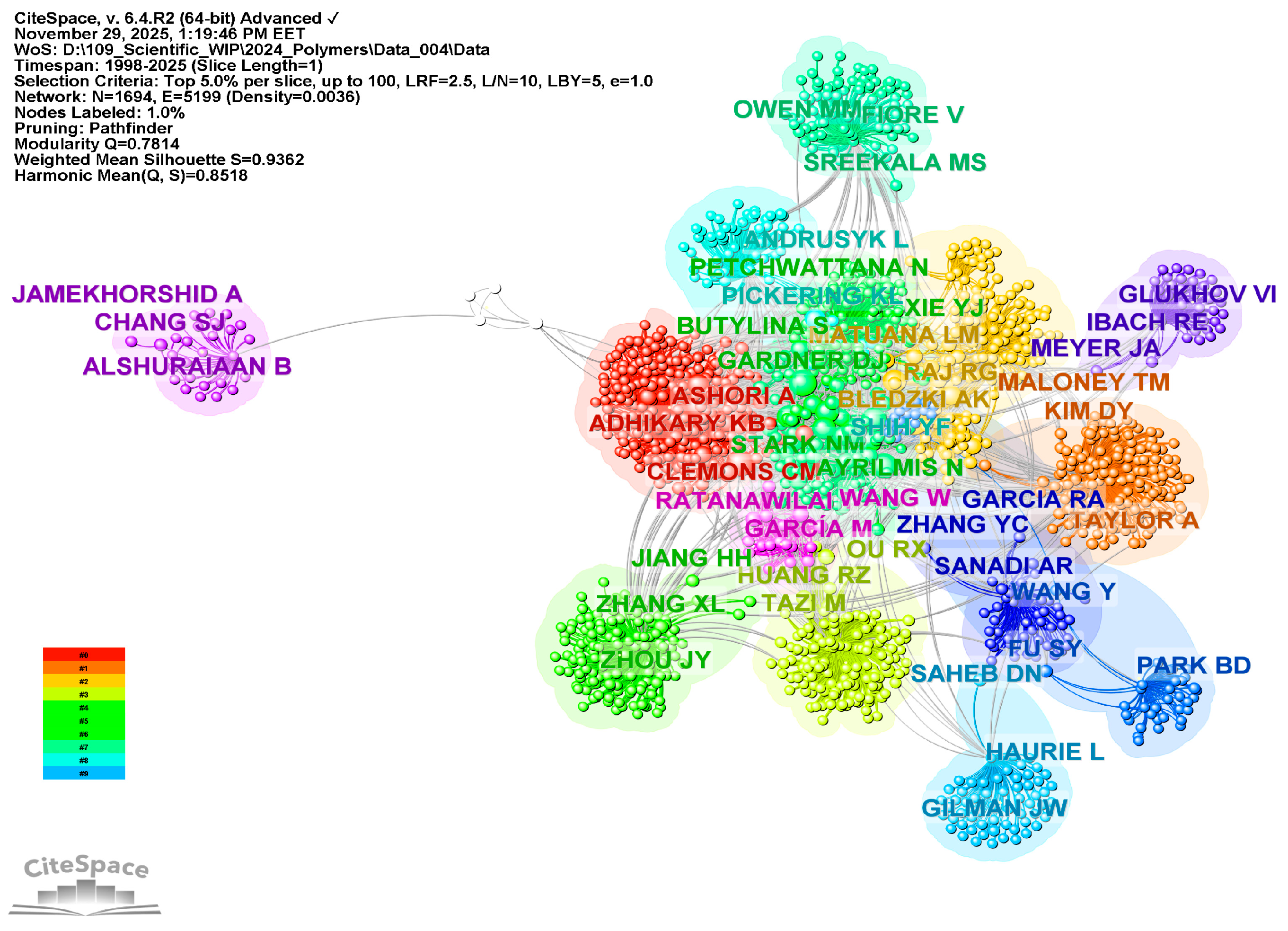
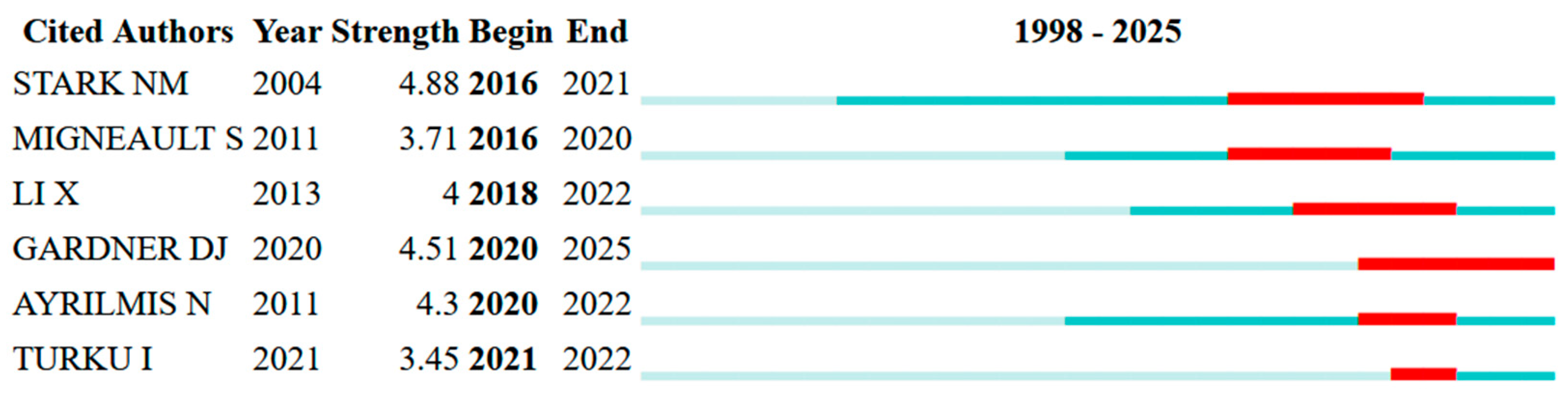
3.3. Co-Citation Analysis of Authors—RQ3
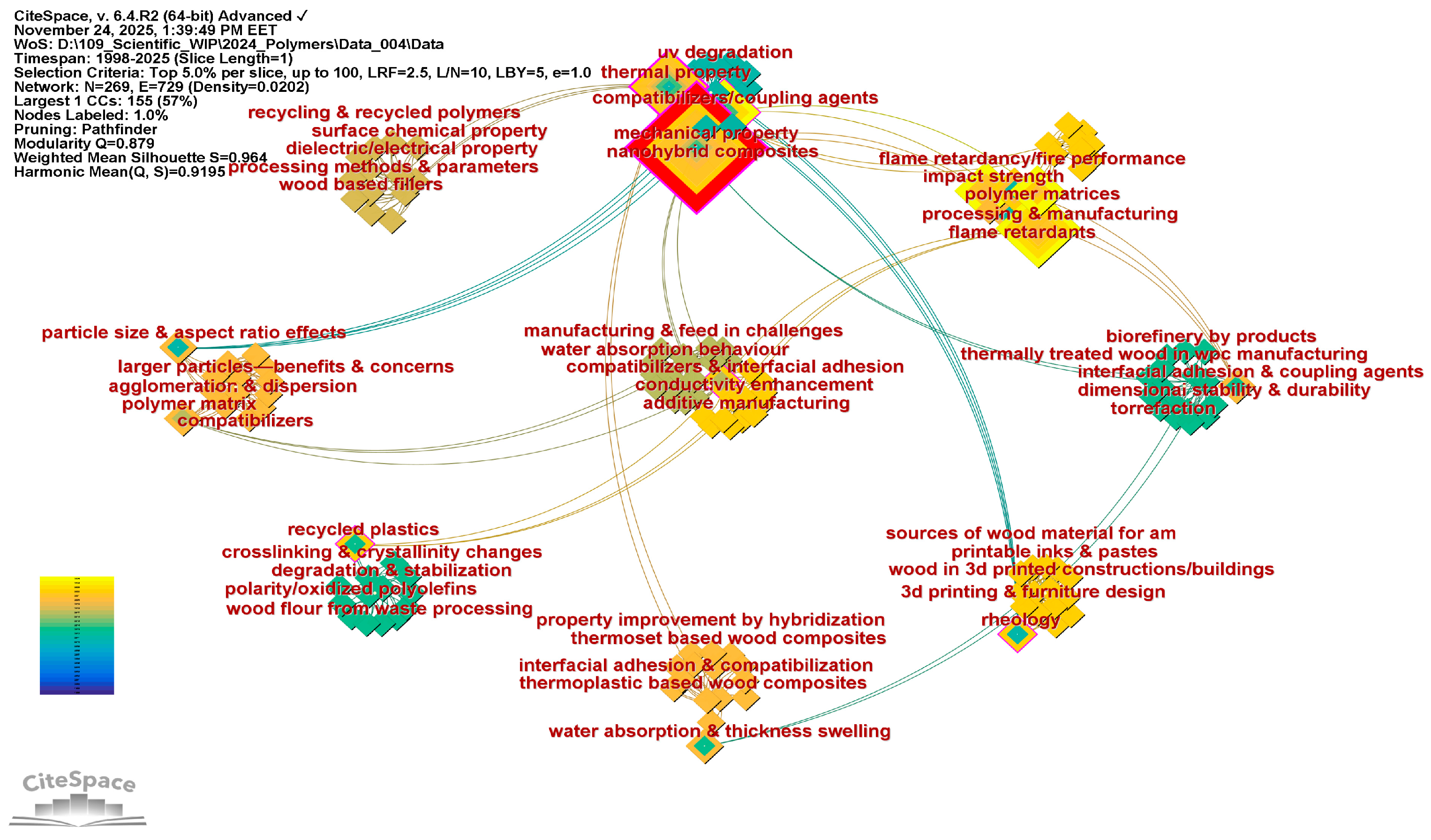
3.4. Co-Occurrence of Keywords—RQ4
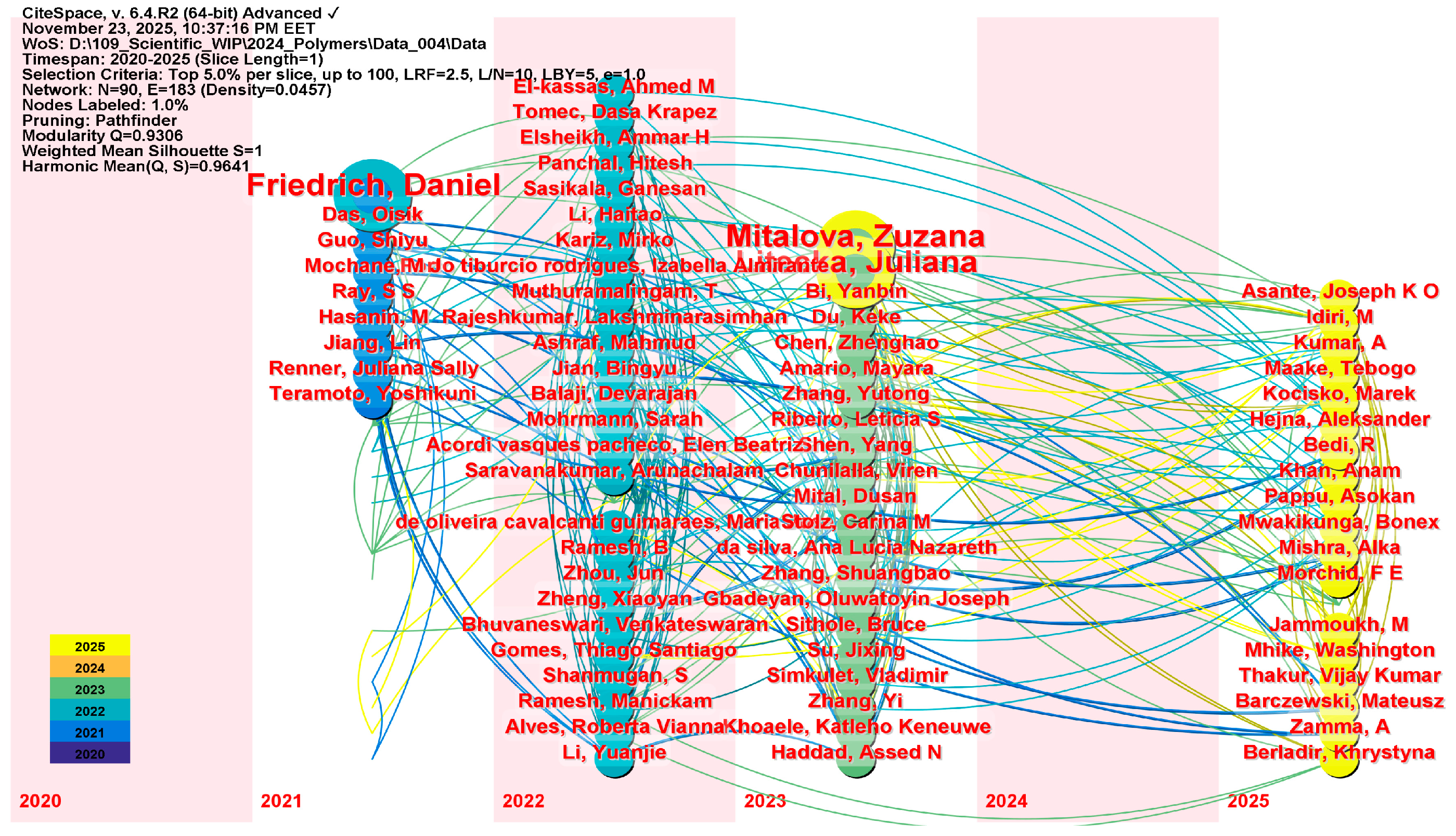
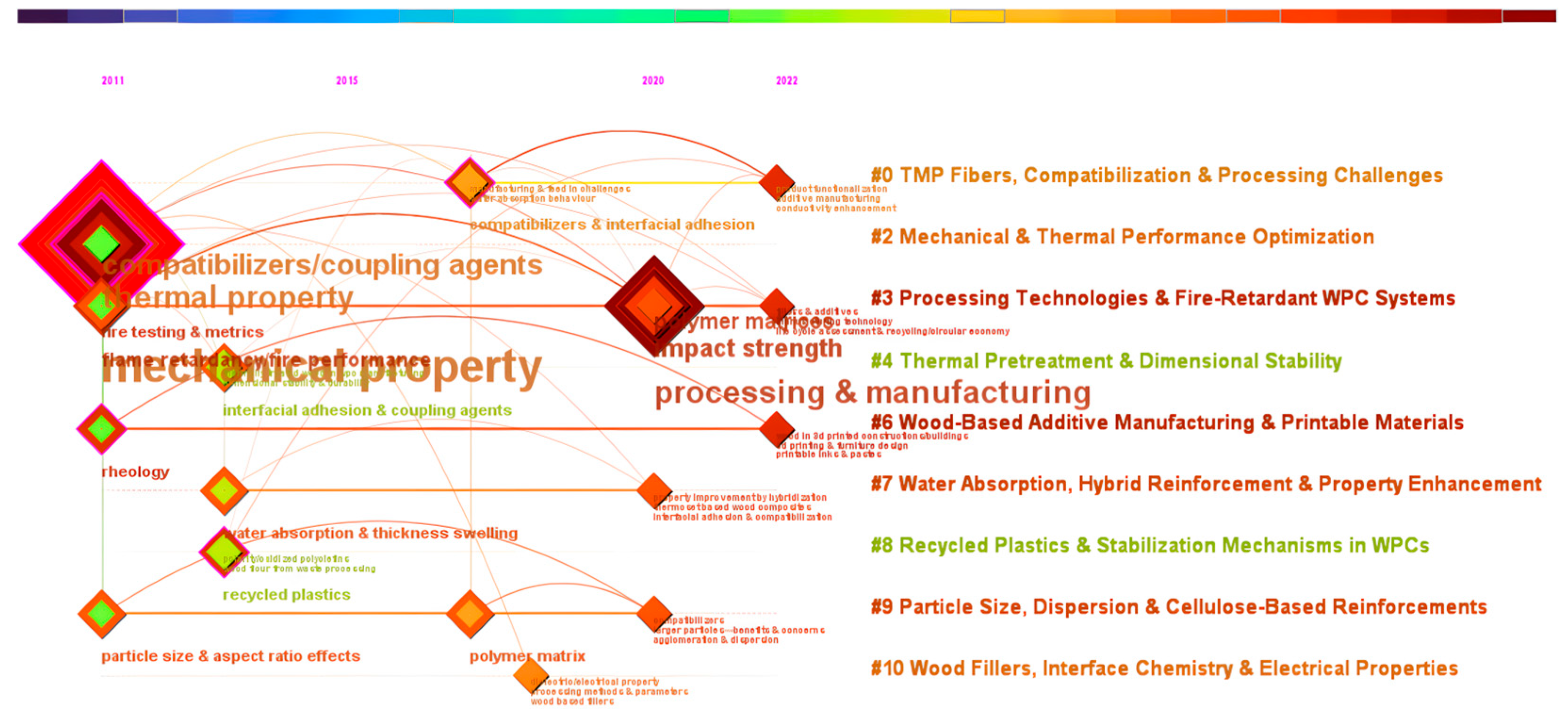
3.5. Timeline View of Co-Cited Keywords—RQ5
3.6. Precision over Proxy: The Methodological Framework for Key Terms Mapping (MFKTM)
4. Conclusions
Supplementary Materials
Author Contributions
Funding
Institutional Review Board Statement
Data Availability Statement
Acknowledgments
Conflicts of Interest
References
- Jones, D.; Brischke, C. Performance of Bio-Based Building Materials; Woodhead Publishing: Sawston, UK, 2017. [Google Scholar] [CrossRef] [Scilit]
- Carus, M.; Gahle, C.; Korte, H. Market and future trends for wood–polymer composites in Europe: The example of Germany. In Wood–Polymer Composites; Woodhead Publishing: Sawston, UK, 2008; pp. 300–330. [Google Scholar] [CrossRef] [Scilit]
- Moreno, D.D.P.; Saron, C. Low-density polyethylene waste/recycled wood composites. Compos. Struct. 2017, 176, 1152–1157. [Google Scholar] [CrossRef] [Scilit]
- Carus, M.; Eder, A.; Dammer, L.; Korte, H.; Scholz, L.; Essel, R.; Breitmayer, E.; Barth, M. Wood-plastic composites (WPC) and natural fibre composites (NFC). In WPC/NFC Mark Study; Nova-Institute: Hürth, Germany, 2015; p. 6. Available online: https://compositesuk.co.uk/wp-content/uploads/2021/12/WPC-NFC-Market-Study-Short-Verson-2015.pdf (accessed on 31 October 2025).
- Müller, U.; Jost, T.; Kurzböck, C.; Stadlmann, A.; Wagner, W.; Kirschbichler, S.; Baumann, G.; Pramreiter, M.; Feist, F. Crash simulation of wood and composite wood for future automotive engineering. Wood Mater. Sci. Eng. 2019, 15, 312–324. [Google Scholar] [CrossRef] [Scilit]
- Schwarzkopf, M.J.; Burnard, M.D. Wood-plastic composites—Performance and environmental impacts. In Environmental Impacts of Traditional and Innovative Forest-Based Bioproducts; Kutnar, A., Muthu, S.S., Eds.; Springer: Singapore, 2016; pp. 19–43. [Google Scholar] [CrossRef] [Scilit]
- Panthapulakkal, S.; Zereshkian, A.; Sain, M. Preparation and characterization of wheat straw fibers for reinforcing application in injection molded thermoplastic composites. Bioresour. Technol. 2006, 97, 265–272. [Google Scholar] [CrossRef] [Scilit] [PubMed]
- Ashori, A. Wood–plastic composites as promising green-composites for automotive industries. Bioresour. Technol. 2008, 99, 4661–4667. [Google Scholar] [CrossRef] [Scilit] [PubMed]
- Stadlmann, A.; Mautner, A.; Pramreiter, M.; Bismarck, A.; Müller, U. Interfacial Adhesion and Mechanical Properties of Wood-Polymer Hybrid Composites Prepared by Injection Molding. Polymers 2021, 13, 2849. [Google Scholar] [CrossRef] [Scilit] [PubMed]
- Mita’ová, Z.; Litecká, J.; Mita, D.; Simkulet, V. Matrices in Wood Plastic Composites: A Concise Review. TEM J. 2023, 12, 1973. [Google Scholar] [CrossRef] [Scilit]
- Najafi, S.K. Use of recycled plastics in wood plastic composites—A review. Waste Manag. 2013, 33, 1898–1905. [Google Scholar] [CrossRef] [Scilit]
- Gulitah, V.; Chiang Liew, K.; Liew, K.C. Effect of Plastic Content Ratio on the Mechanical Properties of Wood-Plastic Composite (WPC) Made From Three Different Recycled Plastic and Acacia Fibres. Trans. Sci. Technol. 2018, 5, 184–189. [Google Scholar]
- Wicaksono, S.T.; Nurdiansah, H.; Sidik, R.; Rasyida, A. Mechanical to Physical Aspects of PP and LDPE Plastic Waste for Potential Wood Plastic Composite. AIP Conf. Proc. 2021, 2384, 050010. [Google Scholar] [CrossRef] [Scilit]
- Formela, K.; Kurańska, M.; Barczewski, M. Recent Advances in Development of Waste-Based Polymer Materials: A Review. Polymers 2022, 14, 1050. [Google Scholar] [CrossRef] [Scilit]
- Nukala, S.G.; Kong, I.; Kakarla, A.B.; Kong, W.; Kong, W. Development of Wood Polymer Composites from Recycled Wood and Plastic Waste: Thermal and Mechanical Properties. J. Compos. Sci. 2022, 6, 194. [Google Scholar] [CrossRef] [Scilit]
- Chand, N.; Fahim, M. Tribology of Natural Fiber Polymer Composites; Woodhead Publishing: Sawston, UK, 2020; Available online: https://www.sciencedirect.com/book/9781845693930/tribology-of-natural-fiber-polymer-composites#book-info (accessed on 31 October 2025).
- Shen, Z.; Ye, Z.; Li, K.; Qi, C. Effects of coupling agent and thermoplastic on the interfacial bond strength and the mechanical properties of oriented wood strand–thermoplastic composites. Polymers 2021, 13, 4260. [Google Scholar] [CrossRef] [Scilit] [PubMed]
- Younesi-Kordkheili, H. Maleated nanolignin as a new coupling agent for wood-plastic composites. J. Compos. Mater. 2023, 57, 4649–4658. [Google Scholar] [CrossRef] [Scilit]
- Nechifor, M.; Tanasă, F.; Teacă, C.A.; Şulea, D. Maleated coupling agents for the surface treatment of natural fibers. In Surface Treatment Methods of Natural Fibres and Their Effects on Biocomposites; Shahzad, A., Tanasa, F., Teaca, C.-A., Eds.; Woodhead Publishing: Cambridge, UK, 2022; pp. 95–123. [Google Scholar] [CrossRef] [Scilit]
- Gardner, D.J.; Han, Y.; Wang, L. Wood–plastic composite technology. Curr. Forest. Rep. 2015, 1, 139–150. [Google Scholar] [CrossRef] [Scilit]
- Cao, S.; Cheng, S.; Cai, J. Research progress and prospects of wood high-temperature heat treatment technology. BioResources 2022, 17, 3702. [Google Scholar] [CrossRef] [Scilit]
- Imken, A.A.P.; Brischke, C.; Kogel, S.; Krause, K.C.; Mai, C. Resistance of different wood-based materials against mould fungi: A comparison of methods. Eur. J. Wood Wood Prod. 2020, 78, 661–671. [Google Scholar] [CrossRef] [Scilit]
- de Prá Andrade, M.; Poletto, M. Wood treatments and interfacial bonding in wood-plastic composites. In Wood Polymer Composites: Recent Advancements and Applications; Springer: Singapore, 2021; pp. 43–65. [Google Scholar] [CrossRef] [Scilit]
- Zor, M.; Mengeloğlu, F.; Aydemir, D.; Şen, F.; Kocatürk, E.; Candan, Z.; Ozcelik, O. Wood plastic composites (WPCs): Applications of nanomaterials. In Emerging Nanomaterials: Opportunities and Challenges in Forestry Sectors; Springer International Publishing: Cham, Switzerland, 2022; pp. 97–133. [Google Scholar] [CrossRef] [Scilit]
- Abdur Rahman, M.; Haque, S.; Athikesavan, M.M.; Kamaludeen, M.B. A review of environmental friendly green composites: Production methods, current progresses, and challenges. Environ. Sci. Pollut. Res. 2023, 30, 16905–16929. [Google Scholar] [CrossRef] [Scilit]
- Kuo, P.-Y.; Wang, S.-Y.; Chen, J.-H.; Hsueh, H.-C.; Tsai, M.-J. Effects of material compositions on the mechanical properties of wood–plastic composites manufactured by injection molding. Mater. Des. 2009, 30, 3489–3496. [Google Scholar] [CrossRef] [Scilit]
- Dolza, C.; Fages, E.; Gonga, E.; Gomez-Caturla, J.; Balart, R.; Quiles-Carrillo, L. Development and characterization of environmentally friendly wood plastic composites from biobased polyethylene and short natural fibers processed by injection moulding. Polymers 2021, 13, 1692. [Google Scholar] [CrossRef] [Scilit]
- Rabbi, M.S.; Islam, T.; Islam, G.S. Injection-molded natural fiber-reinforced polymer composites—A review. Int. J. Mech. Mater. Eng. 2021, 16, 15. [Google Scholar] [CrossRef] [Scilit]
- Toghyani, A.; Matthews, S.; Varis, J. Forming challenges of extruded wood plastic composite products in a post-production process. Procedia CIRP 2020, 93, 502–507. [Google Scholar] [CrossRef] [Scilit]
- Wilczyński, K.J.; Buziak, K. A computer model of starve fed single screw extrusion of wood plastic composites. Polymers 2021, 13, 1252. [Google Scholar] [CrossRef] [Scilit]
- Jiang, T.; Zeng, G.; Hu, C. Fabrication of highly filled wood plastic composite pallets with extrusion-compression molding technique. Polym. Compos. 2020, 41, 2724–2731. [Google Scholar] [CrossRef] [Scilit]
- Basalp, D.; Tihminlioglu, F.; Sofuoglu, S.C.; Inal, F.; Sofuoglu, A. Utilization of municipal plastic and wood waste in industrial manufacturing of wood plastic composites. Waste Biomass Valorization 2020, 11, 5419–5430. [Google Scholar] [CrossRef] [Scilit]
- Zhang, Y.; Fang, J.; Li, J.; Guo, Y.; Wang, Q. The effect of carbon nanotubes on the mechanical properties of wood plastic composites by selective laser sintering. Polymers 2017, 9, 728. [Google Scholar] [CrossRef] [Scilit] [PubMed]
- Kain, S.; Ecker, J.; Haider, A.; Musso, M.; Petutschnigg, A. Effects of the infill pattern on mechanical properties of fused layer modeling (FLM) 3D printed wood/polylactic acid (PLA) composites. Eur. J. Wood Wood Prod. 2020, 78, 65–74. [Google Scholar] [CrossRef] [Scilit]
- Krapež Tomec, D.; Kariž, M. Use of wood in additive manufacturing: Review and future prospects. Polymers 2022, 14, 1174. [Google Scholar] [CrossRef] [Scilit]
- Ramaux, J.; Ziegler-Devin, I.; Besserer, A.; Nouvel, C. 3D Printing of Wood Composites: State of the Art and Opportunities. Polymers 2024, 16, 2827. [Google Scholar] [CrossRef] [Scilit]
- Wang, H.; Zhang, X.; Guo, S.; Liu, T. A review of coextruded wood–plastic composites. Polym. Compos. 2021, 42, 4174–4186. [Google Scholar] [CrossRef] [Scilit]
- Elsheikh, A.H.; Panchal, H.; Shanmugan, S.; Muthuramalingam, T.; El-Kassas, A.M.; Ramesh, B. Recent progresses in wood-plastic composites: Pre-processing treatments, manufacturing techniques, recyclability and eco-friendly assessment. Clean. Eng. Technol. 2022, 8, 100450. [Google Scholar] [CrossRef] [Scilit]
- Jian, B.; Mohrmann, S.; Li, H.; Li, Y.; Ashraf, M.; Zhou, J.; Zheng, X. A review on flexural properties of wood-plastic composites. Polymers 2022, 14, 3942. [Google Scholar] [CrossRef] [Scilit]
- Zhang, Y.; Chen, Z.; Du, K.; Bi, Y.; Su, J.; Zhang, Y.; Shen, Y.; Zhang, S. Functional natural wood-plastic composites: A review of antimicrobial properties and their influencing factors. Ind. Crops Prod. 2023, 201, 116705. [Google Scholar] [CrossRef] [Scilit]
- Ramli, R.A. A comprehensive review on utilization of waste materials in wood plastic composite. Mater. Today Sustain. 2024, 27, 100889. [Google Scholar] [CrossRef] [Scilit]
- Mita’ová, Z.; Mita, D.; Berladir, K. A Concise Review of the Components and Properties of Wood–Plastic Composites. Polymers 2024, 16, 1556. [Google Scholar] [CrossRef] [Scilit] [PubMed]
- Morchid, F.E.; Elfarissi, L.; Zamma, A.; Idiri, M.; Jammoukh, M. 6th International conference on energy, materials and environmental science: Enhancing thermal properties of wood–plastic composites through incorporation of phase change materials: A short review. Euro-Mediterr. J. Environ. Integr. 2024, 10, 1555–1562. [Google Scholar] [CrossRef] [Scilit]
- Zeng, Z.; Zhou, Y.; Wen, S.; Zhou, C. A review: Additive manufacturing of wood-plastic composites. Cellulose 2024, 31, 5315–5341. [Google Scholar] [CrossRef] [Scilit]
- Chatterjee, D.; Ray, S.; Dan, S. Wood and Non-wood Engineered Products: An Overview. In Green Lignocellulosic-Based Panels: Manufacturing, Characterization and Applications; Springer: Cham, Switzerland, 2025; pp. 1–27. [Google Scholar] [CrossRef] [Scilit]
- Xu, K.; Du, G.; Wang, S. Wood plastic composites: Their properties and applications. Engineered Wood Products for Construction. In Engineered Wood Products for Construction; IntechOpen: London, UK, 2021; pp. 197–221. [Google Scholar] [CrossRef] [Scilit]
- Hasanin, M.S.; Abd El-Aziz, M.E.; El-Nagar, I.; Hassan, Y.R.; Youssef, A.M. Green enhancement of wood plastic composite based on agriculture wastes compatibility via fungal enzymes. Sci. Rep. 2022, 12, 19197. [Google Scholar] [CrossRef] [Scilit]
- Shrestha, R.; Ban, S.; Mumin, M.A.; Joshi, R. Recent Progress in Wood-Based Bio-nanocomposites and Their Biomedical Applications. In Novel Bio-Nanocomposites for Biomedical Applications; Springer Series on Polymer and Composite Materials; Springer: Cham, Switzerland, 2024. [Google Scholar] [CrossRef] [Scilit]
- Inci, G.; Köse, H. The landscape of technology research in special education: A bibliometric analysis. J. Spec. Educ. Technol. 2024, 39, 94–107. [Google Scholar] [CrossRef] [Scilit]
- Shatu, F.; Aston, L.; Patel, L.B.; Kamruzzaman, M. Transit oriented development: A bibliometric analysis of research. Adv. Transp. Policy Plan. 2022, 9, 231–275. [Google Scholar] [CrossRef] [Scilit]
- Ellegaard, O.; Wallin, J.A. The bibliometric analysis of scholarly production: How great is the impact? Scientometrics 2015, 105, 1809–1831. [Google Scholar] [CrossRef] [Scilit]
- Guo, Y.; Jiang, J.; Li, S. A sustainable tourism policy research review. Sustainability 2019, 11, 3187. [Google Scholar] [CrossRef] [Scilit]
- Ribeiro, L.S.; Stolz, C.M.; Amario, M.; Silva, A.L.N.D.; Haddad, A.N. Use of Post-Consumer Plastics in the Production of Wood-Plastic Composites for Building Components: A Systematic Review. Energies 2023, 16, 6549. [Google Scholar] [CrossRef] [Scilit]
- Chen, C. CiteSpace II: Detecting and visualizing emerging trends and transient patterns in scientific literature. J. Am. Soc. Inf. Sci. Technol. 2006, 57, 359–377. [Google Scholar] [CrossRef] [Scilit]
- Chen, C. Science mapping: A systematic review of the literature. J. Data Inf. Sci. 2017, 2, 6549. [Google Scholar] [CrossRef] [Scilit]
- Page, M.J.; McKenzie, J.E.; Bossuyt, P.M.; Boutron, I.; Hoffmann, T.C.; Mulrow, C.D.; Shamseer, L.; Tetzlaff, J.M.; Akl, E.A.; Brennan, S.E.; et al. PRISMA 2020 statement: An updated guideline for reporting systematic reviews. BMJ (Clin. Res.) 2021, 372, 71. [Google Scholar] [CrossRef] [Scilit]
- KeyWords Plus on Clarivate Analytics’ Home Page. Available online: https://support.clarivate.com/ScientificandAcademicResearch/s/article/KeyWords-Plus-generation-creation-and-changes?language=en_US (accessed on 28 June 2025).
- Zhang, J.; Yu, Q.; Zheng, F.; Long, C.; Lu, Z.; Duan, Z. Comparing Keywords Plus of WOS and Author Keywords: A Case Study of Patient Adherence Research. J. Assoc. Inf. Sci. Technol. 2016, 67, 967–972. [Google Scholar] [CrossRef] [Scilit]
- Hubbe, M.A.; Grigsby, W. From nanocellulose to wood particles: A review of particle size vs. the properties of plastic composites reinforced with cellulose-based entities. BioResources 2020, 15, 2030–2081. [Google Scholar] [CrossRef] [Scilit]
- Zhang, J.; Wang, H.; Ou, R.; Wang, Q. The properties of flax fiber reinforced wood flour/high density polyethylene composites. J. For. Res. 2018, 29, 533–540. [Google Scholar] [CrossRef] [Scilit]
- Anbupalani, M.S.; Venkatachalam, C.D.; Rathanasamy, R. Influence of coupling agent on altering the reinforcing efficiency of natural fibre-incorporated polymers—A review. J. Reinf. Plast. Compos. 2020, 39, 520–544. [Google Scholar] [CrossRef] [Scilit]
- Fang, L.; Chang, L.; Guo, W.J.; Chen, Y.; Wang, Z. Influence of silane surface modification of veneer on interfacial adhesion of wood–plastic plywood. Appl. Surf. Sci. 2014, 288, 682–689. [Google Scholar] [CrossRef] [Scilit]
- Piao, C.; Cai, Z.; Stark, N.M.; Monlezun, C.J. Potassium methyl siliconate-treated pulp fibers and their effects on wood–plastic composites: Water sorption and dimensional stability. J. Appl. Polym. Sci. 2013, 129, 193–201. [Google Scholar] [CrossRef] [Scilit]
- Migneault, S.; Koubaa, A.; Erchiqui, F.; Chaala, A.; Englund, K.; Wolcott, M.P. Effects of processing method and fiber size on the structure and properties of wood–plastic composites. Compos. Part A Appl. Sci. Manuf. 2009, 40, 80–85. [Google Scholar] [CrossRef] [Scilit]
- Yeh, S.K.; Gupta, R.K. Improved wood–plastic composites through better processing. Compos. Part A Appl. Sci. Manuf. 2008, 39, 1694–1699. [Google Scholar] [CrossRef] [Scilit]
- Fávaro, S.L.; Lopes, M.S.; de Carvalho Neto, A.G.V.; de Santana, R.R.; Radovanovic, E. Chemical, morphological, and mechanical analysis of rice husk/post-consumer polyethylene composites. Compos. Part A Appl. Sci. Manuf. 2010, 41, 154–160. [Google Scholar] [CrossRef] [Scilit]
- Murayama, K.; Suzuki, S.; Kojima, Y.; Kobori, H.; Ito, H.; Ogoe, S.; Okamoto, M. The effects of different types of maleic anhydride-modified polypropylene on the physical and mechanical properties of polypropylene-based wood/plastic composites. J. Wood Chem. Technol. 2018, 38, 224–232. [Google Scholar] [CrossRef] [Scilit]
- Hong, H.; Guo, Q.; Zhang, H.; He, H. Effect of interfacial modifiers and wood flour treatment on the rheological properties of recycled polyethylene/wood flour composites. Prog. Rubber Plast. Recycl. Technol. 2020, 36, 31–46. [Google Scholar] [CrossRef] [Scilit]
- Perisic, S.D.; Radovic, I.; Petrovic, M.; Marinkovic, A.; Stojanovic, D.; Uskokovic, P.; Radojevic, V. Processing of hybrid wood plastic composite reinforced with short PET fibers. Mater. Manuf. Process. 2018, 33, 572–579. [Google Scholar] [CrossRef] [Scilit]
- Peltola, H.; Pääkkönen, E.; Jetsu, P.; Heinemann, S. Wood-based PLA and PP composites: Effect of fibre type and matrix polymer on fibre morphology, dispersion and composite properties. Compos. Part A Appl. Sci. Manuf. 2014, 61, 13–22. [Google Scholar] [CrossRef] [Scilit]
- Pickering, K.L.; Efendy, M.A.; Le, T.M. A review of recent developments in natural fibre composites and their mechanical performance. Compos. Part A Appl. Sci. Manuf. 2016, 83, 98–112. [Google Scholar] [CrossRef] [Scilit]
- Sommerhuber, P.F.; Wenker, J.L.; Rüter, S.; Krause, A. Life cycle assessment of wood-plastic composites: Analysing alternative materials and identifying an environmental sound end-of-life option. Resour. Conserv. Recycl. 2017, 117, 235–248. [Google Scholar] [CrossRef] [Scilit]
- Ratanawilai, T.; Taneerat, K. Alternative polymeric matrices for wood-plastic composites: Effects on mechanical properties and resistance to natural weathering. Constr. Build. Mater. 2018, 172, 349–357. [Google Scholar] [CrossRef] [Scilit]
- Koohestani, B.; Ganetri, I.; Yilmaz, E. Effects of silane modified minerals on mechanical, microstructural, thermal, and rheological properties of wood plastic composites. Compos. Part B Eng. 2017, 111, 103–111. [Google Scholar] [CrossRef] [Scilit]
- Pelaez-Samaniego, M.R.; Yadama, V.; Lowell, E.; Espinoza-Herrera, R. A review of wood thermal pretreatments to improve wood composite properties. Wood Sci. Technol. 2013, 47, 1285–1319. [Google Scholar] [CrossRef] [Scilit]
- Hosseinaei, O.; Wang, S.; Enayati, A.A.; Rials, T.G. Effects of hemicellulose extraction on properties of wood flour and wood–plastic composites. Compos. Part A Appl. Sci. Manuf. 2012, 43, 686–694. [Google Scholar] [CrossRef] [Scilit]
- Mokhena, T.C.; Sadiku, E.R.; Mochane, M.J.; Ray, S.S. Mechanical properties of fire retardant wood-plastic composites: A review. Express Polym. Lett. 2021, 15, 744–780. [Google Scholar] [CrossRef] [Scilit]
- Renner, J.S.; Mensah, R.A.; Jiang, L.; Xu, Q.; Das, O.; Berto, F. Fire behavior of wood-based composite materials. Polymers 2021, 13, 4352. [Google Scholar] [CrossRef] [Scilit]
- Eastman, S.A.; Lesser, A.J.; McCarthy, T.J. Supercritical CO2-assisted, silicone-modified wood for enhanced fire resistance. J. Mater. Sci. 2009, 44, 1275–1282. [Google Scholar] [CrossRef] [Scilit]
- Xu, J.; Sun, J.; Zhao, J.; Zhang, W.; Zhou, J.; Xu, L.; Zhang, D. Eco-friendly wood plastic composites with biomass-activated carbon-based form-stable phase change material for building energy conversion. Ind. Crops Prod. 2023, 197, 116573. [Google Scholar] [CrossRef] [Scilit]
- Imafidon, O.J.; Ting, D.S.K. Energy consumption of a building with phase change material walls—The effect of phase change material properties. J. Energy Storage 2022, 52, 105080. [Google Scholar] [CrossRef] [Scilit]
- Ashori, A.; Sheshmani, S.; Farhani, F. Preparation and characterization of bagasse/HDPE composites using multi-walled carbon nanotubes. Carbohydr. Polym. 2013, 92, 865–871. [Google Scholar] [CrossRef] [Scilit]
- Ashori, A.; Tabarsa, T.; Amosi, F. Evaluation of using waste timber railway sleepers in wood–cement composite materials. Constr. Build. Mater. 2012, 27, 126–129. [Google Scholar] [CrossRef] [Scilit]
- Ashori, A.; Nourbakhsh, A. Preparation and characterization of polypropylene/wood flour/nanoclay composites. Eur. J. Wood Wood Prod. 2011, 69, 663–666. [Google Scholar] [CrossRef] [Scilit]
- Ashori, A.; Nourbakhsh, A. Performance properties of microcrystalline cellulose as a reinforcing agent in wood plastic composites. Compos. Part B Eng. 2010, 41, 578–581. [Google Scholar] [CrossRef] [Scilit]
- Ashori, A.; Nourbakhsh, A. Reinforced polypropylene composites: Effects of chemical compositions and particle size. Bioresour. Technol. 2010, 101, 2515–2519. [Google Scholar] [CrossRef] [Scilit]
- Ashori, A.; Nourbakhsh, A. Mechanical behavior of agro-residue-reinforced polypropylene composites. J. Appl. Polym. Sci. 2009, 111, 2616–2620. [Google Scholar] [CrossRef] [Scilit]
- Ashori, A.; Nourbakhsh, A. Characteristics of wood–fiber plastic composites made of recycled materials. Waste Manag. 2009, 29, 1291–1295. [Google Scholar] [CrossRef] [Scilit]
- Ashori, A. Municipal solid waste as a source of lignocellulosic fiber and plastic for composite industries. Polym. Plast. Technol. Eng. 2008, 47, 741–744. [Google Scholar] [CrossRef] [Scilit]
- Clemons, C.M.; Rowell, R.M.; Plackett, D.; Segerholm, B.K. Wood/Nonwood Thermoplastic Composites. In Handbook of Wood Chemistry and Wood Composites; Rowell, R.M., Ed.; CRC Press: Boca Raton, FL, USA, 2012; pp. 473–508. ISBN 1439853800, 9781439853801. [Google Scholar]
- Clemons, C.M.; Sabo, R.C.; Kaland, M.L.; Hirth, K.C. Effects of silane on the properties of wood–plastic composites with polyethylene–polypropylene blends as matrices. J. Appl. Polym. Sci. 2011, 119, 1398–1409. [Google Scholar] [CrossRef] [Scilit]
- Clemons, C.M.; Ibach, R.E. Effects of processing method and moisture history on laboratory fungal resistance of wood–HDPE composites. For. Prod. J. 2004, 54, 50–57. [Google Scholar]
- Adhikary, K.B.; Pang, S.; Staiger, M.P. Effects of accelerated freeze–thaw cycling on physical and mechanical properties of wood flour–recycled thermoplastic composites. Polym. Compos. 2010, 31, 185–194. [Google Scholar] [CrossRef] [Scilit]
- Adhikary, K.B.; Pang, S.; Staiger, M.P. Long-term moisture absorption and thickness swelling behaviour of recycled thermoplastics reinforced with Pinus radiata sawdust. Chem. Eng. J. 2008, 142, 190–198. [Google Scholar] [CrossRef] [Scilit]
- Adhikary, K.B.; Pang, S.; Staiger, M.P. Dimensional stability and mechanical behaviour of wood–plastic composites based on recycled and virgin high-density polyethylene (HDPE). Compos. Part B Eng. 2008, 39, 807–815. [Google Scholar] [CrossRef] [Scilit]
- Kim, D.; Nishiyama, Y.; Wada, M.; Kuga, S.; Okano, T. Thermal decomposition of cellulose crystallites in wood. Holzforschung 2001, 55, 521–524. [Google Scholar] [CrossRef] [Scilit]
- Kim, D.Y.; Nishiyama, Y.; Kuga, S. Surface acetylation of bacterial cellulose. Cellulose 2002, 9, 361–367. [Google Scholar] [CrossRef] [Scilit]
- Taylor, A.; Yadama, V.; Englund, K.R.; Harper, D.; Kim, J.W. Wood Plastic Composites—A Primer; The University of Tennessee: Knoxville, TN, USA, 2009. [Google Scholar]
- Taylor, A.M.; Gartner, B.L.; Morrell, J.J.; Tsunoda, K. Effects of heartwood extractive fractions of Thuja plicata and Chamaecyparis nootkatensis on wood degradation by termites or fungi. J. Wood Sci. 2006, 52, 147–153. [Google Scholar] [CrossRef] [Scilit]
- Taylor, A.; Lloyd, J.; Shelton, T. An open letter to proponents of CLT/Massive Timber. In Proceedings of the IRG Annual Meeting, Lisbon, Portugal, 15–19 May 2016. [Google Scholar]
- Maloney, T.M. Modern Particleboard and Dry-Process Fiberboard Manufacturing; Miller Freeman: San Francisco, CA, USA, 1977; 672p. [Google Scholar]
- Maloney, T.M. The family of wood composite materials. For. Prod. J. 1996, 46, 18–26. [Google Scholar]
- Bledzki, A.K.; Franciszczak, P.; Osman, Z.; Elbadawi, M. Polypropylene biocomposites reinforced with softwood, abaca, jute, and kenaf fibers. Ind. Crops Prod. 2015, 70, 91–99. [Google Scholar] [CrossRef] [Scilit]
- Bledzki, A.K.; Jaszkiewicz, A. Mechanical performance of biocomposites based on PLA and PHBV reinforced with natural fibres—A comparative study to PP. Compos. Sci. Technol. 2010, 70, 1687–1696. [Google Scholar] [CrossRef] [Scilit]
- Bledzki, A.K.; Mamun, A.A.; Lucka-Gabor, M.; Gutowski, V.S. The effects of acetylation on properties of flax fibre and its polypropylene composites. Express Polym. Lett. 2008, 2, 413–422. [Google Scholar] [CrossRef] [Scilit]
- Bledzki, A.K.; Faruk, O. Injection moulded microcellular wood fibre–polypropylene composites. Compos. Part A Appl. Sci. Manuf. 2006, 37, 1358–1367. [Google Scholar] [CrossRef] [Scilit]
- Bledzki, A.K.; Faruk, O. Creep and impact properties of wood fibre–polypropylene composites: Influence of temperature and moisture content. Compos. Sci. Technol. 2004, 64, 693–700. [Google Scholar] [CrossRef] [Scilit]
- Bledzki, A.K.; Faruk, O.; Huque, M. Physico-mechanical studies of wood fiber reinforced composites. Polym. Plast. Technol. Eng. 2002, 41, 435–451. [Google Scholar] [CrossRef] [Scilit]
- Bledzki, A.K.; Sperber, V.E.; Faruk, O. Natural and Wood Fibre Reinforcement in Polymers; iSmithers Rapra Publishing: Shrewsbury, UK, 2002; Volume 152, ISBN 1859573592/9781859573594. [Google Scholar]
- Bledzki, A.K.; Gassan, J. Composites reinforced with cellulose based fibres. Prog. Polym. Sci. 1999, 24, 221–274. [Google Scholar] [CrossRef] [Scilit]
- Bledzki, A.K.; Reihmane, S.A.; Gassan, J. Thermoplastics reinforced with wood fillers: A literature review. Polym. Plast. Technol. Eng. 1998, 37, 451–468. [Google Scholar] [CrossRef] [Scilit]
- Bledzki, A.K.; Reihmane, S.; Gassan, J. Properties and modification methods for vegetable fibers for natural fiber composites. J. Appl. Polym. Sci. 1996, 59, 1329–1336. [Google Scholar] [CrossRef]
- Matuana, L.M.; Stark, N.M. The use of wood fibers as reinforcements in composites. In Biofiber Reinforcements in Composite Materials; Faruk, O., Sain, M., Eds.; Woodhead Publishing: Cambridge, UK, 2015; pp. 648–688. [Google Scholar] [CrossRef] [Scilit]
- Matuana, L.M.; Diaz, C.A. Strategy to produce microcellular foamed poly(lactic acid)/wood-flour composites in a continuous extrusion process. Ind. Eng. Chem. Res. 2013, 52, 12032–12040. [Google Scholar] [CrossRef] [Scilit]
- Matuana, L.M.; Jin, S.; Stark, N.M. Ultraviolet weathering of HDPE/wood-flour composites coextruded with a clear HDPE cap layer. Polym. Degrad. Stab. 2011, 96, 97–106. [Google Scholar] [CrossRef] [Scilit]
- Matuana, L.M.; Faruk, O. Effect of gas saturation conditions on the expansion ratio of microcellular poly(lactic acid)/wood-flour composites. Express Polym. Lett. 2010, 4, 621–631. [Google Scholar] [CrossRef] [Scilit]
- Matuana, L.M.; Kamdem, D.P. Accelerated ultraviolet weathering of PVC/wood-flour composites. Polym. Eng. Sci. 2002, 42, 1657–1666. [Google Scholar] [CrossRef] [Scilit]
- Matuana, L.M.; Mengeloglu, F. Microcellular foaming of impact-modified rigid PVC/wood-flour composites. J. Vinyl Addit. Technol. 2001, 7, 67–75. [Google Scholar] [CrossRef] [Scilit]
- Matuana, L.M.; Balatinecz, J.J.; Sodhi, R.N.S.; Park, C.B. Surface characterization of esterified cellulosic fibers by XPS and FTIR spectroscopy. Wood Sci. Technol. 2001, 35, 191–201. [Google Scholar] [CrossRef] [Scilit]
- Matuana, L.M.; Kamdem, D.P.; Zhang, J. Photoaging and stabilization of rigid PVC/wood-fiber composites. J. Appl. Polym. Sci. 2001, 80, 1943–1950. [Google Scholar] [CrossRef] [Scilit]
- Matuana, L.M.; Balatinecz, J.J.; Park, C.B.; Woodhams, R.T. Surface characteristics of chemically modified newsprint fibers determined by inverse gas chromatography. Wood Fiber Sci. 1999, 31, 116–127. [Google Scholar]
- Matuana, L.M.; Balatinecz, J.J.; Park, C.B.; Sodhi, R.N.S. X-ray photoelectron spectroscopy study of silane-treated newsprint-fibers. Wood Sci. Technol. 1999, 33, 259–270. [Google Scholar] [CrossRef] [Scilit]
- Matuana, L.M.; Park, C.B.; Balatinecz, J.J. Cell morphology and property relationships of microcellular foamed PVC/wood-fiber composites. Polym. Eng. Sci. 1998, 38, 1862–1872. [Google Scholar] [CrossRef] [Scilit]
- Matuana, L.M.; Balatinecz, J.J.; Park, C.B. Effect of surface properties on the adhesion between PVC and wood veneer laminates. Polym. Eng. Sci. 1998, 38, 765–773. [Google Scholar] [CrossRef] [Scilit]
- Matuana, L.M.; Woodhams, R.T.; Balatinecz, J.J.; Park, C.B. Influence of interfacial interactions on the properties of PVC/cellulosic fiber composites. Polym. Compos. 1998, 19, 446–455. [Google Scholar] [CrossRef] [Scilit]
- Matuana, L.M.; Park, C.B.; Balatinecz, J.J. Characterization of microcellular foamed PVC/cellulosic-fibre composites. J. Cell. Plast. 1996, 32, 449–469. [Google Scholar] [CrossRef] [Scilit]
- Raj, R.G.; Kokta, B.V.; Nizio, J.D. Studies on mechanical properties of polyethylene–organic fiber composites. I. Nut shell flour. J. Appl. Polym. Sci. 1992, 45, 91–101. [Google Scholar] [CrossRef] [Scilit]
- Raj, R.G.; Kokta, B.V. Reinforcing high density polyethylene with cellulosic fibers. I: The effect of additives on fiber dispersion and mechanical properties. Polym. Eng. Sci. 1991, 31, 1358–1362. [Google Scholar] [CrossRef] [Scilit]
- Raj, R.G.; Kokta, B.V. Composites of silane treated cellulosic fibers and high density polyethylene. Die Angew. Makromol. Chem. Appl. Macromol. Chem. Phys. 1991, 189, 169–182. [Google Scholar] [CrossRef]
- Raj, R.G.; Kokta, B.V.; Daneault, C. Wood flour as a low-cost reinforcing filler for polyethylene: Studies on mechanical properties. J. Mater. Sci. 1990, 25, 1851–1855. [Google Scholar] [CrossRef] [Scilit]
- Raj, R.G.; Kokta, B.V.; Daneault, C. A comparative study on the effect of aging on mechanical properties of LLDPE–glass fiber, mica, and wood fiber composites. J. Appl. Polym. Sci. 1990, 40, 645–655. [Google Scholar] [CrossRef] [Scilit]
- Raj, R.G.; Kokta, B.V.; Daneault, C. The use of isocyanate as a bonding agent to improve the mechanical properties of polyethylene–wood fiber composites. Int. J. Polym. Mater. Polym. Biomater. 1990, 14, 223–234. [Google Scholar] [CrossRef] [Scilit]
- Raj, R.G.; Kokta, B.V.; Maldas, D.; Daneault, C. Use of wood fibers in thermoplastics. VII. The effect of coupling agents in polyethylene–wood fiber composites. J. Appl. Polym. Sci. 1989, 37, 1089–1103. [Google Scholar] [CrossRef] [Scilit]
- Raj, R.G.; Kokta, B.V.; Dembele, F.; Sanschagrain, B. Compounding of cellulose fibers with polypropylene: Effect of fiber treatment on dispersion in the polymer matrix. J. Appl. Polym. Sci. 1989, 38, 1987–1996. [Google Scholar] [CrossRef] [Scilit]
- Raj, R.G.; Kokta, B.V.; Daneault, C. Effect of chemical treatment of fibers on the mechanical properties of polyethylene–wood fiber composites. J. Adhes. Sci. Technol. 1989, 3, 55–64. [Google Scholar] [CrossRef] [Scilit]
- Huang, R.; Zhang, X.; Chen, Z.; Wan, M.; Wu, Q. Thermal stability and flame resistance of the coextruded wood–plastic composites containing talc-filled plastic shells. Int. J. Polym. Sci. 2020, 2020, 1435249. [Google Scholar] [CrossRef] [Scilit]
- Huang, R.; Kim, B.J.; Lee, S.; Yang, Z.; Wu, Q. Co-extruded wood–plastic composites with talc-filled shells: Morphology, mechanical, and thermal expansion performance. BioResources 2013, 8, 2115–2133. [Google Scholar] [CrossRef] [Scilit]
- Huang, R.; Mei, C.; Xu, X.; Kärki, T.; Lee, S.; Wu, Q. Effect of hybrid talc–basalt fillers in the shell layer on thermal and mechanical performance of co-extruded wood plastic composites. Materials 2015, 8, 8510–8523. [Google Scholar] [CrossRef] [Scilit]
- Huang, R.; Xu, X.; Lee, S.; Zhang, Y.; Kim, B.J.; Wu, Q. High-density polyethylene composites reinforced with hybrid inorganic fillers: Morphology, mechanical and thermal expansion performance. Materials 2013, 6, 4122–4138. [Google Scholar] [CrossRef] [Scilit] [PubMed]
- Huang, R.; Xiong, W.; Xu, X.; Wu, Q. Thermal expansion behavior of co-extruded wood–plastic composites with glass-fiber-reinforced shells. BioResources 2012, 7, 4752–4766. [Google Scholar] [CrossRef] [Scilit]
- Ou, R.; Wang, Q.; Wolcott, M.P.; Sui, S.; Xie, Y. Rheological behavior and mechanical properties of wood flour/high-density polyethylene blends: Effects of esterification of wood with citric acid. Polym. Compos. 2016, 37, 553–560. [Google Scholar] [CrossRef] [Scilit]
- Ou, R.; Xie, Y.; Wang, Q.; Sui, S.; Wolcott, M.P. Effects of ionic liquid on the rheological properties of wood flour/high-density polyethylene composites. Compos. Part A Appl. Sci. Manuf. 2014, 61, 134–140. [Google Scholar] [CrossRef] [Scilit]
- Ou, R.; Xie, Y.; Wolcott, M.P.; Yuan, F.; Wang, Q. Effect of wood cell wall composition on the rheological properties of wood particle/high-density polyethylene composites. Compos. Sci. Technol. 2014, 93, 68–75. [Google Scholar] [CrossRef] [Scilit]
- Ou, R.; Xie, Y.; Wolcott, M.P.; Sui, S.; Wang, Q. Morphology, mechanical properties, and dimensional stability of wood particle/high-density polyethylene composites: Effect of removal of wood cell wall composition. Mater. Des. 2014, 58, 339–345. [Google Scholar] [CrossRef] [Scilit]
- Ou, R.; Zhao, H.; Sui, S.; Song, Y.; Wang, Q. Reinforcing effects of Kevlar fiber on the mechanical properties of wood-flour/high-density polyethylene composites. Compos. Part A Appl. Sci. Manuf. 2010, 41, 1272–1278. [Google Scholar] [CrossRef] [Scilit]
- Tazi, M.; Sukiman, M.S.; Erchiqui, F.; Imad, A.; Kanit, T. Effect of wood fillers on the viscoelastic and thermophysical properties of HDPE–wood composite. Int. J. Polym. Sci. 2016, 2016, 9032525. [Google Scholar] [CrossRef] [Scilit]
- Tazi, M.; Erchiqui, F.; Godard, F.; Kaddami, H.; Ajji, A. Characterization of rheological and thermophysical properties of HDPE–wood composite. J. Appl. Polym. Sci. 2014, 131, 40300. [Google Scholar] [CrossRef] [Scilit]
- Tazi, M.; Erchiqui, F.; Kaddami, H.; Bouazara, M.; Poaty, B. Evaluation of mechanical properties and durability performance of HDPE–wood composites. AIP Conf. Proc. 2015, 1664, 150001. [Google Scholar] [CrossRef] [Scilit]
- Tazi, M.; Erchiqui, F.; Kaddami, H. Influence of softwood-filler content on the biodegradability and morphological properties of wood–polyethylene composites. Polym. Compos. 2018, 39, 29–37. [Google Scholar] [CrossRef] [Scilit]
- Zhang, X.; Duan, J.; Zhuo, G.; Li, H.; Lyu, J.; Di, J. Nano–silicon carbide-treated wheat straw fiber reinforced high-density polyethylene composites. Ind. Crops Prod. 2022, 182, 114834. [Google Scholar] [CrossRef] [Scilit]
- Zhang, X.; Hao, X.; Hao, J.; Wang, Q. Heat transfer and mechanical properties of wood–plastic composites filled with flake graphite. Thermochim. Acta 2018, 664, 26–31. [Google Scholar] [CrossRef] [Scilit]
- Jiang, H.; Kamdem, D.P. Characterization of the surface and the interphase of PVC–copper amine-treated wood composites. Appl. Surf. Sci. 2010, 256, 4559–4563. [Google Scholar] [CrossRef] [Scilit]
- Jiang, H.; Kamdem, D.P. Development of poly(vinyl chloride)/wood composites: A literature review. J. Vinyl Addit. Technol. 2004, 10, 59–69. [Google Scholar] [CrossRef] [Scilit]
- Jiang, H.; Kamdem, D.P.; Bezubic, B.; Ruede, P. Mechanical properties of poly(vinyl chloride)/wood flour/glass fiber hybrid composites. J. Vinyl Addit. Technol. 2003, 9, 138–145. [Google Scholar] [CrossRef] [Scilit]
- Zhou, J.; Wang, B.; Xu, C.; Xu, Y.; Tan, H.; Zhang, X.; Zhang, Y. Performance of composite materials by wood fiber/polydopamine/silver modified PLA and antibacterial properties. J. Mater. Res. Technol. JMRT 2022, 18, 428–438. [Google Scholar] [CrossRef] [Scilit]
- Xie, Y.; Krause, A.; Militz, H.; Steuernagel, L.; Mai, C. Effects of hydrophobation treatments of wood particles with an amino alkylsiloxane co-oligomer on properties of the ensuing polypropylene composites. Compos. Part A Appl. Sci. Manuf. 2013, 44, 32–39. [Google Scholar] [CrossRef] [Scilit]
- Xie, Y.; Hill, C.A.S.; Xiao, Z.; Militz, H.; Mai, C. Silane coupling agents used for natural fiber/polymer composites: A review. Compos. Part A Appl. Sci. Manuf. 2010, 41, 806–819. [Google Scholar] [CrossRef] [Scilit]
- Butylina, S.; Martikka, O.; Kärki, T. Effect of inorganic pigments on the properties of coextruded polypropylene-based composites. J. Thermoplast. Compos. Mater. 2018, 31, 23–33. [Google Scholar] [CrossRef] [Scilit]
- Butylina, S.; Martikka, O.; Kärki, T. Weathering properties of coextruded polypropylene-based composites containing inorganic pigments. Polym. Degrad. Stab. 2015, 120, 10–16. [Google Scholar] [CrossRef] [Scilit]
- Butylina, S.; Hyvärinen, M.; Kärki, T. A study of surface changes of wood–polypropylene composites as the result of exterior weathering. Polym. Degrad. Stab. 2012, 97, 337–345. [Google Scholar] [CrossRef] [Scilit]
- Butylina, S.; Hyvärinen, M.; Kärki, T. Accelerated weathering of wood–polypropylene composites containing minerals. Compos. Part A Appl. Sci. Manuf. 2012, 43, 2087–2094. [Google Scholar] [CrossRef] [Scilit]
- Butylina, S.; Hyvärinen, M.; Kärki, T. Weathering of wood–polypropylene composites containing pigments. Eur. J. Wood Wood Prod. 2012, 70, 719–726. [Google Scholar] [CrossRef] [Scilit]
- Butylina, S.; Martikka, O.; Kärki, T. Physical and mechanical properties of wood–polypropylene composites made with virgin and/or recycled polypropylene. Polym. Plast. Technol. Eng. 2011, 50, 1040–1046. [Google Scholar] [CrossRef] [Scilit]
- Butylina, S.; Martikka, O.; Kärki, T. Properties of wood fibre–polypropylene composites: Effect of wood fibre source. Appl. Compos. Mater. 2011, 18, 101–111. [Google Scholar] [CrossRef] [Scilit]
- Petchwattana, N.; Sanetuntikul, J.; Sriromreun, P.; Narupai, B. Wood plastic composites prepared from biodegradable poly(butylene succinate) and Burma Padauk sawdust (Pterocarpus macrocarpus): Water absorption kinetics and sunlight exposure investigations. J. Bionic Eng. 2017, 14, 781–790. [Google Scholar] [CrossRef] [Scilit]
- Petchwattana, N.; Covavisaruch, S. Effects of rice hull particle size and content on the mechanical properties and visual appearance of wood plastic composites prepared from poly(vinyl chloride). J. Bionic Eng. 2013, 10, 110–117. [Google Scholar] [CrossRef] [Scilit]
- Petchwattana, N.; Covavisaruch, S.; Chanakul, S. Mechanical properties, thermal degradation and natural weathering of high density polyethylene/rice hull composites compatibilized with maleic anhydride grafted polyethylene. J. Polym. Res. 2012, 19, 9921. [Google Scholar] [CrossRef] [Scilit]
- Petchwattana, N.; Covavisaruch, S.; Sanetuntikul, J. Recycling of wood–plastic composites prepared from poly(vinyl chloride) and wood flour. Constr. Build. Mater. 2012, 28, 557–560. [Google Scholar] [CrossRef] [Scilit]
- Migneault, S.; Koubaa, A.; Perré, P.; Riedl, B. Effects of wood fiber surface chemistry on strength of wood–plastic composites. Appl. Surf. Sci. 2015, 343, 11–18. [Google Scholar] [CrossRef] [Scilit]
- Migneault, S.; Koubaa, A.; Perré, P. Effect of fiber origin, proportion, and chemical composition on the mechanical and physical properties of wood–plastic composites. J. Wood Chem. Technol. 2014, 34, 241–261. [Google Scholar] [CrossRef] [Scilit]
- Migneault, S.; Koubaa, A.; Erchiqui, F.; Chaala, A.; Englund, K.; Krause, C.; Wolcott, M. Effect of fiber length on processing and properties of extruded wood-fiber/HDPE composites. J. Appl. Polym. Sci. 2008, 110, 1085–1092. [Google Scholar] [CrossRef] [Scilit]
- Stark, N.M.; White, R.H.; Mueller, S.A.; Osswald, T.A. Evaluation of various fire retardants for use in wood flour–polyethylene composites. Polym. Degrad. Stab. 2010, 95, 1903–1910. [Google Scholar] [CrossRef] [Scilit]
- Stark, N.M.; Matuana, L.M. Co-extrusion of WPCs with a clear cap layer to improve color stability. In Proceedings of the 4th Wood Fibre Polymer Composites International Symposium, Bordeaux, France, 30–31 March 2009; FCBA Institut Technologique: Paris, France, 2009; pp. 1–13. [Google Scholar]
- Stark, N.M.; Mueller, S.A.; White, R.H.; Osswald, T.A. Effect of fire retardants on heat release rate of wood flour–polyethylene composites. In Proceedings of the 10th International Conference on Wood & Biofiber Plastic Composites and Cellulose Nanocomposites Symposium, Madison, WI, USA, 11–13 May 2009; pp. 103–109. [Google Scholar]
- Stark, N.M.; Matuana, L.M. Coating WPCs using co-extrusion to improve durability. In Proceedings of the Coating Wood and Wood Composites: Designing for Durability, Seattle, WA, USA, 23–25 July 2007; pp. 1–12. [Google Scholar]
- Stark, N.M.; Matuana, L.M. Characterization of weathered wood–plastic composite surfaces using FTIR spectroscopy, contact angle, and XPS. Polym. Degrad. Stab. 2007, 92, 1883–1890. [Google Scholar] [CrossRef] [Scilit]
- Stark, N.M. Effect of weathering cycle and manufacturing method on performance of wood flour and high-density polyethylene composites. J. Appl. Polym. Sci. 2006, 100, 3131–3140. [Google Scholar] [CrossRef] [Scilit]
- Stark, N.M.; Matuana, L.M. Influence of photostabilizers on wood flour–HDPE composites exposed to xenon-arc radiation with and without water spray. Polym. Degrad. Stab. 2006, 91, 3048–3056. [Google Scholar] [CrossRef] [Scilit]
- Stark, N.M.; Matuana, L.M. Surface chemistry and mechanical property changes of wood flour/high-density polyethylene composites after accelerated weathering. J. Appl. Polym. Sci. 2004, 94, 2263–2273. [Google Scholar] [CrossRef] [Scilit]
- Stark, N.M.; Matuana, L.M. Surface chemistry changes of weathered HDPE/wood-flour composites studied by XPS and FTIR spectroscopy. Polym. Degrad. Stab. 2004, 86, 1–9. [Google Scholar] [CrossRef] [Scilit]
- Stark, N.M.; Berger, M.J. Effect of particle size on properties of wood-flour reinforced polypropylene composites. In Proceedings of the Fourth International Conference on Woodfibre–Plastic Composites, Madison, WI, USA, 26–27 May 1997; pp. 12–14. [Google Scholar]
- Stark, N. Influence of moisture absorption on mechanical properties of wood flour–polypropylene composites. J. Thermoplast. Compos. Mater. 2001, 14, 421–432. [Google Scholar] [CrossRef] [Scilit]
- Stark, N.M. Wood fiber derived from scrap pallets used in polypropylene composites. For. Prod. J. 1999, 49, 39–46. [Google Scholar]
- Stark, N.M.; White, R.H.; Clemons, C.M. Heat release rate of wood–plastic composites. SAMPE J. 1997, 33, 26–31. [Google Scholar]
- Stark, N.; Cai, Z. Wood-based composite materials: Panel products, glued laminated timber, structural composite lumber, and wood–nonwood composites. In Wood Handbook—Wood as An Engineering Material; General Technical Report FPL-GTR-282; U.S. Department of Agriculture, Forest Service, Forest Products Laboratory: Madison, WI, USA, 2021. [Google Scholar]
- Gardner, D.J.; Wang, L.; Wang, J. Additive manufacturing of wood-based materials for composite applications. In Proceedings of the SPE Automotive Composites Conference & Exhibition, Novi, MI, USA, 4–6 September 2019. [Google Scholar]
- Gardner, D.J.; Bozo, A. Ten-year field study of wood plastic composites in Santiago, Chile: Biological, mechanical and physical property performance. Maderas. Cienc. Tecnol. 2018, 20, 257–266. [Google Scholar] [CrossRef] [Scilit]
- Ayrilmis, N.; Kariž, M.; Kitek Kuzman, M. Effect of wood flour content on surface properties of 3D printed materials produced from wood flour/PLA filament. Int. J. Polym. Anal. Charact. 2019, 24, 659–666. [Google Scholar] [CrossRef] [Scilit]
- Ayrilmis, N.; Kariz, M.; Kwon, J.H.; Kitek Kuzman, M. Effect of printing layer thickness on water absorption and mechanical properties of 3D-printed wood/PLA composite materials. Int. J. Adv. Manuf. Technol. 2019, 102, 2195–2200. [Google Scholar] [CrossRef] [Scilit]
- Ayrilmis, N. Effect of layer thickness on surface properties of 3D printed materials produced from wood flour/PLA filament. Polym. Test. 2018, 71, 163–166. [Google Scholar] [CrossRef] [Scilit]
- Ayrilmis, N.; Tasdemir, M.; Akbulut, T. Water absorption and mechanical properties of PP/HIPS hybrid composites filled with wood flour. Polym. Compos. 2017, 38, 863–869. [Google Scholar] [CrossRef] [Scilit]
- Ayrilmis, N.; Kwon, J.H.; Han, T.H.; Durmus, A. Effect of wood-derived charcoal content on properties of wood plastic composites. Mater. Res. 2015, 18, 654–659. [Google Scholar] [CrossRef] [Scilit]
- Ayrilmis, N.; Kaymakci, A.; Güleç, T. Potential use of decayed wood in production of wood plastic composite. Ind. Crops Prod. 2015, 74, 279–284. [Google Scholar] [CrossRef] [Scilit]
- Ayrilmis, N. Combined effects of boron and compatibilizer on dimensional stability and mechanical properties of wood/HDPE composites. Compos. Part B Eng. 2013, 44, 745–749. [Google Scholar] [CrossRef] [Scilit]
- Ayrilmis, N.; Kaymakci, A. Fast growing biomass as reinforcing filler in thermoplastic composites: Paulownia elongata wood. Ind. Crops Prod. 2013, 43, 457–464. [Google Scholar] [CrossRef] [Scilit]
- Ayrilmis, N.; Akbulut, T.; Dundar, T.; White, R.H.; Mengeloglu, F.; Buyuksari, U.; Avci, E. Effect of boron and phosphate compounds on physical, mechanical, and fire properties of wood–polypropylene composites. Constr. Build. Mater. 2012, 33, 63–69. [Google Scholar] [CrossRef] [Scilit]
- Ayrilmis, N.; Benthien, J.T.; Thoemen, H.; White, R.H. Effects of fire retardants on physical, mechanical, and fire properties of flat-pressed WPCs. Eur. J. Wood Wood Prod. 2012, 70, 215–224. [Google Scholar] [CrossRef] [Scilit]
- Ayrilmis, N.; Benthien, J.T.; Thoemen, H. Effects of formulation variables on surface properties of wood plastic composites. Compos. Part B Eng. 2012, 43, 325–331. [Google Scholar] [CrossRef] [Scilit]
- Ayrilmis, N. Effect of fire retardants on surface roughness and wettability of wood plastic composite panels. BioResources 2011, 6, 3178–3187. [Google Scholar] [CrossRef] [Scilit]
- Ayrilmis, N.; Akbulut, T.; Dundar, T.; White, R.H.; Mengeloglu, F.; Candan, Z.; Buyuksari, U.; Avci, E. Effect of boron compounds on physical, mechanical, and fire properties of injection-molded wood plastic composites. In Proceedings of the 11th International Conference on Wood and Biofiber Plastic Composites & Nanotechnology in Wood Composites Symposium, Madison, WI, USA, 16–17 May 2011; Forest Products Society: Madison, WI, USA, 2011. 21p. [Google Scholar]
- Ayrilmis, N.; Benthien, J.T.; Thoemen, H.; White, R.H. Properties of flat-pressed wood plastic composites containing fire retardants. J. Appl. Polym. Sci. 2011, 122, 3201–3210. [Google Scholar] [CrossRef] [Scilit]
- Ayrilmis, N.; Jarusombuti, S.; Fueangvivat, V.; Bauchongkol, P. Effects of thermal treatment of rubberwood fibres on physical and mechanical properties of medium density fibreboard. J. Trop. For. Sci. 2011, 23, 10–16. [Google Scholar]
- Ayrilmis, N.; Jarusombuti, S.; Fueangvivat, V.; Bauchongkol, P. Effect of thermal-treatment of wood fibres on properties of flat-pressed wood plastic composites. Polym. Degrad. Stab. 2011, 96, 818–822. [Google Scholar] [CrossRef] [Scilit]
- Ayrilmis, N.; Buyuksari, U. Utilization of olive mill sludge in manufacture of lignocellulosic/polypropylene composite. J. Mater. Sci. 2010, 45, 1336–1342. [Google Scholar] [CrossRef] [Scilit]
- Ayrilmis, N.; Winandy, J.E. Effects of post heat-treatment on surface characteristics and adhesive bonding performance of medium density fiberboard. Mater. Manuf. Process. 2009, 24, 594–599. [Google Scholar] [CrossRef] [Scilit]
- Ayrilmis, N.; Laufenberg, T.L.; Winandy, J.E. Dimensional stability and creep behavior of heat-treated exterior medium density fiberboard. Eur. J. Wood Wood Prod. 2009, 67, 287–295. [Google Scholar] [CrossRef] [Scilit]
- Turku, I.; Kärki, T.; Puurtinen, A. Durability of wood plastic composites manufactured from recycled plastic. Heliyon 2018, 4, e00559. [Google Scholar] [CrossRef] [Scilit] [PubMed]
- Turku, I.; Kärki, T.; Puurtinen, A. Flammability of wood plastic composites prepared from plastic waste. Fire Mater. 2018, 42, 198–201. [Google Scholar] [CrossRef] [Scilit]
- Turku, I.; Keskisaari, A.; Kärki, T.; Puurtinen, A.; Marttila, P. Characterization of wood plastic composites manufactured from recycled plastic blends. Compos. Struct. 2017, 161, 469–476. [Google Scholar] [CrossRef] [Scilit]
- Turku, I.; Kärki, T. The influence of carbon-based fillers on the flammability of polypropylene-based co-extruded wood–plastic composite. Fire Mater. 2016, 40, 498–506. [Google Scholar] [CrossRef] [Scilit]
- Turku, I.; Kärki, T. Durability of fire-retarded wood–polypropylene composites exposed to freeze–thaw cycling. Balt. For. 2016, 22, 341–347. [Google Scholar]
- Turku, I.; Kärki, T. Accelerated weathering of wood–polypropylene composite containing carbon fillers. J. Compos. Mater. 2016, 50, 1387–1393. [Google Scholar] [CrossRef] [Scilit]
- Turku, I.; Kärki, T. Accelerated weathering of fire-retarded wood–polypropylene composites. Compos. Part A Appl. Sci. Manuf. 2016, 81, 305–312. [Google Scholar] [CrossRef] [Scilit]
- Turku, I.; Hämäläinen, K.; Kärki, T. Co-extrusion of wood flour/PP composites with PP-based cap layer reinforced with macro- and micro-sized cellulosic fibres. Adv. Mater. Res. 2014, 834, 203–210. [Google Scholar] [CrossRef] [Scilit]
- Turku, I.; Kärki, T. The effect of carbon fibers, glass fibers and nanoclay on wood flour–polypropylene composite properties. Eur. J. Wood Wood Prod. 2014, 72, 73–79. [Google Scholar] [CrossRef] [Scilit]
- Turku, I.; Nikolaeva, M.; Kärki, T. The effect of fire retardants on the flammability, mechanical properties, and wettability of co-extruded PP-based wood–plastic composites. BioResources 2014, 9, 1539–1551. [Google Scholar] [CrossRef] [Scilit]
- Turku, I.; Kärki, T. Reinforcing wood–plastic composites with macro- and micro-sized cellulosic fillers: Comparative analysis. J. Reinf. Plast. Compos. 2013, 32, 1746–1756. [Google Scholar] [CrossRef] [Scilit]
- Li, X.; Yue, K.; Zhu, L.; Lv, C.; Wu, J.; Wu, P.; Sun, K. Relationships between wood properties and fire performance of glulam columns made from six wood species commonly used in China. Case Stud. Therm. Eng. 2024, 54, 104029. [Google Scholar] [CrossRef] [Scilit]
- Li, X.; Lei, B.; Lin, Z.; Huang, L.; Tan, S.; Cai, X. The utilization of bamboo charcoal enhances wood plastic composites with excellent mechanical and thermal properties. Mater. Des. 2014, 53, 419–424. [Google Scholar] [CrossRef] [Scilit]
- Li, X.; Lei, B.; Lin, Z.; Huang, L.; Tan, S.; Cai, X. The utilization of organic vermiculite to reinforce wood–plastic composites with higher flexural and tensile properties. Ind. Crops Prod. 2013, 51, 310–316. [Google Scholar] [CrossRef] [Scilit]
- Li, X.; Tabil, L.G.; Panigrahi, S. Chemical treatments of natural fiber for use in natural fiber-reinforced composites: A review. J. Polym. Environ. 2007, 15, 25–33. [Google Scholar] [CrossRef] [Scilit]
- Owen, M.M.; Achukwu, E.O.; Romli, A.Z.; Abdullah, A.H.B.; Ramlee, M.H.; Shuib, S.B. Thermal and mechanical characterization of composite materials from industrial plastic wastes and recycled nylon fibers for floor paving tiles application. Waste Manag. 2023, 166, 25–34. [Google Scholar] [CrossRef] [Scilit]
- Owen, M.M.; Ishiaku, U.S.; Danladi, A.; Dauda, B.M.; Romli, A.Z. The effect of surface coating and fibre loading on thermo-mechanical properties of recycled polyethylene terephthalate (RPET)/epoxy-coated kenaf fibre composites. In Proceedings of the AIP Conference, Selangor, Malaysia, 21–22 October 2017; Volume 1985, p. 030002. [Google Scholar] [CrossRef] [Scilit]
- Sreekala, M.S.; Thomas, S. Effect of fibre surface modification on water-sorption characteristics of oil palm fibres. Compos. Sci. Technol. 2003, 63, 861–869. [Google Scholar] [CrossRef] [Scilit]
- Sreekala, M.S.; George, J.; Kumaran, M.G.; Thomas, S. The mechanical performance of hybrid phenol-formaldehyde-based composites reinforced with glass and oil palm fibres. Compos. Sci. Technol. 2002, 62, 339–353. [Google Scholar] [CrossRef] [Scilit]
- Sreekala, M.S.; Kumaran, M.G.; Joseph, S.; Jacob, M.; Thomas, S. Oil palm fibre reinforced phenol formaldehyde composites: Influence of fibre surface modifications on the mechanical performance. Appl. Compos. Mater. 2000, 7, 295–329. [Google Scholar] [CrossRef] [Scilit]
- Fiore, V.; Sanfilippo, C.; Calabrese, L. Influence of sodium bicarbonate treatment on the aging resistance of natural fiber reinforced polymer composites under marine environment. Polym. Test. 2019, 80, 106100. [Google Scholar] [CrossRef] [Scilit]
- Fiore, V.; Di Bella, G.; Valenza, A. The effect of alkaline treatment on mechanical properties of kenaf fibers and their epoxy composites. Compos. Part B Eng. 2015, 68, 14–21. [Google Scholar] [CrossRef] [Scilit]
- Pickering, K.L.; Efendy, M.A. Preparation and mechanical properties of novel bio-composite made of dynamically sheet formed discontinuous harakeke and hemp fibre mat reinforced PLA composites for structural applications. Ind. Crops Prod. 2016, 84, 139–150. [Google Scholar] [CrossRef] [Scilit]
- Pickering, K. (Ed.) Properties and Performance of Natural-Fibre Composites. In Woodhead Publishing Series in Composites Science and Engineering; Elsevier: Cambridge, UK, 2008; ISBN 978-1-84569-459-3. [Google Scholar]
- Pickering, K.L.; Beckermann, G.W.; Alam, S.N.; Foreman, N.J. Optimising industrial hemp fibre for composites. Compos. Part A Appl. Sci. Manuf. 2007, 38, 461–468. [Google Scholar] [CrossRef] [Scilit]
- Pickering, K.L.; Ji, C. The effect of poly[methylene (polyphenyl isocyanate)] and maleated polypropylene coupling agents on New Zealand radiata pine fiber–polypropylene composites. J. Reinf. Plast. Compos. 2004, 23, 2011–2024. [Google Scholar] [CrossRef] [Scilit]
- Pickering, K.L.; Abdalla, A.; Ji, C.; McDonald, A.G.; Franich, R.A. The effect of silane coupling agents on radiata pine fibre for use in thermoplastic matrix composites. Compos. Part A Appl. Sci. Manuf. 2003, 34, 915–926. [Google Scholar] [CrossRef] [Scilit]
- Shih, Y.F.; Chen, Y.H.; Lai, S.Y.; Chen, Y.X.; Wang, S.C.; Zhang, S.P. The effect of thermal, flammability, and mechanical properties of wood plastic composites made from recycled food-packaging LDPE and eco-friendly phytic acid. Int. J. Appl. Sci. Eng. 2021, 18, 1–8. [Google Scholar] [CrossRef] [Scilit]
- Shih, Y.F.; Chang, W.C.; Liu, W.C.; Lee, C.C.; Kuan, C.S.; Yu, Y.H. Pineapple leaf/recycled disposable chopstick hybrid fiber-reinforced biodegradable composites. J. Taiwan Inst. Chem. Eng. 2014, 45, 2039–2046. [Google Scholar] [CrossRef] [Scilit]
- Shih, Y.F.; Wang, Y.T.; Jeng, R.J.; Wei, K.M. Expandable graphite systems for phosphorus-containing unsaturated polyesters I. Enhanced thermal properties and flame retardancy. Polym. Degrad. Stab. 2004, 86, 339–348. [Google Scholar] [CrossRef] [Scilit]
- Andrusyk, L.; Oporto, G.S.; Gardner, D.J.; Neivandt, D.J. Wood plastic composites manufactured from hot water extracted wood. Part I: Mechanical evaluation. In Proceedings of the 51st International Convention of Society of Wood Science and Technology, Concepción, Chile, 10–12 November 2008; pp. 10–12. [Google Scholar]
- Saheb, D.N.; Jog, J.P. Natural fiber polymer composites: A review. Adv. Polym. Technol. J. Polym. Process. Inst. 1999, 18, 351–363. [Google Scholar] [CrossRef]
- Gilman, J. Sustainable flame retardant nanocomposites. In Proceedings of the 11th International Conference and Exhibition on Fire and Materials, San Francisco, CA, USA, 26–28 January 2009; Available online: https://tsapps.nist.gov/publication/get_pdf.cfm?pub_id=901349 (accessed on 30 November 2025).
- Gilman, J.W.; Jackson, C.L.; Morgan, A.B.; Harris, R.; Manias, E.; Giannelis, E.P.; Phillips, S.H. Flammability properties of polymer–layered-silicate nanocomposites. Polypropylene and polystyrene nanocomposites. Chem. Mater. 2000, 12, 1866–1873. [Google Scholar] [CrossRef] [Scilit]
- Haurie, L.; Fernández, A.I.; Velasco, J.I.; Chimenos, J.M.; Cuesta, J.M.L.; Espiell, F. Thermal stability and flame retardancy of LDPE/EVA blends filled with synthetic hydromagnesite/aluminium hydroxide/montmorillonite and magnesium hydroxide/aluminium hydroxide/montmorillonite mixtures. Polym. Degrad. Stab. 2007, 92, 1082–1087. [Google Scholar] [CrossRef] [Scilit]
- Haurie, L.; Fernández, A.I.; Velasco, J.I.; Chimenos, J.M.; Cuesta, J.M.L.; Espiell, F. Synthetic hydromagnesite as flame retardant. Evaluation of the flame behaviour in a polyethylene matrix. Polym. Degrad. Stab. 2006, 91, 989–994. [Google Scholar] [CrossRef] [Scilit]
- Fu, S.; Sun, Z.; Huang, P.; Li, Y.; Hu, N. Some basic aspects of polymer nanocomposites: A critical review. Nano Mater. Sci. 2019, 1, 2–30. [Google Scholar] [CrossRef] [Scilit]
- Fu, S.; Song, P.; Yang, H.; Jin, Y.; Lu, F.; Ye, J.; Wu, Q. Effects of carbon nanotubes and its functionalization on the thermal and flammability properties of polypropylene/wood flour composites. J. Mater. Sci. 2010, 45, 3520–3528. [Google Scholar] [CrossRef] [Scilit]
- Fu, S.Y.; Feng, X.Q.; Lauke, B.; Mai, Y.W. Effects of particle size, particle/matrix interface adhesion and particle loading on mechanical properties of particulate–polymer composites. Compos. Part B Eng. 2008, 39, 933–961. [Google Scholar] [CrossRef] [Scilit]
- Fu, S.Y.; Lauke, B. An analytical characterization of the anisotropy of the elastic modulus of misaligned short-fiber-reinforced polymers. Compos. Sci. Technol. 1998, 58, 1961–1972. [Google Scholar] [CrossRef] [Scilit]
- Park, B.D.; Causin, V. Crystallinity and domain size of cured urea–formaldehyde resin adhesives with different formaldehyde/urea mole ratios. Eur. Polym. J. 2013, 49, 532–537. [Google Scholar] [CrossRef] [Scilit]
- Park, B.D.; Kang, E.C.; Park, J.Y. Effects of formaldehyde to urea mole ratio on thermal curing behavior of urea–formaldehyde resin and properties of particleboard. J. Appl. Polym. Sci. 2006, 101, 1787–1792. [Google Scholar] [CrossRef] [Scilit]
- Park, B.D.; Wi, S.G.; Lee, K.H.; Singh, A.P.; Yoon, T.H.; Kim, Y.S. X-ray photoelectron spectroscopy of rice husk surface modified with maleated polypropylene and silane. Biomass Bioenergy 2004, 27, 353–363. [Google Scholar] [CrossRef] [Scilit]
- Park, B.D.; Balatinecz, J.J. A comparison of compounding processes for wood-fiber/thermoplastic composites. Polym. Compos. 1997, 18, 425–431. [Google Scholar] [CrossRef] [Scilit]
- Wang, Y.; Ye, H.; Xia, C.; Shi, Y.; Zhang, Z.; Lam, S.S.; Ge, S. High-performance poplar–polyethylene laminates based on microwave-assisted acetic acid pretreatment process with potential application in construction. J. Build. Eng. 2023, 72, 106731. [Google Scholar] [CrossRef] [Scilit]
- Zhang, Y.; Rempel, C.; Liu, Q. Thermoplastic starch processing and characteristics—A review. Crit. Rev. Food Sci. Nutr. 2014, 54, 1353–1370. [Google Scholar] [CrossRef] [Scilit] [PubMed]
- Zhang, Y.; Yuan, X.; Liu, Q.; Hrymak, A. The effect of polymeric chain extenders on physical properties of thermoplastic starch and polylactic acid blends. J. Polym. Environ. 2012, 20, 315–325. [Google Scholar] [CrossRef] [Scilit]
- Zhang, Y.; Toghiani, H.; Zhang, J.; Xue, Y.; Pittman, C.U., Jr. Studies of surface-modified wood flour/polypropylene composites. J. Mater. Sci. 2009, 44, 2143–2151. [Google Scholar] [CrossRef] [Scilit]
- Zhang, Y.; Zhang, J.; Shi, J.; Toghiani, H.; Xue, Y.; Pittman, C.U., Jr. Flexural properties and micromorphologies of wood flour/carbon nanofiber/maleated polypropylene/polypropylene composites. Compos. Part A Appl. Sci. Manuf. 2009, 40, 948–953. [Google Scholar] [CrossRef] [Scilit]
- Zhang, Y.; Xue, Y.; Toghiani, H.; Zhang, J.; Pittman, C.U. Modification of wood flour surfaces by esterification with acid chlorides: Use in HDPE/wood flour composites. Compos. Interfaces 2009, 16, 671–686. [Google Scholar] [CrossRef] [Scilit]
- Sanadi, A.R.; Feng, D.; Caulfield, D.F. Highly filled lignocellulosic reinforced thermoplastics: Effect of interphase modification. RISO Int. Symp. Mater. Sci. Polym. Compos. Expand. Limits 1997, 18, 465–470. [Google Scholar]
- Sanadi, A.R.; Caulfield, D.F.; Jacobson, R.E. Agro-Fiber Thermoplastic Composites; CRC Press: Boca Raton, FL, USA, 1996; pp. 377–401. [Google Scholar]
- Sanadi, A.R.; Rowell, R.M.; Caulfield, D.F. Agro-based fiber/polymer composites, blends and alloys. Polym. News 1996, 21, 7–17. [Google Scholar]
- Sanadi, A.R.; Caulfield, D.F.; Jacobson, R.E.; Rowell, R.M. Renewable agricultural fibers as reinforcing fillers in plastics: Mechanical properties of kenaf fiber–polypropylene composites. Ind. Eng. Chem. Res. 1995, 34, 1889–1896. [Google Scholar] [CrossRef] [Scilit]
- Sanadi, A.R.; Rowell, R.M.; Young, R.A. Evaluation of wood–thermoplastic interphase shear strengths. J. Mater. Sci. 1993, 28, 6347–6352. [Google Scholar] [CrossRef] [Scilit]
- Garcia, R.A.; Riedl, B.; Cloutier, A. Chemical modification and wetting of medium-density fibreboard produced from heat-treated fibres. J. Mater. Sci. 2008, 43, 5037–5044. [Google Scholar] [CrossRef] [Scilit]
- Garcia, R.A.; Cloutier, A.; Riedl, B. Dimensional stability of MDF panels produced from heat-treated fibres. Holzforschung 2006, 60, 278–284. [Google Scholar] [CrossRef] [Scilit]
- Meyer, J.A. Industrial use of wood–polymer materials: State of the art. For. Prod. J. 1982, 32, 24–29. [Google Scholar]
- Meyer, J.A. Wood–polymer materials: State of the art. Wood Sci. 1981, 14, 49–54. [Google Scholar]
- Langwig, J.E.; Meyer, J.A.; Davidson, R.W. Influence of polymer impregnation on mechanical properties of Basswood. For. Prod. J. 1968, 18, 33–36. [Google Scholar]
- Meyer, J.A. Treatment of wood–polymer systems using catalyst–heat techniques. For. Prod. J. 1965, 15, 362–364. [Google Scholar]
- Ibach, R.E. Chapter 19: Specialty treatments. In Wood Handbook—Wood as an Engineering Material; General Technical Report FPL-GTR-282; U.S. Department of Agriculture, Forest Service, Forest Products Laboratory: Madison, WI, USA, 2021; 17p. [Google Scholar]
- Ibach, R.E.; Rowell, R.M. Low polymer levels containing bioactive monomer polymerized in situ provide resistance to Gloeophyllum trabeum. In Proceedings of the IRG/WP/95-30066, International Research Group on Wood Preservation, Twenty-Sixth Annual Meeting, Helsingor, Denmark, 10 April 1995; 17p. [Google Scholar]
- Glukhov, V.I.; Shiryaeva, G.V. Parameters of the radiation polymerization of vinyl monomers in wood. Plast. Massy 1973, 6, 35–36. [Google Scholar]
- Chang, S.J.; Wi, S.; Cho, H.M.; Jeong, S.G.; Kim, S. Numerical analysis of phase change materials/wood–plastic composite roof module system for improving thermal performance. J. Ind. Eng. Chem. 2020, 82, 413–423. [Google Scholar] [CrossRef] [Scilit]
- Jamekhorshid, A.; Sadrameli, S.M.; Barzin, R.; Farid, M.M. Composite of wood–plastic and micro-encapsulated phase change material (MEPCM) used for thermal energy storage. Appl. Therm. Eng. 2017, 112, 82–88. [Google Scholar] [CrossRef] [Scilit]
- Alshuraiaan, B. Efficient utilization of PCM in building envelope in a hot environment condition. Int. J. Thermofluids 2022, 16, 100205. [Google Scholar] [CrossRef] [Scilit]
- Ratanawilai, T.; Nakawirot, K.; Deachsrijan, A.; Homkhiew, C. Influence of wood species and particle size on mechanical and thermal properties of wood polypropylene composites. Fibers Polym. 2014, 15, 2160–2168. [Google Scholar] [CrossRef] [Scilit]
- García, M.; Hidalgo, J.; Garmendia, I.; García-Jaca, J. Wood–plastics composites with better fire retardancy and durability performance. Compos. Part A Appl. Sci. Manuf. 2009, 40, 1772–1776. [Google Scholar] [CrossRef] [Scilit]
- Wang, W.; Chen, H.; Li, J. Effects of maleic anhydride grafted polypropylene on the physical, mechanical and flammability properties of wood-flour/polypropylene/ammonium polyphosphate composites. Fibers Polym. 2021, 22, 1137–1144. [Google Scholar] [CrossRef] [Scilit]
- Wang, W.; Peng, Y.; Zammarano, M.; Zhang, W.; Li, J. Effect of ammonium polyphosphate to aluminum hydroxide mass ratio on the properties of wood-flour/polypropylene composites. Polymers 2017, 9, 615. [Google Scholar] [CrossRef] [Scilit] [PubMed]
- Wang, W.; Zhang, W.; Chen, H.; Zhang, S.; Li, J. Synergistic effect of synthetic zeolites on flame-retardant wood-flour/polypropylene composites. Constr. Build. Mater. 2015, 79, 337–344. [Google Scholar] [CrossRef] [Scilit]
- Wang, W.; Zhang, W.; Zhang, S.; Li, J. Preparation and characterization of microencapsulated ammonium polyphosphate with UMF and its application in WPCs. Constr. Build. Mater. 2014, 65, 151–158. [Google Scholar] [CrossRef] [Scilit]
- Wang, W.; Sain, M.; Cooper, P.A. Hygrothermal weathering of rice hull/HDPE composites under extreme climatic conditions. Polym. Degrad. Stab. 2005, 90, 540–545. [Google Scholar] [CrossRef] [Scilit]
- Durmus, A.; Ozcan, M.; Aydin, I. Quantifying effects of compositional variations on microstructural properties of polypropylene-wood fiber composites by melt rheology and tensile test data. J. Compos. Mater. 2019, 53, 503–514. [Google Scholar] [CrossRef] [Scilit]
- Durmus, A.; Woo, M.; Kaşgöz, A.; Macosko, C.W.; Tsapatsis, M. Intercalated linear low density polyethylene (LLDPE)/clay nanocomposites prepared with oxidized polyethylene as a new type compatibilizer: Structural, mechanical and barrier properties. Eur. Polym. J. 2007, 43, 3737–3749. [Google Scholar] [CrossRef] [Scilit]
- Li, J.; Li, D.; Song, Z.; Shang, S.; Guo, Y. Preparation and properties of wood plastic composite reinforced by ultralong cellulose nanofibers. Polym. Compos. 2016, 37, 1206–1215. [Google Scholar] [CrossRef] [Scilit]
- Li, J.; Song, Z.; Li, D.; Shang, S.; Guo, Y. Cotton cellulose nanofiber-reinforced high density polyethylene composites prepared with two different pretreatment methods. Ind. Crops Prod. 2014, 59, 318–328. [Google Scholar] [CrossRef] [Scilit]
- Liu, T.; Wang, Q.; Xie, Y.; Fu, Q. Incorporation effect of enzymatic hydrolysis lignin on the mechanical and rheological properties of the resulting wood flour/high-density polyethylene composites. Polym. Compos. 2016, 37, 379–384. [Google Scholar] [CrossRef] [Scilit]
- Liu, T.; Wang, Q.; Xie, Y.; Lee, S.; Wu, Q. Effects of use of coupling agents on the properties of microfibrillar composite based on high-density polyethylene and polyamide-6. Polym. Bull. 2014, 71, 685–703. [Google Scholar] [CrossRef] [Scilit]
- Liu, T.; Lei, Y.; Wang, Q.; Lee, S.; Wu, Q. Effect of fiber type and coupling treatment on properties of high-density polyethylene/natural fiber composites. BioResources 2013, 8, 4619–4632. [Google Scholar] [CrossRef] [Scilit]
- Friedrich, D. Thermoplastic moulding of wood-polymer composites (WPC): A review on physical and mechanical behaviour under hot-pressing technique. Compos. Struct. 2021, 262, 113649. [Google Scholar] [CrossRef] [Scilit]
- Friedrich, D. Welfare effects from eco-labeled crude oil preserving wood-polymer composites: A comprehensive literature review and case study. J. Clean. Prod. 2018, 188, 625–637. [Google Scholar] [CrossRef] [Scilit]
- Friedrich, D. Thermoplastic moulding of wood-polymer composites (WPC): A review and research proposal on thermo-physical and geometric design options using hot-pressing. Eur. J. Wood Wood Prod. 2022, 80, 7–21. [Google Scholar] [CrossRef] [Scilit]
- Mital’ová, Z.; Litecká, J.; Kociško, M.; Berladir, K. Technologies of Production of Materials Based on WPC: A Short Review. Polymers 2025, 17, 1025. [Google Scholar] [CrossRef] [Scilit]
- Rodrigues, I.A.P.T.; Alves, R.V.; Guimarães, M.J.D.O.C.; Gomes, T.S.; Pacheco, E.B.A.V. Assessment of plastic lumber production in Brazil as a substitute for natural wood. Environ. Dev. Sustain. 2022, 24, 9705–9730. [Google Scholar] [CrossRef] [Scilit]
- Kumar, A.; Bedi, R. Mechanical and durability properties of sustainable composites derived from recycled polyethylene terephthalate and enhanced with natural fibers: A comprehensive review. Mater. Phys. Mechanics 2025, 53, 117–142. [Google Scholar] [CrossRef]
- Maake, T.; Asante, J.K.O.; Mhike, W.; Mwakikunga, B. Fire-Retardant Wood Polymer Composite to Be Used as Building Materials for South African Formal and Informal Dwellings—A Review. Fire 2025, 8, 81. [Google Scholar] [CrossRef] [Scilit]
- Hejna, A.; Barczewski, M. Pushing temperature boundaries in wood–plastic composites’ manufacturing by transdisciplinary paradigm shift: Novel functionalities, higher resource efficiency, and extended application range. J. Bioresour. Bioprod. 2025, 10, 123–127. [Google Scholar] [CrossRef] [Scilit]






| Field Tag | Strategic Query | |
|---|---|---|
| Topic (i.e., Title + Abstract + Keywords) | “wood-polymer *” OR “wood polymer *” OR “wood-plastic *” OR “wood plastic *” | |
| AND | “composite” | |
| AND | “review” OR “literature review” OR “systematic review” OR “scoping review” OR “state of the art” OR “bibliometric analysis” | |
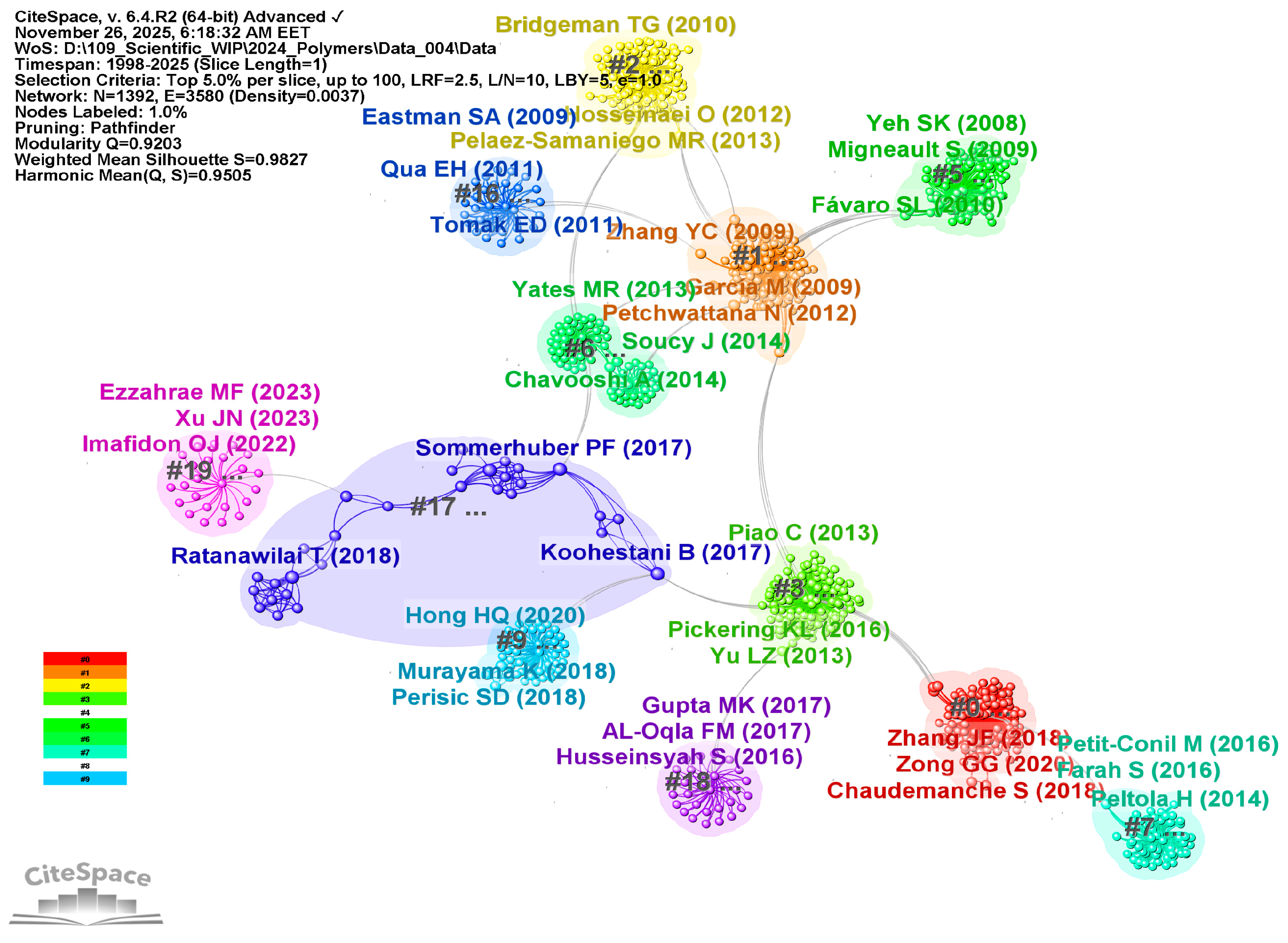
| Research Direction | Cluster Title | Cluster ID * |
|---|---|---|
| Material Reinforcement and Interfacial Engineering | Reinforcement Strategies and Mechanical Properties | #0 |
| Wood Flour–Polyolefin Composites and Interfacial Modification | #1 | |
| Silicon-Based Surface Chemistry and Adhesion Enhancement | #3 | |
| Multicomponent Polymer–Wood Systems and Compatibilization | #6 | |
| Coupling Agents and Interfacial Engineering in Biocomposites | #18 | |
| Processing Approaches and Structure–Property Relationships | Processing Routes, Fiber Size Effects, and Composite Structure | #5 |
| Rheological Behavior and Processing Optimization | #9 | |
| Sustainability, Recycling, Fire Safety, and Thermal Enhancement | Thermal Pretreatment of Wood and Hygrothermal Stability | #2 |
| Biodegradable Polymer–Wood Composites and Fiber Morphology Effects | #7 | |
| Wood Modification, Fire Resistance, and Thermochemical Stability | #16 | |
| Manufacturing Techniques, Recyclability, and Fire-Retardant Performance | #17 | |
| Thermal Energy Storage via PCM Integration | #19 |
Disclaimer/Publisher’s Note: The statements, opinions and data contained in all publications are solely those of the individual author(s) and contributor(s) and not of MDPI and/or the editor(s). MDPI and/or the editor(s) disclaim responsibility for any injury to people or property resulting from any ideas, methods, instructions or products referred to in the content. |
© 2025 by the authors. Licensee MDPI, Basel, Switzerland. This article is an open access article distributed under the terms and conditions of the Creative Commons Attribution (CC BY) license.
Share and Cite
Baba, M.N.; Baba, M.C. A Meta-Synthesis of Review Studies on Wood–Polymer Composites: Mapping the Current Research Landscape. Polymers 2026, 18, 63. https://doi.org/10.3390/polym18010063
Baba MN, Baba MC. A Meta-Synthesis of Review Studies on Wood–Polymer Composites: Mapping the Current Research Landscape. Polymers. 2026; 18(1):63. https://doi.org/10.3390/polym18010063
Chicago/Turabian StyleBaba, Marius Nicolae, and Mirela Camelia Baba. 2026. "A Meta-Synthesis of Review Studies on Wood–Polymer Composites: Mapping the Current Research Landscape" Polymers 18, no. 1: 63. https://doi.org/10.3390/polym18010063
APA StyleBaba, M. N., & Baba, M. C. (2026). A Meta-Synthesis of Review Studies on Wood–Polymer Composites: Mapping the Current Research Landscape. Polymers, 18(1), 63. https://doi.org/10.3390/polym18010063