


Abstract
Spin-labelled compounds are widely used in chemistry, physics, biology, and material sciences, but the directed synthesis of some functionalized organic radicals is still a challenge. We succeeded in the preparation of a tetrazolyl-substituted nitronyl nitroxide radical in pure crystalline form. According to the single-crystal X-ray data, intra- (NH…O, 2.43 Å) and inter-molecular hydrogen bonds (NH…O, 1.91 Å) are formed between NH groups of the tetrazole cycles and O atoms of the paramagnetic moieties. The intermolecular H-bonds connect the molecules forming chains along the a-axis. Moreover, there are short intermolecular contacts between the O atoms (3.096 Å) and between the O and C atoms (3.096 Å) of the nitronyl nitroxide moieties within the chain. The spin-unrestricted broken-symmetry calculations performed at the BS-UB3LYP/def2-TZVP level of theory predicted a sufficient ferromagnetic interaction (J ≈ 20 cm–1) between the adjacent radicals inside the chain, but a weak antiferromagnetic interaction (−J ≤0.2 cm−1) between the nearest radicals belonging to the different chains. Thus, a rare case when stable radicals, the tetrazolyl-substituted nitronyl nitroxides, are ordered into ferromagnetic chains was revealed; an investigation of the magneto-structural correlations inherent in the nitroxide radical will demand a special experiment in the sub-Kelvin regime.
1. Introduction
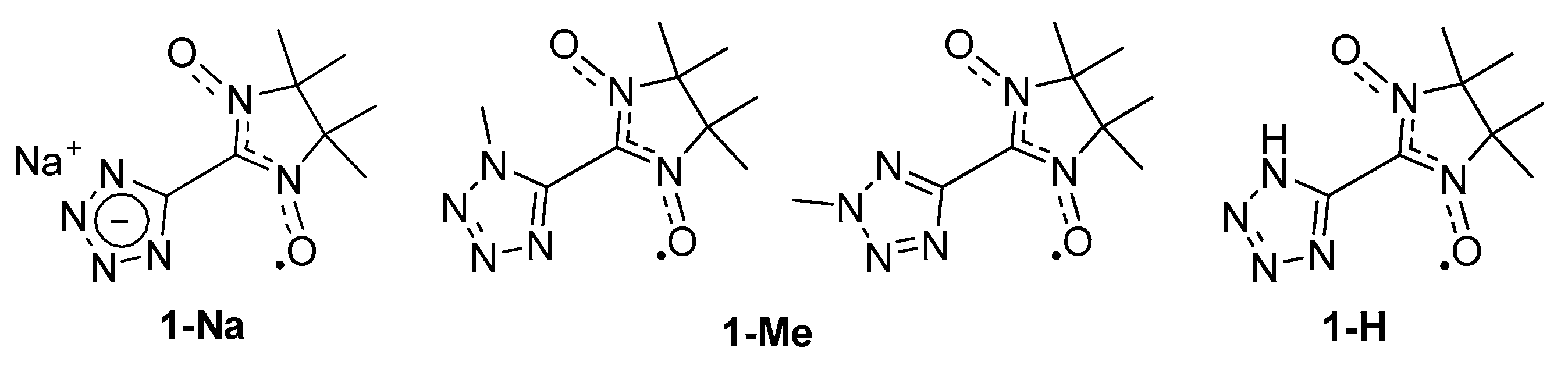
Nitronyl nitroxide radicals and their complexes have been intensively studied for many years, leading to key discoveries in the field of molecular magnetism, such as the preparation of pure organic ferromagnets and ferrimagnets, complexes of transition metals with nitroxides showing magnetic ordering effects, and copper–nitroxide complexes with unusual spin-crossover behavior [1,2,3,4,5,6,7,8,9]. This situation has stimulated the subsequent active developments in the chemistry of this class of paramagnetic compounds with an emphasis on the synthesis of their polyfunctional derivatives [10,11,12,13,14,15]. Although, to date, a huge number of different nitronyl nitroxides have been successfully obtained, there are still poorly studied but interesting types of organic radicals within this class. As an example, the paramagnetic derivatives of a tetrazole can attract attention because of their ability to serve as chelating ligands, including bridged ones [16,17,18]. The synthesis and structure of paramagnetic sodium salt (1-Na) and its isomeric alkyl derivatives (1-Me) have been described [19,20]. In the present paper, we report the synthesis and crystal structure of neutral tetrazolyl-substituted nitronyl nitroxide 1-H, which can be useful as a ligand for the preparation of layered polymer complexes with transition metals (Figure 1).
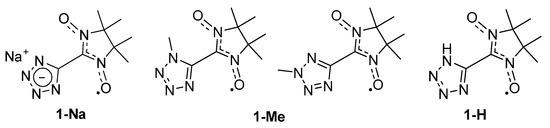
Figure 1.
Tetrazolyl-substituted nitronyl nitroxides.
2. Materials and Methods
2.1. General Notes
A sodium salt of 2-(1H-tetrazol-5-yl)-4,4,5,5-tetramethyl-4,5-dihydro-1H-imidazol-3-oxide-1-oxyl (1-Na) was obtained according to a procedure described in the literature [19]. All of the solvents were freshly distilled, and all of the commercially available reagents were used without further purification. The reactions were monitored using thin-layer chromatography (TLC) on silica gel 60 F254 aluminum sheets. The infrared (IR) spectra were acquired in KBr pellets on a Bruker Vector-22 spectrometer (Bruker, Manasquan, NJ, USA). The UV-VIS spectra were recorded in an ethanol solution by means of a Cary-5000 (Varian) spectrometer. The elemental analyses were performed on a Carlo Erba 1106 CHN elemental analyzer.
An electron spin resonance (ESR) spectrum was acquired on an X-band Bruker Elexsys 540 spectrometer (Bruker, Manasquan, NJ, USA) at room temperature in a diluted (C ≈ 10−4 M) aqueous solution. The spectrum recording parameters were as follows: modulation amplitude 0.05 mT, modulation frequency 100 kHz, and microwave power 2 mW; and 20 scans from 1024 points were accumulated and averaged. The simulation of the solution EPR lines was carried out in Easy Spin software, which is available at http://www.easypin.org.
2.2. 2-(1H-Tetrazol-5-Yl)-4,4,5,5-Tetramethyl-4,5-Dihydro-1H-Imidazol-3-Oxide-1-Oxyl (1-H)
Oxalic acid (95 mg, 1.05 mmol) was added to a solution of the sodium salt of 2-(1Н-tetrazol-5-yl)-4,4,5,5-tetramethyl-4,5-dihydro-1Н-imidazol-3-oxide-1-oxyl (1-Na; 247 mg, 1 mmol) in 5 mL of ethanol. The reaction mixture was stirred for 15 min and loaded onto a chromatographic column (10 cm × 15 cm), packed with Al2O3 (neutral, activity II). The ethanol served as an eluent. A deep violet fraction was collected and evaporated (the bath temperature was ~30 °C). The residue was crystallized from a water-ethanol (5:1) mixture. Radical 1-H was obtained as deep violet crystals (200 mg, 89%). The heating of 1-H led to decomposition without melting. UV-VIS spectrum (EtOH), λmax/nm (ε): 201 (6640), 229 (3920), 329 (630), 334 (5920), 578 br. (350). IR-spectrum, ṽ/cm–1: 467, 540, 596, 1030, 1057, 1076, 1135, 1157, 1317, 1373, 1454, 1487, 1508, 1600, 1660, 1675, 1691, 1710, 1726, 1739, 2611, 2856, 2929, 2941, 3332, 3473, 3604, 3808, 3828, 3845, 3860. Found C 43.0, H 5.9, N 37.2. C8H13N6O2 (225.23). Calcd (%): C 42.6, H 5.8, N 37.3.
2.3. Data Collection and Refinement
The X-ray diffraction (XRD) data were collected by means of a Bruker Kappa Apex II CCD diffractometer with Mo Kα radiation (λ = 0.71073 Å) and a graphite monochromator. The experiment was conducted at 296 (2) K using φ, and ω scans within 2θ = 52°; 39342 reflections were detected, including 2009 independent ones (Rint = 0.054). Crystallographic data: a = 9.0584 (5), b = 13.9014 (8), c = 18.112 (1) Å, V = 2280.8 (2) Å3, space group Pbca, Z = 8, dcalc = 1.312 g/cm3, and μ = 0.099 mm−1. Absorption corrections were applied empirically in the SADABS software [21], which employs multiple measurements of the same reflections at different crystal orientations. The structure model was found using a direct method and was refined in an anisotropic approximation using the SHELXTL software suite [22,23]. The positions of the H atoms were calculated via the riding model. As a result, the maximum and minimum values of the electron densities were found to be 0.17 and −0.14 e/Å3, R = 0.0362 (for 1690 I > 2 σ·[I]), wR2 = 0.0998 (for all 2009 independent reflections), and GooF = 1.013. A CIF file, containing the entire structural information is available as CCDC 1813370 from the Cambridge Crystallographic Data Centre via www.ccdc.cam.ac.uk/data_request/cif.
2.4. Computational Methods
Recently, it was shown that the parameters of exchange coupling between organic radicals [24,25] and ion radicals [26] can be predicted with a high accuracy (no worse than ~30%) by the spin-unrestricted broken-symmetry (BS) approach using density functional theory (DFT) [27]. The same approach was employed in the present work; parameters (J) of the exchange interaction () between the closest radicals were calculated for the X-ray structure geometries at the BS-UB3LYP/def2-TZVP [28,29,30] level of theory, using Orca 3.0.3 software [31]. The J values were calculated via the formula , where is the energy of the triplet state of the radical pair, and denotes the energy of the broken-symmetry singlet state [27]. In every case, the values were close to 2.0 and to 1.0.
3. Results and Discussion
Nitroxide radical 1-H was obtained through the neutralization of its sodium salt 1-Na in a 90% yield. The paramagnetic compound 1-H was stable during the procedures and storage in a refrigerator. The crystallization of 1-H from a mixture of water and EtOH led to well-shaped crystals suitable for subsequent XRD analysis.
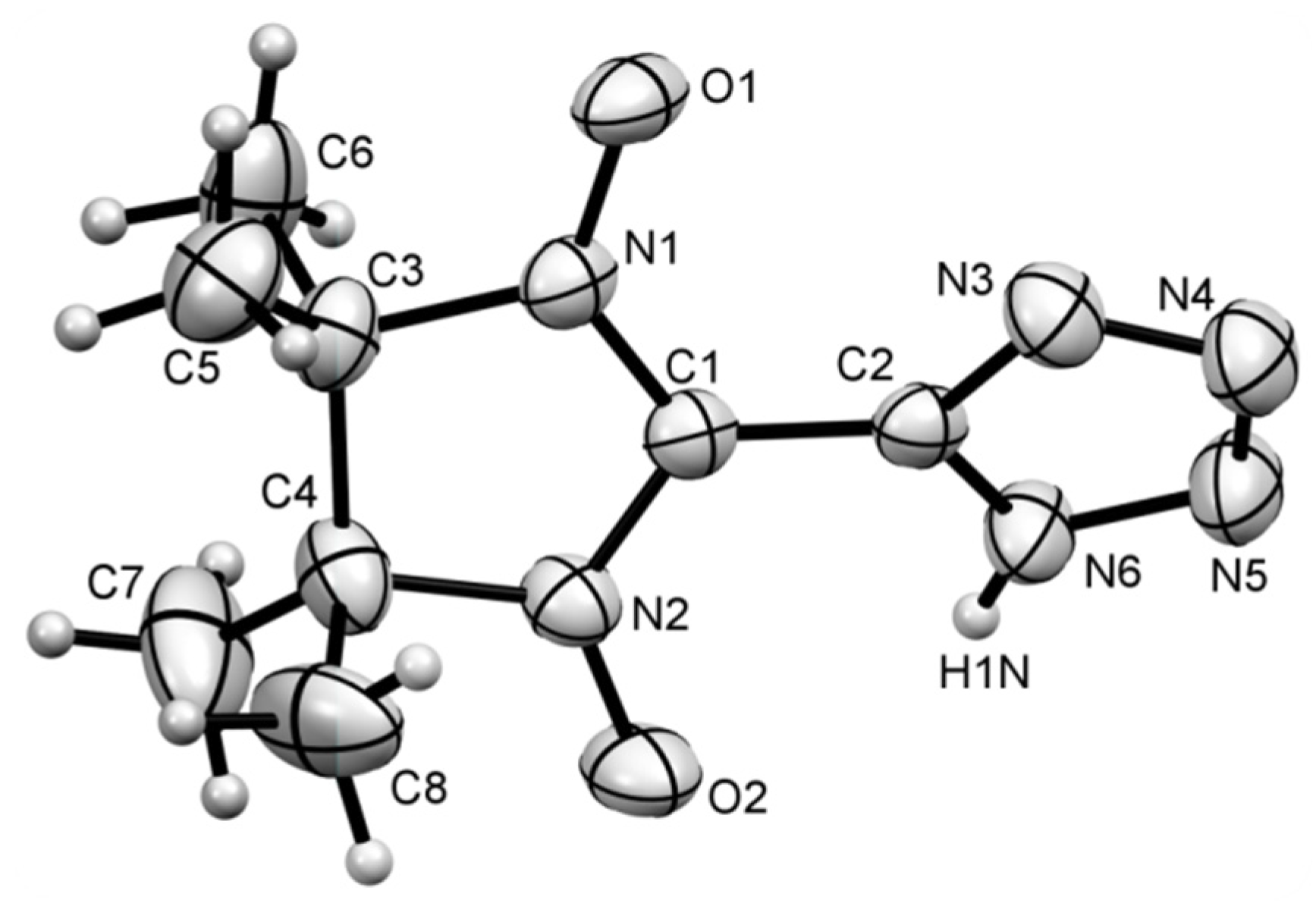
Figure 2 depicts the molecular structure of 1-H with selected bond length values. These lengths are typical and within 3σ correspond to the average values [32]. Thus, the bond lengths of the NO groups were 1.281 (2) and 1.273 (2) Å, and those of the CN groups of the nitronyl nitroxide moieties were 1.336 (2) and 1.3427 (19) Å, respectively. Both five-membered rings of 1-H were planar; the atoms deviated from the mean plane by 0.084 Å on the imidazoline and by 0.003 Å on the tetrazole rings. The dihedral angle between the two planes of the cycles was 30.73 (9)°.
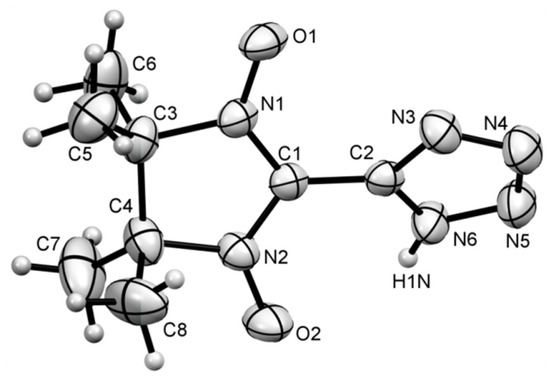
Figure 2.
Molecular structure of 1-H (ellipsoids of thermal oscillations with 50% probabilities). The distances between the atoms in heterocycles and NO groups are as follows: O1–N1 1.281 (2), O2–N2 1.273 (2), N1–C1 1.336 (2), N1–C3 1.507 (2), N2–C1 1.3427 (19), N2–C4 1.501 (2), N3–N4 1.360 (2), N3–C2 1.319 (2), N4–N5 1.294 (2), N5–N6 1.335 (2), N6–C2 1.330 (2), C1–C2 1.447 (2).
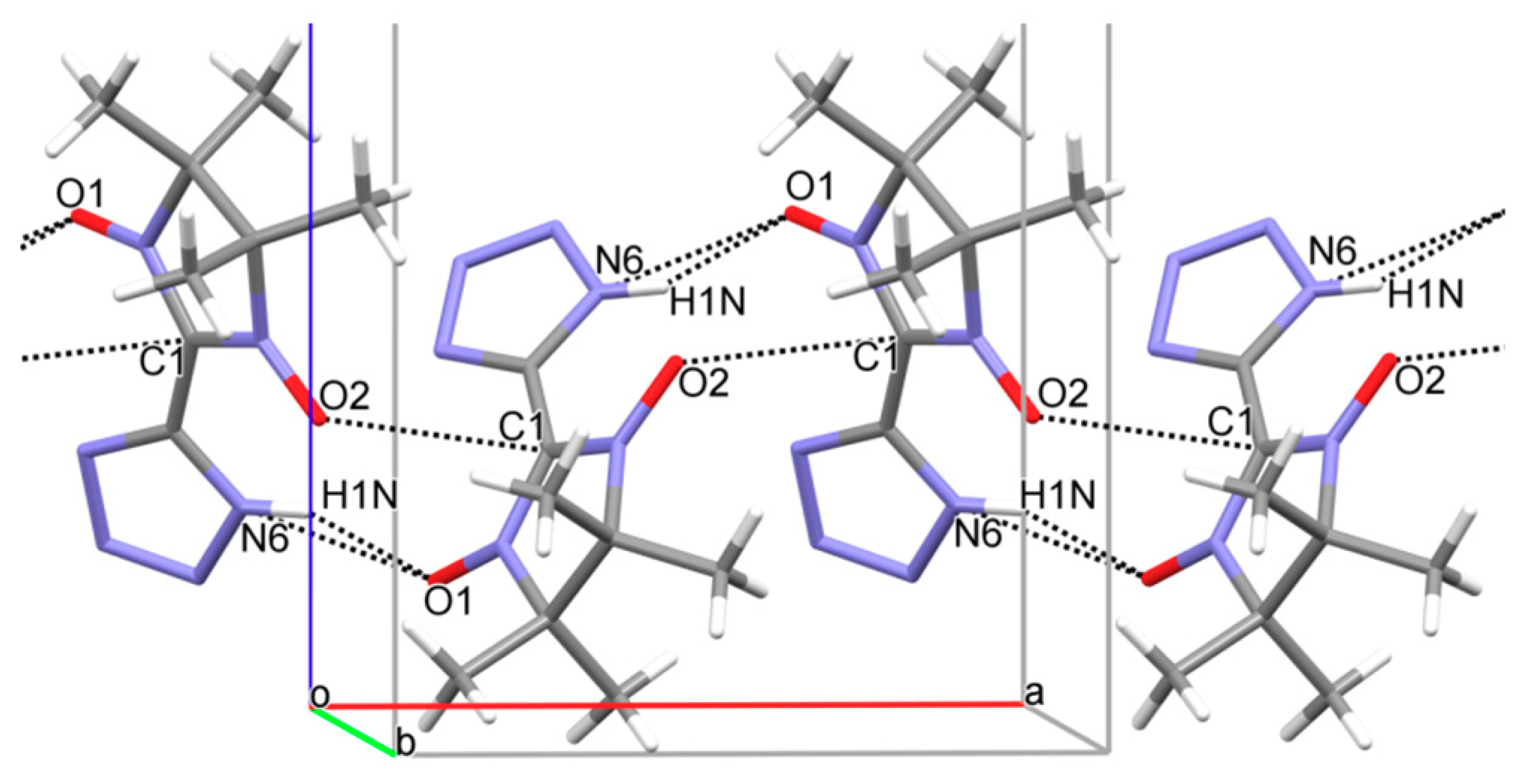
It should be noted that the intramolecular N6–H1N…O2 (Figure 2, H-bond parameters: N6–H1N 0.86, H1N…O2 2.43, N6…O2 2.8669 (18) Å; angle N6–H1N…O2 112°) and intermolecular hydrogen bonds N6–H1N…O1 (Figure 3, H-bond parameters: N6–H1N 0.86, N6H1N…O1 1.91, N6…O1 2.7014 (2) Å; angle N6–H1N…O1 153°) are formed between the NH groups of the tetrazole rings and the O atoms in the crystal state of 1-H. Because of the intermolecular hydrogen bond formation, the 1-H radicals are aligned into infinite chains along the a-axis inside the crystal, so that inside the chains, there were short and equal (3.096 Å) intermolecular contacts between the O2 atoms of one molecule, and the C1 and O1 atoms of an adjacent molecule (Figure 3). To get detailed information about the magnetic properties of the 1-H crystals, the exchange coupling parameters were calculated for the selected radical pair inside the chain and for the pairs of nearest radicals of the neighboring chains.
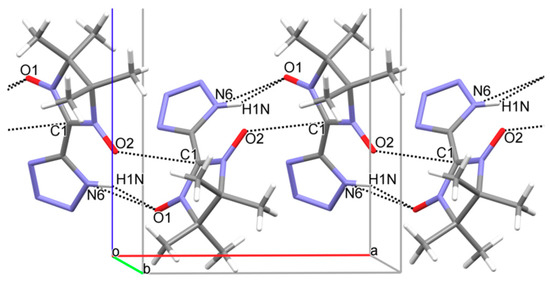
Figure 3.
A fragment of the chain formed by hydrogen bonds N6–H1N…O1 between 1-H molecules.
According to the results of the UB3LYP/def2-TZVP calculations for the triplet state of the selected radical pair inside the chain, the spin density (ρ) on the O2 atom of one radical was 0.30, and −0.18, and 0.34, respectively, on the C1 and O1 atoms of another radical of the pair (Figure 3). Moreover, the calculations predicted the moderate ferromagnetic exchange interaction (J ≈ 20 cm–1) for this radical pair. In our opinion, the main reason for this is just the large negative spin density on C1 atom, which is located near the O2 atom of another radical with the largest positive spin density. Thus, the spin polarization mechanism [33] and a suitable orientation of the radicals are responsible for ferromagnetic coupling. On the other hand, the exchange coupling between the nearest radicals of the neighboring chains were predicted to be much weaker and antiferromagnetic in nature (|J| ≤ 0.2 cm–1).
It should be mentioned that unlike 1-H, a previously described related imidazol-2-yl substituted nitronyl nitroxide radical forms chains because of the intermolecular hydrogen bonds between the nitrogen atoms and the NH fragments of the imidazoline rings [34]. In addition, the short contacts between the O atoms of the radicals of the neighboring chains inside the crystal (3.484 Å) were responsible for the strong antiferromagnetic interactions (J ≈ −62 cm–1) [34].
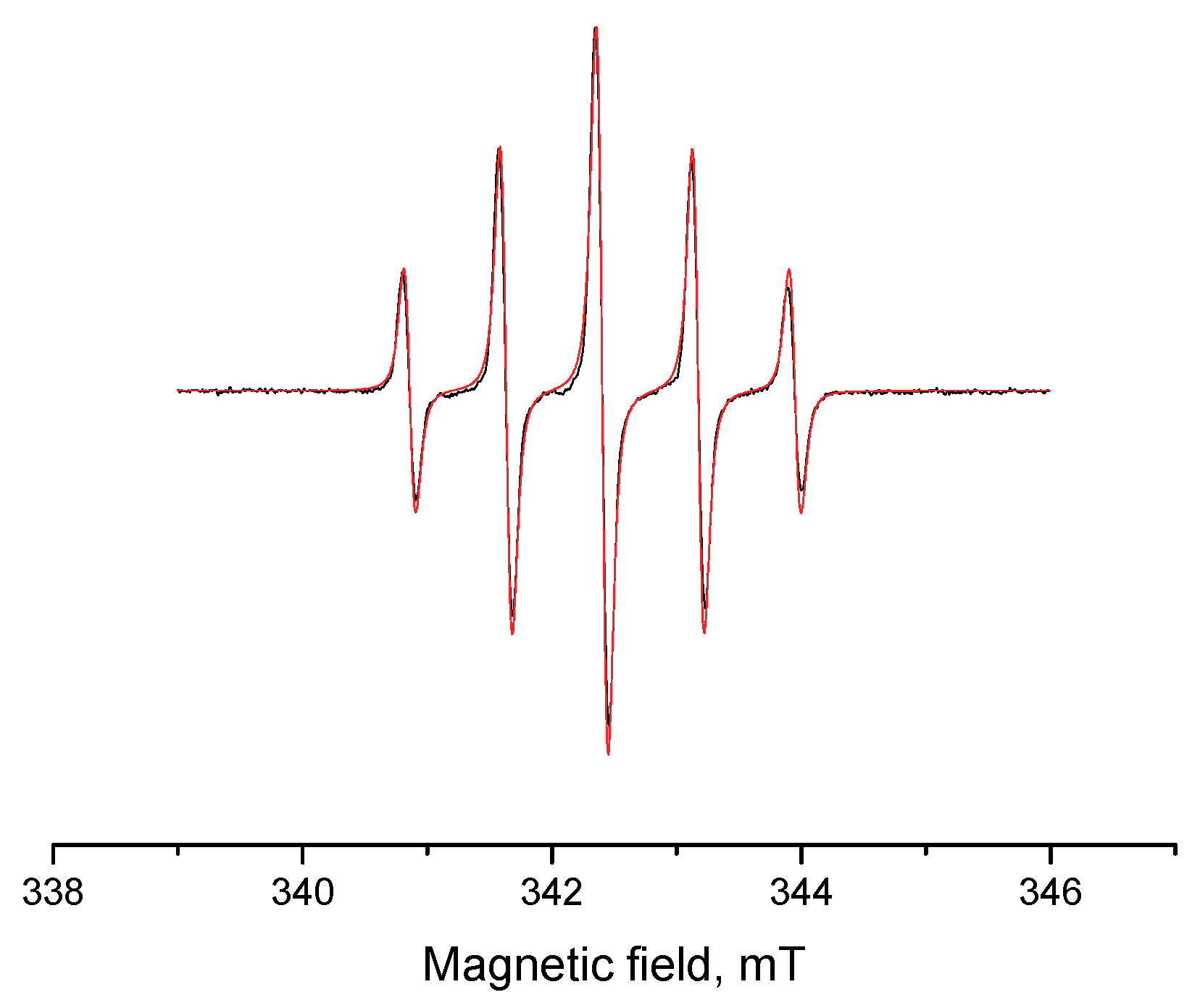
An ESR spectrum of 1-H was recorded in a diluted aqueous solution (Figure 4). The observed clear-cut isotropic five-line pattern at g = 2.0061 originated from the interaction of the unpaired electron with the two equivalent nitrogen nuclei of the imidazoline moiety with hyperfine splitting constants A (2N) = 0.773 mT. The observed values are typical of this class of paramagnetics.
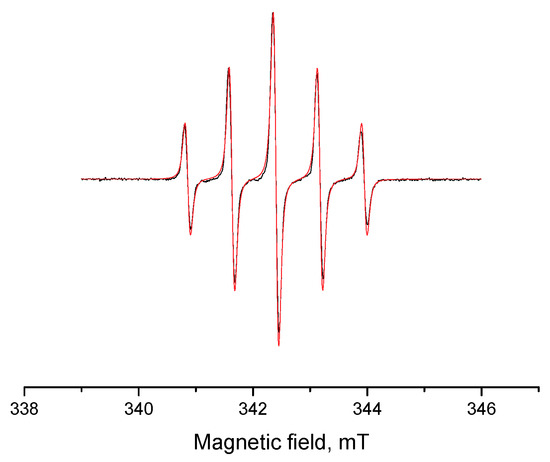
Figure 4.
An electron spin resonance (ESR) spectrum of 1-H in an aqueous solution (С = 10−4 M; black curve) and its simulation (red curve).
4. Conclusions
We succeeded to synthesize and isolate, for the first time, stable spin-labeled tetrazole in a neutral form, 2-(1Н-tetrazol-5-yl)-4,4,5,5-tetramethyl-4,5-dihydro-1Н-imidazol-3-oxide-1-oxyl. It was demonstrated that in the crystal state, the tetrazolyl-substituted nitronyl nitroxides formed intermolecular hydrogen bonds (N–H…O) connecting the radicals into infinite chains. Moreover, the rare short contacts (3.096 Å) between the oxygen and carbon atoms of the neighboring radicals possessing the spin densities of opposite signs in the pair triplet state were observed [35,36]; this explains sufficient ferromagnetic exchange coupling (J ≈ 20 cm−1) between the radicals inside the chain predicted by BS-DFT. Thus, the obtained structural and computational data will be useful for a subsequent precise study of the magneto-structural correlations of the paramagnetic tetrazole derivative.
Author Contributions
Conceptualization, E.T. and D.L.; investigation, V.R., I.B., and E.Z.; formal analysis, D.G., and N.G.
Funding
The experimental part of this research was funded by the Russian Foundation for Basic Research (grant No. 17-53-150020), and the computations part of this work was funded by the Russian Science Foundation (grant 16-13-10155).
Acknowledgments
The authors thank the Multi-Access Chemical Service Center SB RAS for the spectral and analytical measurements. The Supercomputer Center of Novosibirsk State University and Siberian Supercomputer Center (SB RAS) is also acknowledged.
Conflicts of Interest
The authors declare no conflict of interest.
References
- Awaga, K.; Maruyama, Y. Ferromagnetic intermolecular interaction of the organic radical, 2-(4-nitrophenyl)-4,4,5,5-tetramethyl-4,5-dihydro-1H-imidazolyl-1-oxy 3-oxide. Chem. Phys. Lett. 1989, 158, 556–558. [Google Scholar] [CrossRef]
- Awaga, K.; Maruyama, Y. Ferromagnetic and antiferromagnetic intermolecular interactions of organic radicals, u-nitronyl nitroxides. J. Chem. Phys. 1989, 91, 2743–2747. [Google Scholar] [CrossRef]
- Awaga, K.; Inabe, T.; Nagashima, U.; Maruyama, Y. Two-dimensional network of the ferromagnetic organic radical, 2-(4-nitrophenyl)-4,4,5,5-tetramethyl-4,5-dihydro-1H-imidazol-1-oxyl 3-N-oxide. J. Chem. Soc. Chem. Commun. 1989, 1617–1618. [Google Scholar] [CrossRef]
- Sugimoto, T.; Tsujii, M.; Suga, T.; Hosoito, N.; Ishikawa, M.; Takeda, N.; Shiro, M. New Charge-Transfer Complex-Based Organic Ferromagnets: Pyridinium-Substitued Imidazolin-1-Oxyl/Tetrafluorotetracyanoquinodimethanide or Hexacyanobutadienide Salts. Mol. Cryst. Liq. Cryst. 1995, 272, 183–194. [Google Scholar] [CrossRef]
- Caneschi, A.; Gatteschi, D.; Rey, P.; Sessoli, R. Structure and magnetic properties of ferrimagnetic chains formed by manganese (II) and nitronyl nitroxides. Inorg. Chem. 1988, 27, 1756–1761. [Google Scholar] [CrossRef]
- Caneschi, A.; Gatteschi, D.; Renard, J.P.; Rey, P.; Sessoli, R. Magnetic phase transition and low-temperature EPR spectra of a one-dimensional ferrimagnet formed by manganese (II) and a nitronyl nitroxide. Inorg. Chem. 1989, 28, 1976–1980. [Google Scholar] [CrossRef]
- Caneschi, A.; Gatteschi, D.; Renard, J.P.; Rey, P.; Sessoli, R. Ferromagnetic phase transitions of two one-dimensional ferrimagnets formed by manganese (II) and nitronyl nitroxides cis octahedrally coordinated. Inorg. Chem. 1989, 28, 3314–3319. [Google Scholar] [CrossRef]
- Caneschi, A.; Gatteschi, D.; Sessoli, R.; Rey, P. Toward molecular magnets: the metal-radical approach. Acc. Chem. Res. 1989, 22, 392–398. [Google Scholar] [CrossRef]
- Lanfranc de Panthou, F.; Belorizky, E.; Calemczuk, R.; Luneau, D.; Marcenat, C.; Ressouche, E.; Turek, P.; Rey, P. A New Type of Thermally Induced Spin Transition Associated with an Equatorial .dblarw. Axial Conversion in a Copper(II)-Nitroxide Cluster. J. Am. Chem. Soc. 1995, 117, 11247–11253. [Google Scholar] [CrossRef]
- Likhtenshtein, G.I.; Yamauchi, J.; Nakatsuji, S.; Smirnov, A.I.; Tamura, R. Nitroxides: Applications in Chemistry, Biomedicine, and Materials Science, 1st ed.; Wiley-VCH: Weinheim, Germany, 2008; ISBN 978-3527318896. [Google Scholar]
- Rowen, S. Concepts and Applied Principles of Nitroxides; Research Press: New York, NY, USA, 2015. [Google Scholar]
- Romanov, V.; Vorob’ev, A.; Bagryanskaya, I.; Parkhomenko, D.; Tretyakov, E. 1,3-Dipolar Cycloaddition of a Nitronyl Nitroxide-Substituted Alkyne to Heteroaromatic N-Imines. Aust. J. Chem. 2017, 70, 1317–1320. [Google Scholar] [CrossRef]
- Tretyakov, E.V.; Fedyushin, P.A.; Panteleeva, E.V.; Stass, D.V.; Bagryanskaya, I.Yu.; Beregovaya, I.V.; Bogomyakov, A.S. Substitution of a Fluorine Atom in Perfluorobenzonitrile by a Lithiated Nitronyl Nitroxide. J. Org. Chem. 2017, 82, 4179–4185. [Google Scholar] [CrossRef] [PubMed]
- Tretyakov, E.V.; Peshkov, R.Yu.; Panteleeva, E.V.; Scrypnik, A.S.; Stass, D.V.; Romanenko, G.V.; Ovcharenko, V.I. Addition of Cyanomethyl Anion to the Cyano Group of 2-Cyano-4,4,5,5-tetramethyl-4,5-dihydro-1H-imidazol-3-oxide-1-oxyl, a Nitronyl Nitroxide. Tetrahedron Lett. 2016, 57, 2327–2330. [Google Scholar] [CrossRef]
- Depperman, E.C.; Bodnar, S.H.; Vostrikova, K.E.; Shultz, D.A.; Kirk, M.L. Spin Robustness of a New Hybrid Inorganic−Organic High-Spin Molecule. J. Am. Chem. Soc. 2001, 123, 3133–3134. [Google Scholar] [CrossRef] [PubMed]
- Gaponik, P.N.; Voitekhovich, S.V.; Ivashkevich, О.А. Metal Derivatives of Tetrazoles. Russ. Chem. Rev. 2006, 75, 507–539. [Google Scholar] [CrossRef]
- Aromi, G.; Barrios, L.A.; Roubeau, O.; Gamez, P. Triazoles and Tetrazoles: Prime Ligands to Generate Remarkable Coordination Materials. Coord. Chem. Rev. 2011, 255, 485–546. [Google Scholar] [CrossRef]
- Massi, M.; Stagni, S.; Ogden, M.I. Lanthanoid Tetrazole Coordination Complexes. Coord. Chem. Rev. 2017, in press. [Google Scholar] [CrossRef]
- Tretyakov, E.V.; Fokin, S.V.; Romanenko, G.V.; Ovcharenko, V.I. Nitronyl Nitroxides Containing Tetrazole Substituents and Metal Complexes with Spin-Labeled Tetrazole. Polyhedron 2003, 22, 1965–1972. [Google Scholar] [CrossRef]
- Tretyakov, E.V.; Fokin, S.V.; Romanenko, G.V.; Ikorskii, V.N.; Podoplelov, A.V.; Ovcharenko, V.I. Copper(II) bis(hexafluoroacetylacetonate) complexes with 2-(2-methyltetrazolyl)-4,4,5,5-tetramethyl-4,5-dihydro-1H-imidazole 1-oxides. Russ. Chem. Bull. 2006, 55, 66–73. [Google Scholar] [CrossRef]
- Sheldrick, G.M. SADABS. Version 2.01; Bruker AXS Inc.: Madison, WI, USA, 2004. [Google Scholar]
- Sheldrick, G.M. SHELXTL. Version 6.10; Bruker AXS Inc.: Madison, WI, USA, 2004. [Google Scholar]
- Sheldrick, G.M. Crystal structure refinement with SHELXL. Acta Cryst. 2015, C71, 3–8. [Google Scholar]
- Clarke, C.S.; Jornet-Somoza, J.; Mota, F.; Novoa, J.J.; Deumal, M. Origin of the Magnetic Bistability in Molecule-Based Magnets: A First-Principles Bottom-Up Study of the TTTA Crystal. J. Am. Chem. Soc. 2010, 132, 17817–17830. [Google Scholar] [CrossRef] [PubMed]
- Tolstikov, S.E.; Tretyakov, E.V.; Gorbunov, D.E.; Zhurko, I.F.; Fedin, M.V.; Romanenko, G.V.; Bogomyakov, A.S.; Gritsan, N.P.; Mazhukin, D.G. Reaction of Paramagnetic Synthon, Lithiated 4,4,5,5-Tetramethyl-4,5-dihydro-1H-imidazol-1-oxyl 3-oxide, with Cyclic Aldonitrones of the Imidazole Series. Chem. Eur. J. 2016, 22, 14598–14604. [Google Scholar] [CrossRef] [PubMed]
- Gritsan, N.P.; Zibarev, A.V. Chalcogen-Nitrogen Π-Heterocyclic Radical Anion Salts: The Synthesis and Properties. Russ. Chem. Bull. 2011, 60, 2131–2140. [Google Scholar] [CrossRef]
- Soda, T.; Kitagawa, Y.; Onishi, T.; Takano, Y.; Shigeta, Y.; Nagao, H.; Yoshioka, Y.; Yamaguchi, K. Ab Initio Computations of Effective Exchange Integrals for H–H, H–He–H And Mn2o2 Complex: Comparison of Broken-Symmetry Approaches. Chem. Phys. Lett. 2000, 319, 223–230. [Google Scholar] [CrossRef]
- Becke, A.D. Density-functional thermochemistry III. The role of exact exchange. J. Chem. Phys. 1993, 98, 5648–5652. [Google Scholar] [CrossRef]
- Lee, C.; Yang, W.; Parr, R.G. Development of the Colle-Salvetti correlation-energy formula into a functional of the electron density. Phys. Rev. B 1988, 37, 785–789. [Google Scholar] [CrossRef]
- Weigend, F.; Ahlrichs, R. Balanced Basis Sets of Split Valence, Triple Zeta Valence and Quadruple Zeta Valence Quality for H to Rn: Design and Assessment of Accuracy. Phys. Chem. Chem. Phys. 2005, 7, 3297–3305. [Google Scholar] [CrossRef] [PubMed]
- Neese, F. ORCA–An Ab Initio, Density Functional and Semiempirical Program Package. Version 2008, 2, 35. [Google Scholar]
- Allen, F.H.; Kenard, O.; Watson, D.G.; Bramer, L.; Orpen, A.G.; Taylor, R. Tables of Bond Lengths Determined By X-ray and Neutron Diffraction. Part 1. Bond Lengths in Organic Compounds. J. Chem. Soc. Perkin Trans. II 1987, 0, S1–S19. [Google Scholar] [CrossRef]
- McConnell, H.M. Ferromagnetism in Solid Free Radicals. J. Chem. Phys. 1963, 39, 1910. [Google Scholar] [CrossRef]
- Naoki, Y.; Munetoshi, I.; Yuichiro, M.; Takanari, K.; Hidenari, I.; Shigeru, O. Unusually Large Magnetic Interactions Observed in Hydrogen-Bonded Nitronyl Nitroxides. Chem. Lett. 1997, 26, 251–252. [Google Scholar]
- Inoue, K.; Iwamura, H. Magnetic Properties of the Crystals of p-(1-oxyl-3-oxido-4,4,5,5-tetramethyl-2-imidazolin-2-yl)benzoic acid and Its Alkali Metal Salts. Chem. Phys. Lett. 1993, 207, 551–554. [Google Scholar] [CrossRef]
- Zheludev, A.; Barone, V.; Bonnet, M.; Delley, B.; Grand, A.; Ressouche, E.; Rey, P.; Subra, R.; Schweizer, J. Spin Density in a Nitronyl Nitroxide Free Radical. Polarized Neutron Diffraction Investigation and Ab Initio Calculations. J. Am. Chem. Soc. 1994, 116, 2019–2027. [Google Scholar] [CrossRef]
© 2018 by the authors. Licensee MDPI, Basel, Switzerland. This article is an open access article distributed under the terms and conditions of the Creative Commons Attribution (CC BY) license (http://creativecommons.org/licenses/by/4.0/).