You are currently viewing a new version of our website. To view the old version click .
Crystals
  • Article
  • Open Access

22 September 2025

The Influence of Pressure on Magnetite–Zinc Oxide Synthesis in Hydrothermal Conditions

,
,
,
,
,
,
and
1
National Research & Development Institute for Nonferrous and Rare Metals-IMNR, Biruintei Blvd. 178-184, Pantelimon, 077145 Ilfov, Romania
2
Doctoral School Materials Science and Engineering, National University of Science and Technology POLITEHNICA Bucharest, Splaiul Independentei No. 313, Sector 6, 060042 Bucharest, Romania
3
Faculty of Mechanics and Technology, Pitesti University Centre, National University of Science and Technology Politehnica Bucharest, 110040 Pitesti, Romania
*
Authors to whom correspondence should be addressed.
This article belongs to the Section Inorganic Crystalline Materials

Abstract

The combination of ZnO and Fe3O4 nanoparticles represents a synergistic strategy for the treatment of skin cancer, exploiting both oxidative stress-induced cytotoxicity and hyperthermic effects for improved anticancer activity. These nanoparticles also function as drug carriers, facilitating targeted delivery and reducing systemic toxicity. Furthermore, controlled-release systems activated by external stimuli, such as light, pH, temperature, or magnetic fields, optimize the accumulation of the drug in tumor tissues. In the present study, Fe3O4-ZnO composite powders were synthesized in aqueous solution through the hydrothermal method under high pressure and temperature. All synthesized powders were characterized by physicochemical and morpho-structural methods such as: FT-IR, XRD, SEM, DLS, and BET. The influence of the hydrothermal synthesis parameters (pressure and time) on the morpho-structural properties of the magnetite–zinc oxide nanocomposites was studied.

1. Introduction

Cancer is a potentially lethal disease characterized by the uncontrolled proliferation of abnormal cells, which invade neighboring tissues and cause severe damage to healthy cells. The treatment of this disease is based on multiple therapeutic strategies, including chemotherapy, radiotherapy, and immunotherapy, which have proven effective in fighting various types of cancer. However, chemotherapy has a major disadvantage, as it not only acts selectively on malignant cells, but also affects healthy cells. This treatment targets cells with a rapid rate of division, but there are other types of cells in the body that are actively proliferating, such as those of the skin, bone marrow, and vascular endothelium, which can lead to significant side effects [1].
Melanoma is responsible for 20,000 deaths annually in Europe and poses a major public health challenge given its ever-increasing incidence rate, high mortality, and significant impact on the healthcare system. It involves considerable costs and great complexity in the management of cases in advanced stages, putting significant pressure on medical resources and infrastructure [2].
In recent years, nanotechnology has established itself as a promising strategy in the diagnosis and treatment of melanoma, providing advanced drug delivery systems, high-resolution imaging, and targeted therapies with increased efficiency and reduced toxicity [3]. Given the complexity and significant impact of melanoma on public health, recent research focuses on the development of innovative therapies, and the use of nanoparticles for targeted drug delivery and molecular imaging presents itself as a promising approach in improving the early diagnosis and effective treatment of this pathology [4].
Nanoparticles are generally defined as structures ranging in size from 1 to 100 nm, with a significantly increased surface-to-volume ratio, which confers distinct and innovative properties, compared to bulk particles of the same chemical composition [5,6]. The use of nanomaterials is one of the most promising approaches in developing effective solutions to combat various challenges in the biomedical field. Currently, numerous studies are exploring the applicability of metal nanoparticles in multiple medical fields, including anticancer therapies [7].
Thus, among the metal nanoparticles investigated for their applicability in the biomedical field, zinc oxide (ZnO) and magnetite (Fe3O4) have been intensively studied due to their remarkable antibacterial and therapeutic properties. However, magnetite differs significantly from hematite and maghemite in its superior ability to interact with external magnetic fields, giving it a considerable advantage in medical applications, especially in targeted drug delivery and hyperthermia therapies, due to its ability to more effectively control biomolecular responses to magnetic stimuli [8,9,10,11,12,13,14,15].
Zinc oxide (ZnO) is a particularly important multifunctional semiconductor material with extensive applications in numerous scientific fields. Magnetite (Fe3O4), due to its outstanding magnetic, chemical, and structural properties, is widely used in numerous scientific fields, including biomedicine, wastewater treatment, catalysis, and energy storage technologies. Zinc oxide (ZnO) and magnetite (Fe3O4) are intensively studied nanomaterials due to their versatile properties, having applications in the biomedical, electronic, and environmental protection fields. In addition, this material has demonstrated low toxicity and notable antimicrobial activity, making it a valuable candidate for various technological and biomedical uses [16,17,18,19]. All these properties make it possible to use ZnO-based materials in the medical field, having applications as biomarkers, drug delivery systems, and in therapeutic treatments [20,21]. Iron and zinc oxides are known for their antioxidant properties [22,23,24,25,26] and the potential to interact synergistically in various biological processes, while magnetite, due to its magnetic properties, can facilitate the precise targeting of therapeutic agents to tumor lesions. In addition, the use of magnetite in combination with other metal oxides can contribute to the development of advanced imaging methods, through better visibility in magnetic resonance imaging (MRI) and positron emission tomography (PET) imaging, which makes early diagnosis and early monitoring possible [27]. Magnetite, due to its magnetic characteristics and compatibility with biological systems, is used in magnetic resonance imaging (MRI), in controlled drug delivery, photodynamic therapy (PDT), enzymatic immobilization, catalysis, and also in treatments based on magnetic hyperthermia [28,29,30]. The size and morphology of these nanoparticles play an essential role in tissue penetration. The appropriate choice of particle morphology and size is essential to address specific biomedical challenges. In the context of transdermal administration of medicinal products or by intravenous injection, the particles must be small enough to cross the capillaries, but large enough to allow manipulation by magneto-mechanical action, if necessary [3].
Different synthesis methods of magnetite and zinc oxide nanocomposites are described in the literature. The co-precipitation method was used to prepare magnetite–zinc oxide nanocomposites [31]. The magnetite–ZnO mass ratios were 1.5:0, 1:0.5, 0.75:0.75, 0.5:1, and 0:1.5, respectively. SEM analyses show that the size of the nanocomposites is in the range of 17.45–58.14 nm, depending on the ZnO content.
The magnetite/zinc oxide nanocomposites have promising applications for antifungal agents due to the structural and functional characteristics of the material, but also the removal of toxic metal ions from aquatic environments [32]. These characteristics demonstrate the material’s potential for environmental and biomedical uses [32].
A system based on zinc oxide and core/shell magnetite [33] was used for drug delivery. The Fe3O4 nanoparticles were obtained by the co-precipitation synthesis method, which involves the reaction between iron salt solutions (FeCl2 and FeCl3) and an alkaline solution. In this case, NaOH was used as a precipitating agent to facilitate the reaction.
Magnetic and structural properties of iron oxide and ZnO nanocomposites were evaluated [31]. The article focuses on iron oxide nanoparticles (Fe3O4 and γ-Fe2O3), which are used due to their superparamagnetic properties at room temperature, biocompatibility, and low toxicity. However, these particles tend to form clumps, which limits their applicability. One of the solutions proposed to improve their dispersion is to cover them with a protective material, such as zinc oxide (ZnO) [31].
The Fe3O4/ZnO and γ-Fe2O3/ZnO nanocomposites were made by a two-step co-precipitation method, and their morphological analysis was performed using techniques such as FESEM (scanning electron microscopy with field emissions) and TEM (transmission electron microscopy). Following the coating of the magnetic nanoparticles with ZnO, the core/shell structure was confirmed, with the nucleus of Fe3O4 or γ-Fe2O3 covered by a thin layer of ZnO. ZnO particles have a significantly smaller size in nanocomposites than in their pure form, suggesting an interaction between the two components.
In terms of particle sizes, SEM and TEM analyses indicated that γ-Fe2O3 particles have an average size of about 4–14 nm, and those of ZnO in nanocomposites, an average size of 8 nm [31].
The aim of the paper is to demonstrate the feasibility of hydrothermal procedure to obtain magnetite–zinc oxide nanocomposites having the Fe3O4/ZnO mass ratio of 1:2. To the best of our knowledge, it is for the first time, when zinc oxide was precipitated onto already formed Fe3O4 precursor, followed by hydrothermal treatment under high pressure (100 atm) and high temperature (200 °C) in aqueous medium. The influence of time and pressure on the formation of crystalline nanocomposites was studied. It is important to mention that the use of the hydrothermal procedure in aqueous medium required significantly lower energy consumption to heat the water than that needed to vaporize it [34].

2. Materials and Methods

2.1. Hydrothermal Synthesis of Fe3O4-ZnO Nanostructured Composite Powders

Knowing that a higher ZnO content in the nanocomposite increases antibacterial efficiency, while maintaining an optimal level of biocompatibility, a mass ratio of 1:2 between Fe3O4 and ZnO was selected for the experiments, varying the working pressure and the holding time at a temperature of 200 °C. The obtained powders and synthesis conditions are shown in Table 1.
Table 1. Synthesis conditions of nanostructured powders based on magnetite–zinc oxide composites.
The experimental procedure for the hydrothermal synthesis of the nanocomposite based on magnetite and zinc oxide comprises the following steps: aqueous solutions of ferric chloride (FeCl3·6H2O) and ferrous chloride (FeCl2·4H2O) of known concentrations are mixed using a magnetic stirrer with heating at around 70–80 °C. The resulting solution is precipitated with 10 M sodium hydroxide (NaOH) until a strong alkaline pH is reached. The obtained slurry is washed several times on a magnetic stirrer up to a neutral pH. Then, an aqueous solution of Zn(NO3)2·6H2O is added and precipitated with 10 M NaOH until a basic pH of ~9 is reached. The obtained suspension is subjected to hydrothermal synthesis in controlled temperature and pressure conditions (according to the working parameters presented in Table 1, aqueous medium) using a Teflon autoclave—2.2 l (CORTEST, Willoughby, OH, USA)—endowed with a PID programmer at a max. temperature of 304 °C and a max. pressure of 250 atm, working under inert gas pressure. The vapor pressure of the solution, named autogenous pressure (in the Teflon vessel), is a significant component of the total pressure. When the solution is heated, it will produce water vapor. If the vessel is 80% full, the water vapor pressure can reach high values. In an autoclave pressurized with argon as the inert medium, the presence of argon contributes to maintaining a neutral and protective atmosphere, providing an effective “blanketing” effect due to its relatively high density. In parallel, when an internal vessel (e.g., made of Teflon) is filled with a solution to ~80% capacity and heated, an autogenous vapor pressure is developed—the solvent (water) vapor occupies the free space, increasing the internal pressure. In combination with argon, this generates an increased total pressure, which is stabilized in the closed autoclave. Argon is purged from the system from the beginning.
The observable effect, the internal “bubbling”, is a consequence of the partial boiling of the liquid under pressure, leading to the rapid formation of bubbles. With increasing temperature, the viscosity and surface tension of water drop, while diffusivity increases. Self-ionization of water increases with temperature. This means that the concentration of hydronium ion (H3O+) and the concentration of hydroxide (OH) are increased while the pH remains neutral. At high pressure, water remains in the liquid state.
Similar phenomena are encountered in autogenous pressurization systems, where vapors, either from the fuel or the solvent itself, contribute to maintaining and regulating the pressure inside the closed system.
After the hydrothermal synthesis is completed, the obtained suspension is washed down to a neutral pH and dried by freeze-drying at −50 °C, using a freeze-dryer Martin Christ Alpha 1–2 LD plus (Martin Christ Gefriertrocknungsanlagen GmbH, Osterode am Harz, Germany). Dark brown and reddish powders are obtained.

2.2. Characterization Methods

The hydrothermally synthesized powders were characterized by physicochemical and morpho-structural methods such as: FT-IR, XRD, SEM, DLS, and BET.

2.2.1. Fourier Transform Infrared Spectroscopy (FT-IR)

Fourier Transform Infrared Spectroscopy (FT-IR) analysis was accomplished with an ABB MB 3000 FT-IR spectrometer (ABB Inc., Québec, QC, Canada), using the EasiDiff device (PIKE Technologies, Inc., Madison, WI, USA) for powders measurement. The solid composite sample (1% by weight) is mixed with KBr powder. For data acquisition, 64 scans were run at a resolution of 4 cm−1 between 4000 and 550 cm−1. All spectra were registered in transmittance mode. Experimental data were processed using the Horizon MBTM FTIR software version 3.4.0.3 (ABB Inc., Québec, QC, Canada).

2.2.2. X-Ray Diffraction (XRD)

The X-ray diffraction (XRD) characterization was carried out using a Bruker D8 ADVANCE diffractometer (Bruker AXS GmbH, Karlsruhe, Germany) equipped with a Copper radiation source (Kα1—1.5406 Å), and a Scintillation counter and graphite monochromator for CuKβ Removal. The analysis was performed using the Bragg-Brentano method. The acquisition was performed using DIFFRACplus XRD Commender (Bruker AXS) software (version 2.5.0). Diffraction spectra were acquired in the angular range 4–74°, continuously, with a step size of 0.02°. The phase analysis was performed using the DIFFRAC EVA software release 2019 (Bruker AXS GmbH, Karlsruhe, Germany) and the ICDD PDF-5+ 2024 database.

2.2.3. Scanning Electron Microscopy (SEM)

Morphological characterization was achieved with a scanning electron microscope, SEM Quanta 250 (FEI Company, Eindhoven, The Netherlands) in High Vacuum (HV) working mode, using the secondary electron detector (ETD), the backscattered electron detector (ABS), and the energy-dispersive detector (EDS). Before analysis, samples were metallized with a 10 nm thick Au layer.

2.2.4. Dynamic Light Scattering (DLS)

Particle size measurements were performed using Zetasizer Nano ZS90 laser granulometer with zetapotential Malvern Instruments (Worcestershire, UK), domain 0.6–3.0 µm, temperature range 20–90 °C, dispersion type wet, and specialized Zetasizer software 7.02 (Malvern Instruments Ltd., Malvern Panalytical Ltd., Cambridge, UK).

2.2.5. Brunauer, Emmett, and Teller Specific Surface Area Analysis (BET Analysis)

The specific surface area analysis of magnetite–zinc oxide composite powders was performed by the BET method under nitrogen atmosphere, using a Micromeritics® TriStar II Plus instrument (Micromeritics Instrument Corp, Norcross, GA, USA) and TriStar II Plus Version 3.03 data acquisition program. The moisture content of the samples was removed by degassing them at approximately 300 °C for 3 h prior to analysis, using a Micromeritics VacPrep 061 degassing station (Micromeritics Instrument Corp, Norcross, GA, USA).

3. Results and Discussion

3.1. Fourier Transform IR Spectroscopy (FT-IR) Analysis

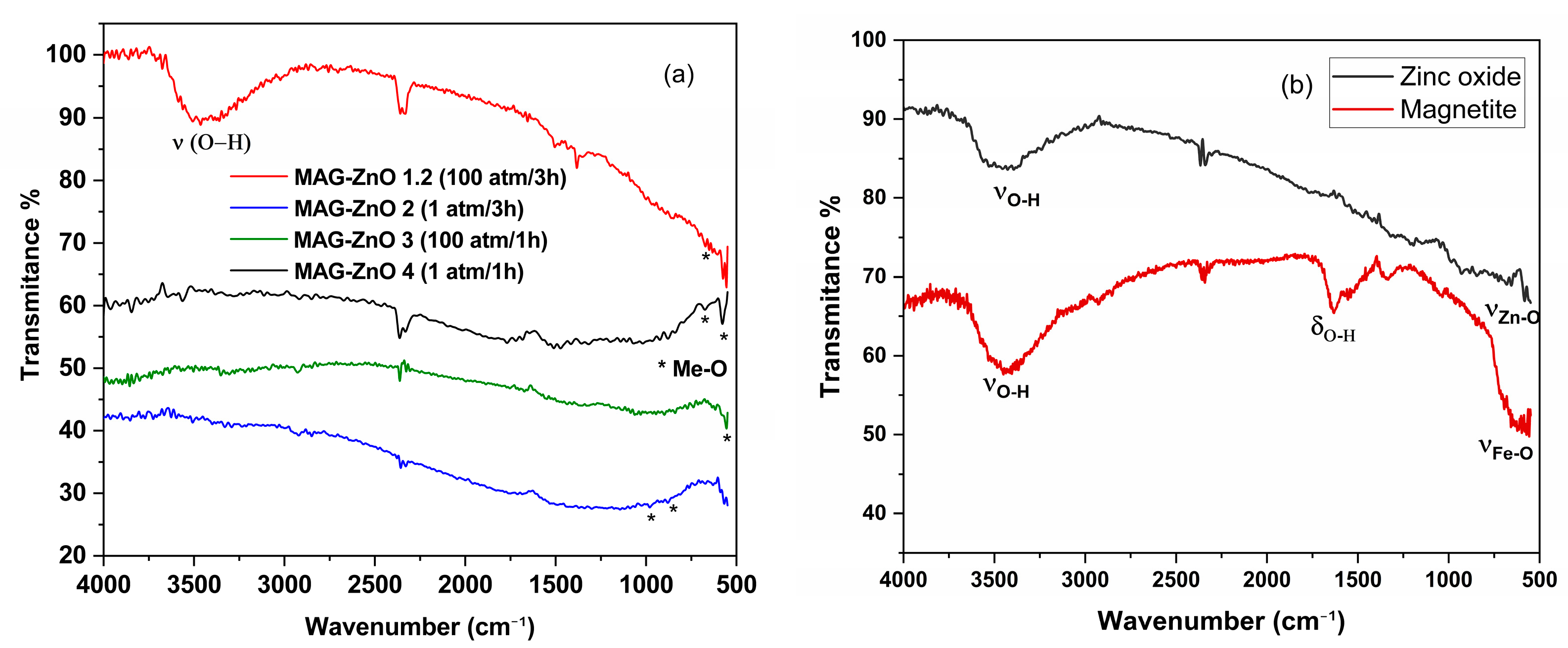
Infrared spectra of magnetite–zinc oxide nanocomposites, characterized by FT-IR spectroscopy in the range of the wavenumber of 500–4000 cm−1, are shown in Figure 1. This characterization was used to investigate functional groups of the Fe3O4-ZnO composites.
Figure 1. FT-IR spectra (a) of magnetite–zinc oxide nanostructured samples and (b) of pure zinc oxide and pure magnetite, respectively.
A band specific to the OH group (ν O–H stretching vibration at 3508 cm−1) can be observed in samples MAG-ZnO 1.2, prepared at 100 atm for 3 h. The Me-O bond (bending vibrations at 555 and 579 cm−1) has been detected in all samples, where “Me” represents the metal (iron and/or zinc). The absorption peak that can be observed around 2360 cm−1 in most of the samples is assigned to carbon dioxide stretching vibration (ν CO2) in the air.
The FT-IR spectra obtained for zinc oxide (ZnO) and magnetite (Fe3O4) samples highlight the characteristic bands of each phase. In the 3350–3400 cm−1 region, a broad band is observed, attributed to the ν O–H stretching vibrations, associated with adsorbed water molecules and hydroxyl groups. Also, around 1630–1650 cm−1, the δ O–H deformation vibrations are noted, confirming the presence of moisture retained by the material.
For ZnO, the characteristic band corresponding to the stretching vibrations of the Zn–O bond appears in the low region of the spectrum, between 400 and 680 cm−1, which confirms the presence of the wurtzite structure. In the case of magnetite, the specific signature is represented by the intense Fe–O stretching band, located in the range of 550–600 cm−1, attributed to the vibrations of the Fe3O4 spinel network.
An additional signal, present in most spectra around 2360 cm−1, is associated with stretching vibrations of carbon dioxide molecules (ν CO2) from the atmosphere that are adsorbed on the surface of the samples.
Thus, comparative FT-IR analysis of nanostructured composite magnetite–zinc oxide and pure magnetite and zinc oxide, respectively, confirms the presence of zinc oxide and magnetite phases, as well as the existence of hydroxyl groups and adsorbed water and CO2 molecules, which can influence the surface behavior. These functional groups give the materials hydrophilicity and functionalization potential, a crucial aspect for biomedical applications (drug delivery systems, biomaterials with antimicrobial properties, magneto-photocatalytic applications).

3.2. XRD Characterization

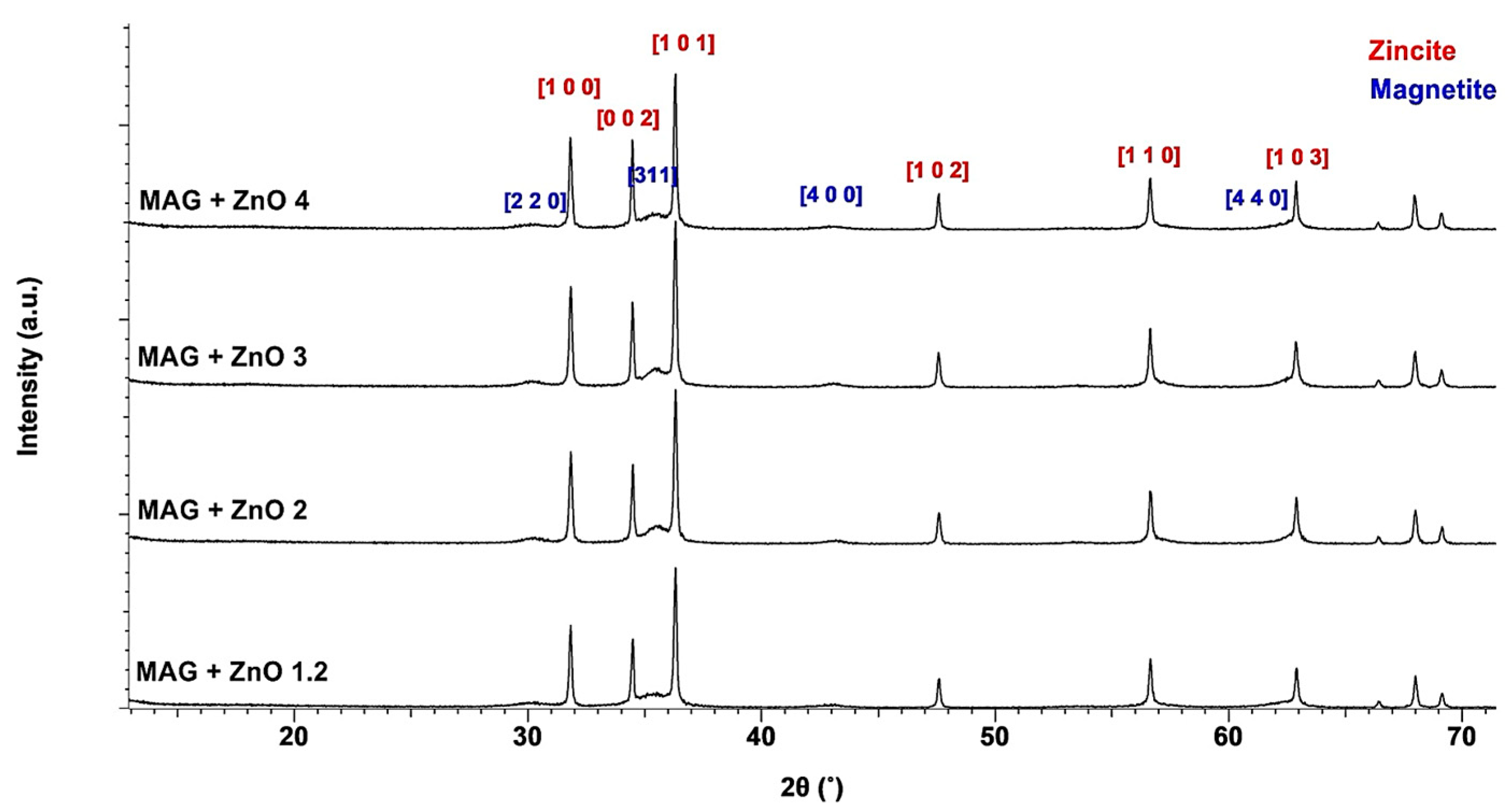
X-ray diffraction characterization of the samples shown in Figure 2 revealed the presence of crystalline phases of zinc oxide hexagonal structure (zincite, PDF Reference 04-015-4060) and magnetite cubic structure (PDF Reference 04-008-4511).
Figure 2. XRD patterns of MAG-ZnO samples.
The XRD patterns exhibit distinct ZnO peaks at 31.79° (100), 34.52° (002), 36.36° (101), 47.65° (102), 56.73° (110), and 62.97° (103). The reflections at 30.23° (220), 35.35° (311), 42.87° (400), and 62.44° (440) correspond to the Fe3O4 crystalline phase.
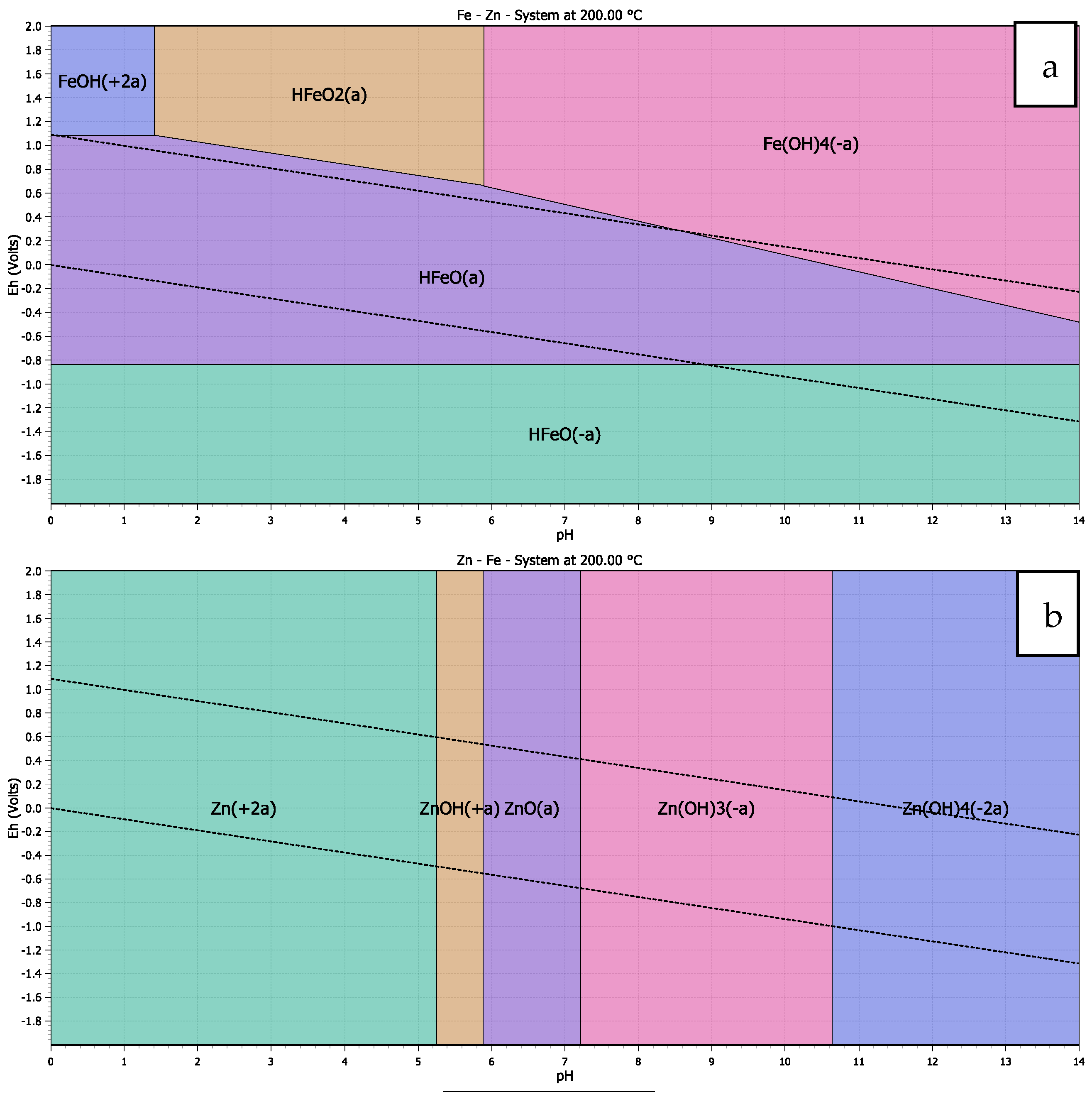
XRD analysis confirmed the presence of crystalline phases of hexagonal zinc oxide and cubic magnetite [35], the material presenting a ZnO–Fe3O4 biphasic structure [32,36], magnetite having a cubic spinel structure, while the zinc oxide particles have a wurtzite hexagonal structural model [32]. Using HSC 10 Chemistry™ Software (METSO, Espoo, Finland) (version 10.4.1.0), the stabilities of ionic and non-ionic species of zinc and iron in water solutions at 200 °C and 100 atm, which are critical to understand problems of dissolution and selective precipitation, were determined (Figure 3).
Figure 3. Eh-pH diagrams at 200 °C and 100 atm for: (a) Fe in the presence of Zn; (b) Zn in the presence of Fe.
The stability diagrams represented in Figure 3 highlight the coexistence, under hydrothermal conditions, of zinc and iron hydroxides, which can react to form the spinel structure ZnFe2O4. The formation of the spinel structure is also confirmed by the presence of the peak at 35.5° (311) in Figure 2 [37]. The crystallite size of ZnO in the (100) direction varies between 52 and 61 nm, as presented in Table 2.
Table 2. Results obtained from the characterization of powders by X-ray diffraction.

3.3. SEM Characterization

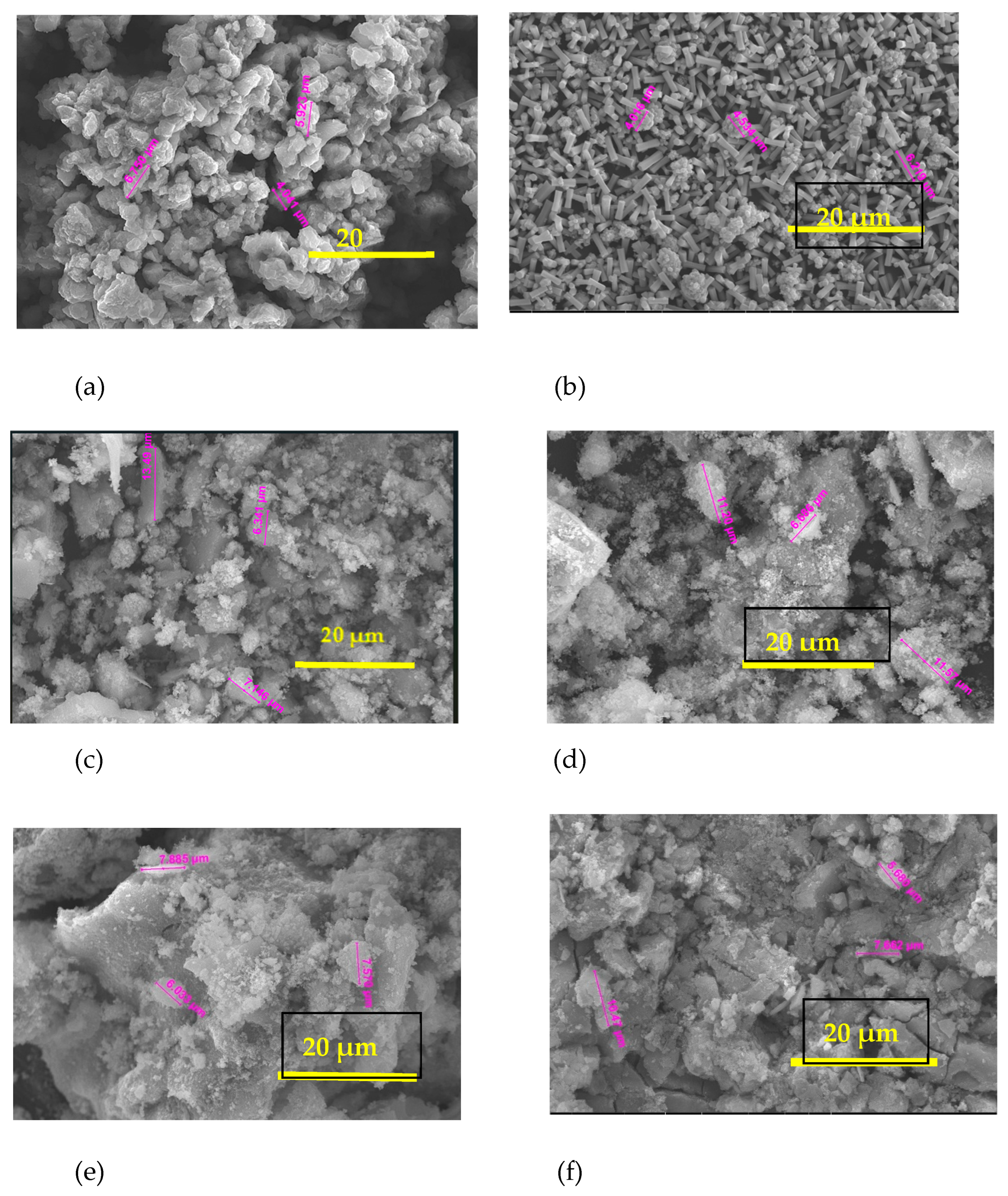
SEM images of Fe3O4-ZnO composite powders are presented in Figure 4 in comparison with single Fe3O4 and ZnO powders prepared in similar conditions.
Figure 4. SEM micrographs of MAG-ZnO samples comparing to pure magnetite (MAG) and ZnO respectively: (a) MAG (100 atm/1 h); (b) ZnO (100 atm/3 h); (c) MAG-ZnO 1.2 (100 atm/3 h); (d) MAG-ZnO 2 (1 atm/3 h); (e) MAG-ZnO 3 (100 atm/1 h); (f) MAG-ZnO 4 (1 atm/1 h).
In Figure 4a, it can be observed that the typical morphology of agglomerated nanopowders of magnetite is prepared by hydrothermal synthesis. Similar agglomerated morphology for magnetic nanoparticles was described in [38].
SEM analysis of magnetite, zinc oxide, and magnetite/ZnO nanocomposite samples revealed an aggregated, polydisperse morphology, with average agglomerate sizes in the range of 5–10 μm. Both magnetite and zinc oxide show a tendency to form hierarchical structures, where primary (submicron) crystallites organize into micrometric particles and subsequently into larger agglomerates. The SEM image for ZnO, which consists of nano-rods and small, flower-like, agglomerated nanoparticles, is shown in Figure 3b. All Fe3O4-ZnO composite samples show irregularly shaped granular aggregates with dimensions in the order of tens of micrometers. The combination of Fe3O4 and ZnO formation during hydrothermal synthesis leads to aggregates made up of prismatic particles, trapped in a finely crystallized matrix. Magnetite/ZnO composites show larger agglomerates (7–10 μm) and a rough, porous surface, suggesting a direct interaction between the two phases.

3.4. Particle Size Analysis by Dynamic Light Scattering (DLS)

The distribution of particle sizes obtained by the DLS technique is a function of the relative intensity of light scattered by particles of different dimensional classes. The time dependence of the fluctuations in the intensities is measured to determine the translational diffusion coefficient (D) and the hydrodynamic diameter (DH). η represents the viscosity of the analyzed suspension. The hydrodynamic diameter is calculated with the Einstein–Stokes equation:
D H = k T 3 π η D
The result is a distribution of intensity.
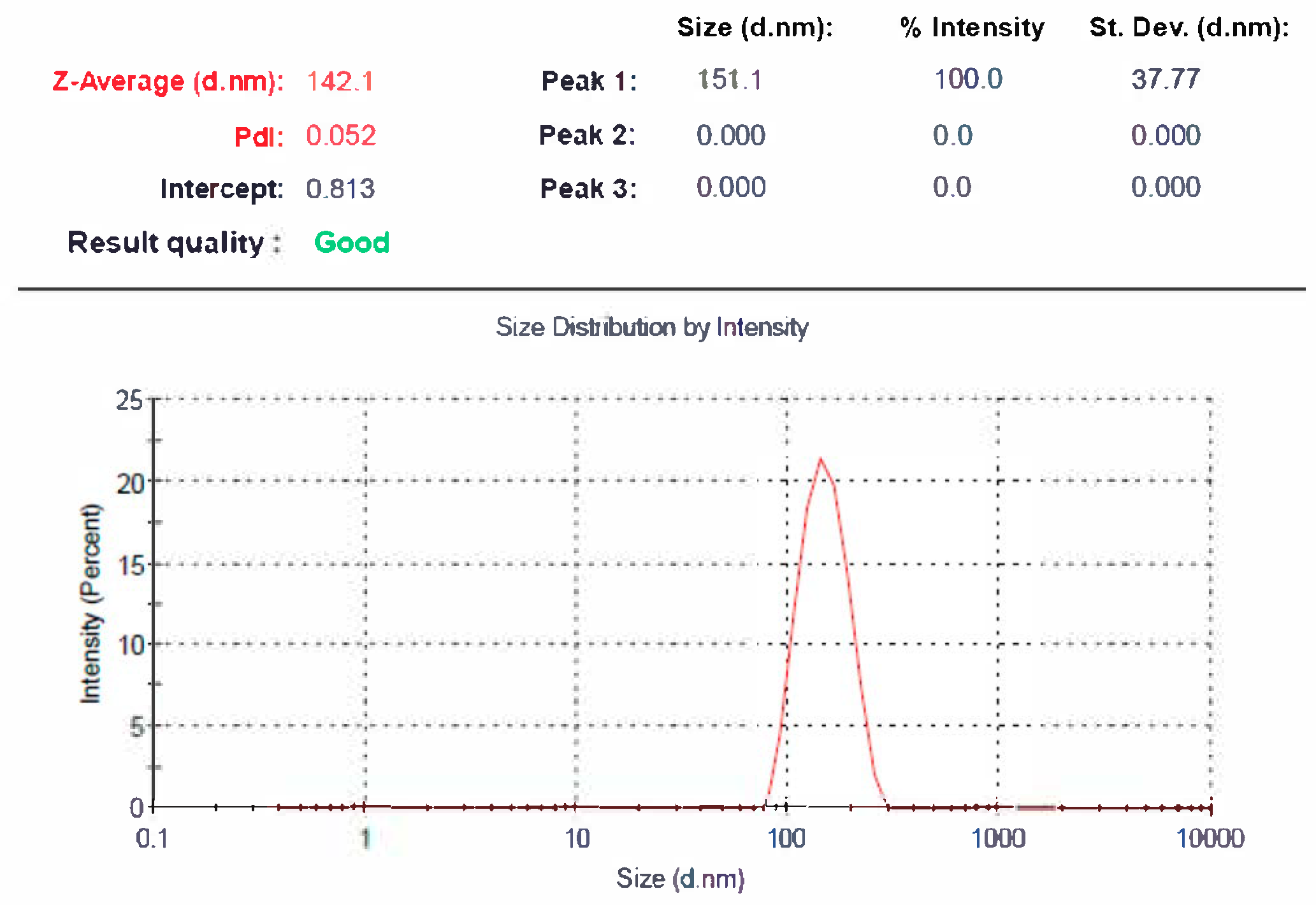
The characterization of stable suspensions based on magnetite and zinc oxide by the DLS method showed that the average particle sizes vary between 142.1 nm (in the case of sample MAG-ZnO 1.2, synthesized at 100 atm for 3 h) and 180 nm (for sample MAG-ZnO 4, synthesized at 1 atm pressure for 1 h), while the polydispersity index (PdI) is between 0.052 (MAG-ZnO 1.2) and 0.199 (MAG-ZnO 4).
The results obtained are presented in Table 3 and Figure 5.
Table 3. The average particle sizes of MAG-ZnO analyzed by the DLS technique.
Figure 5. An example of particle size distribution (sample MAG-ZnO 1.2).

3.5. Characterization of the Specific Surface Area (SSA) Using the BET Method

Table 4 shows the results of the BET measurements for all the investigated samples, based on magnetite and zinc oxide.
Table 4. Specific surface area of Fe3O4-ZnO powders.
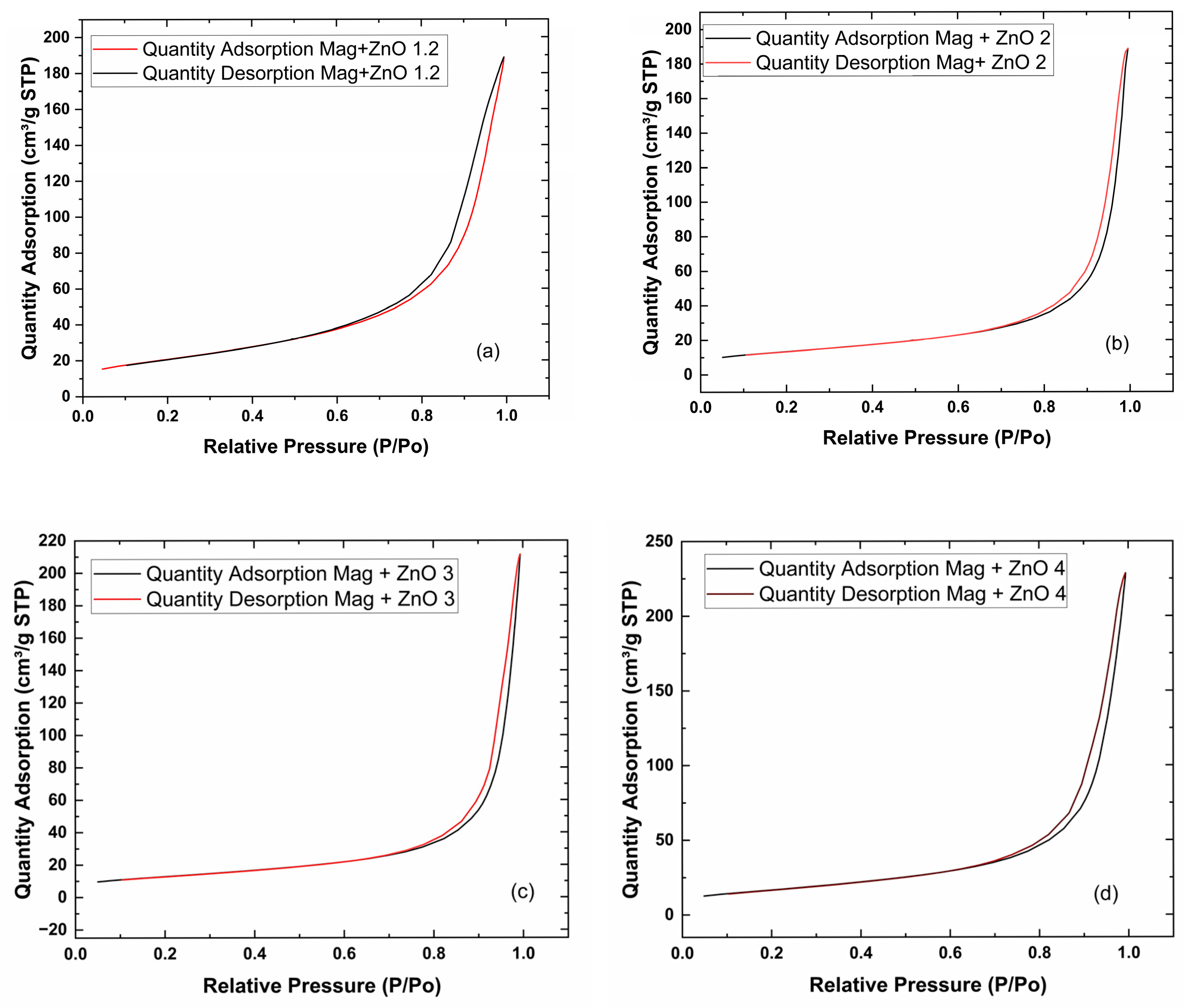
It can be seen that the largest specific surface area (74.92 m2/g) was obtained in the case of the MAG-ZnO 1.2 sample, synthesized at 200 °C, for 3 h, at an applied pressure of 100 atm. In the case of the MAG-ZnO 2 sample, synthesized under the same conditions as MAG-ZnO 1.2, at autogenous pressure, a smaller specific area (47.83 m2/g) is obtained. The smallest specific surface area was obtained in the case of the MAG-ZnO 3 sample, synthesized at 200 °C for one hour at a pressure of 100 atm (45.69 m2/g). Adsorption–desorption isotherms of MAG-ZnO samples are presented in Figure 6.
Figure 6. Adsorption–desorption isotherms of MAG-ZnO samples: (a) MAG-ZnO 1.2 (100 atm/3 h); (b) MAG-ZnO 2 (1 atm/3 h); (c) MAG-ZnO 3 (100 atm/1 h); (d) MAG-ZnO 4 (1 atm/1 h).
The shape of the curves is typical of type III isotherms, which describes a situation in gas–solid adsorption where there is a strong attractive interaction between adsorbate molecules and a weak interaction between the adsorbate and the adsorbent surface. Type III isotherms are not very common and are often seen with chemically hydrophobic surfaces or with extremely weak gas–solid interactions. This leads to a curve that is convex to the pressure axis, indicating unrestricted multilayer formation, rather than a distinct monolayer characteristic of non-porous or macroporous materials. This is essential for applications such as heavy metal adsorption, medicines, and catalysis, among others. The addition of ZnO to magnetite appears to significantly increase the adsorption capacity. ZnO probably contributes to the formation of porous structures (e.g., nanoflowers, nanoparticles, etc.), increasing the total specific surface area, creating complex arrangements of the nanostructures ZnO being precipitated on a high surface area substrate, magnetite [39].
Thus, the hydrothermal synthesis of magnetite/ZnO composites has proven to be effective for obtaining nanostructured materials with a large surface area and adequate porosity, suitable for applications in fields such as contaminant adsorption, catalysis, or medicine.

4. Conclusions

In this study, Fe3O4-ZnO composite powders were prepared by the hydrothermal method at 200 °C for 1 h or 3 h and at variable pressures (100 atm or autogenous pressure). The formation of crystalline phases of zinc oxide and magnetite was confirmed by XRD characterization. FT-IR measurements revealed typical metal–oxygen bonds around 500–600 cm−1. Composite powders consist of agglomerated nanoparticles having a 50–60 nm crystallite size of ZnO (as calculated based on XRD characterization). The hydrodynamic diameter of composite powders varies between 140 and 180 nm, and particle sizes have a monomodal distribution. Fe3O4-ZnO composites have a mesoporous character, and the biggest surface area of ~75 m2/g was obtained for samples prepared at 200 °C/100 atm/3 h.
Based on the textural characterization of the magnetite–zinc oxide composite powders by the BET method, the following key results were obtained:
  • All samples present type III adsorption isotherms with hysteresis loops, specific to non-porous or macroporous materials. Pore dimensions were between 16 and 20 nm.
  • Comparatively, sample MAG-ZnO 1 (BET specific surface area: 74.92 m2/g) exhibits the most favorable combination of high specific surface area and small particles, making it recommended for applications requiring a high degree of adsorption or surface activity (e.g., catalysis, water purification, functional magnetic systems, medical applications).
Further work is in progress to accurately determine the biological behavior of magnetite and zinc oxide-based nanocomposites.

Author Contributions

Conceptualization, L.-M.C., R.M.P., and A.-G.Ș.; methodology, R.M.P.; investigation, M.-A.I., M.-N.C., A.C.M., and D.V.D.; resources, I.A.T.; writing—original draft preparation, M.-A.I.; writing—review and editing, L.-M.C. and R.M.P.; supervision, A.-G.Ș.; project administration, I.A.T.; funding acquisition, R.M.P. All authors have read and agreed to the published version of the manuscript.

Funding

This research was funded by the National Authority for Research, Core Program 5N/01.01.02023-ENERCLEAN, grant number PN 23250202/2023. The APC was funded by PN 23250202/2023.

Data Availability Statement

The original contributions presented in the study are included in the article. Further inquiries can be directed to the corresponding author.

Conflicts of Interest

The authors declare no conflicts of interest.

References

  1. Watermann, A.; Brieger, J. Mesoporous silica nanoparticles as drug delivery vehicles in cancer. Nanomaterials 2017, 7, 189. [Google Scholar] [CrossRef] [PubMed]
  2. Persea, A.M. Melanoma epidemiology and early detection in Europe: Diversity and disparities. Dermatol. Pract. Concept. 2020, 10, e2020033. [Google Scholar]
  3. Montiel Schneider, M.G.; Martín, M.J.; Otarola, J.; Vakarelska, E.; Simeonov, V.; Lassalle, V.; Nedyalkova, M. Biomedical applications of iron oxide nanoparticles: Current insights progress and perspectives. Pharmaceutics 2022, 14, 204. [Google Scholar] [CrossRef]
  4. Dildar, M.; Akram, S.; Irfan, M.; Khan, H.U.; Ramzan, M.; Mahmood, A.R.; Mahnashi, M.H. Skin cancer detection: A review using deep learning techniques. Int. J. Environ. Res. Public Health 2021, 18, 5479. [Google Scholar] [CrossRef]
  5. Auffan, M.; Rose, J.; Bottero, J.Y.; Lowry, G.V.; Jolivet, J.P.; Wiesner, M.R. Towards a definition of inorganic nanoparticles from an environmental, health and safety perspective. Nat. Nanotechnol. 2009, 4, 634–641. [Google Scholar] [CrossRef]
  6. Perez, J.M. Hidden talent. Nat. Nanotechnol. 2007, 2, 535–536. [Google Scholar] [CrossRef]
  7. Yousefi, A.M.; Pourbagheri-Sigaroodi, A.; Fakhroueian, Z.; Salari, S.; Fateh, K.; Momeny, M.; Bashash, D. Anticancer Effects of ZnO/CNT@Fe3O4 in AML-Derived KG1 Cells: Shedding Light on Promising Potential of Metal Nanoparticles in Acute Leukemia. Int. J. Hematol.-Oncol. Stem Cell Res. 2022, 16, 140. [Google Scholar] [CrossRef] [PubMed]
  8. Chernavskiy, P.A.; Novakova, A.A.; Pankina, G.V.; Pankratov, D.A.; Panfilov, S.I.; Petrovskaya, G.A. Synthesis and Characterization of Hematite, Magnetite and Maghemite Supported on Silica Gel. Magnetochemistry 2023, 9, 228. [Google Scholar] [CrossRef]
  9. Cornell, R.M.; Schwertmann, U. The Iron Oxides: Structure, Properties, Reactions, Occurrences, and Uses; Wiley-vch: Weinheim, Germany, 2003; Volume 664. [Google Scholar]
  10. Nguyen, M.D.; Tran, H.V.; Xu, S.; Lee, T.R. Fe3O4 nanoparticles: Structures, synthesis, magnetic properties, surface functionalization, and emerging applications. Appl. Sci. 2021, 11, 11301. [Google Scholar] [CrossRef]
  11. Kozlenko, D.P.; Dubrovinsky, L.S.; Kichanov, S.E.; Lukin, E.V.; Cerantola, V.; Chumakov, A.I.; Savenko, B.N. Magnetic and electronic properties of magnetite across the high-pressure anomaly. Sci. Rep. 2019, 9, 4464. [Google Scholar] [CrossRef] [PubMed]
  12. Hadadian, Y.; Masoomi, H.; Dinari, A.; Ryu, C.; Hwang, S.; Kim, S.; Cho, B.; Lee, J.Y.; Yoon, J. From low to high saturation magnetization in magnetite nanoparticles: The crucial role of the molar ratios between the chemicals. ACS Omega 2022, 7, 15996–16012. [Google Scholar] [CrossRef]
  13. Shokrollahi, H. A review of the magnetic properties, synthesis methods and applications of maghemite. J. Magn. Magn. Mater. 2017, 426, 74–81. [Google Scholar] [CrossRef]
  14. Jubb, A.M.; Allen, H.C. Vibrational spectroscopic characterization of hematite, maghemite, and magnetite thin films produced by vapor deposition. ACS Appl. Mater. Interfaces 2010, 2, 2804–2812. [Google Scholar] [CrossRef]
  15. Baabu, P.R.S.; Kumar, H.K.; Gumpu, M.B.; Babu, K.J.; Kulandaisamy, A.J.; Rayappan, J.B.B. Iron oxide nanoparticles: A review on the province of its compounds, properties and biological applications. Materials 2022, 16, 59. [Google Scholar] [CrossRef] [PubMed]
  16. Singh, R.; Verma, K.; Patyal, A.; Sharma, I.; Barman, P.B.; Sharma, D. Nanosheet and nanosphere morphology dominated photocatalytic & antibacterial properties of ZnO nanostructures. Solid State Sci. 2019, 89, 1–14. [Google Scholar] [CrossRef]
  17. Rastgoo, M.; Montazer, M.; Harifi, T.; Rad, M.M. In-situ sonosynthesis of cobblestone-like ZnO nanoparticles on cotton/polyester fabric improving photo, bio and sonocatalytic activities along with low toxicity and enhanced mechanical properties. Mater. Sci. Semicond. Process. 2017, 66, 92–98. [Google Scholar] [CrossRef]
  18. Azizi-Lalabadi, M.; Ehsani, A.; Divband, B.; Alizadeh-Sani, M. Antimicrobial activity of Titanium dioxide and Zinc oxide nanoparticles supported in 4A zeolite and evaluation the morphological characteristic. Sci. Rep. 2019, 9, 17439. [Google Scholar] [CrossRef]
  19. Paul, S.; Ban, D.K. Synthesis, characterization and the application of ZnO nanoparticles in biotechnology. Int. J. Adv. Chem. Eng. Biol. Sci. 2014, 1, 1–5. [Google Scholar] [CrossRef]
  20. Singh, R.P.; Shukla, V.K.; Yadav, R.S.; Sharma, P.K.; Singh, P.K.; Pandey, A.C. Biological approach of zinc oxide nanoparticles formation and its characterization. Adv. Mater. Lett. 2011, 2, 313–317. [Google Scholar] [CrossRef]
  21. Ioța, M.A.; Cursaru, L.M.; Șchiopu, A.G.; Tudor, I.A.; Motoc, A.M.; Piticescu, R.M. Fe3O4 Core-shell nanostructures with anticancer and antibacterial properties: A Mini-review. Processes 2023, 11, 1882. [Google Scholar] [CrossRef]
  22. Nadeem, T.; Kaleem, M.; Minhas, L.A.; Batool, S.; Sattar, M.M.; Bashir, R.; Mumtaz, A.S. Biogenic synthesis and characterization of antimicrobial, antioxidant, and antihemolytic zinc oxide nanoparticles from Desertifilum sp. TN-15 cell extract. Discov. Nano 2024, 19, 161. [Google Scholar] [CrossRef]
  23. Yang, X.; Liu, L.; Chen, C.; Liao, L.; Huang, S. Green Preparation of ZnO Nanoparticles Using Citrus aurantium L. Extract for Dye Adsorption, Antibacterial, and Antioxidant Activities. Separations 2025, 12, 18. [Google Scholar] [CrossRef]
  24. Rodríguez-Castellanos, A.I.; Moncada-Castellanos, M.E.; Limas-Lopez, G.N.; Martínez-Henríquez, K.; Fodil, N.; Rivera-Flores, O.; Sánchez-Barahona, M.; Romero, A.; Abdullah, J.A.A. Synergistic antioxidant and preservative potential of tomato extract–magnetic iron oxide nanoparticles in bio-coating and food applications. Coatings 2023, 14, 8. [Google Scholar] [CrossRef]
  25. Eldeeb, B.A.; El-Raheem, W.M.A.; Elbeltagi, S. Green synthesis of biocompatible Fe3O4 magnetic nanoparticles using Citrus sinensis peels extract for their biological activities and magnetic-hyperthermia applications. Sci. Rep. 2023, 13, 19000. [Google Scholar] [CrossRef]
  26. Elbrolesy, A.; Elhussiny, F.A.; Abdou, Y.; Morsy, R. Facile synthesis and biophysical characterization of novel zinc oxide/Fe3O4 hybrid nanocomposite as a potentially active agent in sunscreens. Arab. J. Sci. Eng. 2024, 49, 1083–1093. [Google Scholar] [CrossRef]
  27. Laurent, S.; Forge, D.; Port, M.; Roch, A.; Robic, C.; Vander Elst, L.; Muller, R.N. Magnetic iron oxide nanoparticles: Synthesis, stabilization, vectorization, physicochemical characterizations, and biological applications. Chem. Rev. 2008, 108, 2064–2110. [Google Scholar] [CrossRef]
  28. Lee, N.; Yoo, D.; Ling, D.; Cho, M.H.; Hyeon, T.; Cheon, J. Iron oxide-based nanoparticles for multimodal imaging and magnetoresponsive therapy. Chem. Rev. 2015, 115, 10637–10689. [Google Scholar] [CrossRef] [PubMed]
  29. Masoudi, R.; Moghimi, H.; Azin, E.; Taheri, R.A. Adsorption of cadmium from aqueous solutions by novel Fe3O4-newly isolated Actinomucor sp. bio-nanoadsorbent: Functional group study. Artif. Cells Nanomed. Biotechnol. 2018, 46 (Suppl. S3), 1092–1101. [Google Scholar] [CrossRef] [PubMed]
  30. Gupta, R.; Sharma, D. Evolution of magnetic hyperthermia for glioblastoma multiforme therapy. ACS Chem. Neurosci. 2019, 10, 1157–1172. [Google Scholar] [CrossRef]
  31. Bahtiar, S.; Taufiq, A.; Utomo, J.; Hidayat, N. Structural characterizations of magnetite/zinc oxide nanocomposites prepared by co-precipitation method. IOP Conf. Ser. Mater. Sci. Eng. 2019, 515, 012076. [Google Scholar] [CrossRef]
  32. El-Sawy, A.M.; Azab, H.M.; El-Sheikh, M.Y.; Ebid El, Z.M. Fe3O4@ZnO core-shell nanoparticle development for drug delivery application. Delta J. Sci. 2022, 45, 1–19. [Google Scholar]
  33. Loan, T.T.; Huy, D.K.; Chung, H.M.; Thanh, N.K.; Hoan, T.D.; Duong, N.P.; Soontaranon, S.; Klysubun, W. Structure and magnetic properties of magnetic iron oxide/zinc oxide core/shell nanocomposites: Effect of ZnO coating. Mater. Today Commun. 2021, 26, 101733. [Google Scholar] [CrossRef]
  34. Adschiri, T.; Hakuta, Y.; Arai, K. Hydrothermal Synthesis of Metal Oxide Fine Particles at Supercritical Conditions. Ind. Eng. Chem. Res. 2000, 39, 4901. [Google Scholar] [CrossRef]
  35. Raha, S.; Ahmaruzzaman, M. ZnO nanostructured materials and their potential applications: Progress, challenges and perspectives. Nanoscale Adv. 2022, 4, 1868–1925. [Google Scholar] [CrossRef] [PubMed]
  36. Zamiri, R.; Salehizadeh, S.A.; Ahangar, H.A.; Shabani, M.; Rebelo, A.; Kumar, J.S.; Soares, M.J.; Valente, M.A.; Ferreira, J.M.F. Optical and magnetic properties of ZnO/ZnFe2O4 nanocomposite. Mater. Chem. Phys. 2017, 192, 330–338. [Google Scholar] [CrossRef]
  37. Nikolic, M.V.; Vasiljevic, Z.Z.; Lukovic, M.D.; Pavlovic, V.P.; Krstic, J.B.; Vujancevic, J.; Tadic, N.; Vlahovic, B.; Pavlovic, V.B. Investigation of ZnFe2O4 Spinel Ferrite Nanocrystalline Screen-printed Thick Films for Application in Humidity Sensing. Int. J. Appl. Ceram. Technol. 2019, 16, 981–993. [Google Scholar] [CrossRef]
  38. Kimiagar, S.; Mirazimic, H. Hydrothermal synthesis of ZnO nanocomposites for removing fluoride from water. Prog. Phys. Appl. Mater. 2024, 4, 83–91. [Google Scholar]
  39. Puri, S.; Kalkan, A.K.; McIlroy, D.N. Hierarchical Design of High-Surface-Area Zinc Oxide Nanorods Grown on One-Dimensional Nanostructures. Science 2025, 7, 114. [Google Scholar] [CrossRef]
Disclaimer/Publisher’s Note: The statements, opinions and data contained in all publications are solely those of the individual author(s) and contributor(s) and not of MDPI and/or the editor(s). MDPI and/or the editor(s) disclaim responsibility for any injury to people or property resulting from any ideas, methods, instructions or products referred to in the content.

Article Metrics

Citations

Article Access Statistics

Multiple requests from the same IP address are counted as one view.