Abstract
The current framework tackles the buoyancy flow via a slender revolution bodies comprising Molybdenum-Disulfide Graphene Oxide generalized hybrid nanofluid embedded in a porous medium. The impact of radiation is also provoked. The outcomes are presented in this analysis to examine the behavior of hybrid nanofluid flow (HNANF) through the cone, the paraboloid, and the cylinder-shaped bodies. The opposing flow (OPPF) as well as the assisting flow (ASSF) is discussed. The leading flow equations of generalized hybrid nanoliquid are worked out numerically by utilizing bvp4c solver. This sort of the problem may meet in the automatic industries connected to geothermal and geophysical applications where the sheet heat transport occurs. The impacts of engaging controlled parameters of the transmuted system on the drag force and the velocity profile are presented through the graphs and tables. The achieved outcomes suggest that the velocity upsurges due to the dimensionless radius of the slender body parameter in case of the assisting flow and declines in the opposing flow. Additionally, an increment is observed owing to the shaped bodies as well as in type A nanofluid and type B hybrid nanofluid.
1. Introduction
The research regarding the convective-flow entrenched in porous media widely has been utilized owing to its vast engineering applications as solar collectors, heat exchangers, post-accidental heat exclusion in nuclear reactors, building construction, drying processes, oil recovery and geothermal, ground water pollution, etc. Nield [1] analyzed the liquid flow of stability ensuing through a vertical mass and thermal gradients via a horizontal-layer immersed in porous media. Bejan and Khair [2] explored the marvel of mass and heat transfer through a vertical sheet entrenched in a porous medium and they have taken unvarying concentration as well as temperature. The impact of mixed as well as free convective flows with heat transport through a slender revolution of the body in a porous medium was examined by Lai et al. [3] and they concluded that the temperature gradient shrinks due to dimensional radius. The thermal and mass diffusion through a cone embedded in porous medium was scrutinized by Yih [4]. Bano and Singh [5] explored the radiation influence on mass and heat transport from a radiated thin needle in a saturated porous medium by utilizing a technique of Von Karman-integral. Singh and Chandarki [6] inspected the free convective flow with mass and heat transfer through a vertical cylinder occupied in porous media. The mixed convective flow through a vertical flat surface in a porous medium with nanoliquid was examined by Ahmad and Pop [7]. Talebizadeh et al. [8] scrutinized the impact of radiation on natural convective flow through a porous vertical surface and found numerical as well as exact solutions. Moghimi et al. [9] discussed the MHD (magnetohydrodynamic) influence on natural convective flow via a sphere saturated in a porous medium. Moghimi et al. [10] obtained an exact solution of flow through a flat surface with constant heat flux and slip effect by utilizing DQM (differential quadrature method) and HAM (homotopy analysis method). Raju and Sandeep [11] inspected the magnetic influence on flow of mass and heat transport containing Casson fluid through a rotated vertical cone/plate in porous media with micro-organisms. They perceived that the mass and heat transfer from a cone is superior compared to flow over a plate. Raju et al. [12] applied the Buongiorno model to inspect the phenomenon of mass and heat transport through a radiated revolution slender body in porous media. They perceived that the behavior of temperature shrinks in a flow revolution over a cone compared to flow revolution through the cylinder and paraboloid.
Several recent explorations divulged that nanofluids have superior capability of heat transport than convectional fluids. Thus, it is likely to swap conventional heat transport fluids via nanofluids in the numerous designs of heat transport like heat exchanger, heat generators, and cooling systems. Choi [13] observed that, by scattering metallic nanometer sized particles in regular heat transport liquids, the ensuing nanoliquids hold greater thermal conductivity than those of presently utilized ones. Further, Eastman et al. [14] discovered that the shape of the particle has a stronger effect on nanofluid effective thermal conductivity than the size of particle or thermal conductivity of the particle. To augment the nanofluids heat transport owing to nanoparticles migration and the resulting boundary-layer disturbance was experimentally examined by Wen and Ding [15]. The Boltzmann technique to inspect the magnetic impact on the natural convective flow comprising nanoliquid through a cylindrical annulus was studied by Ashorynejad et al. [16]. The impact of distinct shapes of nanoscale particles in EG (entropy generation) based aqueous solution was inspected by Ellahi et al. [17]. Inspired by the importance of nanofluids, several researchers recently were engaged with the debate of flow with heat transport to nanoliquids via different perspective [18,19,20,21].
Recently, a novel type of fluid, suggested hybrid nanofluids has been utilized to augment the heat transport in applications of thermal [22,23,24]. Hybrid nanoliquids consist of two or more different nanoparticles in either mixture of non-composite forms. Hybrid nanofluids envisages in the fields of heat transport as electronic and generator cooling, thermal storage, biomedical, cooling of transformer, lubrication, solar heating, spacecraft and aircraft, welding, protection, refrigeration, and heat pump. Minea [25] inspected the estimations of distinct viscosity of hybrid nanoliquid by scattering the water-based TiO2, Al2O3, and SiO2 nanomaterials. The impact of nonlinear radiation on the magneto flow of micropolar hybrid (Cu-Al2O3) dusty nanofluid from a stretched sheet was examined by Ghadikolaei et al. [26]. Sheikoleslami et al. [27] scrutinized the modeling of the porous domain with Lorentz forces and radiation impact and obtained the solution by CVFEM (control volume based finite element method). They explored that temperature gradient has greater influence due to the greater buoyancy parameter. Gholinia et al. [28] inspected the steady magneto flow of hybrid CNTs (carbon nanotubes) nanofluid over a permeable stretched cylinder. Recently, Khan et al. [29] discussed the influence of magnetic function comprising ethylene glycol-based hybrid nanofluid from a stretched/shrinking wedge with mixed convection and stability analysis performed.
The earlier review literature reveals that the mixed convective generalized hybrid (MoS2-Go) nanofluid flow through a slender revolution bodies in porous media has been highlighted as a mostly unknown area. The radiation impact with generalized hybrid single phase model is discussed here, which is not considered in the earlier published results [7,11]. The leading PDEs (partial differential equations) are altered into ODEs (ordinary differential equation) through suitable transformations and then tackled via three stage Lobatto formula. Impacts of the pertinent variables are portrayed and investigated through the graphs.
2. Problem Formulation
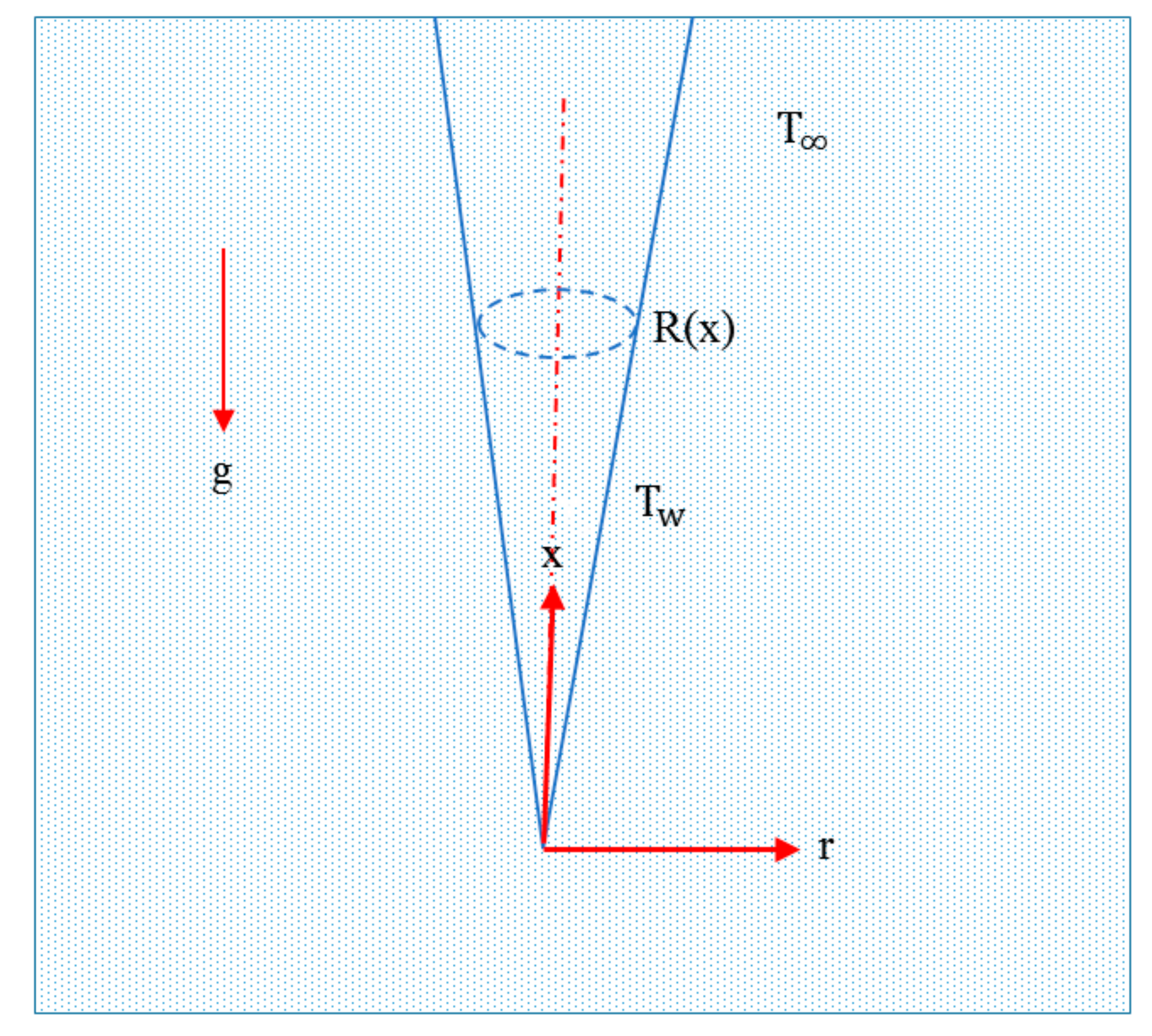
In the current exploration, the buoyancy flow through a slender revolution bodies containing Molybdenum-Disulfide Graphene Oxide along with the generalized hybrid nanofluid entrenched in a saturated porous medium is shown schematically in Figure 1. To optimize the heat transport, the impact of radiation in the occurrence of the opposing and the assisting flows is analyzed. It is assumed that the ambient velocity is considered as with constant , while the constant free stream temperature. The temperature of the slender revolution body is taken as with utilizes for (ASSF) and uses for (OPPF). The system of coordinate from the slender body vortex is at origin, while the distance along the revolution body and normal to the slender revolution body is presented by the cylindrical coordinate . Applying the single-phase model suggested by the Tiwari and Das [30] with the approximations of Boussinesq and boundary layer scaling, the leading equations are
with the corresponding boundary conditions
Figure 1.
Physical diagram of the problem.
Integrating Equation (2) and utilizing Equation (4), it becomes
Here , signify Darcy’s law velocity components in directions, temperature of the hybrid nanofluid, acceleration owing to gravity, hybrid viscosity, base fluid viscosity, permeability of the porous medium, hybrid nanofluid thermal conductivity, hybrid nanofluid heat capacitance, hybrid nanofluid thermal expansion, and surface shape of the axisymmetric body.
For radiation effect, the Rosseland approximation is illustrated as
where and signify coefficient of mean absorption and Stefan–Boltzmann, respectively. Applying Taylor series to expand about and prohibiting the terms involving higher-order, one gets
The similarity variables for further analysis are introduced as
Equation (1) is identically true and Equation (3) and Equation (5) are transformed to
It is perceptible that Equation (9) and Equation (10) will consent the similarity solutions if the power of in Equation (9) disappears, i.e.,:
With this classified condition, Equation (9) can be rewritten as
where the dimensionless constraint involved in the aforementioned equations is mathematically expressed as
and the interpretation of these constraints are the mixed convection parameter, the local Rayleigh number for a porous medium, the Peclet number, the Prandtl number and the radiation parameter, respectively.
Placing , where is constant and utilized for a slender body, it is numerically small. Equation (9) stipulated the body size as well as body shape with surface is defined via
The problems concerning the realistic interest, the amount of For instance, , and represent the cylinder, paraboloid, and cone shape bodies.
The boundary restrictions are
If Equation (10) and Equation (12) are merged, one gets
along with the modified boundary restrictions
The quantities of practical interest and to measure the liquid behaviors is the skin friction which is explained as
The skin friction in the dimensional form is
3. Model of Generalized Hybrid Nanoliquid
In numerical and experimental investigations on the behaviors of nanofluid, modeling their physical quantities using condensed mathematical relationships between solid particles and regular liquid is a common procedure. Numerous experiments have been performed to validate such terms for nanofluids dilute in scattering of a single sort of solid material [31] and mixtures of two kinds of particles (Suresh et al. [32]). Devi and Devi [33] recommended a collection of correlation for hybrid nanofluid physical-quantities. They approached the liquid involving a single sort of nanoparticle as the regular liquid and the other sort of nanoparticle as the individual particle. The relationship of thermal conductivity and viscosity matched Suresh et al.’s [32] experimental outcomes. In the approach of Devi and Devi [33], there exists the non-linear terms owing to the communication of two sorts of distinct nanoparticles. However, in dilute mixtures where the volumetric fractions of nanoparticle are generally tiny, the impacts of these non-linear conditions may not be important. Thus, it realistically ignores the non-linear terms in the model of Devi and Devi. The hybrid nanofluid model in simplified form and the models of normal nanofluid and Devi and Devi are scheduled in Table 1, where Type A signifies the conventional nanoliquid model, Types B and C, respectively; indicate the hybrid nanoliquid model of Devi and Devi and the model of hybrid nanoliquid in simplified form. Devi and Devi [33] used the approach of the recurrence formulae to signify the density, viscosity, thermal conductivity, and specific heat of the hybrid nanoliquid related generally to the N-th type of nanoparticles as
Table 1.
Thermo-physical models of nanofluid and hybrid nanofluid.
From the above correlations, ignoring the non-linear terms, one obtains
It is worth mentioning that for , we remain the recurrence Formula (21) because of the connections amid dissimilar particles can barely be uttered by the Maxwell equations. Additionally, throughout the research the values of is taken which implies that the shape of the particle is spherical.
4. Results and Discussion
The primary intention is to scrutinize the characteristics of generalized hybrid nanoliquid for the mixed convective flow comprising MoS2-Go nanoparticles through slender revolution bodies. The non-linear Equation (15) with boundary restrictions (Equation (16)) has been worked out numerically via Lobatto IIIa formula. The thickness of the boundary layer is considered as 30 for convergence of profiles asymptotically which is essential for this type of problem. Table 2 represents the thermo-physical characteristics of the base and nanofluids. The outcomes of the sundry parameters in the presence of the water-based fluid and the type B hybrid nanofluid on the field of velocity distribution and the skin friction have been examined in Figure 2, Figure 3, Figure 4, Figure 5, Figure 6, Figure 7, Figure 8, Figure 9, Figure 10, Figure 11, Figure 12 and Figure 13. For validation, the results of the current problem have been compared with the outcomes of Ahmad et al. [34] and Saleh et al. [35] as shown in Table 3. An excellent harmony is seen. Whereas the numerical values of types B and C hybrid nanofluid for (ASSF) as well as for (OPPF) are displayed in Table 4 and Table 5.
Table 2.
Thermo-physical properties of the base fluid and hybrid nanoparticles.
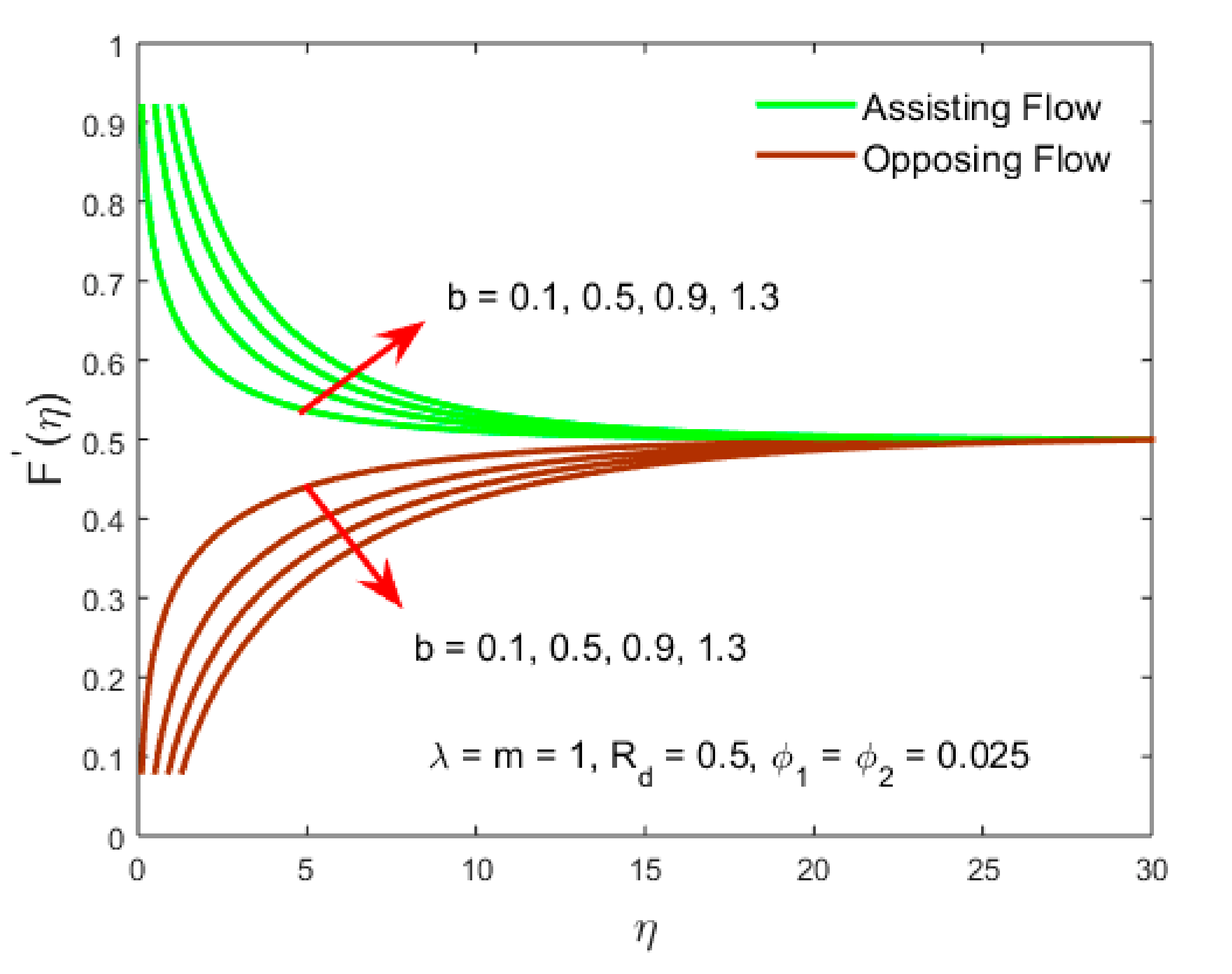
Figure 2.
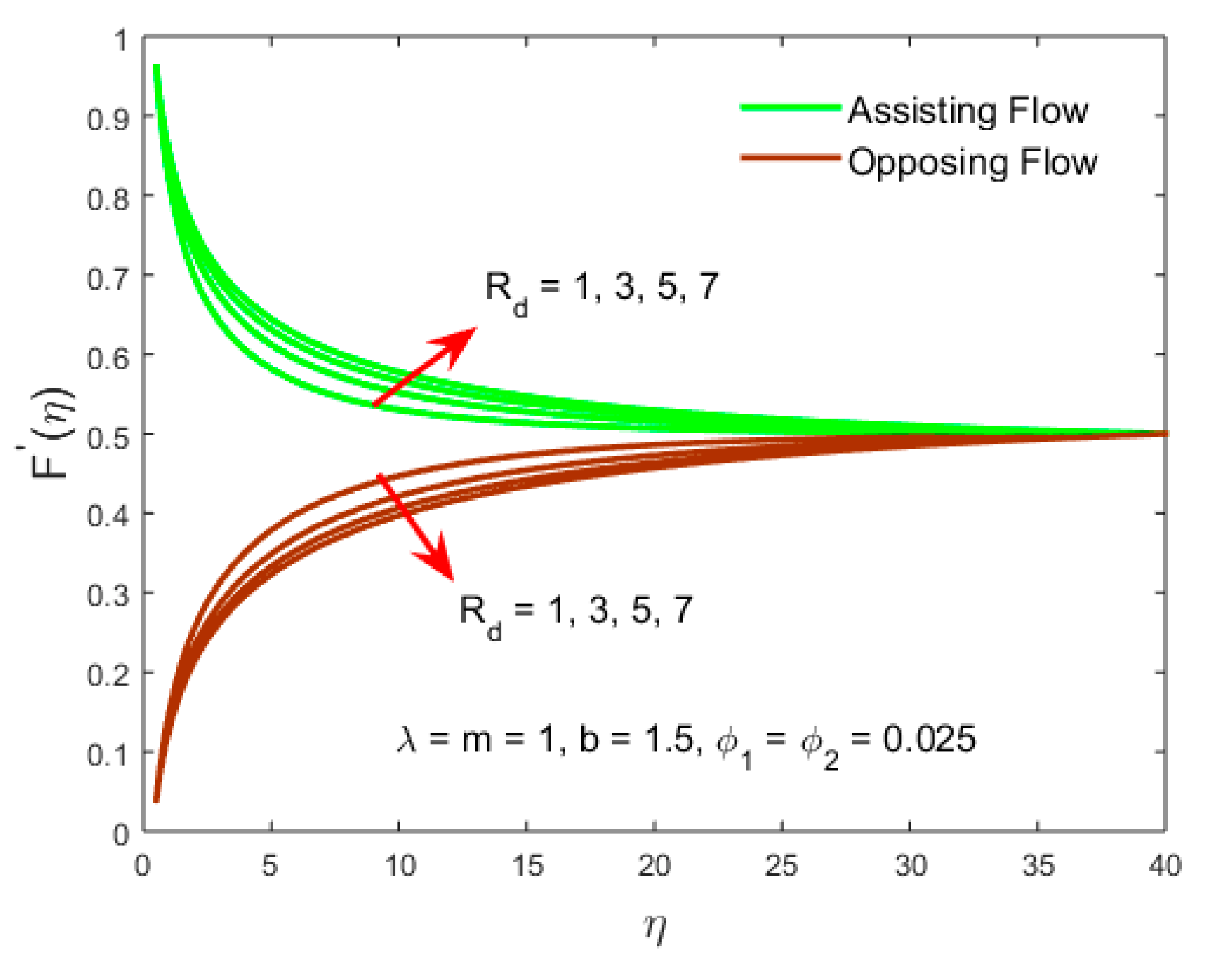
The variation of the velocity profile for the case of assisting and opposing flow versus the similarity variable for the distinct values of the dimensionless radius of the slender body parameter .
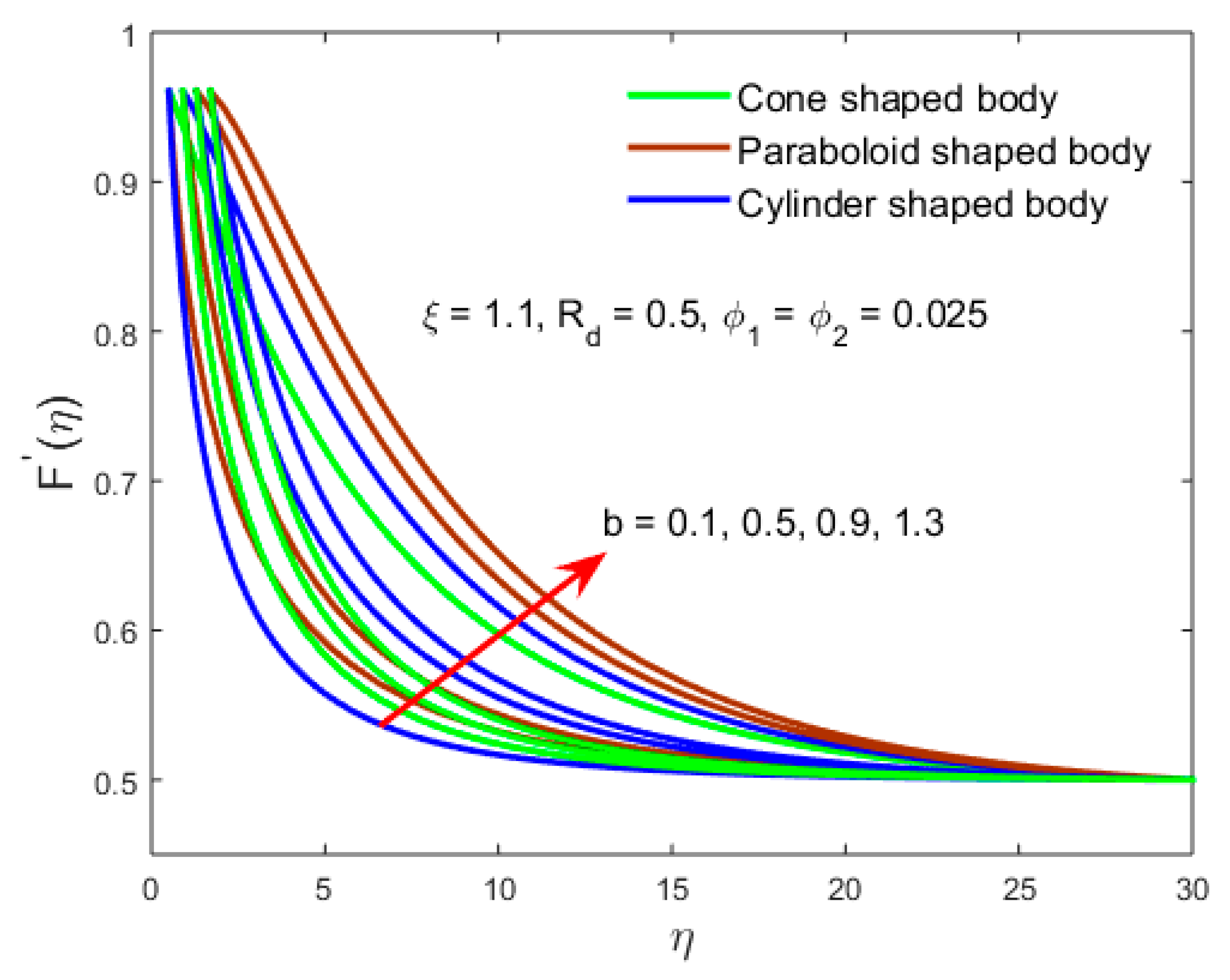
Figure 3.
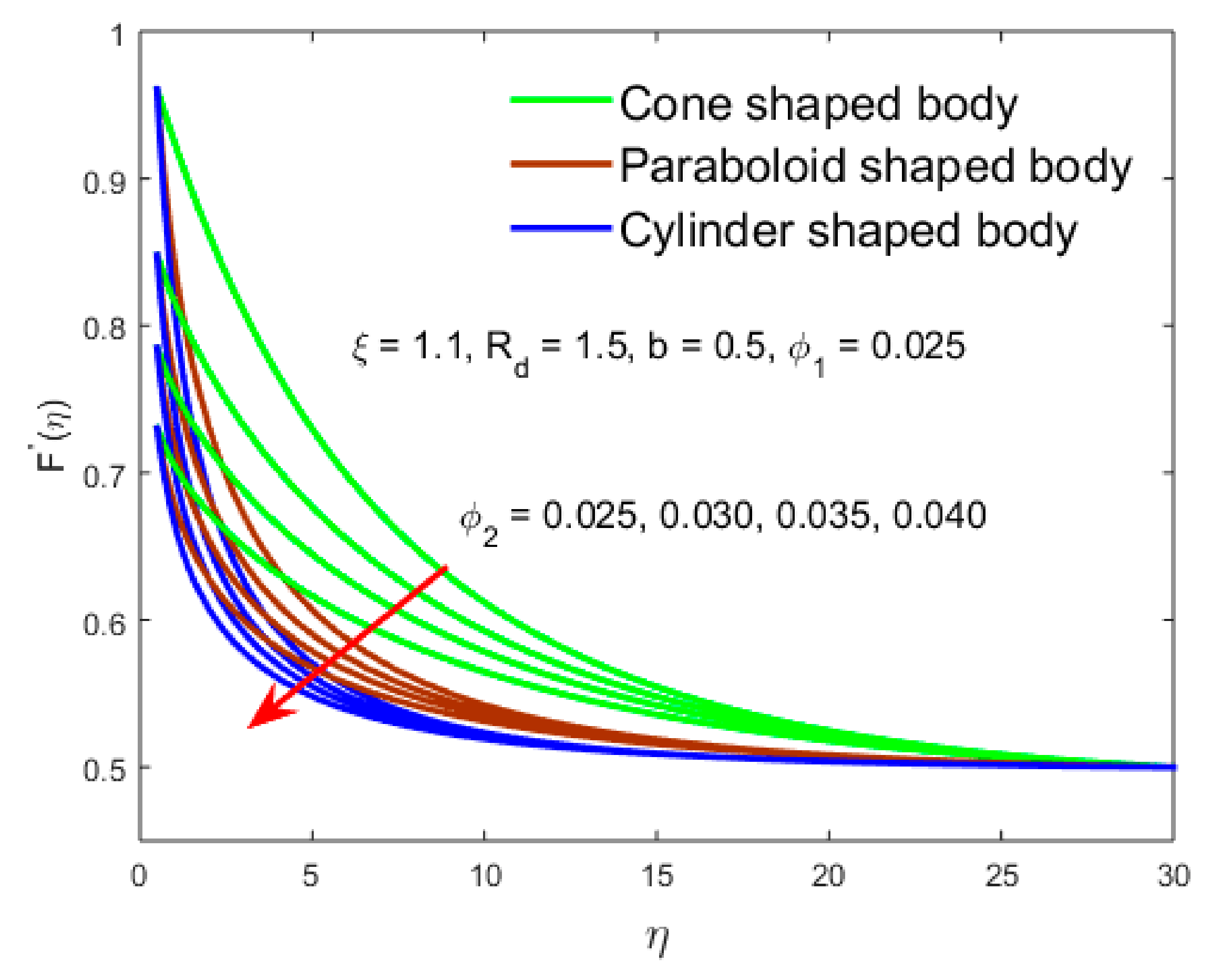
The variation of the velocity profile for the three important cases of shape bodies such as Cone, paraboloid, and cylinder versus the similarity variable for the distinct values of the dimensionless radius of the slender body parameter .
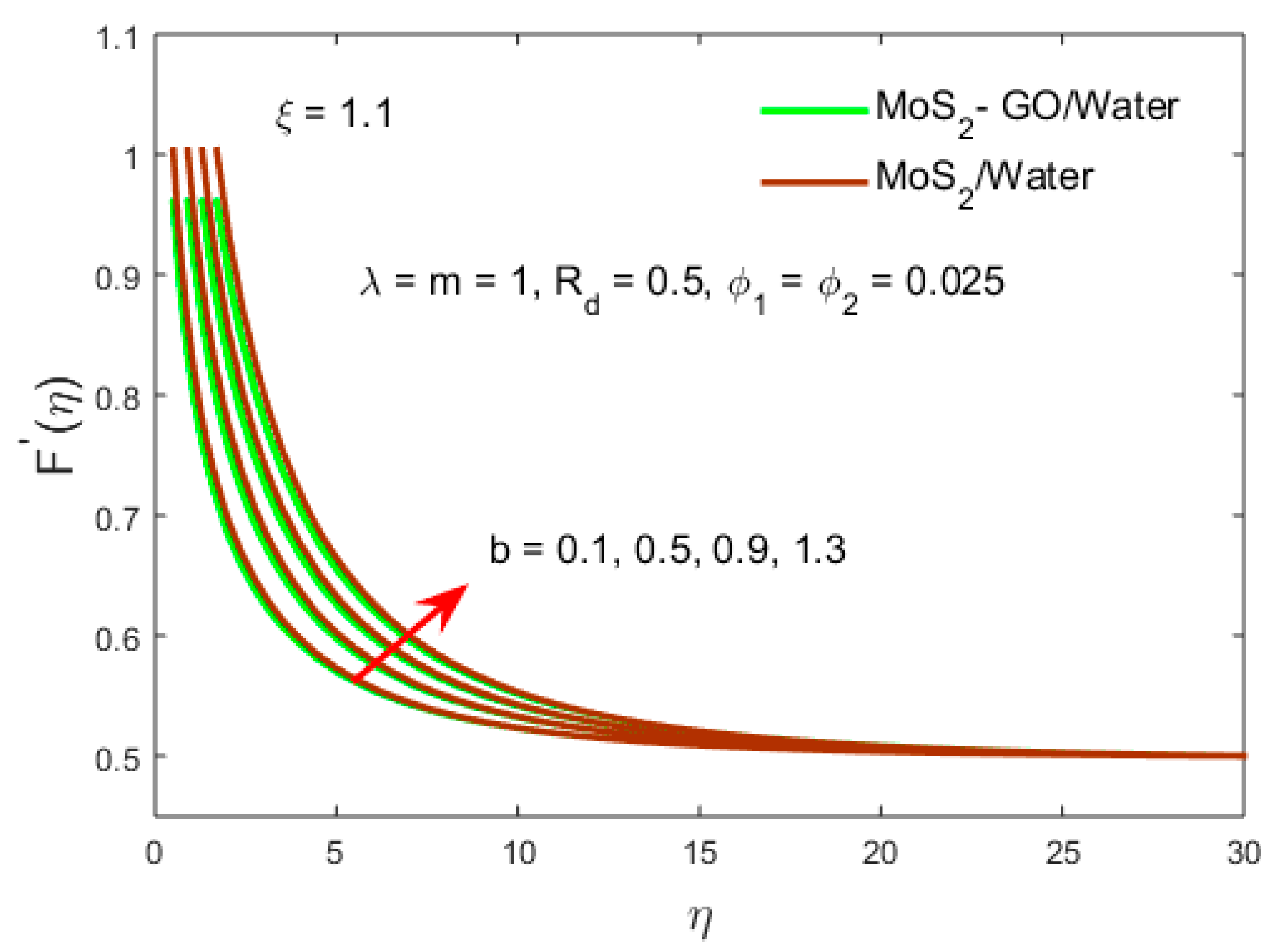
Figure 4.
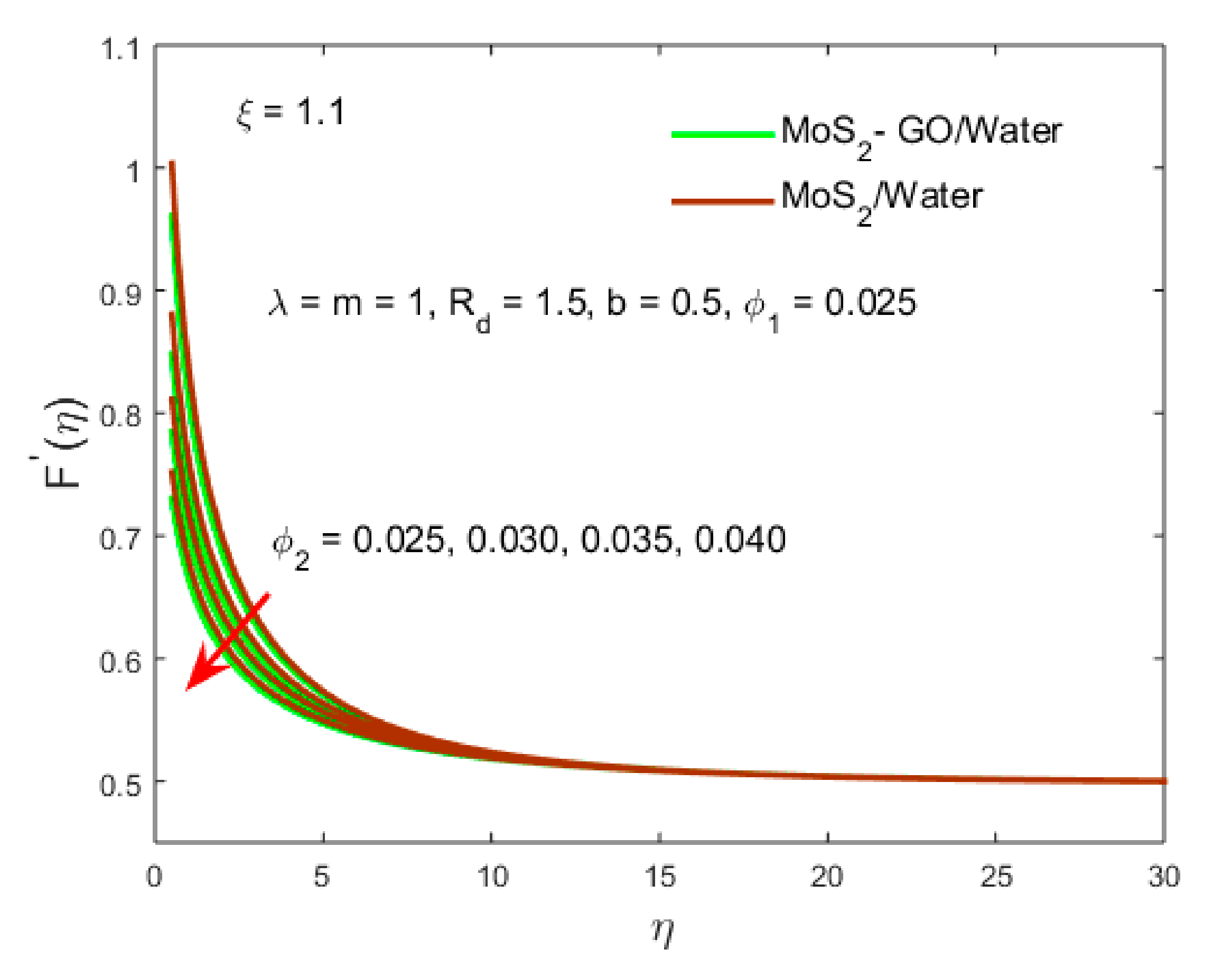
The variation of the velocity profile for the type A normal nanofluid as well as for the type B hybrid nanofluid versus the similarity variable for the distinct values of the dimensionless radius of the slender body parameter .
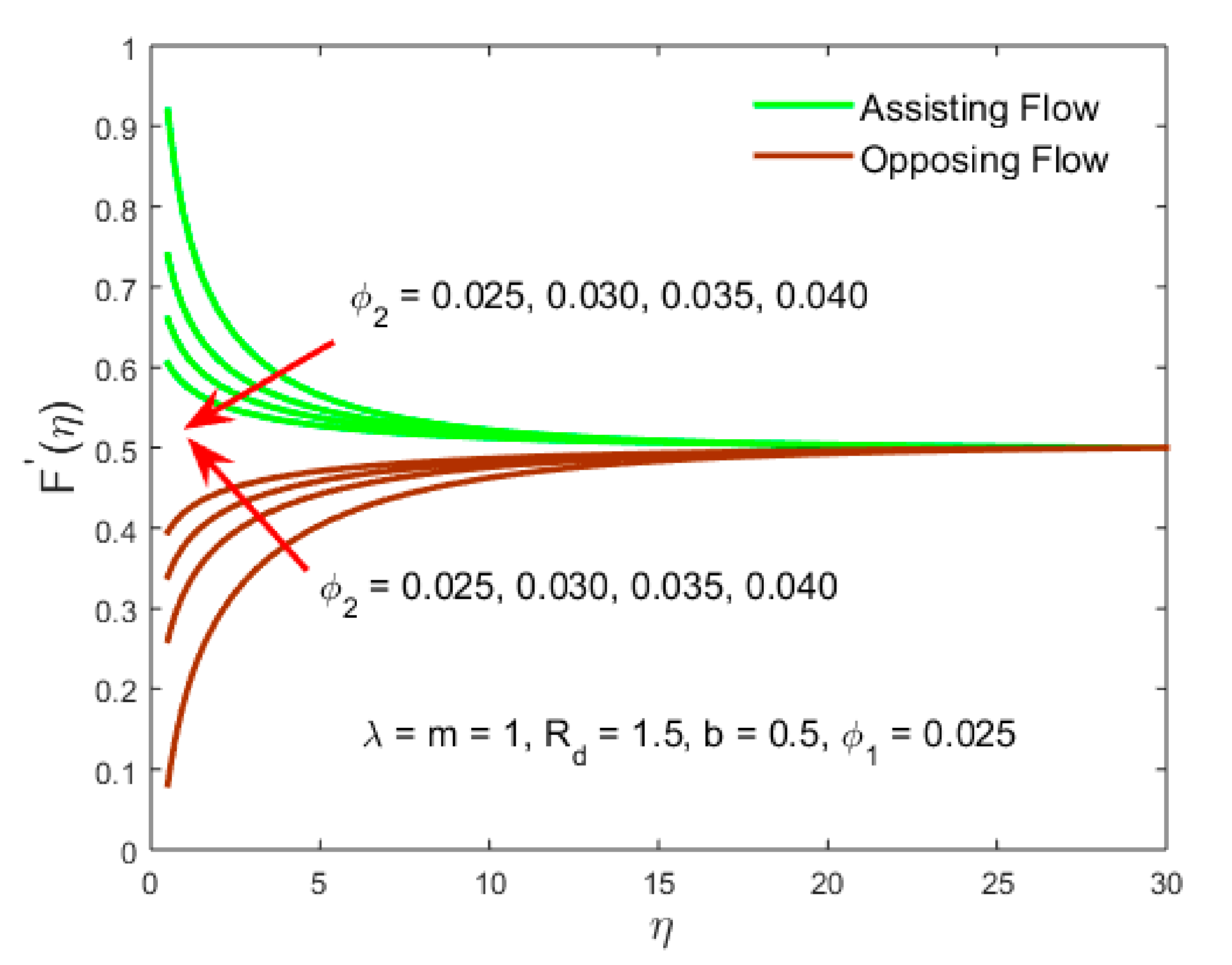
Figure 5.
Shows the variation of the velocity profile for the case of assisting and opposing flow versus the similarity variable for the distinct values of the volume fraction of nanoparticle .
Figure 6.
Shows the variation of the velocity profile for the three important cases of shape bodies such as Cone, paraboloid, and cylinder versus the similarity variable for the distinct values of the volume fraction of nanoparticle .
Figure 7.
The variation of the velocity profile for the type A normal nanofluid as well as for the type B hybrid nanofluid versus the similarity variable for the distinct values of the volume fraction of nanoparticle .
Figure 8.
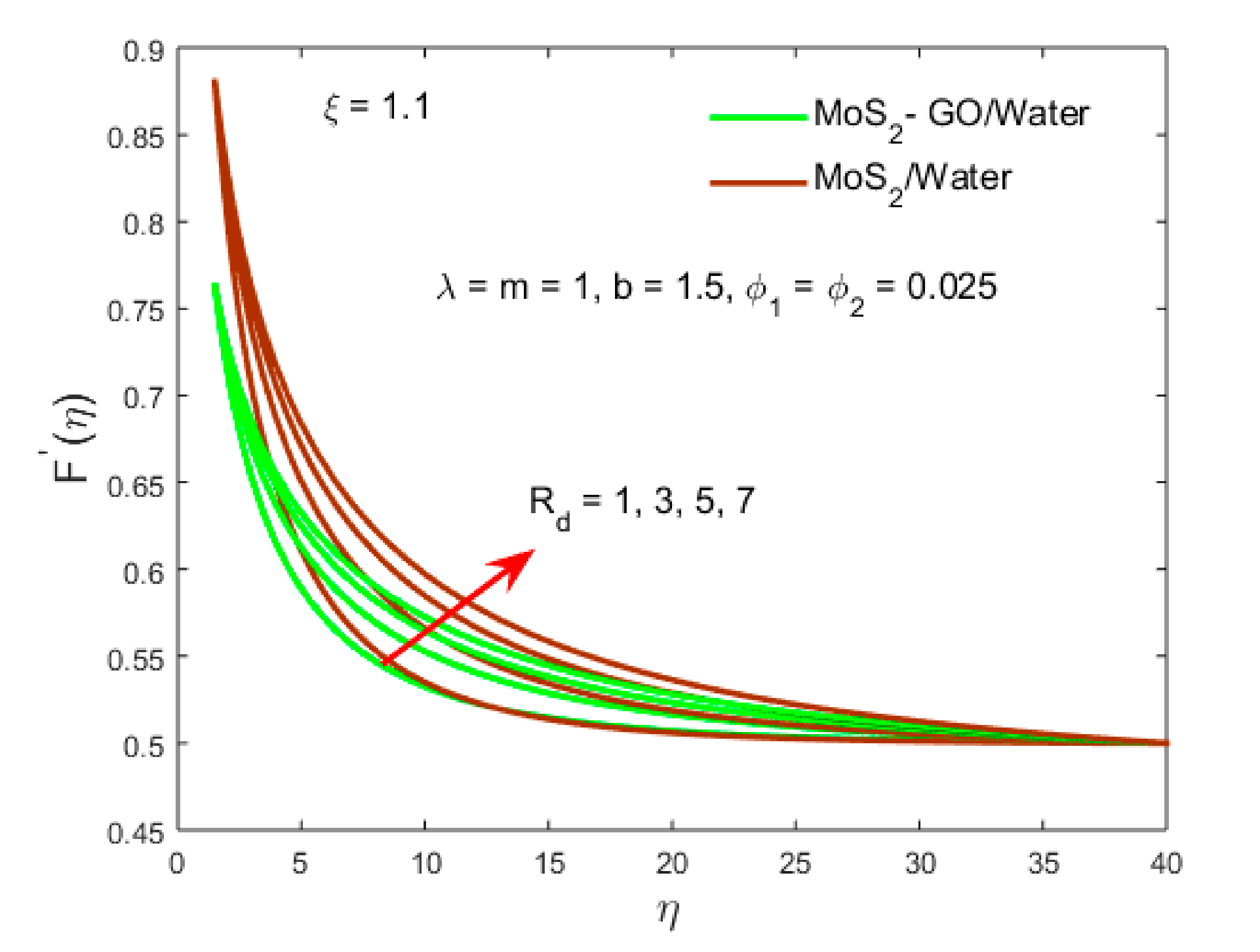
Shows the variation of the velocity profile for the case of assisting and opposing flow versus the similarity variable for the distinct values of the radiation parameter .
Figure 9.
The variation of the velocity profile for the type A normal nanofluid as well as for the type B hybrid nanofluid versus the similarity variable for the distinct values of the radiation parameter .
Figure 10.
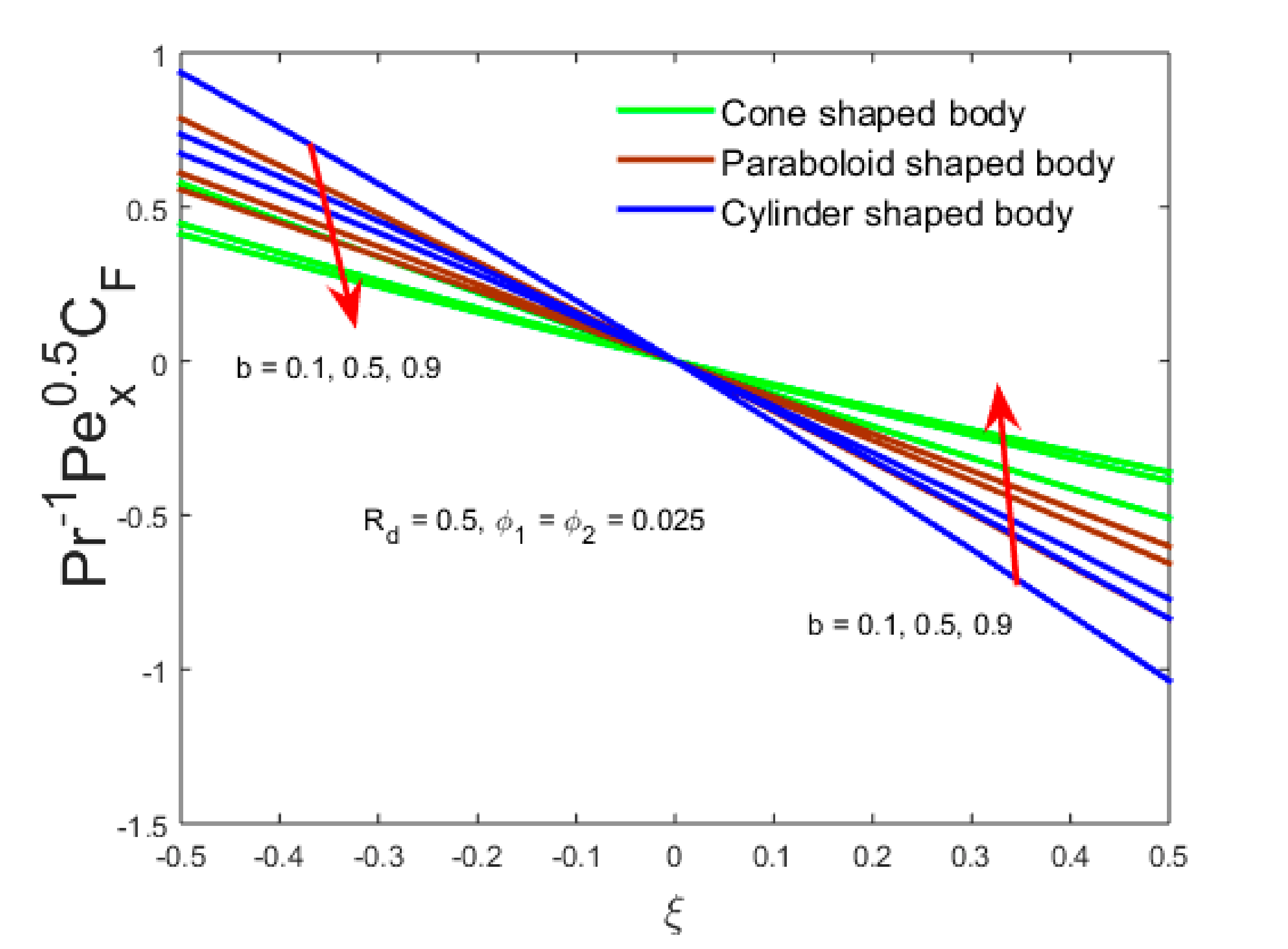
Deviation of the skin friction versus the mixed convection parameter for the distinct values of the dimensionless radius of the slender body parameter .
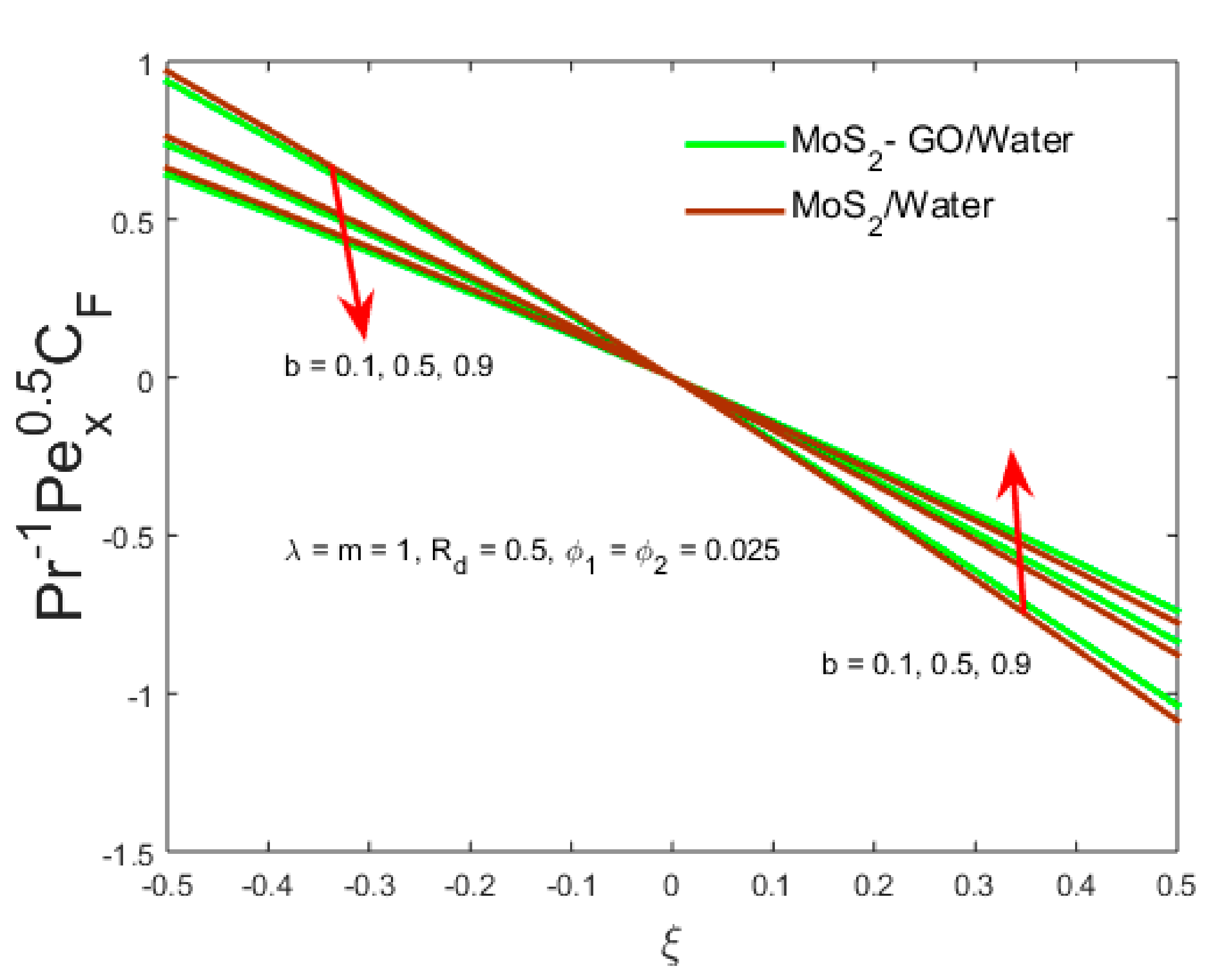
Figure 11.
Deviation of the skin friction versus the mixed convection parameter for the distinct values of the dimensionless radius of the slender body parameter .
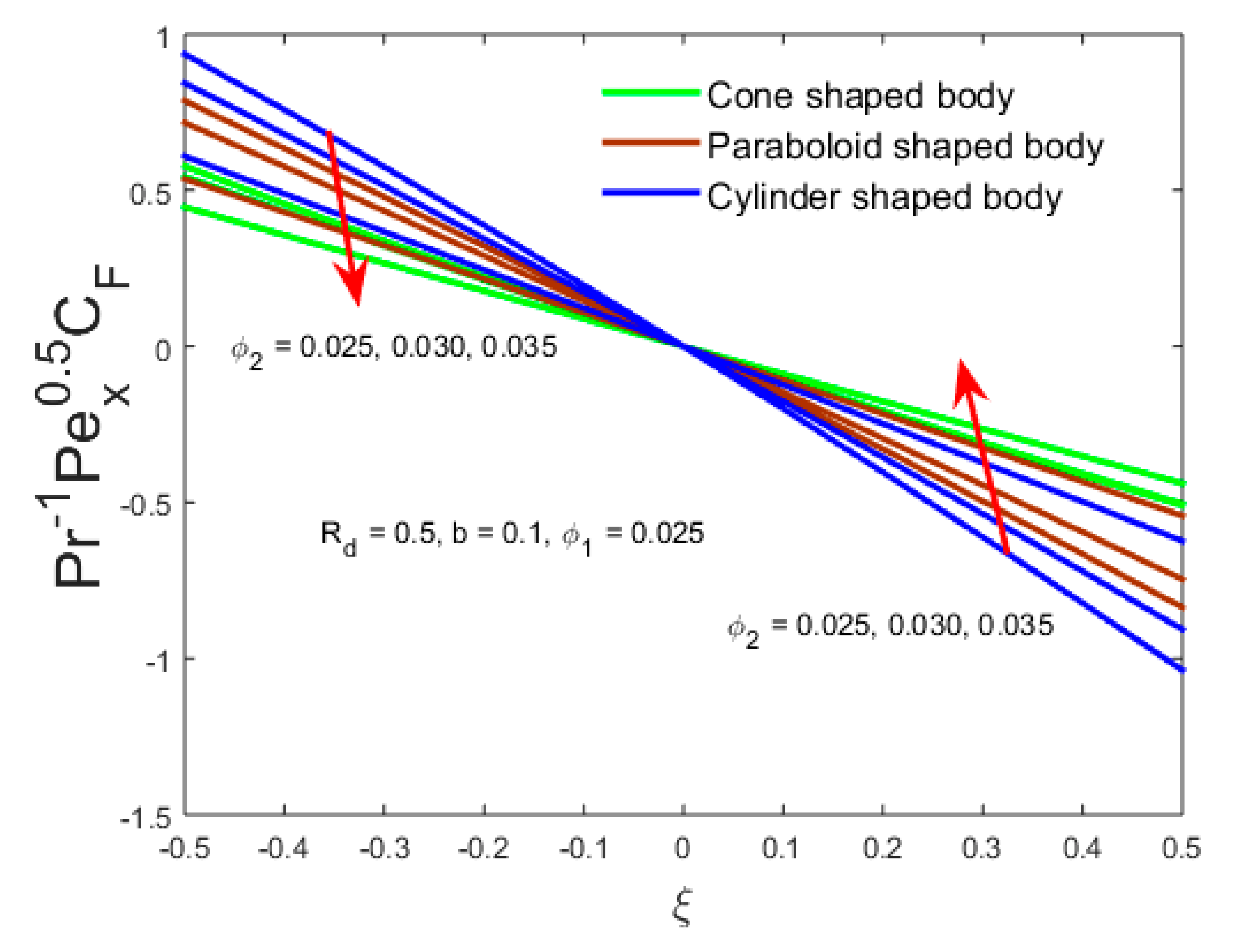
Figure 12.
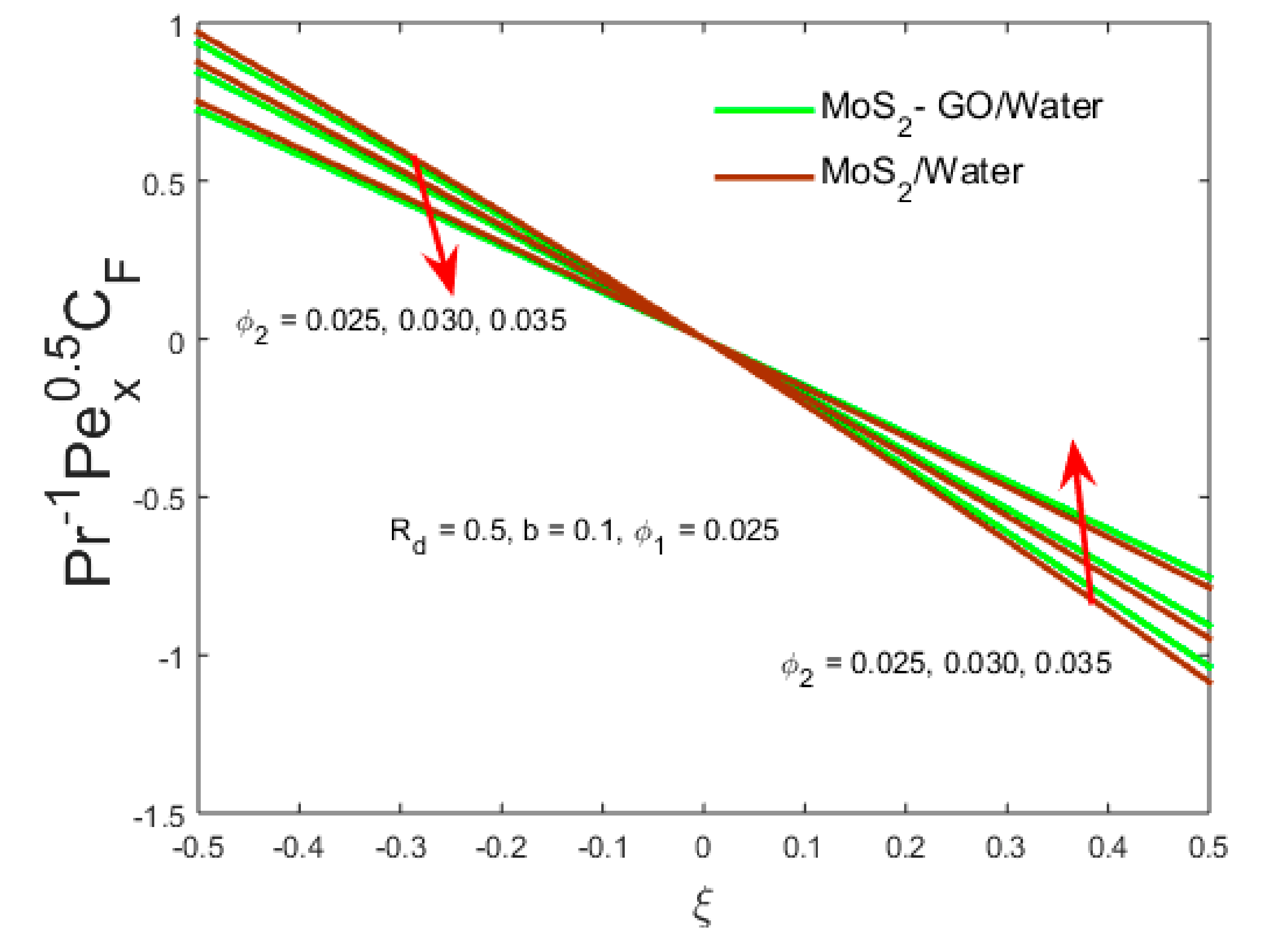
Deviation of the skin friction versus the mixed convection parameter for distinct values of the volume fraction of nanoparticle .
Figure 13.
Deviation of the skin friction versus the mixed convection parameter for distinct values of the volume fraction of nanoparticle .
Table 3.
Comparison values of when for the distinct values of .
Table 4.
Computation of the for the assisting flow utilizing the two different types of models varying while the other fixed parameters are
Table 5.
Computation of the
for the opposing flow utilizing the two different types of models varying while the other fixed parameters are
The outcomes, indicating from these tables the type B hybrid nanofluid, are superior to the type C hybrid nanofluid. Moreover, in case of the assisting flow, the skin friction increases by 0.979% for the type B hybrid nanofluid whereas the skin friction in the type C hybrid nanofluid augments by 1.001%. As the value of the nanoparticle volumetric fraction increases, the skin friction decreases continuously for both types of hybrid nanofluid. In contrast, the skin friction decreases up to 0.435% for the type B hybrid nanofluid due to the fixed value of the parameter in the example of opposing flow while for the type C hybrid nanofluid, it is decreased by 0.446%. Due to very small negligible differences in the outcomes of both the types of hybrid nanofluid, therefore the computation throughout the paper is done only for the type B hybrid nanofluid.
Figure 2 and Figure 7 are set to inspect the impact of the dimensionless radius of the slender body parameter and the volume fraction of nanoparticle on the velocity gradient against the similarity variable for the three different phenomena such as the assisting and opposing flows, shape bodies and the normal nanofluid as well for the hybrid nanofluid. In the example of assisting flow, the velocity distribution and the momentum boundary-layer flow (MBLF) increase with increasing the dimensionless radius of the slender body parameter , while in the phenomenon of the opposing flow, the behavior of the motion of the fluid behaves in the contrary direction as shown in Figure 2. It is transparent to observe from the outcomes that the gap between the curves is initially more significant in the ASSF as well as in the OPPF, while as we upsurge, the value of the dimensionless radius of the slender body parameter the gap between the solution curves is reduced.
On the other hand, the velocity distribution is enhancing the function of the shape bodies as well as for the type B hybrid nanofluid and the type A nanofluid for the higher values of as shown in Figure 3 and Figure 4, respectively. It is perceived from Figure 3 that the velocity field is superior in the flow through a cone compared to paraboloid and cylindrical type’s bodies. Moreover, it is perfectly visible from the graph that the liquid flow accelerates more for the MoS2/water nanoparticle or type A nanofluid as compared to the type B hybrid nanoparticles as highlighted in Figure 4. The gap between the solution curves in the shape bodies is more when compared to the solution curves like Figure 4. Since Figure 5, it has been noticed that for the (ASSF), the velocity distribution decreases with escalating , whereas for the opposing flow, it is augmented.
Additionally, it explains that the thickness of the velocity and the (MBLF) declines with for the ASSF and augments for the OPPF. The outcome of the velocity gradient in Figure 5 is showing a contrary behavior in both the cases of ASSF and OPPF as we compare with the solution curves of Figure 2. From Figure 6, it is transparent that due to the shape bodies, the velocity field is decelerated for the higher impact of . In comparison, the flow of the velocity field over the cone shape body is finer than the rest of the two-shape body. Generally, the velocity upsurges due to the fact that type B hybrid nanofluid dynamic viscosity has an inverse relationship to nanoparticle volume fraction. Hence, an augmenting in guides to the decline’s viscosity of base liquid and therefore speeds up the motion of the liquid flow.
Moreover, the velocity profile reduces due to for the type B hybrid nanofluid and type A nanofluid as portrayed in Figure 7. The impact between the curves is very minor for the parameter while the outcome for the type B hybrid nanofluid is higher than the type A nanofluid.
Figure 8 and Figure 9 highlight the stimulus of radiation parameter on the velocity distribution against the similarity variable of the two distinct phenomena such as the assisting and opposing flows as well as for the type A nanofluid and type B hybrid nanofluid. It is clear from Figure 8 as depicted graphically that the velocity distribution augments for the ASSF and declines for the OPPF as the value of the radiation parameter upsurges. The solution behavior is similarly observed like Figure 2 while the contrary behavior of the outcomes in Figure 5 is seen for both the cases ASSF and as well as in the OPPF, while in comparison the influence between the curves is less. Additionally, is exploited to drop the molecules of liquid into hydrogen. Figure 9 displays that the velocity upsurges are owed to magnifying the radiation parameter for the type A nanofluid as well as for the type B hybrid nanofluid. The motion of the fluid flow for the type A nanofluid is superior as compare to the type B hybrid nanofluid. In addition, the solution impact in the curves for the velocity gradient is more owing to the impact of radiation parameter as compared to the significant impact of the other two parameters which is exercised in Figure 4 and Figure 7, respectively.
Figure 10, Figure 11, Figure 12 and Figure 13 show the variation of the dimensionless radius of the slender body parameter and the nanoparticle volume fraction on the skin friction against the mixed convection parameter for the two distinct cases such as the flow over the shape bodies and the corresponding type A nanofluid and the type B hybrid nanofluid. The skin friction is reduced with enhanced along the horizontal axis of the range () and augments in the spectrum () for the flow over the shape bodies as well as for the types A and B nanofluid and hybrid nanofluid as highlighted in Figure 10 and Figure 11, respectively. The skin friction is higher in the range () for the flow over the cone shape body and also for the type B hybrid nanofluid as compared to the flow on the paraboloid and the cylindrical shape bodies as well as for the type A nanofluid, while the opposite trend is observed in the range () as shown in Figure 10 and Figure 11. The range in both graphs is taken from and it is not the fixed one we can vary from this range as a real number but due to this small range in the solution, the collision is more effectively significant. A similar behavior is detected (Figure 10 and Figure 11) for the skin friction owing to the nanoparticle volume fraction as described in Figure 12 and Figure 13, respectively. Hence, in Figure 12 and Figure 13 illustrate more transparently the impact of the curves of the flow over the shape bodies against the mixed convection parameter owing to is greater compared to on the skin friction while this gap for the type B hybrid nanofluid and type A nanofluid owing the parameter is coarsened as compared to the dimensionless radius of the slender body parameter .
5. Concluding Remarks
The key points of the current study are summarized as:
- The velocity augments for the (ASSF) and declines for the (OPPF) owing to magnifying the dimensionless radius of the slender body parameter while the change behavior is detected in response of the higher nanoparticle volume fraction .
- The persistent effect of , the velocity upsurges for the flow of the shape bodies like paraboloid shape body (), cylindrical shape body () as well as cone shape body () while the same behavior of the velocity is seen in the type A nanofluid and type B hybrid nanofluid.
- The velocity field decreases for the type A nanofluid as well as for the type B hybrid nanofluid and also for the flow over the different shape bodies owing to .
- Due to , the velocity upsurges for the type A nanofluid as well as for the type B hybrid nanofluid while for the type B hybrid nanofluid, the velocity is lesser relative to the type A nanofluid.
- The skin friction under the distinct shape bodies and along the type A nanofluid and type B hybrid nanofluid are augmented for both parameter and along the x-axis of the slender sheet in the range while vice versa in the range .
This sort of problem may be useful in geothermal and geophysical applications. Thus, the outcomes of the problem will be obliging in the evaluation and assessment of resources in geothermal energy.
Author Contributions
Conceptualization, A.Z.; Data curation, A.W.; Formal analysis, M.S.; Investigation, A.W.; Methodology, U.K.; Resources, A.Z.; Software, U.K. and A.Z.; Supervision, D.B. All authors have read and agreed to the published version of the manuscript.
Funding
This research received no external funding.
Conflicts of Interest
The authors declare no conflict of interest.
References
- Nield, D.A. Onset of Thermohaline Convection in a Porous Medium. Water Resour. Res. 1968, 4, 553–560. [Google Scholar] [CrossRef]
- Bejan, A.; Khair, K.R. Heat and mass transfer by natural convection in a porous medium. Int. J. Heat Mass Transf. 1985, 28, 909–918. [Google Scholar] [CrossRef]
- Lai, F.; Pop, I.; Kulack, F. Free and mixed convection from slender bodies of revolution in porous media. Int. J. Heat Mass Transf. 1990, 33, 1767–1769. [Google Scholar] [CrossRef]
- Yih, K.A. Coupled heat and mass transfer by free convection over a truncated cone in porous media: VWT/VWC or VHF/VMF. Acta Mech. 1999, 137, 83–97. [Google Scholar] [CrossRef]
- Bano, N.; Singh, B.B. An integral treatment for coupled heat and mass transfer by natural convection from a radiating vertical thin needle in a porous medium. Int. Commun. Heat Mass Transf. 2017, 84, 41–48. [Google Scholar] [CrossRef]
- Singh, B.; Chandarki, I. Integral treatment of coupled heat and mass transfer by natural convection from a cylinder in porous media. Int. Commun. Heat Mass Transf. 2009, 36, 269–273. [Google Scholar] [CrossRef]
- Ahmad, S.; Pop, I. Mixed convection boundary layer flow from a vertical flat plate embedded in a porous medium filled with nanofluids. Int. Commun. Heat Mass Transf. 2010, 37, 987–991. [Google Scholar] [CrossRef]
- Talebizadeh, P.; Moghimi, M.A.; Kimiaeifar, A.; Ameri, M. Numerical and analytical solutions for natural convection flow with thermal radiation and mass transfer past a moving vertical porous plate by dqm and ham. Int. J. Comput. Methods 2011, 8, 611–631. [Google Scholar] [CrossRef]
- Moghimi, M.A.; Talebizadeh, P.; Mehrabian, M.A. Heat generation/absorption effects on magnetohydrodynamic natural convection flow over a sphere in a non-Darcian porous medium. Proc. Inst. Mech. Eng. Part E J. Process. Mech. Eng. 2010, 225, 29–39. [Google Scholar] [CrossRef]
- Moghimi, M.A.; Tabaei, H.; Kimiaeifar, A. HAM and DQM solutions for slip flow over a flat plate in the presence of constant heat flux. Math. Comput. Model. 2013, 58, 1704–1713. [Google Scholar] [CrossRef]
- Raju, C.S.K.; Sandeep, N. Heat and mass transfer in MHD non-Newtonian bio-convection flow over a rotating cone/plate with cross diffusion. J. Mol. Liq. 2016, 215, 115–126. [Google Scholar] [CrossRef]
- Raju, C.S.K.; Saleem, S.; Upadhya, S.M.; Hussain, I. Heat and mass transport phenomena of radiated slender body of three revolutions with saturated porous: Buongiorno’s model. Int. J. Therm. Sci. 2018, 132, 309–315. [Google Scholar] [CrossRef]
- Choi, S.U.S. Enhancing thermal conductivity of fluids with nanoparticles. In Proceedings of the 1995 International Mechanical Engineering Congress and Exhibition, San Francisco, CA, USA, 12–17 November 1995. [Google Scholar]
- Eastman, J.A.; Choi, S.; Li, S.; Yu, W.; Thompson, L.J. Anomalously increased effective thermal conductivities of ethylene glycol-based nanofluids containing copper nanoparticles. Appl. Phys. Lett. 2001, 78, 718–720. [Google Scholar] [CrossRef]
- Wen, D.; Ding, Y. Experimental investigation into convective heat transfer of nanofluids at the entrance region under laminar flow conditions. Int. J. Heat Mass Transf. 2004, 47, 5181–5188. [Google Scholar] [CrossRef]
- Ashorynejad, H.R.; Mohamad, A.A.; Sheikholeslami, M. Magnetic field effects on natural convection flow of a nanofluid in a horizontal cylindrical annulus using Lattice Boltzmann method. Int. J. Therm. Sci. 2013, 64, 240–250. [Google Scholar] [CrossRef]
- Ellahi, R.; Zeeshan, A.; Hassan, M. Particle shape effects on Marangoni convection boundary layer flow of a nanofluid. Int. J. Numer. Methods Heat Fluid Flow 2016, 26, 2160–2174. [Google Scholar] [CrossRef]
- Soomro, F.A.; Zaib, A.; Haq, R.U.; Sheikholeslami, M. Dual nature solution of water functionalized copper nanoparticles along a permeable shrinking cylinder: FDM approach. Int. J. Heat Mass Transf. 2019, 129, 1242–1249. [Google Scholar] [CrossRef]
- Tabassum, R.; Mehmood, R. Crosswise stream of methanol–iron oxide (CH3OH–Fe3O4) with temperature-dependent viscosity and suction/injection effects. Proc. Inst. Mech. Eng. Part E: J. Process. Mech. Eng. 2019, 233, 1013–1023. [Google Scholar] [CrossRef]
- Zaib, A.; Khan, U.; Wakif, A.; Zaydan, M. Numerical Entropic Analysis of Mixed MHD Convective Flows from a Non-Isothermal Vertical Flat Plate for Radiative Tangent Hyperbolic Blood Biofluids Conveying Magnetite Ferroparticles: Dual Similarity Solutions. Arab. J. Sci. Eng. 2020, 45, 5311–5330. [Google Scholar] [CrossRef]
- Sayed, A.Y.; Abdel-Wahed, M.S. Entropy analysis for an MHD nanofluid with a microrotation boundary layer over a moving permeable plate. Eur. Phys. J. Plus 2020, 135, 1–17. [Google Scholar] [CrossRef]
- Alsarraf, J.; Rahmani, R.; Shahsavar, A.; Afrand, M.; Wongwises, S.; Tran, M.D. Effect of magnetic field on laminar forced convective heat transfer of MWCNT–Fe3O4/water hybrid nanofluid in a heated tube. J. Therm. Anal. Calorim. 2019, 137, 1809–1825. [Google Scholar] [CrossRef]
- Shahsavar, A.; Sardari, P.T.; Toghraie, D. Free convection heat transfer and entropy generation analysis of water–Fe3O4/CNT hybrid nanofluid in a concentric annulus. Int. J. Numer. Methods Heat Fluid Flow 2019, 29, 915–934. [Google Scholar] [CrossRef]
- Khan, U.; Shafiq, A.; Zaib, A.; Baleanu, D. Hybrid nanofluid on mixed convective radiative flow from an irregular variably thick moving surface with convex and concave effects. Case Stud. Therm. Eng. 2020, 21, 100660. [Google Scholar] [CrossRef]
- Minea, A.A. Hybrid nanofluids based on Al2O3, TiO2 and SiO2: Numerical evaluation of different approaches. Int. J. Heat Mass Transf. 2017, 104, 852–860. [Google Scholar] [CrossRef]
- Ghadikolaei, S.; Hosseinzadeh, K.; Hatami, M.; Ganji, D. MHD boundary layer analysis for micropolar dusty fluid containing Hybrid nanoparticles (Cu-Al2O3) over a porous medium. J. Mol. Liq. 2018, 268, 813–823. [Google Scholar] [CrossRef]
- Sheikholeslami, M.; Gerdroodbary, M.B.; Shafee, A.; Tlili, I. Hybrid nanoparticles dispersion into water inside a porous wavy tank involving magnetic force. J. Therm. Anal. Calorim. 2019, 1–7. [Google Scholar] [CrossRef]
- Gholinia, M.; Armin, M.; Ranjbar, A.; Ganji, D. Numerical thermal study on CNTs/ C2H6O2– H2O hybrid base nanofluid upon a porous stretching cylinder under impact of magnetic source. Case Stud. Therm. Eng. 2019, 14, 100490. [Google Scholar] [CrossRef]
- Khan, U.; Zaib, A.; Mebarek-Oudina, F. Mixed Convective Magneto Flow of SiO2–MoS2/C2H6O2 Hybrid Nanoliquids Through a Vertical Stretching/Shrinking Wedge: Stability Analysis. Arab. J. Sci. Eng. 2020, 1–13. [Google Scholar] [CrossRef]
- Tiwari, R.K.; Das, M.K. Heat transfer augmentation in a two-sided lid-driven differentially heated square cavity utilizing nanofluids. Int. J. Heat Mass Transf. 2007, 50, 2002–2018. [Google Scholar] [CrossRef]
- Pak, B.C.; Cho, Y.I. Hydrodynamic and heat transfer study of dispersed fluids with submicron metallic oxide particles. Exp. Heat Transf. 1998, 11, 151–170. [Google Scholar] [CrossRef]
- Suresh, S.; Venkitaraj, K.; Selvakumar, P.; Chandrasekar, M. Synthesis of Al2O3–Cu/water hybrid nanofluids using two step method and its thermo physical properties. Colloids Surfaces A: Physicochem. Eng. Asp. 2011, 388, 41–48. [Google Scholar] [CrossRef]
- Devi, S.S.U.; Devi, S.A. Numerical investigation of three-dimensional hybrid Cu–Al2O3/water nanofluid flow over a stretching sheet with effecting Lorentz force subject to Newtonian heating. Can. J. Phys. 2016, 94, 490–496. [Google Scholar] [CrossRef]
- Ahmad, R.; Mustafa, M.; Hina, S. Buongiorno’s model for fluid flow around a moving thin needle in a flowing nanofluid: A numerical study. Chin. J. Phys. 2017, 55, 1264–1274. [Google Scholar] [CrossRef]
- Salleh, S.N.A.; Bachok, N.; Arifin, N.M.; Ali, F.M.; Pop, I. Magnetohydrodynamics Flow Past a Moving Vertical Thin Needle in a Nanofluid with Stability Analysis. Energies 2018, 11, 3297. [Google Scholar] [CrossRef]
© 2020 by the authors. Licensee MDPI, Basel, Switzerland. This article is an open access article distributed under the terms and conditions of the Creative Commons Attribution (CC BY) license (http://creativecommons.org/licenses/by/4.0/).