1. Introduction
Climate change and global warming is a major challenge for the international community. Greenhouse gases, in particular carbon dioxide (CO
2), accumulated in the atmosphere, cause irreversible damages, and the time required for their repairs could last hundreds of years. Emissions must be reduced by moving to clean and renewable energy resources, and the study of responsible sharing policies, in particular CO
2 emissions, is one of the main goals of international climate policies nowadays. The literature on international cooperation on climate change has been organized around various international cooperation forms [
1]. The existing methods proposed for emission allowances in CO
2 can be classified into four groups: indicator approach based on one or more indicators, optimization approach, game theory approach, and hybrid approaches [
2]. Certain allocation criteria are based upon equity principles, such as the
grandfathering, consisting of giving an equal right to emit for all countries, the
egalitarianism, giving to each person the same right to emit, or
historical responsibility, according to which long-standing polluters should face a greater reduction rate, or other principles of distributive justice [
3]. Other allocation criteria, where countries are compensated for reducing their emissions, follow a principle of
efficiency, such as the approach proposed in [
4], where the authors argue that efficiency can be defined as a type of “fairness”. In practice, alternative methods have been proposed to allocate CO
2 emissions among countries and taking into account criteria, such as energy, the gross domestic product (GDP), population, energy production, etc. (see [
2], for a recent survey), but no consensus has been reached on any particular allocation protocol.
However, the increasing amount of gas emissions and the limited absorption rate of the planet, on the one hand
1, and the fact that countries, in 2020, have already consumed in 8 months
2, all the resources that ecosystems can produce in a single year, it is obvious that we are facing a
claims problem [
5,
6]. Claims problems, also called
bankruptcy situations, are situations where a given quantity of a divisible resource must be allocated among a group of agents. Each agent has his own demand, and the total amount of divisible resources cannot satisfy the demand of all agents. Thus, the problem is to formulate a fair allocation rule or solution [
7] (for a survey on bankruptcy situations, solutions, and their properties see, for instance, [
8,
9]). Bankruptcy situations can model different real ecological problems where a scarce resource, such as food, fishing quotas, medical suppliers, carbon budget, or water has to be shared among countries, or among the individuals of a population [
10].
In this paper, we focus on the allocation of the most important greenhouse gas, carbon dioxide, whose emissions permits must be shared among European Union (EU) countries, and where each country has its own claim of CO
2 emissions permits. This is not the first time that bankruptcy situations have been applied to study this problem at the EU level. For instance, two bankruptcy allocation solutions from the literature, namely, the Constrained Equal Awards (CEA) [
7,
8,
11] and the Weighted Constrained Equal Awards (WCEA) [
12,
13], have been used in [
14] to allocate CO
2 emissions permits using EU countries’ CO
2 claims and an exogenous weight based on the GDP. For other applications of bankruptcy situations to the allocation of emissions permits, see also [
6]. As far as we know, however, this is the first study where the CO
2 allocation problem has been investigated as a claims problem from a multi-criteria point of view. Specifically, in this paper, we introduce a preliminary application of a new allocation method for double-weighted bankruptcy situations based on the combination of two distinct criteria: the ability of countries to efficiently use their CO
2 emissions permits, and the capacity of countries to produce energy in a sustainable manner via renewable sources. More precisely, using an extended version of the CEA solution for bankruptcy situations, we leverage the request of CO
2 emissions permits of EU countries, taking into account both the economic growth of EU countries (in terms of their GDP) and their sustainable policies, measured as the amount of renewable energy produced by each country. We also compare the allocation of CO
2 emissions permits provided by the methods considered in this paper with the distribution of power among the members of the EU Council, which is the main decision making body in the EU. As a main result of our analysis, we show that the double-weighted allocation protocol well represents the effective power of countries within the EU Council, and for this reason it could benefit from a more general consensus within the EU.
The remainder of the paper is organized as follows. The next section is devoted to the introduction of bankruptcy situations, and to the presentation of related basic notions and notation. Then,
Section 3 introduces a new family of bi-criteria allocation methods for double-weighted bankruptcy situations, namely, the Double-Weighted Constrained Equal Awards (DWCEA) methods, and presents an algorithm to compute a specific allocation protocol.
Section 4 is devoted to the application of the proposed protocol introduced in
Section 3 to allocate CO
2 emissions permits among EU countries over the years 2010–2014, and to the comparison of the results provided by the alternative solutions considered in this study.
Section 5 concludes.
2. Preliminary
A
bankruptcy situation or
bankruptcy problem occurs when there is an infinitely divisible resource, the
estate, to be divided among several agents having different
claims and the same preferences, but there are natural upper limits on the allocation: none should be awarded more than his demand. Formally, a
bankruptcy situation [
15], or a
claims problem, is defined by a tuple
(or, simply,
if the set
N is already clearly identified), where
is a set of
agents, the
estate is such that
, and
is a vector of agents’
claims. So, the problem is to divide
E among the agents of
N, each agent
having her/his own claim
.
To allocate the estate E among the agents in N, we define an allocations vector as a real valued vector , respecting the following properties:
rationality: , for all ;
claim boundedness: , for all ;
efficiency: .
So, according to an allocation vector, every agent should receive a non-negative allocation, smaller or equal than her/his claim, and the entire estate should be divided completely among the agents. We are interested in defining a general allocation method, also called
rule or
solution, which is a function that associates to each bankruptcy situation an allocation vector. In the literature on bankruptcy situations, several rules have been proposed to allocate the estate (see, for instance, [
7,
8,
9,
11]).
In this work, we will focus on the
Constrained Equal Awards (CEA) rule, and on some weighted version of the CEA rule. Formally, for each bankruptcy situation
with
N as the set of players, the
rule yields an allocation vector
, such that:
for each agent
and where
and
This method can be defined as an iterative procedure. In the first iteration, all agents receive the same amount of estate, which must be smaller or equal than the smallest claim among the agents. Then, the agents with the smallest claim leave the game. A new iteration starts by equally allocating the remaining part of the estate, if any, among the remaining agents, and paying attention to allocate to each agent no more than the second smallest claim. Then, the agents claiming the second smallest claim leave the game, and the procedure is repeated among the remaining agents until there is no more estate to be shared.
A
weighted bankruptcy situation [
12,
13], is a triple
where
is a bankruptcy situation and
is a vector of positive
weights. The
Weighted Constrained Equal Awards (WCEA) solution [
12,
13] is inspired by the CEA rule, and takes into account not only players’ claims, but also their weights, which modify the impact of the claims over the final allocation. The allocation vector provided by the WCEA rule is the unique vector
such that:
for each agent
and where the parameter
is such that
In the last section of this paper, we also make use of some concepts from cooperative game theory. Specifically, we compare allocation vectors for bankruptcy situations with the vector provided by the
Shapley and Shubik (Sh–Sh) power index [
16] for a simple game representing the voting rule at the EU Council [
17]. A
simple game is a pair
where
N is a set of agents, or
voters, and
v is the
characteristic function of the game that associates to each
coalition a value
such that
and
. The standard interpretation of a simple game is that
means that coalition
S is winning, according to some voting rule, while
means that
S is losing, according to the same voting rule. The Shapley and Shubik power index [
16] is defined as the map
associating to any simple game
a vector of numbers representing the P-power of voters [
18], which is interpreted as the voters expected shares of a fixed prize for winning the elections, and is computed as the expected marginal contribution of each voter
over all possible permutations of voters, i.e.,
, where
s is the cardinality of coalition
S.
3. Double-Weighted Constrained Equal Awards Rule (DWCEA)
Previous studies on bankruptcy situations and their solutions can be seen as an allocation approach where only one criterion, agent’s claim, is considered. Weighted bankruptcy situations [
12] keep into account one more parameter to determine allocation vectors. In this section, we introduce a richer framework for bankruptcy situations, considering two vectors of weights at once, in addition to the vector of claims.
We denote by a double-weighted bankruptcy situation on a set of agents N and where is a strictly positive estate, is the vector of non-negative claims such that , and and are two vectors of non-negative weights. We denote by the family of all double-weighted bankruptcy problems. An allocation rule is a map that associates to any double-weighted bankruptcy situation an allocation vector in such that . Some interesting properties for an allocation rule for double-weighted bankruptcy situations are the following. Equal treatment: an allocation rule satisfies equal treatment if for all , if are such that , and , then . Composition: An allocation rule satisfies composition if for all such that for all and for all we have Invariance under claims truncation: an allocation rule satisfies invariance under claims truncation if for all we have , where is such that for all .
In the attempt to further extend the WCEA rule to situations with two vectors of weights, in this paper, we introduce a
Double-Weighted Constrained Equal Awards (DWCEA) solution, which associates to any double-weighted bankruptcy situation a particular allocation vector
satisfying the following conditions:
for each agent
and with
such that
As it often happens in multi-criteria decision problems, in general, we face a wide choice of allocation vectors that satisfy the constraints specified by relations (
5) and (
6) for some
and
. Therefore, in order to select a specific allocation vector, in the next section we introduce a computational approach to find parameters
and
that do not require to assume any specific priority on the criteria represented by the two weight vectors.
A DWCEA Solution Algorithm with No Priority over Criteria
The algorithm studied in this section is based on the general principle that a DWCEA solution should grant the same importance to the different criteria represented by the two weight vectors. Based on this assumption, we introduce Algorithm 1 providing a solution for problem (
5) under the constraint (
6) with the objective to find feasible
and
without arbitrarily promoting the use of one of the two criteria to drive the choice of these parameters.
| Algorithm 1. Double-Weighted method’s algorithm |
Input: Estate E, Set of player N, Claims vector c, weight vectors , Output: an allocation vector ForEach : , , , ForEach : Begin Bloc 1: if then ForEach : end if End Bloc 1 while AND do if then Algorithm A1 end if if then Algorithm A2 end if end while return x |
Algorithm 1 starts by calculating, for every player , a value and a value , then it sorts these values in incremental order, yielding vectors and . In the initial iteration, the same value is affected to parameters and , which are the temporary parameters used to compute the allocation. Starting the search for parameters and from the median ensures a kind of neutrality for the importance of both criteria in the allocation computation, and it guarantees a minimal worst-case number of iterations before reaching the final and , since this procedure will be iterated at most times. At each iteration of the algorithm, the sum of the allocations, , can take three possible values:
- (1)
, i.e., the sum of allocations is equal to the estate. In this case, we immediately have that and .
- (2)
, i.e., the sum of allocations is strictly larger than the estate. So,
and/or
must be decreased. In this situation, Algorithm 1 selects the first sorted
as
X and the first sorted
as
Y. Then, we choose the biggest value among
X and
Y to change the corresponding
value,
, and we keep the same value for the other
; then, we recompute
S and we reiterate the procedure until we obtain
, as shown in Algorithm A1 (see
Appendix A).
- (3)
, i.e., the sum of allocations is strictly smaller than the estate, we have to increase
and/or
. So,
,
, will be updated to the smallest value among
X, the first
, and
Y, the first
, and we keep the same value for the other
; then, we recompute
S and we re-iterate the procedure until we obtain
, as shown in Algorithm A2 (see
Appendix A).
After a number of iterations
, half of the agents’ demands are considered, and if the sum of allocations does not satisfy the efficiency constraint,
, the algorithm starts the “LastComputing” procedure. The same “LastComputing” procedure is also called at an iteration
such that
and such that
at iteration
(or, inversely, at iteration
such that
and such that
at iteration
). Basically, as shown in the corresponding pseudo-code in
Appendix A, the Last “LastComputing” procedure transforms the double-weighted bankruptcy situation with two weight vectors in a single weighted bankruptcy situation, using the parameter
,
, which did not change since the previous iteration.
It is obvious that the solution provided by Algorithm 1 satisfies the equal treatment property. It also satisfies the composition property, as any solution satisfying conditions (
5) and (
6) when applied to a double-weighted bankruptcy problem
with
yields the allocation provided by the WCEA solution applied to the weighted bankruptcy problem
, and the WCEA solution satisfies the composition property on the class of weighted bankruptcy problems (see [
12,
13]). Instead, we cannot guarantee that the solution provided by Algorithm 1 satisfies the property of invariance under claims truncation, as the use of vector
instead of
c may affect the procedure to compute
and
along the iterations of Algorithm 1.
We now introduce an example of calculations provided by Algorithm 1.
Example 1. Consider the double-weighted bankruptcy situations with as the set of agents, and the other parameters as shown in Table 1. At the first iteration of Algorithm 1, the vectors
and
are defined to sort the ratios
and
, respectively, and the value
is calculated as the average of the two medians of
and
. This value
is assigned to the variables
and
. The provisional allocation for the three agents is computed as
for agent 1,
for agent 2 and
for agent 3. For the sum of allocations
is larger than the estate
, the procedure calls Algorithm A1 (see
Appendix A). Now, at the new iteration (
in
Table 2), the procedure selects the largest value between
and
which is also smaller than
, and such a value is used to set the new
for the corresponding weight
, while the value
is maintained equal to its value at the previous iteration. So, at
,
and
. A new allocation for
and
is computed, and the procedure continues as detailed in in
Table 2, till the sum of allocations becomes strictly smaller than the estate
(this happens at the iteration
of
Table 2. At this point, the largest (and closest to
) value between the
and
is selected (so,
in the specific case), and the
process is called to calculate the final allocation corresponding to the WCEA allocation defined by relations (
3) with claims vector
. The relevant parameters calculated at each iteration of Algorithm 1 are shown in
Table 2.
Example 2. Consider the double-weighted bankruptcy situations with as the set of agents, and the other parameters as shown in Table 1. Similar to Example 2, we show all the iterations of Algorithm 1 in Table A1, Appendix B. Notice that at iterations and , it is called Algorithm A2, instead of Algorithm A1, as in Example 1, for at and at . 4. DWCEA Applied to CO2 Emissions Permits
In the context of global climate negotiations, an imperative step is to find an agreement or a strategy to be adopted for the reduction of CO
2 emissions. However, CO
2 emissions permits are limited and countries have to find a common consensus over methods to allocate emissions permits. In this paper, we analyse EU country claims on CO
2 emissions permits, taking into account the limits in emission of CO
2 recommended by the Kyoto protocol [
19].
In order to retrospectively determine an allocation method that can be considered both efficient and equitable by EU countries, we focus on data provided by the World Bank Open Data project
3. Precisely, for each of the five years from 2010 to 2014, we consider a double-weighted bankruptcy situation
,
, with the 27 EU countries as the set
N of agents, and the following features as vectors of claims and weights: the actual CO
2 emission data from 2010 to 2014, as the vector of claims
; the quantity of GDP over the same time interval, as the first weight vector
reflecting the economic growth rate of a country; finally, the production of renewable energy, as the second weight vector
quantifying the sustainability of policies adopted by each country.
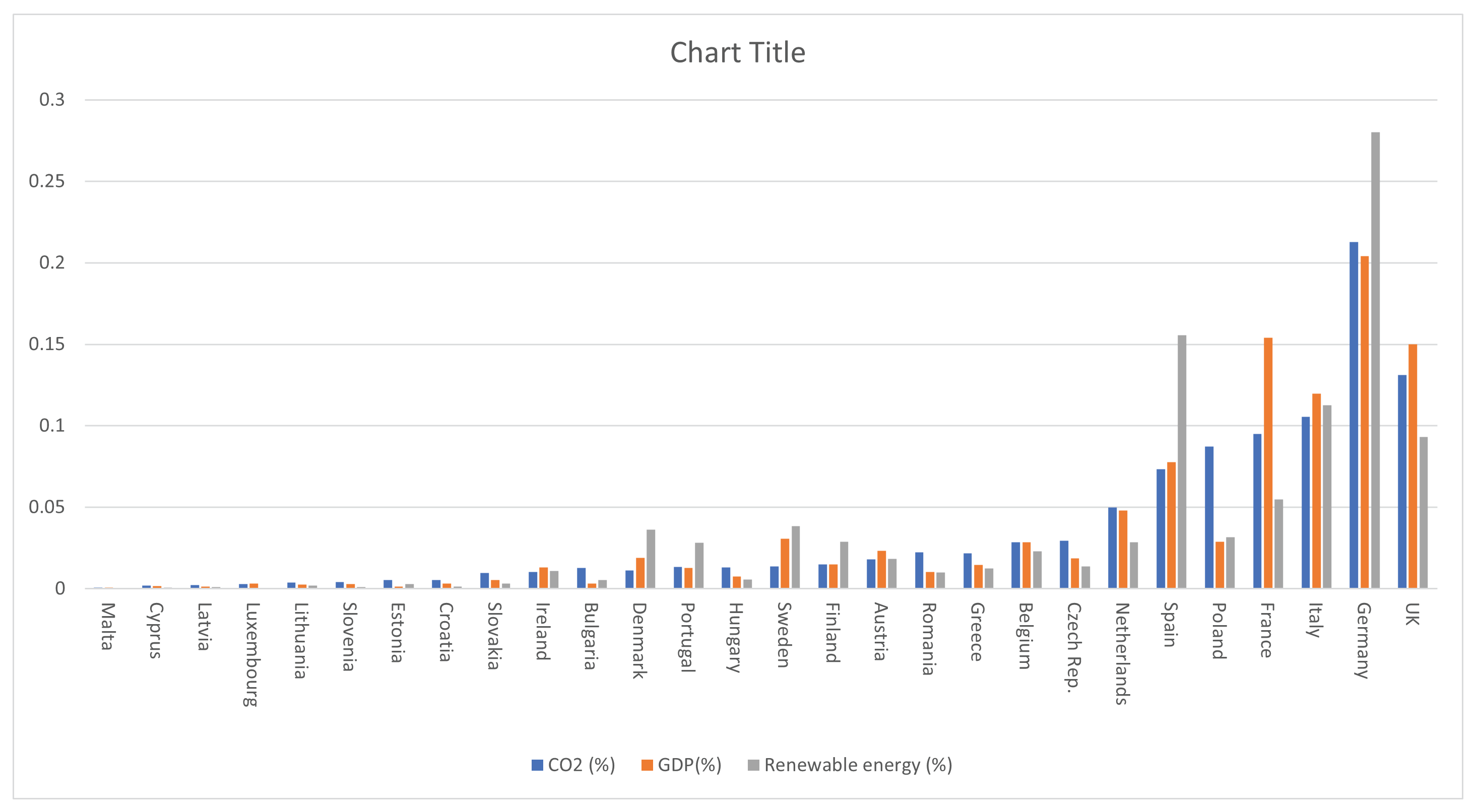
Figure 1 summarizes the total fraction of these three parameters for the 27 EU countries during the period 2010–2014. According to the Kyoto protocol [
19], which imposed by 2010 a reduction of
of the CO
2 total emissions in 1990, we set the estate
E of each of the five bankruptcy problems considered over the years from 2010 to 2014, equal to the
of the total amount of CO
2 emitted by all EU countries in 1990.
We applied Algorithm 1 to each bankruptcy situation
to obtain the DWCEA allocations for years
, and we computed the CEA allocations over the bankruptcy situations
as well as the WCEA allocations over the weighted bankruptcy problems
and
, respectively, for each year from 2010 to 2014. All of those allocations of CO
2 emissions permits are reported in
Table A2,
Table A3,
Table A4 and
Table A5 in
Appendix B.
As expected, the allocation yielded by the CEA solution completely satisfies small claims of emission permits. Instead, countries with high demands (i.e., Germany, UK, Italy and France), are drastically limited in their claims and receive the same amount of emission permits. The allocation provided by the WCEA solution based on GDP as the unique weight, favours countries with high GDP by giving more than half of the estate to the four countries with the highest GDP (i.e., Germany, UK, France, and Italy), while using the renewable energy as the unique weight, it completely satisfies some countries with intermediate emissions claims, (e.g., Denmark, Sweden, Finland, and Portugal), as well as countries having high claims and high renewable energy production (e.g., Germany and Spain).
Considering both the GDP and renewable energy as weights in Algorithm 1 to provide a DWCEA method, the countries respecting a specific threshold of both weights receive their total claims of emission permits, as it happens for Denmark, Sweden, Austria, and Spain in 2010, and for France and UK in 2014. Compared to the allocation generated by the WCEA solution based on GDP only as the weight, we can notice that the DWCEA allocation increases the amount of emission permits for 13 countries in 2010, 16 countries in 2011 and 2012, and 19 countries in 2013 and 2014. Instead, compared to the results obtained by the WCEA based on renewable energy as unique weight, we can observe an improvement in allocations for 17 countries for 2010 and 2011, and at least 14 countries from 2012 to 2014. Furthermore, in 2010, Denmark and Sweden were completely satisfied with whatever allocation method is used; Malta and Austria, in 2010, obtained an equal amount by DWCEA and WCEA based on renewable energy only, and Ireland, Finland, and France, in 2014, received the same amount of emissions permits according to DWCEA and WCEA based on GDP only.
We also notice similarities among allocations of some countries over the five studied years. To be more specific, we investigated those similarities by means of an unsupervised clustering technique, namely, the
K-means method, based on the 1-distance notion to measure the similarity of each country’s allocation distribution over the years from each cluster’s reference centre [
20]. This unsupervised clustering technique aims at grouping records (countries) of the data set into
K distinct clusters according to their similarities, and each record can only be found in one cluster at a time. Note that countries’ emissions are naturally divided in small, medium, and high emission levels. For this reason, we applied the
K-means method with
, to define three distinct groups reflecting the impact on CO
2 emissions of different EU countries. The clustering on CO
2 emission records over the five years is reported in
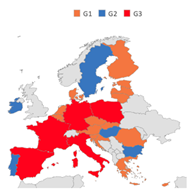
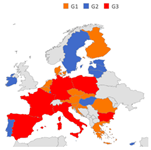
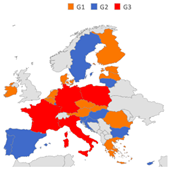
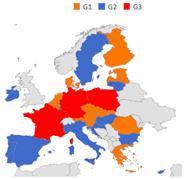
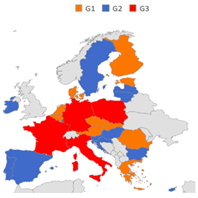
Table 3(1) and shows a group G1 of countries with low emissions, a group G2 formed by countries with medium emissions and, finally, a group G3 containing high emissions countries.
The results of the clustering procedure using the CO
2 emissions and the allocation distributions over the five years provided by the considered solutions CEA, WCEA with GDP only as weight, and WCEA with renewable energy only as weight, and DWCEA are shown in
Table 3(2–5), respectively.
Table 3(2) shows the clusters in accordance with the allocation distribution over the five years yielded by the CEA solution: notice that countries in groups G1 and G2 have low and medium demands and are totally satisfied with respect to their claims from 2010 to 2014. However, in Group 3, only the Netherlands, which has a medium emission distribution, is totally satisfied over 5 years. Other members of cluster G3 receive the same amount despite their different claims (except Spain, who has been totally satisfied since 2013).
Groups formed according to the allocation distribution over the five years by the WCEA solution based on GDP only, are presented in
Table 3(3). We observe that group G1 is defined by countries with a lower GDP, group G2 by countries with intermediate GDP, and the last group, G3, is formed by countries with high GDP. Two countries from group G2 (i.e., Denmark and Sweden), and only one country from group G3 (i.e., France), are totally satisfied throughout the five years. So, these groups show a high association between emissions permits claims and GDP, whose effect plays in favour of countries with a large internal economic production.
In
Table 3(4), concerning the clusters on allocation distributions over the five years provided by the WCEA solution based on the renewable energy only over the five years, group G3 contains countries with high emissions, which are also characterized by high levels of renewable energy production. In this group, Spain and Germany obtain their claims for all studied period. Even if the effect of the activities producing CO
2 is still predominant, here, countries with a high production of renewable energy show a similar allocation distribution over time, and those that are fully satisfied for at least three years are in groups with intermediate and high claims and also high renewable energy production at the same time.
Finally,
Table 3(5) presents the clusters generated on the allocation distribution over the years by the DWCEA allocation method. In this case, clusters are more homogeneous because they are generated by a balance among their claims, their economic levels, and their attitudes to employ green energy. According to the DWCEA allocation distribution over time, only Ireland, Denmark, Sweden, and Austria receive their full claims for at least three years due to their weight on renewable energy production. So, the trade-off between GDP and renewable energy production in the DWCEA allocation method seems to play in favour of countries characterized by intermediate levels of CO
2 claims and GDP and, at the same time, good levels of renewable energy production.
The clusters provided by the
K-means analysis can be interpreted as groups of countries equally affected by each proposed allocation method over the years. So, it seems reasonable to assume that countries in a cluster are guided by common interests and similar goals when faced with the possibility to accept or not a proposed allocation method. Therefore, we analysed the ability of these groups to influence the decision making process in the EU, and in particular on the voting process in the EU Council, which is the main collegiate body defining the overall political priorities of the EU, over the five year interval 2010–2014. For this reason, we focused on the ability of the different clusters of countries to impose a decision according to the voting system adopted during the same period by the EU Council. According to the EU rules (following the Treaty of Lisbon, effective since 2009, and operative for the voting rule of the EU Council since 2014), a decision is approved by the EU Council if it is supported by a coalition of at least
of countries representing at least
of the EU population (and keeping into account that a coalition may block a decision if it contains at least four countries globally representing at least
of the EU population). Using the calculator provided by the EU Council
4, we found the alternative combinations of clusters that may lead to the approval of a decision according to the voting system of the EU Council, which are summarized by
Table 4.
Considering the clusters generated by K-means just on the emissions distributions over the five years, and assuming that all countries within a cluster may only cooperate within the same cluster, or together with all the countries in another cluster, a decision can be approved when all countries in cluster G1 and G3 cooperate, or when all countries cooperate together (the grand coalition). Concerning the clusters obtained on the CEA allocation distributions over the years, the approval of a new agreement is reached by the collaboration of group G3 with groups G2 or G1, respectively, or when all countries of the three groups cooperate to form a grand coalition. Looking at clusters formed with the allocation distributions yielded by the WCEA solution based only on GDP, we observe the same winning coalitions as for the CEA solution, whereas for clusters obtained over the WCEA solution based on renewable energy, an agreement could be reached either by the coalition of countries in clusters G1 and G2, or by all countries together. A similar configuration of winning coalitions of clusters is obtained with the allocation distribution provided by the DWCEA solution, where again the cluster G3 plays a less relevant role to form winning coalitions in the EU Council. So, even if countries in cluster G3 are never fully satisfied for at least three years according to the DWCEA solution, their possible common interest to increase their own allocation would be prevented by the voting mechanism of the EU Council, which makes cluster G3 non-decisive in forming a winning coalition. A similar argument holds for countries in cluster G1 that are never totally satisfied, as well as for the group formed by clusters G1 and G3 together. On the contrary, the group formed by G1 and G2 together could form a blocking coalition against the use of the DWCEA solution, but the fact that group G2 contains many countries that are totally satisfied using the DWCEA method, makes the formation of such a coalition less likely.
As we already observed, the CEA rule fully satisfies countries with a low claim of CO
2 emissions permits, but it might encounter an objection to its application from countries with larger claims, who see their demands of CO
2 emissions permits strongly reduced. In order to mitigate this effect, and improve the acceptability of an allocation by countries with larger claims, the DWCEA solution can be seen by EU governments and populations as a fair compromise, keeping into account both the efficiency in production of countries, as represented by the GDP, and their environmental impact, measured by the rate of renewable energy production. To measure the level of acceptability of the different allocations of CO
2 emission permits, we compared the allocation vectors over the years 2010–2014 with the Sh–Sh power index [
16] computed on the simple game representing the EU Council voting rule. This power index is used as a benchmark to represent the actual shares of power of the EU countries according to the voting rule established by the Lisbona treatment (the data of the Sh–Sh power index used in this paper are from the paper [
17],
Table A1 on page 7, and refer to the population data of 2015). It is in fact well established that the Sh–Sh power index in a simple game is an appropriate measure of the P-power of voters (see, for instance, [
17,
18]), which is a measure for evaluating the outcome that each voter in a simple game can expect before playing the game.
Precisely, to assess the association between the Sh–Sh power index distribution and the CO
2 emission permits allocation vectors, we computed the Pearson correlation between the vector yielded by the Sh–Sh power index of the EU Council and the sum of CO
2 allocations over the interval 2010–2014 for the most powerful EU countries having Sh–Sh power index larger or equal to
of the total power, as well as for the remaining countries (see
Table 5; the choice of the cut-off follows from the fact that countries with a Sh–Sh index larger or equal than
form the smallest set of countries having two-thirds of the total power).
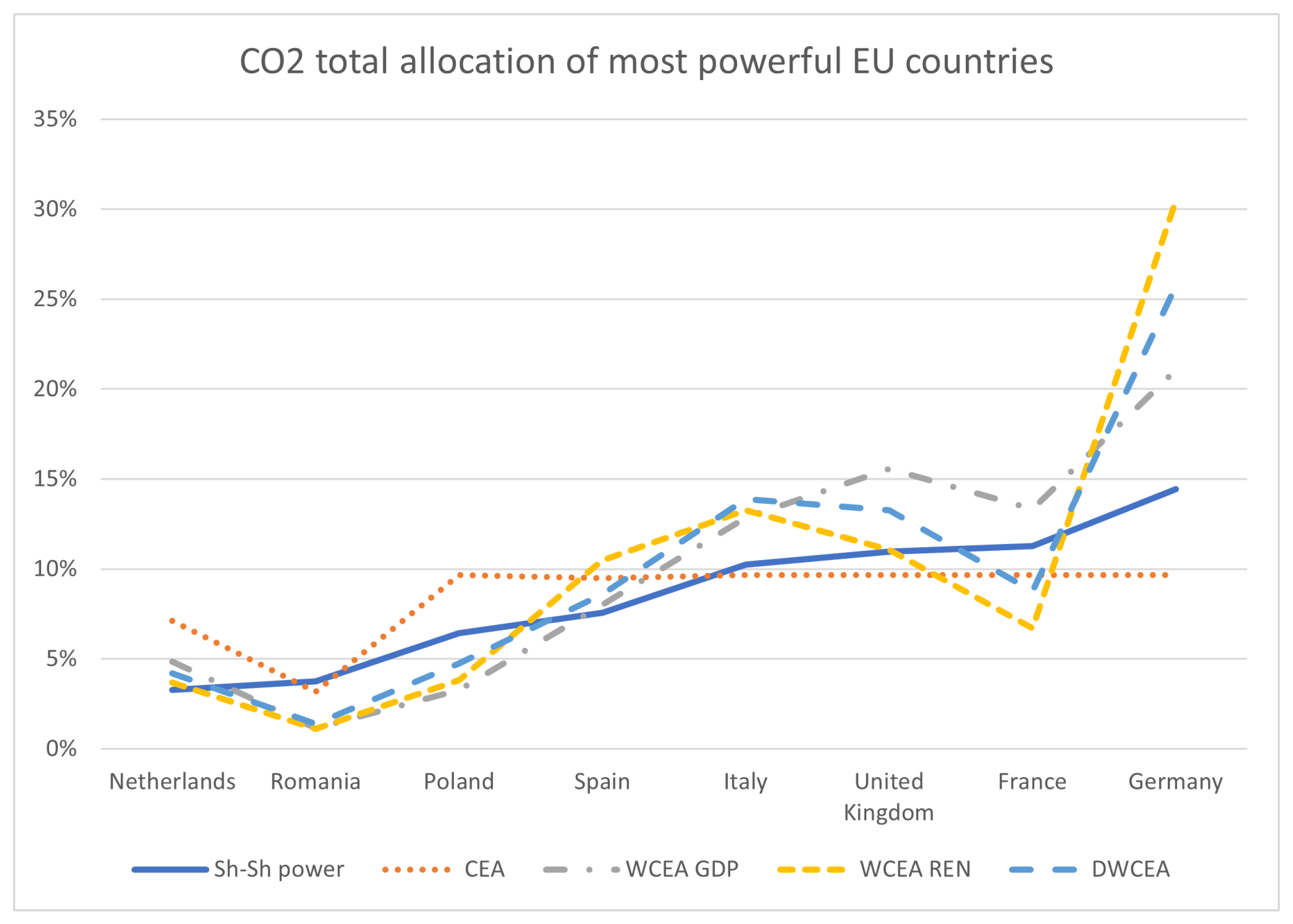
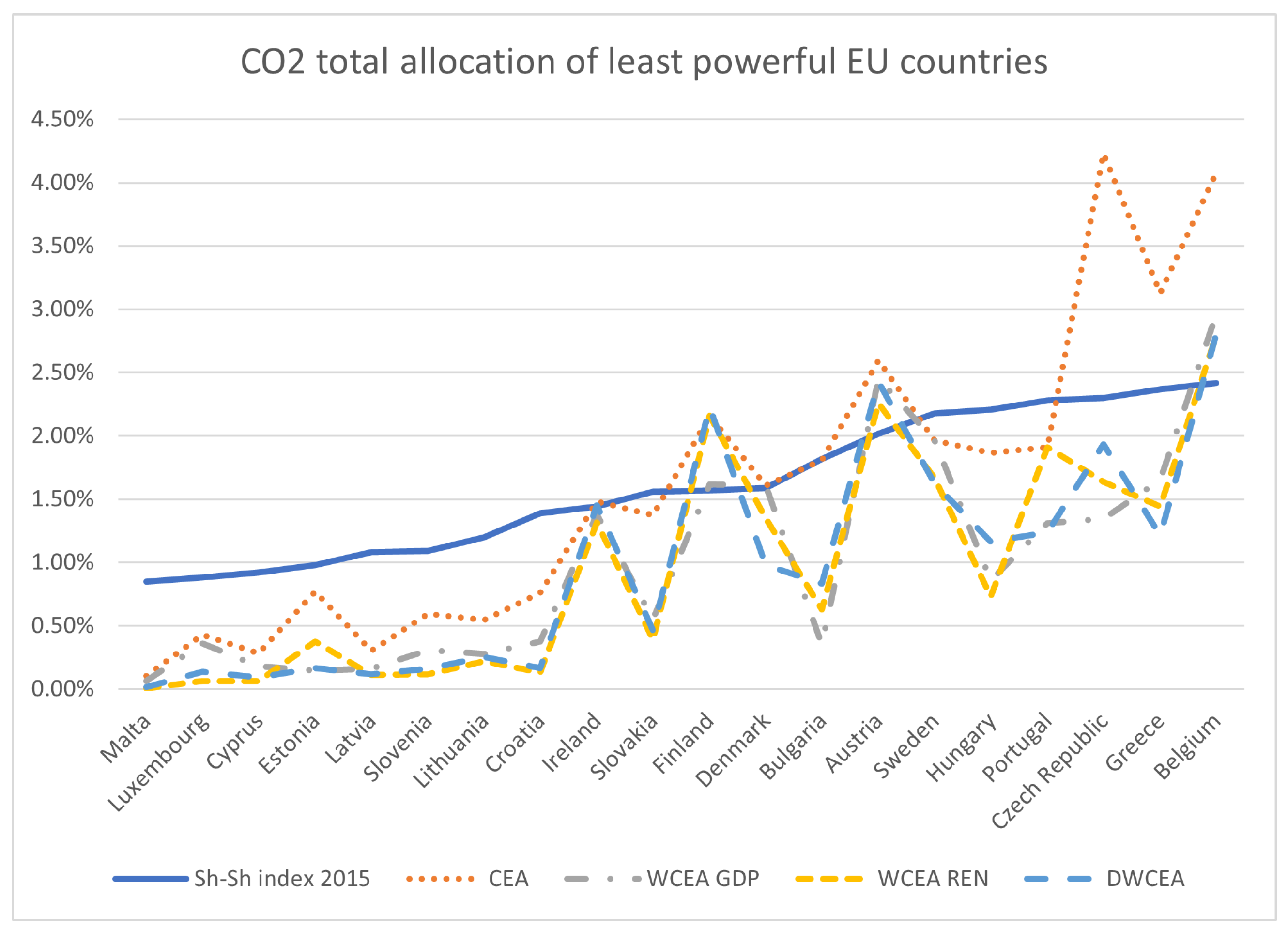
Figure 2 and
Figure 3 show the distribution (in percentage) of total CO
2 allocation vectors over the five years for the most powerful EU countries and the least powerful ones, respectively. In
Figure 2, we observe the systematic cut operated by the CEA rule (dotted line) on the demand of CO
2 permits for the six most powerful countries (precisely, for Poland, Spain, Italy, UK, France, and Germany), while the the adoption of the DWCEA rule shows an increase of the association between the allocation of CO
2 and the Sh–Sh power index of more than
in terms of the Pearson correlation (see
Table 5 for the correlation coefficients of the different CO
2 allocation vectors versus the Sh–Sh index vector). On the other hand, for the group of countries with Sh–Sh index smaller than
, the loss of correlation with the Sh–Sh power index faced by the DWCEA allocation with respect to the CEA allocation is much less important, and is in the order of
(see
Table 5). So, we argue that the loss of acceptability of the DWCEA versus the CEA for the groups of less powerful countries, is largely compensated by the double gain of acceptability for the most powerful ones, and further justified by the use of criteria based on production efficiency and environmental preservation, which may further encourage small countries to adopt better technologies to improve their energetic policies.