Prediction of Resectability of Peritoneal Disease in Ovarian Cancer Patients Using the Peritoneal Cancer Index (PCI) and Fagotti Score on MRI
 , , and
Simple Summary
Abstract
1. Introduction
2. Materials and Methods
2.1. Study Population
2.2. MRI Protocol
2.3. Radiological Evaluation
2.4. Reference Standard
2.5. Statistical Analysis
3. Results
3.1. Study Group
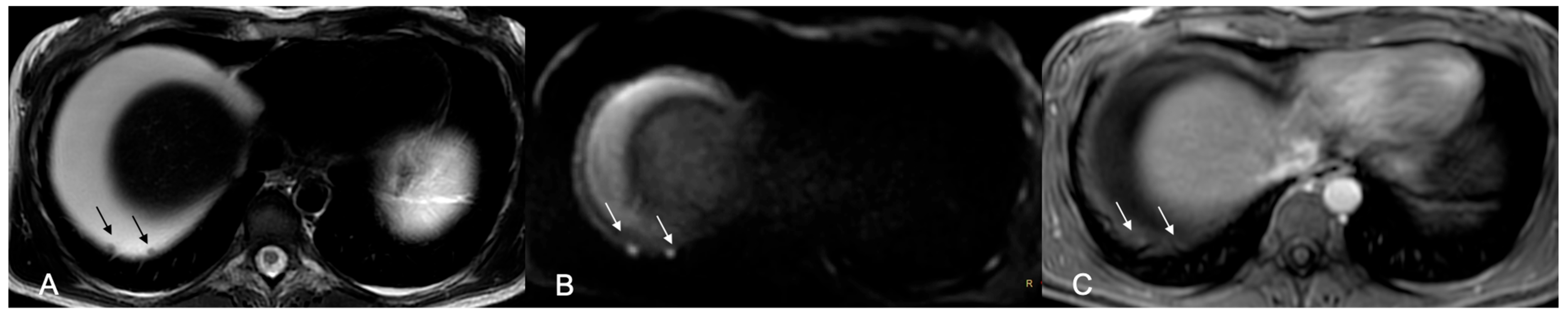
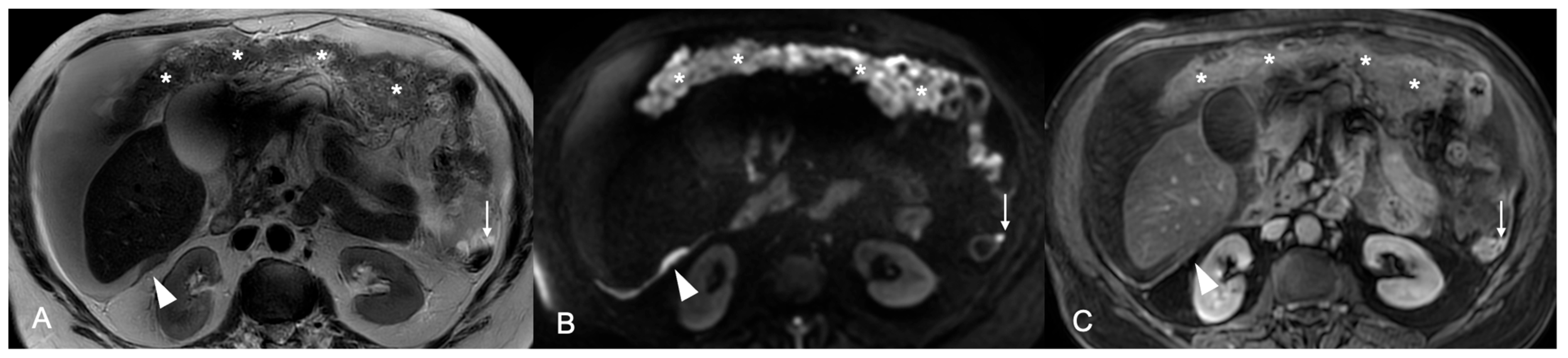
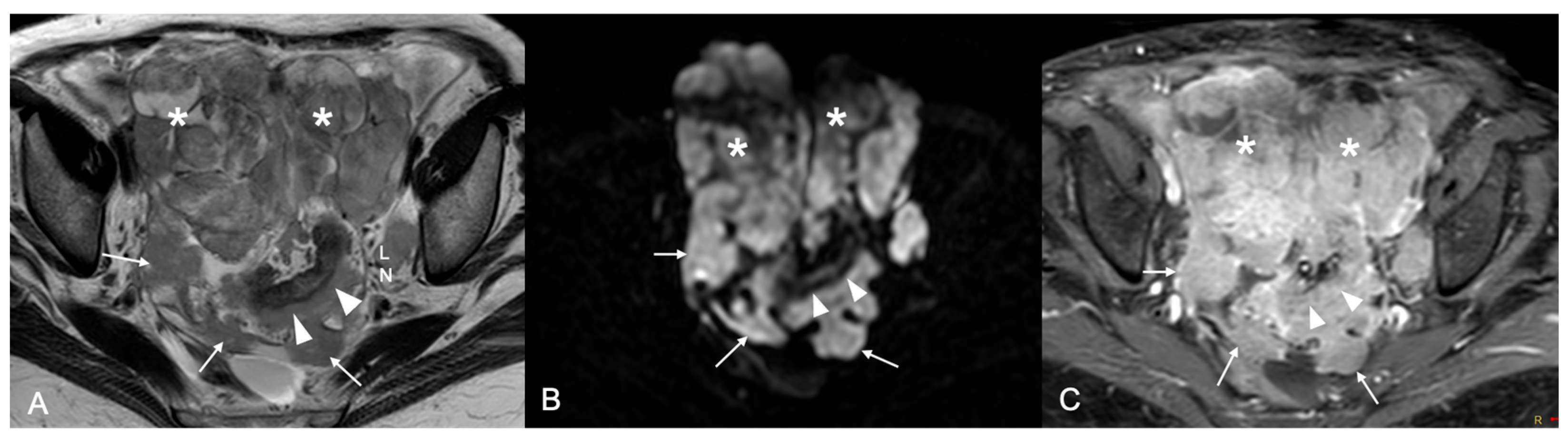
3.2. MRI-Based Fagotti Score
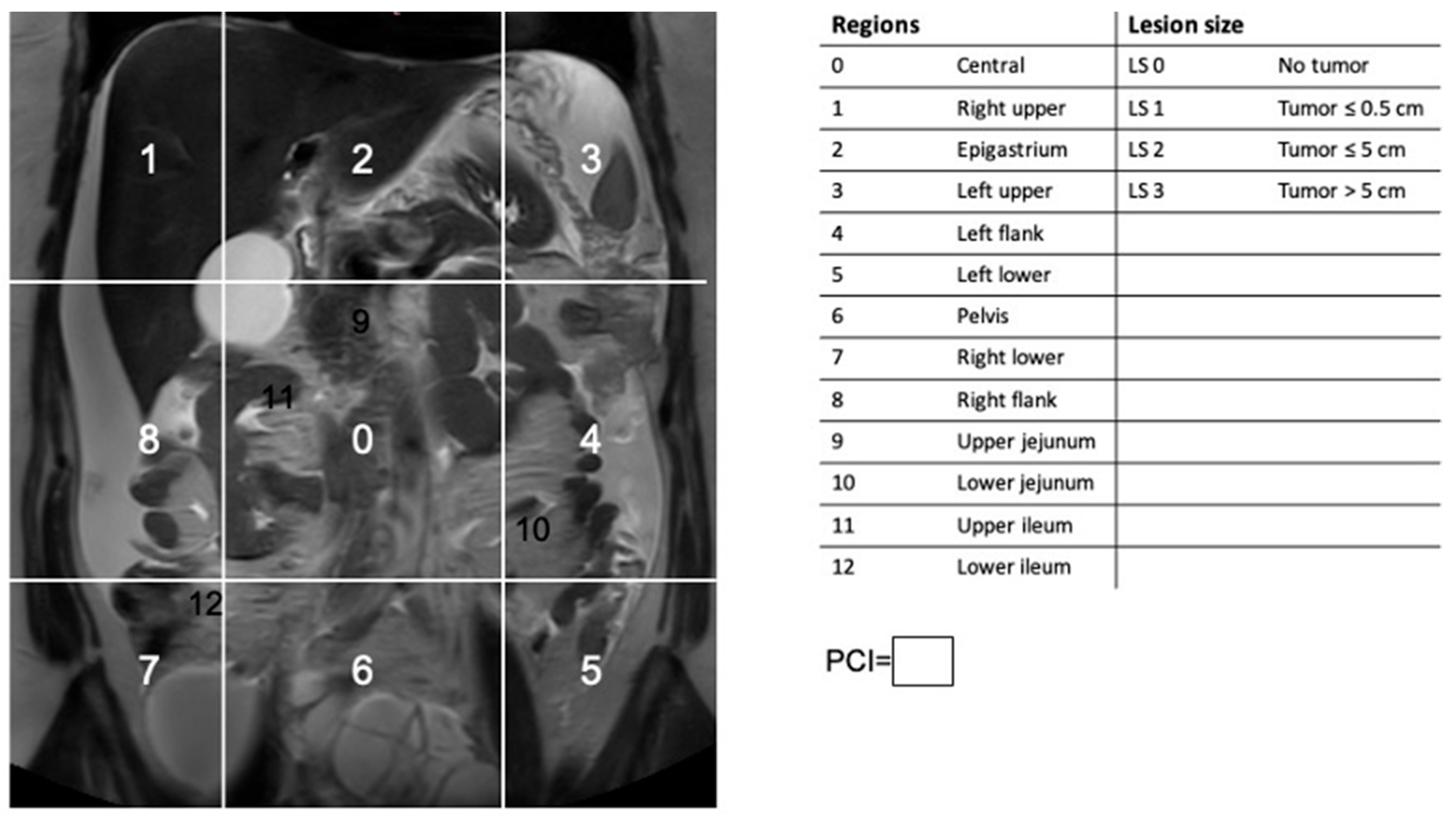
3.3. MRI-Based PCI
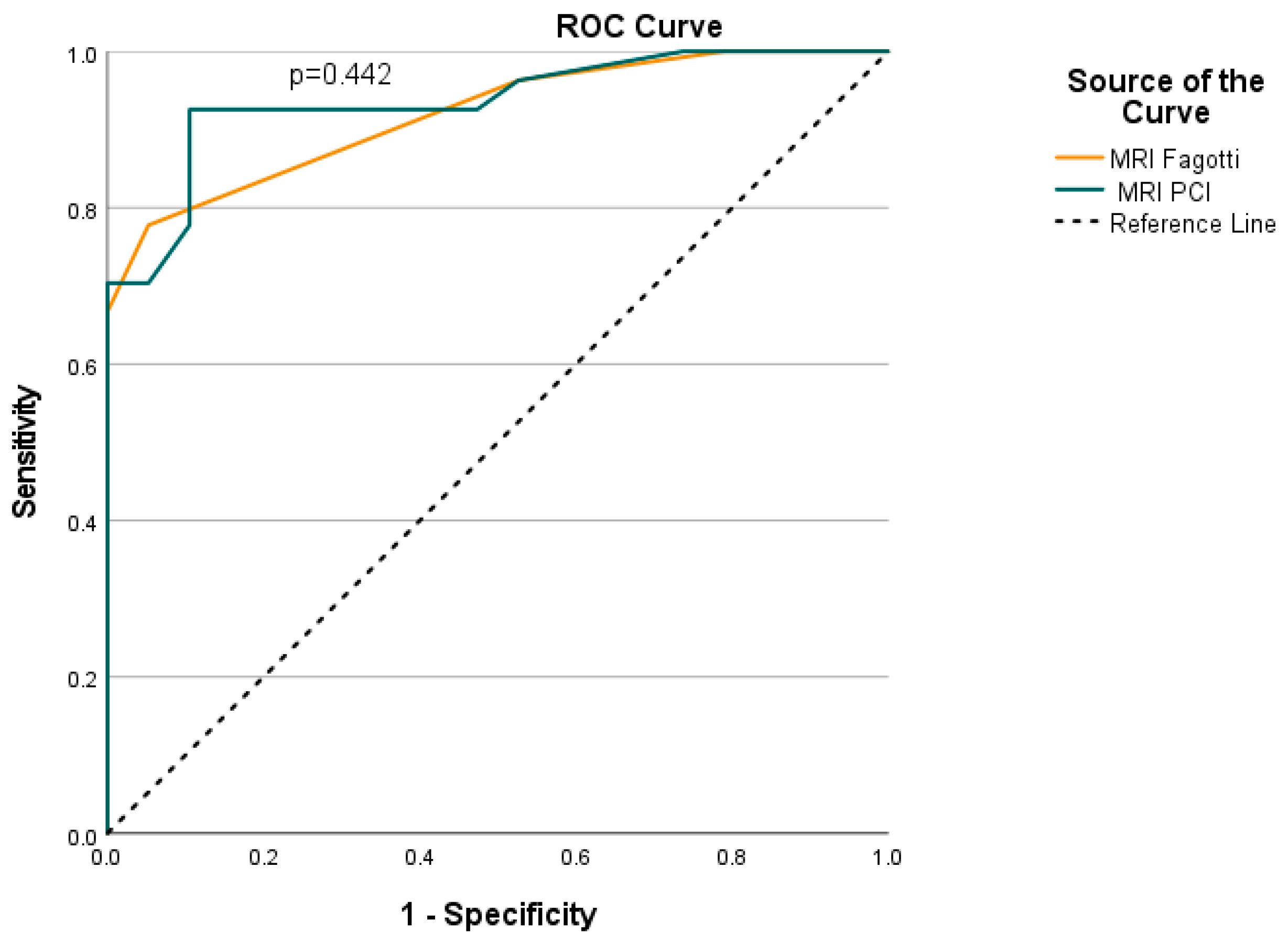
3.4. MRI-Based Fagotti Score vs. MRI-Based PCI
3.5. Interobserver Variability
4. Discussion
5. Conclusions
Supplementary Materials
Author Contributions
Funding
Institutional Review Board Statement
Informed Consent Statement
Data Availability Statement
Conflicts of Interest
Abbreviations
| PCI | Peritoneal Cancer Index |
| MRI | Magnetic Resonance Imaging |
| T2W | T2-weighted |
| DWI | Diffusion Weighted Imaging |
| T1W | T1-weighted |
| ROC | Receiver Operating Characteristic |
| AUC | Area Under the Curve |
| PDS | Primary Debulking Surgery |
| IDS | Interval Debulking Surgery |
| CT | Computed Tomography |
| PET-CT | Positron Emission Tomography-Computed Tomography |
| ADC | Apparent Diffusion Coefficient |
| PIV | Predictive Index Value |
| SD | Standard Deviation |
| IQR | Inter Quartile Range |
| PPV | Positive Predictive Value |
| NPV | Negative Predictive Value |
| OR | Odds Ratio |
| ICC | Intraclass Correlation Coefficient |
| FIGO | International Federation of Gynecology and Obstetrics |
| NACT | Neoadjuvant Chemotherapy |
| CI | Confidence Interval |
References
- Bristow, R.E.; Tomacruz, R.S.; Armstrong, D.K.; Trimble, E.L.; Montz, F.J. Survival Effect of Maximal Cytoreductive Surgery for Advanced Ovarian Carcinoma During the Platinum Era: A Meta-Analysis. J. Clin. Oncol. 2002, 20, 1248–1259. [Google Scholar] [CrossRef]
- Kehoe, S.; Hook, J.; Nankivell, M.; Jayson, G.C.; Kitchener, H.; Lopes, T.; Luesley, D.; Perren, T.; Bannoo, S.; Mascarenhas, M.; et al. Primary Chemotherapy versus Primary Surgery for Newly Diagnosed Advanced Ovarian Cancer (CHORUS): An Open-Label, Randomised, Controlled, Non-Inferiority Trial. Lancet 2015, 386, 249–257. [Google Scholar] [CrossRef] [PubMed]
- Querleu, D.; Planchamp, F.; Chiva, L.; Fotopoulou, C.; Barton, D.; Cibula, D.; Aletti, G.; Carinelli, S.; Creutzberg, C.; Davidson, B.; et al. European Society of Gynaecological Oncology (ESGO) Guidelines for Ovarian Cancer Surgery. Int. J. Gynecol. Cancer 2017, 27, 1534–1542. [Google Scholar] [CrossRef] [PubMed]
- Vergote, I.; Coens, C.; Nankivell, M.; Kristensen, G.B.; Parmar, M.K.B.; Ehlen, T.; Jayson, G.C.; Johnson, N.; Swart, A.M.; Verheijen, R.; et al. Neoadjuvant Chemotherapy versus Debulking Surgery in Advanced Tubo-Ovarian Cancers: Pooled Analysis of Individual Patient Data from the EORTC 55971 and CHORUS Trials. Lancet Oncol. 2018, 19, 1680–1687. [Google Scholar] [CrossRef] [PubMed]
- Onda, T.; Satoh, T.; Ogawa, G.; Saito, T.; Kasamatsu, T.; Nakanishi, T.; Mizutani, T.; Takehara, K.; Okamoto, A.; Ushijima, K.; et al. Comparison of Survival between Primary Debulking Surgery and Neoadjuvant Chemotherapy for Stage III/IV Ovarian, Tubal and Peritoneal Cancers in Phase III Randomised Trial. Eur. J. Cancer 2020, 130, 114–125. [Google Scholar] [CrossRef]
- Fagotti, A.; Ferrandina, M.G.; Vizzielli, G.; Pasciuto, T.; Fanfani, F.; Gallotta, V.; Margariti, P.A.; Chiantera, V.; Costantini, B.; Gueli Alletti, S.; et al. Randomized Trial of Primary Debulking Surgery versus Neoadjuvant Chemotherapy for Advanced Epithelial Ovarian Cancer (SCORPION-NCT01461850). Int. J. Gynecol. Cancer 2020, 30, 1657–1664. [Google Scholar] [CrossRef]
- Vergote, I.; du Bois, A.; Amant, F.; Heitz, F.; Leunen, K.; Harter, P. Neoadjuvant Chemotherapy in Advanced Ovarian Cancer: On What Do We Agree and Disagree? Gynecol. Oncol. 2013, 128, 6–11. [Google Scholar] [CrossRef]
- du Bois, A.; Reuss, A.; Pujade-Lauraine, E.; Harter, P.; Ray-Coquard, I.; Pfisterer, J. Role of Surgical Outcome as Prognostic Factor in Advanced Epithelial Ovarian Cancer: A Combined Exploratory Analysis of 3 Prospectively Randomized Phase 3 Multicenter Trials. Cancer 2009, 115, 1234–1244. [Google Scholar] [CrossRef]
- Vergote, I.; Tropé, C.G.; Amant, F.; Kristensen, G.B.; Ehlen, T.; Johnson, N.; Verheijen, R.H.M.; van der Burg, M.E.L.; Lacave, A.J.; Panici, P.B.; et al. Neoadjuvant Chemotherapy or Primary Surgery in Stage IIIC or IV Ovarian Cancer. N. Engl. J. Med. 2010, 363, 943–953. [Google Scholar] [CrossRef]
- Chang, S.-J.; Hodeib, M.; Chang, J.; Bristow, R.E. Survival Impact of Complete Cytoreduction to No Gross Residual Disease for Advanced-Stage Ovarian Cancer: A Meta-Analysis. Gynecol. Oncol. 2013, 130, 493–498. [Google Scholar] [CrossRef]
- Tangjitgamol, S.; Manusirivithaya, S.; Laopaiboon, M.; Lumbiganon, P.; Bryant, A. Interval Debulking Surgery for Advanced Epithelial Ovarian Cancer. Cochrane Database Syst. Rev. 2016, 1. [Google Scholar] [CrossRef]
- Fagotti, A.; Ferrandina, G.; Fanfani, F.; Ercoli, A.; Lorusso, D.; Rossi, M.; Scambia, G. A Laparoscopy-Based Score To Predict Surgical Outcome in Patients With Advanced Ovarian Carcinoma: A Pilot Study. Ann. Surg. Oncol. 2006, 13, 1156–1161. [Google Scholar] [CrossRef]
- Jacquet, P.; Sugarbaker, P.H. Clinical Research Methodologies in Diagnosis and Staging of Patients with Peritoneal Carcinomatosis. In Peritoneal Carcinomatosis: Principles of Management. Cancer Treatment and Research; Springer: Boston, MA, USA, 1996; pp. 359–374. [Google Scholar] [CrossRef]
- Chéreau, E.; Ballester, M.; Selle, F.; Cortez, A.; Daraï, E.; Rouzier, R. Comparison of Peritoneal Carcinomatosis Scoring Methods in Predicting Resectability and Prognosis in Advanced Ovarian Cancer. Am. J. Obs. Gynecol. 2010, 202, 178.e1–178.e10. [Google Scholar] [CrossRef]
- Ledermann, J.A.; Matias-Guiu, X.; Amant, F.; Concin, N.; Davidson, B.; Fotopoulou, C.; González-Martin, A.; Gourley, C.; Leary, A.; Lorusso, D.; et al. ESGO-ESMO-ESP Consensus Conference Recommendations on Ovarian Cancer: Pathology and Molecular Biology and Early, Advanced and Recurrent Disease. Ann. Oncol. 2024, 35, 248–266. [Google Scholar] [CrossRef]
- Vandecaveye, V.; Rousset, P.; Nougaret, S.; Stepanyan, A.; Otero-Garcia, M.; Nikolić, O.; Hameed, M.; Goffin, K.; de Hingh, I.H.J.; Lahaye, M.J.; et al. Imaging of Peritoneal Metastases of Ovarian and Colorectal Cancer: Joint Recommendations of ESGAR, ESUR, PSOGI, and EANM. Eur. Radiol. 2025, 35, 2712–2722. [Google Scholar] [CrossRef]
- Pinto, P.; Burgetova, A.; Cibula, D.; Haldorsen, I.S.; Indrielle-Kelly, T.; Fischerova, D. Prediction of Surgical Outcome in Advanced Ovarian Cancer by Imaging and Laparoscopy: A Narrative Review. Cancers 2023, 15, 1904. [Google Scholar] [CrossRef]
- Jónsdóttir, B.; Lomnytska, M.; Poromaa, I.S.; Silins, I.; Stålberg, K. The Peritoneal Cancer Index Is a Strong Predictor of Incomplete Cytoreductive Surgery in Ovarian Cancer. Ann. Surg. Oncol. 2021, 28, 244–251. [Google Scholar] [CrossRef]
- Gasimli, K.; Braicu, E.I.; Richter, R.; Chekerov, R.; Sehouli, J. Prognostic and Predictive Value of the Peritoneal Cancer Index in Primary Advanced Epithelial Ovarian Cancer Patients After Complete Cytoreductive Surgery: Study of Tumor Bank Ovarian Cancer. Ann. Surg. Oncol. 2015, 22, 2729–2737. [Google Scholar] [CrossRef]
- Lampe, B.; Kroll, N.; Piso, P.; Forner, D.M.; Mallmann, P. Prognostic Significance of Sugarbaker’s Peritoneal Cancer Index for the Operability of Ovarian Carcinoma. Int. J. Gynecol. Cancer 2015, 25, 135–144. [Google Scholar] [CrossRef]
- Gouy, S.; Belghiti, J.; Uzan, C.; Canlorbe, G.; Gauthier, T.; Morice, P. Accuracy and Reproducibility of the Peritoneal Cancer Index in Advanced Ovarian Cancer during Laparoscopy and Laparotomy. Int. J. Gynecol. Cancer 2013, 23, 1699–1703. [Google Scholar] [CrossRef]
- Engbersen, M.P.; van’ t Sant, I.; Lok, C.; Lambregts, D.M.J.; Sonke, G.S.; Beets-Tan, R.G.H.; van Driel, W.J.; Lahaye, M.J. MRI with Diffusion-Weighted Imaging to Predict Feasibility of Complete Cytoreduction with the Peritoneal Cancer Index (PCI) in Advanced Stage Ovarian Cancer Patients. Eur. J. Radiol. 2019, 114, 146–151. [Google Scholar] [CrossRef]
- Pinto, P.; Moro, F.; Alcázar, J.L.; Alessi, S.; Avesani, G.; Benesova, K.; Burgetova, A.; Calareso, G.; Chiappa, V.; Cibula, D.; et al. Prediction of Non-Resectability in Tubo-Ovarian Cancer Patients Using Peritoneal Cancer Index—A Prospective Multicentric Study Using Imaging (ISAAC Study). Gynecol. Oncol. 2024, 191, 132–142. [Google Scholar] [CrossRef]
- Michielsen, K.; Dresen, R.; Vanslembrouck, R.; De Keyzer, F.; Amant, F.; Mussen, E.; Leunen, K.; Berteloot, P.; Moerman, P.; Vergote, I.; et al. Diagnostic Value of Whole Body Diffusion-Weighted MRI Compared to Computed Tomography for Pre-Operative Assessment of Patients Suspected for Ovarian Cancer. Eur. J. Cancer 2017, 83, 88–98. [Google Scholar] [CrossRef]
- Rizzo, S.; De Piano, F.; Buscarino, V.; Pagan, E.; Bagnardi, V.; Zanagnolo, V.; Colombo, N.; Maggioni, A.; Del Grande, M.; Del Grande, F.; et al. Pre-Operative Evaluation of Epithelial Ovarian Cancer Patients: Role of Whole Body Diffusion Weighted Imaging MR and CT Scans in the Selection of Patients Suitable for Primary Debulking Surgery. A Single-Centre Study. Eur. J. Radiol. 2020, 123, 108786. [Google Scholar] [CrossRef]
- Polterauer, S.; Vergote, I.; Concin, N.; Braicu, I.; Chekerov, R.; Mahner, S.; Woelber, L.; Cadron, I.; Van Gorp, T.; Zeillinger, R.; et al. Prognostic Value of Residual Tumor Size in Patients With Epithelial Ovarian Cancer FIGO Stages IIA-IV. Int. J. Gynecol. Cancer 2012, 22, 380–385. [Google Scholar] [CrossRef]
- Zhou, M.; Wang, D.; Long, Z.; Zhang, Y.; Liu, J. Role of Laparotomy-Based Parameters in Assessment of Optimal Primary Debulking Surgery and Long-Term Outcomes in Patients with Stage IIIC Epithelial Ovarian Cancer. J. Cancer 2020, 11, 983–989. [Google Scholar] [CrossRef]
- Feng, Z.; Wen, H.; Jiang, Z.; Liu, S.; Ju, X.; Chen, X.; Xia, L.; Xu, J.; Bi, R.; Wu, X. A Triage Strategy in Advanced Ovarian Cancer Management Based on Multiple Predictive Models for R0 Resection: A Prospective Cohort Study. J. Gynecol. Oncol. 2018, 29, e65. [Google Scholar] [CrossRef]
- Llueca, A.; Serra, A.; Rivadulla, I.; Gomez, L.; Escrig, J. Prediction of Suboptimal Cytoreductive Surgery in Patients with Advanced Ovarian Cancer Based on Preoperative and Intraoperative Determination of the Peritoneal Carcinomatosis Index. World J. Surg. Oncol. 2018, 16, 37. [Google Scholar] [CrossRef]
- Brun, J.-L.; Rouzier, R.; Uzan, S.; Daraï, E. External Validation of a Laparoscopic-Based Score to Evaluate Resectability of Advanced Ovarian Cancers: Clues for a Simplified Score. Gynecol. Oncol. 2008, 110, 354–359. [Google Scholar] [CrossRef]
- Varnoux, C.; Huchon, C.; Bats, A.S.; Bensaid, C.; Achouri, A.; Nos, C.; Lécuru, F. Diagnostic Accuracy of Hand-Assisted Laparoscopy in Predicting Resectability of Peritoneal Carcinomatosis from Gynecological Malignancies. Eur. J. Surg. Oncol. 2013, 39, 774–779. [Google Scholar] [CrossRef]
- Tomar, T.S.; Nair, R.P.; Sambasivan, S.; Krishna, K.M.J.; Mathew, A.; Ahmed, I.M. Role of Laparoscopy in Predicting Surgical Outcomes in Patients Undergoing Interval Cytoreduction Surgery for Advanced Ovarian Carcinoma: A Prospective Validation Study. Indian J. Cancer 2017, 54, 550–555. [Google Scholar] [CrossRef]
- Hansen, J.M.; Sood, A.K.; Coleman, R.L.; Westin, S.N.; Soliman, P.T.; Ramirez, P.T.; Fellman, B.M.; Schmeler, K.M.; Fleming, N.D. Concordance of a Laparoscopic Scoring Algorithm with Primary Surgery Findings in Advanced Stage Ovarian Cancer. Gynecol. Oncol. 2018, 151, 428–432. [Google Scholar] [CrossRef]
- Llueca, A.; Climent, M.T.; Escrig, J.; Carrasco, P.; Serra, A.; MUAPOS working group (Multidisciplinary Unit of Abdominal Pelvic Oncology Surgery). Validation of Three Predictive Models for Suboptimal Cytoreductive Surgery in Advanced Ovarian Cancer. Sci. Rep. 2021, 11, 8111. [Google Scholar] [CrossRef]
- Fagotti, A.; Vizzielli, G.; De Iaco, P.; Surico, D.; Buda, A.; Mandato, V.D.; Petruzzelli, F.; Ghezzi, F.; Garzarelli, S.; Mereu, L.; et al. A Multicentric Trial (Olympia–MITO 13) on the Accuracy of Laparoscopy to Assess Peritoneal Spread in Ovarian Cancer. Am. J. Obs. Gynecol. 2013, 209, 462.e1–462.e11. [Google Scholar] [CrossRef]
- Kang, S.K.; Reinhold, C.; Atri, M.; Benson, C.B.; Bhosale, P.R.; Jhingran, A.; Lakhman, Y.; Maturen, K.E.; Nicola, R.; Pandharipande, P.V.; et al. ACR Appropriateness Criteria ® Staging and Follow-Up of Ovarian Cancer. J. Am. Coll. Radiol. 2018, 15, S198–S207. [Google Scholar] [CrossRef] [PubMed]
- Ahmed, S.A.; Abou-Taleb, H.; Yehia, A.; El Malek, N.A.A.; Siefeldein, G.S.; Badary, D.M.; Jabir, M.A. The Accuracy of Multi-Detector Computed Tomography and Laparoscopy in the Prediction of Peritoneal Carcinomatosis Index Score in Primary Ovarian Cancer. Acad. Radiol. 2019, 26, 1650–1658. [Google Scholar] [CrossRef]
- Avesani, G.; Arshad, M.; Lu, H.; Fotopoulou, C.; Cannone, F.; Melotti, R.; Aboagye, E.; Rockall, A. Radiological Assessment of Peritoneal Cancer Index on Preoperative CT in Ovarian Cancer Is Related to Surgical Outcome and Survival. Radiol. Med. 2020, 125, 770–776. [Google Scholar] [CrossRef]
- Ghisoni, E.; Katsaros, D.; Maggiorotto, F.; Aglietta, M.; Vaira, M.; De Simone, M.; Mittica, G.; Giannone, G.; Robella, M.; Genta, S.; et al. A Predictive Score for Optimal Cytoreduction at Interval Debulking Surgery in Epithelial Ovarian Cancer: A Two- Centers Experience. J. Ovarian Res. 2018, 11, 42. [Google Scholar] [CrossRef]
- Low, R.N.; Barone, R.M.; Lucero, J. Comparison of MRI and CT for Predicting the Peritoneal Cancer Index (PCI) Preoperatively in Patients Being Considered for Cytoreductive Surgical Procedures. Ann. Surg. Oncol. 2015, 22, 1708–1715. [Google Scholar] [CrossRef]



| Score = 0 | Score = 2 | |
|---|---|---|
| Peritoneal carcinomatosis | Limited disease (e.g., paracolic gutter, pelvic peritoneum) | Massive peritoneal involvement or miliary disease |
| Diaphragmatic disease | Isolated diaphragmatic disease | Widespread infiltration or confluent nodules involving most part (>50%) of the diaphragm |
| Mesenteric disease | Few small nodules | Large infiltrating nodules involving the root of the mesentery or mesenteric retraction |
| Omental disease | Isolated omental disease | Tumor spread up to the large curvature of the stomach |
| Bowel infiltration | No infiltration | Extensive bowel involvement or miliary disease |
| Stomach infiltration | No infiltration | Involvement of the gastric wall |
| Liver disease | No surface lesions | Any surface lesions |
| n = 46 | n | % | |
|---|---|---|---|
| Histological Type | clear cell | 1 | 2.2 |
| endometrioid | 4 | 8.7 | |
| high-grade serous | 35 | 76.1 | |
| low-grade serous | 4 | 8.7 | |
| mucinous | 2 | 4.3 | |
| Stage | Ι | 3 | 6.5 |
| ΙΙ | 3 | 6.5 | |
| ΙΙΙ | 31 | 67.4 | |
| IV | 9 | 19.6 | |
| Treatment | NACT | 19 | 41.3 |
| PDS | 27 | 58.7 | |
| Outcome | complete | 26 | 56.5 |
| optimal | 1 | 2.2 | |
| suboptimal/not feasible | 19 | 41.3 | |
| Mean (SD) | Median (IQR) | ||
| CA-125(u/mL) | 1610.5 (1741.4) | 723.5 (352–2532) | |
| MRI-based Fagotti | 6 (3.8) | 8 (2–8) | |
| MRI-based PCI | 16.7 (7.8) | 19.5 (12–23) | |
| Resectable Disease | |||||||||||
|---|---|---|---|---|---|---|---|---|---|---|---|
| No | Yes | ||||||||||
| Mean (SD) | Median (IQR) | Mean (SD) | Median (IQR) | AUC (95% CI) | p | Optimal Cut-Off | Sensitivity (%) | Specificity (%) | PPV (%) | NPV (%) | |
| MRI-based Fagotti | 9.3 (1.8) | 8 (8–10) | 3.7 (3.2) | 4 (0–6) | 0.92 (0.84–1.00) | <0.001 | ≤6 | 77.8 | 94.7 | 95.5 | 75.0 |
| MRI-based PCI | 22.9 (2.3) | 23 (21–25) | 12.4 (7.4) | 14 (5–19) | 0.94 (0.87–1.00) | <0.001 | ≤20 | 92.6 | 89.5 | 92.6 | 89.5 |
Disclaimer/Publisher’s Note: The statements, opinions and data contained in all publications are solely those of the individual author(s) and contributor(s) and not of MDPI and/or the editor(s). MDPI and/or the editor(s) disclaim responsibility for any injury to people or property resulting from any ideas, methods, instructions or products referred to in the content. |
© 2026 by the authors. Licensee MDPI, Basel, Switzerland. This article is an open access article distributed under the terms and conditions of the Creative Commons Attribution (CC BY) license.
Share and Cite
Konidari, M.; Gourtsoyianni, S.; Thomakos, N.; Lymperopoulou, G.; Tzavara, C.; Pergialiotis, V.; Rodolakis, A.; Moulopoulos, L.A.; Bourgioti, C. Prediction of Resectability of Peritoneal Disease in Ovarian Cancer Patients Using the Peritoneal Cancer Index (PCI) and Fagotti Score on MRI. Cancers 2026, 18, 165. https://doi.org/10.3390/cancers18010165
Konidari M, Gourtsoyianni S, Thomakos N, Lymperopoulou G, Tzavara C, Pergialiotis V, Rodolakis A, Moulopoulos LA, Bourgioti C. Prediction of Resectability of Peritoneal Disease in Ovarian Cancer Patients Using the Peritoneal Cancer Index (PCI) and Fagotti Score on MRI. Cancers. 2026; 18(1):165. https://doi.org/10.3390/cancers18010165
Chicago/Turabian StyleKonidari, Marianna, Sofia Gourtsoyianni, Nikolaos Thomakos, Georgia Lymperopoulou, Chara Tzavara, Vasilios Pergialiotis, Alexandros Rodolakis, Lia Angela Moulopoulos, and Charis Bourgioti. 2026. "Prediction of Resectability of Peritoneal Disease in Ovarian Cancer Patients Using the Peritoneal Cancer Index (PCI) and Fagotti Score on MRI" Cancers 18, no. 1: 165. https://doi.org/10.3390/cancers18010165
APA StyleKonidari, M., Gourtsoyianni, S., Thomakos, N., Lymperopoulou, G., Tzavara, C., Pergialiotis, V., Rodolakis, A., Moulopoulos, L. A., & Bourgioti, C. (2026). Prediction of Resectability of Peritoneal Disease in Ovarian Cancer Patients Using the Peritoneal Cancer Index (PCI) and Fagotti Score on MRI. Cancers, 18(1), 165. https://doi.org/10.3390/cancers18010165