Cost-Effectiveness Analysis of an Intracranial Stereotactic Radiotherapy Service for Brain Metastasis in a North Queensland Regional Cancer Centre
 , , , , and
Simple Summary
Abstract
1. Introduction
2. Materials and Methods
2.1. Study Population
2.2. SRS Services
2.3. Follow-Up
2.4. Cost Analysis
2.4.1. Travel Costs
2.4.2. Accommodation Costs
2.4.3. Informal Care Costs
2.5. Statistical Analysis
3. Results
3.1. Patient Characteristics
3.2. Treatment Costs
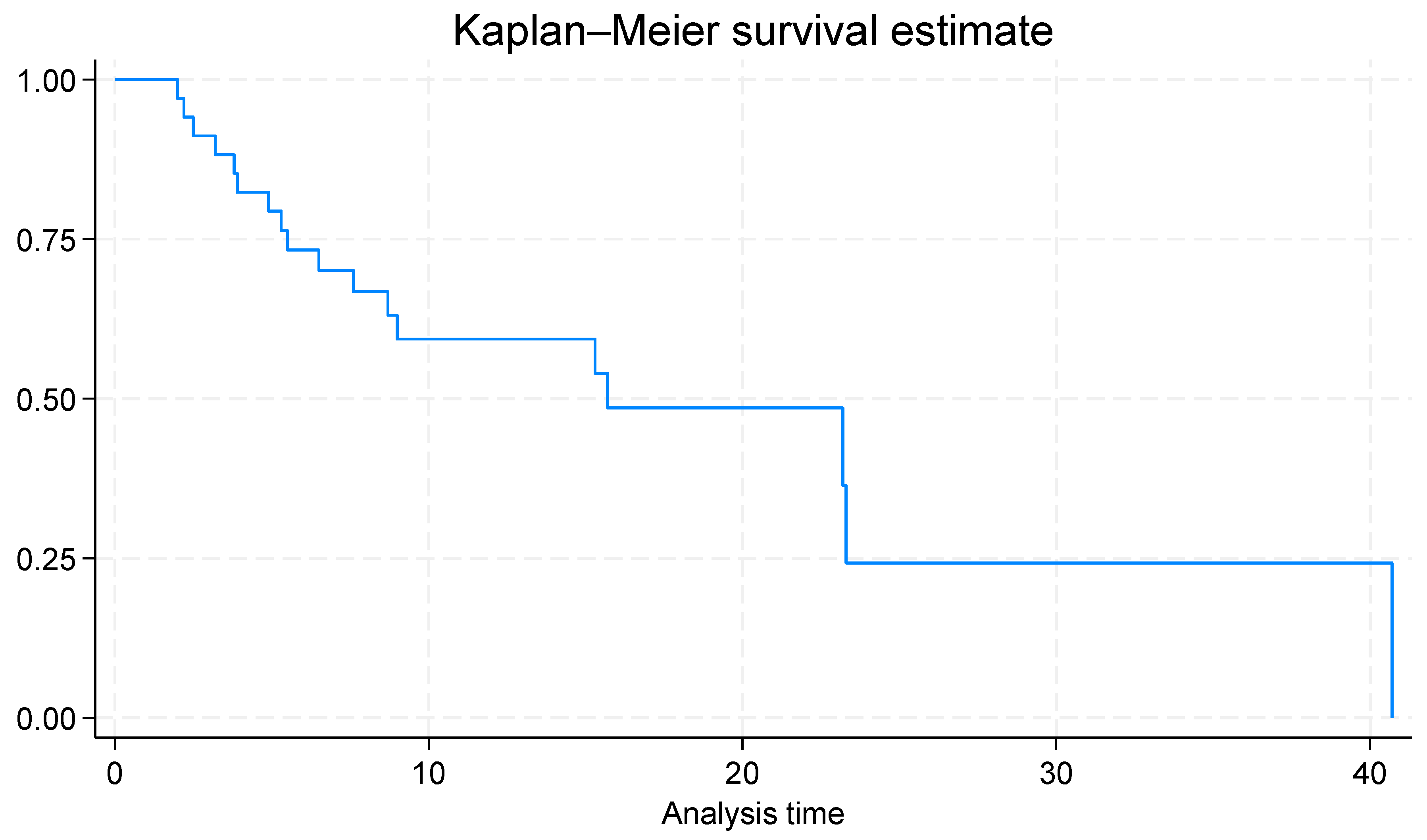
3.3. Survival Outcomes
4. Discussion
5. Conclusions
Supplementary Materials
Author Contributions
Funding
Institutional Review Board Statement
Informed Consent Statement
Data Availability Statement
Acknowledgments
Conflicts of Interest
Abbreviations
| SRS | stereotactic radiosurgery |
| MRI | magnetic resonance imaging |
| RCT | randomised controlled trial |
| PTV | planning treatment volume |
| GTV | gross tumour volume |
| ECOG | Eastern Cooperative Oncology Group |
| OAR | organs at risk |
| CI | confidence interval |
| PTSS | Patient Travel Subsidy Scheme |
| QA | quality assurance |
References
- Lamba, N.; Wen, P.Y.; Aizer, A.A. Epidemiology of brain metastases and leptomeningeal disease. Neuro-Oncology 2021, 23, 1447–1456. [Google Scholar] [CrossRef] [PubMed]
- Your Impact [Internet]. Cancer Council Queensland. 2025. Available online: https://cancerqld.org.au/get-involved/your-impact/ (accessed on 26 November 2025).
- Kim, M.; Suh, C.H.; Lee, S.M.; Kim, H.C.; Aizer, A.A.; Yanagihara, T.K.; Bai, H.X.; Guenette, J.P.; Huang, R.Y.; Kim, H.S. Diagnostic Yield of Staging Brain MRI in Patients with Newly Diagnosed Non–Small Cell Lung Cancer. Radiology 2020, 297, 419–427. [Google Scholar] [CrossRef] [PubMed]
- Alvarez-Breckenridge, C.; Remon, J.; Piña, Y.; Nieblas-Bedolla, E.; Forsyth, P.; Hendriks, L.; Brastianos, P.K. Emerging Systemic Treatment Perspectives on Brain Metastases: Moving Toward a Better Outlook for Patients. Am. Soc. Clin. Oncol. Educ. Book 2022, 1, 147–165. [Google Scholar] [CrossRef]
- Minniti, G.; Clarke, E.; Lanzetta, G.; Osti, M.F.; Trasimeni, G.; Bozzao, A.; Romano, A.; Enrici, R.M. Stereotactic radiosurgery for brain metastases: Analysis of outcome and risk of brain radionecrosis. Radiat. Oncol. 2011, 6, 48. [Google Scholar] [CrossRef]
- Mahajan, A.; Ahmed, S.; McAleer, M.F.; Weinberg, J.S.; Li, J.; Brown, P.; Settle, S.; Prabhu, S.S.; Lang, F.F.; Levine, N.; et al. Post-operative stereotactic radiosurgery versus observation for completely resected brain metastases: A single-centre, randomised, controlled, phase 3 trial. Lancet Oncol. 2017, 18, 1040–1048. [Google Scholar] [CrossRef]
- Myrehaug, S.; Hudson, J.; Soliman, H.; Ruschin, M.; Tseng, C.L.; Detsky, J.; Husain, Z.; Keith, J.; Atenafu, E.G.; Maralani, P.; et al. Hypofractionated Stereotactic Radiation Therapy for Intact Brain Metastases in 5 Daily Fractions: Effect of Dose on Treatment Response. Int. J. Radiat. Oncol. Biol. Phys. 2021, 112, 342–350. [Google Scholar] [CrossRef] [PubMed]
- Zhang, Q.; Hamilton, D.; Conway, P.; Xie, S.J.; Haghighi, N.; Lasocki, A. Radiation necrosis and therapeutic outcomes in patients treated with linear accelerator-based hypofractionated stereotactic radiosurgery for intact intracranial metastases. J. Med. Imaging Radiat. Oncol. 2023, 67, 308–319. [Google Scholar] [CrossRef]
- Andrews, D.W.; Scott, C.B.; Sperduto, P.W.; Flanders, A.E.; Gaspar, L.E.; Schell, M.C.; Werner-Wasik, M.; Demas, W.; Ryu, J.; Bahari, J.P.; et al. Whole brain radiation therapy with or without stereotactic radiosurgery boost for patients with one to three brain metastases: Phase III results of the RTOG 9508 randomised trial. Lancet 2004, 363, 1665–1672. [Google Scholar] [CrossRef]
- Sahgal, A.; Myrehaug, S.D.; Siva, S.; Masucci, G.L.; Maralani, P.J.; Brundage, M.; Butler, J.; Chow, E.; Fehlings, M.G.; Foote, M.; et al. Stereotactic body radiotherapy versus conventional external beam radiotherapy in patients with painful spinal metastases: An open-label, multicentre, randomised, controlled, phase 2/3 trial. Lancet Oncol. 2021, 22, 1023–1033. [Google Scholar] [CrossRef]
- Gamma Knife Centre of Queensland [Internet]. Qld.gov.au. 2025. Available online: https://www.qld.gov.au/health/services/specialists/gamma-knife (accessed on 4 August 2025).
- Statewide Radiotherapy Services [Internet]. Vic.gov.au. 2024. Available online: https://www.health.vic.gov.au/cancer-treatment/radiotherapy-services/statewide-radiotherapy-services (accessed on 26 November 2025).
- Cancer in Rural Australia [Internet]. National Rural Health Alliance. 2022. Available online: https://www.ruralhealth.org.au/publication/fact-sheet/cancer-in-rural-australia/ (accessed on 26 November 2025).
- Ayre, S.K.; Ireland, M.; Taglieri-Sclocchi, A.; Bourdaniotis, X.E.; March, S.; Crawford-Williams, F.; Dunn, J.; Chambers, S.K.; Goodwin, B.C.; Johnson, E.A.; et al. Time from Diagnosis to Treatment: Are Rural Cancer Patients Receiving Optimal Care in Australia? Research Square (Research Square) [Internet]. 17 April 2025. Available online: https://www.researchsquare.com/article/rs-6044124/v1 (accessed on 15 July 2025).
- Australian Bureau of Statistics. Average Weekly Earnings, Australia [Internet]. 2025. Available online: https://www.abs.gov.au/statistics/labour/earnings-and-working-conditions/average-weekly-earnings-australia/nov-2024 (accessed on 11 August 2025).
- Australian Institute of Health and Welfare. Rural and Remote Health [Internet]. 2024. Available online: https://www.aihw.gov.au/reports/rural-remote-australians/rural-and-remote-health (accessed on 26 November 2025).
- Australian Institute of Health and Welfare. Radiotherapy in Australia 2018–19, Introduction [Internet]. Available online: https://www.aihw.gov.au/reports/radiotherapy/radiotherapy-in-australia-2018-19/contents/introduction (accessed on 26 November 2025).
- Gruen, R.L.; Bailie, R.S.; d’Abbs, P.H.; O’Rourke, I.C.; O’Brien, M.M.; Verma, N. Improving access to specialist care for remote Aboriginal communities: Evaluation of a specialist outreach service. Med. J. Aust. 2001, 174, 507–511. [Google Scholar] [CrossRef]
- Hamiduzzaman, M.; McLennan, V.; Gaffney, H.; Miles, S.; Crook, S.; Grove, L.; Gray, M.; Flood, V. Fostering integrated healthcare in rural Australia: A review of service models for older Australians with preventable chronic conditions. Health Policy 2025, 160, 105304. [Google Scholar] [CrossRef]
- National Rural Health Alliance. Evidence Base for Additional Investment in Rural Health in Australia. 23 June 2023. [Internet]. Available online: https://www.ruralhealth.org.au/wp-content/uploads/2024/11/evidence-base-additional-investment-rural-health-australia-june-2023.pdf (accessed on 26 November 2025).
- Conway, J.; Lawn, S.; Crail, S.; McDonald, S. Indigenous patient experiences of returning to country: A qualitative evaluation on the Country Health SA Dialysis bus. BMC Health Serv. Res. 2018, 18, 1010. [Google Scholar] [CrossRef]
- Yashadhana, A.; Field, T.; Liu, E.; Serova, N.; O’Leary, M.; Kenning, G.; Kuchelmeister, V.; Lockhart, J.; de Leeuw, E. Therapeutic aspects of Connection to Country and cultural landscapes among Aboriginal peoples from the Stolen Generations living in urban NSW, Australia. Public Health Res. Pract. 2023, 33, e3342332. [Google Scholar] [CrossRef] [PubMed]
- Ng, S.; Ward, E.C.; Garvey, G.; Butler, T.; Tesiram, J.; Brown, B.; Foley, J.; Packer, R.; Hansen, A. First Nations Australians and head and neck cancer: Health professionals’ priorities for improving the pathway of care. Support. Care Cancer 2025, 33, 624. [Google Scholar] [CrossRef] [PubMed]
- Queensland Government. The Patient Travel Subsidy Scheme|Ambulance and Patient Travel [Internet]. www.qld.gov.au. 2022. Available online: https://www.qld.gov.au/health/services/travel/subsidies (accessed on 26 November 2025).
- Birkmeyer, J.D.; Siewers, A.E.; Finlayson, E.V.A.; Stukel, T.A.; Lucas, F.L.; Batista, I.; Welch, H.G.; Wennberg, D.E. Hospital volume and surgical mortality in the United States. N. Engl. J. Med. 2002, 346, 1128–1137. [Google Scholar] [CrossRef]
- Gooiker, G.A.; van Gijn, W.; Wouters, M.W.J.M.; Post, P.N.; van de Velde, C.J.H.; Tollenaar, R.A.E.M. Systemic review and meta-analysis of the volume-outcome relationship in pancreatic surgery. Br. J. Surg. 2011, 98, 485–494. [Google Scholar] [CrossRef] [PubMed]
- Bhattarai, N.; McMeekin, P.; Price, C.; Vale, L. Economic evaluations on centralisation of specialised healthcare services: A systematic review of methods. Health Econ. Res. BMJ Open 2016, 6, e011214. [Google Scholar] [CrossRef]
- Elrod, J.K.; Fortenberry, J.L. The hub-and-spoke organization design: An avenue for serving patients well. BMC Health Serv. Res. 2017, 17, 457. [Google Scholar] [CrossRef]
- Palmer, J.D.; Perlow, H.K.; Matsui, J.K.; Ho, C.; Prasad, R.N.; Liu, K.; Upadhyay, R.; Klamer, B.; Wang, J.; Damante, M.; et al. Fractionated pre-operative stereotactic radiotherapy for patients with brain metastases: A multi-institutional analysis. J. Neuro-Oncol. 2022, 159, 389–395. [Google Scholar] [CrossRef]
- Prabhu, R.S.; Dhakal, R.; Vaslow, Z.K.; Dan, T.; Mishra, M.V.; Murphy, E.S.; Patel, T.R.; Asher, A.L.; Yang, K.; Manning, M.A.; et al. Preoperative Radiosurgery for Resected Brain Metastases: The PROPS-BM Multicenter Cohort Study. Int. J. Radiat. Oncol. Biol. Phys. 2021, 111, 764–772. [Google Scholar] [CrossRef]
- Udovicich, C.; Koo, K.; Bryant, J.M.; Bugarini, A.; Huo, M.; Kim, K.H.; Li, Y.D.; Oliver, D.E.; Patel, S.; Rogers, S.; et al. International collaboration of neoadjuvant stereotactic radiosurgery for brain metastases: The INTERNEO individual patient data pooled analysis. Radiother. Oncol. 2025, 202, 110641. [Google Scholar] [CrossRef] [PubMed]


| Parameter | Data |
|---|---|
| Sample size | 34 |
| Age (mean, range) | 65 (Range 49–78) |
| Type of cancer (n, %) | Non-small cell lung cancer—15 (42%) Melanoma—5 (14%) Gastrointestinal—3 (9%) Small cell lung cancer—2 (6%) Renal cell carcinoma—1 (3%) Breast—2 (6%) Others—6 (17%) |
| Concurrent chemotherapy (n, %) | 2 (6%) |
| Concurrent immunotherapy (n, %) | 4 (12%) |
| Surgery (n, %) | 16 (47%) |
| Radiotherapy dose (some patients received multiple Rx doses, n, %) | 24 Gy in 3 fractions: 24 (71%) 30 Gy in 5 fractions: 5 (15%) 25 Gy in 5 fractions: 3 (9%) 27 Gy in 3 fractions: 3 (9%) 27.5 Gy in 5 fractions: 2 (6%) |
| Radiotherapy-related necrosis (n, %) | 8 (24%) (grade 1 or 2 necrosis) |
| Progressive disease (n, %) | 19 (56%) |
| Radiotherapy in Metropolitan Centre | Radiotherapy in Regional Hospital | |
|---|---|---|
| Medical | ||
| Mean (95% CI) | AUD 5754 (5103–6405) | AUD 5754 (5103–6405) |
| Non-medical | ||
| Mean (95% CI) | AUD 2554 (2262–2846) | AUD 1682 (929–2435) |
| Travel | ||
| Mean (95% CI) | AUD 1045 (883–1207) | AUD 436 (228–645) |
| Accommodation | ||
| Mean (95% CI) | AUD 651 (576–726) | AUD 499 (272–726) |
| Informal care | ||
| Mean (95% CI) | AUD 858 (759–957) | AUD 747 (407–1086) |
| Total cost | ||
| Mean (95% CI) | AUD 7450 (6657–8254) | AUD 6690 (6005–7375) |
| Study | Hospital | Sample Size | Time_0 | Median OS (95% CI) in Months | Mean Age | Cancer Type | Surgery Performed | Immuno-Therapy | Previous Radiotherapy |
|---|---|---|---|---|---|---|---|---|---|
| Myrehaug et al., 2021 [7] | Sunnybrook Health Sciences Centre, Ontario, Canada | 220 | Radiotherapy | 11.8 (9.9–14) | Breast: 45 (20%) NSCLC: 105 (47%) Melanoma: 18 (8%) RCC: 14 (6%) Gastrointestinal: 17 (7%) Other: 21 (10%) | - | - | - | |
| Zhang et al., 2023 [8] | Peter MacCallum Cancer Centre, Melbourne, Australia | 152 | First day of hypofractionated stereotactic radiosurgery | 9.6 (8.5–12.6) | 61.9 | NSCLC: 49 (32%) Breast: 38 (25%) Melanoma: 26 (17%) Other: 39 (26%) | - | 23% | 14% |
| Current study | A regional hospital in North Queensland | 34 | First radiotherapy | 15.7 (7.8–23.6) | 65 | NSCLC: 15 (42%) SCLC: 2 (6%) RCC: 1 (3%) Breast: 2 (6%) Others: 6 (17%) GI: 3 (9%) Melanoma: 5 (14%) | 16 (50%) | 4 (11%) | - |
Disclaimer/Publisher’s Note: The statements, opinions and data contained in all publications are solely those of the individual author(s) and contributor(s) and not of MDPI and/or the editor(s). MDPI and/or the editor(s) disclaim responsibility for any injury to people or property resulting from any ideas, methods, instructions or products referred to in the content. |
© 2026 by the authors. Licensee MDPI, Basel, Switzerland. This article is an open access article distributed under the terms and conditions of the Creative Commons Attribution (CC BY) license.
Share and Cite
Zhang, Q.; Gao, L.; Das, N.; Squire, T.; Stoker, D.; Shakya, R.; Patel, D.; Joshi, A.; Xing, T. Cost-Effectiveness Analysis of an Intracranial Stereotactic Radiotherapy Service for Brain Metastasis in a North Queensland Regional Cancer Centre. Cancers 2026, 18, 163. https://doi.org/10.3390/cancers18010163
Zhang Q, Gao L, Das N, Squire T, Stoker D, Shakya R, Patel D, Joshi A, Xing T. Cost-Effectiveness Analysis of an Intracranial Stereotactic Radiotherapy Service for Brain Metastasis in a North Queensland Regional Cancer Centre. Cancers. 2026; 18(1):163. https://doi.org/10.3390/cancers18010163
Chicago/Turabian StyleZhang, Qichen, Lan Gao, Neha Das, Timothy Squire, Daniel Stoker, Reshma Shakya, Deepti Patel, Abhishek Joshi, and Tao Xing. 2026. "Cost-Effectiveness Analysis of an Intracranial Stereotactic Radiotherapy Service for Brain Metastasis in a North Queensland Regional Cancer Centre" Cancers 18, no. 1: 163. https://doi.org/10.3390/cancers18010163
APA StyleZhang, Q., Gao, L., Das, N., Squire, T., Stoker, D., Shakya, R., Patel, D., Joshi, A., & Xing, T. (2026). Cost-Effectiveness Analysis of an Intracranial Stereotactic Radiotherapy Service for Brain Metastasis in a North Queensland Regional Cancer Centre. Cancers, 18(1), 163. https://doi.org/10.3390/cancers18010163