Targeting Cancer-Associated Fibroblasts in Prostate Cancer: Recent Advances and Therapeutic Opportunities
 , , and
Simple Summary
Abstract
1. Introduction
2. Materials and Methods
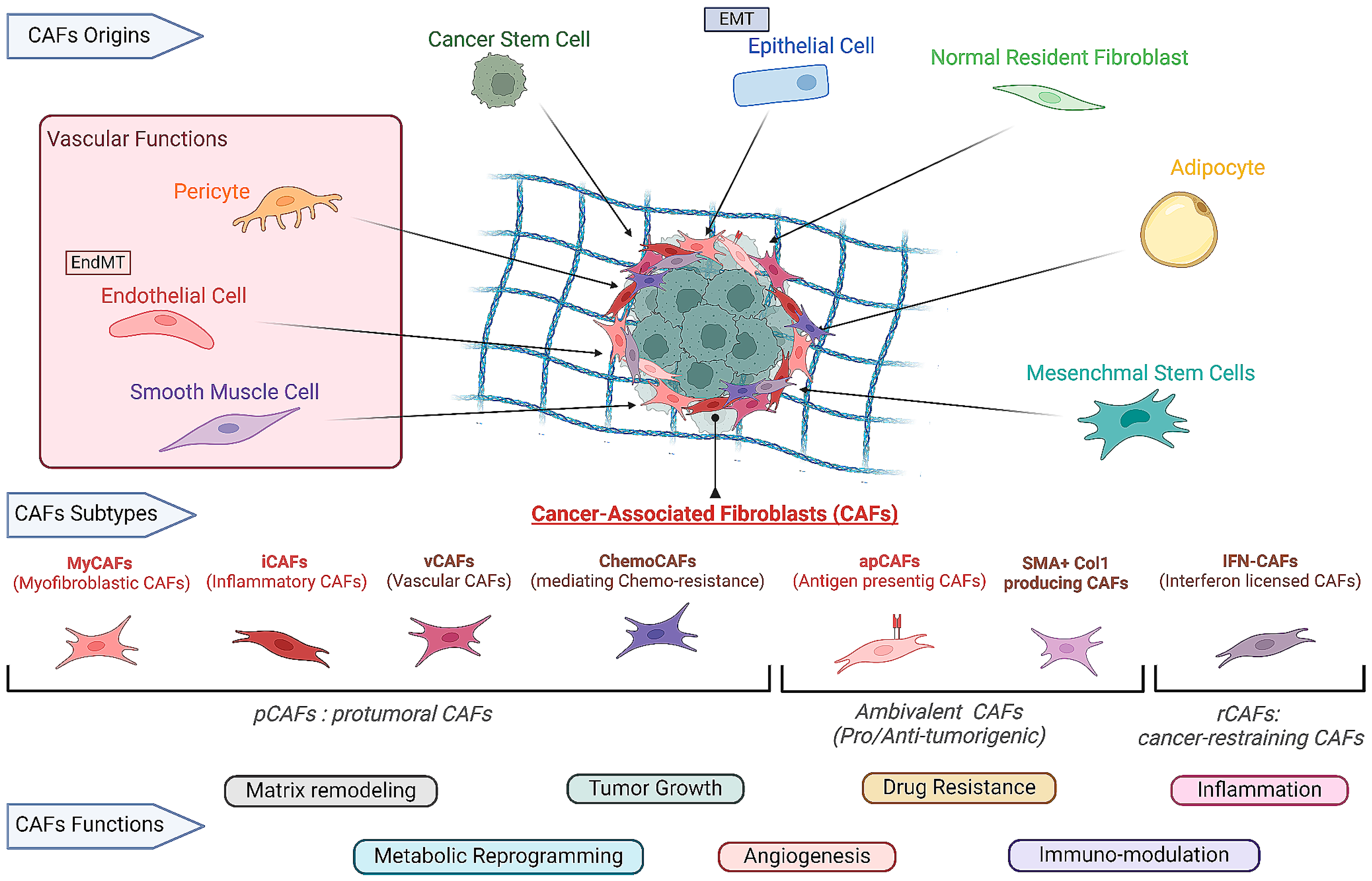
3. Overview of the Prostate Cancer Microenvironment and CAFs
3.1. Immunomodulatory Functions of CAFs
3.2. The Role of CAFs in ECM Remodeling
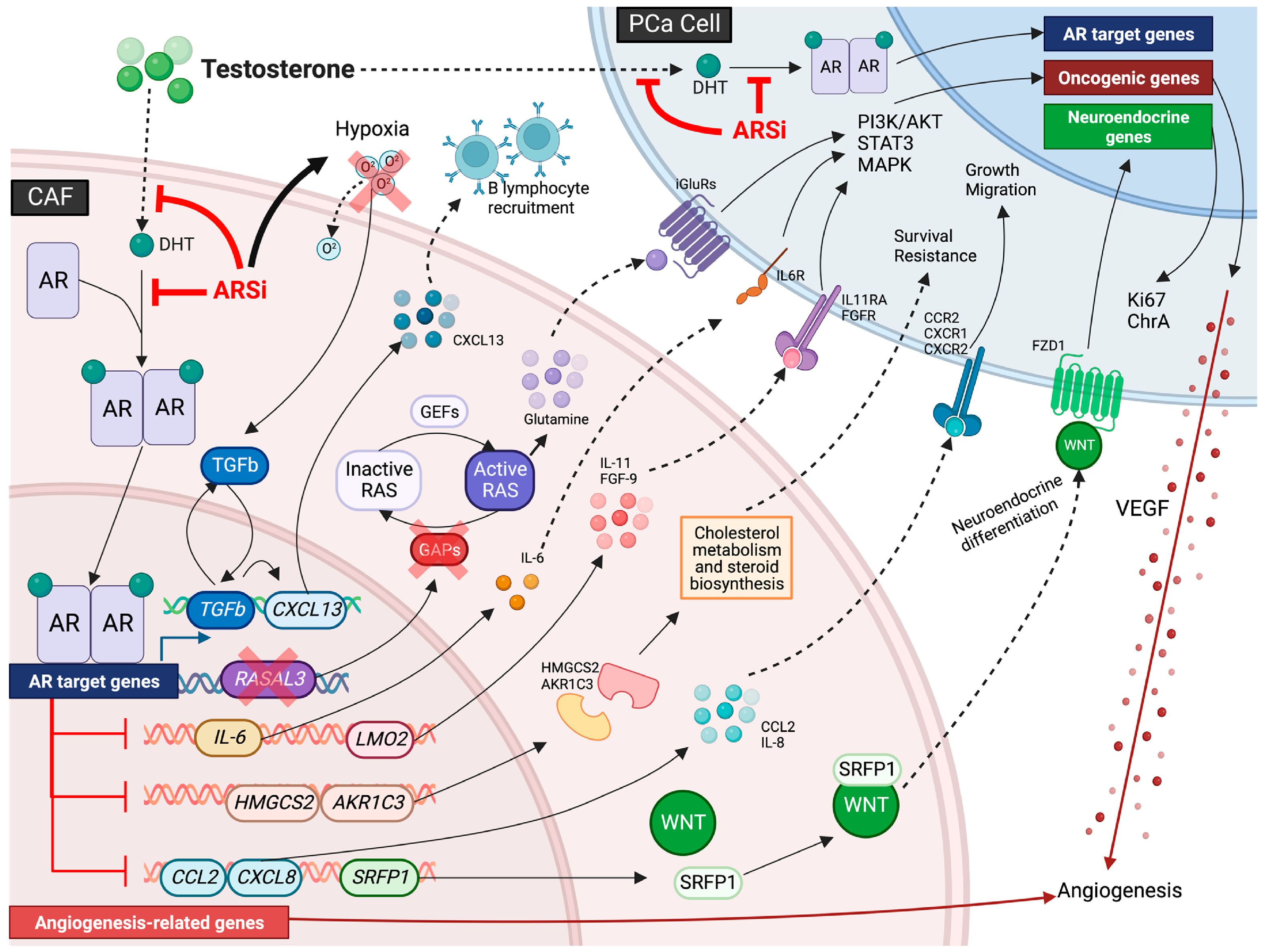
3.3. The Role of CAFs in Promoting Angiogenesis
4. Heterogeneity of CAFs
4.1. Spatial Heterogeneity of CAFs Within Tumors
4.2. CAFs Remodeled into Pro-Drug-Resistant Phenotypes Under Therapeutic Pressure
5. CAFs Function Subclusters in PCa
5.1. Myofibroblastic CAFs (myCAFs)
5.2. Inflammatory CAFs (iCAFs)
5.3. Antigen-Presenting CAFs (apCAFs)
5.4. Metabolic CAFs (meCAFs)
5.5. Other Less Prevalent CAFs Subtypes
6. Pro-Tumor Pathways and Molecular Hubs in CAFs
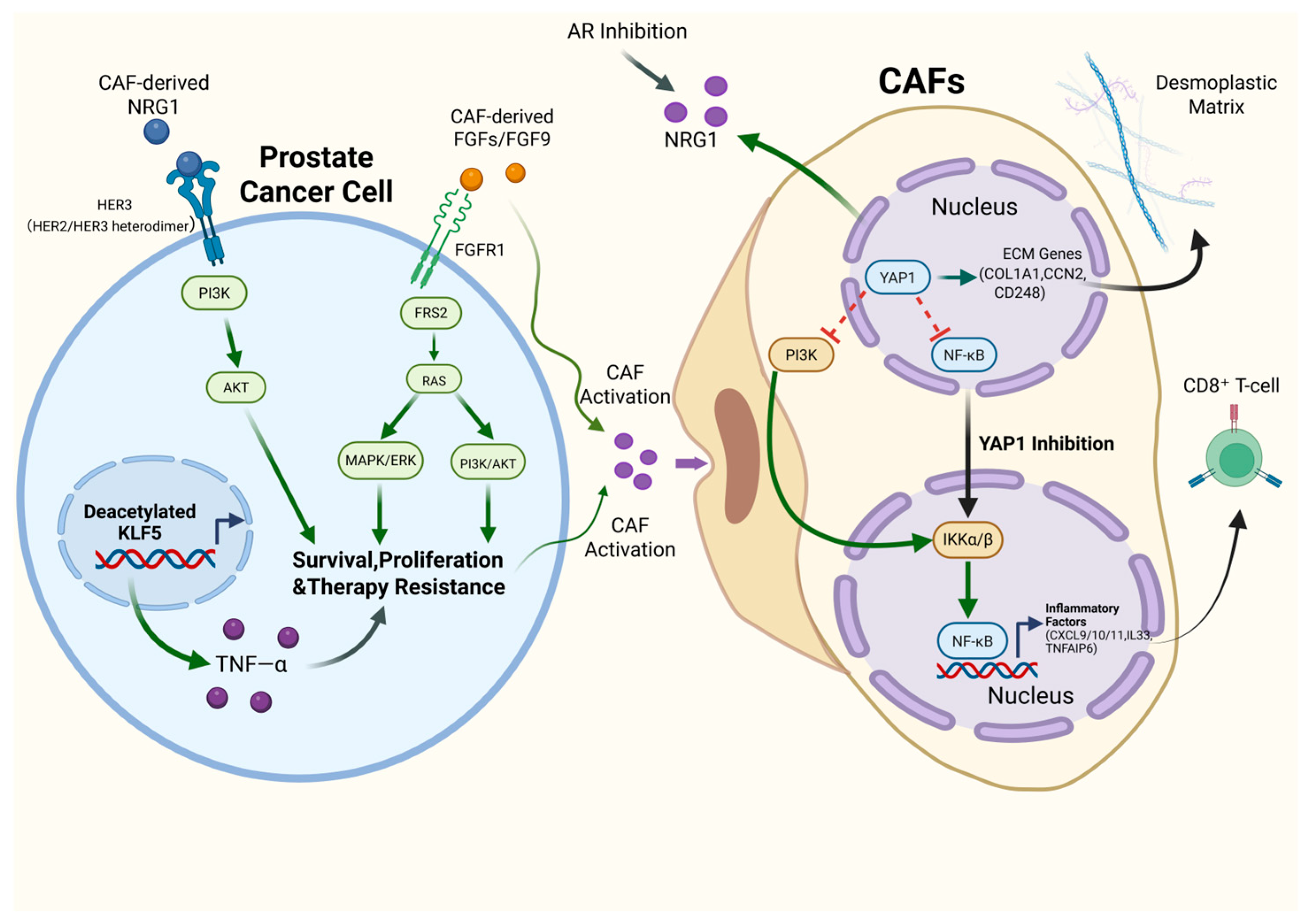
6.1. YAP1
6.2. Fibroblast Growth Factor (FGF)
6.3. NRG1
7. Biological and Clinical Significance of CAF Heterogeneity
7.1. CAF-Based Prognosis and Immunotherapy Prediction
7.2. Targeting CAFs Paracrine Signaling and Soluble Support
7.3. Targeting CAF-Driven Stromal Barriers
7.4. Targeting CAF-Derived Exosomes
8. Discussion
9. Conclusions
Author Contributions
Funding
Data Availability Statement
Acknowledgments
Conflicts of Interest
Abbreviations
| ADT | Androgen deprivation therapy |
| AR | Androgen receptor |
| CAF(s) | Cancer-associated fibroblast(s) |
| CRPC | Castration-resistant prostate cancer |
| ECM | Extracellular matrix |
| EMT | Epithelial–mesenchymal transition |
| EndMT | Endothelial–mesenchymal transition |
| FN1 | Fibronectin 1 |
| HSPC | Hormone-sensitive prostate cancer |
| ICB | Immune checkpoint blockade |
| iCAF(s) | Inflammatory cancer-associated fibroblast(s) |
| MAOA | Monoamine oxidase A |
| meCAF(s) | Metabolic cancer-associated fibroblast(s) |
| MRI | Magnetic resonance imaging |
| mCRPC | Metastatic castration-resistant prostate cancer |
| myCAF(s) | Myofibroblastic cancer-associated fibroblast(s) |
| NE | Neuroendocrine |
| NF(s) | Normal fibroblast(s) |
| OXPHOS | Oxidative phosphorylation |
| PCa | Prostate cancer |
| PSA | Prostate-specific antigen |
| TAM(s) | Tumor-associated macrophage(s) |
| TAN(s) | Tumor-associated neutrophil(s) |
| TCA | Tricarboxylic acid |
| TGF-β | Transforming growth factor beta |
| TME | Tumor microenvironment |
| Treg(s) | Regulatory T cell(s) |
| vCAF(s) | Vascular cancer-associated fibroblast(s) |
References
- Bray, F.; Laversanne, M.; Sung, H.; Ferlay, J.; Siegel, R.L.; Soerjomataram, I.; Jemal, A. Global cancer statistics 2022: GLOBOCAN estimates of incidence and mortality worldwide for 36 cancers in 185 countries. CA A Cancer J. Clin. 2024, 74, 229–263. [Google Scholar] [CrossRef] [Scilit]
- Harris, E. Prostate Cancer Cases Might Rise to 3 Million Globally by 2040. JAMA 2024, 331, 1698. [Google Scholar] [CrossRef] [Scilit]
- James, N.D.; Tannock, I.; N’DOw, J.; Feng, F.; Gillessen, S.; Ali, S.A.; Trujillo, B.; Al-Lazikani, B.; Attard, G.; Bray, F.; et al. The Lancet Commission on prostate cancer: Planning for the surge in cases. Lancet 2024, 403, 1683–1722. [Google Scholar] [CrossRef] [Scilit]
- Padhani, A.R.; Schoots, I.G. Prostate cancer screening—Stepping forward with MRI. Eur. Radiol. 2023, 33, 6670–6676. [Google Scholar] [CrossRef] [Scilit]
- Wei, Z.; Lan, X.; Hou, E. Synergistic potential and challenges of immunotherapy combined with radiotherapy in metastatic castration-resistant prostate cancer: A review of mechanisms and clinical advances. Clin. Transl. Oncol. 2025. [Google Scholar] [CrossRef] [Scilit] [PubMed]
- Flores-Téllez, T.d.N.; Baena, E. Experimental challenges to modeling prostate cancer heterogeneity. Cancer Lett. 2022, 524, 194–205. [Google Scholar] [CrossRef] [Scilit]
- Garje, R.; Bin Riaz, I.; Naqvi, S.A.A.; Rumble, R.B.; Taplin, M.-E.; Kungel, T.M.; Herchenhorn, D.; Zhang, T.; Beckermann, K.E.; Vapiwala, N.; et al. Systemic Therapy in Patients With Metastatic Castration-Resistant Prostate Cancer: ASCO Guideline Update. J. Clin. Oncol. 2025, 43, 2311–2334. [Google Scholar] [CrossRef] [Scilit]
- Wang, H.; Li, N.; Liu, Q.; Guo, J.; Pan, Q.; Cheng, B.; Xu, J.; Dong, B.; Yang, G.; Yang, B.; et al. Antiandrogen treatment induces stromal cell reprogramming to promote castration resistance in prostate cancer. Cancer Cell 2023, 41, 1345–1362.e9. [Google Scholar] [CrossRef] [Scilit] [PubMed]
- Saw, P.E.; Chen, J.; Song, E. Targeting CAFs to overcome anticancer therapeutic resistance. Trends Cancer 2022, 8, 527–555. [Google Scholar] [CrossRef] [Scilit] [PubMed]
- Krolewski, J.J.; Sha, K.; Mastri, M.; Tang, D.; Eng, K.; Nastiuk, K.L. Abstract A084: Towards combining androgen deprivation and immunotherapy to prevent progression to castration-resistant prostate cancer. Cancer Immunol. Res. 2019, 7, A084. [Google Scholar] [CrossRef] [Scilit]
- ChallaSivaKanaka, S.; Vickman, R.E.; Kakarla, M.; Hayward, S.W.; Franco, O.E. Fibroblast heterogeneity in prostate carcinogenesis. Cancer Lett. 2021, 525, 76–83. [Google Scholar] [CrossRef] [Scilit]
- Quail, D.F.; Joyce, J.A. Microenvironmental regulation of tumor progression and metastasis. Nat. Med. 2013, 19, 1423–1437. [Google Scholar] [CrossRef] [Scilit] [PubMed]
- Pakula, H.; Pederzoli, F.; Fanelli, G.N.; Nuzzo, P.V.; Rodrigues, S.; Loda, M. Deciphering the Tumor Microenvironment in Prostate Cancer: A Focus on the Stromal Component. Cancers 2024, 16, 3685. [Google Scholar] [CrossRef] [Scilit] [PubMed]
- Orr, B.; Riddick, A.C.P.; Stewart, G.D.; Anderson, R.A.; Franco, O.E.; Hayward, S.W.; Thomson, A.A. Identification of stromally expressed molecules in the prostate by tag-profiling of cancer-associated fibroblasts, normal fibroblasts and fetal prostate. Oncogene 2012, 31, 1130–1142. [Google Scholar] [CrossRef] [Scilit]
- Cheteh, E.H.; Sarne, V.; Ceder, S.; Bianchi, J.; Augsten, M.; Rundqvist, H.; Egevad, L.; Östman, A.; Wiman, K.G. Interleukin-6 derived from cancer-associated fibroblasts attenuates the p53 response to doxorubicin in prostate cancer cells. Cell Death Discov. 2020, 6, 42. [Google Scholar] [CrossRef] [Scilit] [PubMed]
- Augsten, M.; Hägglöf, C.; Olsson, E.; Stolz, C.; Tsagozis, P.; Levchenko, T.; Frederick, M.J.; Borg, Å.; Micke, P.; Egevad, L.; et al. CXCL14 is an autocrine growth factor for fibroblasts and acts as a multi-modal stimulator of prostate tumor growth. Proc. Natl. Acad. Sci. USA 2009, 106, 3414–3419. [Google Scholar] [CrossRef] [Scilit]
- Panic, A.; Ketteler, J.; Reis, H.; Sak, A.; Herskind, C.; Maier, P.; Rübben, H.; Jendrossek, V.; Klein, D. Progression-related loss of stromal Caveolin 1 levels fosters the growth of human PC3 xenografts and mediates radiation resistance. Sci. Rep. 2017, 7, srep41138. [Google Scholar] [CrossRef] [Scilit]
- Vitale, G.; Caraglia, M.; Jung, V.; Kamradt, J.; Gentilini, D.; Di Martino, M.T.; Dicitore, A.; Abate, M.; Tagliaferri, P.; Itro, A.; et al. Molecular Characterization of Cancer Associated Fibroblasts in Prostate Cancer. Cancers 2022, 14, 2943. [Google Scholar] [CrossRef] [Scilit]
- Coursier, D.; Calvo, F. CAFs vs. TECs: When blood feuds fuel cancer progression, dissemination and therapeutic resistance. Cell. Oncol. 2024, 47, 1091–1112. [Google Scholar] [CrossRef] [Scilit]
- Pawar, J.S.; Salam, A.; Dipto, S.U.; Al-Amin, Y.; Salam, M.T.; Sengupta, S.; Kumari, S.; Gujjari, L.; Yadagiri, G. Cancer-Associated Fibroblasts: Immunosuppressive Crosstalk with Tumor-Infiltrating Immune Cells and Implications for Therapeutic Resistance. Cancers 2025, 17, 2484. [Google Scholar] [CrossRef] [Scilit]
- Thiery, J. Modulation of the antitumor immune response by cancer-associated fibroblasts: Mechanisms and targeting strategies to hamper their immunosuppressive functions. Explor. Target. Anti-Tumor Ther. 2022, 3, 598–629. [Google Scholar] [CrossRef] [Scilit]
- Lakins, M.A.; Ghorani, E.; Munir, H.; Martins, C.P.; Shields, J.D. Cancer-associated fibroblasts induce antigen-specific deletion of CD8+ T Cells to protect tumour cells. Nat. Commun. 2018, 9, 948. [Google Scholar] [CrossRef] [Scilit]
- Lavie, D.; Ben-Shmuel, A.; Erez, N.; Scherz-Shouval, R. Cancer-associated fibroblasts in the single-cell era. Nat. Cancer 2022, 3, 793–807. [Google Scholar] [CrossRef] [Scilit] [PubMed]
- Qiu, Y.; Wang, Y.; Liu, J.; Sun, K.; Liu, B.; Hou, Q. Single-cell sequencing unveils the transcriptomic landscape of castration-resistant prostate cancer-associated fibroblasts and their association with prognosis and immunotherapy response. BMC Cancer 2025, 25, 813. [Google Scholar] [CrossRef] [Scilit]
- Fridlender, Z.G.; Sun, J.; Kim, S.; Kapoor, V.; Cheng, G.; Ling, L.; Worthen, G.S.; Albelda, S.M. Polarization of tumor-associated neutrophil pheno-type by TGF-beta: “N1” versus “N2” TAN. Cancer Cell 2009, 16, 183–194. [Google Scholar] [CrossRef] [Scilit]
- Comito, G.; Giannoni, E.; Segura, C.P.; Barcellos-De-Souza, P.; Raspollini, M.R.; Baroni, G.; Lanciotti, M.; Serni, S.; Chiarugi, P. Cancer-associated fibroblasts and M2-polarized macrophages synergize during prostate carcinoma progression. Oncogene 2013, 33, 2423–2431. [Google Scholar] [CrossRef] [Scilit]
- Zhang, R.; Zong, J.; Peng, Y.; Shi, J.; Du, X.; Liu, H.; Shen, Y.; Cao, J.; Jia, B.; Liu, F.; et al. GPR30 knockdown weakens the capacity of CAF in promoting prostate cancer cell invasion via reducing macrophage infiltration and M2 polarization. J. Cell. Biochem. 2021, 122, 1173–1191. [Google Scholar] [CrossRef] [Scilit]
- Wu, T.; Wang, W.; Shi, G.; Hao, M.; Wang, Y.; Yao, M.; Huang, Y.; Du, L.; Zhang, X.; Ye, D.; et al. Targeting HIC1/TGF-β axis-shaped prostate cancer microenvironment restrains its progression. Cell Death Dis. 2022, 13, 624. [Google Scholar] [CrossRef] [Scilit] [PubMed]
- Carstens, J.L.; Shahi, P.; Van Tsang, S.; Smith, B.; Creighton, C.J.; Zhang, Y.; Seamans, A.; Seethammagari, M.; Vedula, I.; Levitt, J.M.; et al. FGFR1–WNT–TGF-β Signaling in Prostate Cancer Mouse Models Recapitulates Human Reactive Stroma. Cancer Res. 2014, 74, 609–620. [Google Scholar] [CrossRef] [Scilit] [PubMed]
- Chen, H.; Fang, S.; Zhu, X.; Liu, H. Cancer-associated fibroblasts and prostate cancer stem cells: Crosstalk mechanisms and implications for disease progression. Front. Cell Dev. Biol. 2024, 12, 1412337. [Google Scholar] [CrossRef] [Scilit]
- Lee, J.; Kim, Y.; Lee, C.; Jeon, S.S.; Seo, H.; Lee, J.; Choi, J.; Kang, M.; Kim, E.; Shin, K. Generation of prostate cancer assembloids modeling the patient-specific tumor microenvironment. PLoS Genet. 2025, 21, e1011652. [Google Scholar] [CrossRef] [Scilit]
- Provenzano, P.P.; Cuevas, C.; Chang, A.E.; Goel, V.K.; Von Hoff, D.D.; Hingorani, S.R. Enzymatic Targeting of the Stroma Ablates Physical Barriers to Treatment of Pancreatic Ductal Adenocarcinoma. Cancer Cell 2012, 21, 418–429. [Google Scholar] [CrossRef] [Scilit]
- Meads, M.B.; Gatenby, R.A.; Dalton, W.S. Environment-mediated drug resistance: A major contributor to minimal residual disease. Nat. Rev. Cancer 2009, 9, 665–674. [Google Scholar] [CrossRef] [Scilit]
- Li, C.; Cheng, D.; Li, P. Androgen receptor dynamics in prostate cancer: From disease progression to treatment resistance. Front. Oncol. 2025, 15, 1542811. [Google Scholar] [CrossRef] [Scilit] [PubMed]
- Zhang, Z.; Zhang, Q.; Wang, Y. CAF-mediated tumor vascularization: From mechanistic insights to targeted therapies. Cell. Signal. 2025, 132, 111827. [Google Scholar] [CrossRef] [Scilit] [PubMed]
- Di Spirito, A.; Balkhi, S.; Vivona, V.; Mortara, L. Key immune cells and their crosstalk in the tumor microenvironment of bladder cancer: Insights for innovative therapies. Explor. Target. Anti-Tumor Ther. 2025, 6, 1002304. [Google Scholar] [CrossRef] [Scilit]
- Vecchiotti, D.; Clementi, L.; Cornacchia, E.; Nolfi, M.D.V.; Verzella, D.; Capece, D.; Zazzeroni, F.; Angelucci, A. Evidence of the Link between Stroma Remodeling and Prostate Cancer Prognosis. Cancers 2024, 16, 3215. [Google Scholar] [CrossRef] [Scilit] [PubMed]
- Yu, D.; Xu, H.; Zhou, J.; Fang, K.; Zhao, Z.; Xu, K. PDPN/CCL2/STAT3 feedback loop alter CAF heterogeneity to promote angiogenesis in colorectal cancer. Angiogenesis 2024, 27, 809–825. [Google Scholar] [CrossRef] [Scilit]
- Zhao, Z.; Sun, H.; Liu, Y.; Zhang, Y.; Wang, X.; Wang, X.; Tan, C.; Ni, S.; Weng, W.; Zhang, M.; et al. PDPN+ cancer-associated fibroblasts enhance gastric cancer angiogenesis via AKT/NF-κB activation and the CCL2-ACKR1 axis. Medcomm 2025, 6, e70037. [Google Scholar] [CrossRef] [Scilit]
- Chi, J.-Y.; Hsiao, Y.-W.; Liu, H.-L.; Fan, X.-J.; Wan, X.-B.; Liu, T.-L.; Hung, S.-J.; Chen, Y.-T.; Liang, H.-Y.; Wang, J.-M. Fibroblast CEBPD/SDF4 axis in response to chemotherapy-induced angiogenesis through CXCR4. Cell Death Discov. 2021, 7, 94. [Google Scholar] [CrossRef] [Scilit]
- Liu, Y.; Sinjab, A.; Min, J.; Han, G.; Paradiso, F.; Zhang, Y.; Wang, R.; Pei, G.; Dai, Y.; Liu, Y.; et al. Conserved spatial subtypes and cellular neighborhoods of cancer-associated fibroblasts revealed by single-cell spatial multi-omics. Cancer Cell 2025, 43, 905–924.e6. [Google Scholar] [CrossRef] [Scilit] [PubMed]
- Ohlund, D.; Handly-Santana, A.; Biffi, G.; Elyada, E.; Almeida, A.S.; Ponz-Sarvise, M.; Corbo, V.; Oni, T.E.; Hearn, S.A.; Lee, E.J.; et al. Distinct populations of inflammatory fibroblasts and myofibroblasts in pancreatic cancer. J. Exp. Med. 2017, 214, 579–596. [Google Scholar] [CrossRef] [Scilit]
- Elyada, E.; Bolisetty, M.; Laise, P.; Flynn, W.F.; Courtois, E.T.; Burkhart, R.A.; Teinor, J.A.; Belleau, P.; Biffi, G.; Lucito, M.S.; et al. Cross-Species Single-Cell Analysis of Pancreatic Ductal Adenocarcinoma Reveals Antigen-Presenting Cancer-Associated Fibroblasts. Cancer Discov. 2019, 9, 1102–1123. [Google Scholar] [CrossRef] [Scilit]
- Dominguez, C.X.; Müller, S.; Keerthivasan, S.; Koeppen, H.; Hung, J.; Gierke, S.; Breart, B.; Foreman, O.; Bainbridge, T.W.; Castiglioni, A.; et al. Single-Cell RNA Sequencing Reveals Stromal Evolution into LRRC15+ Myofibroblasts as a Determinant of Patient Response to Cancer Immunotherapy. Cancer Discov. 2020, 10, 232–253. [Google Scholar] [CrossRef] [Scilit]
- Adema, K.; Schon, M.A.; Nodine, M.D.; Kohlen, W. Lost in space: What single-cell RNA sequencing cannot tell you. Trends Plant Sci. 2024, 29, 1018–1028. [Google Scholar] [CrossRef] [Scilit]
- Forsthuber, A.; Aschenbrenner, B.; Korosec, A.; Jacob, T.; Annusver, K.; Krajic, N.; Kholodniuk, D.; Frech, S.; Zhu, S.; Purkhauser, K.; et al. Cancer-associated fibroblast subtypes modulate the tumor-immune microenvironment and are associated with skin cancer malignancy. Nat. Commun. 2024, 15, 9678. [Google Scholar] [CrossRef] [Scilit]
- Ma, C.; Yang, C.; Peng, A.; Sun, T.; Ji, X.; Mi, J.; Wei, L.; Shen, S.; Feng, Q. Pan-cancer spatially resolved single-cell analysis reveals the crosstalk between cancer-associated fibroblasts and tumor microenvironment. Mol. Cancer 2023, 22, 170. [Google Scholar] [CrossRef] [Scilit]
- Tindall, D.J.; Lonergan, P.E. Androgen receptor signaling in prostate cancer development and progression. J. Carcinog. 2011, 10, 20. [Google Scholar] [CrossRef] [Scilit] [PubMed]
- Graham, L.; Schweizer, M.T. Targeting persistent androgen receptor signaling in castration-resistant prostate cancer. Med. Oncol. 2016, 33, 44. [Google Scholar] [CrossRef] [Scilit] [PubMed]
- Coutinho, I.; Day, T.K.; Tilley, W.D.; Selth, L.A. Androgen receptor signaling in castration-resistant prostate cancer: A lesson in persistence. Endocrine-Related Cancer 2016, 23, T179–T197. [Google Scholar] [CrossRef] [Scilit]
- Zhang, Y.; Fan, A.; Li, Y.; Liu, Z.; Yu, L.; Guo, J.; Hou, J.; Li, X.; Chen, W. Single-cell RNA sequencing reveals that HSD17B2 in cancer-associated fibroblasts promotes the development and progression of castration-resistant prostate cancer. Cancer Lett. 2023, 566, 216244. [Google Scholar] [CrossRef] [Scilit]
- Le, T.K.; Duong, Q.H.; Baylot, V.; Fargette, C.; Baboudjian, M.; Colleaux, L.; Taïeb, D.; Rocchi, P. Castration-Resistant Prostate Cancer: From Uncovered Resistance Mechanisms to Current Treatments. Cancers 2023, 15, 5047. [Google Scholar] [CrossRef] [Scilit]
- Brunner, E.; Damisch, E.; Groninger, M.E.; Baschieri, F.; Tyckaert, F.; Nommensen, L.; Neumann, L.; Fotakis, G.; Trajanoski, Z.; Schäfer, G.; et al. Unraveling the YAP1-TGFβ1 axis: A key driver of androgen receptor loss in prostate cancer-associated fibroblasts. J. Exp. Clin. Cancer Res. 2025. [Google Scholar] [CrossRef] [Scilit]
- Liang, H.-Q.; He, Q.-H.; Wei, Q.-J.; Mo, Q.-Z.; Yang, G.-L.; Wei, F.-Y.; Wei, L.-W.; Li, Y.-J.; Qin, M.; Cheng, J.-W. CTHRC1 expresses in cancer-associated fibroblasts and is associated with resistance to anti-androgen therapy in prostate cancer. Genes Genom. 2025, 47, 541–557. [Google Scholar] [CrossRef] [Scilit] [PubMed]
- Ammirante, M.; Kang, Y.; Karin, M. Abstract PR3: Myofibroblasts activated upon tissue injury and hypoxia promote development of castration-resistant prostate cancer. Cancer Res. 2013, 73, PR3. [Google Scholar] [CrossRef] [Scilit]
- Chen, J.; Chen, R.; Huang, J. A pan-cancer single-cell transcriptional analysis of antigen-presenting cancer-associated fibroblasts in the tumor microenvironment. Front. Immunol. 2024, 15, 1372432. [Google Scholar] [CrossRef] [Scilit]
- Huang, H.; Wang, Z.; Zhang, Y.; Pradhan, R.N.; Ganguly, D.; Chandra, R.; Murimwa, G.; Wright, S.; Gu, X.; Maddipati, R.; et al. Mesothelial cell-derived antigen-presenting cancer-associated fibroblasts induce expansion of regulatory T cells in pancreatic cancer. Cancer Cell 2022, 40, 656–673.e7. [Google Scholar] [CrossRef] [Scilit]
- Wang, W.; Li, T.; Xie, Z.; Zhao, J.; Zhang, Y.; Ruan, Y.; Han, B. Integrating single-cell and bulk RNA sequencing data unveils antigen presentation and process-related CAFS and establishes a predictive signature in prostate cancer. J. Transl. Med. 2024, 22, 57. [Google Scholar] [CrossRef] [Scilit]
- Galbo, P.M.; Zang, X.; Zheng, D. Molecular Features of Cancer-associated Fibroblast Subtypes and their Implication on Cancer Pathogenesis, Prognosis, and Immunotherapy Resistance. Clin. Cancer Res. 2021, 27, 2636–2647. [Google Scholar] [CrossRef] [Scilit] [PubMed]
- Lv, K.; He, T. Cancer-associated fibroblasts: Heterogeneity, tumorigenicity and therapeutic targets. Mol. Biomed. 2024, 5, 70. [Google Scholar] [CrossRef] [Scilit] [PubMed]
- Bartoschek, M.; Oskolkov, N.; Bocci, M.; Lövrot, J.; Larsson, C.; Sommarin, M.; Madsen, C.D.; Lindgren, D.; Pekar, G.; Karlsson, G.; et al. Spatially and functionally distinct subclasses of breast cancer-associated fibroblasts revealed by single cell RNA sequencing. Nat. Commun. 2018, 9, 5150. [Google Scholar] [CrossRef] [Scilit]
- Pan, J.; Ma, Z.; Liu, B.; Qian, H.; Shao, X.; Liu, J.; Wang, Q.; Xue, W. Identification of cancer-associated fibroblasts subtypes in prostate cancer. Front. Immunol. 2023, 14, 1133160. [Google Scholar] [CrossRef] [Scilit]
- Naito, Y. How Do Cancer Cells Create Cancer-Associated Fibroblast Subtypes? Impacts of Extracellular Vesicles on Stromal Diversity. Cancer Sci. 2025, 116, 2347–2361. [Google Scholar] [CrossRef] [Scilit]
- Tuxhorn, J.A.; Ayala, G.E.; Smith, M.J.; Smith, V.C.; Dang, T.D.; Rowley, D.R. Reactive stroma in human prostate cancer: Induction of myofibroblast phenotype and extracellular matrix remodeling. Clin. Cancer Res. 2002, 8, 2912–2923. [Google Scholar]
- Kim, W.; Barron, D.A.; Martin, R.S.; Chan, K.S.; Tran, L.L.; Yang, F.; Ressler, S.J.; Rowley, D.R. RUNX1 is essential for mesenchymal stem cell proliferation and myofibroblast differentiation. Proc. Natl. Acad. Sci. USA 2014, 111, 16389–16394. [Google Scholar] [CrossRef] [Scilit] [PubMed]
- Hamanaka, R.B.; Mutlu, G.M. The role of metabolic reprogramming and de novo amino acid synthesis in collagen protein production by myofibroblasts: Implications for organ fibrosis and cancer. Amino Acids 2021, 53, 1851–1862. [Google Scholar] [CrossRef] [Scilit] [PubMed]
- Liu, W.; Wang, M.; Liu, M. Single-cell and bulk RNA sequencing reveal cancer-associated fibroblast heterogeneity and a prognostic signature in prostate cancer. Medicine 2023, 102, e34611. [Google Scholar] [CrossRef] [Scilit] [PubMed]
- Zhao, Z.; Hu, Y.; Li, H.; Lu, T.; He, X.; Ma, Y.; Huang, M.; Li, M.; Yang, L.; Shi, C. Inhibition of stromal MAOA leading activation of WNT5A enhance prostate cancer immunotherapy by involving the transition of cancer-associated fibroblasts. J. Immunother. Cancer 2025, 13, e010555. [Google Scholar] [CrossRef] [Scilit]
- Tran, L.L.; Dang, T.; Thomas, R.; Rowley, D.R. ELF3 Mediates IL-1α Induced Differentiation of Mesenchymal Stem Cells to Inflammatory iCAFs. Stem Cells 2021, 39, 1766–1777. [Google Scholar] [CrossRef] [Scilit]
- Wo, Q.; Shi, L.; Shi, J.; Mao, Y.; Xie, L. The Mechanism by Which Hedgehog Interacting Protein (HHIP) in Cancer-Associated Fibroblasts Regulate the Secretion of Inflammatory Factors Through the JAK1/STAT3 Pathway Affecting Prostate Cancer Stemness. J. Inflamm. Res. 2024, 17, 8659–8680. [Google Scholar] [CrossRef] [Scilit]
- Archer, M.; Dogra, N.; Kyprianou, N. Inflammation as a Driver of Prostate Cancer Metastasis and Therapeutic Resistance. Cancers 2020, 12, 2984. [Google Scholar] [CrossRef] [Scilit]
- Guo, T.; Xu, J. Cancer-associated fibroblasts: A versatile mediator in tumor progression, metastasis, and targeted therapy. Cancer Metastasis Rev. 2024, 43, 1095–1116. [Google Scholar] [CrossRef] [Scilit]
- Thomas, M.E.; Jie, E.; Kim, A.M.; Mayberry, T.G.; Cowan, B.C.; Luechtefeld, H.D.; Wakefield, M.R.; Fang, Y. Exploring the role of antigen-presenting cancer-associated fibroblasts and CD74 on the pancreatic ductal adenocarcinoma tumor microenvironment. Med. Oncol. 2024, 42, 15. [Google Scholar] [CrossRef] [Scilit]
- Zhang, D.; Wang, Y.; Shi, Z.; Liu, J.; Sun, P.; Hou, X.; Zhang, J.; Zhao, S.; Zhou, B.P.; Mi, J. Metabolic Reprogramming of Cancer-Associated Fibroblasts by IDH3α Downregulation. Cell Rep. 2015, 10, 1335–1348. [Google Scholar] [CrossRef] [Scilit]
- Becker, L.M.; O’cOnnell, J.T.; Vo, A.P.; Cain, M.P.; Tampe, D.; Bizarro, L.; Sugimoto, H.; McGow, A.K.; Asara, J.M.; Lovisa, S.; et al. Epigenetic Reprogramming of Cancer-Associated Fibroblasts Deregulates Glucose Metabolism and Facilitates Progression of Breast Cancer. Cell Rep. 2020, 31, 107701. [Google Scholar] [CrossRef] [Scilit] [PubMed]
- Lisanti, M.P.; Martinez-Outschoorn, U.E.; Sotgia, F. Oncogenes induce the cancer-associated fibroblast phenotype: Metabolic symbiosis and “fibroblast addiction” are new therapeutic targets for drug discovery. Cell Cycle 2013, 12, 2723–2732. [Google Scholar] [CrossRef] [Scilit]
- Fiaschi, T.; Marini, A.; Giannoni, E.; Taddei, M.L.; Gandellini, P.; De Donatis, A.; Lanciotti, M.; Serni, S.; Cirri, P.; Chiarugi, P. Reciprocal Metabolic Reprogramming through Lactate Shuttle Coordinately Influences Tumor-Stroma Interplay. Cancer Res. 2012, 72, 5130–5140. [Google Scholar] [CrossRef] [Scilit] [PubMed]
- Ippolito, L.; Comito, G.; Parri, M.; Iozzo, M.; Duatti, A.; Virgilio, F.; Lorito, N.; Bacci, M.; Pardella, E.; Sandrini, G.; et al. Lactate Rewires Lipid Metabolism and Sustains a Metabolic–Epigenetic Axis in Prostate Cancer. Cancer Res. 2022, 82, 1267–1282. [Google Scholar] [CrossRef] [Scilit]
- Mishra, R.; Haldar, S.; Placencio, V.; Madhav, A.; Rohena-Rivera, K.; Agarwal, P.; Duong, F.; Angara, B.; Tripathi, M.; Liu, Z.; et al. Stromal epigenetic alterations drive metabolic and neuroendocrine prostate cancer reprogramming. J. Clin. Investig. 2018, 128, 4472–4484. [Google Scholar] [CrossRef] [Scilit] [PubMed]
- Li, Z.; Sun, C.; Qin, Z. Metabolic reprogramming of cancer-associated fibroblasts and its effect on cancer cell reprogramming. Theranostics 2021, 11, 8322–8336. [Google Scholar] [CrossRef] [Scilit]
- Ippolito, L.; Morandi, A.; Taddei, M.L.; Parri, M.; Comito, G.; Iscaro, A.; Raspollini, M.R.; Magherini, F.; Rapizzi, E.; Masquelier, J.; et al. Cancer-associated fibroblasts promote prostate cancer malignancy via metabolic rewiring and mitochondrial transfer. Oncogene 2019, 38, 5339–5355. [Google Scholar] [CrossRef] [Scilit]
- Zhang, K.; Liu, K.; Hu, B.; Du, G.; Chen, X.; Xiao, L.; Zhang, Y.; Jiang, L.; Jing, N.; Cheng, C.; et al. Iron-loaded cancer-associated fibroblasts induce immunosuppression in prostate cancer. Nat. Commun. 2024, 15, 9050. [Google Scholar] [CrossRef] [Scilit]
- Zhao, F.; Zeng, J.; Chen, C.; Zhao, X.; Zhang, T.; Thomas, G.V.; Sears, R.C.; Alumkal, J.J.; Moran, A.E.; Mills, G.B.; et al. Deciphering single-cell heterogeneity and cellular ecosystem dynamics during prostate cancer progression. bioRxiv 2024. [Google Scholar] [CrossRef] [Scilit]
- Ding, C.; Wang, J.; Wang, J.; Niu, J.; Xiahou, Z.; Sun, Z.; Zhao, Z.; Zeng, D. Heterogeneity of cancer-associated fibroblast subpopulations in prostate cancer: Implications for prognosis and immunotherapy. Transl. Oncol. 2024, 52, 102255. [Google Scholar] [CrossRef] [Scilit] [PubMed]
- Krušlin, B.; Ulamec, M.; Tomas, D. Prostate cancer stroma: An important factor in cancer growth and progression. Biomol. Biomed. 2015, 15, 1–8. [Google Scholar] [CrossRef] [Scilit] [PubMed]
- Martin, M.; Pujuguet, P.; Martin, F. Role of Stromal Myofibroblasts Infiltrating Colon Cancer in Tumor Invasion. Pathol.-Res. Pract. 1996, 192, 712–717. [Google Scholar] [CrossRef] [Scilit]
- Noel, A.; Foidart, J.-M. The Role of Stroma in Breast Carcinoma Growth In Vivo. J. Mammary Gland. Biol. Neoplasia 1998, 3, 215–225. [Google Scholar] [CrossRef] [Scilit] [PubMed]
- Rowe, R.G.; Weiss, S.J. Navigating ECM Barriers at the Invasive Front: The Cancer Cell–Stroma Interface. Annu. Rev. Cell Dev. Biol. 2009, 25, 567–595. [Google Scholar] [CrossRef] [Scilit]
- Chung, L.W.; Baseman, A.; Assikis, V.; Zhau, H.E. Molecular insights into prostate cancer progression: The missing link of tumor microenvironment. J. Urol. 2005, 173, 10–20. [Google Scholar] [CrossRef] [Scilit]
- Tossetta, G.; Fantone, S.; Marzioni, D.; Mazzucchelli, R. Cellular Modulators of the NRF2/KEAP1 Signaling Pathway in Prostate Cancer. Front. Biosci. 2023, 28, 143. [Google Scholar] [CrossRef] [Scilit]
- Iqbal, M.J.; Kabeer, A.; Abbas, Z.; Siddiqui, H.A.; Calina, D.; Sharifi-Rad, J.; Cho, W.C. Interplay of oxidative stress, cellular communication and signaling pathways in cancer. Cell Commun. Signal. 2024, 22, 7. [Google Scholar] [CrossRef] [Scilit]
- Augsten, M.; Sjöberg, E.; Frings, O.; Vorrink, S.U.; Frijhoff, J.; Olsson, E.; Borg, Å.; Östman, A. Cancer-Associated Fibroblasts Expressing CXCL14 Rely upon NOS1-Derived Nitric Oxide Signaling for Their Tumor-Supporting Properties. Cancer Res. 2014, 74, 2999–3010. [Google Scholar] [CrossRef] [Scilit]
- Zohar, Y.; Mabjeesh, N.J. Targeting HIF-1 for prostate cancer: A synthesis of preclinical evidence. Expert Opin. Ther. Targets 2023, 27, 715–731. [Google Scholar] [CrossRef] [Scilit] [PubMed]
- Lin, H.; Deng, N.; Li, Y.; Zhong, J.; Zou, Z.; Pan, Z.; Lv, D.; Wu, K.; Liu, P.; Wang, J. Spatial transcriptomics and single cell profiling reveal the dynamics of antigen presenting cancer associated fibroblasts during prostate cancer progression. arXiv 2025. [Google Scholar] [CrossRef] [Scilit]
- Beier, A.-M.K.; Puhr, M.; Stope, M.B.; Thomas, C.; Erb, H.H.H. Metabolic changes during prostate cancer development and progression. J. Cancer Res. Clin. Oncol. 2022, 149, 2259–2270. [Google Scholar] [CrossRef] [Scilit] [PubMed]
- Fu, Y.; Liu, S.; Yin, S.; Niu, W.; Xiong, W.; Tan, M.; Li, G.; Zhou, M. The reverse Warburg effect is likely to be an Achilles’ heel of cancer that can be exploited for cancer therapy. Oncotarget 2017, 8, 57813–57825. [Google Scholar] [CrossRef] [Scilit]
- Yuan, K.; Du, X.; Dong, L.; Pan, J.; Xue, W. Modelling the tumor microenvironment in vitro in prostate cancer: Current and future perspectives. View 2024, 5, 20240074. [Google Scholar] [CrossRef] [Scilit]
- Ahuja, S.; Sureka, N.; Zaheer, S. Unraveling the intricacies of cancer-associated fibroblasts: A comprehensive review on metabolic reprogramming and tumor microenvironment crosstalk. APMIS 2024, 132, 906–927. [Google Scholar] [CrossRef] [Scilit]
- Kalluri, R. The biology and function of fibroblasts in cancer. Nat. Rev. Cancer 2016, 16, 582–598. [Google Scholar] [CrossRef] [Scilit]
- Davies, A.H.; Bishop, J.L.; Zoubeidi, A. Castration-Resistant Prostate Cancer. In Precision Molecular Pathology of Prostate Cancer; Robinson, B.D., Mosquera, J.M., Ro, J.Y., Divatia, M., Eds.; Springer International Publishing: Cham, Switzerland, 2018; pp. 297–322. [Google Scholar]
- Tolkach, Y.; Kristiansen, G. The Heterogeneity of Prostate Cancer: A Practical Approach. Pathobiology 2018, 85, 108–116. [Google Scholar] [CrossRef] [Scilit]
- Lanka, S.M.; Zorko, N.A.; Antonarakis, E.S.; Barata, P.C. Metastatic Castration-Resistant Prostate Cancer, Immune Checkpoint Inhibitors, and Beyond. Curr. Oncol. 2023, 30, 4246–4256. [Google Scholar] [CrossRef] [Scilit]
- de Porras, V.R.; Font, A.; Aytes, A. Chemotherapy in metastatic castration-resistant prostate cancer: Current scenario and future perspectives. Cancer Lett. 2021, 523, 162–169. [Google Scholar] [CrossRef] [Scilit]
- Imamura, J.; Ganguly, S.; Muskara, A.; Liao, R.S.; Nguyen, J.K.; Weight, C.; Wee, C.E.; Gupta, S.; Mian, O.Y. Lineage plasticity and treatment resistance in prostate cancer: The intersection of genetics, epigenetics, and evolution. Front. Endocrinol. 2023, 14, 1191311. [Google Scholar] [CrossRef] [Scilit]
- Xiong, Z.; Yu, S.-L.; Xie, Z.-X.; Zhuang, R.-L.; Peng, S.-R.; Wang, Q.; Gao, Z.; Li, B.-H.; Xie, J.-J.; Huang, H.; et al. Cancer-associated fibroblasts promote enzalutamide resistance and PD-L1 expression in prostate cancer through CCL5-CCR5 paracrine axis. iScience 2024, 27, 109674. [Google Scholar] [CrossRef] [Scilit] [PubMed]
- Ji, S.; Xi, Z.; Li, T.; Jia, G.; Zhang, Y.; Zheng, C.; Wang, W.; Ni, W.; Zhang, Y.; Zhou, Z.; et al. PA2G4 in CAFs promotes biochemical recurrence of prostate cancer via H3K18la. Cell Biosci. 2025, 15, 152. [Google Scholar] [CrossRef] [Scilit]
- Calvo, F.; Ege, N.; Grande-Garcia, A.; Hooper, S.; Jenkins, R.P.; Chaudhry, S.I.; Harrington, K.; Williamson, P.; Moeendarbary, E.; Charras, G.; et al. Mechanotransduction and YAP-dependent matrix remodelling is required for the generation and maintenance of cancer-associated fibroblasts. Nat. Cell Biol. 2013, 15, 637–646. [Google Scholar] [CrossRef] [Scilit]
- Dupont, S.; Morsut, L.; Aragona, M.; Enzo, E.; Giulitti, S.; Cordenonsi, M.; Zanconato, F.; Le Digabel, J.; Forcato, M.; Bicciato, S.; et al. Role of YAP/TAZ in mechanotransduction. Nature 2011, 474, 179–183. [Google Scholar] [CrossRef] [Scilit] [PubMed]
- Uchihara, T.; Miyake, K.; Yonemura, A.; Komohara, Y.; Itoyama, R.; Koiwa, M.; Yasuda, T.; Arima, K.; Harada, K.; Eto, K.; et al. Extracellular Vesicles from Cancer-Associated Fibroblasts Containing Annexin A6 Induces FAK-YAP Activation by Stabilizing b1 Integrin, Enhancing Drug Resistance. Cancer Res. 2020, 80, 3222–3235. [Google Scholar] [CrossRef] [Scilit] [PubMed]
- Licaj, M.; Mhaidly, R.; Kieffer, Y.; Croizer, H.; Bonneau, C.; Meng, A.; Djerroudi, L.; Mujangi-Ebeka, K.; Hocine, H.R.; Bourachot, B.; et al. Residual ANTXR1+ myofibroblasts after chemotherapy inhibit anti-tumor immunity via YAP1 signaling pathway. Nat. Commun. 2024, 15, 1312. [Google Scholar] [CrossRef] [Scilit]
- Song, H.; Lu, T.; Han, D.; Zhang, J.; Gan, L.; Xu, C.; Liu, S.; Li, P.; Zhang, K.; Hu, Z.; et al. YAP1 Inhibition Induces Phenotype Switching of Cancer-Associated Fibroblasts to Tumor Suppressive in Prostate Cancer. Cancer Res. 2024, 84, 3728–3742. [Google Scholar] [CrossRef] [Scilit]
- Athavale, D.; Balch, C.; Zhang, Y.; Yao, X.; Song, S. The role of Hippo/YAP1 in cancer-associated fibroblasts: Literature review and future perspectives. Cancer Lett. 2024, 604, 217244. [Google Scholar] [CrossRef] [Scilit]
- Shen, T.; Li, Y.; Zhu, S.; Yu, J.; Zhang, B.; Chen, X.; Zhang, Z.; Ma, Y.; Niu, Y.; Shang, Z. YAP1 plays a key role of the conversion of normal fibroblasts into cancer-associated fibroblasts that contribute to prostate cancer progression. J. Exp. Clin. Cancer Res. 2020, 39, 36. [Google Scholar] [CrossRef] [Scilit]
- Zhao, M.; Zhuo, M.-L.; Zheng, X.; Su, X.; Meric-Bernstam, F. FGFR1β is a driver isoform of FGFR1 alternative splicing in breast cancer cells. Oncotarget 2019, 10, 30–44. [Google Scholar] [CrossRef] [Scilit] [PubMed]
- Tomlinson, D.C.; Knowles, M.A. Altered Splicing of FGFR1 Is Associated with High Tumor Grade and Stage and Leads to Increased Sensitivity to FGF1 in Bladder Cancer. Am. J. Pathol. 2010, 177, 2379–2386. [Google Scholar] [CrossRef] [Scilit]
- Lin, Y.; Wang, F. FGF signalling in prostate development, tissue homoeostasis and tumorigenesis. Biosci. Rep. 2010, 30, 285–291. [Google Scholar] [CrossRef] [Scilit] [PubMed]
- Giacomini, A.; Grillo, E.; Rezzola, S.; Ribatti, D.; Rusnati, M.; Ronca, R.; Presta, M. The FGF/FGFR system in the physiopathology of the prostate gland. Physiol. Rev. 2021, 101, 569–610. [Google Scholar] [CrossRef] [Scilit]
- Afshan, S.; Kim, Y.G.; Mattsson, J.; Åkerfelt, M.; Härkönen, P.; Baumgartner, M.; Nees, M. Targeting the cancer cells and cancer-associated fibroblasts with next-generation FGFR inhibitors in prostate cancer co-culture models. Cancer Med. 2024, 13, e70240. [Google Scholar] [CrossRef] [Scilit]
- Ye, Y.; Mo, R.; Zheng, R.; Zou, J.; Liu, S.; Mi, Q.; Zhong, W. Identification and Validation of FGF-Related Prognostic Signatures in Prostate Cancer. Dis. Markers 2023, 2023, 7342882. [Google Scholar] [CrossRef] [Scilit] [PubMed]
- Zhang, B.; Liu, M.; Mai, F.; Li, X.; Wang, W.; Huang, Q.; Du, X.; Ding, W.; Li, Y.; Barwick, B.G.; et al. Interruption of KLF5 acetylation promotes PTEN-deficient prostate cancer progression by reprogramming cancer-associated fibroblasts. J. Clin. Investig. 2024, 134, e175949. [Google Scholar] [CrossRef] [Scilit]
- Sahin, I.; Mega, A.E.; Carneiro, B.A. Androgen receptor-independent prostate cancer: An emerging clinical entity. Cancer Biol. Ther. 2018, 19, 347–348. [Google Scholar] [CrossRef] [Scilit]
- Su, R.; Chen, L.; Jiang, Z.; Yu, M.; Zhang, W.; Ma, Z.; Ji, Y.; Shen, K.; Xin, Z.; Qi, J.; et al. Comprehensive analysis of androgen receptor status in prostate cancer with neuroendocrine differentiation. Front. Oncol. 2022, 12, 955166. [Google Scholar] [CrossRef] [Scilit] [PubMed]
- Bluemn, E.G.; Coleman, I.M.; Lucas, J.M.; Coleman, R.T.; Hernandez-Lopez, S.; Tharakan, R.; Bianchi-Frias, D.; Dumpit, R.F.; Kaipainen, A.; Corella, A.N.; et al. Androgen Receptor Pathway-Independent Prostate Cancer Is Sustained through FGF Signaling. Cancer Cell 2017, 32, 474–489.e6. [Google Scholar] [CrossRef] [Scilit]
- Capparelli, C.; Rosenbaum, S.; Berger, A.C.; Aplin, A.E. Fibroblast-derived Neuregulin 1 Promotes Compensatory ErbB3 Receptor Signaling in Mutant BRAF Melanoma. J. Biol. Chem. 2015, 290, 24267–24277. [Google Scholar] [CrossRef] [Scilit]
- Fang, B.; Lu, Y.; Li, X.; Wei, Y.; Ye, D.; Wei, G.; Zhu, Y. Targeting the tumor microenvironment, a new therapeutic approach for prostate cancer. Prostate Cancer Prostatic Dis. 2024, 28, 260–269. [Google Scholar] [CrossRef] [Scilit] [PubMed]
- Orme, J.J.; Huang, H. Microenvironment-Mediated Resistance to Anti-Androgen Therapy. Cancer Cell 2020, 38, 155–157. [Google Scholar] [CrossRef] [Scilit]
- Zhang, Z.; Karthaus, W.R.; Lee, Y.S.; Gao, V.R.; Wu, C.; Russo, J.W.; Liu, M.; Mota, J.M.; Abida, W.; Linton, E.; et al. Tumor Microenvironment-Derived NRG1 Promotes Antiandrogen Resistance in Prostate Cancer. Cancer Cell 2020, 38, 279–296.e9. [Google Scholar] [CrossRef] [Scilit]
- Wang, C.; Cao, H.; Sun, P.; Chen, L.; Feng, Y.; Gao, R. NRG1 secreted by cancer-associated fibroblasts contributes to enzalutamide resistance in prostate cancer cells. Am. J. Cancer Res. 2024, 14, 4830–4840. [Google Scholar] [CrossRef] [Scilit]
- Chen, Y.; McAndrews, K.M.; Kalluri, R. Clinical and therapeutic relevance of cancer-associated fibroblasts. Nat. Rev. Clin. Oncol. 2021, 18, 792–804. [Google Scholar] [CrossRef] [Scilit] [PubMed]
- Lan, X.; Li, W.; Zhao, K.; Wang, J.; Li, S.; Zhao, H. Revisiting the role of cancer-associated fibroblasts in tumor microenvironment. Front. Immunol. 2025, 16, 1582532. [Google Scholar] [CrossRef] [Scilit]
- Li, Y.; Wang, L.; Ma, W.; Wu, J.; Wu, Q.; Sun, C. Paracrine signaling in cancer-associated fibroblasts: Central regulators of the tumor immune microenvironment. J. Transl. Med. 2025, 23, 697. [Google Scholar] [CrossRef] [Scilit]
- Zhang, H.; Yue, X.; Chen, Z.; Liu, C.; Wu, W.; Zhang, N.; Liu, Z.; Yang, L.; Jiang, Q.; Cheng, Q.; et al. Define cancer-associated fibroblasts (CAFs) in the tumor microenvironment: New opportunities in cancer immunotherapy and advances in clinical trials. Mol. Cancer 2023, 22, 159. [Google Scholar] [CrossRef] [Scilit]
- Owen, J.S.; Clayton, A.; Pearson, H.B. Cancer-Associated Fibroblast Heterogeneity, Activation and Function: Implications for Prostate Cancer. Biomolecules 2022, 13, 67. [Google Scholar] [CrossRef] [Scilit]
- Luo, H.; Xia, X.; Huang, L.-B.; An, H.; Cao, M.; Kim, G.D.; Chen, H.-N.; Zhang, W.-H.; Shu, Y.; Kong, X.; et al. Pan-cancer single-cell analysis reveals the heterogeneity and plasticity of cancer-associated fibroblasts in the tumor microenvironment. Nat. Commun. 2022, 13, 6619. [Google Scholar] [CrossRef] [Scilit]
- Gao, Z.; Zhang, N.; An, B.; Li, D.; Fang, Z.; Xu, D. Comprehensive analyses of the cancer-associated fibroblast subtypes and their score system for prediction of outcomes and immunosuppressive microenvironment in prostate cancer. Cancer Cell Int. 2024, 24, 127. [Google Scholar] [CrossRef] [Scilit]
- Zhao, Y.; Shen, M.; Wu, L.; Yang, H.; Yao, Y.; Yang, Q.; Du, J.; Liu, L.; Li, Y.; Bai, Y. Stromal cells in the tumor microenvironment: Accomplices of tumor progression? Cell Death Dis. 2023, 14, 587. [Google Scholar] [CrossRef] [Scilit]
- Ma, J.; Chen, X.; Chen, Y.; Tao, N.; Qin, Z. Ligustilide Inhibits Tumor Angiogenesis by Downregulating VEGFA Secretion from Cancer-Associated Fibroblasts in Prostate Cancer via TLR4. Cancers 2022, 14, 2406. [Google Scholar] [CrossRef] [Scilit]
- Zuo, J.; Chen, J.; Tan, Z.; Wen, L.; Zhao, J.; Fu, Y.; Wang, H.; Fu, S.; Wang, J. Comprehensive Mendelian randomization and colocalization analysis of plasma proteomics to identify new therapeutic targets for bladder cancer. J. Cancer 2025, 16, 3163–3179. [Google Scholar] [CrossRef] [Scilit] [PubMed]
- Xiang, X.; Niu, Y.-R.; Wang, Z.-H.; Ye, L.-L.; Peng, W.-B.; Zhou, Q. Cancer-associated fibroblasts: Vital suppressors of the immune response in the tumor microenvironment. Cytokine Growth Factor Rev. 2022, 67, 35–48. [Google Scholar] [CrossRef] [Scilit]
- Hou, W. Role of TGFβ-activated cancer-associated fibroblasts in the resistance to checkpoint blockade immunotherapy. Front. Oncol. 2025, 15, 1602452. [Google Scholar] [CrossRef] [Scilit] [PubMed]
- Rodríguez-Nieves, J.A.; Patalano, S.C.; Almanza, D.; Gharaee-Kermani, M.; Macoska, J.A. CXCL12/CXCR4 Axis Activation Mediates Prostate Myofibroblast Phenoconversion through Non-Canonical EGFR/MEK/ERK Signaling. PLoS ONE 2016, 11, e0159490. [Google Scholar] [CrossRef] [Scilit] [PubMed]
- Baci, D.; Bruno, A.; Cascini, C.; Gallazzi, M.; Mortara, L.; Sessa, F.; Pelosi, G.; Albini, A.; Noonan, D.M. Acetyl-L-Carnitine downregulates invasion (CXCR4/CXCL12, MMP-9) and angiogenesis (VEGF, CXCL8) pathways in prostate cancer cells: Rationale for prevention and interception strategies. J. Exp. Clin. Cancer Res. 2019, 38, 464. [Google Scholar] [CrossRef] [Scilit]
- Lang, J.; Zhao, X.; Qi, Y.; Zhang, Y.; Han, X.; Ding, Y.; Guan, J.; Ji, T.; Zhao, Y.; Nie, G. Reshaping Prostate Tumor Microenvironment To Suppress Metastasis via Cancer-Associated Fibroblast Inactivation with Peptide-Assembly-Based Nanosystem. ACS Nano 2019, 13, 12357–12371. [Google Scholar] [CrossRef] [Scilit]
- Li, J.; Lei, T.; Ouyang, W.; Ye, Z.; Li, L.; Li, G.; Liu, H. Reshape tumor microenvironment by modulating CXCR4 with FAP-targeted diselenide-organosilica delivery system for prostate cancer immunotherapy. Chem. Eng. J. 2024, 503, 158308. [Google Scholar] [CrossRef] [Scilit]
- Ghalehbandi, S.; Yuzugulen, J.; Pranjol, Z.I.; Pourgholami, M.H. The role of VEGF in cancer-induced angiogenesis and research progress of drugs targeting VEGF. Eur. J. Pharmacol. 2023, 949, 175586. [Google Scholar] [CrossRef] [Scilit] [PubMed]
- Yanushko, D.; Falcon, B.G.; El Bizri, R.; Pervizou, D.; Dolgos, R.; Keime, C.; Ye, T.; Thibault-Carpentier, C.; Le Magnen, C.; Henri, S.; et al. p53-loss induced prostatic epithelial cell plasticity and invasion is driven by a crosstalk with the tumor microenvironment. Cell Death Dis. 2025, 16, 46. [Google Scholar] [CrossRef] [Scilit]
- Gao, F.; Chen, X.; Li, X.; Deng, C.; Luo, P. The Pro-Migratory and Pro-Invasive Roles of Cancer-Associated Fibroblasts Secreted IL-17A in Prostate Cancer. J. Biochem. Mol. Toxicol. 2025, 39, e70047. [Google Scholar] [CrossRef] [Scilit]
- Zhang, Z.; Wang, R.; Chen, L. Drug Delivery System Targeting Cancer-Associated Fibroblast for Improving Immunotherapy. Int. J. Nanomed. 2025, 20, 483–503. [Google Scholar] [CrossRef] [Scilit] [PubMed]
- Zou, L.; Xian, P.; Pu, Q.; Song, Y.; Ni, S.; Chen, L.; Hu, K. Nano-drug delivery strategies affecting cancer-associated fibroblasts to reduce tumor metastasis. Acta Pharm. Sin. B 2025, 15, 1841–1868. [Google Scholar] [CrossRef] [Scilit] [PubMed]
- Biffi, G.; Tuveson, D.A. Diversity and Biology of Cancer-Associated Fibroblasts. Physiol. Rev. 2020, 101, 147–176. [Google Scholar] [CrossRef] [Scilit]
- Zhang, L.; Zhu, T.; Miao, H.; Liang, B. The Calcium Binding Protein S100A11 and Its Roles in Diseases. Front. Cell Dev. Biol. 2021, 9, 693262. [Google Scholar] [CrossRef] [Scilit]
- Han, D.; Guo, C.; Cheng, H.; Lu, J.; Hou, Z.; Zhang, X.; Luo, Y.; Zhang, B.; Zhao, W.; Shang, P. Downregulation of S100A11 promotes T cell infiltration by regulating cancer-associated fibroblasts in prostate cancer. Int. Immunopharmacol. 2024, 128, 111323. [Google Scholar] [CrossRef] [Scilit]
- Peng, L.; Wang, D.; Han, Y.; Huang, T.; He, X.; Wang, J.; Ou, C. Emerging Role of Cancer-Associated Fibroblasts-Derived Exosomes in Tumorigenesis. Front. Immunol. 2022, 12, 795372. [Google Scholar] [CrossRef] [Scilit] [PubMed]
- Kong, L.; Wang, X.; Li, Y.; Zhang, X. Cancer-associated fibroblast-secreted exosomes promote prostate cancer cell migration and invasion by the FGL1/SOX5 axis. Histol. Histopathol. 2024, 40, 891–899. [Google Scholar] [CrossRef] [Scilit]
- Zhao, J.; Shen, J.; Mao, L.; Yang, T.; Liu, J.; Hongbin, S. Cancer associated fibroblast secreted miR-432-5p targets CHAC1 to inhibit ferroptosis and promote acquired chemoresistance in prostate cancer. Oncogene 2024, 43, 2104–2114. [Google Scholar] [CrossRef] [Scilit] [PubMed]
- Liang, J.; Liao, Y.; Wang, P.; Yang, K.; Wang, Y.; Wang, K.; Zhong, B.; Zhou, D.; Cao, Q.; Li, J.; et al. Ferroptosis landscape in prostate cancer from molecular and metabolic perspective. Cell Death Discov. 2023, 9, 128. [Google Scholar] [CrossRef] [Scilit]
- Zhang, Y.; Zhao, J.; Ding, M.; Su, Y.; Cui, D.; Jiang, C.; Zhao, S.; Jia, G.; Wang, X.; Ruan, Y.; et al. Loss of exosomal miR-146a-5p from cancer-associated fibroblasts after androgen deprivation therapy contributes to prostate cancer metastasis. J. Exp. Clin. Cancer Res. 2020, 39, 282. [Google Scholar] [CrossRef] [Scilit] [PubMed]
- Abdelaal, A.M.; Sohal, I.S.; Iyer, S.G.; Sudarshan, K.; Orellana, E.A.; Ozcan, K.E.; dos Santos, A.P.; Low, P.S.; Kasinski, A.L. Selective targeting of chemically modified miR-34a to prostate cancer using a small molecule ligand and an endosomal escape agent. Mol. Ther.-Nucleic Acids 2024, 35, 102193. [Google Scholar] [CrossRef] [Scilit]
- Özdemir, B.C.; Pentcheva-Hoang, T.; Carstens, J.L.; Zheng, X.; Wu, C.-C.; Simpson, T.R.; Laklai, H.; Sugimoto, H.; Kahlert, C.; Novitskiy, S.V.; et al. Depletion of carcinoma-associated fibroblasts and fibrosis induces immunosuppression and accelerates pancreas cancer with reduced survival. Cancer Cell 2014, 25, 719–734, Erratum in Cancer Cell 2015, 28, 831–833. [Google Scholar] [CrossRef] [Scilit]
- Zhang, M.; Zhang, B. Extracellular matrix stiffness: Mechanisms in tumor progression and therapeutic potential in cancer. Exp. Hematol. Oncol. 2025, 14, 54. [Google Scholar] [CrossRef] [Scilit]
- Chhabra, Y.; Weeraratna, A.T. Fibroblasts in cancer: Unity in heterogeneity. Cell 2023, 186, 1580–1609. [Google Scholar] [CrossRef] [Scilit]
- Han, C.; Liu, T.; Yin, R. Biomarkers for cancer-associated fibroblasts. Biomark. Res. 2020, 8, 64. [Google Scholar] [CrossRef] [Scilit]
- Wang, W.-Q.; Liu, L.; Xu, J.-Z.; Yu, X.-J. Reflections on depletion of tumor stroma in pancreatic cancer. Biochim. et Biophys. Acta (BBA)-Rev. Cancer 2019, 1871, 267–272. [Google Scholar] [CrossRef] [Scilit]
- Entenberg, D.; Oktay, M.H.; Condeelis, J.S. Intravital imaging to study cancer progression and metastasis. Nat. Rev. Cancer 2022, 23, 25–42. [Google Scholar] [CrossRef] [Scilit]
- Yang, M.; Qin, C.; Tao, L.; Cheng, G.; Li, J.; Lv, F.; Yang, N.; Xing, Z.; Chu, X.; Han, X.; et al. Synchronous targeted delivery of TGF-β siRNA to stromal and tumor cells elicits robust antitumor immunity against triple-negative breast cancer by comprehensively remodeling the tumor microenvironment. Biomaterials 2023, 301, 122253. [Google Scholar] [CrossRef] [Scilit] [PubMed]
- Tan, S.; Zhou, F.; Wu, X. Lactate-Mediated Crosstalk Between Tumor Cells and Cancer-Associated Fibroblasts: Mechanisms and Therapeutic Opportunities. Int. J. Mol. Sci. 2025, 26, 5583. [Google Scholar] [CrossRef] [Scilit] [PubMed]
- Xu, J.; Chen, Z.; Qin, Y.; Tan, L.; Xu, S. Nano-strategies targeting cancer-associated fibroblasts to enhance immunotherapy and reverse resistance. Front. Immunol. 2025, 16, 1668199. [Google Scholar] [CrossRef] [Scilit] [PubMed]



| CAF Subtype | Origins/Sources | Key Markers/ Expression Features | Primary Functions/ Mechanisms | Specific Roles in PCa (Ultimate Outcomes) | Associated Signaling Pathways | Therapeutic Potential/ Targets |
|---|---|---|---|---|---|---|
| Mainly Studied Subtypes | ||||||
| MyCAFs | Normal fibroblasts or mesenchymal stem cells induced by tumor epithelial factors (e.g., TGF-β, FGF); also via EMT or endothelial-mesenchymal transition (EndMT) [64,65,66]. | α-SMA, TAGLN, MYL9, TPM1, COL1A1, COL1A2, MAOA ↑; low AR expression ↓ in some contexts [67]. | ECM remodeling, immune suppression, proliferation/migration [67]. | Accelerates castration-resistant prostate cancer (CRPC) recurrence, immune escape, and tumor invasion [10]. | TGF-β/HIF-1α/CTGF ↑ (positive feedback) [55]; MAOA-ROS-WNT5A ↑ (immunosuppressive phenotype) [68]; NF-κB-TGFβ1-YAP1 ↑ (AR downregulation ↓) [53]. | Inhibit MAOA to enhance T cell activation [68]; block TGF-β to prevent activation [55]; combine with YAP1 inhibitors to restore enzalutamide sensitivity [53]; target CTHRC1 for ADT resistance [54]. |
| iCAFs | Local normal fibroblasts, mesenchymal stem cells (MSCs), endothelial cells (via EndMT), adipocytes, or bone marrow precursors; induced by IL-1, TGF-β1, CXCL16, lactate, or oxidative stress (ROS) [13,51,69]. | PDGFRA, LIF, CXCL1 ↑, CXCL12 ↑, CXCL14 ↑, CCL2 ↑, IL-6 ↑, IL-8 ↑, IL-1β ↑, CSF2, CSF3 [13]; HSD17B2 ↑ in CRPC [51]. | Inflammation, immune cell recruitment, angiogenesis [13,51,69] | Promotes CRPC progression [51], ADT resistance, and tumor invasion [8,69,70]. | IL-1/NF-κB ↑ [71]; TGF-β/SMAD/SOX4 ↑ (phenotype conversion) [8]; JAK1/STAT3 ↑ (inflammation regulation) [70]; AR-TGFBR1 ↓ (ADT-induced TGFBR1 ↑ sensitivity) [8]. | Target HSD17B2 to reduce AR inhibition [51]; inhibit TGF-β/SPP1/ERK to block resistance [8]; upregulate HHIP to suppress JAK1/STAT3 ↑ [70]; knock down ELF3 to reduce proliferation [69]. |
| apCAFs | Primarily from mesothelial cells via IL-1/NF-κB and TGF-β/Smad pathways; through mesothelial-to-mesenchymal transition (MMT) [72]. | MHC-II ↑, CD74 ↑ [73]; co-expression of mesothelial and CAFs markers (e.g., CTSK, MRC2) [58]. | Antigen presentation, T cell modulation, immune evasion [58]. | Enhances immune evasion, reducing anti-tumor immunity post-ADT [58]. | MHC-II pathway ↑ (pre-ADT); ligand-receptor interactions with CD4+ T cells ↑ (TCR activation via CD25/CD69 ↑) [58]. | Restore apCAF function post-ADT to enhance CD4+ T cell activation; combine with ICB; use as prognostic marker [58]. |
| meCAFs | Local fibroblasts influenced by oncogenic signals (RAS, TGF-β, NF-κB) via oxidative stress; hypoxia-induced epigenetic changes (HIF-1α-dependent) [74,75,76]. | MCT4 ↑ (lactate export) [77]; ACLY ↑, ACC ↑, FASN ↑ (lipid synthesis) [78]; SIRT3 ↓ [77]; glutamine/aspartate synthesis enzymes (ASNS ↑, PC ↑) [79,80]. | Metabolic reprogramming [77], amino acid/lipid support [78,79,80]. | Fuels tumor growth [80], EMT [81], ADT resistance [79], and metastasis [81]. | HIF-1α/ROS ↑ (lactate production) [77]; SIRT1/PGC-1α ↑ (mitochondrial biogenesis) [81]; mTOR-FOXM1 ↑ (glutamine-induced NE shift) [79]; ATF4 ↑ (aspartate/asparagine synthesis) [80]. | Target MCT1/ACLY to disrupt lactate-lipid axis [78]; inhibit glutamine synthesis via RASAL3 [79]; block mitochondrial transfer to reduce OXPHOS [81]. |
| Other Minor Subtypes | ||||||
| FerroCAFs [82] | These subtypes are primarily identified through single-cell RNA sequencing, with limited detailed studies on their origins. | PVR (CD155) ↑, Hmox1 ↑; high Fe2+ content. | Iron metabolism, immunosuppression | Promotes immunosuppression and poor prognosis in metastatic CRPC. | Hmox1-Kdm6b ↑ (epigenetic MASP upregulation). | Inhibit Hmox1/Kdm6b to reduce immunosuppression and enhance ICB efficacy. |
| mCAFs [83] | Low α-SMA ↓; high ECM/EMT-related genes ↑ (specific markers not fully listed). | ECM remodeling, immunosuppression, NE differentiation | Drives Enzalutamide resistance and neuroendocrine differentiation in CRPC. | Immune/NE pathways ↑ (specific pathways not detailed). | Target immune/NE pathways to reduce resistance; use as CRPC biomarker. | |
| C0 CAFs [62] | aSMA ↑, CAV1 ↑, MYH1 ↑, MCAM ↑, RGS5 ↑. | Microvascular development, ECM remodeling. | Supports microvascular development in HSPC, contributing to tumor growth. | Microvascular-related pathways ↑ (specific pathways not detailed). | Target microvascular pathways to inhibit tumor growth; use as HSPC biomarker. | |
| C1 CAFs [62] | COL1A1 ↑, COL3A1 ↑, FN1 ↑, FAP ↑. | ECM remodeling, tumor invasion | Drives CRPC progression and poor prognosis via enhanced ECM remodeling. | ECM remodeling pathways ↑ (specific pathways not detailed). | Target FN1/FAP to reduce ECM remodeling and CRPC progression; use as prognostic marker. | |
| ABCA8+ CAFs (C1-like CAFs) [84] | ABCA8 ↑, NFAT5 ↑. | Proliferation, migration | Enhances tumor growth and metastasis via proliferation and invasion. | PTN-NCL-NFAT5 ↑ (CAFs conversion and progression). | Target NFAT5 to suppress proliferation/invasion; use as CRPC biomarker. | |
Disclaimer/Publisher’s Note: The statements, opinions and data contained in all publications are solely those of the individual author(s) and contributor(s) and not of MDPI and/or the editor(s). MDPI and/or the editor(s) disclaim responsibility for any injury to people or property resulting from any ideas, methods, instructions or products referred to in the content. |
© 2025 by the authors. Licensee MDPI, Basel, Switzerland. This article is an open access article distributed under the terms and conditions of the Creative Commons Attribution (CC BY) license.
Share and Cite
Chen, P.; Chen, J.; Zhan, P.; Ye, X.; Zhao, L.; Zhang, Z.; Zuo, J.; Shi, H.; Li, X.; Wu, S.; et al. Targeting Cancer-Associated Fibroblasts in Prostate Cancer: Recent Advances and Therapeutic Opportunities. Cancers 2026, 18, 151. https://doi.org/10.3390/cancers18010151
Chen P, Chen J, Zhan P, Ye X, Zhao L, Zhang Z, Zuo J, Shi H, Li X, Wu S, et al. Targeting Cancer-Associated Fibroblasts in Prostate Cancer: Recent Advances and Therapeutic Opportunities. Cancers. 2026; 18(1):151. https://doi.org/10.3390/cancers18010151
Chicago/Turabian StyleChen, Peng, Junhao Chen, Peiqin Zhan, Xinni Ye, Li Zhao, Zhongsong Zhang, Jieming Zuo, Hongjin Shi, Xiangyun Li, Songhong Wu, and et al. 2026. "Targeting Cancer-Associated Fibroblasts in Prostate Cancer: Recent Advances and Therapeutic Opportunities" Cancers 18, no. 1: 151. https://doi.org/10.3390/cancers18010151
APA StyleChen, P., Chen, J., Zhan, P., Ye, X., Zhao, L., Zhang, Z., Zuo, J., Shi, H., Li, X., Wu, S., Fu, Y., Wang, H., & Fu, S. (2026). Targeting Cancer-Associated Fibroblasts in Prostate Cancer: Recent Advances and Therapeutic Opportunities. Cancers, 18(1), 151. https://doi.org/10.3390/cancers18010151