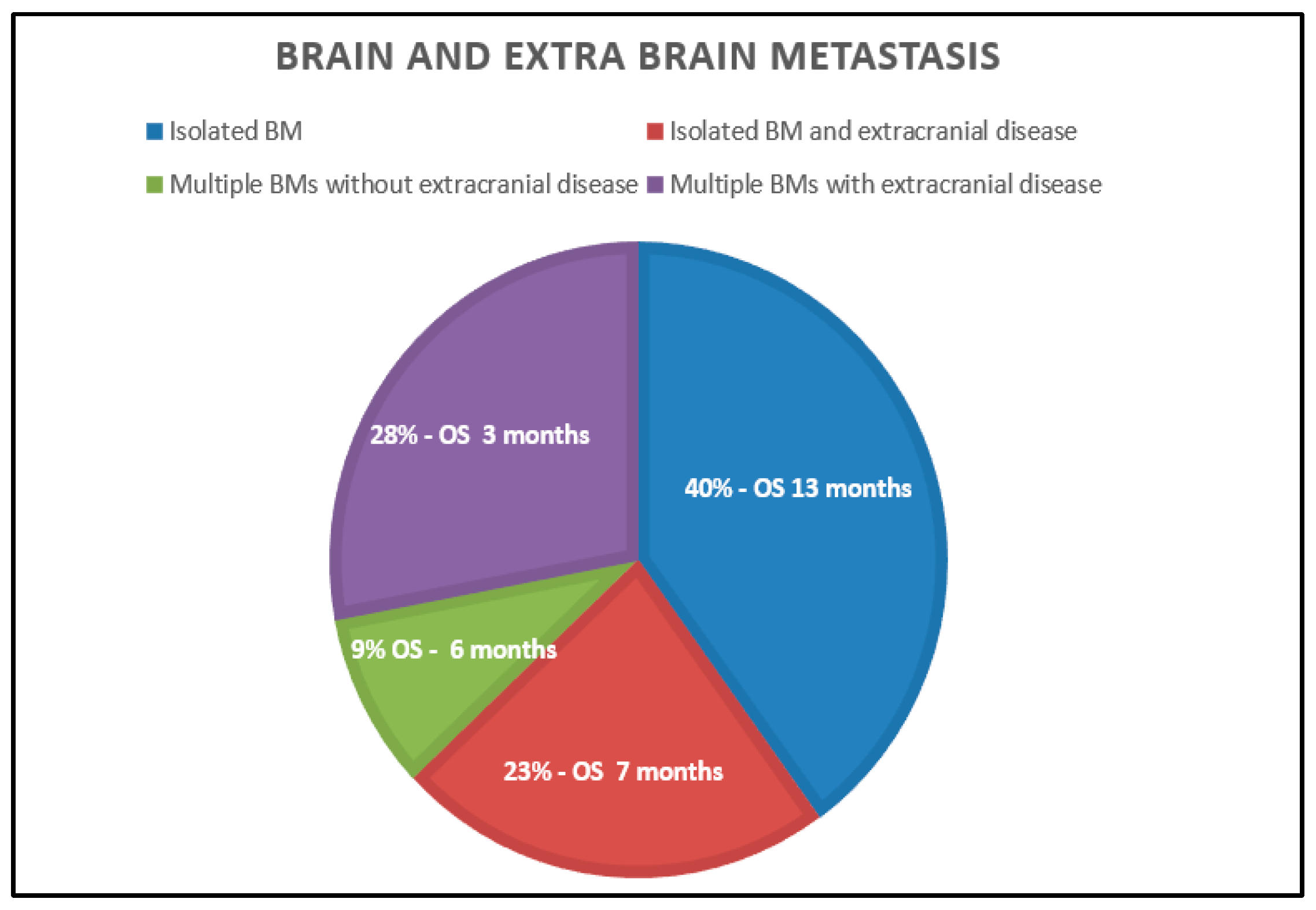
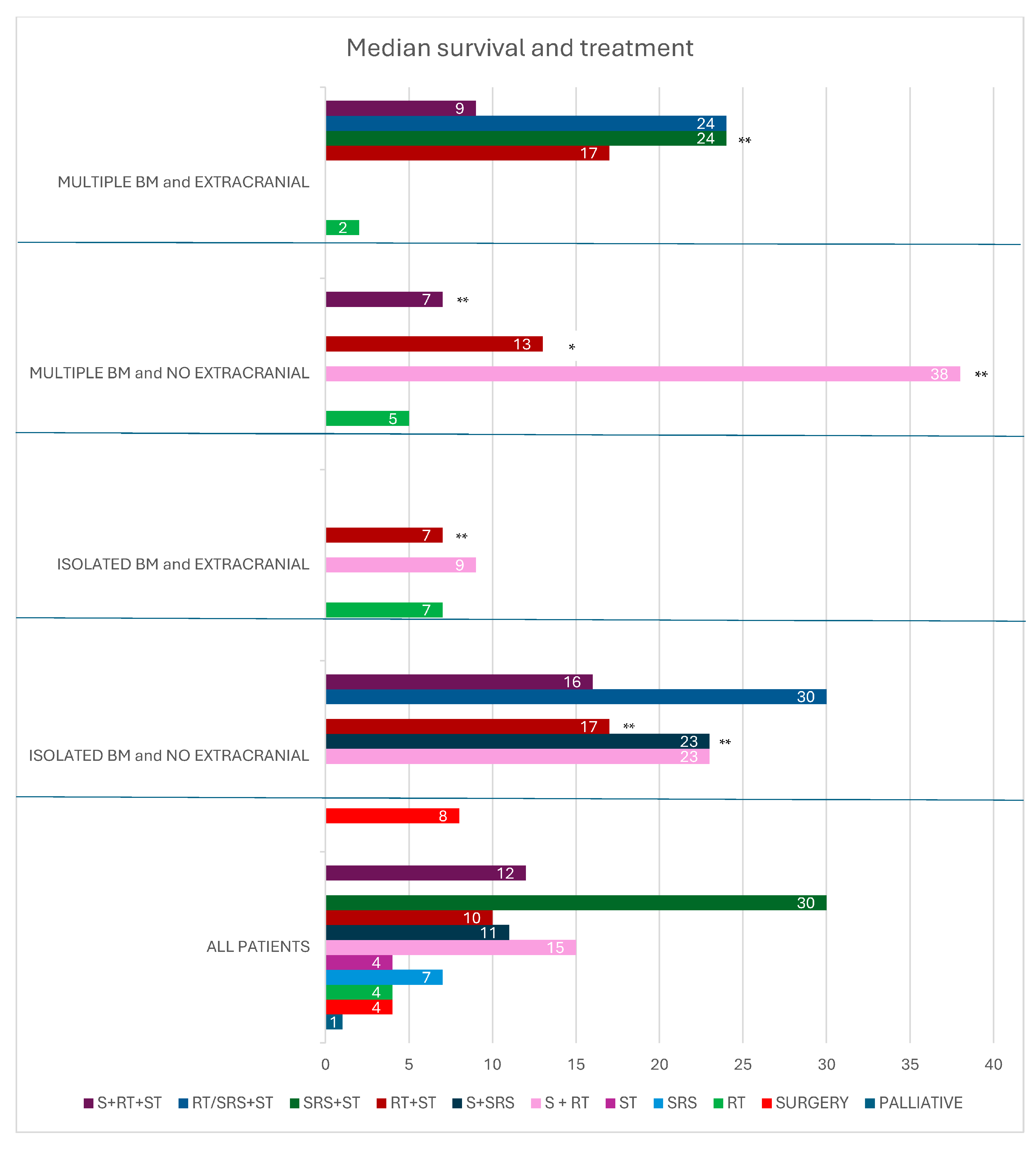
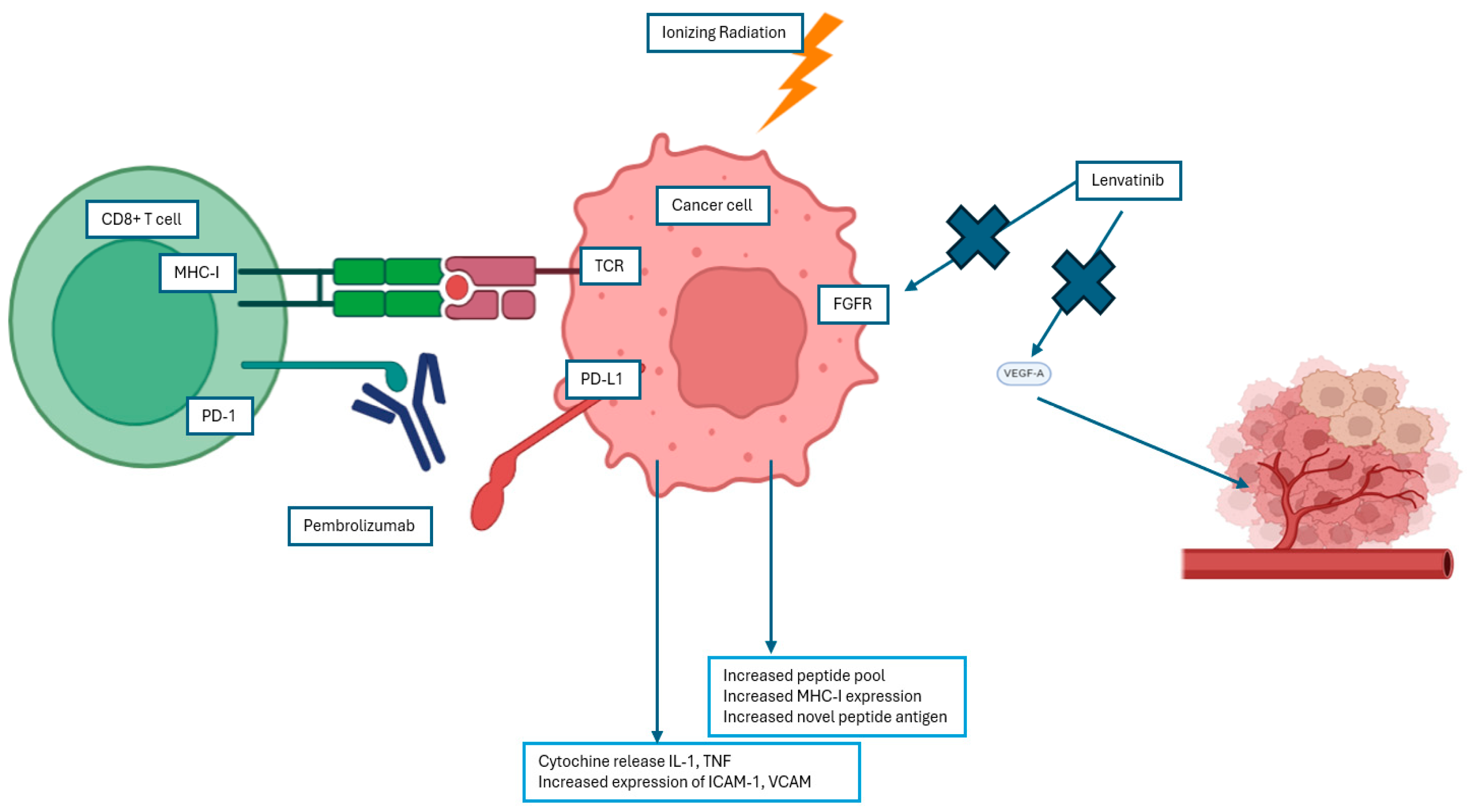
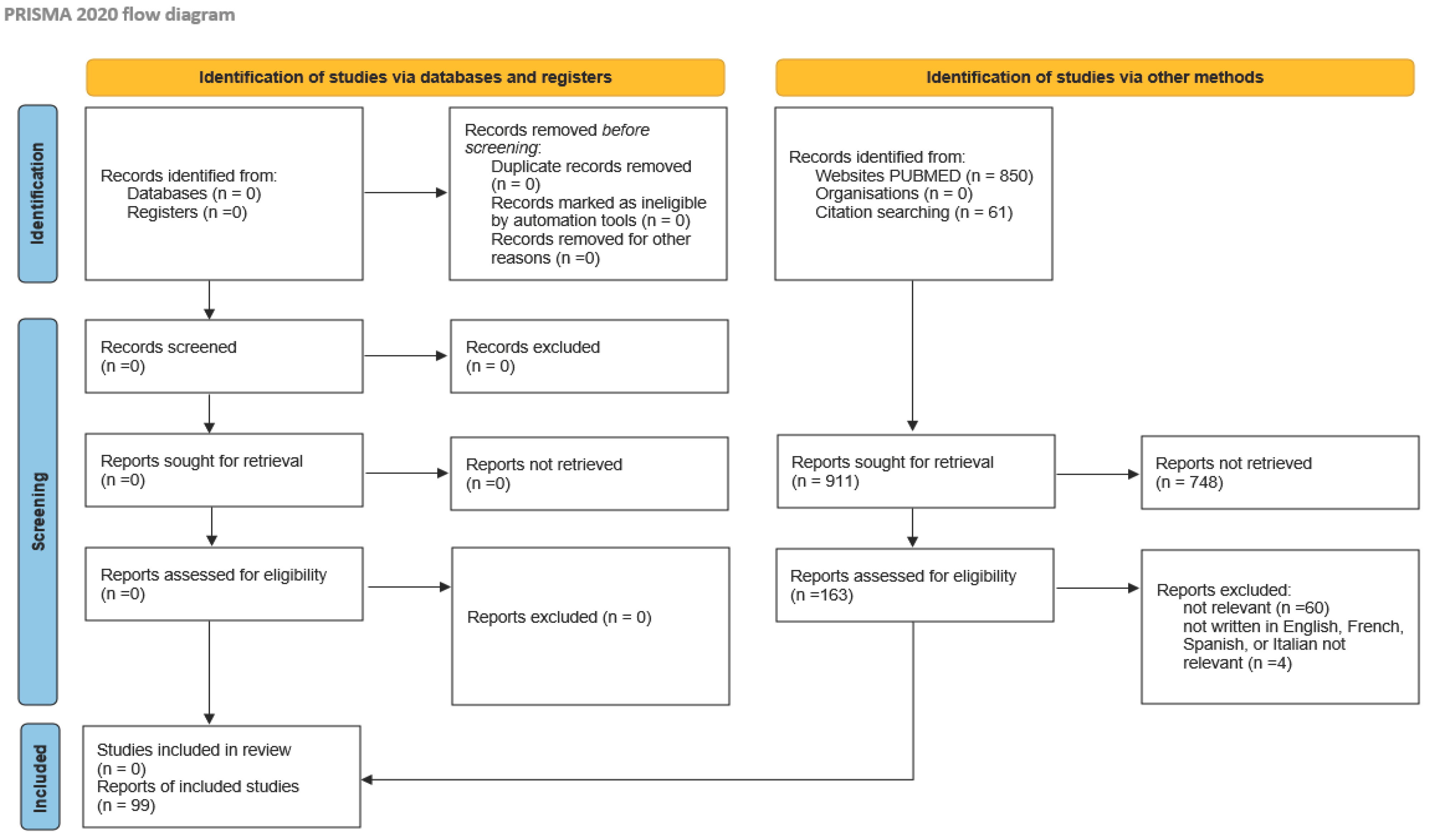
Brain Metastasis in Endometrial Cancer: A Systematic Review
 ,
,  ,
,  , , ,
, , ,
Simple Summary
Abstract
1. Introduction
2. Methods
3. Results
3.1. Isolated Brain Metastasis Without Extracranial Disease
3.2. Isolated Brain Metastasis and Extracranial Disease
3.3. Multiple Brain Metastasis Without Extracranial Disease
3.4. Multiple Brain Metastasis with Extracranial Disease
4. Discussion
Treatment
5. Conclusions
Author Contributions
Funding
Institutional Review Board Statement
Informed Consent Statement
Data Availability Statement
Conflicts of Interest
References
- Siegel, R.L.; Miller, K.D.; Fuchs, H.E.; Jemal, A. Cancer Statistics, 2021. CA Cancer J. Clin. 2021, 71, 7–33. [Google Scholar] [CrossRef] [Scilit] [PubMed]
- Yasin, H.K.; Taylor, A.H.; Ayakannu, T. A Narrative Review of the Role of Diet and Lifestyle Factors in the Development and Prevention of Endometrial Cancer. Cancers 2021, 13, 2149. [Google Scholar] [CrossRef] [Scilit] [PubMed]
- Fernandez, C.J.; George, A.S.; Subrahmanyan, N.A.; Pappachan, J.M. Epidemiological link between obesity, type 2 diabetes mellitus and cancer. World J. Methodol. 2021, 11, 23–45. [Google Scholar] [CrossRef] [Scilit]
- Medina-Gutiérrez, E.; Céspedes, M.V.; Gallardo, A.; Rioja-Blanco, E.; Pavón, M.; Asensio-Puig, L.; Farré, L.; Alba-Castellón, L.; Unzueta, U.; Villaverde, A.; et al. Novel Endometrial Cancer Models Using Sensitive Metastasis Tracing for CXCR4-Targeted Therapy in Advanced Disease. Biomedicines 2022, 10, 1680. [Google Scholar] [CrossRef] [Scilit]
- SEER Cancer Stat Facts: Uterine Cancer. Available online: https://seer.cancer.gov/statfacts/html/corp.html (accessed on 7 October 2024).
- Tung, H.J.; Huang, H.J.; Lai, C.H. Adjuvant and post-surgical treatment in endometrial cancer. Best Pract. Res. Clin. Obstet. Gynaecol. 2022, 78, 52–63. [Google Scholar] [CrossRef] [Scilit]
- Ko, E.M.; Brensinger, C.M.; Cory, L.; Giuntoli, R.L.; Haggerty, A.F.; Latif, N.A.; Aviles, D.; Martin, L.; Morgan, M.A.; Lin, L.L. Utilization and survival outcomes of sequential, concurrent and sandwich therapies for advanced stage endometrial cancers by histology. Gynecol. Oncol. 2020, 159, 394–401. [Google Scholar] [CrossRef] [Scilit]
- Legge, F.; Restaino, S.; Leone, L.; Carone, V.; Ronsini, C.; Di Fiore, G.L.M.; Pasciuto, T.; Pelligra, S.; Ciccarone, F.; Scambia, G.; et al. Clinical outcome of recurrent endometrial cancer: Analysis of post-relapse survival by pattern of recurrence and secondary treatment. Int. J. Gynecol. Cancer 2020, 30, 193–200. [Google Scholar] [CrossRef] [Scilit]
- Mariani, A.; Webb, M.J.; Keeney, G.L.; Podratz, K.C. Routes of lymphatic spread: A study of 112 consecutive patients with endometrial cancer. Gynecol. Oncol. 2001, 81, 100–104. [Google Scholar] [CrossRef] [Scilit]
- Mao, W.; Wei, S.; Yang, H.; Yu, Q.; Xu, M.; Guo, J.; Gao, L. Clinicopathological study of organ metastasis in endometrial cancer. Future Oncol. 2020, 16, 525–540. [Google Scholar] [CrossRef] [Scilit]
- Ostrom, Q.T.; Wright, C.H.; Barnholtz-Sloan, J.S. Brain metastases: Epidemiology. Handb. Clin. Neurol. 2018, 149, 27–42. [Google Scholar]
- Lu-Emerson, C.; Eichler, A.F. Brain metastases. Continuum 2012, 18, 295–311. [Google Scholar] [CrossRef] [Scilit] [PubMed]
- Hanlon, P.; Fauré, I.; Corcoran, N.; Butterly, E.; Lewsey, J.; McAllister, D.A.; Mair, F.S. Identification and prevalence of frailty in diabetes mellitus and association with clinical outcomes: A systematic review protocol. BMJ Open. 2020, 10, e037476. [Google Scholar] [CrossRef] [Scilit] [PubMed] [PubMed Central]
- Salibi, B.S.; Beltaos, E. Endometrial adenocarcinoma with cerebral metastasis and subdural ossification. Wis. Med. J. 1972, 71, 255–258. [Google Scholar] [PubMed]
- Nakano, K.K.; Schoene, W.C. Endometrial carcinoma with a predominant clear-cell pattern with metastases to the adrenal, posterior mediastinum, and brain. Am. J. Obstet. Gynecol. 1975, 122, 529–530. [Google Scholar] [CrossRef] [Scilit] [PubMed]
- Hacker, J.R.; Foxet, J.L. Surgical treatment of brain stem carcinoma: Case report Neurosurgery. Neurosurgery 1980, 6, 430–432. [Google Scholar] [CrossRef] [Scilit] [PubMed]
- Turner, D.M.; Graf, C.J. Nontraumatic subdural hematoma secondary to dural metastasis: Case report and review of the literature. Neurosurgery 1982, 11, 678–680. [Google Scholar] [CrossRef] [Scilit]
- Kishi, K.; Nomura, K.; Miki, Y.; Shibui, S.; Takakura, K. Metastatic brain tumor. A clinical and pathologic analysis of 101 cases with biopsy. Arch. Pathol. Lab. Med. 1982, 106, 133–135. [Google Scholar]
- Aalders, J.G.; Abeler, V.; Kolstad, P. Recurrent adenocarcinoma of the endometrium: A clinical and histopathological study of 379 patients. Gynecol. Oncol. 1984, 17, 85–103. [Google Scholar] [CrossRef] [Scilit]
- Ritchie, W.W.; Messmer, J.M.; Whitley, D.P.; Gopelrud, D.R. Uterine carcinoma metastatic to the larynx. Laryngoscope 1985, 95, 97–98. [Google Scholar]
- Savage, J.; Subby, W.; Okagaki, T. Adenocarcinoma of the endometrium with trophoblastic differentiation and metastases as choriocarcinoma: A case report. Gynecol. Oncol. 1987, 26, 257–262. [Google Scholar] [CrossRef] [Scilit]
- McCormick, P.C.; Post, K.D.; Kandji, A.D.; Hays, A.P. Metastatic carcinoma to the pituitary gland. Br. J. Neurosurg. 1989, 3, 71–79. [Google Scholar] [CrossRef] [Scilit] [PubMed]
- Sawada, M.; Inagaki, M.; Ozaki, M.; Yamasaki, M.; Nakagawa, H.; Inoue, T.; Terada, N.; Wada, A. Long-term survival after brain metastasis from endometrial cancer. Jpn. J. Clin. Oncol. 1990, 20, 312–315. [Google Scholar] [PubMed]
- Brezinka, C.; Fend, F.; Huter, O.; Plattner, A. Cerebral metastasis of endometrial carcinoma. Gynecol. Oncol. 1990, 38, 278–281. [Google Scholar] [CrossRef] [Scilit] [PubMed]
- Lieschke, G.J.; Tress, B.; Chambers, D. Endometrial adenocarcinoma presenting as pituitary apoplexy. Aust. New Zealand J. Med. 1990, 20, 81–84. [Google Scholar] [CrossRef] [Scilit] [PubMed]
- Kottke-Marchant, K.; Estes, M.L.; Nunez, C. Early brain metastases in endometrial carcinoma. Gynecol. Oncol. 1991, 41, 67–73. [Google Scholar] [CrossRef] [Scilit] [PubMed]
- De Porre, P.M.; Subandono Tjokrowardojo, A.J. Brain metastases of endometrial carcinoma. Case report and review of literature. Strahlenther. Onkol. 1992, 168, 100–101. [Google Scholar] [PubMed]
- Thomas, H.; Lambert, H.E. Solitary cerebral metastases from gynaecological malignancy: The case for radical therapy. Clin. Oncol. 1992, 4, 133–134. [Google Scholar] [CrossRef] [Scilit]
- Wroński, M.; Zakowski, M.; Arbit, E.; Hoskins, W.J.; Galicich, J.H. Endometrial cancer metastasis to brain: Report of two cases and a review of the literature. Surg. Neurol. 1993, 39, 355–359. [Google Scholar] [CrossRef] [Scilit] [PubMed]
- Iqbal, J.B.; Ironside, J.W. Cerebral metastasis from a malignant mixed Mūllerian tumour of the uterus. Histopathology 1993, 23, 277–279. [Google Scholar] [CrossRef] [Scilit]
- Ruelle, A.; Zuccarello, M.; Andrioli, G. Brain metastasis from endometrial carcinoma. Rep. Two Cases. Neurosurg. Rev. 1994, 17, 83–87. [Google Scholar]
- Cormio, G.; Lissoni, A.; Losa, G.; Zanetta, G.; Pellegrino, A.; Mangioni, C. Brain metastases from endometrial carcinoma. Gynecol. Oncol. 1996, 61, 403. [Google Scholar] [CrossRef] [Scilit] [PubMed]
- De Witte, O.; Lefranc, F.; Salmon, I.; Violon, P.; Brotchi, J. Métastases cérébrales d’origine gynécologique [Cerebral metastases of gynecological origin]. Neurochirurgie 1996, 42, 216–220. [Google Scholar] [PubMed]
- Salvati, M.; Cervoni, L.; Raguso, M. Therapeutic observations of solitary cerebral metastases due to endometrial carcinoma. Minerva Ginecol. 1998, 50, 445–447. [Google Scholar] [PubMed]
- Martińez-Manãs, R.M.; Brell, M.; Rumià, J.; Ferrer, E. Brain Metastases in endometrial carcinoma. Gynecol. Oncology. 1998, 70, 282–284. [Google Scholar] [CrossRef] [Scilit]
- Ogawa, K.; Tomita, T.; Kakinohana, Y.; Kamata, M.; Moromizato, H.; Nagai, Y.; Higashi, M.; Kanazawa, K.; Yoshii, Y. Palliative radiation therapy for brain metastases from endometrial carcinoma: Report of two cases. Jpn. J. Clin. Oncol. 1999, 29, 498–503. [Google Scholar] [CrossRef] [Scilit] [PubMed]
- Crispino, M.; Tira, A.; Volpi, D.; Olivetti, L. Solitary cerebral metastasis of endometrial carcinoma. La Radiol. Medica 2000, 100, 515–517. [Google Scholar]
- Petru, E.; Lax, S.; Kurschel, S.; Gücer, F.; Sutter, B. Long-term survival in a patient with brain metastases preceding the diagnosis of endometrial cancer. Report of two cases and review of the literature. J. Neurosurg. 2001, 94, 846–848. [Google Scholar] [CrossRef] [Scilit] [PubMed]
- Mahmoud-Ahmed, A.S.; Suh, J.H.; Barnett, G.H.; Webster, K.D.; Belinson, J.L.; Kennedy, A.W. The effect of radiation therapy on brain metastases from endometrial carcinoma: A retrospective study. Gynecol. Oncol. 2001, 83, 305–309. [Google Scholar] [CrossRef] [Scilit] [PubMed]
- Sewak, S.; Muggia, F.M.; Zagzag, D. Endometrial carcinoma with cerebellar metastasis: A case report and review of the literature. J. Neurooncol. 2002, 58, 137–140. [Google Scholar] [CrossRef] [Scilit] [PubMed]
- Shiohara, S.; Ohara, M.; Itoh, K.; Shiozawa, T.; Konishi, I. Successful treatment with stereotactic radiosurgery for brain metastases of endometrial carcinoma: A case report and review of the literature. Int. J. Gynecol. Cancer. 2003, 13, 71–76. [Google Scholar] [CrossRef] [Scilit] [PubMed]
- Gien, L.T.; Kwon, J.S.; D’Souza, D.P.; Radwan, J.S.; Hammond, J.A.; Sugimoto, A.K.; Carey, M.S. Brain metastases from endometrial carcinoma: A retrospective study. Gynecol. Oncol. 2004, 93, 524–528. [Google Scholar] [CrossRef] [Scilit] [PubMed]
- Elliott, K.S.; Borowsky, M.E.; Lee, Y.C.; Rao, C. Abulafia O. Prolonged survival in recurrent endometrial carcinoma to the brain. Gynecol. Oncol. 2004, 95, 247–251. [Google Scholar] [CrossRef] [Scilit] [PubMed]
- Salvati, M.; Caroli, E.; Orlando, E.R.; Nardone, A.; Frati, A.; Innocenzi, G.; Giangaspero, F. Solitary brain metastases from uterus carcinoma: Report of three cases. J. Neurooncol. 2004, 66, 175–178. [Google Scholar] [CrossRef] [Scilit] [PubMed]
- N’Kanza, A.L.; Jobanputra, S.; Farmer, P.; Lovecchio, J.; Yelon, J.A.; Rudloff, U. Central nervous system involvement from malignant mixed Müllerian tumor (MMMT) of the uterus. Arch Gynecol. Obstet. 2005, 273, 63–68. [Google Scholar] [CrossRef] [Scilit] [PubMed]
- Ota, T.; Yoshida, M.; Kimura, M.; Kinoshita, K. Clinicopathologic study of uterine endometrial carcinoma in young women aged 40 years and younger. Int. J. Gynecol. Cancer. 2005, 15, 657–662. [Google Scholar] [CrossRef] [Scilit] [PubMed]
- Dietrich III, C.S.; Modesitt, S.C.; DePriest, P.D.; Ueland, F.R.; Wilder, J.; Reedy, M.B.; Pavlik, E.J.; Kryscio, R.; Cibull, M.; Giesler, J.; et al. The efficacy of adjuvant platinum-based chemotherapy in Stage I uterine papillary serous carcinoma (UPSC). Gynecol. Oncol. 2005, 99, 557–563. [Google Scholar] [CrossRef] [Scilit]
- Lee, W.J.; Chen, C.H.; Chow, S.N. Brain metastases from early-stage endometrial carcinoma 8 years after primary treatment: Case report and review of the literature. Acta Obs. Gynecol. Scand. 2006, 85, 890–891. [Google Scholar] [CrossRef] [Scilit] [PubMed]
- Llaneza-Coto, A.P.; Seco-Navedo, M.; Fernandez-García, T.; Redondo-Onia, M. Brain metastases of endometrial carcinoma in a young woman. Prog. De Obstet. Y Ginecol. 2006, 49, 82–84. [Google Scholar] [CrossRef] [Scilit]
- Chura, J.C.; Marushin, R.; Boyd, A.; Ghebre, R.; Geller, M.A.; Argenta, P.A. Multimodal therapy improves survival in patients with CNS metastasis from uterine cancer: A retrospective analysis and literature review. Gynecol. Oncol. 2007, 107, 79–85. [Google Scholar] [CrossRef] [Scilit] [PubMed]
- Orrù, S.; Lay, G.; Dessì, M.; Murtas, R.; Deidda, M.A.; Amichetti, M. Brain metastases from endometrial carcinoma: Report of three cases and review of the literature. Tumori J. 2007, 93, 112–117. [Google Scholar] [CrossRef] [Scilit] [PubMed]
- Sohaib, S.A.; Houghton, S.L.; Meroni, R.; Rockall, A.G.; Blake, P.; Reznek, R.H. Recurrent endometrial cancer: Patterns of recurrent disease and assessment of prognosis. Clin. Radiol. 2007, 62, 28–34. [Google Scholar] [CrossRef] [Scilit] [PubMed]
- Monaco, E.; Kondziolka, D.; Mongia, S.; Niranjan, A.; Flickinger, J.C.; Lunsford, L.D. Management of brain metastases from ovarian and endometrial carcinoma with stereotactic radiosurgery. Cancer 2008, 113, 2610–2614. [Google Scholar] [CrossRef] [Scilit] [PubMed]
- Ramirez, C.; Reyns, N.; Pasquier, D. Blond S. Bilateral thalamic metastases in endometrial adenocarcinoma. Eur. Neurol. 2008, 59, 330. [Google Scholar] [CrossRef] [Scilit] [PubMed]
- Al-Mujaini, A.; Gans, M.; Deschênes, J. Cortical visual loss consequent to brain metastases from an endometrial carcinoma. Can J. Ophthalmol. 2008, 43, 486. [Google Scholar] [CrossRef] [Scilit] [PubMed]
- Asensio, N.; Luis, A.; Costa, I.; Oliveira, J.; Vaz, F. Meningeal carcinomatosis and uterine carcinoma: Three different clinical settings and review of the literature. Int. J. Gynecol. Cancer 2009, 19, 168–172. [Google Scholar] [CrossRef] [Scilit]
- Srikantia, N.; Rekha, B.; Rajeev, A.G.; Kalyan, S.N. Endometrioid endometrial adenocarcinoma in a premenopausal woman with multiple organ metastases. Indian J. Med. Paediatr. Oncol. 2009, 30, 80–83. [Google Scholar] [CrossRef] [Scilit]
- Blecharz, P.; Urbański, K.; Mucha-Małecka, A.; Małecki, K.; Reinfuss, M.; Jakubowicz, J.; Skotnicki, P. Hematogenous metastases in patients with Stage I or II endometrial carcinoma. Strahlenther. Onkol. 2011, 187, 806–811. [Google Scholar] [CrossRef] [Scilit] [PubMed]
- Forster, M.D.; Dedes, K.J.; Sandhu, S.; Frentzas, S.; Kristeleit, R.; Ashworth, A.; Poole, C.J.; Weigelt, B.; Kaye, S.B.; L Rhoda Molife, L.R. Treatment with olaparib in a patient with PTEN-deficient endometrioid endometrial cancer. Nat. Rev. Clin. Oncol. 2011, 8, 302–306. [Google Scholar] [CrossRef] [Scilit]
- Yamashita, S.; Fukuda, T.; Shimizu, T.; Tanaka, M. Intracranial hemorrhage from undiagnosed metastatic brain tumor during general anesthesia. J. Clin. Anesth. 2011, 23, 562–564. [Google Scholar] [CrossRef] [Scilit] [PubMed]
- Menendez, J.Y.; Bauer, D.F.; Shannon, C.N.; Fiveash, J.; Markert, J.M. Stereotactic radiosurgical treatment of brain metastasis of primary tumors that rarelyme astasize to the central nervous system. J. Neurooncol. 2012, 109, 513–519. [Google Scholar] [CrossRef] [Scilit] [PubMed]
- Cabuk-Comert, E.; Bildaci, T.B.; Kisa-Karakaya, B.; Tarhan, N.Ç.; Özen, Ö.; Gülşen, S.; Dursun, P.; Ayhan, A. Outcomes in 12 gynecologic cancer patients with brain metastasis: A single center’s experience. Turk J. Med. Sci. 2012, 42, 385–394. [Google Scholar] [CrossRef] [Scilit]
- Talwar, S.; Cohen, S. Her-2 targeting in uterine papillary serous carcinoma. Gynecol. Oncol. Case Rep. 2012, 2, 94–96. [Google Scholar] [CrossRef] [Scilit] [PubMed]
- Berretta, R.; Patrelli, T.S.; Faioli, R.; Mautone, D.; Gizzo, S.; Mezzogiorno, A.; Giordano, G.; Modena, A.B. Dedifferentiated endometrial cancer: An atypical case diagnosed from cerebellar and adrenal metastasis: Case presentation and review of literature. Int. J. Clin. Exp. Pathol. 2013, 6, 1652–1657. [Google Scholar] [PubMed] [PubMed Central]
- Gulsen, S.; Terzi, A. Multiple brain metastases in a patient with uterine papillary serous adenocarcinoma: Treatment options for this rarely seen metastatic brain tumor. Surg. Neurol. Int. 2013, 4, 111. [Google Scholar] [CrossRef] [Scilit]
- Bergamini, A.; Rabaiotti, E.; De Marzi, P.; Ferrari, M.; Petrone, M.; Viganò, R.; Mangili, G. Brain metastases from early-stage endometrial carcinoma: A challenging issue. Cancer Break. News 2014, 2, 15–17. [Google Scholar]
- Nassir, M.; Roth, A.; Gasimli, K.; Braicu, E.I.; Fotopoulou, C.; Mawrin, C.; Badakhshi, H.; Warnke, J.P.; Sehouli, J. Is endometrial cancer really a neurophobic tumor? A case report and review of the literature. Anticancer. Res. 2014, 34, 249–257. [Google Scholar] [PubMed]
- Shepard, M.J.; Fezeu, F.; Lee, C.C.; Sheehan, J.P. Gamma knife radiosurgery for the treatment of gynecologic malignancies metastasizing to the brain: Clinical article. J. Neurooncol. 2014, 120, 515–522. [Google Scholar] [CrossRef] [Scilit]
- Gressel, G.M.; Lundsberg, L.S.; Altwerger, G.; Katchi, T.; Azodi, M.; Schwartz, P.E.; Ratner, E.S.; Damast, S. Factors Predictive of Improved Survival in Patients With Brain Metastases From Gynecologic Cancer: A Single Institution Retrospective Study of 47 Cases and Review of the Literature. Int. J. Gynecol. Cancer. 2015, 25, 1711–1716. [Google Scholar] [CrossRef] [Scilit]
- Kim, Y.Z.; Kwon, J.H.; Lim, S. A clinical analysis of brain metastasis in gynecologic cancer: A retrospective multi-institute analysis. J. Korean Med. Sci. 2015, 30, 66–73. [Google Scholar] [CrossRef] [Scilit]
- Kouhen, F.; Afif, M.; Kabous, M.E.; Raiss, F.; Benhmidou, N.; Majjaoui, S.; Elkacemi, H.; Kebdani, T.; Benjaaafar, N. Métastasese cérébrale d’un cancer de l’endomètre: À propos d’un cas et une revue de la littérature. Pan Afr. Med. J. 2015, 20. [Google Scholar] [CrossRef] [Scilit]
- Narisimhulu, D.M.; Khulpateea, N.; Meritz, K.; Xu, Y. Brain metastasis in two patients with stage IA papillary serous carcinoma of the uterus. Gynecol. Oncol. Rep. 2015, 13, 2. [Google Scholar] [CrossRef] [Scilit] [PubMed]
- Sierra, T.; Nguyen, L.; Mascitelli, J.; Kalir, T.; Fishman, D. Brain metastasis from uterine serous carcinoma: A case report and review of literature. Gynecol. Oncol. Rep. 2015, 11, 34–37. [Google Scholar] [CrossRef] [Scilit] [PubMed] [PubMed Central]
- Uccella, S.; Morris, J.M.; Multinu, F.; Cliby, W.A.; Podratz, K.C.; Gostout, B.S.; Dowdy, S.C.; Ghezzi, F.; Makdisi, P.B.; Keeney, G.L.; et al. Primary brain metastases of endometrial cancer: A report of 18 cases and review of the literature. Gynecol. Oncol. 2016, 142, 70–75. [Google Scholar] [CrossRef] [Scilit] [PubMed]
- Shin, H.K.; Kim, J.H.; Lee, D.H.; Cho, Y.H.; Kwon, D.H.; Roh, S.W. Clinical Outcomes of Gamma Knife Radiosurgery for Metastatic Brain Tumors from Gynecologic Cancer: Prognostic Factors in Local Treatment Failure and Survival. J. Korean Neurosurg. Soc. 2016, 59, 392–399. [Google Scholar] [CrossRef] [Scilit] [PubMed] [PubMed Central]
- Matsunaga, S.; Shuto, T.; Sato, M. Gamma Knife Surgery for Metastatic Brain Tumors from Gynecologic Cancer. World Neurosurg. 2016, 89, 455–463. [Google Scholar] [CrossRef] [Scilit] [PubMed]
- Divine, L.M.; Kizer, N.T.; Hagemann, A.R.; Pittman, M.E.; Chen, L.; Powell, M.A.; Mutch, D.G.; Rader, J.S.; Thaker, P.H. Clinicopathologic characteristics and survival of patients with gynecologic malignancies metastatic to the brain. Gynecol. Oncol. 2016, 142, 76–82. [Google Scholar] [CrossRef] [Scilit] [PubMed] [PubMed Central]
- Sawada, M.; Matsuzaki, S.; Yoshino, K.; Ueda, Y.; Yoshida, S.; Kimura, T.; Ogita, K. Long-term survival in small-cell carcinoma of the endometrium with liver and brain metastases. Anticancer. Drugs 2016, 27, 138–143. [Google Scholar] [CrossRef] [Scilit] [PubMed]
- Keller, A.; Ismail, R.; Potrebko, P.S.; Pepe, J.; Wu, M.; Saigal, K.; Biagioli, M.; Shridhar, R.; Holloway, R.; Field, M.; et al. Role of Gamma Knife® Radiosurgery for the Treatment of Brain Metastases from Gynecological Cancers. Cureus 2016, 8, e947. [Google Scholar] [CrossRef] [Scilit] [PubMed] [PubMed Central]
- Gilani, M.A.; Williams, N.L.; Giordano, C.; Rosenblum, N.; Shi, W.; Anne, P.; Schilder, R.J. Brain Metastases in Patients with Gynecologic Cancers: A Single Institution Experience and Review of the Literature. Open J. Obstet. Gynecol. 2016, 6, 544–552. [Google Scholar] [CrossRef] [PubMed] [PubMed Central]
- Könnecke, H.K.; Rushing, E.J.; Neidert, M.C.; Reimann, R.; Regli, L.; Bozinov, O.; Burkhardt, J.K. Heterogeneous Appearance of Central Nervous System Involvement in Malignant Mixed Müllerian Tumors. J. Neurol. Surg. A Cent Eur. Neurosurg. 2016, 77, 447–451. [Google Scholar] [CrossRef] [Scilit] [PubMed]
- Takeshita, S.; Todo, Y.; Furuta, Y.; Okamoto, K.; Minobe, S.; Yamashiro, K.; Kato, H. Prognostic factors for patients with brain metastasis from gynecological cancer: A significance of treatment-free interval of more than 6 months. Jpn. J. Clin. Oncol. 2017, 47, 604–610. [Google Scholar] [CrossRef] [Scilit] [PubMed]
- Kimyon, G.; Turan, T.; Basaran, D.; Turkmen, O.; Karalok, A.; Tasci, T.; Tulunay, G.; Kose, M.F. Is neurosurgery with adjuvant radiotherapy an effective treatment modality in isolated brain involvement from endometrial cancer? From case report to analysis. Int. J. Gynecol. Cancer 2017, 27, 315–325. [Google Scholar] [CrossRef] [Scilit] [PubMed]
- Toyoshima, M.; Tsuji, K.; Shigeta, S.; Tokunaga, H.; Ito, K.; Watanabe, Y.; Yoshinaga, K.; Otsuki, T.; Niikura, H.; Yaegashi, N. Leptomeningeal metastasis from gynecologic cancers diagnosed by brain MRI. Clin. Imaging. 2017, 41, 42–47. [Google Scholar] [CrossRef] [Scilit] [PubMed]
- Kasper, E.; Ippen, F.; Wong, E.; Uhlmann, E.; Floyd, S.; Mahadevan, A. Stereotactic radiosurgery for brain metastasis from gynecological malignancies. Oncol. Lett. 2017, 13, 1525–1528. [Google Scholar] [CrossRef] [Scilit] [PubMed] [PubMed Central]
- Healy, V.; O’Halloran, P.; O’Brien, S.; Beausang, A.; Caird, J. CNS metastasis secondary to malignant-mixed Müllerian tumor: Case report and review of therapeutics. CNS Oncol. 2017, 6, 315–323. [Google Scholar] [CrossRef] [Scilit]
- Johnston, H.; McTyre, E.R.; Cramer, C.K.; Lesser, G.J.; Ruiz, J.; Bourland, J.D.; Watabe, K.; Lo, H.W.; Qasem, S.; Laxton, A.W.; et al. Stereotactic radiosurgery in the treatment of brain metastases from gynecologic primary cancer. J. Radiosurgery SBRT 2017, 5, 55–61. [Google Scholar] [PubMed] [PubMed Central]
- Stamates, M.M.; Lee, J.M.; Merrell, R.T.; Shinners, M.J.; Wong, R.H. Combined Open and Endoscopic Endonasal Skull Base Resection of a Rare Endometrial Carcinoma Metastasis. J. Neurol. Surg. Rep. 2018, 79, e9–e13. [Google Scholar] [CrossRef] [Scilit] [PubMed] [PubMed Central]
- Salvatore, B.; D’Amico, D.; Fonti, R. Metastasis to the Sellar/Suprasellar Region in a Patient With Endometrial Carcinoma Detected by 18F-FDG PET/CT. Clin. Nucl. Med. 2018, 43, 363–364. [Google Scholar] [CrossRef] [Scilit] [PubMed]
- Cybulska, P.; Stasenko, M.; Alter, R.; Makker, V.; Cadoo, K.A.; Sonoda, Y.; Abu-Rustum, N.R.; Mueller, J.J.; Leitao, M.M.; Sonoda, Y.; et al. Brain metastases in patients with low-grade endometrial carcinoma. Gynecol. Oncol. Rep. 2018, 26, 87–90. [Google Scholar] [CrossRef] [Scilit]
- Eulálio Filho, W.M.N.; Fé, T.S.M.; Rodrigues, R.M.M.; Lima, M.S.O.; Vieira, S.C. Brain Metastasis in Papillary Serous Adenocarcinoma of the Endometrium. Rev. Bras. de Hematol. e Hemoter. 2019, 41, 264–267. [Google Scholar] [CrossRef] [Scilit] [PubMed] [PubMed Central]
- Zhang, Y.; Grant, M.S.; Stepp, W.H.; Clark, L.H. Clinical characteristics of CNS metastases from primary gynecologic cancers. Gynecol. Oncol. Rep. 2019, 30, 100518. [Google Scholar] [CrossRef] [Scilit] [PubMed] [PubMed Central]
- Moroney, M.R.; Wheeler, L.J.; Corr, B.R. Clinical presentation of brain metastases from endometrial carcinoma: A case series. Gynecol. Oncol. Rep. 2019, 28, 79–83. [Google Scholar] [CrossRef] [Scilit] [PubMed]
- Yang, F.; Shao, Y.; Xu, H.; Chen, J. Brain metastasis from early stage endometrial carcinoma 13 years after primary treatment: A case report and review of the literature, Int. J. Clin. Exp. Pathol. 2019, 12, 1806–1810. [Google Scholar]
- Katiyar, V.; Araujo, T.; Farooq, M.Z.; Vohra, I.; Gupta, S. Brain Metastasis in a Young Patient with Uterine Carcinosarcoma. Cureus 2019, 11, e5010. [Google Scholar] [CrossRef] [Scilit] [PubMed] [PubMed Central]
- Du, H.; Jia, A.; Ren, Y.; Gu, M.; Li, H.; Sun, M.; Tang, T.; Liu, H.; Jie Bai, J. Endometrial adenocarcinoma metastatic to the pituitary gland: A case report and literature review. J. Int. Med. Res. 2020, 48, 0300060520924512. [Google Scholar] [CrossRef] [Scilit]
- Ogino, A.; Hirai, T.; Serizawa, T.; Yoshino, A. Gamma Knife Surgery for Brain Metastases from Uterine Malignant Tumor. World Neurosurg. 2020, 139, e363–e372. [Google Scholar] [CrossRef] [Scilit] [PubMed]
- Guo, J.; Cui, X.; Zhang, X.; Qian, H.; Duan, H.; Zhang, Y. The Clinical Characteristics of Endometrial Cancer With Extraperitoneal Metastasis and the Value of Surgery in Treatment. Technol. Cancer Res. Treat. 2020, 19, 1533033820945784. [Google Scholar] [CrossRef] [Scilit]
- Nasioudis, D.; Persaud, A.; Taunk, N.K.; Latif, N.A. Brain Metastases From Gynecologic Malignancies: Prevalence and Management. Am. J. Clin. Oncol. 2020, 43, 418–421. [Google Scholar] [CrossRef] [Scilit] [PubMed]
- Bhambhvani, H.P.; Zhou, O.; Cattle, C.; Taiwo, R.; Diver, E.; Hayden Gephart, M. Brain Metastases from Endometrial Cancer: Clinical Characteristics, Outcomes, and Review of the Literature. World Neurosurg. 2021, 147, e32–e39. [Google Scholar] [CrossRef] [Scilit] [PubMed]
- Beucler, N.; Sellier, A.; Bernard, C.; Joubert, C.; Desse, N.; Dagain, A. Brain metastases in endometrial cancer: A systematic review of the surgical prognostic factors. Eur. J. Obstet. Gynecol. Reprod. Biol. 2021, 258, 240–252. [Google Scholar] [CrossRef] [Scilit] [PubMed]
- Wang, Q.; Zhang, F.; Gao, H.; Xu, Y. Successful treatment of a patient with brain metastases from endometrial cancer using Niraparib: A case report. Ann. Palliat. Med. 2021, 10, 818–827. [Google Scholar] [CrossRef] [Scilit] [PubMed]
- Gill, C.M.; D’Andrea, M.R.; Tomita, S.; Suhner, J.; Umphlett, M.; Zakashansky, K.; Blank, S.V.; Tsankova, N.; Shrivastava, R.K.; Fowkes, M.; et al. Tumor immune microenvironment in brain metastases from gynecologic malignancies. Cancer Immunol. Immunother. 2021, 70, 2951–2960. [Google Scholar] [CrossRef] [Scilit] [PubMed]
- Leung, S.O.A.; Foley, O.; Chapel, D.; Da Silva, A.; Nucci, M.; Muto, M.G.; Campos, S. Next- Generation Sequencing in the Diagnosis of Metastatic Lesions: Reclassification of a Glioblastoma as an Endometrial Cancer Metastasis to the Brain. Oncologist 2021, 26, e2102–e2109. [Google Scholar] [CrossRef] [Scilit] [PubMed] [PubMed Central]
- Crain, C.N.; Ngwanyam, R.; Punch, G. Rare brain metastasis with unusual characteristics in a late recurrence of stage IIIA uterine papillary serouscarcinoma. BJR Case Rep. 2021, 7, 20200157. [Google Scholar] [CrossRef] [Scilit] [PubMed] [PubMed Central]
- Karpathiou, G.; Camy, F.; Chauleur, C.; Dridi, M.; Dal Col, P.; Peoc’h, M. Brain Metastases from Gynecologic Malignancies. Medicina 2022, 58, 548. [Google Scholar] [CrossRef] [Scilit] [PubMed] [PubMed Central]
- Zhang, M.; Li, R.; Zhang, S.; Xu, X.; Liao, L.; Yang, Y.; Guo, Y. Analysis of prognostic factors of metastatic endometrial cancer based on surveillance, epidemiology, and end results database. Front. Surg. 2023, 9, 1001791. [Google Scholar] [CrossRef] [Scilit] [PubMed] [PubMed Central]
- Wei, Z.; Luy, D.D.; Tang, L.W.; Deng, H.; Jose, S.; Scanlon, S.; Niranjan, A.; Lunsford, L.D. Gamma Knife radiosurgery for gynecologic metastases to the brain: Analysis of pathology, survival, and tumor control. Gynecol. Oncol. 2023, 172, 21–28. [Google Scholar] [CrossRef] [Scilit] [PubMed]
- Matsunaga, S.; Shuto, T.; Serizawa, T.; Aoyagi, K.; Hasegawa, T.; Kawagishi, J.; Yomo, S.; Kenai, H.; Nakazaki, K.; Moriki, A.; et al. Gamma Knife Radiosurgery for Metastatic Brain Tumors from Uterine Cervical and Endometrial Carcinomas: Histopathological Analysis of Survival and Local Control. A Japanese Multi-Institutional Cooperative and Retrospective Cohort Study. Word Neurosurg. 2023, 171, e572–e580. [Google Scholar] [CrossRef] [Scilit]
- Butorac, D.; Potkonjak, A.M.; Kuharić, J.; Vujić, G. Brain metastasis as a first clinical presentation of endometrial cancer: A case report. Eur. J. Obstet. Gynecol. Reprod. Biol. 2024, 296, 380–381. [Google Scholar] [CrossRef] [Scilit] [PubMed]
- Shelvin, K.B.; Vincent, J.; Morron, S.; Morin, M.; Mammoser, A.; Nair, N. Recurrent high grade serous endometrial cancer with brain metastases: Immunotherapy confers pembro Lenvatinib improved quality of life and survival. Gynecol. Oncol. Rep. 2024, 55, 101494. [Google Scholar] [CrossRef] [Scilit] [PubMed] [PubMed Central]
- Paget, S. The distribution of secondary gro wths in cancer of the breast. Lancet 1889, 133, 571–573. [Google Scholar] [CrossRef] [Scilit]
- McGranahan, N.; Swanton, C. Clonal heterogeneity and tumor evolution: Past, present, and the future. Cell 2017, 168, 613–628. [Google Scholar] [CrossRef] [Scilit] [PubMed]
- Fischer, G.M.; Jalali, A.; Kircher, D.A.; Lee, W.C.; McQuade, J.L.; Haydu, L.E.; Joon, A.Y.; Reuben, A.; de Macedo, M.P.; Carapeto, F.C.L.; et al. Molecular profiling reveals unique immune and metabolic features of melanoma brain metastases. Cancer Discov. 2020, 9, 628–645. [Google Scholar] [CrossRef] [Scilit]
- Baeriswyl, V.; Christofori, G. The angiogenic switch in carcinogenesis. Semin. Cancer Biol. 2009, 19, 329–337. [Google Scholar] [CrossRef] [Scilit]
- Condamine, T.; Ramachandran, I.; Youn, J.I.; Gabrilovich, D.I. Regulation of tumor metastasis by myeloid-derived suppressor cells. Annu. Rev. Mar. Sci. 2015, 66, 97–110 . [Google Scholar] [CrossRef] [Scilit]
- Yuzhalin, A.E.; Yu, D. Brain Metastasis Organotropism. Cold Spring Harb. Perspect. Med. 2019, 10, a037242. [Google Scholar] [CrossRef] [Scilit]
- Bonneville, R.; Krook, M.A.; Kautto, E.A.; Miya, J.; Wing, M.R.; Chen, H.Z.; Reeser, J.W.; Yu, L.; Roychowdhury, S. Landscape of microsatellite instability across 39 cancer types. JCO Precis. Oncol. 2017, 2017, PO.17.00073. [Google Scholar] [CrossRef] [Scilit] [PubMed] [PubMed Central]
- Levine, D.A. The Cancer Genome Atlas Research Network. Integrated genomic characterization of endometrial carcinoma. Nature 2013, 497, 67–73. [Google Scholar] [CrossRef] [Scilit]
- León-Castillo, A.; de Boer, S.M.; Powell, M.E.; Mileshkin, L.R.; Mackay, H.J.; Leary, A.; Nijman, H.W.; Singh, N.; Pollock, P.M.; TransPORTEC Consortium; et al. Molecular Classification of the PORTEC-3 Trial for High-Risk Endometrial Cancer: Impact on Prognosis and Benefit From Adjuvant Therapy. J. Clin. Oncol. 2020, 38, 3388–3397. [Google Scholar] [CrossRef] [Scilit] [PubMed] [PubMed Central]
- Ashley, C.W.; Paula, A.D.C.; Kumar, R.; Mandelker, D.; Pei, X.; Riaz, N.; Reis-Filho, J.S.; Weigelt, B. Analysis of mutational signatures in primary and metastatic endometrial cancer reveals distinct patterns of DNA repair defects and shifts during tumor progression. Gynecol. Oncol. 2019, 152, 11–19. [Google Scholar] [CrossRef] [Scilit]
- Flamini, M.; Sanchez, A.; Goglia, L.; Tosi, V.; Genazzani, A.; Simoncini, T. Differential actions of estrogen and SERMs in regulation of the actin cytoskeleton of endometrial cells. Mol. Hum. Reprod. 2009, 15, 675–685. [Google Scholar] [CrossRef] [Scilit] [PubMed]
- Agacayak, E.; Keles, A.; Deger, U.; Ozcelik, M.S.; Peker, N.; Gunduz, R.; Akkus, M.; Buyukbayram, H. Could Moesin Be a New Marker for Indicating Progression in Endometrial Cancer? Cancer Manag. Res. 2022, 14, 1247–1257. [Google Scholar] [CrossRef] [Scilit] [PubMed]
- Che, Q.; Xiao, X.; Xu, J.; Liu, M.; Lu, Y.; Liu, S.; Dong, X. 17β-Estradiol promotes endometrial cancer proliferation and invasion through IL-6 pathway. Endocr. Connect. 2019, 8, 961–968. [Google Scholar] [CrossRef] [Scilit] [PubMed]
- Atıcı, Ö.K.; Govindrajan, N.; Lopetegui-González, I.; Shemanko, C.S. Prolactin: A hormone with diverse functions from mammary gland development to cancer metastasis. Semin. Cell Dev. Biol. 2021, 114, 159–170. [Google Scholar]
- Ding, K.; Yuan, Y.; Chong, Q.-Y.; Yang, Y.; Li, R.; Li, X.; Kong, X.; Qian, P.; Xiong, Z.; Pandey, V.; et al. Autocrine Prolactin Stimulates Endometrial Carcinoma Growth and Metastasis and Reduces Sensitivity to Chemotherapy. Endocrinology 2017, 158, 1595–1611. [Google Scholar] [CrossRef] [Scilit] [PubMed]
- Tamaru, S.; Kajihara, T.; Mizuno, Y.; Mizuno, Y.; Tochigi, H.; Ishihara, O. Endometrial microRNAs and their aberrant expression patterns. Med. Mol. Morphol. 2020, 53, 131–140. [Google Scholar] [CrossRef] [Scilit]
- van den Bent, M.J. The diagnosis and management of brain metastases. Curr. Opin. Neurol. 2001, 14, 717–723. [Google Scholar] [CrossRef] [Scilit]
- Langer, C.J.; Mehta, M.P. Current management of brain metastases, with a focus on systemic options. J. Clin. Oncol. 2005, 23, 6207–6219. [Google Scholar] [CrossRef] [Scilit]
- Prabhu, R.S.; Press, R.H.; Patel, K.R.; Boselli, D.M.; Symanowski, J.T.; Lankford, S.P.; McCammon, R.J.; Moeller, B.J.; Heinzerling, J.H.; Fasola, C.E.; et al. Single-fraction stereotactic radiosurgery (SRS) alone versus surgical resection and SRS for large brain metastases: Amulti-institutional analysis. Int. J. Radiat. Oncol. Biol. Phys. 2017, 99, 459–467. [Google Scholar] [CrossRef] [Scilit]
- Mahajan, A.; Ahmed, S.; McAleer, M.F.; Weinberg, J.S.; Li, J.; Brown, P.; Settle, S.; Prabhu, S.S.; Lang, F.F.; Levine, N.; et al. Postoperative stereotactic radiosurgery versus observation for completely resected brain metastases: A single-centre, randomised, controlled, phase 3 trial. Lancet Oncol. 2017, 18, 1040–1048. [Google Scholar] [CrossRef] [Scilit]
- Patchell, R.A.; Tibbs, P.A.; Regine, W.F.; Dempsey, R.J. Postoperative radiotherapy in the treatment of single metastases to the brain: A randomized trial. JAMA 1998, 280, 1485–1489. [Google Scholar] [CrossRef] [Scilit] [PubMed]
- Armstrong, J.G.; Wronski, M.; Galicich, J.; Arbit, E.; Leibel, S.A.; Burt, M. Postoperative radiation for lung cancer metastatic to the brain. J. Clin. Oncol. 1994, 12, 2340–2344. [Google Scholar] [CrossRef] [Scilit]
- Hagen, N.A.; Cirrincione, C.; Thaler, H.T.; DeAngelis, L.M. The role of radiation therapy following resection of single brain metastasis from melanoma. Neurology 1990, 40, 158–160. [Google Scholar] [CrossRef] [Scilit]
- Flickinger, J.C.; Lunsford, L.D.; Kondziolka, D. Dose prescription and dose-volume effects in radiosurgery. Neurosurg. Clin. N Am. 1992, 3, 51–59. [Google Scholar] [CrossRef] [Scilit]
- Higuchi, Y.; Matsuda, S.; Serizawa, T. Gamma knife radiosurgery in movement disorders: Indications and limitations. Mov. Disord. 2017, 32, 28–35. [Google Scholar] [CrossRef] [Scilit]
- Brown, P.D.; Jaeckle, K.; Ballman, K.V.; Farace, E.; Cerhan, J.H.; Anderson, S.K.; Carrero, X.W.; Barker, F.G., 2nd; Deming, R.; Burri, S.H.; et al. Effect of Radiosurgery Alone vs Radiosurgery With Whole Brain Radiation Therapy on Cognitive Function in Patients With 1 to 3 Brain Metastases: A Randomized Clinical Trial. JAMA 2016, 316, 401–409. [Google Scholar] [CrossRef] [Scilit] [PubMed] [PubMed Central]
- Verhaa Verhaak, E.; Gehring, K.; Hanssens, P.E.J.; Aaronson, N.K.; Sitskoorn, M.M. Health-related quality of life in adult patients with brain metastases after stereotactic radiosurgery: A systematic, narrative review. Support Care Cancer 2020, 28, 473–484. [Google Scholar] [CrossRef] [Scilit]
- Andrews, D.W.; Scott, C.B.; Sperduto, P.W.; Flanders, A.E.; Gaspar, L.E.; Schell, M.C.; Werner-Wasik, M.; Demas, W.; Ryu, J.; Bahary, J.P.; et al. Whole brain radiation therapy with or without stereotactic radiosurgery boost for patients with one to three brain metastases: Phase III randomised trial. Lancet 2004, 363, 1665–1672. [Google Scholar] [CrossRef] [Scilit]
- El Shafie, R.A.; Celik, A.; Weber, D.; Schmitt, D.; Lang, K.; König, L.; Bernhardt, D.; Höne, S.; Forster, T.; von Nettelbladt, B.; et al. A matched-pair analysis comparing stereotactic radiosurgery with whole-brain radiotherapy for patients with multiple brain metastases. J. Neurooncol. 2020, 147, 607–618. [Google Scholar] [CrossRef] [Scilit]
- Gatterbauer, B.; Hirschmann, D.; Eberherr, N.; Untersteiner, H.; Cho, A.; Shaltout, A.; Göbl, P.; Fitschek, F.; Dorfer, C.; Wolfsberger, S.; et al. Toxicity and efficacy of Gamma Knife radiosurgery for brain metastases inmelanoma pati ents treated with immunotherapy or targeted therapy-a retrospective cohort study. Cancer Med. 2020, 9, 4026–4036. [Google Scholar] [CrossRef] [Scilit]
- Oleinika, K.; Nibbs, R.J.; Graham, G.J.; Fraser, A.R. Suppression, subversion and escape: The role of regulatory T cells in cancer progression. Clin. Exp. Immunol. 2013, 171, 36–45. [Google Scholar] [CrossRef] [Scilit]
- Smyth, M.J.; Godfrey, D.I.; Trapani, J.A. A fresh look at tumor immunosurveillance and immunotherapy. Nat. Immunol. 2001, 2, 293–299. [Google Scholar] [CrossRef] [Scilit] [PubMed]
- Qiu, B.; Aili, A.; Xue, L.; Jiang, P.; Wang, J. Advances in radiobiology of stereotactic ablative radiotherapy. Front. Oncol. 2020, 10, 1165. [Google Scholar] [CrossRef] [Scilit] [PubMed]
- Fonteneau, J.F.; Larsson, M.; Bhardwaj, N. Interactions between dead cells and dendritic cells in the induction of antiviral CTL responses. Curr. Opin. Immunol. 2002, 14, 471–477. [Google Scholar] [CrossRef] [Scilit]
- Lugade, A.A.; Moran, J.P.; Gerber, S.A.; Rose, R.C.; Frelinger, J.G.; Lord, E.M. Local radiation therapy of B16 melanoma tumors increases the generation of tumor antigen specific effector cells that traffic to the tumor. J. Immunol. 2005, 174, 7516–7523. [Google Scholar] [CrossRef] [Scilit]
- Fleming, G.F.; Brunetto, V.L.; Cella, D.; Look, K.Y.; Reid, G.C.; Munkarah, A.R.; Kline, R.; Burger, R.A.; Goodman, A.; Burks, R.T. Phase III trial of doxorubicin plus cisplatin with or without paclitaxel plus filgrastim in advanced endometrial carcinoma: A Gynecologic Oncology Group Study. J. Clin. Oncol. 2004, 22, 2159–2166. [Google Scholar] [CrossRef] [Scilit] [PubMed]
- Miller, D.S.; Filiaci, V.L.; Mannel, R.S.; Cohn, D.E.; Matsumoto, T.; Tewari, K.S.; Di Silvestro, P.; Pearl, M.L.; Argenta, P.A.; Powell, M.A.; et al. Carboplatin and Paclitaxel for Advanced Endometrial Cancer: Final Overall Survival and Adverse Event Analysis of a Phase III Trial (NRG Oncology/GOG0209). J. Clin. Oncol. 2020, 38, 3841–3850. [Google Scholar] [CrossRef] [Scilit] [PubMed] [PubMed Central]
- Eskander, R.N.; Michael, W.; Sill, M.W.; Lindsey Beffa, L.; Richard, G.; Moore, R.G.; Joanie, M.; Hope, J.M.; Musa, F.B.; Mannel, R.; et al. Pembrolizumab plus Chemotherapy in Advanced Endometrial Cancer. N. Engl. J. Med. 2023, 388, 2159–2170. [Google Scholar] [CrossRef] [Scilit]
- Mirza, M.R.; Chase, D.M.; Slomovitz, B.M.; de Pont Christensen, R.; Zoltán Novák, Z.; Destin Black, D.; Lucy Gilbert, L.; Sharma, S.; Valabrega, G.; Landrum, L.M.; et al. Dostarlimab for primary advanced or recurrent endometrial cancer. N. Engl. J. Med. 2023, 388, 2145–2158. [Google Scholar] [CrossRef] [Scilit]
- Colombo, N.; Biagioli, E.; Harano, K.; Galli, F.; Hudson, E.; Antill, Y.; Choi, C.H.; Rabaglio, M.; Marmé, F.; Marth, C.; et al. Atezolizumab and chemotherapy for advanced or recurrent endometrial cancer (AtTEnd): A randomised, double-blind, placebo-controlled, phase 3 trial. Lancet Oncol. 2024, 25, 1135–1146. [Google Scholar] [CrossRef] [Scilit] [PubMed]
- Tillmanns, T.; Masri, A.; Stewart, C.; Chase, D.; Karnezis, A.; Chen, L.M.; Urban, R. Advanced endometrial cancer-The next generation of treatment: A society of gynecologic oncology journal club clinical commentary. Gynecol. Oncol. Rep. 2024, 55, 101462. [Google Scholar] [CrossRef] [Scilit] [PubMed] [PubMed Central]
- O’Malley, D.M.; Bariani, G.M.; Cassier, P.A.; Marabelle, A.; Hansen, A.R.; De Jesus Acosta, A.; Miller, W.H., Jr.; Safra, T.; Italiano, A.; Mileshkin, L.; et al. Pembrolizumab in Patients With Microsatellite Instability-High Advanced Endometrial Cancer: Results From the KEYNOTE-158 Study. J. Clin. Oncol. 2022, 40, 752–761. [Google Scholar] [CrossRef] [Scilit] [PubMed] [PubMed Central]
- Oaknin, A.; Gilbert, L.; Tinker, A.V.; Brown, J.; Mathews, C.; Press, J.; Sabatier, R.; O’Malley, D.M.; Samouelian, V.; Boni, V.; et al. Safety and antitumor activity of dostarlimab in patients with advanced or recurrent DNA mismatch repair deficient/microsatellite instability-high (dMMR/MSI-H) or proficient/stable (MMRp/MSS) endometrial cancer: Interim results from GARNET-a phase I, single-arm study. J. Immunother. Cancer. 2022, 10, e003777. [Google Scholar] [CrossRef] [Scilit] [PubMed] [PubMed Central]
- Wilson, L.J.; Linley, A.; Hammond, D.E.; Hood, F.E.; Coulson, J.M.; MacEwan, D.J.; Ross, S.J.; Slupsky, J.R.; Smith, P.D.; Eyers, P.A.; et al. New perspectives, opportunities, and challenges in exploring the human protein kinome. Cancer Res. 2018, 78, 15–29. [Google Scholar] [CrossRef] [Scilit] [PubMed]
- Matsui, J.; Yamamoto, Y.; Funahashi, Y.; Tsuruoka, A.; Watanabe, T.; Wakabayashi, T.; Uenaka, T.; Asada, M. E7080, a novel inhibitor that targets multiple kinases, has potent antitumor activities against stem cell factor producing human small cell lung cancer H146, based on angiogenesis inhibition. Int. J. Cancer 2008, 122, 664–671. [Google Scholar] [CrossRef] [Scilit] [PubMed]
- Okamoto, K.; Kodama, K.; Takase, K.; Sugi, N.H.; Yamamoto, Y.; Iwata, M.; Tsuruoka, A. Antitumor activities of the targeted multi-tyrosine kinase inhibitor lenvatinib (E7080) against RET gene fusion-driven tumor models. Cancer Lett. 2013, 340, 97–103. [Google Scholar] [CrossRef] [Scilit] [PubMed]
- Yamamoto, Y.; Matsui, J.; Matsushima, T.; Obaishi, H.; Miyazaki, K.; Nakamura, K.; Tohyama, O.; Semba, T.; Yamaguchi, A.; Hoshi, S.S.; et al. Lenvatinib, an angiogenesis inhibitor targeting VEGFR/FGFR, shows broad antitumor activity in human tumor xenograft models associated with microvessel density and pericyte coverage. Vasc Cell 2014, 6, 18. [Google Scholar] [CrossRef] [Scilit] [PubMed] [PubMed Central]
- Dutt, A.; Salvesen, H.B.; Chen, T.H.; Ramos, A.H.; Onofrio, R.C.; Hatton, C.; Nicoletti, R.; Winckler, W.; Grewal, R.; Hanna, M.; et al. Drug-sensitive FGFR2 mutations in endometrial carcinoma. Proc. Natl. Acad. Sci. USA 2008, 105, 8713–8717. [Google Scholar] [CrossRef] [Scilit] [PubMed] [PubMed Central]
- Byron, S.A.; Gartside, M.G.; Wellens, C.L.; Mallon, M.A.; Keenan, J.B.; Powell, M.A.; Goodfellow, P.J.; Pollock, P.M. Inhibition of activated fibroblast growth factor receptor 2 in endometrial cancer cells induces cell death despite PTEN abrogation. Cancer Res. 2008, 68, 6902–6907. [Google Scholar] [CrossRef] [Scilit] [PubMed]
- Ott, P.A.; Bang, Y.J.; Berton-Rigaud, D.; Elez, E.; Pishvaian, M.J.; Rugo, H.S. Safety and antitumor activity of pembrolizumab in advanced programmed death ligand 1-positive endometrial cancer: Results from the KEYNOTE-028 study. J. Clin. Oncol. 2017, 35, 2535–2541. [Google Scholar] [CrossRef] [Scilit]
- Makker, V.; Rasco, D.; Vogelzang, N.J.; Brose, M.S.; Cohn, A.L.; Mier, J.; Di Simone, C.; Hyman, D.M.; Stepan, D.E.; Dutcus, C.E.; et al. Lenvatinib plus pembrolizumab in patients with advanced endometrial cancer: An interim analysis of a multicentre, open-label, single-arm, phase 2 trial. Lancet Oncol. 2019, 20, 711–718. [Google Scholar] [CrossRef] [Scilit]
- Makker, V.; Taylor, M.H.; Aghajanian, C.; Oaknin, A.; Mier, J.; Cohn, A.L.; Romeo, M.; Bratos, R.; Brose, M.S.; Di Simone, C.; et al. Lenvatinib plus pembrolizumab in patients with advanced endometrial cancer. J. Clin. Oncol. 2020, 38, 2981–2992. [Google Scholar] [CrossRef] [Scilit] [PubMed]
- Makker, V.; Colombo, N.; Casado Herraez, A.; Santin, A.D.; Colomba, E.; Miller, D.S.; Fujiwara, K.; Pignata, S.; Baron-Hay, S.; Ray-Coquard, I.; et al. Study 309–KEYNOTE-775 Investigators. Lenvatinib plus pembrolizumab for advanced endometrial cancer. N. Engl. J. Med. 2022, 386, 437–448. [Google Scholar] [CrossRef] [Scilit] [PubMed]
- Colombo, N. Outcomes by histology and prior therapy with lenvatinib plus pembrolizumab vs treatment of physician’s choice in patients with advanced endometrial cancer (Study 309/KEYNOTE-775). Ann. Oncol. 2021, 32, S729–S730. [Google Scholar] [CrossRef] [Scilit]



| Author, Year [Ref] | No. of Patients EC BM/Total | Age at BM Year (Range) | Stage at Diagnosis (n. pt) | Histology (n. pt) | Grade (n. pt) | Other Metastasis (n. pt) | Interval EC to BM Months | Site of BM (n. pt) | No. of BM (Range) | Treatment for BM (n. pt) | Survival After BM Months (Range) |
|---|---|---|---|---|---|---|---|---|---|---|---|
| Salibi B.S., Beltaos E., 1972 [14] | 1 | 63 | NS | adenocarcinoma | NS | no | 6 | ST | single | S | >18 |
| Nakano K.K. et al., 1975 [15] | 1 | 77 | NS | clear cell | NS | lung, adrenal, mediastinum | 26 | ST | single | S + RT | 4 |
| Hacker R.J., Fox J.L., 1980 [16] | 1 | 80 | / | adenocarcinoma | NS | no | 216 | IT | single | S | 1 |
| Turner D.M., Graf C.J, 1982 [17] | 1 | 83 | NS | adenocarcinoma | G3 | ns | NS | dura mater | single | S | 1 |
| Kishi K. et al., 1982 [18] | 1 | NS | NS | NS | NS | NS | NS | ST | single | NS | >96 |
| Aalders J.G. et al., 1984 [19] | 11 | NS | NS | NS | NA | no (8) yes (3) | NS | NS | NS | NS | NS |
| Ritchie W.W. et al., 1985 [20] | 1 | 61 | IIIC | C undifferentiated | G3 | larynx | NS | ST | multiple | NS | 4 |
| Savage W. et al., 1987 [21] | 1 | 70 | I | adenocarcinoma | G1 | yes | 0 | ST | single | RT | 14 |
| McCormick P.C. et al., 1989 [22] | 1/4 ## | 64 | NS | NS | NS | lung | 36 | pituitary | single | S | NS |
| Sawada M. et al., 1990 [23] | 1 | 43 | IIIC | C undifferentiated | G3 | obturator nodes | 2 | ST | single | S + RT | 84 |
| Brezinka C. et al., 1990 [24] | 1 | 64 | IC | adenocarcinoma | G2 | abdomen, chest nodes | 1 | ST | single | S | 1 |
| Lieschke G.J. et al., 1990 [25] | 1 | NS | IVB | adenocarcinoma | NS | no | NS | pituitary | single | PALLIATIVE | 1 |
| Kottke-Marchant K. et al., 1991 [26] | 1 | 59 | IIIA | clear cell | G3 | paraaortic nodes | before | ST | single | biopsy + RT | 38 |
| 1 | 43 | IIIA | endometrioid | G3 | no | 0 | ST/IT | 2 | S | 0.75 | |
| 1 | 46 | IA | endometrioid | G3 | no | before | ST | single | S + RT | 9 | |
| De Porre, Subandono Tjokrowardojo, 1992 [27] | 11 data for 1 | 67 | NS | adenosquamous | G3 | no | 8 | ST | single | S | 14 |
| Thomas H, Lambert H.E., 1992 [28] | 1/3 # | 51 | I | adenocarcinoma | NS | no | 24 | ST | single | S + RT | >84 |
| Wroński M. et al., 1993 [29] | 1 | 70 | / | serous | / | lung | 20 | IT | single | RT | 5.5 |
| 1 | 60 | / | clear cell | / | lung | 84 | / | 2 | RT | 1.5 | |
| Iqbal J.B, Ironside J.W., 1993 [30] | 1 | 58 | NS | carcinosarcoma | / | no | 8 | ST | single | S + RT | >25 |
| Ruelle A. et al., 1994 [31] | 1 | 64 | NS | adenocarcinoma | G3 | lung, bone | 14 | IT | single | S + RT | 9 |
| 1 | 63 | I | adenocarcinoma | G3 | paraaortic nodes | before | ST | single | S + RT | >24 | |
| Cormio G. et al., 1996 [32] | 1 | 59 | IV | endometrioid | G3 | pelvis lung | 11 | ST | multiple | PALLIATIVE | 1 |
| 1 | 57 | IB | endometrioid | G3 | no | 13 | ST | single | S + RT | 83 | |
| 1 | 68 | IB | adenosquamous | G2 | no | 35 | IT | multiple | RT | 3 | |
| 1 | 49 | IIIA | endometrioid | G3 | lung, bone | 81 | ST | single | PALLIATIVE | 2 | |
| 1 | 57 | IB | endometrioid | G1 | no | 36 | ST | single | S + RT | 28 | |
| 1 | 57 | IC | endometrioid | G2 | no | 17 | ST | single | S | 3 | |
| 1 | 65 | IIA | endometrioid | G3 | no | 8 | ST | single | PALLIATIVE | 1 | |
| 1 | 47 | IV | clear cell | G3 | lung | 3 | ST/IT | multiple | PALLIATIVE | 1 | |
| 1 | 51 | IIIC | endometrioid | G1 | lung, liver | 46 | ST/IT | multiple | PALLIATIVE | 1 | |
| 1 | 63 | IC | endometrioid | G3 | no | 58 | ST | single | PALLIATIVE | 1 | |
| De Witte O. et al., 1996 [33] | 1/4 # | 67 | IA | adenocarcinoma | NS | no | 24 | ST | single | S + RT | 60 |
| 1/4 # | 40 | IVB | adenosquamous | G3 | no | before | ST | single | S + RT | NED 2 | |
| Salvati M. et al., 1998 [34] | 1 | 48 | IA | adenocarcinoma | G3 | no | 10 | ST | single | S + RT + ST | 20 |
| 1 | 54 | IA | adenocarcinoma | G3/4 | no | 26 | ST | single | S + RT + ST | 74 | |
| Martinez-Manas R.M. et al., 1998 [35] | 1 | 76 | IIB | adenocarcinoma | G3 | no | 18 | ST | single | S | 8 |
| Ogawa K. et al., 1999 [36] | 1 | 43 | IIB | adenocarcinoma | G2 | lung, paraaortic nodes | 36 | ST | multiple | RT | 5 |
| 1 | 64 | IIB | adenocarcinoma | G3 | Chest and supraclavicular nodes, adrenal gland | 18 | ST/IT | multiple | RT | 3 | |
| Crispino M. et al., 2000 [37] | 1 | 57 | IC | NS | G3 | no | 12 | ST | single | S + RT | 3 |
| Petru E. et al., 2001 [38] | 1 | 59 | IVA | adenocarcinoma | G3 | no | before | ST | single | SRS + ST | 171 |
| 1 | 69 | IIIC | serous | G3 | no | before | IT | single | SRS | 15 | |
| Mahmoud-Ahmed A.S. et al., 2001 [39] | 1 | 45 | IVB | adenocarcinoma | NS | no | 0 | ST/IT | multiple | RT | 6 |
| 1 | 61 | IVB | adenocarcinoma | NS | bone | 0 | ST/IT | multiple | RT | 1 | |
| 1 | 54 | IIIC | adenocarcinoma | NS | no | 12 | ST | single | S + RT | 11.5 | |
| 1 | 67 | IB | adenosquamous | NS | bone | 21 | ST | multiple | RT | 2 | |
| 1 | 44 | IIIB | adenosquamous | NS | bone, liver, lung | 4 | ST/IT | multiple | RT | 0.25 | |
| 1 | 66 | IIIA | adenocarcinoma | NS | lung | 2 | ST | single | S + RT | 15.5 | |
| 1 | 46 | IIIC | adenocarcinoma | NS | peritoneum | 70 | ST | multiple | RT | 3 | |
| 1 | 44 | IVB | adenocarcinoma | NS | no | 1 | ST | multiple | S | 1.5 | |
| 1 | 48 | IIIB | adenosquamous | NS | nodes | 14 | ST | multiple | S | 4 | |
| 1 | 65 | IVB | adenocarcinoma | NS | bone | 3 | IT | single | S + RT | 15 | |
| Sewak S. et al., 2002 [40] | 1 | 63 | IB | endometrioid | G3 | chest | 48 | IT | single | S + RT | 6 |
| Shiohara S. et al., 2003 [41] | 1 | 48 | IIIA | adenosquamous | G3 | no | 0 | ST | single | S + SRS + ST | 38 |
| Gien L.T. et al., 2004 [42] | 8 | 67 (48–82) | IIB (2) IIIC (4) IVB (2) | adenocarcinoma (4) serous (2) clear cell (1) adenosquamous (1) | G2 (3) G3 (5) | no (2) yes (6) | 0 (2) metachronous (6) | ST (4) IT (2) ST/IT (2) | single (4) multiple (4) | RT (6) ST (1) PALLIATIVE (1) | 3.5 (0.25–7) |
| Elliott K.S. et al., 2004 [43] | 1 | 51 | IIB | adenocarcinoma | G3 | no | 2 | ST | single | S + RT + ST | >30 |
| Salvati M. et al., 2004 [44] | 1 | 62 | IA | adenocarcinoma | NS | no | 48 | ST | single | S + RT | >9 |
| 1 | 51 | IVB | adenocarcinoma | G3 | yes | 0 | ST | single | S + RT + ST | 34 | |
| N’Kanza A.L. et al., 2005 [45] | 1 | 61 | carcinosarcoma | chest, abdomen, pelvis | 0 | ST/IT | 2 | RT | 2 | ||
| Ota T. et al., 2005 [46] | 1 | 34 | IA | adenocarcinoma | G1 | ovarian, liver | 60 | NA | ns | NS | 11 |
| Dietrich C.S. et al., 2005 [47] | 1 | 72 | IC | NS | liver, lung | 22 | NS | ns | NS | 2 | |
| Lee W.J. et al., 2006 [48] | 1 | 54 | IB | endometrioid | G3 | no | 108 | ST | 2 | RT | 0.16 |
| Llaneza-Coto A.P. et al., 2006 [49] | 1 | 43 | IIA | adenocarcinoma | G3 | no | 0 | ST | single | S | 1 |
| Chura J.C. et al., 2007 [50] | 20 | 64 (49–78) | IA (1) IB (2) IIIA (4) IIIC (4) IVB (9) | adenocarcinoma (11) carcinosarcoma (3) adenosquamous (2) serous (1) C undifferentiated (3) | G1 (3) G2 (6) G3 (11) | yes (16) no (4) | 11.5 (0.6–73.6) | NS | Single (8) multiple (12) | RT (7) RT + ST (4) S + RT (1) SRS + RT (1) S + RT + ST (3) PALLIATIVE (4) | 2 (0.1–39) |
| Orrù S. et al., 2007 [51] | 1 | 61 | IIIC | adenocarcinoma | G3 | no | 17 | ST | 2 | S + RT | >64 |
| 1 | 60 | IIIA | adenocarcinoma | G3 | no | 6 | ST | single | RT | 4 | |
| 1 | 49 | IIIB | adenocarcinoma | G3 | no | 10 | ST | single | S + RT | >16 | |
| Sohaib S.A. et al., 2007 [52] | 1 | NS | NS | adenocarcinoma | NS | no | NS | NS | single | NS | NS |
| Monaco E. et al., 2008 [53] | 6/27 # | 60.4 | NS | NS | NS | NS | NS | NS | NS | SRS ± S ± RT ± ST | 7 (0.2–25) |
| Ramirez C. et al., 2008 [54] | 1 | 61 | IIB | adenocarcinoma | G3 | no | 12 | IT | multiple | RT | 17 |
| Al Mujani A. et al., 2008 [55] | 1 | 69 | NS | adenocarcinoma | NS | lung | 83 | ST | multiple | NS | NS |
| Asensio S. et al., 2009 [56] | 1/3 # | 72 | / | serous | G3 | no | / | leptomeninges | single | RT + ST | 4 |
| Srikantia et al., 2009 [57] | 1 | 41 | IC | endometrioid | G3 | Liver, bone, subcutaneous, spine | 3 | ST | multiple | RT + ST | NS |
| Blecharz P, et al., 2011 [58] | 10 | / | / | / | / | / | / | / | / | S + RT (2) RT (8) | 2/10 alive at 36 m |
| Forster M.D et al., 2011 [59] | 1 | 59 | NS | adenocarcinoma | NA | lung, liver, peritoneum | 120 | ST | multiple | SRS + ST * | 18 |
| Yamashita S. et al., 2011 [60] | 1 | 57 | NS | NS | NA | no | 0 | ST | single | ST | >3 |
| Menendez J.Y. et al., 2012 [61] | 5/36 ## | / | / | / | / | / | / | / | / | SRS | / |
| Cabuk-Comert E et al., 2012 [62] | 1/12 # | 53 | IA | adenocarcinoma | G2 | peritoneum | 29 | IT | multiple | RT + ST | >30 |
| 1/12 # | 54 | IIIA | serous | G3 | peritoneum | 2 | IT | single | ST | 5 | |
| Talwar S. and Cohen S, 2012 [63] | 1 | 63 | IA | serous | G3 | lung | 63 | NS | multiple | RT + ST | >3 |
| Berretta R. et al., 2013 [64] | 1 | 67 | IVB | C undifferentiated | G3 | adrenal gland, pelvis | 0 | IT | multiple | S + ST | 4 |
| Gulsen S. and Terzi A., 2013 [65] | 1 | 71 | NS | serous | G3 | no | 27 | ST/IT | multiple | S + RT + ST | >9 |
| Bergamini A. et al., 2014 [66] | 1 | 46 | IA | endometrioid | G2 | no | 2 | IT | single | S + SRS | 40 |
| 1 | 56 | IA | endometrioid | G3 | no | 2 | IT | single | S + SRS | 5 | |
| Nassir M. et al., 2014 [67] | 1 | 72 | II | adenocarcinoma | G2 | no | 27 | ST | single | S + SRS + RT | >14 |
| Shepard M.J. et al., 2014 [68] | 6/16 # | / | NS | / | / | 25 | / | single | S + RT (1) SRS (5) | 8.3 m | |
| Gressel G.M. et al., 2015 [69] | 21/47 # | 56 | I (1) II (2) III (6) IV (12) | serous 4 endometrioid (13) squamous (1) adenosquamous (1) | / | yes (17) no (4) | 9.5 | NS | Single (5) multiple (16) | S (1) RT (15) S + RT (2) PALLIATIVE (4) | 30 4 (0–123) 26 (7–45) 4 (2–10) |
| Kim Y.Z. et al., 2015 [70] | 19/61 # | 58 | II (3) III (8) IV (8) | endometrioid (6) adenocarcinoma (11) leiomyosarcoma (2) | / | yes (8) | NS | ST (13) IT (6) | single (11) multiple (8) | S (9) RT (14) PALLIATIVE (2) ST (9) | 23 (17.8–28.8) |
| Kouhen F. et al., 2015 [71] | 1 | 62 | IA | adenocarcinoma | G3 | no | 24 | ST | single | RT + ST | 30 |
| Narasimhulu D.M. et al., 2015 [72] | 1 | 81 | IA | serous | G3 | lung, vulvar | 36 | ST | 2 | RT | 4 |
| 1 | 62 | IA | adenocarcinoma | vaginal, para-aortic nodes | 24 | ST | single | S | 8 | ||
| Sinai, 2013 [73] | 1 | 55 | IIIC2 | serous | G3 | no | 11 | ST | single | S + RT + ST | >12 |
| Sierra T. et al., 2015 [73] | 1 | 55 | IVB | serous | NS | lung | 11 | ST | multiple | S + RT + ST | >8 |
| Uccella S. et al., 2016 [74] | 1 | 66 | IIIC | serous | G3 | bone, lung | 18 | ST | single | SRS | 6 |
| 1 | 77 | IA | adenocarcinoma | G2 | no | 57 | IT | single | S + RT | 50 | |
| 1 | 55 | IIIC | adenocarcinoma | G3 | no | 5 | ST | single | S partial + RT | 7 | |
| 1 | 54 | IB | adenosquamous | G3 | no | 1 | ST | single | S + RT | 12 | |
| 1 | 65 | IA | adenocarcinoma | G3 | no | 6 | ST | single | S + RT | >64 | |
| 1 | 63 | IVB | serous | G3 | no | 0 | ST/IT | 2 | S partial + RT | 5 | |
| 1 | 74 | IB | adenocarcinoma | G1 | retro-crural nodes | 40 | ST | single | S + RT | 8 | |
| 1 | 62 | IIIA | adenocarcinoma | G3 | no | 3 | ST | single | S + RT | NED 118 | |
| 1 | 65 | IVB | serous | G3 | abdominal | 19 | ST | multiple | RT | 17 | |
| 1 | 60 | IVB | C undifferentiated | G3 | abdominal | 5 | ST | 3 | PALLIATIVE | 0 | |
| 1 | 79 | IIIA | C undifferentiated | G3 | liver, para-aortic nodes, lung | 5 | ST | single | PALLIATIVE | 1 | |
| 1 | 42 | IVB | adenocarcinoma | G3 | no | 0 | IT | single | S + RT | NED 100 | |
| 1 | 78 | IIIC | adenocarcinoma | G2 | pelvic nodes | 4 | ST | 2 | RT | 1 | |
| 1 | 74 | IVB | adenocarcinoma | G3 | lung | 4 | ST/IT | multiple | RT | 5 | |
| 1 | 80 | IIIA | adenocarcinoma | G3 | lung, liver | 13 | ST/IT | multiple | RT | 2 | |
| 1 | 62 | IIIA | adenocarcinoma | G1 | peritoneum | 5 | ST | 2 | PALLIATIVE | 0.5 | |
| 1 | 52 | IVB | adenocarcinoma | G3 | peritoneum, bone, neck | 7 | ST | multiple | RT + ST | 3 | |
| 1 | 59 | IB | adenocarcinoma | G3 | lung | 1.5 | ST | multiple | RT | 28 | |
| Shin H.K. et al., 2016 [75] | 6/24 # | Endometrioid (5) small cell (1) | / | / | / | / | / | SRS | 7.5 (2–51) | ||
| Matsunaga S. et al., 2016 [76] | 37/70 # | / | / | / | / | / | / | / | / | SRS | 8 |
| Divine L.M. et al., 2016 [77] | 32/100 # | 57 (28–82) | / | 19 | |||||||
| Sawada M. et al., 2016 [78] | 1 | 40 | IVB | small cell carcinoma | / | liver | 0 | IT | single | S + RT + ST | 144 |
| Keller A. et al., 2016 [79] | 10/33 # | / | / | / | / | / | / | / | / | SRS ± RT | 6 |
| Gilani M.A. et al., 2016 [80] | 6/23 # | 63 | I (2) III (2) unknown (2) | adenocarcinoma (3) sarcoma (3) | / | / | 22 | / | / | / | 2 |
| Könnecke HK et al., 2016 [81] | 1 | 55 | carcinosarcoma | no | 3 | ST | multiple | S + RT + ST | 4 | ||
| 1 | 67 | carcinosarcoma | no | 14 | IT + medullary | multiple | S + RT | 12 | |||
| Takeshita S. et al., 2017 [82] | 12/47 # | 73 (56-80) | I (4) III (5) IV (3) | serous (3) endometrioid (6) carcinosarcoma (2) mixed-epithelial C (1) | yes (11) | 22 (6–148) | / | multiple (5) single (3) unknown (4) | S + RT (3) RT (4) RT + ST (1) PALLIATIVE (4) | PFS 9 (2–36) | |
| Takeshita S. et al., 2017 [82] | 1 | yes | single | RT | 22 | ||||||
| 1 | no | single | S + RT | NED 52 | |||||||
| Kimyon G. et al., 2017 [83] | 1 | 69 | / | / | / | no | / | NS | single | S + RT | 21 |
| Toyoshima M. et al., 2017 [84] | 2/8 # | 62 | / | / | / | / | / | leptomeninges | single | PALLIATIVE | 1.5 |
| Kasper E. et al., 2017 [85] | 1/8 # | / | / | / | / | / | / | / | / | SRS | / |
| Healy V. et al., 2017 [86] | 1 | 74 | IIIA | carcinosarcoma | no | 16 | IT | single | S + RT | >2 | |
| Johnston H. et al., 2017 [87] | 6/33 # | / | / | / | / | / | / | / | / | SRS ± RT | 6 |
| Stamates M.M. et al., 2018 [88] | 1 | 60 | IIIC2 | NS | / | no | IT | single | S + RT + ST ** | >12 | |
| Salvatore B. et al., 2018 [89] | 1 | 77 | / | / | / | / | / | pituitary | / | / | / |
| Cybulska P. et al., 2018 [90] | 23 | 66 (47–86) | I 15 II 2 III 3 IV 3 | NS | G1 (9) G2 (14) | 29.7 | IT (6) | single (6) Multiple (17) | S + ST (2) S + RT + ST (4) S + RT (3) RT + ST (1) RT (7) PALLIATIVE (6) | 5.1 (2.2–8.1) | |
| Eulálio Filho WMN et al., 2019 [91] | 1 | 56 | IB | serous | G3 | no | 16 | ST | single | S + RT | 12 |
| Zhang Y. et al., 2019 [92] | 24/42 # | 61.2 | I 3 II 2 III 12 IV 7 | endometrioid G 1/2 (4) endometrioid G 3 (7) serous (4) carcinosarcoma (3) adenosquamous (1) clear cell carcinoma (1) leiomyosarcoma (1) pleomorphic sarcoma (1) | G1 (2) G2 (2) G3 (20) | 1.9 | NS | Single (8) multiple (16) | NS | NS | |
| Moroney M.R. et al., 2019 [93] | 1 | 61 | IB | adenocarcinoma | G3 | lung pelvis | 20 | IT | single | S + RT | 7 |
| 1 | 66 | II | serous | G3 | lung | 32 | ST | single | RT + ST | 3 | |
| 1 | 50 | IA | adenocarcinoma | G2 | pelvis, peritoneum | 34 | ST | 2 | PALLIATIVE | 3 | |
| 1 | 55 | IVB | adenocarcinoma | G3 | lung, pelvis, peritoneum, bone | 7 | ST | single | RT | 3 | |
| 1 | 71 | IVB | adenocarcinoma | G3 | lung, bone | 20 | ST | single | RT + ST | 10 | |
| 1 | 49 | IIIC | adenocarcinoma | G3 | lung pelvis | 57 | ST | multiple | RT | 2 | |
| 1 | 45 | IVB | adenocarcinoma | G3 | lung bone | 9 | ST | multiple | PALLIATIVE | 1 | |
| 1 | 54 | IVB | serous | G3 | lung pelvis, peritoneum, | 12 | ST | multiple | S + RT + ST | >12 | |
| 1 | 82 | IIIC | adenocarcinoma | G3 | lung peritoneum | 82 | ST | single | RT | 7 | |
| 1 | 51 | IA | adenocarcinoma | G2 | lung pelvis, peritoneum, | 199 | ST | single | RT | 1 | |
| 1 | 51 | IA | adenocarcinoma | G2 | lung peritoneum | 37 | ST | multiple | S + RT + ST | 9 | |
| 1 | 33 | IIIB | adenocarcinoma | G1 | lung | 110 | ST | single | S + RT | 6 | |
| Yang F. et al., 2019 [94] | 1 | 64 | IA | adenocarcinoma | G2 | no | 156 | ST | single | S | >12 |
| Katiyar V. et al., 2019 [95] | 1 | 41 | IV | carcinosarcoma | G3 | Lung, nodes | 7 | ST | Single | RT | 1 |
| Mao W. et al., 2020 [10] | 132 | NS | endometrioid (75) serous (3) carcinosarcoma (12) mixed epithelial (15) undifferentiated (11) | G1 (6) G2 (13) G3 (45) unknown (30) | yes (64) no (41) | NS | NS | NS | 1–5 10% at 3 and at 5 y | ||
| Du H. et al., 2020 [96] | 1 | 68 | IVB | endometrioid | G1 | no | 0 | pituitary | single | PALLIATIVE | 3 |
| Ogino A. et al., 2020 [97] | 12/37 # | 54 | / | NS | / | / | 22.5 | / | 3 | S + RT (2) RT (10) | 6 m |
| Guo J. et al., 2020 [98] | 27 | / | / | / | / | / | / | / | / | / | 6 |
| Nasioudis D et al., 2020 [99] | 498/853 # | 61 | / | / | / | / | / | / | single (165) multiple (333) | ST (228) RT (169) SRS (44) | 4.34 m |
| Bhambhvani H.P. et al., 2021 [100] | 30 | 62 (39–79) | I (6) II (1) III (11) IV (9) | endometrioid (16) serous (7) carcinosarcoma (5) glassy cell C (1) clear cell 1 | G1 (3.3%) G3 (80%) | yes 21 no 9 lung 70% bone 36.7% liver 20% | 21 (1.4–134) | ST (16) IT (6) ST/IT (8) | 2 (1–20) | S + SRS (11) SRS (17) | 6.8 (1–58.2) 15.7 (2.8–58.2) 5.6 (1–50.4) |
| Beucler N. et al., 2021 [101] | 1 | 70 | IVA | endometrioid | G2 | no | 38 | ST | single | S + RT | 108 |
| 1 | 53 | II | adenocarcinoma | yes | 30 | ST | single | S + SRS | >6 | ||
| Wang Q. et al., 2021 [102] | 1 | 62 | NS | serous BRCA 1 mut | G3 | no | 16 | NS | multiple | RT + ST *** | 13 |
| Gill M.C. et al., 2021 [103] | 21 | / | / | / | / | / | 18 | / | / | / | 6.8 m (2.6–14.7) |
| Leung S.O.A et al., 2021 [104] | 1 | 64 | endometrioid | G3 | no | 0 | ST + IT | single | S + RT + ST | 6 | |
| Crain N. et al., 2021 [105] | 1 | 57 | IIIA | serous | G3 | no | 72 | ST | Single | S + RT | >14 |
| Karpathiou G. et al., 2022 [106] | 6/18 # | 63 | endometrioid | G2 (1) G3 (5) | no | 27.8 | ST (5) IT (1) | single single | NS NS | 5 | |
| Zhang M. et al., 2023 [107] | 121 | / | / | non endometrioid 83% | / | / | 22.8 | NS | (2–10) | NS | NS |
| Wei Z. et al., 2023 [108] | 25/50 # | 65.5 | / | / | / | / | / | / | / | SRS | / |
| Matsunaga S. et al., 2023 [109] | 73/134 | / | / | / | / | / | / | / | / | SRS | / |
| Butorac D. et al., 2024 [110] | 1 | 0 | single | ||||||||
| Shelvin K.B. et al., 2024 [111] | 1 | 53 | IIIC2 | serous | G3 | Lung, liver | 33 | ST/IT | multiple | RT + ST **** | 32 |
| Sambataro D, personal communication, 2024 | 1 | 74 | II | endometrioid | G1 | mediastinal nodes, interaortocaval nodes | 52 | ST/IT | 2 | SRS + ST **** | 30 |
| Histology | Rate |
|---|---|
| Adenocarcinoma NOS * | 34.5% |
| Endometrioid adenocarcinoma | 28.5% |
| Serous carcinoma | 15% |
| Carcinosarcoma | 7% |
| Adenosquamous carcinoma | 4.8% |
| Clear cell carcinoma | 2.5% |
| Undifferentiated carcinoma | 3% |
| Mixed endometrial carcinoma | 1 case |
| Glass cell carcinoma | 1 case |
| Squamous carcinoma | 1 case |
| Small cell carcinoma ** | 2 cases |
| Leiomyosarcoma ** | 3 cases |
| Pleomorphic sarcoma ** | 1 case |
| Sarcoma ** | 1 case |
| Reference | Treatments | Percent of Patients | Median Survival | Range |
|---|---|---|---|---|
| (Months) | ||||
| [25,32,42,50,69,70,74,82,84,90,93,96] | Palliative therapy | 8% | 1 | 0.5–4 |
| [14,16,17,22,24,26,27,32,35,39,49,69,70,72,94] | Surgery | 5% | 4 | 0.75–30 |
| [21,26,29,32,36,39,42,45,48,50,51,54,57,69,70,72,74,82,90,93,95,97] | Radiotherapy | 23% | 4 | 0.16–38 |
| [38,61,68,74,75,76,85,100,108,109] | SRS | 38% | 7 | 1–50 |
| [42,60,62,70] | Systemic therapy | 11% * | 3,5 | Na |
| [15,23,26,28,30,31,32,33,37,39,40,44,50,51,58,68,69,74,81,82,83,86,90,91,93,97,101,105] | Surgery + radiotherapy | 10% | 15 | 2–118 |
| [66,100,101] | Surgery + SRS | 10% | 11 | 5–58 |
| [50,56,57,62,63,71,74,82,90,93,102,111] | Radiotherapy and systemic therapy | 4% | 10 | 3–32 |
| Sambataro D. personal communication [38,59] | SRS and systemic therapy | 3 patients | 30 | 18–171 |
| [34,43,44,50,65,73,78,81,88,90,93,104] | Surgery, radiotherapy and systemic therapy | 5% | 12 | 4–74 |
| [64,90] | Surgery and systemic therapy | 3 patients ** | 4 | Na |
| [67] | Surgery, SRS and radiotherapy | 1 patient | 14 | Na |
| [41] | Surgery, SRS and systemic therapy | 1 patient | 38 | Na |
| Author, Year [Ref] | N. PATIENTS/DESEASE | TREATMENT | EFFICACY |
|---|---|---|---|
| Petru E. et al., 2001 [38] | 2/endometrial cancer | SRS + S + ST SRS | Survival 171 months Survival 15 months |
| Shiohara S. et al., 2003 [41] | 1/endometrial cancer | S + SRT + ST | Survival 38 months |
| Chura J.C. et al., 2007 [50] | 1/20 endometrial cancer | SRS + WBRT | Median survival of 20 patients 2 months (range 0.1–39 months) |
| Monaco E. et al., 2008 [53] | 6/endometrial cancer 21/ovarian cancer | SRS 100% S 14.8% WBRT 66.7% ST 88.9% | Median survival 7 months |
| Forster M.D. et al., 2011 [59] | 1/endometrial cancer | SRS + CT | Median survival 18 months |
| Menendez J.Y. et al., 2012 [61] | 4/sarcoma 2/prostate cancer 3/thyroid cancer 5/endometrial cancer 7/ovarian cancer 2/cervical cancer 6 /esophageal cancer 2/bladder cancer 1/liver cancer 1/pancreatic cancer 3 /testicular cancer | 44 gamma knife sessions treating 74 tumors | 63 tumors showed no radiographic evidence of progression, 13 tumors demonstrated radiographic progression between one and 12 months after gamma knife treatment |
| Bergamini A. et al., 2014 [66] | 2/endometrial cancer | SRS + WBRT | survival 40 and 5 months |
| Nassir M. et al., 2014 [67] | 1/endometrial cancer | S + SRT + WBRT | alive 14 months |
| Shepard MJ et al., 2014 [68] | 8/ovarian cancer 6/endometrial cancer 1/cervical cancer 1/leiomyosarcoma | median dose to the tumor margin was 20 Gy (range 10–22 Gy), and the median maximum radio-surgical dose was 31 Gy (range 16–52.9 Gy) | ovarian cancer median survival 22.3 months endometrial cancer median survival 8.3 months cervical cancer median survival 8 months leiomyosarcoma weeks secondary to disseminated extracranial primary disease |
| Uccella S. et al., 2016 [74] | 1/18 endometrial cancer | SRS | survival 6 months |
| Shin H.K. et al., 2016 [75] | 14/ovarian cancer 6/endometrial cancer 4/cervical cancer | 24 SRS 6 WBRT 3 S 7 Ommaya reservoir insertion | CR in 39 lesions (66.1%) PR in 11 lesions (18.6%) SD in 3 lesions (5.1%) median OS 9.5 months after SRS (range 1–102 months), 6 alive |
| Matsunaga S. et al, 2016 [76] | 33 /ovarian cancer with 147 tumors 37/endometrial cancer with 159 tumors | SRS | local tumor control rates 96.4% at 6 months and 89.9% at 1 year there was no statistically significant difference between ovarian and uterine cancers |
| Keller A. et al., 2016 [79] | 17/ovarian cancer 10/ endometrial cancer 6/cervical cancer | SRS ± WBRT | cervical cancer median survival 17 months endometrial cancer median survival 6 months ovarian cancer median survival 16 months |
| Kasper E. et al., 2017 [85] | A total of 20 lesions in 8 patients: 1/endometrial cancer 7/ovarian cancer | SRS 3 patients surgical resection 1 patient re-irradiation | the actuarial 1-, 2- and 3-year local control rates were 91, 91 and 76%, respectively the median overall survival time was 29 months |
| Johnston H. et al., 2017 [87] | 2/cervical cancer 6/endometrial cancer 25/ovarian cancer | SRS ± WBRT | local failure at 1 and 2 years for the entire population was 10.4% and 14.3% median overall survival for all patients was 12 months (range 1–77 months) |
| Bhambhvani H.P. et al., 2021 [100] | 30/endometrial cancer | SRS alone 93% SRS + S 36.7% | median survival 5.6 months (range, 1–50.4) vs 15.7 months (range 2.8–58.2 months p = 0.17 |
| Beucler N. et al., 2021 [101] | 1/endometrial cancer | S + SRS + WBRT | alive 14 |
| Wei Z. et al., 2023 [108] | 4/cervical cancer 25/endometrial cancer 21/ovarian cancer | SRS | OS at 6 and 12 months after SRS was 48%, and 44%, |
| Matsunaga S. et al., 2023 [109] | 61 patients with 260 tumors of CC 73 patients with 302 tumors of EC | SRS | local tumor control rates at 6, 12, and 24 months after GKRS were 90.0%, 86.6%, and 78.0% for CC and 92.2%, 87.9%, and 86.4% for EC |
Disclaimer/Publisher’s Note: The statements, opinions and data contained in all publications are solely those of the individual author(s) and contributor(s) and not of MDPI and/or the editor(s). MDPI and/or the editor(s) disclaim responsibility for any injury to people or property resulting from any ideas, methods, instructions or products referred to in the content. |
© 2025 by the authors. Licensee MDPI, Basel, Switzerland. This article is an open access article distributed under the terms and conditions of the Creative Commons Attribution (CC BY) license (https://creativecommons.org/licenses/by/4.0/).
Share and Cite
Sambataro, D.; Gebbia, V.; Bonasera, A.; Quattrocchi, A.M.O.; Caputo, G.; Vinci, E.; Di Mattia, P.; Lavalle, S.; Pecorino, B.; Scandurra, G.; et al. Brain Metastasis in Endometrial Cancer: A Systematic Review. Cancers 2025, 17, 402. https://doi.org/10.3390/cancers17030402
Sambataro D, Gebbia V, Bonasera A, Quattrocchi AMO, Caputo G, Vinci E, Di Mattia P, Lavalle S, Pecorino B, Scandurra G, et al. Brain Metastasis in Endometrial Cancer: A Systematic Review. Cancers. 2025; 17(3):402. https://doi.org/10.3390/cancers17030402
Chicago/Turabian StyleSambataro, Daniela, Vittorio Gebbia, Annalisa Bonasera, Andrea Maria Onofrio Quattrocchi, Giuseppe Caputo, Ernesto Vinci, Paolo Di Mattia, Salvatore Lavalle, Basilio Pecorino, Giuseppa Scandurra, and et al. 2025. "Brain Metastasis in Endometrial Cancer: A Systematic Review" Cancers 17, no. 3: 402. https://doi.org/10.3390/cancers17030402
APA StyleSambataro, D., Gebbia, V., Bonasera, A., Quattrocchi, A. M. O., Caputo, G., Vinci, E., Di Mattia, P., Lavalle, S., Pecorino, B., Scandurra, G., Scibilia, G., Centonze, D., & Valerio, M. R. (2025). Brain Metastasis in Endometrial Cancer: A Systematic Review. Cancers, 17(3), 402. https://doi.org/10.3390/cancers17030402