Lynch Syndrome in Focus: A Multidisciplinary Review of Cancer Risk, Clinical Management, and Special Populations

 , , , and
Simple Summary
Abstract
1. Overview of Lynch Syndrome
1.1. Historical Background
1.2. Etiology and Prevalence
1.3. Molecular Pathogenesis of LS
- High epithelial turnover: These tissues exhibit rapid epithelial cell turnover, increasing the frequency of replication errors. In the absence of functional MMR, such errors accumulate, leading to increased genomic instability and cancer development [14].
- Tumor type-specific target gene mutations: dMMR generates many MSI-driven frameshift mutations that can inactivate tumor-suppressive functions. The most frequently affected genes are different by tumor type, conferring selective advantages in CRC (e.g., TGFBR2, ACVR2A, BAX) versus EC (e.g., JAK1, TFAM) [15].
- Dietary mutagens: Certain dietary mutagens—especially 2-amino-1-methyl-6-phenylimidazo [4,5-b]pyridine (PhIP), a heterocyclic aromatic amine formed in meat cooked at high temperatures—have been shown to promote CRC development in LS through several mechanisms. These include facilitating the loss of the remaining wild-type MMR allele, impairing protective DNA damage signaling in the resulting dMMR cells, and exacerbating mutability, ultimately generating a compound hypermutator phenotype [16].
2. Molecular Genetics of Lynch Syndrome and Associated Genes
2.1. MLH1 (MIM#120436)
2.2. PMS2 (MIM#600259)
2.3. MSH6 (MIM#600678)
2.4. MSH2 (MIM#609309)
2.5. EPCAM (MIM#185535)
2.6. Variant Interpretation
3. Nomenclature: Lynch Syndrome and Its Mimickers
3.1. Familial Colorectal Cancer Type X (FCCTX)
3.2. Lynch-like Syndrome (LLS)
- Undetected germline variants in MMR genes: Some variants may remain undetected due to limitations in current sequencing technologies.
- GPVs in non-MMR genes: Found in 4.5% of patients with dMMR tumors not explained by MLH1 hypermethylation [50].
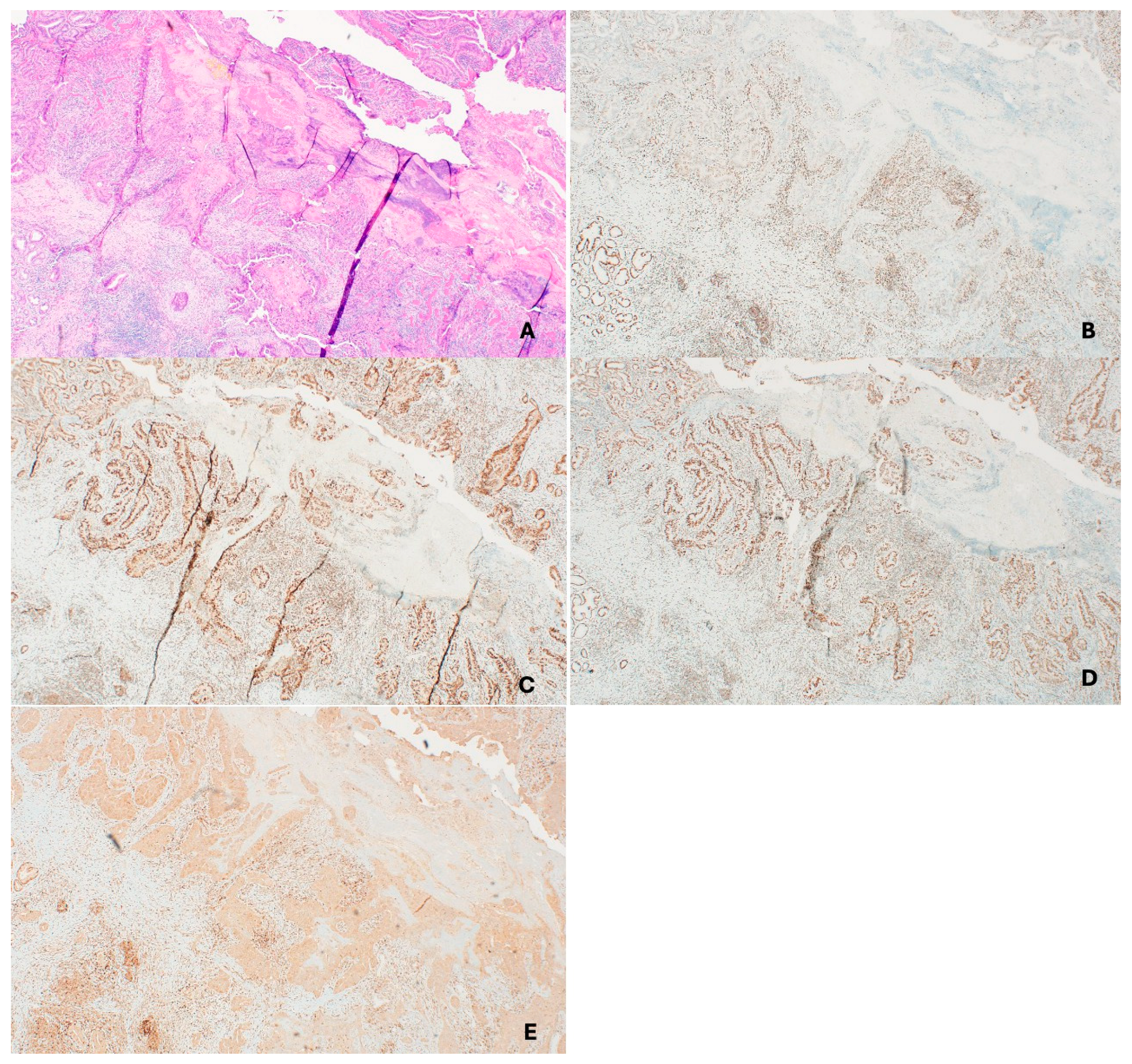
- Mosaic LS: Rare cases of somatic mosaicism, presence of two or more genetically distinct cell populations, in MMR genes have been reported, often involving multiple LS-associated cancers [51,52,53,54,55]. Walker et al. confirmed a low-level mosaic MSH6 variant using droplet digital polymerase chain reaction (ddPCR) across colonic mucosa, saliva, and blood after identifying a shared somatic MSH6 mutation in both colorectal and endometrial tumors [56]. O’Brien et al. described a mosaic MSH2 PV in a patient with endometrial adenocarcinoma and keratoacanthomas (KA); the diagnosis was confirmed through deep tumor sequencing and reanalysis of blood-derived DNA, following IHC that revealed loss of MSH2 and MSH6 expression in both tumors [55].
3.3. Constitutional Mismatch Repair Deficiency
3.4. Double Heterozygosity in LS
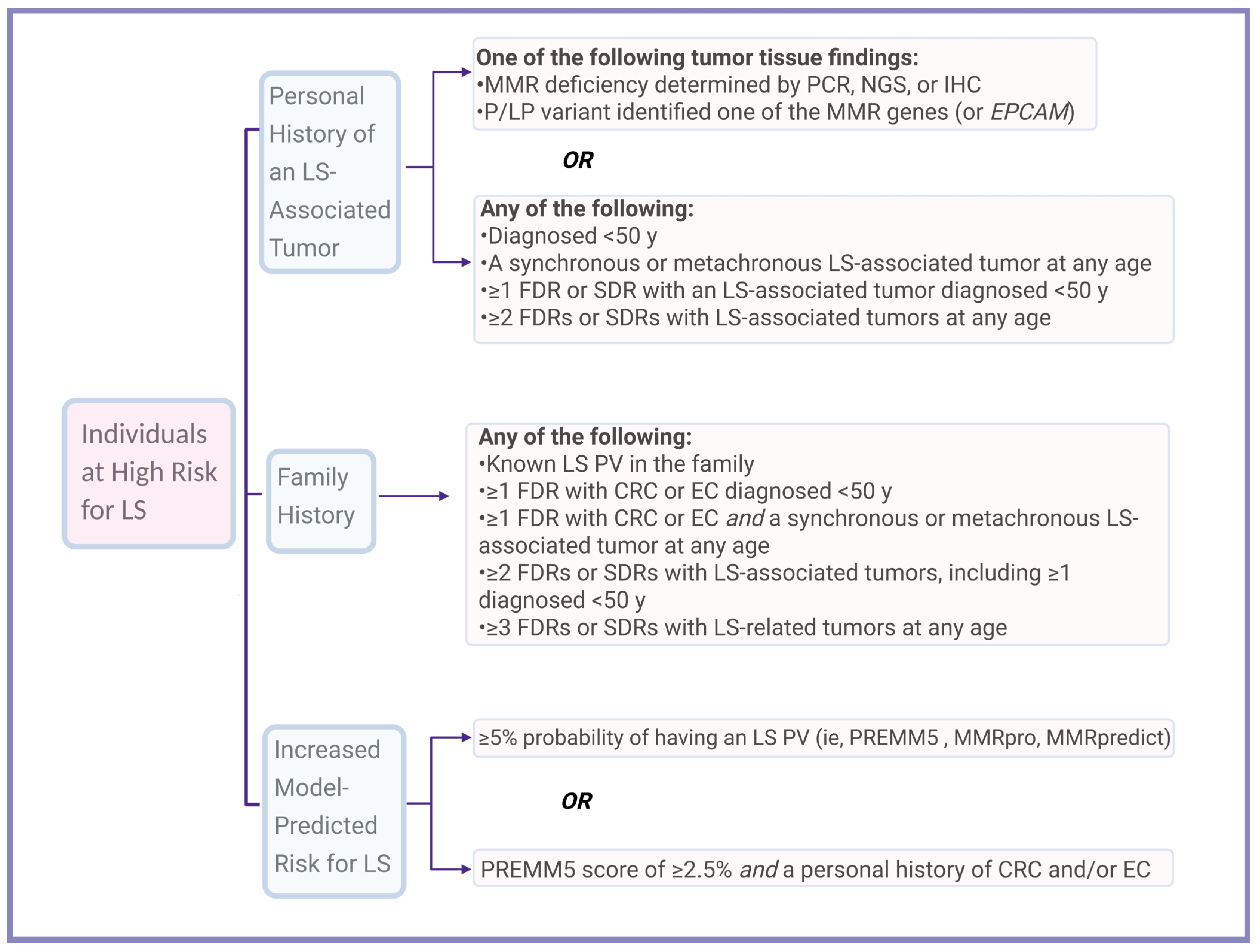
4. Identifying Individuals at High Risk for Lynch Syndrome: Navigating the Lack of Consensus Criteria
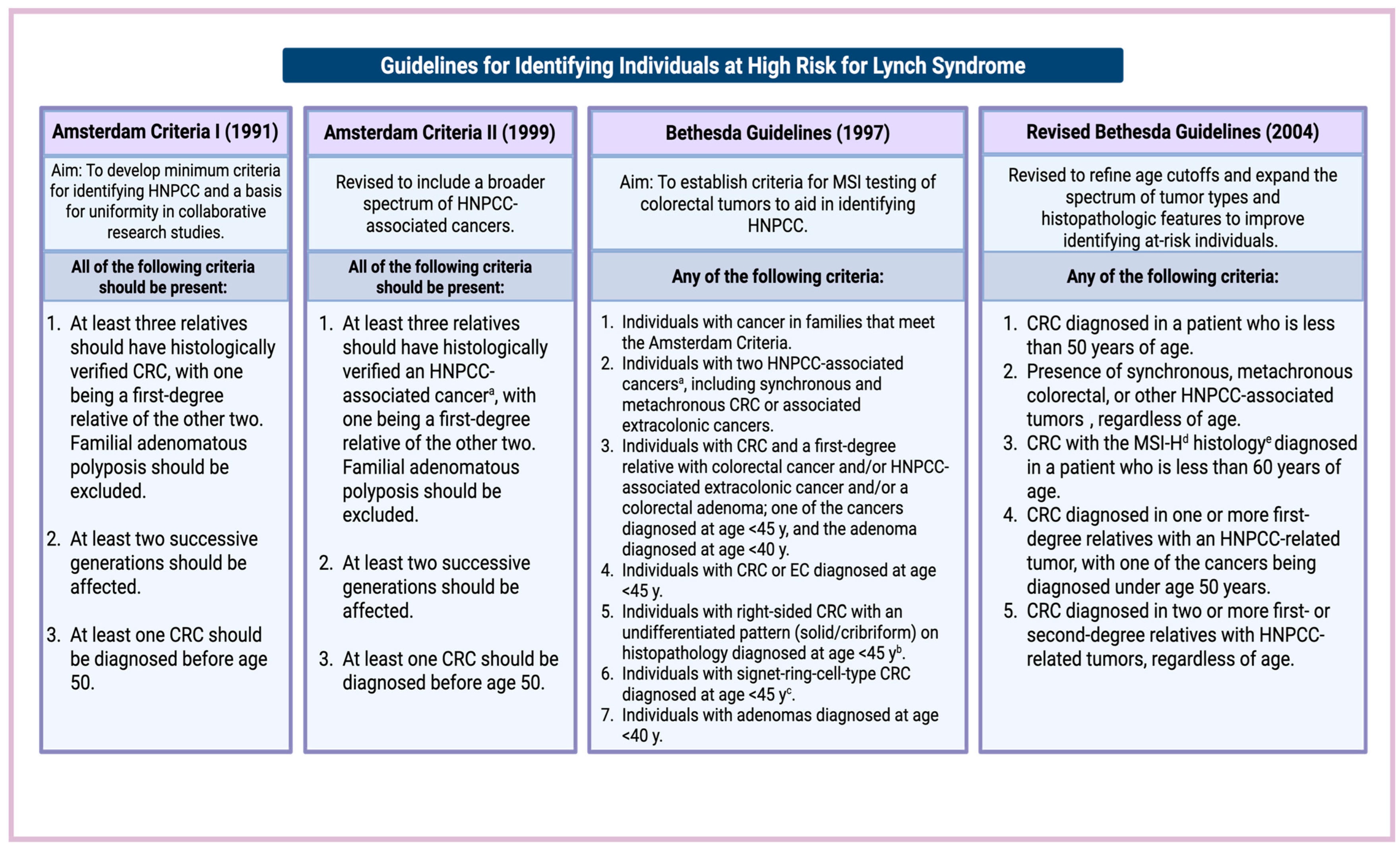
4.1. Clinical Criteria
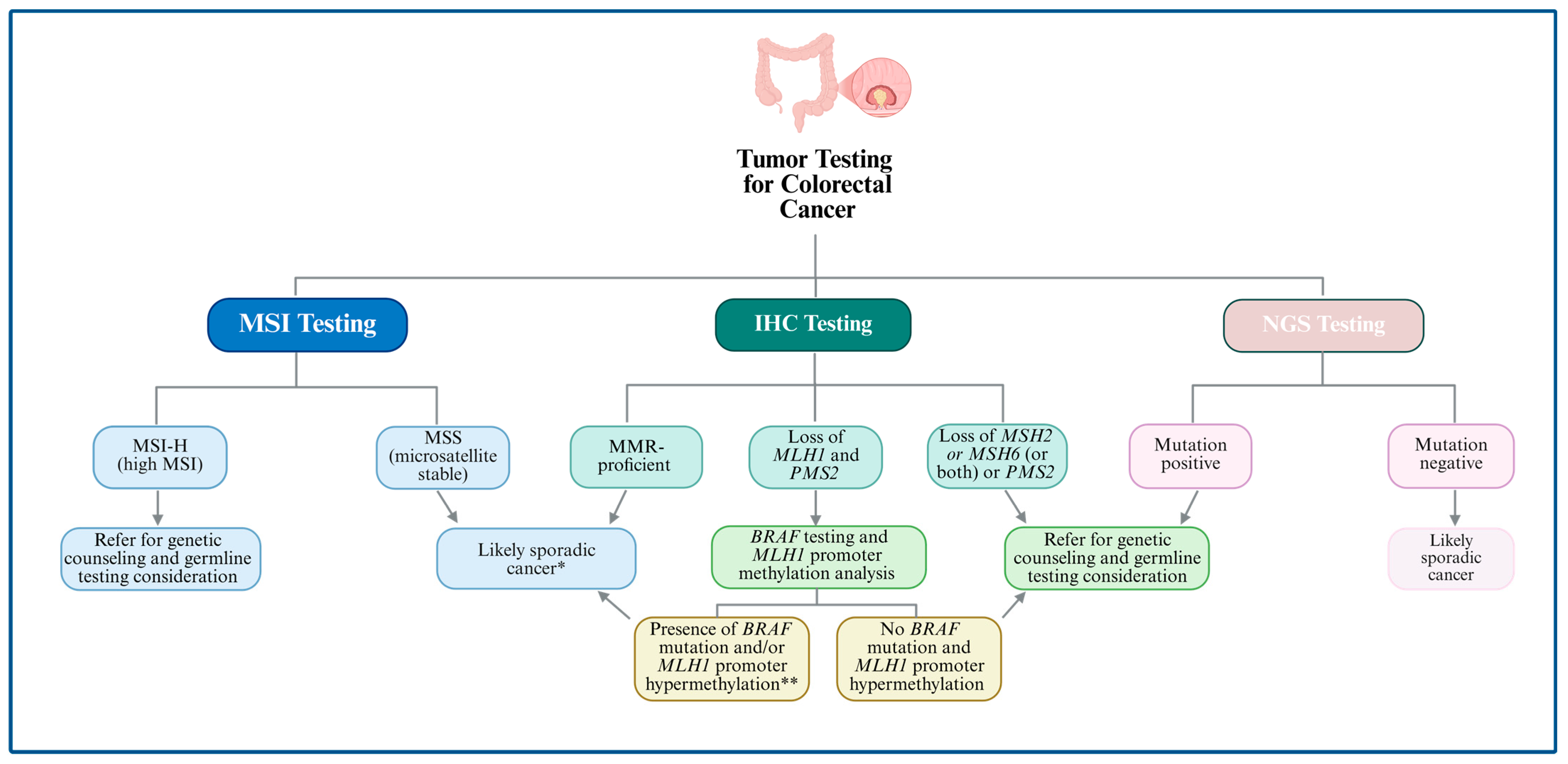
4.2. Tumor Testing
4.3. Prediction Models
4.4. Germline Testing
5. Tumor Spectrum in Lynch Syndrome
5.1. Colorectal Cancer
5.1.1. Epidemiology for LS-Associated Colorectal Cancer
5.1.2. Pathogenesis of LS-Associated Colorectal Cancer
5.1.3. Surveillance of LS-Associated Colorectal Cancer
5.1.4. Immunotherapy in LS-Associated Colorectal Cancer
5.2. Small Bowel Cancer
5.3. Gastric Cancer
5.4. Gynecologic Cancers
5.4.1. Surveillance for LS-Associated Gynecologic Malignancies
- Endometrial cancer
- Ovarian cancer
5.4.2. Chemoprevention for LS-Associated Gynecologic Malignancies
- Endometrial cancer
- Ovarian cancer
5.4.3. Risk-Reducing Surgery for LS-Associated Gynecologic Malignancies
- Endometrial cancer
- Ovarian cancer
5.4.4. Oncologic Treatment Considerations for LS-Associated Gynecologic Malignancies
5.5. Urothelial Cancer
5.6. Biliary Tract Cancer
5.7. Pancreatic Cancer
5.8. Cutaneous Tumors
5.9. Brain Tumors
5.10. Cancers with Emerging or Uncertain Associations with LS
5.10.1. Prostate Cancer
5.10.2. Breast Cancer
5.10.3. Sarcomas
5.10.4. Adrenocortical Carcinoma
6. Differential Diagnoses
6.1. Hereditary Cancer Syndromes
6.2. Sporadic Colorectal Cancers
7. The Utilization of Immune-Mediating Agents in the Management of Individuals with Lynch Syndrome
7.1. Immune Checkpoints and the Use of Immune Checkpoint Blockade in the Treatment of LS-Associated Cancer
7.2. Vaccines for Immunoprevention in LS
8. Genetic Counseling
8.1. Inheritance
8.2. Genetic Information Nondiscrimination Act (GINA) and Related Legal and Ethical Considerations
8.3. Family Planning and Preimplantation Genetic Testing
8.4. Genetic Testing Considerations in Special Populations: Pediatric and Military Populations
9. Significance of Lynch Syndrome in Cancer Genetics: Knowledge Gaps and Future Directions
10. Conclusions
Supplementary Materials
Author Contributions
Funding
Acknowledgments
Conflicts of Interest
Abbreviations
| ACC | Adrenocortical carcinoma |
| ACMG | American college of medical genetics |
| AD | Autosomal dominant |
| ADSM | Active-duty service members |
| BSO | Bilateral salpingo-oophorectomy |
| BTC | Biliary tract cancer |
| CDC | Centers for Disease Control and Prevention |
| CEA | Carcinoembryonic antigen |
| CMMRD | Constitutional mismatch repair deficiency |
| CRC | Colorectal cancer |
| CTLA-4 | Cytotoxic T-lymphocyte antigen 4 |
| ddPCR | Droplet digital PCR |
| dMMR | Deficient mismatch repair |
| DoD | U.S. Department of Defense |
| EAU | European Association of Urology |
| EC | Endometrial cancer |
| EGAPP | Evaluation of Genomic Applications in Practice and Prevention |
| EGD | Esophagogastroduodenoscopy |
| ES | Exome sequencing |
| ESMO | European Society for Medical Oncology |
| FAP | Familial adenomatous polyposis |
| FCCTX | Familial colorectal cancer type X |
| FDA | U.S. Food and Drug Administration |
| GC | Gastric cancer |
| GINA | Genetic Information Nondiscrimination Act |
| GPV | Germline pathogenic variant |
| GS | Genome sequencing |
| HBOC | Hereditary breast and ovarian cancer |
| HNPCC | Hereditary nonpolyposis colorectal cancer |
| ICG-HNPCC | International Collaborative Group on HNPCC |
| ICI | Immune checkpoint inhibitor |
| IHC | Immunohistochemistry |
| KA | Keratoacanthoma |
| LPV | Likely pathogenic variant |
| LS | Lynch syndrome |
| LS-CRC | Lynch syndrome-associated colorectal cancer |
| MGPT | Multigene panel testing |
| MMR | Mismatch repair |
| MSI | Microsatellite instability |
| MSI-H | Microsatellite instability-high |
| MSS | Microsatellite stability |
| MUC1 | Mucin-1 |
| N-803 | Nogapendekin alfa inbakicept |
| NCCN® | National Comprehensive Cancer Network® |
| NF1 | Neurofibromatosis type 1 |
| NGS | Next-generation sequencing |
| OC | Ovarian cancer |
| PC | Pancreatic cancer |
| PCR | Polymerase chain reaction |
| PD-1 | Programmed death receptor-1 |
| PD-L1 | Programmed death-ligand 1 |
| PFS | Progression-free survival |
| PGT-M | Preimplantation genetic testing for monogenic disorders |
| pMMR | Proficient mismatch repair |
| PV | Pathogenic variant |
| SBA | Small bowel adenocarcinoma |
| SA | Sebaceous adenoma |
| SC | Sebaceous carcinoma |
| SN | Sebaceous neoplasm |
| SNV | Single-nucleotide variant |
| SV | Structural variant |
| TME | Tumor microenvironment |
| Tri-Ad5 | Trivalent adenovirus-5 |
| UC | Urothelial cancer |
| U.S. | United States |
| UTC | Urinary tract cancer |
| UTS | Universal tumor screening |
| UTUC | Upper tract urothelial carcinoma |
| VUS | Variant of uncertain significance |
References
- Warthin, A.S. Heredity with reference to carcinoma. Arch. Intern. Med. 1913, 12, 546–555. [Google Scholar] [CrossRef]
- Lynch, H.T.; Shaw, M.W.; Magnuson, C.W.; Larsen, A.L.; Krush, A.J. Hereditary factors in cancer. Study of two large midwestern kindreds. Arch. Intern. Med. 1966, 117, 206–212. [Google Scholar] [CrossRef]
- Lynch, H.T.; Krush, A.J. The cancer family syndrome and cancer control. Surg. Gynecol. Obstet. 1971, 132, 247–250. [Google Scholar] [PubMed]
- Boland, C.R.; Troncale, F.J. Familial colonic cancer without antecedent polyposis. Ann. Intern. Med. 1984, 100, 700–701. [Google Scholar] [CrossRef]
- Win, A.K.; Jenkins, M.A.; Dowty, J.G.; Antoniou, A.C.; Lee, A.; Giles, G.G.; Buchanan, D.D.; Clendenning, M.; Rosty, C.; Ahnen, D.J.; et al. Prevalence and Penetrance of Major Genes and Polygenes for Colorectal Cancer. Cancer Epidemiol. Biomarkers Prev. 2017, 26, 404–412. [Google Scholar] [CrossRef] [PubMed]
- Lynch, H.T.; Lynch, P.M.; Lanspa, S.J.; Snyder, C.L.; Lynch, J.F.; Boland, C.R. Review of the Lynch syndrome: History, molecular genetics, screening, differential diagnosis, and medicolegal ramifications. Clin. Genet. 2009, 76, 1–18. [Google Scholar] [CrossRef]
- Kahn, R.M.; Gordhandas, S.; Maddy, B.P.; Baltich Nelson, B.; Askin, G.; Christos, P.J.; Caputo, T.A.; Chapman-Davis, E.; Holcomb, K.; Frey, M.K. Universal endometrial cancer tumor typing: How much has immunohistochemistry, microsatellite instability, and MLH1 methylation improved the diagnosis of Lynch syndrome across the population? Cancer 2019, 125, 3172–3183. [Google Scholar] [CrossRef]
- Hitchins, M.P.; Ward, R.L. Constitutional (germline) MLH1 epimutation as an aetiological mechanism for hereditary non-polyposis colorectal cancer. J. Med. Genet. 2009, 46, 793–802. [Google Scholar] [CrossRef]
- Ortega, J.; Lee, G.S.; Gu, L.; Yang, W.; Li, G.M. Mispair-bound human MutS-MutL complex triggers DNA incisions and activates mismatch repair. Cell Res. 2021, 31, 542–553. [Google Scholar] [CrossRef]
- Li, G.M. Mechanisms and functions of DNA mismatch repair. Cell Res. 2008, 18, 85–98. [Google Scholar] [CrossRef] [PubMed]
- Kunkel, T.A.; Erie, D.A. DNA mismatch repair. Annu. Rev. Biochem. 2005, 74, 681–710. [Google Scholar] [CrossRef]
- Nolano, A.; Medugno, A.; Trombetti, S.; Liccardo, R.; De Rosa, M.; Izzo, P.; Duraturo, F. Hereditary Colorectal Cancer: State of the Art in Lynch Syndrome. Cancers 2022, 15, 75. [Google Scholar] [CrossRef]
- Olave, M.C.; Graham, R.P. Mismatch repair deficiency: The what, how and why it is important. Genes. Chromosomes Cancer 2022, 61, 314–321. [Google Scholar] [CrossRef]
- Cerretelli, G.; Ager, A.; Arends, M.J.; Frayling, I.M. Molecular pathology of Lynch syndrome. J. Pathol. 2020, 250, 518–531. [Google Scholar] [CrossRef] [PubMed]
- Kim, T.M.; Laird, P.W.; Park, P.J. The landscape of microsatellite instability in colorectal and endometrial cancer genomes. Cell 2013, 155, 858–868. [Google Scholar] [CrossRef]
- Ijsselsteijn, R.; van Hees, S.; Drost, M.; Jansen, J.G.; de Wind, N. Induction of mismatch repair deficiency, compromised DNA damage signaling and compound hypermutagenesis by a dietary mutagen in a cell-based model for Lynch syndrome. Carcinogenesis 2022, 43, 160–169. [Google Scholar] [CrossRef]
- Witt, D.; Faust, U.; Strobl-Wildemann, G.; Sturm, M.; Buchert, R.; Zuleger, T.; Admard, J.; Casadei, N.; Ossowski, S.; Haack, T.B.; et al. Genome sequencing identifies complex structural MLH1 variant in unsolved Lynch syndrome. Mol. Genet. Genomic Med. 2023, 11, e2151. [Google Scholar] [CrossRef]
- Pinto, D.; Pinto, C.; Guerra, J.; Pinheiro, M.; Santos, R.; Vedeld, H.M.; Yohannes, Z.; Peixoto, A.; Santos, C.; Pinto, P.; et al. Contribution of MLH1 constitutional methylation for Lynch syndrome diagnosis in patients with tumor MLH1 downregulation. Cancer Med. 2018, 7, 433–444. [Google Scholar] [CrossRef] [PubMed]
- Sipila, L.J.; Aavikko, M.; Ravantti, J.; Martin, S.; Kuopio, T.; Lahtinen, L.; Gen, F.; Peltomaki, P.; Mecklin, J.P.; Aaltonen, L.A.; et al. Detection of a major Lynch Syndrome-causing MLH1 founder variant in a large-scale genotyped cohort. Fam. Cancer 2024, 23, 647–652. [Google Scholar] [CrossRef]
- Cajal, A.R.; Pinero, T.A.; Verzura, A.; Santino, J.P.; Solano, A.R.; Kalfayan, P.G.; Ferro, A.; Vaccaro, C. Founder mutation in Lynch syndrome. Medicina 2016, 76, 180–182. [Google Scholar] [PubMed]
- Dominguez-Valentin, M.; Sampson, J.R.; Seppala, T.T.; Ten Broeke, S.W.; Plazzer, J.P.; Nakken, S.; Engel, C.; Aretz, S.; Jenkins, M.A.; Sunde, L.; et al. Cancer risks by gene, age, and gender in 6350 carriers of pathogenic mismatch repair variants: Findings from the Prospective Lynch Syndrome Database. Genet. Med. 2020, 22, 15–25. [Google Scholar] [CrossRef]
- Dominguez-Valentin, M.; Plazzer, J.P.; Sampson, J.R.; Engel, C.; Aretz, S.; Jenkins, M.A.; Sunde, L.; Bernstein, I.; Capella, G.; Balaguer, F.; et al. No Difference in Penetrance between Truncating and Missense/Aberrant Splicing Pathogenic Variants in MLH1 and MSH2: A Prospective Lynch Syndrome Database Study. J. Clin. Med. 2021, 10, 2856. [Google Scholar] [CrossRef]
- Clendenning, M.; Hampel, H.; LaJeunesse, J.; Lindblom, A.; Lockman, J.; Nilbert, M.; Senter, L.; Sotamaa, K.; de la Chapelle, A. Long-range PCR facilitates the identification of PMS2-specific mutations. Hum. Mutat. 2006, 27, 490–495. [Google Scholar] [CrossRef]
- Tomsic, J.; Senter, L.; Liyanarachchi, S.; Clendenning, M.; Vaughn, C.P.; Jenkins, M.A.; Hopper, J.L.; Young, J.; Samowitz, W.; de la Chapelle, A. Recurrent and founder mutations in the PMS2 gene. Clin. Genet. 2013, 83, 238–243. [Google Scholar] [CrossRef]
- Raskin, L.; Schwenter, F.; Freytsis, M.; Tischkowitz, M.; Wong, N.; Chong, G.; Narod, S.A.; Levine, D.A.; Bogomolniy, F.; Aronson, M.; et al. Characterization of two Ashkenazi Jewish founder mutations in MSH6 gene causing Lynch syndrome. Clin. Genet. 2011, 79, 512–522. [Google Scholar] [CrossRef]
- Rhees, J.; Arnold, M.; Boland, C.R. Inversion of exons 1-7 of the MSH2 gene is a frequent cause of unexplained Lynch syndrome in one local population. Fam. Cancer 2014, 13, 219–225. [Google Scholar] [CrossRef] [PubMed]
- Ligtenberg, M.J.; Kuiper, R.P.; Geurts van Kessel, A.; Hoogerbrugge, N. EPCAM deletion carriers constitute a unique subgroup of Lynch syndrome patients. Fam. Cancer 2013, 12, 169–174. [Google Scholar] [CrossRef] [PubMed]
- Thompson, B.A.; Spurdle, A.B.; Plazzer, J.P.; Greenblatt, M.S.; Akagi, K.; Al-Mulla, F.; Bapat, B.; Bernstein, I.; Capella, G.; den Dunnen, J.T.; et al. Application of a 5-tiered scheme for standardized classification of 2,360 unique mismatch repair gene variants in the InSiGHT locus-specific database. Nat. Genet. 2014, 46, 107–115. [Google Scholar] [CrossRef]
- Landrum, M.J.; Lee, J.M.; Riley, G.R.; Jang, W.; Rubinstein, W.S.; Church, D.M.; Maglott, D.R. ClinVar: Public archive of relationships among sequence variation and human phenotype. Nucleic Acids Res. 2014, 42, D980–D985. [Google Scholar] [CrossRef]
- Rath, A.; Radecki, A.A.; Rahman, K.; Gilmore, R.B.; Hudson, J.R.; Cenci, M.; Tavtigian, S.V.; Grady, J.P.; Heinen, C.D. A calibrated cell-based functional assay to aid classification of MLH1 DNA mismatch repair gene variants. Hum. Mutat. 2022, 43, 2295–2307. [Google Scholar] [CrossRef] [PubMed]
- Jia, X.; Burugula, B.B.; Chen, V.; Lemons, R.M.; Jayakody, S.; Maksutova, M.; Kitzman, J.O. Massively parallel functional testing of MSH2 missense variants conferring Lynch syndrome risk. Am. J. Hum. Genet. 2021, 108, 163–175. [Google Scholar] [CrossRef]
- Frederiksen, J.H.; Jensen, S.B.; Tumer, Z.; Hansen, T.V.O. Classification of MSH6 Variants of Uncertain Significance Using Functional Assays. Int. J. Mol. Sci. 2021, 22, 8627. [Google Scholar] [CrossRef]
- Rayner, E.; Tiersma, Y.; Fortuno, C.; van Hees-Stuivenberg, S.; Drost, M.; Thompson, B.; Spurdle, A.B.; de Wind, N. Predictive functional assay-based classification of PMS2 variants in Lynch syndrome. Hum. Mutat. 2022, 43, 1249–1258. [Google Scholar] [CrossRef]
- Vasen, H.F.; Mecklin, J.P.; Khan, P.M.; Lynch, H.T. The International Collaborative Group on Hereditary Non-Polyposis Colorectal Cancer (ICG-HNPCC). Dis. Colon. Rectum 1991, 34, 424–425. [Google Scholar] [CrossRef]
- Vasen, H.F.; Watson, P.; Mecklin, J.P.; Lynch, H.T. New clinical criteria for hereditary nonpolyposis colorectal cancer (HNPCC, Lynch syndrome) proposed by the International Collaborative group on HNPCC. Gastroenterology 1999, 116, 1453–1456. [Google Scholar] [CrossRef] [PubMed]
- Vasen, H.F.; Moslein, G.; Alonso, A.; Bernstein, I.; Bertario, L.; Blanco, I.; Burn, J.; Capella, G.; Engel, C.; Frayling, I.; et al. Guidelines for the clinical management of Lynch syndrome (hereditary non-polyposis cancer). J. Med. Genet. 2007, 44, 353–362. [Google Scholar] [CrossRef]
- Idos, G.; Valle, L. Lynch Syndrome. In GeneReviews((R)); Adam, M.P., Feldman, J., Mirzaa, G.M., Pagon, R.A., Wallace, S.E., Amemiya, A., Eds.; University of Washington: Seattle, WA, USA, 1993. [Google Scholar]
- Lindor, N.M.; Rabe, K.; Petersen, G.M.; Haile, R.; Casey, G.; Baron, J.; Gallinger, S.; Bapat, B.; Aronson, M.; Hopper, J.; et al. Lower cancer incidence in Amsterdam-I criteria families without mismatch repair deficiency: Familial colorectal cancer type X. J. Am. Med. Assoc. 2005, 293, 1979–1985. [Google Scholar] [CrossRef]
- Nieminen, T.T.; Abdel-Rahman, W.M.; Ristimaki, A.; Lappalainen, M.; Lahermo, P.; Mecklin, J.P.; Jarvinen, H.J.; Peltomaki, P. BMPR1A mutations in hereditary nonpolyposis colorectal cancer without mismatch repair deficiency. Gastroenterology 2011, 141, e23–e26. [Google Scholar] [CrossRef] [PubMed]
- Nieminen, T.T.; O’Donohue, M.F.; Wu, Y.; Lohi, H.; Scherer, S.W.; Paterson, A.D.; Ellonen, P.; Abdel-Rahman, W.M.; Valo, S.; Mecklin, J.P.; et al. Germline mutation of RPS20, encoding a ribosomal protein, causes predisposition to hereditary nonpolyposis colorectal carcinoma without DNA mismatch repair deficiency. Gastroenterology 2014, 147, 595–598 e595. [Google Scholar] [CrossRef] [PubMed]
- Schulz, E.; Klampfl, P.; Holzapfel, S.; Janecke, A.R.; Ulz, P.; Renner, W.; Kashofer, K.; Nojima, S.; Leitner, A.; Zebisch, A.; et al. Germline variants in the SEMA4A gene predispose to familial colorectal cancer type X. Nat. Commun. 2014, 5, 5191. [Google Scholar] [CrossRef]
- Martin-Morales, L.; Feldman, M.; Vershinin, Z.; Garre, P.; Caldes, T.; Levy, D. SETD6 dominant negative mutation in familial colorectal cancer type X. Hum. Mol. Genet. 2017, 26, 4481–4493. [Google Scholar] [CrossRef]
- Garre, P.; Martin, L.; Sanz, J.; Romero, A.; Tosar, A.; Bando, I.; Llovet, P.; Diaque, P.; Garcia-Paredes, B.; Diaz-Rubio, E.; et al. BRCA2 gene: A candidate for clinical testing in familial colorectal cancer type X. Clin. Genet. 2015, 87, 582–587. [Google Scholar] [CrossRef] [PubMed]
- Kim, I.J.; Ku, J.L.; Kang, H.C.; Park, J.H.; Yoon, K.A.; Shin, Y.; Park, H.W.; Jang, S.G.; Lim, S.K.; Han, S.Y.; et al. Mutational analysis of OGG1, MYH, MTH1 in FAP, HNPCC and sporadic colorectal cancer patients: R154H OGG1 polymorphism is associated with sporadic colorectal cancer patients. Hum. Genet. 2004, 115, 498–503. [Google Scholar] [CrossRef]
- Segui, N.; Mina, L.B.; Lazaro, C.; Sanz-Pamplona, R.; Pons, T.; Navarro, M.; Bellido, F.; Lopez-Doriga, A.; Valdes-Mas, R.; Pineda, M.; et al. Germline Mutations in FAN1 Cause Hereditary Colorectal Cancer by Impairing DNA Repair. Gastroenterology 2015, 149, 563–566. [Google Scholar] [CrossRef]
- Nejadtaghi, M.; Jafari, H.; Farrokhi, E.; Samani, K.G. Familial Colorectal Cancer Type X (FCCTX) and the correlation with various genes-A systematic review. Curr. Probl. Cancer 2017, 41, 388–397. [Google Scholar] [CrossRef]
- Garcia, F.A.O.; de Andrade, E.S.; de Campos Reis Galvao, H.; da Silva Sabato, C.; Campacci, N.; de Paula, A.E.; Evangelista, A.F.; Santana, I.V.V.; Melendez, M.E.; Reis, R.M.; et al. New insights on familial colorectal cancer type X syndrome. Sci. Rep. 2022, 12, 2846. [Google Scholar] [CrossRef] [PubMed]
- Xu, Y.; Li, C.; Zhang, Y.; Guo, T.; Zhu, C.; Xu, Y.; Liu, F. Comparison Between Familial Colorectal Cancer Type X and Lynch Syndrome: Molecular, Clinical, and Pathological Characteristics and Pedigrees. Front. Oncol. 2020, 10, 1603. [Google Scholar] [CrossRef] [PubMed]
- Haraldsdottir, S.; Hampel, H.; Tomsic, J.; Frankel, W.L.; Pearlman, R.; de la Chapelle, A.; Pritchard, C.C. Colon and endometrial cancers with mismatch repair deficiency can arise from somatic, rather than germline, mutations. Gastroenterology 2014, 147, 1308–1316. [Google Scholar] [CrossRef]
- Pearlman, R.; Frankel, W.L.; Swanson, B.J.; Jones, D.; Zhao, W.; Yilmaz, A.; Miller, K.; Bacher, J.; Bigley, C.; Nelsen, L.; et al. Prospective Statewide Study of Universal Screening for Hereditary Colorectal Cancer: The Ohio Colorectal Cancer Prevention Initiative. JCO Precis. Oncol. 2021, 5, 779–791. [Google Scholar] [CrossRef]
- Pastrello, C.; Fornasarig, M.; Pin, E.; Berto, E.; Pivetta, B.; Viel, A. Somatic mosaicism in a patient with Lynch syndrome. Am. J. Med. Genet. A 2009, 149A, 212–215. [Google Scholar] [CrossRef]
- Sourrouille, I.; Coulet, F.; Lefevre, J.H.; Colas, C.; Eyries, M.; Svrcek, M.; Bardier-Dupas, A.; Parc, Y.; Soubrier, F. Somatic mosaicism and double somatic hits can lead to MSI colorectal tumors. Fam. Cancer 2013, 12, 27–33. [Google Scholar] [CrossRef] [PubMed]
- Geurts-Giele, W.R.; Rosenberg, E.H.; Rens, A.V.; Leerdam, M.E.V.; Dinjens, W.N.; Bleeker, F.E. Somatic mosaicism by a de novo MLH1 mutation as a cause of Lynch syndrome. Mol. Genet. Genom. Med. 2019, 7, e00699. [Google Scholar] [CrossRef]
- Guillerm, E.; Svrcek, M.; Bardier-Dupas, A.; Basset, N.; Coulet, F.; Colas, C. Molecular tumor testing in patients with Lynch-like syndrome reveals a de novo mosaic variant of a mismatch repair gene transmitted to offspring. Eur. J. Hum. Genet. 2020, 28, 1624–1628. [Google Scholar] [CrossRef]
- O’Brien, A.; Macfarlane, S.; Sommerlad, M.; Schirwani, S. Mosaic Muir Torre Syndrome: Keratoacanthoma as a Piece of the Puzzle. Am. J. Dermatopathol. 2024, 46, 162–166. [Google Scholar] [CrossRef]
- Walker, R.; Clendenning, M.; Joo, J.E.; Xue, J.; Mahmood, K.; Georgeson, P.; Como, J.; Joseland, S.; Preston, S.G.; Chan, J.M.; et al. A mosaic pathogenic variant in MSH6 causes MSH6-deficient colorectal and endometrial cancer in a patient classified as suspected Lynch syndrome: A case report. Fam. Cancer 2023, 22, 423–428. [Google Scholar] [CrossRef]
- Holter, S.; Hall, M.J.; Hampel, H.; Jasperson, K.; Kupfer, S.S.; Larsen Haidle, J.; Mork, M.E.; Palaniapppan, S.; Senter, L.; Stoffel, E.M.; et al. Risk assessment and genetic counseling for Lynch syndrome—Practice resource of the National Society of Genetic Counselors and the Collaborative Group of the Americas on Inherited Gastrointestinal Cancer. J. Genet. Couns. 2022, 31, 568–583. [Google Scholar] [CrossRef]
- Tung, N.; Ricker, C.; Messersmith, H.; Balmana, J.; Domchek, S.; Stoffel, E.M.; Almhanna, K.; Arun, B.; Chavarri-Guerra, Y.; Cohen, S.A.; et al. Selection of Germline Genetic Testing Panels in Patients With Cancer: ASCO Guideline. J. Clin. Oncol. 2024, 42, 2599–2615. [Google Scholar] [CrossRef]
- Referenced with Permission from the NCCN Clinical Practice Guidelines in Oncology (NCCN Guidelines®) for Guideline Genetic/Familial High-Risk Assessment: Colorectal, Endometrial, and Gastric V.1.2025. © National Comprehensive Cancer Network, Inc. 2025. Available online: https://www.nccn.org/ (accessed on 28 June 2025).
- Hamilton, S.R.; Liu, B.; Parsons, R.E.; Papadopoulos, N.; Jen, J.; Powell, S.M.; Krush, A.J.; Berk, T.; Cohen, Z.; Tetu, B.; et al. The molecular basis of Turcot’s syndrome. N. Engl. J. Med. 1995, 332, 839–847. [Google Scholar] [CrossRef] [PubMed]
- Kruse, R.; Rutten, A.; Lamberti, C.; Hosseiny-Malayeri, H.R.; Wang, Y.; Ruelfs, C.; Jungck, M.; Mathiak, M.; Ruzicka, T.; Hartschuh, W.; et al. Muir-Torre phenotype has a frequency of DNA mismatch-repair-gene mutations similar to that in hereditary nonpolyposis colorectal cancer families defined by the Amsterdam criteria. Am. J. Hum. Genet. 1998, 63, 63–70. [Google Scholar] [CrossRef]
- Weissman, S.M.; Bellcross, C.; Bittner, C.C.; Freivogel, M.E.; Haidle, J.L.; Kaurah, P.; Leininger, A.; Palaniappan, S.; Steenblock, K.; Vu, T.M.; et al. Genetic counseling considerations in the evaluation of families for Lynch syndrome—A review. J. Genet. Couns. 2011, 20, 5–19. [Google Scholar] [CrossRef] [PubMed]
- Rajan, N.; Cook, S.; Best, K.; Lynch Syndrome, U.K.S.C.g.; Monahan, K. Universal testing of cutaneous sebaceous carcinoma: A missed opportunity in Lynch syndrome detection. Lancet Oncol. 2024, 25, e1–e2. [Google Scholar] [CrossRef]
- PMS2 Gene [updated 2025 May 2025]. Available online: https://medlineplus.gov/genetics/gene/pms2/ (accessed on 28 June 2025).
- Colas, C.; Guerrini-Rousseau, L.; Suerink, M.; Gallon, R.; Kratz, C.P.; Ayuso, E.; Group, E.G.C.G.; Brugieres, L.; Wimmer, K. ERN GENTURIS guidelines on constitutional mismatch repair deficiency diagnosis, genetic counselling, surveillance, quality of life, and clinical management. Eur. J. Hum. Genet. 2024, 32, 1526–1541. [Google Scholar] [CrossRef]
- Jacquart, A.; Depas, M.; McFarland, R.; Basel, D. Unknown Synergistic Effect of Digenetic Inheritance of MMR Pathogenic Mutations: Double Heterozygosity in Lynch Syndrome, A Single Case Report & Family Study. In Proceedings of the 2016 NSGC 35th Annual Education Conference, Seattle, WA, USA, 28 September–1 October 2016. [Google Scholar]
- Rodriguez-Bigas, M.A.; Boland, C.R.; Hamilton, S.R.; Henson, D.E.; Jass, J.R.; Khan, P.M.; Lynch, H.; Perucho, M.; Smyrk, T.; Sobin, L.; et al. A National Cancer Institute Workshop on Hereditary Nonpolyposis Colorectal Cancer Syndrome: Meeting highlights and Bethesda guidelines. J. Natl. Cancer Inst. 1997, 89, 1758–1762. [Google Scholar] [CrossRef]
- Syngal, S.; Fox, E.A.; Eng, C.; Kolodner, R.D.; Garber, J.E. Sensitivity and specificity of clinical criteria for hereditary non-polyposis colorectal cancer associated mutations in MSH2 and MLH1. J. Med. Genet. 2000, 37, 641–645. [Google Scholar] [CrossRef]
- Umar, A.; Boland, C.R.; Terdiman, J.P.; Syngal, S.; de la Chapelle, A.; Ruschoff, J.; Fishel, R.; Lindor, N.M.; Burgart, L.J.; Hamelin, R.; et al. Revised Bethesda Guidelines for hereditary nonpolyposis colorectal cancer (Lynch syndrome) and microsatellite instability. J. Natl. Cancer Inst. 2004, 96, 261–268. [Google Scholar] [CrossRef] [PubMed]
- Hampel, H.; Frankel, W.L.; Martin, E.; Arnold, M.; Khanduja, K.; Kuebler, P.; Clendenning, M.; Sotamaa, K.; Prior, T.; Westman, J.A.; et al. Feasibility of screening for Lynch syndrome among patients with colorectal cancer. J. Clin. Oncol. 2008, 26, 5783–5788. [Google Scholar] [CrossRef] [PubMed]
- Bartley, A.N.; Mills, A.M.; Konnick, E.; Overman, M.; Ventura, C.B.; Souter, L.; Colasacco, C.; Stadler, Z.K.; Kerr, S.; Howitt, B.E.; et al. Mismatch Repair and Microsatellite Instability Testing for Immune Checkpoint Inhibitor Therapy: Guideline From the College of American Pathologists in Collaboration With the Association for Molecular Pathology and Fight Colorectal Cancer. Arch. Pathol. Lab. Med. 2022, 146, 1194–1210. [Google Scholar] [CrossRef] [PubMed]
- Moreira, L.; Balaguer, F.; Lindor, N.; de la Chapelle, A.; Hampel, H.; Aaltonen, L.A.; Hopper, J.L.; Le Marchand, L.; Gallinger, S.; Newcomb, P.A.; et al. Identification of Lynch syndrome among patients with colorectal cancer. J. Am. Med. Assoc. 2012, 308, 1555–1565. [Google Scholar] [CrossRef]
- Ranganathan, M.; Sacca, R.E.; Trottier, M.; Maio, A.; Kemel, Y.; Salo-Mullen, E.; Catchings, A.; Kane, S.; Wang, C.; Ravichandran, V.; et al. Prevalence and Clinical Implications of Mismatch Repair-Proficient Colorectal Cancer in Patients With Lynch Syndrome. JCO Precis. Oncol. 2023, 7, e2200675. [Google Scholar] [CrossRef]
- Evaluation of Genomic Applications in Practice and Prevention (EGAPP) Working Group. Recommendations from the EGAPP Working Group: Genetic testing strategies in newly diagnosed individuals with colorectal cancer aimed at reducing morbidity and mortality from Lynch syndrome in relatives. Genet. Med. 2009, 11, 35–41. [Google Scholar] [CrossRef]
- Palomaki, G.E.; McClain, M.R.; Melillo, S.; Hampel, H.L.; Thibodeau, S.N. EGAPP supplementary evidence review: DNA testing strategies aimed at reducing morbidity and mortality from Lynch syndrome. Genet. Med. 2009, 11, 42–65. [Google Scholar] [CrossRef]
- Balmana, J.; Balaguer, F.; Cervantes, A.; Arnold, D.; Group, E.G.W. Familial risk-colorectal cancer: ESMO Clinical Practice Guidelines. Ann. Oncol. 2013, 24, vi73–vi80. [Google Scholar] [CrossRef]
- Giardiello, F.M.; Allen, J.I.; Axilbund, J.E.; Boland, C.R.; Burke, C.A.; Burt, R.W.; Church, J.M.; Dominitz, J.A.; Johnson, D.A.; Kaltenbach, T.; et al. Guidelines on genetic evaluation and management of Lynch syndrome: A consensus statement by the US Multi-Society Task Force on colorectal cancer. Gastroenterology 2014, 147, 502–526. [Google Scholar] [CrossRef] [PubMed]
- Provenzale, D.; Gupta, S.; Ahnen, D.J.; Bray, T.; Cannon, J.A.; Cooper, G.; David, D.S.; Early, D.S.; Erwin, D.; Ford, J.M.; et al. Genetic/Familial High-Risk Assessment: Colorectal Version 1.2016, NCCN Clinical Practice Guidelines in Oncology. J. Natl. Compr. Cancer Netw. 2016, 14, 1010–1030. [Google Scholar] [CrossRef]
- Goodfellow, P.J.; Billingsley, C.C.; Lankes, H.A.; Ali, S.; Cohn, D.E.; Broaddus, R.J.; Ramirez, N.; Pritchard, C.C.; Hampel, H.; Chassen, A.S.; et al. Combined Microsatellite Instability, MLH1 Methylation Analysis, and Immunohistochemistry for Lynch Syndrome Screening in Endometrial Cancers from GOG210: An NRG Oncology and Gynecologic Oncology Group Study. J. Clin. Oncol. 2015, 33, 4301–4308. [Google Scholar] [CrossRef]
- FDA Grants Accelerated Approval to Pembrolizumab for First Tissue/Site Agnostic Indication. Available online: https://www.fda.gov/drugs/informationondrugs/approveddrugs/ucm560040.htm (accessed on 27 June 2025).
- Latham, A.; Srinivasan, P.; Kemel, Y.; Shia, J.; Bandlamudi, C.; Mandelker, D.; Middha, S.; Hechtman, J.; Zehir, A.; Dubard-Gault, M.; et al. Microsatellite Instability Is Associated With the Presence of Lynch Syndrome Pan-Cancer. J. Clin. Oncol. 2019, 37, 286–295. [Google Scholar] [CrossRef] [PubMed]
- Papadopoulou, E.; Rigas, G.; Fountzilas, E.; Boutis, A.; Giassas, S.; Mitsimponas, N.; Daliani, D.; Ziogas, D.C.; Liontos, M.; Ramfidis, V.; et al. Microsatellite Instability Is Insufficiently Used as a Biomarker for Lynch Syndrome Testing in Clinical Practice. JCO Precis. Oncol. 2024, 8, e2300332. [Google Scholar] [CrossRef] [PubMed]
- Kastrinos, F.; Uno, H.; Ukaegbu, C.; Alvero, C.; McFarland, A.; Yurgelun, M.B.; Kulke, M.H.; Schrag, D.; Meyerhardt, J.A.; Fuchs, C.S.; et al. Development and Validation of the PREMM(5) Model for Comprehensive Risk Assessment of Lynch Syndrome. J. Clin. Oncol. 2017, 35, 2165–2172. [Google Scholar] [CrossRef] [PubMed]
- Chen, S.; Wang, W.; Lee, S.; Nafa, K.; Lee, J.; Romans, K.; Watson, P.; Gruber, S.B.; Euhus, D.; Kinzler, K.W.; et al. Prediction of germline mutations and cancer risk in the Lynch syndrome. J. Am. Med. Assoc. 2006, 296, 1479–1487. [Google Scholar] [CrossRef]
- Barnetson, R.A.; Tenesa, A.; Farrington, S.M.; Nicholl, I.D.; Cetnarskyj, R.; Porteous, M.E.; Campbell, H.; Dunlop, M.G. Identification and survival of carriers of mutations in DNA mismatch-repair genes in colon cancer. N. Engl. J. Med. 2006, 354, 2751–2763. [Google Scholar] [CrossRef]
- Sandoval, R.L.; Horiguchi, M.; Ukaegbu, C.; Furniss, C.S.; Uno, H.; Syngal, S.; Yurgelun, M.B. PREMM5 distinguishes sporadic from Lynch syndrome-associated MMR-deficient/MSI-high colorectal cancer. Fam. Cancer 2023, 22, 459–465. [Google Scholar] [CrossRef]
- Heald, B.; Hampel, H.; Church, J.; Dudley, B.; Hall, M.J.; Mork, M.E.; Singh, A.; Stoffel, E.; Stoll, J.; You, Y.N.; et al. Collaborative Group of the Americas on Inherited Gastrointestinal Cancer Position statement on multigene panel testing for patients with colorectal cancer and/or polyposis. Fam. Cancer 2020, 19, 223–239. [Google Scholar] [CrossRef]
- Hitchins, M.P.; Damaso, E.; Alvarez, R.; Zhou, L.; Hu, Y.; Diniz, M.A.; Pineda, M.; Capella, G.; Pearlman, R.; Hampel, H. Constitutional MLH1 Methylation Is a Major Contributor to Mismatch Repair-Deficient, MLH1-Methylated Colorectal Cancer in Patients Aged 55 Years and Younger. J. Natl. Compr. Cancer Netw. 2023, 21, 743–752 e711. [Google Scholar] [CrossRef]
- Lee, K.; Abul-Husn, N.S.; Amendola, L.M.; Brothers, K.B.; Chung, W.K.; Gollob, M.H.; Gordon, A.S.; Harrison, S.M.; Hershberger, R.E.; Li, M.; et al. ACMG SF v3.3 list for reporting of secondary findings in clinical exome and genome sequencing: A policy statement of the American College of Medical Genetics and Genomics (ACMG). Genet. Med. 2025, 27, 101454. [Google Scholar] [CrossRef]
- Melo, M.; Ribeiro, M.; Silva, P.F.; Valente, S.; Alves, F.; Venancio, M.; Sequeiros, J.; Freixo, J.P.; Antunes, D.; Oliveira, J. Medically Actionable Secondary Findings from Whole-Exome Sequencing (WES) Data in a Sample of 3972 Individuals. Int. J. Mol. Sci. 2025, 26, 3509. [Google Scholar] [CrossRef] [PubMed]
- Seppala, T.T.; Latchford, A.; Negoi, I.; Sampaio Soares, A.; Jimenez-Rodriguez, R.; Sanchez-Guillen, L.; Evans, D.G.; Ryan, N.; Crosbie, E.J.; Dominguez-Valentin, M.; et al. European guidelines from the EHTG and ESCP for Lynch syndrome: An updated third edition of the Mallorca guidelines based on gene and gender. Br. J. Surg. 2021, 108, 484–498. [Google Scholar] [CrossRef] [PubMed]
- Tomita, N.; Ishida, H.; Tanakaya, K.; Yamaguchi, T.; Kumamoto, K.; Tanaka, T.; Hinoi, T.; Miyakura, Y.; Hasegawa, H.; Takayama, T.; et al. Japanese Society for Cancer of the Colon and Rectum (JSCCR) guidelines 2020 for the Clinical Practice of Hereditary Colorectal Cancer. Int. J. Clin. Oncol. 2021, 26, 1353–1419. [Google Scholar] [CrossRef]
- Stjepanovic, N.; Moreira, L.; Carneiro, F.; Balaguer, F.; Cervantes, A.; Balmana, J.; Martinelli, E.; on behalf of the ESMO Guidelines Committee. Hereditary gastrointestinal cancers: ESMO Clinical Practice Guidelines for diagnosis, treatment and follow-updagger. Ann. Oncol. 2019, 30, 1558–1571. [Google Scholar] [CrossRef] [PubMed]
- Herzig, D.O.; Buie, W.D.; Weiser, M.R.; You, Y.N.; Rafferty, J.F.; Feingold, D.; Steele, S.R. Clinical Practice Guidelines for the Surgical Treatment of Patients With Lynch Syndrome. Dis. Colon. Rectum 2017, 60, 137–143. [Google Scholar] [CrossRef]
- Vasen, H.F. Clinical description of the Lynch syndrome [hereditary nonpolyposis colorectal cancer (HNPCC)]. Fam. Cancer 2005, 4, 219–225. [Google Scholar] [CrossRef]
- Young, J.; Simms, L.A.; Biden, K.G.; Wynter, C.; Whitehall, V.; Karamatic, R.; George, J.; Goldblatt, J.; Walpole, I.; Robin, S.A.; et al. Features of colorectal cancers with high-level microsatellite instability occurring in familial and sporadic settings: Parallel pathways of tumorigenesis. Am. J. Pathol. 2001, 159, 2107–2116. [Google Scholar] [CrossRef]
- Jass, J.R.; Walsh, M.D.; Barker, M.; Simms, L.A.; Young, J.; Leggett, B.A. Distinction between familial and sporadic forms of colorectal cancer showing DNA microsatellite instability. Eur. J. Cancer 2002, 38, 858–866. [Google Scholar] [CrossRef]
- Buttin, B.M.; Powell, M.A.; Mutch, D.G.; Rader, J.S.; Herzog, T.J.; Gibb, R.K.; Huettner, P.; Edmonston, T.B.; Goodfellow, P.J. Increased risk for hereditary nonpolyposis colorectal cancer-associated synchronous and metachronous malignancies in patients with microsatellite instability-positive endometrial carcinoma lacking MLH1 promoter methylation. Clin. Cancer Res. 2004, 10, 481–490. [Google Scholar] [CrossRef]
- Rijcken, F.E.; Hollema, H.; Kleibeuker, J.H. Proximal adenomas in hereditary non-polyposis colorectal cancer are prone to rapid malignant transformation. Gut 2002, 50, 382–386. [Google Scholar] [CrossRef] [PubMed]
- Mecklin, J.P.; Sipponen, P.; Jarvinen, H.J. Histopathology of colorectal carcinomas and adenomas in cancer family syndrome. Dis. Colon. Rectum 1986, 29, 849–853. [Google Scholar] [CrossRef] [PubMed]
- Lynch, H.T.; Smyrk, T.C.; Watson, P.; Lanspa, S.J.; Lynch, J.F.; Lynch, P.M.; Cavalieri, R.J.; Boland, C.R. Genetics, natural history, tumor spectrum, and pathology of hereditary nonpolyposis colorectal cancer: An updated review. Gastroenterology 1993, 104, 1535–1549. [Google Scholar] [CrossRef] [PubMed]
- Ahadova, A.; von Knebel Doeberitz, M.; Blaker, H.; Kloor, M. CTNNB1-mutant colorectal carcinomas with immediate invasive growth: A model of interval cancers in Lynch syndrome. Fam. Cancer 2016, 15, 579–586. [Google Scholar] [CrossRef]
- Vasen, H.F.A. Progress Report: New insights into the prevention of CRC by colonoscopic surveillance in Lynch syndrome. Fam. Cancer 2022, 21, 49–56. [Google Scholar] [CrossRef]
- Miyaki, M.; Iijima, T.; Kimura, J.; Yasuno, M.; Mori, T.; Hayashi, Y.; Koike, M.; Shitara, N.; Iwama, T.; Kuroki, T. Frequent mutation of beta-catenin and APC genes in primary colorectal tumors from patients with hereditary nonpolyposis colorectal cancer. Cancer Res. 1999, 59, 4506–4509. [Google Scholar]
- Johnson, V.; Volikos, E.; Halford, S.E.; Eftekhar Sadat, E.T.; Popat, S.; Talbot, I.; Truninger, K.; Martin, J.; Jass, J.; Houlston, R.; et al. Exon 3 beta-catenin mutations are specifically associated with colorectal carcinomas in hereditary non-polyposis colorectal cancer syndrome. Gut 2005, 54, 264–267. [Google Scholar] [CrossRef]
- Ahadova, A.; Gallon, R.; Gebert, J.; Ballhausen, A.; Endris, V.; Kirchner, M.; Stenzinger, A.; Burn, J.; von Knebel Doeberitz, M.; Blaker, H.; et al. Three molecular pathways model colorectal carcinogenesis in Lynch syndrome. Int. J. Cancer 2018, 143, 139–150. [Google Scholar] [CrossRef]
- de Miranda, N.F.; Goudkade, D.; Jordanova, E.S.; Tops, C.M.; Hes, F.J.; Vasen, H.F.; van Wezel, T.; Morreau, H. Infiltration of Lynch colorectal cancers by activated immune cells associates with early staging of the primary tumor and absence of lymph node metastases. Clin. Cancer Res. 2012, 18, 1237–1245. [Google Scholar] [CrossRef] [PubMed]
- Bauer, K.; Nelius, N.; Reuschenbach, M.; Koch, M.; Weitz, J.; Steinert, G.; Kopitz, J.; Beckhove, P.; Tariverdian, M.; von Knebel Doeberitz, M.; et al. T cell responses against microsatellite instability-induced frameshift peptides and influence of regulatory T cells in colorectal cancer. Cancer Immunol. Immunother. 2013, 62, 27–37. [Google Scholar] [CrossRef]
- Akiyama, Y.; Iwanaga, R.; Saitoh, K.; Shiba, K.; Ushio, K.; Ikeda, E.; Iwama, T.; Nomizu, T.; Yuasa, Y. Transforming growth factor beta type II receptor gene mutations in adenomas from hereditary nonpolyposis colorectal cancer. Gastroenterology 1997, 112, 33–39. [Google Scholar] [CrossRef]
- Sanchez, A.; Bujanda, L.; Cuatrecasas, M.; Bofill, A.; Alvarez-Urturi, C.; Hernandez, G.; Aguilera, L.; Carballal, S.; Llach, J.; Herrera-Pariente, C.; et al. Identification of Lynch Syndrome Carriers among Patients with Small Bowel Adenocarcinoma. Cancers 2021, 13, 6378. [Google Scholar] [CrossRef]
- Suerink, M.; Kilinc, G.; Terlouw, D.; Hristova, H.; Sensuk, L.; van Egmond, D.; Farina Sarasqueta, A.; Langers, A.M.J.; van Wezel, T.; Morreau, H.; et al. Prevalence of mismatch repair deficiency and Lynch syndrome in a cohort of unselected small bowel adenocarcinomas. J. Clin. Pathol. 2021, 74, 724–729. [Google Scholar] [CrossRef]
- Aparicio, T.; Henriques, J.; Manfredi, S.; Tougeron, D.; Bouche, O.; Pezet, D.; Piessen, G.; Coriat, R.; Zaanan, A.; Legoux, J.L.; et al. Small bowel adenocarcinoma: Results from a nationwide prospective ARCAD-NADEGE cohort study of 347 patients. Int. J. Cancer 2020, 147, 967–977. [Google Scholar] [CrossRef]
- Latham, A.; Shia, J.; Patel, Z.; Reidy-Lagunes, D.L.; Segal, N.H.; Yaeger, R.; Ganesh, K.; Connell, L.; Kemeny, N.E.; Kelsen, D.P.; et al. Characterization and Clinical Outcomes of DNA Mismatch Repair-deficient Small Bowel Adenocarcinoma. Clin. Cancer Res. 2021, 27, 1429–1437. [Google Scholar] [CrossRef] [PubMed]
- Lin, C.F.; Carwana, H.E.; Jiang, S.F.; Li, D. Risk of Gastric and Small Intestinal Cancer in Patients With Lynch Syndrome: Data From a Large, Community-Based US Population. Clin. Transl. Gastroenterol. 2024, 15, e1. [Google Scholar] [CrossRef]
- Kim, J.; Braun, D.; Ukaegbu, C.; Dhingra, T.G.; Kastrinos, F.; Parmigiani, G.; Syngal, S.; Yurgelun, M.B. Clinical Factors Associated with Gastric Cancer in Individuals with Lynch Syndrome. Clin. Gastroenterol. Hepatol. 2020, 18, 830–837. [Google Scholar] [CrossRef] [PubMed]
- Kumar, S.; Dudzik, C.M.; Reed, M.; Long, J.M.; Wangensteen, K.J.; Katona, B.W. Upper Endoscopic Surveillance in Lynch Syndrome Detects Gastric and Duodenal Adenocarcinomas. Cancer Prev. Res. 2020, 13, 1047–1054. [Google Scholar] [CrossRef]
- Ladigan-Badura, S.; Vangala, D.B.; Engel, C.; Bucksch, K.; Hueneburg, R.; Perne, C.; Nattermann, J.; Steinke-Lange, V.; Rahner, N.; Schackert, H.K.; et al. Value of upper gastrointestinal endoscopy for gastric cancer surveillance in patients with Lynch syndrome. Int. J. Cancer 2021, 148, 106–114. [Google Scholar] [CrossRef] [PubMed]
- Caspers, I.A.; Eikenboom, E.L.; Lopez-Yurda, M.; van Grieken, N.C.T.; Bisseling, T.M.; Dekker, E.; Bastiaansen, B.A.J.; Cats, A.; van Leerdam, M.E.; Netherlands Foundation for Detection of Hereditary Tumours Collaborative, I. Gastric and duodenal cancer in individuals with Lynch syndrome: A nationwide cohort study. EClinicalMedicine 2024, 69, 102494. [Google Scholar] [CrossRef] [PubMed]
- Farha, N.; Hrabe, J.; Sleiman, J.; Beard, J.; Lyu, R.; Bhatt, A.; Church, J.; Heald, B.; Liska, D.; Mankaney, G.; et al. Clinically actionable findings on surveillance EGD in asymptomatic patients with Lynch syndrome. Gastrointest. Endosc. 2022, 95, 105–114. [Google Scholar] [CrossRef]
- Lu, K.H.; Dinh, M.; Kohlmann, W.; Watson, P.; Green, J.; Syngal, S.; Bandipalliam, P.; Chen, L.M.; Allen, B.; Conrad, P.; et al. Gynecologic cancer as a “sentinel cancer” for women with hereditary nonpolyposis colorectal cancer syndrome. Obstet. Gynecol. 2005, 105, 569–574. [Google Scholar] [CrossRef]
- Meyer, L.A.; Broaddus, R.R.; Lu, K.H. Endometrial cancer and Lynch syndrome: Clinical and pathologic considerations. Cancer Control 2009, 16, 14–22. [Google Scholar] [CrossRef]
- Post, C.C.B.; Stelloo, E.; Smit, V.; Ruano, D.; Tops, C.M.; Vermij, L.; Rutten, T.A.; Jurgenliemk-Schulz, I.M.; Lutgens, L.; Jobsen, J.J.; et al. Prevalence and Prognosis of Lynch Syndrome and Sporadic Mismatch Repair Deficiency in Endometrial Cancer. J. Natl. Cancer Inst. 2021, 113, 1212–1220. [Google Scholar] [CrossRef] [PubMed]
- Broaddus, R.R.; Lynch, H.T.; Chen, L.M.; Daniels, M.S.; Conrad, P.; Munsell, M.F.; White, K.G.; Luthra, R.; Lu, K.H. Pathologic features of endometrial carcinoma associated with HNPCC: A comparison with sporadic endometrial carcinoma. Cancer 2006, 106, 87–94. [Google Scholar] [CrossRef]
- Ketabi, Z.; Bartuma, K.; Bernstein, I.; Malander, S.; Gronberg, H.; Bjorck, E.; Holck, S.; Nilbert, M. Ovarian cancer linked to Lynch syndrome typically presents as early-onset, non-serous epithelial tumors. Gynecol. Oncol. 2011, 121, 462–465. [Google Scholar] [CrossRef]
- ACOG. Practice Bulletin No. 147: Lynch syndrome. Obstet. Gynecol. 2014, 124, 1042–1054. [Google Scholar] [CrossRef]
- Underkofler, K.A.; Ring, K.L. Updates in gynecologic care for individuals with lynch syndrome. Front. Oncol. 2023, 13, 1127683. [Google Scholar] [CrossRef] [PubMed]
- Weiss, N.S.; Sayvetz, T.A. Incidence of endometrial cancer in relation to the use of oral contraceptives. N. Engl. J. Med. 1980, 302, 551–554. [Google Scholar] [CrossRef]
- Vereide, A.B.; Arnes, M.; Straume, B.; Maltau, J.M.; Orbo, A. Nuclear morphometric changes and therapy monitoring in patients with endometrial hyperplasia: A study comparing effects of intrauterine levonorgestrel and systemic medroxyprogesterone. Gynecol. Oncol. 2003, 91, 526–533. [Google Scholar] [CrossRef]
- Baker, J.; Obermair, A.; Gebski, V.; Janda, M. Efficacy of oral or intrauterine device-delivered progestin in patients with complex endometrial hyperplasia with atypia or early endometrial adenocarcinoma: A meta-analysis and systematic review of the literature. Gynecol. Oncol. 2012, 125, 263–270. [Google Scholar] [CrossRef]
- Dashti, S.G.; Chau, R.; Ouakrim, D.A.; Buchanan, D.D.; Clendenning, M.; Young, J.P.; Winship, I.M.; Arnold, J.; Ahnen, D.J.; Haile, R.W.; et al. Female Hormonal Factors and the Risk of Endometrial Cancer in Lynch Syndrome. J. Am. Med. Assoc. 2015, 314, 61–71. [Google Scholar] [CrossRef]
- Liu, Q.; Simin, J.; Debelius, J.; Fall, K.; Sadr-Azodi, O.; Engstrand, L.; Williams, C.; Brusselaers, N. Menopausal hormone therapies and risk of colorectal cancer: A Swedish matched-cohort study. Aliment. Pharmacol. Ther. 2021, 53, 1216–1225. [Google Scholar] [CrossRef]
- Referenced with Permission from the NCCN Clinical Practice Guidelines in Oncology (NCCN Guidelines®) for Guideline Uterine Neoplasms V.3.2024. © National Comprehensive Cancer Network, Inc. 2024. Available online: https://www.nccn.org/ (accessed on 7 October 2024).
- Referenced with Permission from the NCCN Clinical Practice Guidelines in Oncology (NCCN Guidelines®) for Guideline Ovarian Cancer V.3.2024. © National Comprehensive Cancer Network, Inc. 2024. Available online: https://www.nccn.org/ (accessed on 7 October 2024).
- Wischhusen, J.W.; Ukaegbu, C.; Dhingra, T.G.; Uno, H.; Kastrinos, F.; Syngal, S.; Yurgelun, M.B. Clinical Factors Associated with Urinary Tract Cancer in Individuals with Lynch Syndrome. Cancer Epidemiol. Biomark. Prev. 2020, 29, 193–199. [Google Scholar] [CrossRef] [PubMed]
- Metcalfe, M.J.; Petros, F.G.; Rao, P.; Mork, M.E.; Xiao, L.; Broaddus, R.R.; Matin, S.F. Universal Point of Care Testing for Lynch Syndrome in Patients with Upper Tract Urothelial Carcinoma. J. Urol. 2018, 199, 60–65. [Google Scholar] [CrossRef] [PubMed]
- Gayhart, M.G.; Johnson, N.; Paul, A.; Quillin, J.M.; Hampton, L.J.; Idowu, M.O.; Smith, S.C. Universal Mismatch Repair Protein Screening in Upper Tract Urothelial Carcinoma. Am. J. Clin. Pathol. 2020, 154, 792–801. [Google Scholar] [CrossRef]
- Coleman, J.A.; Clark, P.E.; Bixler, B.R.; Buckley, D.I.; Chang, S.S.; Chou, R.; Hoffman-Censits, J.; Kulkarni, G.S.; Matin, S.F.; Pierorazio, P.M.; et al. Diagnosis and Management of Non-Metastatic Upper Tract Urothelial Carcinoma: AUA/SUO Guideline. J. Urol. 2023, 209, 1071–1081. [Google Scholar] [CrossRef]
- Roupret, M.; Seisen, T.; Birtle, A.J.; Capoun, O.; Comperat, E.M.; Dominguez-Escrig, J.L.; Gurses Andersson, I.; Liedberg, F.; Mariappan, P.; Hugh Mostafid, A.; et al. European Association of Urology Guidelines on Upper Urinary Tract Urothelial Carcinoma: 2023 Update. Eur. Urol. 2023, 84, 49–64. [Google Scholar] [CrossRef] [PubMed]
- Cloyd, J.M.; Chun, Y.S.; Ikoma, N.; Vauthey, J.N.; Aloia, T.A.; Cuddy, A.; Rodriguez-Bigas, M.A.; Nancy You, Y. Clinical and Genetic Implications of DNA Mismatch Repair Deficiency in Biliary Tract Cancers Associated with Lynch Syndrome. J. Gastrointest. Cancer 2018, 49, 93–96. [Google Scholar] [CrossRef] [PubMed]
- Takamizawa, S.; Morizane, C.; Tanabe, N.; Maruki, Y.; Kondo, S.; Hijioka, S.; Ueno, H.; Sugano, K.; Hiraoka, N.; Okusaka, T. Clinical characteristics of pancreatic and biliary tract cancers associated with Lynch syndrome. J. Hepatobiliary Pancreat. Sci. 2022, 29, 377–384. [Google Scholar] [CrossRef] [PubMed]
- Kanaya, N.; Aoki, H.; Morito, T.; Taniguchi, F.; Shigeyasu, K.; Tamura, C.; Sugano, K.; Akagi, K.; Ishida, H.; Tanakaya, K. Clinical features of biliary tract cancer in Japanese individuals with Lynch syndrome. J. Gastrointest. Oncol. 2022, 13, 2532–2538. [Google Scholar] [CrossRef]
- Moller, P.; Seppala, T.T.; Bernstein, I.; Holinski-Feder, E.; Sala, P.; Gareth Evans, D.; Lindblom, A.; Macrae, F.; Blanco, I.; Sijmons, R.H.; et al. Cancer risk and survival in path_MMR carriers by gene and gender up to 75 years of age: A report from the Prospective Lynch Syndrome Database. Gut 2018, 67, 1306–1316. [Google Scholar] [CrossRef]
- O’Connor, C.A.; Harrold, E.; Lin, D.; Walch, H.; Gazzo, A.; Ranganathan, M.; Kane, S.; Keane, F.; Schoenfeld, J.; Moss, D.; et al. Lynch Syndrome and Somatic Mismatch Repair Variants in Pancreas Cancer. JAMA Oncol. 2024, 10, 1511–1518. [Google Scholar] [CrossRef]
- Goggins, M.; Overbeek, K.A.; Brand, R.; Syngal, S.; Del Chiaro, M.; Bartsch, D.K.; Bassi, C.; Carrato, A.; Farrell, J.; Fishman, E.K.; et al. Management of patients with increased risk for familial pancreatic cancer: Updated recommendations from the International Cancer of the Pancreas Screening (CAPS) Consortium. Gut 2020, 69, 7–17. [Google Scholar] [CrossRef]
- Kunnackal John, G.; Das Villgran, V.; Caufield-Noll, C.; Giardiello, F.M. Comparison of universal screening in major lynch-associated tumors: A systematic review of literature. Fam. Cancer 2022, 21, 57–67. [Google Scholar] [CrossRef]
- Gallon, R.; Gawthorpe, P.; Phelps, R.L.; Hayes, C.; Borthwick, G.M.; Santibanez-Koref, M.; Jackson, M.S.; Burn, J. How Should We Test for Lynch Syndrome? A Review of Current Guidelines and Future Strategies. Cancers 2021, 13, 406. [Google Scholar] [CrossRef]
- Kattapuram, M.; Shabet, C.; Austin, S.; Jacobs, M.F.; Koeppe, E.; Smith, E.H.; Lowe, L.; Else, T.; Cha, K.B. A retrospective cohort study of genetic referral and diagnosis of Lynch syndrome in patients with cutaneous sebaceous lesions. Fam. Cancer 2023, 22, 295–301. [Google Scholar] [CrossRef] [PubMed]
- Cook, S.; Pethick, J.; Kibbi, N.; Hollestein, L.; Lavelle, K.; de Vere Hunt, I.; Turnbull, C.; Rous, B.; Husain, A.; Burn, J.; et al. Sebaceous carcinoma epidemiology, associated malignancies and Lynch/Muir-Torre syndrome screening in England from 2008 to 2018. J. Am. Acad. Dermatol. 2023, 89, 1129–1135. [Google Scholar] [CrossRef]
- Kim, H.; Lim, K.Y.; Park, J.W.; Kang, J.; Won, J.K.; Lee, K.; Shim, Y.; Park, C.K.; Kim, S.K.; Choi, S.H.; et al. Sporadic and Lynch syndrome-associated mismatch repair-deficient brain tumors. Lab. Investig. 2022, 102, 160–171. [Google Scholar] [CrossRef]
- Benusiglio, P.R.; Elder, F.; Touat, M.; Perrier, A.; Sanson, M.; Colas, C.; Guerrini-Rousseau, L.; Tran, D.T.; Trabelsi, N.; Carpentier, C.; et al. Mismatch Repair Deficiency and Lynch Syndrome Among Adult Patients With Glioma. JCO Precis. Oncol. 2023, 7, e2200525. [Google Scholar] [CrossRef]
- Le, D.T.; Durham, J.N.; Smith, K.N.; Wang, H.; Bartlett, B.R.; Aulakh, L.K.; Lu, S.; Kemberling, H.; Wilt, C.; Luber, B.S.; et al. Mismatch repair deficiency predicts response of solid tumors to PD-1 blockade. Science 2017, 357, 409–413. [Google Scholar] [CrossRef]
- Oka, S.; Urakami, S.; Hagiwara, K.; Hayashida, M.; Sakaguchi, K.; Miura, Y.; Inoshita, N.; Arai, M. The prevalence of lynch syndrome (DNA mismatch repair protein deficiency) in patients with primary localized prostate cancer using immunohistochemistry screening. Hered. Cancer Clin. Pract. 2023, 21, 20. [Google Scholar] [CrossRef]
- Bancroft, E.K.; Page, E.C.; Brook, M.N.; Thomas, S.; Taylor, N.; Pope, J.; McHugh, J.; Jones, A.B.; Karlsson, Q.; Merson, S.; et al. A prospective prostate cancer screening programme for men with pathogenic variants in mismatch repair genes (IMPACT): Initial results from an international prospective study. Lancet Oncol. 2021, 22, 1618–1631. [Google Scholar] [CrossRef] [PubMed]
- Roberts, M.E.; Jackson, S.A.; Susswein, L.R.; Zeinomar, N.; Ma, X.; Marshall, M.L.; Stettner, A.R.; Milewski, B.; Xu, Z.; Solomon, B.D.; et al. MSH6 and PMS2 germ-line pathogenic variants implicated in Lynch syndrome are associated with breast cancer. Genet. Med. 2018, 20, 1167–1174. [Google Scholar] [CrossRef] [PubMed]
- Harkness, E.F.; Barrow, E.; Newton, K.; Green, K.; Clancy, T.; Lalloo, F.; Hill, J.; Evans, D.G. Lynch syndrome caused by MLH1 mutations is associated with an increased risk of breast cancer: A cohort study. J. Med. Genet. 2015, 52, 553–556. [Google Scholar] [CrossRef] [PubMed]
- Engel, C.; Loeffler, M.; Steinke, V.; Rahner, N.; Holinski-Feder, E.; Dietmaier, W.; Schackert, H.K.; Goergens, H.; von Knebel Doeberitz, M.; Goecke, T.O.; et al. Risks of less common cancers in proven mutation carriers with lynch syndrome. J. Clin. Oncol. 2012, 30, 4409–4415. [Google Scholar] [CrossRef]
- Stoll, J.; Rosenthal, E.; Cummings, S.; Willmott, J.; Bernhisel, R.; Kupfer, S.S. No Evidence of Increased Risk of Breast Cancer in Women With Lynch Syndrome Identified by Multigene Panel Testing. JCO Precis. Oncol. 2020, 4, 51–60. [Google Scholar] [CrossRef]
- Kaczmar, J.M.; Everett, J.; Ruth, K.; Martinez Stoffel, E.; Stoll, J.; Kupfer, S.; Hampel, H.; Stadler, Z.K.; Gaddam, P.; Rybak, C.; et al. Sarcoma: A Lynch syndrome (LS)-associated malignancy? In Proceedings of the 2015 ASCO Annual Meeting I, Chicago, IL, USA, 29 May–2 June 2015. [Google Scholar]
- Fummey, E.; Navarro, P.; Plazzer, J.P.; Frayling, I.M.; Knott, S.; Tenesa, A. Estimating cancer risk in carriers of Lynch syndrome variants in UK Biobank. J. Med. Genet. 2024, 61, 861–869. [Google Scholar] [CrossRef] [PubMed]
- Poumeaud, F.; Valentin, T.; Vande Perre, P.; Jaffrelot, M.; Bonnet, D.; Chibon, F.; Chevreau, C.; Selves, J.; Guimbaud, R.; Fares, N. Special features of sarcomas developed in patients with Lynch syndrome: A systematic review. Crit. Rev. Oncol. Hematol. 2023, 188, 104055. [Google Scholar] [CrossRef]
- de Angelis de Carvalho, N.; Niitsuma, B.N.; Kozak, V.N.; Costa, F.D.; de Macedo, M.P.; Kupper, B.E.C.; Silva, M.L.G.; Formiga, M.N.; Volc, S.M.; Aguiar Junior, S.; et al. Clinical and Molecular Assessment of Patients with Lynch Syndrome and Sarcomas Underpinning the Association with MSH2 Germline Pathogenic Variants. Cancers 2020, 12, 1848. [Google Scholar] [CrossRef]
- Poumeaud, F.; Valentin, T.; Fares, N.; Segier, B.; Watson, S.; Verret, B.; Tlemsani, C.; Penel, N.; Lejeune, S.; Firmin, N.; et al. Sarcomas developed in patients with Lynch Syndrome are enriched in pleomorphic soft-tissue sarcomas and are sensitive to immunotherapy. Eur. J. Cancer 2025, 216, 115196. [Google Scholar] [CrossRef]
- Shehata, M.S.; Lofftus, S.Y.; Park, J.Y.; Singh, A.S.; Federman, N.C.; Eilber, F.C.; Crompton, J.G.; McCaw, T.R. Sarcoma in patients with Lynch syndrome and response to immunotherapy. J. Surg. Oncol. 2024, 129, 820–826. [Google Scholar] [CrossRef]
- Kaur, R.J.; Pichurin, P.N.; Hines, J.M.; Singh, R.J.; Grebe, S.K.; Bancos, I. Adrenal Cortical Carcinoma Associated With Lynch Syndrome: A Case Report and Review of Literature. J. Endocr. Soc. 2019, 3, 784–790. [Google Scholar] [CrossRef]
- Ahuja, K.; Goudar, R. A novel lynch syndrome kindred with hereditary adrenal cortical carcinoma. Cancer Genet. 2024, 288–289, 137–140. [Google Scholar] [CrossRef]
- Raymond, V.M.; Everett, J.N.; Furtado, L.V.; Gustafson, S.L.; Jungbluth, C.R.; Gruber, S.B.; Hammer, G.D.; Stoffel, E.M.; Greenson, J.K.; Giordano, T.J.; et al. Adrenocortical carcinoma is a lynch syndrome-associated cancer. J. Clin. Oncol. 2013, 31, 3012–3018. [Google Scholar] [CrossRef] [PubMed]
- Domenech, M.; Grau, E.; Solanes, A.; Izquierdo, A.; Del Valle, J.; Carrato, C.; Pineda, M.; Duenas, N.; Pujol, M.; Lazaro, C.; et al. Characteristics of Adrenocortical Carcinoma Associated With Lynch Syndrome. J. Clin. Endocrinol. Metab. 2021, 106, 318–325. [Google Scholar] [CrossRef] [PubMed]
- Casey, R.T.; Giger, O.; Seetho, I.; Marker, A.; Pitfield, D.; Boyle, L.H.; Gurnell, M.; Shaw, A.; Tischkowitz, M.; Maher, E.R.; et al. Rapid disease progression in a patient with mismatch repair-deficient and cortisol secreting adrenocortical carcinoma treated with pembrolizumab. Semin. Oncol. 2018, 45, 151–155. [Google Scholar] [CrossRef] [PubMed]
- Bhattacharya, P.; Leslie, S.W.; McHugh, T.W. Lynch Syndrome (Hereditary Nonpolyposis Colorectal Cancer). In StatPearls; StatPearls Publishing: Treasure Island, FL, USA, 2025. [Google Scholar]
- Schwitalle, Y.; Kloor, M.; Eiermann, S.; Linnebacher, M.; Kienle, P.; Knaebel, H.P.; Tariverdian, M.; Benner, A.; von Knebel Doeberitz, M. Immune response against frameshift-induced neopeptides in HNPCC patients and healthy HNPCC mutation carriers. Gastroenterology 2008, 134, 988–997. [Google Scholar] [CrossRef]
- Reuschenbach, M.; Kloor, M.; Morak, M.; Wentzensen, N.; Germann, A.; Garbe, Y.; Tariverdian, M.; Findeisen, P.; Neumaier, M.; Holinski-Feder, E.; et al. Serum antibodies against frameshift peptides in microsatellite unstable colorectal cancer patients with Lynch syndrome. Fam. Cancer 2010, 9, 173–179. [Google Scholar] [CrossRef]
- Ishikawa, T.; Fujita, T.; Suzuki, Y.; Okabe, S.; Yuasa, Y.; Iwai, T.; Kawakami, Y. Tumor-specific immunological recognition of frameshift-mutated peptides in colon cancer with microsatellite instability. Cancer Res. 2003, 63, 5564–5572. [Google Scholar] [PubMed]
- Kloor, M.; Reuschenbach, M.; Pauligk, C.; Karbach, J.; Rafiyan, M.R.; Al-Batran, S.E.; Tariverdian, M.; Jager, E.; von Knebel Doeberitz, M. A Frameshift Peptide Neoantigen-Based Vaccine for Mismatch Repair-Deficient Cancers: A Phase I/IIa Clinical Trial. Clin. Cancer Res. 2020, 26, 4503–4510. [Google Scholar] [CrossRef]
- von Knebel Doeberitz, M.; Kloor, M. Towards a vaccine to prevent cancer in Lynch syndrome patients. Fam. Cancer 2013, 12, 307–312. [Google Scholar] [CrossRef]
- Pardoll, D.M. The blockade of immune checkpoints in cancer immunotherapy. Nat. Rev. Cancer 2012, 12, 252–264. [Google Scholar] [CrossRef]
- FDA. Approves First Cancer Treatment for Any Solid Tumor with a Specific Genetic Feature. Available online: https://www.drugs.com/newdrugs/fda-approves-keytruda-pembrolizumab-first-cancer-any-solid-tumor-specific-genetic-feature-4538.html (accessed on 6 July 2025).
- FDA. Approves Merck’s KEYTRUDA. (Pembrolizumab) for Adult and Pediatric Patients with Unresectable or Metastatic, Microsatellite Instability-High (MSI-H) or Mismatch Repair Deficient (dMMR) Solid Tumors. Available online: https://www.merck.com/news/fda-approves-mercks-keytruda-pembrolizumab-for-adult-and-pediatric-patients-with-unresectable-or-metastatic-microsatellite-instability-high-msi-h-or-mismatch-repair-deficient-cance/ (accessed on 6 July 2025).
- Andre, T.; Shiu, K.K.; Kim, T.W.; Jensen, B.V.; Jensen, L.H.; Punt, C.; Smith, D.; Garcia-Carbonero, R.; Benavides, M.; Gibbs, P.; et al. Pembrolizumab in Microsatellite-Instability-High Advanced Colorectal Cancer. N. Engl. J. Med. 2020, 383, 2207–2218. [Google Scholar] [CrossRef]
- Overman, M.J.; McDermott, R.; Leach, J.L.; Lonardi, S.; Lenz, H.J.; Morse, M.A.; Desai, J.; Hill, A.; Axelson, M.; Moss, R.A.; et al. Nivolumab in patients with metastatic DNA mismatch repair-deficient or microsatellite instability-high colorectal cancer (CheckMate 142): An open-label, multicentre, phase 2 study. Lancet Oncol. 2017, 18, 1182–1191. [Google Scholar] [CrossRef]
- Andre, T.; Elez, E.; Van Cutsem, E.; Jensen, L.H.; Bennouna, J.; Mendez, G.; Schenker, M.; de la Fouchardiere, C.; Limon, M.L.; Yoshino, T.; et al. Nivolumab plus Ipilimumab in Microsatellite-Instability-High Metastatic Colorectal Cancer. N. Engl. J. Med. 2024, 391, 2014–2026. [Google Scholar] [CrossRef] [PubMed]
- Westin, S.N.; Moore, K.; Chon, H.S.; Lee, J.Y.; Thomes Pepin, J.; Sundborg, M.; Shai, A.; de la Garza, J.; Nishio, S.; Gold, M.A.; et al. Durvalumab Plus Carboplatin/Paclitaxel Followed by Maintenance Durvalumab With or Without Olaparib as First-Line Treatment for Advanced Endometrial Cancer: The Phase III DUO-E Trial. J. Clin. Oncol. 2024, 42, 283–299. [Google Scholar] [CrossRef] [PubMed]
- Patel, S.A.; Nilsson, M.B.; Le, X.; Cascone, T.; Jain, R.K.; Heymach, J.V. Molecular Mechanisms and Future Implications of VEGF/VEGFR in Cancer Therapy. Clin. Cancer Res. 2023, 29, 30–39. [Google Scholar] [CrossRef]
- Alabi, F.; Okpalanwaka, I.F.; Azoroh, B.; Okoyeocha, E.; Balogun, T.; Ayinde, I.B. Lenvatinib Plus Pembrolizumab Versus Chemotherapy in Advanced Endometrial Cancer: Efficacy and Safety Insights. Cureus 2025, 17, e89030. [Google Scholar] [CrossRef]
- Eskander, R.N.; Sill, M.W.; Beffa, L.; Moore, R.G.; Hope, J.M.; Musa, F.B.; Mannel, R.; Shahin, M.S.; Cantuaria, G.H.; Girda, E.; et al. Pembrolizumab plus Chemotherapy in Advanced Endometrial Cancer. N. Engl. J. Med. 2023, 388, 2159–2170. [Google Scholar] [CrossRef]
- Powell, M.A.; Bjorge, L.; Willmott, L.; Novak, Z.; Black, D.; Gilbert, L.; Sharma, S.; Valabrega, G.; Landrum, L.M.; Gropp-Meier, M.; et al. Overall survival in patients with endometrial cancer treated with dostarlimab plus carboplatin-paclitaxel in the randomized ENGOT-EN6/GOG-3031/RUBY trial. Ann. Oncol. 2024, 35, 728–738. [Google Scholar] [CrossRef]
- Makker, V.; Colombo, N.; Casado Herraez, A.; Santin, A.D.; Colomba, E.; Miller, D.S.; Fujiwara, K.; Pignata, S.; Baron-Hay, S.; Ray-Coquard, I.; et al. Lenvatinib plus Pembrolizumab for Advanced Endometrial Cancer. N. Engl. J. Med. 2022, 386, 437–448. [Google Scholar] [CrossRef]
- O’Malley, D.M.; Bariani, G.M.; Cassier, P.A.; Marabelle, A.; Hansen, A.R.; De Jesus Acosta, A.; Miller, W.H., Jr.; Safra, T.; Italiano, A.; Mileshkin, L.; et al. Pembrolizumab in Patients With Microsatellite Instability-High Advanced Endometrial Cancer: Results From the KEYNOTE-158 Study. J. Clin. Oncol. 2022, 40, 752–761. [Google Scholar] [CrossRef] [PubMed]
- Andre, T.; Berton, D.; Curigliano, G.; Sabatier, R.; Tinker, A.V.; Oaknin, A.; Ellard, S.; de Braud, F.; Arkenau, H.T.; Trigo, J.; et al. Antitumor Activity and Safety of Dostarlimab Monotherapy in Patients With Mismatch Repair Deficient Solid Tumors: A Nonrandomized Controlled Trial. JAMA Netw. Open 2023, 6, e2341165. [Google Scholar] [CrossRef] [PubMed]
- Woerner, S.M.; Kloor, M.; Mueller, A.; Rueschoff, J.; Friedrichs, N.; Buettner, R.; Buzello, M.; Kienle, P.; Knaebel, H.P.; Kunstmann, E.; et al. Microsatellite instability of selective target genes in HNPCC-associated colon adenomas. Oncogene 2005, 24, 2525–2535. [Google Scholar] [CrossRef] [PubMed]
- Willis, J.A.; Reyes-Uribe, L.; Chang, K.; Lipkin, S.M.; Vilar, E. Immune Activation in Mismatch Repair-Deficient Carcinogenesis: More Than Just Mutational Rate. Clin. Cancer Res. 2020, 26, 11–17. [Google Scholar] [CrossRef]
- Chang, K.; Taggart, M.W.; Reyes-Uribe, L.; Borras, E.; Riquelme, E.; Barnett, R.M.; Leoni, G.; San Lucas, F.A.; Catanese, M.T.; Mori, F.; et al. Immune Profiling of Premalignant Lesions in Patients With Lynch Syndrome. JAMA Oncol. 2018, 4, 1085–1092. [Google Scholar] [CrossRef]
- Koornstra, J.J.; de Jong, S.; Boersma-van Eck, W.; Zwart, N.; Hollema, H.; de Vries, E.G.; Kleibeuker, J.H. Fas ligand expression in lynch syndrome-associated colorectal tumours. Pathol. Oncol. Res. 2009, 15, 399–406. [Google Scholar] [CrossRef][Green Version]
- Abidi, A.; Westdorp, H.; Gorris, M.A.J.; Scheijen, B.; Boller, A.-L.; Irusquieta, C.B.; Hoogerbrugge, N.; Schreibelt, G.; de Vries, J.I.J.M. Dendritic cells to prevent cancer: Immune responses against neoantigens after dendritic cell vaccination of Lynch Syndrome patients. J. Immunol. 2022, 208, 178.03. [Google Scholar] [CrossRef]
- Vilar, E.; Willis, J.; D’Alise, M.; Hall, M.; Cruz-Correa, M.; Idos, G.E.; Thirumurthi, S.; Leoni, G.; Garzia, I.; Antonucci, L.; et al. 638 Nous-209 vaccine induces shared neoantigen immunogenicity for cancer interception in healthy lynch syndrome carriers: Results from phase Ib/II trial. J. Immunother. Cancer 2024, 12, A1–A1683. [Google Scholar] [CrossRef]
- Leoni, G.; D’Alise, A.M.; Cotugno, G.; Langone, F.; Garzia, I.; De Lucia, M.; Fichera, I.; Vitale, R.; Bignone, V.; Tucci, F.G.; et al. A Genetic Vaccine Encoding Shared Cancer Neoantigens to Treat Tumors with Microsatellite Instability. Cancer Res. 2020, 80, 3972–3982. [Google Scholar] [CrossRef] [PubMed]
- Berinstein, N.L. Carcinoembryonic antigen as a target for therapeutic anticancer vaccines: A review. J. Clin. Oncol. 2002, 20, 2197–2207. [Google Scholar] [CrossRef] [PubMed]
- Engel, B.J.; Bowser, J.L.; Broaddus, R.R.; Carson, D.D. MUC1 stimulates EGFR expression and function in endometrial cancer. Oncotarget 2016, 7, 32796–32809. [Google Scholar] [CrossRef]
- Ramanathan, R.K.; Lee, K.M.; McKolanis, J.; Hitbold, E.; Schraut, W.; Moser, A.J.; Warnick, E.; Whiteside, T.; Osborne, J.; Kim, H.; et al. Phase I study of a MUC1 vaccine composed of different doses of MUC1 peptide with SB-AS2 adjuvant in resected and locally advanced pancreatic cancer. Cancer Immunol. Immunother. 2005, 54, 254–264. [Google Scholar] [CrossRef]
- Lepisto, A.J.; Moser, A.J.; Zeh, H.; Lee, K.; Bartlett, D.; McKolanis, J.R.; Geller, B.A.; Schmotzer, A.; Potter, D.P.; Whiteside, T.; et al. A phase I/II study of a MUC1 peptide pulsed autologous dendritic cell vaccine as adjuvant therapy in patients with resected pancreatic and biliary tumors. Cancer Ther. 2008, 6, 955–964. [Google Scholar]
- Morse, M.A.; Chaudhry, A.; Gabitzsch, E.S.; Hobeika, A.C.; Osada, T.; Clay, T.M.; Amalfitano, A.; Burnett, B.K.; Devi, G.R.; Hsu, D.S.; et al. Novel adenoviral vector induces T-cell responses despite anti-adenoviral neutralizing antibodies in colorectal cancer patients. Cancer Immunol. Immunother. 2013, 62, 1293–1301. [Google Scholar] [CrossRef]
- Balint, J.P.; Gabitzsch, E.S.; Rice, A.; Latchman, Y.; Xu, Y.; Messerschmidt, G.L.; Chaudhry, A.; Morse, M.A.; Jones, F.R. Extended evaluation of a phase 1/2 trial on dosing, safety, immunogenicity, and overall survival after immunizations with an advanced-generation Ad5 [E1-, E2b-]-CEA(6D) vaccine in late-stage colorectal cancer. Cancer Immunol. Immunother. 2015, 64, 977–987. [Google Scholar] [CrossRef]
- Kimura, T.; McKolanis, J.R.; Dzubinski, L.A.; Islam, K.; Potter, D.M.; Salazar, A.M.; Schoen, R.E.; Finn, O.J. MUC1 vaccine for individuals with advanced adenoma of the colon: A cancer immunoprevention feasibility study. Cancer Prev. Res. 2013, 6, 18–26. [Google Scholar] [CrossRef]
- Gatti-Mays, M.E.; Redman, J.M.; Donahue, R.N.; Palena, C.; Madan, R.A.; Karzai, F.; Bilusic, M.; Sater, H.A.; Marte, J.L.; Cordes, L.M.; et al. A Phase I Trial Using a Multitargeted Recombinant Adenovirus 5 (CEA/MUC1/Brachyury)-Based Immunotherapy Vaccine Regimen in Patients with Advanced Cancer. Oncologist 2020, 25, 479–e899. [Google Scholar] [CrossRef]
- Schoen, R.E.; Boardman, L.A.; Cruz-Correa, M.; Bansal, A.; Kastenberg, D.; Hur, C.; Dzubinski, L.; Kaufman, S.F.; Rodriguez, L.M.; Richmond, E.; et al. Randomized, Double-Blind, Placebo-Controlled Trial of MUC1 Peptide Vaccine for Prevention of Recurrent Colorectal Adenoma. Clin. Cancer Res. 2023, 29, 1678–1688. [Google Scholar] [CrossRef]
- Bilusic, M.; McMahon, S.; Madan, R.A.; Karzai, F.; Tsai, Y.T.; Donahue, R.N.; Palena, C.; Jochems, C.; Marte, J.L.; Floudas, C.; et al. Phase I study of a multitargeted recombinant Ad5 PSA/MUC-1/brachyury-based immunotherapy vaccine in patients with metastatic castration-resistant prostate cancer (mCRPC). J. Immunother. Cancer 2021, 9, e002374. [Google Scholar] [CrossRef]
- Margolin, K.; Morishima, C.; Velcheti, V.; Miller, J.S.; Lee, S.M.; Silk, A.W.; Holtan, S.G.; Lacroix, A.M.; Fling, S.P.; Kaiser, J.C.; et al. Phase I Trial of ALT-803, A Novel Recombinant IL15 Complex, in Patients with Advanced Solid Tumors. Clin. Cancer Res. 2018, 24, 5552–5561. [Google Scholar] [CrossRef] [PubMed]
- Romee, R.; Cooley, S.; Berrien-Elliott, M.M.; Westervelt, P.; Verneris, M.R.; Wagner, J.E.; Weisdorf, D.J.; Blazar, B.R.; Ustun, C.; DeFor, T.E.; et al. First-in-human phase 1 clinical study of the IL-15 superagonist complex ALT-803 to treat relapse after transplantation. Blood 2018, 131, 2515–2527. [Google Scholar] [CrossRef] [PubMed]
- Prince, A.E.; Roche, M.I. Genetic information, non-discrimination, and privacy protections in genetic counseling practice. J. Genet. Couns. 2014, 23, 891–902. [Google Scholar] [CrossRef]
- Willard, L.; Uhlmann, W.; Prince, A.E.R.; Blasco, D.; Pal, S.; Roberts, J.S.; Consortium, I.W. The Genetic Information Nondiscrimination Act and workplace genetic testing: Knowledge and perceptions of employed adults in the United States. J. Genet. Couns. 2025, 34, e1945. [Google Scholar] [CrossRef]
- De Castro, M.; Biesecker, L.G.; Turner, C.; Brenner, R.; Witkop, C.; Mehlman, M.; Bradburne, C.; Green, R.C. Genomic medicine in the military. NPJ Genom. Med. 2016, 1, 15008. [Google Scholar] [CrossRef] [PubMed][Green Version]
- Baruch, S.; Hudson, K. Civilian and military genetics: Nondiscrimination policy in a post-GINA world. Am. J. Hum. Genet. 2008, 83, 435–444. [Google Scholar] [CrossRef]
- Kesserwan, C.; Friedman Ross, L.; Bradbury, A.R.; Nichols, K.E. The Advantages and Challenges of Testing Children for Heritable Predisposition to Cancer. Am. Soc. Clin. Oncol. Educ. Book. 2016, 35, 251–269. [Google Scholar] [CrossRef] [PubMed]
- Scollon, S.; Anglin, A.K.; Thomas, M.; Turner, J.T.; Wolfe Schneider, K. A Comprehensive Review of Pediatric Tumors and Associated Cancer Predisposition Syndromes. J. Genet. Couns. 2017, 26, 387–434. [Google Scholar] [CrossRef] [PubMed]
- Zelley, K.; Schienda, J.; Gallinger, B.; Kohlmann, W.K.; McGee, R.B.; Scollon, S.R.; Schneider, K.W. Update on Genetic Counselor Practice and Recommendations for Pediatric Cancer Predisposition Evaluation and Surveillance. Clin. Cancer Res. 2024, 30, 3983–3989. [Google Scholar] [CrossRef] [PubMed]
- Green, R.C.; Berg, J.S.; Grody, W.W.; Kalia, S.S.; Korf, B.R.; Martin, C.L.; McGuire, A.L.; Nussbaum, R.L.; O’Daniel, J.M.; Ormond, K.E.; et al. ACMG recommendations for reporting of incidental findings in clinical exome and genome sequencing. Genet. Med. 2013, 15, 565–574. [Google Scholar] [CrossRef] [PubMed]
- U.S. Department of Defense. Medical Standards for Military Service: Retention. In DoD Instruction 6130.03; Office of the Under Secretary of Defense for Personnel and Readiness, 2020; Volume 2. [Google Scholar]
- U.S. Department of Defense. Medical Standards for Military Service: Appointment, Enlistment, or Induction. In DoD Instruction 6130.03; Office of the Under Secretary of Defense for Personnel and Readiness, 2018; Volume 1. [Google Scholar]



| Comparison of Lynch Syndrome Risk Prediction Models | |||
|---|---|---|---|
| Feature | PREMM5 | MMRpredict | MMRPro |
| MMR genes included | MLH1, MSH2, MSH6, PMS2, EPCAM | MLH1, MSH2, MSH6 | MLH1, MSH2, MSH6 |
| Methodology | Polytomous logistic regression | Multivariate logistic regression | Mendelian and Bayesian models |
| Clinical data utilized | Personal and family history of LS-associated cancers | Personal history of CRC and family history of CRC and/or EC a | Personal and family history of CRC and EC, age, molecular testing results |
| Threshold for germline testing | ≥5% (or ≥2.5% if a personal history of CRC and/or EC) | ≥5% | ≥5% |
| Online access (accessed on 2 November 2025) | https://premm.dfci.harvard.edu | https://webapps.igc.ed.ac.uk/world/research/hnpccpredict/ | https://projects.iq.harvard.edu/bayesmendel/mmrpro |
| Cancer Site | Lifetime Cumulative Risk in the General Population | Cumulative Risk Through Age 80 and Estimated Average Age of Presentation | |||
|---|---|---|---|---|---|
| MLH1 | MSH2 and EPCAM | MSH6 | PMS2 | ||
| Colorectal | 4% | 46–61% 44 y | 33–52% 44 y | 10–44% 42–69 y | 8.7–20% 61–66 y |
| Endometrial | 3.1% | 34–54% 49 y | 21–57% 47–48 y | 16–49% 53y–55y | 13–26% 49–50 y |
| Ovarian | 1.1% | 4–20% 46 y | 8–38% 43 y | ≤1–13% 46 y | According to NCCN guidelines, it is unclear whether PMS2 LS carriers have increased risk for other LS-associated cancers compared to the general population and data are insufficient to provide cancer risk estimates beyond those for CRC and EC. |
| Gastric | 0.8% | 5–7% 52 y | 0.2–9% 52 y | ≤1–7.9% * | |
| Small bowel | 0.3% | 0.4–11% 47 y | 1.1–10% 48 y | ≤1–4% 54 y | |
| Pancreas | 1.7% | 6.2% NA | 0.5–1.6% NA | 1.4–1.6% NA | |
| Biliary tract | NA | 1.9–3.7% 50 y | 0.02–1.7% 57 y | 0.2–≤1% NA | |
| Renal pelvis and/or ureter | 1.8% | 0.2–5% 59–60 y | 2.2–28% 54–61 y | 0.7–5.5% 65–69 y | |
| Bladder | 2.2% | 2–7% 59 y | 4.4–12.8% 59 y | 1.0–8.2% 71 y | |
| Prostate | 12.8% | 4.4–13.8% 63 y | 3.9–23.8% 59–63 y | 2.5–11.6% 63 y | |
| Brain | 0.6% | 0.7–1.7% NA | 2.5–7.7% NA | 0.8–1.8% 43–54 y | |
| NCCN Version 1.2025 | EHTG/ESCP 2021 | JSCCR 2020 | ESMO 2019 | ASCRS 2016 | |
|---|---|---|---|---|---|
| Colorectal Cancer | MLH1, MSH2, and EPCAM: Colonoscopy at age 20–25 or 2–5 y before earliest CRC if it is diagnosed <25 y and repeat every 1–2 y. MSH6 and PMS2: Colonoscopy at age 30–35 or 2–5 y before earliest CRC if diagnosed < 30 y and repeat every 1–3 y. | Colonoscopy
|
| MLH1 and MSH2: Colonoscopy at age 25 or 5 y prior to the earliest CRC if it is diagnosed before age 25, and repeat every 1–2 y MSH6 and PMS2: Colonoscopy at age 35 or 5 y prior to the earliest CRC and repeat every 1–2 y. |
|
| Aspirin Chemoprevention |
|
|
|
|
|
| Gastric and Small Bowel Cancer | MLH1, MSH2, MSH6, and EPCAM:
|
|
|
|
|
| Pancreatic Cancer |
|
| NA |
|
|
| Endometrial Cancer |
|
|
|
|
|
| Ovarian Cancer | MLH1, MSH2, MSH6, and EPCAM:
|
|
|
| |
| Urothelial Cancer |
|
|
|
|
|
| Gene(s)/ Inheritance | Disorder | Clinical Characteristics | Other Non-Gastrointestinal Characteristics |
|---|---|---|---|
| APC/AD | APC-related disorders:
| Numerous adenomatous polyps in the colon, often with a younger age of onset compared to Lynch syndrome CRC risk: ~100% if untreated Increased risk of medulloblastoma, thyroid papillary carcinoma, hepatoblastoma, pancreatic, gastric, and duodenal cancers |
|
| MUTYH/AR | MUTYH-associated polyposis: 10–100 colorectal polyps | Colonic adenomas, hyperplastic and/or serrated polyps, and duodenal adenomas CRC risk: 80–90% if left untreated. CRC may occur with no polyposis, and most CRCs are MSS |
|
| PTEN/AD | PTEN-hamartoma tumor syndrome:
| Numerous colorectal polyps: hamartomas, adenomas, ganglioneuromas, serrated polyps, juvenile polyps, inflammatory polyps, and lymphoid aggregates CRC risk: 2- to 3-fold increased lifetime risk | Increased risk of breast, thyroid, and renal cancers. Clinical criteria for the diagnosis of this condition have been developed. |
| BMPR1A SMAD4 AD | Juvenile polyposis syndrome (JPS) | Multiple juvenile polyps (hamartomatous) in the gastrointestinal tract (5 or more) CRC risk: ~68% by age 60. | Individuals with PV in SMAD4 are at risk of Hereditary Hemorrhagic Telangiectasia (HHT) |
| AXIN2/AD GREM1/AD MBD4/AD+AR MLH3/AR MSH3/AR NTHL1/AR POLD1/AD POLE/AD | Oligopolyposis syndromes (10–100 polyps):
| AXIN2: tubular adenomas (0–100) CRC risk: increased, not well-defined. GREM1: Multiple polyps of more than 1 histologic type. CRC risk: 11–20% MBD4: 15–100 tubular adenomas. CRC risk: increased, not well-defined. MLH3 and MSH3: 30–100 tubular adenomas. CRC risk: increased, not well-defined. NTHL1: 1–100 polyps Adenomas most frequently. CRC risk: >20% POLD1/POLE: 30–100 tubular adenomas. CRC risk: >20% | AXIN2: hypo- or oligodontia MBD4: biallelic (acute myeloid leukemia); biallelic and monoallelic (uveal melanoma) NTHL1: Breast cancer is most common, endometrial malignancies, urothelial carcinomas, brain tumors, hematologic malignancies, basal cell carcinomas, head and neck squamous cell carcinomas, and cervical cancers in multiple individuals. POLD1/POLE: other cancers reported with limited evidence. |
| RNF43/AD | Serrated polyposis syndrome (SPS) | Polyps: 5–100 serrated polyps/lesions (any histological subtype) CRC risk: increased, not well-defined | PVs in RNF43 have been identified as a rare cause of SPS. |
| RPS20/AD | RPS20-associated hereditary nonpolyposis CRC | MMR proficient tumors CRC risk: increased, not well-defined | |
| STK11/AD | Peutz-Jeghers syndrome (PJS) | ≥2 Peutz-Jeghers-type hamartomatous polyps (colon and small intestine) CRC risk: ~39% lifetime risk | Increased risk for breast, pancreatic, stomach, small intestine, lung, testicular, and gynecologic cancers |
| TP53/AD | Li-Fraumeni syndrome (LFS) | CRC risk: >20% | Increased risk for sarcoma, breast, brain, leukemia, lung, adrenocortical, and other cancers |
Disclaimer/Publisher’s Note: The statements, opinions and data contained in all publications are solely those of the individual author(s) and contributor(s) and not of MDPI and/or the editor(s). MDPI and/or the editor(s) disclaim responsibility for any injury to people or property resulting from any ideas, methods, instructions or products referred to in the content. |
© 2025 by the authors. Licensee MDPI, Basel, Switzerland. This article is an open access article distributed under the terms and conditions of the Creative Commons Attribution (CC BY) license (https://creativecommons.org/licenses/by/4.0/).
Share and Cite
Eroglu, S.; Birsenogul, I.; Bowen, A.P.; Doyle, J.F.; Pupkin, S.E.; Villar, J.; Tarney, C.M.; Gandia, E.; Pastor, D.M.; Estrada-Veras, J.I. Lynch Syndrome in Focus: A Multidisciplinary Review of Cancer Risk, Clinical Management, and Special Populations. Cancers 2025, 17, 3981. https://doi.org/10.3390/cancers17243981
Eroglu S, Birsenogul I, Bowen AP, Doyle JF, Pupkin SE, Villar J, Tarney CM, Gandia E, Pastor DM, Estrada-Veras JI. Lynch Syndrome in Focus: A Multidisciplinary Review of Cancer Risk, Clinical Management, and Special Populations. Cancers. 2025; 17(24):3981. https://doi.org/10.3390/cancers17243981
Chicago/Turabian StyleEroglu, Seyma, Ilhan Birsenogul, Alexandra P. Bowen, Joseph F. Doyle, Stephen E. Pupkin, Joaquin Villar, Christopher M. Tarney, Edwin Gandia, Danielle M. Pastor, and Juvianee I. Estrada-Veras. 2025. "Lynch Syndrome in Focus: A Multidisciplinary Review of Cancer Risk, Clinical Management, and Special Populations" Cancers 17, no. 24: 3981. https://doi.org/10.3390/cancers17243981
APA StyleEroglu, S., Birsenogul, I., Bowen, A. P., Doyle, J. F., Pupkin, S. E., Villar, J., Tarney, C. M., Gandia, E., Pastor, D. M., & Estrada-Veras, J. I. (2025). Lynch Syndrome in Focus: A Multidisciplinary Review of Cancer Risk, Clinical Management, and Special Populations. Cancers, 17(24), 3981. https://doi.org/10.3390/cancers17243981