


Abstract
This paper proposes an adaptive absolute ego-motion estimation method using wearable visual-inertial sensors for indoor positioning. We introduce a wearable visual-inertial device to estimate not only the camera ego-motion, but also the 3D motion of the moving object in dynamic environments. Firstly, a novel method dynamic scene segmentation is proposed using two visual geometry constraints with the help of inertial sensors. Moreover, this paper introduces a concept of “virtual camera” to consider the motion area related to each moving object as if a static object were viewed by a “virtual camera”. We therefore derive the 3D moving object’s motion from the motions for the real and virtual camera because the virtual camera’s motion is actually the combined motion of both the real camera and the moving object. In addition, a multi-rate linear Kalman-filter (MR-LKF) as our previous work was selected to solve both the problem of scale ambiguity in monocular camera tracking and the different sampling frequencies of visual and inertial sensors. The performance of the proposed method is evaluated by simulation studies and practical experiments performed in both static and dynamic environments. The results show the method’s robustness and effectiveness compared with the results from a Pioneer robot as the ground truth.
1. Introduction
Recently, with the increasing number of elderly people in many countries, the age-related problems will become increasingly serious, such as hearing loss, sight loss, memory loss and other increased health problems, which definitely lead to a burning issue for all modern societies around the world [1]. Commonly, most aging people with these age-related problems have difficulties in safety and mobility of daily life, especially within unfamiliar environments, so they usually rely on some aiding devices, like a positioning system, to carry out tasks and activities.
As is known, the Global Positioning System (GPS) has been available for a wide variety of navigation applications over the past 50 years because of its high accuracy. Therefore, it is one of the most important parts for positioning and tracking systems and especially plays a key role in outdoor positioning. However, for indoors, and outdoor environments with tall buildings and trees, GPS-based positioning is not suitable due to the unreliable satellite signals. With recent development of miniature sensor technology, more and more researchers have been attracted to developing various wearable electronic aids for aging people to avoid collision and motion risks. However, these aiding devices still have limited functionality and flexibility so that developing a novel wearable indoor positioning system is desirable to make the aging people’s daily life much easier and more convenient.
In this paper, we mainly focus on the integration of ego- and ambient-motion tracking in indoor environments using wearable visual-inertial sensors, where global positioning (GPS-denied) is unavailable or inaccurate. The goal of this work is to obtain not only accurate ego-motion estimation, but also the motion of moving object with a metric scale under dynamic scenes. In our work, a moving visual IMU (Inertial Measurement Unit) system (vIMU) is developed to observe both a 3D static scene as shown in Figure 1a and a 3D dynamic scene as shown in Figure 1b. Rotational and translational motion is estimated individually by visual and inertial sensors. Outliers from visual estimations due to the variety of dynamic indoor environment are rejected via our proposed adaptive orientation method using MARG (Magnetic, Angular Rate and Gravity) sensors [2]. Moreover, a concept of “virtual camera” is presented to consider the motion area of each moving object as if a static object were observed by a “virtual camera”, while the motion of the “real camera” is estimated by the extracted features from the static background. In particular, considering of the different sampling rates of visual and inertial sensors and the scale ambiguity in monocular camera tracking, we propose a multi-rate linear Kalman-filter (MR-LKF) to integrate visual and inertial estimations.
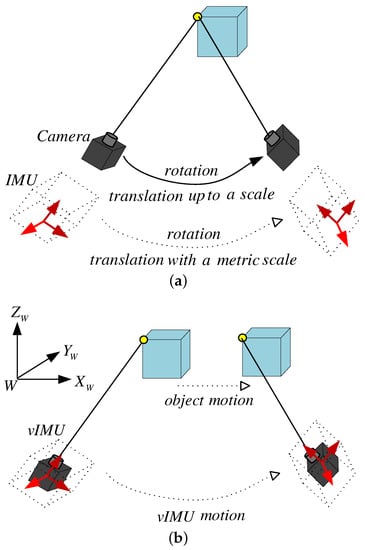
Figure 1.
Static and dynamic scene. (a) in a static scene, a camera integrated with an IMU can infer the information of the metric scale; (b) in a dynamic scene, the problem is how to accurately infer both the vIMU motion and the object motion.
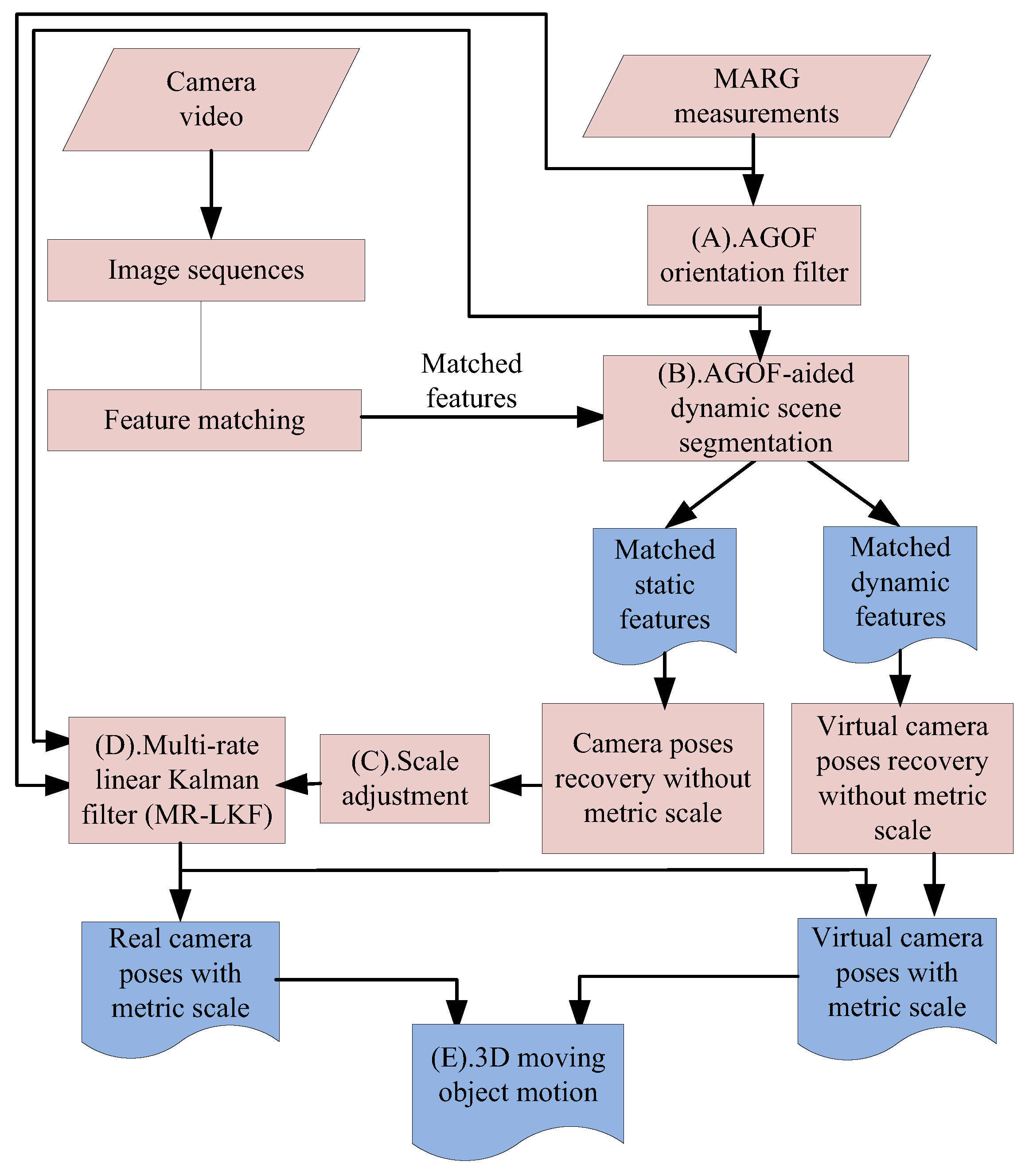
The main contributions of this paper are summarized as follows: (1) a novel method for dynamic scene segmentation based on AGOF-aided (Adaptive-Gain Orientation Filter) homography recovery constraint and epipolar geometry constraint shown as process (B) in Figure 2; (2) a new concept of “virtual camera” for robust ego- and ambient-estimation in dynamic environments; and (3) an MR-LKF fusion method for solving the problems of two different sampling rates and scale ambiguity.
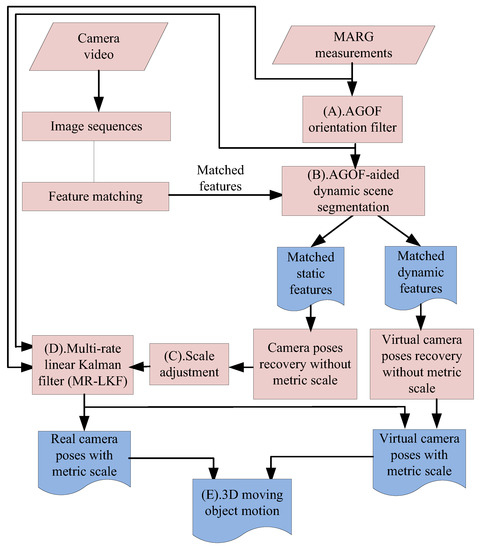
Figure 2.
The main framework of the proposed method.
2. Related Work
In recent years, with the development of technology in computer vision, more and more researchers have been attracted to develop monocular visual-based localization algorithms based on the theory of structure from motion (SFM) [3,4,5,6]. However, there are two main problems with monocular visual-based localization algorithms. One is the triangulation problem, which can only be enabled in at least two views where the 3D scene is commonly assumed to be static. If there are other objects moving in the 3D scene, which is referred to as the dynamic 3D scene, the rule of triangulation will fail unless some constraints are further applied [7]. The other is the visual scale problem, which is usually lost when projecting a 3D scene on a 2D imaging plane. The most common approach for doing so is stereo vision [8,9]. Although these systems work well in many environments, stereo vision is fundamentally limited by two specific cameras. In addition, the structure of 3D environment and the motion of camera could be recovered from a monocular camera using structure from motion (SFM) techniques [10,11,12,13,14], but they are up to an arbitrary scale. Methods appearing in structure from motion to infer the scale of the 3D structure is to place an artificial reference with a known scale into the scene. However, it limits its applications to place a marker before the 3D reconstruction .
In the past 10 years, the integration of visual and inertial sensors has shown more significant performance than a single sensor system, especially in positioning and tracking systems [8,15,16,17] due to their complementary properties [18]. Inertial sensors provide good signals with high-rate motions in the short term but suffer from accumulated drift due to the double integration during the estimation of position. On the contrary, visual sensors offer accurate ego-motion estimation with low-rate motion in the long term, but are sensitive to blurred features during unpredicted and fast motions [19]. Therefore, recently, these complementary properties have been utilized by more and more researchers as the basic principle for integrating visual and inertial sensors together. Moreover, the inertial sensors can not only be small in size, light weight and low in cost, but also easily adopt wireless communication technologies, so it is much easier for people to wear them. This is why we call them “wearable” inertial sensors.
In general, the Kalman filter (KF) is a common and popular algorithm for sensor fusion and data fusion, which is an efficient recursive filter and widely used in many applications. In recent years, more and more researchers have been attracted to develop novel Kalman-filter-based algorithms to deal with structural systems. In structural systems, the states including displacements and velocities are difficult or sometimes impossible to measure, so a variety of novel Kalman filters have been developed from Kalman’s original formulation by accounting for non-stationary unknown external inputs and theoretical investigation of observability, stability and associated advancements [20,21,22,23]. To our knowledge, nonlinear Kalman filter techniques are usually applied to almost all of the inertial-visual fusion algorithms, such as extended KF, unscented KF, etc. [8,17,24,25,26], because a large state vector and a complex nonlinear model are required when both the orientation and the position are optimized in the same process. However, an unacceptable computational burden would be imposed because of so many recursive formulas. Moreover, the linear approximations of EKF may result in non optimal estimates. Although [27] proposed a modified linear Kalman filter to perform the fusion of inertial and visual data, the accurate orientation estimates were based on the assumption of gyroscope measurements trusted for up to several minutes. In [28], the authors proposed a novel fusion algorithm by separating the orientation fusion and the position fusion process, while the orientation estimation could only be robust for a static or slow movement without magnetic distortions using the method proposed in [29]. In contrast, in this paper, the orientation is firstly estimated by our previously proposed orientation filter in [2] only from inertial measurements. Our orientation filter can not only obtain the robust orientation in real time for both extra acceleration and magnetic distortions, but also eliminate the bias and noise in angular velocity and acceleration. In addition, the sampling rates for visual and inertial sensors are inherently different. As a result, an efficient inertial-visual fusion algorithm, called multi-rate AGOF/Linear Kalman filter (MR-LKF), is proposed to separate the orientation and the position estimation; thus, this results in a small state vector and a linear model. A summary of the related work on inertial-visual integration is presented in Table 1.

Table 1.
Related work on inertial-visual fusion (OS, FFT, OFP, OPSP, SE, DFSV, KF, DKF, EKF, UKF, Gyro, Mag and Acc stand for Orientation Source, Fusion Filter Type, Orientation-aided Feature points, Orientation and Position in the Same Process, Scale Estimation, Dimension of Filter’s State Vector, Kalman Filter, Decentralized Kalman Filter, Extended Kalman Filter, Unscented Kalman Filter, Gyroscope, Magnetometer and Accelerometer respectively; x—No and √—Yes).
3. Sensors
This section introduces some preliminary notations and definitions for the camera and integrated visual-inertial (vIMU) system. For brevity and clarity, Table 2 gives the definitions of mathematical symbols and variables.
Table 2.
Definitions of mathematical symbols and variables.
3.1. Camera
3.1.1. Camera Model
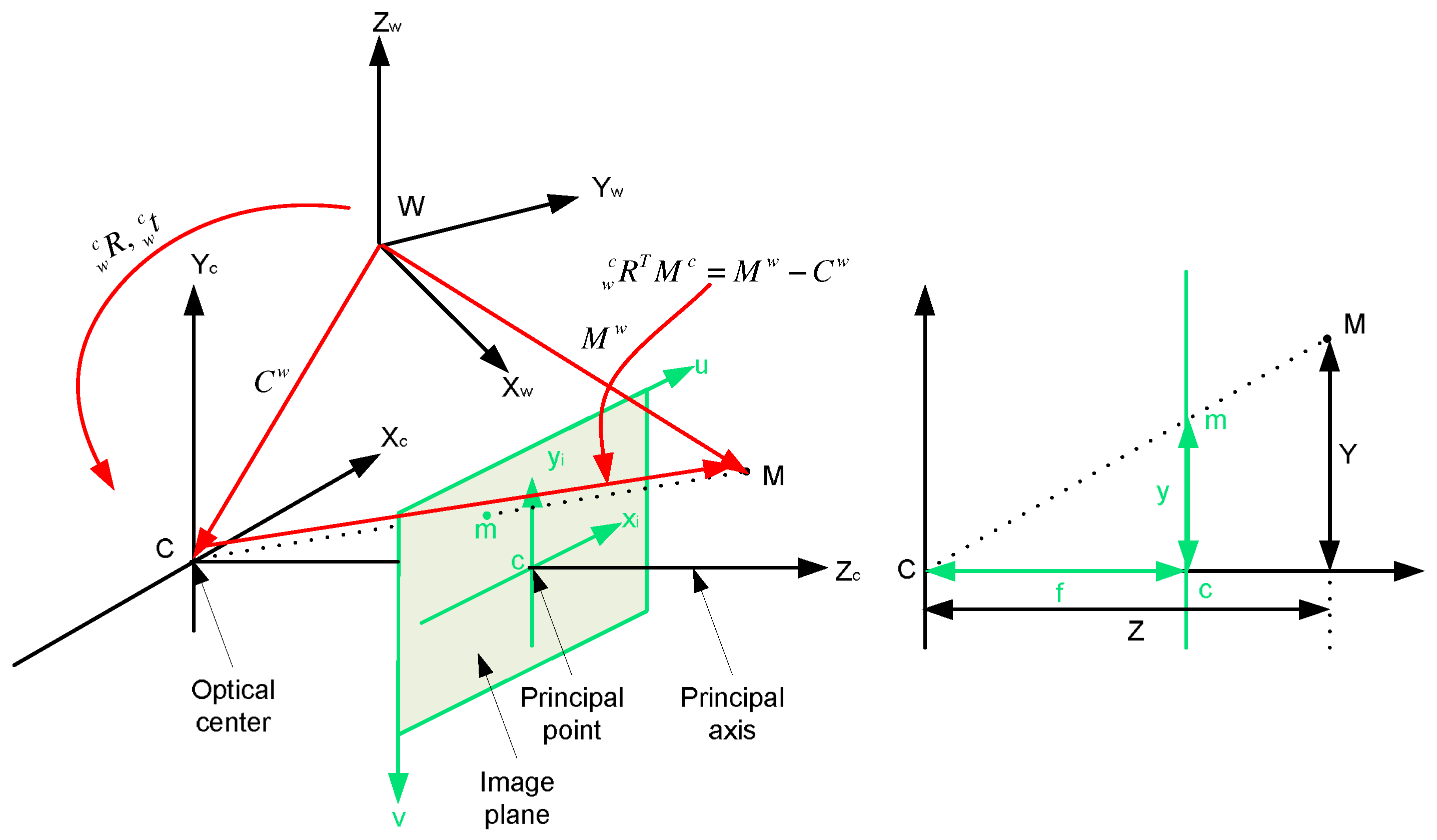
A camera is a mapping between the 3D world and a 2D image, so the most specialized and simplest camera modle, called the basic pinhole camera model [10], is used here to deduce the mapping between a point in 2D image coordinate system and a point in 3D camera coordinate system. Under this model, a 3D point in the camera coordinate system c is mapped to the 2D point in the image coordinate system i, which is located on the image plane (). A line joining the point to the center of projection (called camera centre) meets the image plane illustrated in Figure 3. Based on triangle similarity, the relationship between and is given in Label (1):
where f denotes the focal length. Based on the representation of homogeneous coordinates, Label (1) can be rewritten as a linear mapping using a matrix representation denoted in Label (2):
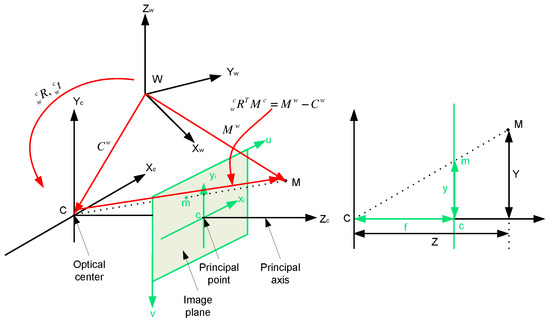
Figure 3.
left: the relationship between the camera and image coordinates and between the camera and world coordinates; right: side view of the left figure is used to derive the relationship between the camera and image coordinates based on the principle of similarity.
3.1.2. Intrinsic Camera Parameters
Usually, most of the current imaging systems use pixels to measure image coordinates where the origin of the pixel coordinate system is located at the top-left pixel of the image. Therefore, in order to describe a projected point in the pixel coordinate system, the intrinsic camera parameters have to be taken into account. If represents the 2D point in the pixel coordinate system p corresponding to the 2D point in image coordination system i, the relationship between and can be rewritten in Label (4):
where and , respectively, represent the number of pixels per unit of length in the direction of x and y. Based on Label (4) and the representation of homogeneous coordinates, the correlation of and can be easily denoted in Label (5) using a matrix representation:
Depending on Labels (3) and (5), we can easily express the mapping between a 3D point in the camera frame and its corresponding 2D point in the pixel frame using the camera intrinsic calibration matrix K as shown in the following equation:
where and , called focal distances, can be respectively obtained by using and multiplied by the focal length f.
3.1.3. Extrinsic Camera Parameters
Generally, 3D points are not expressed in the moving camera coordinate system c but in a fixed reference frame, called the world coordinate system w. The relationship between those coordinate systems can be given by a rigid transformation consisting of a rotation and a translation called the extrinsic camera parameters or the camera pose. This is illustrated on the right side of Figure 3. The mapping of a point expressed in the world frame to a point expressed in the camera frame can be denoted as follows:
where is the position of the camera center in the world frame. Label (7) can be rewritten in another commonly used form as illustrated in Lable (8):
where the rotation is pre-estimated only from inertial sensors and then used for calculating the translation denoted as . By introducing homogeneous coordinates, Label (8) can be expressed as a linear operation shown in Label (9):
where and are the camera’s extrinsic parameters.
3.1.4. From World to Pixel Coordinates
3.2. Visual IMU System
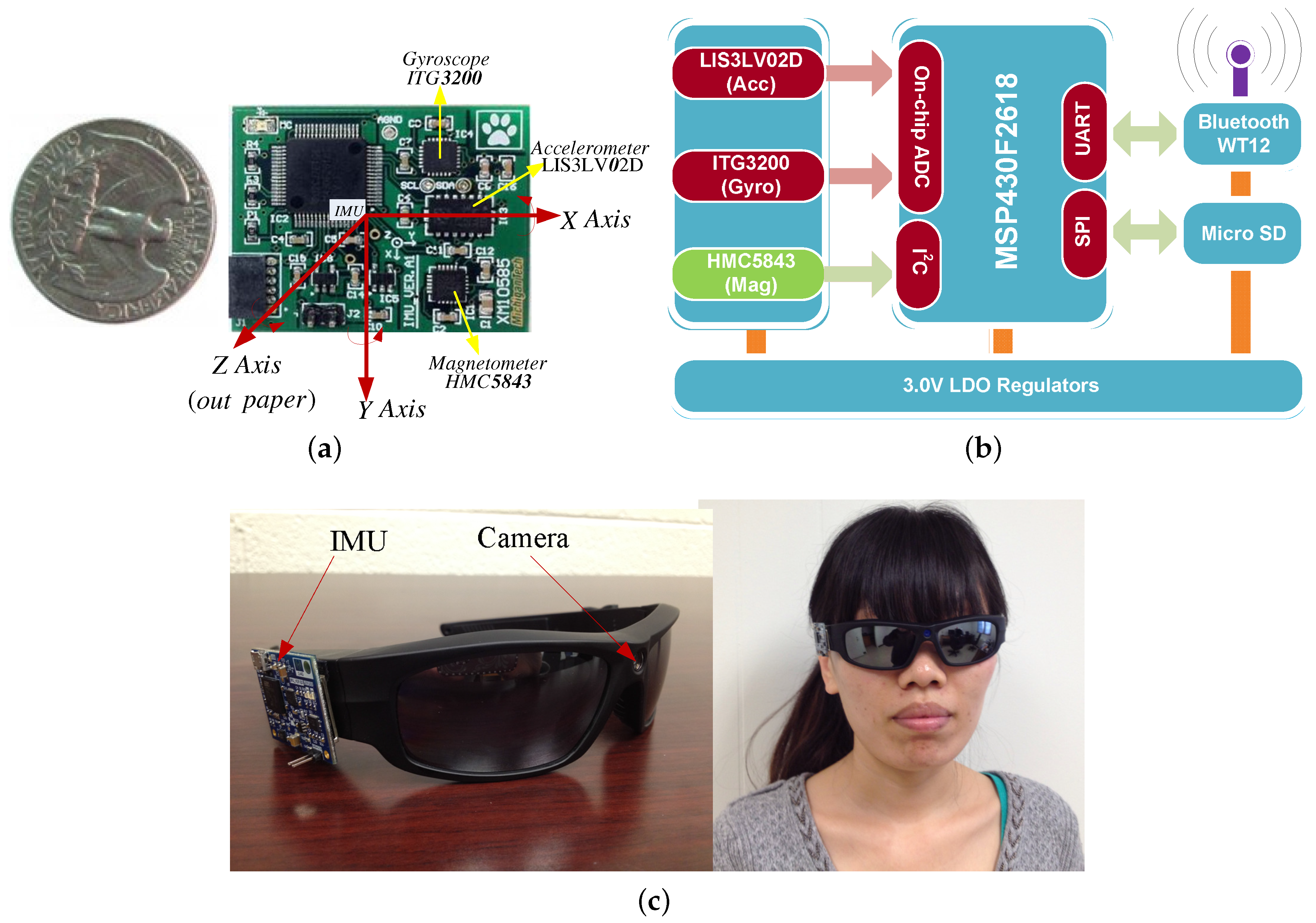
A wearable visual IMU (vIMU) system is shown in Figure 4c. It integrates a camera and a newly developed MARG sensor together on a sunglass, so it is convenient for people to wear. The camera has a feature of 170 degree wide-angle, HD (High Definition) camera lens with 5.0 Mage 720P. Figure 4a shows the prototype of MARG sensor, which contains a tri-axis accelerometer (LIS3LV02D), a tri-axis gyroscope (ITG3200) and a tri-axis magnetometer (HMC5843) in a small sensor package. All signals are transmitted through Bluetooth. Moreover, an processor (TI MSP430F2618) is embedded in the small chip for convenient computation. The hardware configurations of the MARG sensor is shown in Figure 4b.
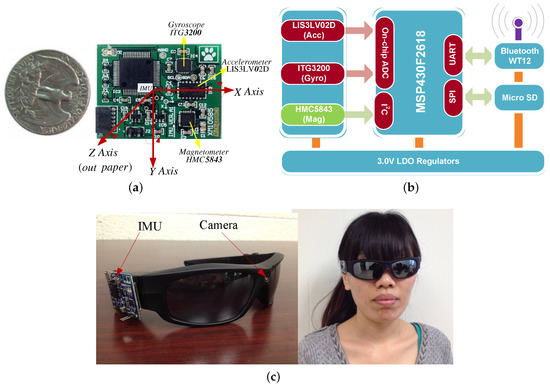
Figure 4.
Prototype of MARG sensor and wearable vIMU system. (a) the developed MARG sensor; (b) hardware configuration of MARG sensor; (c) the wearable vIMU system.
In order to integrate the measurements from different sensors, their measurements have to be timely and spatially synchronized due to each physical sensor providing measurements in its own time and spatial reference. The proposed vIMU system provides timely synchronized image sequences and inertial readings. The sample rate of MARG sensor is 60 Hz and the sample rate of camera can be lower due to the accurate baseline from epipolar geometry constraint. The related coordinate systems connected to the camera and the MARG sensor have already been presented in our previous work [2,30].
4. Motion Estimation
In this section, an adaptive method is presented to estimate motion from visual measurements with the help of inertial measurements. Inertial motion estimation outputs the real-time orientation using an adaptive-gain orientation filter (AGOF) from our previous work [2], which aids visual motion estimation to not only segment dynamic scenes, but also compute the camera transformation from corresponding features between consecutive images.
4.1. AGOF-Aided Dynamic Scene Segmentation
The SIFT (Scale-Invariant Feature Transform) algorithm is selected to generate a SIFT descriptor corresponding to each key-point [31] and then all 2D matched feature points are obtained. The goal of our work is to propose a robout algorithm to classify these matched feature points. As a result, different groups of matched featuer points are used to recover the corresponding motions. In this subsection, we present the sorted method for matched feature points: AGOF-aided homography recovery constraint and epipolar geometry constraint.
4.1.1. Homography Recovery
When the camera undergoes a pure translation, a general motion of camera can be transformed to a special motion with the help of the preestimated robust orientation from our AGOF filter. Usually, there are two special cases: one is parallel to the image plane and the other is perpendicular to the image plane.
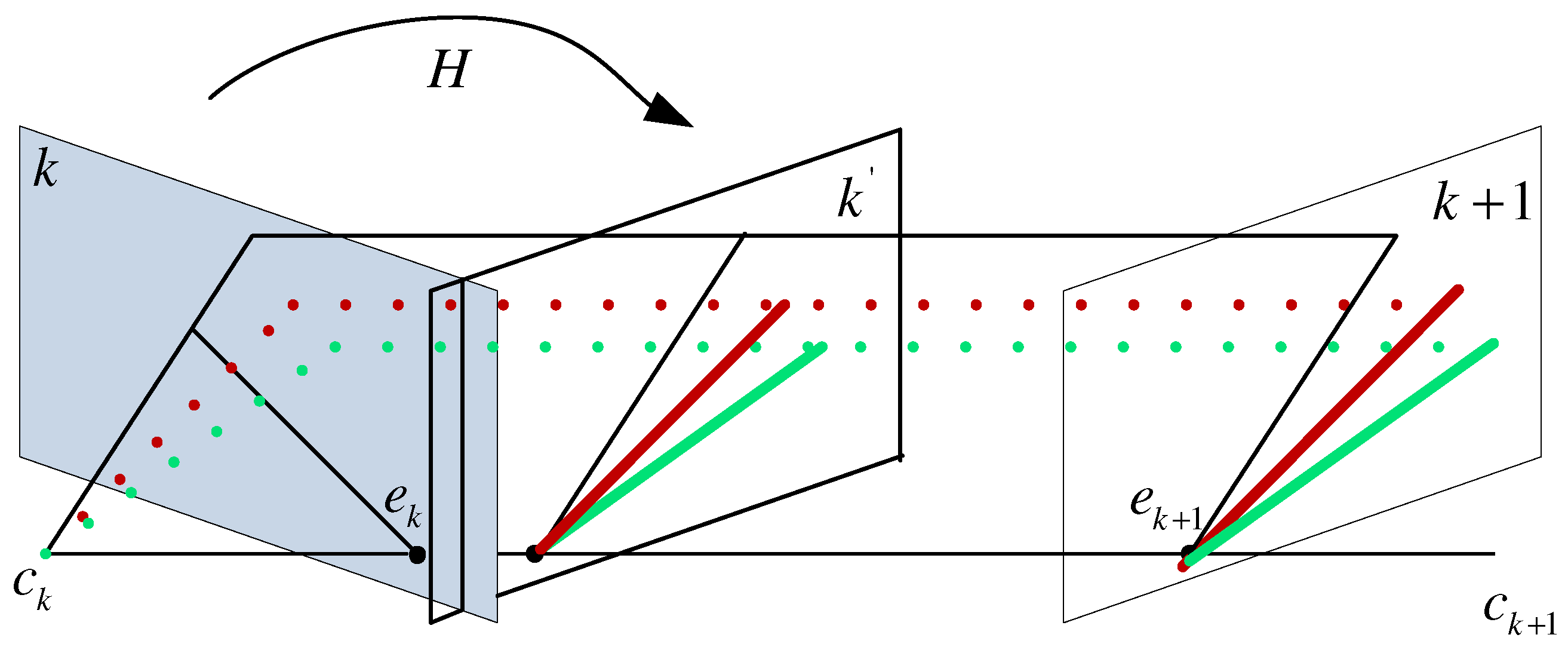
As shown in Figure 5, the homography H can recover rotation between two consecutive images because it directly connects the corresponding 2D points of a 3D point. If the camera intrinsic parameter K and the rotation R are known, the homography H can be directly obtained using Label (11):
where and are corresponding 2D points in two consecutive frames k and of a 3D point . As we mentioned previously, the rotation R can be preestimated, so a bunch of motion lines, which connect the corresponding 2D matched feature points of a 3D point, are obtained. These lines can be sorted by computing the slope of them or checking if they can intersect at the same point called “epipole”. The slope of motion line can be expressed in Label (12) according to and :
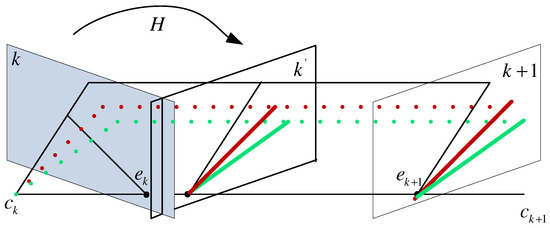
Figure 5.
Homography recovery under a general motion of camera.
If equals 0, then the real camera moves along x-axis of the camera coordinate system.
4.1.2. Epipolar Geometry
According to the definition in reference [10], two epipolar lines can be obtained in Label (13) based on the optical flows:
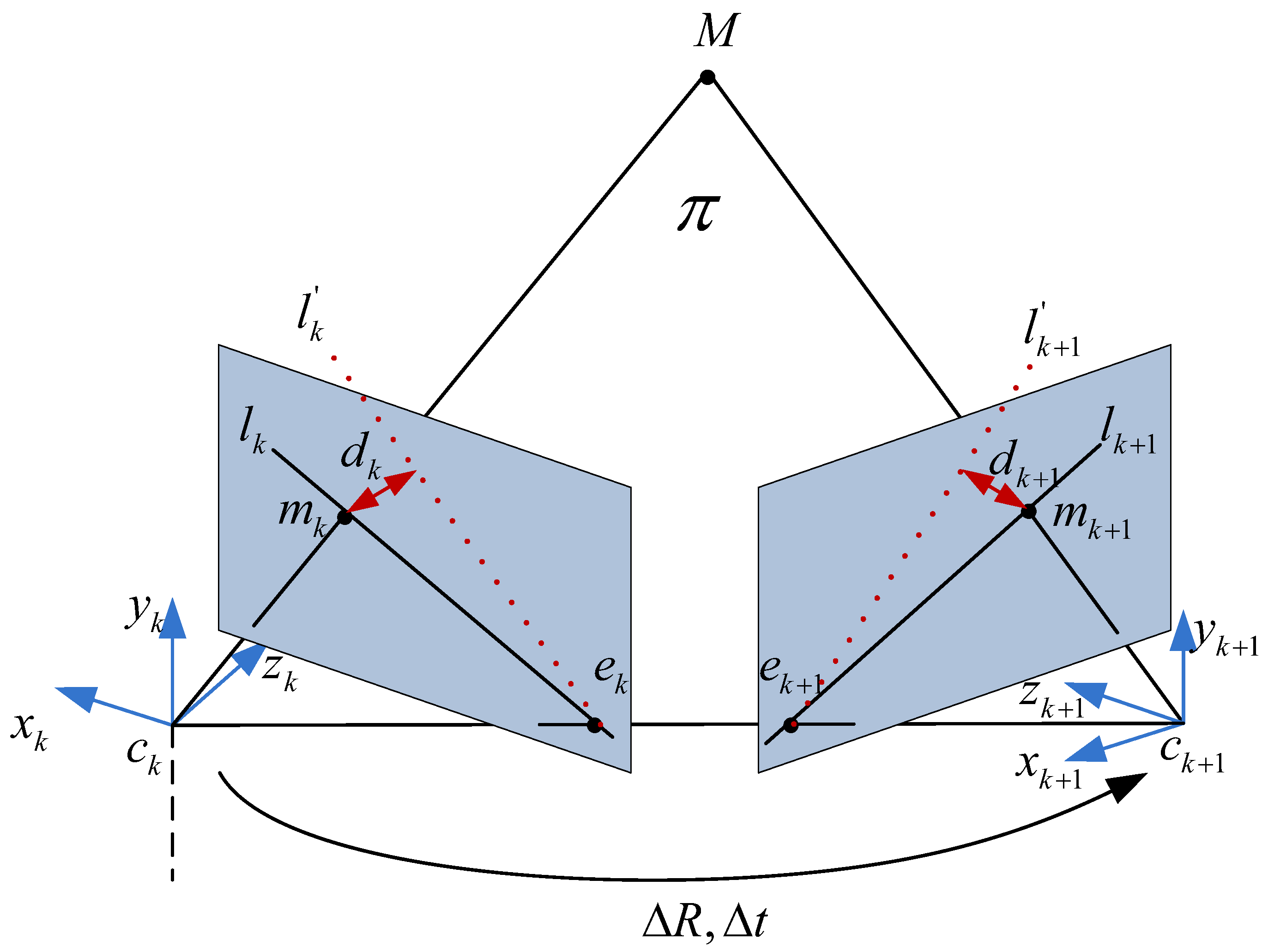
where and are the epipoles; and are skew-symmetric matrixes; and respectively denote lines connecting and in frame k and frame respectively as shown in Figure 6. Moreover, based on the constraint of epipolar geometry as depicted in Label (14), two epipolar lines and could be inferred from the fundamental matrix as shown in Label (15):
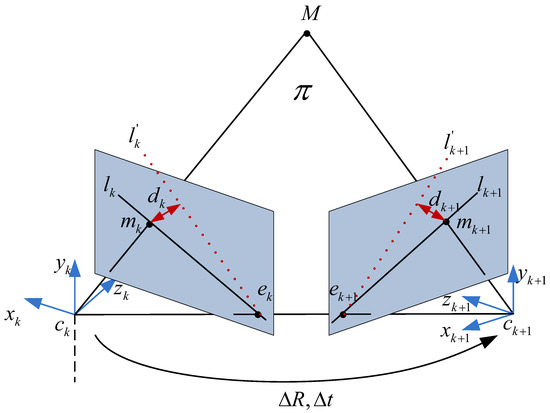
Figure 6.
Epipolar geometry.
Based on two constraints of optical flow and epipolar geometry for static points, we can obtain and , where ≅ means up to a scale factor. Nevertheless, the constrain of epipolar geometry will be not satisfied if the points belong to moving objectgs. Therefore, for feature points from moving objects in the scene, the distance from the 2D point to the corresponding epipolar line is chosen to evaluate how discrepant this epipolar line is, and it can be derived in Label (16) from the constraint of epipolar geometry:
In general, the distance for a static point is non-zero due to image noises and estimation errors of epipolar geometry. Actually, the larger the distance, the more confidently the 3D point is considered to be part of a moving object.
4.2. Real and Virtual Camera Motion Recovery
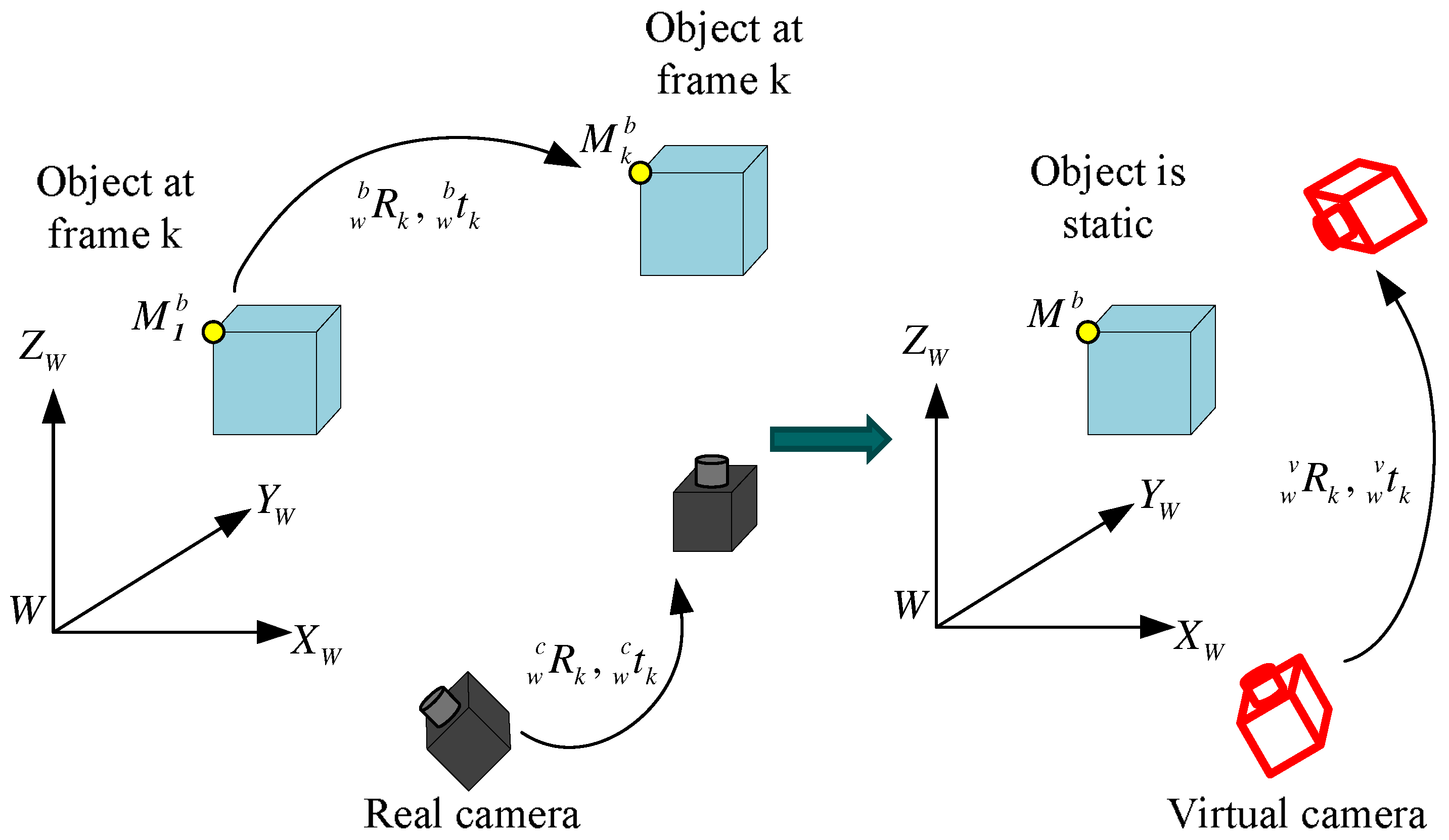
Based on the matched 2D feature points from a moving object viewed by a moving camera, the recovered poses actually reflect the combined motion of the moving object and the moving camera. For better understanding, a novel concept of a “virtual” camera is proposed to consider as if the object were static observed by a “virtual” moving camera in comparison with the “real” camera as depicted in Figure 7. This section will emphasize how to recover the motion of real and virtual camera.
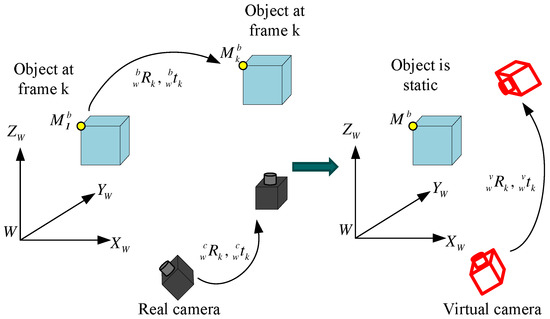
Figure 7.
A concept of virtual camera.
4.2.1. Relative Motion Recovery for Real Camera
After dividing 2D matched feature points based on two pre-presented constraints, the essential matrix can be derived from the fundamental matrix and the camera’s intrinsic parameter matrix K using Labels (14) and (17):
As we know, the relative translation and rotation of camera can be obtained from the essential matrix , so and could differentiate the relative motion of camera from the absolute motion of camera. Authors in [10] retrieved the camera matrices from the essential matrix using , so the relative rotation and the relative translation , as shown in Figure 6, can be recovered from by using Labels (18) and (19) based on the method proposed in [32]:
where is ’s cofactor and is a identity matrix. As a result, two solutions and could be obtained for by finding the largest row of matrix as shown in Label (19):
where is the largest element of diagonal of matrix (). Therefore, the camera matrix has only two different solutions: and due to pre-estimated accurate in [2]. Here, we use the rule that a reconstructed 3D point should be in front of the camera between two consecutive views to check which one of these two solutions is satisfied.
Finally, a refining process called “Bundle Adjustment” is used to optimize the parameters of the relative motion and the optical characteristics of the camera K, according to a nonlinear least square solution to minimize the total reprojection errors of all points in two consecutive images at k and as shown in Label (20):
where represents the i- 2D point in the image coordinate at frame k and is the corresponding 3D point.
4.2.2. Relative Motion Recovery for Virtual Camera
According to the pre-proposed concept of virtual camera, the motion of virtual camera is actually the combination motion of real camera and moving object. In addition, the intrinsic parameters of virtual camera is the same as those of real camera, but the motion of virtual camera is different from that of real camera with the presence of moving objects.
Meanwhile, the relative motion of virtual camera can be obtained by using the similar method as the real camera in Section 4.2.1. The only difference is that the relative rotation does not need to be recovered for the real camera because the real camera is rigidly attached with the IMU and the rotation of real camera can be pre-estimated from IMU-only.
4.2.3. Scale Adjustment
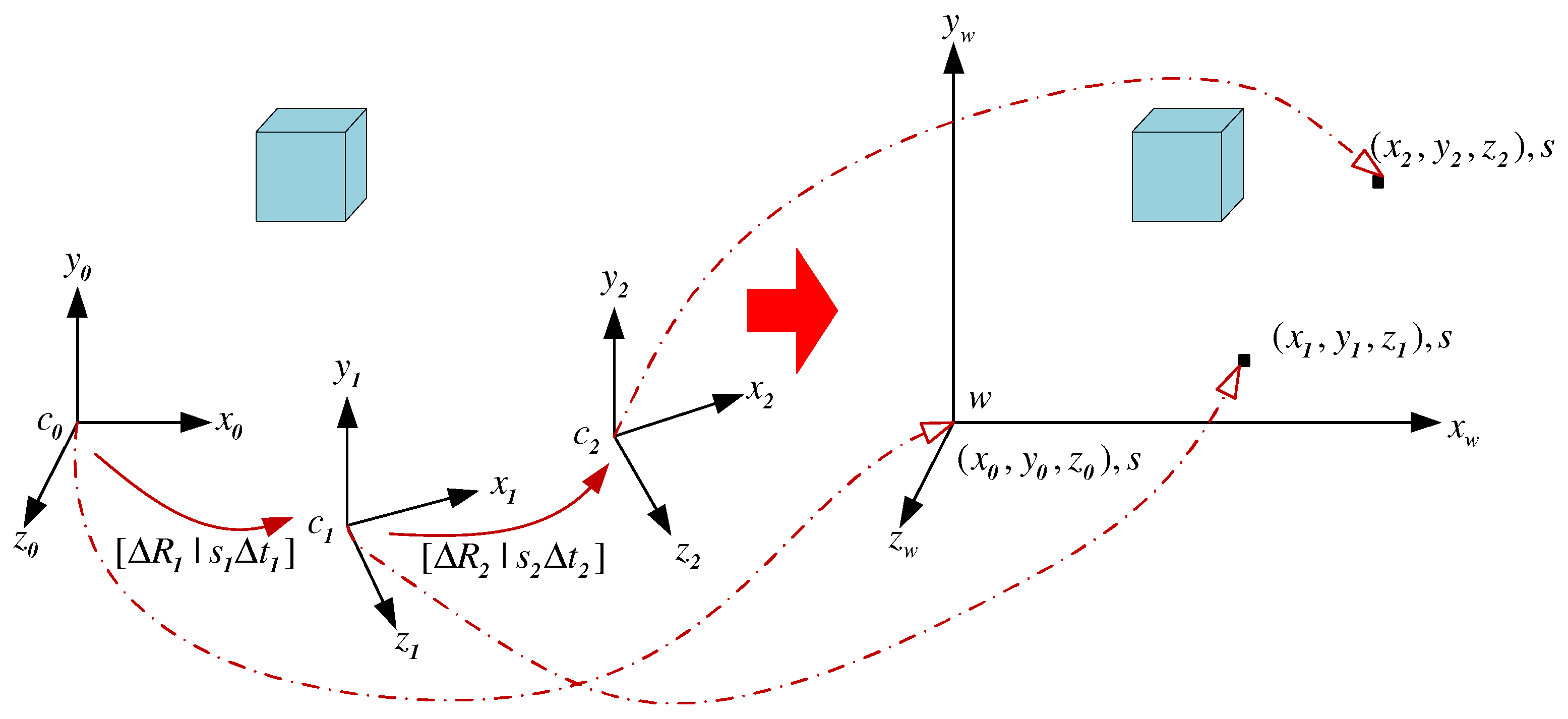
The baseline , recovered from based on Label (19), can only have available direction because the camera motion is only estimated up to a scale. This is a so-called scale problem in monocular vision. Since there are multiple frames, the baseline estimated between each pair of consecutive frames is only determined up to an unknown and different scale factor as shown in Figure 8.
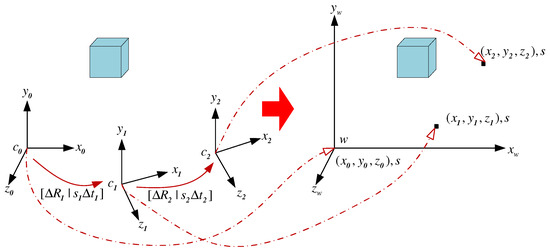
Figure 8.
Unified scale recovery from videos.
In order to obtain a scale consistent trajectory estimation of the camera motion, the scale for each camera motion between two consecutive frames needs to be adjusted so that only one global scale parameter remains unknown. This global scale defines the true size of the reconstructed 3D structure and can be recovered if the information about the real world is introduced. In this subsection, an inertial measurement unit, which consists of three-axis accelerometer, gyroscope and magnetometer, is used to infer the information about the real world. Section 5 will introduce the estimation of this absolute global scale in details.
For adjusting the scale, the method proposed in [33] will be employed in this subsection, where the scale is computed in closed form with a 1-point algorithm. Given the scale free motion estimation () of the camera from frame k to frame , the feature matches between frame and frame k (), and the reconstructed 3D points () obtained from three consecutive frames , and k , the scale can be adjusted as follows:
where is the scale ratio that relates the baseline between camera frame and frame and the baseline between camera frame and frame k. Label (21) can be rewritten as , where and are vectors. The vector contains one constraint per row , defined by one 2D ∼ 3D correspondence. The vector is defined as: where is the first row of . Then, the scale is solved by using SVD (Singular Value Decomposition) [10] for obtaining a solution in the least square sense as:
Though only one 2D∼3D correspondence is needed to solve the scale parameter, all available correspondences are used in this paper for robustness.
4.2.4. Camera Absolute Motion Recovery
Usually, the camera absolute poses, which are relative to the world coordinate, are essential to be obtained for motion estimation. However, from the 2D matched points, we can derive the relative rotation and translation between two consecutive frames. If () and () respectively represent the absolute rotation and translation of camera for frame k () and , then a static 3D point can be easily expressed between the camera frame and the world frame as shown in Labels (23) and (24):
The position of will not be changed from frame k to frame because is a static point and meanwhile the world frame does not move. In other words, we can easily define , then can be derived from Label (23) as . Thus, Label (25) is obtained by substituting for in Label (24):
with and . Inversely, given () and (), the camera’s absolute poses at frame cane be easily solved by using Label (26):
4.3. Motion Estimation for 3D Object
In this section, the motion of 3D objects in the world frame will be estimated from the motion of real camera and virtual camera. Assuming that a 3D point is attached to a moving object as depicted in the left of Figure 7, can be derived from the initial position according to the motion of rigid object( and ) Label (27):
where superscript b indicates the point is attached to the moving object and subscript k denotes the point is viewed at frame k. It is clearly seen that the static rigid object is a special case where and .
Based on the motion of real camera and at frame k, we can use Label (28) to obtain the 3D position of a point from the world frame to the current real camera frame:
Combining Labels (27) and (28), the 3D position of point with respect to the k- camera can be easily derived in Label (29):
As aforementioned, the special case with and can be thought as the static object observed by a moving camera, which can simplify Label (29) to be Label (8). Actually, the definition of the “virtual” camera originates from Label (29), which denotes a static object () viewed by a moving camera as shown in the right of Figure 7. Therefore, the motion of “virtual” camera (, ) at frame k can be denoted in Label (30):
It is clearly seen that the initial point has and in frame 1, so the motion of virtual camera has the same motion as the real camera at frame 1: and . During the following frames, the virtual camera’s motion differs from the real camera’s motion because of the motion of rigid objects.
As a result, the object pose (, ) can be derived by using Label (30) based on the real camera’s motion (, ) and the virtual camera’s motion (, ):
5. Multi-Rate Linear Kalman Filter
As we mentioned previously, the main problem of monocular vision is scale ambiguity. The inertial sensors can infer the position with absolute metric unit from the accelerometer, which suffers from the accumulated drift for long-term tracking. Therefore, the combination of monocular visual and inertial data is proposed in this paper to solve the scale ambiguity. In the state-of-the-art literature [8,17,24,25,26], the sensor fusion algorithm requires a nonlinear estimator to estimate both the orientation and the position in the same process, such as Extended Kalman Filter (EKF), Unscented Kalman Filter (UKF), etc. However, in this paper, a multi-rate linear estimator, called “AGOF/Linear Kalman Filter” as our previous work [30], was designed to integrate visual and inertial measurements together without updating orientation information, so that the model can be linear and only needs a small state vector. The following sections briefly review our proposed filter in [30].
5.1. State Vector Definition
The state vector and the system process noise can be expressed as follows
where is camera position without scale, is camera velocity, is camera acceleration expressed in metric unit (meter), is the reciprocal of the absolute scale factor, which leads to low-order polynomials and is the accelerometer bias.
5.2. Dynamic Model
The system is assumed to have a uniformly accelerated linear translation at time k, so the translation of the camera can be modeled by an equation set. Thus, the dynamic model of the state is defined as follows:
where T represents the time span between k and . is based on a random walk model and the bias is based on the value and a white noise at time k.
5.3. Measurement Model
The involved sensors are with two different sampling rates, so two measurements are considered: one is when inertial measurements are available and the other is when visual measurements are available. Therefore, the updating equation of measurements for output states is:
with for available inertial measurements or for available visual measurements.
In order to obtain reliable measurements from inertial sensors as the input of measurement model, the effect of the gravity denoted in the earth coordinate system e should be firstly removed from the raw acceleration measurements in sensor coordinate system s based on the preestimated robust orientation using the quaternion-based representation. The related equations are depicted in Label (35):
where the operator denotes converting orientation from unit quaternion representation to rotation matrix representation; and can be obtained from the hand-eye calibration using the method in [34].
6. Experimental Results and Analysis
6.1. Experimental Setup
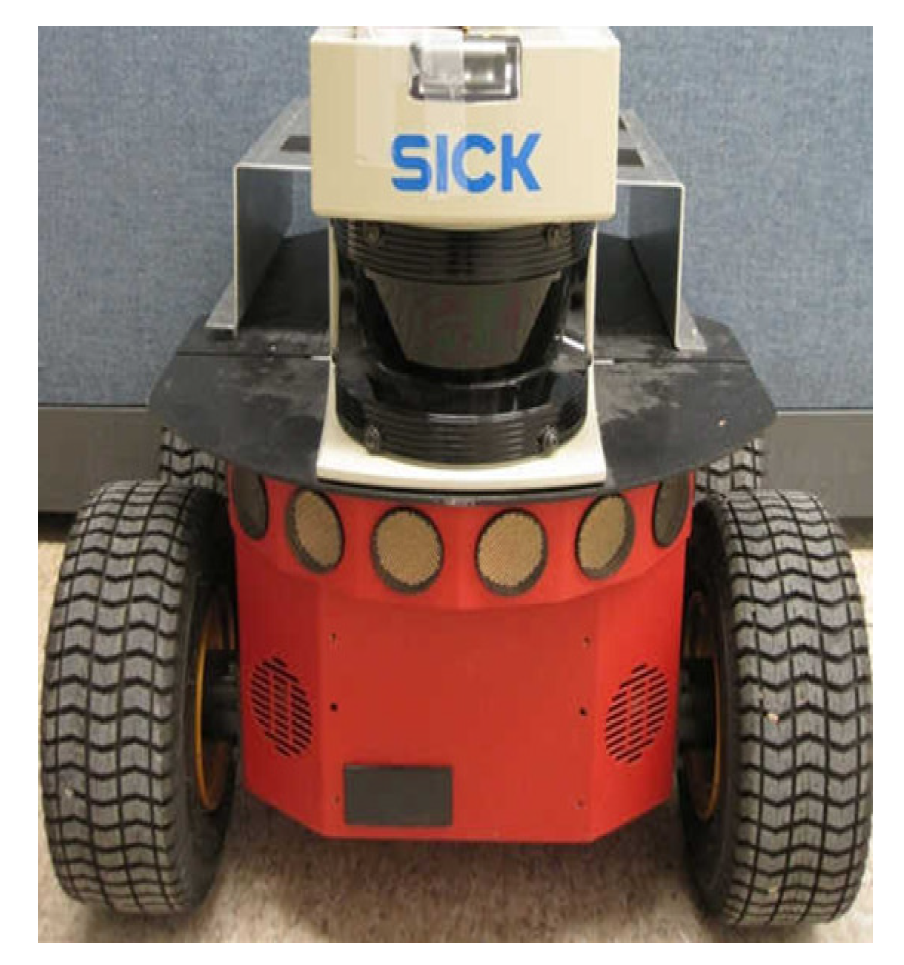
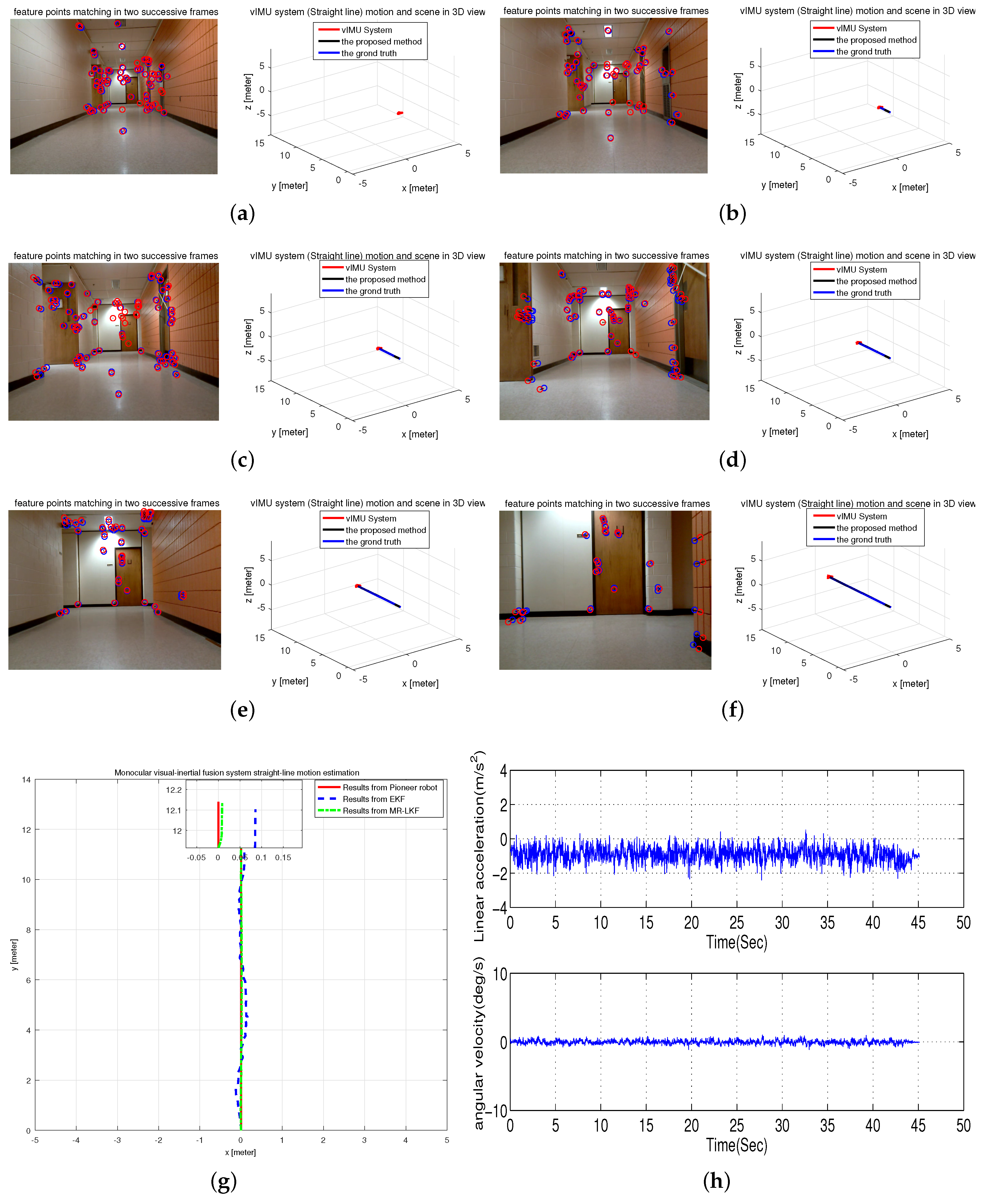
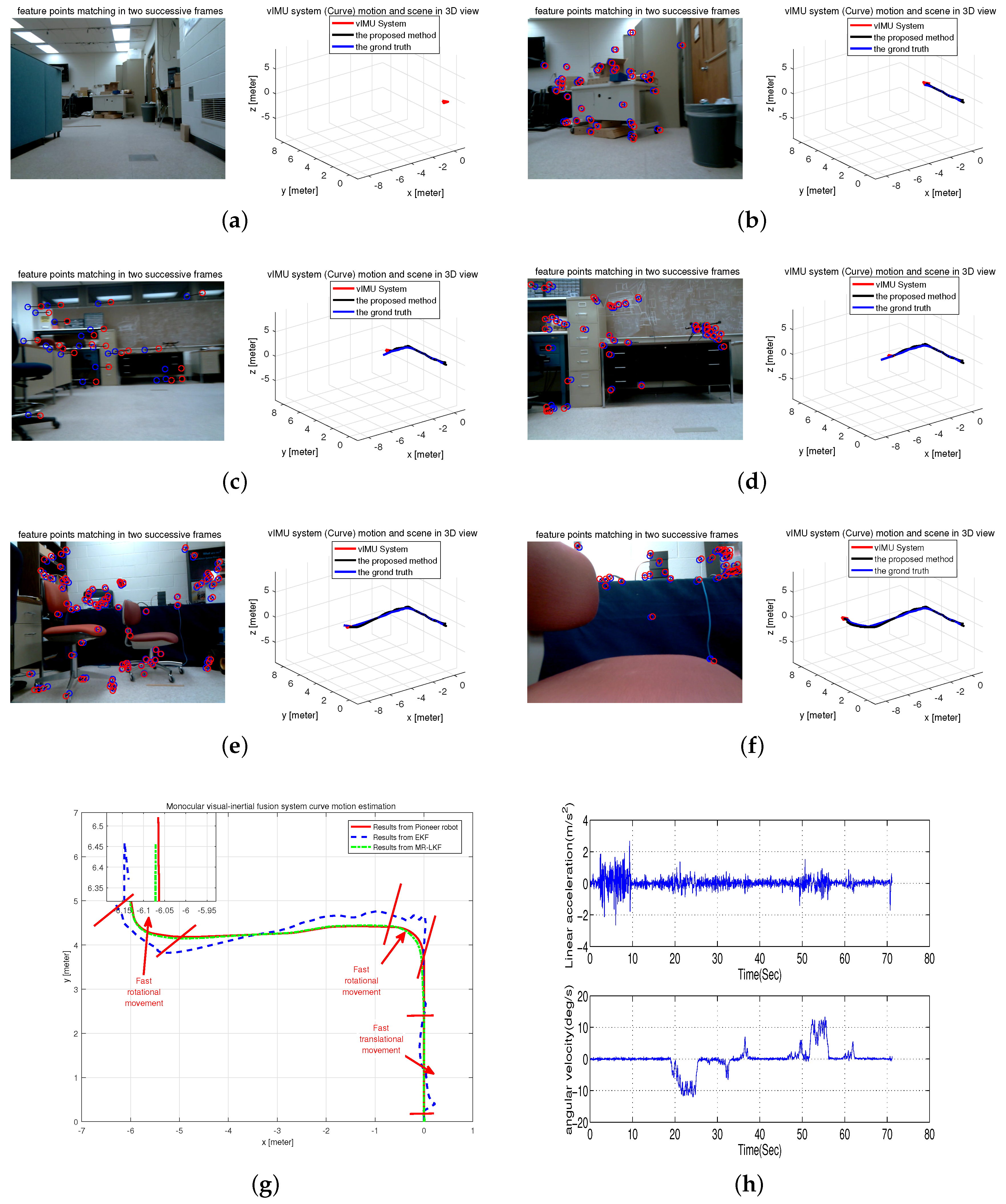
The performance of our proposed method was tested by a sunglass with wearable visual-inertial fusion system as shown in Figure 4c in different indoor environments. Firstly, three different experiments were performed in three different indoor environments, which are a hallway, an office room and a home-based environment. In order to test the accuracy of ego-motion estimation, the results from a Pioneer robot were as our ground truth shown in Figure 9. Moreover, the results were compared with those from EKF to verify our proposed MR-LKF more efficient. Secondly, a longer closed-loop path was performed, where a person was walking up and down the stairs with the visual-inertial system. Finally, an office-based dynamic environment was concerned, where a toy car was moving in a straight line.
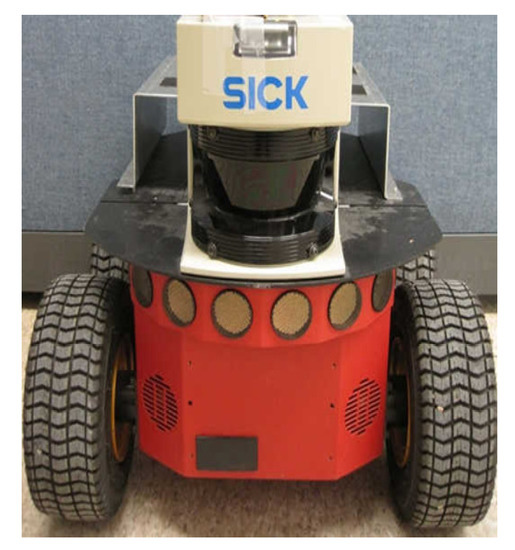
Figure 9.
The Pioneer robot platform for experimental illustrations.
6.2. Experimental Results
6.2.1. Experiment I: Straight-Line Motion Estimation in a Hallway
The experiment was conducted to attach the proposed vIMU system on the Pioneer robot platform to follow a straight line in our office hallway. The tracked trajectory is shown in Figure 10g compared with the results from EKF and the Pioneer robot. It is clearly seen that the estimated trajectory is more accurate and closer to the ground truth. In addition, Figure 10h shows the inertrial measurements, which obviously shows the movement of the system as slow and smooth. Moreover, typical frames and 3D visualized tracked trajectory are clearly given in Figure 10a–f.
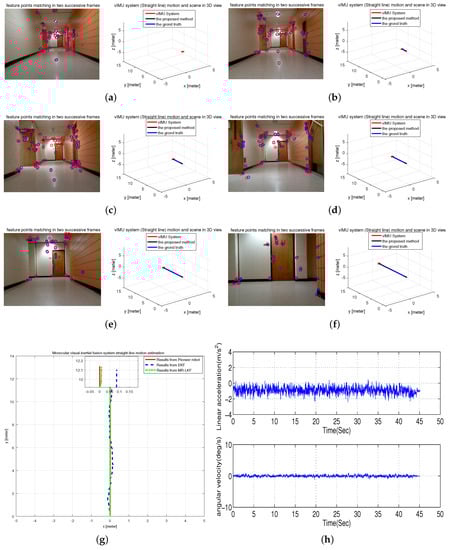
Figure 10.
Straight-line Motion Estimation in a hallway. (a–f) typical frames; (g) estimated trajectory with a magnified final position; (h) inertial measurements.
6.2.2. Experiment II: Curve Motion Estimation in an Office Room
In this test scenario, the Pioneer robot attached the visual-inertial system to follow a curve in our office room. Figure 11h shows the inertial measurements, which obviously show that the system experienced fast rotational and translational motion. The tracked trajectory is shown in Figure 11g compared with the results from EKF and the Pioneer robot. It is clearly seen that the estimated trajectory is more accurate and closer to the ground truth. Moreover, typical frames and 3D visualized tracked trajectory are clearly given in Figure 11a–f.
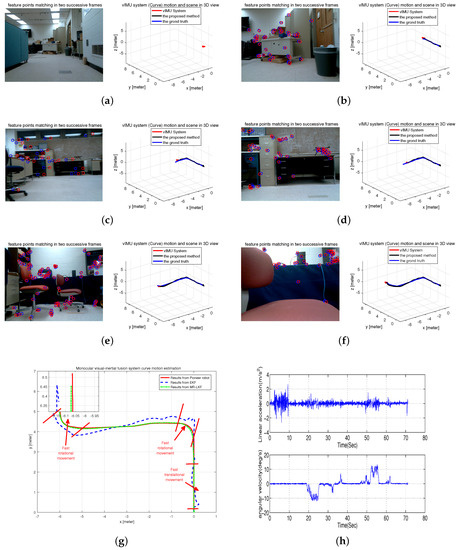
Figure 11.
Curve Motion Estimation in an office room. (a–f) typical frames; (g) estimated trajectory with a magnified final position; (h) inertial measurements.
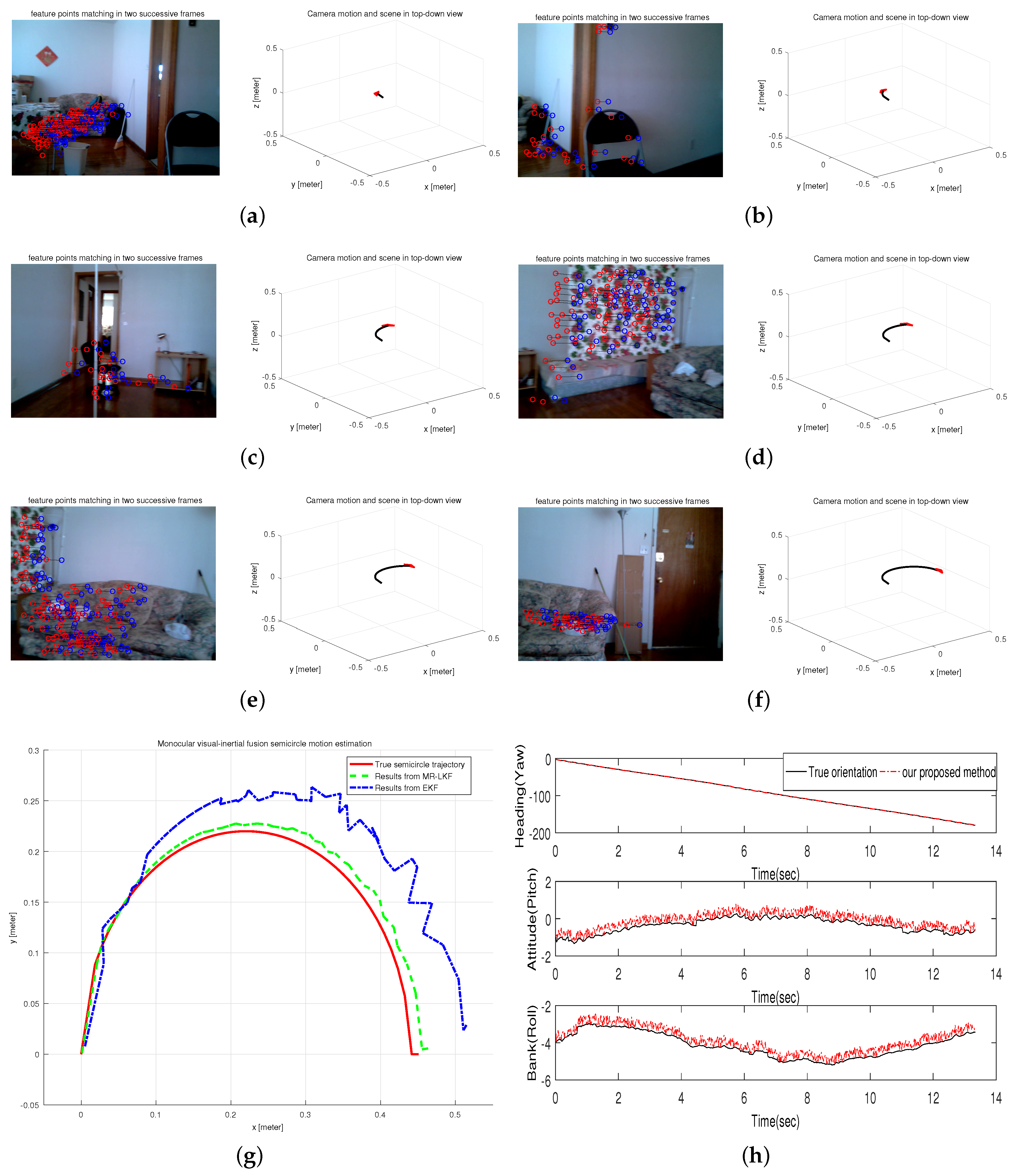
6.2.3. Experiment III: Semicircle Motion Estimation in A Home-Based Environment
This test was performed on a controllable robot arm to generate a semicircle movement in a home-based environment. Obviously, the radius of the semicircle is actually the length of the arm, so the accuracy of estimated results can be verified based on the known trajectory equation. The tracked trajectory is shown in Figure 12g compared with the results from EKF and the known trajectory. It is clearly seen that the estimated trajectory is more accurate and closer to the known trajectory. In addition, Figure 12h shows the orientation estimation from our AGOF orientation filter compared with the true orientation. Moreover, typical frames and 3D visualized tracked trajectory are clearly given in Figure 12a–f.
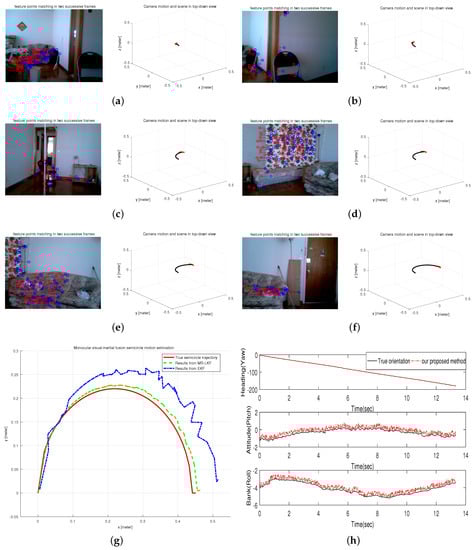
Figure 12.
Semicircle Motion Estimation in a home-based environment. (a–f) typical frames; (g) estimated trajectory; (h) Orientation estimation.
6.2.4. Experiment IV: Closed-Loop Motion Estimation
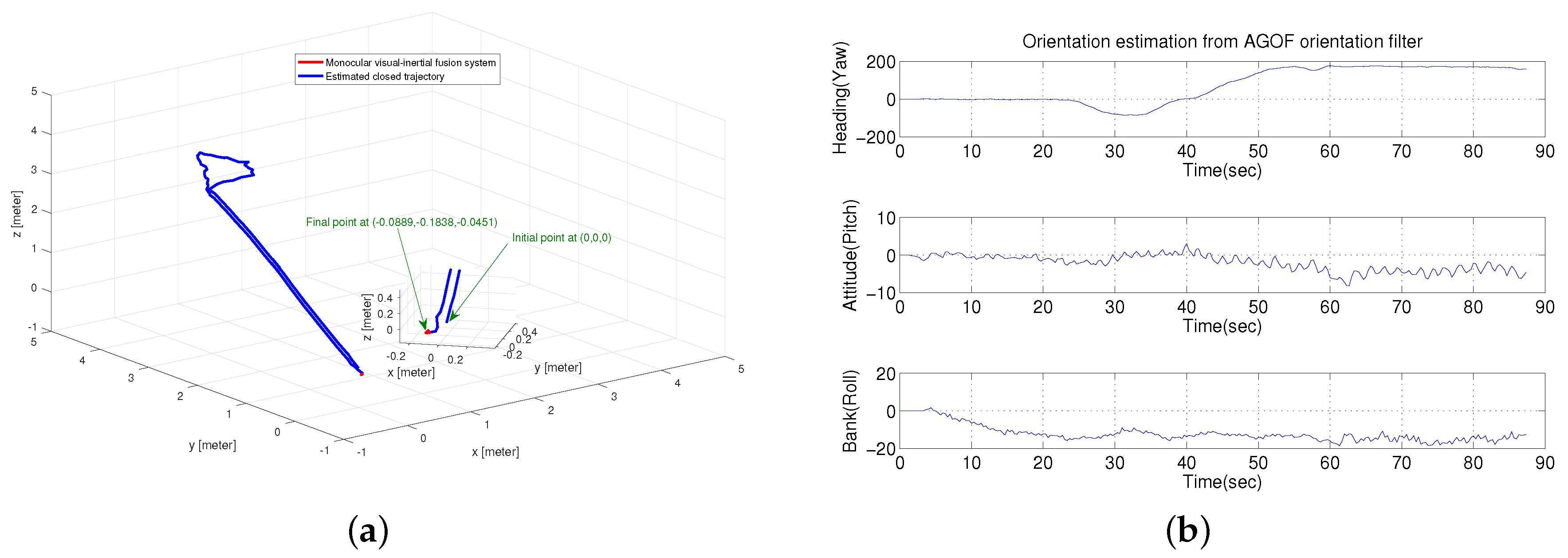
In this test, a longer trial was performed to verify the efficiency of the proposed method in three-dimensional estimation, where a closed route was conducted by a person walking up and down stairs with the visual-inertial system. Figure 13a shows the estimated trajectory with a magnified final position. It is clearly seen that our proposed method can correct the drift and make the final position very close to the initial position. Moreover, the robust orientation estimation from our AGOF filter, shown in Figure 13b, plays an important role in reducing the drift.
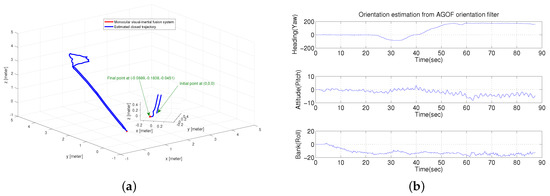
Figure 13.
Closed-loop Motion Estimation. (a) closed trajectory estimation; (b) orientation estimation from AGOF filter.
6.2.5. Experiment V: Motion Estimation with Moving Objects in an Office-Based Environment
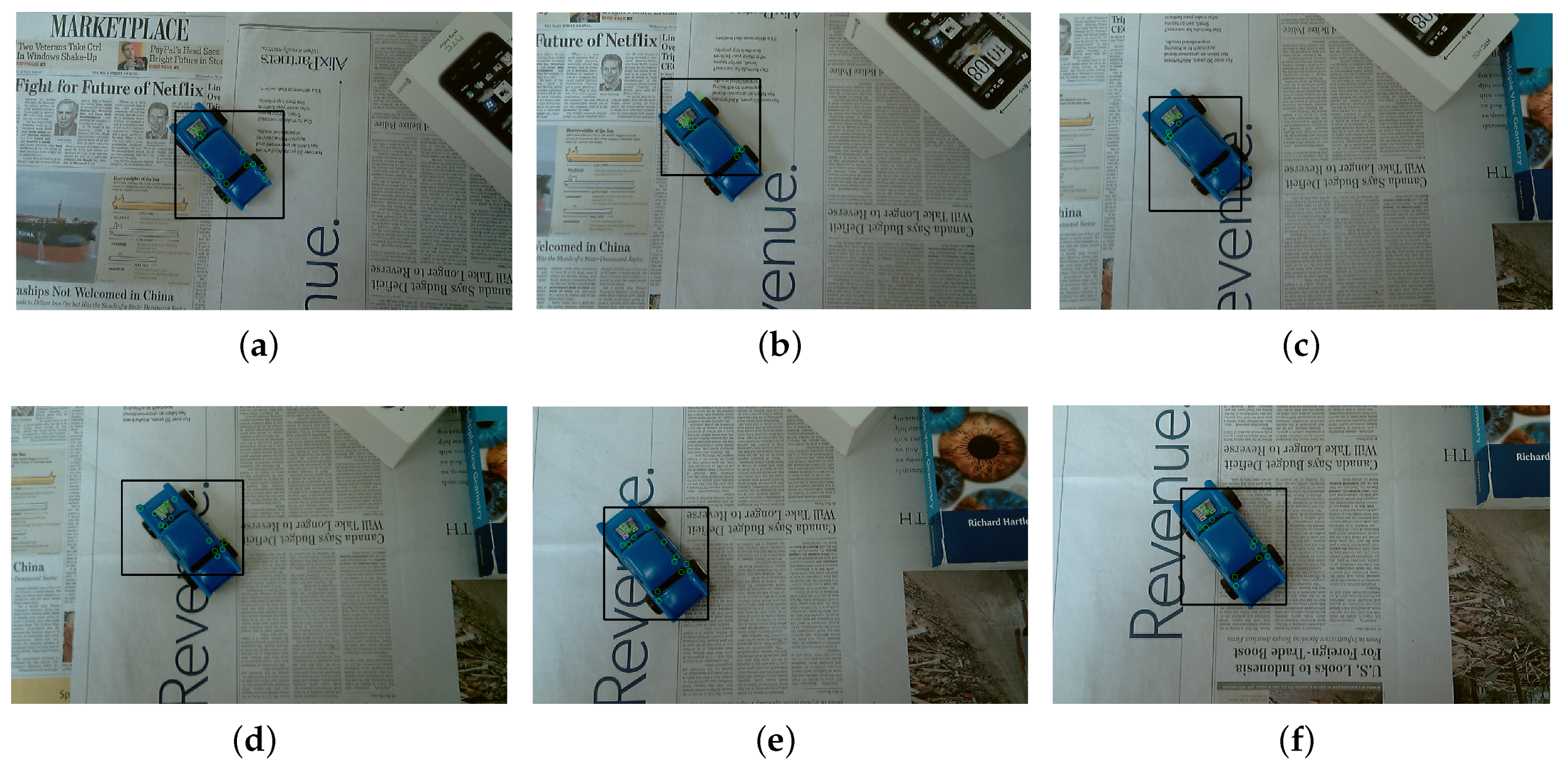
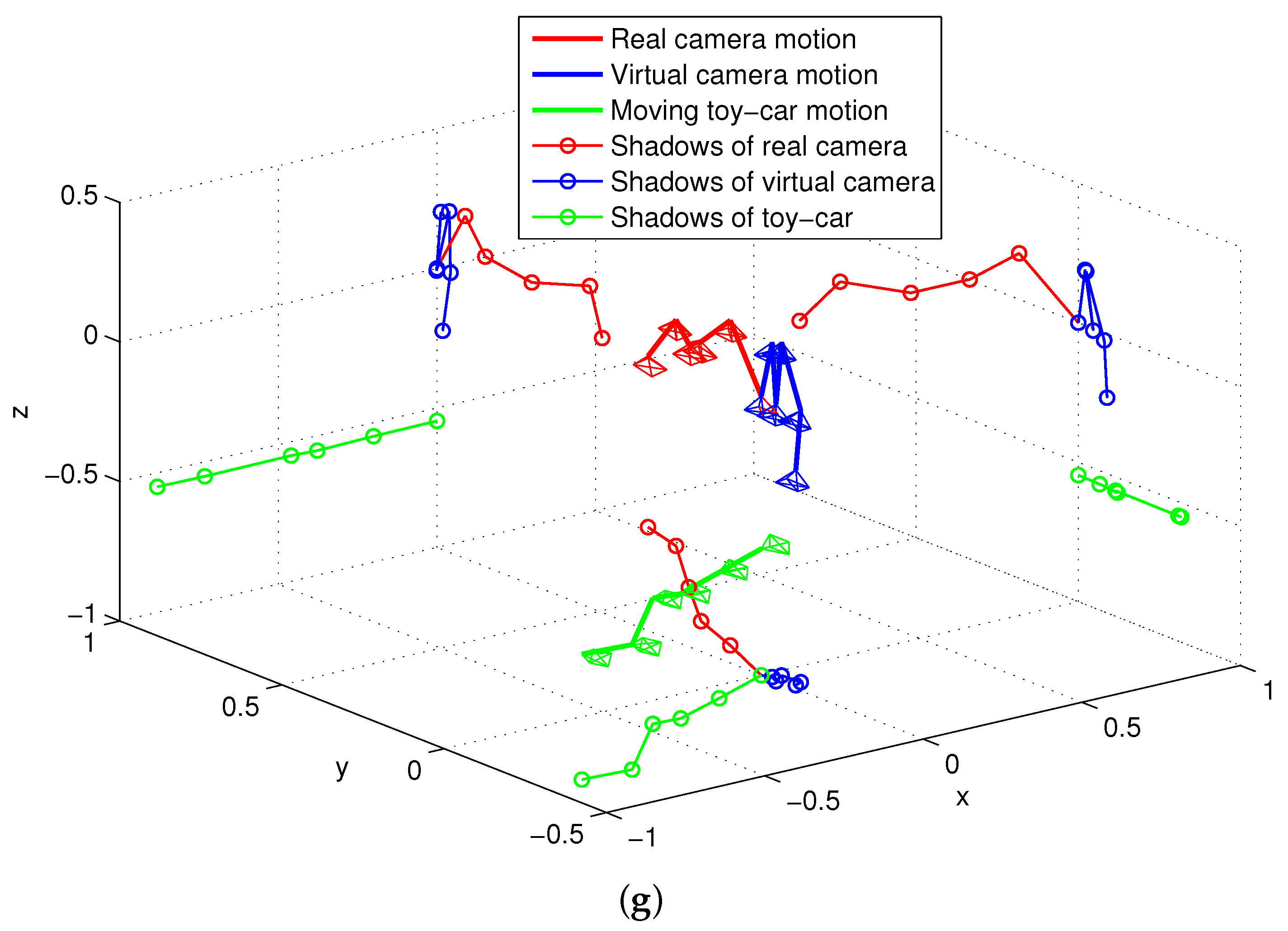
During this test, a person wearing the visual-inertial system was walking in an office-based environment, where a moving toy car was viewed. In this test scenario, a straight line was performed by the moving toy car on a table. The detected moving toy car is labeled within a black bounding box and six key frames with this detected toy car are selected as denoted in Figure 14a–f. Figure 14g shows the motion of the real and virtual camera, which are labeled by using red and blue line, respectively. The motion of moving car is finally derived and labeled by green line in Figure 14g. In particular, the trajectory of a moving car is clearly seen by drawing the shadows of each motion on a 2D plane.
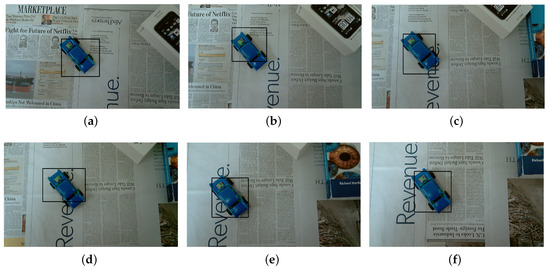
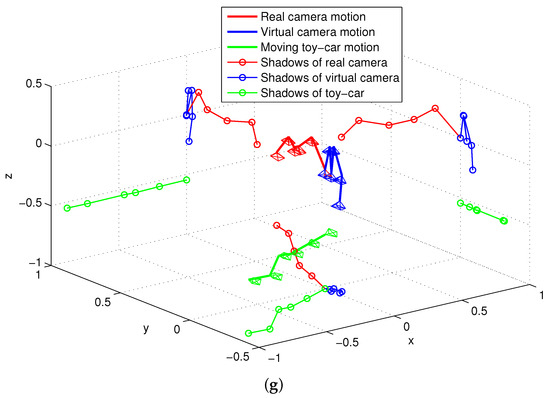
Figure 14.
Motion estimation with moving objects in an office-based environment. (a–f) typical frames; (g) the 3D motion of real camera, virtual camera and moving toy car with 2D shadows.
6.3. Experimental Analysis
6.3.1. Scale Factor Analysis
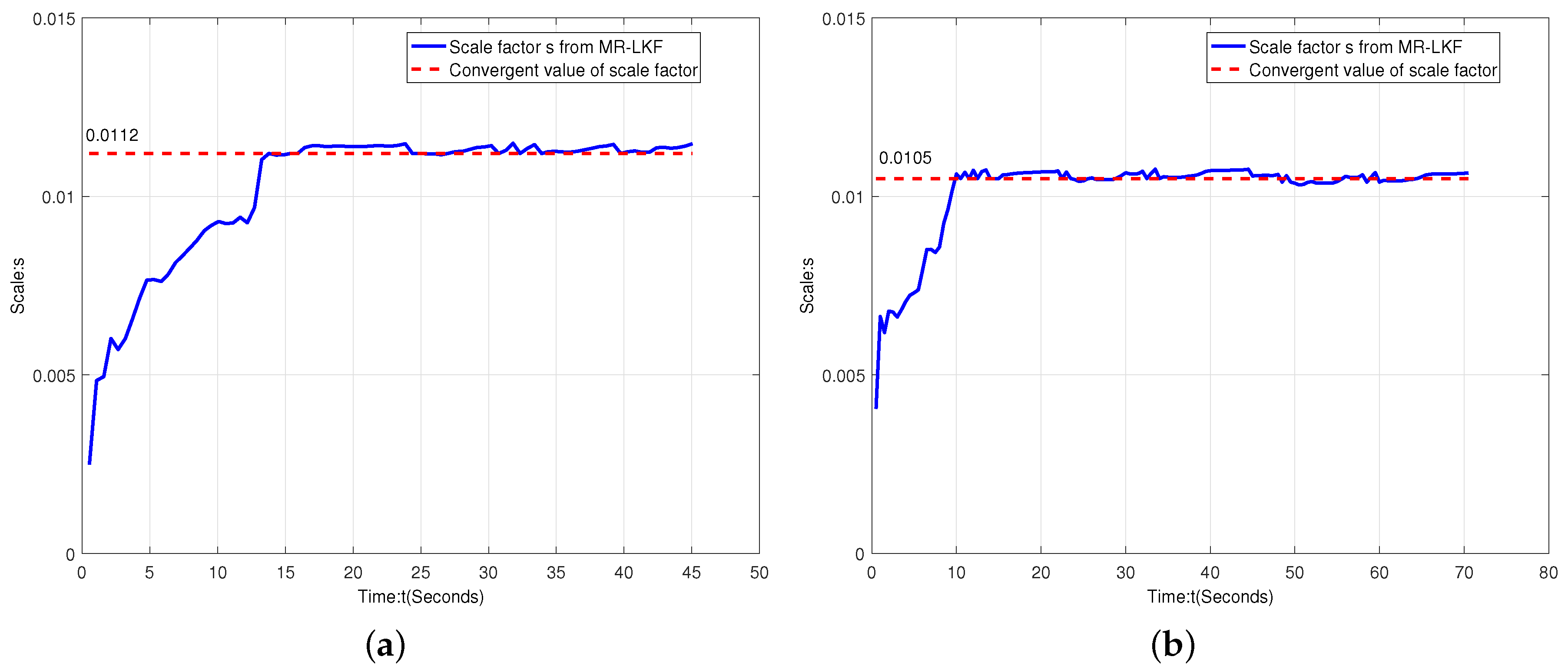
Figure 15 shows the scale factor estimation for straight-line and curve movements. It is clearly illustrated that the scale factor s changes over time t and its converge time is about 10 s. Therefore, each experiment requires 10 s time calibration at the beginning.
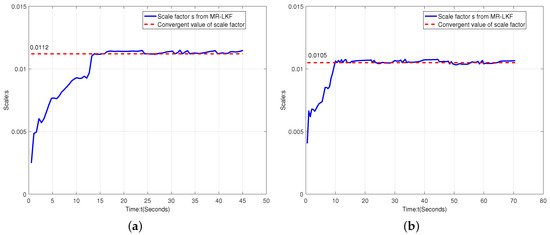
Figure 15.
Scale factor analysis. (a) scale factor estimation for straight-line motion; (a) scale factor estimation for curve motion.
6.3.2. Accuracy Analysis
Four different movements have been used to test the accuracy of our proposed algorithm. For Experiments I and II, the error of each camera position in the reconstructed trajectory is calculated as the Euclidean distance between each point of the estimated camera trajectory and the trajectory from Pioneer robot as shown in Label (36). Based on the known trajectory equation of the semicircle, the accuracy can be verified by Label (37), where m is actually the length of robot arm. The accuracy of the fifth experiment is verified based on the known path of the moving toy car:
Table 3 depicts the error accuracy analysis for four experiments. The true length of four different trajectories is respectively 12 m, m, m and 1 m. As clearly shown in Figure 10h and Figure 11h, the robot platform experienced different motions with slow and smooth motion in Experiment I and fast rotational and translational motion in Experiment II. From Table 3, it is clearly seen that Experiment I has higher accuracy than Experiment II, but the estimated results from our proposed method in both of Experiments I and II are more accurate than those from the EKF as shown in Figure 10g and Figure 11g.
Table 3.
Error accuracy analysis in four experiments.
6.3.3. Dynamic Scene Segmentation Analysis
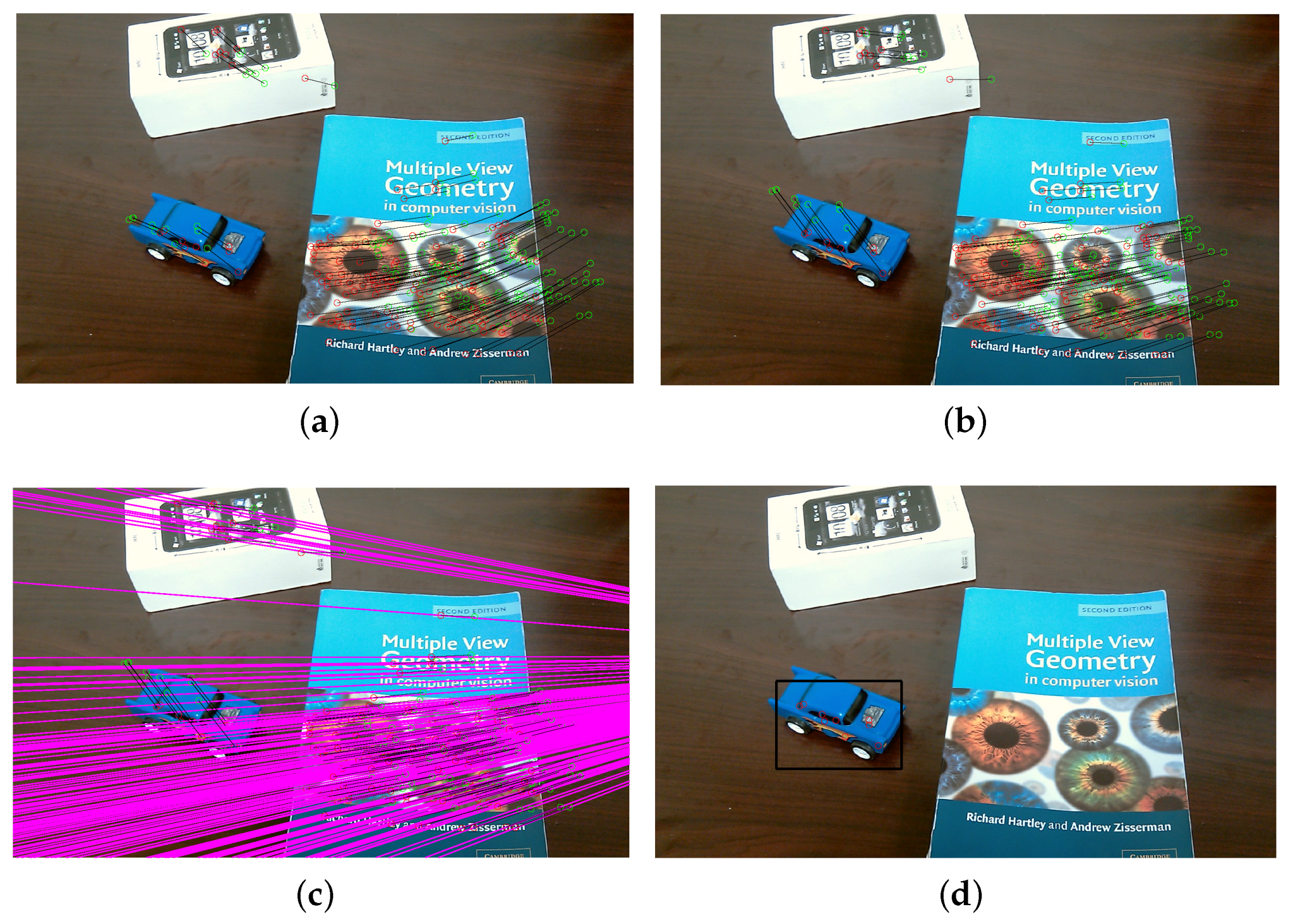
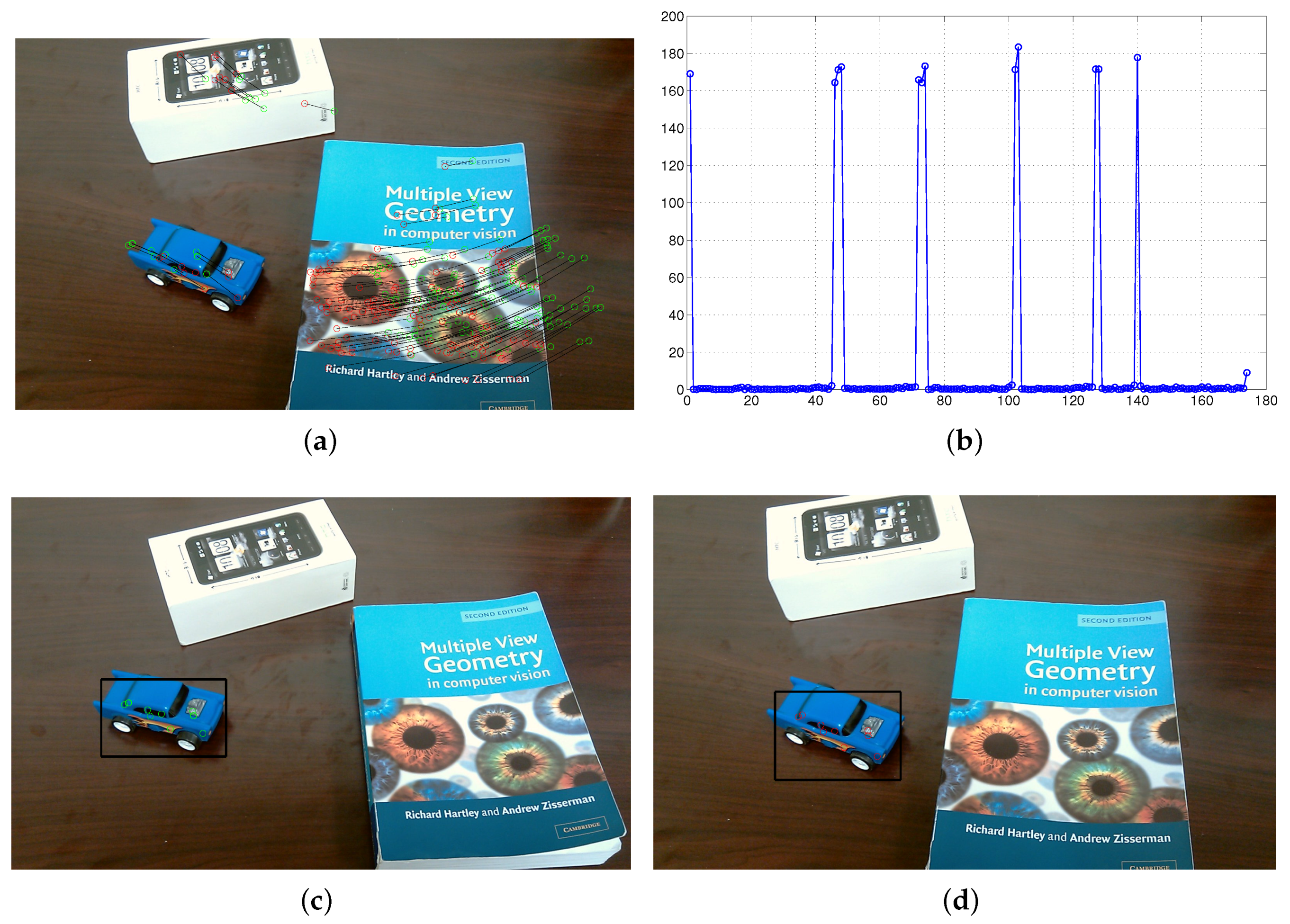
The experimental illustration was shown in Figure 16 to demonstrate our proposed AGOF-aided homography recovery constraint for dynamic scene segmentation. Figure 16a shows detected 2D feature points and matched in two consecutive frames (green circles in the first frame and red circles in the second frame). In Figure 16b, the feature points in the first frame are transformed and 2D motion paths are obtained based on homography recovery with the help of the AGOF orientation filter. It is clear seen from Figure 16c that the feature matches can be easily sorted out. Finally, the moving object can be detected and separated from the background as denoted in Figure 16d.
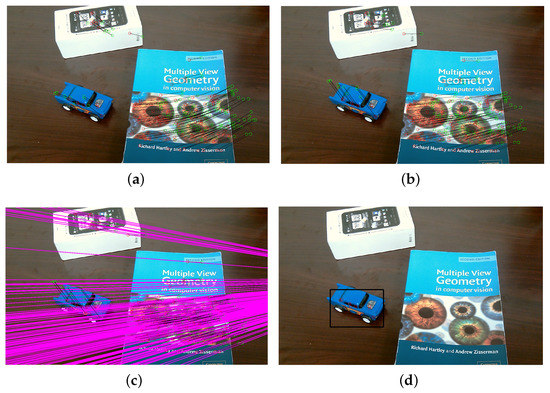
Figure 16.
Experimental illustrations for homography recovery. (a) detected 2D feature points in first frame; (b) detected 2D feature points in second frame; (c) sorted feature matches; (d) detected toy car.
The experimental illustration for the proposed dynamic scene segmentation constrained by epipolar geometry is shown in Figure 17. Figure 17a depicts detected 2D feature points and matched in two consecutive frames. The distance errors between the points and their corresponding epipolar lines are shown in Figure 17b. As we described in Section 4.1.2, the larger the distance is, the more likely the 3D point belongs to an independently moving object. Therefore, the distance errors can be used to sort out the points belonging to the moving object. As a result, the moving object can be separated from the background and tracked in each frame as shown in Figure 17c,d.
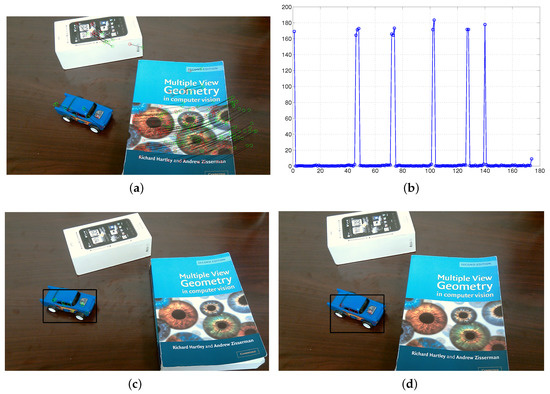
Figure 17.
Experimental illustrations for epipolar geometry. (a) feature matches; (b) distance errors; (c) moving toy car detected in first frame; (d) moving toy car detected in second frame.
6.3.4. Scale Adjustment and Estimation Analysis
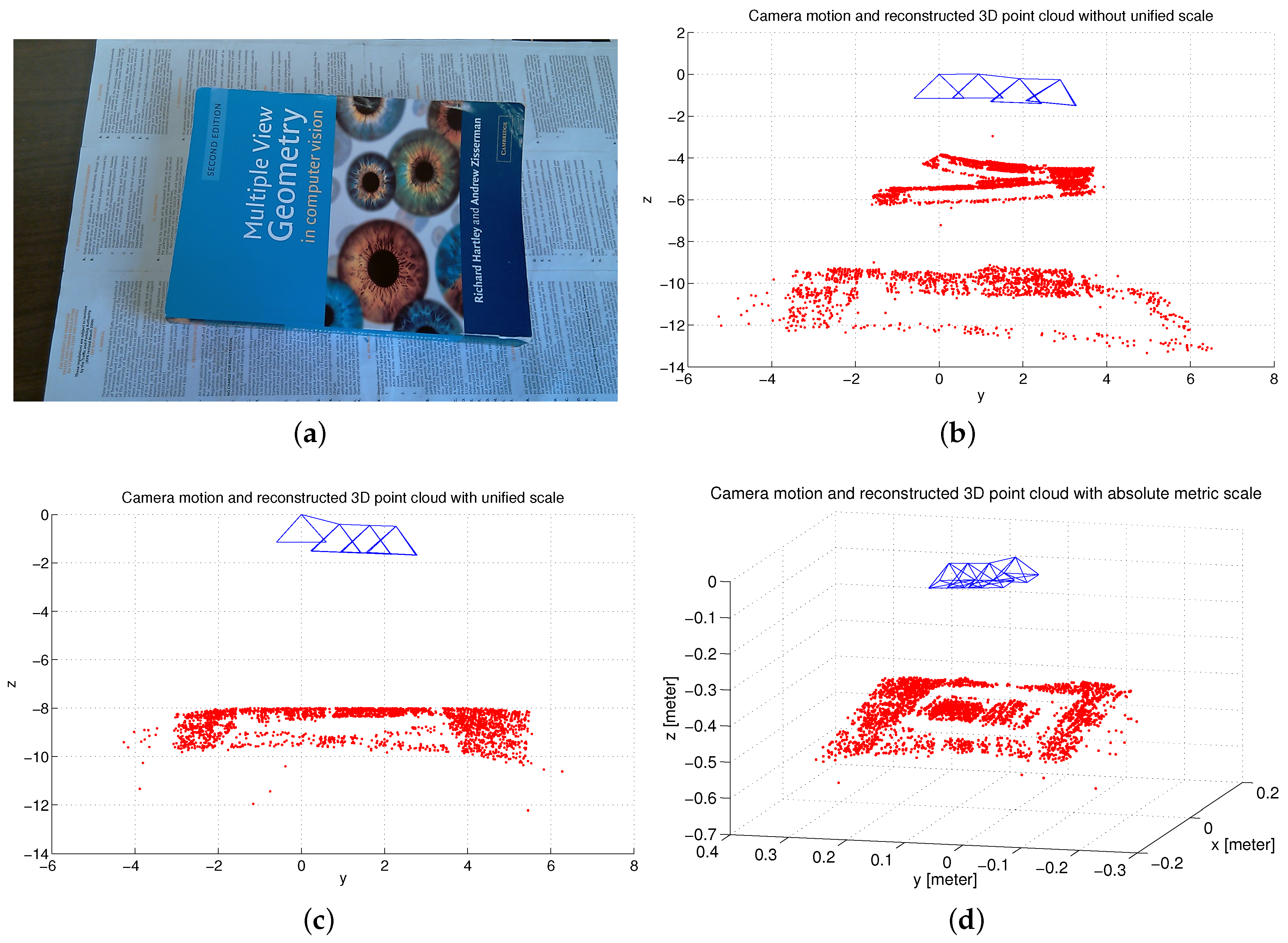
Based on a set of scale inconsistent camera motions and 2D feature matches, the 3D structure could be reconstructed using a linear reconstruction method, such as singular value decomposition (SVD) [10]. While the reconstructed 3D structure could be very noisy and not consistent due to the frame-to-frame reconstruction and the inconsistent estimation of the camera motion. This also results in a duplicated structure as shown in Figure 18b. After adopting our proposed scale adjustment method, a refined 3D point cloud can be obtained with a unified scale. Figure 18c clearly shows that the reconstructed 3D structure is consistent and has no duplicated structure. Having obtained a set of scale consistent camera motions, an absolute global scale can be estimated with the help of the IMU sensor and the 3D reconstructed point cloud with metric scale is shown in Figure 18d.
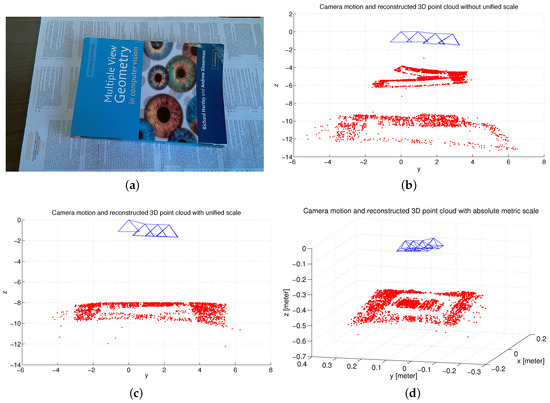
Figure 18.
Experimental illustrations for scale adjustment and estimation. (a) original frame; (b) camera motion and 3D reconstructed point cloud without unified scale; (c) camera motion and 3D reconstructed point cloud with unified scale; (d) camera motion and 3D reconstructed point cloud with metric scale.
7. Conclusions
A novel wearable absolute ego-motion tracking system was proposed for indoor positioning. The use of pre-estimated orientation from inertial sensors can eliminate mismatched points based on geometry constraints. In addition, a novel concept of “virtual camera” was presented to represent the motion from the motion areas related to each moving object, which was actually the combined motion from the real camera and the moving object. Moreover, an adaptive multi-rare linear Kalman filter was adopted to solve not only scale ambiguity, but also the problem of different sampling rates. This proposed system has much potential to aid the visually impaired and blind people, so, in the future, the goal of our work will aim at several scenarios of real obstacles to test the robustness and effectiveness of the proposed system with motion alerts.
Supplementary Materials
The following are available online at http://www.mdpi.com/2072-666X/9/3/113/s1, Video S1: Ego-motion demonstration, Video S2: Realtime orientation demonstration.
Acknowledgments
This work is partially supported by the National Science Foundation of China (NSFC) under Grant (No. 61403237 and No. 61573226) and Shandong Jianzhu University Doctoral Program Foundation under Grant (No. XNBS1330).
Author Contributions
Ya Tian and Zhe Chen designed the algorithm, performed the experiments, analyzed the data and wrote the paper. Shouyin Lu and Jindong Tan conceived of and designed the experiments. All authors contributed to the paper correction and improvments.
Conflicts of Interest
The authors declare no conflict of interest.
References
- Aging Statistics from Administration on Aging. Available online: https://aoa.acl.gov/Aging-Statistics/index.aspx (accessed on 24 October 2017).
- Tian, Y.; Wei, H.; Tan, J. An Adaptive-Gain Complementary Filter for Real-Time Human Motion Tracking With MARG Sensors in Free-Living Environments. IEEE Trans. Neural Syst. Rehabilit. Eng. 2013, 21, 254–264. [Google Scholar] [CrossRef] [PubMed]
- Davison, A. Real-time simultaneous localisation and mapping with a single camera. In Proceedings of the ICCV ’03 Proceedings of the Ninth IEEE International Conference on Computer Vision, Washington, DC, USA, 13–16 October 2003; Volume 2, pp. 1403–1410. [Google Scholar]
- Klein, G.; Murray, D. Parallel Tracking and Mapping for Small AR Workspaces. In Proceedings of the 6th IEEE and ACM International Symposium on Mixed and Augmented Reality, Nara, Japan, 13–16 November 2007; pp. 225–234. [Google Scholar]
- Forster, C.; Pizzoli, M.; Scaramuzza, D. SVO: Fast Semi-Direct Monocular Visual Odometry. In Proceedings of the IEEE International Conference on Robotics and Automation (ICRA), Hong Kong, China, 31 May–7 June 2014; pp. 15–22. [Google Scholar]
- Engel, J.; Cremers, D. Semi-dense Visual Odometry for a Monocular Camera. In Proceedings of the IEEE International Conference on Computer Vision, Sydney, Australia, 1–8 December 2014; pp. 1449–1456. [Google Scholar]
- Randeniya, D.; Sarkar, S.; Gunaratne, M. Vision-IMU Integration Using a Slow-Frame-Rate Monocular Vision System in an Actual Roadway Setting. IEEE Trans. Intell. Transp. Syst. 2010, 11, 256–266. [Google Scholar] [CrossRef]
- Tardif, J.; George, M.; Laverne, M. A New Approach to Vision-Aided Inertial Navigation. In Proceedings of the IEEE/RSJ International Conference on Intelligent Robots and Systems, Taipei, Taiwan, 18–22 October 2010; pp. 4161–4168. [Google Scholar]
- Scharstein, D.; Szeliski, R. A Taxonomy and Evaluation of Dense Two-Frame Stereo Correspondence Algorithms. Int. J. Comput. Vis. 2002, 47, 7–42. [Google Scholar] [CrossRef]
- Hartley, R.; Zisserman, A. Multiple View Geometry in Computer Vision; The Press Syndicate of the University of Cambridge: Cambridge, UK, 2003. [Google Scholar]
- Pollefeys, M.; Van Gool, L.; Vergauwen, M.; Verbiest, F.; Cornelis, K.; Tops, J.; Koch, R. Visual Modeling with a Hand-Held Camera. Int. J. Comput. Vis. 2004, 59, 207–232. [Google Scholar] [CrossRef]
- Jebara, T.; Azarbayejani, A.; Pentland, A. 3D structure from 2D motion. IEEE Signal Process. Mag. 1999, 16, 66–84. [Google Scholar]
- Chiuso, A.; Favaro, P.; Jin, H.; Soatto, S. Structure from motion causally integrated over time. IEEE Trans. Pattern Anal. Mach. Intell. 2002, 24, 523–535. [Google Scholar] [CrossRef]
- Esteban, I.; Dijk, J.; Groen, F. FIT3D toolbox: Multiple view geometry and 3D reconstruction for matlab. In Electro-Optical Remote Sensing, Photonic Technologies, and Applications IV; SPIE: Bellingham, WA, USA, 2010. [Google Scholar]
- You, S.; Neumann, U.; Azuma, R. Hybrid Inertial and Vision Tracking for Augmented Reality Registration. In Proceedings of the IEEE Virtual Reality, Houston, TX, USA, 13–17 March 1999; pp. 260–267. [Google Scholar]
- Huster, A.; Frew, E.; Rock, S. Relative position estimation for AUVs by fusing bearing and inertial rate sensor measurements. In Proceedings of the OCEANS ’02 MTS/IEEE, Biloxi, MI, USA, 29–31 October 2002; Volume 3, pp. 1863–1870. [Google Scholar]
- Bleser, G.; Stricker, D. Advanced Tracking Through Efficient Image Processing and Visual-Inertial Sensor Fusion. Comput. Graph. 2009, 33, 59–72. [Google Scholar] [CrossRef]
- Peter Corke, J.L.; Dias, J. An introduction to inertial and vision sensing. Int. J. Robot. Res. 2007, 26, 519–535. [Google Scholar] [CrossRef]
- Gemeiner, P.; Einramhof, P.; Vincze, M. Simultaneous motion and structure estimation by fusion of inertial and vision data. Int. J. Robot. Res. 2007, 26, 591–605. [Google Scholar] [CrossRef]
- Maes, K.; Lourens, E.; Nimmen, K.V.; Reynders, E.; Roeck, G.D.; Lombaert, G. Design of sensor networks for instantaneous inversion of modally reduced order models in structural dynamics. Mech. Syst. Signal Process. 2015, 52–53, 628–644. [Google Scholar] [CrossRef]
- Lourens, E.; Papadimitriou, C.; Gillijns, S.; Reynders, E.; Roeck, G.D.; Lombaert, G. Joint input-response estimation for structural systems based on reduced-order models and vibration data from a limited number of sensors. Mech. Syst. Signal Process. 2012, 29, 310–327. [Google Scholar] [CrossRef]
- Azam, S.E.; Chatzi, E.; Papadimitriou, C. A dual Kalman filter approach for state estimation via output-only acceleration measurements. Mech. Syst. Signal Process. 2015, 60–61, 866–886. [Google Scholar] [CrossRef]
- Azam, S.E.; Chatzi, E.; Papadimitriou, C.; Smyth, A. Experimental Validation of the Dual Kalman Filter for Online and Real-Time State and Input Estimation. In Proceedings of the IMAC XXXIII, Orlando, FL, USA, 2–5 February 2015; pp. 1–13. [Google Scholar]
- Chen, J.; Pinz, A. Structure and Motion by Fusion of Inertial and Vision-Based Tracking. In Proceedings of the 28th OAGM/AAPR Conference, Hagenberg, Austria, 17–18 June 2004; Volume 179, pp. 55–62. [Google Scholar]
- Li, M.; Mourikis, A.I. High-Precision, Consistent EKF-Based Visual-Inertial Odometry; Sage Publications, Inc.: Thousand Oaks, CA, USA, 2013. [Google Scholar]
- Panahandeh, G.; Jansson, M. Vision-Aided Inertial Navigation Based on Ground Plane Feature Detection. IEEE/ASME Trans. Mechatron. 2014, 19, 1206–1215. [Google Scholar]
- Diel, D.D.; DeBitetto, P.; Teller, S. Epipolar Constraints for Vision-Aided Inertial Navigation. In Proceedings of the IEEE Workshop on Motion and Video Computing, Breckenridge, CO, USA, 5–7 January 2005; Volume 2, pp. 221–228. [Google Scholar]
- Liu, C.; Prior, S.D.; Teacy, W.L.; Warner, M. Computationally efficient visual-inertial sensor fusion for Global Positioning System-denied navigation on a small quadrotor. Adv. Mech. Eng. 2016, 8. [Google Scholar] [CrossRef]
- Madgwick, S.O.H.; Harrison, A.J.L.; Vaidyanathan, R. Estimation of IMU and MARG orientation using a gradient descent algorithm. In Proceedings of the IEEE International Conference on Rehabilitation Robotics, Zurich, Switzerland, 29 June–1 July 2011; p. 5975346. [Google Scholar]
- Tian, Y.; Hamel, W.R.; Tan, J. Accurate Human Navigation Using Wearable Monocular Visual and Inertial Sensors. IEEE Trans. Instrum. Meas. 2014, 63, 203–213. [Google Scholar] [CrossRef]
- Lowe, D. Distinctive image features from scale-invariant keypoints. Int. J. Comput. Vis. 2004, 60, 91–110. [Google Scholar] [CrossRef]
- Horn, B.K. Recovering Baseline and Orientaiton from Essential Matrix. J. Opt. Soc. Am. 1990, M, 1–10. [Google Scholar]
- Esteban, I.; Dorst, L.; Dijk, J. Closed form solution for the scale ambiguity problem in monocular visual odometry. In Proceedings of the Third International Conference on Intelligent Robotics and Applications, Shanghai, China, 10–12 November 2010; Part I. pp. 665–679. [Google Scholar]
- Lobo, J.; Dias, J. Vision and Inertial Sensor Cooperation Using Gravity as a Vertical Reference. IEEE Trans. Pattern Anal. Mach. Intell. 2003, 25, 1597–1608. [Google Scholar] [CrossRef]
© 2018 by the authors. Licensee MDPI, Basel, Switzerland. This article is an open access article distributed under the terms and conditions of the Creative Commons Attribution (CC BY) license (http://creativecommons.org/licenses/by/4.0/).