High-Quality and High-Efficiency Fabrication of Microlens Array by Rotary Profile Cutting Method
 ,
, 
Abstract
1. Introduction
2. Methods
2.1. Basic Principles of RPC for MLA Mold Fabrication
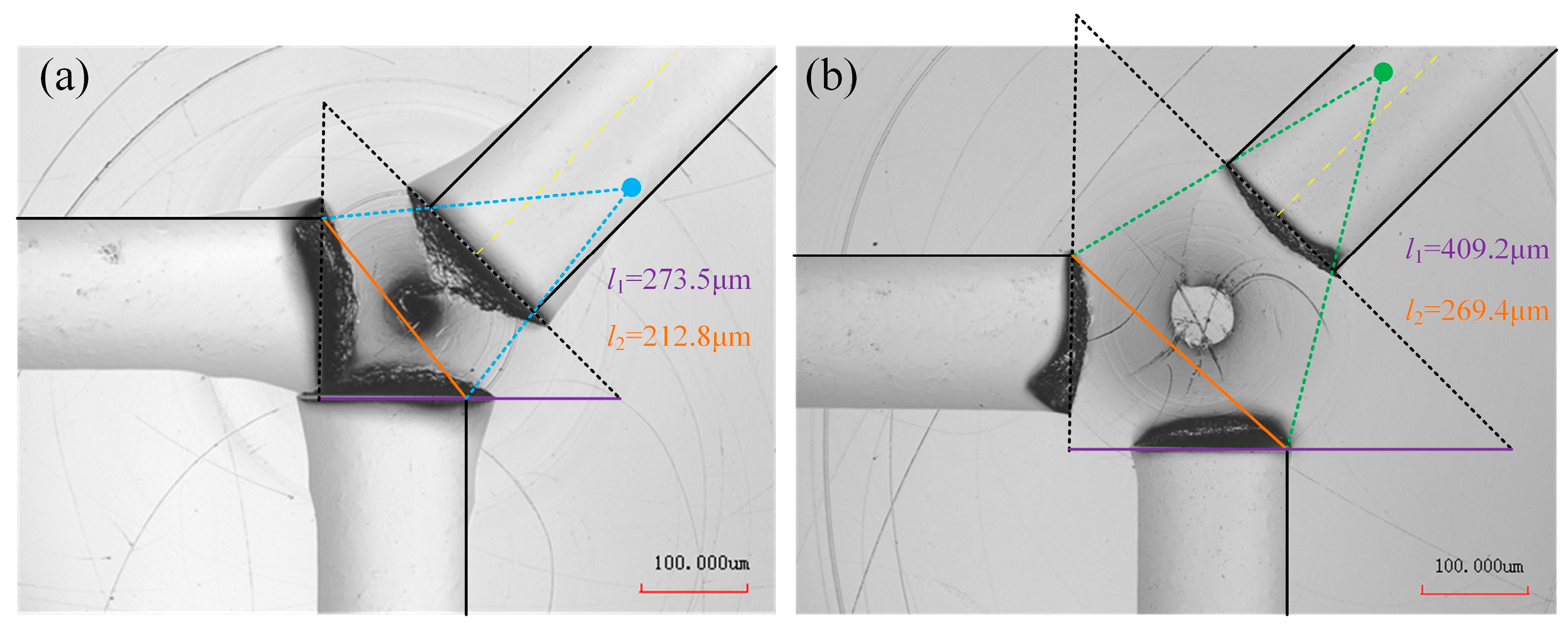
2.2. Effect of Tool Setting Errors During RPC
2.3. Control Method of Tool Setting Errors
3. Experimental Setup
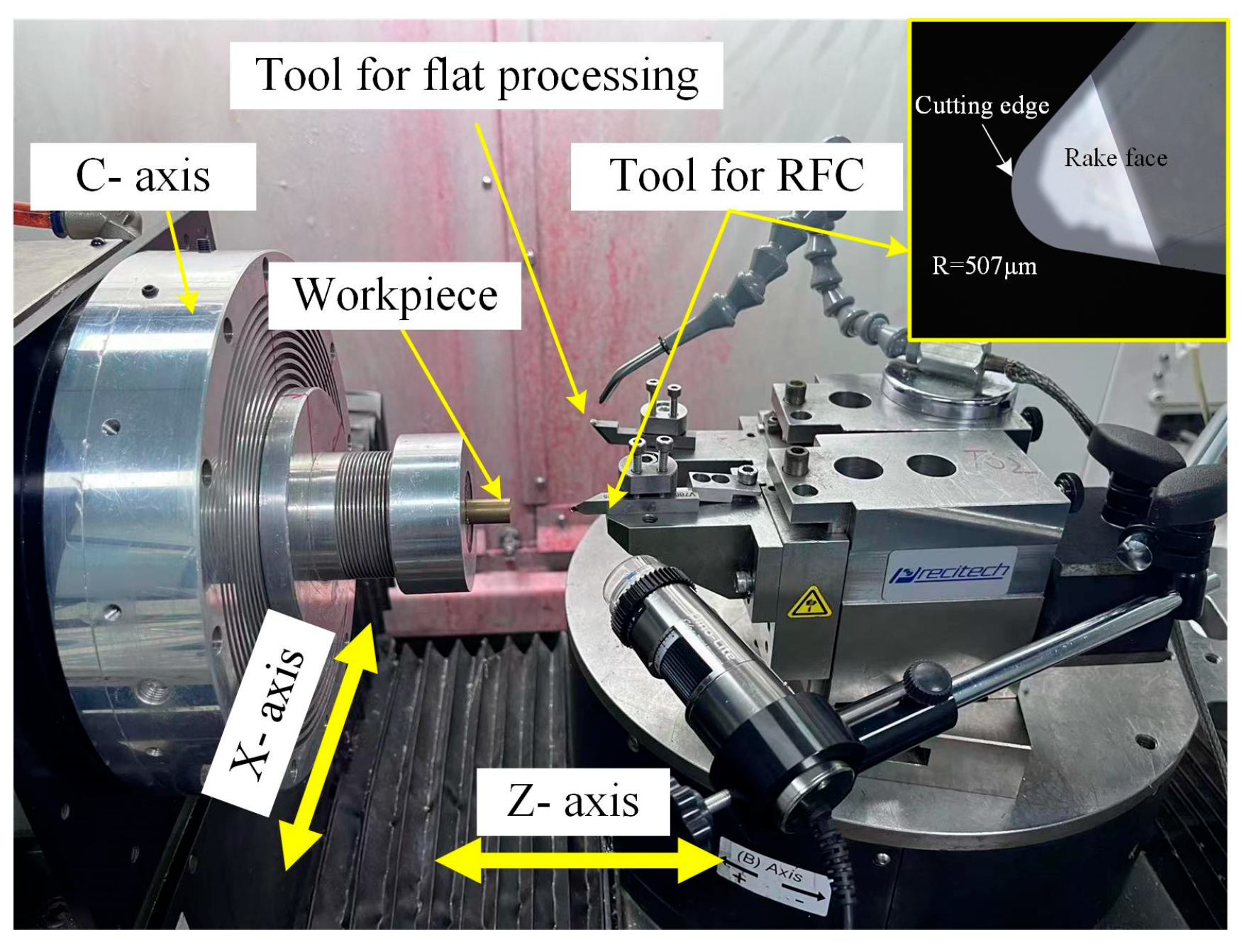
3.1. Rotary Profile Cutting for MLA Mold
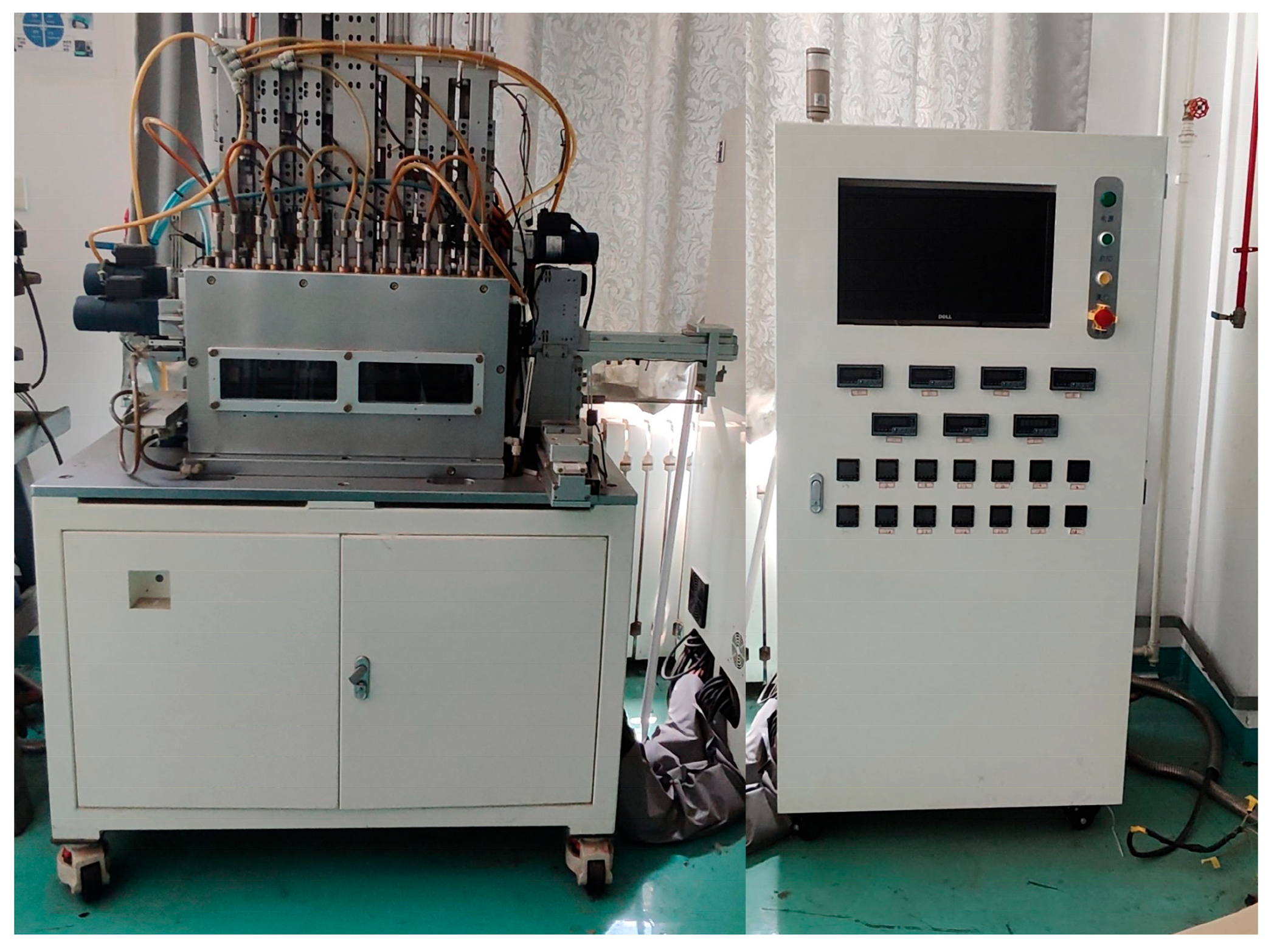
3.2. Precision Glass Molding for MLA Optics
4. Results and Discussion
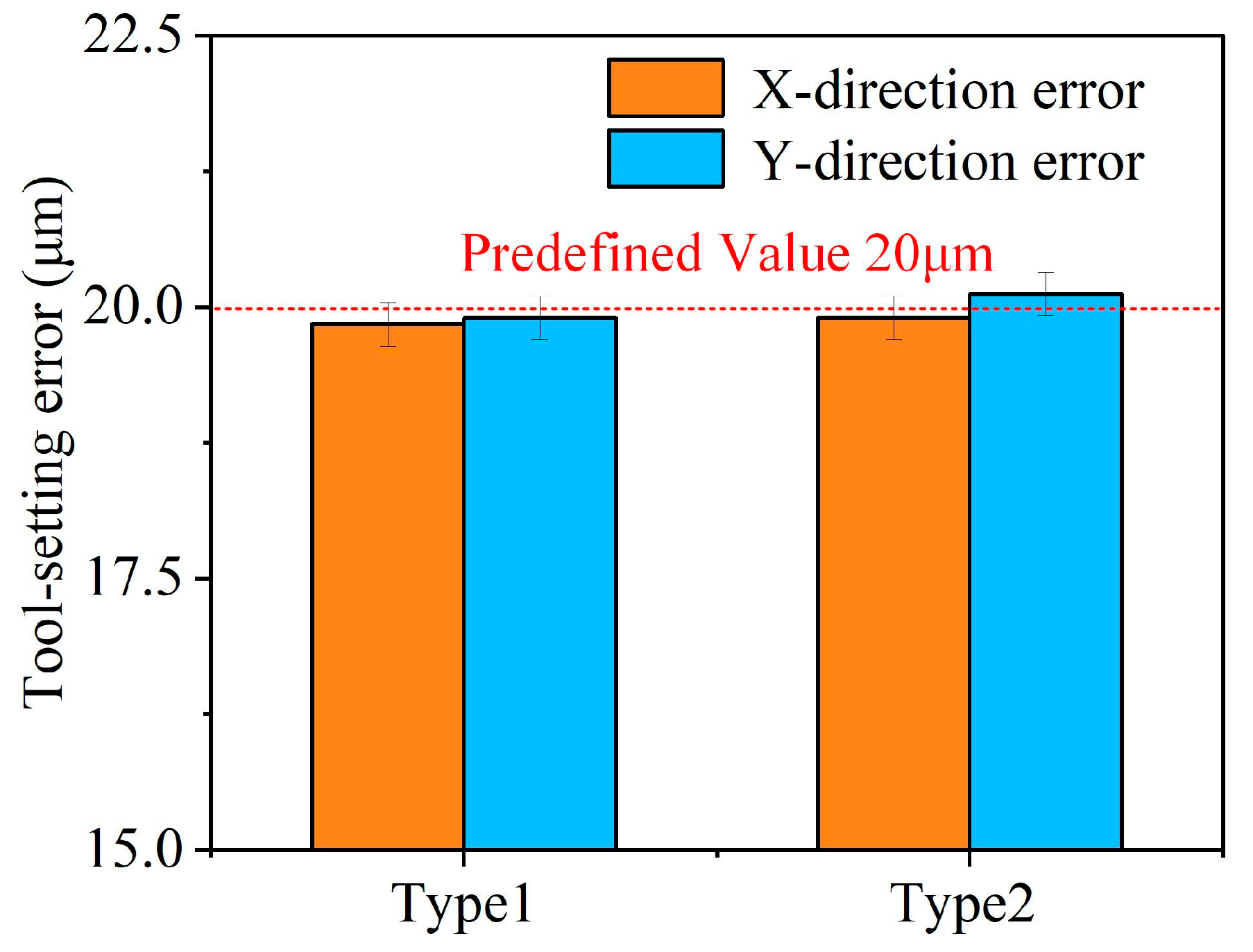
4.1. Quantification of Tool Setting Errors
4.2. Evaluation of MLA Accuracy
4.3. Test of MLA Optical Imaging Performance
5. Conclusions
Author Contributions
Funding
Data Availability Statement
Conflicts of Interest
References
- Zhou, T.; He, Y.; Wang, T.; Zhu, Z.; Xu, R.; Yu, Q.; Zhao, B.; Zhao, W.; Liu, P.; Wang, X. A review of the techniques for the mold manufacturing of micro/nanostructures for precision glass molding. Int. J. Extreme Manuf. 2021, 3, 042002. [Google Scholar] [CrossRef]
- Liu, Z.; Hu, G.; Ye, H.; Wei, M.; Guo, Z.; Chen, K.; Liu, C.; Tang, B.; Zhou, G. Mold-free self-assembled scalable microlens arrays with ultrasmooth surface and record-high resolution. Light Sci. Appl. 2023, 12, 143. [Google Scholar] [CrossRef]
- Zhang, Q.; Schambach, M.; Schlisske, S.; Jin, Q.; Mertens, A.; Rainer, C.; Hernandez-Sosa, G.; Heizmann, M.; Lemmer, U. Fabrication of Microlens Arrays with High Quality and High Fill Factor by Inkjet Printing. Adv. Opt. Mater. 2022, 10, 2200677. [Google Scholar] [CrossRef]
- Xu, M.; Xue, Y.; Li, J.; Zhang, L.; Lu, H.; Wang, Z. Large-Area and Rapid Fabrication of a Microlens Array on a Flexible Substrate for an Integral Imaging 3D Display. ACS Appl. Mater. Interfaces 2023, 15, 10219–10227. [Google Scholar] [CrossRef]
- Schambach, M.; León, F.P. Microlens Array Grid Estimation, Light Field Decoding, and Calibration. IEEE Trans. Comput. Imaging 2020, 6, 591–603. [Google Scholar] [CrossRef]
- Lin, R.J.; Su, V.-C.; Wang, S.; Chen, M.K.; Chung, T.L.; Chen, Y.H.; Kuo, H.Y.; Chen, J.-W.; Chen, J.; Huang, Y.-T.; et al. Achromatic metalens array for full-colour light-field imaging. Nat. Nanotechnol. 2019, 14, 227–231. [Google Scholar] [CrossRef] [PubMed]
- Martínez-Corral, M.; Javidi, B. Fundamentals of 3D imaging and displays: A tutorial on integral imaging, light-field, and plenoptic systems. Adv. Opt. Photonics 2018, 10, 512. [Google Scholar] [CrossRef]
- Delgado, T.; Nieto, D.; Flores-Arias, M.T. Fabrication of microlens arrays on soda-lime glass using a laser direct-write technique and a thermal treatment assisted by a CO2 laser. Opt. Lasers Eng. 2015, 73, 1–6. [Google Scholar] [CrossRef]
- Wu, J.; Guo, Y.; Deng, C.; Zhang, A.; Qiao, H.; Lu, Z.; Xie, J.; Fang, L.; Dai, Q. An integrated imaging sensor for aberration-corrected 3D photography. Nature 2022, 612, 62–71. [Google Scholar] [CrossRef] [PubMed]
- Zhou, T.; Ma, F.; Ruan, B.; Zhou, J.; Liew, P.; Wang, X. Microlens array fabrication on WC mold using EDM milling with in situ electrode trimming. Int. J. Adv. Manuf. Technol. 2019, 103, 3003–3011. [Google Scholar] [CrossRef]
- Cheng, T.; Ke, K.; Yang, S. Fabrication of wafer-level double-sided microlens array using injection compression molding. Polym. Eng. Sci. 2023, 63, 1334–1341. [Google Scholar] [CrossRef]
- Yang, S.; Kim, J.; Seo, Y.; Jeong, K. Rotational Offset Microlens Arrays for Highly Efficient Structured Pattern Projection. Adv. Opt. Mater. 2020, 8, 2000395. [Google Scholar] [CrossRef]
- Zuo, H.; Choi, D.-Y.; Gai, X.; Luther-Davies, B.; Zhang, B. CMOS compatible fabrication of micro, nano convex silicon lens arrays by conformal chemical vapor deposition. Opt. Express 2017, 25, 3069. [Google Scholar] [CrossRef] [PubMed]
- Yan, J.; Oowada, T.; Zhou, T.; Kuriyagawa, T. Precision machining of microstructures on electroless-plated NiP surface for molding glass components. J. Mater. Process. Technol. 2009, 209, 4802–4808. [Google Scholar] [CrossRef]
- Zhou, T.; Zhou, J.; Wang, T.; Gao, L.; Ruan, B.; Yu, Q.; Zhao, W.; Wang, X. Fabrication of high aspect-ratio aspheric microlens array based on local spiral diamond milling. J. Manuf. Process. 2022, 83, 547–554. [Google Scholar] [CrossRef]
- Yi, A.Y.; Li, L. Design and fabrication of a microlens array by use of a slow tool servo. Opt. Lett. 2005, 30, 1707. [Google Scholar] [CrossRef]
- Cheung, C.F.; Hu, K.; Jiang, X.Q.; Kong, L.B. Characterization of surface defects in fast tool servo machining of microlens array using a pattern recognition and analysis method. Measurement 2010, 43, 1240–1249. [Google Scholar] [CrossRef]
- Zhou, T.; Zhang, Z.; Zhou, J.; Zhao, B.; Yao, X.; Wang, X.; Hu, J.; Zeng, J. Study of quadrifoliate tool-setting method for diamond milling of microlens array. Precis. Eng. 2023, 83, 170–180. [Google Scholar] [CrossRef]
- Luan, S.; Peng, F.; Zheng, G.; Gui, C.; Song, Y.; Liu, S. High-speed, large-area and high-precision fabrication of aspheric micro-lens array based on 12-bit direct laser writing lithography. Light Adv. Manuf. 2022, 3, 47. [Google Scholar] [CrossRef]
- Sun, Y.; He, Z.; Fu, C.; Xie, Z.; Zhang, B.; Liu, H. Surface modeling and influencing factors for microlens array by slow tool servo machining. J. Manuf. Process. 2023, 102, 365–374. [Google Scholar] [CrossRef]
- Kong, L.B.; Cheung, C.F. Modeling and characterization of surface generation in fast tool servo machining of microlens arrays. Comput. Ind. Eng. 2012, 63, 957–970. [Google Scholar] [CrossRef]
- Kim, Y.B.; Park, J.; Lee, W.S.; Lee, J.K. Fabrication of microlens array by the tilted milling method to improve the surface morphology. Mater. Manuf. Process. 2021, 36, 1171–1177. [Google Scholar] [CrossRef]
- Gonzalez-Hernandez, D.; Varapnickas, S.; Merkininkaitė, G.; Čiburys, A.; Gailevičius, D.; Šakirzanovas, S.; Juodkazis, S.; Malinauskas, M. Laser 3D Printing of Inorganic Free-Form Micro-Optics. Photonics 2021, 8, 577. [Google Scholar] [CrossRef]
- Yu, Q.; Zhou, T.; He, Y.; Liu, P.; Wang, X.; Jiang, Y.; Yan, J. Annealed high-phosphorus electroless Ni–P coatings for producing molds for precision glass molding. Mater. Chem. Phys. 2021, 262, 124297. [Google Scholar] [CrossRef]



| Cutting Parameter | Value |
|---|---|
| Cutting velocity v (mm/min) | 3.5 |
| C-axis rotation speed (deg/min) | 100 |
| Depth of finish cutting (nm) | 30, 60, 120, 240 |
| Tool nose radius R (μm) | 507 |
| Tool clearance angle (°) | 15 |
| Rake angle (°) | 0 |
| Machining time (min) | 25 |
| Stage | Temperature (°C) | Heating/Cooling Rate (°C/s) | Force (N) |
|---|---|---|---|
| Rapid heating | 25–310 | 3 | 0 |
| Slow heating1 | 310–355 | 0.3 | 0 |
| Slow heating2 | 355–375 | 0.2 | 0 |
| Temperature holding & Pressurization | 375 | 0 | 518 |
| Annealing & Pressure reduction | 375–340 | 0.2 | 50 |
| Slow cooling | 340–300 | 0.5 | 50 |
| Rapid cooling | 300–25 | 3 | 0 |
Disclaimer/Publisher’s Note: The statements, opinions and data contained in all publications are solely those of the individual author(s) and contributor(s) and not of MDPI and/or the editor(s). MDPI and/or the editor(s) disclaim responsibility for any injury to people or property resulting from any ideas, methods, instructions or products referred to in the content. |
© 2025 by the authors. Licensee MDPI, Basel, Switzerland. This article is an open access article distributed under the terms and conditions of the Creative Commons Attribution (CC BY) license (https://creativecommons.org/licenses/by/4.0/).
Share and Cite
Gao, L.; Sun, X.; Yu, Q.; Wang, Y.; Uddin, M.N.; Duan, R.; Wang, G.; Zhou, Z.; Xie, Q.; Sun, T.; et al. High-Quality and High-Efficiency Fabrication of Microlens Array by Rotary Profile Cutting Method. Micromachines 2025, 16, 1374. https://doi.org/10.3390/mi16121374
Gao L, Sun X, Yu Q, Wang Y, Uddin MN, Duan R, Wang G, Zhou Z, Xie Q, Sun T, et al. High-Quality and High-Efficiency Fabrication of Microlens Array by Rotary Profile Cutting Method. Micromachines. 2025; 16(12):1374. https://doi.org/10.3390/mi16121374
Chicago/Turabian StyleGao, Liheng, Xiuwen Sun, Qian Yu, Yinhui Wang, Md Nasir Uddin, Ruijue Duan, Gang Wang, Zhikang Zhou, Qiuchen Xie, Tao Sun, and et al. 2025. "High-Quality and High-Efficiency Fabrication of Microlens Array by Rotary Profile Cutting Method" Micromachines 16, no. 12: 1374. https://doi.org/10.3390/mi16121374
APA StyleGao, L., Sun, X., Yu, Q., Wang, Y., Uddin, M. N., Duan, R., Wang, G., Zhou, Z., Xie, Q., Sun, T., & Zhou, T. (2025). High-Quality and High-Efficiency Fabrication of Microlens Array by Rotary Profile Cutting Method. Micromachines, 16(12), 1374. https://doi.org/10.3390/mi16121374