


Abstract
Dietary fiber supplementation has been studied as a promising strategy in the treatment of obesity and its comorbidities. A systematic review and meta-analysis were performed to verify whether the consumption of yeast beta-glucan (BG) favors weight loss in obese and non-obese rodents. The PICO strategy was employed, investigating rodents (Population), subjected to the oral administration of yeast BG (Intervention) compared to animals receiving placebo (Comparison), evaluating body weight changes (Outcome), and based on preclinical studies (Study design). Two reviewers searched six databases and the grey literature. We followed the PRISMA 2020 guidelines, and the protocol was registered on PROSPERO (CRD42021267788). The search returned 2467 articles. Thirty articles were selected for full-text evaluation, and seven studies remained based on the eligibility criteria. The effects of BG intake on body weight were analyzed based on obese (n = 4 studies) and non-obese animals (n = 4 studies). Even though most studies on obese rodents (75%) indicated a reduction in body weight (qualitative analysis), the meta-analysis showed this was not significant (mean difference −1.35 g—95% CI −5.14:2.45). No effects were also observed for non-obese animals. We concluded that the ingestion of yeast BG barely affects the body weight of obese and non-obese animals.
1. Introduction
Obesity is a complex disease in which genetic, immunometabolic and environmental factors are involved [1]. It is associated with considerable public health consequences [2], causing approximately 3.4 million deaths worldwide every year [3]. Hypertension, dyslipidemia, cardiovascular disease, cancer [4] and mainly diabetes mellitus are closely associated with obesity [5] and, due to its increasing prevalence and morbidity risks, this disease is considered a global health pandemic [3].
The importance of weight balance for health is emphasized by most medical societies [6,7]. It generally involves lifestyle changes with caloric restrictions and physical exercise [7,8]. There are relatively few drugs approved for obesity treatment, and some of them have important side effects that contraindicate their use or are financially unfeasible for the majority of the population [7]. Furthermore, it is known that losing weight and maintaining this loss is not always an easy task, with most individuals experiencing weight regains [8].
Along with lifestyle changes, soluble fiber ingestion seems to be a relatively inexpensive and applicable approach to improve blood glucose and body weight control in patients with overweight and obesity [9]. In this context, beta-glucans (BGs) are a diverse group of natural polysaccharides. Their effects vary according to molecular weight, tertiary structure, solubility and type of linkage branching [10]. BG chemical structures have a central linear β (1 → 3) ligation composed of D-glucose monomers linked by a β-glycosidic bond, with the ramification (1 → 4) found in those extracted from bacteria and plants, whereas β (1 → 6) are found in BGs extracted from fungi [11,12]. These fibers have a beneficial role in metabolic disorders due to their ability to form a viscous solution (decreasing carbohydrate and lipid absorption) and to ferment (acetate, propionate and butyrate) in the gut, influencing the intestinal mucosal immunity, in addition to the barrier integrity and function [10].
Traditionally, cereal BGs are known to cause metabolic benefits [13,14], whereas those from microorganisms improve immune responses [15,16]. However, recent studies from our group have demonstrated metabolic benefits after yeast BG (Saccharomyces cerevisiae) ingestion [17,18,19], in addition to the immunological enhancement [20,21]. However, the effects of fungal BG on body weight control are still unknown, and potentially controversial [22,23].
Before indicating alternative treatments for human patients, effectiveness criteria must be raised. The best evidence for clinical decision might be generated using systematic reviews of randomized clinical trials. However, animal studies evaluate more homogenous samples, with standardized feeding and environments. These models provide well-controlled in vivo results based on physiologically and genetic similar organisms, which increase our understanding of human diseases and isolated treatment effects [24]. In this sense, animal models are essential for establishing the applicability and safety of novel therapeutics prior to human consumption [25]. Consequently, before considering yeast BG as a potential adjuvant agent for treating obesity, it is important to verify whether there is sufficient evidence of its effects in pre-clinical studies. Thus, we hypothesized that BG intake would reduce body mass in an obesity model. Therefore, the objective of this systematic review was to evaluate the effect of yeast BGs on the body weight control of obese and non-obese rodents against placebo.
2. Materials and Methods
2.1. Registration Protocol and Study Design
This systematic review was registered on PROSPERO under registration number CRD42021267788. Besides, the present manuscript was organized based on PRISMA 2020 guidelines (Preferred Reporting Items for Systematic Reviews and Meta-analyses) [26].
2.2. Focused Question
The Participants (P), Interventions (I), Control (C) and Outcomes (O) (PICO) format was used to formulate the focused question: “Can the consumption of yeast BG (I) favor obese and non-obese rodents’ (P) weight loss (O) in comparison to placebo (C)?”.
2.3. Eligibility Criteria
2.3.1. Search Strategy
We searched six different electronic databases (Embase, PubMed, Scielo, Science Direct, Scopus and Web of Science). The search was conducted until July 2021, using the following keyword combination: “yeast” and “beta-glucan” and “body weight”. Appropriate MeSH and entry terms (Saccharomyces cerevisiae or baker or sizofiran or lentinan or zimosan/and beta-glucan or β-glucan or beta glucans/and overweight or obesity or body mass index or weight loss or weight gain) were used. A similar strategy was employed in all databases. We also used keywords translated into Portuguese and Spanish in Scielo database. Furthermore, grey literature (Google Scholar, Proquest Dissertations and Thesis and Open Gray databases) and manual searches on the references of the included studies were also consulted. In all cases, no restrictions on the language or publication date were applied. Details of searches in each database are presented in Supplementary File S1. In some databases, the number of keywords was adapted to provide a broader search according to the available tools.
2.3.2. Inclusion Criteria and Study Selection
For the present review, we selected only in vivo pre-clinical studies involving rodents (mice or rats), investigating the effects of oral yeast BG supplementation on body weight changes. Literature reviews, letters to Editors, reference guides, and studies conducted on other species of animal models besides rodents or using other sources of BG were excluded.
To avoid confounding factors, we only included studies investigating the isolated effect of yeast BG. In this sense, studies involving other fungal species (such as mushrooms), mixtures of the yeast BG into other foods, probiotics, short exposition (1 week or less), experiments with other disease models than rodent obesity (e.g., streptozotocin-induced diabetes before the final body weight evaluation, inflammatory and infectious diseases, cancer and irradiation) were also excluded. No restrictions were made regarding the sex, number of animals, purity, or dosage of yeast BG.
2.3.3. Articles Selection and Data Extraction
Two researchers (M.M.C and J.C.R.C.) separately conducted the database searches and independently reviewed all titles and abstracts using Rayyan software (https://www.rayyan.ai/, accessed on 16 November 2021) and the Mendeley® reference manager (www.mendeley.com, accessed on 16 November 2021). Studies that did not meet the eligibility criteria were excluded. Then, from the selected abstracts, the same investigators evaluated the full manuscripts based on these same criteria. The senior author (L.J.P.) made the final judgment when a consensus could not be reached by the two reviewers. Articles excluded after this phase with respective reasons can be seen in Supplementary File S2.
The data were independently collected by the same reviewers and the information was then cross-checked. Information including the authors, year of publication, study design, experimental period, source of BG, yeast species, animal characteristics (mice or rats), sex, initial and final body weight, statistical analysis, and main outcomes were assessed. When the weight values were graphed, we tried to contact the authors by email and, in cases of no feedback, we estimated the values using the Image J program (http://imagej.nih.gov/ij/, accessed on 16 November 2021).
2.3.4. Risk of Bias (RoB) Assessment
We used the Systematic Review Centre for Laboratory Animal Experimentation (SYRCLE) RoB tool to evaluate the risk of bias. This document contain 10 entries, related to 6 types of bias: selection, performance, detection, attrition, reporting and other biases [27].
2.3.5. Methodological Quality Assessment
We qualitatively analyzed the selected studies according to the Animal Research Reporting In Vivo Experiment (ARRIVE) guidelines [28]. This checklist contains a predefined grading for 20 categories [28,29]. The categories were represented by letters from “A” to “T”, with the domains A, D, K and N worth one point, and the remaining domains worth two points. The sum score varied from 0 to 36 points, and the maximum score for each category was calculated. We also calculated the Quality Score/Maximum Score ratio, defining three possible range coefficients in which scores below 0.5 were considered “poor”, from 0.5 to 0.8 “average”, and from 0.81 to 1 “excellent” [30].
2.4. Data Analysis
We assessed clinical and methodological heterogeneity by analyzing study characteristics such as species (rat or mouse), sex, dose of BG, time of use, outcome measurements or comparators to determine the possible body weight changes. We also separately evaluated the animals’ BG consumption into two groups (not obese and obese animals), with their respective sex and weight-matched controls.
Meta-analysis was performed using the META package [31] of R statistical software [32]. A random effects model was used for the meta-analysis. The summary of the effect measure was depicted in a forest plot, containing the mean difference (MD) and 95% confidence intervals (CIs). For each study, the mean value, standard deviation and sample size were reported for both experimental and control groups, separating for obese and non-obese subgroups. The publication bias was quantitatively evaluated by funnel plots to identify and to avoid asymmetries in the selected studies [33].
3. Results
3.1. Study Selection and Characteristics
The flowchart diagram of this review is outlined in Figure 1. A total of 2654 reports was initially identified after searching in all databases. After removing duplicates, 2467 studies had their titles and abstracts read and 30 potential references were appraised. Of these 30 articles, 23 were excluded because: not used yeast species (n = 6); involving other types of challenge (e.g., cancer, Alzheimer’s disease, infection) (n = 7); used model streptozotocin-induced diabetes (n = 3); administered BG mixed with other agents (n = 3); administered probiotics (n = 2); not evaluated body weight (n = 1); and performed short BG exposition (n = 1). Three additional articles were found by manually searching, but they were excluded after full-text reading (Supplementary File S2). Finally, seven studies were selected. Three of the studies only investigated non-obese animals [34,35,36], whereas another three evaluated only obese animals [37,38,39]. One article evaluated both normal-weight and obese animals [19]. Thus, each analysis contained four studies. Seven selected articles generated eight entries.
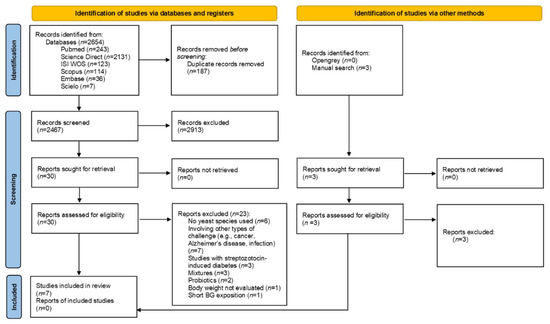
Figure 1.
Flow diagram of the screened articles adapted from the PRISMA statement.
3.2. Results for Individual Studies
The characteristics of the seven studies included in the present study are described in Table 1. In all cases, yeast was the only source of BG, and body weight was a secondary outcome. The only yeast used in all studies was Saccharomyces cerevisiae, and in only one of them, the purity found was less than 50% [39].

Table 1.
Data extraction of the selected non-obese and obese animal studies.
The majority of samples (62.5%) involved rats [19,34,35,36]. In studies involving non-obese animals, only rats were used, whereas in 37.5% of the studies involving obese rodents, mice were used [37,38,39]. Half of the studies only evaluated males [19,35,37], whereas 37.5% analyzed both males and females [34,36,38], and one study was performed only using females [39]. In none of the studies was a metabolic cage used.
In non-obese animals, the intervention period ranged from 14 to 91 days, and the dose comprised values between 2 and 2000 mg/kg body weight/day, [19,34,35,36]. In obese animals, the intervention period ranged from 28 to 49 days, and the doses varied from 25 to 450 mg/kg [19,37,38,39] applied three times a week (mean of 193 mg/kg body weight/day), as described by Shituleni et al. [39].
For non-obese animals, none of the studies showed statistically significant weight loss. Nonetheless, for obese animals, statistically significant differences were reported in 75% of the studies [37,38,39].
3.3. Bias of Risk and Methodological Quality Assessments
In the risk of bias analysis, no concerns were found for “sequence generation” and “random outcome assessment”, because all studies (100%) provided a proper description and objective body weight analyses were carried out. A low risk of bias was found for most studies in terms of “baseline characteristics” (87.5%), “selective outcome reporting” (87.5%), and “incomplete outcome data” (75%) domains. However, considering “other bias” and “allocation concealment”, only some of the studies succeeded, with 50% and 37.5%, respectively. None of the studies provided clear information about “random housing”, “blinding of participants and personnel” or “blinding of outcome assessment” (Table 2).
Table 2.
Assessment of the risk of bias in included studies.
The total score obtained through ARRIVE guidelines ranged from 28 to 30 points (mean score 29.37 ± 1.89) (Table 3) within a maximum score of 36. Of the 20 entries evaluated, 14 categories (70%) (A, C, D, E, G, H, K, L, M, N, O, P, S and T) scored as “excellent” (between 0.8 and 1.0), whereas 6 (30%) (B, F, I, J, Q and R) were classified as “average” (between 0.5 and 0.8). No category was classified as “poor” (below 0.5) (Table 3).
Table 3.
Scores of quality assessment according ARRIVE guidelines of the animal models in included studies.
3.4. Meta-Analysis Results
In general, heterogeneity among studies was significant (I2 = 58%; p < 0.01), and for this reason, random effects models were preferred (Figure 2). Non-significant mean differences were found between BG and controls for both non-obese (MD: 3.93 g, τ2 = 23.14; 95% CI: −0.03 to 7.89) and obese animals (MD: −1.35 (τ2 = 12.7852; 95% CI: −5.14 to 2.45).
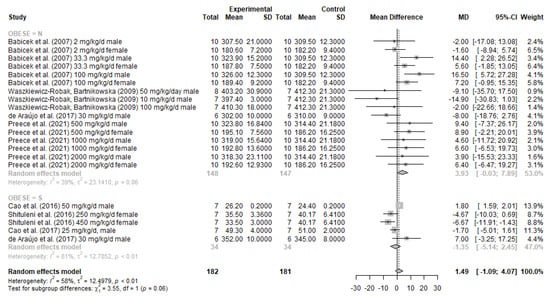
Figure 2.
Forest plot and meta-analysis of BG on the body weight of obese and non-obese rodents [19,34,35,36,37,38,39].
4. Discussion
The findings of the present study indicate that the oral consumption of yeast BG is not associated with a significant reduction in body weight for either non-obese or obese animals, rejecting our initial hypothesis. Although 75% of primary studies evaluating obese animals indicated significant body weight reduction, after meta-analysis, this result was not significant (adjusting for samples sizes and respective study relative weight in the model). BG did not influence body weight either both qualitative or quantitative analyses.
In the present study, genetic background, obesity induction models, time after induction of obesity to start BG ingestion, and duration of BG treatment varied widely among the studies, which made translational comparisons difficult [25]. In addition, the experimental findings suggest that the effects of BG vary according to the route of administration, average molecular weight, and differences in dose, purity and water-solubility [12,40]. Recently, Markovina et al. summarized the results and efficacy of different sources of BG and highlighted that, in general, it is complicated to provide recommendations because clinical details of BG type and dosage are not always clear [41]. Due to these considerations, constant improvements are needed to adjust preclinical models, so that they can significantly reflect clinical observations and processes [25].
BGs reduce glucose and lipid absorption by forming a gelatinous barrier in the intestine [19,42] whereas, a consequent reduction in body weight was expected. Although the barrier effect inherent to fibers has been described and valued, it can be assumed that it is transient [43]. In this sense, the metabolic benefits of BG ingestion in relation to blood glucose and lipoprotein profile might be related to other pathways in addition to the barrier effect. Fiber-rich diets increase the intestinal production of short-chain fatty acids (SCFA) such as acetate, propionate and butyrate, leading to higher microbial diversity in addition to reductions in inflammation and insulin resistance [44,45]. Although many studies have sought an association between prebiotics/probiotics and body weight reduction, this outcome is generally quite discrete, even in long-term supplementation [46]. Therefore, the use of such agents should be considered not for body weight reduction, but to preventively control insulin resistance and dyslipidemia. In the context of metabolic disorders, these effects are of clinical relevance [46]. However, the mechanisms by which BGs beneficially regulate the intestinal microbial population remain under debate [47].
In models with obese animals, we found that yeast BG consumption reduced body weight in 75% of primary studies (based on qualitative analysis). However, it is important to consider that even though qualitative analysis indicated a significant reduction in body weight for obese animals, the amount of weight loss seems quite small and possibly irrelevant. It is known that BG may induce satiety, contributing to explaining the slight reduction in body weight observed after BG ingestion. Shituleni et al. observed that obese mice supplemented with yeast BG had lower food intake and significant weight loss compared to the placebo group [39]. Some properties of BG, including gut swelling, increased chyme viscosity and consequent delay in gastric emptying, could contribute to food intake reductions [48,49]. Thus, the presence of fibers in the stomach can generate an early feeling of fullness, although it is short in duration [43].
Another important factor may be attributed to changes in the gut microbiota after BG consumption [38,50]. Treatment with yeast BG suppresses gut inflammation, altering the microbiota composition and ultimately increasing the immune-regulatory SCFA production [51]. Coexisting microorganisms in the digestive tract can modify various chemicals, triggering host reactions that modulate important effects on immunity and metabolism [52]. The gut microbiota can be modulated by the diet and lead to changes in the balance between different bacterial phyla. Thus, those with greater capacity to extract energy from certain macronutrients such as fiber predominate [53]. SCFA and polysaccharide metabolites, obtained through the enzymatic action of the intestinal microbiota, play important roles in gene expression, proliferation, chemotaxis, differentiation and apoptosis of animal cells [54]. Changes in energy extraction capacity, even if slight, can prove to be significant over time, impacting on body weight [53]. More possible evidence of BG effects on the microbiota is the increased abundance of Akkermansia muciniphila, a bacterium inversely associated with insulin resistance [38].
Despite being more studied in research involving immunological parameters, there is parallel evidence that yeast BG performs similar metabolic activity to cereal-BG such as oats and barley [18,55]. It is also described that BGs cause a delay in the digestive enzyme action on starch. This could result in a reduction in carbohydrate absorption, and, consequently, a reduction in blood glucose [55]. β-glucans extracted from yeast are mostly insoluble glucose monomers, presenting β-1, 3 d-glucose linkages and β1, 6 side branches [56,57]. Solubility can be induced by acid degradation method [58]. The main component of β-glucan from the yeast cell wall is a slightly branched, high-molecular (1 → 3)-β-D-glucan, with about 3% of β (1 → 6) branching [56]. Yeast β-glucans enhance bowel motility and intestinal obstipation [58,59,60]. The main action mechanism after ingestion involves contact with pattern recognition receptors (PPRs) in the intestinal cells, which internalize fragments that will interact and activate the immune system [61]. Yeast BG also interferes with liver lipid metabolism, expressively changing the transcriptional profiles, and leading to a reduced lipid accumulation in obese mice livers [37]. Additionally, this fiber can modulate the immune response, decreasing the insulin resistance linked to obesity [62]. Taken together, these facts can ultimately contribute to weight loss. Thus, there are many different and indirect ways in which BG can affect the metabolism and, notably, the body weight.
Currently, type 2 diabetes and obesity are considered subclinical inflammatory states, and BG administration is among the strategies with the power to mitigate inflammatory conditions, by reducing the production of pro-inflammatory cytokines. Such results may lead to an improvement in the metabolic status [38]. However, it is necessary to be aware that BG structural differences depend on the source, and can promote changes in their properties, resulting in specific different outcomes [12]. In this systematic review, a statistically significant difference in body weight was not found in any of the studies involving both obese and non-obese animals.
Regarding the risk of bias assessed by the SYRCLE RoB tool [27], our results are in agreement with those found by other systematic reviews of preclinical studies [63,64]. In studies involving animals, it is relatively common to observe biases due to the lack of blinding and randomization [64], essential items to avoid subjective outcome measurements and to reduce measurement bias [65]. Related to the quality criteria assessed through the ARRIVE guidelines [28], we observed that the categories “study design” and “sample size” received the lowest ratings. Evaluating the quality of reporting interventional animal studies, Ting et al. [66] reported that none of their 41 selected studies described sample size calculations, as well as the reporting of randomization and assessor blinding which occurred in 17.1% and 29.3% of the studies, respectively. Although sample calculations were not demonstrated in any article, it is assumed that most studies performed it, because for approval from animal research ethics committees, this definition is usually mandatory in order to avoid animal misuse. However, due to their importance, these details should not be omitted [66]. In this sense, limitations of the present research protocol relate to a lack of information in several studies, such as sample size calculation, randomization, and lack of blinding. However, overall scores of the ARRIVE guidelines indicated an average of 82% (Table 3).
BG ingestion seems to be harmless [34]. We did not find toxicity or side effect reports in any study. Even in humans, high doses such as 15 g/day have already been used without damage, which proves the safety of this supplement [67]. Flatulence, diarrhea and abdominal discomfort have been reported for humans, but they are usually discreet, and it is not necessary to suspend the treatment [67,68].
Systematic reviews can facilitate the translation of research results from animals to humans [69]. Animal studies, however, differ from clinical studies in some aspects, such as the diversity of animal species, experimental design and study characteristics. According to the Collaborative Approach to Meta-Analysis and Review of Animal Data from Experimental Studies, CAMARADES (www.camarades.info, accessed on 16 November 2021), heterogeneity over 60% is very common in meta-analyses using animal studies. Instead of abandoning meta-analyses, random effects models are suggested, which better fit the variation in animal studies [70]. Additionally, these animal studies generally present a reduced sample (around 10 animals per group), and slightly different studies of an individual intervention are often performed across many laboratories. There is also a great emphasis on minimizing variance through the use of inbred strains, pathogen-free environments, and specific handling conditions. Thus, it is recommended to random effects models when I2 values are greater than 50% [71].
5. Conclusions
Yeast beta-glucans ingestion does not significantly influence the body weight of obese and non-obese rodents.
Supplementary Materials
The following are available online at https://www.mdpi.com/article/10.3390/nu13124250/s1, Supplementary File S1: Search strategy on databases. Supplementary File S2: Articles excluded and reasons for exclusion (databases n = 20; manual search n = 3).
Author Contributions
Conceptualization, L.J.P., R.M.M., M.G.Z., E.F.A., T.M.S.V.G. and M.C.A.P.; methodology, L.J.P., M.M.C., J.C.R.-C., M.G.Z., E.F.A., T.M.S.V.G., M.C.A.P. and R.R.L.; formal analysis, R.R.L. and L.J.P.; investigation, L.J.P., M.M.C., J.C.R.-C., M.G.Z., E.F.A., T.M.S.V.G., M.C.A.P. and V.P.; resources, L.J.P. and R.M.M.; data curation, R.R.L. and L.J.P.; writing—original draft preparation, M.M.C., J.C.R.-C. and V.P.; writing—review and editing, L.J.P., V.P., M.C.A.P., E.F.A., M.G.Z. and R.M.M.; visualization, L.J.P. and E.F.A.; supervision, L.J.P., M.C.A.P., M.G.Z. and R.M.M.; project administration, L.J.P.; funding acquisition, L.J.P. and R.M.M. All authors have read and agreed to the published version of the manuscript.
Funding
This study was supported by the National Council for Scientific and Technological Development (Conselho Nacional de Desenvolvimento Científico and Tecnológico—CNPq), the Research and Support Foundation of the State of Minas Gerais (Fundação de Amparo and Pesquisa do Estado de Minas Gerais—FAPEMIG) and the Coordination for the Improvement of Higher Education Personnel (Coordenação de Aperfeiçoamento de Nível Superior—CAPES).
Institutional Review Board Statement
Not applicable.
Informed Consent Statement
Not applicable.
Data Availability Statement
Data are available upon request.
Conflicts of Interest
The authors declare no conflict of interest.
References
- Lee, C.J.; Sears, C.L.; Maruthur, N. Gut microbiome and its role in obesity and insulin resistance. Ann. N. Y. Acad. Sci. 2019, 1461, 37–52. [Google Scholar] [CrossRef]
- Ogden, C.L.; Carroll, M.D.; Curtin, L.R.; McDowell, M.A.; Tabak, C.J.; Flegal, K. Prevalence of Overweight and Obesity in the United States, 1999–2004. JAMA 2006, 295, 1549–1555. [Google Scholar] [CrossRef] [PubMed]
- Ng, M.; Fleming, T.; Robinson, M.; Thomson, B.; Graetz, N.; Margono, C.; Mullany, E.C.; Biryukov, S.; Abbafati, C.; Abera, S.F.; et al. Global, regional, and national prevalence of overweight and obesity in children and adults during 1980–2013: A systematic analysis for the Global Burden of Disease Study 2013. Lancet 2014, 384, 766–781. [Google Scholar] [CrossRef]
- Kahn, S.E.; Hull, R.L.; Utzschneider, K.M. Mechanisms linking obesity to insulin resistance and type 2 diabetes. Nature 2006, 444, 840–846. [Google Scholar] [CrossRef]
- DeFronzo, R.A.; Ferrannini, E.; Groop, L.; Henry, R.R.; Herman, W.H.; Holst, J.J.; Hu, F.B.; Kahn, C.R.; Raz, I.; Shulman, G.; et al. Type 2 diabetes mellitus. Nat. Rev. Dis. Prim. 2015, 1, 15019. [Google Scholar] [CrossRef] [PubMed]
- Garvey, W.T.; Mechanick, J.I.; Brett, E.M.; Garber, A.J.; Hurley, D.L.; Jastreboff, A.M.; Nadolsky, K.; Pessah-Pollack, R.; Plodkowski, R.; Reviewers of the AACE/ACE Obesity Clinical Practice Guidelines. American association of clinical endocrinologists and American college of endocrinology comprehensive clinical practice guidelines for medical care of patients with obesity. Endocr. Pract. 2016, 22, 1–203. [Google Scholar] [CrossRef]
- Bray, G.A.; Heisel, W.E.; Afshin, A.; Jensen, M.D.; Dietz, W.H.; Long, M.; Kushner, R.F.; Daniels, S.R.; Wadden, T.A.; Tsai, A.G.; et al. The Science of Obesity Management: An Endocrine Society Scientific Statement. Endocr. Rev. 2018, 39, 79–132. [Google Scholar] [CrossRef] [PubMed]
- Soleymani, T.; Daniel, S.; Garvey, W.T. Weight maintenance: Challenges, tools and strategies for primary care physicians. Obes. Rev. 2016, 17, 81–93. [Google Scholar] [CrossRef]
- Thompson, S.V.; Hannon, B.A.; An, R.; Holscher, H.D. Effects of isolated soluble fiber supplementation on body weight, glycemia, and insulinemia in adults with overweight and obesity: A systematic review and meta-analysis of randomized controlled trials. Am. J. Clin. Nutr. 2017, 106, 1514–1528. [Google Scholar] [CrossRef]
- Stier, H.; Ebbeskotte, V.; Gruenwald, J. Immune-modulatory effects of dietary Yeast Beta-1,3/1,6-D-glucan. Nutr. J. 2014, 13, 38. [Google Scholar] [CrossRef]
- Rahar, S.; Swami, G.; Nagpal, N.; Nagpal, M.A.; Singh, G.S. Preparation, characterization, and biological properties of β-glucans. J. Adv. Pharm. Technol. Res. 2011, 2, 94–103. [Google Scholar] [CrossRef]
- Han, B.; Baruah, K.; Cox, E.; Vanrompay, D.; Bossier, P. Structure-Functional Activity Relationship of β-Glucans From the Perspective of Immunomodulation: A Mini-Review. Front. Immunol. 2020, 11, 658. [Google Scholar] [CrossRef] [PubMed]
- Shen, X.L.; Zhao, T.; Zhou, Y.; Shi, X.; Zou, Y.; Zhao, G. Effect of Oat β-Glucan Intake on Glycaemic Control and Insulin Sensitivity of Diabetic Patients: A Meta-Analysis of Randomized Controlled Trials. Nutrients 2016, 8, 39. [Google Scholar] [CrossRef] [PubMed]
- Ho, H.V.T.; Sievenpiper, J.L.; Zurbau, A.; Mejia, S.B.; Jovanovski, E.; Au-Yeung, F.; Jenkins, A.L.; Vuksan, V. The effect of oat β-glucan on LDL-cholesterol, non-HDL-cholesterol and apoB for CVD risk reduction: A systematic review and meta-analysis of randomised-controlled trials. Br. J. Nutr. 2016, 116, 1369–1382. [Google Scholar] [CrossRef]
- Pereira, L.J. Efecto de los beta-glucanos en el control de los niveles de glucosa en. Nutr. Hosp. 2015, 31, 170–177. [Google Scholar] [CrossRef]
- Akramiene, D.; Kondrotas, A.; Didziapetriene, J.; Kevelaitis, E. Effects of beta-glucans on the immune system. Medicina 2007, 43, 597–606. [Google Scholar] [CrossRef] [PubMed]
- Silva, V.D.O.; Lobato, R.V.; Andrade, E.F.; De Macedo, C.G.; Napimoga, J.T.C.; Napimoga, M.H.; Messora, M.R.; Murata, R.M.; Pereira, L.J. β-Glucans (Saccharomyces cereviseae) Reduce Glucose Levels and Attenuate Alveolar Bone Loss in Diabetic Rats with Periodontal Disease. PLoS ONE 2015, 10, e0134742. [Google Scholar] [CrossRef]
- Pereira, L.J. Effects of β-glucans (Saccharomyces cerevisae) per os administration in rats with streptozotocin-induced diabetes. Nutr. Hosp. 2015, 32, 256–264. [Google Scholar] [CrossRef]
- De Araújo, T.V.; Andrade, E.F.; Lobato, R.V.; Orlando, D.R.; Gomes, N.F.; De Sousa, R.V.; Zangeronimo, M.; Pereira, L.J. Effects of beta-glucans ingestion (Saccharomyces cerevisiae) on metabolism of rats receiving high-fat diet. J. Anim. Physiol. Anim. Nutr. 2016, 101, 349–358. [Google Scholar] [CrossRef]
- Bacha, U.; Nasir, M.; Iqbal, S.; Anjum, A.A. Nutraceutical, Anti-Inflammatory, and Immune Modulatory Effects ofβ-Glucan Isolated fromYeast. BioMed Res. Int. 2017, 2017, 1–14. [Google Scholar] [CrossRef]
- Mosikanon, K.; Arthan, D.; Kettawan, A.; Tungtrongchitr, R.; Prangthip, P. Yeast β–Glucan Modulates Inflammation and Waist Circumference in Overweight and Obese Subjects. J. Diet. Suppl. 2016, 14, 173–185. [Google Scholar] [CrossRef]
- Rahmani, J.; Miri, A.; Černevičiūtė, R.; Thompson, J.; De Souza, N.N.A.; Sultana, R.; Varkaneh, H.K.; Mousavi, S.M.; Hekmatdoost, A. Effects of cereal beta-glucan consumption on body weight, body mass index, waist circumference and total energy intake: A meta-analysis of randomized controlled trials. Complement. Ther. Med. 2019, 43, 131–139. [Google Scholar] [CrossRef] [PubMed]
- Strączkowski, M.; Nikołajuk, A.; Majewski, R.; Filarski, R.; Stefanowicz, M.; Matulewicz, N.; Karczewska-Kupczewska, M. The effect of moderate weight loss, with or without (1, 3)(1, 6)-β-glucan addition, on subcutaneous adipose tissue inflammatory gene expression in young subjects with uncomplicated obesity. Endocrine 2018, 61, 275–284. [Google Scholar] [CrossRef]
- Fernandes, M.R.; De Lima, N.V.; Rezende, K.S.; Santos, I.C.M.; Silva, I.S.; Guimarães, R.D.C.A. Animal models of obesity in rodents. An integrative review. Acta Cir. Bras. 2016, 31, 840–844. [Google Scholar] [CrossRef] [PubMed]
- Kleinert, M.; Clemmensen, C.; Hofmann, S.; Moore, M.C.; Renner, S.; Woods, S.C.; Huypens, P.; Beckers, J.; de Angelis, M.H.; Schürmann, A.; et al. Animal models of obesity and diabetes mellitus. Nat. Rev. Endocrinol. 2018, 14, 140–162. [Google Scholar] [CrossRef]
- Page, M.J.; McKenzie, J.E.; Bossuyt, P.M.; Boutron, I.; Hoffmann, T.C.; Mulrow, C.D.; Shamseer, L.; Tetzlaff, J.M.; Akl, E.A.; Brennan, S.E.; et al. The PRISMA 2020 statement: An updated guideline for reporting systematic reviews. BMJ 2021, 372, n71. [Google Scholar] [CrossRef]
- Hooijmans, C.R.; Rovers, M.M.; de Vries, R.B.; Leenaars, M.; Ritskes-Hoitinga, M.; Langendam, M.W. SYRCLE’s risk of bias tool for animal studies. BMC Med. Res. Methodol. 2014, 14, 43. [Google Scholar] [CrossRef]
- Kilkenny, C.; Browne, W.; Cuthill, I.C.; Emerson, M.; Altman, D.G.; Group NCRRGW. Animal research: Reporting in vivo experiments: The ARRIVE guidelines. Br. J. Pharmacol. 2010, 160, 1577–1579. [Google Scholar] [CrossRef]
- Kilkenny, C.; Browne, W.J.; Cuthill, I.C.; Emerson, M.; Altman, D.G. Improving Bioscience Research Reporting: The ARRIVE Guidelines for Reporting Animal Research. PLoS Biol. 2010, 8, e1000412. [Google Scholar] [CrossRef] [PubMed]
- Javed, F.; Kellesarian, S.; Abduljabbar, T.; Abduljabbar, A.; Akram, Z.; Vohra, F.; Rahman, I.; Romanos, G. Influence of involuntary cigarette smoke inhalation on osseointegration: A systematic review and meta-analysis of preclinical studies. Int. J. Oral Maxillofac. Surg. 2017, 47, 764–772. [Google Scholar] [CrossRef]
- Schwarzer, G.; Mair, P.; Hatzinger, R. meta: An R Package for Meta-Analysis. R News 2007, 7, 40–45. [Google Scholar]
- Development Core Team. R Core Team: A Language and Environment for Statistical Computing; R Core Team: Vienna, Austria, 2018. [Google Scholar]
- Sterne, J.; Sutton, A.J.; Ioannidis, J.P.A.; Terrin, N.; Jones, D.R.; Lau, J.; Carpenter, J.; Rucker, G.; Harbord, R.; Schmid, C.; et al. Recommendations for examining and interpreting funnel plot asymmetry in meta-analyses of randomised controlled trials. BMJ 2011, 343, d4002. [Google Scholar] [CrossRef]
- Babíček, K.; Čechová, I.; Simon, R.; Harwood, M.; Cox, D. Toxicological assessment of a particulate yeast (1,3/1,6)-β-d-glucan in rats. Food Chem. Toxicol. 2007, 45, 1719–1730. [Google Scholar] [CrossRef]
- Waszkiewicz-Robak, B.; Bartnikowska, E. Effects of spent brewer’s yeast and biological β-glucans on selected parameters of lipid metabolism in blood and liver in rats. J. Anim. Feed. Sci. 2009, 18, 699–708. [Google Scholar] [CrossRef]
- Preece, K.E.; Glávits, R.; Murbach, T.S.; Endres, J.R.; Hirka, G.; Vértesi, A.; Szakonyiné, I.P. Assessment of toxicological potential of sodium carboxymethyl beta-glucan, a novel beta-glucan. Food Chem. Toxicol. 2021, 152, 112226. [Google Scholar] [CrossRef]
- Cao, Y.; Sun, Y.; Zou, S.; Li, M.; Xu, X. Orally Administered Baker’s Yeast β-Glucan Promotes Glucose and Lipid Homeostasis in the Livers of Obesity and Diabetes Model Mice. J. Agric. Food Chem. 2017, 65, 9665–9674. [Google Scholar] [CrossRef] [PubMed]
- Cao, Y.; Zou, S.; Xu, H.; Li, M.; Tong, Z.; Xu, M.; Xu, X. Hypoglycemic activity of the Baker’s yeast β-glucan in obese/type 2 diabetic mice and the underlying mechanism. Mol. Nutr. Food Res. 2016, 60, 2678–2690. [Google Scholar] [CrossRef] [PubMed]
- Shituleni, S.A.; Gan, F.; Nido, S.A.; Mengistu, B.M.; Khan, A.Z.; Liu, Y.; Huang, K. Effects of yeast polysaccharide on biochemical indices, antioxidant status, histopathological lesions and genetic expressions related with lipid metabolism in mice fed with high fat diet. Bioact. Carbohydrates Diet. Fibre 2016, 8, 51–57. [Google Scholar] [CrossRef]
- Kimura, Y.; Sumiyoshi, M.; Suzuki, T.; Suzuki, T.; Sakanaka, M. Inhibitory effects of water-soluble low-molecular-weight β-(1,3–1,6) d-glucan purified from Aureobasidium pullulans GM-NH-1A1 strain on food allergic reactions in mice. Int. Immunopharmacol. 2007, 7, 963–972. [Google Scholar] [CrossRef] [PubMed]
- Markovina, N.; Banjari, I.; Popovic, V.B.; Kadic, A.J.; Puljak, L. Efficacy and safety of oral and inhalation commercial beta-glucan products: Systematic review of randomized controlled trials. Clin. Nutr. 2019, 39, 40–48. [Google Scholar] [CrossRef]
- Guilarducci, J.D.S.; Marcelino, B.A.R.; Konig, I.; Orlando, T.M.; Varaschin, M.S.; Pereira, L.J. Therapeutic effects of different doses of prebiotic (isolated from Saccharomyces cerevisiae) in comparison to n-3 supplement on glycemic control, lipid profiles and immunological response in diabetic rats. Diabetol. Metab. Syndr. 2020, 12, 1–12. [Google Scholar] [CrossRef]
- Slavin, J.L. Dietary fiber and body weight. Nutrition 2005, 21, 411–418. [Google Scholar] [CrossRef] [PubMed]
- Saad, M.J.; Santos, A.; Prada, P.O. Linking Gut Microbiota and Inflammation to Obesity and Insulin Resistance. Physiology 2016, 31, 283–293. [Google Scholar] [CrossRef]
- Sonnenburg, E.D.; Smits, S.A.; Tikhonov, M.; Higginbottom, S.K.; Wingreen, N.S.; Sonnenburg, J.L. Diet-induced extinctions in the gut microbiota compound over generations. Nat. Cell Biol. 2016, 529, 212–215. [Google Scholar] [CrossRef] [PubMed]
- Depommier, C.; Everard, A.; Druart, C.; Plovier, H.; Van Hul, M.; Vieira-Silva, S.; Falony, G.; Raes, J.; Maiter, D.; Delzenne, N.M.; et al. Supplementation with Akkermansia muciniphila in overweight and obese human volunteers: A proof-of-concept exploratory study. Nat. Med. 2019, 25, 1096–1103. [Google Scholar] [CrossRef]
- Muthuramalingam, K.; Kim, Y.; Cho, M. β-glucan, “the knight of health sector”: Critical insights on physiochemical heterogeneities, action mechanisms and health implications. Crit. Rev. Food Sci. Nutr. 2021, 1–37. [Google Scholar] [CrossRef]
- Johansen, H.N.; Knudsen, K.E.; Sandström, B.; Skjøth, F. Effects of varying content of soluble dietary fibre from wheat flour and oat milling fractions on gastric emptying in pigs. Br. J. Nutr. 1996, 75, 339–351. [Google Scholar] [CrossRef][Green Version]
- Aravind, N.; Sissons, M.; Egan, N.; Fellows, C.M.; Blazek, J.; Gilbert, E.P. Effect of β-Glucan on Technological, Sensory, and Structural Properties of Durum Wheat Pasta. Cereal Chem. J. 2012, 89, 84–93. [Google Scholar] [CrossRef]
- Everard, A.; Matamoros, S.; Geurts, L.; Delzenne, N.M.; Cani, P.D. Saccharomyces boulardii Administration Changes Gut Microbiota and Reduces Hepatic Steatosis, Low-Grade Inflammation, and Fat Mass in Obese and Type 2 Diabetic db/db Mice. mBio 2014, 5, e01011-14. [Google Scholar] [CrossRef] [PubMed]
- Gudi, R.; Suber, J.; Brown, R.; Johnson, B.M.; Vasu, C. Pretreatment with Yeast-Derived Complex Dietary Polysaccharides Suppresses Gut Inflammation, Alters the Microbiota Composition, and Increases Immune Regulatory Short-Chain Fatty Acid Production in C57BL/6 Mice. J. Nutr. 2019, 150, 1291–1302. [Google Scholar] [CrossRef]
- Fan, Y.; Pedersen, O. Gut microbiota in human metabolic health and disease. Nat. Rev. Microbiol. 2020, 19, 55–71. [Google Scholar] [CrossRef] [PubMed]
- Turnbaugh, P.J.; Ley, R.E.; Mahowald, M.A.; Magrini, V.; Mardis, E.R.; Gordon, J.I. An obesity-associated gut microbiome with increased capacity for energy harvest. Nature 2006, 444, 1027–1031. [Google Scholar] [CrossRef]
- Corrêa-Oliveira, R.; Fachi, J.L.; Vieira, A.; Sato, F.T.; Vinolo, M.A.R. Regulation of immune cell function by short-chain fatty acids. Clin. Transl. Immunol. 2016, 5, e73. [Google Scholar] [CrossRef]
- Vetvicka, V.; Vetvickova, J. Effects of yeast-derived β-glucans on blood cholesterol and macrophage functionality. J. Immunotoxicol. 2009, 6, 30–35. [Google Scholar] [CrossRef] [PubMed]
- Novak, M.; Vetvicka, V. β-Glucans, History, and the Present: Immunomodulatory Aspects and Mechanisms of Action. J. Immunotoxicol. 2008, 5, 47–57. [Google Scholar] [CrossRef]
- Manners, D.J.; Masson, A.J.; Patterson, J.C.; Björndal, H.; Lindberg, B. The structure of a β-(1→6)-d-glucan from yeast cell walls. Biochem. J. 1973, 135, 31–36. [Google Scholar] [CrossRef] [PubMed]
- Han, M.D.; Han, Y.S.; Hyun, S.H.; Shin, H.W. Solubilization of water-insoluble beta-glucan isolated from Ganoderma lucidum. J. Environ. Biol. 2008, 29, 237–242. [Google Scholar] [PubMed]
- Battilana, P.; Ornstein, K.; Minehira, K.; Schwarz, J.M.; Acheson, K.; Schneiter, P.; Burri, J.; Jéquier, E.; Tappy, L. Mechanisms of action of beta-glucan in postprandial glucose metabolism in healthy men. Eur. J. Clin. Nutr. 2001, 55, 327–333. [Google Scholar] [CrossRef]
- McRorie, J.W.; McKeown, N.M. Understanding the Physics of Functional Fibers in the Gastrointestinal Tract: An Evidence-Based Approach to Resolving Enduring Misconceptions about Insoluble and Soluble Fiber. J. Acad. Nutr. Diet. 2017, 117, 251–264. [Google Scholar] [CrossRef]
- Wani, S.M.; Gani, A.; Mir, S.A.; Masoodi, F.A.; Khanday, F.A. β-Glucan: A dual regulator of apoptosis and cell proliferation. Int. J. Biol. Macromol. 2021, 182, 1229–1237. [Google Scholar] [CrossRef]
- Cao, Y.; Sun, Y.; Zou, S.; Duan, B.; Sun, M.; Xu, X. Yeast β-Glucan Suppresses the Chronic Inflammation and Improves the Microenvironment in Adipose Tissues of ob/ob Mice. J. Agric. Food Chem. 2018, 66, 621–629. [Google Scholar] [CrossRef]
- Parra, M.M.O.; Elangovan, S.; Lee, C.-T.; Satheesh, E. Specialized pro-resolving lipid mediators in experimental periodontitis: A systematic review. Oral Dis. 2018, 25, 1265–1276. [Google Scholar] [CrossRef] [PubMed]
- Kilkenny, C.; Parsons, N.; Kadyszewski, E.; Festing, M.F.W.; Cuthill, I.C.; Fry, D.; Hutton, J.; Altman, D.G. Survey of the Quality of Experimental Design, Statistical Analysis and Reporting of Research Using Animals. PLoS ONE 2009, 4, e7824. [Google Scholar] [CrossRef]
- Ma, B.; Xu, J.-K.; Wu, W.-J.; Liu, H.-Y.; Kou, C.-K.; Liu, N.; Zhao, L. Survey of basic medical researchers on the awareness of animal experimental designs and reporting standards in China. PLoS ONE 2017, 12, e0174530. [Google Scholar] [CrossRef] [PubMed]
- Ting, K.H.; Hill, C.L.; Whittle, S. Quality of reporting of interventional animal studies in rheumatology: A systematic review using the ARRIVE guidelines. Int. J. Rheum. Dis. 2015, 18, 488–494. [Google Scholar] [CrossRef]
- Nicolosi, R.; Bell, S.J.; Bistrian, B.R.; Greenberg, I.; Forse, R.A.; Blackburn, G.L. Plasma lipid changes after supplementation with beta-glucan fiber from yeast. Am. J. Clin. Nutr. 1999, 70, 208–212. [Google Scholar] [CrossRef]
- Santas, J.; Lázaro, E.; Cuñé, J. Effect of a polysaccharide-rich hydrolysate from Saccharomyces cerevisiae (LipiGo®) in body weight loss: Randomised, double-blind, placebo-controlled clinical trial in overweight and obese adults. J. Sci. Food Agric. 2017, 97, 4250–4257. [Google Scholar] [CrossRef] [PubMed]
- Perel, P.; Roberts, I.; Sena, E.S.; Wheble, P.; Briscoe, C.; Sandercock, P.; Macleod, M.R.; Mignini, L.E.; Jayaram, P.; Khan, K.S. Comparison of treatment effects between animal experiments and clinical trials: Systematic review. BMJ 2006, 334, 197. [Google Scholar] [CrossRef]
- Hooijmans, C.R.; IntHout, J.; Ritskes-Hoitinga, M.; Rovers, M. Meta-Analyses of Animal Studies: An Introduction of a Valuable Instrument to Further Improve Healthcare. ILAR J. 2014, 55, 418–426. [Google Scholar] [CrossRef] [PubMed]
- Vesterinen, H.; Sena, E.S.; Egan, K.; Hirst, T.; Churolov, L.; Currie, G.; Antonic-Baker, A.; Howells, D.; Macleod, M.R. Meta-analysis of data from animal studies: A practical guide. J. Neurosci. Methods 2014, 221, 92–102. [Google Scholar] [CrossRef]
Publisher’s Note: MDPI stays neutral with regard to jurisdictional claims in published maps and institutional affiliations. |
© 2021 by the authors. Licensee MDPI, Basel, Switzerland. This article is an open access article distributed under the terms and conditions of the Creative Commons Attribution (CC BY) license (https://creativecommons.org/licenses/by/4.0/).